Sometime this spring, AI stopped being a passive tool you pick up and started becoming an active system that runs in the background.
For about two years, most of the AI I saw at conferences and in companies I work with fell into a category I’d call “cool demo, now what?” (I’ve written before about the non-obvious ways tools like GPT change the game.) Someone shows you a dazzling thing the technology can do, everyone applauds, and then Monday arrives and nothing about how the work actually gets done has changed.
That era is ending, and I don’t think enough people have noticed.
Sometime this spring, AI quietly crossed a line. It stopped being a passive tool you pick up and started becoming an active system that runs in the background. Recent reports describe autonomous agents that can manage and execute multi-step tasks without a human babysitting each step. One phrase from the research stuck with me: AI is moving “from demo culture into the operating system” of small companies. Not the flashy part. The plumbing.
That shift changes the question I think every leader should be asking. For two years, the question was, “What can this tool do?” The better question—the one that actually predicts whether you’ll get value—is: “What have we built around it?”
Run the co-worker test.
For each AI tool in your company, ask: is this something a person occasionally picks up, or a system that runs whether or not anyone’s watching? If everything is still in the “occasionally picks up” category, you’re stuck in demo culture and leaving the real value on the table.
Build the guardrails before you build the autonomy.
The big enterprise vendors are racing to turn safety, permissions, and audit trails into product features—because an unsupervised agent with the wrong permissions is a disaster waiting to happen. Before you let an agent act on its own, decide exactly what it can touch, what it must escalate, and how you’ll review what it did. Write it down on a single page. It may be the most valuable document you create all year.
Pick the handoff, not the takeover.
The mistake is trying to automate an entire job. The win is automating the handoff—the agent does the first 80 percent, then hands a human the 20 percent that needs judgment, taste, or care. The goal isn’t to replace your people; it’s to hand them the hard, human work with the easy stuff already cleared away. That’s not a smaller job. It’s a better one.
The goal was never to remove the humans. It was to remove the parts of work that were beneath the humans. We spent a century asking people to do robotic work because we didn’t have robots. Now we do. The opportunity isn’t to do the same work faster—it’s to finally let people do the work only people can do: the caring, the creating, the connecting—and let the quiet co-workers handle the rest.
The demo era is over. The operating-system era has begun. The only question that matters now isn’t how smart your tools are. It’s what you’ve had the discipline to build around them. Ask yourself the co-worker test today. The companies that answer it honestly—and then build the boring infrastructure—are going to look unrecognizable, in the best way, a year from now.
As AI takes over from Google search, the thing that used to draw people to your creative work is disappearing fast. Here’s what’s happening, and how to respond.
At Cannes Lions 2026, Pinterest said something that should stop every creative in their tracks. Alongside a suite of shiny new AI advertising tools, the platform offered a candid description of where the whole industry is heading.
The web, it said, is moving “beyond the traditional search-and-click model toward a more conversational and generative web,” where brands now compete “not just for attention, but for recommendation, relevance and action”. That might sound like a boringly technical sentence, but buried within it is something very profound that affects every creative working today.
Because what it describes isn’t just a change in how Pinterest sells ads, but a fundamental change in how people find information and inspiration online. And if you’re a creative, the implications for whether you actually get work in future are huge.
Discovery is being dismantled
Until recently, the web gifted creatives many ways to attract clients that didn’t demand a huge marketing budget. A portfolio site that ranked in search results for “editorial illustrator” or “branding studio Bristol.” Instagram, Behance or Dribbble surfacing work to people who’d never heard of you. A piece is getting shared, and the share carries your name back to your profile. None of this required paid promotion.
Now, though, every rung of that ladder has been sawn off.
We’ve seen the decline of organic search: on Google, your freelance or studio site now sits below ads, AI Overviews and big-domain content, making it close to hopeless in promoting your craft. Meanwhile, social algorithms have decoupled reach from quality. Feeds now reward volume, trends and posting cadence rather than the best work, and throttle creators unless they either pay or perform constantly.
And now, as the final nail in the coffin, agentic AI (where AI basically acts as your personal assistant) has removed the last thing the first two still left intact: the click that carried a person to your door.
Who wins and who loses?
Nowadays, when someone types “find me an illustrator who works in cut-paper collage for a children’s book”, AI returns an answer, not a list of links to explore. It decides who gets named, and there’s no way to influence it: no ad slot to buy, no SEO lever to pull.
And how does it reach this decision? AI platforms lean on aggregate signals: who’s already cited, listed, written about, and linked to. This favours the already-famous and the big studios with a deep web footprint, leaving the vast majority of smaller independents floundering.
It’s a virtuous circle for the former, a vicious one for the latter. The visible gets recommended, and the recommendation makes them more visible. The talented new graduate with a thin online presence isn’t in AI’s field of view, so they stay invisible forever.
Pinterest’s new Ask Pinterest app captures this dynamic perfectly. It’s designed, the company says, for “more conversational, complex, multi-step decisions that don’t fit neatly into a single search”: planning a dinner party, furnishing a room over time, finding a gift that feels personal. Truly, it sounds like a great experience. But there’s a trade-off, and it’s a biggie. When answers arrive without a source, the source no longer matters.
So what should you focus on instead?
Pinterest is changing
Be a category of one
In this shiny new world of AI, you can’t optimise your way into a recommendation, the way you once keyword-optimised a website. Recommendation runs on reputation signals that a system can read: being named in other people’s work, on lists, in interviews, in the press, and in collaborations. So the answer for creatives isn’t to play the algorithms harder. It’s to become the name people and systems already trust enough to surface.
One part of that is to own your relationships. A newsletter list, for example, is a direct connection that no algorithm can intermediate away. A community of people who’ve chosen to hear from you isn’t subject to a platform’s recommendation logic. Look at how designers like Liz Mosley have built something genuinely resilient: a website, a podcast, templates, resources; an audience that actively follows her work rather than stumbling across it.
Another is to get cited and named, because getting talked about (positively, of course) is the new currency. This means leaning on the channels no algorithm can gatekeep: word of mouth, referrals, events, and real rooms. And in your work, aiming to be a category of one, with a style so specific it gets requested by name rather than retrieved by attribute. The creatives who get asked for by name are the ones that AI can neither replace nor substitute.
Lee Brown, Pinterest’s chief business officer, frames it this way: “The future of discovery won’t be driven by keywords alone. It will be shaped by context, taste, and trusted recommendations.” He’s describing his platform’s perceived advantage. But he’s also, accidentally, describing yours.
Context is where you work. Taste is what you’ve spent years developing. And trusted recommendations? Those come from people who know you and what you make, not from a system optimising for engagement.
Uncertain future
One last thought. If the systems doing the recommending keep starving the independents who make the original work, they’ll eventually run short of anything worth recommending. AI will ultimately kill off its own supply of information and inspiration. Where that death-spiral leads us is anyone’s guess, but it’s best to be prepared all the same.
In the meantime, I’d advise you to start building those direct relationships. Make the work that can’t be AI-assembled from anything else. And above all, don’t wait for your web traffic to disappear before you start, because that could be too late.
AI disrupted the current job market—and created a long list of new roles with impressive salaries across tech, medicine, HR, IT, marketing, and more.
Artificial intelligence is disrupting the current job market, leaving a trail of corporate layoffs and workers scrambling to determine what positions will be safe in the future.
At the same time, AI tools are also creating a number of high-paying jobs that didn’t exist a decade ago, according to a new report from job search and career platform Ladders. The survey looked at data from professionals earning over $100,000 a year and mapped the top 15 six-figure jobs that it says are worth considering.
“Most headlines frame AI as a wrecking ball aimed at our paychecks,” Marc Cenedella, Ladders’ CEO, tells Fast Company. “This study, however, shows [more than] 1.3 million new jobs have been created since the term ‘AI’ entered the mainstream vernacular, with many of those roles paying 56% above the rest of the pack.”
These jobs exist across industries including medicine, marketing, technology, human resources, information technology (IT), and cybersecurity.
Cenedella says the study’s real value is that it provides a map of the jobs that workers should invest their time in today, including a mix of new positions (chief listening officer, AI ethicist, and climate change analyst) as well as some obvious choices (SEO specialist, social media manager, and chief AI officer).
“The best job bets all share one trait: A human is managing the machine, not racing against it,” Cenedella adds.
AEO specialists and AI ethicists?
Cenedella says there is currently a high demand for AEO specialists and AI ethicists. But what exactly do they do?
As AI-generated summaries cut search in Google by 45% (even though the summaries are wrong 10% of the time), companies are adapting to the collapse in web traffic by investing in answer engine optimization (AEO) specialists, who make sure their original content appears in AI overviews or large language models (LLMs) like ChatGPT and Claude. These AEO specialists are the next generation of marketing and website professionals.
Alternatively, the need for AI ethicists will only continue to grow as AI agents make more autonomous decisions, requiring a human to verify that their output is accurate, legal, and fair. AI ethicists set policies for how companies can ethically use AI while protecting against data leaks and major mistakes AI agents can make, such as deleting 2.5 years’ worth of records.
15 high-salary jobs in 2026
Here is the full list of 15 high-paying jobs in the age of AI, as well as a salary range and degree requirements for each.
Chief AI officer — $200,000–$500,000 (bachelor’s degree minimum)
Influencer manager — $135,000 (no degree required)
AI ethicist — $70,000–$170,000 (bachelor’s)
Data protection officer — $118,000 (bachelor’s minimum)
Data scientist — $112,000 (bachelor’s)
Climate change analyst — $112,000 (bachelor’s)
Drone operator — $71,000–$100,000 (remote pilot certificate)
AEO specialist — $91,000–$180,000 (no degree required)
SEO specialist — $86,000+ (no degree required)
Social media manager — $74,000–$200,000+ (no degree required)
However, Cenedella adds that degree requirements shouldn’t be a main focus. “The smartest move a worker can make today is to stop treating a degree as the main thing that qualifies them and start building proof for why they should own a role instead,” Cenedella tells Fast Company. “Whatever your current job is, do a piece of it with AI, capture the result, and put it somewhere you can show it: A year of quietly documented results beats a degree program that won’t exist until you’re already too late to it.”
Jennifer Mattson is a Contributing Writer at Fast Company, where she covers news trends and writes daily about business, technology, finance and the workplace.. She is a former network news producer for CNN, CNN International and a number of public radio programsMore
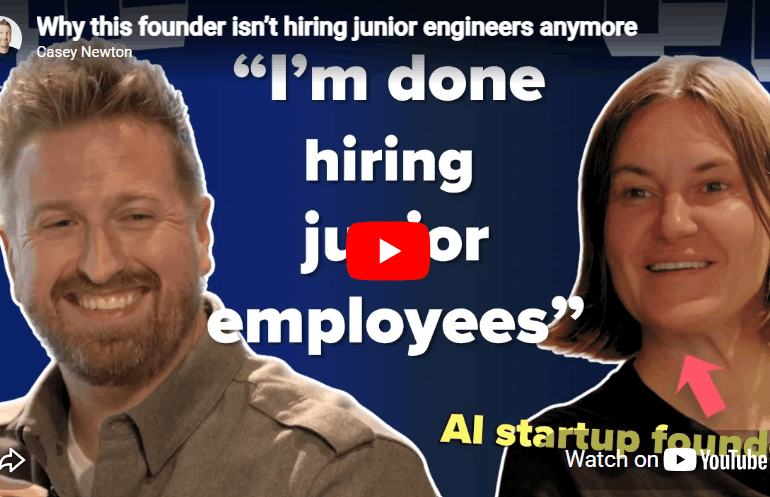
And yes, AI is a factor. Replika and Wabi founder Eugenia Kuyda on how advances in coding changed her hiring calculus
This is an interview about AI. My fiancé works at Anthropic. See my full ethics disclosure here.
Last week in our series on AI and jobs, Brookings’ Molly Kinder warned us to prepare for a “messy middle”: a long, “politically explosive” stretch in which AI job losses are concentrated among some of the best-paid workers in the economy. This week, for the first-ever Platformer live show, I wanted to talk to someone who believes in that vision: a founder building the tools that might bring it about, and who turned out to be unusually candid about what that might cost us.
I’ve known Eugenia Kuyda for more than a decade. In 2015, after her best friend Roman Mazurenko died in a car accident, she gathered the text messages he had sent to friends and family and built a chatbot that let them speak with him again — a story I covered at the time for The Verge, nearly a decade before ChatGPT made chatbots ubiquitous. That project was the seed for Replika, the AI companion app that now claims more than 40 million users. Kuyda’s latest startup, Wabi, takes AI in a different direction — away from personal entertainment and into the world of work. The app, which is now available for iOS, lets you vibe-code apps on your phone using text prompts. Over the next year, Kuyda hopes to shift more of the team’s work away from standard enterprise software toward apps built on her own platform.
Kuyda argues that we are living in “the Microsoft DOS era of AI interfaces,” and that we’re desperately in need of a Windows equivalent: an easy-to-use graphical user interface that lets the average person take full advantage of agents and personalized software. When that happens, she predicts, the long tail of subscription-based apps — the calorie counters, meditation apps, and fitness trackers of the world — will start to disappear, replaced by software that we make and share ourselves.
But what struck me most during our conversation was her answer to the question at the heart of our podcast miniseries. When we began, I expected that more tech executives would tell me they expect AI to cause job loss. Instead, it’s been the opposite — most of them have said that advances in AI will only increase demand for software engineers and other knowledge workers.
Kuyda is our first guest to say plainly that she believes that is a fantasy. The fear of job loss is “super justified,” she told me; in her view, AI has made hiring junior employees “extremely expensive and completely unsustainable for a startup,” because every hire now competes with the leverage of what she calls a “1,000x engineer.” “I think the crazy protests around jobs and AI are going to start happening,” she said. “We live in this very optimistic city, where it’s all about future, future, future — but as soon as you get out of here, it’s pretty scary.”
She’s building Wabi accordingly: the company is modelled on a soccer team, she told me, with 10 to 15 superstar “players on the pitch” who get sizable equity and public-facing roles, supported by contractors in the back office. She doesn’t think you need more than that to build a billion-dollar company anymore.
Whether that turns out to be true depends in part on Kuyda’s own bet on Wabi. Can vibe-coded apps truly compete with enterprise software in the way that she hopes? Or will most companies continue to prefer the stability and support that comes with traditional software as a service?
We should get more data on that point soon: Kuyda told me on the show that after a year in beta, Wabi will launch publicly before the end of the month.
Highlights of our conversation are below, edited for clarity and length. Listen to the entire conversation wherever you get your podcasts — just search for Platformer — or watch it on YouTube at youtube.com/caseynewton.
And let us know what you think — we’re new to podcast production, and welcome your feedback at [email protected].
Casey Newton:So it’s 2015. You are almost a decade away from ChatGPT. What were you seeing that made you think, “I can actually use the tools that are here to make a kind of prototypical chatbot, and that will be an interesting thing to explore”?
Eugenia Kuyda: We actually started a company that was building chatbot tech in 2013. What kick-started that was a friend of mine who used to work at Google DeepMind showed me this technology called word2vec, which was the original tech to basically transform language into math — to let computers understand words, in a way. ImageNet also dropped, and I was like, whoa — soon that will somehow come together, and we’ll have these new neural networks that will understand language. I used to be a journalist before that, and we had this gigantic sign in neon: “The limits of my language are the limits of my world.”
Newton:Which is a Wittgenstein quote, if I remember right.
Kuyda:I felt like if we figured out how to build language models, that would probably be the closest to understanding the world as well.
So we started building that, way before any of the first language models. Then in 2015, Google published a paper where they talked about the first deep learning model applied to dialogue generation, and we decided to hire every possible NLP researcher we could find to focus on these language models. And then, of course, after Roman passed away, we built that AI for him. We were struggling to find a consumer application, and that was it. We were like: maybe we can’t yet build a chatbot that talks eloquently with people and has meaningful conversations, but maybe we can build one that can listen, and that would probably be enough for many people out there.
Newton:How confident were you when you were doing that?
Kuyda: We thought it would work at some point. The models were so crappy in 2016, when we started Replika, that they would just produce non sequiturs. These were sequence-to-sequence models, and of course there were no models off the shelf or through APIs, so we had to build our own — this was right before people moved on to transformers. So it was very hard to say, “Okay, this will become what it is today.” We just felt that it would happen; we didn’t know when. For us it was more like: okay, maybe the tech is lagging, but it’s less about tech capabilities — it’s going to be more about human vulnerabilities. There were so many people who wanted so much to have some connection — someone to listen, someone to hear them out, to accept them, to understand them — that maybe in the beginning just those people would react positively to it, and as the tech got better, we could increase the range of people it would resonate with.
Casey: I think there’s something really poignant about the fact that even though the technology, by today’s standards, was maybe not that good, the human desire and need for support and connection was so powerful that people looked right past it. But at the same time, I wouldn’t downplay the technology either, because when I was talking with Roman’s friends and family, the part of the story that will still make me cry when I tell other people about it is how much people learned about their friend and family member after he passed away, and how their relationship with him changed after he passed away, because of the conversations they were having in this app. That was honestly the moment when I started to take AI more seriously, because I thought: if people can feel that deeply even in this very primitive version of the thing that we have today, there just has to be something there.
Kuyda: I think so. And looking at my previous relationships — oftentimes we do have relationships with people where maybe they don’t respond that much, or it’s more about our fantasies. How much do we put in? A good example is talking to God. So many people talk to God, and maybe he doesn’t really respond.
Newton:He’s sort of famous for leaving you on read.
Eugenia: I also had a lot of experience going on dates where you just listen, and maybe ask, “Oh, tell me more,” and then the guy would be like, “Oh, that was the best conversation I’ve ever had.” And you space out half the time when they’re talking — you’re thinking about all the groceries you need to buy. So I’m like, if this is the level of understanding that’s required for the most amazing conversation, we can probably build that.
Casey:Once you realized how low the bar was, you thought, “There’s a unicorn here.”
I want to zoom out and ask you a question about your two companies, because on the surface they look quite different, right? One is about an AI that you develop relationships with; the other is a tool for making apps. In your mind, are they completely different, or do you see a through line there that you’re chasing?
Eugenia: They’re definitely different things, but for me the idea was always: how can we make a person’s life better, or help them unlock their potential? With Replika it’s easy — it was always about building an AI to help people flourish and feel better in the long term. We had some big studies published around that with Stanford and Harvard, some of them published in Nature, where we proved we were doing that.
With Wabi, the idea is: most of our time today is spent on our phones, using software that’s not built by us — built, in David Foster Wallace’s words, by people that don’t love us, that want us to just scroll or click on things. We shape our buildings, and then they shape us. It’s the same with software — we shape our software, and then it shapes us. Only we don’t shape it; someone else does.
So in this new era, where anyone can really build something in a matter of a few seconds, why not let people take a little bit more agency? Maybe not build every app they use, but at least have software be more decoupled from this model where every app needs to be a business. Wabi is a platform where people can make apps, but can also discover, remix, and use them with their friends and their families. It’s a social platform where you can quickly spin up any app, or find any app, and start using it with whoever you want. In my case, that means creating software that really fits my life — whether it’s helping me learn more about the art movements I’m into, or the language I forgot, or teaching my kids something, or finding cool events to take my kids to, or even just a better weightlifting tracker.
Casey: What is a feature or a design element of something you’ve built that made you feel like, “This is truly, personally for me — I would not expect to encounter this kind of app anywhere else”?
Eugenia: When you take away the idea that you have to make an app, put it on the App Store, distribute it, and make it for some audience, it can just be n-of-one. For me, I have an app that teaches me a daily philosophy concept.
But that’s the simple way of putting it. The more interesting reason I really decided to work on this is that I do believe we’re in the Microsoft DOS era of AI interfaces, where everything’s a chatbot. I’ve worked for 10 years on a chatbot, and I do believe there will be a GUI moment — a Windows, macOS moment — that will come to AI. Mostly because even though the model capabilities became so much better over the years, most people — normies, I guess, us included — still use ChatGPT and Claude mostly the same way they used them in 2022 and 2023: ask questions, search, do homework. That’s it. It’s not all these crazy agents — they’re not spinning up cron jobs or figuring out Claude Cowork, even. And really, that’s because through text, through a chatbot, it’s very hard to discover anything.
Casey:It feels like talking to the Alexa in your house, right? It can set a timer, and it can check the weather, and it can do 1,000 things, and you don’t know what those things are — so you just use it to check the weather and set a timer.
Eugenia: Exactly. But even if you set a timer, you need to see that timer. Chat is great as one of the interfaces; it cannot be the primary one. People love to tap, tap, tap, click, click, click, scroll, scroll, scroll. And that’s the only way to really make things discoverable and multiplayer.
Casey: Talk about the demand that you’ve seen for Wabi so far. Sometimes I feel like a freak, because I like to use software — I love productivity tools. Most people don’t feel that way. So talk to me about these people who are out there saying, “I need to build a philosophy app that only I will understand.”
Eugenia: It’s really just about making this tool simpler for people to use. We’re still in private beta — we’re going public in the next two weeks, so I’m super excited about that.
But I think we grow up being more creators, and at some point we become consumers. Kids use Roblox — kids make these games, kids hang out in these environments they make for themselves. And then at some point we just turn into these passive consumers: scroll, scroll, scroll, and subscribe, subscribe, subscribe. I think once you show people that it’s actually very easy to make something — or not even make something; maybe we just suggest some apps for you that someone else made, and it’s very easy to remix them. The agent says, “Hey, I see you added this app. I know all your apps are black and white — let’s change this one into black and white, too.” So it’s proactively helping you use all this software.
But I do believe software needs to change. If we’re just using AI to write the same old apps from the past, that’s pretty boring. What needs to happen is new agentic apps, where all apps have agency and are more alive. What I mean by that is that you can change them, they can suggest how you can change them, they can grow with you, they can evolve with you — and they can also talk to you. Right now, apps can only send you push notifications. With Wabi, all apps have a chat, so the push notification becomes “Time to work out” — but you can also say “Stop messaging me” as a response. You can change everything right there in the chat. Chat becomes the way for an app to talk to you, but also the way for you to change it.
Casey:Tell me about an example of something somebody built that made you say, “This is the promise of what I’m doing, realized” — the equivalent of that early moment with chatbots, when you saw the pieces coming together and how badly people wanted it, even though the technology was primitive.
Eugenia: A couple of things from my personal experience. I built this weightlifting tracker — I’d been tracking my gym workouts in Notes, which I found out a lot of people do. We make all of our apps agentic by default, and it started talking to me after my workouts, giving me some pointers on how to improve them. So I said, “Now also talk to me during workouts, as I’m logging — tell me what I can do as the next exercise.” And all of a sudden this app just felt so much more alive, and so much better than even a really fancy-looking app off the App Store, because it was smart. And not only that — it was also connected to my Apple Health, it was connected to my other apps, so all of a sudden it had a lot more knowledge about me. That was really a magical moment.
Another one: we have a few apps for our team. Our design engineer, Alex, makes lunches for us at the office every day, so we made an app where he puts up the menu for the week, and we can all vote and comment and say stuff — “Oh my god, these poke bowls were so nice.” It was just a little bit magical, because it created another way for us to bond more as a team.
To me, the really important thing is that today we have AI that lives separately in a chatbot interface, and then we have apps on our phones, and everyone’s debating: okay, MCPs or APIs — how are they going to communicate? But really, we should not have that distinction. Every agent or agent skill should just be an app, because a normal, regular person will never understand what an agent skill is, and no one’s going to go read Markdown files on GitHub. Instead, they can totally understand: oh, it’s just an app that looks at your inbox, and whenever there’s a new email, checks whether it’s an important one and sends you a quick summary. That is super easy to understand. If I tell you it’s an email agent that triages your inbox — “here’s the Markdown file, go figure it out” — that’s hard to understand.
Casey:In a world where everyone can make their own software, what does it do to the value of software that other people are selling — SaaS companies, for example?
Eugenia: The biggest problem with vibe coding is that no one’s going to use other people’s apps if those indie developers own the backend and the data. There’s just no way — even for consumers, let alone for businesses. If I build an AI therapy app on Replit and say, “Casey, use my fantastic AI therapy app, here you go,” you’re like: okay, well, Eugenia can read all my logs. [And so you won’t use it.]
And I don’t even need to be a bad actor. Maybe I just forget to maintain it, and then all your therapy sessions go away. Or I’m bad with security, and all of that is exposed to everyone. So the only way for people to share their personal software is to build it on one platform, where all the backend stays in one place, and the platform is responsible for security, the social graph, privacy, maintenance — the apps will never go away. And for B2B, it’s kind of the same premise.
Casey:So what is the sweet spot? If you project a couple of years into the future, what is the mix on my phone of apps that other people made and apps that I made bespoke for myself?
Eugenia: I think the only big, big apps that will stay are the ones that either have network effects — the big social networks, of course — or that have basically an offline business behind them, like Instacart or Uber. You’re not using those for the software, obviously. But everything that’s just software, I think, will go — especially all the subscription apps, the long tail of the App Store. That is going away. There’s just no need for any of it — it’s already barely working. If you really think about subscription apps — if you take out dating apps, social networks, and games, just the pure software — there’s only Duolingo that actually ended up going public. Nothing on the App Store that’s purely software really became a huge, huge business.
Casey:Would you be willing to name a name, or maybe a category, that you just think is actually in a lot of trouble here?
Eugenia: Subscription apps with low retention. Fitness apps, calorie trackers, sports apps, meditation apps — pretty much every app from that lifestyle and health and fitness category. They’re not providing a lot of value. If they have low retention, that means they’re just selling stuff during onboarding — that’s the name of the game for most of these apps — and then people just leave and never come back. Instead of that, I think people will want tools that are a lot more agentic, smarter, and tailored to them, and that they can use with their friends immediately.
Casey:So I used Wabi today — I made a podcast question evaluator. And I’ll give you a bit of gentle product feedback. The app looked very beautiful, but the keyboard was floating over the UI element to submit the question. I said, “Hey, the element is covered,” and it said, “Okay, I’m going to fix that” — and then it didn’t really fix it. To me this speaks to the challenge of DIY software. What has been your experience as you’re trying to bring people along? Do people have the patience to say, “I’m going to stick with this and figure it out,” or do they hit that limit and think, “I’m just going to ask ChatGPT”?
Eugenia: That’s a great question. When we started a year ago, on our evals we had 10 to 15 percent quality, which was: pretty much nothing’s working. So we had to build a lot around it. By November, it went to 75 percent, and now it’s probably at 80-something. And with our public launch we’re actually moving away from React Native to web views, and there we’re seeing closer to 90 percent. So I think that’s just going to be solved — it’s just a matter of time. We’ve seen the cost go down dramatically, the speed improve dramatically, the evals go up dramatically. Compared to Replika — where, in 2016, to think we would have meaningful conversations with computers was really crazy — to think that developing mini apps on the go will be solved in the next year? It’s a safe bet.
And what we figured out is that people forgive when it’s theirs. My weightlifting tracker is not the most perfect one, but it’s mine. I came up with everything. I’m very proud of it. It’s like pruning your own garden — we’re so proud of our kids.
Casey:That’s very real. When I’ve used other coding tools to make little tools that I use at Platformer, you do have a sense of pride, even though all you did was type in the box.
One word that gets used a lot to talk about what you’re doing is “democratizing,” right? You’re taking something that used to be the province of an elite, and you’re putting the tools into lots of people’s hands. There are many questions right now about the near-term future of software engineering, given that tools like yours exist. You are somebody who employs software engineers. How are you thinking about that question?
Eugenia: I guess there are two sides of it. First is the beauty of the idea that everyone can build — because up until now, there were maybe 6 million Android developers and 4 million iOS developers in the world, and billions of people using these apps. That’s a real mismatch. Instead of that, now everyone can be that person. And I do think there’s something beautiful in how it’s a little easier to create software than to make content — because one could argue, well, you can make great YouTube videos or Instagram stories. But there, if you look better, if you’re richer, it’s easier for you to do these things. With an app, it’s truly the quality of your idea. Anyone can create anything, and I like that a lot.
But the second part of the story is the questions about jobs. Compared to Replika, one of the reasons I wanted to start a new company was to work again with a team of 10 to 15 incredible people, instead of 100-plus people. Because now it’s just crazy how expensive it is to hire another person if you get it wrong.
Ten years ago there was this article about “below the API” and “above the API” …
Casey:Tell me about it.
Eugenia: When Uber and the on-demand economy were really happening, the idea was that you should stay above the API. Below the API means you’re working a job where the API tells you what to do — you’re an Uber driver, and an algorithm tells you what to do. And then there are people above the API — the software developers at Uber HQ who are developing the algorithm that will tell the driver what to do. So the whole idea was: stay above the API. And now it’s: stay above the AI.
But before, you could hire a 10x engineer — incredible — but you could also hire a 1x engineer,. and okay, the difference is 10x, whatever. Now, either you hire a person who is incredible at coming up with stuff and spinning up all the agents and doing the work — you’re hiring a 1,000x person — or you hire just some person who’s going to take up the time of the 1,000x person, and it’s really expensive. So hiring a not-so-great person, or a junior person, becomes extremely expensive — and completely unsustainable for a startup. And that, I think, is really hard.
That’s really bad news, frankly. I don’t have a solution. I think tech probably needs to create a better narrative for how this is going to go. I think the crazy protests around jobs and AI are going to start happening. We live in this very optimistic city, where it’s all about future, future, future — but as soon as you get out of here, it’s pretty scary. People are really struggling to find jobs, and I think this can only get worse.
Casey:How justified do you think that fear is? Do you think that two years from now there will be more software engineers, as we know them today, or fewer?
Eugenia: I think it’s a super justified fear. And I don’t believe in this “oh, it’s just another technology, and we’ll have even more jobs” line. People say, “Radiologists still exist!” I’m like, yeah, but I’m not hiring people anymore for these junior jobs.
Casey:First of all, thank you for saying what you just said. When I’ve talked to other folks in this series, there’s been a lot of reluctance to say, “I think there are going to be fewer software engineers.” Basically to a person, everybody has said: I think there’s going to be more — or maybe we won’t call them software engineers, but we’ll have more “builders.” It sounds like you started this company assuming maybe it will never be the size of your previous company, because you’re just not going to need as many people.
Eugenia: Yeah, I really believe that.
I think two things need to change. We’re still building the software of the past using the tools of today and the future. So we need to think: what’s the software of the future? How can apps change? We don’t need the same old apps and the same old distribution platforms operating this way when you can spin up an app in seconds.
And then the second question is: we should really think about a new type of company building. It’s almost like everything changed. For example, Figma designers — that is definitely going away. It’s just completely crazy to design everything, mock everything first, and then go develop it, and then test it and iterate. Of course everything should just be built at the same time.
I do think that right now, if you’re building a startup — specifically an application-layer startup like ours — you probably need 10 to 15 people, but absolutely insane people. And in order to attract them, because so many big companies are trying to get them, you need to change what you’re offering. You’re not going to attract them with 0.1 percent of equity and whatever the startup salary is. So we’re trying to do it differently.
I’m a big soccer fan, so I’m like: okay, let’s try to do a soccer team, where there are players on the pitch and there’s the back office. What are the most important roles for us? Let’s make them players on the pitch. They’re the team. Let’s give them the fame. Let’s give them a lot more ownership than employee number 15 would usually get — all 10 to 15 will get very meaningful, sizable equity grants. It’s a relatively flat hierarchy, but they need to be absolute superstars. And because you’re able to give a little more — pay them a little more, give them fame and ownership in a way that not a lot of other startups can — you create this incredible team on the pitch.
And everyone who is just doing one thing — maybe we need someone to deal with accounting, or legal, or motion design — we hire them as contractors, even if they’re full time. We want the top people there too, but that’s part of the agreement: you guys are coming in to fill a role, and the founding team is the founding team. And the people who put on a jersey with the name of the company — we want them to be active on socials, we want them to put their names out there.
Casey:And to cook lunch.
Eugenia: Cook lunch, yeah — everything. But that allows you to hire really top-tier people, not just as a first or second employee, but even as employee number 15. And I don’t think you need more than 10 to 15 people to build a billion-dollar company.
Casey:So in this moment, it’s possible to build a billion-dollar company, and you don’t need more than 10 or 15 people.
Eugenia: Well, some people are trying to do it with one.
Casey:I imagine some folks sitting here are thinking: Eugenia, I would love for someone like you to consider me insane, and a superstar, and worthy of putting on the jersey. What does that mean in practice? Has the skill set changed? What do people actually need to be able to do in a world where maybe there are only ever 10 or 15 seats at this company?
Eugenia: It really depends, because we have designers, product people, generalists, engineers. When it comes to engineers, it’s either really incredible generalists or people who are super good at that one particular thing. For example, Swift — it’s very hard to find a fantastic Swift iOS engineer, and we went through, I think, 120 people recruiting one, for our second-highest person. Because the question is always: will GPT-6 replace the person I’m hiring? And if the answer is maybe yes, then it’s an extremely expensive hire for us — it’s better maybe not to do it, because we’ll spend more time coaching and rewriting. But for everyone on the team, I think it’s agency, product intuition, design taste — whatever your specialization — and not being an asshole. Three very important qualities.
Casey:I think I understand what you mean by every one of those, but agency could mean a lot of things. What does a high-agency person look like at your company? What are they doing?
Eugenia: Well, Alex is one.
Casey: I think we can all agree Alex is extremely high-agency.
Eugenia: But frankly, I really think management at that stage is almost counterproductive, so people need to figure out what they do. We also build a lot of agents internally that are actually managing our company. But it’s people who can decide what needs to be done, go get it done, and push it to production. That is what’s needed. Ideally, you need a few generalists who can do it all the way, and some specialized people who are very good at backend, very good at frontend, polishing the stuff that they’re building. But you really just need people who know: okay, this needs to be done — quickly agree on it, and just go get shit done. If someone needs to go somewhere and agree, and then mock something up, and then develop it — you’ve already lost, because everything’s moving so quickly. There’s no time for that.
Casey:So being able to initiate a project and get it done without much help along the way — this is a core skill that you are hiring for.
Eugenia: Yeah. Get shit done. Also known as agency.
Casey:Last question. You’ve talked a little bit about your concerns about these new times that we’re moving into. Is there anything out there that is making you optimistic about AI and jobs in the near-term future?
Eugenia: The idea that we can all be creators, and can channel our creativity a lot more — can build stuff that before was constrained by developers or designers. I think that’s cool. We spend so much time on our phones using other people’s apps, doing what other people decided we should be doing. It would be really awesome if we could build stuff that would make our lives better. To me, that really is the way to ultimately connect with other people — use apps with friends, use apps with family, use apps with people you didn’t really know before. To me, that’s the beautiful part of it: all these new opportunities that are going to open up. And I think this is probably the first time where the iPhone is somewhat fragile. Maybe there is a way to build a better operating system that’s more serving us, versus serving companies through the apps that they built.
You watched it happen on a Tuesday. It was your spring intern. The one who joined last month and never ran a campaign before. They pulled up ChatGPT in a meeting and generated the kind of competitor comparison that used to take you a week when you were their age. It took them 90 seconds.
It wasn’t great. The positioning was off in a couple of places, the tone was generic, and it cited a competitor that pivoted out of your category eight months ago.
But it was fine. That was the problem.
Because fine is what most B2B marketing has been for the last decade. Fine is what built a lot of careers, including, if we’re being honest, parts of yours and mine. And fine just got commoditized.
This isn’t an article about how AI is going to change everything. You’ve read that one already. Instead, I want to talk about what actually changed, what didn’t and why the marketers panicking right now are missing the much more interesting story.
The Honest Part
Let’s name what got taken before we talk about what didn’t.
The skills that defined a “good marketer” five years ago are now table stakes. I’m talking about competitor research, first-draft copy, messaging docs, nurture sequences, and anything where the work was structured, the inputs were public and the output was a document. That work is no longer where your value lives.
But here’s the thing that took me a while to admit. Those deliverables were never the actual job. They were the artefacts of the job. The job was always judgment and knowing which competitor actually mattered, which message would land with which buyer or which campaign was worth running. The deliverables were just how we proved we’d done the thinking.
AI didn’t take the job. It took the proof of work. Which means the job itself, the part that was always hardest to see and hardest to hire for, is now exposed.
Here’s a small example of what I mean.
For about 20 years, “SEO” was a complete sentence. That’s over. SEO still exists, but it’s now one acronym in a much messier alphabet. There’s GEO, or generative engine optimization, which is getting your content surfaced inside AI-generated answers. There’s AEO, which is the answer-engine version of the same idea. And now there’s even LLMO, which is the inside-baseball term for being cited by name when someone asks Claude or ChatGPT about your category.
If you wanted to “do SEO” in 2018, you hired someone who knew SEO. If you want to do digital visibility in 2026, which is what the work actually is now, you need someone who can read a market well enough to know which of those surfaces matters for your buyers. That’s judgment.
What AI Structurally Can’t Do
This is the part where most people get preachy, so I’ll try not to. But it’s also the part that matters most, so I want to be specific about it.
AI doesn’t have your scar tissue. AI wasn’t in those meeting rooms. It can pattern-match case studies, but it can’t pattern-match the things you learned that nobody ever wrote down.
It doesn’t have your taste. Like why one subject line feels right and another feels slightly off. Taste is developed over years of being wrong about small things, and it’s the rarest skill in marketing because it’s the hardest to teach.
It doesn’t have your relationships. AI can map networks, but it can’t be in them. Don’t be afraid to leverage the people you know in authentic ways.
It doesn’t have your point of view. Not your LinkedIn brand, but your actual, sometimes-unpopular position on why your category is broken and how to fix it. POV is what comes from living through enough cycles to have opinions you’re willing to defend.
These aren’t consolation prizes. They aren’t the soft skills you fall back on when the hard skills get automated. They are, and always were, the actual job.
You’re Not Behind. You’re Repositioning.
This isn’t a transition you survive. It’s a repositioning you need to be awake for. Audit what you do that’s now commoditized, and be honest with yourself. Then identify what you do that isn’t, and be generous with yourself.
Beyond that exercise, these nuggets will also help:
• Stop Competing With The Machine On Volume: If AI can produce 50 ad variants, your edge isn’t producing the 51st. Your edge is choosing which two go live, why those two and what they tell you to do next. The leverage moved from production to selection.
• Become The Editor, Not The Writer: The most valuable skill in marketing right now is taste applied to AI output. Read everything the machine produces with a sharper eye than you’ve ever read your own drafts.
• Leverage Inputs The Model Can’t Access: Customer interviews. Win/loss calls. Sales call transcripts. Your CRM. Your community. Your own conversations with buyers. These are proprietary data your competitors don’t have, and the LLMs don’t either.
• Build Your POV: Not as a brand exercise, but as a competitive moat. Pick the take on your category that only you would have, given your specific career, and write it. Defend it. Be wrong sometimes. Recognizability is a function of having said something specific enough to disagree with.
• Get Closer To Revenue: The marketer attached to pipeline and retention is harder to displace than the marketer attached to impressions and MQLs. This was always true. It’s just become impossible to fake.
The new era of B2B marketing isn’t about surviving AI. It’s about being undeniable enough that survival isn’t the question.
Harley Finkelstein offers new details about the explosion of AI search on the e-commerce platform.
AI search is already upending e-commerce. Over the past year, shopping suggestions from popular large language models, such as ChatGPT, Claude, and Gemini, have delivered a sizable uptick in site traffic, sales, and new customers. That’s according to Shopify.
The $140 billion e-commerce company reported first quarter results earlier today, and during the conference call, president Harley Finkelstein offered new details about just how transformative AI-powered search has been for the millions of merchants on the platform. AI-driven traffic to Shopify stores has skyrocketed by 8x, compared to the first quarter of last year. Over that same period, orders that originated with AI-powered search have spiked by nearly 13x. LLMs have also been helping companies source new customers.
“New buyer orders from AI searches are actually occurring at nearly 2x the rate of traditional organic search,” said Finkelstein during the earrings call. “These merchants are now discovering new buyers on these agentic services that they may not otherwise have seen.”
More than three-quarters of e-commerce companies have already started rethinking their marketing plans to account for AI search, according to a survey conducted by the financial technology company Mercury last fall. This tide shift has spurned an entirely new industry of generative engine optimization, often abbreviated as GEO. This strategy, which has supplanted its digital forefather search engine optimization: starts with a straightforward question: How do I get this agent to recommend my company?
While startups are still very much in the experimental stage of answering that question, founders have told Inc. that they have found success so far by expanding their digital footprint, so that their name and their company name is included in as much AI training data as possible. In practice, that means blanketing the internet: talking with journalists, going on podcasts, posting on LinkedIn, hosting webinars, publishing case studies, conducting original research, producing highly-specific educational content, and engaging in thought leadership as a founder.
When in doubt, go straight to the source and prompt the LLM itself. “The trick is to ask. Ask Google in AI mode, or ask ChatGPT,” Andy Crestodina, co-founder and chief marketing officer of Orbit Media Studios, a Chicago-based digital agency that focuses on web development and website optimization, told Inc. last year. “Very few people have had a conversation with AI about why it would or wouldn’t recommend them.”
The three-time Inc. 5000 founder says the goal is “about training the AI to believe that you’re the best option.”
The purpose of online shopping was to make buying easier, a benefit widely used during the pandemic.
So much so that even after physical stores reopened, retailers continued to invest more in developing their digital businesses.
But that convenience has also caused a new problem.
For many consumers, online shopping now means juggling sales, dozens of open tabs, abandoned carts, promo-code hunting, price comparisons, resale checks, brand newsletters, restock alerts, and social-media ads that may or may not show the product they actually want.
And while this may be a headache for consumers, it translates into new opportunities, especially given the emerging scope of artificial intelligence and agentic commerce.
Retailers such as Amazon and Walmart have already successfully integrated AI shopping agents on their sites, and many other vendors are relying on AI-powered product discovery for exposure.
Bridging the gap further are AI startups such as Phia and The Mall, which are built around a simple consumer frustration.
Shoppers have more online options than ever, but finding the right product at the right price from the right brand has become harder to manage.
That shift could have major implications for retailers as the next stage of online shopping may begin with an AI assistant that already knows what a shopper likes.
AI shopping apps, The Mall, try to solve consumer shopping problem
The Mall, a new app founded by Sreya Halder and Ellie Konsker, aims to recreate the shopping mall experience for the internet age.
Instead of making shoppers jump from one brand website to another, The Mall lets users build a personalized feed from their favourite brands.
Shoppers can follow brands, track sales, get alerts about new arrivals or restocked products, and discover similar items from other retailers.
The idea reflects a broader problem in online retail. Consumers may know where they like to shop, but keeping up with every brand’s website, newsletter, sale calendar, drop, and restock can become overwhelming.
The Mall is trying to put those updates in one place.
According to TechCrunch, the app uses large language models and custom models to label products it pulls into its system, allowing users to search for specific items and drops.
When shoppers are ready to buy, the app opens a browser page inside the app and takes them to the brand’s e-commerce site to complete the purchase.
That matters because The Mall is not trying to be another traditional marketplace. It is trying to become a personalized feed of what shoppers actually want to buy.
“We created The Mall to solve our own problem: always forgetting where to shop from and resorting to the same 5 websites. So we made a solution: one app to save brands from anywhere, get updates when they save sales, new arrivals, or restock popular products, and smart filters to easily discover more. And now we’re making it for you,” said The Mall founders Halder and Konsker.
The app is currently available only for iOS and is free to use.
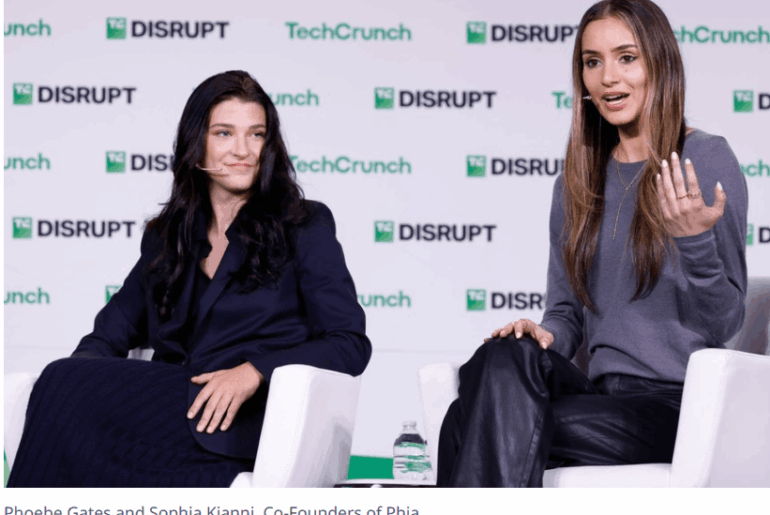
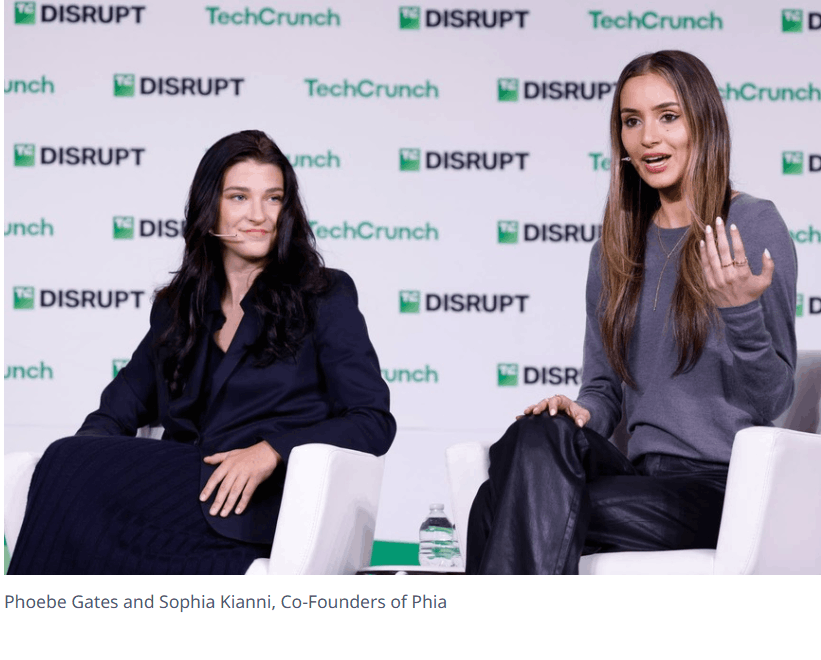
Phoebe Gates and Sophia Kianni, Co-Founders of Phia Kimberly White / Getty Images
Phoebe Gates’ Phia gets celebrity funding
Phia is attacking the shopping problem from a different angle. The AI shopping app, co-founded by Phoebe Gates (Bill Gates’ daughter) and Sophia Kianni in 2025, helps shoppers compare prices and find alternatives, including resale and second hand options.
If a shopper is about to buy a new item, Phia can surface whether the same or a similar product is available for less elsewhere, similar to the travel app Travago.
That gives the app a clear consumer hook at a time when shoppers remain highly price-sensitive.
It also gives Phia a sustainability angle, since resale can steer consumers toward second hand options instead of buying new.
Phia has also grown quickly.
The company posted on its Instagram page that, within a year, it surpassed 1.5 million users, has partnered with over 9,600 retail brands, and raised a $35.5 million Series A round at a $185 million valuation.
The company also announced a new list of celebrity investors, including Khloe Kardashian, Priyanka Chopra Jonas, Jessica Alba, Sydney Sweeney, Paris Holton, and Mindy Kaling, among others.
For consumers, the app promises to do some of the work that shoppers already do manually, including comparing prices, checking resale value, and searching for better alternatives.
Both apps currently serve as discovery tools.
AI could change who controls the shopping journey
For years, retailers have fought to win shoppers’ attention through search results, social media ads, loyalty programs, email lists, and marketplaces.
AI could disrupt that model by shifting more decision-making to a layer between the consumer and the retailer.
PwC describes agentic commerce as a new way of shopping powered by AI agents that can act on a user’s behalf. Unlike a basic chatbot, these tools can browse, compare, and, eventually, initiate purchases based on a shopper’s goals, preferences, and limits.
That could significantly change the retail funnel.
A consumer may not need to search “best work bag,” visit five retailer websites, compare prices, check resale sites, read reviews, and wait for a sale. An AI agent could eventually do much of that work before the shopper ever sees a product page.
McKinsey has described agentic commerce as a major shift in which AI agents anticipate consumer needs, navigate shopping options, negotiate deals, and execute transactions in line with human intent.
The firm estimates that by 2030, agentic commerce could account for up to $1 trillion in orchestrated revenue in the U.S. business-to-consumer retail market.
That is why the trend is not limited to startups.
Amazon is also pushing deeper into AI-powered shopping. AWS recently introduced its Agentic Shopping Assistant for retailers, a solution designed to help companies build their own conversational shopping experiences using their own data, catalogues, business rules, and brand voice.
Amazon said Kate Spade is already using the solution to build an AI gift concierge, while other retailers are testing it.
The move shows how quickly AI shopping is moving from a novelty to a competitive retail tool.
Retailers may have to compete for AI attention
The shift could be helpful for consumers, especially those tired of scrolling through endless products or wondering whether they are getting the best deal.
AI shopping apps could help shoppers compare prices faster, discover smaller brands, avoid missing sales, and make more confident purchases. They could also make online shopping feel more personalized and less fragmented.
But for retailers, the rise of AI shopping agents could create new pressure.
If shoppers rely on AI tools to decide what to buy, retailers may have to optimize not only for Google search and social media algorithms, but also for AI recommendations.
It could also change how retailers think about loyalty.
A shopper may still love a brand, but if an AI assistant finds a similar item for less, available faster, or with better resale value, the consumer may choose the alternative.
It does not mean AI shopping apps will replace retailers’ own websites or stores overnight. For example, final transactions at The Mall and Phia are handled by the retailer or seller, not in the app.
But there is still pressure on retailers to adapt to these shifting circumstances. Placer.ai’s retail outlook found that more than 55% of respondents were confident in brick-and-mortar performance in 2026, while only 20% expressed concern.
At the same time, 44% said they expect agentic AI to increase the share of online retail, and 34% said it could drive broader growth across commerce overall.
So AI isn’t driving shoppers away from stores; it’s just helping determine which stores to visit and which retailer gets the final sale.
The Arena Media Brands, LLC THESTREET is a registered trademark of TheStreet, Inc.
Muck Rack, the AI communications platform, today joined the Sounds Profitable Partner Network, the Boston-based trade association for the podcasting industry announced on May 13, 2026. The partnership brings together two organizations whose work has been converging as podcast appearances generate editorial pickups, YouTube clips, and citations in AI-powered search results – blurring the lines between earned media strategy and audio distribution.
The announcement signals something broader than a standard partnership deal. Sounds Profitable, which counts nearly 210 organizations globally in its network, has historically served podcast companies and audio platforms. Muck Rack is not a podcast company. It is a PR software platform used by communications professionals to track media coverage, monitor brand mentions, and measure how organizations appear in news and in AI-generated answers. Its entry into the Sounds Profitable ecosystem reflects a shift in where the podcast industry is drawing attention from outside the audio world.
Podcasting as earned media infrastructure
The rationale for the partnership is grounded in a structural change in how podcast content travels. A single brand appearance on a podcast no longer stays within that episode’s listenership. It lives on YouTube as a video clip, gets picked up by journalists writing about the same topics, and increasingly surfaces when users query AI-powered search systems. According to the press release from Sounds Profitable, 71% of podcast creators now produce video content, meaning the distribution surface of any given audio appearance has expanded considerably.
Muck Rack’s platform monitors exactly that kind of multi-channel propagation. The company combines global media monitoring, Generative Engine Optimization (GEO) insights, social listening, media data, AI automation, and analyst advisory services. According to the announcement, the platform helps organizations manage reputation, act quickly, and demonstrate impact across the PR workflow. Thousands of journalists also use Muck Rack’s free tools to showcase their work and analyse news.
For PR professionals advising brands on podcast strategy, the question has shifted. It is no longer only about which shows to appear on. It is about how that appearance travels – whether it earns editorial coverage, whether it surfaces in AI-powered search results when someone asks a brand-related question, and whether the brand’s communications team can measure the full downstream reach of a single recorded conversation.
“PR professionals are finally recognizing what podcast listeners have always known: audio is where trust gets built. Muck Rack has been part of my toolkit throughout my career because it’s one of the few platforms that can actually measure that trust over time,” said Molly DeMellier, Head of Communications at Sounds Profitable. “Bringing Muck Rack into the Sounds Profitable Partner Network gives our team, clients, and the broader podcast industry, the strategic communications infrastructure they deserve.”
The Sounds Profitable network and what membership includes
Sounds Profitable describes itself as the trade association for the podcasting industry. Founded to address a gap between podcasting’s audience scale and the industry’s ability to communicate its value to brands and media buyers, the organization operates an influential newsletter with 10,000 subscribers globally. It runs a podcast covering audio industry developments, maintains what it describes as the only searchable repository of key data points in podcasting, and hosts events including Podcast Movement, Cannes Lions, SXSW, and The Podcast Show.
Partner Network membership, according to the announcement, includes direct access to that research database, membership in a Slack community of more than 2,100 industry leaders, monthly strategic advising sessions, and priority access to major industry events. The nearly 210 members span the breadth of the audio ecosystem – hosting platforms, ad tech providers, agencies, publishers, and now, for the first time in a clearly visible way, a PR software company.
That last detail is the one industry observers are likely to note. The Sounds Profitable Partner Network has functioned as a map of where the podcast industry’s infrastructure sits. Muck Rack’s entry suggests that infrastructure is expanding upstream – into the communications and reputation management layer that operates before a podcast is even distributed, and well after the episode file is downloaded.
The Podcast Show London: where the partnership begins
The partnership launches with a joint appearance at The Podcast Show London, scheduled for May 20 to 21, 2026. Molly DeMellier, Head of Communications at Sounds Profitable, and Natan Edelsburg, Chief Partnerships Officer at Muck Rack, will appear together on the Brand Stage for a fireside chat titled “The New Word of Mouth: Podcasts, Earned Media, and AI Search.”
The session is framed around original research from both organizations. According to the press release, DeMellier and Edelsburg will examine how awareness, earned media, and discoverability now compound across channels, and what that means for communications strategy. The 71% video creator figure from Sounds Profitable’s research shapes part of the session’s argument: that a brand appearance can no longer be treated as a single-channel event.
The Brand Stage placement is notable. The Podcast Show London’s Brand Stage is specifically oriented toward how companies and communications professionals engage with the medium – not the creator or technical side of podcasting. It is a signal about who the session is aimed at: marketing and communications decision-makers who are still forming their frameworks for podcast strategy, rather than podcast industry insiders already embedded in the space.
Edelsburg addressed that gap directly. “Podcasts have become one of the most powerful channels for building brand credibility, but most PR teams don’t yet have a framework for thinking about them strategically,” he said. “Sounds Profitable is the organization that understands this space better than anyone. We’re excited to bring our research and platform to their network and to start that conversation on stage in London.”
Market context: podcast advertising at record scale
That complexity – audio appearing on video platforms, podcast appearances generating editorial coverage, brand mentions surfacing in AI-generated answers – is precisely the environment Muck Rack was built to monitor. The partnership with Sounds Profitable places Muck Rack in direct proximity to the industry’s primary research and knowledge network at a moment when brands are actively working out what podcast measurement actually means.
GEO and AI search: the emerging measurement frontier
One of the more technically specific aspects of Muck Rack’s offering, as described in the announcement, is its Generative Engine Optimization (GEO) insights capability. GEO refers to the practice of understanding and improving how a brand or organization appears in answers generated by large language models and AI-powered search systems such as Google’s AI Overviews, ChatGPT, and similar tools.
The addition of GEO to the podcast context is not incidental. As podcast appearances generate transcripts, editorial pickups, and YouTube clips, those downstream artifacts become part of the content corpus that AI search systems index and synthesize when generating answers. A brand that appears consistently in high-quality podcast conversations, and whose appearances generate further editorial coverage, may surface more frequently in AI-generated brand-related answers.
Muck Rack’s platform tracks both traditional media monitoring and how brands appear in AI-generated answers. That dual capability places it at an intersection that few PR platforms have reached. For communications professionals working with brands that are expanding into podcasting, the ability to track the full chain from audio appearance to AI search citation represents a new measurement surface.
Industry convergence: PR technology meets the podcast ecosystem
The Sounds Profitable Partner Network has grown from its earlier configuration of around 150 partners – visible in materials from Podcast Movement 2024 – to nearly 210 as of this announcement, a figure also reflected in the organization’s most recent public-facing descriptions. That growth trajectory maps onto the period of strongest commercial development in podcasting, when advertising spending, audience measurement, and distribution infrastructure were all advancing simultaneously.
Muck Rack joining that network is, in one reading, a data point about normalization. Podcasting is now sufficiently embedded in mainstream media and brand communications that the PR platform sector has direct strategic interest in understanding it – not as a novelty or a supplemental channel but as a primary channel for earned media that requires monitoring, measurement, and reputation management at the same level as print, broadcast, or digital news.
The announcement noted that Sounds Profitable sits at the center of the industry for companies looking to enter the space. That positioning has historically attracted audio and advertising technology companies. Its attraction of a communications platform suggests the categories of companies that see strategic value in the podcast ecosystem are expanding.
For marketing and communications professionals, the partnership offers a practical signal: the infrastructure for treating podcast appearances with the same analytical rigor as traditional press placements is taking shape. Whether through Muck Rack’s monitoring and GEO tools, through Sounds Profitable’s research database, or through the two organizations’ joint work that will be visible at The Podcast Show London and in future programming, the gap between podcast strategy and mainstream PR measurement is narrowing.
Timeline
Earlier 2024 and prior: Sounds Profitable Partner Network counted approximately 150 partners, as reflected in Podcast Movement 2024 and SXSW 2025 materials
May 13, 2026: Sounds Profitable announces Muck Rack as new Partner Network member; network stands at nearly 210 organizations globally
May 20-21, 2026: The Podcast Show London; DeMellier and Edelsburg scheduled for Brand Stage fireside chat titled “The New Word of Mouth: Podcasts, Earned Media, and AI Search”
Summary
Who: Sounds Profitable, the trade association for the podcasting industry, and Muck Rack, an AI communications platform used by PR professionals to monitor media coverage and AI search appearances.
What: Muck Rack joined the Sounds Profitable Partner Network, a network of nearly 210 organizations globally. The partnership includes a joint appearance at The Podcast Show London on May 20-21, 2026, with a Brand Stage fireside chat on podcasts, earned media, and AI search. Muck Rack brings global media monitoring, Generative Engine Optimization insights, social listening, and AI automation to a network historically focused on audio and advertising technology companies.
When: The partnership was announced on May 13, 2026. The first joint public appearance is scheduled for The Podcast Show London on May 21, 2026.
Where: Sounds Profitable is based in Boston, Massachusetts. The Podcast Show London takes place in London. The Partner Network operates globally, spanning nearly 210 organizations across the audio and advertising industries.
Why: Podcast appearances now travel across YouTube, editorial coverage, and AI-powered search results – expanding the measurement surface beyond traditional listener data. Muck Rack’s platform tracks how brands appear across all of these channels, including in AI-generated answers. According to Sounds Profitable’s own research, 71% of podcast creators now produce video content, meaning a single brand appearance can reach multiple audiences and platforms simultaneously. As podcast advertising spending reached $2.9 billion in the United States in 2025 and monthly listenership hit a record 58% of Americans, PR professionals are under increasing pressure to account for podcasting within mainstream communications measurement frameworks.
Luís Rijo is a seasoned marketing professional with over 10 years of experience in Digital Marketing, Search, Social, Display, Video, and DOOH. Based in Europe. Also writing in the spend. Reach out via [email protected]
Reflecting on Black Friday and Cyber Monday figures, Ollie Shelton at Threepipe Reply surveys the new ecommerce landscape.
If 2023 was the year generative AI captured imaginations and 2024 was the year brands began experimenting with it, then 2025 was the year AI stopped being optional. It became the operational core of marketing.
This was the year that those championing agentic advertising moved from ‘early adopters’ to ‘early majority.’ And the data emerging from Black Friday and Cyber Monday (BFCM) 2025 confirms the shift: AI-powered discovery, comparison, and decision-making is already reshaping consumer behaviour at scale.
The clearest signal came not just from the numbers, but from how shoppers behaved. Across the US, online sales hit $44.2bn (up 7.7%) during the period between Thanksgiving and Cyber Monday. In the UK, online spend reached £3.8bn (up 4.3%) from Black Friday to Cyber Monday
AI assistants influenced over $14bn in Black Friday sales globally and $9.8bn on Cyber Monday. Mobile also dominated, accounting for 55–70% of global online purchases, while TikTok Shop surged, with UK purchases up 28%, delivering up 50% year-over-year (yoy) during Cyber Week.
AI rules
Consumers didn’t just browse; they asked AI for the best price, fastest delivery, or highest-rated product. This is the behavioural shift that makes 2025 the year agentic advertising took hold.
Agentic AI moved marketing from prompt-based tasks to goal-based execution. This is no longer theoretical; it’s happening inside platforms and increasingly inside brands.
This year, we saw widespread adoption of systems that can: autonomously redistribute budget based on real-time signals; adjust creative and messaging in response to audience behaviour; run iterative testing without human touchpoints; and unify signals from search, retail media, social, and commerce.
At Threepipe Reply, we’ve already deployed intelligent frameworks that dynamically shift budget between Google, Meta, TikTok, and retail media depending on rising or falling demand signals.
BFCM 2025 was a preview of this future. The volatility of deals, competitor pricing, and stock levels meant brands with automated pipelines simply responded faster.
Intelligent efficiency
The efficiency mandate of recent years has recently collided with rising media costs and intense competition. But AI has turned efficiency from a constraint into an advantage, as demonstrated by the BFCM 2025 numbers.
US conversion rates improved even as average order volume fell due to rising prices. Global social media delivered 14% of all traffic to retailers, up 12% yoy. And UK mobile share grew 14% yoy, reflecting faster, more decisive consumer journeys.
Threepipe Reply is using agentic modelling to reduce wastage, sharpen investment, and allow media to self-optimize within guardrails. Human teams now focus on strategy, brand, and orchestration, not weekly bid adjustments.
With TikTok Shop surpassing $500m in US sales from Black Friday to Cyber Monday 2025, the importance of creative velocity and variation is clear. What wins today is content that’s iterative, behaviour-led, and supported by predictive signals. It must also be tailored to formats, creators, and communities.
Across beauty, retail, fashion, and sport, we’re already using creative intelligence tools to generate, test, and evolve content automatically.
This was the year creativity stopped being a static asset; 2026 will be the year that creativity becomes adaptive.
Everything, everywhere
We’re also seeing the end of channel silos. Consumers use search now to evaluate, social to validate, retail media to compare, and mobile to buy, often within minutes – and BFCM 2025 confirmed this.
Over 80% of US traffic spikes were driven by AI discovery and price comparison. Beauty, fitness, apparel, and tech dominated, fuelled by influencer and UGC loops. Social live commerce surged globally, pulling forward purchase intent.
Threepipe Reply’s intelligence mapping shows that cross-channel signals increasingly outweigh channel-specific insights. 2026 will push this further as measurement moves from channel attribution to journey-level orchestration.
The rise of AI-mediated shopping means that product comparison happens instantly; preferences are shaped before a website visit; baskets are built in the background; and search, social, and commerce merge into one intent layer.
This is why we’re investing heavily in AI shelf optimization, ensuring brands appear across LLMs, AI search, retail media, and social recommendations.
In 2026, the majority of product discovery will happen in environments brands can’t see directly, but only influence.
Fasten your seatbelts
Our view is clear: 2025 was the implementation year. Brands modernized systems, adopted agentic models, and deployed creative and media intelligence.
2026 will be the acceleration year. We expect to see: AI-native operating models; dynamic, adaptive brand worlds; predictive commerce ecosystems; and unified creative and media intelligence stacks. Along with safe and auditable AI governance frameworks, and hybrid human/AI workforces inside marketing teams.
The brands building this foundation now will be the category leaders in 2026.
Taboola survey of 200 senior marketers finds 76% see meaningful performance gains from agentic AI tools, but only within search and social, not the open web.
Bar chart showing AI campaign adoption: Performance Max and Advantage+ at 98%, open web at 80%.
Taboola this week published a survey report showing that 76% of senior performance marketers are seeing meaningful improvements from agentic AI campaign tools, yet the benefits remain concentrated almost entirely within search and social platforms. The report, titled “The Agentic Advantage in Performance Marketing: Securing Incremental Growth Beyond Search and Social,” was conducted in March 2026 across 200 marketing leaders in the United States and United Kingdom and released in May 2026 by Realize, Taboola’s advertiser platform.
The findings land alongside the beta rollout of Realize+, Taboola’s agentic campaign system for the open web that the company launched on April 23, 2026. Taken together, the survey and the product signal how the company is trying to shift budget away from walled gardens by making the argument that the automation advertisers already rely on in Google and Meta can be replicated outside those platforms.
Who was surveyed and how
The study was administered online by Global Surveyz Research, an independent global research firm, with respondents recruited through a B2B research panel and invited via email. All 200 participants hold roles ranging from Senior Manager to VP and are responsible for performance strategy and execution at their organizations. Companies represented span the eCommerce, Banking and Financial Services, Automotive, and Health and Pharma sectors, split evenly 50-50 between the US and UK. Organization size leans large: 41% employ 1,000 to 4,999 people, 43% employ 5,000 to 9,999, and 16% employ 10,000 or more. Monthly marketing budgets start at $300,000 and range up to $5 million or more. The average survey completion time was 6 minutes and 6 seconds.
Responses to most non-numerical questions were randomized to prevent order bias. The survey was conducted entirely in March 2026.
AI adoption is a two-platform market
At-scale adoption of AI-powered campaign solutions is concentrated almost entirely on Google and Meta. According to the Realize report, 91% of respondents currently use Google’s Performance Max at scale, with a further 7% testing or piloting it – meaning 98% of the sample is actively engaged with the product. Meta’s Advantage+ shows almost identical numbers, with 88% using it at scale and 10% in testing, for a combined engagement rate of 98%.
TikTok’s Smart+ occupies a different position. Current at-scale usage sits at just 9%, yet 73% of respondents are in active testing or piloting, suggesting broad exploratory interest that has not yet translated into full deployment. Open web campaign management solutions are used at scale by 36% of respondents, with a further 44% in the testing phase – an 80% total engagement rate that trails the two dominant platforms by a considerable margin.
The concentration matters. Performance Max and Advantage+ are not just the most-used tools; they are also the benchmarks against which all other solutions are judged. Both products use fully automated bidding, audience selection, and creative serving. The survey’s framing consistently positions them as the standard that the open web has not yet matched.
Three-quarters report performance lift
Of the 200 respondents, all are currently measuring the performance impact of their best-performing platforms. According to the report, 76% are seeing meaningful improvements, with 29% reporting a significant lift and 47% reporting a moderate lift. A further 7% describe only a limited lift, 16% say it is too early to determine, and just 1% see no impact. Zero respondents said they are not measuring at all.
The strongest perceived benefit of these tools is real-time CPA/ROAS optimization, cited as the top value driver by 41% of respondents. Saving time and operational efficiency comes second at 14%, followed by improved budget allocation across channels at 11%. Greater ability to drive incremental performance ranks fourth at 10%. Automated creative generation and testing, and improved audience targeting and segmentation, each score 6%.
The ranking reflects a market where performance advertising is primarily evaluated in revenue terms. CPA and ROAS are the dominant success metrics, and solutions that directly optimize toward them carry more weight than those offering operational or creative benefits alone.
Budgets remain locked in search and social
Despite broad satisfaction with AI tools in search and social, budget allocation has not moved significantly toward newer channels. According to the report, 74% of respondents allocate more than 25% of their total budget to paid search, against an average allocation of 22% of total budget. Paid social sees significant investment from 67%, with an average share of 21%.
The open web occupies a moderate position: 63% fund it at a moderate level (10-25% of budget), while only 4% give it significant investment above 25%. Average allocation sits at 13%. Retail Media Networks attract mostly minimal spend from 56% of respondents, with an average of 9%. Connected TV is split between moderate (50%) and minimal (35%) investment, averaging 12%. Affiliate and Partner Networks receive primarily minimal investment from 64% of respondents, averaging 8%.
The pattern reflects a structural gap. The open web reaches a large audience – Taboola’s own platform touches approximately 600 million daily active users across properties including NBC News, Yahoo, and Samsung devices – yet it captures a fraction of the budget that search and social command. According to the report, the explanation is technical rather than strategic: the open web has yet to match the automation sophistication available in search and social, which offer advertisers more advanced tool options and more attractive CPA and ROAS outcomes.
This budget concentration is not a new observation. As PPC Land has tracked, Taboola began addressing the open web’s automation deficit by expanding the Realize platform in October 2025 with deepened partnerships with TIME, Weather Channel Digital, Gannett, Nexstar, and Slate, followed by the launch of Predictive Audiences in June 2025, which delivered conversion improvements of up to 270% for early adopters.
Workflow integration is the dominant adoption barrier
The biggest internal obstacle to broader agentic AI adoption is not scepticism about performance outcomes. According to the report, 54% of respondents cite difficulty integrating these solutions into existing workflows as the single largest barrier. That figure dwarfs all other options: lack of team knowledge or expertise scores 12%, uncertainty about which technology or vendor to choose scores 9%, and budget constraints rank fourth at 6%.
The challenge grows sharply with budget size. Among companies spending $300,000 to $499,000 per month, only 9% identify workflow integration as the primary barrier. That figure rises to 38% among $500,000 to $999,000 per month spenders. Among the largest two segments – $1 million to $4.9 million per month and $5 million or more per month – it reaches 74% and 68% respectively. The companies that have invested most heavily in existing platforms are the ones finding it hardest to add a new layer of automation on top.
This creates a specific challenge for the open web. Large advertisers, who would generate the most revenue for platforms like Realize, are precisely those with the most entrenched workflows and the highest integration costs. The transition from manual campaign management to agentic systems requires changes to reporting infrastructure, attribution models, and organizational processes that small budgets can absorb more easily than large ones.
82% see potential, few have scaled
When asked about their organizational stance on AI-powered goal-based buying on the open web, 82% of respondents indicate they see meaningful growth potential. The distribution within that 82% is revealing. According to the report, 46% describe it as a high-potential opportunity they have not yet scaled, 19% say they believe in it but are holding back, and only 17% describe it as a proven growth driver at scale. On the sceptical side, 15% question its incremental impact, 2% say they do not believe it drives meaningful results, and 1% have not seriously evaluated it.
The gap between perceived potential and actual deployment is large. The dominant stance is one of cautious optimism – recognizing the opportunity while lacking either the tools or the confidence to act on it fully. According to the report, many of those holding back are not doing so out of caution but because a suitable solution does not yet exist at the technical level they require.
Open web barriers are operational, not philosophical
The factors limiting further open web investment point squarely at operational complexity and measurement gaps. According to the report, 74% of respondents cite too many vendors or the complexity of managing multiple partners as a limiting factor. Lack of unified attribution and measurement ranks close behind at 71%. Brand safety concerns are cited by 54%. Insufficient resources to manage additional channels scores 42%.
Strategic scepticism is rare. Only 7% say they have not seriously considered diverting budgets to the open web, 5% say they do not believe they can reach incremental users, and just 2% say they do not believe incremental performance is achievable. Only 5% report no significant barriers at all.
The data draws a clear line: advertisers broadly believe the open web can deliver performance, but fragmentation and measurement complexity make it operationally harder than staying within walled gardens. This is directly relevant to the investment case for platforms like Realize. The argument is not that advertisers need convincing about the open web’s audience quality; it is that they need a simpler operational layer to access it.
81% would increase open web investment if automation matched search and social
The study’s most direct finding on the market opportunity is this: 81% of respondents agree they would increase open web investment if it offered agentic AI-powered campaign solutions comparable to what they use in search and social. Broken down, 49% strongly agree and 32% somewhat agree. Only 11% disagree, and 8% are neutral.
The intensity of agreement scales with seniority and spend. Among VPs, 67% strongly agree – compared to 46% of Directors and 35% of Senior Managers. The pattern by budget is steeper still: only 3% of organizations spending $300,000 to $499,000 per month strongly agree, rising to 21% among $500,000 to $999,000 per month spenders, 67% among $1 million to $4.9 million per month, and 74% among those spending $5 million or more. The largest advertisers are the most enthusiastic about automation reducing operational complexity.
Expected budget reallocation averages 24%
If agentic AI solutions existed for the open web, virtually all respondents (99%) say they would allocate some share of their performance marketing budget to it. The average expected allocation is 24%. Half of respondents cluster in the 11-25% range, while 37% would allocate 26-50%. Only 11% would allocate up to 10%, 2% would allocate more than 50%, and 1% would allocate nothing.
The gap between current and anticipated significant open web investment tells the story clearly. Just 4% of respondents currently invest more than 25% of their performance budget in the open web. At least 39% say they would invest 26% or more if agentic AI solutions were available for it. That would not make the open web the dominant channel – the 24% average still trails paid search’s current 22% average allocation modestly – but it would represent a substantial shift in where performance dollars flow.
Why this matters for the marketing industry
The survey’s findings carry direct implications for how performance marketing budgets may evolve. At present, the industry’s agentic AI story is largely a Google and Meta story. As PPC Land has reported, Google’s Performance Max serves over one million advertisers and has received more than 90 quality improvements over the past year, including expanded automation tools, AI-generated creative features, and channel performance reporting. Meta’s Advantage+ demonstrated 22% average ROAS improvements through 2025.
The pressure that dynamic creates on other channels is real. If 74% of performance budgets flow to paid search and social, and those platforms continue improving their automation while the open web remains fragmented, the gap risks widening rather than closing. The survey suggests the market is aware of this dynamic and is looking for a way through it. Whether platforms like Realize can provide the automation layer that unlocks the 81% willing to increase open web investment is a product and execution question as much as a market one.
The Taboola survey also lands as the company reported Q1 2026 revenue of $466.4 million, a 9.1% year-on-year increase. Realize+ is built on two core technical components. The first is the Decision Engine, which includes a Budget Allocator that automatically moves spend toward the highest-performing campaigns in real time. The second is the Element Generator, which creates and continuously updates ads and targeting parameters without manual input. The architecture is explicitly designed to replicate the autonomy of Performance Max and Advantage+ on open web inventory – without the owned-and-operated bias critics of walled garden systems have raised repeatedly.
Adam Singolda, CEO of Taboola, addressed the core market demand in the press release accompanying the report: “Advertisers of all sizes are leaning into agentic advertising, and the results are following. Our research shows a clear demand for advertisers that want the same ‘always-on,’ AI-driven performance they see in walled gardens applied to the open web. They are looking for autonomous systems that learn continuously, pivot in real time, and turn every impression into a measurable outcome.”
The survey frames this not as a niche demand but as a near-universal one. Three-quarters of all respondents rate finding a performance channel that delivers incremental outcomes beyond search and social as very or extremely important. Among VPs, that figure climbs to 53% rating it extremely important alone. Among those spending $5 million or more per month, 70% call it extremely important – the single largest concentration of urgency in the entire dataset. The combination of high stated demand, measurable performance gaps, and specific operational barriers provides the clearest public data picture yet of where performance marketing budgets might go if the automation gap between walled gardens and the open web can be closed.
Timeline
April 2024 – Taboola launches Taboola Select, a curated premium publisher package for large advertisers with access to a vetted subset of 15% of top US publishers.
June 2025 – Taboola announces full commercial launch of Predictive Audiences on its Realize platform, reporting conversion improvements up to 270% for early adopters including The Motley Fool, QuinStreet, and NerdWallet.
October 15, 2025 – Taboola expands the Realize platform with deepened publisher partnerships including TIME, Weather Channel Digital, Gannett, Nexstar, and Slate, adding display inventory to a historically native-focused network.
October 22, 2025 – Taboola and Paramount Advertising announce Performance Multiplier, connecting CTV advertising to measurable open web performance outcomes via Realize.
March 2026 – Global Surveyz Research conducts the survey underlying the “Agentic Advantage in Performance Marketing” report, polling 200 senior performance marketers in the US and UK.
April 23, 2026 – Taboola launches Realize+, an agentic AI system for open web performance campaigns built on a Decision Engine and Element Generator, alongside Claude Skills integration.
May 14, 2026 – Taboola and Realize publish “The Agentic Advantage in Performance Marketing” report based on the March 2026 survey of 200 senior marketers in the US and UK.
Summary
Who: Taboola (Nasdaq: TBLA), through its Realize advertiser platform, in partnership with Global Surveyz Research, surveyed 200 senior performance marketers – ranging from Senior Managers to VPs – at mid-to-large organizations in the United States and United Kingdom across eCommerce, Banking and Financial Services, Automotive, and Health and Pharma industries.
What: A research report titled “The Agentic Advantage in Performance Marketing: Securing Incremental Growth Beyond Search and Social” showing that 76% of performance marketers see meaningful performance gains from agentic AI tools like Google Performance Max and Meta Advantage+, yet gains are concentrated within walled gardens. The report also finds 81% would increase open web investment if comparable automation were available, with an average expected budget allocation of 24% to the open web under that scenario.
When: The survey was conducted in March 2026 and the report was published on May 14, 2026.
Where: Respondents are based in the United States and United Kingdom, split evenly 50-50. The findings relate to global digital advertising markets and the structural divide between walled garden platforms and the open web.
Why: The research addresses a persistent structural imbalance in digital advertising, where the open web captures a fraction of performance budgets despite reaching a large share of user time. The primary barriers identified are not performance scepticism but operational complexity: workflow integration difficulties, fragmented vendor environments, and lack of unified attribution. The report was released alongside Taboola’s Realize+ beta, positioning the findings as a market-level argument for agentic AI automation on the open web.