
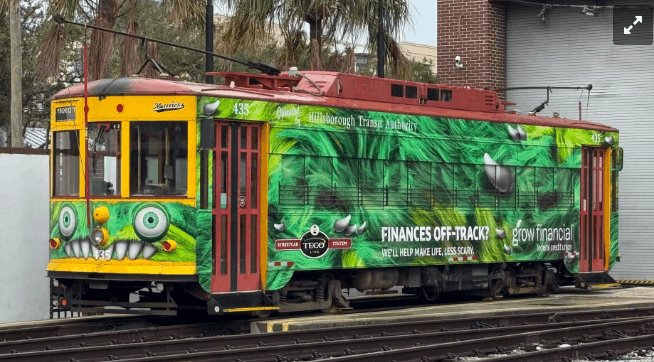
As consumers move through their days, static thinking about out-of-home media is struggling to keep up. From transit wraps to rideshare placements, the most compelling OOH opportunities are no longer fixed to a single spot – they’re traveling the same routes your audience is.
Marketing has become incredibly sophisticated at understanding how people move. Brands invest heavily in customer journey mapping, location intelligence, attribution and audience analytics to understand where consumers spend their time and how they make decisions.
Yet when it comes to media planning, we often still think about audiences as if they’re stationary.
The reality is that consumers are constantly moving. They travel between offices, stores, restaurants, entertainment venues, transit systems, airports, campuses and neighbourhoods. They encounter countless environments throughout the course of a day, and every one of those environments creates an opportunity for a brand to show up in a way that feels relevant and connected to the moment.
Moving media
As consumer behaviour has evolved, so has out-of-home.
For many marketers, OOH is still synonymous with billboards, street furniture, and place-based media. Those formats remain incredibly important. They build awareness, deliver scale and continue to be a critical part of successful media plans.
But they’re no longer the whole story.
Today’s OOH landscape includes a growing range of moving and dynamic formats that allow brands to engage consumers throughout their daily journeys. Transit media, rideshare advertising, vehicle wraps, mobile billboards, waterway media and other dynamic executions extend a brand’s presence beyond fixed locations and into the spaces between them.
While a billboard may establish a powerful presence at a destination, moving media follows the flow of consumer activity – reaching people as they commute, shop, attend events, travel and experience their communities.
Location matters
This shift reflects a broader change taking place across marketing.
Advertisers increasingly recognize that context matters. Knowing who someone is remains important, but understanding where they are, what they are doing, and the mindset they’re in can be equally valuable. Relevance is often created by the environment surrounding the message as much as the audience receiving it.
That’s where OOH has a unique advantage.
Out-of-home doesn’t interrupt the consumer experience. It exists within it.
Whether it’s a transit campaign surrounding a major event, a mobile activation supporting a product launch or a rideshare program concentrated around a convention district, OOH has the ability to reinforce a brand message in a way that feels timely, contextual and authentic. In those moments, location isn’t simply where the ad appears – it becomes part of the creative canvas.
Measurement capabilities
At the same time, the industry’s measurement capabilities have advanced significantly.
For years, OOH was often viewed primarily as an awareness medium. Marketers appreciated its visibility and scale but struggled to evaluate it using the same frameworks applied to other channels.
That’s changed.
Today, advertisers have access to sophisticated tools that provide deeper insight into audience movement, campaign reach, visitation patterns, engagement and attribution. Location intelligence, mobile data, geofencing and improved measurement methodologies are helping marketers better understand how OOH contributes across the customer journey and how it drives real business outcomes.
This progress comes at exactly the right time.
Marketers are navigating an increasingly fragmented media environment where attention is harder to capture, and every investment is expected to perform. As a result, there is growing demand for channels that can deliver scale, flexibility, contextual relevance and measurable results.
OOH is uniquely positioned to deliver all of the above.
Opportunity ahead
The industry’s continued growth reflects its ability to evolve alongside changes in technology, consumer behaviour and media consumption. Dynamic and moving formats represent the next step in that evolution, creating new opportunities for brands to connect with consumers wherever their journeys take them.
The opportunity ahead is not to rethink the value of OOH. It’s to broaden our understanding of what OOH can be.
Consumers are moving. Media planning is becoming more movement-oriented. And the ability to engage audiences in motion will be one of the defining strengths of out-of-home in the years ahead.