A new survey indicates that 1 in 5 small businesses use social media in place of a website. Many assume a website is cost-prohibitive and may not consider the risks of not having one.
By MediaStreet Staff Writers
More than one-third (36%) of small businesses do not have a website, according to the websites section of the fourth annual Small Business Survey conducted by Clutch, a B2B research firm. One in five small businesses (21%) selectively use social media instead of a website in an effort to engage customers.
The survey indicates that small businesses consider cost a bigger concern than the potential repercussions of not having a website.
Social media platforms such as Facebook and Instagram attract small businesses by cultivating a highly engaged user base. However, relying solely on social media may be a risky strategy for businesses.
“Whenever you put all of your eggs into someone else’s basket, it’s risky,” said Judd Mercer, Creative Director of Elevated Third, a web development firm. “If Facebook changes their algorithm, there’s nothing you can do.”
Facebook recently announced changes that potentially increase the risk of using social media in place of a website. The social media platform plans to prioritise posts from family and friends over posts from brands.
This new policy may make it more difficult for small businesses to reach their audiences through social media. As a result, websites are expected to regain importance among businesses – as long as cost is not considered an obstacle.
Among small businesses that do not currently have a website, more than half (58%) plan to build one in 2018.
Some Small Businesses Say Website Cost is Prohibitive, But Others Cite Costs of $500 or Less
More than a quarter (26%) of small businesses surveyed say cost is a key factor that prevents them from having a website. However, nearly one-third of small businesses with websites (28%) report spending $500 or less.
Small businesses may not be aware that some web development agencies offer packages that defray costs by dividing website construction into multiple phases or sliding rates for small businesses. “You don’t necessarily need to launch with your first-generation website,” said Vanessa Petersen, Executive Director of Strategy at ArtVersion Interactive Agency, a web design and branding agency based in Chicago. “Maybe just start small.”
Mobile-Friendly Websites Becoming Standard Businesses that do have websites are moving en mass to mobile friendly ones, the survey found. Over 90% of respondents said their company websites will be optimised for viewing on mobile devices by the end of this year.
In addition to the 81% of company websites that are already optimised for mobile, an additional 13% that say they plan to optimise for mobile in 2018.
Clutch’s 2018 Small Business Survey included 351 small business owners. The small businesses surveyed have between 1 and 500 employees, with 55% indicating that they have 10 or fewer employees.
To read the full report and source the survey data, click here.
80 percent of the world’s Internet users are active on social media
By MediaStreet Staff Writers
Social media management platform Hootsuite, and We Are Social, the global socially-led creative agency, have released Digital in 2018, a report of social media and digital trends around the world.
Representing 239 countries and territories, the seventh annual report finds the number of Internet users in the world has now surpassed the 4 billion mark, putting more than half the global population online. Of that, social media brings nearly 3.2 billion active users online to connect with each other, consume media, interact with brands, and more.
The 2018 key findings include:
Internet user numbers increased 7 percent in the last 12 months to hit 4.021 billion, or 53 percent of the world’s population
Global social media usage has increased by 13 percent in the last 12 months, reaching 3.196 billion users
Mobile social media usage has increased by 14 percent year over year to 2.958 billion users, with 93 percent of social media users accessing social from mobile
Internet users are projected to spend a combined total of 1 billion years online in 2018, of which 325 million years will be spent on social media
The report also found that global growth of the Internet is propelling ecommerce forward, with 1.77 billion Internet users purchasing consumer goods online in 2017, an increase of 8 percent compared to a year ago. Collectively, consumers spent a total of USD $1.474 trillion on ecommerce platforms in the past 12 months, 16 percent more than in 2016.
Said Simon Kemp, Global Consultant, We Are Social, “With four billion people now online, connectivity is already a way of life for most of us. However, as Internet companies strive to serve the next billion users, we’ll see important changes in digital over the coming months. Audio-visual content will take priority over text – especially in social media and messaging apps – while voice commands and cameras will replace keyboards as our primary means of input. Social relationships and online communities will evolve to accommodate these new ways for people to interact with each other. This will result in rich new experiences for all of us, but businesses need to start preparing for these changes today.”
“The Digital in 2018 report highlights the continuing growth of the Internet and social media to individuals and businesses around the world. This dynamic has forever altered the customer journey as consumers and B2B professionals increasingly conduct research, make buying decisions, seek support, and recommend brands online. To achieve competitive advantage, all executives must dive deep into digital now, meeting their customers where they are to best market, sell, and serve them,” said Penny Wilson, CMO, Hootsuite.
An episode of US show Black-ish saw a character discussing an ad campaign by Procter & Gamble. Is this the future of TV?
Advertiser-funded programming is an important source of money for broadcasters, but could advertiser-funded dialogue be the next step? Last week saw a groundbreaking attempt to blend advertising and editorial in an episode of the hit US sitcom Black-ish, which involved consumer goods firm Procter & Gamble paying for a plotline.
In the episode, broadcast on ABC, characters discussed P&G’s award-winning ad campaign, “The Talk”, which features African American parents talking about racism to their children. The show’s storyline involved character Dre Johnson – the father of the family, who is himself black and an ad executive – developing an advertising campaign that focuses on P&G’s film.
While we are in a new golden age of television, it has been less memorable for advertisers, who have found the digital audiences provided by Google and Facebook more alluring. Global spending on ad slots will grow 1.1% this year to $188.7bn (£136bn), according to media buyer ZenithOptimedia, while digital spending is expected to rise more than 10% to $224.7bn.
This has forced broadcasters to find new ways of bringing in money and set up deals like the Black-ish episode with P&G.
Advertisers are now frequently heavily involved in all aspects of a TV show, from providing funding and doing product-placement deals to having products digitally inserted into scenes using special effects.
Viewers of Channel 4’s hit celebrity winter sports show The Jump, Sheridan Smith’s turn in ITV drama Cilla, Channel 5’s The Yorkshire Vet, or Air Ambulance ER on Sky might be unaware that they made it to the small screen in part because of co-financing from an arm of WPP, the world’s biggest advertising group.
Former Olympic swimmer Rebecca Adlington in The Jump, which was co-financed by advertising giant WPP. Photograph: Ian Derry/Channel 4/PA
Advertisers looking for even more control are becoming involved in creating shows that will appeal to viewers and show off their brand. The deal for Channel 4’s Eat The Week with Iceland, which shows attempts by time-starved families to cook together, included the frozen-food chain having naming rights for the show. “Iceland was fully integrated,” says Liam Mullins, managing partner at media agency the7stars, which struck the deal. “We even chose the freezer.”
Three years ago, UKTV, which owns 10 TV channels including Dave and Gold, revealed that a quarter of its original commissions were part-funded by advertisers. Kate Norum, senior commercial partnerships manager at the company, says the proportion is now much lower, at about five shows per year, but that it remains an important part of the business.
“Nearly every brand is looking to move into content creation but a lot of what they do is sitting unwatched on digital platforms,” she says. “If we can bring top-up funding to the table, then every penny goes into the production of the show. We will only do things that we think are editorially relevant: we wouldn’t want viewers thinking they were being bashed around the head with a commercial partnership.”
One example is a tie-up with Ancestry.co.uk to make The Secrets in My Family, a show that dug into a family’s history each week, fronted by The One Show’s co-host Alex Jones. The genealogy company was consulted on elements including the talent, the title, the contributors and their stories, but ultimate editorial control was held by UKTV.
Advertisers can also pay to have products featured in shows, which must carry a “P” logo to indicate the presence of paid-for placements – something that has been allowed in the UK only since 2011.
The problem with the modest £30m-a-year product-placement business is that sometimes brands don’t realise what they are getting themselves into. For every success like Superdrug’s tie-up with ITV2’s Love Island, which saw bottles of suntan lotion located strategically throughout the set of the runaway hit show, there is the cautionary tale of Big Brother.
In 2012, Henkel, which owns brands including haircare label Schwarzkopf, spent £2m on a Big Brother deal, but the Channel 5 reality show became embroiled in an abuse and racism scandal between housemates. The deal, which included the housemates and presenter Emma Willis dyeing their hair the brand’s distinctive red colour, did not go as intended for Henkel, as more than 1,200 viewers complained to the broadcasting regulator Ofcom.
Sheridan Smith in ITV’s Cilla. Photograph: McPix Ltd/REX
Some advertisers are now looking to Hollywood-style effects to make sure they get the perfect placement.
London-based Mirriad places virtual advertising inventory into finished TV programmes – for example, inserting a billboard advert for insurer Prudential into an episode of the hit US comedy Modern Family.
“It is all about putting in images that were never there,” says Mark Popkiewicz, chief executive of Mirriad. “In today’s world, where audiences are ignoring traditional ads more and more, or blocking them, it is critical for an advertiser to be able to benefit from great content in a natural way.”
However, these innovations – from dialogue to superimposed ads – carry a health warning. Advertisers need to tread carefully as modern audiences have an increasingly low tolerance for commercial exploitation, and blurring the line between advertising and content can run the risk of a viewer backlash.
“It is a careful balance,” says Richard McKerrow, co-founder of Bake Off maker Love Productions. “While obviously we have scrutinised commercial opportunities, you have to be careful to protect the creative integrity and authenticity of a show. It is vital that viewers trust what they are seeing.”
If the example set by the Black-ish episode takes off, it could also be question of whether viewers trust what they are hearing.
Agencies believe brands will have to spend more on paid ads on Facebook in order to get the same number of views — further lining Facebook’s pockets. This is just the “final nail in the existing coffin” of organic reach, said Doug Baker, director of strategic services at digital agency AnalogFolk.
Facebook’s ad rates have risen by 35 percent in the last quarter alone. Agencies have noticed a slow decline in organic reach on Facebook for some time. Digital agency Jellyfish said organic reach on Facebook is already around 2 percent across most European clients. John Hegeman, Facebook’s vp of product management, said in a statement on the news feed update that advertising on the social network will be “unaffected,” but agencies disagree.
Far too many brands pump bland broadcast comms into mass-reach media buys on Facebook and spam millions of news feeds, said Mobbie Nazir, chief strategy officer at agency We Are Social. Now, there will be far more onus on planning Facebook campaigns that go deeper into media planning, campaign execution and optimization, and reporting on various metrics, she added.
“We all need to become better media planners, said Greg Allum, head of social at Jellyfish. There’s a “fundamental shift” in the roles of traditional social media marketers encapsulated in the news feed update, he added. Not only “do you have to understand brand and content,” marketers also require a key understanding of how to plan media campaigns on social.
For many brands, the bigger challenge will emerge from Facebook’s parallel war on low-quality brand content, with the platform’s December announcement that it was deprioritizing “engagement bait.” While agencies accept it will be difficult for most brands to be consistently “meaningful” — particularly when competing with treasured moments with friends and family — there is an opportunity to drive higher creative standards. “Those brands that look to add value to people’s lives and invest in high-quality, original content will have the most sustained success,” Baker said.
The risk could come once brands find loopholes in the algorithm. “I can see brands that tap into authentic conversations with a credible point of view will do well,” said Chris Pearce, the CEO at digital agency TMW Unlimited, “whereas others will be tempted to be increasingly controversial or polarizing in order to stimulate conversation.”
Another risk is if posts are boosted. Ad rankings on Facebook are not affected by the news feed’s overhaul. But as Kevin Chan, the integrated performance director at iProspect, pointed out, if a boosted page post is getting less organic reach due to these changes, then that might impact the auction. Engagement is a “very small” part of ad ranking on the social network, which relies on many other data points to determine what ads people see to ensure relevancy and value, he said.
It seems like Facebook is returning to being a social network rather than a news organization. In the enduring debate on Facebook’s impact on post-truth politics, the social network has continually denied it is a media company. This algorithm change looks like a step to confirm that, returning to the days of wall posts and status updates.
In terms of how this change will be pitched to brands, Edie Greaves, senior strategist at digital agency Possible, believes there will be a continuation of the stance from both Facebook and Snapchat that brands are “partners,” not “advertisers.”
Greaves believes Facebook will begin offering brands new ways to communicate with people, but they will have to up their spend to get into the news feed. Perhaps Facebook will follow in the footsteps of networks like WeChat that heavily restrict the role brands play in the news feed but give more free reign to advertisers within messaging apps, she added.
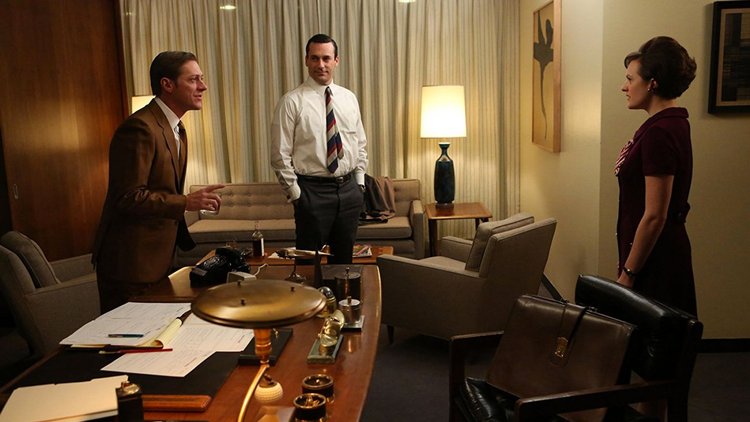
I was chatting with a marketing friend the other day, and he was telling me how much he loves watching Mad Men, not just for the entertainment value, but to see how advertisers used to conduct business and the creative process Don Draper and his team used to go through for each project. Fun side note: a lot of the commercials that aired during the show were commercials from that time. It was a great show, exploring everything from changing gender roles and racial issues in the ’60s to the bold, in-your-face advertising tactics that dominated marketing at the time.
While modern digital marketing has changed drastically from tools created with adtech (check out these 10 adtech trends to keep an eye out for), programmatic, machine learning, native advertising, data-driven granular targeting and the coveted “growth hacking,” some highly effective advertising methods from the old days have remained
Fifty years ago, advertising was a one-way conversation. Without the web to provide information and context, brands were free to create their own reality and to tell customers what to think about their brands. Campaigns were written around a catchy slogan and marketing materials, packaging and media supported the manufactured brand vision.
How consumer perception has changed
Well, hold on to your fedoras Mad Men fans, because that type of branding still works. “Aspirational advertising” is today’s modern version of that in-your-face, one-way conversational advertising. Yes, it may be more subtle, but it still works by gently coaxing you to improve your class by purchasing “better” brands.
Nathan Linder, the co-founder of IDW, a modern advertising agency, explains how some things have changed, and some have remained. “Today’s digital age has disrupted every product category and marketplace. The products and services that were once commonplace, such as travel agents, have now moved to services like Expedia and Travelocity,” he says.
The changes, of course, extend to advertising. Consumers can easily research every claim, consult reviews from people they will never meet and even research the origin of ingredients from the food they consume. Increasingly, consumers are more interested in fine details: Is this product GMO, from a fair trade source, made in America
With every aspect of their product line available for criticism, brands have to work even harder to sell their brand vision — without appearing to do so. Given the way things have changed, it is a little surprising that antiquated methods of brand reinforcement are still effective.
“In the advertising and marketing industry, some age-old tactics that continue to be worth their weight in gold include product placement and retail merchandising,” Linder says. “These tactics continue to be where the rubber meets the road for consumer packaged goods players. While TV, web, social and billboard continue to remain relevant, getting products within the ‘arm’s reach of desire’ is the moment of truth for CPG brands such as Coca-Cola and others, all who follow aspirational marketing.”
What it means for brands
Successful brands are still building successful campaigns around carefully crafted brand vision, and customers are still buying in for as long as the company and the product live up to the message. “Authenticity in marketing and advertising is when a brand lives up to all of its promises: quality, customer service, pricing, and when this happens brands win consumer loyalty,” shares Ryan Williams, founder of Industry Threadworks.
Everything about the brand must be consistent across all channels. From tweets to in-store displays, from customer service employees to employees social accounts, brands must control the message, and act quickly when the public perception is betrayed.
In the heyday of Mad Men, when hydration was more dependent on bourbon than on imported water, and customer loyalty was unshakeable, companies could convince customers of anything. All they needed was trust, and consumers were willing to give it. Advanced technology and the abuse of that trust has made today’s customer’s skeptical. Today’s companies have to work harder to earn that trust and work harder to retain it. The same traditional brand-building tactics are still in play, but have simply aged with the times.
Andrew Medal is the founder of creative digital agency Agent Beta. He has helped organizations as varied as the California Education Department, Proctor & Gamble, Microsoft and Warner Bros. He has proven results for Fortune 500 to venture-backed startups by developing software and driving growth. Medal volunteers inside prison institutions with the Last Mile, where he empowers inmates with front-end web development skills. Join his book club on Instagram, and sign up to receive pre-sale alerts about his next book titled, Welcome to Prison Whitey: The Hilarious Factual Prison Tale of an Entrepreneur from the ‘Burbs.
Silicon Valley’s online tech giants are under pressure, and not just from Russia investigators. This time it is the people who pay the bills: the advertisers who are asking serious questions about whether their products were sold alongside covert Russian propaganda.
Just as airlines pull their ads during coverage of air crashes, advertisers have long had strict rules about the placement of their brands. But the evolution of the automated digital ad business, including that of Facebook, Twitter and Google, has led to some distasteful situations for advertisers, including the placement of hundreds of their banner ads — including those for politicians — atop jihadi videos on YouTube.
That debacle has led advertisers to be especially sensitive to what they call the issue of “brand safety,” the effort to make sure their commercials appear next to quality content.
The sun rises behind the sign at the entrance to Facebook headquarters in Menlo Park before the company’s IPO launch in 2012. Beck Diefenbach / Reuters file
“The controls are not as strong as one would like,” said Bill Koenigsberg, chief executive of Horizon Media, an ad agency that spends around $8 billion a year for clients from Geico to Burger King. “Facebook and Google have hired people to be brand-safety watchdogs. Marketers are asking a lot more questions, the agencies that represent them are trying to hold Facebook and Google a lot more accountable, and if they don’t clean up the garden you will start to see it affect their pocketbooks.”
He said it isn’t just the Russia investigations that are causing concern but the parade of bad news surrounding the online advertising business. “Every day there is another snippet that comes out, and you piece them together and you’re starting to draw conclusions that the water isn’t as clear as we’d hoped.”
Facebook said it will place 1,000 staff members on a team to review ads and soup up its machine-learning abilities to address the problem. But the revelations are dragging the company and other online firms into a huge and potentially costly embarrassment.
No companies have pulled their ads from Facebook yet, at least not publicly, but executives say the sentiment is turning negative. That could have substantial implications for the company’s bottom line, which is almost entirely dependent on ad revenue.
One high-level business strategist, Michael Kassan, chief executive of Medialink, which advises tech companies and large media conglomerates, said that chief marketing officers at big companies fear that their bosses will ask them what is adjacent to their ads.
“People are on much higher alert,” Kassan said. “I have never seen it so pronounced. It’s every one of them.”
Kassan thinks the Russia investigation is still too new for marketers to figure out how it affects them.
“But you can’t argue they’re not involved,” he said. “If your brand is supporting the inclusion of stuff you don’t think is appropriate and you have proximity to it? One is known by the company one keeps.”
Nonetheless, there is still a clear reluctance in the advertising world to publicly criticize Facebook and Google.
“The entire advertising world is very anxious,” said Mike Paul, an independent expert in crisis public relations, who has worked at big ad agencies, “but few will admit publicly that the negative news is affecting Facebook because it is the 800-pound gorilla globally for ad and media buyers.”
Facebook’s Credibility Problem
The nervousness is not just because of the Russia inquiry. Brian Wieser, an analyst with Pivotal Research, recently found that the company claimed to reach an audience of 41 million people in the U.S. ages 18 to 24, though only 31 million of them exist, according to the Census Bureau.
The Video Advertising Bureau, an organization of broadcasters and cable companies, issued a study on Oct. 2, asserting that there are fewer people ages 18-34 living in every state than the number of people in that age range that Facebook claims it can reach in those states. (NBCUniversal, the parent company of NBC News, is a member of the bureau, as are the other major networks.)
Facebook said the problem may have been caused by kids pretending to be older, and said it does not bill advertisers on the basis of those estimates.
Facebook bought a series of newspaper ads, which ran on Wednesday, to explain its commitment to transparency. “We take the trust of the Facebook community seriously,” the ads said. “We will fight any attempt to interfere with elections or civic engagement on Facebook.”
Last month, ProPublica, the investigative news site, revealed that Facebook advertisers were able to use self-serve tools to target “Jew haters.” The company’s chief operating officer, Sheryl Sandberg, acknowledged the failure.
“We never intended or anticipated this functionality being used this way – and that is on us,” she said in a company statement.
A few days later, Mark Zuckerberg, Facebook’s chief executive, admitted that he was wrong to dismiss fake news on the social network as having had any influence on the election. “Calling that crazy was dismissive and I regret it,” he said in a statement.
Facebook and Google: The “Digital Duopoly”
Facebook is the second-biggest player in the digital ad market after Google. Both companies are set to grow their share of the ad pie. Together they are often known as the “digital duopoly,” with the kind of global scale other media companies can only dream of. Facebook has 2 billion monthly users. YouTube, owned by Google, has 1.5 billion.
And the financials are staggering by any measure.
This year, Google (including YouTube) will garner $35 billion in total digital ad dollars in the U.S., up 18.9 percent from last year, according to eMarketer, a measurement firm. That expansion will push Google’s share of the U.S. digital ad market to 42.2 percent.
The firm forecasts Facebook’s total digital revenues in the U.S. will grow 40.4 percent to $17.37 billion, pushing its share of all U.S. digital ad business to 20.9 percent.
Mark Zuckerberg did a Facebook live to discuss Russian election interference and next steps to protect the integrity of the democratic process. Facebook
Advertisers have to take Facebook and Google’s word that they get what they pay for. “We do not have visibility into whether we got what we bought,” said a senior marketing executive with a Fortune 500 company, who added: “I’m really nervous. We’re in business with Facebook and Google, they are the gateway to the audience, but the relationships are strained.”
Meanwhile, Facebook is on track to have yet another killer quarter. Last week a Deutsche Bank analyst, Lloyd Walmsley, told investors: “Facebook is the new IBM (in a good way). …We think Facebook is growing into a similar position in advertising, with best-in-class ad systems, a large growing audience across numerous products and a well-oiled sale machine.”
YouTube’s Credibility Problem
Still, Alphabet’s Google — is facing its own YouTube drama with advertisers around the globe.
One ad executive, who did not want to be identified because of business relationships with the online companies, said that a recent test run of ads on YouTube found they were placed adjacent to content that didn’t meet the firm’s requirements 30 percent of the time. After the Las Vegas shooting last week, for example, false conspiracy theories wound up high on YouTube’s search results, as reported in the Wall Street Journal. YouTube said it would tweak its search results to show more reliable sources of news.
Some of YouTube’s largest advertisers in 2016 dropped their spending by 95 percent or more, according to Pathmatics, a company that tracks online advertising, and measured desktop ad spending.
The company says AT&T notably reduced spending on YouTube by 76 percent over the year before (January through August). Disney spent less than $200,000 from April to August after spending more than $1 million in January, the data showed. Overall, however, Pathmatics said that spending on desktop YouTube was up 31 percent for the period January through August versus the same period last year.
In August, Google said it would refund advertisers for ads placed on dodgy websites with fraudulent traffic counts, according to a Wall Street Journal report.
Proctor & Gamble, the packaged-goods giant, cut more than $100 million in digital spending beginning in March, the company’s chief brand officer, Marc Pritchard, said in a speech in Orlando, Florida, on Thursday.
“There is no question ads should ever be on an ISIS video,” Pritchard said.
A Wake-Up Call For the Industry
Martin Sorrell, chief executive of the WPP Group, an advertising holding company whose agencies spend billions of ad dollars around the globe, said the pressure on Facebook is going to intensify. He said he has urged Facebook for some time to acknowledge that it is not just a platform.
“They are a media company,” he said. “They seem to have acknowledged the need for human review and that you can’t just rule by algorithm alone.”
Randall Rothenberg, president and chief executive of the Interactive Advertising Bureau, which represents Google, Facebook and other big content companies and advertising firms, said there’s an industry-wide effort to fix a host of issues, from fraud to cybersecurity to fake news.
“What has changed over the past three to four months, thanks in no small part to the Mueller investigation and the dribbling of information from various parties, is a broader understanding from multiple constituents that these things are all connected,” he said, referring to Robert Mueller, the special counsel investigating Russian meddling in last year’s election.
“The common understanding is out there,” Rothenberg added, “and now there is a greater will among more parties to come to the table to solve it.”
The application to the advertising industry is so obvious it is like a slap in the face with a wet fish.
By MediaStreet Staff Writers
Lately, social media has been all about heated exchanges and distribution of fake news. And right in the thick of these skirmishes are Twitter bots. They have certainly earned themselves a bad reputation, tweeting on behalf of politicians and driving troll trains through the media landscape with abandon.
But, not all bots are bad, according to a boffins at USC’s Information Sciences Institute. Computer scientist Emilio Ferrara undertook a large-scale experiment designed to analyse the spread of information on social networks. Ferrara teamed up with some Danish boffins from the Technical University of Denmark to deploy a network of “social bots,” programmed to spread positive messages on Twitter.
“We found that bots can be used to run interventions on social media that trigger or foster good behaviours,” says Ferrara, whose previous research focused on the proliferation of bots in the U.S. election campaign.
But it also revealed another intriguing pattern: information is much more likely to become viral when people are exposed to the same piece of information multiple times through multiple DIFERENT sources. Says Ferrara, “This milestone shatters a long-held belief that ideas spread like an infectious disease, or contagion, with each exposure resulting in the same probability of infection. Now we have seen empirically that when you are exposed to a given piece of information multiple times, your chances of adopting this information increase every time.”
To reach these conclusions, the researchers first developed a dozen positive hashtags, ranging from health tips to fun activities, such as encouraging users to get the flu shot, high-five a stranger and even Photoshop a celebrity’s face onto a turkey at Thanksgiving. Then, they designed a network of 39 bots to deploy these hashtags in a synchronised manner to 25,000 real followers during a four-month period from October to December 2016.
Each bot automatically recorded when a target user retweeted intervention-related content and also each exposure that had taken place prior to retweeting. Several hashtags received more than one hundred retweets and likes. “We also saw that every exposure increased the probability of adoption – there is a cumulative reinforcement effect,” says Ferrara. “It seems there are some cognitive mechanisms that reinforce your likelihood to believe in or adopt a piece of information when it is validated by multiple sources in your social network.”
This mechanism could explain, for example, why you might take one friend’s movie recommendation with a grain of salt. But the probability that you will also see that movie increases cumulatively as each additional friend makes the same recommendation.
This discovery could improve how positive intervention strategies are deployed in social networks in many scenarios, including public health announcements for disease control or emergency management in the wake of a crisis. The common approach is to have one broadcasting entity with many followers. But this study implies that it would be more effective to have multiple, decentralised bots share synchronised content.
Advertisers, mull this over. Bots can be your very best friend.
The Economist prizes its high-quality environment, but that doesn’t mean it’s against audience targeting.
The publisher is tapping into its subscriptions data to sell acutely-targeted digital ad campaigns not only on its own platforms but also across an audience-extension network. Now, the publisher’s conversations with advertisers are pivoting toward how to use its subscriber and registration data to inform a brand’s campaign-targeting objectives whether across The Economist’s properties or not.
In some cases, that involves matching Economist data with a marketer’s data to identify potential prospects, after which the publisher will create custom prospect pools for that client. Ads can the run across Facebook and other platforms, as well as other news outlets, according to Stephane Pere, chief data officer at The Economist Group.
“We already trade our audiences on other platforms via our extended network, which was a simple pivot. This is the next iteration, where we can help brands manage their own retargeting. We can share audiences with each other and create bespoke targeting,” said Pere. A couple of initial tests have been run with existing clients, though Pere said it was too early to reveal specifics. The team is also yet to figure out a commercial blueprint for the offering, but the aim is to form more of these data-driven partnerships with clients, and provide extensive campaign optimizing and reporting, he added.
The publisher already offers brands off-site targeting for branded content campaigns created by The Economist’s in-house team. But this would be for all a brand’s activity, regardless of which entity created the content.
The Economist has made big strides in its internal data management, having further developed its cloud-based insights platform, that provides a single view of a reader, in the last six months. The platform pulls in transactional data from subscriptions, engagement and marketing channel data taken from its email communications and push notifications, and applies data science techniques to infer customer attributes based on their behaviors. The plan is to overlap that platform, with its main DMP to create smarter audience sets.
That capability, plus the lessons it has learned from its own digital subscriptions sales drives, will be packaged for clients. The publisher continuously tests different ways to drive new, and retain existing subscribers. That’s given it a wealth of data on which stages in the reader’s journey, they are likely to stay engage, and that increases retention. These are lessons it now wants to apply to its advertising business, according to Pere. “We can map target audiences at each touch point of the conversion funnel. Therefore the goal is to not just move prospects from A to B to C during a campaign, but to keep pushing them from B to C and from C to D throughout the year. We can do that for brands,” added Pere.
British national newspaper Trinity Mirror, has been exploring a similar model, opening up its first-party data to clients like Nestlé, whose agency ZenithOptimedia is working on a custom DMP comprising solely first-party audience segments from select publishers like Trinity Mirror.
“Data segments are a huge part of our planning strategies, particularly deterministic data as it adds a layer of verification in a very complex market. Knowing a user is subscribed to The Economist is of huge benefit for those of us who work on clients that are trying to target users who have a strong business interest such as Microsoft, Automotive Fleet and banking clients,” said Chinwe Mlemchukwu, digital account manager at Carat’s media buying arm Amplifi. “The Economist is a trusted premium publisher with a strong ABC1 audience and the ease of having the ability to buy via our trading desk makes for an enticing proposition. I would expect that this would have a lot of interest from many media buyers across the agency,” she added.
About time too: a major advertiser has become so frustrated with Facebook and Google’s limp attempts to police the content they publish that it has taken matters into its own hands. Vodafone will no longer rely on website “blacklists” drawn up by the social media titans and its own advertising agency. Instead, to prevent its ads appearing next to hate speech or fake news, Vodafone will issue a “whitelist” of sites on which it is happy for its commercial messages to appear.
The new approach is sensible. Indeed, it’s a wonder that major advertisers have been so slow to protect themselves from Facebook and Google’s failures. Vodafone spends £400m a year on online advertising. Even if 99% of that money ends up being directed to reputable sites, the other 1% can do serious damage to a brand while also generating revenue for some hideous websites.
Advertisers’ reluctance to take the initiative may stem from two factors. First, the worry that drawing up “whitelists” and employing human judgment is a more expensive way to advertise. Second, a sense that Google and Facebook’s machines are too big and powerful to challenge.
Vodafone, let’s hope, has shattered both ideas. Yes, it’s a big advertiser that can afford to carry a few extra costs but it is surely right when it says algorithms, designed to carve up demographic categories, are simply not up to the job of making editorial judgments. It also seems to have little difficulty in laying down the new terms of trade to Google and Facebook.
Other advertisers should follow Vodafone’s lead – and, if not, explain why they’re happy to turn a blind eye when even small portions of their advertising budgets end up funding some of the internet’s most gruesome offerings.
Shawbrook would be better going private
Shawbrook is the challenger bank that has been a challenging investment at times for its shareholders. Floated at 290p in 2015, the shares fell as low at 130p a year ago after the referendum result – Brexit was deemed by the market to be unhelpful for UK buy-to-let lenders. Then came Shawbrook’s confidence-rattling revelation of lending “irregularities” in one division.
In the circumstances, you might have expected the board to embrace the takeover approach from Pollen Street, already a 38% owner, plus fellow private equity house BC Partners. That was the way the plot seemed to be heading when Shawbrook agreed to open its books. But the board has now rejected four offers, deeming the bidders’ final pitch at 340p a share, or £868m, to be an undervaluation.
One admires the independent directors’ determination to squeeze Pollen Street for every last drop of value. In the end, however, resistance is likely to be futile since acceptances are already 45% and many of the other shares are already in the hands of arbitrage funds who are only there for the final bump in the bid. The real question is whether the bidders manage to pass 75%, at which point Shawbrook would be delisted.
It would be a shame to see the ranks of quoted challenger banks depleted. But, actually, Pollen Street and BC make a fair point. The strength of the Brexit storms are unknowable for specialist lenders and may be better combated away from a public market that tends to demand lending growth in all circumstances.
It’s possible that Shawbrook, whose returns on equity have been strong when it has avoided cock-ups, will sail through happily. But the bidders aren’t making a risk-free bet. It’s probably best to let Shawbrook go private.
Bailey stays on trend at Burberry
The annual report would have been a good place for Burberry to explain what on earth the job of “president” involves. Christopher Bailey, the outgoing chief executive but continuing chief creative officer, will have presidential status from next month but the demands of the role remain obscure.
The “evolved structure”, which will see Marco Gobbetti become chief executive, “will allow me to redouble my focus on design for this next phase, and on making products and telling stories that inspire our customers”, Bailey tells shareholders in the report. But isn’t all that designing stuff covered by the creative gig?
Maybe the un-corporate title is just there to remind everyone who is really boss. The remuneration arrangements suggest the same. Bailey, who has just picked up £10.5m as a delayed retention bonus, will be able to earn an indicative maximum of £7.6m in the coming year. Gobbetti will be chasing a whisker less at £7.3m.
A difference of £300,000 is a rounding error at those levels, of course – but maybe it simply wouldn’t do for the president to be denied bragging rights.
Image: Vodafone: flying ahead of rivals with its new advertising policy. Photograph: Toby Melville/Reuters
“It’s a pretty interesting, and tough and brutal game for anybody who’s not Facebook and not Google,” tech exec Scott McNealy says.
He says only a minute fraction of netizens click on ads, and many of them do it accidentally.
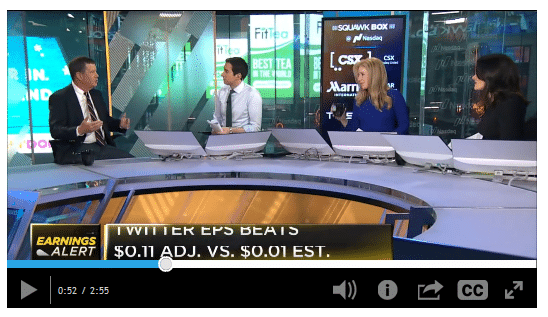
Wall Street rejoiced Wednesday about Twitter‘s better-than-expected earnings, sending its shares up sharply.
But online advertising has yet to see a “real breakthrough” that allows any other players to really compete with Facebook and Google, said Scott McNealy, former chairman and CEO of Sun Microsystems.
“It’s a pretty interesting, and tough and brutal game for anybody who’s not Facebook and not Google,” McNealy told CNBC’s “Squawk Box.” “They’re owning so much of the digital advertising space. And the space hasn’t really evolved as well, I think, as people wish it had.”
McNealy is now chairman and CEO Wayin, a digital marketing platform. When AT&T debuted the first online banner ad in 1994, it seemed promising, McNealy said. But he said that today, a minute fraction of netizens click on ads, and many of them do it accidentally.
“It’s kind of a black box, and advertisers I talk to — the big brands — are very frustrated that they don’t really know how many clicks they are getting,” McNealy said. “They’re not getting the data back.”
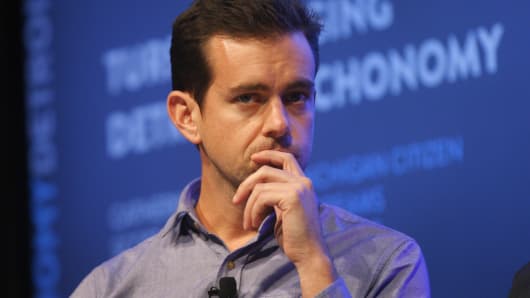
Rebecca Cook | Reuters
Jack Dorsey, CEO of Twitter and Square.
Twitter reported earnings of 11 cents per share on revenue of $548 million, better than the penny per share on revenue of about $512 million that was expected by a Thomson Reuters consensus estimate.
Its premarket stock price was more than 9 percent higher.
But overall, Twitter’s earnings and revenue are on the decline from last year, and the company’s outlook was bleaker than analyst forecasts, as the company is “phasing out less effective ad formats.”
“You have the issues with the advertisers, where they don’t trust the content on there,” James Cakmak, internet equity research analyst at Monness, Crespi, Hardt & Co., told CNBC ahead of the earnings release. “Fake users, the harassment issue. If you purge users, and make it completely verified, that would solve that problem. And secondly, you should be able to charge those users.”
Twitter has ambitions to stream live video programming all the time, according to BuzzFeed News. But so far, it has been losing steam to competitors.
Snap, newly public, is growing super fast: Revenue was $404.48 million in 2016, up from $58.66 million in 2015. And Snapchat has high engagement, especially among teens. Amazon, meanwhile, has deepened its push into “over-the-top” video content, announcing this month an exclusive partnership to livestream “Thursday Night Football.” Last year, that deal belonged to Twitter.
“Targeting was supposed to be the holy grail, but all we’re doing really is doing the same kind of advertising you see on TV: 20, 40, 60-second spots,” McNealy said. “That really hasn’t changed the game.”
Facebook’s Mark Zuckerberg has made big acquisitions and expansiveplans. Twitter, meanwhile, has seen a shake-up, with many top-level executives departing, leaving Anthony Noto as chief operating officer and chief financial officer. CEO Jack Dorsey is also at the helm of Square.
Cakmak said Twitter’s ad team may be too focused on winning TV advertising dollars.
“With a brand ad, it’s all about trying to get to a mass market,” Cakmak said. “[Twitter’s] ads and their team are mismatched with the skillset and the niche-ness of the model, which should be more direct response, highly tailored.”
McNealy said he’s working with Twitter on “brand experiences,” using chat bots or artificial intelligence to take ads in different directions, depending on the viewer.
“Experiences are where you can actually interact — it’s not, ‘Lean back and watch a video,'” McNealy said. “Everybody who is watching advertising today has a keyboard, a touchscreen, a speaker and a microphone. So now you can engage.”
— CNBC’s Julia Boorstin contributed to this report