Tag

advertisers

Browsing

By Jessica Davies.

The Economist prizes its high-quality environment, but that doesn’t mean it’s against audience targeting.

The publisher is tapping into its subscriptions data to sell acutely-targeted digital ad campaigns not only on its own platforms but also across an audience-extension network. Now, the publisher’s conversations with advertisers are pivoting toward how to use its subscriber and registration data to inform a brand’s campaign-targeting objectives whether across The Economist’s properties or not.

In some cases, that involves matching Economist data with a marketer’s data to identify potential prospects, after which the publisher will create custom prospect pools for that client. Ads can the run across Facebook and other platforms, as well as other news outlets, according to Stephane Pere, chief data officer at The Economist Group.

“We already trade our audiences on other platforms via our extended network, which was a simple pivot. This is the next iteration, where we can help brands manage their own retargeting. We can share audiences with each other and create bespoke targeting,” said Pere. A couple of initial tests have been run with existing clients, though Pere said it was too early to reveal specifics. The team is also yet to figure out a commercial blueprint for the offering, but the aim is to form more of these data-driven partnerships with clients, and provide extensive campaign optimizing and reporting, he added.

The publisher already offers brands off-site targeting for branded content campaigns created by The Economist’s in-house team. But this would be for all a brand’s activity, regardless of which entity created the content.

The Economist has made big strides in its internal data management, having further developed its cloud-based insights platform, that provides a single view of a reader, in the last six months. The platform pulls in transactional data from subscriptions, engagement and marketing channel data taken from its email communications and push notifications, and applies data science techniques to infer customer attributes based on their behaviors. The plan is to overlap that platform, with its main DMP to create smarter audience sets.

That capability, plus the lessons it has learned from its own digital subscriptions sales drives, will be packaged for clients. The publisher continuously tests different ways to drive new, and retain existing subscribers. That’s given it a wealth of data on which stages in the reader’s journey, they are likely to stay engage, and that increases retention. These are lessons it now wants to apply to its advertising business, according to Pere. “We can map target audiences at each touch point of the conversion funnel. Therefore the goal is to not just move prospects from A to B to C during a campaign, but to keep pushing them from B to C and from C to D throughout the year. We can do that for brands,” added Pere.

British national newspaper Trinity Mirror, has been exploring a similar model, opening up its first-party data to clients like Nestlé, whose agency ZenithOptimedia is working on a custom DMP comprising solely first-party audience segments from select publishers like Trinity Mirror.

“Data segments are a huge part of our planning strategies, particularly deterministic data as it adds a layer of verification in a very complex market. Knowing a user is subscribed to The Economist is of huge benefit for those of us who work on clients that are trying to target users who have a strong business interest such as Microsoft, Automotive Fleet and banking clients,” said Chinwe Mlemchukwu, digital account manager at Carat’s media buying arm Amplifi. “The Economist is a trusted premium publisher with a strong ABC1 audience and the ease of having the ability to buy via our trading desk makes for an enticing proposition. I would expect that this would have a lot of interest from many media buyers across the agency,” she added.

By Jessica Davies

Sourced from DIGIDAY UK

By

About time too: a major advertiser has become so frustrated with Facebook and Google’s limp attempts to police the content they publish that it has taken matters into its own hands. Vodafone will no longer rely on website “blacklists” drawn up by the social media titans and its own advertising agency. Instead, to prevent its ads appearing next to hate speech or fake news, Vodafone will issue a “whitelist” of sites on which it is happy for its commercial messages to appear.

The new approach is sensible. Indeed, it’s a wonder that major advertisers have been so slow to protect themselves from Facebook and Google’s failures. Vodafone spends £400m a year on online advertising. Even if 99% of that money ends up being directed to reputable sites, the other 1% can do serious damage to a brand while also generating revenue for some hideous websites.

Advertisers’ reluctance to take the initiative may stem from two factors. First, the worry that drawing up “whitelists” and employing human judgment is a more expensive way to advertise. Second, a sense that Google and Facebook’s machines are too big and powerful to challenge.

Vodafone, let’s hope, has shattered both ideas. Yes, it’s a big advertiser that can afford to carry a few extra costs but it is surely right when it says algorithms, designed to carve up demographic categories, are simply not up to the job of making editorial judgments. It also seems to have little difficulty in laying down the new terms of trade to Google and Facebook.

Other advertisers should follow Vodafone’s lead – and, if not, explain why they’re happy to turn a blind eye when even small portions of their advertising budgets end up funding some of the internet’s most gruesome offerings.

Shawbrook would be better going private

Shawbrook is the challenger bank that has been a challenging investment at times for its shareholders. Floated at 290p in 2015, the shares fell as low at 130p a year ago after the referendum result – Brexit was deemed by the market to be unhelpful for UK buy-to-let lenders. Then came Shawbrook’s confidence-rattling revelation of lending “irregularities” in one division.

In the circumstances, you might have expected the board to embrace the takeover approach from Pollen Street, already a 38% owner, plus fellow private equity house BC Partners. That was the way the plot seemed to be heading when Shawbrook agreed to open its books. But the board has now rejected four offers, deeming the bidders’ final pitch at 340p a share, or £868m, to be an undervaluation.

One admires the independent directors’ determination to squeeze Pollen Street for every last drop of value. In the end, however, resistance is likely to be futile since acceptances are already 45% and many of the other shares are already in the hands of arbitrage funds who are only there for the final bump in the bid. The real question is whether the bidders manage to pass 75%, at which point Shawbrook would be delisted.

It would be a shame to see the ranks of quoted challenger banks depleted. But, actually, Pollen Street and BC make a fair point. The strength of the Brexit storms are unknowable for specialist lenders and may be better combated away from a public market that tends to demand lending growth in all circumstances.

It’s possible that Shawbrook, whose returns on equity have been strong when it has avoided cock-ups, will sail through happily. But the bidders aren’t making a risk-free bet. It’s probably best to let Shawbrook go private.

Bailey stays on trend at Burberry

The annual report would have been a good place for Burberry to explain what on earth the job of “president” involves. Christopher Bailey, the outgoing chief executive but continuing chief creative officer, will have presidential status from next month but the demands of the role remain obscure.

The “evolved structure”, which will see Marco Gobbetti become chief executive, “will allow me to redouble my focus on design for this next phase, and on making products and telling stories that inspire our customers”, Bailey tells shareholders in the report. But isn’t all that designing stuff covered by the creative gig?

Maybe the un-corporate title is just there to remind everyone who is really boss. The remuneration arrangements suggest the same. Bailey, who has just picked up £10.5m as a delayed retention bonus, will be able to earn an indicative maximum of £7.6m in the coming year. Gobbetti will be chasing a whisker less at £7.3m.

A difference of £300,000 is a rounding error at those levels, of course – but maybe it simply wouldn’t do for the president to be denied bragging rights.

Image: Vodafone: flying ahead of rivals with its new advertising policy. Photograph: Toby Melville/Reuters 

By

Sourced from The Guardian

By

  • “It’s a pretty interesting, and tough and brutal game for anybody who’s not Facebook and not Google,” tech exec Scott McNealy says.
  • He says only a minute fraction of netizens click on ads, and many of them do it accidentally.

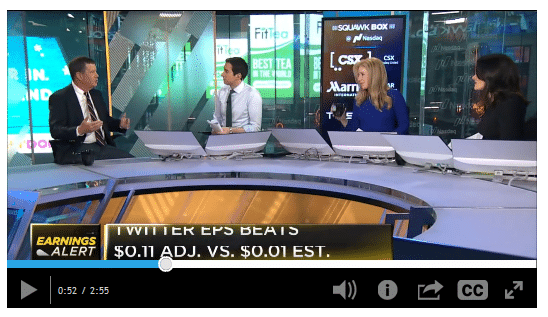
Wall Street rejoiced Wednesday about Twitter‘s better-than-expected earnings, sending its shares up sharply.

But online advertising has yet to see a “real breakthrough” that allows any other players to really compete with Facebook and Google, said Scott McNealy, former chairman and CEO of Sun Microsystems.

“It’s a pretty interesting, and tough and brutal game for anybody who’s not Facebook and not Google,” McNealy told CNBC’s “Squawk Box.” “They’re owning so much of the digital advertising space. And the space hasn’t really evolved as well, I think, as people wish it had.”

McNealy is now chairman and CEO Wayin, a digital marketing platform. When AT&T debuted the first online banner ad in 1994, it seemed promising, McNealy said. But he said that today, a minute fraction of netizens click on ads, and many of them do it accidentally.

“It’s kind of a black box, and advertisers I talk to — the big brands — are very frustrated that they don’t really know how many clicks they are getting,” McNealy said. “They’re not getting the data back.”

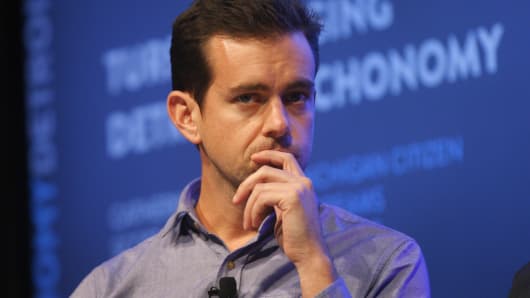
Jack Dorsey, CEO of Twitter and Square.

Rebecca Cook | Reuters
Jack Dorsey, CEO of Twitter and Square.

Twitter reported earnings of 11 cents per share on revenue of $548 million, better than the penny per share on revenue of about $512 million that was expected by a Thomson Reuters consensus estimate.

Its premarket stock price was more than 9 percent higher.

But overall, Twitter’s earnings and revenue are on the decline from last year, and the company’s outlook was bleaker than analyst forecasts, as the company is “phasing out less effective ad formats.”

“You have the issues with the advertisers, where they don’t trust the content on there,” James Cakmak, internet equity research analyst at Monness, Crespi, Hardt & Co., told CNBC ahead of the earnings release. “Fake users, the harassment issue. If you purge users, and make it completely verified, that would solve that problem. And secondly, you should be able to charge those users.”

Twitter has ambitions to stream live video programming all the time, according to BuzzFeed News. But so far, it has been losing steam to competitors.

Snap, newly public, is growing super fast: Revenue was $404.48 million in 2016, up from $58.66 million in 2015. And Snapchat has high engagement, especially among teens. Amazon, meanwhile, has deepened its push into “over-the-top” video content, announcing this month an exclusive partnership to livestream “Thursday Night Football.” Last year, that deal belonged to Twitter.

“Targeting was supposed to be the holy grail, but all we’re doing really is doing the same kind of advertising you see on TV: 20, 40, 60-second spots,” McNealy said. “That really hasn’t changed the game.”

Facebook’s Mark Zuckerberg has made big acquisitions and expansive plans. Twitter, meanwhile, has seen a shake-up, with many top-level executives departing, leaving Anthony Noto as chief operating officer and chief financial officer. CEO Jack Dorsey is also at the helm of Square.

Cakmak said Twitter’s ad team may be too focused on winning TV advertising dollars.

“With a brand ad, it’s all about trying to get to a mass market,” Cakmak said. “[Twitter’s] ads and their team are mismatched with the skillset and the niche-ness of the model, which should be more direct response, highly tailored.”

McNealy said he’s working with Twitter on “brand experiences,” using chat bots or artificial intelligence to take ads in different directions, depending on the viewer.

“Experiences are where you can actually interact — it’s not, ‘Lean back and watch a video,'” McNealy said. “Everybody who is watching advertising today has a keyboard, a touchscreen, a speaker and a microphone. So now you can engage.”

— CNBC’s Julia Boorstin contributed to this report

By

Sourced from CNBC