Tag

advertising

Browsing

A new study published in the journal Communication Research shows that specific communication tactics used in advertorials are very persuasive. But why they are more effective than traditional advertisements?

The investigation, which looked specifically at health advertorials, showed that advertorials, or “native advertisements” are actually far more persuasive than even ad agencies thought they were.

Advertorials, or advertisements camouflaged as credible news, succeed in misleading people, in part, by damping down skepticism and expectations for truth in advertising. The study was undertaken at Dartmouth College-Stanford University.

The fact that advertorials are so successful has led to complaints, and then a crackdown. Over in the U.S., the Federal Trade Commission last December issued guidelines on native advertising intended to prevent customers from being deceived. The guidelines suggest using a clear label of “advertisement” and placing disclosures in front of or above the headline. So, while the Americans are having a meltdown, the rest of the world is wondering whether their own governments will meddle with advertising rules.

Advertorials are not new. Infomercials and other “blurring practices” between editorials and advertising first appeared as early as the late 1940s in television and print media, and the volume and revenue of blurring practices of advertising are increasing. But until now it was it not clear how advertorials create favourable marketing environments for advertisers, and how readers process advertorials.

The Dartmouth-Stanford study found that advertorials were less likely to trigger consumer awareness of persuasive intent, especially when the “advertisement” label was not present.

“Unlabelled advertorials, compared to labelled advertorials and regular advertisements, were less likely to trigger consumer awareness of persuasive intent, and increased favourable attitudes toward advertising messages and purchase intention,” says lead author Sunny Jung Kim. “Because of their design and structure, advertorials tend to sway readers into believing that they are viewing credible information in the form of an editorial or news source.”

Participants in their experiments exhibited more positive attitudes toward advertorials than they did toward traditional advertisements due to advertorials’ unique structure, which, in turn, increased their willingness to purchase advertised products.

“This form of advertising appears to be on the rise as advertisers try to embed their ads in the stories we read and the photos we see in almost every platform of social media,” said co-author Jeff Hancock, a professor of communication at Stanford University. “Understanding how these advertorials operate cognitively can improve guidelines for the prevention of misleading or confusing consumers.”

Kim adds: “Until now, there has been no empirical evidence that has tested the core elements of persuasion tactics in advertorials, namely their unique structure and labelling and its impact on information processing. These advertising tactics are pervasive across various forms of media, from newspapers and magazines to social media. Our findings have broad implications for health researchers, advertisers and consumers.”

For those of us that think that advertorial is a perfectly viable way for advertisers to reach their target markets? Rock on, while we can. At least we know it works.

By Stuart Heritage.

The baked bean maker has had to can its ad after the ASA said kids could be harmed by drumming on beans tins. Where was the watchdog when the Hofmeister bear was on a boozy rampage?

The Advertising Standards Authority has banned the new Heinz Beanz advert – in which a succession of people tap out an Ed Sheeran-ish tune on empty cans – on the basis that children might mimic the commercial and cut off their fingers on a jagged scrap of metal. However, it is by no means the only “dangerous” ad. Here are some well-known ads that would no longer make it past health and safety.

John Lewis, 2016

A dog bounces on a trampoline, as happy as can be. However, several animal welfare campaigners have condemned the ad, pointing out the range of injuries and stress that trampolines can cause animals.

Proposed change: Advert now ends with the dog splayed out on the trampoline, howling in pain, while the father gingerly attempts to remove him with a shovel.

Muller Püd Corner, 2015

Nicole Scherzinger becomes so lost in the reverie of her delicious yoghurt that she topples backwards off a chair, laughing adorably. However, the NHS last year treated 13,000 people who suffered chair-related injuries.

Proposed change: Advert now ends with Scherzinger semi-conscious and bleeding, while a man in a bowler hat screams to camera: “Chair safety is not a joke!”

Cadbury’s Dairy Milk, 2007

A lone gorilla sits behind a set of drums, preparing to play along to In the Air Tonight by Phil Collins. However, fast-forwarding to 2016, the shooting of Harambe in Cincinnati zoo highlights the dangers posed to humanity by gorillas.

Proposed change: One second before the gorilla’s big fill, he is riddled with bullets. New slogan reads: “Dairy Milk – We just saved you from being mauled to death by this atrocity of nature.”

Hofmeister, 1981

A bear in a hat has a lovely time drinking beer in a pub. However, alcohol consumption in animals can lead to vomiting, weakness, hypotension, coma, hypothermia and death.

Proposed change: Advert now ends with a doctor informing a female bear and two cubs that the Hofmeister bear isn’t going to make it, and everyone sinking to their knees in horrified despair.

Apple, 2007

Paul McCartney walks down the middle of a road, playing a mandolin and singing Dance Tonight, which made it to No 26 in the UK charts. However, on average, one pedestrian dies on British roads every day.

Proposed change: After a line and a half of the song, McCartney is hit by a distracted driver. As he dies in the road, the ghost of Steve Jobs appears before him and barks: “Heaven isn’t real!”

R White’s Lemonade, 1973

A man sneaks downstairs in the dark at night to get a glass of his favourite carbonated beverage. However, this week, Cancer Research UK underlined the dangers of consuming too many sugar-packed fizzy drinks.

Proposed change: Advert is altered to show a man sneaking downstairs at night to prepare a fresh kale salad for himself. When confronted by his wife, he yells: “It’s kale! I’m going to live for ever!” Then he turns to camera and shouts: “EAT CLEAN!”

By

Sourced from The Guardian

By Jose Vilches.

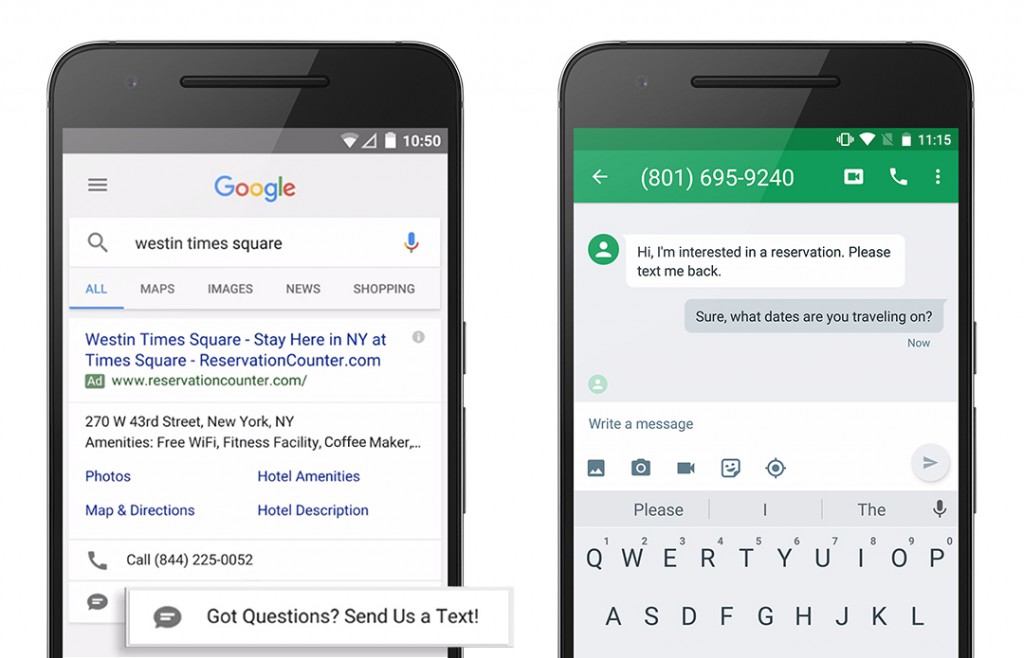
Messaging can be a very effective tool for generating leads and turning them into sales as more and more people choose this method to communicate with brands. Not one to miss on a trend, Google is rolling out a new click-to-message option in AdWords search ads.

The new feature works through an ad extension that advertisers can enable within their AdSense accounts and relies solely on SMS — as opposed to popular platforms like WhatsApp, Facebook Messenger or Google’s own Allo. Tapping on the texting option in an ad launches a user’s SMS app with a pre-written message tailored to the product or service they’re interested in. For example, if you’re a travel advertiser and someone messages you after searching for New York City hotels, they can send or edit your pre-written message text, “I’m interested in a reservation. Please text me back with more information.”

Google says 65% of consumers would consider using messaging to connect with a business to get information about a product or service.

Facebook is also ramping up its own Messenger client as a customer service platform and is known to be working on a similar click-to-message ad product. Meanwhile, WhatsApp, which is also owned by Facebook and has over a billion monthly active users, has confirmed it will begin to integrate businesses services into its app before the end of this year.

The new option gives advertisers a faster way to connect with consumers on mobile and increase conversion rates. It’s also good for who’d rather avoid being put on hold, listening to a list of menu options and waiting to get transferred to a human being.

By

Sourced from TECHSPOT