Yesterday, Google revealed more details on its plans to bake some ad blocking features into its Chrome browser next year, and the reaction, at least on social media, was predictably fierce.
Here comes the digital ad bully, throwing its weight around. Of course Google is doing this, not because it wants to help the ad industry, but because this serves Google. And look at the hypocrites at Google, paying one ad blocking company (Eyeo) while pledging to stamp out ad blocking for all.
The knee jerk reaction is predictable. After all, Google has a well earned reputation for using its clout (like pushing some advertisers to use its ad tech to buy ads programmatically).
But what if Google isn’t being evil in this case?
In explaining why Chrome would block certain ad types dubbed to be “annoying” to consumers, such as videos that automatically play with the sound on or ads that keep people from content until a countdown clock ticks down, Google’s direct of product management Scott Spencer pointed out to Business Insider that some web browsers have long blocked pop-up ads. Which raises some questions:
Anybody lamenting the non-democratic nature of arbitrarily blocking all pop-ups?
Has the digital ad economy survived the lack of pop-up ad inventory?
It’s dangerous to be naive when it comes to Google. These guys tend to be smart and see around corners, and focus on doing things that are good for Google. But is it outside the realm of possibility that in this case the company may be wielding its massive power for good, because it actually wants the digital ecosystem to thrive? After all, Google probably wins either way.
The company seems to be trying to making some gestures to cater to other media companies’ interests. As the Wall Street Journal reported, Google is giving publishers lots of time to prepare. And it even wants to help publishers make money from people that block ads, per the Financial Times.
To read more about Google’s point of view on ad blocking, click here:
Social media marketing is currently a very popular practice for businesses. But it isn’t all success and roses. A recent Temple study shows that businesses must find a proper balance in order to avoid negative results. So for businesses who currently rely on social media marketing to attract new customers, listen up.
While the potential for social media marketing seems almost limitless, a study led by Ph.D. candidate Shuting Wang and senior associate dean of research Paul Pavlou reveals the exact opposite. The Temple professionals recently conducted a study which looked to determine the specific value of social media marketing in relation to data from WeChat and a Chinese shoe retailer.
The study revealed that while social media advertising had a positive impact on increasing customer sales in the short term, it actually created a negative impact on the business in the long term.
When looking at the specific figures, the business witnessed a 5% increase in sales on the same day following a social media post. However, this same post increased the chance that customers would unfollow the business by 300%. Within five months, the retailer experienced a 5% decreased in sales paired with a 20% loss of online followers within a year.
With regard to these findings, Shuting Wang notes that people often “get annoyed” by a company’s post in the long term compared to the short term. “In that case, they will unfollow, which will lead to a long-term decrease in purchases,” Wang said.
Researcher Paul Pavlou believes this phenomenon can be contributed to the way in which companies often “over-do” social media.
“They see that the more posts they put out there, the more sales they’re going to see,” Pavlou notes. “Companies should be more careful with this and focus more on their long-term goals. Social media marketing is so quick, so immediate that companies say, ‘Well, let me leverage this as much as possible in the short term,’ and they may actually miss the big picture.”
While the study findings support the idea that too much social media advertising can hurt a company’s sales production, there are contextual factors which also play a role. Professor Paul Greenwood notes that these factors include, “What time of day it is, and where people are located.” In addition, the professor notes that people in large cities “Unfollow a lot faster…and if you post during rush hour, people unfollow a lot faster, but if you post at off-peak hours or smaller locations, that effect seems to go away.”
While the full extent of social media marketing trends have yet to be identified, Greenwood believes that future research will look to address whether dissatisfied customers go to competing firms or simply stop purchasing in general. This information will drastically help businesses fine-tune their social media strategies going forward.
While the Temple study revealed the potentially harmful effects of social media advertising, it is important to note this only took place when attempting to sell products. Businesses who have a balanced social media approach, or one which incorporates potential sales with public relations, are much more likely to create productive customer relationships in the long run.
For some interesting case studies on this topic, click here.
In an age where digital media is constantly changing, public relations practitioners and business professionals still see the benefits of traditional media coverage. This is according to study conducted by researchers at the University of Georgia.
The study finds those who use news sources to convey certain information about their products prefer independent media coverage.
Lynne Sallot is a professor of public relations of Journalism and Mass Communication. She says, “We have this intuitive idea that getting our messages covered by the news media makes those messages more credible than when we put them out there ourselves. Everyone believes this, but it’s been difficult to prove it.”
Independent media coverage is a more traditional form of news content like a TV broadcast, newspaper article or radio show, whereas more controlled sources of media are paid media such as advertisements or an organisation’s own website.
Pauline Howes is an associate professor of communications, and conducted the research. She says, “When asked directly, public relations practitioners and businesspeople in this study said they see independent media coverage as more credible than controlled, or paid, media. This seems to support the value of news coverage as part of a communications plan.
“Both types of communication are used by businesspeople, but an independent source may be viewed by audiences as having more credibility because it is not controlled or influenced by the subject of a story.”
When determining what goes into a business’s story, the editors and producers behind these independent news sources have no vested interest in the company or its products.
Differing from past experimental studies, this research looked at real world perceptions by interviewing public relation practitioners as well as business professionals.
Says Sallot, “There is some truth that to some audiences, messages covered by the media are more important. Until now, most of the research has suggested that that’s not true.”
Because of the conducted interviews, Howes and Sallot were able to get more personal feedback from those in the field. This study supported the belief that corporate/ PR messages that are carried by news media do have enhanced news credibility.
Advertising is strangling the web, and that may have to do with the declining value and lack of transparency associated with the players that dominate it. (Image: Anders Emil Møller / Trouble).
The problem with advertising data and what to do about it. Plus, the future of big data architecture, and other stories from the Ad Tech trenches.
The greatest minds of this generation are wasted on advertisement. Or at least, that’s what someone who has been there and done that thinks. Like most successful aphorisms, this raises eyebrows, drives heated discussions, and strikes a point or two.
Marketing and advertising have enormous influence on society at large — business, technology, media, culture, and data. So, discussing with people working on the intersection of those can offer some insights on the state of the union of Big Data and Ad Tech.
Advertising is big, and so is its data
Advertising is a multi-billion dollar business that has been going through the process of digital transformation for a couple of decades already. Some of today’s most advanced, powerful, and influential companies have advertising embedded in their core.
A good part of the innovation that has been driving big data has come about as a response to the needs of advertising at scale before getting a life of its own. MapReduce, for example, the blueprint for Hadoop’s first incarnation, was originally developed and deployed at scale at Google.
Mike Driscoll, CEO of Metamarkets, points out that marketing is being digitally transformed and marketers are following suite. Metamarkets is part of the Ad Tech wave, and its core business is to provide marketers with insights on their digital presence.
“The future will be digital,” Driscoll says. “CMOs (Chief Marketing Officers) are turning to CMTOs (Chief Marketing Technical Officers). But as marketers are going digital, they are also starting to have less trust in some of the channels they’re buying from. Investing in technology means they are now able to hold their partners accountable.”
The findings of the survey show that almost half of the brands using programmatic media buying believe lack of transparency is inhibiting its future growth and scale. But what do we talk about when we talk about transparency here?
The advertising pie may be growing, but the growth is driven by a duopoly. (Image: Jason Kint)
It’s not hard to see where this is going: Google and Facebook dominating the market and dictating their terms. This presents a problem for all parties involved. For media, depen
dence on advertising translates as dependence on the Big Two. Media are trying to find ways to cope and come up with new models of doing business while maintaining their editorial independence.
For consumers, the ever-increasing volume of advertising means they are constantly bombarded by a barrage of ads. They are told that this is the price they have to pay for having access to free content, and to a certain extent, it is true. The problem is that more and more advertising is strangling content, consumer fatigue is taking over, and the value and effectiveness of advertising is dropping.
Obviously, this presents a problem for advertisers and their clients. “Marketers want more transparency. They would like to get a receipt for what they buy, instead of a powerpoint and a good story,” Driscoll says. “Brands are asking from their partners to provide better analytics. Historically, channels have been providing results, but not analytics on the results.
Digital transformation means that we don’t just buy goods anymore, we also buy data about the goods. Take AWS, for example: When they started, they just provided the service, but by now, you also get analytics to go with it. Major channels need to invest more not just in internal technology, but also in providing better data access to their partners.”
The big guys will just not share
But, seriously, this is Google and Facebook we’re talking about. Are we to believe that the most iconic data-driven organizations in the world can’t make the right data available to marketers? “Ask any marketer and they’ll tell you — the big guys will just not share. It’s not in their interest to be transparent, but rather to be as less transparent as possible,” Driscoll says.
Almost half of brands being advertised see lack of transparency as a problem. Image: MetaMarkets
So, what can be done to deal with this? The real power of marketers is the power to check them, according to Driscoll. “If you look at the leaders emerging in Fortune 500, the next generation of marketers are technologists, and they are demanding independent audits and data. Consider this:
For a long time, advertisers wanted to know if their ads were viewed or not. Facebook says, ‘OK, we’ll measure it ourselves.’ And they got away with it for a while. They reported their own view-ability stats, just like NBC used to report how many people viewed their own shows.
That does not mean Facebook and Co., will give away all of their data — you also have to consider privacy issues here. But when you talk to brands, even though they will not say that in public, they are actually doing that. When you have budgets in the tends of millions, you can do that — pull data out and do what every marketer would like to do: Build a unified view over their channels.”
“We’ve been hearing rumours about the Congress getting involved, but for most businesses that would be the last resort. It’s not the ideal solution for marketers or media companies, especially considering the all-time low approval ratings in the US right now,” Driscoll says. For him, the answer is in marketers investing more in analytics.
On the one end of the continuum, organizations can do it all themselves, using infrastructure like Hadoop and analytics tools that sit on top and can help them collect and analyze the data they need. On the other end, Metamarkets touts itself as the right solution for marketers.
Metamarkets is a domain-specific solution that builds on four pillars: Fast data exploration, intuitive visualization, collaboration, and intelligence. Driscoll elaborates: “Scale is a requirement, and we are quickly moving towards streaming events and data.
Interactive visualization helps you understand what’s going on. You need more than dashboards. Dashboards may update, but the questions they answer stay the same. You need collaboration — like Slack for data, that helps teams communicate and share methods and insights.
And you need intelligence. In analytics, you spend 80 percent of your time preparing data and 20 percent actually doing analysis. We have ETL connectors for a multitude of platforms that help get the data where you need them. Plus, it’s one thing to show data, and another thing to search for insights.”
Metamarkets tries to look at what analysts do and automate that to suggest root causes. For example, a campaign running behind targets is something that can be monitored using metrics. But to get to the reason why this is happening, an analyst would slice and dice data per region or demographics.
Metamarkets says they can automate this process and suggest root causes, evolving from tracking statistical significant signals to deriving business-focused insights. “We let analysts specify metrics they are interested in, and then perform root cause analysis for them. We believe in machine and human working side by side, not in replacing analysts, but in giving them super-powers,” Driscoll says.
Data at advertising scale and the future of pipelines
As Metamarkets has been on the forefront of data at advertising scale, and Driscoll himself has served as its CTO, he shared some insights on the evolution of big data architecture: “We have been pushing the limits of scale, so we encounter problems before others do,” he says.
This has resulted in MetaMarkets developing and releasing Druid, an open-source distributed column store. “We created Druid because we needed it and it did not exist, so we had to build it. And then we open sourced it, because if we had not, something else would have come along and replaced it.”
MetaMarkets has been evolving its data pipeline, but still not turning to Kappa architecture on the grounds that its clients are not ready for it. (Image: MetaMarkets)
“We have the largest deployment in production, and we love being part of the community. Druid is used by the likes of Airbnb and Ali Baba. But we have no plans of building a business around it. We don’t believe the future is around data infrastructure, which is becoming a commodity, and we don’t want to be competing against the Googles of the world there.
Sure, this may be working for companies built around Hadoop, but commercialization of open source needs widespread adoption to succeed. But I can tell you that Cloudera and Hortonworks are looking to add Druid to their stack and to the range of services they offer.”
Driscoll does not believe in horizontally expanding Metamarkets, even though its experience in building data pipelines at scale could in theory be applied to other domains beyond advertising. Its own pipeline has been evolving, going from Hadoop to Spark and from Storm to Samza.
“Spark is more mature and it meets our needs at this point, and we also feel about the same way about Samza,” he says. “But we see streaming as the future of our pipeline. When you work with streaming, there’s a sort of CAP theorem equivalent that applies there.
In distributed data stores, you have consistency, availability and partition tolerance, and you can pick two of those that your system supports simultaneously. In streaming data, you have accuracy, velocity, and volume, and your system can only support two of those simultaneously.
This is why we think the model supported by Apache Beam, Google Data Flow, and Apache Flink will be key going forward. When streaming at scale, there’s no such thing as objective truth, so you have to rely on statistical approximation and on using watermarks.
Do we see our current Lambda architecture giving way to a flattened, Kappa architecture? When you work on the bleeding edge of real-time architecture, the ability of organizations like Metamarkets that are in the business of integrating data from other sources is important.
But when it comes to other companies, not many are yet at the point where they can stream data out. Only the most sophisticated, agile companies out there are able to do this. At this point, only about 50 percent of our clients are there.”
I wonder how today’s marketers would handle possibly the greatest ad agency creative chief of all time, the late great Paul Arden of Saatchi & Saatchi London, who allegedly locked all the footage from a TV shoot in a safe to stop the client changing it. As far as I know, it remains in that safe today.
Oh, and by the way: that was one of Arden’s lesser stunts.
Creative brilliance and weirdness go hand-in-hand — sadly for our ever-increasingly corporatized ad agency industry.
Psychology discusses creativity in terms of “cognitive disinhibition,” where “normal” people have a distinct barrier between the conscious and the unconscious and “abnormal” people have little or no barrier, leading to something called “flight of ideas,” the principal symptom of schizophrenia.
In between are rare individuals whose barrier is, let’s say, faulty, allowing a certain amount of “slippage” between conscious and subconscious.
This manifests itself by rendering that person not entirely fixed on the matter at hand, but also visited by attendant, peripheral, different thoughts.
When accompanied by a strong intellect, this person can harness these subconscious thoughts into a different, creative level of thinking.
Some can even create the regular ability to have so-called “Eureka moments,” laterally solving problems that others can only approach one-dimensionally.
Needless to say, these people – let’s call them creative talents – often come with other non-conformist behaviors. While no way mentally unstable or pathological, these people nevertheless have an extra “headfull” of thoughts and stimuli, a circumstance that can make them act differently.
It can make them weird.
Indeed, when I met and spent an hour or so with Google cofounders Larry Page and Sergei Brin (not a humble brag, just an out-and-out brag), the first thing that struck me and the other eight or so non-Googlers with me was how totally and utterly they didn’t fit any kind of normal corporate template. For a start they were fresh-faced youths and wore tee-shirts. One wore Crocs.
Compare to the one time I took off my suit jacket once in an ad agency holding company board meeting and got ribbed mercilessly by the CEO and others on the fact that I was wearing a short-sleeved Lacoste shirt.
We haven’t even got to the inner person yet and already the mere clothing is being frowned upon — jokingly, yes, but the true thinking was clear.
I guess I can imagine this being a thing at the client end, but at the ad agency end? At what point did ad agency clients start coming to us because we’re the same as them? Never, I would guess. But somewhere along the line (perhaps it was pitch “chemistry” sessions?) agencies came to believe that the best way to win was to look, sound, be like the client.
I can think of no greater killer of ad agency self-respect and, eventually, reputation — as evidenced by the deluge of clients seeking “creative second-opinions” outside their agencies of record.
My experience with ad agency HR is that, bizarrely, their remit is to ensure homogeneity. A corporate construct that agencies copied from their clients in the first place, HR’s big smokescreen is their role as protectors of culture (another corporate construct).
In ad agencies, culture is the new religion — as in the Marxist sense of “the opium of the masses.” It’s a tool to regulate behavior — which is directly in opposition to diversity. The entire point of diversity is to ensure differing behaviors and viewpoints.
Temperamental and intellectual homogeneity seems to me to be utterly inimical to any ad agency statements about their so-called commitment to diversity.
Unless of course, the diversity they have in mind doesn’t include diversity of opinion or behavior, in which case what’s the point? Optics? Numbers? Experience suggests that the latter is precisely what agencies have in mind.
Mark Wnek is a creative crisis manager for clients and ad agencies. His primer “10 Steps To Radically Improve Your Creativity Nipples” will be available later this spring.
When I last worked in the ad industry, George W. Bush was president, tweets were something you heard in the park and Yahoo was – actually, Yahoo was the same in 2007 as well.
I left the business and went off to work in new product development, occasionally sitting in the same meeting rooms as my client’s ad agencies, and generally not paying a lot of attention to their presentations. Sorry.
Last year I started to get interested in ad land again, as I read more and more about programmatic advertising. In the NPD game, we’d been using clever algorithms to predict consumer behaviour for years. Wow, I thought. Now you can crunch all that data in real time on the viewer of any ad, you could do some truly amazing things. Agencies must be all over it.
My own online experience told me that maybe agencies weren’t. The same ad for a Garmin watch had been following me for a week. The same ad, whether I was on Facebook where I chat with friends, on Wired where I read about technology, or on Twitter, where I scream into the abyss. All that data about who I was, what I was doing or what platform I was on: clearly, none of it was affecting the ad.
I started to talk to friends who worked in programmatic. Most ad agencies, it seemed, were not interested in the data. Instead, they were just tossing stills from print and TV campaigns over the fence and asking the media companies to make them work online.
Why, I asked. Dunno, said the programmatic dudes, we can tell them 5,000 things about a single page view, but they don’t use any of it.
Five thousand things! I doubt I know 5,000 things about myself. My 10 years geeking out on vast amounts of data has taught me that 5,000 results are as good as none. Two are too few. Four to six – those I can work with. I wondered how my old friends who’d stuck it out in ad planning were doing. I asked a few of them, from global ad agencies to a couple of hot shops, to send me a blank briefing form from their agencies.
What is the brand’s tone of voice? What is the single most compelling message we can tell them? What supports this? I had to rush up to a few people as if I were Dr Who. I grabbed them by the lapels. What year is it? I asked in rising panic. It felt like I was back in the early 90s, when there were five TV stations in the UK and a bunch of poster sites at roundabouts.
Back then, when you had two campaigns a year at News at Ten and some slots in the Sunday supps, it was completely fine to bang away at being the ‘ultimate driving machine’ in the same Teutonic tone. Nobody got too tired of it. But when I wake up to your brand on Facebook, and scroll past it on Twitter, and see it on Instagram… it just comes across as repetitive.
Yet there are brands that are thriving online, both big and small. They’ve realised that it’s more important to be multifaceted than monotonous, to be surprising rather than consistent. Take Taco Bell, a chain that’s gone from being dubbed ‘Taco Hell’ five years ago to Gen Z’s default hangout. Its social media takes a lot of credit for this: it’s beautiful on Instagram, bitchy on Twitter, inspiring on its website, and its $40,000 TacoBot has already taken $10m in orders on Slack.
Movember has become a global movement online, rising from two Aussies in a pub to a phenomenon that’s raised over $300m. Their messages cover prostate cancer, male suicide and facial hair grooming tips. Their Facebook posts are funny, tear-jerking, surreal, handy, thrilling and heartwarming. Clearly nobody ever showed them an ad agency brief.
Nike, Rude Health Cereals, Victoria’s Secret even Victoria Beckham all seem to have discovered a way to thrive online, one that’s a million miles away from the USP or ‘brutal simplicity of thought’. They’re all multifaceted personalities, and they adapt their tone of voice to their audiences’ moods. Data allows you to do that, if you use it intelligently.
Last year, I teamed up with Torie Chilcott, one of the gods of programmatic advertising, to systematise the process. We started crunching data on what people loved online – not advertising, just… everything, from kittens to TED talks. This led us to a startling conclusion. There are dozens of kinds of content that people love, but they have four broad types. (Remember how I said you can work with four to six data points? Here they come…)
Great online content is either funny, useful, beautiful or inspiring. Great online brands do all four of those things. Victoria’s Secret is hilarious on Instagram. Rude Health is angry and ranty on YouTube. They bring surprise instead of consistency, and match their tone to the platform, rather than expect their audience to change emotional gear.
Data can help you broaden a brand’s emotional appeal. Our data shows that young women in London tend to find grandiose things beautiful, laugh hardest at dark humour and value authoritative opinion. BMW drivers aren’t inspired by social good or anything heartwarming. (Don’t you love it when the facts confirm your prejudices?) Data can also tell you where they’ll be most receptive to each of those tones of voice. To become a multifaceted brand, you’ll need to start thinking in a new way, at that 90s ad brief really isn’t going to help you.
Here’s the questions we think your brief should be asking.
If you can’t answer them, you can’t expect to sync with your audience’s emotions online.
We need 4 executions, not one.
We need to find our brand’s funny, useful, beautiful and inspiring.
Funny
What makes our target audience laugh?
How does that humour connect to our brand personality?
Inspiring
What kind of voice does our audience stand up and follow?
What in our brand could create that kind of rallying cry?
Useful
Where do our target audience go to learn?
What makes them lean forward and how can we learn from that?
Brian Millar is co-founder of the Emotional Intelligence Agency, a communications planning company that maps consumers’ emotional lives online. Follow him on Twitter @arthurascii
Instagram continues its surge in generating advertiser interest while Facebook remains the dominant social platform. This is according to a first quarter survey of advertising agencies conducted by Strata.
The survey also found a continued multi-quarter decline in YouTube’s lead over Instagram, bringing the two within one point of each other in advertiser interest. 54% of agencies report plans to use YouTube against 53% for Instagram. Facebook remains entrenched in first place as 95% of agencies are interested in the platform. Twitter, which historically held third place in agency interest until the second quarter of 2016, continues its slide with interest from 37% of agencies, finding itself just 10% above fifth-placed LinkedIn.
The interest in these social platforms is reflected in agency spending, as well. 93% percent of agencies are currently spending money on Facebook, with 53% planning to spend on YouTube, and 49% planning on Instagram. The current spend lagging behind agency interest could indicate increased spend in the coming quarters.
More than half of agencies now plan to spend more than 5% of their overall advertising budgets on social media, with 22% allocating between 11-25% of their budgets on social, compared to 18% in 4Q16. The increase in budget for paid social coincides with the proliferation of live streaming tools, such as Facebook Live and Snapchat Live as 42% of agencies report that clients were interested in these innovations for their campaigns.
“Though Facebook has remained the dominant player in the social media space, the gradual shifts in focus to other platforms has been interesting to watch. There’s always been a premium on live, so it’s not surprising that agencies have an interest in exploring Facebook Live, Snapchat’s Spectacles, and Instagram’s Stories,” said Judd Rubin, senior vice president at Strata.
When agencies were asked which form of media they prioritised the most, 24% reported that digital video was their primary focus. Although that leaves digital video in second, behind local TV and cable at 36%, the interest in digital video has seen a 351% increase over the past year.
The rise in interest in digital video may be surprising in light of the fact that agencies appear split on the effectiveness of digital video. Twenty-five percent feel that it can be as effective as traditional TV, but 33% feel it isn’t, and 42% are unsure. When asked more broadly about perceived ROI from digital video, over 50% felt fairly confident that they were getting good value for their money. Forty-one percent noted they were unsure, and only 9% of agencies felt they were not getting a strong ROI.
If the advertising industry doesn’t find a way to measure performance accurately and consistently, Proctor & Gamble’s threat to pull spend from digital advertising will be just the tip of the iceberg, warns Kantar Media.
According to a new international study by Kantar Media examining consumer and industry attitudes to advertising, there is a lack of consistent, comparable measures to understand the audience and gauge the effectiveness of advertising.
This is a “significant concern” for those working in the industry, said the report. “Unless consistent metrics across traditional and digital channels are developed, industry growth will be put at risk.”
The report, Dimension, was based on interviews with 5,213 adults, with access to the internet, across the UK (1,035), the US (1,014), China (1,067), France (1,000) and Brazil (1,097)
The study claims to have found that brands are still unable to consistently measure the impact and effectiveness of advertising from channel to channel, and from market to market.
This risks alienating consumers are 71% of respondents said they saw the ads over and over again, finding them too repetitive. “Over-targeting on digital platforms threatens to undermine brand marketing efforts,” said the report.
According to a new international study by Kantar Media examining consumer and industry attitudes to advertising, there is a lack of consistent, comparable measures to understand the audience and gauge the effectiveness of advertising.
This is a “significant concern” for those working in the industry, said the report. “Unless consistent metrics across traditional and digital channels are developed, industry growth will be put at risk.”
The report, Dimension, was based on interviews with 5,213 adults, with access to the internet, across the UK (1,035), the US (1,014), China (1,067), France (1,000) and Brazil (1,097)
The study claims to have found that brands are still unable to consistently measure the impact and effectiveness of advertising from channel to channel, and from market to market.
This risks alienating consumers are 71% of respondents said they saw the ads over and over again, finding them too repetitive. “Over-targeting on digital platforms threatens to undermine brand marketing efforts,” said the report.
The US feels the most over-targeted, with 76% of consumers saying they see the same ads repeatedly, followed by the UK with 74%. That figure is only 58% in China.
Both the UK (49%) and the US (48%) also feel more strongly than China (33%) that they frequently see online ads that are not relevant to them.
It also found that consumers prefer advertising on TV and print than they do about online formats. In the UK, about a third of respondents actively dislike online ads, versus only 13% on newspapers. The US shows similar figures and while China is less strong in its dislike of online ads (averaging around 20%), only 9% dislike newspaper ads.
“It’s a collective challenge for our industry: unless we work together to solve this problem, the growth of the sector will be hindered,” Andy Brown, chief executive and chairman of Kantar Media said. “So long as standards differ between markets and across media forms no one wins. Brands can’t track spend, agencies can’t deliver the best solutions for their clients, and consumers’ openness to marketing will diminish if the channels used to reach them are not used intelligently.”
Despite the negative headlines though, 68% of respondents either like or tolerate advertising, while 73% of consumers think advertisers are doing a better job of reaching them now than in the past.
However, these high numbers are swayed by strong results from China where 87% of consumers feel current advertising is outperforming that of the past. In the UK and US that figure is only 59% respectively.
Facebook and YouTube are unquestionably two of the world’s most popular digital platforms. And with such large audiences up for grabs, it’s no wonder that advertisers are pouring funds into both businesses: Facebook generated close to $27 billion in advertising revenue in 2016, and though Google doesn’t break out YouTube sales, it credits the video platform as a crucial driver of its advertising revenue, which topped $79 billion last year.
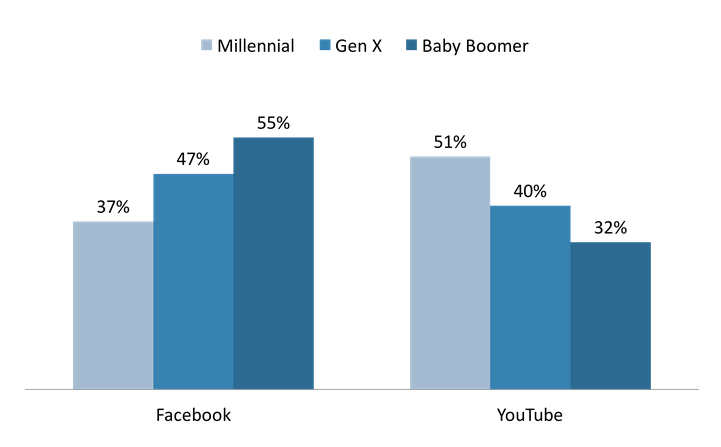
Unfortunately for brands, Facebook and YouTube serve up the most annoying ads, according to BI Intelligence’s 2017 Digital Trust survey. In a virtual tie, ads on Facebook and YouTube were deemed the most irksome by 45% and 43% of the survey’s 1,740 respondents, respectively. Twitter garnered just 6% of the vote, followed by Instagram and Snapchat at 3%, and LinkedIn at 1%.
BI Intelligence
It’s not surprising that these two platforms are reputed to have the most annoying ads. Of the platforms included in the survey, Facebook and YouTube are the top two destinations of digital time spent in the US, according to comScore. People may be more sensitive to ads on Facebook and YouTube simply because they spend more time, and therefore see more ads, on these sites. And because Facebook and YouTube are relatively mature social platforms, they likely serve ads with greater and more noticeable frequency.
Millennials and baby boomers are divided on which platform serves the worst ads. Their preferences are inversely related by age group: Older survey respondents like YouTube ads more than Facebook ads, and vice versa for younger respondents. The familiarity that older people have with traditional TV may explain their tolerance for YouTube ads, which consist of pre- and mid-roll ads that resemble ad interruptions in linear programming.
BI Intelligence
These results point to a pressing need to improve advertising on both Facebook and YouTube. For its part, Facebook has said it’s curbing growth in its ad load — or the ratio of ads to organic posts. YouTube was similarly mindful when it scrapped its unskippable 30-second ad format in February. However, the onus to improve the ad experience shouldn’t be entirely on platforms. Brand advertisers also need to create quality ads that provide pleasurable viewing experiences. The reality is, the campaigns they’re running on the most popular platforms — in which they’re investing the most money, to reach the widest audiences — aren’t resonating.
BI Intelligence’s Digital Trust survey examines consumers’ perception of major social platforms. It rates Facebook, YouTube, Instagram, Twitter, Snapchat, and LinkedIn on security, community, user experience, and content authenticity and shareability to help brands and marketers make informed decisions about what platforms to spend their marketing and branding dollars on. The full report will be available through BI Intelligence in May.
A new study published in the journal Communication Research shows that specific communication tactics used in advertorials are very persuasive. But why they are more effective than traditional advertisements?
The investigation, which looked specifically at health advertorials, showed that advertorials, or “native advertisements” are actually far more persuasive than even ad agencies thought they were.
Advertorials, or advertisements camouflaged as credible news, succeed in misleading people, in part, by damping down skepticism and expectations for truth in advertising. The study was undertaken at Dartmouth College-Stanford University.
The fact that advertorials are so successful has led to complaints, and then a crackdown. Over in the U.S., the Federal Trade Commission last December issued guidelines on native advertising intended to prevent customers from being deceived. The guidelines suggest using a clear label of “advertisement” and placing disclosures in front of or above the headline. So, while the Americans are having a meltdown, the rest of the world is wondering whether their own governments will meddle with advertising rules.
Advertorials are not new. Infomercials and other “blurring practices” between editorials and advertising first appeared as early as the late 1940s in television and print media, and the volume and revenue of blurring practices of advertising are increasing. But until now it was it not clear how advertorials create favourable marketing environments for advertisers, and how readers process advertorials.
The Dartmouth-Stanford study found that advertorials were less likely to trigger consumer awareness of persuasive intent, especially when the “advertisement” label was not present.
“Unlabelled advertorials, compared to labelled advertorials and regular advertisements, were less likely to trigger consumer awareness of persuasive intent, and increased favourable attitudes toward advertising messages and purchase intention,” says lead author Sunny Jung Kim. “Because of their design and structure, advertorials tend to sway readers into believing that they are viewing credible information in the form of an editorial or news source.”
Participants in their experiments exhibited more positive attitudes toward advertorials than they did toward traditional advertisements due to advertorials’ unique structure, which, in turn, increased their willingness to purchase advertised products.
“This form of advertising appears to be on the rise as advertisers try to embed their ads in the stories we read and the photos we see in almost every platform of social media,” said co-author Jeff Hancock, a professor of communication at Stanford University. “Understanding how these advertorials operate cognitively can improve guidelines for the prevention of misleading or confusing consumers.”
Kim adds: “Until now, there has been no empirical evidence that has tested the core elements of persuasion tactics in advertorials, namely their unique structure and labelling and its impact on information processing. These advertising tactics are pervasive across various forms of media, from newspapers and magazines to social media. Our findings have broad implications for health researchers, advertisers and consumers.”
For those of us that think that advertorial is a perfectly viable way for advertisers to reach their target markets? Rock on, while we can. At least we know it works.