By Samuel Scott.
There are so many slaves in the marketing industry that we should create an underground railroad beneath all our office buildings.
Following the recent news that the Japanese advertising firm Dentsu has been charged in the suicide of an illegally overworked employee, I collected stories from my own personal experiences, what I have read in the press, and what others have told me or posted online. Identifying specifics and situations have been removed. The anecdotes are from several countries.
But first, I will present data that compares agency and in-house salaries in the PR, advertising, and digital worlds in the UK, US, and Canada. (For those who want more information, the UK recruitment agency Major Players partnered with The Drum to release this 2017 salary report as well.)
The salaries
Public relations
The Works PR and communications recruitment agency in the UK conducts a salary survey every year. Here is part of the 2016 findings:

For the US, I pulled data from PayScale. The chart in the top left corner shows the median nationwide salaries for various job titles at PR agencies. The other boxes are in-house salary details of some of those listed agency jobs:

For Canada, I used the latest data from The Creative Group:

Advertising
For the UK, I could not find side-by-side comparisons of agency and in-house salaries. But I did find the following two data sets for agency positions in the Major Players 2017 salary report:


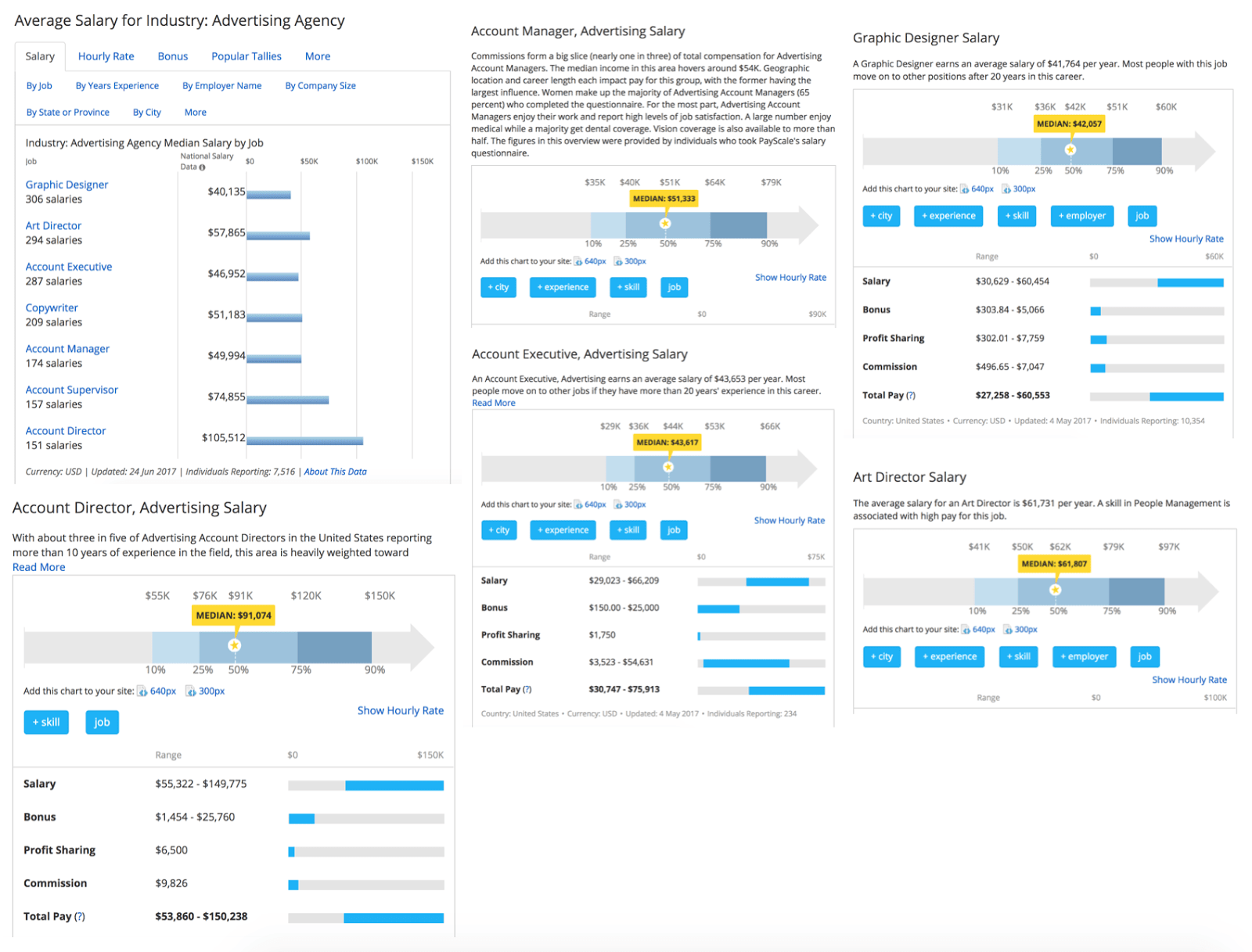
Here is the corresponding US data from PayScale. The chart in the top left corner shows the median nationwide salaries for various job titles at ad agencies. The other boxes are in-house salary details of some of those listed agency jobs:
A comparison for Canada:

Digital
For the UK, I used a report from The Candidate staffing firm:

US and Canada:
I could not find such side-by-side salary comparisons for digital agencies and in-house jobs in the United States and Canada, but I did find this 2016 agency survey conducted by Moz cofounder Rand Fishkin that includes both countries:

What it means
For most positions in all three countries, the salaries at marketing agencies are moderately to significantly lower than those for in-house positions – especially at the inexperienced end of the spectrum. The ‘gap between the rich and poor’ also seems to be larger within agencies.
However, I can attest from personal experience and stories from others that many agencies effectively give even less than these figures – and that they do it with a straight face.
Public relations
In the PR world, many agencies consist of a few well-paid strategic executives and an army of low-level, underpaid publicists who make countless phone calls and write untold numbers of emails to get as much news coverage as possible. Most are salaried but work so much overtime that they are effectively paid only a couple of pounds, dollars, or euros per hour. Many are students or recent university graduates who are officially – and often illegally – unpaid “interns” who are there only to “learn” and not work.
It’s a huge problem that no one is acknowledging – because the old have always taken advantage of the young.
Agency stress is also higher. Companies take weeks or months to hire and fire in-house staff, but many clients feel that they can change agencies within days. As a result, agency staff are under constant pressure to respond at all hours to multiple ‘bosses’. The young are on the first line of communication from clients and bear the brunt of the workload.
In a case that rattled the entertainment industry and beyond, the US studio Fox Searchlight settled a lawsuit last year from an unpaid intern who argued that he had learned nothing from his work on the film Black Swan and was essentially free labour. (For those in America who think that their rights have been violated, the Huffington Post published a list of tips on how unfairly unpaid interns can get their due wages. Here are the US Department of Labor’s specific rules.)
When any agency advertises openings for interns, the business goal is almost always to get cheap labour. No agency makes money by altruistically devoting time to teaching something to someone who will leave in six months.
Still, the problem does not stop with interns.
Advertising
Take a look at this archived Reddit thread from 2015 on “Why agency people are so unhappy.” Two of the comments summarise the problem well:
“The money just doesn’t make sense to me at this point for the amount of time you have to work sometimes… Most of my peers look at it as more of a long-term game. Low pay up front, but bust your ass long enough, and with a little luck, you’ll never have to worry about money again. That’s a little unrealistic for most of us, but the few optimists I know look at it that way.”
Here is more:
- An anonymous advertising industry blogger simply called agencies “white collar sweatshops”.
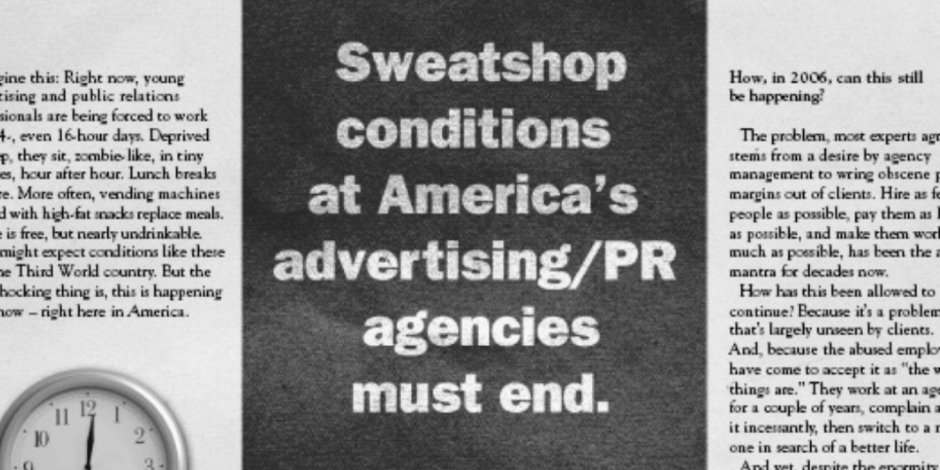
- MGH Advertising itself once placed an ad in The Wall Street Journal claiming that the ad industry was full of sweatshops (see main image).
- “Goodvertising” author Thomas Kolster wrote in a column for The Drum that the industry needs to stop the overworking culture and make it fun and worthwhile instead.
The Twitter satire account Adweak, which is as funny as it is truthful, put it perfectly:

Digital
On the digital side of things, the situation is a little different. Online marketers should not be surprised at the low salaries at agencies. People who routinely proclaim that they know multitudes of quick and easy ‘hacks’ have only themselves to blame when their retainers and salaries are hacked down as well. Why should anyone pay a lot of money for someone to do hacks?
Instead of creating long-term, integrated campaigns, digital marketers all too often suffer from short-termism and think about numbers of social media followers, blog spam, and rankings of keywords – and those activities occur with high turnover rates that lead to lower retainers. Of course, the good agencies know that true SEO is a complicated, long-term process – but the constant promotion of ‘hacks’ by hacks is not doing anyone any favours.
So, between ad agencies and digital ones, guess which ones are paid more? Companies often choose to go with digital agencies when they need something done quickly and cheaply.
I do not want to name names, but I know the owner of a digital agency in a certain country with global, well-known clients. I respected the person greatly – until I found out that the owner was paying gross salaries of $18,000 per year to young employees in the agency’s large, metropolitan and expensive city.
A friend of mine who once worked at a ‘content agency’ in a certain country told me this:
“At my content agency, they defended the rights of the client at the expense of the employee. We had very stringent goals on a monthly basis which were impossible to meet. At one point, I had almost 30 blog articles I had to write in one month, many of which were extremely technical and required 2,000 words.
“Days off were allowed, but it was known that they give a really hard time and try to make you work on vacation days. I took off in April to be home with my family. I took one week off after being there almost a year and never even taking a sick day.
“About a week before the vacation, I get called in for a meeting: ‘Congratulations! You have a new client! They only require 12 more articles a month – starting now.’ I was furious. I had told them about my vacation and they never even took it into consideration.
“This is the situation in many agencies. More work is more money and employees are expected to go to all lengths to to get the work done without being included in the conversation in the first place and saying whether or not it’s possible to even accomplish.”
Sweatshops kill agencies
Among my circle of friends in marketing, most of us agree that agencies are places to learn early in one’s career – but that everyone should leave as quickly as possible. Those with talent and ability eventually end up in-house. (Many of us have also sworn never to work for agencies again following the bad experiences.) It’s why sweatshop conditions lead to short-term gain but long-term pain for owners – everyone ends up leaving.
And the agencies have no one but themselves to blame.
In 2016, Farmer & Company chief executive Michael Farmer, a 25-year advertising veteran, published ‘Madison Avenue Manslaughter: An Inside View of Fee-Cutting Clients, Profit-Hungry Owners and Declining Ad Agencies‘, a book that Keenan Beasley summarises in Forbes with this question: “How did America’s darling Mad Men go from rolling in it to barely holding on?”
The answer, according to Farmer, is a combination of outdated compensation models, an inability to measure results, and the pressure to spread themselves too thin. In the Forbes interview, he also says:
“Executives at these large agencies somehow continue to eke out profits through these sweatshop conditions, and they get huge bonuses for doing so. They’re all just praying they retire before the whole system blows up.”
The timer might already be ticking. Two years ago, marketing consultant Mark W. Schaefer cited reports from the Association of National Advertisers and the Society of Digital Agencies to show in the Harvard Business Review that companies are bringing more and more marketing in-house. In the first half of 2017, an increasing number of brands purchased agencies themselves.
Gerry Moira, the retired chairman and UK director of creativity at Havas London, put it more bluntly:
“If I were starting out now, I’d much rather be client-side. It’s the future… Agencies have had their day. They are sweatshops whose output has become so much more prosaic because of social media.”
So, what’s the answer?
Of course, not every agency is like the underground work camp in Indiana Jones and the Temple of Doom. Most bosses are not going to rip out hearts and wheel people down into lakes of lava – unless perhaps you work for Meryl Streep’s Anna Wintour-inspired character in The Devil Wears Prada.
But far too many agencies are, in fact, sweatshops.
Agencies typically compete with other agencies and in-house alternatives with either their expertises or their pricing. In other words, they market themselves by saying that they are either better or cheaper. Those that compete based on price are usually sweatshops that deserve to implode more quickly than Lindsey Lohan’s acting career.
Once the sweatshops close, the marketing agencies that remain will deserve to remain and will be those that focus on the one thing that differentiates them: creativity. Agencies need to reassert the value of creativity to get higher fees, and agency employees need to do the same to justify higher salaries.
Creative people get bored easily. It’s why agencies have typically delivered the best ad campaigns. (Just remember that the doomed Kendall Jenner Pepsi spot was created by an in-house ‘content creation arm’, a fact that reveals the results when marketers who do not know advertising are the ones creating the ads.) People who work on a single brand will eventually run out of ideas. The ability to work on multiple accounts keeps the creative juices flowing.
As I discuss as a frequent marketing speaker, the problem is that creativity is being increasingly devalued in the marketing world today. Marketers think more and more about data, automation, and analytics – and, therefore, what typically results in direct-response campaigns.
Just read this eye-rolling column from Jesse Williams of Mindbox Studios:
“Marketing is no longer design, it’s no longer messaging, it’s no longer SEO, or social, or branding. It’s data – and the rock stars of modern marketing are the ones who can find and interpret that data.”
Unfortunately, this pile of malarkey is what drives a lot of discussion today. Too many people think that they can merely press a couple buttons, insert a few keywords into website metadata, target and track the best individuals, spread blogspam, or write a social media post in a certain way and then the sales will start pouring in.
In response to such drivel, creative staff need to communicate that direct response campaigns are only one tool of many and that a lot of the data is completely wrong anyway.
Creativity can save agencies
Creativity is something that the tech world will never replace – and that creativity is what builds brands and can be used in areas ranging from television to print to social media to email. Creativity is the only advantage that premium agencies can offer because all of the others compete on price and therefore offer a value proposition that is not viable over the long term.
But I guarantee you that some martech person somewhere will soon develop something he will call ‘AI-powered content marketing’. It will purport to use artificial intelligence and real-time analysis of one thing or another to create instant blog posts designed for goals such as ranking in Google search results or maximising conversion rates.
And the posts will be loads of tosh because they will be more boring than Daft Punk’s autotuned-to-death song One More Time. They will do nothing to build brands. Creatives need to remind people that at the end of the day, the brand is the most important thing. It’s the only way that agencies – and the people who work for them – will survive.
Creative agencies of the world, unite! You have nothing to lose but your existence. Come together to advocate for brand advertising and against the hacks the dominate modern marketing. Show the world the benefits of creativity. Demand higher fees, not lower ones. Pay your workers more, not less.
But will all of this work? I admit that I’m skeptical. As conditions will either remain the same or worsen, I think that we will instead see more unionising along the lines of what boutique consultancy Modern Craft co-founder Randy Siu recently saw in Canada:

Unless agencies can raise their fees to cover the higher salaries that workers deserve, such unionising will merely slow down the approaching agency extinction rather than prevent it.
So, in the meantime, will marketing agencies really ever stop being sweatshops by another name? Sadly, it’s as likely as a bloke building a time machine, going back to the year 2000, and dating all three members of Atomic Kitten at the same time.
But please prove me wrong.
The Promotion Fix is an exclusive biweekly column for The Drum contributed by Samuel Scott, a global marketing speaker who is a former journalist, newspaper editor, and director of marketing and communications in the high-tech industry. Follow him on Twitter and Facebook. Scott is based out of Tel Aviv, Israel.
The Promotion Fix is an exclusive biweekly column for The Drum from Samuel Scott, a global keynote marketing speaker who is a former journalist, newspaper editor, and director of marketing and communications in the high-tech industry. Follow him @samueljscott.