Tag

Brand

Browsing

Now? Fashion brands are meeting with social media influencers directly.

By MediaStreet Staff Writers

Hundreds of NY Fashion Week influencers were invited to a party specifically held to put them in front of brands that want some of the spotlight. The party was held by a company called Influence, which connects brands and influencers. Together, they create social campaigns that expand visibility and engage new audiences for brands. The influencer gets paid, and the brands get to reach audiences that they might not be able to access using other methods. Welcome to the “now” of fashion and brand marketing.

Influence is a sister company to the already-successful operation called Newswire. Newswire currently have an online portal that publishes thousands of press releases every day. Journalists and influencers can go straight to company news, by keyword or subject search. This means that they can get their news directly from the companies, rather than have the interaction brokered through a PR agency. This renders the traditional PR agency almost obsolete.

The way the PR industry is changing is similar to the way that fashion magazines are going. Teen magazines and fashion publications are no longer the huge, powerful entities that brokered deals between brands/fashion houses and their audiences. Now, it is the online fashion influencers who have huge sway with their fans, and brands can contact them directly. This circumvents the hugely expensive fashion magazines, whose circulations are falling dramatically.

As an example, a top YouTube fashion influencer is Chriselle Lim. Her channel is growing at a breakneck pace. Her videos reveal how to transform basic pieces of clothing into stylish apparel. Chriselle has support from global brands such as Target and Estee Lauder.

The change in the way brands and fashion are marketed has been incredibly rapid. Fashion magazines? Pah. Now Facebook, Instagram, Twitter and YouTube are the place to put brand marketing spend.

But back to the party. The event hosted hundreds of NY Fashion Week Influencers at Manhattan’s chic Sixty Soho Hotel. Influencers and brands from across the globe arrived to share in networking and developing opportunities for campaign partnerships that strengthen an Influencer’s channel and widen content reach for brands. The party was also used to promote Influence.com itself. And it worked, because here you are, reading about this new company.

Said Director of Influencer Marketing, Magnolia Sevenler, “Whether you are an influencer or marketer, the Influence by Newswire platform provides a community to build your campaigns.”

According to Sevenler, the platform has been well-received from both marketers and creators for its simplicity and reach. “It’s exciting to see all the positive feedback…as we enter a new era of marketing, where micro-influencers can be rewarded for their passions and brands can reach new untapped audiences.”

The company has plans to expand its network and add additional features to enhance users’ experience. And it is doing this all because the fashion magazine industry is destined for a papery grave. It’s time to move on, people, and bring your marketing spend with you.

Have you listed your company in our Media Directory? It’s free! Everyone’s favourite price! Click here to do it now.


By

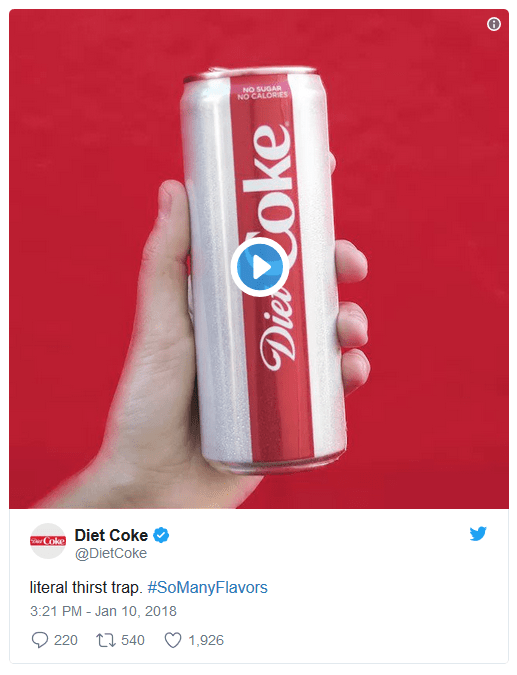
The Coca-Cola Company is looking to solidify the future of Diet Coke in North America with a new colourful rebrand that brings with it a handful of premium fruity flavors.

Over the last few years, sales of Diet Coke in the region have plummeted, partly cannibalized by Coke Zero and even Coke Life. 2017, conversely, saw the rebranding of Zero to Zero Sugar in the US and the end of Life in the UK – where sales of the drink have also been fizzling out.

In 2016, Coca-Cola rolled out a global one brand strategy to promote all of its products at the same time, rather than instinctively separating them into different marketing campaigns. In spite of this, in the same year the drinks maker still decided to champion Diet Coke in North America, pushing ad spend behind the variant with a bottle refresh campaign.

Now, in the US at least, the brand appears to have flipped its strategy and decided that answer to attracting new drinkers to the 35-year-old diet brand is a sleek and bold redesign that features tall cans.

Along with this, variant flavors, Ginger Lime, Feisty Cherry, Zesty Blood Orange and Twisted Mango have come to the fore, inspired by millennials’ love for strong tastes like “hoppy craft beers to spicy sauces”. These flavors were chosen after the company spoke to 10,000 Americans and developed around 30 final combinations – down to four.

Rafael Acevedo, Coca-Cola North America’s group director for Diet Coke, said: “Diet Coke is one of the most iconic brands loved by millions of fans in North America, throughout this relaunch journey, we wanted to be bold, think differently and be innovative in our approach. And most importantly, we wanted to stay true to the essence of Diet Coke while recasting the brand for a new generation.”

Acevedo said the work would make the brand “more relatable and more authentic”.

James Sommerville, vice president, Coca-Cola global design, said the work “elevates the brand to a more contemporary space, while still using at its foundation the recognizable core brand visual assets”.

To support the relaunch, an integrated marketing campaign will be activated later in January to introduce the new look and tastes to consumers.

By

Sourced from THE DRUM

By

The search by brand marketers for consumer engagement has led to the continued growth and funding of the social media influencer that has made millionaires of some vloggers and online celebrities the world over.

However, as these seemingly normal people have grown their fame, demand by brands for their audiences has similarly grown and the rules and regulations around their ability to promote products became a problem for marketing regulators. And in that time some have developed that relationship to become the face and voice of individual brands they truly connect with. Examples are endless, from Cole LaBrant and Mackenzie Davis to Maia Mitchell, who have used different platforms and shared their own life skills and insights to develop personal fan bases. And as Facebook changes its newsfeed algorithm to drive more personalised content to the fore, over media content, those organic relationships will become more coveted by advertisers.

According to research by blog discovery website Bloglovin’ 32% of marketers saw influencer campaigns as being essential to their strategies, with 41% admitting to seeing more success from their influencer campaigns over their traditional advertising.

“Brands are learning,” states Peter Willems, head of marketing activities and sponsorship for world footballing body, Uefa, while speaking on a panel organized by FCB Inferno about influencers and his experience of working with them through the launch of a new project alongside freestyle soccer skills channel, F2.

“Brands are more and more trying to put the objective first. We believe in data but we struggle a little bit with specific target groups, especially youngsters, and therefore one of the objectives of working with F2 was to grow our database within that specific target group. We believe at the moment that influencers can help us there.” he continues to explain, adding that sharing the objective with the influencers who are involved in the collaboration is now crucial too.

Willems also cites the comparison over the share prices of Adidas and main rival Nike as examples of how powerful the use of influencers can be in delivering sales, with Adidas having spent years now working with online personalities to achieve global growth and product awareness.

“For me, the biggest problem has to be how you measure success, which is still in its infancy to show what it can bring and what it can do,” Willems continues.

That problem around measuring return on investment is definitely to be an issue that brands entering this burgeoning sector face, agrees Laura Visick, head of social for FCB Inferno.

“There are soft and hard metrics that we can put in place such as reach and engagement which can be given to the influencers themselves to benchmark against their own content and to identify how things are resonating. One of the most important things is upfront identifying what the objective is and articulating what success looks like to ensure that everyone is on board.. there are a huge number of ways to work with influencers,” she explains of the clearly maturing marketing strategy, where one celebrity tweet is not seen as success in itself.

“The ASOS model is a good one. They are building a group of influencers that are engaging with and advocating the brand all of the time, and there are a few campaigns that we are seeing coming through that the moment that are very similar. They are building a group of ambassadors who are engaging with the brand and creating a very authentic relationship rather than a ‘one-hit-wonder’,” she continues, adding that that course helps create more robust measurements.

Using tools to help monitor and achieve return on investment is an obvious route. Verena Papik, director of marketing EMEA of Musical.ly, says it is important for brands to understand why each tool is being used and used to meet specific set goals and objectives.

She also advises that brands and influencers set objectives that see both succeed together.

“When brands and influencers really collaborate together, and they include a tool like Musical.ly, it is to add value to each other. Everyone is getting lost in setting goals and achieving data numbers, numbers of posts; but in reality is actually about adding value to each other,” she explains. “For a long term relationship you definitely have to understand what benefit the other party can actually bring to this partnership.”

Influencer, Bangs Carey-Campbell, fitness editor at Elle Magazine and blogger, advises that brands recognise the importance of not just paying online celebrities to pose with one-off products but to agree an ongoing strategy and to really follow through on the partnership for the most successful collaborations. She also advises that influencers understand the brand’s perspective rather than forcing their own ways of working fully, too.

“It’s about finding that middle ground when creating content. Especially if you are being paid to do that. You do have to understand from a brand’s perspective that they have a certain job description and certain markers that they have to achieve even if they are not 100% clear on them. It can be tough from the creative’s point of view as you have a way that you like to produce your content, but that’s why the brand got in touch with you. It can be tough to find that middle ground but as a creator, if that is the direction that you want to take your brand in, and you want to be more involved with other brands, you have got to be willing to meet in the middle somewhere. It’s not compromising your material. It’s finding a way to work together and find a way to be flexible,” she relays but later offers a reminder to brands that they are working and partnering with individual people, and not to forget that and treat them as a soulless commodity.

There is a long way still to go for the brand and influencer model, and the bubble has far from burst judging by the growing numbers offering their services and audiences to brands, however another piece of advice that all contributors agreed with was that influencers were more successful if they offered authentic insights and had achieved success in the fields their audiences held interests in. Otherwise it was likely that such influence would be fleeting and of little long-term commercial value in tandem.

By

Sourced from THE DRUM

Keep this in mind if you are marketing sexy products.

By MediaStreet Staff Writers

What does a company that makes sex products do for their annual Valentine’s sales push? They do a survey, to find out how best to market to their customers. And here are the results.

Valentine’s Day, it seems, is starting to suck for everyone. Singles have made it their own anti-holiday, full of memes and proclamations about the commercialisation of the day. But what about couples? Is it all it’s really cracked up to be?

A company called K-Y undertook a survey to find out how to best market their sex products to customers. And it makes for depressing reading. What was once thought to be a romantic and sexy day has become an experience full of pressure and hype. Pressure to buy the right card, pick the sexiest lingerie and have the most mind-blowing sex of your life – and you only have one day to make it all happen.

According to the Love All 365 survey, half of Millennials feel they are missing out if they don’t have sex on Valentine’s Day, but more than 60% of them report that the sex doesn’t live up to the hype. That’s a lot of lead up for a big letdown.

The survey further illuminates the Valentine’s Day tension by revealing that while 82% of people are more likely to have sex with their partner on Valentine’s Day, 83% report that sex is best when it’s impulsive versus planned. Preparing for sex at Valentine’s Day is certainly a faux pas many couples are guilty of committing in spite of the fact that, as the statistics affirm, our preference is for spontaneity.

The good news is that 97% of couples report that having good sex with their partners makes them feel more connected.

“We don’t want couples saving their ‘sexy’ for special occasions, when great sex can and should happen any day of the year,” said Nadja Korner, Marketing Director of K-Y. “Good sex helps strengthen the relationship, so instead of putting all your romantic energy into nights like Valentine’s Day, surprise your partner with that special sexy something on an unexpected night. After all, the essence of pleasure is spontaneity.”

So if you are creating an advertising campaign using a sexy theme, keep the idea of spontaneous sex in mind. Especially if you are targeting Millennials. ■


Have you listed your company in our Media Directory? Click here to do it now.

Academics have identified four distinct personas of social media user that teenagers describe as shaping how they behave on social media.

By MediaStreet Staff Writers

Young social media users are categorised as either acting like the Geek, the Internet Celebrity, the Victim or the Lurker depending on their levels of online activity and visibility, University of Sussex academics say.

The categorisations are based on interviews the researchers conducted with children aged between 10 and 15-years-old for a new book, Researching Everyday Childhoods, published by Bloomsbury last month.

The interviews revealed many youngsters were increasingly savvy about maintaining their privacy online, often being motivated to protect themselves by unpleasant past personal experiences or negative incidents that affected classmates.

Dr Liam Berriman, lecturer in digital humanities at the University of Sussex, said: “Our research found that concerns about staying safe online created an atmosphere of intense anxiety for young people, even if they had not directly experienced any problems themselves. The young people we spoke to felt a great weight of responsibility for their safety online and were often motivated by the concern of being labelled a victim.”

“While there has been a lot of negative media coverage around teenagers’ interaction with social media, our findings are more hopeful that teenagers are responsible users of social media, are very conscious of the dangers and make considerable efforts to protect themselves against those risks.”

Teenagers navigate between the desire to be praised and recognised online and anxieties over the risk of opening themselves up to criticism and trolling. Among the four personas is the Internet Celebrity who is able to best use the latest trends and increasingly values “visibility of the self” through Instagram, Snapchat, the selfie and YouTube vlogging.

The internet celebrity

But academics also identified how young people are experimenting with and enjoying invisibility online. They describe the Lurker as someone able to avoid peer dramas arising through platforms such as Facebook, whilst still engaging in fun peer activities such as stalking their favourite music bands online.

The lurker

The Geek, meanwhile, uses invisibility to anonymously share and promote their amateur media creations online, such as music videos or fan fiction writing. The academics described how the Geeks’ long hours of labour on projects risked parental concern that their behaviour was obsessive or addictive.

The geek

Professor Rachel Thomson, professor of childhood and youth studies at the University of Sussex, said, “What is distinctive about these active social media users was the entrepreneurial character of their practice, with ‘play’ re-envisaged as a form of economically rewarding work. By gaining an audience, young people are aware that they could capture advertising and corporate sponsorship. The dream is to ‘go viral’, establishing a career as a cultural creator.”

The research also highlights the risks contained in a world dominated by personal visibility with the Victim left to suffer personal exposure and shame following the creation and display of intimate material such as sexting and the loss of control of this material.

The victim

The Victim’s high visibility is often out of their control with their presence and heightened without their consent as private material is extracted from them and exchanged under false premises.

This can vary from the frustration of being tagged in photographs and the creation of an unflattering digital footprint through the activities of others to the more invasive techniques of fraping, where a person’s online identity is hijacked without their permission, or sharing of intimate photographs.

Dr Berriman said, “These examples reveal the impossibility of non- participation in the world of social media. A teenager does not necessarily have to create an online persona, it is something that can be created by others.”

This is great food for thought for anyone trying to catch the attention of teenagers online. You may even need to consider four different approaches when targeting the teen market. Thanks, science!


Have you listed your company in our Media Directory? Click here to do it now.

New research studying the millennials market has identified five unique subgroups.

A new research study from Zeldis Research Associates reveals surprising findings for marketers which belie the frequent mythology that Millennials are “all the same.”

Unlike many other market studies attempting to better understand Millennials as a single group, Zeldis researchers identified five Millennial segments based on income, attitudes, and other important factors.  This “Seen One Millennial and You Haven’t Seen Them All” study is part of Zeldis’ ongoing investigation into how marketers can better reach and successfully engage this group.

“Despite a lot of the media coverage we hear, Millennials are not one homogenous group, unfortunately and incorrectly characterised by a few negative stereotypes such as lazy or entitled,” said Zeldis Executive Vice President Amy Rey. “Our research shows that there are important differences among Millennials. We wanted to dispel some of the myths and help marketers better understand the nuances that will help make Millennial-targeted outreach, products and messaging more effective.”

Five Identifiable Segments

Based on online interviews with 1000 Millennials aged 21-36, the Zeldis researchers identified five unique segments:  Faithful Optimists (31% of the sample), Struggling Parents (23%), Secular Activists (22%) Tech-Savvy Independents (14%), and Pessimistic Conservatives (10%).  Some of their findings include:

– Faithful Optimists, the largest segment, tend to be joyful, hardworking, dependable, and religious. They are more likely to be non-white and heterosexual.

– Struggling Parents tend to be pessimistic about their lives and about the country. They don’t pay much attention to politics or technology. They are more likely to be white women with children and tend to be less educated and from rural areas.

– Secular Activists are more likely to be politically liberal, and to be pessimistic about the country’s future. They tend to be single, childless, and secular and are more likely to be part of the LGBT community.

-Tech-Savvy Independents are more politically conservative but also environmentally conscious. Optimistic about the economy, this segment has a higher proportion of males and non-whites, and tends to be from urban locations.

– Pessimistic Conservatives, the smallest segment, are likely to be from suburban areas. They tend to be religious and politically conservative. Skewing male and non-white, they have high incomes but are pessimistic about their economic future.

Though holding some attitudes and beliefs in common with other segments, each group showed nuanced differences that the Zeldis researchers believe are important for companies to understand and apply when marketing their products.

The full results are available at ZeldisMillennialsStudy.com.


Have you listed your company in our Media Directory? Click here to do it now.

People will always pay more when being led by the heart and not the head.

By MediaStreet Staff Writers

Brides and the bereaved beware: You, like many shoppers, may have a tendency to reject thriftiness when your purchase is a matter of the heart, according to a new study led by the University of Colorado Boulder.

People are reluctant to seek cost-saving options when buying what they consider sacred – such as engagement rings, cremation urns, or even desserts for a birthday party – for or to commemorate loved ones. The paper, published in Judgment and Decision Making, is the first to examine the implications of this phenomenon.

Even when they identify a less expensive alternative to be equally desirable, people choose the more expensive of two items. They also avoid searching for lower prices and negotiating better prices when the goods they’re buying are symbolic of love.

“People’s buying behaviour changes when they’re making purchases out of love because it feels wrong to engage in cost-saving measures,” said Peter McGraw, associate professor of marketing and psychology at CU. “People abandon cost-saving measures when it comes to sentimental buys because they want to avoid having to decide what is the right amount of money to spend on a loving relationship.”

The findings highlight how wedding, funeral and other industries can exploit consumers, said McGraw.

In one part of the study, which involved nearly 245 participants, the researchers asked attendees at a Boulder wedding show about their preference between two engagement rings. The attendees nearly always chose the more expensive ring when deciding between a more expensive ring with a bigger carat and a less expensive ring with a smaller carat.

“It’s important to be aware of this tendency not to seek cost savings because, over a lifetime, consumers make many purchases that are symbolic of love — whether for weddings, funerals, birthdays, and anniversaries,” said McGraw. “The loss of savings can really add up and put people in compromising financial situations.”

So how can we apply this to a marketing situation? If you are selling goods or services for sentimental events, play up the quality, not the price.


Have you listed your company on the MediaStreet directory? Click here to do it now! It’s free!

By Monique Claiborne.

By focusing on a new digital strategy, TUMI broke the mold and tapped into a new source of growth.

It may not be widely recognized yet, but digital technology is probably one of the best things to happen to luxury brands in a long time, says a Boston Consulting Group study titled Digital or Die: The Choice for Luxury Brands. Luxury brands that fail to evolve their digital front risk getting left behind as digital is the inevitable, inescapable business shift of the future.

One luxury brand that has successfully used digital marketing to cement its place as a leading international business, accessory and travel lifestyle brand is TUMI. What I’ve noticed about TUMI is it has responded quickly to the fast and forceful digital takeover — unlike many dying brands — and that payoff has translated to its e-commerce business, which is in the high double digits in 2017 compared to 2016.

I had a chance to catch up with Victor Sanz, TUMI’s creative director, to understand more about the company’s digital maturity. Below are three key takeaways every company can learn from TUMI’s transformation.

1. Create a fresh customer service strategy.

Through a number of different channels, TUMI has placed a priority on its online presence to better serve its customers. In my experience, the real importance of digital to companies is not the emergence of new technology, but the important shift in customer behavior. By expanding its digital marketing reach into more upper funnel initiatives, TUMI now focuses on improving user experience on the website, both mobile and desktop.

Investing in a digital strategy focused on customers not only better equips you to efficiently respond to the changing customer, but also improves customer satisfaction and brand recognition. TUMI has shown this by improving its online merchandising strategy to create more personalized experiences for customers and further revamping its CRM to better understand customers.

2. Nurture a customer community.

Growing companies use social tools and online platforms to enable new customers to develop quickly and efficiently. TUMI has made a tremendous effort to target a younger demographic, with efforts largely geared toward engaging customers with its Women’s Assortment. The luxury brand has created more personal communications to target new and repeat customers, with a bigger focus on new customer acquisition.

Like TUMI, you can reduce the promotional component of your business and produce more segmented and targeted messages when communicating with customers. TUMI has created connections between the people within the organization and the people who buy its products. In today’s age, companies that build authentic relationships between their business and their customers can successfully generate new and sustainable customers.

3. Never stop developing.

Companies must now respond to rising customer expectations and acclimatize to the breakneck speed of technology. To meet future challenges, you must constantly develop the capability to quickly identify, evaluate and invest in the right trends at the right time.

Committed to testing and improving marketing tactics not only through products but also the user experience on its online platform, TUMI is exceeding customer expectations. TUMI will continue to focus on its ‘bread and butter’ — women and women’s products — but also dive deeper into analytics and segmentation of TUMI.com.Taking an entrepreneurial approach and establishing new agile initiatives allows you to quickly bring a new idea to the market and then iteratively improve through customer feedback.

No longer can you open new stores in high-end markets and expect consumers to automatically appear. Consumers now want omnichannel interactions and seek brand interaction. It’s no surprise luxury brands are up against tough growth challenges. If you take one thing away from TUMI’s digital transformation, it should be that the digital disruption has left many businesses spinning but revealed fantastic opportunities for higher levels of customer engagement for those that seek it. Valuing and investing in digital technologies will allow you to extend and individualize your business services beyond the physical store.

Feature Image Credit: Courtesy TUMI

By Monique Claiborne

Finance and business travel writer

Sourced from Inc.

A new survey indicates that 1 in 5 small businesses use social media in place of a website. Many assume a website is cost-prohibitive and may not consider the risks of not having one.

By MediaStreet Staff Writers

More than one-third (36%) of small businesses do not have a website, according to the websites section of the fourth annual Small Business Survey conducted by Clutch, a B2B research firm. One in five small businesses (21%) selectively use social media instead of a website in an effort to engage customers.

The survey indicates that small businesses consider cost a bigger concern than the potential repercussions of not having a website.


Social media platforms such as Facebook and Instagram attract small businesses by cultivating a highly engaged user base. However, relying solely on social media may be a risky strategy for businesses.

“Whenever you put all of your eggs into someone else’s basket, it’s risky,” said Judd Mercer, Creative Director of Elevated Third, a web development firm. “If Facebook changes their algorithm, there’s nothing you can do.”

Facebook recently announced changes that potentially increase the risk of using social media in place of a website. The social media platform plans to prioritise posts from family and friends over posts from brands.

This new policy may make it more difficult for small businesses to reach their audiences through social media. As a result, websites are expected to regain importance among businesses – as long as cost is not considered an obstacle.

Among small businesses that do not currently have a website, more than half (58%) plan to build one in 2018.

Some Small Businesses Say Website Cost is Prohibitive, But Others Cite Costs of $500 or Less

More than a quarter (26%) of small businesses surveyed say cost is a key factor that prevents them from having a website. However, nearly one-third of small businesses with websites (28%) report spending $500 or less.

Small businesses may not be aware that some web development agencies offer packages that defray costs by dividing website construction into multiple phases or sliding rates for small businesses. “You don’t necessarily need to launch with your first-generation website,” said Vanessa Petersen, Executive Director of Strategy at ArtVersion Interactive Agency, a web design and branding agency based in Chicago. “Maybe just start small.”

Mobile-Friendly Websites Becoming Standard
Businesses that do have websites are moving en mass to mobile friendly ones, the survey found. Over 90% of respondents said their company websites will be optimised for viewing on mobile devices by the end of this year.

In addition to the 81% of company websites that are already optimised for mobile, an additional 13% that say they plan to optimise for mobile in 2018.

Clutch’s 2018 Small Business Survey included 351 small business owners. The small businesses surveyed have between 1 and 500 employees, with 55% indicating that they have 10 or fewer employees.

To read the full report and source the survey data, click here.


The advertising industry seems to have the power to shape society’s view of gay people. And it is going hard on proving it. 

By MediaStreet Staff Writers

The past 15 years have seen a dramatic increase in the presence of gays in advertising. Every ad seems to be getting good with the gays.

The media has transformed the stigmatised stereotype of gays into a new, socially desirable image of stylish consumers with high-end taste.

This marketing strategy affects the way gays understand themselves and influences the meaning of gayness for society in general, explains Wan-Hsiu Sunny Tsai, assistant professor of advertising at the University of Miami School of Communication, in a study published by the Journal of Advertising.

“The findings illuminate the influential role of advertising in informing and shaping personal identities and highlights the often ignored socio-political dimension of advertising, Tsai says. “In other words, when marketers argue that no matter who they target, ‘it’s just business,’ their marketing messages actually have broader, cultural impacts on the minority community.”

According to the study, five specific strategies emerged within these minority consumers to interpret the messages catered to them:

  • Gay men accepted the perception of “higher disposable income of gay male households” and transformed material consumption into a definition of self-worth. “I was on many consumer panels because I fit the profile of gay men who have disposable income and travel a lot,” one participant said.
  • Participation in the mass market was equated to membership in mainstream society. “We got money. We contribute to the corporation. We contributed to big business. We got families. We are part of the mainstream now,” a participant said.
  • Targeted advertising was identified as an essential step in achieving social political inclusion. “Consumer rights and citizenship, civil rights are intricately connected. And when we express our identity as a consumer, that reinforces and strengthens our identity as a citizen,” a participant said.
  • Perpetuating problematic depictions of gays as effeminate men or lesbians as “sexualized femme” was tolerated in the interests of social inclusion. “I was ambivalent when watching this commercial. It’s playing up the stereotype. But for me, if you can see gay people on TV, it’s positive,” one participant said.
  • Participants were willing to give up something of their subcultural identity for the sake of total acceptance in society. “When we are truly accepted in the society, we will just blend in… even that might mean sacrificing our uniqueness,” a participant said.

The next logical question is, how do you target your particular message to the gay community, if you want to attract their business? We await the next study…