Tag

content marketing

Browsing

By 

When it comes to effective marketing, writing style matters — but many marketers ignore it. Columnist Mark Traphagen discusses how to cultivate a sense of style for your marketing.

I entered marketing as a career relatively late in life. While I rue not having discovered this wonderful world earlier, one of the things I don’t regret is how useful almost all my previous work experiences were to molding my success as a marketer. And of all those experiences, the most valuable has proven to be my years teaching English literature and composition to middle and high schoolers.

Why? Because at its most fundamental level, marketing is communication. Marketing is successful when a message is transmitted from a business to a consumer — and that message not only resonates with the consumer but moves her or him to action.

Many skills from the study of written composition contribute to effective message communication for marketing, but I think one of the most overlooked is writing style.

Keep up with all the developments in interactive marketing!

Why style?

If I just said the word “style” to you out of the context of this site or article, chances are the first association you would make is with “fashion.” Curiously enough, when I looked up the meaning of style on several fashion sites, one of the most common definitions was “a way of communicating.”

The clothes you wear and the way you wear something send a message to others, whether or not you are conscious of it. So I suppose that a person with style is one who consciously and intentionally cultivates a message about themselves through their clothing and accessories.

And so it is with written (or audio or video) communication. The style you use for your message is very much a part of the communication. It’s at least as important, and in some situations more so, than the content or ideas themselves.

For writing, stylistic choices affect several areas:

  • Choice of vocabulary
  • Reading level
  • The author’s “voice”
  • Level of formality
  • The look of the text (for example, short vs. long paragraphs, inclusion of images)

The goal of using style effectively for marketing communications is to match your style to your intended audience, while at the same time avoiding inauthenticity.

Style and emotional impact

Experienced marketers have always understood intuitively that effective marketing appeals to more than the rational mind. Modern psychology and brain research have confirmed that emotions are much more responsible for most of our decisions than logical determinations.

While not a direct appeal to the emotional side of the brain, writing style does help make the subtle, subconscious connection that opens prospects up to the message. Sometimes, it’s just a matter of avoiding initial rejection. A speaker in a business suit is going to experience far less resistance from a corporate boardroom than someone in a clown suit.

Of course, clown-suit guy might be more successful communicating with a group of children (if he doesn’t scare them all away first!).

Marketing with style

My favorite guide to cultivating an effective writing style in the 21st century is “The Sense of Style” by cognitive scientist and author Steven Pinker. Pinker applies the latest research on linguistics, neuroscience and more to cut through the restrictive, pedantic, and too-often unjustified rules of past style guides to concentrate on what actually works.

But his approach is far from utilitarian. He believes that effective writing is enjoyable and inspiring.

Mere rules and usage restrictions ignore the fluidity of language. Humans and their cultures are constantly evolving, and their languages and idioms evolve concurrently. Pinker is more concerned about prose making a genuine connection with the reader rather than it being “correct.”

Why does writing style matter to marketing?

The right style earns trust. While few readers or listeners would articulate it, sloppy or inappropriate language is a primary reason for rejecting a message. Having the right style for your intended audience shows you respect and “get” them. It lowers their natural resistance barriers to marketing.

The right style crosses the writer-receiver divide. One of the fundamentals of communication theory is that there is always a transmitter and a receiver, but no communication takes place unless, in the end, the receiver has a similar conception in mind to what the transmitter intended to send. The wrong style introduces static into the transmission that can cause the message to be decoded incorrectly, or rejected altogether.

The right style adds beauty to the world. That seems like an odd goal for a marketing message. But think about why art has such appeal. A great piece of art cuts through the ordinariness of life and makes us take notice. Even better, it causes us to think differently about the world. In a very real sense, the goal of a marketer is to “change the world” of the prospects, to open them to considering an approach, solution, convenience or tool that would make their life different and to envision the better world that will result.

Style is where marketing science meets marketing as an art, and it creates the magic that leads to sales.

Cultivating a sense of style for your marketing

Pinker’s book helps the reader cultivate effective style. Here’s how some of his points apply to our marketing writing:

• Start by being a good reader. Pinker believes that the best writers are not only avid readers — they are engaged readers. That is, they’ve learned to pay attention to what works in the writing of others they admire. While reading and enjoying their writing, they have one eye peering behind the curtain to observe how they do what they’re doing.

Marketers should be constantly analyzing the marketing messages that most appeal to them, noting how the use of language, tone, humor and so on make the message click.

• Envision the world you want to create. Keep in mind what I said above: Effective communication happens when the message receiver enters to some extent into the world of the message transmitter, or at least the world he or she wants to conjure up.

The unending fascination of millions of readers and viewers with “The Lord of the Rings” or “Game of Thrones” has much to do with J.R.R. Tolkien’s and George R.R. Martin’s ability to draw them into a world that previously only existed in the author’s mind. As a marketer, seek in your writing to create a world that your prospects will want to inhabit and see themselves living in.

• Beware of the curse of knowledge. The “curse of knowledge” is the failure to understand what it is like for someone to not know what you know. In other words, when you know something deeply and passionately (your products or services, for example, and how they meet needs and solve problems), it’s easy to assume that everyone else already feels the way you do and will automatically see their need for what you’re selling. They don’t, and they won’t.

You have to cultivate the ability to see things from the perspective of someone who (so far) couldn’t care less about what you’re offering, and shape your messages to bridge that gap, to help your prospects walk along the same path that brought you to your present passions.

• Build arcs of coherence. Don’t get so bogged down in the individual details of your message that you fail to connect the dots for your readers. Always remember that no one has to read your marketing message.

Outline the details you want to get across, and then plan how they connect together to draw the reader on and keep her or him engaged. Think in terms of a drama, and make sure all your players and their action work together toward the goal of where you want your prospect to end up.

One of the primary challenges of our profession is also one of its deepest joys and most tangible rewards. That challenge is getting past the natural resistance and short attention span of your marketing prospects so that they are drawn into the world you want them to inhabit, the world in which they see their lives as better, fun or more productive because they have whatever you’re trying to sell.

I say that challenge is also the greatest joy and reward for a marketing writer because unlike other writers, we get very quick feedback on the effectiveness of our messages. A novelist may spend years writing, then more years waiting for edits, publication and promotion. We marketers know very quickly what works and what doesn’t for our target markets, and we can adjust on the fly to be more effective.

Think about the style you incorporate into your marketing writing and what you can do better to build that bridge to your readers that turns them into customers.

By 

Mark Traphagen is Senior Director of Brand Evangelism for Stone Temple Consulting. His primary responsibility is building the online reputation of Stone Temple while testing strategies and tactics that will benefit STC clients. Mark writes for numerous top industry publications, and is a regular speaker at various SMX events and other national marketing conferences.

Sourced from Marketing Land

B

There are plenty of online marketing strategies out there that most businesses already use or are at least aware of. But there are also some lesser known strategies or lessons that you might not have considered. See some of the top tips about not-so-obvious online marketing strategies from members of the online small business community below.

Don’t Fall for These Common PPC Misconceptions

When it comes to PPC advertising, it’s not always best to adhere to common practices. There are some misconceptions that have led to negatives for a lot of businesses. Pauline Jakober shares some common misconceptions about PPC advertising in this Search Engine Journal post.

Use Color to Increase Website Conversions

To make your website as effective as possible, you need to consider every single detail — and that includes the colors you choose to include in the design. In this SUCCESS Agency blog post, Mary Blackiston explains how you can use color to increase website conversions.


Take Advantage of These New Facebook Groups Features

Facebook is already a great way to connect with your community online. And now, the platform has introduced some improvements that could make your community even stronger. Mike Allton of the Social Media Hat details those features here. And BizSugar members also share thoughts on the post too.

Try These Lesser Known Online Advertising Platforms

You already know about the big name online advertising platforms like Google. But there are plenty of other options out there that small businesses can use to supplement their online advertising strategies. Susan Solovic lists three lesser known options in this post.

Take a Look at the Best SEO Strategy You’re Not Using

Link building is a common SEO practice. But there’s another layer to that strategy that many businesses overlook. For that reason, Neil Patel thinks it’s one of the best SEO strategies you’re not already using. He goes into more detail in a recent post.

Track Blog Growth with Google Analytics

Blogging is a common tactic used to grow a business. But before you can reap the benefits of blogging, you have to actually grow a successful blog. In this Basic Blog Tips post, Susan Velez offers some insights you can use to track your blog growth using Google Analytics.

Change Your Content Marketing Program in 2018

Content marketing is already a popular strategy. But if you’re not adapting to the latest trends and changing up your tactics to better serve potential customers, you could fall behind. Rachel Lindteigen of Marketing Land outlines how you can change up your content marketing program for 2018.

Use Instagram to Grow Your Business

If you’re not already using Instagram for marketing your business, you’re really missing out. In this Blogging Wizard post, Elna Cain discusses the potential benefits of the platform. You can also see commentary from the BizSugar community.

Learn How to Identify and Deal with Detractors

Brand advocates can offer lots of potential marketing value for businesses. But detractors have the opposite effect. So you need to be able to identify those detractors and learn how to minimize their impact. Ivan Widjaya elaborates in a recent SMB CEO post.

Build a Top Notch Content Marketing Team

Content marketing isn’t just a small operation anymore. If you’re still trying to manage your content strategy on your own or with one part time team member, your business could fall behind. Instead, consider the skills listed in this Content Marketing Institute post by Michele Linn when building your content marketing team.

Feature Image Credit: Shutterstock

B

Sourced from Small Business Trends

By Ashley Zeckman

One of the best ways to improve your skills as a content marketer is to learn from the successes and failures of other marketers. And as we near the end of 2017, many marketers are reflecting on what has (and hasn’t) worked in the past year and looking to what this means for content goals and plans for the coming year.

It doesn’t matter if you are a team of one or a team of one hundred, outside insights can be incredibly valuable for improving your approach to content marketing.

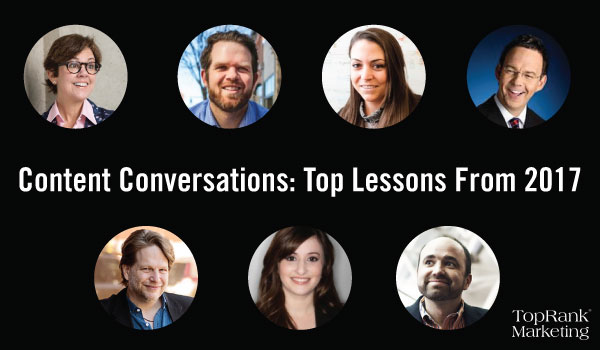
Since we know you’re likely busy working, wrapping up 2017 and planning for 2018, we’re here to help. Recently we had the chance to sit down (or stand up?) for some great content conversations with some of today’s top marketers.

Below you’ll find their top content lessons learned in 2017 as well as how you can apply these insights to your own content marketing approach.

Don’t Be Afraid to Take Risks

In a profession with so many moving parts and fast-paced changes, it can be easy to become risk averse. The problem is, if you don’t take risks to create great, more impactful content, your competition will, and your audience will follow.

Content risks don’t have to mean completely changing your approach. It can be slight tweaks and tests along the way to improve performance and innovate.


Ann Handley
Chief Content Officer, MarketingProfs

“More marketers are getting comfortable taking risks because sometimes our very best work comes out of us taking a risk.” @annhandley tweet this

Ask Yourself:

  • What are some small risks that you can begin taking today to improve your approach to content marketing?
  • How can you work testing new content approaches into your routine?
  • What can you learn from other marketers that are having success with innovation?

Make Owned Content a Cornerstone

It’s no secret that social networks and content on 3rd party websites are a great way to attract your audience. Ultimately though, these approaches should be used as a means to draw people to owned content on your website.

Social algorithms change constantly and you’ll find that if you put the majority of your efforts into building relationships on those platforms, you can lose that audience faster than you gained it.


Joe Pulizzi
Author & Keynote Speaker

“Use social media platforms to get your audience to your own content so you create a direct connection.” @joepulizzi tweet this

Ask Yourself:

  • Which platforms are currently the biggest drivers of audience members to your owned content?
  • How can social networks and other credible websites become part of your strategy for driving visitors to your website?

Focus on Quality Content

As more and more brands become publishers, that means that a huge influx of content has been hitting the search results and inboxes of your target customers. Unfortunately, a lot of what is out there is not at the level of quality that it needs to be to provide value.

That means, customers are becoming overwhelmed by crappy content and are in dire need of quality content created for them by marketers who understand their top needs.


Chris Brogan
CEO, Owner Media Group

“There should be a big, wide-open playing field for marketers that are passionate and make real business happen.” @chrisbrogan tweet this

Ask Yourself:

  • What would it take to create high-quality content on a consistent basis?
  • Should content quantity be reduced in order to focus on impact?
  • Can your team truly identify the difference between low and high-quality content?

Pay Attention to Distribution

All too often, content distribution and amplification are either ignored, or treated as an afterthought when creating content. At the end of the day, we are marketers that are responsible for the performance of the content that we creates which means giving distribution the time and attention it deserves.


Alexandra Rynne
Content Marketing Manager – Marketing Solutions, LinkedIn

“Give your content room to breathe and focus on what works and what doesn’t so you can approach it better next time.” @amrynnie tweet this

Ask Yourself:

  • Are you creating content for content’s sake or is your content tied to business objectives?
  • How can you give content distribution and amplification the same attention as creation?
  • Are you documenting which forms of content distribution are effective? And which ones aren’t?

Eliminate Marketing Buzzwords

It doesn’t matter if you create content for a B2C or B2B audience, the key is connecting with people. When marketers focus on creating product, solutions or services based content, they’re ignoring the true needs of their audience.

Buying audiences don’t care about marketing buzzwords, they want to know what problems you can help them solve. This requires creating a true connection and providing honest and helpful content based on what their top needs are.


Tim Washer
Writer & Producer, Cisco

“Instead of trying to change what people say, we need to change how people think.” @timwasher tweet this

Ask Yourself:

  • Is our content focused on the message we want to send or the true needs of our customers?
  • How much do we actually know about what our target audience wants and needs?

Invest in Dedicated Content Marketing Staff

You wouldn’t hire a plumber to do your drywall or a professor to act as an electrician. The same can be said for your marketing team. While there are some marketers that can fulfill multiple roles, now more than ever it’s critical to work with a dedicated content marketing staff.

That can mean hiring full-time resources in-house and/or partnering with an agency that has expertise in your industry.


Dayna Rothman
VP of Marketing & Sales Development, BrightFunnel

“One of the most important things your team needs is a dedicated resource to run content.” @dayroth tweet this

Ask Yourself:

  • Who in my organization is truly responsible for content?
  • Are we setting content teams up for success?
  • Do we need outside help to scale our content marketing program?

Document Your Content Strategy

While we are seeing a 1-2% increase each year in marketers who have a documented content strategy, we are still nowhere near to 50%. Your content strategy should be your guide for all content you create and serve as an anchor point if your team ever starts to get off track.

Without a documented strategy, it is MUCH more difficult to meet business objectives and make a case for content’s place within your organization.


Chris Moody
Content Marketing Leader, GE Digital

“Your content strategy is the single most important document you’ll create. It’ll make you more productive and it’ll be used internally on a regular basis.” @cnmoody tweet this

What Content Lesson Did You Learn in 2017?

If we are going to move forward and improve content in 2018, it’s essential to reflect on what we’ve learned in 2017. Some lessons are easy and others are plagued with difficulty. As you reflect on the past year, think about your biggest content lesson learned. Feel free to share in the comments below!

Disclosure: BrightFunnel is a TopRank Marketing client.

By Ashley Zeckman

Sourced from TopRank Marketing

By Bill Wagner

My own little small-sample case study.

Blogging is big business, and Google thinks so, too. Rand Fishkin of Moz has a series of YouTube video I highly recommend to anyone interested in deep dive into the deeper recesses of SEO. Check out his Whiteboard Friday series HERE.

Ranking high on search results is vital for smaller business in need of exposure. Blogging is the best organic method of achieving those results if done correctly. Throwing words on a page isn’t the answer. Quality is, and that means writing good stuff that gets shared over and over again.

A good social media automation tool boosts this process nicely. I use eClincher. You should, too.

I don’t have an AdWords account or fancy metric aggregators, nor do I need them. Social media is a storytelling platform that takes time. I believe in the process and sticking to the grind. In the end, quality wins the right people and the right eyeballs. This proves my point if only to myself.

The Test And Results

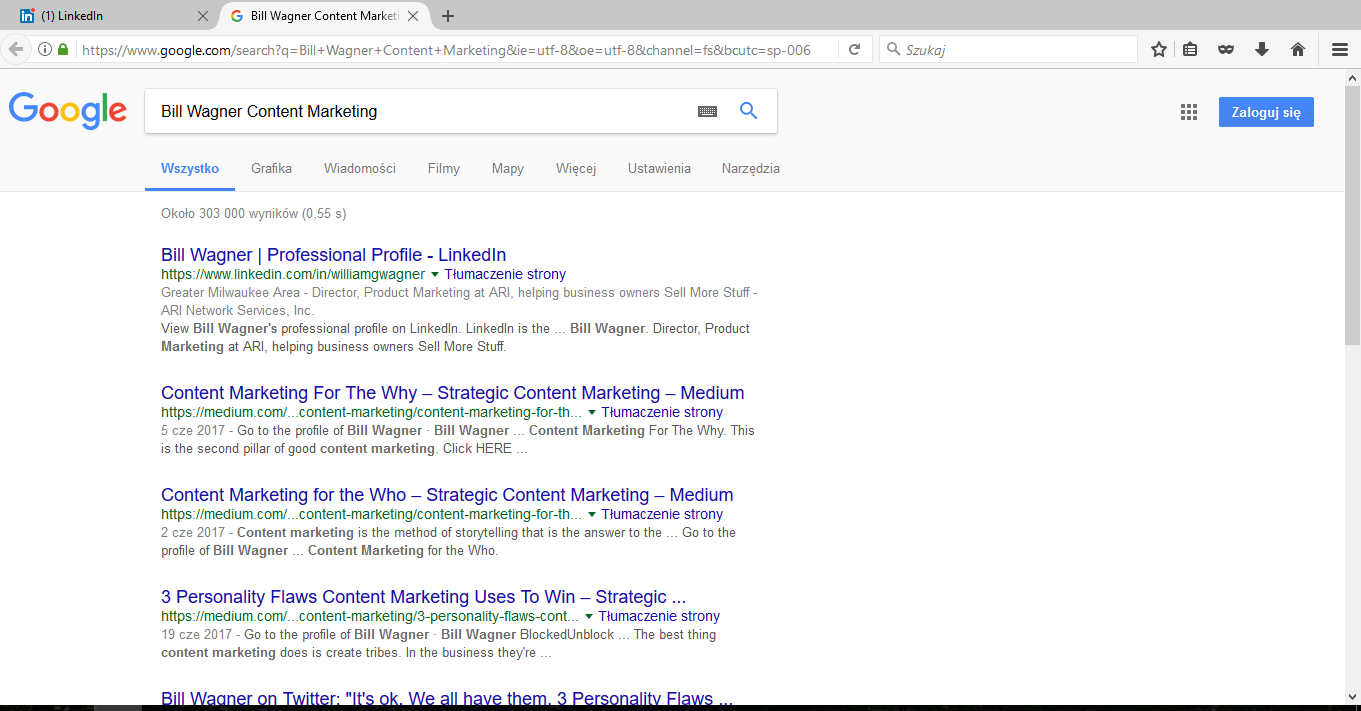
Using a long-tail keyword, I found my grind quite fruitful. I searched “Bill Wagner Content Marketing” and found my blog posts ranking on page 1 of results.

I was beyond happy. I actually clapped and giggled like a little kid at my desk. Then, of course, the skeptic in me raised his hand with a valid question: Were these results simply a by-product of searching on my own Google account?

That’s a good point. Let’s test that.

The benefits of social media paid off once more as I reached out to my LinkedIn network and Facebook friends for help. I asked for screen shots of their front page with the same long-tail keyword. Below is a sample of results. You can see more of them on my LinkedIn profile.

My social network is awesome!

Mobile searches yielded a few more paid results before my organic work showed up, but the data was clear. My blogging and automated sharing has paid off. A simple long-tail keyword is mine, all mine! (Cue the Dr. Evil laugh!)

Conclusions About The Process

Blogging works and this is proof. The secret sauce, the one thing you must do right now, the simple hack to make it all work? Time. That’s it. It takes time.

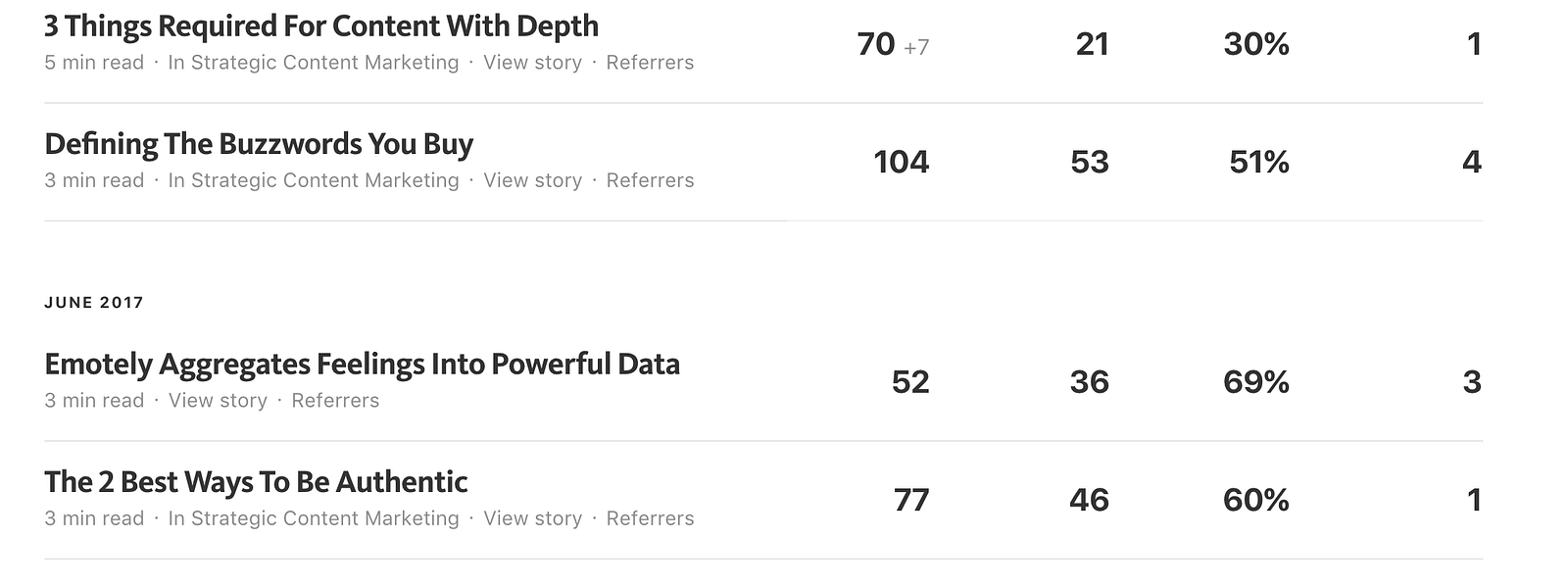
These posts were all written in June and July 2017. I shared them repeatedly over the last several weeks. The question you may be asking is how many clicks and reads does it take? Here are my Medium stats:

A big part of social media sharing is using the right platforms at the right times. LinkedIn and Google + are big parts of my strategy. Google + is very important for search because Google’s search algorithm prioritizes placement there.

The numbers speak for themselves. Obviously some of the stuff I wrote didn’t do as well as the rest. My personal favorite is Connecting With People Who Hate Your Shirt. Yet, my most popular post is about marketing buzzwords. There’s another one of those coming soon. Believe that.

My Beliefs Confirmed

I embrace the grind at my content marketing business Safe Strategies. Social media, blogging, graphics, videos, and all online content comes together to tell a multi-layered story that is your business.

This is just a tiny sample of how well-crafted content builds a great online presence. Let’s connect and chat about what you want out of social media and how Safe Strategies creates it. Increased engagement, better leads, and quality customer interactions are all things that happen when you invest time online.

Let’s chat. Connect with me on Twitter @LearningBill, on LinkedIn, or Facebook.

By Bill Wagner

Umpire and referee turned writer and coder. I delete more than I publish. I laugh at my own jokes, too. Follow my company on Twitter @SafeStrategies

Sourced from Medium.com

By Cameron Conaway

For many content marketers, social media strategy never gets beyond the spray-and-pray process of sharing a new piece of content with the widest audience possible, and then measuring if anybody engaged with it. It’s based on an idea that if you just keep creating new content and pushing it out, results will come.

But, as Jonathan Crossfield puts it, “In social media, the audience pulls the strings.”

As content marketers, we must take a step back. Just as we put time into creating a content marketing strategy, so too do we need to create a social media strategy specifically tailored to our content goals. And this begins with establishing the right social media KPIs (key performance indicators) for those content goals.

After all, if our social media strategy is built around intuition rather than KPIs, it’s unlikely to serve our content well.

Social media strategist Jeremy Goldman knows a thing or two about this. He’s the author of Going Social and Getting to Like, and he’s the founder of Firebrand Group, a brand management consulting firm that counts L’Oréal and Unilever among its many clients.

CCO: Going Social was published four years ago, and yet still contains lessons for today’s social media strategists. What are the most significant changes since then?

Goldman: When Going Social was about to come out, I was freaking out for the reason you just stated … social media moves so fast. How do you write a book like that without it immediately becoming outdated? I realized I had to avoid writing about the mechanics of how you respond to comments on Facebook or how you participate in a Twitter chat since those could easily change at any moment. Instead, I focused on how social media is based on the principles of communication that have predated social media by a few millennia.

As for the most significant changes? That’s easy. Social media is pay for play, and good luck running any meaningful strategy purely around organic reach. When I wrote Going Social, mid-sized businesses could actually find ways to get creative and win at social media without a paid media budget. Oh, how times have changed.

CCO: In the context of content marketing, how do you wade through the seemingly infinite social media metrics to get to the social media KPIs?

Goldman: First, it’s completely normal to get metrics and KPIs mixed up to some extent. In fact, I’ve seen people at even senior levels flub this. Metrics are simply measurements quantified. KPIs are metrics that you’ve determined are mission critical to your business.

You touch on something very important here: These days we can measure more than ever before. However, that isn’t necessarily a good thing in that it causes some organizations to lose focus. Just because we have more metrics doesn’t mean we need more KPIs.

The more KPIs your organization has defined, the less focused it likely is. I had one company boasting that it was determined to go from four KPIs to 16 KPIs in the next fiscal year. Is that always a good thing or does that dilute the value of a KPI?

CCO: Speak to the newly minted content marketing manager. What are the first steps they need to take to figure out the best social media KPIs for their content marketing goals?

Goldman: That’s going to depend on the organization and the scope of the particular role, so the first thing is to figure out how to be of greatest value to the organization in general. If the best thing is to get eyeballs on the company’s latest white paper, the best KPIs may be visits to the lead-gen form connected to the white paper, and the total number of white paper downloads – simple as that.

CCO: What are typically the most important social media KPIs for content marketing, and how do you create a sustainable, team-oriented process for driving toward them?

Goldman: Again, it’s going to depend on the organization, but I think sales leads is probably the number one KPI for content marketing. If you’re not making any sales, it’s hard to keep the lights on, and it’s hard to write good content without any lights. Tied to that, customers coming from those leads are a powerful KPI, not to mention traffic on specific pieces of content.

I like that you ask how to have a team-oriented process because that’s something not enough people touch on. It’s important to have the entire team pushing in the right direction. Every team member must understand not just team KPIs but what role each member of the group needs to play to reach them. You can’t all be rowing in different directions. I see that happen all too often.

CCO: You’ve helped both scrappy start-ups and massive transnational companies establish their social media KPIs. What themes run through each, and what can content marketers, regardless of the size of their company, learn from them?

Goldman: Small companies and large enterprises have far more in common than you’d think. The biggest parallel is a desire to run before figuring out what path they should be taking. We live in a society that rather harshly judges anyone who takes a second to breathe. If you’re not doing, you must be a slacker, right? But the reality is that setting KPIs and then revisiting those KPIs on a regular basis are beyond critical, and both start-ups and monolithic enterprises don’t do it often enough.

CCO: Can you offer some tips on establishing the best social media KPIs for your content marketing goals?

Goldman: Understand your brand. Your organization presumably has a mission statement – a reason for being. It may sound like a lofty place to start, but you can’t succeed without an understanding of the firm and where it’s looking to go.

Determine your own role. Make sure you know what your role is in the company. You would be surprised at how many content marketing managers are spending their time in slightly different areas than their managers would like.

Survey your metrics. Look at all the metrics your organization is tracking. Don’t assume everything is important. Likewise, don’t assume a seemingly valueless metric can’t be immensely helpful.

Determine your KPIs. Break down your list of metrics and pick a few you’re determined to work night and day to measure your success by. Make sure you’re not picking too many – no more than six and, in some cases, fewer will do.

Refine on an ongoing basis. There’s a chance you may have picked the wrong KPIs, your role may have changed, or your organization is heading in a new direction. No matter which one occurs, reviewing your KPIs on a regular basis lets you course correct and select new ones.

By Cameron Conaway

Cameron Conaway was awarded the 2015 Daniel Pearl Investigative Journalism Fellowship. He curates Content Land, a weekly resource for journalists and content marketers who want to work smarter by learning how both fields intersect. Follow him on Twitter @CameronConaway.

Other posts by Cameron Conaway

Sourced from Content Marketing Institute

By Marcia Riefer Johnston

Hey, marketers! Do you ignore your organization’s most important audience? Probably, says consultant and author Carla Johnson.

Chances are, you and your team put all your brand-building energy into external messages. But who are any company’s biggest brand builders? Who, in fact, turn (or don’t turn) your marketing promises into truth? The people on the inside.

If your co-workers aren’t part of your content marketing strategy, you’re missing an opportunity.

It’s a missed opp if employees aren’t an audience for your #contentmarketing. @CarlaJohnson #employeeadvocacy Click To Tweet

At Content Marketing World, Carla’s talk – My Employee Said What?!?! Creating a Content Strategy for Employees, the Most Vital and Ignored Audience – walked us through a how-to on using inward-focused content to support employees in becoming smarter, stronger brand ambassadors. This post reviews her advice:

  • Make “who we are” clear and simple.
  • Create employee content that inspires.
  • Decide how you want employees to feel about your brand.

All quotations and images in this post come from Carla’s presentation.

HANDPICKED RELATED CONTENT:
How Adidas Creates Moments of Relevance

Make ‘who we are’ clear and simple

Many employees have no sense of their company’s brand identity. Carla cites a 2012 Gallup survey which found that 41% of employees don’t know what their company stands for and don’t know what differentiates their own company from its competitors. How can people represent – or fully support – something they don’t understand?

Many employees have no sense of their company’s brand identity, says @CarlaJohnson. #employeeadvocacy Click To Tweet

“We’re creating a vortex of ignorance” with employees, Carla says.

Businesses need to constantly convey “who we are” – clearly and simply. Vision and mission statements alone don’t cut it. It’s ridiculous to think slogans and posters suffice, Carla says. What employees need is an in-their-bones sense of shared identity.

Kathy Button Bell, chief marketing officer at Emerson, came up against a challenge with her company’s brand identity. When she came on board, Emerson was “a brand without a brand.” The sub-brands were well established, but employees – over 110,000 people around the world – had no sense of the global Emerson brand.

Kathy’s team asked customers how they felt about Emerson. Over and over, people said the same thing: We can bring our toughest problems to Emerson, and your engineers will help us figure it out.

Emerson encapsulated its brand in this statement: Consider it Solved™.

The marketing team took this sense of identity into every nook and cranny of the organization around the world. Two years ago, when the company celebrated its 125th anniversary, the video it created leaves no doubt that Emerson’s employees know what this company stands for and what makes it special. You couldn’t ask for more enthusiastic ambassadors for a brand.

Marketers need to lead the way with messaging. Employees want to be proud of what they do and what their companies stand for. They want to know what to say. As Kathy explained to Carla, “They don’t want to have to make it up.”

Marketers need to lead the way w/ messaging so employees know what to say. @Emerson_KathyBB #employeeadvocacy Click To Tweet

How many employees know what your organization stands for and what sets it apart from its competitors? How could you adjust your content marketing strategy to increase that awareness?

HANDPICKED RELATED CONTENT:
How to Write a Style Guide for Your Brand

Create employee content that inspires

Companies teach employees to tune out internal communication. “We’re terrible at connecting with employees as an audience,” Carla says. “They don’t want to listen to us. We have to reallocate the communication that we send to employees.”

Carla estimates that 80% of information given to employees is administrative: “information they have to know and we have to give them” (usually mundane and full of corporate-speak). The rest is something like 10% crisis-related and 10% – if that – creative, fun, unexpected, or inspiring.


Re-slice that communication pie, Carla says.

Re-slice the employee communication pie for more fun, unexpected, inspiring content, says @CarlaJohnson. Click To Tweet

Under the leadership of CMO Antonio Lucio, Hewlett-Packard focuses “a conscious 60%” of employee communication on the inspiring story of HP.

“HP has to do most of those employee communications anyway,” Carla says. “Why not make them engaging?”

Another company that emphasizes engaging content for and by employees is Molson Coors Brewing Co. When the company’s CEO noticed its beers were not on tap at all the pubs in Denver – the company’s back yard – the marketing team kicked off an internal program: Reclaim Colorado. Each employee was given a $35 monthly allocation for buying beer for others when they were out having drinks.

Employees came back and shared stories of what it was like to be an ambassador for the brand. Below is one of over 200 stories shared by employees internally (on Yammer), relaying enthusiastic experiences with the Reclaim Colorado program. In this case, a mom-to-be fills in her co-workers on the unconventional party favors she created for her baby-shower guests.


How much of your organization’s content for and by employees do people find inspiring? How could you adjust your content marketing strategy to inspire them more?

Decide how you want employees to feel about your brand

Employees serve as ambassadors for the brand only if they emotionally connect with it. Thus, to create an effective internal content marketing strategy, determine first what the company wants employees to feel about its brand.

In other words, Carla says, work backward from the goal. Design your strategy for employee communications the way an architect designs a building: Consider the experience you want to create then design the building – or the strategy – that delivers that experience.

Molson Coors wanted its employees to feel pride in the company, so it first shared the company story, and then inspired and empowered them to share that story – over beers – with family, friends, and co-workers.

#Content pros think like architects: Work backward from the feelings you want people to have. @CarlaJohnson Click To Tweet

Ford Motor Co. realized the importance of employees’ emotional connection to the company. In the early 1980s, Ford created an internal TV network and broadcast company news around the clock to all 250 of its employee locations.

At another point, some Ford employees shared with managers a perception that product quality was slipping, revealing this type of comment: “My neighbor looks at me when his Ford breaks down and swears we’re not making cars the way we used to.” The company realized that it had to address both the quality concerns and the employee concerns. For the latter, Sara Tatchio, manager of the Integrated Global Communications group, rented a Detroit sports arena and bused in Ford employees by the thousands. The employees spent the day talking with designers and engineers. “Ford wanted employees to know that the company was taking quality as seriously as they were,” Carla says. “It wanted employees to be excited about what was coming down the pike.”

How does your company want employees to feel about its brand? How could you adjust your content strategy to build this emotional connection?

Conclusion

However much attention your content team may be investing in communicating with your organization’s most vital audience – its employees – Carla suggests putting more energy into supporting them in becoming smarter, stronger brand ambassadors.

How do your company’s content teams help inspire employees? Let us know in a comment.

Here’s an excerpt from Carla’s talk:

Learn more about how to improve your content marketing program from Carla Johnson and hundreds of experts at Content Marketing World Sept. 5-8 in Cleveland, Ohio. Register today and use code BLOG100 to save $100.

Cover image by Joseph Kalinowski/Content Marketing InstitutHere’s Why Your Content Marketing Strategy is Totally Failing

By Marcia Riefer Johnston

Marcia Riefer Johnston is the author of Word Up! How to Write Powerful Sentences and Paragraphs (And Everything You Build from Them) and You Can Say That Again: 750 Redundant Phrases to Think Twice About. As a member of the CMI team, she serves as Managing Editor of Content Strategy. She has run a technical-writing business for … a long time. She taught technical writing in the Engineering School at Cornell University and studied literature and creative writing in the Syracuse University Masters program under Raymond Carver and Tobias Wolff. She lives in Portland, Oregon. Follow her on Twitter @MarciaRJohnston. For more, see Writing.Rocks.

Other posts by Marcia Riefer Johnston

Sourced from Content Marketing Institute

By Hurera Sheikh, 

For decades, businesses have relied on telemarketing, walk-in meetings and print ads to generate leads. Despite their utility, many companies are shifting towards a combination of both online and offline lead generation techniques to maximize their reach. According to Webbiquity, overall B2B marketing budgets are expected to increase by 5% on average in the coming year with spending on digital marketing programs projected to rise three times as fast. These astounding forecasts mandate a swift revision of your B2B lead generation methods and here are the bleeding-edge online lead generation tools that can help you get there.

1. Virtual Event Marketing

Virtual events have seen a hockey stick growth in the past decade with no signs of stopping and there are several sophisticated virtual event platforms out there, like vFairs, that can help you deliver a stellar virtual event. With Market Research Media stating that the virtual event market will grow from $14 billion in 2018 to $18 billion in 2023, we can see how pivotal a role this avenue has to play in online lead generation and here’s how to make the most of them to generate leads:

Develop a Killer Registration Page: Incorporate a simple signup form, informative yet concise content and good visuals on your registrations page.

Optimize Virtual Booths and Help Desks: By having someone present at each booth 24-7 when the event is live, you can maximize the contacts exchanged over the booths and follow up with these leads when they’re still warm.

Host Stellar Webinars: These are the front-running lead generation tools in content marketing which is why you should include live or pre-recorded webinars in your virtual event.

Leverage Your Resource Center: Add a sense of exclusivity to your event by either charging for or having visitors sign-up for downloading premium content from the virtual event.

Integrate With Ecommerce: With a virtual event, you’re attending visitors, demonstrating products and negotiating prices in real time which makes online transactions a lot more easier, quicker and likely. Use paypal or debit/credit card integrations to make sales during the event and maximize on the shortened sales cycle.

2. PPC (Pay Per Click)

PPC is a digital marketing formula where the advertiser pays an amount (as per suggested bid) each time someone clicks a link on Google SERPs. With PPC, you select the keywords in Google AdWords that you want your website to show up whenever a relevant search is performed which allows you to advertise to people who are genuinely interested in what you are offering.

Here are 4 pro tips to nailing your PPC Campaigns:

Identify What You’re Selling: Run some google searches to find out what words your competitors are focusing on.

Research Your Keywords: If you’re new to PPC Campaigns, it’s best to go for broad keywords that yield wider results. Shift to more specific keywords once you’ve gained deeper insights and also incorporate negative keywords to further specify searches.

Be Specific: If you have categories within a product or service, focus on them by creating themed ad groups. For instance, ‘premium male colognes’ is far more relevant to a buyer looking for a purchase versus a generic phrase like ‘colognes’.

Build Specific Landing Pages and Monitor Them: Don’t land all your ads on the same page. Make separate landing pages for each keyword to maximize your chances of conversion. The idea is to match your site copy with the initial intent.

3. Content Marketing and SEO

With SEO, you can reach leads and route them to your website without paying for the top spot in search results. However, it’s not a lead generating strategy on its own and must be coupled with great content to seal the deal. This marriage of content marketing and SEO, known as Search Engine Marketing, relies largely on a concept called ‘user intent’ that is, the real meaning behind a person’s search that explains what they’re looking for. When someone keys in a certain keyword for search, the pages that rank highest in search results are the ones that best serve its user intent.

For instance, a quick search for ‘content marketing’ shows search results on ‘how-tos’ which show that the phrase serves an ‘inform’ intent. Alternatively, type ‘content automation’ and you’ll see companies that enable content automation which signals a purchase intent. This is valuable information for your SEO campaign because it allows you to develop content to meet the audience’s needs.

Using SEO for Lead Generation:

Enlist Relevant Keywords and Research Them: Use Google Keyword Planner and Google Trends to identify terms that are relevant to your industry and put them to the search test to identify the user intent behind each of them..

Segment Keywords According to Sales Funnel: Keywords predominantly showing an inform intent are likely to be used by people at the top of the sales funnel whereas those more used for purchase intent are likely to be used by people further across the sales funnel. Use these insights to develop relevant content and ascertain conversions.

Optimize Existing Content: Review existing content and rephrase parts of it to match keywords with user intent. Go over your eBooks, blog posts, listicles, tutorials and press releases to modify them with keywords according to the sales funnel they are catering to and develop additional content to fill any gaps.

According to ReadyTalk, inbound campaigns generate 3 times more leads than outbound campaigns at 62% the cost. With search engine marketing providing an astonishingly lower cost per lead, it’s about time that you start exploring it to up your lead generation game.

4. Social Media Marketing

Social media is a powerful channel to disseminate content and engage audiences at a personal level. It’s a place to sense sentiments as well and develop the “voice” of the brand. Persistence in social media eventually leads to discovery and a boost in incoming leads. Last year, social media channels were the third leading source of website visits for businesses and with 72% internet users engaged with social networking, the platform has immense potential to bring you business. Here’s how:

It Enables You to Publish Varied Content: Social media allows you to express yourself in a variety of mediums from infographics, articles and videos. With repurposing, you can drive a lot of value out of the same material too.

Run Active Q&A Sessions to Become Thought Leaders: Position yourself as a thought leader by adding value in LinkedIn discussions, taking questions on Quora, creating informative posts and responding to comments.

Paid Campaigns: You can run sponsored campaigns on Facebook, Instagram, Twitter and LinkedIn to grab a more targeted audience. These campaigns allow you to create target audience profiles in great detail based on their demographics, income levels and interests. For instance, LinkedIn you can post an ad in front of C-level execs in your industry if you throw enough spend on it. You’re already creating great things, it’s important that it reaches the right people too and these campaigns facilitate this.

5. Email Marketing

According to Neil Patel, leading author and online marketer, email campaigns surpass social media by 20% in customer retention. With 73% marketers citing emails as crucial to their marketing plans, it becomes clear that they are a formidable source of generating solid leads.

Email marketing can be used to promote your blog content, upcoming events, sales and promotions and quite simply to stay in conversation with your followers and guiding them to a specific call-to-action. This two-way interaction lends emails the edge of being far more personalized which brings a lead another step closer to converting. According to HubSpot, companies that nurture leads through email generate 50% more sales-ready leads on average at 33% of the cost.

There’s no denying the centrality of digital marketing in today’s day and age but investment in its different techniques is only as good as the returns they bring. With the rules of marketing changing fast, it’s crucial to keep pace. Employ these bleeding-edge techniques so that you stay connected with your audience in a meaningful way and allow them to naturally transition from being consumers to paying customers.

Sourced from Huffington Post

By Neil Patel.

We’re living in the golden age of content marketing right now.

Social media has made it easier than ever before to reach and connect with your ideal demographic.

Social Media Today put it best with its infographic on social media marketing statistics of 2017.


That’s right, 79% of all American Internet users are on Facebook!

While there are still some brands that refuse to adapt to the changing needs of the marketplace, more and more businesses are accomplishing amazing things in the world of marketing.

Despite my long-term involvement in it, I’ve always considered myself a student of the industry.

Every day, I’m excited to see where the world of digital media marketing is going and to find new ideas or techniques that I can share with all of you.

That’s why I’ve decided to analyze some of the world’s most popular blogs and present you with 6 actionable lessons that you can use to enhance your marketing strategy right away.

Each of these brands, in one way or another, has changed the marketing game, and the average business owner can learn quite a bit from their success.

Here’s the list, and feel free to jump to any particular section that interests you.

  • Clarity is everything (or why lists work)
  • The power of the headline
  • Visual content matters
  • Data-driven content wins the long game
  • CTAs may not be sexy, but they work
  • Long-form content works

1. Clarity is everything (or why lists work)

It’s easy to look at sites that have simplistic aesthetics and think that their owners are just not invested in the presentation of their content.

The truth is that some of the most effective blogs I’ve ever seen tend to value simplicity over complexity.

Why?

Because that’s what their users value the most, too.

I’ll be the first to defend long-form content (it’s what most of my content is, after all).

But I’d be a fool if I didn’t recognize the power and impact that short-form content has had on the world of content marketing.

And it’s not a surprise when you stop and think about it.

The average consumer can get their information from lots of sources.


If we’re working off the assumption that most of them cover the same topics, particularly as it relates to current events in the industry, it’s no wonder that users stick with the no-fluff version.

The idea that straightforward content is easier to read isn’t breaking news. We’ve all known about that since middle school.

What makes this clarity-driven content so exciting is its accessibility and actionability.

I was thinking about this while scanning Lifehacker, which has one of the most pleasantly minimalist designs I’ve seen.


With an estimated 21 million unique monthly visitors, Lifehacker’s emphasis on keeping things as simple as possible is clearly working for them.

There aren’t any ads surrounding their articles, ensuring that you’re able to focus on whatever content you happen to be reading.

Take a look at the article below and you’ll notice nothing but white space, which helps keep the page from feeling cluttered.


And while you’re presented with some options for what to read next, it never feels overwhelming or distracting.

It’s not just easy to learn something. It’s easy to take that knowledge and apply it.

Since we’re on the topic of clarity, it’s time we talked about list articles.

In our industry, lists are often viewed as a necessary evil.

Plenty of people will argue that listicles somehow undermine the integrity of the content marketing process.

I couldn’t disagree more.

Uninspired listicles are clearly not a great marketing tool. But those have short-sighted thinking and bad writing to blame above all else.

The problem isn’t the format. The problem is that people misuse it.

If anything, I welcome the listicle if it encourages brands to prioritize simplicity and clarity in their marketing efforts.

Well-written listicles feature a recognizable structure and a clear value proposition. They’re easy enough for the average reader to enjoy, and people find value in them.

The format works — in the right hands, of course.

The Huffington Post, with 160 million visitors every month, has the list article down to a science.


If you take a closer look and actually dive into the articles, you’ll notice that there’s minimal fluff here.

For example, take a look at the article “10 Things People With Autism Wish You Knew.” You’ll notice that it manages to provide value without overstaying its welcome.


And that’s an important lesson for any content creator. If you’re going to produce content, make sure that it’s presented in a way that makes consuming it simple and straightforward.

2. The power of the headline

I’m always a bit hesitant to discuss the importance of headlines when it comes to content marketing.

Not because I doubt their importance. The value of a compelling headline has been proven time and time again, so it’s not exactly controversial.

No, I’m worried about the brands that see the word ‘headline’ and think ‘click bait’.

So, before we move forward, let me be absolutely clear. If you’re in the world of content marketing, don’t overuse click bait.

It’s really that simple.

Your headline should still be intriguing and catchy. It should inspire curiosity and compel the average reader to stop what they’re doing and think, “Man, I gotta know what all this is about.”

But don’t promise something in your headline that your article doesn’t cover.

One of my favorite examples of this is Business Insider’s article titles. No matter what industry they’re tackling, the titles always manage to be eye-catching without ever being misleading.


With over 78 million readers every month, Business Insider proves that you can rise above click bait and still develop a massive following.

Your headline should be an introduction to your content — not a trick that gets people to read your article.

Why am I so insistent about this?

Because quite a few brands engage in click-bait behavior, and I’m convinced that they don’t understand how much it can damage their reputation.

When it comes to digital media marketing, your currency is trust. If people trust your content, they’re likely to share it.

If they trust you as a content creator, they’re likely to believe in your business.

Trust, just like success, is difficult to earn and easy to lose.

The moment that consumers open one of your articles and think, “Wow, this was just click bait,” you’ve compromised your relationship.

And for what? A slight bump in traffic in the short run isn’t worth the long-term damage.

There’s an important lesson to be learned here, particularly for brands that are struggling with headlines.

As tempting as it might be, don’t start making click-bait titles.

Forget about the fact that they can compromise the relationship you’ve built with your audience. The truth is that you just don’t need them to experience the benefits of compelling headlines.

All you really need to do is apply the 3 basic rules of headline structure.

  • Make sure you’re using relevant, specific data in your headline.
  • Imply value propositions with words like ‘Tips’, ‘Reasons’, ‘Secrets’, and ‘Ways.’
  • Provide a major call to attention.

From there, the rest will come down to collecting data and constantly testing.

It won’t be glamorous, but it’s better than destroying your credibility.

You can create compelling headlines without lying to your audience.

Want to know what the secret is?

The content that you’re making has to be compelling too.

3. Visual content matters

If you were to take it at face value, creating content might seem like a one-dimensional task.

No matter what problem you’re tackling, you’re solving the issue with your written analysis and trying to create an engaging experience through compelling words.

But if you’ve been paying attention over the last few years, you know that content marketing is so much bigger than just the written word.

Particularly as it relates to the world of social media marketing and digital media as a whole, your content is expected to be multi-dimensional before it can be considered truly engaging.

The copy you create certainly matters, and it’s arguably the most important aspect of the creative process.

But make no mistake. Presentation matters, especially in industries in which you’re facing stiff competition.

Enter the world of visual content.

Mashable, with 45 million unique visitors a month, has embraced the explosion of visual content and ensured that all of their written content has some level of visual content integrated.

To really understand why this matters, we need to change the way we think about content.

First off, it’s important to acknowledge that compelling content doesn’t necessarily mean professional.

TMZ has managed to build an entire business using assets like amateur videos to promote their content.

12.3

Imagine each piece of content that you create as a journey. Each journey is unique to the problem you’re trying to solve and the value you’re trying to offer.

But like any journey, your content has a beginning and an end.

Still with me?

Okay, so the content that you write out could be some of the wittiest and most engaging copy you’ve ever created.

But at the end of the day, it’s still a tall order to expect the average person to sit down and happily read 10 minutes’ worth of your content.

Could you shorten the length of the journey by shortening your content? Sure, but that’s not the only way to solve this problem.

If you can incorporate enough engaging, relevant imagery into the article, there’s a much higher chance that your reader will make it to the end of your article.

To be as engaging as possible, your content needs enough structural integrity to guide people to the end.

Buzzfeed goes as far as using people’s tweets as visual content, and with plenty of success.


You’ve already done the hardest part, which is coming up with a compelling, unique idea.

So what can we learn from these blogs?

If you’re going to execute it, make sure that you’re presenting the best piece of content you possibly can.

And part of presenting the best content possible is using any tool at your disposal to engage your reader.

Oh, and if you think that visual media is a purely superficial solution to the problem of encouraging engagement, allow me to introduce you to the infographic.


Visual content might be widely used for its potential as entertainment, but it’s just as powerful when it’s used as an educational tool.

4. Data-driven content wins the long game

All content is not created equal.

To put it simply, there are really only three kinds of content in the world.

  • Content that doesn’t work
  • Content that wins the short game
  • Content that wins the long game

Before I go any further, let me just say that I’ve got nothing against winning the short game.

There are sites like Engadget, which experienced major success while only focusing on producing punchy, short-form content that revolves around current industry-relevant events.


If you run a business, winning the short game is about more than just keeping the lights on for another month.

Small, tactical victories reinforce the fact that your business is growing and developing the way you want it to.

And if you can string enough of those small, tactical victories together, you’ll likely end up winning the long game.

But there’s a difference between consistent, sustainable growth and only being focused on the short-term gains.

We’ve all seen it at this point. Content that’s clearly only made to take advantage of some scandal or controversy that will be irrelevant in the next month.

I’ve got no problem with you trying to win today — as long as you don’t forget about winning tomorrow.

From a purely analytical perspective, I want to create content that I can repurpose or revitalize down the line, which can be invaluable in the future.

From a personal, human perspective, it’s difficult for people to consider you compelling if you don’t have anything memorable to say.

And simply reporting on current events is not how you end up with engaging, impactful content.

Creating a piece that simply covers scandal is just not that useful down the line.

Now, if you were to use that controversy to analyze a particular industry issue and encourage a discussion on it, that’s a different story.

See what I mean? There’s a way to win the battle today and the war tomorrow.

Going back to Engadget, you can look at their content and instantly recognize that they’re constantly moving forward with the strongest data available at the time.

And why does this matter? Because it shows brands and businesses that you can create engaging content that’s backed by relevant data, which then extends the content’s life expectancy.

Always think about the future when you’re creating content. How can you use it to further your long objectives?

5. CTAs may not be sexy, but they work

There are two camps to the call-to-action (CTA) discussion.

For some people, CTAs are a gimmicky way to encourage engagement. They’re like the silly tagline in a commercial.

When you’ve seen as many poorly-structured CTAs as I have, you can start to understand why people hesitate before using them in their own content.

But the second camp of people, which is the group that I fall into, is made up of people who recognize the incredible value of a well-placed CTA.


Whether you’re a big fan of them or not, no one can deny that they’re effective.

The question isn’t whether or not they work.

Instead, it’s helpful to understand why they work and what the average business owner can do to create effective CTAs.

The best CTAs all have a few things in common.

They all offer value by appealing to the needs of the brand’s audience. The best CTAs are tactically placed in easy-to-find places, which increases the likelihood of engagement.

But the most important part of any effective CTA? It should guide your consumer towards the next step in your marketing funnel.

Just take a look at TechCrunch. They may not exactly be subtle with their CTA placement, but with over 12 million unique visitors every month, it’s clearly working for them.

Their CTA for Disrupt SF is easy to find, and it clearly offers value and has an obvious next step for readers.

If you’re just starting to implement CTAs, those three basic steps should be the building blocks of your CTA strategy.

Even if you make the most amazing content ever published, you can’t just cross your fingers and hope that people will share it.

You can’t control how people will instinctively react to your content or your CTAs. All you can control is what happens on your end of the creation process.

Ask people to share your content on social media, get them to sign up for your newsletter, or invite them to check out your inventory. CTAs like these seem simple, but they’re also powerful.

It doesn’t matter what that next step is. What matters is that you’re moving your relationship with your audience forward and moving in the direction of growth.

6. Long-form content works

Remember, earlier in this article, when I was talking all about the benefits of clarity and brevity?

I’m sure a lot of you must be wondering how I can champion short-form content while also producing articles that run for thousands of words.

The reality of the situation is that there are no ‘sides’ here.

There are clear benefits to producing short-term content, just like there are clear benefits to producing long-form content.

Whichever type of content you decide to create will depend entirely on what you’re most comfortable producing and what type of content resonates with your audience the most.

And for me, that means producing long-form content.

By the way, this isn’t something that I’m guessing or assuming. I discuss this more in depth in my article on how to get more traffic, but I’ll summarize it here just to keep things moving.

Long-form content is performing better than ever these days.

And the best part?

Search engines love long-form content. This means that writing high-quality posts that are 2,000 words or longer will inevitably boost your conversion rate.

Just take a look at this serpIQ graph. It shows that posts with 2,000+ words are leading the charge in search results.

12.6

Long-form content has always given me the best results, and the reasons why are actually pretty simple.

For starters, I thrive off the trust that all of you have in me and my content.

But I have to earn that trust every single day, and in my experience, there’s no easier way to do that than by providing you with quality content and analysis.

By diving deep into the topics I choose, I’m able to prove to you that my content is worth your time.

After I’ve done that enough times, the idea is that you’ll come back to this site because you understand that I pack my articles with as much value as possible.

Plus, in-depth analysis and discussion tend to lead to the creation of evergreen content, which lends itself particularly well to long-term growth.

And I’m not the only one who’s experiencing success with long-form content.

Buffer routinely publishes plenty of long form content, often with a heavy emphasis on providing data and insight.

Its article, “How to Create a Social Media Marketing Strategy From Scratch,” article was a 9-minute read, but just look at all those shares!

12.8

What’s the lesson here? Don’t shy away from long-form content because you’re afraid it’ll scare people away.

As long as it’s well-written and engaging, and as long as it offers readers legitimate value, your long-form content can perform as well as (or better than) short-form content.

Conclusion

Creating content that stands out is never an easy task.

Every single blog that I used as an example on this list struggled to find its winning formula.

No one is expecting you to figure it all out overnight. All I want to do is help you arm yourself with the right knowledge and tools in this fight.

But if you can learn to embrace the ideas presented here, there’s no doubt in my mind that your content will evolve into something much more impactful.

Focus on clarity. Use visual content that grabs the reader and refuses to let go. Write powerful headlines. Continue to craft compelling CTAs.

And, if you’re anything like me, don’t be afraid to create long-form content.

What lessons have your favorite blogs taught you this year? Which of these blogs do you think has the most effective content marketing?


By and sourced from Neil Patel.

By Adil Zaman

“What is content Marketing?” is one of the most famous questions these days.

To answer that question, I’ve created a step by step guide in which I will cover each and every topic about content Marketing Like a season. So, grab a cup of tea and start reading 🙂

What is Content Marketing?

According to Content Marketing Institute (CMI), Content Marketing is a long-term marketing approach in which we focus on the creation and distribution of most relevant, valuable and consistent content with the specified audience.

In addition to that, I’ve explored some more definitions from the web so that you can get clear idea about what is content marketing?

Marketo states that content marketing is a systematic process in which high quality and valuable content is created for well defined audience. In this marketing technique, businesses usually advertise its products and services with targeted audience.

Bob Ruffalo from IMPACTBND says that content marketing is all about the information. He further explains that it is a business marketing technique in which businesses or brands regularly share helpful, educational and insightful information with the specific audience so that they can solve their problems and improve their lives.

Neil Patel (a famous digital marketing expert) greatly explained what is content marketing? He says that content marketing is a broad niche. It is not just about blog posts, Facebook, Twitter and YouTube viral posts and videos. He further explains that content marketing is all about story telling. In my point of view, he thought differently and presented another aspect of content marketing

CopyBlogger is one of the best and helpful blogs for bloggers. While researching content marketing, I stumbled upon their page and found another awesome definition which is Content Marketing means creating and distributing valuable free contents to attract, engage and convert prospects into buyers and buyers into repeat or regular buyers.

Content Marketing Terms

After reading all these definitions, you can see that there are some specific content marketing terms which have been consistently used in the definitions such as

  • Strategic approach
  • Valuable content

Let’s elaborate each term in detail:

1. Strategic Approach

Strategic approach means long term approach. It means that content marketing is used for long term period instead of short term period.

So, it is a systemic and continues process which businesses have to integrate it in their marketing campaigns.

2. Valuable Content

In all the above mentioned definitions, you will definitely notice a term “valuable content”. Josh Steimle (a Forbes contributor) also highlighted the term valuable content in his article. He says that if we remove “valuable” in the content marketing definition, then the remaining stuff will act like traditional advertising and marketing material which is usually avoided by people.

In content marketing campaigns, creation of high quality valuable content is very important. The main reason of valuable content is to attract and convert prospects into happy customers.

According to Marketo Guide, today customers are expert. An average customer (around 60% to 90%) guides themselves before they reach out to brands and sale persons. Another research shows that 81% shoppers love to research online before they make big purchases. In the same report, researchers found that buyers spend 79 days (on average basis) in conducting research before buying.

The above statistics shows that buyers love to do research about the products/services before they buy. These researches are usually conducted online and they guide themselves through online free contents and guides.

Final Thoughts

Content marketing is not a new marketing approach. It has been used from centuries but in different forms. I believe that content marketing is the present as well as the future of marketing and small businesses should integrate it in their marketing strategies.

By Adil Zaman

Sourced from Fincyte


By Michele Linn.

Questions.

At CMI, we get a lot of them, and we answer them in blog posts, interviews, one-on-one conversations, etc.

We (still) are often asked what content marketing is, how brands truly find success, and how to get started.

We field a lot of questions about how to generate leads with content marketing, but our answer isn’t focused on leads — it’s about the real value in building a subscriber.

Now, we’ve pulled together the answers in an e-book, 10 Most Common Content Marketing Questions: Real-World Insights for Enterprise Marketers. Below is a sampling of some answers. To read the more detailed answers to all 10 questions — along with examples from companies thriving in content marketing — check out the e-book, which covers:

  • Why are companies using content marketing? What are the benefits?
  • How do we convince the management team that content marketing works?
  • How long will it take to see positive results from the program?
  • Our company wants to bring in more sales leads. How can content marketing help us do that?
  • What are the best ways to build an audience with content?
  • How do we measure the effectiveness of content marketing?
  • Why are some companies successful with content marketing while others are not?
  • How do we determine whether the company should buy or build a content platform?
  • What’s the content marketing technology stack, and how do we build it?
  • Our organization is new to content marketing — where do we start?

Even if you already know the answers, you can use the e-book as your go-to resource for co-workers, managers, and industry peers who may be asking questions. Sometimes, it just takes the same answer said in a different way or from an independent third party — or repeated for the eighth time — to make an impact.

As a quick note, while these questions have been asked by marketers at brands, anyone in content marketing can benefit from the answers.

Now for a glimpse at four of the 10 questions.

Why are companies using content marketing? What are the benefits?

Content marketing is the process to provide truly relevant and useful information to your prospects and customers to help them address important challenges. This is different than traditional marketing efforts like sales collateral and other product-specific information. Content marketing includes things like educational articles, e-books, videos, and webinars that answer specific questions people have.

By becoming a credible, authoritative resource on topics that matter to potential customers, your business is more likely to get discovered by the right audience and earn their loyalty and trust — which, in turn, enables your brand to strengthen its customer relationships, grow an active and engaged subscriber base, and even increase its profits.

Download the e-book to get the key reasons people use content marketing with an example of each.

Be a credible, authoritative source on topics that matter to your customers, says @MicheleLinn. Click To Tweet

How do I convince my management team that content marketing works?

Many people want to know how to prove content marketing is more effective than a direct approach, such as producing traditional advertising collateral and sales pitches.

Just as if you were to make the case for anything, you need to understand what your manager cares about most, then present your argument in terms of how content marketing can address — or even alleviate — some of those pressing concerns.

It may also be helpful to support your argument by pointing to the success that other businesses like yours have achieved through content marketing. Share examples from competitors and other relevant brands whenever possible to make a bigger impact than theories and assumptions alone could do.

The e-book goes into the four key ways you can get buy in.


Our company wants to bring in more sales leads. How can content marketing help us do that?

Getting new leads is a huge need for many organizations. What makes people more willing to give their contact information or even more personal details? Content that is genuinely useful, answers their questions, or serves their needs in other ways.

While we often get asked about leads, we put more faith in the power of the subscriber.

A lead is simply someone who discloses some information in exchange for a piece of content or something else of value. A lead is not a definitive indicator of interest in an ongoing conversation with your business — in fact, a lead may not even have an active interest in your products or services at all.

On the other hand, a subscriber is someone who signs up to receive regular communication because they believe you have something valuable to offer them — and you’ll continue to provide this value beyond the initial engagement. In other words, they sign up in anticipation of the value they expect to receive in the future.

What might help is to first think about building an audience through subscription, then mine that subscription list for leads (as the audience engages in your pieces of content). You’ll likely find that those leads will be MUCH more valuable and likely to buy if you nurture them over a longer time by delivering real value outside the products and services you offer.

Learn the key difference between given and gathered data — and how this distinction helps you build a better audience — in the new e-book.

Build an audience through subscription then mine the subscription list for leads, says @MicheleLinn. Click To Tweet

What are the best ways to build an audience with content?

In general, we’ve discovered that brands are most successful when they use content to build an audience by:

  • Choosing one specific audience to focus on
  • Choosing one platform for publishing content (such as a blog or a video series)
  • Publishing content consistently for a long time

Focusing on one content type before diversifying keeps brands from overextending themselves before they really understand the needs of their subscribers.

the-base-content

The e-book goes into more detail on what type of audience you want to build and what steps to take.

How do I measure the effectiveness of content marketing?

Before you can determine the effectiveness of your content, you need to define what success means for your organization, then decide which key performance indicators show whether your content efforts are moving the needle in the right direction.

If you are uncertain where to start, we suggest measuring success by tracking your subscribers and measuring how their behavior differs from non-subscribers. For instance, do subscribers spend more money for certain products or services? Are they more likely to advocate on behalf of your brand?

Measure how subscriber behaviors differ from non-subscribers, says @MicheleLinn. Click To Tweet

While there is no one right way to measure the success of your content marketing program, this chart indicates some common goals and metrics based on where in the sales cycle you want traction.


To get more actionable advice on the four questions above and answers to all 10 questions, download the e-book, 10 Most Common Content Marketing Questions: Real-World Insights for Enterprise Marketers.

What other questions do you have? I’d love to hear from you! Just respond in the comments or reach out to me via Twitter @michelelinn. Or, if you’ll be at Content Marketing World, I’d love to catch up with you in person.

By Michele Linn

Sourced from Content Marketing Institute