Tag

Digital Marketing

Browsing

By

As I have discussed for some time, B2B digital marketing is in a period of transition that is beginning to resemble something very similar to B2C digital marketing. It’s true that there are some substantial differences between business to business customers and retail consumer traits, but the line between how each customer type pursues purchases is getting more blurred. The customer journey of B2B buyers and the traditional retail consumer is converging, requiring B2B brands to modify how they approach their digital presence and the marketing tactics they use with prospects. I started using http://duxdigital.com.au/expertise/seo/ for my digital marketing and have been very happy with the services.

Is digital marketing blurring the lines between B2B and B2C marketing?

How has B2B marketing become much more reminiscent of traditional retail B2C marketing online?

B2B Digital Marketing Is Transforming

For at least two decades now, larger retail B2C brands have approached their digital marketing as at least an important part of what they do. Over this period, consumer brands have increasingly made their digital marketing components at least as important to their results as their other marketing channels, such as major media and print advertising. At the same time, small to medium-sized retail businesses have also committed to their online marketing resources through content creation, email marketing, website improvements and an advancing social media presence.

Due to the submersion of the online world into all of our lives, B2B decision makers have become accustomed to using digital elements as a part of their normal personal activities and we’re seeing that carried over into the business customer journey processes as well. Because B2B employees that make purchase decisions are indeed also humans, it is no surprise that how they now use digital channels in their personal lives is being carried over to their business activities. B2B brands are being forced to provide the digital marketing channels that consumers expect in a similar way for their business to business prospects.

B2B Marketing Becoming Just Like B2C

When we are working with a new B2B clients on their integrated digital marketing, we often spend a lot of time discussing and justifying the various digital marketing components we are proposing for their program. The fact is that many business to business brands just aren’t comfortable with some of the normal B2C marketing elements being utilized within their brand marketing, which is specifically designed to reach an exclusively business audience. A significant misunderstanding of the new digital marketing world, how their target audience uses online resources and introducing things that are very different from what they have always done is a hindrance to many B2B brands pressing forward toward improving their online marketing results.

Fortunately, we’ve been here before and are able to walk our clients through the real numbers surrounding the new B2B digital marketing expectations and standards for typical B2B brands of all sizes. The facts about B2B marketing closely aligning with how B2C digital marketing has been done for years is quite eye-opening.

Here are some intriguing B2B integrated digital marketing statistics from Forrester Research and a white paper produced by IBM called “The Convergence of the Enterprise Sales Model.” All of which support the transition of old school B2B marketing to something that much more closely resembles new B2B integrated digital marketing.

Let’s cover just a few of the most important B2B buyer statistics one at a time:

Search Is Important To B2B marketing also: In fact, 73% of all traffic around the world to B2B company sites, actually originates from search engines. This clearly shows the importance of an organic search engine marketing program that is actively producing content that B2B buyers are searching for.

B2B Prospects Are Doing Research Before Interaction With Sales: The Forrester research shows that a significant 57% of the buying process is done by B2B buyers prior to ever engaging with sales representatives. That means that just like retail consumers, B2B customers are following a very similar purchase journey that involves research before moving down the purchasing process.

Research Prior To Making Contact: The researching process is further defined in this B2B buyer statistic. 89% of B2B researchers use the Internet during the B2B research process. They use research to determine the brands that are providing what they need and evaluating them before deciding which to pursue conversations with.

B2B Brands Think The Expectations Have Changed: The IBM white paper notes that some 80% of B2B companies believe that their customer expectations have changed due to B2C marketing practices. So even your peers see the changes that are impacting the requirements of B2B marketing teams.

Social Media Matters For B2B Brands: 75% of the B2B buyers that were surveyed stated that they are indeed influenced by social media. It’s time that your brand change it’s thinking on when and how social media has a place within your brand and sales person efforts. Social media is now a normal part of both B2C and B2B marketing efforts and you are required to do it and do it well.

There is no longer any doubt that a highly integrated, multi-channel digital marketing program is every bit as important to the long-term success of the typical B2B brand as it has been for B2C brands for some time. A highly sophisticated digital marketing strategy that includes content marketing, video, email marketing, marketing automation, expected website features and social media integration are just a few of the components B2B buyers expect from brands of all types.

As B2B brands continue to digitally transform, there is a growing need to ramp up their digital marketing footprint. Digital transformation includes both internal and external components that elevate the company’s ability to scale, increase revenues and stay ahead of their competition. How well B2B brands implement the new requirements within their sales and marketing departments will determine their future success.

Sourced from @fondalo

By Talha Manzoor.

No matter if you are a startup business, running a cafe, or just launched your online clothing store, you are continuously looking for some techniques to attract more and more people without breaking the bank.

In this day and age where nearly every individual is occupied with technical gadgets and smartphones, it gives a great opportunity for entrepreneurs and small business owners to get the most of this technology.

It is the online marketers’ and entrepreneurs’ deepening obsession with digital technology that has made critical to think about digital marketing for small business. Without devising a digital marketing strategy for your small business, you are missing out on potential leads, increased business growth opportunities, greater operational efficiency, more ROI in your advertising and promotions and much, much more.

Why Digital Marketing for Your Small Business is Important?

Creating a digital marketing strategy for your small business is a unique way to connecting, engaging with and promoting your products or services to current and prospective customers using a number of digital channels. These digital channels include your mobile optimized website, website development, ecommerce, search engine optimization, social media marketing, email marketing, content marketing, paid campaigns, banner advertising and much more.

Though it’s quite difficult to understand and try the multitude of options, tools, tactics and figuring out which is the right option for your small business based on your target customers and the industry in which you are operating. Setting a specific budget, estimating the expected conversion rate and ROI and executing the right strategy can help your small business to grow exponentially.

Here are the most effective digital marketing strategies that will surely help your small business to succeed.

Inbound Marketing

In this customer-driven world, businesses need to communicate openly and function transparently. With inbound marketing, brands can gain customers’ attention which is accomplished by actively engaging on social media platforms and posting fresh and unique visual content.

You can increase user engagement on social media by regularly posting content such as informative blogs, ebooks, videos, infographics, podcasts, webinars, slideshare, and much more. This combination of content and online user engagement works best and creates a strong foundation for sales and marketing efficiency, effectiveness and growth.

Inbound marketing strategy leverages the most relevant customer-driven modalities of this fast-paced digital age, and the most inbound campaigns are most efficient that different other traditional outbound strategies such as TV, radio, print and PR.

Marketing Automation

If you have truly convinced with the effectiveness of inbound marketing they you should seriously consider about some all-in-one marketing automation tools. These automation software have built-in web, social customer relationship management CRM and content management software CMS features. Some famous automation tools include HubSpot, Marketo, Eloqua, and Lyris.

Nearly every software provides the more and less same features, but the most significant is the one that provides the ability to access in-depth marketing analytics by using a single platform. Using the granular data feedback will allow you to create high-converting retargeting campaigns or take the most sensible future digital marketing initiatives.

For your small business or startup company, using marketing automation tool is indeed a wise choice that can help your startup to perform effectively and get more conversions.

Retargeting/Remarketing Campaigns

Every business wants to stay in front of their prospects, retargeting does the same. Tracking your potential customers who visit your website and then subsequently showing your retargeted banner ads to them when they visit different other websites.

Only 2% of consumers convert in the first place when they visit an ecommerce store or online business website, ad retargeting allows small businesses to connect potential customers with your customized messages multiple time, thereby increasing the chances of getting more leads and conversions.

This is why remarketing technique is considered as the most effective yet powerful digital marketing strategy for your small business. Because banner ad retargeting methods can deliver your message across numerous channels with the goal of pulling the end-user back to your website and persuading them to make a purchase.

There are many cutting edge brands who are using retargeting/remarketing techniques to achieve higher conversion rates. Your small business should give it a whirl!

Responsive Web Design

In this mobile obsessed world, responsive web design takes a more advanced mobile-first approach. Designing a mobile-optimized website has now become an important aspect for nearly business available online. Creating website for small-sized devices and ensuring web-based content scales properly on devices of multiple sizes is the key.

Responsive web design creates a great sense of consistency in both design and content across multiple devices. So, it’s high time for startups and small businesses to develop a mobile optimized website when consumers are accessing websites, searching information, ordering food, booking their favorite restaurant via mobile devices. Hiring a professional web design agency in Dubai is simply the easiest solution to develop a responsive website of your choice.

Final Words

The goal of all these digital marketing strategies is to capture and engage with more and more users. And if you have just launched your business or running a small business, investing in digital marketing for your small business is worth the effort. The more you put in, the better your results will most likely be, when it comes to business growth, efficiency, brand recognition and awareness.

By Talha Manzoor

Talha Manzoor holds vital experience in launching online brands and maintaining their profound presence both through positive publicity and paid advertising. Currently he is associated with Dubai Monsters – a renowned web design agency in Dubai. He loves to write about latest in technology and occasionally writes about nature. He has a fun and frolic personality and does animal welfare as voluntary work. He tweets at @Talhamanzoor24.

Sourced from Dubai Monsters

By Ayaz Nanji.

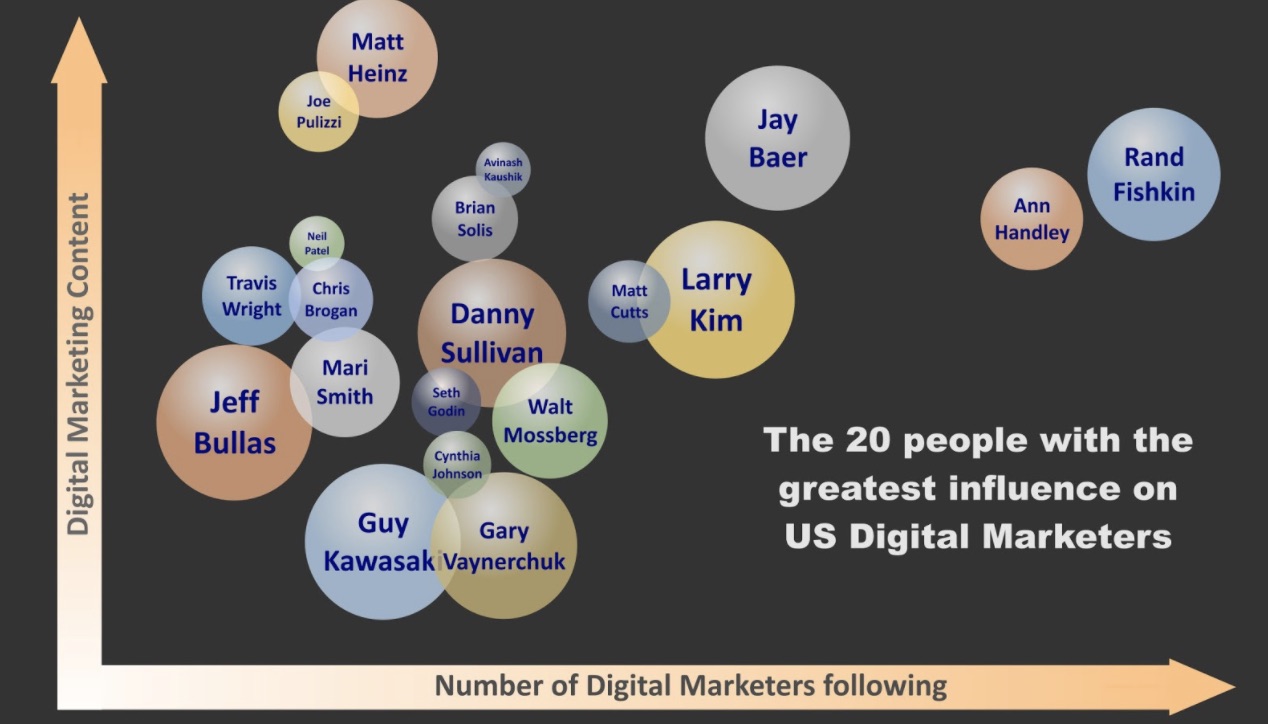
Who reaches the most digital marketers on social media? Which influencers have the biggest impact on digital marketing discussions in the United States?

By Ayaz Nanji.

Who reaches the most digital marketers on social media? Which influencers have the biggest impact on digital marketing discussions in the United States?

To find out, Apollo Target identified the people who publish the most-shared content about digital marketing on Twitter as well as those who have the largest followings of digital marketers on Twitter.

The full report identifies the 300 people who most influence digital marketers in the United States, and also breaks down the list by category (writers, consultants, etc.).

The two people in the US with the largest digital marketer Twitter followings are Rand Fishkin of Moz and MarketingProfs’ Ann Handley.

Matt Heinz of Heinz Marketing, Joe Pulizzi of the Content Marketing Institute, and Jay Baer of Convince and Convert are the people who publish the most-influential digital marketing content.

About the research: The report was based on an analysis of 2016 Twitter data. The researchers identified the people who publish the most-shared content about digital marketing on Twitter as well as those who have the largest followers of digital marketers on Twitter.

By Ayaz Nanji

Ayaz Nanji is an independent digital strategist and a co-founder of ICW Content, a marketing agency specializing in content creation for brands and businesses. He is also a research writer for MarketingProfs. He has worked for Google/YouTube, the Travel Channel, AOL, and the New York Times.

LinkedIn: Ayaz Nanji Twitter: @ayaznanji

Sourced from MarketingProfs