Tag

marketing

Browsing

Sex doesn’t sell… so, what now?

By Mediastreet Staff Writers

Could it be that sex actually does not sell? An analysis of nearly 80 advertising studies published over more than three decades suggests that’s the case.

Says University of Illinois advertising professor John Wirtz, “We found that people remember ads with sexual appeal more than those without. But that effect doesn’t extend to the brands or products that are featured in the ads.”

Wirtz and his co-authors conducted a first-of-its-kind meta-analysis of 78 peer-reviewed studies looking at the effects of sexual appeals in advertising. Their findings were posted online this week by the International Journal of Advertising.

Their research found that not only were study participants no more likely to remember the brands featured in ads with sexual appeals, they were more likely to have a negative attitude toward those brands, Wirtz said.

Participants also showed no greater interest in making a purchase. “We found literally zero effect on participants’ intention to buy products in ads with a sexual appeal,” Wirtz said. The assumption that sex sells is entirely wrong.  “There’s no indication that there’s a positive effect.”

As defined in the research, sexual appeals included models who were partially or fully nude; models who were engaged in sexual touching or in positions that suggested a sexual encounter was imminent; sexual innuendoes; and sexual embeds, which are partially hidden words or pictures that communicate a sexual message.

“The strongest finding was probably the least surprising, which is that males, on average, like ads with sexual appeals, and females dislike them,” Wirtz said. “However, we were surprised at how negative female attitudes were toward these ads.”

Wirtz said he decided to pursue this research because he sees meta-analysis – the application of statistical procedures to data from a range of studies – as a powerful tool. “The average number of participants in each individual study was about 225, but by using a meta-analysis, we could combine studies and conduct some analyses with more than 5,000 participants – in one analysis, with more than 11,000. This means that our results present a more accurate picture of what happens when someone sees an ad with a sexual appeal.”

The implications of the research for advertising practitioners are mixed, given that ads with sexual appeals are remembered more – and advertisers want people to remember their ads, Wirtz said – yet they don’t appear to help in selling brands or products. “Certainly the evidence indicates that the carryover effect to liking the ads doesn’t influence whether they’re going to make a purchase.”

This could be one reason why a national restaurant chain, known in recent years for ads selling its sandwiches with scantily clad models in suggestive poses, made a very public break with that approach in a three-minute commercial in the last Super Bowl, Wirtz said.

“If the ‘sexy ads’ had been effective, it’s unlikely the company or ad agency would have made such a drastic change. When product is moving, people don’t make changes.”


By

Media agencies are facing the greatest level of disruption in our vertical we have ever seen.

I mean bigger than when we decoupled creative agencies from media buying agencies, when we were back in the day when everything was full-service, and bigger than the event of digital advertising and digital media in itself.

That moment when agencies like us were born, with new capabilities that the market did not have. This is bigger than that, because it’s fundamentally about the root-to-branch adoption of digital technology, and changes within the media landscape that affect the entire advertising and publishing supply chain.

How digital adoption effects the advertising and publishing chain

From a media owner perspective – and I’m not just talking publisher here, I’m talking about television, outdoor, radio – there are pressures upon these media owners right now to trade their inventory in a different way. That means changes to their technology, changes to their actual business plan, the way that they run their company.

Advertisers, thinking about them as businesses, they’re the driving force behind these changes that I want to talk about. They are going through transformational changes, which mean that they need a different type of agency today, right now. These pressures, either side of us from businesses, brands, advertisers and on the media/owner side, it’s meaning that a new type of agency needs to evolve right now. At an individual level, that sets a challenge for all of us in terms of the type of marketer we are going to need to become.

Where this is already happening

These are tectonic changes I’m talking about, and if you keep your eyes open, it’s happening right in front of you, in the headlines of our trade press, every single day.

Accenture, in terms of digital, have historically been involved in the big transformational discussions with the C-suite. They have now purchased businesses like The Monkeys and Karmarama. These businesses now, they are big players across the entire advertising supply chain, and within digital transformation. They are in our world. Huge networks, like Dentsu Aegis, have purchased Merkle. The agency landscape is completely changing.

The catalysts behind this movement

Buying people in real time

Firstly, this is about the personalisation of media. It’s about the fact that now, through technology, through digital advertising, we’re interested in buying people in real time for advertisers. We don’t want to buy a huge, expensive television slot with dramatic amounts of wastage. We want to buy people in real time, based upon data that we know about them.

The necessity of digital transformation

Digital, and specifically technological changes, is placing a transformational necessity upon companies globally. It’s about the experience they provide to consumers. Think about it; where do you set the bar?

How should we execute media buying in the future?

Let’s have a quick look at how we might execute media buying looking forwards. To some extent, this is in play right now. From a data perspective, you have things like analytics, CRM, first- and third-party data, all being fed into something like a data management platform, where we segment an audience based upon their propensity to do business with an advertiser, which we then feed into our ad tech, and we purchase media.

I’m talking about buying people in real time. We can now buy TV. We, as a business, as an agency, we’ve purchased radio, using data. These doors are opening for us, as an agency, and for advertisers. And this is what it’s going to look like. We’ll be trading across the entire piece, in real time. This is a data-activated, omni-channel buying machine. It’s about an experience. You want to be plumbing in personalised creative into all this. This is about a digital experience, that we would execute on behalf of an advertiser.

What type of marketers do we need to be?

This new world that we’re talking about, where transformation is taking place, and where there is a need for a new type of media and creative agency, it’s causing debate at the minute within our industry, about what type of marketer do we need to be?

Some people are saying, we need to be left-brained. Left-brained, think probably historically Accenture, mathematics.

Some people believe we need to be right-brained, which is creative. It’s the realm of traditional marketing. That is intuition, right-brain, but I’m with my counterpart at Accenture Interactive, who believes we need to be whole-brained marketers. The whole-brained marketer needs to exist within a framework like this, where analytics, CRM, media buying and creative augment a central pillar of activity, which is based around the transformational element, the strategy and, obviously comms. It has data at its core, and it also concerns itself perpetually with every single output around customer experience. That must sit at the very core of any organisational structure.

What my message is really about, and what I want to kind of get home to you all is that we will not be digital marketing agencies in the very near future. I don’t believe we’ll even be a marketing or a media agency in the very near future. I think we are now in the business of providing a customer experience. The quicker our industry orientates itself around that central theme, I think the quicker we’re going to mirror the type of value that our clients so desperately need, as they themselves transform

By

Sam Garrity is managing director at RocketMill.

Sourced from THEDRUM

By 

If you have ever been part of a marketing team of a corporate, you will know how hectic the work can be. Along with focusing on industry needs, the marketers are also supposed to concentrate on day-to-day tasks which are generally repetitive in nature. Imagine spending your time on sending the same welcome mail every time a new customer logs into your portal, sending emails on discount offers to existing customers every time a clearance sale happens or directly engaging with every new individual who enters into the company’s social media profiles. There is no point in blaming the marketers if they get fed up with doing the extra work and loose their focus on the original task. This is where the importance of Marketing Automation comes into the picture.

Why Marketing Automation?

The chances that you have heard the term before but do not exactly have a clear idea about what it is-Can happen. In simple words, marketing automation refers to the software that can be used to execute marketing actions without manual effort. So why should you be interested in having marketing automation software? The answer is simple. In today’s corporate world, marketers who use the software tend to outperform the ones who don’t use it for performing their tasks.

The Origin Of Marketing Automation

Marketing automation emerged as a way for marketers to reach out to potential customers through multiple marketing channels. The origins of marketing automation can be traced back along with the origin of CRM platforms. Majority marketers will agree that marketing automation & CRM platforms go hand in hand.

The marketing automation started taking shape and became more distinct during the middle of the 2000s and in the past few years, it has become a $1.62 billion industry garnering over 142,700 users worldwide.

Moreover, the cost of marketing automation tools has become affordable in a way that nowadays even start-ups who have just entered the market have started using them. Earlier, it was only accessible to large multinational corporations and their likes.

Previously marketing automation mainly revolved around email marketing but it was the time when the internet was just getting popular among the general public. Later it developed as an amalgamation of much-needed marketing technology, namely web analytics, email and marketing resource management. With the arrival of social media channels, mobile commerce, and landing pages, marketing automation tools started developing themselves to become an all-in-one marketing and sales platform.

Marketing Automation Is High tech but Tech Friendly

One awesome feature of marketing automation is that even if it is developed as per the most sophisticated technology, it’s very simple to handle. The best marketing solutions are designed specifically to overcome the need for a technical team to run it. A marketing manager with basic digital knowledge will be enough to properly handle the marketing automation tool.

Possibilities in marketing Automation

  • Email marketing
  • Landing page creation
  • Cross-channel marketing campaigns
  • Lead generation
  • Segmentation
  • Lead nurturing and scoring
  • Cross-sell and up-sell
  • Retention
  • Measuring ROI
  • Website personalization

These strategies are familiar to all the marketers out there, but without the right equipment, they can be hard to accomplish. When a company’s marketing team grows above the primary level, there comes a point where it won’t be possible to manage 1:1 connections with customers using the manual tools available. That’s when automation comes in handy.

6 Benefits Of Marketing Automation:

Better Leads

One of the best benefits of marketing automation is that it can help you reach out to potential customers at the exact point in the sales funnel, for example, where they’ve expressed an interest in your newsletter or browsed your blog for long enough, etc. This means that the lead list will be more targeted, and potentially useful instead of just a list of random email addresses.

 Better Client Relationships

Marketing campaigns carried out through the automation software would be done at regular intervals and at a specified frequency. Marketers can use it to gain the trust of the customers through repeated efforts and by maintaining consistency.The software will play an important role to fill up the communication gap between the business and the customers.

Multi-Channel Campaign Automation

Marketers understand the need to coordinate their campaigns across multiple platforms, channels, and devices, because today’s customers often jump from one to another, spontaneously. Marketing automation can make this omnipresent status significantly easier for marketers to achieve.

Marketers can target customers with hyper-relevant product recommendations, conditional content, and smart segmentation, not just through email, but also social interactions, SMS messaging, push notifications, targeted ads, and more with the help of marketing automation.

Customer Retention through automation

Customer retention is one of the easiest ways to raise profits. Certain automation tools such as win-back and abandoned cart campaigns can have a huge impact on customer retention.

Automating those retention programs, prompted by an abandoned cart or a defined period of inactivity, constructed with timely and relevant messaging, can be the approach to bring the customer back and re-engage them with the product.

Avoiding human error

One of the most useful marketing automation benefits is that software can’t make the same kind of mistakes that we humans sometimes make. This ensures avoiding small, silly manual errors that sometimes have large, catastrophic results.

Understanding the correct message and applying it

Through the help of marketing automation, marketers can instantly understand which message is suitable for each target audience, as well as where, when, and how to send them for best results. Marketers can continuously test, optimize, and re-test messages, creative executions, and even subject lines. This type of information is needed to optimize content, resulting in getting the job done in less time and money not going to waste.

The potential of marketing automation is endless and it is the future of digital for brands. Marketers around the world are pursuing marketing automation tools as it is essential for attaining that competitive edge over the rest. Marketing Automation not only benefits your business but, it also helps in improving the relationship with your customers.

Feature Image Credit: Štefan Štefančík on Unsplash

By 

Sourced from iamWIRE

By .

Focus less on the product and more on the company and the people who work there.

When building a messaging strategy, the first question young startups typically asks themselves is, What do my customers want? In the digital-first world that we live in today, consumers value authenticity more than ever before, and it’s the brand’s job to make sure the messaging delivers on those values. According to a survey conducted by Label Insight, over 40 percent of customers would switch from their current preferred brand to one that offers more authenticity in their marketing strategies.

One of the biggest mistakes that many businesses make is they talk too much about their product and not enough about their company and the people who work there. And yes, there is a difference. A company’s most attractive qualities aren’t always the services it offers, but rather the type of experience it’s providing its customers.

Failing to exude authenticity is one mistake that startups cannot afford to make, so here are three brand guidelines to keep in mind when developing a messaging strategy.

Forgo a professional online presence in favor of an honest one.

So your website is super professional and legitimate — doesn’t sound so bad does it? While maintaining a strong brand reputation online is important, there is more authenticity in the startup sphere when you showcase your company’s personality. Social media is an obvious place in which to do so, with 83 percent of consumers preferring brand personality on Facebook above all social channels, according to Sprout Social, but updating your brand’s website is just as valuable to telling your brand story; and we all know that every startup has a good story.

Include short and sweet videos about the team on the about us page like these profiles by Nextiny or spice up your blog with how-tos like this Trello video that addresses relevant customer questions (Full disclosure: Both were made using Wistia’s platform). Making these adjustments can go a long way when it comes to showing off what type of company you are.

Be your own customer.

A good way to retain brand authenticity is by offering solutions for your customers based on how you address your own problems that arise internally. If you can identify your own business need or point of pain, chances are there are other companies out there facing the same problem. By modifying or creating products and services that also better serve your own customers, you’ve become more relatable and more importantly, reliable. In the tech space, there is no “one size fits all” for the way customers incorporate products into their framework, so creating customized solutions for your clients based on what you know about how they do business, better serves your customer base and makes you a better business partner in the long run.

For example, we realized that our videos were more successful when we showed a human face next to the content we were presenting so we relied on that partnership heavily. When we set out to make Soapbox, a browser-based screen and webcam recording tool, we made sure it was easy for non-professional video makers to do the same so they could be equally as successful.

People don’t care about products, so stop marketing them.

Every day, consumers are exposed to as many as 5,000 product-centric messages. That means that even if your company makes use of a unique and differentiated value proposition, content with this focus can easily get lost in the mix. The best content marketing tactic to drive traffic that converts is to standardize your messaging to be less about your product and more about your brand’s mission. This may involve a collective effort to revise your company mission statement, but this should be an exciting time for your business, not a stressful one. It’s also a great way to reconnect with the underlying purpose of your company and a reminder of why you started the business in the first place.

84 Lumber is privately held, second generation, woman-owned supplier of building materials that understands how to create content focused on more than just the products its selling. This year, 84 Lumber used its history and mission to create a commercial, The Journey Begins, that followed a young girl on her journey toward a better life, which connected with consumers on a common level and highlighted its desire to help build both hope and homes.

The overall lesson here? Your customers are not programmable machines, and they want to be sold a reliable solution that gets them one step closer to their business goals. The best way to earn long-term customer loyalty and set yourself apart from industry competitors is to be honest, and incorporate more holistic conversations into your content strategy and overall brand narrative. Be your own customer, show off those fun and creative employees you hired, and keep lines of communication wide open, because authenticity will always win.

Feature Image Credit: Shutterstock 

By .

Sourced from Entrepreneur

By .

Facebook has introduced Facebook Cross-Platform Brand Lift in the US and UK which along with Nielsen Total Brand Effect with Lift will help advertisers optimize their Facebook and TV campaigns using actionable results according to a blog post.

The platform will see Facebook will match rival Google which launched Brand Lift for TV some years back in order to help marketers understand how YouTube campaigns can impact metrics such as awareness.

Facebook’s advertising partners who are expanding from digital advertising into cross-media campaigns will be able to leverage Facebook Cross-Platform Brand Lift solution.

Margo Arton, senior director of Ad Effectiveness at BuzzFeed said: “Now that Buzzfeed has begun to diversify our media strategies to include both Television and Digital, having the option to leverage solutions such as Facebook’s Cross-Platform Brand Lift and Nielsen Total Brand Effect with Lift presents a great opportunity.”

“We look forward to using cross-platform brand lift measurement to both receive valuable insights about our multi-media campaign performance in a single reporting surface, and also to optimize campaign elements such as spend and creative across both platforms.”

Facebook cited an example of household brand Shark’s campaign which was deemed a success as measured by Nielsen Total Brand Effect with Lift.

Ajay Kapoor, VP, Digital Transformation & Strategy, SharkNinja said: “We proved that Facebook video ads are a natural complement to TV campaigns. We experienced better brand results among people who saw ads on both versus just TV or Facebook alone. We saw the ‘better together’ impact first-hand. Facebook and TV are powerful individually, but deliver a stronger message to our audience when used in tandem.”

Facebook recently introduced more ways to help marketers re-engage offline audiences.

By

Sourced from THEDRUM

By Harsh Pamnani.

In a market crowded with a lot of brands offering similar products, a good positioning makes a brand and its products stand out from the competition

Getting in front of customers and prospects is an important thing, but more important thing is what you will communicate about your brand and product when you are in front of your audience. Positioning helps marketers to connect their brand and products best with their target audience. In a market crowded with a lot of brands offering similar products, a good positioning makes a brand and its products stand out from the competition.

Positioning is one of the most important components of marketing strategy and vital to success of any brand. Al Ries and Jack Trout, in their book Positioning: The Battle for Your Mind, introduce the subject by saying: Positioning is not what you do to a product. Positioning is what you do to the mind of the prospect. That is, you position the product in the mind of the prospect.

Let’s have a look at a few important rules of positioning:

1.    Positioning drives marketing strategy: The process of creating positioning statement requires identifying target audience; product category; product’s specific benefit, strengths and weaknesses and differentiation from the nearest competitor. Positioning drives all components of marketing strategy such as advertising, packaging, pricing, distribution, public relations, merchandising and brand communication. Additionally, strong positioning attracts partners, employees, investors, customers to associate with a company owning top positioned brands. Moreover, good positioning attracts influencers such as journalists, analysts, thought leaders etc. to cover a brand in their articles and reports. For example, in extremely competitive, coffee selling business, Starbucks has positioned itself as an upscale brand. Its stores’ locations, service, products display, packaging, socializing environment, pricing etc. are designed according to its positioning of an upscale brand.

2.    Positioning is relative: In any category, customers think about brands relative to other brands in the same category. To gain strong position for its brands, a company must differentiate its brands and products from others in the market. The most important point is that differentiation has to be sustainable. Differentiations such as price and features can be surpassed by competition in some time but it is difficult for competition to surpass the differentiation of quality, service, availability and leadership. For example, there are many digital wallets such as PayTm, MobiKwik, Freecharge, BHIM, State Bank of India’s SBI Buddy etc. All of these wallets have almost similar features and pricing and solve the similar purpose, but in customers’ mind PayTm has taken up the top position and has strong perception of quality and leadership.

3.    Positioning changes as market changes: In today’s fast changing world, products change, markets change, customers’ demands change, competition change, technologies change, regulations change and so on. These changes can create an opportunity for a new player to shake the positioning of an established player. For example, non-polluting electric vehicles are seen as norm of the future and Tesla is a prominent player in elegant electric vehicles. As per an article in recode, the 14-year-old company Tesla is now worth more than 113 year old company Ford. In a way, Tesla’s positioning seems to be surpassing Ford’s position.

4.    Positioning is multidimensional: Positioning has multiple dimensions such as product positioning, market positioning, industry positioning and leaders’ positioning. Product positioning is defined by a company based on its strategy, focus on market segment, price point, distribution channel etc. Market positioning of a brand or product is defined by word of mouth of influencers such as customers, analysts, retailers, journalists, partners etc. Industry positioning is defined by revenue and profit of a company. And most importantly, success of company elevates the positioning of its leader. For example, iPhone is a product brand, Apple is a company brand and Steve Jobs is a leader brand.  iPhone is positioned as a premium smart phone with higher price point targeted towards upper middle class and rich customers and available through selective channels. Positive word of mouth by influencers including customers has helped iPhone in gaining market recognition as the top positioned smart phone. Revenue through sales of iPhone helps Apple in achieving better positions in rankings such as Fortune 500. Success of Apple’s products such as iPhone has contributed to Steve Jobs’ position as one of the best business leaders. Again, Steve Jobs’ positioning as one of the best leaders drives positioning of his company, company’s products and so on.

5.    Positioning evolves over time: As company grows over time, its market segments evolve, its products evolve and it’s positioning in market evolves. If a company is focussed on niche market segment then it has to position itself for niche customers. But over the time, when market segment evolves or when company tries to enter into adjacent market segments then its positioning evolves. For example, when Uber was new in India, smart phones were available with limited number of people and taxi riding was not a preferred option as compared to auto rickshaws. Initially, Uber targeted customers who were looking to enjoy a luxury experience, had smart phones and credit cards. It was positioned as a taxi ride service for classes. Later on, Uber expanded its offerings such as low cost small cars, medium cost sedans and higher cost big cars. It also expanded its services from point to point transfer to outstation travel, taxi hire for personal usage, economical ride sharing etc. Moreover, along with credit card, it started accepting money through PayTm and cash. This evolution not only expanded Uber’s market segment, but also their positions from a transportation option for classes to a transportation option for masses.

6.    Positioning is strongest in the new category: In a mature category, there are already established players and to create its position, a brand has to compete with existing brands. But if a brand is able to create a new category then it can achieve leadership status in that category. For example, fast food is an overcrowded category with many popular brands such as McDonald’s, KFC, Subway, Taco Bell, Dominos, Dunkin Donuts, and Starbucks etc.  But all of these brands have created their leadership positions in separate subcategories within fast food category. For example, McDonald’s is known for burgers, KFC is known for chicken, Subway for sandwiches, Taco Bell for Mexican food, Dominos for pizza delivery, Dunkin Donuts for donuts, Starbucks for coffee and so on. Though all these players try to enter into each other’s’ offerings but their positioning is strongest around their key fast food offerings.

7.    Positioning is internal: The purpose of positioning statement is to align internal stakeholders such as marketing team, sales team, delivery team etc. on a common view of market. This alignment helps in having common interpretation of target audience, product category, differentiation from competitors, benefits for customers and so on. When everybody internally is on the same page, external communication becomes homogenous, relevant, targeted and clear.  For example Harley-Davidson’s internal positioning statement is: The only motorcycle manufacturer that makes big, loud motorcycles for macho guys (and “macho wannabes”) mostly in the United States who wants to join a gang of cowboys in an era of decreasing personal freedom. Taglines are external facing catch phrases that summarize positioning statement extremely concisely. For Harley-Davidson, tagline is “Define your world in a whole new way.”

8.    Positioning gets spoiled by brand extension: Brand extension is a common method used by companies to launch a new product by using an existing brand name on a new product in a different category. A company using brand extension hopes to leverage its existing customer base and brand loyalty to increase its profits with a new product offering. If a company expands its business too fast by launching multiple products using its powerful brand name, then it is necessary for it to maintain quality. If quality of a few of the products of a respected brand is bad, then customers no matter how loyal they are will start rethinking about the brand. Lowered image of a few products in customers’ mind would eventually impact the brand position and the business’ revenue. For example, Baba Ramdev’s Patanjali brand has a strong positioning in Ayurvedic products. But since last few years, Patanjali has been launching many new products in different categories and that’s too fast. There have been incidences when government’s food safety departments have raised questions on a few of the Patanjali’s products. Though strong brand name of Baba Ramdev and Patanjali have helped the company to launch and distribute many new products, quality concerns on a few products, effect overall positioning of the brand Patanjali.

(Views expressed are author’s personal and don’t necessarily represent any company’s opinions.)

Disclaimer: The views expressed in the article above are those of the authors’ and do not necessarily represent or reflect the views of this publishing house. Unless otherwise noted, the author is writing in his/her personal capacity. They are not intended and should not be thought to represent official ideas, attitudes, or policies of any agency or institution.


By Harsh Pamnani

The author is a Marketer & Author. He is an alumnus of XLRI, Jamshedpur  More From The Author >>

Sourced from BW BUSINESSWORLD

Sourced from net gain.

When it comes to marketing strategy, every business is different. You have to be: It’s a key part of your USP.  However, some businesses are better than others in applying the marketing process because of their focus, how evolved their capabilities are, and the level of resources they make available.  

From experience the most effective marketing businesses are the ones that focus on the customer, use insightful data to inform every decision and invest resources to exploit opportunities that best meet their customers’ needs. They have evolved their marketing capabilities to enable them to engage their customers with the most relevant products and services through the most appropriate channel at the most opportune time that yields the best result for both the customer and the business.

Getting to this level is not an easy journey. Established businesses may have amassed years of knowledge, skills and capabilities, but ensuring their data, legacy systems and thinking stay ahead of the game takes significant investment. Younger businesses might be able to leap-frog straight to the latest thinking, but the experience to truly exploit it doesn’t come cheap.


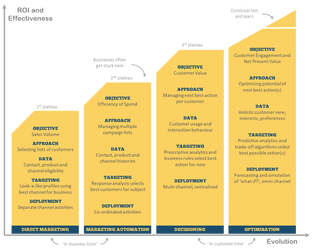
Picture


First steps: Direct Marketing and Automation

Businesses often start out with simple direct marketing techniques to select lists of prospective or existing customers that meet a short-term demand to drive (e.g.) increased sales. These lists can be produced using simple database tools and specialist technical resources, but as the number, complexity and speed of discrete campaign requirements grow, it quickly becomes a difficult problem to govern and remain agile so, marketing effectiveness can plateau.

The first major evolution is to invest in fit-for-purpose marketing automation tools that increase efficiency by helping the marketer to govern the overall activity schedule, embed test and learn techniques to help improve future targeting effectiveness, and manage the creation and execution of multiple, simultaneous activities to keep up with demand from whichever parts of the business are shouting loudest to meet immediate targets.

It is at this point that many businesses find their marketing effectiveness reaches another plateau and they get stuck just keeping up with business-as-usual. Marketing automation tools are good at ‘pushing’ campaigns that are driven by the business’ agenda and marketing calendar, but they’re not so good at being customer-friendly – e.g. was there a missed opportunity to do something better to engage the customer at a more opportune time and maximise customer value?

Being more customer-centric: Decisioning
To evolve further means overlaying a ‘pull’ approach where activity is driven by customer need and behaviour. Business rules and predictive analytics are applied through a decision engine to determine which, of all possible actions, is best in any given situation, often in ‘customer time’ during a transaction or interaction.

This personalisation process usually considers, for each individual customer: whether they are eligible for the action; whether it is the right timing; whether it’s the right level of relevance and appropriateness; whether it would generate the right outcome; and what the relative priority is in achieving the business goal.

​Consequently, businesses tend to arrive at the third plateau of marketing effectiveness when the complexity of managing this decisioning process becomes too great: The number of different situations or actions has grown significantly, or overarching goals and constraints such as budgets, capacity or targets are inappropriate to apply at a customer level.


The next generation: Optimisation
The last evolutionary step is to optimise each decision to maximise the overall objective, such as return on investment and profitability, while satisfying all constraints, such as budget spend and enhancing customer engagement. This involves sophisticated algorithms to trade-off the different decision factors in each action to determine which best meet the overall objective while satisfying the constraints.

This might sound complicated…and it often is, but the pay-off is the business performance uplift it can provide, which can be significant. It also provides true, top-down control over marketing activity so, for example, flexing the decision factors provides an opportunity to explore different ‘what-if?’ scenarios and see which gives the best mix of business and customer benefits.

Keep moving forward
Whilst making optimal decisions could be the ultimate evolution, marketing effectiveness can still reach a plateau because your data, predictions and actions can quickly go ‘out of date’ in today’s marketplace: Every customer is different and has constantly evolving needs and interests that someone will be able to satisfy.

Consequently, the most important tools in your toolbox are insight and agility: Continually testing new ideas, actions and situations with customers to learn what works and what needs refining (or discarding) and then quickly adapting the capabilities of the business to generate value for your customers.

Sourced from net gain

By Shawn Lim.

As the world’s biggest advertisers like Unilever and Proctor & Gamble continue to operate on lower advertising budgets and spend less on media buys in 2017, Facebook believes that putting its faith in mobile advertising will help it ride the storm going into the next year.

Ever since P&G’s top marketer Marc Pritchard announced that the Ariel and Pampers advertiser will review all of its agency contracts and called for more transparency in the media supply chain at the start of year, the advertising industry has seen some major shakeups.

Unilever dropped half of its creative agencies under its employment and reduced spend to $200m, while P&G reduced up to $140m of its ad spend and stopped investing in areas where it was unsafe for its brands, on top of its move to stop targeted ads on Facebook in 2016.

The cutbacks by the FMCG giants were necessary to clean up the supply chain and remove fraudulent inventory, acknowledges William Platt-Higgins, vice president, global client partnerships at Facebook in an interview with The Drum in Singapore, and notes that it is in everybody’s interest that fraud be eliminated from the ecosystem.

“We have seen various marketers and agencies taking a hard stance on this publicly and some clients very surgically try and cut out as much of that as possible. They have done so without any negative impact on their business because the inventory that they are weeding out is actually not good inventory to begin with,” explains Platt-Higgins.

“It won’t be eliminated completely, but I think all the clients that we work with in all regions of the world are focused on reducing fraud as much as they can and getting transparency into the supply chain by using third party verification.”

While Facebook has previously come under fire for reporting miscalculated metrics and for a lack of transparency because of its closed marketplace around its user data, brands and agencies still trust the social media giant, according to Platt-Higgins, which is why all Facebook verticals are growing, including FMCG.

He also accuses critics of being green-eyed about Facebook’s strong, growing partnership with P&G and other big FMCGs, claiming that it is being brought earlier into the creative and strategy planning stages.

“They (Unilever and P&G) are very focused on maximising value for their investments and cleaning up as much of their supply as they can. They are looking to hold all media choices, not just digital media choices accountable,’ says Platt-Higgins.

“One of the things we are starting to hear is the advantage of any digital investment is it is more measurable than traditional offline investments. Digital channels, because they are measurable, the amount of data available on their efficacy and attribution to sales is large.

“What we are seeing from these conversations is ‘It is great that I am holding all my digital investments super accountable, because that is the right thing to do and I want to hold all my other investments as accountable as well’. What you will see increasingly is that investments will flow to media channels that are providing the higher returns of investment and the higher value, and they will recede from those that aren’t.

He also repeats a well-trotted out company line about its closed marketplace, as he says that the Facebook ecosystem does not qualify it as a ‘walled garden’. He explains that people are jealous of the quality of its data and its desire to protect its data, which comes as a result of its commitment to user privacy.

“We certainly hear it (walled gardens) and I don’t think that we would agree with that,” he adds, adding that the requests tend to boil down to various people or entities wanting more data on individuals, which breaches Facebook’s terms of service and the trust that people give when they join.

“That is something that we will and must protect. So that’s our stance on it,” asserts Platt-Higgins.

Quoting a book called ‘How Brands Grow’ by professor Byron Sharp at the Ehrenberg-Bass Institute, Platt-Higgins says Sharp’s words inspired Facebook to shift its focus to mobile advertising to cope with the FMCG giants’ lower ad spend and media buys. Sharp wrote that in order for brands to grow they need to bring new users into the franchise, and that consumers are not uniquely loyal to brands and instead tend to shop on a ‘consumer regiment’ of products because of mental and physical availability.

He claims that this approach by Facebook has seen it reach 500,000 households in the Philippines for Nestle’s all-purpose cream product campaign using Facebook and Instagram. While in the UK, 37 FMCG campaigns that made use of its tools drove a 3.7% increase in sales, and of those people buying those products 60% were non-brand buyers. In the US, 200 campaigns on Facebook and Instagram drove an increase in household penetration, bringing new users in 72% of the time.

“Over the last number of years, as people shifted to mobile devices, the concept of both mental and physical availability has changed. If you are in the business of growing your brand, what you need to master is mobile marketing,” says Platt-Higgins.

“This is where we have been spending most of our time. Not only is Facebook and Instagram driving sales, but they are disproportionately driving household penetration and bringing new users in because of mobile.

“In Indonesia or India, where there might be power outages from television, the opportunity to reach people with mobile and bring top-of-mind awareness and mental availability is huge.”

However, Platt-Higgins admits that simply porting assets from television onto mobile does not necessarily work and Facebook is constantly reminding itself that the way people consume content is different. He adds that if a brand is not building for the mobile environment intentionally and with craft, care, seniority, thoughtfulness and senior stakeholder-management stewardship, as well as optimising for mobile, then it is a missed opportunity.

“Brands need to optimise in three areas. One is the reach, where often what we find is that clients have gone too narrow with their reach and that can be a drag on their results. We see that the frequency is not optimised and not reaching people enough or too often. The most important thing is how the creative is being optimised for mobile,” explains Platt-Higgins.

“We spend a lot of time trying to audit and show whether or not the work has been optimised for mobile and if it has, how we can make it even better.

“If we can get those three things right, we find that we can disproportionately drive sales and Facebook has a direct attribution to sales. That is the only equation that people are interested in.”

Platt-Higgins’ advice on mobile certainly carry weight, as a report by eMarketer found that FMCG brands are expected to invest 28% more in mobile advertising in 2017 in the UK.

By Shawn Lim

Sourced from THEDRUM

By Neil Patel.

We’re living in the golden age of content marketing right now.

Social media has made it easier than ever before to reach and connect with your ideal demographic.

Social Media Today put it best with its infographic on social media marketing statistics of 2017.


That’s right, 79% of all American Internet users are on Facebook!

While there are still some brands that refuse to adapt to the changing needs of the marketplace, more and more businesses are accomplishing amazing things in the world of marketing.

Despite my long-term involvement in it, I’ve always considered myself a student of the industry.

Every day, I’m excited to see where the world of digital media marketing is going and to find new ideas or techniques that I can share with all of you.

That’s why I’ve decided to analyze some of the world’s most popular blogs and present you with 6 actionable lessons that you can use to enhance your marketing strategy right away.

Each of these brands, in one way or another, has changed the marketing game, and the average business owner can learn quite a bit from their success.

Here’s the list, and feel free to jump to any particular section that interests you.

  • Clarity is everything (or why lists work)
  • The power of the headline
  • Visual content matters
  • Data-driven content wins the long game
  • CTAs may not be sexy, but they work
  • Long-form content works

1. Clarity is everything (or why lists work)

It’s easy to look at sites that have simplistic aesthetics and think that their owners are just not invested in the presentation of their content.

The truth is that some of the most effective blogs I’ve ever seen tend to value simplicity over complexity.

Why?

Because that’s what their users value the most, too.

I’ll be the first to defend long-form content (it’s what most of my content is, after all).

But I’d be a fool if I didn’t recognize the power and impact that short-form content has had on the world of content marketing.

And it’s not a surprise when you stop and think about it.

The average consumer can get their information from lots of sources.


If we’re working off the assumption that most of them cover the same topics, particularly as it relates to current events in the industry, it’s no wonder that users stick with the no-fluff version.

The idea that straightforward content is easier to read isn’t breaking news. We’ve all known about that since middle school.

What makes this clarity-driven content so exciting is its accessibility and actionability.

I was thinking about this while scanning Lifehacker, which has one of the most pleasantly minimalist designs I’ve seen.


With an estimated 21 million unique monthly visitors, Lifehacker’s emphasis on keeping things as simple as possible is clearly working for them.

There aren’t any ads surrounding their articles, ensuring that you’re able to focus on whatever content you happen to be reading.

Take a look at the article below and you’ll notice nothing but white space, which helps keep the page from feeling cluttered.


And while you’re presented with some options for what to read next, it never feels overwhelming or distracting.

It’s not just easy to learn something. It’s easy to take that knowledge and apply it.

Since we’re on the topic of clarity, it’s time we talked about list articles.

In our industry, lists are often viewed as a necessary evil.

Plenty of people will argue that listicles somehow undermine the integrity of the content marketing process.

I couldn’t disagree more.

Uninspired listicles are clearly not a great marketing tool. But those have short-sighted thinking and bad writing to blame above all else.

The problem isn’t the format. The problem is that people misuse it.

If anything, I welcome the listicle if it encourages brands to prioritize simplicity and clarity in their marketing efforts.

Well-written listicles feature a recognizable structure and a clear value proposition. They’re easy enough for the average reader to enjoy, and people find value in them.

The format works — in the right hands, of course.

The Huffington Post, with 160 million visitors every month, has the list article down to a science.


If you take a closer look and actually dive into the articles, you’ll notice that there’s minimal fluff here.

For example, take a look at the article “10 Things People With Autism Wish You Knew.” You’ll notice that it manages to provide value without overstaying its welcome.


And that’s an important lesson for any content creator. If you’re going to produce content, make sure that it’s presented in a way that makes consuming it simple and straightforward.

2. The power of the headline

I’m always a bit hesitant to discuss the importance of headlines when it comes to content marketing.

Not because I doubt their importance. The value of a compelling headline has been proven time and time again, so it’s not exactly controversial.

No, I’m worried about the brands that see the word ‘headline’ and think ‘click bait’.

So, before we move forward, let me be absolutely clear. If you’re in the world of content marketing, don’t overuse click bait.

It’s really that simple.

Your headline should still be intriguing and catchy. It should inspire curiosity and compel the average reader to stop what they’re doing and think, “Man, I gotta know what all this is about.”

But don’t promise something in your headline that your article doesn’t cover.

One of my favorite examples of this is Business Insider’s article titles. No matter what industry they’re tackling, the titles always manage to be eye-catching without ever being misleading.


With over 78 million readers every month, Business Insider proves that you can rise above click bait and still develop a massive following.

Your headline should be an introduction to your content — not a trick that gets people to read your article.

Why am I so insistent about this?

Because quite a few brands engage in click-bait behavior, and I’m convinced that they don’t understand how much it can damage their reputation.

When it comes to digital media marketing, your currency is trust. If people trust your content, they’re likely to share it.

If they trust you as a content creator, they’re likely to believe in your business.

Trust, just like success, is difficult to earn and easy to lose.

The moment that consumers open one of your articles and think, “Wow, this was just click bait,” you’ve compromised your relationship.

And for what? A slight bump in traffic in the short run isn’t worth the long-term damage.

There’s an important lesson to be learned here, particularly for brands that are struggling with headlines.

As tempting as it might be, don’t start making click-bait titles.

Forget about the fact that they can compromise the relationship you’ve built with your audience. The truth is that you just don’t need them to experience the benefits of compelling headlines.

All you really need to do is apply the 3 basic rules of headline structure.

  • Make sure you’re using relevant, specific data in your headline.
  • Imply value propositions with words like ‘Tips’, ‘Reasons’, ‘Secrets’, and ‘Ways.’
  • Provide a major call to attention.

From there, the rest will come down to collecting data and constantly testing.

It won’t be glamorous, but it’s better than destroying your credibility.

You can create compelling headlines without lying to your audience.

Want to know what the secret is?

The content that you’re making has to be compelling too.

3. Visual content matters

If you were to take it at face value, creating content might seem like a one-dimensional task.

No matter what problem you’re tackling, you’re solving the issue with your written analysis and trying to create an engaging experience through compelling words.

But if you’ve been paying attention over the last few years, you know that content marketing is so much bigger than just the written word.

Particularly as it relates to the world of social media marketing and digital media as a whole, your content is expected to be multi-dimensional before it can be considered truly engaging.

The copy you create certainly matters, and it’s arguably the most important aspect of the creative process.

But make no mistake. Presentation matters, especially in industries in which you’re facing stiff competition.

Enter the world of visual content.

Mashable, with 45 million unique visitors a month, has embraced the explosion of visual content and ensured that all of their written content has some level of visual content integrated.

To really understand why this matters, we need to change the way we think about content.

First off, it’s important to acknowledge that compelling content doesn’t necessarily mean professional.

TMZ has managed to build an entire business using assets like amateur videos to promote their content.

12.3

Imagine each piece of content that you create as a journey. Each journey is unique to the problem you’re trying to solve and the value you’re trying to offer.

But like any journey, your content has a beginning and an end.

Still with me?

Okay, so the content that you write out could be some of the wittiest and most engaging copy you’ve ever created.

But at the end of the day, it’s still a tall order to expect the average person to sit down and happily read 10 minutes’ worth of your content.

Could you shorten the length of the journey by shortening your content? Sure, but that’s not the only way to solve this problem.

If you can incorporate enough engaging, relevant imagery into the article, there’s a much higher chance that your reader will make it to the end of your article.

To be as engaging as possible, your content needs enough structural integrity to guide people to the end.

Buzzfeed goes as far as using people’s tweets as visual content, and with plenty of success.


You’ve already done the hardest part, which is coming up with a compelling, unique idea.

So what can we learn from these blogs?

If you’re going to execute it, make sure that you’re presenting the best piece of content you possibly can.

And part of presenting the best content possible is using any tool at your disposal to engage your reader.

Oh, and if you think that visual media is a purely superficial solution to the problem of encouraging engagement, allow me to introduce you to the infographic.


Visual content might be widely used for its potential as entertainment, but it’s just as powerful when it’s used as an educational tool.

4. Data-driven content wins the long game

All content is not created equal.

To put it simply, there are really only three kinds of content in the world.

  • Content that doesn’t work
  • Content that wins the short game
  • Content that wins the long game

Before I go any further, let me just say that I’ve got nothing against winning the short game.

There are sites like Engadget, which experienced major success while only focusing on producing punchy, short-form content that revolves around current industry-relevant events.


If you run a business, winning the short game is about more than just keeping the lights on for another month.

Small, tactical victories reinforce the fact that your business is growing and developing the way you want it to.

And if you can string enough of those small, tactical victories together, you’ll likely end up winning the long game.

But there’s a difference between consistent, sustainable growth and only being focused on the short-term gains.

We’ve all seen it at this point. Content that’s clearly only made to take advantage of some scandal or controversy that will be irrelevant in the next month.

I’ve got no problem with you trying to win today — as long as you don’t forget about winning tomorrow.

From a purely analytical perspective, I want to create content that I can repurpose or revitalize down the line, which can be invaluable in the future.

From a personal, human perspective, it’s difficult for people to consider you compelling if you don’t have anything memorable to say.

And simply reporting on current events is not how you end up with engaging, impactful content.

Creating a piece that simply covers scandal is just not that useful down the line.

Now, if you were to use that controversy to analyze a particular industry issue and encourage a discussion on it, that’s a different story.

See what I mean? There’s a way to win the battle today and the war tomorrow.

Going back to Engadget, you can look at their content and instantly recognize that they’re constantly moving forward with the strongest data available at the time.

And why does this matter? Because it shows brands and businesses that you can create engaging content that’s backed by relevant data, which then extends the content’s life expectancy.

Always think about the future when you’re creating content. How can you use it to further your long objectives?

5. CTAs may not be sexy, but they work

There are two camps to the call-to-action (CTA) discussion.

For some people, CTAs are a gimmicky way to encourage engagement. They’re like the silly tagline in a commercial.

When you’ve seen as many poorly-structured CTAs as I have, you can start to understand why people hesitate before using them in their own content.

But the second camp of people, which is the group that I fall into, is made up of people who recognize the incredible value of a well-placed CTA.


Whether you’re a big fan of them or not, no one can deny that they’re effective.

The question isn’t whether or not they work.

Instead, it’s helpful to understand why they work and what the average business owner can do to create effective CTAs.

The best CTAs all have a few things in common.

They all offer value by appealing to the needs of the brand’s audience. The best CTAs are tactically placed in easy-to-find places, which increases the likelihood of engagement.

But the most important part of any effective CTA? It should guide your consumer towards the next step in your marketing funnel.

Just take a look at TechCrunch. They may not exactly be subtle with their CTA placement, but with over 12 million unique visitors every month, it’s clearly working for them.

Their CTA for Disrupt SF is easy to find, and it clearly offers value and has an obvious next step for readers.

If you’re just starting to implement CTAs, those three basic steps should be the building blocks of your CTA strategy.

Even if you make the most amazing content ever published, you can’t just cross your fingers and hope that people will share it.

You can’t control how people will instinctively react to your content or your CTAs. All you can control is what happens on your end of the creation process.

Ask people to share your content on social media, get them to sign up for your newsletter, or invite them to check out your inventory. CTAs like these seem simple, but they’re also powerful.

It doesn’t matter what that next step is. What matters is that you’re moving your relationship with your audience forward and moving in the direction of growth.

6. Long-form content works

Remember, earlier in this article, when I was talking all about the benefits of clarity and brevity?

I’m sure a lot of you must be wondering how I can champion short-form content while also producing articles that run for thousands of words.

The reality of the situation is that there are no ‘sides’ here.

There are clear benefits to producing short-term content, just like there are clear benefits to producing long-form content.

Whichever type of content you decide to create will depend entirely on what you’re most comfortable producing and what type of content resonates with your audience the most.

And for me, that means producing long-form content.

By the way, this isn’t something that I’m guessing or assuming. I discuss this more in depth in my article on how to get more traffic, but I’ll summarize it here just to keep things moving.

Long-form content is performing better than ever these days.

And the best part?

Search engines love long-form content. This means that writing high-quality posts that are 2,000 words or longer will inevitably boost your conversion rate.

Just take a look at this serpIQ graph. It shows that posts with 2,000+ words are leading the charge in search results.

12.6

Long-form content has always given me the best results, and the reasons why are actually pretty simple.

For starters, I thrive off the trust that all of you have in me and my content.

But I have to earn that trust every single day, and in my experience, there’s no easier way to do that than by providing you with quality content and analysis.

By diving deep into the topics I choose, I’m able to prove to you that my content is worth your time.

After I’ve done that enough times, the idea is that you’ll come back to this site because you understand that I pack my articles with as much value as possible.

Plus, in-depth analysis and discussion tend to lead to the creation of evergreen content, which lends itself particularly well to long-term growth.

And I’m not the only one who’s experiencing success with long-form content.

Buffer routinely publishes plenty of long form content, often with a heavy emphasis on providing data and insight.

Its article, “How to Create a Social Media Marketing Strategy From Scratch,” article was a 9-minute read, but just look at all those shares!

12.8

What’s the lesson here? Don’t shy away from long-form content because you’re afraid it’ll scare people away.

As long as it’s well-written and engaging, and as long as it offers readers legitimate value, your long-form content can perform as well as (or better than) short-form content.

Conclusion

Creating content that stands out is never an easy task.

Every single blog that I used as an example on this list struggled to find its winning formula.

No one is expecting you to figure it all out overnight. All I want to do is help you arm yourself with the right knowledge and tools in this fight.

But if you can learn to embrace the ideas presented here, there’s no doubt in my mind that your content will evolve into something much more impactful.

Focus on clarity. Use visual content that grabs the reader and refuses to let go. Write powerful headlines. Continue to craft compelling CTAs.

And, if you’re anything like me, don’t be afraid to create long-form content.

What lessons have your favorite blogs taught you this year? Which of these blogs do you think has the most effective content marketing?

By and sourced from Neil Patel.

By Harry McCracken

A company that made its name helping small businesses with email is staking its future on the “small business” part of that proposition.

MailChimp did not start out as an enterprise obviously destined to help millions of small companies market themselves via email.

Actually, the company was originally the Rocket Science Group, a web-design firm that began fooling around with email in 2001 at the request of some of its customers. Its original email engine borrowed code from an earlier failed e-greeting card startup. Ben Chestnut and Dan Kurzius landed on the name MailChimp after discovering that their first choice, ChimpMail, was taken. And their initial simian-themed branding consisted of a repurposed drawing of a chimp–eventually known as “Freddie”–who’d appeared on one of the e-greetings.

The email marketing features the company built proved so useful that they began to look like a better opportunity than the design business–which, Chestnut says, “was all about billable hours and salesmanship, and those were things we sucked at.” In 2006, Chestnut and Kurzius decided to go all-in with MailChimp. “We took a year saying goodbye to all the agencies and clients, finding them new vendors,” he explains.

A very early incarnation of MailChimp.

MailChimp really went into turbo mode in 2009, when it instituted a freemium business model that let customers send up to 3,000 emails a month to up to 500 subscribers at no cost. Letting companies get addicted to the service before requiring them to pay up proved so successful that the free version now lets users send 12,000 emails to 2,000 subscribers.

Now MailChimp is probably the biggest name in its category–in part because its offerings are so well done and widely used, and in part because it’s cleverly promoted itself via efforts such as quirky sponsorship messages on the Serial podcast. And despite its high profile, it’s even larger than you might guess. Based in Atlanta–far outside Silicon Valley’s bubble of venture-funded would-be unicorns–the company has 600-plus employees and did more than $400 million in revenue last year. More than 15 million customers sent 246 billion emails in 2016.

There are still additional small businesses out there that need help with email, but MailChimp’s growth strategy isn’t just about finding them. It’s also committed to keeping its focus on serving small businesses rather than using them as a springboard to reach larger customers with more lavish budgets.

Mailchimp cofounder and CEO
Mailchimp cofounder and CEO Ben Chestnut.

Though Chestnut is quick to tout the effectiveness of email marketing–he says it can return $40 in revenue for every $1 spent–he also claims “not to have any particular kind of affinity or attachment to email.” The future of the company, he says, is “to take MailChimp magic we give to email, and sprinkle it on other marketing channels.”

That vision has been apparent in the company’s product announcements for awhile now. A year ago, it introduced a recommendation engine–akin to the ones devised by big companies such as Amazon–that let its customers plunk product suggestions into the emails they sent their customers. Then in January of this year, it began helping small businesses buy Facebook ads–figuring that the expertise it had in building friendly web interfaces gave it an opportunity to make the process easier than Facebook had done on its own.

[Photo: courtesy of MailChimp]

The Instagram Opportunity

As MailChimp was deciding what big ad platform to support after Facebook, it sought input from its customers. They had a clear favorite: Instagram. If you find that unexpected, you’re not alone. “We kind of thought Google might be next,” Chestnut says. “Instagram was a surprise for us.”

Once you think it over, though, that preference makes more and more sense. In March, Instagram announced that it had a million active advertisers, a milestone it reached in large part because a lot of small businesses find it to be a valuable marketing platform. Any digital business with that many small-business customers is likely to have meaningful overlap with MailChimp’s customer base.

Chestnut speculates that another reason for Instagram’s popularity among MailChimp users is that writing the ad copy required for a Google ad sounds like more work than creating an image-centric Instagram post. In fact, he says, many small companies are already adept at promoting themselves simply by having and maintaining Instagram accounts: “Anything that’s new and free, they’re going to exploit the hell out of.”

As with Facebook, MailChimp’s Instagram ad-buying feature aims to simplify the process of purchasing ads. Just as important, it allows Instagram to choose the pool of users who will see an ad by picking people similar to those in the MailChimp customer’s email file, allowing for more precise targeting. “When they use Instagram alone, they get OK results,” Chestnut says. “But when they combine it with MailChimp, they get much better results.”

MailChimp’s strategy with these new ad-buying services and other functionality it’s recently added isn’t to give itself a new revenue stream. Instead, it’s offering them as part of its existing subscriptions at the same price as before. As with its freemium model, the company is betting that the more essential it can make itself to the way small businesses operate, the easier it will be to get large numbers of them to pay on an ongoing basis.

With MailChimp’s broadening of its mission beyond email, it won’t run out of new features to roll out anytime soon. Since the Instagram feature launched in May, the company has added integration with online commerce service PrestaShop alongside its existing support for commerce platforms such as Shopify and Magento. (PrestaShop is particularly popular in Europe, and over half of MailChimp’s business now comes from outside the U.S.)

The company is also experimenting with a marketing medium I would not have predicted: direct mail, delivered by the U.S. Postal Service. It isn’t a logical option for every small business, Chestnut emphasizes–“if you’re selling something for $2, you’re not going to benefit from direct mail, you’ll lose money on it”–but for high-ticket items, it could have its place. And he adds that he’s often heard that direct mail is ripe for democratization, thereby playing to MailChimp’s strengths as an outfit that specializes in streamlining the complexity out of marketing tasks.

With its large base of email customers, MailChimp also has the opportunity to blur the lines between marketing’s digital and physical realms. “Maybe we send an email, and if you opened and didn’t buy, we send something a week later via snail mail,” Chestnut muses.

The evolution of Freddie, MailChimp's mascot.
The evolution of Freddie, MailChimp’s mascot.

Marketing MailChimp

Once upon a time, MailChimp actively avoided conventional marketing of itself. “Ben had this idea: Instead of spending money on traditional advertising, we’d take that money and buy shirts and give them away,” says Mark DiCristina, MailChimp’s senior director of brand marketing. “It worked really well. Part of that is people like free stuff. But we made really nice T-shirts and they had Freddie our mascot on them and they didn’t have our logo anywhere. It was more like a gift they received than swag.” The fact that these freebies were so well done, DiCristina says, helped shape MailChimp’s overall desire to be a brand associated with quality.

Particularly given MailChimp’s current broadening of its horizons, the company is now more interested in marketing itself in a way that feels more like marketing–while still feeling like MailChimp. Its current efforts began with a campaign that like that memorable Serial spot, riffed on its own odd name. It involved terms such as “JailBlimp,” “MailShrimp,” and “KaleLimp,” and was about as far from a hard sell as imaginable. “Rather than coming out of the gates with all this stuff explicitly about functionality, we [showed] them we’re still the same MailChimp they love,” Chestnut explains.

Now the company has followed up with “MailChimp vs. the Black Hole,” a set of ads that do tout specific benefits such as the ability to use your MailChimp customer list to pinpoint prospects on Instagram. They remain quirky–the black hole even talks in some of them–but the quirkiness serves the straightforward goal of explaining what MailChimp is and what it can do for small businesses.

Which brings up another marketing medium that the company has found effective for telling people about its expanding portfolio of features: email! MailChimp, it turns out, is a happy MailChimp customer. “In all seriousness,” Chestnut says, “it gets us the best ROI when we email our customers and tell them this stuff is available.”

By Harry McCracken

Harry McCracken is the technology editor for Fast Company, based in San Francisco. In past lives, he was editor at large for Time magazine, founder and editor of Technologizer, and editor of PC World. More

Sourced from Fast Company