Tag

marketing

Browsing

Sourced from ad exchanger.

Data-Driven Thinking” is written by members of the media community and contains fresh ideas on the digital revolution in media.

Today’s column is written by Martin Kihn, research vice president at Gartner.

Inspired by results from retargeting, marketers are scrambling to stitch together customer data, unleash machine learning and deliver personalized experiences in display and video ads, websites, apps, watches and – soon – refrigerators.

But in our rush to hypertarget, marketers ignore the perils of personalization. Algorithms – or “algos,” as we say – can be intrusive and are prone to overuse. They build a commercial echo chamber and hone us down to our obvious features. Every time an optimization is made, some data is discarded. Usually, it’s data that doesn’t fit the model, which are exactly the features that make us unique.

Our algo addiction is a hidden threat to advertising’s function as a catalyst of discovery.

Algos are scripts that use rules to make decisions and improve their own performance over time. Marketers have employed them for years. Recommender systems use them to suggest which items we’re more likely to watch or buy. Personalization engines assemble website pages with articles, videos and images with which we’re more likely to engage. There are algorithms that write emails and uppity bots that want to fix it all.

They are already turning against us. For example, retargeting tech is not good at knowing when you buy an item or lose interest. Obnoxious ads contribute to an ad rejection culture that inspires ad blocking. GroupM calls this “repetitive irrelevance” and notes the irony that the “tracking and targeting intended to make advertising welcome makes it a nuisance.”

Robots On The Rampage

In February, the Pew Research Center issued a report that canvassed dozens of algo experts in many fields, including marketing. While praising the potential for machines to automate tasks and improve decisions, these experts also raised disturbing specters, such as corporate power creep and robot-driven bread lines.

Even rejecting dark fantasies, we have two reasons for caution. First, the techniques used to build algorithms, such as those used for ad targeting or product recommender systems, have their limits. Second, the human brain is biased in ways that can conspire with these algos to make marketing worse.

Algo perils: Optimization algos do the best they can with the data they’ve got – but that’s all they’ve got. Limited info is fed into what data scientists call a sparse array. For example, a product recommender may know a few things about you, such as the items you’ve bought, some demographics and location. While trying to predict what you’ll buy next, it looks for correlations between you and other customers, your items and other items, or both.

Common techniques applied here are principle component analysis, singular value decomposition and matrix factorizations. These are forms of dimensionality reduction which – as the name implies – are used to find the strongest signals in a lot of noise. To oversimplify, these methods reduce all customers and items (or ads) down to their most common features and ignore data that don’t fit.

This method of matchmaking is like trying to find a spouse by locating a bunch of guys your age who live in your city, averaging their girlfriends into one woman and marrying her. It might make for an OK date, but it’s no way to find true love.

Brains Out Of Balance

People have won Nobel Prizes showing us how biased our brains are. For programmatic marketers, the primary perils are self-seeking and herd behavior.

Self-seeking: It turns out that we humans also use algos to make decisions. We perform a kind of singular value decomposition on life. Technology makes this worse by giving us more ways to co-curate reality. Eli Pariser, the founder of MoveOn.org, argued in a popular book and TED talk called “The Filter Bubble” that personalization hurts us:

“[T]he filter bubble has dramatically changed the informational physics that determines which ideas we come in contact with.”

We have a tendency to like things we agree with and ignore things we don’t. This is confirmation bias. We show it in our social networks by “unfriending” people during elections and in our online news reading by ignoring sources we don’t like. In doing so, we train content targeting algos to reinforce our first prejudice.

In programmatic terms, we give digital signals from our comfort zone that label us as the Brooks Brothers man or luxury two-seater millennial. For a minute, these labels improve ad response. But over time, putting people into audiences flattens them and they lose their impact. The result is a narrowing of our digital marketing experience over time that makes it boring.

It’s already happened. If you don’t believe me, borrow someone else’s non-ad-blocked browser. Look at the ads. You will see some you’ve never seen before and won’t miss the usual suspects you’ve already tuned out. You will notice someone else’s ads more because they’re fresh.

Herd behavior: When we’re not sure what to buy, we look for popularity. There is nothing wrong with herd behavior, but once again, algos are exploiting it to death. They turn a herd into a stampede. Studies show that item and content voting tools quickly converge on a few top items, silencing the rest. Other studies show that the digital experience itself makes people lazy, focusing attention on fewer things over time.

The Serendipity Maker

What’s also lost in algorithms is serendipity. It’s a term first used by Horace Walpole in 1754 in a story in which the three princes of Serendip stumble on things they weren’t seeking. Using models that learn from what we’ve done before – and only what we’ve done before – recommender systems, personalization engines and ad targeting tools are the coded opposite of serendipity.

Yet good marketing is the art of discovery. It is supposed to capture our attention. Repeating messages we’ve already seen and recommending things because they’re popular might be logical, but it hardly fulfills David Ogilvy’s definition of a good ad: “I want you to find it so interesting that you buy the product.”

What can we do? Amid the original surge of panic around filter bubbles in 2010, a programmer at The Guardian created a simple “serendipity maker” for news. It pulled stories at random from a number of sources and presented them in a feed. Adding some randomness back into our marketing models would be a good place to start.

Humans are not machines, and the customer is always right. Too often, the algorithm gets that wrong.

Follow Martin Kihn (@martykihn), Gartner (@Gartner_inc) and AdExchanger (@adexchanger) on Twitter.

Sourced from ad exchanger.

By .

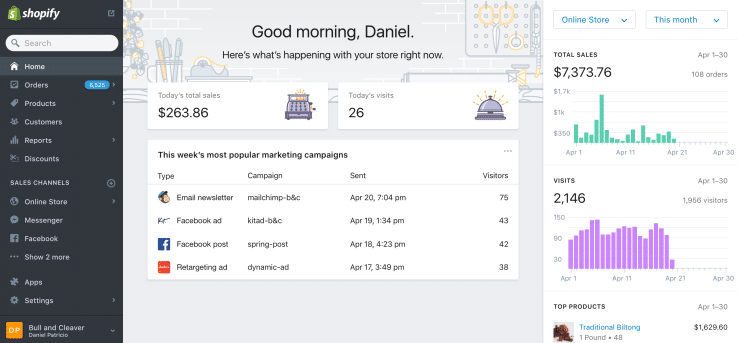
Shopify is announcing a number of new APIs for developers at its annual Unite developer conference in San Francisco today, but the new Marketing Events API might be the most interesting, especially for sellers using the platform. Basically, it allows the many developers already building marketing plug-in apps for Shopify stores to more easily show what their tools are doing for merchants, directly within Shopify itself. And, it could eventually recommend winning marketing strategies without any human intervention.

For instance, a newsletter integration provider could show Shopify store owners how many sales are resulting directly from email campaigns, and do so without requiring any heavy lifting on the part of the merchant like messing with manual UTM code creation and tracking. The results will also show up as visualized data in Shopify’s store backend for users, which is a huge deal when you consider many small sellers have never really thought hard about what marketing can do for their business, let alone know where to go looking for worthwhile analytics.

“Marketing apps have always been the biggest category in our app store, in terms of installs, developer interest and that kind of thing,” explained Shopify product manager Daniel Patricio. “But only very recently, we started thinking about how we can take advantage of all the apps on our platform to help them and to help our merchants, long term.”

It’s clear that people build things with it, and run campaigns, but it struck Patricio that it’s very difficult for merchants to track things. It’s fairly easy to identify the sources of traffic to the store, but when you don’t necessarily know what specific action caused that traffic, it’s hard to identify your best practices for marketing and reconfiguring your campaign in a way that will lead to growth.

Patricio found out how hard it was based on experience with his own store on Shopify, which sells cured meats. He had to build his own tool, using pretty hacky methods, to find out what was working about his marketing efforts and what wasn’t as he was trying to increase his shipment volume to help make sure he could keep his drop shipper.

“We just went to 12 of our biggest app partners and said ‘we know you’re doing good things, but nobody knows what it is,’” he said. “So we asked them to add this tracking so that we could more easily show merchants what this was doing for them.”

In aggregate, it’s obvious that marketing is doing lots of work in making stores successful. Patricio told me that 50 percent of stores on the platform have marketing apps installed, and those that track marketing using UTM codes are 10 times more successful than those that don’t. To that end, the Marketing Events API is also going to help give direct, in-line feedback to shop owners about what they can do, and when.

“We can look at what’s working in terms of marketing for that category, and we can make recommendations specific to the merchant about what they should do to improve,” Patricio said. Those recommendations can be inline, one-click calls to action that take merchants to the marketing activity they need to do to get those improvements others in their category are seeing.

Basically the goal is to make merchants more sustainable and more likely to grow over time, which benefits Shopify. This should also benefit merchants building apps for the platform, so Patricio is confident that more developers will join in once they see how well this works in terms of adding some transparency to the often murky marketing process.

Recommendations are based on anonymized aggregated category data, Shopify says, and so won’t ever reveal the exact secret sauce of your closest competitor. But it sounds like marketing recommendations could become more sophisticated over time, letting Shopify offer a more or less full-service marketing engine for small businesses that otherwise wouldn’t have access to those kinds of tools.

By

Sourced from TechCrunch

By .

When I last worked in the ad industry, George W. Bush was president, tweets were something you heard in the park and Yahoo was – actually, Yahoo was the same in 2007 as well.

I left the business and went off to work in new product development, occasionally sitting in the same meeting rooms as my client’s ad agencies, and generally not paying a lot of attention to their presentations. Sorry.

Last year I started to get interested in ad land again, as I read more and more about programmatic advertising. In the NPD game, we’d been using clever algorithms to predict consumer behaviour for years. Wow, I thought. Now you can crunch all that data in real time on the viewer of any ad, you could do some truly amazing things. Agencies must be all over it.

My own online experience told me that maybe agencies weren’t. The same ad for a Garmin watch had been following me for a week. The same ad, whether I was on Facebook where I chat with friends, on Wired where I read about technology, or on Twitter, where I scream into the abyss. All that data about who I was, what I was doing or what platform I was on: clearly, none of it was affecting the ad.

I started to talk to friends who worked in programmatic. Most ad agencies, it seemed, were not interested in the data. Instead, they were just tossing stills from print and TV campaigns over the fence and asking the media companies to make them work online.

Why, I asked. Dunno, said the programmatic dudes, we can tell them 5,000 things about a single page view, but they don’t use any of it.

Five thousand things! I doubt I know 5,000 things about myself. My 10 years geeking out on vast amounts of data has taught me that 5,000 results are as good as none. Two are too few. Four to six – those I can work with. I wondered how my old friends who’d stuck it out in ad planning were doing. I asked a few of them, from global ad agencies to a couple of hot shops, to send me a blank briefing form from their agencies.

What is the brand’s tone of voice? What is the single most compelling message we can tell them? What supports this? I had to rush up to a few people as if I were Dr Who. I grabbed them by the lapels. What year is it? I asked in rising panic. It felt like I was back in the early 90s, when there were five TV stations in the UK and a bunch of poster sites at roundabouts.

Back then, when you had two campaigns a year at News at Ten and some slots in the Sunday supps, it was completely fine to bang away at being the ‘ultimate driving machine’ in the same Teutonic tone. Nobody got too tired of it. But when I wake up to your brand on Facebook, and scroll past it on Twitter, and see it on Instagram… it just comes across as repetitive.

Yet there are brands that are thriving online, both big and small. They’ve realised that it’s more important to be multifaceted than monotonous, to be surprising rather than consistent. Take Taco Bell, a chain that’s gone from being dubbed ‘Taco Hell’ five years ago to Gen Z’s default hangout. Its social media takes a lot of credit for this: it’s beautiful on Instagram, bitchy on Twitter, inspiring on its website, and its $40,000 TacoBot has already taken $10m in orders on Slack.

Movember has become a global movement online, rising from two Aussies in a pub to a phenomenon that’s raised over $300m. Their messages cover prostate cancer, male suicide and facial hair grooming tips. Their Facebook posts are funny, tear-jerking, surreal, handy, thrilling and heartwarming. Clearly nobody ever showed them an ad agency brief.

Nike, Rude Health Cereals, Victoria’s Secret even Victoria Beckham all seem to have discovered a way to thrive online, one that’s a million miles away from the USP or ‘brutal simplicity of thought’. They’re all multifaceted personalities, and they adapt their tone of voice to their audiences’ moods. Data allows you to do that, if you use it intelligently.

Last year, I teamed up with Torie Chilcott, one of the gods of programmatic advertising, to systematise the process. We started crunching data on what people loved online – not advertising, just… everything, from kittens to TED talks. This led us to a startling conclusion. There are dozens of kinds of content that people love, but they have four broad types. (Remember how I said you can work with four to six data points? Here they come…)

Great online content is either funny, useful, beautiful or inspiring. Great online brands do all four of those things. Victoria’s Secret is hilarious on Instagram. Rude Health is angry and ranty on YouTube. They bring surprise instead of consistency, and match their tone to the platform, rather than expect their audience to change emotional gear.

Data can help you broaden a brand’s emotional appeal. Our data shows that young women in London tend to find grandiose things beautiful, laugh hardest at dark humour and value authoritative opinion. BMW drivers aren’t inspired by social good or anything heartwarming. (Don’t you love it when the facts confirm your prejudices?) Data can also tell you where they’ll be most receptive to each of those tones of voice. To become a multifaceted brand, you’ll need to start thinking in a new way, at that 90s ad brief really isn’t going to help you.

Here’s the questions we think your brief should be asking.

If you can’t answer them, you can’t expect to sync with your audience’s emotions online.

We need 4 executions, not one.

We need to find our brand’s funny, useful, beautiful and inspiring.

Funny

What makes our target audience laugh?

How does that humour connect to our brand personality?

Inspiring

What kind of voice does our audience stand up and follow?

What in our brand could create that kind of rallying cry?

Useful

Where do our target audience go to learn?

What makes them lean forward and how can we learn from that?

Beautiful

What aesthetics turn our audience on and off?

What would our brand look like in that style?

By

Brian Millar is co-founder of the Emotional Intelligence Agency, a communications planning company that maps consumers’ emotional lives online. Follow him on Twitter @arthurascii

Sourced from The Drum

Influencer marketing is evolving and fast.

By MediaStreet staff writers.

#HASHOFF, a micro-influencer marketing platform, today released a report detailing key industry trends driving the increasing popularity and viability of influencer marketing.

To understand the changing face of influencer marketing, and gain insight into where influencers are headed, #HASHOFF surveyed hundreds of vetted influencers on its platform. The #HASHOFF platform has over 150,000 opt-in influencers who partner with brands and work hard to grow and maintain their organic audiences every day.

With 25% of internet users employing some form of ad blocking, and consumers continuing to trust word of mouth over all other forms of marketing, influencer marketing is proving to be a powerful channel for targeted marketing.

The report found that micro-influencers are emerging as a critical marketing channel for brands large and small, enabling brands to grow awareness and drive sales. Brands are increasingly relying on micro-influencers to share their brand messages, since these influencers have higher engagement rates and are perceived as more passionate, creative and authentic by audiences.

Here are just a few of the highlights from the report:

  • While most respondents work across multiple platforms, nearly all respondents (92%) selected Instagram as their #1 platform of focus, followed by Facebook.
  • The majority (56%) of influencers surveyed spend at least four hours per day on social media, and more than 20% spend 7-8 hours or more.
  • Nearly one-third of influencers have grown their audience by 20%-50% in the past year, while one-fourth have grown their audience by 50%-100%, and 17% have more than doubled their audiences.
  • Platform of choice for influencers – Last year, 80% of respondents said Instagram was #1, while this year, a full 92% cite Instagram as their top platform, a 12%-point increase. A similar number of influencers (87%) predict Instagram will remain #1 for them next year.

“The time, energy, passion and creativity that goes into each influencer post is exactly why brands choose influencers to deliver content to their communities,” said Joel Wright, President of #HASHOFF. “These numbers not only confirm the viability and strength of the micro-influencer channel, but show that brands are increasingly aware that driving authentic and organic content over this medium increases brand-consumer engagement. Creating impactful brand experiences in a crowded media market that combines targeting, analysis and brand safety is vital for brand-consumer engagement, and the #HASHOFF platform delivers all three.”

“The number of followers has no relevance in this day and age, where followers and likes can be bought,” said influencer @AlishaMarie (despite having nearly 3M Instagram followers, 2.45M Twitter followers and 1.9 YouTube subscribers herself). “Content should be king.”

“Influencer marketing grows brands,” said micro-influencer @throughjakeseyes. “Even influencers with fewer than 10K Instagram followers can still have a big impact on the brand and create ROI.”

“I love Instagram for the inspiration and creativity it offers and for the real friendships I’ve made through it!” influencer @ChrissyJPowers said.

Echoed @EdiCaves, “I love Instagram because of the community. Instagram allows me to connect with locals that I would have never met otherwise. As my following has grown, brands have begun to contact me about work.”


By Candide McDonald & Lindy Hughson.

The rules of marketing are changing fast, and as they do, packaging looks set to become one of the most important forms of media that connects millennials to brands.

Millennials don’t play by the rules. That, no doubt, contributes to the misconception that they are narcissistic, vain, selfish and uninterested in anything that doesn’t relate to their lives directly. In truth, it’s that no other generation has had so many ways to express itself. Millennials are just using what is available to explore and confirm who they are. This is, or has been, a rite of passage for everyone since moving into adulthood began.

But the fact that millennials don’t play by the traditional rules of marketing has important consequence for brands. They don’t hang out on TV, in print or on radio, because they have other options. And they’re not at all receptive to being told what they should or shouldn’t buy by brands, because they have the means to find out everything they need to know – all by themselves.

With the world’s leading tech companies, including Microsoft, Apple, Samsung, Huawei, LG, Acer, Intel, Meta, Magic Leap, and ODG, all working feverishly to make mixed reality part of everyday life in the very near future, packaging may well become one of the most important forms of media that connects millennials to brands.

Packaging that activates mixed media could become the on-shelf and in-hand catalyst that enables millennials to find out everything they need to know about brands – all by themselves, as well as being how brands “talk” to and play with millennials to get them to engage with them. But even without mixed reality’s ability to turn packaging into next-generation websites filled with 3D content that users can touch, hold, speak to, and learn from, packaging can still be the door that gives brands access to millennials’ attention.

As the founder of UK company GBH Design, Mark Bonner, puts it in his foreword to Silas Amos’s book Digital Print. A Bigger Spectrum, “Our audience is on the move and we need to move with them. Which media will they consume our [brand] story in first? Our ideas need multiple front doors. We need to catch our target in a triangulation of crossfire to get our messages heard. And no-one knows where the magic bullet will come from”.

What we do know is that for millennials, their mobile phones are the font of all knowledge, an always-on entertainment provider and the preferred means of communication (trumping verbal conversations).

That does not mean that brands have a captive millennial audience on mobile. According to an Accenture study last year, 69% of those aged 18 to 24 and 64% of those between 25 and 34, know how to block ads. Globally, 41% do it. Millennials don’t like to be interrupted, but there’s something more fundamental – the law of attraction. Beg a millennial (or anyone else, for that matter) to “come to your party” and he or she won’t want to come.

Packaging gives brands the chance to let people know they are “hosting a party” – a competition, video series, music concert, game, recipe series, background story…and provides the door that allows them to access it. That’s not begging. To a millennial, that’s cool.

CASE STUDY: Party like you mean it

Bud Light “created a party” on its packaging that resonated with millennials at Mad Decent Block Party music festival events held in the US and Canada in September 2015.

HP Mosaic software was used to provide customised shrink-sleeves for a limited-edition run of beer cans. Printed on an HP Indigo WS 6800 digital press, 31 designs were transformed into more than 31 million possible graphics, ultimately creating 200,000 unique can designs, with no two cans exactly alike.

Recounting this case study in Digital Print – A Bigger Spectrum, Silas Amos writes: “Mad Decent Block parties have a mission to bring new genres and cultures to light in the constantly evolving music world, while Bud Light’s tagline tells us it’s ‘up for whatever’. Together they wanted an ethos that would amplify their spontaneous ‘anything goes’ ethos.”

Bud Light Mad Decent Block 

“Today’s consumer is seeking unique, customised experiences,” says Valerie Toothman, VP of Innovation, Anheuser-Busch (brand owner of Bud Light). “The reaction we got at the Mad Decent Block parties proved that custom graphics are indeed an impactful and relevant way to elevate a consumer’s experience with the the brand.”

According to Jason Beckley, business development manager HP South Pacific, “HP’s ‘Mosaic’ software takes customisation to a new level, it allows for the creation of an almost infinite number of designs based on core patterns within a brands’ visual image, and which when assembled on-shelf provides an arresting display with each printed piece unique and distinctive from the next.”

Bud light cans 2

By Candide McDonald & Lindy Hughson

Sourced from Packaging News

By Lolly Daskal.

As a leadership coach and business consultant, I am always on the lookout for the most effective resources that I can find so that I can help my clients with their leadership development and business strategies.

Recently I picked up The Brand Mapping Strategy: Design, Build and Accelerate Your Brand by Karen Leland.

Leland, the founder of Sterling Marketing Group, is a branding and marketing strategist who works with entrepreneurs and executives around the world to build stronger personal, team and business brands.

Mistake #1. Failing to create a personal brand on purpose.
Leland says that many leaders still don’t get that in today’s world, a personal brand can be just as important as a business brand. Leland says that one Burson-Marsteller study, reported that 48 percent of a company’s reputation can be attributed to the standing of its CEO. For this reason alone, leaders have the responsibility to build a parallel brand that complements, not conflicts with, their business brand. According to Leland, the key is for leaders to create their personal brand by design–rather than by default. This requires moving beyond basic reputation management, to strategic personal brand management.

Mistake #2. Mistaking an elevator pitch for a personal brand.
The typical personal brand elevator pitch is meant to convey who a leader is in a few sentences. While useful to have, this is just the tip of the personal branding iceberg. Leland’s Brand Mapping model prescribes that leaders need to articulate in a deep and authentic way 6 other aspects to their personal leadership brand. Among these are:

  • Unique Branding Proposition, which answers the question, What is it about what you do, or how you do it, that makes you unique, distinct and special? What sets you apart?
  • Brand Tone and Temperament. What is the consistent mood, tenor, quality, character and manner that you bring to all your interactions?
  • Brand Energy. What can you be counted on to contribute–in all circumstances and at all times?

Mistake #3. Failing to put a personal brand strategy in place.
Too many leaders stop at the front door of their businesses when it comes to their personal brands. While they may have a plan for managing their reputation inside their organization, they often don’t think through a strategy for how to promote and manage their reputation, and build their personal brand, in their industry and the business world at large.

A successful personal brand strategy always takes into account the leader’s goals and objectives and considers where the executive’s natural talents lie. For example, if the leader excels at writing, a blog may be perfect fit for their personal brand strategy. If the leader is a powerful speaker, keynoting or being on conference panels would work in the tactic mix nicely. Lastly, any effective leadership brand strategy must consider where most of the customers and colleagues they work with consume their information; i.e., blogs, newspapers, podcasts, etc.

In combination these factors help a leader determine a brand strategy that goes beyond a basic elevator pitch, to a powerful presentation of who they are in the world at large.

More than anything I found in interviewing Karen and reading her book a refreshing blend of no-nonsense advice, informed by research and the in-depth experience to back up her recommendations. Leland makes a great case as to why every leader must incorporate the work of building a personal brand as part of their leadership development.

By Lolly Daskal

Sourced from Inc.com

By Matt Krepsik.

Most marketers rely on either marketing mix models or a form of attribution modeling to measure how effectively their marketing efforts are driving sales.

There are pros and cons to both approaches, especially as both continue to mature, but marketing mix models take some elements into account that attribution models often do not. Matt Krepsik, global head of ROI at Nielsen, spoke with eMarketer’s Maria Minsker about making the case for marketing mix models and how brands can benefit from them.

eMarketer: A growing number of vendors are offering marketing mix models for measuring the impact of marketing tactics on sales. Can you explain how these models work?

Matt Krepsik: Marketing models enable companies to understand and assess the incremental value of their investments. What makes marketing mix models unique is their capability to take effective frequency and reach into account. For example, the models can identify that if a brand is launching a TV campaign, it needs to drive a reach of around 60% of viewers. That percentage is identified as a saturation point, and after it’s reached the brand will start to see diminishing returns.

On top of that, there’s the concept of effective frequency, which is the number of times a company should invest in order for a customer to see an ad and respond to it. The embedded intelligence behind marketing mix model decisioning is based on an understanding of reach and frequency, which enables marketers to make better decisions and optimize their expense.

“What’s amazing is a marketing mix model not only allows marketers to make those budgetary decisions … but can also push those decisions forward into other activation platforms, such as the marketing cloud.”

eMarketer: How effective are these models at predicting how marketing drives sales?

Krepsik: When the models control other factors that influence businesses, they produce a fairly strong level of accuracy. Our Benchmark Media Optimizer tool uses a marketing mix model, for example, and we typically make predictions within 5% to 6% of the actual in-market performance.

eMarketer: In what ways can marketers take the insight they gain from marketing mix models and make it actionable?

Krepsik: Let’s say I’m a brand owner and I’m trying to figure out what my media plan will look like next year. Perhaps I want to shift dollars to a digital campaign. What’s amazing is a marketing mix model not only allows marketers to make those budgetary decisions with really solid intelligence, but can also push those decisions forward into other activation platforms, such as the marketing cloud.

eMarketer: What happens when a brand uses a marketing mix model from one vendor, but relies on a different marketing cloud provider? Do integration challenges arise?

“We already know so much about how brand owners make investments in their media buys that artificial intelligence [AI] is the next phase.”

Krepsik: No brand owner in the world is going to use the same tool for everything. [That’s why it’s important to] build direct integrations to the buying platforms of choice, whether those are agency platforms or third-party platforms, such as the Adobe Marketing Cloud.

eMarketer: What’s the next phase for marketing mix models? Are they going to become smarter and more accurate over time?

Krepsik: We already know so much about how brand owners make investments in their media buys that artificial intelligence [AI] is the next phase. An AI prediction engine will be able to make two or three recommendations on media buys before even building a model. Rather, the prediction will be based on a brand’s profile and what is generally known about consumers in a specific category and in a specific country.

By Matt Krepsik

Sourced from eMarketer

By Adam Heitzman

Don’t have funds to compete with big brands on marketing? There are plenty of free marketing tactics small businesses can do that deliver results on little to no budget.

Between influencers, paid search, outsourcing design, and everything else, marketing has gotten expensive. Spending on marketing has been on a dramatic upward swing for some time now, and will almost certainly continue to increase. For larger businesses, this doesn’t present a particularly difficult challenge, because they need only adjust and reallocate a few numbers to their marketing budget.

But for other businesses, the increase in spending on marketing means it’s only getting more difficult to compete. For smaller, independent, and locally owned businesses, there isn’t always extra money that can be pulled from one expense and reallocated to a marketing budget. This presents both problems and opportunities: problems, because it’s already hard for smaller businesses to compete with bigger businesses/budgets and online retailers; opportunities, because it’s a chance to get creative with your marketing strategy while learning more about how your business can connect with your audience.

Contrary to what the predominance of digital marketing, SEO, and paid search would lead you to think, you don’t have to swear off traditional marketing tactics completely. In fact, if you’re working with a limited or nonexistent budget, there are plenty of effective, “old school” marketing strategies that work well when paired with some digital strategies. For marketing on a dime, these 5 marketing ideas mix up some effective ways to blend digital and traditional marketing at little to no cost.

1. Use Social Media

The free option of marketing across social media platforms is teeming with possibilities. Yes, many businesses pay for promoted advertising and targeting on social media platforms, but there are plenty of other ways you can very effectively reach your users. Some of my favorite free social media marketing tactics are:

  • Hosting a contest. Maybe a photo contest or a tagging contest. Whatever the contest is, people love freebies and it’s a quick way to increase followers.
  • Posting tutorials. If you sell products, you can demonstrate how to use them in a way that compels users to buy them. For example, a boutique could demonstrate a bunch of different ways to wear a scarf they sell.
  • Personalizing your brand. There’s a local bakery I follow that does this particularly well. By posting pictures of happy bakers baking or being silly with frosting, they create a personalized charm for their brand. Now, when I think of cupcakes, I think of that bakery.
  • Sharing helpful tips/information. For example, if you’re a local auto shop and your city got an unexpected blizzard, share some winter car care tips or advice on driving in the snow. It’ll be quick and easy for your users to read, and something they’re likely to share.

2. Create a Loyalty Program

This doesn’t have to be nearly as expensive as it sounds. To implement a loyalty program, it could be something as simple as a strategic email list. Let’s say you have an email loyalty sign-up sheet at your register. You can entice customers to sign up by emailing a birthday coupon, or giving them store credit when they refer someone. If you’re a local coffee shop, print off some punch cards that make every 10th coffee free. These are easy ways to reward your customers for their loyalty without breaking the bank.

3. Partner With Another Business

Creating mutually beneficial relationships can be really helpful for a couple of reasons. First and foremost, you can create a small business ally that sends customers in your direction. Second, you have someone to learn alongside. By finding a business in a similar financial situation that complements yours, you can develop a strategic business partnership.

Let’s revisit the auto body shop and coffee shop I mentioned earlier. If you own one of those businesses and the two happen to be right next door to one another, why not work out a little partnered marketing? If a customer of the auto shop has to wait for a repair, why not send them next door with a $1 off coupon? And why not leave a pricing menu/business card for the auto shop by the register for customers to see? This is particularly effective for local businesses, as customers can come to associate a certain area or neighborhood with specific goods and services.

4. Make the Most of Your Reviews

Online reviews are really, really important for businesses. Why? Because 88% of consumers trust online reviews as much as a personal recommendation, and that number jumps to 92% as it pertains to local businesses. Reviews are one of your greatest online marketing assets, because it speaks directly to the experience and/or products your business has to offer. This is good, because optimizing your reviews is a really easy process.

Start by asking for reviews from all of your customers, especially the most loyal and returning customers. Then build asking reviews into an everyday practice. Once you have the reviews, be sure to respond to all of them. Good reviews, bad reviews, neutral reviews, whatever the case may be, engage with the users leaving them, because it’s as effective as free marketing gets.

5. Support a Cause

Supporting a cause = free marketing and publicity. You might not have the money to donate, but you most certainly have the man power to volunteer. You could for half a day and promote that employees will be volunteering for a cause the business has chosen to support. This works, firstly because customers are more compelled to purchase goods or services from a business they feel an ethical attachment to, and secondly because many charities offer free publicity in exchange for business support.

The opinions expressed here by Inc.com columnists are their own, not those of Inc.com.

By Adam Heitzman

Adam Heitzman is a co-founder and managing partner at HigherVisibility, a nationally recognized SEO firm. Having been a marketing executive in the financial services industry, Heitzman now uses his 10-plus years of… Full bio

Sourced from Inc.com

By Jon Miller.

Account-based marketing (ABM) addresses the biggest problem faced by B2B marketers in the last decade: Traditional strategies focus on high-velocity, low-value deals, and not enough on the major accounts.

ABM is built on six processes that flip the focus from generating leads to courting the companies you want to do business with.

ABM isn’t a quick fix: It takes patience and a long-term commitment. But you can drive real results by effectively using the six processes:

  1. Selecting accounts
  2. Discovering contacts
  3. Developing insights
  4. Generating account-relevant content
  5. Delivering account-specific interactions
  6. Orchestrating account-focused plays

1. Select accounts: Get Sales and Marketing Together from the start

Selecting your target accounts is the most important step in any ABM program. An effective plan will focus on a limited number of accounts; if you choose unwisely, you’ll be wasting time and resources on accounts that don’t amount to anything.

How to do it

Start by creating a profile of your ideal client, based on past business experiences, business compatibility, a growing market, and committed account managers. You can use a combination of analytics—such as firmographics, technographics, and intent data—and old-fashioned gut instinct to make your selections.

Depending on the number of accounts you want to target, prioritize them into tiers that range from one-to-one campaigns to industry-specific campaigns. This process is as much an art as it is a science.

How it aligns Sales and Marketing

Account selection as a first step brings your marketing and sales teams together from the start, because both have valuable insights about accounts and communications.

Marketing will have a lot of data available. Sales has the direct experience with clients to know what makes a good target account, and where your company already has relationships within the target account.

The process of agreeing on the target accounts will necessitate alignment.

2. Discover contacts: Pool resources for greater wins

After Sales and Marketing generate a list of target accounts, the team will need a list of actual people at those companies. Discovering contacts is a process of finding the right people for each key persona at each target account.

How to do it

Start by researching your existing data to identify ideal buyer profiles, followed by an investigation of information sources, such as…

  • LinkedIn and other social media channels
  • Company websites
  • Industry forums

Other methods include setting up a call program that has sales reps call the accounts directly, purchasing contact data from reputable data providers, using predictive data sources, establishing list-building partners, and using a company’s email format to figure out email addresses based on names.

Scores of great brands provide software and service platforms for all those tasks, and more.

How it aligns Sales and Marketing

To discover the most contacts, Sales and Marketing will need to pool their resources. Sales has data from past sales calls and networking; Marketing has data from previous lead generation efforts. Both are valuable sources for identifying ideal buyer profiles.

3. Develop insights: Two heads are better than one

Accounts are more likely to respond to marketing that is customized to their specific needs. Once a list of contacts at each target account is established, the team will need details about their industries, business models, buying centers, relationships within their companies, needs and pain points, and how they take their coffee (wouldn’t hurt to know).

Every detail will help the team develop highly personalized content that will stand out from the noise.

How to do it

The information needed to develop insights can come from direct conversations with members of the buying team, social media, blog posts, company materials, market data, existing CRM notes, and the content visitors consume when visiting your website.

If you still need insights, run a survey that directly asks the questions you want to ask, or work with a third-party vendor who can help you develop the unique insights your brand needs.

How it aligns Sales and Marketing

Good salespeople learn and remember as much as they can about their clients—from their business needs to their favorite sports teams. ABM brings Sales and Marketing together in a disciplined focus to gather and maintain those insights for maximum impact.

4. Generate account-relevant content

Relevant, personalized content is where ABM shines. It’s the payoff to Step 1 through 3, and the huge advantage that ABM has over other demand-gen strategies.

With detailed insights into each contact at each target account, the team can weave various levels of personalization (greater personalization for C-suite contacts and Tier 1 accounts, and less personalization for lower-level managers and Tier 3 accounts, for example) into content strategies.

The resulting highly relevant content or messaging is what gets your brand noticed above the noise of the competition. It communicates greater care, and it is a much stronger introduction to a new contact or account: 75% of executives will read unsolicited marketing materials that contain ideas that might be relevant to their business, according to ITSMA.

How to do it

Most content should fall between personalized and industry-targeted. Start with the insights you’ve gathered and use them to create topics that will be of interest to the key personas within your accounts.

Create hyper-personalized content for Tier 1 accounts that uses their specific business model, data, industry trends, challenges, etc. (Use “door openers” such as their favorite sports team or vacation spots, as appropriate.)

How it aligns Sales and Marketing

Since both Sales and Marketing have had a hand in developing and creating the content, both have a stake in it. That means both will promote and share it, eventually leading to more relevant leads for Sales.

5. Deliver account-specific interactions

ABM is an active strategy; once you’ve completed the previous four processes, you shouldn’t sit back and wait. Go out and get in front of your most valued contacts.

How to do it

The staple Marketing tactics for delivering account-specific interactions include live events, webinars, Web personalization, online advertising, and direct mail. For Sales, the core interactions include human email, phone and voicemail, and personalized social outreach.

Live, human interaction is the most valuable: Use live events and direct sales touches whenever possible.

How it aligns Sales and Marketing

Without proper orchestration (see process No. 6), this is where functions start to split a little bit. But when the interactions are coordinated across channels, alignment is the result.

6. Orchestrate account-focused plays

Orchestration takes all the first five processes and brings them together into highly specified plays that take your ABM to the next level.

How to do it

Start by identifying your own challenges with a specific account, and customize your playbook based on those difficulties. An example might be to post a wave of targeted ads, followed by a second wave of direct mail, and then a series of human touches from sales development reps across email, phone, and social channels.

How it aligns Sales and Marketing

Orchestration is all about Sales and Marketing working together in coordinated, account-focused plays. It’s not a linear process of handoffs from one department to the next; it’s a synchronized set of interactions across departments and channels.

Work together for real results

Sales and Marketing alignment might not be the number one reason to adopt an ABM strategy(higher close rates, greater efficiency, and bigger contracts, however, might be), but it is a serious bonus. Greater alignment in any part of your organization improves performance overall.

If you’re interested in seeing it in action, start with the process of selecting accounts and see how your teams do. Get everyone in a room, explain the process, and start brainstorming which accounts are worth targeting. When you combine that with the core infrastructure you need to be account-centric (i.e., lead to account matching), you’ll be surprised by how quickly you can get an account-based strategy off the ground.

By Jon Miller

Jon Miller is the CEO and a co-founder of account-based marketing and sales software provider Engagio, and formerly VP of marketing and a co-founder of marketing automation provider Marketo.

LinkedIn: Jon Miller

Twitter: @jonmiller

Sourced from MarketingProfs

By Clare Lane.

To succeed as a content marketer in today’s demanding communications climate, pros must have a hybrid skillset.

According to research from Fractl, nearly half of the content marketing jobs on Indeed.com call for both technical and creative skills. To find success, an ideal marketer should be both a technician and an artist.

Here’s how those traits can set you apart from your competitors:

Creativity and ingenuity

More and more, employers want employees with creative flair.

From Fractl:

Creative skills differ from practical, technical skills because they’re less tangible and more conceptual. Our study ranks the top five creative skills as writing, marketing strategy, content strategy, thought leadership, and brand development. Such skills are best learned through hands-on training, often acquired through experience; however, marketers can also learn from authoritative industry resources.

Technological knowhow

Although many emerging marketers regularly use technology, Fractl data say they lack relevant technical skills.

FREE GUIDE:10 ways to improve your writing today. Download now.

Even if you have minimal experience with Google Analytics, recruiters advise mentioning that in an interview or presenting it prominently on your résumé.

Here are a few other in-demand tech skills:

Our study ranks SEO, HTML, Google Analytics, CSS, and programming as the most common technical skills that today’s content marketers need to master.

Consider yourself a tech guru or creative leader? Santa Clara, California-based Apple is seeking acontent marketing manager to write and produce various types of downloadable content. Applicants should understand how to build and manage a rich content calendar that can attract a qualified audience to Apple blog posts, white papers, reports, webinars, videos and infographics.

Not the job for you? See what else we have in our weekly professional pickings:

Content marketing specialist— Plated (New York)

Website coordinator/digital engagement— Feeding America (Illinois)

Advertising copywriter— Coral Gables Advertising Agency (Florida)

Corporate media manager— Lynn Hazan and Associates (New York)

Communications associate— Google (California)

Freelance online editor— The Education and Training Foundation (United Kingdom)

Content producer— Northwestern University (Illinois)

Senior marketing specialist— Milestone Systems (Oregon)

SEO writer—On Target Media (Nevada)

Marketing manager— Greencheck Group (Wisconsin)

Public relations coordinator— Viacom (New York)

Content writer—Brafton (Illinois)

Marketing manager— Uber (Washington, D.C.)

Digital marketing analyst— Stony Brook University (New York)

Enterprise marketing content strategist— Adobe (Utah)

Digital content coordinator—Cox Media (Georgia)

Social media and digital marketing manager— Motel One (Germany)

Sales and events coordinator— Colorado Springs Event Center (Colorado)

Director of communications— City of South Bend (Indiana)

Publications and media coordinator— Beebe Healthcare (Delaware)

Content coordinator— Alliance of the Great Lakes (Illinois)

Social media manager— Blaze Pizza (California)

Public relations manager— Long Center for the Performing Arts (Texas)

Editorial assistant— Penguin Random House (United Kingdom)

Social media coordinator— Red Light Public Relations (California)

Assistant director of public relations—St. Louis College of Pharmacy (Missouri)

Communications officer— W. M. Keck Observatory (Hawaii)

Public relations and advertising manager— JC Resorts (California)

Brand experience associate— Mike’s Hard Lemonade Co. (Illinois)

Social media manager—Travel Pirates (Oregon)

By Clare Lane

Sourced from Ragan’s PR Daily