Tag

Social Media

Browsing

HOW people use social media is more important than the time they spend using it. Let’s stop the moral panic.

By MediaStreet Staff Writers

There has so far been no evidence supporting the view that the amount of time spent on social media affects mental health in young people, says Chloe Berryman of the University of Central Florida. In fact, she says that there are very few links between different aspects of social media use among young adults and possible mental health problems such as loneliness, decreased empathy and social anxiety.

“We do not deny the potential for some online behaviours to be associated with mental health problems, rather we propose that research focus on the behaviour of individuals rather than assume media is the root cause of all socio-personal problems,” says Berryman, who compared the response that some people have to social media to a form of ‘moral panic’ such as that surrounding video games, comic books and rock music.

Berryman and her colleagues analysed the responses of 467 young adults to a variety of questionnaires. They were questioned about the amount of time per day they spent using social media, the importance it has in their lives, and the way they used social media. Their current mental health state, levels of social anxiety, the quality of their relationship with their parents and the amount of social support that they could count on were also assessed. Aspects such as general mental health symptoms, suicidal ideation, loneliness, social anxiety and decreased empathy were also considered.

The only worrying trend found had to do with ‘vaguebooking,’ which refers to a person’s tendency to write social media posts that contain little actual and clear information, but are worded in such a way as to solicit attention and concern from potential readers. Young people who tended to often write such posts were found to be lonelier, and to have more suicidal thoughts than others.

“Vaguebooking was slightly predictive of suicidal ideation, suggesting this particular behaviour could be a warning sign for serious issues,” says Berryman. “It is therefore possible that some forms of social media use may function as a ‘cry for help’ among individuals with pre-existing mental health problems.”

“Overall, results from this study suggest that, with the exception of vaguebooking, concerns regarding social media use may be misplaced,” she adds. “Our results are generally consistent with other studies which suggests that how people use social media is more critical than the actual time they spend online with regards to their mental health.”

There you go, readers. Go forth and Facebook obsessively… it’s all good.

Researchers need to be aware of the mistakes that can be made when for mining social-media data.

By MediaStreet Staff Writers

A growing number of academic researchers are mining social media data to learn about both online and offline human behaviour. In recent years, studies have claimed the ability to predict everything from summer blockbusters to fluctuations in the stock market.

But mounting evidence of flaws in many of these studies points to a need for researchers to be wary of serious pitfalls that arise when working with huge social media data sets. That is, according to computer scientists at McGill University in Montreal and Carnegie Mellon University in Pittsburgh.

Such erroneous results can have huge implications: thousands of research papers each year are now based on data gleaned from social media. “Many of these papers are used to inform and justify decisions and investments among the public and in industry and government,” says Derek Ruths, an assistant professor in McGill’s School of Computer Science.

Ruths and Jürgen Pfeffer of Carnegie Mellon’s Institute for Software Research highlight several issues involved in using social media data sets – along with strategies to address them. Among the challenges:

  • Different social media platforms attract different users – Pinterest, for example, is dominated by females aged 25-34 – yet researchers rarely correct for the distorted picture these populations can produce.
  • Publicly-available data feeds used in social media research don’t always provide an accurate representation of the platform’s overall data – and researchers are generally in the dark about when and how social media providers filter their data streams.
  • The design of social media platforms can dictate how users behave and, therefore, what behaviour can be measured. For instance, on Facebook the absence of a “dislike” button makes negative responses to content harder to detect than positive “likes.”
  • Large numbers of spammers and bots, which masquerade as normal users on social media, get mistakenly incorporated into many measurements and predictions of human behaviour.
  • Researchers often report results for groups of easy-to-classify users, topics, and events, making new methods seem more accurate than they actually are. For instance, efforts to infer political orientation of Twitter users achieve barely 65% accuracy for typical users – even though studies (focusing on politically active users) have claimed 90% accuracy.

Many of these problems have well-known solutions from other fields such as epidemiology, statistics, and machine learning, Ruths and Pfeffer write. “The common thread in all these issues is the need for researchers to be more acutely aware of what they’re actually analysing when working with social media data,” Ruths says.

Social scientists have honed their techniques and standards to deal with this sort of challenge before.

The infamous ‘Dewey Defeats Truman’ headline of 1948 stemmed from telephone surveys that under-sampled Truman supporters in the general population. Rather than permanently discrediting the practice of polling, that glaring error led to today’s more sophisticated techniques, higher standards, and more accurate polls. Says Ruths, “Now, we’re poised at a similar technological inflection point. By tackling the issues we face, we’ll be able to realise the tremendous potential for good promised by social media-based research.”


By Judith Ohikuare

For many people, every share on social media (a tweet, status update, Snap, Boomerang) feels like an extension of one’s personal brand. Even the act of setting a profile to private is an expression of that brand.
If you’re concerned about how to best develop whatever you want your brand to be (or reshape what you already have) for professional reasons, rest assured that you have likely done a lot of legwork already.
You likely have some digital presence and have started to represent yourself in some way IRL. What you might really need to hone is your framing of those efforts, so that they become specific to your career.
“The term ‘personal brand’ is a buzzword, however, I believe the concept is incredibly important,” says WayUp CEO Liz Wessel. “Being able to convey what it is that makes you unique, and tie it back to what you do professionally, is something that everyone — whether you are looking for a job or not — should be able to do.”
One step is learning how to convey who you are through conversation, she explains. You can start by thinking through the following questions:
1. What am I passionate about?
2. What are some of my favorite hobbies or activities?
3. What are my interests?
4. In what activities, projects, or groups have I demonstrated leadership?
“These questions will give you a good start to developing the story you can start to tell about yourself,” Wessel continues. “Once you’ve fleshed out your answers, practice speaking about these attributes so that you’ll be able to weave them into the conversation in interviews, coffee chats, or when you are meeting new people in general.”
Some guidelines to follow in those networking situations: Introduce yourself with your full name, be mindful of your body language, and make it a genuine conversation (which means not dominating the interaction). Other actions, like sending thank-you emails or cards after a meeting, or how quickly you respond to people could become part of your trademark.
For better or worse, another aspect of your personal brand is how you look. If you don’t have to wear a uniform, do you tend to wear all black? If you do wear a uniform, do you put a spin on the non-regulation aspects, or present yourself more neutrally? Be aware that things like makeup, hair, piercings, tattoos, even whether you wear heels versus flats, or trousers over dresses can all contribute to your personal brand — or what others perceive that brand to be.
Next, after you have a good handle on what works in presenting yourself in person, determine how to do the same thing online, Wessel says.
If you are intentionally aligning your online presence with your professional field, you may want to follow some conventions, even as you put your own spin on it. That can vary by industry in terms of the kinds of photos people share (candid or professional?), the regularity with which people post, or even the times they post (considering when likeminded, like-interested people are alert).
“Eighty percent of employers Google jobseekers before inviting them into an interview, so it’s vital that you create the image online that you want employers to see, and don’t let others create it for you,” she says. “You can tell your story through a personal website or portfolio, or by crafting a consistent image on your social media accounts. For example, users on WayUp create profiles where they talk about more than just their work experience — partially because they have only a little in the first place.”
When you talk about your job or your career, she continues, you should absolutely talk about why you love what you do — “don’t just list out your jobs and your achievements.”
“What is it that makes you love your work? How did you get into it in the first place? There’s likely a story somewhere in there that will give a glimpse into who you are as a person,” Wessel adds. Delving deeper into these areas on a website, in a portfolio, or in person, gives you the opportunity to showcase who you are as a full person — something that is harder to achieve on a résumé page.
“I think most people don’t realize that incorporating your brand and non-work experiences into the way you talk about your career is one of the best ways to differentiate yourself from other applicants,” Wessel says. “For example, the number-one attribute employers look for is leadership. The best candidates I’ve interviewed demonstrate their leadership abilities by referencing their hobbies, interests, and other non-work experiences in addition to talking about their professional experiences.”
In essence, even though the idea of personal branding can feel contrived or awkward, it’s really about dictating the terms of how you engage with other people on and offline. Not everything is in your control when it comes to work, but putting your best self forward is.
Feature Image: Photographed by Anna Alexia Basile.

By Judith Ohikuare

Sourced from Refinery 29 

By Bill Wagner

My own little small-sample case study.

Blogging is big business, and Google thinks so, too. Rand Fishkin of Moz has a series of YouTube video I highly recommend to anyone interested in deep dive into the deeper recesses of SEO. Check out his Whiteboard Friday series HERE.

Ranking high on search results is vital for smaller business in need of exposure. Blogging is the best organic method of achieving those results if done correctly. Throwing words on a page isn’t the answer. Quality is, and that means writing good stuff that gets shared over and over again.

A good social media automation tool boosts this process nicely. I use eClincher. You should, too.

I don’t have an AdWords account or fancy metric aggregators, nor do I need them. Social media is a storytelling platform that takes time. I believe in the process and sticking to the grind. In the end, quality wins the right people and the right eyeballs. This proves my point if only to myself.

The Test And Results

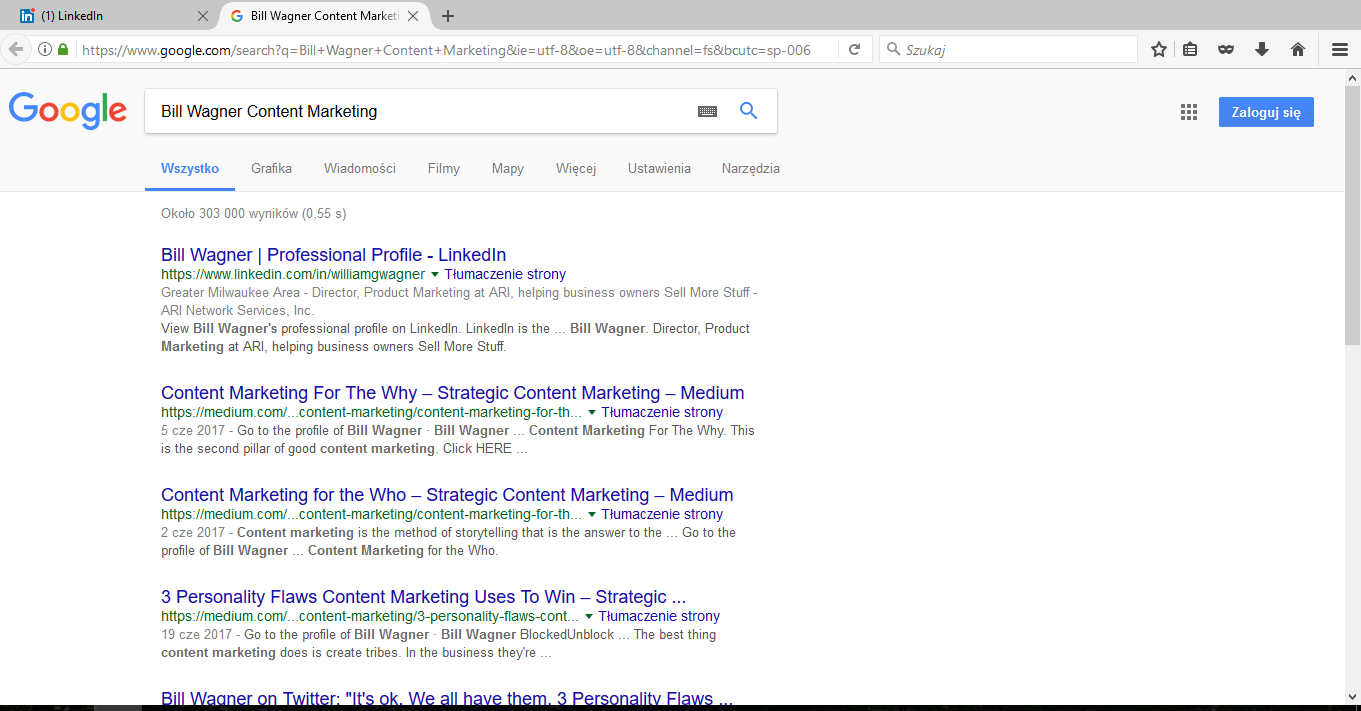
Using a long-tail keyword, I found my grind quite fruitful. I searched “Bill Wagner Content Marketing” and found my blog posts ranking on page 1 of results.

I was beyond happy. I actually clapped and giggled like a little kid at my desk. Then, of course, the skeptic in me raised his hand with a valid question: Were these results simply a by-product of searching on my own Google account?

That’s a good point. Let’s test that.

The benefits of social media paid off once more as I reached out to my LinkedIn network and Facebook friends for help. I asked for screen shots of their front page with the same long-tail keyword. Below is a sample of results. You can see more of them on my LinkedIn profile.

My social network is awesome!

Mobile searches yielded a few more paid results before my organic work showed up, but the data was clear. My blogging and automated sharing has paid off. A simple long-tail keyword is mine, all mine! (Cue the Dr. Evil laugh!)

Conclusions About The Process

Blogging works and this is proof. The secret sauce, the one thing you must do right now, the simple hack to make it all work? Time. That’s it. It takes time.

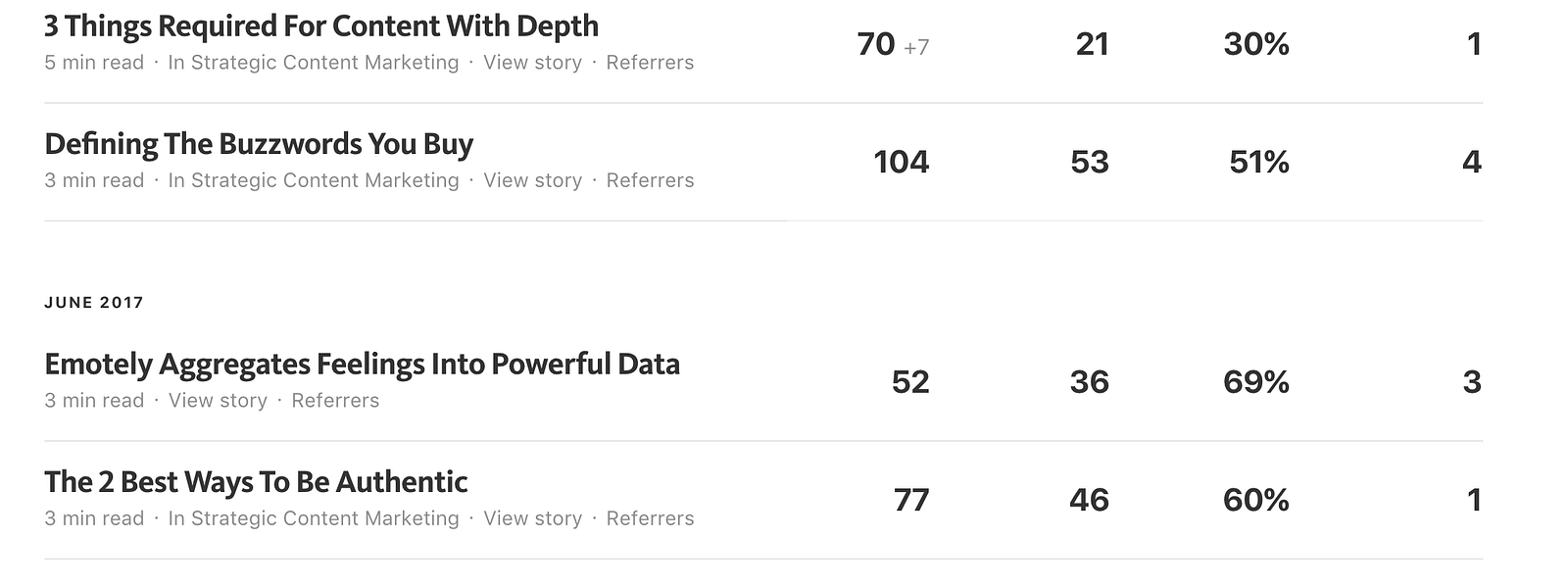
These posts were all written in June and July 2017. I shared them repeatedly over the last several weeks. The question you may be asking is how many clicks and reads does it take? Here are my Medium stats:

A big part of social media sharing is using the right platforms at the right times. LinkedIn and Google + are big parts of my strategy. Google + is very important for search because Google’s search algorithm prioritizes placement there.

The numbers speak for themselves. Obviously some of the stuff I wrote didn’t do as well as the rest. My personal favorite is Connecting With People Who Hate Your Shirt. Yet, my most popular post is about marketing buzzwords. There’s another one of those coming soon. Believe that.

My Beliefs Confirmed

I embrace the grind at my content marketing business Safe Strategies. Social media, blogging, graphics, videos, and all online content comes together to tell a multi-layered story that is your business.

This is just a tiny sample of how well-crafted content builds a great online presence. Let’s connect and chat about what you want out of social media and how Safe Strategies creates it. Increased engagement, better leads, and quality customer interactions are all things that happen when you invest time online.

Let’s chat. Connect with me on Twitter @LearningBill, on LinkedIn, or Facebook.

By Bill Wagner

Umpire and referee turned writer and coder. I delete more than I publish. I laugh at my own jokes, too. Follow my company on Twitter @SafeStrategies

Sourced from Medium.com

By Dixie Somers

Blogging as a marketing strategy for your business takes several different abilities to be successful. While those skills may vary based on your niche, industry, or branding, here are the core skills that will improve your blog marketing.

1. Social Media

Social media marketing is about building a following that you can channel to your blog and your business. You have to discover who your target market is, which social platforms they use, and what kind of posts and content they prefer. For example, you can leverage social causes such as reducing the 7.8 billion tons of waste businesses discard annually.

2. Basic HTML

If you’re working with web content, you should know some HTML (hyper-text markup language), the code by which webpages are created. Sure, you can buy text editors that convert to HTML, but that isn’t always necessary, and may not help if you need to change the HTML later. If you want to make quick adjustments to your content, such as adding links or changing images, you need to know HTML.

3. Technical Skills

HTML is a good start, but there’s more technical knowledge involved. You may want to know some scripting or programming languages to customize your blog site. You’ll probably need to lean about tools and software for creating audio, video, photo editing, and database use. A database master degree will benefit you in all aspects of modern business.

4. SEO

Search engine optimization (SEO) is an absolute must. Search engines rely on different factors to rank your site for their indexes. It starts with keywords and phrases. This is how the search engines index your blog and its content. You can use keyword tools to find the most popular, most relevant keywords and weave them naturally into your content to improve your ranking.

5. Web Analytics

The traffic you draw is a good measure of how successful your blog is. Major social sites like Facebook and Twitter include analytic tools. You can also find them included in several blogging platforms or available as plugins, as well as third party tools. These analytics breakdown your number of visits, page views, length on page, abandonment rates, and more. Understanding these numbers can give you a clear idea of where your blog is headed or what kind of impact your last post or change had.

You can learn as you grow, or just learn enough to implement your latest idea. But the more you improve on these skills, the more effective your blogging will be.


By Dixie Somers

Sourced from ifb Independent Fashion Bloggers


By Laura Meoli.

Whether you’re clueless about media production, or the next Martin Scorsese, there are endless ways to get your name out there. Modern businesses realize that success means changing with the times, and adapting your brand to current technology. I’m not talking about changing your business plan. Staying current is all about utilizing the FREE resources out there to bring your brand to where your customers live. Local businesses are going to still get people walking in the door, but not every entrepreneur needs to have a store-front to make money.

Your customers are likely glued to their phones- so meet them where they are… on social media. A successful brand has a presence on EVERY social media platform, AND on their own website. For example, Pepsi just happens to be a household name because of it’s long history and expensive advertising campaigns that makes it’s logo, font style and colors instantly recognized. Here are five keys to successful branding, for entrepreneurs and start-ups

Don’t get overwhelmed by social media. Choose Wisely.

For businesses without the history or resources that Pepsi has, you will need to make sure that you have a presence on the social media outlets that your potential customers are using. Not all of them will serve you, so don’t waste your time. I would not recommend using EVERY social media platform, but to choose 2 or 3 that are specific to your potential customer. For example, if you are a crafts artist, I would suggest using Pinterest, because that is where people typically look for arts and crafts. Then, I would think about what is that platform lacking in terms of what you have to deliver. For the crafts artist, you may enjoy teaching certain techniques. Pinterest might be good for that, but bigger more complicated projects need video tutorials- so I would suggest using Facebook and YouTube as well. Facebook will be a place where you can share both videos and photos, and because it is so versatile, I always suggest to my clients to start with Facebook. The most important thing when choosing your social media platforms, is to choose based on how comfortable you are using the platform. You can learn to use ANY platform satisfactorily, but if you are passionate about photos for example, I would suggest using Instagram because that joy will shine through in your posts, and you will engage a more authentic audience.

Automate your content for FREE.

When it comes to social media content, Quality is more important than Quantity. In fact, if you are constantly posting mediocre content without much thought, your followers will likely not see value and will unfollow you because it looks like spam. You don’t have to be a slave to social media. Tools like Hootsuite can allow you the opportunity to schedule all of your content ahead of time, for FREE.

Remember that a potential customer visiting your facebook page today, for example, will likely only see the last few posts you’ve shared. Re-sharing content is OKAY. Bonus points if you re-share content as it relates to something currently relevant in the news. For example, in October, I would suggest using content related to Halloween, and using the hashtag.

Consistency is not only key, it’s the lock, the door, and the digital store-front for your brand.

The number one way to be recognizable is to be consistent. Don’t confuse your potential customer by having different names, logos, banners and branding in all the places you live online. That would be like Pepsi changing their name and expecting the same loyal customers to still buy their products. Make sure your visuals are the same on each social media platform, and even matching your website. This includes your logo, banner (AKA header image, or cover photo), and your branding color(s) and font(s). I suggest having no more than 3 branding colors, and no more than 2 fonts (1 for a headline and the other for your body text). The logo and banner should incorporate these fonts and colors. Websites don’t always have a large availability of font styles, so when it comes to writing blogs, it’s okay to have a basic font for your body text. It’s the logos, banners and images that should ALWAYS stay consistent. The tricky part here is that each social media platform has a different set of specifications and requirements for your banner and logo elements. For example, Youtube’s banner is much more wide and shorter in height than Facebook’s banner. Start by creating your website banner, then download specs for your social media platform banners, and customize your design slightly to fit the specs. Unfortunately, each platform has different specs, so you will likely have to make a few different versions. You want to make sure if you have a photo of yourself in the banner, for example, that your head is not cut off, and that text is fully visible on desktop AND mobile devices. Also, look out for redundancy. Your website banner does not need your web address on it, because people are already there- but your social media pages do! Don’t try to cram a bunch of keywords into your banner image and logo. Keep it clean and stick with your branding colors and font.

For an example, check out my website, facebook, twitter and youtube channels to see how you can customize your banner to fit various platforms.

Bonus Tip: Search engines (such as Google or Yahoo) do not recognize the text content in your photos. So if you have important keywords or copy to share, make sure it is written as text on your websites, and not just in your banner or logo image. Don’t jam pack your banner or logo with keywords, because it doesn’t get read by search engines anyway.

Logos are important. Be original.

There are sites out there like Fiverr.com that claim to create custom logos for $5. I’ve done that about three times and found that these “experts” are just taking stock images with little care, and giving you a very basic result. It isn’t customized, it won’t be what you’re looking for, and it rarely ever helps you build brand recognition. Here’s why… For example, most film production companies will ask for a film clapper, a film reel or a camera as the imagery in their logo. If you use a stock image site like Canva to create your logo, you will have a limited amount of film-related images to choose from. Every film production company is going to look on Canva and use these images for their logos, so by the time you show up wanting to create something unique- it’s too late. That image will already be taken and likely is being used by your direct competition. Think about it- If you have the same logo as your competition, with just your name switched out- how will you stand out? What makes your potential customer want to buy from you rather than the other five companies with the same exact logo?

Search engines aren’t doing you any favors when it comes to putting your content high-up in search results (unless you pay them to do so). And people don’t spend much time searching before deciding who looks legit, and who doesn’t. Your logo and banner is your first impression. Don’t give potential customers a reason to go with the competition. I always recommend hiring a professional to create your high-end LOGO, so you have a custom, personal design. Click here to get a custom, high-quality logo and banner for your website.

Know when to DIY (do it yourself), and when not to.

When it comes to branding, it IS possible to do it yourself. However, don’t be fooled into thinking that people who are super-active on social media don’t have help. Lots of entrepreneurs have interns, and even hire virtual assistants who help with various aspects of their business.

There are a million things to do as an entrepreneur, we can’t always do it all ourselves. Don’t be afraid to ask for help, and use the tools out there to enhance and empower your social media sharing. Outsource the parts of your business that you do not enjoy doing. BUT be clear on how it’s done in the first place so when you do hire someone, you are knowledgeable about potential errors or mistakes that can occur.

I believe that we can learn almost anything. There are just some things that are better left to professionals. For example, I teach video production and podcasting to various people at all skill levels. Some people really enjoy doing their own videos, and depending on their goals, video might be the perfect way to engage their audience. But remember, people don’t spend much time looking in the search results before deciding who looks legit, and who doesn’t. If your logo and banner is your first impression, your videos are the second impression. Don’t give potential customers a reason to go with the competition. You can certainly have videos that you’ve produced yourself on your website, YouTube channel or social media. Your videos don’t need to cost a lot of money to produce- as long as the content is there and consistent with your brand. I suggest having at least 1 professionally produced video that introduces and explains your brand. This video should be strategically placed as the main video on your YouTube channel, featured and starred on Facebook and other social media sites, and shared OFTEN. This will help build that impression of your brand as high-quality, and it will bring your potential customer to your website. From there, you can go nuts creating as much content as you want with your iPhone, because you’ve already hooked them.

Not investing in high-quality video and images is like going to a networking event wearing your pajamas. Since you don’t have a store-front, your online content needs to represent you. What you write is important, but with such short attention spans today, images and videos are your first impression. Make it a good one! LoudaVision Productions can create a custom, high-quality video for your website AND teach you how to increase your own production value for future self-made content.

By Laura Meoli,

Laura Meoli is a Digital Media Producer, Filmmaker and host of the LoudaVision Podcast for creative people.

Twitter @LoudaVision

Sourced from HUFFPOST

By .

Facebook has introduced Facebook Cross-Platform Brand Lift in the US and UK which along with Nielsen Total Brand Effect with Lift will help advertisers optimize their Facebook and TV campaigns using actionable results according to a blog post.

The platform will see Facebook will match rival Google which launched Brand Lift for TV some years back in order to help marketers understand how YouTube campaigns can impact metrics such as awareness.

Facebook’s advertising partners who are expanding from digital advertising into cross-media campaigns will be able to leverage Facebook Cross-Platform Brand Lift solution.

Margo Arton, senior director of Ad Effectiveness at BuzzFeed said: “Now that Buzzfeed has begun to diversify our media strategies to include both Television and Digital, having the option to leverage solutions such as Facebook’s Cross-Platform Brand Lift and Nielsen Total Brand Effect with Lift presents a great opportunity.”

“We look forward to using cross-platform brand lift measurement to both receive valuable insights about our multi-media campaign performance in a single reporting surface, and also to optimize campaign elements such as spend and creative across both platforms.”

Facebook cited an example of household brand Shark’s campaign which was deemed a success as measured by Nielsen Total Brand Effect with Lift.

Ajay Kapoor, VP, Digital Transformation & Strategy, SharkNinja said: “We proved that Facebook video ads are a natural complement to TV campaigns. We experienced better brand results among people who saw ads on both versus just TV or Facebook alone. We saw the ‘better together’ impact first-hand. Facebook and TV are powerful individually, but deliver a stronger message to our audience when used in tandem.”

Facebook recently introduced more ways to help marketers re-engage offline audiences.

By

Sourced from THEDRUM

By Addison Nugent.

Back in the early aughts, when social media was a domain relegated to angsty teens, the adult workforce would have laughed at the idea of an employer demanding they take certification classes in managing their Friendster, LiveJournal or Myspace accounts.

But that is exactly what SocialB, a U.K.-based digital marketing firm, offers its clients for today’s social media platforms. With courses like “Social Media Masterclass” and “Social Selling Training,” Socialb attracts pre-eminent clients, among them the United Nations, the BBC and Virgin Management. So why are some of the world’s most powerful organizations seeking social media advice?

Historically, companies blocked social media websites that they felt were irrelevant … and a distraction from productivity.

Tessa Horehled, managing director, Move Shake Make

Turns out, there are lots of reasons: 1.3 trillion to be exact. As in $1.3 trillion. That’s the amount McKinsey Global Institute says companies the world over stand to gain annually from effective use of social media. But to get a piece of it, they need to overcome what is known as the social media skills gap — that is, the divide between new digital demands and a dire lack of employee training.

According to a study by the Technical University of Munich published in June, just 5 percent of businesses surveyed strongly agreed that their organizations have enough personnel to handle the digital transformation. That reflects research Capgemini published in 2013, which remains the most in-depth study on the topic: It found that just 7 percent of employees surveyed believe they have strong social media skills.

A growing number of training consultants wants to radically increase that number and help companies bridge the gap. “We are not taught at school or college how to use social media, and even with the launch of digital qualifications at university, I don’t believe they educate people on the personal brand aspect or how to really use social media for businesses,” says SocialB CEO Lynsey Sweales. “The decision-makers in business who are trying to recruit a digital or social media person aren’t always sure what skilled questions to ask or the answers that validate that expertise. This either means they don’t recruit at all or they recruit the wrong person and don’t see the results they are expecting.”

Why is the workforce so unprepared when 34 percent of those workers are millennials who grew up with the internet? The answer could be that the universe of social media keeps expanding. Facebook was once a platform exclusively for college students; now it’s used by more than a quarter of the world’s population, according to Internet World Stats. When Instagram launched in 2010, it was just another photo-sharing app; today, companies see Instagram stars as “influencers” and treat them as powerful marketing tools. Other firms are turning to Snapchat, which began life in 2011 strictly as a teen app, to reach the youngest customers. With this ever-shifting digital landscape, it’s not surprising that employees struggle to keep up.

But they really must if their company is in the online game — and these days that means most companies. According to a 2014 eMarketer report, 88 percent of U.S. companies use Facebook, Twitter, Instagram and other platforms to promote their products and services. It’s a highly effective marketing tool: 78 percent of consumers report that it influences their purchases, according to a 2015 Forbes survey.

When it comes to ramping up those social media chops and reversing that trend, employees are not getting much in-house help. Of the companies surveyed by Capgemini, fewer than half were investing in the development of their employees’ digital skills, and none of them planned to invest more than 20 percent of their training budget on social media/digital education. “Historically, companies blocked social media websites that they felt were irrelevant to an employee’s function and a distraction from productivity,” says Tessa Horehled, a global digital marketing strategist and managing director of digital marketing firm Move Shake Make. “As social media has become a more prominent business tool, not only for the marketing team, these previous restrictions are gradually falling away.”

Fortunately, some companies are starting to step up their game. Although management once assigned social media duties to a specific person or a team, most innovative outfits these days recognize that it has become the responsibility of all employees. According to a 2015 study published by Altimeter, 47 percent of companies surveyed reported that they provide social business training for staff, a steady 2 percent increase from 2013. Alternatively, employees can independently seek out social media training and certification from sites that offer online courses like SocialB, Hootsuite Academy, Splash Media U, Expert Rating, Mediabistro and Market Motive.

When it comes to training, Fragkiskos Filippaios wants to go further upstream. Filippaios, associate dean for graduate studies at the University of Kent and co-author of the paper “Social Career Management: Social Media and Employability Skills Gap,” thinks higher education could take a more prominent role in improving social media education. “Universities and colleges fail to appreciate the need to include the use of online social networks in the curriculum,” he says. “[There is an] urgent need to … equip graduates and future professionals with those tools.”

The idea of social media penetrating all levels of society, including the workspace, has recently become the subject of dystopian narratives like the 2017 film The Circle and multiple episodes of the hit TV series Black Mirror. It seems as though offices that function like social media platforms may indeed be the future. But rather than the oppressive hierarchies dreamed up by sci-fi writers, workplaces where every employee is equally capable of contributing to the centrally important task of social media management may in fact create a more egalitarian “economy of trust.

By Addison Nugent.

Sourced from www.ozy.com

By Cameron Conaway

For many content marketers, social media strategy never gets beyond the spray-and-pray process of sharing a new piece of content with the widest audience possible, and then measuring if anybody engaged with it. It’s based on an idea that if you just keep creating new content and pushing it out, results will come.

But, as Jonathan Crossfield puts it, “In social media, the audience pulls the strings.”

As content marketers, we must take a step back. Just as we put time into creating a content marketing strategy, so too do we need to create a social media strategy specifically tailored to our content goals. And this begins with establishing the right social media KPIs (key performance indicators) for those content goals.

After all, if our social media strategy is built around intuition rather than KPIs, it’s unlikely to serve our content well.

Social media strategist Jeremy Goldman knows a thing or two about this. He’s the author of Going Social and Getting to Like, and he’s the founder of Firebrand Group, a brand management consulting firm that counts L’Oréal and Unilever among its many clients.

CCO: Going Social was published four years ago, and yet still contains lessons for today’s social media strategists. What are the most significant changes since then?

Goldman: When Going Social was about to come out, I was freaking out for the reason you just stated … social media moves so fast. How do you write a book like that without it immediately becoming outdated? I realized I had to avoid writing about the mechanics of how you respond to comments on Facebook or how you participate in a Twitter chat since those could easily change at any moment. Instead, I focused on how social media is based on the principles of communication that have predated social media by a few millennia.

As for the most significant changes? That’s easy. Social media is pay for play, and good luck running any meaningful strategy purely around organic reach. When I wrote Going Social, mid-sized businesses could actually find ways to get creative and win at social media without a paid media budget. Oh, how times have changed.

CCO: In the context of content marketing, how do you wade through the seemingly infinite social media metrics to get to the social media KPIs?

Goldman: First, it’s completely normal to get metrics and KPIs mixed up to some extent. In fact, I’ve seen people at even senior levels flub this. Metrics are simply measurements quantified. KPIs are metrics that you’ve determined are mission critical to your business.

You touch on something very important here: These days we can measure more than ever before. However, that isn’t necessarily a good thing in that it causes some organizations to lose focus. Just because we have more metrics doesn’t mean we need more KPIs.

The more KPIs your organization has defined, the less focused it likely is. I had one company boasting that it was determined to go from four KPIs to 16 KPIs in the next fiscal year. Is that always a good thing or does that dilute the value of a KPI?

CCO: Speak to the newly minted content marketing manager. What are the first steps they need to take to figure out the best social media KPIs for their content marketing goals?

Goldman: That’s going to depend on the organization and the scope of the particular role, so the first thing is to figure out how to be of greatest value to the organization in general. If the best thing is to get eyeballs on the company’s latest white paper, the best KPIs may be visits to the lead-gen form connected to the white paper, and the total number of white paper downloads – simple as that.

CCO: What are typically the most important social media KPIs for content marketing, and how do you create a sustainable, team-oriented process for driving toward them?

Goldman: Again, it’s going to depend on the organization, but I think sales leads is probably the number one KPI for content marketing. If you’re not making any sales, it’s hard to keep the lights on, and it’s hard to write good content without any lights. Tied to that, customers coming from those leads are a powerful KPI, not to mention traffic on specific pieces of content.

I like that you ask how to have a team-oriented process because that’s something not enough people touch on. It’s important to have the entire team pushing in the right direction. Every team member must understand not just team KPIs but what role each member of the group needs to play to reach them. You can’t all be rowing in different directions. I see that happen all too often.

CCO: You’ve helped both scrappy start-ups and massive transnational companies establish their social media KPIs. What themes run through each, and what can content marketers, regardless of the size of their company, learn from them?

Goldman: Small companies and large enterprises have far more in common than you’d think. The biggest parallel is a desire to run before figuring out what path they should be taking. We live in a society that rather harshly judges anyone who takes a second to breathe. If you’re not doing, you must be a slacker, right? But the reality is that setting KPIs and then revisiting those KPIs on a regular basis are beyond critical, and both start-ups and monolithic enterprises don’t do it often enough.

CCO: Can you offer some tips on establishing the best social media KPIs for your content marketing goals?

Goldman: Understand your brand. Your organization presumably has a mission statement – a reason for being. It may sound like a lofty place to start, but you can’t succeed without an understanding of the firm and where it’s looking to go.

Determine your own role. Make sure you know what your role is in the company. You would be surprised at how many content marketing managers are spending their time in slightly different areas than their managers would like.

Survey your metrics. Look at all the metrics your organization is tracking. Don’t assume everything is important. Likewise, don’t assume a seemingly valueless metric can’t be immensely helpful.

Determine your KPIs. Break down your list of metrics and pick a few you’re determined to work night and day to measure your success by. Make sure you’re not picking too many – no more than six and, in some cases, fewer will do.

Refine on an ongoing basis. There’s a chance you may have picked the wrong KPIs, your role may have changed, or your organization is heading in a new direction. No matter which one occurs, reviewing your KPIs on a regular basis lets you course correct and select new ones.

By Cameron Conaway

Cameron Conaway was awarded the 2015 Daniel Pearl Investigative Journalism Fellowship. He curates Content Land, a weekly resource for journalists and content marketers who want to work smarter by learning how both fields intersect. Follow him on Twitter @CameronConaway.

Other posts by Cameron Conaway

Sourced from Content Marketing Institute

Sourced from Greatist.

She took your pictures off her ‘gram. Y’all must have broke up.” Everyone with a social media account understands that verse of Yo Gotti’s song “Down in the DM.” We’ve all felt the pressure to prove a relationship is going well through an outpouring of highly visible romantic messages, but how much of what we portray online is reflective of reality? And does our public performance of love hurt our real relationships

In July my husband and I celebrated three years of marriage. Getting married at the tender age of 22 came with its own set of challenges; we’ve been discovering ourselves in the process of discovering each other. Over the last three years, we’ve had our share of ups and downs, but the best lessons have come from the downs. One of the most surprising pertains to how our relationship is portrayed online.

I’m fairly active on social media and used to post frequently about my daily experiences and my relationship. My husband, on the other hand, is the complete opposite. Sure, he has a Facebook profile, but he definitely has low levels of engagement. I knew his relationship with social media meant he was unlikely to post about me, but that didn’t stop it from irritating me when he didn’t.

I made the mistake many do; I equated my insufficient presence on his page to insufficient love for me. Surely, if he loved me, he would shout it from the rooftops of the interwebs. So we did what most couples do when they have different views: We argued.

I’m not alone. Research gathered by the Pew Research Center suggests at least 24 percent of individuals think technology has either a negative or less-than-positive impact on their relationships. So… what about those people who incessantly post about how gorgeous and perfect their lives are? How real can those “perfect” Facebook couples really be?

We’ve all seen photos and statuses of friends and acquaintances who gush over their partners, the latest trips, the latest gifts. But what’s the reality here? More than once, I’ve talked to a distraught friend after they had a relationship-threatening fight, just to see them—moments later—post an “I love you more than the world” status and a photo of their partner on Instagram. And I doubt I’m the only one who’s experienced something similar.

I’ve envied the relationships I’ve seen online—you know, the really sentimental ones, where partners write long, heartfelt statuses about each other. But in reality, the couples who write those gushingly romantic posts might be, at best, trying to make up after a bad fight or construct a reality that portrays their desired relationship, rather than their real one. At worst, they might be victims of territorial controlling partners.

There’s some data that suggests frequent social media use has a negative correlation with levels of relationship satisfaction, and recent research has shown that individuals with multiple social media profiles often suffer from increased risk of depression. This is particularly common among millennials.

Surely if he loved me, he would shout it from the rooftops of the interwebs.

There are any number of reasons people fall into social media overshare, ranging from simply enjoying the dopamine releases that come with an influx of notifications to covering up uncertainty within a relationship.

And romantic relationships aren’t the only ones affected by this behavior. If you’ve ever wondered if your friends are jealous about what you post on your page, the answer is “probably.” Nearly half of social media users reported feelings of jealousy when their content didn’t get as much positive attention as their friends’. In order to keep up with the Joneses, many people feel pressure to uphold an unrealistic persona to garner more likes.

Remember, there’s significant work that goes on behind the scenes when you take the perfect couples’ picture for social. These images don’t just happen: You have to consider lighting and angles, arrange the backdrop, take several iterations, engage with all the feedback… so when, in this process, are you really spending time with your partner

Some experts believe the pressure to post the “right” relationship photo makes it difficult to be present for our partners and live in the moment. A study published in 2016 revealed that the more selfies posted on platforms like Instagram, the higher the likelihood of relationship conflicts and jealousy, particularly when those images get significant attention. Other issues can arise when everyone but your partner likes your pictures (at least that was the case for me).

The truth is a good amount of tech-related conflicts happen in relationships: 42 percent report being distracted by their phones, 18 percent argue about the amount of time spent online, and 8 percent have conflicts due to what a partner does online.

The way someone chooses to portray their relationship on social media is a personal decision, and many happy, fully functional relationships are broadcasted on social. And for good reason: A cute post can be a wonderful way to make your spouse feel appreciated, if that’s their “love language.” However, there are also many people like myself, who have become so consumed with the stressors of their online footprint that it causes issues

Do what works best for you but be vigilant and wary of the issues you and your partner face that are social media related. In my case, when I stopped obsessing over the fact that my husband wasn’t posting about us (and started mentioning my husband as little as possible), it removed a ton of pressure from our relationship. As the old adage goes, the grass isn’t always greener.

A. Rochaun Meadows-Fernandez is a diversity content specialist who produces materials relating to mental and physical health, sociology, and parenting. Her work can be seen on several national platforms. Check her out on Facebook and Twitter.

Sourced from Greatist