Tag

Social Media

Browsing

Where to Focus Your Annual Marketing Spend

It’s never too early to start working on your company’s marketing plan for the upcoming year – just ask the accounting department. For B2B and B2C marketers alike, there are many conversations to be had about the impact your budget will have on your marketing capabilities and strategy.

Use this guide to assess your company’s current marketing practices and discover the marketing methods you may want to introduce in next year’s plan. After all, your 2018 budget is likely an untapped resource for your marketing team and might allow for optimization, integration and innovation. Did we overdo it on the buzzwords? In any case, use this guide to get a jump start on your 2018 marketing budget and determine what tactics you should incorporate to make the year a successful one.

Step 1: Analyze and Benchmark Past Marketing Successes

Marketing is a balancing act and when you’re trying to increase qualified leads, it should never be a guessing game. To develop a truly successful marketing plan, you first have to look back at marketing plans from years past.

Use data from Google Analytics, your email marketing service and your marketing automation system to understand what sources are driving the most leads. Once you have tangible numbers, you can identify which sources contribute the highest percentage of total revenue via leads and conversions.

After you’ve collected year-over-year analytics data from each marketing channel and their corresponding sales metrics, you should ask yourself two simple but important questions:

  • What’s working?
  • What’s not working?

Unfortunately, each marketing tactic cannot be evaluated in the same way. While print ads offer circulation data, you can’t determine the exact number of readers who flipped through a publication’s pages. On the other hand, display advertising can provide definitive findings as to the size of the audience, the amount of impressions and click data.

Do your best to prioritize marketing tactics based on an unbiased review of their performance each year. When analyzing performance, try to maintain a holistic view of your business. What outside factors are influencing business development besides marketing? The loss of a key employee or the emergence of a new local competitor could be to blame.

Return on marketing investment (ROMI) can be tough to navigate, but with persistent research, you can optimize the channels that are working in your favor and pull back marketing spend on the tactics that aren’t.

Step 2: Determine 2018 Marketing Goals

Once you’ve familiarized yourself with the success of your past and current tactical marketing plans, it’s time to determine your 2018 marketing goals. After all, you can’t take a road trip if you don’t know where you’re headed.

Your marketing goals should be strategic objectives that are quantifiable and specific.

Define your goals on multiple levels; start from the top by determining your short and long-term business objectives. With this information, you can understand the amount of revenue you will need to achieve those goals and therefore the number of new leads you will need to generate. This is where the fun starts. Armed with these numbers and your data from step one, you can begin to break down these goals even further, setting success measurements for each marketing channel and tactic.

For tactical goals, be specific in terms of budget and results. How much are you willing to spend on this tactic? How many clicks or new leads do you expect this tactic to generate? Here’s an example:

  • Channel: Digital marketing
  • Platform: Google AdWords
  • Tactic: PPC campaign
  • Spend: $3,000/month
  • Goal: 500 clicks, 30 conversions

It’s important to establish objectives, but there should be some element of flexibility. Many factors that will impact progress toward your goals are constantly in flux, such as the cost associated with certain keywords  and ad groups on Google AdWords.

Keep in mind that circumstances may change throughout the year and budgets may have to be adjusted. If your current structure does not allow for budgetary changes, your goals and expectations should be altered accordingly.

Step 3: Consider Marketing Channel Options

There are multiple marketing channels to choose from when creating your 2018 plan, but most marketers will recommend an integrated approach. If your budget is tight, it may be in your best interest to focus investments on one or two channels. Here are a few channels that every modern marketer should consider:

  • Digital Marketing
    • Website development: Investing in development can go a long way. Whether you’re starting from scratch to create a new website or you’re improving an existing one, users can always appreciate a site that has top-notch UX and updated features.
    • Display advertising & pay-per-click (PPC): Advertising via search engines and partner websites is becoming increasingly commonplace as technology advances. Display advertising is an economical online advertising method, offering the opportunity to display graphic banner ads on website categories of your choosing. PPC, while more costly, is extremely customizable; advertisers can specify bids, ad copy, display time of day, location targeting and more.
    • Email marketing: A standard among most companies in 2017, there are still realms to explore in the world of email marketing. Experiment with email workflows to capture leads and incorporate responsive elements to heighten engagement metrics.
    • Social media advertising: For marketers who have established a strong social media presence for their company, social media advertising is an excellent tactic to incorporate. LinkedIn is the most beneficial for B2B marketers (especially its new InMail advertising option), while Facebook suits B2C marketers.
    • Search engine optimization (SEO): Optimizing your website for search engines is becoming increasingly important. How many times do you Google per day?
  • PR & Social Media

Public relations and social media marketing are standard for most B2B and B2C businesses. To take your editorial calendar to the next level, put down the press release and consider adding a new method to the mix.

Content marketing is a tactic that has grown in popularity in the past few years; this avenue allows companies to produce in-depth industry content that draws in a new, more targeted audience.

Content marketing is especially useful in the B2B space because industry content may not be as readily available to interested consumers. This content not only serves as quality editorial copy on-site, but it also has the potential to be leveraged for lead nurturing and demand generation purposes.

  • Traditional Marketing Channels

Traditional marketing methods have been a staple in the industry for decades and most are still in use. Direct mail, event marketing, television spots and print advertising are just a few tactics that are still a core focus for many marketers.

But be wary of opting for traditional methods unless you can prove that the tactics will result in strong leads. If not, they may not be worth the significant investment.

Step 4: Prioritize Your Needs

This is the hard part. Marketing on every platform is be the ideal circumstance, but for small to medium sized business (SMBs), this may not be realistic.

To prioritize your marketing needs, start with the most costly endeavors. Choose the tactic that is the most effective at driving leads and go from there.

Once you’ve incorporated the tactics that require the most spend, you can balance the rest of your budget with more cost-effective tactics.

Most B2B and B2C marketers find that working with an agency is helpful in determining the best marketing mix. For most of our clients, the marketing channel priorities that garner the most online success include:

  • PPC campaigns
  • Content marketing
  • SEO

Ultimately, there’s no magic formula. Your marketing budget should be a mix of different methods, based on the resources you’re working with and the audience you’re trying to reach.

This guide should serve as a starting point for your 2018 marketing planning and help you bring increased exposure for your business in the new year.

Sourced from Marketing Insider Group

By

Bill Gates is famous for saying, “I choose a lazy person to do a hard job. Because a lazy person will find an easy way to do it.”

However shocking that sounds, putting more work and hours into something doesn’t always yield better results. And today’s fast-paced online world can be especially tough on businesses that don’t manage to keep up.

As a busy blogger, you’re probably juggling a multitude of different tasks, many of which are repetitive and frankly, quite boring. For your blog to take off and scale into something greater than a company of one employee, you must use your time efficiently and learn to automate and delegate.

Read on to learn about the practical tools of automation and how to use them to grow your business.

Importance of automation

On average 49 percent of companies are currently using marketing automation and the adoption is growing rapidly, as there are 11 times more B2B organizations using marketing automation now than in 2011.

Why is everyone jumping on this new trend? According to various research findings, marketers who’ve adopted marketing automation count multiple benefits:

  • They see an average increase of sales revenues by 34 percent (Pardot, 2015)
  • 64 percent of marketers say they saw the benefits of using marketing automation within the first six months of its implementation. (Regalix, 2015)
  • 74 percent of respondents say the technology’s ability to save them time is its largest benefit. This is followed in close second by increased customer engagement (68 percent), with more timely communications and increased opportunities tied in third place (58 percent). (Adestra, 2015)

Besides helping to improve customer experience, email marketing and, lead management as well as helping to reduce human error in marketing campaigns, the biggest and most important benefit of automation for busy bloggers is that it can save hours and hours of time, which could be spent creating new content and growing the business.

Curating content

Creating excellent content for your blog is only half the story. You might be a skilled writer and an expert in your field, but churning out high-quality content every day is hardly possible if you’re a one-man show. And yet, it doesn’t mean you should let your social media presence suffer.

What you need to keep your communication flowing is a rich selection of well-written content that your target audience would find interesting and valuable. By sharing blog posts, videos or infographics created by other bloggers or businesses you will continue to create value for your followers and boost your credibility. Content curation can be an opportunity for bloggers to build their following and figure out the interests and motivations of their audience.

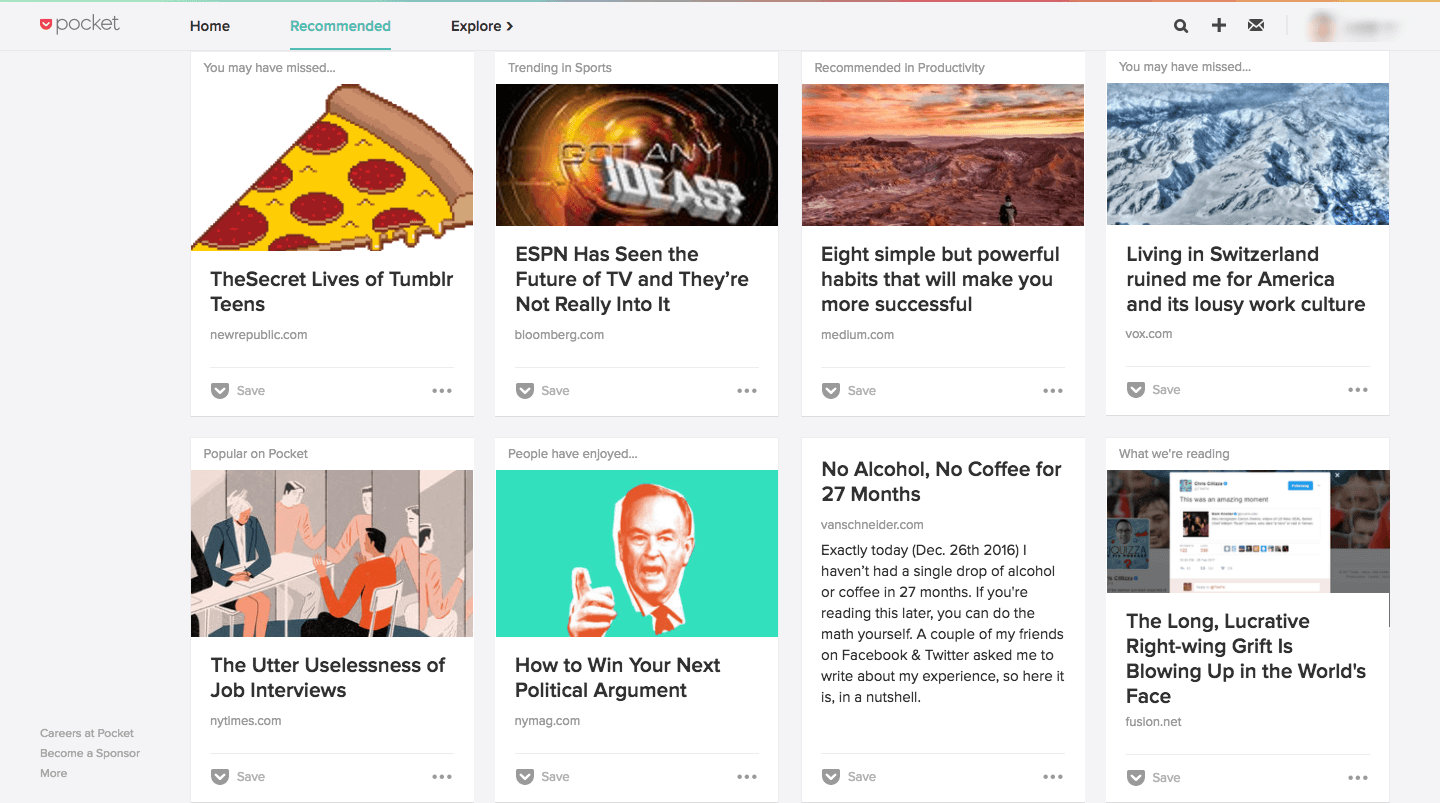
Credit: Pocket

Explore the most popular content curation tools, such as Pocket, Scoop.it, Feedly, and Storify that will help you to discover, save, and distribute the best content from around the web.

Scheduling social media updates

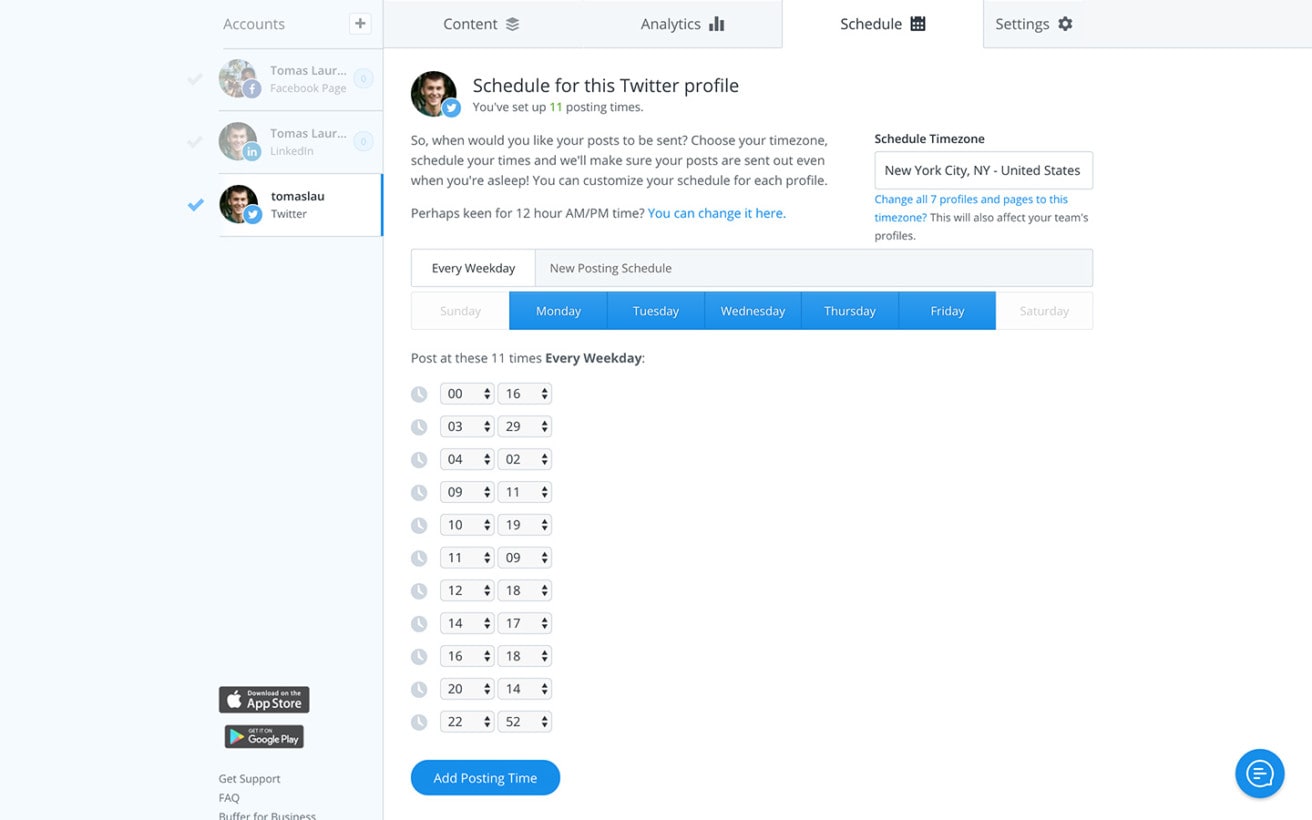
The best way to manage the time you spend on social media is by blocking off a few hours in your calendar for content scheduling and getting it all done in one go. Buffer and Hootsuite are the leading content scheduling tools available online that can take the pain out of this boring task. Instead of copy-pasting the same message across different platforms, fiddling with different settings and re-uploading visuals, get all your social media content planned out and scheduled by using a dedicated automation tool.

Credit: Buffer

To get the most of social media automation, be sure to craft your own social media content plan. A robust social media content calendar will not only help you stick to a consistent schedule, but will also make the planning of time-sensitive content easier and help you enforce a healthy sharing ratio. One of the most popular ways for figuring out the ideal ratio for the content you’ll share on different channels is to use the 411 rule. This rule refers to a practice of sharing four user-centric educational or entertaining posts for every one “slightly promotional” and one “hard sale” post.

Credit: Buffer

When it comes to choosing the optimal time to post on social media, you’ll need to do a bit of heavy-lifting yourself and analyze your audience’s behavior and preferences. When are your followers online? When do you see the level of engagement spike throughout the day? Look into the built-in analytics on Twitter or Facebook to determine the best times to push your messages out. Alternatively, you can rely on the clever algorithms that Buffer and Hootsuite both use to automatically schedule your post to go out when they’re most likely to be noticed. CoSchedule have rounded up a number of studies to figure out the perfect times to post and found that:

  • The best times to post on Facebook are Saturday and Sunday at 12–1 p.m.
  • The best time to tweet is noon and 5–7 p.m. on Wednesdays.
  • The best time to post on LinkedIn is Tuesday, Wednesday, and Thursday at 7–8:30 a.m., noon, and 5–6 p.m.

Automation plugins for your blog

Although not a WordPress plugin, IFTTT is one of the most versatile automation tools on the market. It can send you a daily email with the GIFs that are trending on Giphy or notify you when a new subscriber is added to your MailChimp list. The possibilities are wide-ranging and exciting.

To maximize the ROI of your email marketing, ensure your workflow is set up properly. Use a WordPress form builder to have a smart-looking subscription form that integrates with your email provider on your site. Then set up an automated workflow on your email platform to trigger a welcome campaign once a new email is added to your mailing list. If you want to quickly capture new leads on your blog and add them to the right mailing list, CaptainForm, a user-friendly WordPress form builder that integrates with MailChimp and GetResponse, is a good place to start.

Credit: CaptainForm

Another cool WordPress plugin that can take some work off your hands is Revive Old Post, which promises to help you keep the old posts alive and drive more traffic by reposting them on social media. To keep your content calendar neatly organized, you can also explore the CoSchedule plugin, which will help you take control of your blogging calendar.

Hiring and training a VA (virtual assistant)

Many bloggers will attest to the idea that hiring a VA right from the start is the best thing you can do for your business. The most common objection here is that it seems counterintuitive to pay someone before you start making money yourself, but it is the only way for you to focus on the most important, revenue-producing tasks and leave the rest in someone else’s capable hands.

So where do you find a talented VA that will help you bring order to chaos? Many entrepreneurs scour freelancer marketplaces like Upwork and PeoplePerHour or leverage their personal and professional networks on social media (Facebook and LinkedIn groups, Twitter hashtags).

When hiring a VA, make sure you know exactly what type of tasks you’ll be outsourcing so that you can look out for the right set of skills. Do they need a good written English? Does it matter what time zone they live in? Do they need any specific knowledge? If you’re struggling to wrap your head around this, use Foundr’s Hiring a VA checklist to cover your bases.

Credit: Trello

If your VA lives on the other side of the world, you can use tools like Screenmailer to explain projects and tasks in a quick and reliable way. Trello is also an excellent tool to keep track of the progress and make sure you’re all on the same page.

Avoiding common mistakes

Don’t be afraid of making a few mistakes here and there – they’re not going to kill your business. But there are a few things to keep in mind when it comes to marketing automation:

1) Set goals for each automated effort

You will need a way to measure the success of your marketing automation, so make sure you set goals for each automated effort, such as social media, email workflows, and so on. This will help you to track the performance of automated campaigns and ensure they’re optimized for the best results.

2) Optimize your email automation

Automating your email marketing will be an exhilarating experience. However, it’s key to remember that adding your leads to onboarding or welcome automation workflows only works if the lists are segmented and you personalize the content that you send. Don’t make the mistake of blasting generic emails to the entire mailing list because it will turn people away.

3) Don’t get lazy

Marketing automation will save you tons of time, but don’t make the mistake of letting things take their own course. Take time every week to re-test and review your automated messages to make sure they’re still relevant. If your engagement rates start to drop, it’s time to refresh the content and do some A/B testing.

Conclusion

Once you turn your blog into a source of income, your efforts must be focused on growing the business. So you can’t spend your days plowing through a to-do list that has no direct (or very little) impact on your revenue. Automating the most time-consuming tasks will free up a lot of time and allow you to scale your business without much investment. And if you decide to hire a VA, there is only one thing to remember – never outsource core tasks and you’ll be just fine!

By

Sourced from TNW

Social media is changing.

It used to be a one-to-many channel. Businesses would publish links, photos, and videos on Facebook, Twitter, and Instagram, hoping to reach as many people as they can and drive a high number of leads and sales.

When marketers first started using social media as a marketing channel, there was less content, less noise, and people were willing to click on almost everything they saw on their news feed.

Then, we hit content shock.

There is now more content on social platforms than people can consume. If a post doesn’t look interesting or useful, people just scroll past it. As Rank Fishkin observed, “Twitter, Facebook, et al. have become more challenging sources from which to drive traffic. Clicks are just harder to come by.”

Social media is no longer a megaphone.

It is now becoming a one-to-few — and often one-to-one — channel. Businesses and organizations that are succeeding on social media now are the ones providing personalized social experiences to their fans such as KLM Royal Dutch Airlines, NASA, and Airbnb.

Social media is becoming a conversation. Here’s why…

Social media is incredible for some things but not all things

Social media is often seen as a solution to every marketing problem. And, of course, it’s great for certain aspects of marketing including brand awareness. But the truth is, social media probably isn’t going to help you achieve every business or marketing goal you have.

For example, I believe social media is no longer a great traffic driver for most businesses. The strategy of batching and blasting marketing messages across various platforms might have been an effective way to drive clicks in the past, but not anymore. And, in mind at least, that’s not a bad thing because:

Social media is becoming an engagement channel. 

And with this shift comes new opportunities, such as incredible customer service and one-on-one conversations, which major social media platforms are embracing more and more with platforms and features like Messenger, Instagram Direct, and Twitter Direct Messages.

Engagement is also about the content you create and share across social platforms. Is it entertaining, useful, or unique? Does it encourage your audience to respond? Or is it just there to drive clicks back to your website?

The future of social media (and some might argue the past and the present of social media) is about deepening your relationships with your fans by engaging them and not simply pushing out marketing messages.

Let’s look at why this shift might be true…

4 reasons why engagement is the future of social media

1. Low organic reach and referral traffic

In recent years, organic reach on social media has fallen so low that social media is becoming a less viable channel for traffic.

Businesses are reaching fewer people on social media and getting less traffic from social media through organic means. Even publishers, businesses that heavily rely on social media for referral traffic, are getting less social referral traffic. Many major publishers have been seeing a fall in Facebook referral traffic — some as much as 50 percent.

As the amount of content on social media increases far beyond what we can consume, each social media post becomes less and less likely to be seen.

Here’s a simplified calculation: if 10 million posts are published per day by users and brands and all social media users collectively consume only one million posts per day, each post has a 10 percent chance of being seen. If the number of posts published per day increases to 100 million and all social media users still consume only one million posts per day, each post now has only a one percent chance of being seen.

The reality is that as more content is published on social media, organic reach will naturally fall.

A study by Social@Ogilvy found that Facebook organic reach has fallen to just six percent in 2014.

Declining organic reach on Facebook

The number likely has fallen even further after Facebook made a change to its algorithm to prioritize posts from family and friends over those from Pages.

Social media is losing its potential as a traffic channel as more and more content are posted on social media. As Michael Stelzner, CEO and Founder of Social Media Examiner, said, “Traffic has been going down, down, down and down. For years! That’s the challenge – you’re not getting the reach or visibility and we have to be OK with that reality.”

We have to adapt accordingly.

2. The rise of social messaging (and chatbots)

While social media has been the dominant platform over the last five to 10 years, social messaging apps (messaging apps built around social media platforms) are growing much faster than social media platforms. There are now more people using the top four messaging apps than people using the top four social media apps, as reported by Business Insider.

The top four messaging apps are now bigger than the top four social networks

Activate, a strategy consulting firm, predicted that 1.1 billion more people will use messaging apps by 2018, resulting in 1.5 times more people using messaging apps than people using social media apps.

The rise of social messaging signifies a change in people’s social media behavior and preferences — towards more personal, one-to-one communications. When people view social media, they are no longer just thinking about the posts on their news feed. They are also thinking about reaching your business for customer support through Twitter, receiving timely information or ordering products through your Messenger chatbot.

A company that is at the forefront of this change is KLM Royal Dutch Airlines. Apart from posting interesting content on their one-to-many channels, they have invested a lot in one-to-one channels.

By engaging their social media fans on both one-to-many and one-to-one channels, they were able to gain tremendous business value. For instance, their social media efforts helped to increase their Net Promoter Score from 35 in 2015 to an all-time high of 43 in 2016.

Businesses that only push out marketing content on social media will miss out the opportunity to serve customers in meaningful ways and might be left obsolete on social media.

3. People use social media to reach brands

Social media is the first place most people turn to for customer support, as Sprout Social has found. And more and more people are using social media to get help from brands. The average number of social messages that needed a response from brands had increased by 18% from 2015 to 2016.

Social media is the top customer service channel

People are not only using private social media channels such as Messenger or Twitter Direct Messages to reach businesses for help. Take a look at Airbnb’s Facebook Page and you’ll notice that its users are also commenting on its posts to get help. (And Airbnb does a great job responding and helping them.)

There’re benefits to helping customers on social media. Sprout Social also found that being responsive on social media prompts customers to purchase while ignoring customers causes less brand loyalty.

At the same time, it’s becoming easier to help your customers on social media. To meet this trend, social media platforms are developing more customer service tools to help businesses respond to their customers.

Businesses have to change their approach towards social media and go beyond just publishing content. You’ll have to be there and help your customers when they ask for help.

4. Algorithms prioritize engagement

Besides engaging customers through customer service and one-on-one conversations, engagement is also about the quality of your content. Is it engaging enough to elicit positive responses from your fans?

To be seen and heard on social media (organically), you need to create content that engages your fans. The number of engagement on your social media posts influences the number of people who would see them.

If many people engage with your post, social media algorithms will take it as a sign that your post is interesting and will more likely show that post to more people. If there are few interactions (or many negative interactions such as “Hide post” on Facebook) on your post, social media algorithms will assume it is uninteresting, irrelevant, or not useful and not show it to as many people. So the more positive interactions on your posts, the more people you will reach on social media.

If your ultimate goal is traffic, leads, or conversions, then the more of such results you can potentially get. Socialbakers studied 30,000 Facebook posts by over 2,700 businesses and found that the more interactions a Page has, the higher the traffic to its website.

Interactions correlate with site visits

What’s the value of engagement?

I believe businesses will no longer join social media because they see it as a strong referral source or direct revenue channel. The primary reason to be on social media will be to build your brand through engagement.

Many businesses are already doing this — strengthening their brand through social media. Some (like KLM, Starbucks, and Nike ) help their customers quickly resolve issues through social media.

Others share content that their fans like and grow their brand through amplification from existing followers, influencers, and social ads. If you look at the social media profiles of brands like Denny’s, Oreo, and GoPro, you’ll notice how they use their content to reinforce their brand image rather than link their fans to their website or directly sell their products.

GoPro building its brand on Facebook

Social is a way for us to build confidence in the brand by showcasing our personality. Engage with them, inspire them and answer their questions quickly.

Hannah Pilpel, social project manager at MADE.COM

But why brand-building with social media is so important?

A customer’s journey with most businesses is not linear

Most customers rarely go from your Facebook Page to your website to your checkout page. It might look more like this:

➡️ Someone hears about your product through a friend.
➡️ On the same day, the customer sees your Facebook post, enjoys the content, and comments on it.
➡️ The following week, the customer searches on Google for a product that you sell and your website appears on the first page.
➡️ She recognizes your brand and tweeted you a question about your product.
➡️ You promptly replied her, and she decided to order the product from your website.

(Even this is a very simplified version of an actual customer journey.)

A study by Sprout Social found that 85 percent of people have to see something on social media more than once before they would purchase it. But they will also unfollow you if you post too many promotional messages.

Why people unfollow brands

By engaging your customers through timely customer support, one-on-one conversations, and interesting or helpful content, you can strengthen your brand image. Then, when these customers are deciding if they should purchase or continue to purchase from you, this brand equity can help win them over.

And it’s proven by research.

Social media interactions increase customer loyalty

A group of U.S. researchers studied consumers’ interactions with their favorite brands and their relationship with the brands. They found that consumers who engage with their favorite brands on social media have stronger relationships with those brands than consumers who don’t engage with their favorite brands.

Consumers who engage with their favorite brands on social media are more likely:

  • to have a better evaluation of the brands,
  • stay loyal to the brands, and
  • recommend the brands to others.

When they trust your brand, they’re more likely to give you their email address, sign up for a webinar, or purchase your product when you ask. That’s the reason why MailChimp does so much brand marketing. Their brand marketing creates a bias for MailChimp so that when someone is choosing an email marketing platform, she will think of MailChimp first.

Branding sounds good but…

What about measurable ROI like leads and sales?

Yes, they are important, too.

Marketers and businesses will always want to justify the time, energy, and resources they spend on social media. 78 percent of social media marketers discuss social media ROI with their boss, and 42 percent have such discussions frequently, according to Simply Measured.

Social ROI discussions

If social media ROI is important to you and your business, you can still keep an eye on results that are more directly measurable as you focus on brand-building on social media through engagement.

There are several ways you can measure these results such as through Google Analytics, Facebook Analytics, or Facebook Ads Manager if you are using Facebook ads. Also, as social media platforms develop more shopping features such as Pinterest’s Buyable Pins and Instagram shopping, there’ll likely be more robust analytics to show the monetary value of social media.

Here’re a few examples of how businesses are measuring their social media ROI, according to Econsultancy:

It’s important to remember that when you use social media as an engagement and brand-building channel, you might not generate many leads or sales directly from social media. But you would indirectly.

For instance, someone might discover you on social media and, a week later, find you on Google and purchase from you. We will usually credit Google for the purchase when your social media activities actually helped to influence the purchasing decision. Using tools like Google Analytics’ Multi-Channel Funnels or premium social media analytics tools, you can evaluate how your social media activities indirectly helped with lead generation and sales.

Social media assisted conversions

Over to you

People’s behaviors on and expectations of social media are (or have been) changing. Social media platform themselves are also adapting to meet this change.

If you want to succeed on social media, I think your primary goal on social media should be brand-building. You have to focus on the “social” of “social media” and engage your fans.

What do you think?

We have built Buffer Reply to help businesses serve and engage with their fans more effectively on social media. If you want to build your brand and give your followers a better experience on social media, we’d love for you to give Buffer Reply a try.

Image credit: Pixabay, (feature image), Econsultancy (quote)

Sourced from Buffer Social

By .

he mobile search landscape has changed immensely in recent years, transforming how consumers engage with brands and discover new products. But the change of pace has left some brands struggling to keep up, wondering just how hard mobile is working for them, and whether their brand proposition is really translating to the small screen.

It has led to many making what are, in 2017, some fundamental mistakes with mobile strategy. Here are six of the biggest:

The ‘m-dot’ site

When the ‘mobilegeddon’ update first reared its head in 2015, it unsurprisingly caused panic in the digital ecommerce sector. This was an update that threatened to dramatically harm the web visibility of those brands that weren’t delivering a mobile-friendly experience, and it was an update that would kick-in not very long after it was first announced – certainly not long enough to align all of the necessary stakeholders and plan, build, test and launch a completely new site.

Many brands responded by launching what became known as m-dot websites – essentially copies of a desktop website that were tweaked for mobile and appear on an m.website.com or mobile.website.com sub-domain. It was a quick-fix solution, allowing brands to meet the criteria that would see them becoming a ‘mobilegeddon’ victim, but avoided the need to go through a lengthy web redesign and build.

But now Google is warning brands that it wants to see the end of the m-dot, claiming that the mobile-first index may not index m-dot sites effectively. Throw in the increased risk of broken redirects and duplicate content that come with an m-dot, and the time really has come for you call in the designers and go responsive.

Being deaf to voice search

In June 2017, a Think with Google survey found that 57% of people would use voice search more if it recognised more complex commands, and 58% of respondents said they would like more detailed results when using search.

Think about how you can make your existing keyword strategy more conversational, to reflect the way in which your audiences are going to interact verbally with their mobile or smart devices – particularly if your site features a lot of ‘how to’ content on its site. A desktop search for ‘flights to London’ could very easily become ‘when is the next flight to London?’ or ‘what is the cheapest way to get to London tomorrow morning’. Could your current content answer that query?

Not thinking about your long-term app strategy

A survey by Localytics found that 60% of people who download an application become inactive within 30 days, whilst data from Quattra shows that the daily active user rate drops 77% the first three days after an app is installed on a device.

Mobile apps are not, in themselves, a flawed marketing channel but if you are going to invest in developing and maintaining one, think carefully about how you are going to avoid the graveyard of unused apps that lies on practically every smartphone in existence.

Is your app simply an extension of your mobile site? If so, then think about why you actually need one. What does your app offer that your users can’t get or would find more difficult to get elsewhere?

Think about how you would use your app to re-engage and reconnect with your audiences throughout the customer journey, using your data to provide personalised messages and push notifications that will resonate with them. Just remember not to over-use tactics like push notifications as they can get irritating (particularly if you are just pushing offers and sales messages).

Bombarding users with ads

Speaking of things that are irritating, ads on mobile. Obtrusive adverts are annoying on any platform, but on the small screen of mobile, they are even more of a user experience faux-pas.

If you are advertising to consumers on mobile, make sure that it isn’t your brand that is frustrating what should be a seamless and enjoyable user experience with an intrusive and impossible to dismiss pop-up or interstitial. Not only does it frustrate users and harm the brand, it can also harm your organic search visibility.

Ignoring your audiences’ neighbourhood

So-called ‘near me’ searches are growing at a rate of 130% per year, and 88% of these searches are made using a mobile device, claims Google.

This trend is being driven by the way in which the customer journey is becoming much more integrated between desktop, mobile and offline. Consumers are turning to their devices for ‘quick reference’ queries – local shops and restaurants for example – and then making purchasing decisions across any number of channels based on that information.

It means that brands, particularly those with an offline presence, need to really think about how they are optimising their online presence for ‘near me’ searches, and thinking about the content that they serve to these audiences that works on a localised level, and could drive an in-store visit.

Consider the importance of implicit search variables, such as location, time, device, transport and previous search history, and ensure that you have content that can serve as many combinations of those searches as possible.

Failing to close the loop

Cross-device tracking remains one of the biggest challenges for marketers, as multiple devices and multiple communications channels converge to create a much more complicated customer journey.

Google is working hard to close this loop as much as possible, with Google Attribution rolling out to provide much better integration between AdWords and Analytics, and it is continuing to use user data and search history to ‘join up the dots’ as much as possible.

Different organisations will have different approaches and different models to understand how different devices and channels contribute to the overall buying journey, and the model that you adopt will ultimately depend on your brand objectives for your mobile strategy. However, if you are using a last click model of attribution, then it is highly likely that you are either under or over-estimating the value of mobile, depending on the nature of the brand and the product.

By

Michael Hewitt is a content marketing manager at Stickyeyes, and is behind the agency’s guide to mastering your mobile strategy.

Sourced from THEDRUM

By Ryan Holmes.

Treating social media as just another marketing channel? Tread lightly. A user revolt is brewing.

Fake. It’s a word that gets mentioned a lot these days when we talk about social media. Fake news. Fake followers. Real people sharing fake, filtered versions of their lives.

It’s enough to make you stop and wonder: Is there something inherently wrong with social media? Is it bad for us? It it … evil?

This isn’t a new question. I’ve thought about it a lot over the years. My life and career are wrapped up in social media. I know it’s sometimes tempting to dismiss social networks as time sucks … or even threats to civilization. But this is too simplistic. The truth, I think, is much closer to an old adage:

The day after fire was invented, someone invented arson.

Social media, just like fire, is a technology. It’s neither good nor evil. You can use it to bring warmth and light into your life. Or you can use it to burn, harm, and destroy.

For some people, social media is a valuable tool that brings together family and friends, raises awareness for social causes and gives us something to scroll through when we’re bored. For others, it becomes a tool for exploitation, an unhealthy addiction, even a vehicle to spread hate and violence.

Ultimately, the impact is in our hands. Social media, as the name suggests, is just the medium–not the message.

The social paradox

Having said that, it’s not hard to understand the haters. In some respects, social media has done a 180. In the beginning, it was about living out loud–an antidote to slick corporate messages and imagery pushed out over TV and in magazines. Facebook was revolutionary precisely because it was real–immediate and unfiltered. On Twitter, people really did share photos of their breakfast.

But that’s changed. The gold standard in social media these days is something that’s “Instagram-worthy.” Instead of a raw look at real life, we get an impossibly beautiful and polished version of life–cropped, filtered … largely fictitious. Even when it’s our own face. The popular Facetune app, for example, makes it possible for anyone to airbrush their features to model-worthy perfection. (And, more often than not, these perfect people on Instagram are actually trying to sell us something.)

That same craving for fakeness and excess partly explains the prevalence of fake news and clickbait. As our news feeds get increasingly crowded, it’s hard to resist gravitating to splashy, tabloid headlines, even when we sense something just doesn’t add up. Fakeness is a lot like trans fat in that way–tempting but just empty calories; irresistible but ultimately damaging.

A real-ness revolt

But it’s critical to remember social media isn’t just that. And it doesn’t have to be that way. In fact, it’s not hard to see a countermovement afoot–a push to reclaim social media’s roots. Snapchat started it. Disappearing pics gave people license to be real again. Silly lenses helped us let our hair down. Instead of worrying about projecting a personal brand, we actually started communicating.

Thankfully, other networks have begun to get the message, too. Facebook Live videos are proving so popular because you only get one take–no re-dos. Instagram Stories already has 250 million users in large part because it’s a lot more interesting to watch an unedited video of someone than to look at a picture that’s been Photoshopped to death.

Intimacy and authenticity are regaining a foothold. Especially among younger users, fake is out. Teens have taken to starting “finsta” accounts–friends-only Instagram profiles–so they can share a “less edited, less filtered version of their lives.” The newfound popularity of the Minutiae app–which alerts users at a random time and challenges them to share a “mundane” picture of their actual surroundings–is another testament to this real-ness revolt.

Social media lessons for businesses

So, where does this leave all the companies today who rely on social media to connect with customers? To me, it’s an early warning. Social media has grown into an invaluable business tool. (In fact, my company is built on that fact.) But treating social media as business as usual is a recipe for failure.

More than other channels, social media marketing requires creativity, reinvention and breaking rules. Because there are no gatekeepers, people are constantly pushing the limits and demanding more real-ness and more honesty. Businesses that have grown used to treating social media as just another mass marketing channel may have a rough road ahead.

The key, instead, is to find ways to reclaim social media’s personal and human roots. Granted, doing this at scale isn’t easy. But the more that businesses are able to share candid updates and connect with people on an individual level, the greater the impact that their messages will have. Getting actual employees on board–and even executives–can go a long way to breathing life back into dry corporate social media channels. Tracking “meaningful relationship moments“–not vanity metrics like Likes or RTs–is also a step in the right direction.

The alternative isn’t pretty. A rebellion is brewing. Social media may be more prevalent than ever, but news streams today are as likely to be greeted with skepticism as with enthusiasm. Honesty, transparency and authenticity are re-emerging as the new standard. Anything less is playing with fire.

Image Credit: Getty Images

By Ryan Holmes

Founder and CEO, Hootsuite

Sourced from Inc.

Sourced from Smart Insights.

Average just won’t cut it…

95 million images and videos are posted to Instagram every day, and more than 250 billion photos have been uploaded to Facebook since its conception. The need for brands to stand out in the digital era is obvious, yet every day you’ll see generic and uninspiring images carelessly repurposed across the web.


Even household brands fall into the trap: at Picfair, we frequently run reverse image searches of globally-distributed magazine covers to show just how frequently an image has been used. This lack of care shown when selecting imagery runs the risk of brands not only appearing inauthentic but also minimising cut-through on crowded news feeds.

So how can brands ensure their visuals stand out?

1. Be bold

Tapping into trends can work wonders, but it’s also good to break the rules sometimes. Find images that will disrupt the news feed and provoke emotions people aren’t expecting. Imagine how many travel brands are promoting the same destinations and how many of them choose the same cliched postcard photo instead of seizing a creative opportunity. Consider conceptual photography to illustrate your story, encouraging audiences to engage with your content in a different way. Create a mood board featuring competitor content and visuals you’ve shortlisted — you’ll then be able to identify which photos truly stand out.


2. Own your assets

Use simple graphic design and photo editing apps like Canva or Over to access a huge range of templates to ensure your visual storytelling is unique. It can be as simple as adding a text overlay on visuals or using blocks of colour to break up space. There is an endless selection of styles you can play with.

With a risk of the same images surfacing on the web telling multiple brand stories, the rise in stress-free design apps are becoming the go-to tool for the likes of Amnesty International who need striking and engaging graphic content to be produced in minutes. A quick skim of their Facebook page immediately displays a clear visual style. Having ownable and distinctive assets means audiences can identify your content within seconds.

3. Source content from local creators

Global media startup The Culture Trip based their model on sourcing content from local content creators, delivering personalised and authentic recommendations. Their global hub spanning 130 countries is comprised of photographers, writers and videographers, allowing them to create a distinct and engaging experience for their “culturally curious” audience.

Similarly, a recent campaign Picfair produced with Canon sourced content straight from the heart of one of the most diverse continents in the world. #CelebrateAfrica encouraged African residents from all walks of life to upload images challenging stereotypes and hoary cliches. Entries were submitted from photographers of all levels in 42 countries, uncovering a valuable new stream of content for Picfair’s publisher customers looking to tell African stories with conviction and authenticity.

With online news feeds becoming more crowded and competitive than ever, brands need to up their game in the battle to come out on top. Be bold, don’t be afraid to take risks which may very well reverse preconceptions you had about your audience, use time-saving design apps to develop a visual style for your brand, and capitalise on local, authentic content where you can.

Sourced from Smart Insights.


Social media monitoring gives journalists more power to verify that stories coming in are real. However, it also gives others power to track where our kids are, right down to the exact address. Is it too much of a trade-off?

By MediaStreet Staff Writers

While social media has wild benefits and is currently seen as the place to put ads in front of captive markets, there are uncomfortable trade-offs. Take for example, Snapchat. While this app is wildly popular with kids, tweens and 20-somethings, it has been criticised for a new feature that makes parents feel really panicked.

https://www.youtube.com/watch?v=RQMxcbZ2iIg

The controversial Snap Map app enables Snapchat users to track their “friends.” This is the latest in a series of monitoring tools to be built on social media platforms. The Snap Map app has provoked widespread concern among parents, and protests from child protection agencies. So much so that boffins at Ludwig-Maximilians-Universitaet (LMU) in Munich decided to study the benefits and risks associated with the use of such technologies.

Snap Map enables users to monitor their friends’ movements, and determine – in real time – exactly where their posts are coming from (down to the address). Many social media users also expressed their indignation, referring to the app as ‘stalking software’.

“However, Snap Map is just one of a range of apps that allows social network users to be monitored without their knowledge and with pin-point accuracy,” says Professor Neil Thurman of LMU. “Indeed some of these apps far exceed Snap Map in their surveillance capabilities, and are able to track individuals over time and across multiple social networks.”

In his latest study, which has been published in Digital Journalism, Thurman lists a range of such apps – including Echosec, Dataminr, Picodash, and SAM. While Snapchat’s Snap Map is aimed at the public, many of the other social media monitoring apps are aimed at professional users, including the security forces, journalists, and marketeers.

Thurman analysed how journalists reacted to these new tools for locating and filtering content on social networks, and monitoring the activities and movements of its authors. It turns out that these apps are particularly useful in verification, enabling journalists to judge whether witness accounts were actually posted from the supposed scene of the action.

“These apps have been welcomed by some journalists who see them as an ‘early warning system'” says Thurman. But, he says, they also have consequences for users’ personal privacy. In the course of his study, he interviewed journalists who were given an opportunity to experiment with some of these apps professionally. One said that being able to track the locations of individual social media users felt “slightly morally wrong and stalkeresque.”

However, reservations like this are apparently not universal. “One of the apps my report describes – Geofeedia – was used by hundreds of law enforcement agencies, promoted as giving the police the power to “monitor” – via social media – trade union members, protesters, and activist groups, who the company described as being an overt threat. “The Geofeedia controversy led to its demise, with social networks refusing to persist in supplying the app with a pipeline of posts for fear of further negative publicity.”

According to an article in the business magazine Forbes, cited by Thurman, the sheer number of apps that have been built on their platforms makes it impossible for the leading social media networks to prevent this form of social surveillance.

“As we’ve seen with the launch of Snap Map, social media surveillance is not going to go away,” he warns. “Although we might now know how to go ‘ghost’ on Snapchat, how many of us know that our other social media posts could be betraying our whereabouts to the thousands of organisations around the world using social media monitoring apps most have never heard of?”

Does this make you think about where your marketing spend is going?


By Kenya Foy.

o your social media feeds have you feeling down and like less than your typically fabulous self? It may be time to take a step back from the web and completely disconnect. A telltale sign that social media is screwing with your mental health is when what you absorb online begins to negatively impact how you feel in IRL. That much you probably know — but how does social media overdose look in real life?

Whether your preferred platform is Facebook, Twitter, Instagram, Snapchat, Tumblr, or a combination of all of them them, there’s plenty of evidence to support the fact that social media has the potential to damage mental health. Sure, science links selfie-snapping to happiness, but many of us are paying a heavy price when it comes to curating all those picture perfect images for followers, many whom we may never even get to know in reality.

Obviously, there are positive aspects to engaging online, but it’s also extremely important to recognize the signs that social media may be effing with your mental health.

You feel sad, stressed, drained, or depressed after being online.

via giphy

After scrolling through all your feeds, you might feel overwhelmed by a profound sense of sadness, envy, frustration or an intense loneliness that you can’t quite explain. However, it isn’t all in your head. Multiple studies and research have found a direct correlation between your mental health and social media use, including symptoms such as depression and lower self-esteem.

2 You struggle to define your own goals.

via giphy

You had solid plan to reach a particular goal — until you logged on. Now you can’t decide whether you want to build a brand, become a blogger, a musician, a photographer, or all of the above. And by the way, all of these career moves should’ve happened, like, yesterday according to what you’re picking up from the TL.

You had at least a semblance of direction before you checked out your Twitter feed, but now your brain is all bogged down to the point that you can’t separate your aspirations and plans from those of your online friends.

3 You constantly play the comparison game.


via giphy

Not that we needed the confirmation, but there’s scientific proof that comparing yourself to your Facebook friends is harmful to your mental health. There are a million reasons why we compare ourselves on social media, but no matter the cause, it’s a dangerous trap that many of us fall into. At some point, it becomes almost second nature to see someone else’s post or photo and immediately begin a mental rundown of how you do or don’t measure up to them.

Suddenly, whatever interesting/thrilling/inspiring activity they post online makes your life look like a total snoozefest with zero purpose. What’s worse is we tend to completely disregard the fact that people (including ourselves) intentionally curate the best images of themselves and their lives, and that #nofilter hashtag simply may not be truthful.

4 You feel guilty about what you share.

via giphy

Oopsies, you totally overshared or kinda sorta fudged the truth about that time you… Well, it’s out there for everyone to see so no need to go into detail. Either way, if sharing your world online is causing you to feel guilty or anxious, maybe consider scaling back and editing to only post things that make you feel positive and uplifted.

5 When you spend the majority of your time online.

via giphy

If you can’t disengage yourself from social media to be an active participant in your real life, social media can definitely take a toll on your mental health. Researchers have discovered that people who self-reported more social media use have higher self-reports of depression. Additionally, studies found a link between loneliness and increased Facebook use among first-year college students.

6 When you rely on likes, follows, or frequent engagement from others to boost your confidence.

via giphy
If someone you admire doesn’t like your post, you feel down in the dumps, and when you share a really cool photo that doesn’t earn a ton of likes, you find yourself questioning why you even posted it in the first place. Does anything you think/do/say/feel/like even matter?!

7 When you do EVERYTHING with social media in mind.

via giphy

You can’t enjoy a meal without thinking about how the lighting will look in a photo, every moment is a missed opportunity to frame for social media, and you’d prefer it if you spent the rest of your life communicating with people online instead of IRL. Ever again.

8When your social media starts to negatively affect your diet and body image.

According to experts, eating poorly can be an effect of social media use. Between the abundance of online detoxing trends, dieting crazes, and the barrage of photos of from your favorite Instagram fitness star, many are placing an incredible amount of pressure on themselves to mimic the #fitspo lifestyles they see online, going to dangerous extremes that lead to body dysmorphia, eating disorders, and overall body image insecurities.

Social media can be a great tool to connect with like-minded people, share your life and stay on top of trends, but if it becomes too overwhelming, prioritize your mental health by giving yourself permission to disconnect and detox.

By Kenya Foy

Sourced from Hello Giggles

By

Never underestimate the power of email – a cornerstone for both traditional marketing and consumer-facing market strategies that has seen an 83% growth in B2B and B2C markets since 2015.

According to new research released by Salesforce, who polled 3,500 global marketing leaders, at either a manger level or higher position for its fourth annual State of Marketing report, email experienced the largest surge in consumer-facing marketing programs, with email use by B2C marketers rising 106%. This surge indicates that marketers may be testing new channels in conjunction with proven ones to find combinations that work for their consumers. Marketers also report higher levels of awareness, engagement, and acquisition when combining email with additional marketing channels according to Salesforce.

The Salesforce report also found that video advertising has experienced the largest two-year growth in B2B marketing, with video use growing 204%. Email was the second-highest advertising channel in growth for B2C marketers, but trailed video advertising’s growth of 141%.

Video advertising was closely followed by SMS/text messaging, a channel that grew 197% in the B2B market. B2B email marketing, on the other hand, has only grown 56% since 2015.

A marked trend among high-performing marketers is that they are 12.8 times more likely to combine marketing efforts across channels such as email, mobile, and social. On average, marketing leaders today say that 34% of their budget is spent on channels they didn’t know existed five years ago and they expect that to reach 40% by 2019.

The reports also suggests that about half (51%) of the emails are identical messages to what they have broadcast in other channels. This is considered to be a missed opportunity for most marketers who may not be evolving fast enough between email and other channels based on customer behaviors or actions.

Additionally, 51% of respondents said their emails contain the same messages as other marketing channels, while 29% of email messages evolve across channels and customer actions.

As in previous report iterations, Salesforce analyzed the differences between self-identifying high-performing and low-performing marketers.

By

Sourced from THE DRUM

By 

Social media – who doesn’t know about it? In this digital tech savvy world, social media has gained a massive toehold. Various social media platforms are explored in-depth for digital marketing. No doubt, LinkedIn, Facebook, and Twitter are the most receptive social platforms for business; however, various platforms, including Instagram, are preferred for various marketing activities; they are:


Facebook dominates among all social media marketing platforms as a source of social traffic and sales.

Instagram is one of the fastest growing social media platforms. The name Instagram is derived from a combination of “Instant Photo” and “Telegram.” Instagram, an incredible social media platform for sharing pictures, was launched in the Spring Season of 2010. In a less than decade, this platform has grown into a powerful social media force, not to be overlooked.

Since 2012, Instagram is owned by Facebook. This acquisition of Instagram by Facebook shows where the digital marketing trends are heading. Since both social media platforms are owned by the same owner, you can easily connect these two to boost your digital marketing strategies.

In the recent past, Instagram has literally competed extremely well with the dominant top four platforms viz. Facebook, LinkedIn, Twitter, and Pinterest. Instagram has more than 500 million users.

Instagram is a great platform for online marketing since it is more popular on mobile; moreover, mobile is gaining huge traction day by day by both users and search engines.

People are prioritizing visual content over plain, and hence, Instagram is considered as one of the most effective social media marketing platforms for the coming days. As a business owner, you should use Instagram to market your products and services. Apart from product images, you can also share videos. Its ‘LIVE recording and sharing’ feature is getting way popular bit by bit.

Explore Instagram as a social media marketing platform

Social media management starts with the base of your followers and followings. To boost your Instagram marketing, first of all, you need to boost your followers on a constant and stable basis. The more people are aware of your brand, the greater your chances are to potentially reach your target audience.

Let’s run through the tips and tactics how to explore Instagram as a social media marketing platform to make your brand more popular.

1. Hashtags – use unique, crisp, meaningful, and attractive

Hashtags are not only important for Twitter; they also play a prominent role on Instagram, Facebook, Pinterest, LinkedIn, and Google plus.

According to Dominique Jackson, the beauty of hashtags for Instagram is they make your content discoverable and increase your chances of engagement.

It’s a big way of how users can find you through their mobile Instagram searches. As compared to Twitter, here you’re not restricted by character count. You can include a few tags in your posts to get connected. While deciding on hashtag for branding, it is advisable to create brand specific hashtags. Try to keep it as unique and crisp as possible.

Make usage of both sort of hashtags; brand specific hashtags and community specific hashtags. Brand hashtags help you to popularize your brand and community hashtags help you to become more discoverable.

Try multiple variant of hashtags such as brand specific hashtags, general hashtags, and trending hashtags, to get noticed in searches.

Examples of brand specific hashtags are:

#PutACanOnIt—Red Bull

#ShareaCoke—Coca Cola

#SpeakBeautiful – Dove

#TweetFromTheSeat—Charmin

#OreoHorrorStories—Oreo

#WantAnR8—Audi

An ideal general hashtag should be prepared with two words over a single word to make it meaningful e.g. rather than #QL, #AskQL is a better hashtag.

2. Emojis – use the right Emojis to keep your audience engaged

In any sort of online communication, Emojis is the best substitute for the absence of facial expression, tonal inflection, and body language.

Nearly 50 percent of all captions and comments on Instagram now have an emoji or two.

 
The same source has mentioned that posts with Emojis bring 17% higher interaction rates on Instagram.Based on the fact that 80% of smartphone users regularly use Emojis in their daily communication, their use has been quoted as the highest growing ‘language’ in some of the countries across the globe. Worldwide brands are obviously energized and enthusiastic to cash on this new form of communication.

3. Interaction – consistently interact with your followers

Once you get follower/s, do not shy away to stay engaged. Constantly post impressive content which your followers find relevant to their interest and business. Avoid throwing random posts, i.e. once in a week or ten in a go, as far as possible. At least, twice a day posting is requisite. Once your followers start increasing, you can start posting three to four times a day. Consistency matters most!

According to Anthony Carbone, “If you stick to a niche and show authenticity and passion in your posts, you will find a strong following”

The more people you can dynamically involve and persuade to comment on your content (images/videos), the better for you. Since, it will inculcate the interest for others who want to contribute or comment on your content as well.

A good example on how to stay engaged with your customers is well set by Starbucks. It is considered as one of the top brands on Instagram. Starbucks often appreciates their followers / customers by giving a shout-out with cool images. This is how they had updated their Facebook cover image using Instagram post.

4. Networking – create a positive community

Once you will have an active profile, you will surely start getting followers of your niche. But the main question here is retention! You need to retain them as your dedicated followers.

This is, in fact, the most important, most tricky, and most significant matter for any social media account. You need to build a network of your domain and keep them engaged. Interact with them, share their posts, give opinion / comments on their posts, ask them relevant questions, reply to their questions, and keep having all such sort of communication. In addition, stay away from controversial posts. It can badly impact your brand value. Build a vast network of your industry and create a positive community through your posts and engagement.

Follow your followers and work hard to turn your following into followers.

5. Amount of information – do not bore your audience with information overload

No doubt consistency is inevitable, but if it lacks harmony and relevancy of content, it results in either spamming or information overload. Keep your frequency correct and consistent. Rather than preaching them, engage with them. It’s better to ask sometimes, they should feel being valued. Dig out meaningful interaction from them.

The ideal proportion of posts based on followers suggested by industry experts are:

6. Free tools – make the most use of Instagram marketing tools that are free

Instagram also provides free analytics tools for business profiles; prudently and sensibly make the most use of them to market your products and services.

For example, “insights”, an analytical tool, provides you access to engagement data. If your account is initially signed up as a personal account for your business, do get switched to a business profile. That’s how you can cash advantage of the free tools that businesses use to track the shape of their brand on Instagram. ‘Insights’ assists you understand your audience, provides you data on posts with most impressions, engagements, and shares. Ultimately, you will conclude which posts are effective and which ones are not working well with your audience.

With SocialBakers, you can get a FREE report on the most engaged Instagram posts. If your Instagram followers are below 25,000, you can use Simply Measured to check your highly popularized posts.

Alternatively, there are many other scheduling tools available. With the help of tools like Buffer, Hootsuite, Sprout Social, Autogrammer, and others post your content when your audiences are online and earn more engagement.

7. Promotion – utilize cross posting function

As a business, one normally stays active and present on all possible platforms. Now, practically speaking, not all your Twitter followers are your LinkedIn buddies and not all your Instagram followers know about your presence on Google Plus.

Here, to expand your relevant reach and knock your target audience from all possible angles, you need to do cross promotion of your own posts.

A research conducted by Harvard Business School reported that retailers using cross-media marketing are more profitable than those that use only one channel for promotion.

Invite your followers from other networks to visit your Instagram profile and build your network. Whatever posts get better engagement on Twitter or Facebook, repost them on Instagram too and vice-versa.

8. Content – repurpose content from other related sources

As stated in earlier paragraphs, effective and successful Instagram marketing

needs consistent posts related to your products and services. It is well obvious that every time coming up with creative and engaging posts is not as easy as it seems. That’s where re-purposing content or curating content offers a hand of help.

As per Amanda DiSilvestro, Content repurposing is your hidden online marketing gem.

It’s absolutely fine to use others content which is relevant to your products and services provided you either have tagged or mentioned the original poster. Tagging is the best way, you need to give the credit to the original creator; and that’s how it becomes a completely ethical marketing practice and does not fall under the black clouds of plagiarism.

Tagging provides you with another major benefit of engagement. You may receive like or repost from the person whom you have tagged and your post can easily reach to their audience. You need to ensure that the posts which you wither repurpose or curate are relevant to your followers.

9. Engage with influencers – you need them!!

According to KISSmetrics, 70% of Instagram users have already looked up various brands on the platform and actually want to consume their content

Here comes power of Instagram influencers in the picture. Instagram beats all other massive social networks like Facebook and Twitter when it comes to influencer marketing. This is because the other platforms share information whereas Instagram is about sharing experiences with the help of visual content.

Your content shared, acknowledged, or praised by any influencer can embark a real positive image on your followers.

To reach on peak in no time, we suggest you make a use of tool, Revfluence. The Revfluence platform enables you to create original content with influential content creators that can drive new customers and followers for your brand.

Closing thoughts

If you have online business, why can’t you have a strong social media presence too? Social media marketing via Instagram can assist you achieve your targeted business goals with much of the ease.

Instagram has very dedicated users, who often use it daily. It provides a great social media marketing platform to reach potential customers across the world. Use Instagram extensively and appropriately, and grow bigger!

By

Sophie helps QL Tech look good on the online platform and helps the company reach out far and wide in the online realm. Being a SEO Professional and a part-time blogger, she is responsible for producing content that is optimized to ensure maximum reach. With over five years of expertise in the field of SEO and digital marketing, Sophie also delves into blogging, online reputation management, and social media marketing.

Sourced from QL Tech