Just like the everyday social media user, a successful brand should have its own story and personality.
Brand storytelling, when done properly, allows marketers to build personality and associate emotion with a brand to create (or, at least, attempt to create) a personal connection with the consumer. The prevalence of social media today has driven an interest in leveraging the convergence of content creation and programmatic advertising to tell the story behind a brand.
As co-founder and president of Track Marketing Group, I’ve helped different brands socialize their story using strong visual narratives and integration of live experiences to build engaged communities. Here are five tips to creating your social brand narrative, and hopefully, inspiring your community.
Use Powerful Imagery
It’s often said that good public speakers take their audience on a journey, hopefully leaving it feeling motivated and inspired. Leveraging the power of photography to take the consumer through a visual journey is one of the most powerful ways to tell your brand story across all social platforms.
Use original images. Storytelling is most effective when it’s personalized. Stock images will never do your brand story justice. Make the investment and create original visuals that tell the exact story in your brand voice.
Use social platform-specific visual tactics. With the number of social platforms consumers are using today, it’s safe to say that one size does NOT fit all. Instagram profile grids, the act of taking one single image and sharing it as a grid of several broken images to create a big picture when viewed on the main user profile, might work well on Instagram but lose their effectiveness on Twitter and Snapchat. Know your community and apply the best visuals that work within the confines of the different social platforms.
Limit The Use of Hashtags
Being on the agency side, clients are always looking to sum up their entire brand ethos using one hashtag. Unicorn hashtags — simple premises that the consumer can immediately understand and connect to the brand — are far and in-between.
Use hashtags as a way to corral and enhance your brand story along with the extended consumer chapters and plot twists. The hashtag should not be your brand story
Empower Your Community
One of the most popular story structures is called the “monomyth,” also known as “the hero’s journey.” In monomyths, heroes are called to leave their home and set out on a journey to an unknown place. After overcoming a trial, they return home with newfound wisdom or a reward that they can share with and ultimately help their community.
Social media and the power of user-generated content allow marketers the unique opportunity to allow the consumer to finish the monomyth. The brand’s journey into the unknown can be open ended and completed by the consumer in his or her own words and visuals.
Tactically, we can do this two ways:
Crowdsourced Content. Leveraging crowdsourced images to show the pillars of the brand story through the consumer’s lens and, in turn, bring the brand story into the real world.
Social Listening. Utilize social tools to identify and listen to your brand advocates and engage with them on a one-on-one basis to amplify the story beyond your reach.
Expand Your Message
The greatest stories are those that are broad and relatable to a wide group of people. The best TV shows in history all transcended their specific subject and captured a moment in time in our culture. “Star Wars” is a box office juggernaut because it tells a story that the consumer easily understands.
The best stories are relatable by the average person. Telling your brand story on social means that you have to be unique yet still attainable by the average social media user. If your entire story is only for the one percent on social, that’s not a story – that’s only a chapter.
Let The Words Tell A Story
Storytelling on social media is ultimately driven by words. Whether we are looking to inspire, motivate or galvanize the consumer and community, the copy that we use either as standalone text or as captions to our visuals will dictate the brand story arc(s).
New Balance, one of our agency clients, recently launched its “Always In Beta” campaign telling their brand story of being in a state of relentless improvement — that there is no finish line to what’s possible and that you can always improve with determination.
New Balance has taken its ‘Always in Beta’ brand story to social by creating original content that visually speaks to its performance heritage, yet with words that are broader than footwear and apparel. This has allowed it to become more than just a footwear brand but to enter its consumer’s personal storyline.
Great brands rely on stories to define their brands. With society driven by social media and an “always on” mentality, today’s brand journey must begin, build and extend onto social. Approach your storytelling with an authentic yet broader lens than your brand-specific filter, and you’ll give your consumer the social authority to make your brand story into their personal folktale.
This article is courtesy of BusinessCollective, featuring thought leadership content by ambitious young entrepreneurs, executives & small business owners.
Burson-Marsteller’s Twiplomacy study is an annual global survey of how world leaders, governments and international organisations use social media.
So what has the latest study unearthed? Well, religion is still relevant even in these modern times. Pope Francis is the most followed icon on Twitter. The Pontiff is ahead of U.S. President Donald Trump and Indian Prime Minister Narendra Modi.
Pope Francis has a combined total of 33,716,301 followers on his nine language accounts, ahead of U.S. President Donald Trump with 30,133,036 followers and Indian Prime Minister Narendra Modi with 30,058,659 followers,
Twitter is the prime social network used by 276 heads of state and government, and foreign ministers, in 178 countries, representing 92 percent of all United Nations (UN) member states. Facebook is the second-most used social platform by world leaders, with 169 governments having established official pages. However, world leaders have, on average, twice as many followers on their Facebook pages as followers on Twitter. Data for Twiplomacy, which updated the studies about Facebook, Instagram, Snapchat and Periscope, was captured in May 2017 using Burson-Marsteller’s proprietary Burson tools, CrowdTangle.com and Twitonomy.com.
President Trump is among a very small group of leaders who manage their own Twitter accounts, and his tweets have generated 166 million interactions (likes and retweets) over the past 12 months – including the nearly four months since he was sworn in as U.S. President – almost five times as many as Modi with 35 million interactions.
Saudi Arabia’s @KingSalman is the most effective world leader on Twitter based on the average number of retweets per original tweet. Of his ten tweets over the past year, King Salman has received an average of 147,456 retweets. President Trump’s personal Twitter account, @realDonaldTrump, is the second-most effective Twitter account of any world leader, with an average of 13,094 retweets per tweet. Pope Francis is in third place, with 10,337 average retweets per tweet.
President Trump’s unorthodox use of Twitter during the U.S. presidential election campaign, and especially since taking office, has left many governments around the world wondering if – and how – they should engage with @realDonaldTrump on Twitter. Some leaders, such as Prime Minister Justin Trudeau of Canada and Pope Francis, have sub-tweeted President Trump without directly mentioning him by name. Only three world leaders have addressed @realDonaldTrump directly on Twitter to rebuke his policies, including Mexican President Enrique Pena Nieto; Hilda Heine, the President of the Marshall Islands; and Ricardo Rosselló, the Governor of Puerto Rico.
The 2017 edition of Twiplomacy also examines the use of other social media platforms including Facebook, Instagram, Snapchat and Periscope, and the Twiplomacy.com website includes rankings as well as a social media atlas for each country studied. The study found, for example, the number of governments using Periscope has doubled over the past year, offering a cost-effective way to broadcast press conferences live.
“Politics and diplomacy are playing out on social media in a way we have never seen before,” said Don Baer, Worldwide Chair and CEO, Burson-Marsteller. “With the U.S. president bypassing traditional government channels to communicate directly to his supporters and detractors alike, we can expect more people in positions of power to adopt this practice. Our Twiplomacy study shows how fast-paced and dynamic our communications landscape truly is.”
“The study demonstrates the intense evolution in how world leaders and governments are using social media to reach policy or political objectives,” added Ramiro Prudencio, CEO of Burson-Marsteller Europe, Middle East and Africa. “This cross-platform analysis provides key insights on social media use in a global, fast-paced, connected, 24/7 information environment.”
The 2017 Twiplomacy study analysed 856 Twitter accounts of heads of state and government, and foreign ministers, in 178 countries with a combined total audience of 356 million followers. Foreign ministries tend to use Twitter to establish mutual relations. The European Union (EU) External Action Service is the best-connected foreign office, mutually connected to 128 peers. Russia’s Foreign Ministry is in second position, maintaining mutual Twitter relations with 127 other world leaders. The German Foreign Ministry has 116 mutual connections with peers, followed by the UK Foreign Office and the Foreign Ministry of Norway with 115 and 109 mutual connections, respectively.
The Donald Trump @WhiteHouse account does not follow any other foreign leader. The archived @ObamaWhiteHouse account, conversely, follows the UK government account, @Number10gov, and the Russian Prime Minister’s account, @MedvedevRussiaE.
The most followed non-government account is the United Nations Twitter account, @UN, which is followed by 338 of the 856 world leaders’ Twitter accounts; @BarackObama and the @ObamaWhiteHouse are followed by 312 and 254 world leaders, respectively. @UNICEF is the second-most followed international organisation and The New York Times (@NYTimes) is the most followed news organisation. The @Twiplomacy Twitter account is the eighth-most followed non-governmental account by world leaders, with a following of 184 heads of state and government, ahead of @Reuters and @TheEconomist.
“Twitter facilitates relations between world leaders in today’s online world,” said Matthias Lüfkens, Managing Director, Digital, at Burson-Marsteller EMEA. “I am especially honoured to see our @Twiplomacy Twitter account among the most followed accounts by heads of state and government.”
Other key findings include:
Mexican President Enrique Peña Nieto is Latin America’s most followed leader. @EPN has 6.3 million followers, far ahead of Colombia’s President @JuanManSantos, Argentina’s @MauricioMacri, and Venezuela’s @NicolasMaduro, each of whom have more than 3 million followers.
Kenya’s Uhuru Kenyatta, @UKenyatta, is Sub-Saharan Africa’s most followed leader with 2 million followers, ahead of Rwanda’s @PaulKagame and Nigerian President Muhammadu Buhari (@MBuhari), both of whom have more than 1 million followers.
The UK Prime Minister, @Number10gov, is the most followed EU leader, with more than 5.1 million followers, ahead of the British @RoyalFamily and France’s @Elysee Palace, with 2.9 and 1.5 million followers, respectively. Newly elected French President @EmmanuelMacron has shot into fifth place behind Spanish Prime Minister @MarianoRajoy, both with more than 1 million followers.
Sheikh Mohammed bin Rashid Al Maktoum, @HHShkMohd, is the most followed Arab leader with 7.9 million, followed by Jordan’s @QueenRania and Saudi Arabia’s @KingSalman with 6.5 million followers each.
India’s Foreign Minister, @SushmaSwaraj, is the most followed female world leader with 8 million followers, ahead of Jordan’s @QueenRania.
Abdullah Bin Zayed, @ABZayed, the Foreign Minister of the United Arab Emirates, is the second-most followed foreign minister with 3.9 million followers, with Saudi Arabia’s Foreign Minister, @AdelAljubeir, in third place with 1.3 million followers.
Among the foreign ministries, the U.S. State Department (@StateDept) is the most followed, with 4.3 million, ahead of the Turkish Foreign Ministry (@TC_Disisleri) and India’s @IndianDiplomacy, with more than 1.2 million followers each.
More than 4,100 embassies and 1,100 ambassadors are currently active on Twitter.
The complete collection of social media studies can be found on bm.com and twiplomacy.com.
62% of travel marketers rate Facebook as the most effective social media network.
By MediaStreet staff writers
Facebook is peerless amongst travel marketers according to a new industry-wide survey from EyeforTravel. The State of Data and Analytics in Travel Report 2017 found that 61.6% think Facebook is the best performing social media network, leaving Instagram – also a Facebook company – a distant second at 15.8% of respondents.
Twitter rounds out the top three at 10.3% of respondents and is followed by YouTube at 6.2% of respondents. No other social media network had a significant response rate.
“Facebook has numerous advantages above its rivals, but the largest of these is the depth of information it has on its users,” said Alex Hadwick, Head of Research at EyeforTravel. “Potentially Facebook has the majority of a Millennial or Generation Z’s life recorded in detail, from their interests and preferences, to the places they have travelled to. This gives them enormous power that has been multiplied by the clever acquisitions of Instagram and WhatsApp. In my opinion these acquisitions also help to future-proof Facebook from potential downturns in usage of its original platform.”
The survey also found that 78% of travel marketers are using social media data in their marketing campaigns. This level of integration illustrates the importance social now plays in marketing efforts, a position that is likely to increase rather than diminish in the medium-term.
The travel industry is clamouring for more and better data, as well as the tools and skills to understand it. This survey was conducted across all the sectors and received responses from more than 450 professionals working with data in travel. They came from across the world and from a variety of different professional areas, including C-suite executives, marketers, revenue managers, and analysts.
One of the most challenging part in public relations (if you are a startup or a small business) is on how much money you are willing to spend in PR activities to encourage people to talk about your products or services.
Since budget in PR is often limited, you have to find other alternative ways to create awareness about your brand. Fortunately, social media is easy to acquire and has been proven as a very effective PR tool if you are on a budget.
Since social media is very popular and almost all those who have internet access often use it, the need to get your brand in the very centre of where the action happens should be your top priority. The good news is, in social media you can do PR activities within your budget. Because traditional PR is very costly, social media websites are now the best places to make people talk about your products or services.
When people talk about your brand in social media the probability of increasing its visibility is higher because anything that is hot and trending can always spark interest and discussion. It’s just like, when a social influencer talks about your brand and their followers talk about it as well, in no time, you’ll just realise that your content becomes viral and everyone starts talking about your brand. And, you know that this kind of buzz can help you a lot in building your PR.
Now, the important question is, how do you encourage people to talk about your products or services in social media if you are not a well-known brand? This is probably quite challenging because you can’t force people to create a buzz about your business just by asking them. This is where a bit of strategy and understanding your target audience come in a handy.
Create a compelling and controversial content. Compelling in a way that it has the power to grab people’s attention and stick in their thoughts that would prod them to talk about it to others. Controversial in a good way that it would encourage them to discuss about it for days. A good example is featuring current hot and controversial issues that are highly relevant to your target audience. If you are a SEO company, creating and publishing an Infographic that features studies that show how Fortune 500 businesses managed to earn billions through search engine optimisation is definitely a winner.
Blog about a very famous person most of your target audience love. Have you ever asked why entertainment websites are quite popular? It’s because their main topics revolve around very famous celebrities most people love and idolise. Featuring a very famous SEO celebrity and letting your target audience know the most surprising facts they haven’t known about them yet is a good example.
Start a social media contest and encourage influential users to join. This is quite popular and very effective as well. You can start by listing social media influencers whose interest are within your niche. You can start by tapping influential bloggers to join a contest that would measure their online popularity through total number of likes in Facebook. In the entire duration of the contest, people would surely talk about your brand and will become curious that even their favourite bloggers are patronising the contest you organised.
Pioneer a social cause that is highly relevant to your brand. A social cause such as a campaign for “free internet everywhere” is highly regarded by many and would surely catch the interest of your target audience. Pioneering social causes is a way of reaching out to them and making a good impression. In your campaign, you should encourage social media users to use your official brand hashtag every time they mention about your cause.
Promote the use of your official brand hashtag. People won’t talk about your brand if you remain invisible. In social media, hashtags are very powerful features that would allow users to become more familiar with your brand’s name. For example, every time you share a status, a tweet, or a post, always make sure to include your official hashtag and encourage your existing customers to use it as well.
Encouraging people to talk about your brand is no easy task. It would take more effort and time and there’s no absolute formula to do it right the first time. The tips above are not direct solutions but just a few ideas on how you do public relations even with a very limited budget.
Are you self-employed and trying to promote yourself or your products? Then it might be better if you don’t choose the image yourself!
When trying to pick the most flattering pictures for online profiles, it may be best to let a stranger do the choosing, a study published in the open access journal Cognitive Research: Principles and Implications suggests.
In the first study to investigate the process by which people choose their profile pictures, a team led by researchers at UNSW Sydney, Australia found that images selected by strangers convey more favourable first impressions than images people select for themselves. The findings appear to contradict previous research which showed that people tend to portray themselves more favourably than others.
Dr David White, lead author of the study said: “Our findings suggest that people make poor choices when selecting flattering images of themselves for online profile pictures, which affects other people’s perception of them. This effect is likely to have a substantial impact on online interactions, the impressions people form and the decisions they base on them, including whether to employ, date, befriend or even vote for someone.
“Previous work has shown that people make inferences about an individual’s character and personality within a split second of seeing a photograph of their face, so our results have clear practical implications; if you want to put your best face forward, it makes sense to ask someone else to choose your picture.”
To find out whether selecting one’s own profile picture might have a positive or negative effect on first impressions, the researchers asked 102 students to select two out of 12 photos of their own face that they were most or least likely to use as a profile picture in three online network contexts: social networks, dating sites and professional networks.
Participants were then asked to do the same for 12 images of a randomly selected stranger who had participated in the study previously. The researchers found that people tended to select images that highlighted positive personality traits in line with the context of the website that the image was for.
Dr White continued, “Our results demonstrate that people know how to select profile pictures that fit specific networking contexts and make positive impressions on strangers: dating images appear more attractive, and professional images appear more competent.”
However, when the researchers showed these images to unfamiliar viewers (i.e. strangers) they had recruited via the internet and asked them to rate how attractive, trustworthy, dominant, confident or competent the person in them appeared, they found that the images people had selected for themselves made a less favourable impression than images selected by others.
Dr White added, “Future research needs to investigate the mechanisms that underlie the choices people make when selecting profile pictures to find out why people seem to have a limited ability to select the most flattering images of themselves.”
For social media managers, this makes your workload a little bit smaller.
By MediaStreet staff writers.
The world of social video is about to get even wider, thanks to MyQuikVid.
The video uploading and sharing app lets users push interesting, funny, newsworthy or inspiring content directly to all their social media accounts at once. Developed by startup Wynntech Apps, MyQuikVid is available here.
“MyQuikVid is a simple way for anyone to capture, edit, produce and share beautiful videos with their family, friends or the entire world — no matter what social media platform they each use,” says Darrin Wynn, founder of Wynntech Apps. “The app connects to the most popular social media and video platforms, including Facebook and YouTube, eliminating the hassle of opening each one independently and navigating through their uploading and sharing screens. MyQuikVid also provides all the editing and production tools one would expect from a video sharing app. Our plan is to continue making the app better and better as we receive feedback from early adopters of MyQuikVid.”
Social video has been on an exponential growth curve in recent years, thanks to faster broadband and more sophisticated devices that capture HD video with ease. According to Brandwatch, Facebook’s 500 million users collectively accounted for 8 billion daily video views in 2016. Upstart Snapchat, meanwhile, boasted 6 billion video views each day across its entire user community. The average U.S. adult spent over an hour each day watching videos on their devices last year. Finally, 78% of people watched online videos every week, and more than half watched every day. All signs point to those numbers going even higher in 2017.
MyQuikVid lets users record a new video directly from the app or choose an existing video from the phone’s gallery. Next, users have the option to trim the video, add a watermark or add text. After giving their edited video a title and brief description, users can share their finished production to Facebook, Twitter, YouTube and Instagram with just a single tap. MyQuikVid’s YouTube channel features a brief demonstration of these core features.
Special editing effects like slow motion are currently in the works. In addition, an iOS version of MyQuikVid will launch soon, in collaboration with Sileria Android Development Company.
Rather than bundle social video into sponsorship deals, Premier League clubs want to carve out its commercial value to convince sponsors to pay more for that engagement.
The modern-day newsfeed is as stuffed with posts from wannabe stars and celebrity spats as it is with videos from training grounds and changing rooms. Yet many of those creating this content aren’t sure of its commercial worth as it becomes increasingly hard to ignore how much more exposure football teams can get on social media compared to TV.
But because it’s tricky to track the value a brand gets on social, it’s arguably been massively undervalued. No commercial chief can point to half a million Facebook views and say ‘that’s just helped secure my new partnership deal’ when measurement is so blunt. On the other hand, many would ask ‘what’s the cost of not doing it?’
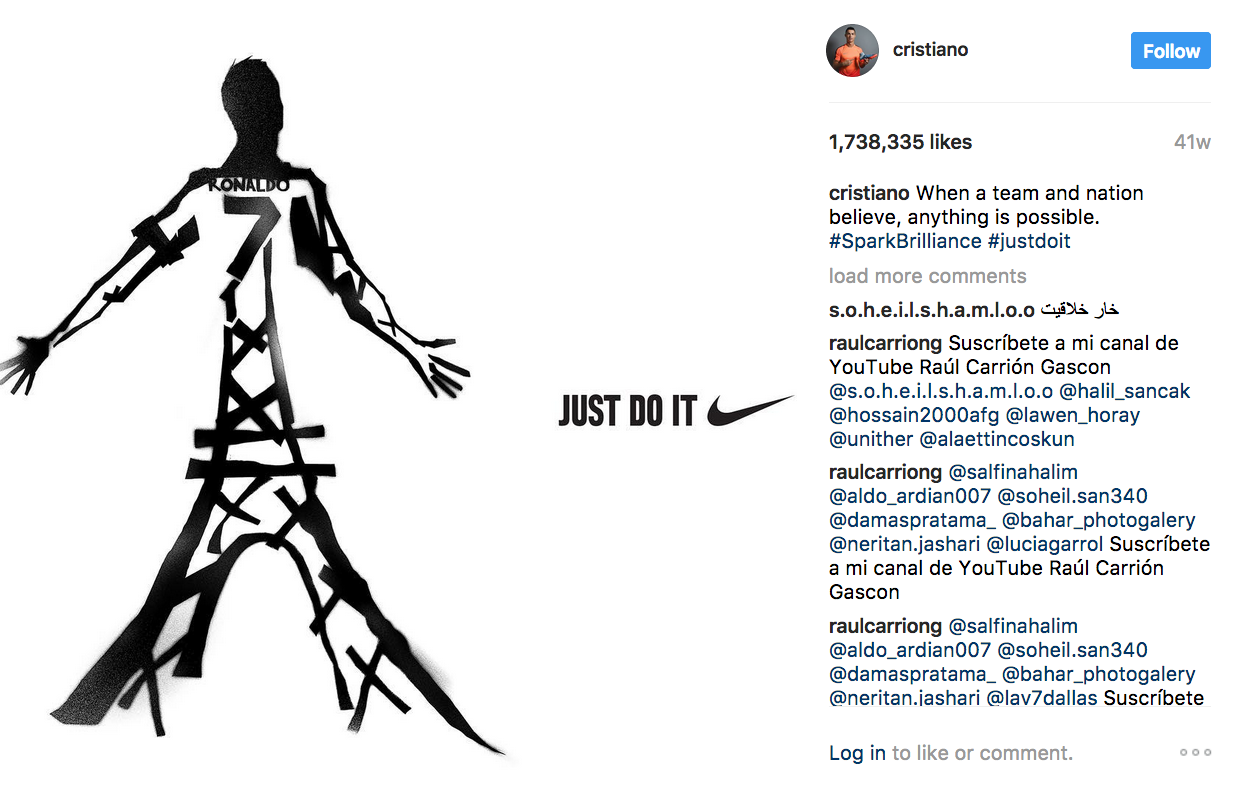
Hundreds of millions in the case of Real Madrid’s Cristiano Ronaldo, whose social media accounts generated an eye-bulging $500m in value for Nike last year according to sponsorship analytics company Hookit.
While Ronaldo isn’t a club, he is a media owner like the Real Madrid team he plays for and, just like his employers, the Portuguese forward knows that content and platforms he owns are in high demand. The world’s most prolific athlete on social media had one post last year that was worth $5.8m after it racked up 1.7m ‘likes’ and nearly 13,000 comments due its timing with Portugal’s Euro 2016 victory.
Ronaldo’s post was worth $5.8m after racking up 1.7m ‘likes’
Valuations like these are frequent as they are rooted in the old media equivalency rules of sponsorship. Hookit’s methodology uses average number of impressions per interaction to come up with a monetary value when really sponsors want a clearer way to compare social media posts with TV inventory. What the likes of Hookit do prove, however, is just how much teams could be missing in the media valuations they currently conduct – especially as brands demand sharper measurement from all parts of the marketing mix.
“Some clubs are not doing it [measuring social video] right and those who aren’t need to change the way they are approaching brands,” says Jean-Pierre Diernaz, vice-president of marketing at Nissan Europe. The car maker, which sponsors Manchester City and the Uefa Champions League among others, sees a potential in a fast spinning sports industry and yet is perturbed by what it deems is an unwillingness to fix what has become a largely inefficient market.
The social video sports revolution
Pound-busting TV deals pushed the 20 top-flight English teams to post record revenues of £3.6bn between 2015 and 2016 and yet they still struggled to make a profit. Collectively, Premier League clubs made a pre-tax loss of £110m, according to Deloitte, stressing the need for additional revenue streams at a time when many commercial bosses are yet to properly monetise their online fanbases.
“Every club has a certain number of fans but what is important is those who are actively engaging with the club,” continues Diernaz. ”The clubs need to be actively showing on the platforms that here is the value. If you look at the top 20 YouTubers in the world they are getting a lot of business with what they are doing so why would you not be operating the same as a football club. It’s clearly a strategy that would accelerate this for clubs.”
Several Premier League clubs are wise to the opportunity, resolving to give brands what they want in the hope of extracting more money from sponsorships. When City Football Group’s (CFG) commercial boss Tom Glick says he can see a time when social video could help his team renegotiate deals, he’s actually talking about a point when he and his team understand the market value of every post and the revenues they generate.
Numbers like that could come in handy if City were to try to convince Nike to top the £60m a season, 15-year deal with Chelsea when it comes to renegotiations. A club like Manchester City could potentially command tens of millions in media value on TV coverage alone. Add social into a mix and that could significantly inflate the media value of said sponsorship deal. Placements that were once thought useless on TV such as those at the club’s training ground could be worth more to a sponsor looking to reach the growing number of younger fans who aren’t only concerned with what their club does on match days.
Training ground placements could prove valuable to City, with fans concerned with the club beyond match day
“Often what’s holding social video back is it is generally wrapped into a larger sponsorship deal which can undervalue what that media represents because its not pulled out or compared with other formats – like display advertising – that might be getting sold… to me social video is more valuable than a display ad on a club’s website and yet in many cases these things are not necessarily being valued in the same way,” suggests Gareth Capon, the chief executive at social video production business Grabyo.
“If you’re a training ground sponsor then you don’t get much TV presence on game day, it’s more the main kit and headline sponsors,” he continues. “But now with social video you suddenly have all these assets where fans who want to know what’s happening with their club each day get to see your brand and those posts are shared all around the world. That’s a real change and the value for that media is not well understood… but once it starts to get compared with traditional TV advertising or and other forms of advertising, or at least it’s valued as a component of an overall sponsors package, then I think its value will rocket.”
Being able to quantify the value of social media
Southampton, like City, have made strides in recent years to move away from being so reliant on broadcast, focusing on depth of engagement rather than mass exposure. WPP-owned sports marketing agency Two Circles is helping it make the transition, which is very much a work in progress. “It’s about how best to value the video so we’re not only doing it in a traditional sense,” says James Kennedy, Southampton FC’s head of marketing. “We’re going down much more of an impression-based route as oppose to a sales route.”
This means partnerships aren’t typically signed off with an agreed number of tweets and database blasts to feign brand activation. Rather, Southampton are focused less on selling price and impressions and much more on delivering engagement and value.
“The ‘impression-based route’ is about understanding a brand’s target audience and helping them reach this group (in a targeted, cost efficient way) across the club’s entire digital network – web, email and social,” adds Kennedy. “So while achieving mass brand exposure and positive affinity is one objective, Saints can help brands develop campaigns to achieve specific objectives because they can segment their entire digital fanbase.”
Methods like this are heavily reliant on equivalent media value measurement. In the case of Southampton, the club argues that it doesn’t apply an “equivalent” media value in the traditional sense. However, because they – along with Two Circles – eschew inflated media values, they have a more consistent benchmark for a marketer to compare the impact of a campaign with buying the media space elsewhere.
Southampton FC’s marketers have become smarter as to how they use their owned media to generate commercial value
Simply put, what Southampton et al are using involves reach and frequency measures of signage to determine the value of sponsors exposure. These are calculated in differing ways and to varying degrees of sophistication but every measure – or impression – is ascribed an equivalent media value that a marketer can compare with paid for advertising. Hence, the underlying assumption for any brand tracking social video this way is it keeps their sponsorship rooted in the value of logo exposure as well as brand equity.
“The way content is valued is media equivalency so if Chevrolet wanted to buy ad space from TV for millions of people then how much would that cost versus being on the front of the Manchester United jersey… it’s exactly the same premise for how we [Nielsen Sports] value digital and social content,” says Max Barnett, global head of digital at Nielsen Sports. The measurement firm is readying a product it claims brings social media and traditional media valuation together for the first time, meaning for every minute of brand exposure data collected, an average of 5,000 data points are input to algorithms to calculate qualitative and valuation based outputs. While similar tools exist, Barnett hopes Nielsen’s own alternative becomes a unified measurement of sponsorship across all media channels.
“We’re seeing more clients’ commercial teams target 15% to 20% share of media value through digital and social” he continues. “If you have declining TV audiences then that’s a really important gap to fill. The audiences are more than likely not leaving, but consuming the content in a different way. Likewise, you could see brands selecting properties with a more significant social footprint to align to their wider marketing channel objective. Could we also see brands go after digital and social assets in the not too distant future? That depends on how rights holders want to package and promote.”
Is it time for football clubs to think like media owners
Some Premier League bosses hope to do this using social metrics such as earned impressions, shares and followers. The Drum understands a number of commercial bosses have at least considered the possibility of adopting a cost per engagement as a new standard in ROI measurement. While these talks are yet to materialise into anything beyond speculation, that they are even happening is vindication enough of social video’s potential value.
Putting a price on social video has been a thorny subject for some time and it was a challenge we have been seeking to shine more light on with our research report series,” says Michael Litman, founder and chief executive at Burst Insights. For example, the social analytics firm found that of the top 20 best performing videos across each social video platform from last season only Manchester United and Chelsea saw exposure value within the set reach over 31m. Arsenal ranked third, Liverpool FC fourth, Manchester City were in fifth place and Tottenham Hotspur rounded out the top six.
“This shows that for example Arsenal are overachieving on social video performance versus actual player performance on the pitch,” adds Litman. “Spurs fans on the flip-side I think will prefer to be nearer the top of the table in real life. I think we will see in time real world performance, correlating more closely with digital performance as the clubs become more akin to global media broadcasters in their own rights.”
Sports sponsorship has become a new game stuck with old rules. No longer is it enough for rights holders to give sponsors the most media for their money. Instead, sponsors want to know how the rights they’re buying add value to their brands, a shift that’s forcing the likes of Manchester City and Southampton FC to behave more like media owners.
The global success of the top six [Premier League] clubs generates a constant demand for sponsorship assets,” says Tom McDonnell, chief executive at digital fan interaction specialists Monterosa. “Brands are looking for end-to-end solutions that entertain and engage. It’s not enough to count a ‘view’, which could be fleeting, but to also consider interaction and active conversation. If a club provides better assets via social video with proven engagement and interaction, it differentiates the club’s offering and that hits the bottom line.”
Search Engine Optimization (SEO) is the most important feature that enables improved website visibility and recognition online. Without it, you might as well stand on the street and yell at people to check out your website. However, SEO is a strategy that needs to be implemented the right way in order for it to provide the best results.
There is no doubt that you will find tips and guides online that will “teach” you how to take an advantage of SEO fast and easy. However, you shouldn’t believe everything you find on the Internet. In fact, there are ways to take an advantage of SEO, but Google loves nothing more than to punish those who try to cheat their way to the top of the rankings. Here is some SEO advice you should most definitely ignore.
More Keywords Means Higher Rankings
No, it doesn’t. As the matter of fact, trying to flood content with keywords will do quite the opposite of ranking it high. It will get banned from search engine altogether. Google has this algorithm that has cute and fuzzy update names like Panda, Penguin or Pigeon but don’t let these names fool you, they are nasty critters when it comes to punishing bad SEO techniques. Stuffing keywords in content will not only be ignored by
Stuffing keywords in content will not only be ignored by readers but will also be marked as spam by Google’s spiders. They can punish a website with low rankings or remove everything from search engine depending on the level of violation.
Social Media Is Irrelevant
Who needs social media when you can have content and keywords, right? Wrong! Social media is a powerful asset when it comes to promoting a website or content and improving SEO rating. However, many people use it the wrong way by repeatedly posting backlinks to their blogs or posts. This approach is considered as spam and you will get removed from a social network if you keep it up. Nevertheless, social media marketing campaigns can vastly improve visibility and SEO rankings, however only if done properly and efficiently.
You Don’t Need Fast Internet for a Blog
Wrong again! Having a blog is an effective way to promote content, attract an audience and improve visibility and SEO. By posting organic, fresh and interesting content relevant to some product, service or website on your blog, will help improve rankings in the long run. However, slow internet means a slow loading page, and if people hate anything these days, its sluggish web pages.
Furthermore, the success of your blog highly depends on viewers – if they get bored they will leave, and if they leave you to get no traffic, it’s that simple. So ask yourself this: “Should I test people’s patience, or should I look for fastest internet providers near me and increase my bandwidth speed?” The choice is easy -you should invest a little bit extra and give your audience a fast blog to enjoy.
You Can Use the Same Keyword More Than Once
No, you can’t! Using the same keyword more than once, especially on the same website, will actually hurt rankings and not improve them. As mentioned, Google updates their algorithm regularly and using a keyword repeatedly will be punished by lowering the website rank on their search engine. However, not all hope is lost, as you can still post good content and use long tail keywords instead of repeating the same one over and over.
There Is No Need for Fresh Content
That is a terrible advice. Of course, there is a need for fresh content! Having consistency and posting new and fresh content regularly not only improves rankings, but it’s on Google’s preferred list of approaches as well. Furthermore, don’t try to fool Google by changing the dates on old posts to make them appear fresh because those fluffy pandas and penguins are going to slap you silly with punishments.
Always make sure you have something new to post about and if you really need to recycle old content then add something fresh to it and make a comparison. For instance, “Bad things about using SEO the wrong way in 2015” and make it “The difference between bad things about using SEO the wrong way in 2015 and 2017”. Give your old content new life, not a new post date.
Key Takeaway
As you are well aware by now, the Internet is full of bad advice. However, there is also good advice, so don’t hesitate to seek it out. If you are going to fully utilize the potential of SEO, then make sure you do it properly.
Author Nate Vickery
Nate Vickery is a business consultant and blogger. He is mostly interested in latest technology trends applicable to marketing and management. Nate is editor-in-chief at Bizzmarkblog.com.
Instagram continues its surge in generating advertiser interest while Facebook remains the dominant social platform. This is according to a first quarter survey of advertising agencies conducted by Strata.
The survey also found a continued multi-quarter decline in YouTube’s lead over Instagram, bringing the two within one point of each other in advertiser interest. 54% of agencies report plans to use YouTube against 53% for Instagram. Facebook remains entrenched in first place as 95% of agencies are interested in the platform. Twitter, which historically held third place in agency interest until the second quarter of 2016, continues its slide with interest from 37% of agencies, finding itself just 10% above fifth-placed LinkedIn.
The interest in these social platforms is reflected in agency spending, as well. 93% percent of agencies are currently spending money on Facebook, with 53% planning to spend on YouTube, and 49% planning on Instagram. The current spend lagging behind agency interest could indicate increased spend in the coming quarters.
More than half of agencies now plan to spend more than 5% of their overall advertising budgets on social media, with 22% allocating between 11-25% of their budgets on social, compared to 18% in 4Q16. The increase in budget for paid social coincides with the proliferation of live streaming tools, such as Facebook Live and Snapchat Live as 42% of agencies report that clients were interested in these innovations for their campaigns.
“Though Facebook has remained the dominant player in the social media space, the gradual shifts in focus to other platforms has been interesting to watch. There’s always been a premium on live, so it’s not surprising that agencies have an interest in exploring Facebook Live, Snapchat’s Spectacles, and Instagram’s Stories,” said Judd Rubin, senior vice president at Strata.
When agencies were asked which form of media they prioritised the most, 24% reported that digital video was their primary focus. Although that leaves digital video in second, behind local TV and cable at 36%, the interest in digital video has seen a 351% increase over the past year.
The rise in interest in digital video may be surprising in light of the fact that agencies appear split on the effectiveness of digital video. Twenty-five percent feel that it can be as effective as traditional TV, but 33% feel it isn’t, and 42% are unsure. When asked more broadly about perceived ROI from digital video, over 50% felt fairly confident that they were getting good value for their money. Forty-one percent noted they were unsure, and only 9% of agencies felt they were not getting a strong ROI.
“Today’s modern school is in a constant state of flux,” says Mark Christensen. A former teacher and administrator, and school board member, he now works in the Ed Tech field. “I have really come to appreciate how technology can be used to improve student engagement, promoting a school or college’s unique mission, and making it is easier to connect with alumni. We live in a modern world that revolves around technology and it must, therefore, be implemented properly.”
According to Mark, there are seven key reasons as to why it is hugely important that people properly manage their online footprint. “By understanding these seven reasons, and implementing them within the communication strategies of your educational establishment, you will be able to develop an excellent online presence.”
1. Take Charge of Perception
Technology is one of the best public relations tools at your disposal. If managed properly, then you control the message and how people perceive you and your school. You must be proactive in this; regularly sending out new positive messages.
2. Take Control of Your Brand
You must make sure that your tone is consistent in how it looks, feels, and sounds. Start by looking at your social media profiles, such as Facebook and Twitter, and make sure they look the same. This is your only opportunity to make that all-important first impression. It will take a visitor just a single second to see whether or not they want to follow you. There are some key things to consider in this, including ensuring that:
The way your profile looks is consistent with your brand’s vision and mission.
You have a clear and concise bio that makes it clear who you are.
You have a good ratio of followers to following, so that you can increase your overall credibility. By following others, you show that you care.
3. Build a Community Through Interaction
You can speak with businesses, alumni, students, and parents in real time. They will contact you using their smart devices, which means they expect real-time information as well. At the same time, other people can see the conversation and how it is responded to. This means that you can really be active in what people see. You can launch and promote campaigns and events, making sure that everybody knows what is going on. If you connect with people, they are more likely to invest in you as well.
4. Be Relevant and Timely
For instance, let’s say that a VIP is visiting your school campus, that a graduation ceremony is about to take place, that your college team won a big sports event, or that you have recruited a new important faculty member. You must report this straight away, because it will become old news more quickly than you can imagine. Your audience wants to know what is happening right now, not what has happened weeks ago. You must engage your community through relevant content, speaking to them as real human beings. Don’t be afraid to ask questions, or to post tweets with humour and honesty. Most importantly, make sure your content is valuable and awesome, bringing something of value to your audience.
5. Make Sure Important Information Is Shared
You have to make sure that if something is happening, people get to know about it in plenty of time. Try to get insight from your audience on upcoming activities, asking them to comment or post, or otherwise engage in what you are doing. By reading what they mention on your social media pages, you can gain a real insight into what they want.
6. Remember that You Are Being Watched
If you want to own something, you have to say it first. Hence, remember that there are people you want to reach who haven’t quite found you yet. Promote your school and its community, spirit, and mission whenever you can. Make sure that your content is valuable and unique, as well as being fresh at all times. People who may accidentally come across you, or who are researching you without you knowing it, will appreciate this.
7. Make Sure Your Content Is Properly Managed and Organised
You need to make sure that it is easy for your readers to navigate through your news stories, pictures, and other posts. Have a good content library present where people can find what they want through an easy search function. This is the only element that you should reuse, but make sure it is repurposed as well.