Tag

YouTube

Browsing

The battle between TV and Online rages on.

By MediaStreet staff.

New research reveals that 39% of U.S. broadband households visit a video sharing site like YouTube at least once a week. In total, 59% of broadband households visit an online video site on a regular basis.

“User-generated video from sites like YouTube skew to young consumers,” said Glenn Hower, Senior Analyst at Parks Associates. “Consumers 18-24 go to a video sharing site 13 days per month on average. They also use a video chat app like Snapchat an average of nearly 11 days in one month. The TV is still the most-used device for watching video content, but increased usage of secondary devices and video apps is making a significant impact on how users, especially younger viewers, consume and perceive content.”

360 View: Digital Media & Connected Consumers shows live streaming on platforms like Periscope and Facebook Live is still in its early days. Currently 26% of households participate in live streaming activities, such as streaming video from their own device or watching video over a live streaming platform.

“Emerging content platforms are changing the way content creators tell visual stories,” Hower said. “Services like YouTube have given rise to video bloggers and sketch performers, who can interact with their audiences in a way that traditional media like film and television cannot allow. In addition, live streaming on platforms like Twitter’s Periscope or Facebook Live is raw and impromptu, which can come across as more ‘authentic’ compared to a recorded video that has been edited and perfected.”

360 View: Digital Media & Connected Consumers analyses trends in music and video consumption by platform, source, and content expenditure. It segments consumers based on their consumption habits.


By MediaStreet Staff Writers

Instagram continues its surge in generating advertiser interest while Facebook remains the dominant social platform. This is according to a first quarter survey of advertising agencies conducted by Strata.

The survey also found a continued multi-quarter decline in YouTube’s lead over Instagram, bringing the two within one point of each other in advertiser interest. 54% of agencies report plans to use YouTube against 53% for Instagram. Facebook remains entrenched in first place as 95% of agencies are interested in the platform. Twitter, which historically held third place in agency interest until the second quarter of 2016, continues its slide with interest from 37% of agencies, finding itself just 10% above fifth-placed LinkedIn.

The interest in these social platforms is reflected in agency spending, as well. 93% percent of agencies are currently spending money on Facebook, with 53% planning to spend on YouTube, and 49% planning on Instagram. The current spend lagging behind agency interest could indicate increased spend in the coming quarters.

More than half of agencies now plan to spend more than 5% of their overall advertising budgets on social media, with 22% allocating between 11-25% of their budgets on social, compared to 18% in 4Q16. The increase in budget for paid social coincides with the proliferation of live streaming tools, such as Facebook Live and Snapchat Live as 42% of agencies report that clients were interested in these innovations for their campaigns.

“Though Facebook has remained the dominant player in the social media space, the gradual shifts in focus to other platforms has been interesting to watch. There’s always been a premium on live, so it’s not surprising that agencies have an interest in exploring Facebook Live, Snapchat’s Spectacles, and Instagram’s Stories,” said Judd Rubin, senior vice president at Strata.

When agencies were asked which form of media they prioritised the most, 24% reported that digital video was their primary focus. Although that leaves digital video in second, behind local TV and cable at 36%, the interest in digital video has seen a 351% increase over the past year.

The rise in interest in digital video may be surprising in light of the fact that agencies appear split on the effectiveness of digital video. Twenty-five percent feel that it can be as effective as traditional TV, but 33% feel it isn’t, and 42% are unsure. When asked more broadly about perceived ROI from digital video, over 50% felt fairly confident that they were getting good value for their money. Forty-one percent noted they were unsure, and only 9% of agencies felt they were not getting a strong ROI.


By Robert Elder.

Facebook and YouTube are unquestionably two of the world’s most popular digital platforms. And with such large audiences up for grabs, it’s no wonder that advertisers are pouring funds into both businesses: Facebook generated close to $27 billion in advertising revenue in 2016, and though Google doesn’t break out YouTube sales, it credits the video platform as a crucial driver of its advertising revenue, which topped $79 billion last year.

Unfortunately for brands, Facebook and YouTube serve up the most annoying ads, according to BI Intelligence’s 2017 Digital Trust survey. In a virtual tie, ads on Facebook and YouTube were deemed the most irksome by 45% and 43% of the survey’s 1,740 respondents, respectively. Twitter garnered just 6% of the vote, followed by Instagram and Snapchat at 3%, and LinkedIn at 1%.

bii most annoying ads facebook and youtubeBI Intelligence

It’s not surprising that these two platforms are reputed to have the most annoying ads. Of the platforms included in the survey, Facebook and YouTube are the top two destinations of digital time spent in the US, according to comScore. People may be more sensitive to ads on Facebook and YouTube simply because they spend more time, and therefore see more ads, on these sites. And because Facebook and YouTube are relatively mature social platforms, they likely serve ads with greater and more noticeable frequency.

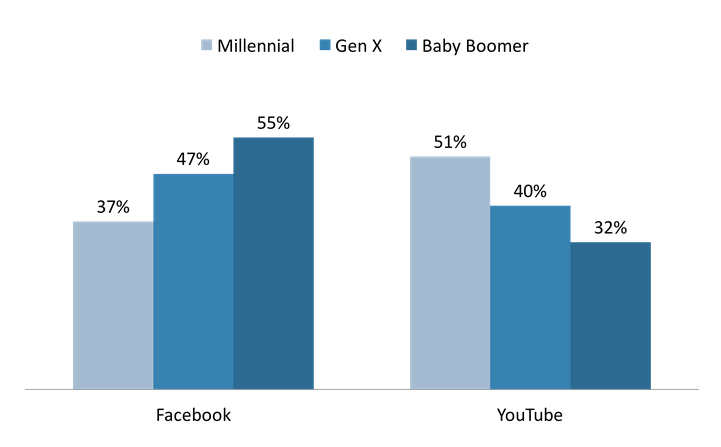
Millennials and baby boomers are divided on which platform serves the worst ads. Their preferences are inversely related by age group: Older survey respondents like YouTube ads more than Facebook ads, and vice versa for younger respondents. The familiarity that older people have with traditional TV may explain their tolerance for YouTube ads, which consist of pre- and mid-roll ads that resemble ad interruptions in linear programming.

bii most annoying ads ad preferences are inversely related by ageBI Intelligence

These results point to a pressing need to improve advertising on both Facebook and YouTube. For its part, Facebook has said it’s curbing growth in its ad load — or the ratio of ads to organic posts. YouTube was similarly mindful when it scrapped its unskippable 30-second ad format in February. However, the onus to improve the ad experience shouldn’t be entirely on platforms. Brand advertisers also need to create quality ads that provide pleasurable viewing experiences. The reality is, the campaigns they’re running on the most popular platforms — in which they’re investing the most money, to reach the widest audiences — aren’t resonating.

BI Intelligence’s Digital Trust survey examines consumers’ perception of major social platforms. It rates Facebook, YouTube, Instagram, Twitter, Snapchat, and LinkedIn on security, community, user experience, and content authenticity and shareability to help brands and marketers make informed decisions about what platforms to spend their marketing and branding dollars on. The full report will be available through BI Intelligence in May.

By Robert Elder

Sourced from Business Insider UK