Meta’s adding some more ad tools to WhatsApp, in order to help businesses capitalize on the rising use of messaging, and WhatsApp in particular, in more markets.
First off, Meta’s adding a new option that will enable businesses on WhatsApp to launch paid promotions on Facebook and Instagram, without needing a Facebook account.
As you can see in this example sequence, this new promotion type will include a WhatsApp CTA, which will drive potential customers back to your messaging channel.
That could be a good way to boost brand exposure, and open up a more direct line of communication via the messaging platform, which is also more likely to give you access to push notifications for any future messages.
Businesses need to respect the use of messaging in this regard, and avoid spamming potential customers (note: Meta has a limit on how many messages brands can send for this reason). But it could be a good way to establish direct contact, and keep customers updated on relevant product updates.
Along this line, Meta’s also adding some new promoted message options to connect with people who’ve previously registered interest in your business.
“Starting soon we’ll begin testing a new feature within the WhatsApp Business app where small businesses will have the option to send personalized messages to their customers – like appointment reminders, birthday greetings or even updates on a holiday sale – in a faster and more efficient way. Rather than having to manually send the same message to multiple customers, this new feature will give businesses the ability to send personal messages with the customer’s name and customizable call-to-action buttons to specific customer lists such as those with a select label (like “VIP customers” or “new customers”), schedule the day and time the messages are sent and then see what’s working. We’ll offer this advanced, optional type of message for a fee in the WhatsApp Business app. We’ll have more details to share in the future.”
That’ll add another way to re-engage shoppers, and the more relevant you can make these updates, based on their past interaction history, the better.
WhatsApp’s focus on privacy has seen it become a more significant connective tool for many more users, while the broader shift towards messaging, as opposed to feed posting, has also helped to boost reliance on the app. And while WhatsApp has always been big in regions like Brazil and India, it’s now also seeing significant growth in North America, which Meta says is now the platform’s fastest-growing region.
Direct connection can be a powerful tool for engaging potential customers, and as users look to shift more of their interactions to more private spaces, it’s worth considering where WhatsApp may fit into your outreach planning.
Logic may guide decisions in marketing, but emotions win the heart. They are vital in today’s marketing if you want to stand out, be memorable and build lasting relationships, but it isn’t the easiest to do — so here are some tips to get started.
Appealing to your customer’s emotions with your marketing messages leaves a lasting impression, as long as you do it effectively and ethically. These are approaches I’ve learned to master over the course of my 20-plus years in business, so let’s dive into it.
Storytelling: Using empathy and other emotions
Emotions are the universal language that connects us all. Weave narratives that captivate your audience, drawing them into a world where they can relate and empathize. Identify the primary emotions you want to evoke, whether that be nostalgia, empathy or excitement. Make sure you choose an emotion that goes with your brand. For example, it may not be appropriate for a funeral home to use humour in its marketing. Always use your discretion; you know your brand and your audience best.
If you’re part of a charity and the goal is to alleviate poverty, using empathy would be a great way to connect with the donors. You could recommend to the charity to reach out to past individuals who received help and see if they’d be open to sharing their stories in order to help more people. This type of emotional storytelling could inspire more donations and support.
Authenticity: The beacon of emotional connection
In a world rife with gimmicks, authenticity shines like a beacon, guiding you toward genuine emotional connection. Be true to your brand’s values and let your message reflect its essence. Authenticity creates trust, and trust allows emotions to flow freely. Avoid the pitfalls of insincerity and let your audience feel the authenticity in every word you craft. To be authentic, be consistent, reliable and make sure you actually care about your audience. Also, make sure you’re being as transparent as you can.
If you own a sustainable clothing company, just stating you’re sustainable isn’t enough. You need to be transparent about what you’re doing consistently to be better for the environment and the people. You can show your supply chain process, share images and videos of the workers and their working conditions and show real statistics on how your brand is different than your competitors.
The art of surprise and delight
Although routine and predictability often prevail, it is essential for your marketing message to stand out and create a memorable experience for your audience. Injecting surprises and moments of delight into your message can ignite joy and leave a lasting impression.
Imagine you are a bakery launching a new line of cupcakes. Instead of simply showcasing the cupcakes’ flavours and ingredients, you decide to take a creative approach to surprise and delight your audience. You craft a marketing campaign where customers are encouraged to order a box of cupcakes, but each box contains a hidden cupcake with a unique flavour not mentioned anywhere in your marketing materials.
Customers eagerly receive their cupcake boxes, filled with anticipation as they bite into the delicious treats. They’ll enjoy the basic flavours like vanilla and chocolate, but imagine how they’ll react when they see a hidden cupcake with an interesting flavor. Maybe it’ll be lavender cream or coconut pie flavoured. The element of surprise adds an extra layer of excitement and delight, creating a memorable experience that sparks conversations and drives customer loyalty.
Using all five senses
When you use aspects like specific colours, design elements and music that align with your brand and your audience, you’re more likely to stir their emotions. The trick to great emotional marketing is using as many senses as you can in your messaging and campaigns.
Let’s say there’s a new yoga studio in town and they decide to invite the community to check out the space and see what they’re all about. The studio can use all five senses on opening day:
They can start by creating a comfortable and tranquil space that is visually appealing through design elements and decor (sight and touch);
Burn incense or vanilla-scented candles (smell);
Play calming instrumental tracks with soft piano melodies and gentle nature sounds in the background to add to a mind and body experience (sound)
Host a yoga session (touch). Maybe the yoga mats are new and extra soft or maybe there are comfortable pillows around in the seating area.
Offer healthy snacks like fresh fruits from the local farmers market (taste) or organic, hydrating drinks post-yoga session.
By creating a multi-sensory experience, you’ll make it more likely that your brand will stay top of mind.
Creating a compelling and unique emotional marketing campaign isn’t necessarily easy, but when you use storytelling, embrace authenticity, surprise and delight your audience and use strong sensory experiences, you will create an experience your audience won’t easily forget.
Jason Miller is a seasoned CEO with an overwhelming passion to help other business owners and CEOs succeed. He was nicknamed Jason “The Bull” Miller because he takes no BS and no excuses from the people he serves. He has mentored thousands of people over more than two decades.
Meta is looking to capitalize on the 200 million users now catered to by WhatsApp Business, which previously stood at 50 million in 2020.
With ‘click-to-WhatsApp’ ads now accounting for a healthy part of the platform’s revenue, the Meta-owned messaging platform is now looking to expand that to allow users to generate ads without needing a Facebook account.
As part of the revisions to WhatsApp Business, companies will also be able to create ads for Facebook and Instagram from within the app.
WhatsApp Business is getting better
The news comes as Meta continues to battle a tough and changing economy during its so-called ‘Year of Efficiency’ which has seen it lay off thousands of workers and cut funding to several projects.
While the company has stated that it remains committed to artificial intelligence and the metaverse, ensuring a diverse selection of revenue streams is vital for sustainability, and given the four-fold increase in WhatsApp Business users, trying to eke out more money from SMBs and larger enterprises is a no-brainer.
The company has not confirmed how much the changes to its messaging app will cost, but we do know that the services will be chargeable thanks to a Reuters report.
Personalized messaging is also set to come to the platform, with the messaging app soon to be able to generate messages to customers to notify them of upcoming appointments, or for ecommerce businesses to advertise new products and sales, for example.
These changes represent an entire shift for the company as CEO Mark Zuckerberg looks to make more money from Meta’s messaging platforms, including WhatsApp and Messenger.
The company has not announced details on pricing as yet, but testing for the new features is expected to follow imminently before a full release, likely later this year.
With several years’ experience freelancing in tech and automotive circles, Craig’s specific interests lie in technology that is designed to better our lives, including AI and ML, productivity aids, and smart fitness. He is also passionate about cars and the decarbonisation of personal transportation. As an avid bargain-hunter, you can be sure that any deal Craig finds is top value!
What you give and what you get when a company has your phone number.
I have a new text bestie, and it’s the brands.
Scrolling through my phone recently, I was surprised to see just how many of my incoming messages were not from friends or family but instead from companies. The package update from UPS made sense, as did the alert on the restaurant reservation I’d made over the weekend. But why did I have an offer from a swimming-pool-sharing service I’ve never used and an alert about a sale on items from Tory Burch, a brand I’ve never purchased? And what about the Pride party invite from a beauty loyalty program named Allē?
The situation made me feel a little sad and uncool — I’d rather a friend ask me to a party than an app made by the pharma giant that makes Botox. It’s also just a reality of being a consumer today, albeit a reality that snuck up on us. Reaching consumers via SMS, meaning text messages, has become increasingly popular among marketers. If you feel like the brands are texting you a lot more than they used to, it’s because they are.
“Getting someone’s phone number is incredibly valuable for marketers,” said Erin Blake, vice president director of connections strategy at Digitas, a digital marketing agency. “There’s a reason why a lot of brands care about SMS as a channel for marketing and why you’re seeing so much of it right now.”
It’s not that hard to see why. I voluntarily gave my phone number to all the companies currently texting me except for one (I think), and I’ve considered engaging with those messages much more than I would any other advertisement. If I’m being honest here, if I’d taken a closer look at the party invite, maybe I would have gone.
You open your texts a lot more than you do your emails
There are multiple reasons marketers are turning to text to reach consumers, the main one being that it works.
Text message open rates are astronomically high, having a 97 percent read rate within 15 minutes of being delivered, according to Insider Intelligence. That’s well above open rates for emails, which estimates place at around 20 percent. Consumers click through on SMS at higher rates than they do emails, too.
“Texts are acted on in near real-time, we’re talking minutes, as opposed to email, which is going to have a low response rate in a couple of days,” Blake said.
Text has served as a fresh channel as other, more traditional formats have become difficult to navigate, explained Sara Varni, chief marketing officer at Attentive, an SMS marketing platform. “There’s been a lot of changes around privacy and regulation when it comes to how people can retarget customers, and so channels that used to be tried and true, whether that was a retargeting program with Google or an email, some of those channels have declined over time,” she said.
Many people’s inboxes are inundated with messages from dozens upon dozens of companies they’ve interacted with a handful of times, if at all. Even if you wanted to jump on that sale from American Airlines, you have to sift through 30 other offers you have no interest in. People’s text messages, at least for the time being, are less cluttered — in part because it’s more expensive for brands to text people than it is to email them.
“In general, most users’ text message feed is a lot less spammy than their email feed. It’s harder to get permission, but once you get permission, it works better,” said Jason Goldberg, chief commerce strategy officer at advertising firm Publicis.
Unlike email, text doesn’t have a separate folder for junk or for spam, or, in the case of a service like Gmail, a different section for promotions you never even have to look at if you don’t want to. “There’s none of that filtering on your SMS messenger client,” Goldberg said.
All of our text messages are mashed together, putting brand texts together with messages from your mom. It’s a solid deal for marketers, though maybe not so much for you.
“Your text message inbox is incredibly personal, that’s where a lot of people are having most of their interpersonal communications on a day-to-day basis,” Blake said. “I would caution brands to really think through how they can be good stewards of that trust and build that relationship, because if you break it, that’s a lot harder to get back.”
The good, the spam, and the ugly
What people in the industry say about marketing via text message is that it’s one of a number of avenues brands can use to reach consumers and that the good actors involved are very smart about how often to message and with what. They say that SMS marketing is more conversational, not just a constant attempt at a hard sell, and note that consumers can often respond to messages to really interact. It’s actually somewhat true.
There are plenty of examples where you can see text messaging from brands working. There are moments when SMS is really clutch, like when a flight moves gates, or a shipment is delayed. Chatbots on websites and in text messages are notoriously bad for solving anything beyond basic problems, but in a world where artificial intelligence and ChatGPT do really make them better, you could see that adding some value to SMS, too. “Maybe now because of Chat GPT, the robots will make people more happy than humans, so SMS could grow along with all of the other text-based services,” Goldberg said. (To be sure, the hype machine around AI right now basically has it either fixing everything under the sun or ruining the world, hard to say.)
Varni said that text message marketing can be a solid medium for giving consumers a curated experience, for sending loyal customers special deals, for educating people, or for alerting them when an item becomes available they wanted. Her company works with its clients to try to make sure it doesn’t go overboard. “We don’t want to turn SMS into the next version of email, which becomes a graveyard of brands and promotions in your inbox,” she said.
In many cases when it comes to legitimate companies and brands, people are signing up to receive text messages, often in exchange for a discount or free shipping or some sort of gift. A survey from Attentive found that 91 percent of consumers globally have signed up for an SMS program or are interested in doing so.
Still, it doesn’t take much for people to start to feel annoyed and overwhelmed by all the texts. A report from data company Validity found that 96 percent of survey respondents have felt annoyed at least occasionally by marketing text messages, 84 percent have gotten a text message from a company they didn’t remember signing up for, and 70 percent have worried brand texts pose a data security risk.
According to data shared with Vox by Robokiller, a spam text and call blocker, 70 percent of the spam messages identified on its platform were related to brand marketing messages in May and June of 2023. Even if the texts aren’t technically spam, that’s how many consumers see them, said Patrick Falzon, the general manager at Teltech, the app maker behind Robokiller. “Those are messages that are coming from what you’d think of as legitimate companies offering some degree of promotional discount, sales offer, trying to pull people back into some web funnel or experience,” he said, meaning guiding people from an entry point toward some goal or action, like a sale. He acknowledged that the high open rates can be enticing for marketers, but they can also create tension for brands over time. “You’re likely going to see increasing consumer fatigue,” he said, “and with that, consumer pushback.”
The good news for consumers is that if they want to stop getting marketing texts from brands, in many cases, they can just respond “stop” to the messages, and that’s that. Phone providers tend to take the issue quite seriously, too, in part at the government’s urging, blocking robotexts and making sure that once people say they want to opt out, they can. Still, the system is imperfect. Not every marketer is going to heed a consumer’s “stop” wishes or refrain from passing your phone number onto someone else. “There are more gaps in the regulatory frameworks on the text side of things vs. calls,” Falzon said.
Between the brands and the politicians, maybe just throw your phone into the sea (I kid, kind of)
Much of our personal data is already all over the internet and in the hands of actors good and bad. That landscape makes it a little difficult, from a distance, to decipher just how to think about text message marketing. On the one hand, it’s not ideal that companies that are pretty bad at protecting their data get their hands on yet another piece of information. On the other hand, a text from a company with a sale isn’t the worst thing in the world. Like, oh, yet another brand has my phone number? At least I got a 20 percent discount for handing it over.
“It’s just way more common to see, in funnels, brands asking for your phone number,” Falzon said. “We, as consumers, have become kind of numb to giving out our information online.”
The tipping point here really hinges on whether people become so inundated with messages that their phones wind up looking like their email inboxes — a space where there’s so much of everything that it’s next to impossible to find anything. And again, we don’t really have much ability right now to filter our text messages like we do our emails right now.
The brands, hopefully, aren’t going to blow up our phones to the level of email in the near future, but we should prepare for some text-heavy months ahead. Marketers generally jump on the holiday season to send an extra number of texts, meaning you should expect more messages in October, November, and December. Then there’s election season and the raft of political texts that come along with it. And then there’s the next holiday season after that.
“Political campaigns are really leaning into SMS as well, so it’s not restricted to commercial brands,” Falzon said. “Politicians are using it a lot. I think, unfortunately, it’s going to be a pretty rough next 12 to 18 to 24 months for consumers.”
So look forward to texts from Starbucks and Old Navy and Donald Trump and Bernie Sanders from here until eternity.
We live in a world that’s constantly trying to sucker us and trick us, where we’re always surrounded by scams big and small. It can feel impossible to navigate. Every two weeks, join Emily Stewart to look at all the little ways our economic systems control and manipulate the average person. Welcome to The Big Squeeze.
Correction: A previous version of this story misstated the percentage of Validity survey respondents who felt annoyed by marketing text messages. The correct number is 96 percent.
Emily Stewart covers business and economics for Vox and writes the newsletter The Big Squeeze, examining the ways ordinary people are being squeezed under capitalism. Before joining Vox, she worked for TheStreet.
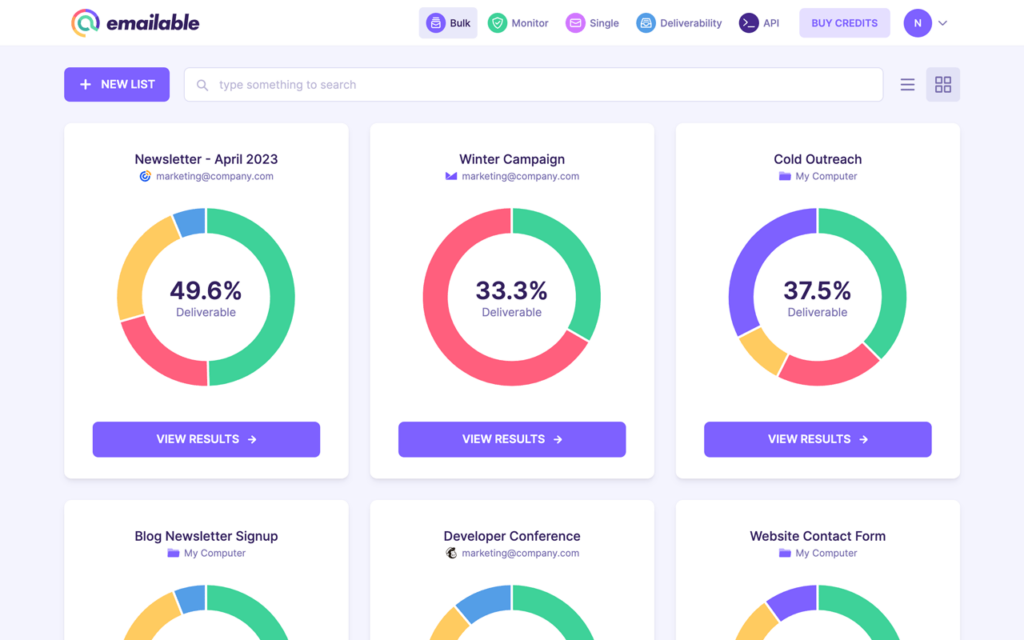
Email deliverability can make or break a campaign. As marketers, we’ve all felt the sting of meticulously crafted emails landing in the spam folder or worse, bouncing back entirely.
Emailable is an email list cleaner that eliminates irrelevant, spammy, and invalid emails from your database.
It offers:
Bulk email checking
Email list cleaning automation
Real-time email verification
A comprehensive deliverability tool suite
But here’s where Emailable really shines: its speed. In a world where every minute counts, Emailable gets it.
It’s fast, efficient, and doesn’t keep you waiting.
Many users report switching over because their old tools took hours or days to complete email verification. In my experience, scrubbing my data only takes a few seconds. For a large list, it will be slightly longer.
The simplicity of Emailable’s email cleaning process is noteworthy. It provides clear descriptions of each type of result, making it easy to act on.
Emailable is no slouch when it comes to security, either. Emailable safeguards data with GDPR compliance and 256-bit TLS encryption.
Also, the platform integrates with the email service provider, customer relationship manager, and marketing platforms you already use.
The pricing is competitive, and most importantly, it works even better than advertised.
You can be confident that your email marketing efforts are built on a solid foundation of reliable, verified email addresses.
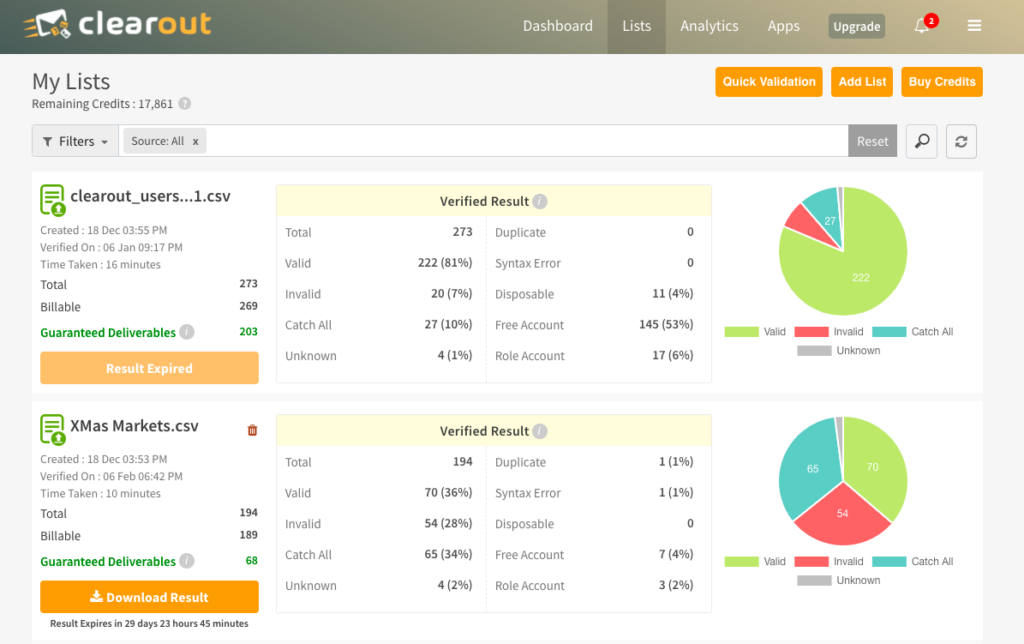
Clearout offers a suite of tools designed to streamline and enhance email marketing efforts.
From verifying emails at the point of capture to maintaining data hygiene, Clearout excels.
What sets Clearout apart as an email scrubber is its accuracy. It not only removes invalid emails but also ensures that the emails that do make it through are high quality.
We can avoid spam traps, which keeps my open rates high (and overall ROI positive).
Clearout’s speed is another standout feature. Whether I’m verifying a handful of emails or a list of thousands, Clearout easily handles it.
This efficiency is crucial – no more waiting days for results.
Data security is a top priority, and Clearout doesn’t disappoint. Data is well-protected with 256-bit SSL encryption and adherence to GDPR, SOC 2 Type 2, and ISO norms.
The flexibility of Clearout’s integration capabilities is also a big plus. The rest API is adaptable and can integrate with any programming language.
Looking at other user reviews, it’s clear that my positive experience with Clearout is not unique. Users have praised its accuracy, affordability, and user-friendly interface.
This kind of feedback reinforces my confidence in the platform.
Pros vs Cons
Pros
Ensures email list accuracy.
Helps maintain sender reputation
Prevents accidental data loss
Great for large email lists
User-friendly interface
Cons
Setup can be challenging for certain systems.
Pricing
Credits
Pay As You Go ($/Email)
Monthly Cost (Price per Email)
3,000 credits
$21 ($0.007)
$16.80 ($0.0056)
10,000 credits
$58 ($0.0058)
$46.40 ($0.00464)
100,000 credits
$350 ($0.0035)
$280 ($0.0028)
250,000 credits
$625 ($0.0025)
$500 ($0.002)
500,000 credits
$850 ($0.0017)
$680 ($0.00136)
1 million credits
$1,100 ($0.0011)
$880 ($0.00088)
Hunter (Popular Email Scrubber)
Hunter.io, at its core, is a tool designed to streamline the process of cold outreach by finding and verifying professional email addresses. (By the way, here’s our full Hunter.io review)
Compared to tools like Emailable and ZeroBounce, which focus more on bulk email verification, Hunter.io focuses more on outbound lead generation.
Yes – bulk email verification is a part of that, so there is also some overlap.
Hunter.io’s features include:
Domain Search
Email Finder
Email Verifier
Email Campaigns
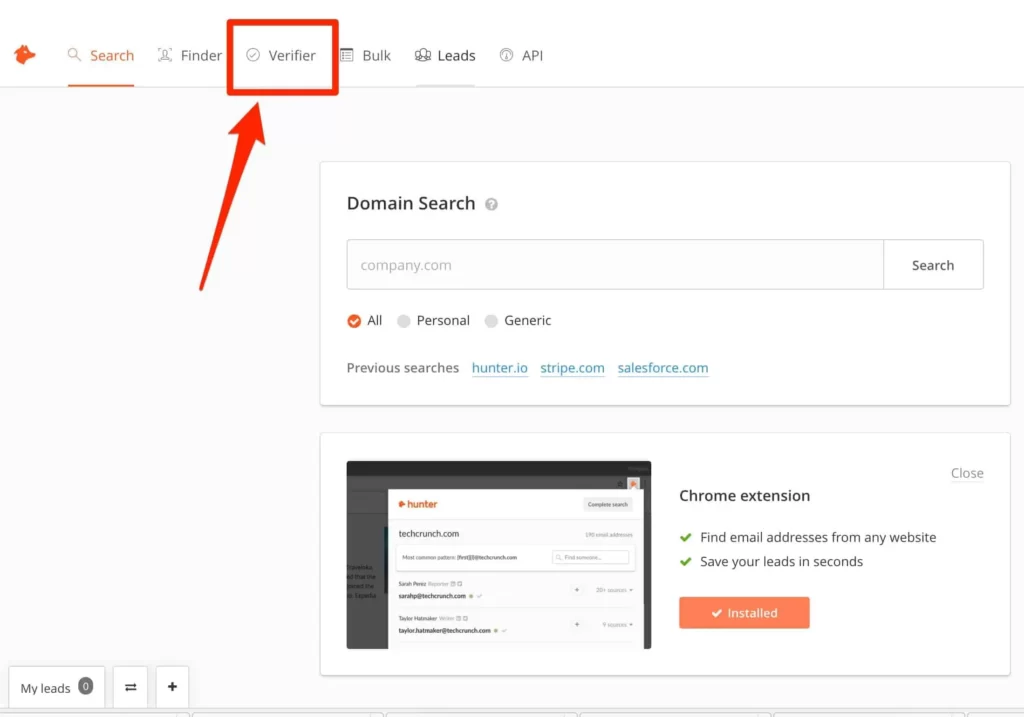
The process begins with the Domain Search feature. Instead of spending hours trawling through LinkedIn or company websites, I enter the domain name into Hunter.io.
In an instant, I have a list of professional email addresses from that domain.
Once I have these potential leads, the next step is to ensure the emails are valid. At this point, I’ll use the verifier, which ensures 95% accuracy.
However, where Hunter.io truly stands out is its Email Campaigns feature.
Unlike other tools that stop at email verification, Hunter.io takes it a step further by allowing me to compose, schedule, and track email campaigns directly from the platform.
In terms of use cases, Hunter.io excels in roles where outbound lead generation is key.
For example:
Salespeople targeting decision-makers
Bloggers performing backlink outreach
If you want to further explore solutions for this outbound use-case, you can check out our best Hunter.io alternatives.
Pros vs Cons
Pros
Reliable data for outreach.
Confirms the validity of emails.
Improves email deliverability.
Lead qualification
Transparency on data origin
Follow up automation
Cons
Some verified emails may be non-existent
Pricing
Plan
Monthly Cost
Monthly Searches
Monthly Verifications
Free
$0/month
25
50
Starter
$49/month
500
1,000
Growth
$149/month
5,000
10,000
Business
$499/month
50,000
100,000
Note: Annual pricing plans offer a 30% discount.
ZeroBounce
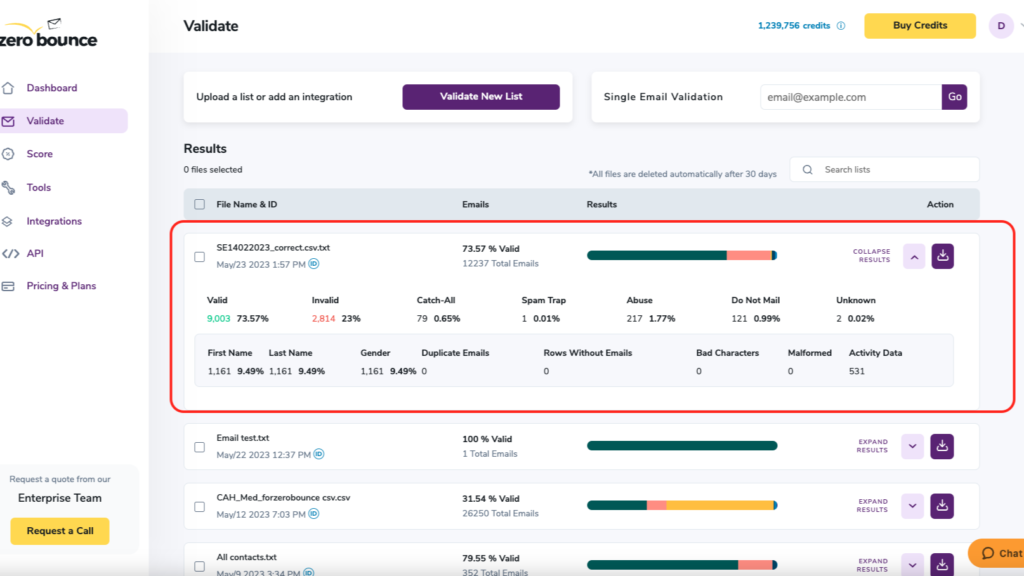
ZeroBounce is a comprehensive email validation service that offers:
Email list validation
Email list cleaning service
Additional data appending
Improved deliverability
The accuracy is impressive, with a 99% accuracy claim that holds up in practice.
This was evident in the case of MediaShares, where their bounce rate dropped from 12% almost to 0% after using ZeroBounce.
It’s GDPR, SOC 2 Type 2, and PCI compliant and uses military-grade data encryption to protect data.
ZeroBounce integrates with existing email marketing platforms and CRMs, enabling smooth data transfer. The real-time verification feature is also a bonus, validating emails as they are collected.
The Activity Data service is a unique feature that provides insights into subscriber engagement, allowing for improved email list performance.
The AI-driven email scoring system is another plus, predicting subscriber interaction with your emails.
ZeroBounce’s reputation is strong, with numerous positive customer reviews and testimonials. They also have a free trial for Niche Pursuits readers, allowing you to test the tool’s capabilities before purchasing.
They offer both pay-as-you-go and monthly options. For smaller lists or infrequent use, I recommend the pay-as-you-go plan. The monthly pricing may offer better value for regular use.
Emails
Pay-as-you-go ($/email)
Monthly ($/email)
Up to 2,000
Free
$0.0075
From 2,000
$0.008
$0.0075
From 5,000
$0.0078
$0.007
From 10,000
$0.0065
$0.0064
From 25,000
n/a
n/a
From 50,000
n/a
n/a
From 100,000
$0.0039
$0.0035
From 250,000
$0.003
$0.00255
From 1,000,000
$0.00225
$0.00191
Bouceless
Whether you’re verifying a list of email addresses or searching for new ones, Bounceless delivers results quickly without compromising on accuracy.
It offers:
Email verification
Email finder
Deliverability
Blacklist monitoring
Under the hood, Bounceless employs advanced techniques to ensure top-notch email management.
It intelligently cleans spam trap records, removing any potential risks. Duplicate email addresses are swiftly eliminated. Risk validation scans for and eliminates high-risk keywords and domains in email addresses.
To improve deliverability, Bounceless validates the Mail-Transfer-Agent (MTA) and ensures the syntax of email addresses is valid.
It also removes emails with invalid, inactive, or parked domains and identifies catch-all domains.
Not only is Bounceless powerful, but it’s also incredibly easy to use. Most users report completing their first email clean-up within just 20 minutes.
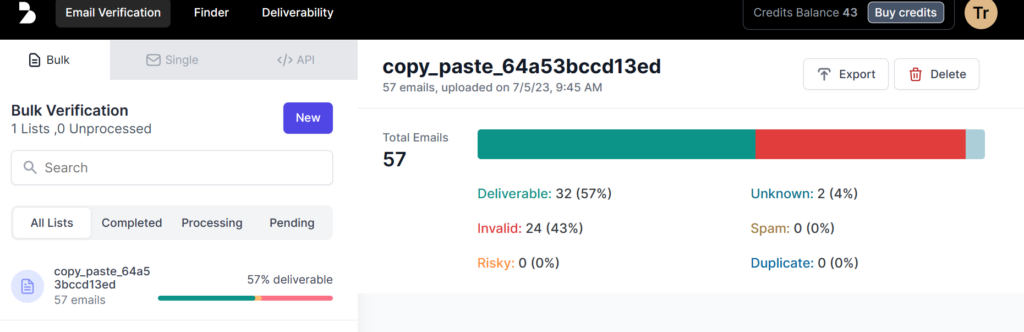
In the 57 email test that I ran, it performed slightly slower than Emailable.
And when it comes to bounce rates, Bounceless delivers impressive results. Users have experienced a remarkable 234% improvement.
The pay-as-you-go pricing model offers flexibility that’s hard to find.
Compared to tools like Hunter, Bounceless does offer more options. It’s also nice that you have flexibility to choose a package without being tied to a monthly subscription.
In addition to its technical prowess, Bounceless offers detailed reporting so you can always keep track of your email list’s health.
Pros vs Cons
Pros
User-friendly with affordable pricing
Provides insightful analytics
Highly accurate in validating emails
Rapid validation results
Cons
Customer support response can be delayed.
Pricing
Credits
Pay as you go
Monthly ($/email)
5,000
$29 ($0.0058)
$15 ($0.003)
10,000
$49 ($0.0049)
$24 ($0.0024)
25,000
$99 ($0.00396)
$49 ($0.00196)
50,000
$169 ($0.00338)
$89 ($0.00178)
100,000
$299 ($0.00299)
$169 ($0.00169)
300,000
$599 ($0.0019)
$349 ($0.00116)
500,000
$799 ($0.00159)
$449 ($0.0008)
1M
$999 ($0.0099)
$599 ($0.00059)
2.5M
$1649 ($0.00065)
$1199 ($0.0004796)
5M
$2299 ($0.00045)
$1799 ($0.0003598)
The monthly package includes an email finder, inbox placement, and blacklist monitoring.
Bouncer
Bouncer is an email list scrubber laser-focused on email verification and deliverability.
It’s a no-nonsense solution that gets the job done, and it does it well.
First, let’s talk about email verification. Bouncer identifies undeliverable emails before you send your campaign, ensuring you get far fewer bounced emails.
The API is another strong point. It’s robust, reliable, and easy to use.
Users have praised its straightforwardness and the quick response from the support team. The API offers both batch and real-time verification options, making it a versatile tool for any business.
Bouncer’s Toxicity Check feature is another standout. It’s an extra layer of protection, removing potentially harmful email addresses, such as breached ones, complainers, and potential spam traps.
The Deliverability Kit is a proactive feature that monitors your inbox placement and blacklists, alerting you when things go awry.
Bouncer’s ability to verify email addresses hosted by different email service providers, including deep catch-all Google Workspace and Office365 verification, is impressive.
It does this with few unknown results (0.3-3%), which is phenomenal.
In terms of speed, Bouncer can check over 200,000 emails per hour, and the results speak for themselves. Users have reported a significant drop in bounce rates, from 25% to a mere 1-1.5%.
It does all this with a fair pricing model.
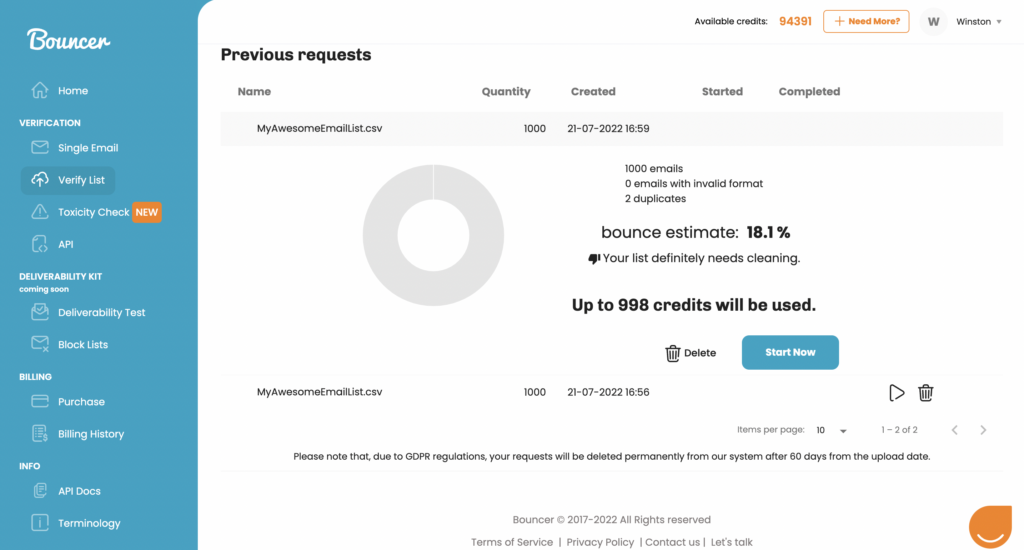
The fact that Bouncer allows you to test your list’s quality completely free is a big plus. It will pull a sample from your list, check it, and will tell you if it needs cleaning. That way, you don’t burn unnecessary credits.
Pros vs Cons
Pros
Easy to use and connect to other tools
High accuracy email checker
Keeps email list clean at great price point
Exceptional support
Reduced spam complaints
Cons
Onboarding could be better
Pricing
Credits
Pay-as-You-Go Price ($/email)
Monthly Price ($/email)
5,000
$29.00 ($0.0058)
$29.00 ($0.0058)
10,000
$49.00 ($0.0049)
$49.00 ($0.0049)
25,000
$99.00 ($0.0049)
$99.00 ($0.0049)
50,000
$169.00 ($0.00338)
$169.00 ($0.00338)
100,000
$299.00 ($0.00299)
$299.00 ($0.00299)
300,000
$599.00 ($0.0019)
$599.00 ($0.0019)
500,000
$799.00 ($0.0016)
$799.00 ($0.0016)
1,000,000
$999.00 ($0.0099)
$999.00 ($0.0099)
2,500,000
$1649.00 ($0.00065)
$1649.00 ($0.00065)
5,000,000
$2299.00 ($0.00045)
$2299.00 ($0.00045)
Email scrubber – Final Thoughts
Remember, maintaining a clean email list is just as important as growing it. A clean email list can improve your deliverability rate, reduce your bounce rate, and ultimately increase your ROI.
So, invest in a good email scrubber like Emailable. It’s one that will pay for itself in the long run.
P.S. List cleaning and maintaining sender reputation are necessities for landing in the inbox, but so are avoiding spam trigger words. So make sure to pay attention to those as you craft your emails!
Trevor Sinclair is an entrepreneur and online business expert. He’s seen first-hand how the internet can empower people to create businesses and lifestyles they love. Now, he’s passionate about helping others do the same.
When he’s not working, you may find him hacking up a golf course or savouring the bold flavours of Thai cuisine.
A look at how an integration layer completes AI applications and how integrations can be done better with the help of AI.
AI is reshaping the enterprise landscape. Already, developer productivity, digital labour, email marketing, website creation, etc., seem ripe for a major transformation. It is also well understood that general AI foundation models like GPT4 and Falcon-40B need to be fine-tuned or prompt-tuned for enterprise-specific tasks, and therefore must be fed some curated data that allows for some subset of the parameters to be “adjusted,” or output changed based on new task information given in prompts.
However, training the models is one thing. Enterprise applications today live and die on access to current enterprise data. For example, an e-commerce website might return the status of the orders of a logged-in customer. Or a chat application might process the return of a product. In neither of these cases can anything useful be done without real connectivity to ( integration with) one or more enterprise applications. First, we’ll speak to how an integration layer completes AI applications.
In addition, these integrations do not magically appear. They have to be coded, and they have to be tested and maintained. Later, we’ll speak to how integrations can be done better with the help of AI.
AI Without Integration is Incomplete
How would an AI application return useful information? AI without integration is like fish without water.
In the above figure, a natural language question, “When will my package arrive?” will need to be parsed by a foundation model, and generate a GraphQL request that then accesses an enterprise data source (and in this case, third-party systems such as FedEx), and then the response needs to be used as the input to generate the output.
The above example, while simple, shows that AI foundation models must be complemented by integration and API technologies. As readers of articles from one of the authors know, we have a particular bias for GraphQL APIs. And in this case, they are especially useful since the AI application can be trained to call one universal GraphQL API, and not have to deal with the subtleties of formats and authorizations and sideways information passing if the application were to learn multiple backends.
Integration Without AI is Incomplete
However, the complement to the above is that the opposite is also true. For each of the personas and task sets in the integration space, there are benefits in the application of AI:
Integration personas in the API management domain
Developers are the primary focus of this effort in the industry today. Prior to the rise of AI, domains like API management and application integration have already evolved toward low code/no code tooling for creating integrations, enabling citizen developers with less skill and experience to use them. AI provides the ability to further augment and empower those developers in more advanced or historically specialist scenarios.
Administrators, operations folks and site reliability engineers (SREs) of integration deployments will also benefit from the application of AI. Anomaly detection on operational metrics such as API response codes, transaction rate, queue depth and on system logs are all scenarios that machine learning models are well evolved to support – and provide the administrator a sixth sense to observe and maintain the health of a system.
Product managers and business owners often being on the less technical end of the spectrum also benefit from the low-code and generative capabilities described above, supporting them to self-serve their needs for query and analysis of data to identify business trends and new revenue streams.
In all cases there are various aspects that require close watching as AI technology matures:
First, the models have to be trustworthy. The art and science of trust in AI is being created rapidly, but of course, the rate and pace of innovation in the core AI algorithms is moving even faster. At some point in time, the trust research will have to catch up with the model research.
Related to this is determinism and repeatability. In scenarios such as generating a mapping between two data objects, it is not desirable that a different mapping be created each time you ask the same question, and yet that is the case today for many foundation models as they balance probability between multiple competing options.
Critical to the effectiveness of AI capabilities is correctness. There are many well-known examples where content generated by AI is plausible at first glance, but flawed in practice. As such, today a skilled expert is often still needed to review, debug and rectify the AI-generated artefact, but as the technology matures, we expect to see growing confidence in the validity of the output that will reduce the need for human oversight.
Next, the cost of inferencing, which is often not talked about, will become the dominant OpEx, and enterprises will have to learn to trade off the size of the model and the size of the prompt (linear and quadratic influences respectively on the cost of inferencing) with the quality of the output (is it worth going from a 8B parameter model to 100B parameter model for a 2% lift in the quality of the output)?
Sensitivity of data ownership is also a key concern for many enterprises. Foundation models work most effectively when they can be trained using the largest corpus of available examples, but if those examples contain sensitive customer information or represent a competitive advantage to the enterprise, then care must be taken in how that data will be further used by the model owner.
Summary
There is a bright future for AI-driven integration, both in the application of integration to provide access to enterprise data for use by AI tools and also for application of AI to benefit the delivery of integration scenarios.
We will be publishing a whole series of articles on the topic of the influence of AI on APIs and integration, and as some of you might know, StepZen was acquired by IBM, so we will be bringing on some additional API and integration experts, such as Matt Roberts, the CTO for IBM’s Integration portfolio.
Anant is the founder and CEO of StepZen, a startup with a new approach for simplifying the way developers access the data they need to power digital experiences. With a career that spans IBM Fellow, CTO of IBM’s Information Management… Read more from Anant Jhingran
Matt Roberts is Distinguished Engineer and CTO for the IBM Integration product portfolio where he has technical responsibility for offerings that cover API management, application integration, security gateways and high-speed data transfer. He has extensive experience delivering software products and…
Establishing a robust online presence is imperative for businesses seeking sustainable growth and increased visibility in the ever-evolving digital landscape.
This comprehensive guide will outline eight crucial steps every business should undertake to improve its online presence. By implementing these strategies, you can position your business for success and outrank competitors in the digital realm.
1. Develop a User-Friendly Website
To captivate online visitors and enhance their browsing experience, it is paramount to have a well-designed and user-friendly website. Ensure your website is visually appealing, easy to navigate, and optimized for various devices, including desktops, tablets, and smartphones. Incorporate intuitive menus, clear calls-to-action (CTAs), and visually engaging elements to guide users seamlessly through your website’s content.ll
2. Create a Visual Aspect That Leaves a Lasting Impression
A visually captivating logo and a well-defined brand colour scheme are vital to establishing a solid and memorable brand identity. Let’s explore how incorporating these visual elements can enhance your online presence.
Design an Eye-Catching Logo
Your logo visually represents your brand and can leave a lasting impression on potential customers. It should be unique, easily recognizable, and reflective of your brand’s values and personality. Consider the following principles when designing your logo:
Simplicity: Aim for a clean and uncluttered design that is easily understandable.
Memorability: Create a distinctive and memorable logo, leaving a lasting impression on viewers.
Relevance: Ensure your company logo aligns with your brand’s identity, industry, and target audience.
Versatility: Design a company logo that can be scaled and adapted for various platforms, including websites, social media profiles, print materials, and signage.
Select an Appropriate Colour Scheme
Colours evoke emotions and play a crucial role in brand perception. Choose a colour scheme that resonates with your brand’s values, personality, and target audience. Consider the following factors when selecting your brand’s colour palette:
Brand Identity: Determine the emotions and qualities you want your brand to convey. For example, blue can signify trust and professionalism, while yellow can evoke feelings of energy and optimism.
Audience Preferences: Research your target audience’s preferences and cultural associations with colours. Different colours can have varying meanings across different demographics and cultures.
Colour Harmony: Select a harmonious combination of colours that work well together and provide visual cohesion. Consider using colour theory principles such as complementary, analogous, or monochromatic colour schemes.
Investing in a well-designed logo and a thoughtfully selected colour scheme can enhance your brand’s recognition, establish a consistent visual identity, and leave a lasting impression on your target audience.
Enhancing your website’s visibility in search engine results is crucial for attracting organic traffic. Optimize your website using targeted keywords relevant to your industry and niche. Furthermore, conduct thorough keyword research to identify high-value keywords your target audience will likely search for. Incorporate these keywords strategically within your website’s content, meta tags, URLs, and headings to increase your chances of ranking higher in search engine results.
a. Conduct Keyword Research
Keyword research is the base of successful SEO. You’ll want to identify words you will use throughout your content that are relevant to your customers and align with your industry. Check if your target audience uses search to find what they want.
Use keyword research tools like Google Keyword Planner, SEMrush, or Moz Keyword Explorer.
b. Optimise On-Page Elements
On-page optimization involves optimizing various elements within your website to make it search engine-friendly and user-friendly. Pay attention to the following elements:
Title Tags: Craft unique, concise, and keyword-rich title tags for each page. Place the primary keyword towards the beginning of the title tag to maximize its impact.
Meta Descriptions: Write compelling meta descriptions summarising each page’s content. While meta descriptions do not directly impact rankings, they influence click-through rates (CTR) and can drive more traffic to your website.
Headers and Subheadings: Organise your content using headers (H1, H2, H3, etc.) and subheadings to improve readability and help search engines understand the structure of your content. Incorporate relevant keywords in these headings to signal the content’s relevance.
Then, URL Structure: Create user-friendly URLs that are concise, descriptive, and include targeted keywords. Avoid using numbers, symbols, or generic parameters in your URLs.
Keyword Optimization: Incorporate relevant keywords naturally throughout your content, including in the opening paragraph, headings, subheadings, and body text. However, avoid keyword stuffing, as it can harm your rankings.
d. Build High-Quality Backlinks
Earning high-quality backlinks from authoritative and relevant websites is a fundamental aspect of SEO. Backlinks act as votes of confidence and signal to search engines that your website is trustworthy and valuable.
4. Create High-Quality and Engaging Content
Content is king in the digital realm. Producing high-quality, informative, and engaging content is a powerful way to establish credibility, attract visitors, and encourage repeat visits. Develop a content strategy that aligns with your target audience’s needs and interests. Moreover, regularly publish blog posts, articles, videos, infographics, and other forms of content that offer value and keep your audience informed and entertained.
5. Build a Strong Social Media Presence
Harness the power of social media platforms to amplify your online reach and connect with your target audience. Create and maintain active profiles on platforms such as Facebook, Twitter, LinkedIn, Instagram, and YouTube, depending on your business type. Regularly share compelling content, engage with your followers, and foster meaningful conversations to cultivate a loyal community around your brand.
6. Leverage Influencer Marketing
Influencer marketing has emerged as a potent strategy to expand your online presence and reach new audiences. Identify influential personalities, bloggers, or industry experts whose values align with your brand’s identity. Collaborate with them to create content, reviews, or endorsements highlighting your products or services. By leveraging the influence of these individuals, you can significantly boost your brand’s visibility and credibility.
7. Harness the Potential of Email Marketing
Email marketing remains a highly effective tool for nurturing leads, fostering customer loyalty, and driving conversions. Build a subscriber list by offering valuable incentives such as exclusive content, discounts, or free resources.
Craft engaging newsletters, personalized offers, and automated email sequences to deliver relevant and targeted messages to your subscribers. Segment your email list based on user preferences and behaviours to enhance the effectiveness of your campaigns.
According to oberlo.com (Email has made its way from simple messages between academics to widespread global usage. In 2022, the number of email users worldwide was forecast at 4.3 billion (Statista, 2021). This figure is set to grow to 4.6 billion in 2025, making up more than half of the expected world population.
8. Optimise for Local Search
For businesses with a physical presence, optimizing for local search is essential. Claim and optimize your business listings on prominent online directories such as Google My Business, Bing Places, and Yelp. Ensure that your business information, including name, address, phone number (NAP), and operating hours, is accurate and consistent across all platforms. Encourage satisfied customers to leave positive reviews, significantly influencing local search rankings.
9. Analyse and Adapt
Tracking and analysing your website’s performance and user behaviour is crucial to continually enhancing your online presence. Utilize analytics tools such as Google Analytics to gain insights into key metrics like website traffic, bounce rate, conversion rate, and user demographics.
Also, Identify areas of improvement, experiment with different strategies, and adapt your approach based on data-driven insights to optimize your online presence effectively.
Conclusion
In today’s digital landscape, businesses must prioritize their online presence to thrive and surpass competitors.
By following these eight essential steps – developing a user-friendly website, implementing SEO strategies, creating high-quality content, building a solid social media presence, leveraging influencer marketing, harnessing the potential of email marketing, optimizing for local search, and analysing and adapting.
you can strengthen your online presence, attract a larger audience, and achieve sustainable business growth. Embrace these strategies and unlock the immense potential of the digital realm for your business.
A seasoned professional specializing in digital marketing and blogging. With expertise in various approaches such as content marketing, SEO, SMO, and PPC, his experience in crafting informative and engaging blog content and strategy has proven instrumental in boosting business growth and driving increased traffic.
How we engage with our audiences online is constantly shifting and evolving.
In-person was king at some point, email at another and everything from omnichannel advertising to personalization has its place in the funnel. But an ongoing challenge, no matter how well we do any of this, is keeping our audiences committed and loyal to our brands and what we have to offer them in the long run.
Audience conversions happen for a wealth of reasons. From catching one’s eye amid the daily scroll to being referred by a friend or colleague, we all connect to a brand at a particular touchpoint. On the commercial side, it could mean buying a product or signing up for a discount, and on the non-commercial side, it’s making a donation toward a cause or signing up for a newsletter.
As marketers, we put a lot of effort into that first touch, so engagement usually starts off well. You’re able to confidently nurture and segment your new users so that they’re engaging with content from your brand that resonates with them and makes them want to purchase, register, volunteer or donate. The bigger challenge is the long game: retaining their interest and brand loyalty for longer than an extended honeymoon period.
There are a number of tactics non-profit and commercial brands can use to keep and reengage their subscribers, members and/or customers committed through a consistent brand experience. The following are three rules of thumb that we must always keep top of mind.
1. Treat everyone like they’re a paying member.
Whether you run a paid membership service or not, approach all your audiences as such. Offer them value that makes them feel part of something important and special. From discounts to invitation-only opportunities, remind them at each touchpoint of the value they’re getting from having connected with your brand in the first place. In doing so, you’re much more likely to see longer-term engagement with your offerings.
2. Deepen your relationship with them.
We all know our audiences to a certain extent, but it’s usually based on a particular moment in time. There are so many factors that influence people’s changing interests and priorities. Make sure you know what those are. An easy way to do so is to ask for feedback. Following your first rule of thumb (treat everyone like they’re a paying member), offer them something real in return—and don’t make it a chance to win something. For example, offer a discount code on their next purchase, mail them a piece of swag (which is a win-win for brand loyalty) or send them a free ticket to an event. Depending on your budget and goals, the value you can offer them will pay you tenfold through the honest feedback they’ll hand over in return.
3. Maintain personalization.
As the saying goes, “If you’re talking to everyone, you’re talking to no one.” If you’ve got segmentation rules set up, make sure you’re keeping them up to date and modifying them when needed. Your second rule of thumb (deepen your relationship with them) will inform the content and channel of your personalized outreach. The more confident you are that you have the right segments at this very moment, the easier it is to develop the right messaging that keeps your audiences committed to your product or cause.
Building and retaining brand loyalty is, of course, an ongoing process that requires the same level of experimentation and A/B testing as your top-of-the-funnel tactics. Consistently focus on delivering value, building positive relationships and providing content that resonates with each of your audience segments. By doing so, you can maintain a loyal customer base that supports your brand not just now but well into the future.
Managing Director of Marketing at Forum One, a leader in marketing and outreach to the world’s most influential nonprofits and foundations. Read Christina Crawley’s full executive profile here.
In this article, we explore essential steps to develop a successful marketing strategy that will help your startup thrive.
Starting a new business venture can be an exhilarating experience. However, without a well-defined marketing strategy, even the most promising startups can struggle to gain traction in today’s competitive landscape.
Launching a startup requires careful planning and execution. A robust marketing strategy serves as the backbone of your business growth and ensures that your target audience becomes aware of your products or services. By following a systematic approach, you can build a solid foundation for your marketing efforts and maximise your chances of success.
In this article, we explore essential steps to develop a successful marketing strategy that will help your startup thrive.
Understanding your target audience
Before diving into marketing tactics, it’s crucial to understand your target audience. Conduct thorough research to identify their demographics, preferences, and pain points. This knowledge will allow you to tailor your marketing messages effectively and engage with your audience on a deeper level.
Define specific and measurable marketing objectives for your startup. Whether it’s increasing brand awareness, driving website traffic, or generating leads, setting clear goals will help you stay focused and track your progress. Remember to align your marketing objectives with your overall business goals to ensure consistency and cohesion.
Conducting market research
To develop an effective marketing strategy, you need to have a comprehensive understanding of your industry and competitors. Conduct market research to identify market trends, analyse your competition’s strengths and weaknesses, and uncover untapped opportunities. This valuable information will guide your marketing decisions and give you a competitive edge.
Differentiating your startup from the competition is essential to attract customers. Define your unique selling proposition (USP) the distinct value that sets your products or services apart. Your USP should highlight the benefits your startup offers and why customers should choose you over competitors.
Selecting the right marketing channels is crucial for reaching your target audience effectively. Consider your audience’s preferences and behaviour to determine which channels will yield the best results. Whether it’s social media, content marketing, email marketing, or paid advertising, choose channels that align with your target audience and business goals.
Compelling content is the cornerstone of a successful marketing strategy. Develop high- quality content that educates entertains, or solves your audience’s problems. By providing valuable information, you can position your startup as an authority in your industry and build trust with your target audience.
Implementing SEO strategies
Search engine optimisation (SEO) plays a vital role in driving organic traffic to your website. Conduct keyword research to identify relevant search terms and incorporate them strategically into your website content. Optimise your meta tags, headings, and URLs to improve your search engine rankings and increase your visibility online.
Social media has become an integral part of marketing strategies. Create a strong presence on platforms that align with your target audience. Develop engaging content tailored to each platform, and encourage social sharing and interaction. Leverage social media advertising to amplify your reach and target specific demographics. Regularly analyse your social media metrics to identify what resonates with your audience and refine your approach.
Building strategic partnerships
Collaborating with complementary businesses can expand your reach and create mutually beneficial opportunities. Identify potential partners whose target audience overlaps with yours. Explore co-marketing initiatives, joint events, or cross-promotions that can help you tap into new markets and gain exposure.
To ensure the effectiveness of your marketing efforts, establish key performance indicators (KPIs), and regularly track and analyse your results. Monitor metrics such as website traffic, conversion rates, social media engagement, and customer feedback. Use this data to make data-driven decisions, optimise your campaigns, and identify areas for improvement.
The marketing landscape is ever-evolving, and it’s crucial to adapt and iterate your strategies accordingly. Stay updated with industry trends, monitor your competitors, and be open to new approaches. Regularly evaluate your marketing efforts, gather feedback, and make necessary adjustments to stay ahead of the curve and maintain a competitive edge.
Creating a budget and allocating resources
Developing a marketing budget and effectively allocating resources is essential for startup success. Determine how much you can allocate towards marketing activities while considering factors such as advertising costs, hiring professionals, and technology investments. Prioritise your marketing initiatives based on their potential impact and allocate resources accordingly.
As your startup grows, consider hiring marketing professionals who possess the expertise and experience to drive your marketing efforts forward. Look for individuals who understand your industry, have a track record of success, and align with your company’s vision and culture. An experienced marketing team can help execute your strategies effectively and scale your marketing efforts.
Developing a successful marketing strategy for your startup requires careful planning, understanding your target audience, and leveraging the right marketing channels. By defining your goals, conducting thorough market research, analysing competitors, and implementing effective strategies like SEO, content marketing, social media, and email marketing, you can build brand awareness, attract customers, and drive growth for your startup.
How this creative business marketing tool can be a double-edged sword, as cyberrisks abound.
Whatever category your business belongs to, 2023’s connected world requires all companies to market themselves via tech and social media, in order to gain popularity and more customers. But equally, in an effort to infiltrate more devices and execute more malware, scammers are increasingly using ingenious methods of exploitation.
Many creative tactics are used for digital marketing communication, but they aren’t without their dangers. For example, pay-per-click advertising, email marketing, and video marketing can be tampered with by malicious actors, with clickbait being a popular vector to lead consumers to phishing sites. Unsurprisingly, RAV researchers found in a recent consumer cybersecurity trends report that phishing is the leading malware distribution method affecting home users today.
Quick Response (QR) codes are another example of common digital marketing, and another possible vector for phishing, as they are the epitome of “security without context”—you can’t interpret the QR code with the naked eye, and so a consumer won’t know what it does until they scan it. So as with any connected technologies, it’s important to examine any possible cyberrisks affecting consumers.
QR Codes: What’s the appeal?
QR codes hit mainstream use throughout North America and Europe in 2020 when the pandemic forced businesses to go contactless. Given the QR codes’ large storage capability and the popular use of mobile devices, these two-dimensional barcodes are designed to be scanned using a smartphone camera and a QR code reader app to provide quick access to information.
They are widely used in various industries, including marketing, retail, and hospitality, offering direct access to websites, contact details, social media pages, and product information, or to perform transactions. Adopting QR codes can help a business in several ways, like for improving customer engagement, increasing sales, and streamlining operations. QR codes also enable QR code login (QRL), a convenient and secure way for consumers to log in to websites and applications without the need for usernames and passwords.
Security without context—is it safe?
Worryingly, people may blindly scan QR codes without a pause as to what it might entail. Case in point: The Coinbase Superbowl 2022 commercial utilized a bouncing QR code on a giant screen and garnered 20 million hits within one minute of the ad airing. It was an immensely effective marketing move (and funnily reminiscent of The Office’s legendary bouncing DVD opening teaser)—so much so that it temporarily “broke” the Coinbase website.
However, there’s something worrying about the laissez-faire reaction of the audience. In general, it’s safe for consumers to scan QR codes from trusted sources, yet there are potential risks, e.g. codes directing users to malicious websites, or containing embedded malware that allows criminals access to the victim’s mobile device to steal personal and financial information.
Implementing the scams
It can be difficult to know if a QR code is fake or legitimate. Humans cannot decipher the dot pattern, but people can try to confirm whether a QR code was pasted over another one, which could indicate that the new one is fake. QR code readers can often read these codes even if they are dirty or defective, potentially using its software to automatically correct the pattern.
Issues like these introduce a new risk for otherwise legitimate QR codes. The HP Threat Research Team found nearly daily QR code “scan scam” campaigns since last October. These can deceive people into scanning the codes that are trying to bypass less robust phishing detection and protection.
Threat actors can alter QR codes by greying out certain areas, slightly warping square dots in the code, or cloning a login QR code to a fake login page that closely mimics a legitimate online service, known as “QRL-jacking.” In a QRL-jacking attack, the attacker intercepts the person’s QR code login session and uses the device to scan the code to gain access to the user’s account. The attack can be carried out using various methods, such as redirecting the user to a fake login page or using a malware-infected app to scan the QR code.
For QR scams to work, social engineering is required. The consumer needs to be convinced to scan the QR code. Some such scams involve directing users to malicious websites asking for credit and debit card details, or phishing campaigns masquerading as parcel delivery companies seeking payment.
QR code scams often work best in places where the population prefers to go cashless, using their phones to make payments. Threat actors will exploit simple, everyday activities in order to take advantage of people. For example, in 2022 in San Antonio, fake QR codes were detected on parking meters throughout the city. People trying to pay for parking were directed to a fraudulent website to submit payment.
Stay cybersafe
It’s often the minor everyday activities that can drastically affect us without realizing it. Exercising caution and common sense when using QR codes is vital, especially if the user is prompted to enter sensitive information. In this respect, adding a second layer of authentication to online accounts can help protect the consumer.
Other safety guidelines include only scanning QR codes from trusted sources; using a QR code scanner app with in-built security features to detect and warn against malicious QR codes; and exerting caution if a QR code prompts you to download or install anything on your device. Also, check that any page you are redirected to has a legitimate URL, is displaying the HTTPS security indicator, and keep your device’s software up-to-date to ensure it is protected against known security vulnerabilities.
It’s always exciting to adopt new technologies when promoting your business, or being able to easily access information with a single click as a consumer. But staying aware and vigilant will always be a must. Using QR codes as a vector for scams is yet further proof that cybercriminals are diversifying, so we too need to stay one step ahead of the game.
By Andrew Newman
Andrew Newman is the founder and CTO of ReasonLabs