Author

editor

Browsing

By Ashley Simpson

The good news is that marketing and communications have some overlap that makes both a great move for your career. They are both a core component of a robust marketing strategy, but they have slightly different focuses.

NUMBERS AND STATISTICS VS. WORDS

The first and most significant difference between marketing and communications is how success is measured.

Those responsible for marketing strategies are focused on the bottom-line numbers: how many clients or leads are brought in, campaign performance, and profit. Marketing managers know exactly who they are targeting and use market research to do just that. Statistics are a core component of marketing.

Communications strategies are more focused on the words used to relay a feeling to that ideal avatar that the marketing strategy targets. Oftentimes, they rely on copywriting to create content for a wide variety of customers and outlets. They might write newsletters for email marketing, copy for a landing page, and blog content.

OUTCOMES VS. ATTITUDES

Because of the last difference, it might be clear to you that there’s another difference between those who have a communications degree and those who have a marketing degree.

Namely, they concern themselves with two dramatically different levels of success.

Marketing managers are typically concerned with the outcomes of a digital marketing strategy. They want to know what the bottom line of the advertising effort is costing them and if it has a great return on investment (ROI). If there is no discernible outcome, then the marketing department will need to refocus its efforts.

On the other hand, corporate communications is focused on the attitudes of those public relations campaigns. Communications focuses on how people feel about a brand and if the target audience is likely to view them favourably. It’s less about the numbers and more about the feeling.

SALARY DIFFERENCES

Last but not least, there is a salary difference between marketing and communications careers. For those who are more concerned with the bottom line, a marketing career may be the better option. It tends to pay more than communications in the long run.

Entry-level marketers make an average of $48,752 annually, while marketing managers make about $140,000 annually.

Entry-level communications representatives make slightly more at $62,101, while managers make about $123,777.

While you may make more initially from communications careers, marketing has the better salary if you are looking for a career you can stick with long-term. However, they are so similar at higher levels that it may pay off to score that higher starting salary associated with communications careers.

WHAT IS MARKETING?

Now that we have the differences between marketing vs communications out of the way, it’s time to think about what each one offers individually. Pursuing a marketing degree means you are going to be thoroughly invested in the nitty-gritty details of marketing campaigns.

Marketing covers promoting and advertising for the company you work with to help them find new clientele who will contribute to the bottom line of the business. It’s a lot of strategic planning and statistics that prove that target customers are being reached with a campaign.

In other words, marketing focuses on emerging technologies to help leverage these capabilities for financial profit.

WHAT IS COMMUNICATIONS?


Unlike marketing, communications focuses on both written and spoken communication. Instead of looking at the numbers, a communications degree helps you to focus more on the experience of the ideal customer avatar. Everything about it is designed to be customer-centric, including the essential experience of intercultural communication.

It’s about the quality of the relationship you’re nurturing over how many leads and sales you make. Communications professionals want to make a lasting impression rather than just making a sale in the here and now.

While the goal is ultimately the same (help customers find a brand they love), they take different forms. Communications is often focused more on inbound marketing such as content creation, including writing a blog post or email campaigns. Marketing is more focused on outbound marketing, reaching new and potential clients. If you choose to work in communications, you may want to consider becoming a content marketing consultant.

SIMILARITIES IN MARKETING VS COMMUNICATIONS

As you might have gathered, there is a lot of overlap in what a marketing or communications role may play. Both are focused on improving company perception, though one is focused on the dollars and the other more so on brand management.

Here are some similarities that might lead you to study both marketing and communications as your ideal career path forward.

DESIRE TO REACH AN AUDIENCE WITH A TIMELY MESSAGE

While communicators focus on the actual wording of the message, both marketers and communications majors will want to reach an audience with the right message at the right time. While communications majors might work on inbound marketing and marketers work on outbound, both aim to improve the lives of their target audience.

They are passionate about the companies they work for and want the world to know about what is being offered.

INCREASE PERFORMANCE AND RECOGNITION OF THE BRAND

Despite having different sets of tools to manage any given marketing plan, both roles are focused on driving more sales to the company. Marketers concern themselves with the bottom-line numbers, but that doesn’t mean those in communications careers don’t care. They simply pride themselves on how well the words they write drive sales.

Both want the business to take off and see massive success. After all, their jobs depend on it. While they have key differences in what matters to them, performance is at the heart of all they do.

SKILLS REQUIRED FOR SUCCESS

Whether you work in marketing or communications, you will still have to have some of the same skills. As with most positions these days, you need excellent interpersonal communication skills. You should be able to communicate with the team you are on, as well as other departments, to yield the best results.

Plus, you will need to have a great deal of creativity to get the company’s message out to other people. No matter what your niche, you will have to come up with innovative new ways of reaching people via marketing campaigns or content marketing.

PLATFORMS USED (SOCIAL MEDIA, WEBSITE, COMMERCIALS, ETC.)

Of course, there is also significant overlap in how marketing and communications professionals reach their given audience. In today’s world, social media is one of the most prevalent areas where industry trends are leading both marketers and communicators to market.

The specific message you send and the specific platform you use will differ, but you should have some familiarity with all of them.

There are also more traditional means of communicating a message to a prospective customer: print ads, website content marketing, Google ads, commercials, and more. There is a seemingly endless list of potential platforms that both marketing and communications professionals will need to understand.

It’s all about delivering information by any means necessary, whether that requires social networking, press releases, or some other means of hitting the right audience at the right time.

COULD YOU USE A MARCOMM DEGREE?

Many people find that they don’t want to decide between marketing and communications. Both aspects of the marketing plan are interesting to them. This is why many schools are now offering what is known as MarComm degrees, where students double major.

This allows the overlap to work in your favour. You can earn the high-dollar compensation of a marketing manager while working with the words and content of the communications department. It makes you more versatile in the industry and gives you an endless supply of potential positions.

Many programs will allow you to get your bachelor’s degree in both areas which can be great for your potential income down the line.

FINAL THOUGHTS: WILL YOU CHOOSE MARKETING VS COMMUNICATIONS?

Do you have in-depth knowledge related to running a marketing campaign or focusing on content marketing? It might be time for you to think about making a career path out of those skills, which could start with going back to school for a marketing degree or a communications degree (or both!).

Whether you want to write website content or analyse the numbers, there is likely something in one of these two career paths for you to follow if you love digital marketing. Consider whether you might be well suited to making a job switch to one of these fields!

Here are some other courses for business that might help you to jumpstart a new career in these areas!

By Ashley Simpson

Ashley is an experienced freelance writer with an enthusiasm for finding creative ways to earn money online. She uses her passion for words to share what she has learned with the world.

She spends most of her time blogging for a multitude of websites and consuming everything she can get her hands on in relation to personal finance and side hustles.

Sourced from Niche Pursuits

By 

Spam complaint rate rises across the B2B space

Back in October, Google and Yahoo unveiled a pivotal update to their bulk sender guidelines.

Launching February 1, these new regulations, which impact both bulk emailers (those sending over 5,000 emails daily to Gmail accounts) and general Gmail users alike, introduced authentication requirements and defined thresholds for spam complaints. Specifically, they defined a spam complaint threshold of 0.3%.

Our preliminary analysis of the announcement was that this 0.3% threshold wouldn’t be a major problem for most email marketers. In fact, for large companies with established customer bases and large inbound lists, this update would probably help those companies. They likely have low existing complaint rates and can more easily and safely expand their outbound efforts.

However, the smaller, less established companies, specifically, those in the B2B space that may be using more aggressive outbound email marketing strategies or have been leaning on ABM to establish their brand, would likely be in trouble.

And it turned out that we were right.

Spam complaint rates across the B2B space

To better understand how these new sender guidelines would impact outbound marketing and sales, particularly in the B2B space, we studied spam complaint rates across various industries.

Our findings showed that complaint rates were well beyond the 0.3% threshold laid out by Google and Yahoo. In fact, it wasn’t even close! The average spam complaint rate across the B2B space was 2.01%, with a range between 1.1% and 3.1%.

Even worse, for the top 9 spammiest verticals, we couldn’t find a single sender that was able to score below the 0.3% threshold. When you break it down by industry, it becomes ever more clear who the top offenders are:

  • B2B Software: Spam complaint rates peak at 3.2%, with a range of 1.3% to 4.3%.
  • Political Issue & Electioneering Communications: Rates hover around 2.9%, ranging from 1.5% to 3.4%.
  • Sales and Marketing Services: Experience a 2.8% rate, with a broad spectrum from 2.0% to 5.3%.
  • Recruiting: Faces a 2.1% rate, ranging between 1.7% and 3.1%.
  • Retail and E-Commerce: Encounter a 2.3% rate, with variations from 0.5% to 2.9%.
  • Real Estate: Deals with a 1.9% rate, spanning 1.5% to 3.4%.
  • Education and Training Providers: Show a 1.7% rate, within a range of 0.4% to 2.1%.
  • Financial Services: Encounter a lower rate of 1.1%, ranging from 0.7% to 1.9%.
  • Healthcare and Pharmaceuticals: Have the lowest rate at 0.9%, with a range of 0.7% to 1.4%.

This data isn’t entirely surprising when you think about it. B2B software companies and sales and marketing companies tend to do a lot of outbound. Healthcare and Pharmaceuticals on the other hand are beholden to pretty strict laws and regulations around communication.

B2B sales & marketing teams must adjust quickly

This data signals a critical issue for B2B outbound marketing. For businesses that rely heavily on outbound emails for lead generation and sales, this is a significant hurdle. Meeting the new sub-0.3% threshold appears daunting, if not impossible. The good news is there are strategies to mitigate these hurdles:

Boost transactional email volume: If we want to reduce the spam complaint rate %, we may want to increase total emails sent and optimize email volume. Increase the volume of non-spammy, transactional emails such as order confirmations, tracking updates, or purchase follow-ups. These are less likely to be flagged as spam and can balance out your overall email metrics.

Prioritize warm leads: Focus your emails on high-intent users (think those who visited your pricing page or added something to their cart). Tools for website visitor identification can be invaluable here.

Provide clear & numerous unsubscribe options: The unsubscribe option should be easily accessible and in multiple places. Hidden or hard-to-find unsubscribe links increase the likelihood of being marked as spam.

Utilize intent-based email lists: In some instances, there is no getting around cold emails. What you can do however is use intent-based email lists that can help you create more appropriate messaging that will resonate with prospects. The more you know about what your audience is interested in, the more personalized messaging you can create.

For B2B companies, adapting to these new guidelines is crucial. While outbound isn’t gone, it is more challenging. The good news for users is that this new complaint rate threshold should improve the email marketing and outbound space as a whole.

These new guidelines will force B2B marketers to evolve their outbound strategies and build better campaigns. For users this means less spam and more relevant emails. For marketing and sales teams, this should mean better targeting, more personalization, and less laziness.

The result? Improved sales to lead time. At the end of the day, large email providers like Google and Yahoo are focused on creating a better user experience and this means less spam. For B2B teams, the answer is simple…don’t be a spammer.

We’ve listed the best sales management software.

Feature Image credit: Shutterstock/Billion Photos

By 

Larry Kim is the CEO of Customers.AI.

Sourced from techradar pro

This article was produced as part of TechRadarPro’s Expert Insights channel where we feature the best and brightest minds in the technology industry today. The views expressed here are those of the author and are not necessarily those of TechRadarPro or Future plc. If you are interested in contributing find out more here: https://www.techradar.com/news/submit-your-story-to-techradar-pro

By Yogesh Bhardwaj

Here, we have listed 5 ways ChatGPT can help Instagram Influencers to boost their Instagram income. Check out more details below.

ChatGPT Plus for Instagram Influencers: Instagram influencers are always looking for new and creative methods to improve their online visibility and increase their income. Influencers who are hoping to interact with their followers, produce interesting material and eventually boost their income can use ChatGPT Plus which can be a useful resource. Here are five methods ChatGPT can help Instagram influencers make significant money with their account.

Content Creation

You can use ChatGPT Plus to come up with original and imaginative content ideas. Influencers can use ChatGPT to jumpstart their content production process by using it to write captivating captions, fascinating anecdotes and original post ideas. This guarantees a constant supply of engaging and engaging content to maintain follower’s attention towards your account.

Caption Writing

Creating the ideal caption is essential to success on Instagram. Influencers can use ChatGPT Plus to help them create relevant and visually striking captions for their posts. This improves communication with the audience and raises the possibility of material becoming viral or becoming more visible.

High Engagement Collection

Retaining a high degree of interaction with followers is a crucial part of being an influencer. Influencers can use techniques such as surveys, Q&A sessions and challenges to engage their audience more. Influencers can build stronger communities and draw in more businesses for partnerships by encouraging their followers to take an active role in the community.

Affiliate Assistance

Influencers who promote goods or services can make a lot of money through affiliate marketing. ChatGPT Plus can help with the creation of genuine and compelling product reviews, descriptions and promotional content. Influencers may improve their affiliate marketing efforts and get larger commission revenue by utilizing the linguistic skills of the model.

Brand Collaboration Pitches

Influencers can also use ChatGPT Plus as a useful tool to connect with businesses and inquire about possible collaborations. They can even convince a company to work with them by crafting persuasive pitch emails or direct messages that are composed and professional. This may lead to profitable brand partnerships, sponsorships and other revenue-generating ventures.

By Yogesh Bhardwaj

Sourced from DNP India

Keep watching YouTube Channel ‘DNP INDIA’. Also, please subscribe and follow us on FACEBOOK, INSTAGRAM, and TWITTER.

By Tina Moffett

Google unveiled Meridian, an open-source marketing mix modelling (MMM) tool aimed at tackling crucial measurement challenges. MMM tools gauge the impact of marketing and media investments on vital performance indicators, such as sales or revenue, while also forecasting the revenue potential of marketing endeavours. According to Forrester’s Marketing Survey, 2023, about 30% of B2C marketers use MMM tools to better understand how marketing drives value for the business.

Unpacking Google Meridian’s Core Pillars

Google’s foray into providing an open-source MMM tool reflects an understanding that restricted access to crucial data points within closed ecosystems impedes advertisers’ ability to effectively measure digital ads. Meridian aims to “[empower] teams to build best-in-class [MMM models] and drive better business outcomes.” The tech giant emphasizes Meridian’s “privacy-durable” approach grounded in innovation, transparency, actionability, and education. But B2C marketers must review Meridian’s claims with a critical eye:

  • “Privacy-durable” is redundant. MMM inherently maintains privacy durability, since it operates without individual customer behavior data. Inputs focus on aggregated media cost and revenue data, steering clear of clicks, views, or individual sales conversions.
  • “Innovation” claims are overstated. Most marketing analytics vendors already use the same methods as Meridian. Meridian’s MMM approach leans on solid but common techniques, such as a geo-level Bayesian hierarchical model incorporating seasonality, frequency, and reach data. The inclusion of nonmarketing indicators also remains ambiguous.
  • “Open source” does not equal complete transparency. While open source allows users to view and modify the MMM algorithm, complete transparency remains elusive, particularly for nontechnical stakeholders such as, for example, a VP of marketing. For many buyers, understanding ML approaches presents a significant challenge, necessitating considerable support and hand-holding.
  • “Actionability” may be limited to marketing use cases. Meridian’s scenario planning aligns with MMM providers’ offerings, aiding marketers in forecasting future marketing impacts. It’s unclear, however, whether Meridian offers scenario planning encompassing nonfinancial KPIs, constraint functionalities, frequent optimizations, or multiple optimization objectives.
  • “Education” skews technical, not practical. While Meridian’s technical specifications may satisfy ML engineers and data scientists, marketing executives require more comprehensive education and support. Marketing executives seek guidance on ML-driven models, while data scientists using Meridian need best practices for stakeholder engagement and model adoption.

Unlock Marketing Success Beyond MMM And Build A Comprehensive Measurement Strategy

Google’s announcement underscores the significance of ML-driven marketing analytics for measuring incremental marketing effectiveness and guiding budget allocations. Here are some key considerations before you build an MMM model:

  • Adopt a layered measurement approach. MMM alone will not provide ad tactic or spot level performance. It offers CMOs a guide on overall marketing mix performance and budget allocation. Incorporate marketing mix modelling as part of an overarching layered measurement strategy, utilizing various techniques to gauge marketing efficacy.
  • Choose vendors with diverse analytics capabilities. Evaluate vendors based on their industry experience, data normalization processes, measurement methodologies, and supporting services.
  • Manage expectations with MMM analysis. Expect to see MMM analyses such as channel halo effects, ad decay, optimal frequency of channels, and large-scale programs. But MMM may not offer granular insights into ad tactic performance — the models don’t process clicks and conversion level data as part of their analysis.
  • Implement incrementality testing. If you need help with an ad spot, or a particular display ad performance, testing approaches can help measure marketing uplift. Your data science teams, data-driven agencies, or independent vendors can help set up a rigorous marketing or media test to analyse the incremental impact of different marketing tactics.
  • Educate your organization on marketing analytics. Forrester believes that AI suffers from a trust problem, and explainable AI — the techniques and software capabilities for ensuring that people understand how AI systems arrive at their outputs — is a critical transparency mechanism. Prioritize transparency in MMM, and consider tools with explainable AI capabilities to enhance understanding and trust in AI-driven insights.

By Tina Moffett

This post was written by Principal Analyst Tina Moffett and it originally appeared here.

Follow me on Twitter or LinkedIn. Check out my website.

Forrester is one of the most influential research and advisory firms in the world. We help leaders across technology, customer experience, digital, marketing, sales, and product functions use customer obsession to accelerate growth.

Through Forrester’s proprietary research, consulting, and events, leaders from around the globe are empowered to be bold at work — to navigate change and put their customers at the center of their leadership, strategy, and operations.

Our unique insights are grounded in annual surveys of more than 700,000 consumers, business leaders, and technology leaders worldwide; rigorous and objective research methodologies, including Forrester Wave™ evaluations; 70 million real-time feedback votes; and the shared wisdom of our clients.

Sourced from Forbes

By Steve Allen

Steve Allen is a niche site builder, writer, and all-around WordPress wizard. He enjoys personal development, entrepreneurship, double espressos, and making things work better than they did before.

Sourced from Niche Pursuits

Sourced from The Drum

Creators are eager to move beyond short-term, transactional deals and build enduring partnerships, says CreatorIQ’s research with Ipsos. Here are four ways brands can capitalize.

We know that brands want to include creators in their affiliate marketing programs. But stopping at affiliate-only engagements fails to leverage the full potential of creator marketing.

According to a recent survey CreatorIQ conducted with market research firm Ipsos, creators are eager to move beyond short-term, transactional deals and build enduring partnerships. That’s great news for brands.

The benefit of affiliate marketing programs for brands is clear: creators promoting products and services in return for a commission of sales is a low-risk, high-reward strategy. The problem is that too often, affiliate marketing deals focus too much on the short-term transactional nature of the relationship and miss the long-term opportunities.

Creators, meanwhile, want something more. They want a real relationship with the brands they work with, not just a transactional one. That means brands who treat their successful affiliate deals as the beginning of a fruitful creator relationship have the opportunity to build enduring, cooperative partnerships that will continue to deliver positive results for the long term.

How can brands build these enduring partnerships? Our research found four key takeaways brands should keep in mind.

1. Partner with creators who use and like your products

Creators prefer to promote brands they personally love, use, and believe in themselves, with “already using products in daily life” cited as a top consideration with 80% of creators surveyed.

Non-financial factors, like product quality and brand reputation, are more important to creators than commission rates and earning potential. In fact, 82% list “product quality and audience relevancy” as a top consideration for working with brands.

Remember most creators (and the ones you want to work with most) consider product quality as the most crucial factor when choosing whether to work with a brand in any kind of relationship, not just affiliate partnerships. That means there’s authentic brand affinity and alignment on values, style, and audience.

Takeaway

Before reaching out to creators with partnership offers, do your research first. Has the creator used or mentioned your product (or your competitors’) before? How closely does the creator’s audience match your target demographic? These are important details that you can find using creator marketing solutions like CreatorIQ.

2. Enable direct relationships

Creators want to work directly with the brands they use, not just given a product to sell. But traditional affiliate programs tend to more on transactions and less on support. That means there’s a need to establish clear lines of communication.

Among the biggest areas of support creators ask for are:

  1. Assistance in resolving payment issues – 36%
  2. Access to a dedicated affiliate manager – 35%
  3. Help resolving technical issues – 29%

Takeaway

Address the mundane nuts-and-bolts payment and support features of your creator program so they don’t cause frustration or eat up resources, freeing you up to focus on the important things like building relationships with your most important creator partners.

3. Provide product training and support

Creators are on the front lines, selling your products to their followers. In short, they’re sellers, so why not provide them with similar training and support as you do your sales staff? This means giving access to additional resources and content that will help them succeed.

This includes details like product education, training on your proven best practices, and a sneak peek at upcoming product launches so they can plan and strategize with more information at their fingertips.

Takeaway

Your creators are your sellers—treat them as such. Give them access to resources and content that will help them be successful in their role, such as product education, best practices training, and advance info about upcoming product drops and sales promotions.

4. Provide opportunities beyond affiliate

If a creator is successful in driving direct revenue through affiliate links, that’s a strong indication that they can contribute in other meaningful ways. Offer these creators additional partnership opportunities and unlock their full potential.

In fact, of those surveyed, 41% of creators said the biggest challenge with affiliate programs is the “lack of additional opportunities with the brand” they have affiliate partnerships with. Not far behind is an inability to evolve the brand relationship further.

Building trust and establishing an ongoing relationship with creators and their audience means moving past the initial engagement, and seeking opportunities for the long haul. One-and-done opportunities reduce creators’ ability to build trust with their audiences, which negatively impacts purchases. Authenticity is paramount to these creators—posting a couple of affiliate links and moving on comes across as disingenuous.

Takeaway

A creator who delivers affiliate sales is a creator with the potential to benefit your brand in other ways. Collaborate with them on new campaigns, new content, and even product development. If they want to work with you and have a proven ability to move the needle on lower-funnel results, there’s little downside in establishing a more direct relationship.

Conclusion

Combined, these findings indicate that brands should think of affiliate programs as a beginning, not an end, to creator partnerships. Our data shows that creator content simply performs better than traditional “ads”, so brands should be leveraging creators for things like sponsored posts, paid ads, product pages, and even in-store signage.

Ultimately, establishing direct relationships with creators and bringing them into the company fold — including such steps as product training, consultation, and other key support activities —  is a far more sustainable and successful strategy.

When used to identify the highest-performing creators through proven performance, affiliate programs are really just the start of the relationship between brand and creators, which can evolve into a long-term, fruitful partnership.

For more details, download the free report Beyond Affiliate: Building Sustainable Creator Partnerships from CreatorIQ here. 

Sourced from The Drum

By JP Botero

Crucial KPIs for B2B Marketing Success

Unlocking the true potential of B2B marketing requires a strategic approach, and at the heart of this strategy lies the indispensable concept of Key Performance Indicators (KPIs).

In his influential book, Measure What Matters, author John Doerr, a luminary in the business world, delves into the critical role of KPIs in shaping the success of B2B marketing endeavours.

B2B Marketing KPIs: 3 KPIs That Generate More Money

In his book, Doeer shares examples of how Google and other B2B companies achieve success by focusing on the right KPIs.

As a seasoned venture capitalist and influential figure in Silicon Valley, Doerr draws upon his vast experience to underscore the importance of setting and tracking KPIs for businesses striving to achieve excellence.

This article navigates through Doerr’s perspective, shedding light on how KPIs serve as the linchpin for B2B marketers, enabling them to measure, analyze, and optimize their efforts.

As businesses strive for excellence and relevance in the dynamic B2B arena, Doerr’s wisdom becomes a guiding beacon, emphasizing the profound importance of KPIs in steering marketing strategies toward unparalleled success.

In this article, you will learn the most critical KPIs for every B2B marketer to bring the right results for his or her company.

Understanding B2B Marketing KPIs

Key Performance Indicators (KPIs) are the compass that guides businesses toward success.

Karl Pearson once said: “When performance is measured, performance improves. When performance is measured and reported back, the rate of improvement accelerates.”

B2B Marketing KPIs: 3 KPIs That Generate More Money

You will only create real success once you understand the KPIs that bring the right results.

Understanding the intricacies of these metrics is pivotal for marketers striving to navigate the complex terrain of B2B interactions effectively.

The Role of KPIs in B2B Marketing

At the core of any successful B2B marketing strategy lies the fundamental understanding of the role that KPIs play.

According to John Doerr, KPIs are not just metrics; they are strategic tools that drive decision-making and performance evaluation.

In the intricate dance of B2B transactions, these indicators become the cornerstone for assessing the effectiveness of marketing efforts and refining strategies for optimal results such as sales, customer retention, and lead attraction.

Selecting the Right KPIs for Your Business

One size does not fit all when it comes to KPIs. Selecting the right metrics tailored to your business is a critical step in leveraging their potential.

If your business focuses on monthly services, your KPIs may differ from those of a company that sells its product just once.

The process involves a deep dive into the unique aspects of your industry, target audience, and business objectives. As business strategist Roger Martin says: “You need to understand what game you are playing first.”

Doerr also emphasizes precision in this selection, advocating for KPIs that align seamlessly with your specific business goals.

Aligning KPIs With Business Goals

Before you consider the most critical KPIs for your business, it is important to identify  the end result you are seeking  with your strategy.

If you want to create awareness and initiate a free trial with your campaign, your KPIs should be focused on web traffic, new subscribers, or the reach of your campaign.

In contrast, if your campaign intends to close the sale, your KPIs should focus on cart abandonment, daily orders, and A/B tests.

The synergy between KPIs and business goals is the linchpin for success in B2B marketing.

Doerr’s insights underscore the importance of aligning these metrics with overarching business objectives.

Whether it’s enhancing brand visibility, increasing lead generation, or optimizing conversion rates, each chosen KPI should be a strategic ally in advancing the organization’s broader goals.

Three Most Essential KPIs for B2B Marketers

Some essential KPIs should always be on your radar. However, you can get distracted by trying to track too many KPIs.

As Jim Collins, author of Good to Great, said: “If you have more than three priorities, you don’t have priorities.” The same applies for KPIs. If you have more than three KPIs, then you don’t have KPIs.

B2B Marketing KPIs: 3 KPIs That Generate More Money

Amidst the myriad of available metrics, certain KPIs are essential for B2B marketers. These indicators serve as a compass, guiding businesses through the intricate B2B landscape and ensuring that they stay on course toward their goals.

These KPIs are website traffic, conversion rate, and customer lifetime value.

Website Traffic

Website traffic stands out as an essential Key Performance Indicator (KPI) for every B2B marketer.

The blood of every business is cash, and website traffic is the first step in the sales process to bring in money.

It serves as a barometer of the effectiveness of email campaigns, providing valuable insights into audience engagement and the impact of content.

If your marketing campaign is not bringing people to your webpage, you lose your money and efforts. It is like having a physical store that nobody ever enters to see what you offer.

Monitoring and enhancing website traffic signifies the success of email marketing efforts and offers opportunities to nurture leads and drive conversions.

Importance of Website Traffic for B2B Email Marketers

Audience Engagement and Interest: A surge in website traffic following an email campaign indicates that recipients are not only opening emails but also taking the desired action of visiting the website.

This demonstrates genuine interest and engagement with the content or offerings.

Lead Nurturing Opportunities: Website traffic is a precursor to lead generation.

By analysing the behaviour of visitors, B2B marketers can identify potential leads, understand their preferences, and tailor subsequent email campaigns to address specific needs, thereby nurturing leads through the sales funnel.

Conversion Tracking: Website traffic is closely linked to conversion metrics.

By tracking the journey of visitors from email click-throughs to specific landing pages or product pages, marketers gain insights into the effectiveness of their calls-to-action and can optimize for higher conversion rates.

Improving and Measuring Website Traffic

Measuring web traffic is very simple if you have the right service for it. With beehiiv, you can track all of the aspects involved in web traffic, such as demographics, time spent, etc.

Compelling Email Content: Crafting emails that pique curiosity and offer value is what will bring people to your website.

Engaging content encourages recipients to click on the website to learn more about your business and offers.

Two of the best practices to see if your content is creating that curiosity are through an engaging subject line and A/B tests.

Clear Call-to-Action (CTA): Include a clear and compelling CTA in emails, directing recipients to visit the website for exclusive content, promotions, or further information. A well-designed CTA increases the likelihood of click-throughs.

Segmentation and Personalization: Tailor email content based on audience segments.

Personalized emails resonate better with recipients, prompting them to visit the website for content that directly addresses their interests or pain points.

If you have a worldwide audience, send them the information in their preferred language.

Landing Page Optimization: Ensure that landing pages are user-friendly, relevant, and aligned with the email content. A seamless transition from email to website enhances the user experience and encourages prolonged engagement.

Analytics Tools: Leverage web analytics tools to measure website traffic, track user behaviour, and assess the impact of email campaigns.

Platforms like Google Analytics offer comprehensive insights into visitor demographics, sources, and engagement metrics.

In conclusion, website traffic is a critical KPI for B2B email marketers because it is the first step to getting clients. Also, website traffic provides a comprehensive view of campaign performance and audience engagement.

By employing strategic measures to improve and measure website traffic, marketers can optimize their email campaigns, nurture leads effectively, and drive meaningful conversions in the competitive B2B landscape.

Conversion Rate

The conversion rate emerges as a paramount Key Performance Indicator (KPI) that directly reflects the success of campaigns in turning leads into valuable customers. This is where the actual money comes to your account.

Understanding the significance of conversion rates and employing strategies to enhance and measure them are essential for B2B marketers striving to maximize the impact of their email initiatives.

The conversion rate directly measures how well an email campaign translates leads into desired actions, such as making a purchase, filling out a form, or downloading content.

Conversion rate becomes a crucial KPI For B2B marketers because it quantifies the return on investment (ROI).

Also, conversion rates offer more than just numerical insights; they provide a qualitative assessment of lead quality.

Analysing which leads convert and the nature of their interactions allows marketers to refine targeting strategies and focus efforts on the most promising segments.

Therefore, the conversion rate is essential because of the money it brings and because it tells you where it is coming from.

You can calculate your conversion rates by simply taking the number of conversions and dividing that by the number of total website visits.

B2B Marketing KPIs: 3 KPIs That Generate More Money

For example, if you had 70 conversions from 1,000 interactions, your conversion rate would be 7%, since 70 ÷ 1,000 = 7%.

Now, if you want to measure an ad’s conversion, the formula works the same. Divide the number of conversions by the number of interactions from the ad.

Improving Conversion Rates

Compelling Copy and Design: Engaging copy, coupled with visually appealing design, enhances the likelihood of capturing the audience’s attention and driving them towards conversion actions.

According to a study, high-quality images increase conversions by up to 60%.

Strategic Call-to-Action (CTA): The CTA is the linchpin of conversion.

Some marketers use the same CTA for web traffic and conversion. That is a big mistake.

The web traffic CTA is focused on getting attention from the customer. The conversion CTA should be focused on benefits for the customer. Ensure that it is prominently placed, visually striking, and communicates the desired action.

A well-designed CTA motivates recipients to take the next step. If the customer never takes the next step, you will never have a conversion.

Personalization and Segmentation: Tailor email content based on recipient preferences and behaviours.

You can gather tons of information about behaviour from web traffic.

Personalized and segmented campaigns resonate better with the audience, increasing the likelihood of conversions.

Suppose you know that a possible customer has spent around 10 minutes looking at premium service but only 30 seconds looking at your basic service. In that case, you should use that information and offer the premium service in your emails.

Mobile Optimization: With a growing number of users accessing emails on mobile devices, optimizing email campaigns for mobile responsiveness is imperative.

B2B Marketing KPIs: 3 KPIs That Generate More Money

A seamless mobile experience ensures that potential leads can easily convert regardless of their device.

Here is some data about the importance of optimization:

A/B Testing: Experiment with different elements of email campaigns, such as subject lines, copy variations, or CTAs, through A/B testing. 

Analysing the performance of different elements helps identify the most effective strategies for improving conversion rates.

In conclusion, the conversion rate is a vital KPI for B2B email marketers, providing a direct measure of campaign success and lead quality.

Marketers can refine their email initiatives by strategically improving and measuring conversion rates, maximizing ROI, and driving meaningful business outcomes in the competitive B2B landscape.

Customer Lifetime Value (CLV) and Cost Per Lead (CPL)

Understanding and optimizing Customer Lifetime Value (CLV) alongside Cost Per Lead (CPL) emerge as indispensable Key Performance Indicators (KPIs).

Usually, these two are taken as two different KPIs; but since you need to know the cost per lead in order to calculate the customer lifetime value, it is better to see both as one.

These metrics not only gauge the efficiency of lead generation efforts but also provide valuable insights into the long-term impact of marketing strategies on customer relationships and revenue generation.

Importance of CLV and CPL for B2B Email Marketers

Long-Term Revenue Projection: Customer Lifetime Value represents the total anticipated revenue that a business expects from a customer throughout their entire relationship.

For B2B email marketers, this metric goes beyond immediate transactions, offering a strategic perspective on the long-term value of acquired customers.

Even with products sold once in a lifetime, you can always upsell, increasing the value of a lifetime customer.

Think of Microsoft, for example. You only buy the software once, but they offer Office and other cloud services as part of their portfolio.

Cost-Efficient Lead Generation: Cost Per Lead measures the expenditure incurred in acquiring a potential customer. When paired with CLV, it provides a comprehensive view of the cost-effectiveness of lead generation efforts.

A lower CPL, coupled with a higher CLV, signifies efficient marketing strategies that yield sustainable returns.

Resource Allocation: Understanding CLV and CPL allows B2B marketers to allocate resources more effectively.

By focusing efforts on channels and campaigns that demonstrate a favorable balance between cost and lifetime value, marketers can optimize budgets for maximum impact.

Why trust me: I have been working for a social media agency for the last four years, and understanding the CLV and CPL has helped us allocate our resources wisely.

For example, our CPL is around two times the money a customer spent on his first purchase; however, by focusing on the CLV, we have discovered that it is worth paying that price because the average customer stays with us for around one year.

That means that the CLV is around five times higher than our CPL. That is good business right there.

Improving and Measuring CLV and CPL

The formula used to calculate customer lifetime value is: Customer Lifetime Value = Customer Value x Average Customer Lifespan.

B2B Marketing KPIs: 3 KPIs That Generate More Money

The formula used to calculate cost per lead is: Your Total Marketing Spend / Total Number of New Leads.

B2B Marketing KPIs: 3 KPIs That Generate More Money

Segmentation for CLV: Tailor email campaigns based on customer segments to enhance CLV.

Different customer segments may exhibit distinct preferences and behaviors, allowing marketers to personalize content and nurture relationships effectively.

Customers will keep doing business with you if they feel supported by you. It could be a simple email every week asking for feedback or offering help. Thought leadership content is another fantastic way to engage them with you and your services.

Quality Lead Generation: Focus on generating high-quality leads to improve CPL.

Social media has made us think that more is better, but you don’t need to reach millions just to get one customer.

If you focus on getting your content in the eyes of the right people, you will get better conversion.

By refining targeting strategies, employing advanced lead qualification methods, and nurturing leads through personalized content, marketers can increase the likelihood of attracting valuable prospects at a lower cost.

Customer Retention Strategies: CLV is deeply intertwined with customer retention.

Implement strategies to enhance customer satisfaction, provide ongoing value, and encourage repeat business. Engaged and satisfied customers are more likely to contribute to a higher CLV. Make sure to be there for them as much as you can.

Another good strategy is to involve your customers in new launches or beta versions of new updates. They will feel valued, and your relationship with them will increase.

Lifecycle Email Marketing: Implement email marketing strategies that span the customer lifecycle.

From onboarding sequences to re-engagement campaigns, personalized and timely emails nurture customer relationships, increasing the likelihood of a higher CLV.

In conclusion, CLV and CPL are pivotal KPIs for B2B email marketers, offering a holistic view of the effectiveness of lead generation efforts and the long-term impact on revenue.

Remember this mantra: You want to be in business for years and decades, not just months.

By strategically improving and measuring these metrics, marketers can optimize resource allocation, enhance customer relationships, and ensure sustainable growth in the competitive B2B landscape.

Conclusion

Web traffic, conversion rate, and customer lifetime value (CLV) aren’t just metrics; they are the pillars of success.

Web traffic signifies engagement, conversion rates validate strategies, and CLV guides long-term growth.

These KPIs create a strategic trifecta, providing B2B marketers with a comprehensive toolkit for effective decision-making and sustainable success in the competitive landscape.

In this data-driven approach, these metrics cease to be numbers and become the driving force behind resource-efficient lead generation, impactful conversions, and enduring customer relationships.

By JP Botero

Sourced from beehiiv Blog

Join beehiiv today and get access to the most complete analytic tool for your B2B marketing efforts. With beehiiv 3D Analytic tool, you will have all of the information and data that you need to measure your KPIs and dominate your industry. Join now!

By Katie DeWitt

If you’re curious about the differences between YouTube vs. Rumble – such as which will bring you the most ad revenue as a video content creator, you should definitely keep reading! In this comparison breakdown, we’ll discuss:

  • The pros and cons of the two platforms
  • Comparisons of ad revenue
  • Audience size
  • User interface
  • And more

So, let’s determine which online video-sharing platform will be best for you as a creator in the online video industry.

YOUTUBE VS. RUMBLE: COMPARING AD REVENUE

The main difference between Rumble and YouTube is how they monetize their content. This dramatically impacts potential earnings for creators. We compare Rumble vs. YouTube advertising revenue below.

YOUTUBE MONETIZATION

YouTube’s Partner Program is how creators monetize their content and earn money on the platform. Unlike Rumble, YouTube has video monetization requirements creators must meet before they can start earning money.

Before they will pay creators, YouTube makes their creators make and share videos without earning money from the ads they place in their videos. YouTube can place ads on your videos without you even being eligible for monetization. This is a point of contention for some creators.

Monetization requirements for joining the YouTube Partner Program include having:

  • 1,000 subscribers
  • 4,000 hours of watch time in the last 12 months or 10 million Shorts views in the last 90 days

Reaching 1,000 subscribers is the main hurdle creators face when trying to achieve YouTube monetization. This requirement sometimes deters new creators from continuing with this endeavour. Learning how to increase YouTube subscribers is a key part of creators’ journeys on the path to start earning money from their quality content.

Between the two platforms, YouTube has more monetization requirements than Rumble.

YOUTUBE PARTNER PROGRAM

So, how does YouTube pay its creators?

The YouTube Partner Program will pay creators based on a revenue-sharing model.

Ads are served on your video content, and creators earn a percentage of the ad revenue. This monetization method means you could earn a lot of money as your videos gain popularity. After you start monetizing, earning YouTube passive income is a great way to earn more money as a creator.

RUMBLE MONETIZATION OPTIONS

When learning how to make money on Rumble, creators are often surprised at the monetization options that are readily available to them.

Unlike YouTube, Rumble offers immediate monetization options for its creators. It doesn’t have subscriber or watch time requirements. Having this ability to immediately start monetizing your videos gives Rumble an advantage that other platforms don’t have.

Monetization opportunities are instantly available for Rumble creators.

You can earn money in several ways as part of the Rumble Partner Program. These include:

  • Rumble Player Revenue: Rumble also offers a revenue share model for its creators. Videos on Rumble earn money based on engagement, not only views. Creators will earn money based on comments, likes, shares, views, and more. The overall engagement on your video plays into the share of the advertising revenue you will receive.
  • Video Licensing Deals: Creators can also increase their earnings by receiving video licensing deals. If a third party licenses your videos, you earn a percentage of the licensing fee. Fees are based on the terms discussed in each licensing agreement.
  • Platform Partnerships: Rumble partners with other high-traffic websites and large companies, including Yahoo, Xbox, MSN, and more. When your videos are syndicated through these platforms, creators will earn a percentage of the revenue from these deals.
  • YouTube Monetization: That’s right, Rumble has a channel on YouTube. Rumble will feature its creators on their YouTube channel. If your videos are featured, you will earn a cut from the ad revenue your video generated.

While YouTube monetization is limited to revenue share, Rumble offers its creators many more options. The additional monetization opportunities also present unique options for creators to feel like they have full control over their income streams.

When deciding between Rumble and YouTube, their vastly different monetization methods are the main factors to consider. The additional effort in reaching 1,000 subscribers can pay off in the long run for successful YouTube creators. But, the hard work required to reach 1,000 subscribers can feel daunting.

What are the Rumble and YouTube differences when it comes to user experience?

YOUTUBE USER EXPERIENCE

Since the platform has been around since 2005, many of its users have been consuming content on the platform for a very long time.

It’s undeniable that YouTube has played a key role throughout the history of vlogging. For many people with a free account, YouTube is the video platform where they watch a variety of videos during both their childhood and adulthood.

This storied history means many users already have a deep familiarity and comfort with the platform. Going to YouTube’s website to watch video content is likely second nature to many people. On the other hand, migrating to a new platform like Rumble can take a mindset shift for viewers.

Combined with a user interface that’s easy to navigate, YouTube offers a user-friendly experience.

Additionally, YouTube offers faster server speeds than Rumble. With such a powerhouse parent company (Google), it’s nearly impossible to beat YouTube’s server speeds.

ADDITIONAL SOCIAL OPTIONS

YouTube also offers other ways for creators to connect with their audiences. Additional social aspects of the platform include:

  • Shorts: An alternative to TikTok, YouTube Shorts are 60-second videos designed to drive traffic to your long-form videos.
  • Posts: Creators can post short-form content and pictures directly to their subscribers. This feature is great for teasing upcoming content, alerting subscribers to new videos, and making channel announcements.

These additional features give creators unique ways to drive more traffic to their videos and easily communicate with their subscribers.

RUMBLE USER EXPERIENCE

Rumble also offers a user-friendly experience for its creators and viewers.

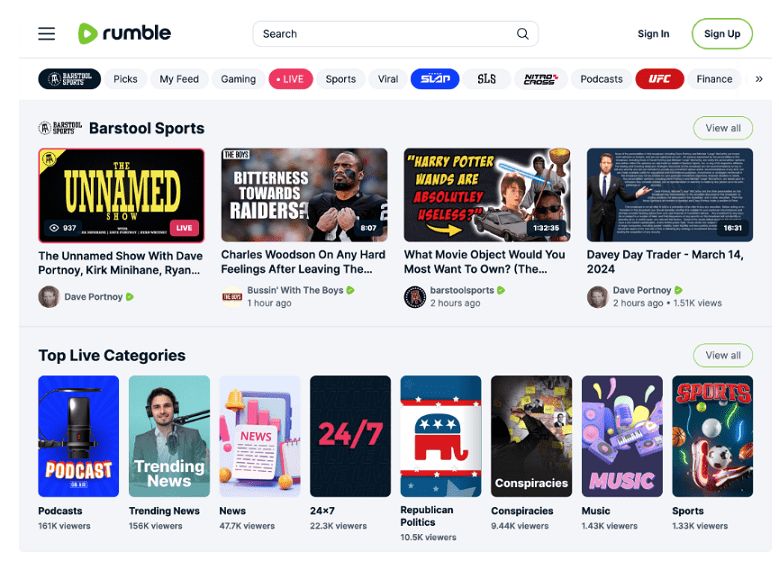
Watching videos on Rumble and YouTube is a very similar experience. The user interface appears to be almost the same as YouTube. The YouTube similarities are striking.

Additionally, Rumble operates on their own server. While this does translate to slower server speeds, they can still provide a great user experience when hosting live streams. This is imperative for gamers and other types of influencers. If live streams are a major part of your content strategy, Rumble could be a great platform for you to try.

Rumble also takes additional measures to help creators target their audience. This includes customized tags and a streamlined process to upload videos. If audience targeting and an easy upload process are important to you, Rumble could be your platform.

YOUTUBE VS. RUMBLE: COMPARING AUDIENCES

How do audience size and engagement compare Rumble and YouTube? This is a major part of deciding which platform to upload videos to and spend your precious time on.

AUDIENCES ON YOUTUBE

One of the key differences when comparing YouTube vs Rumble is the audience size on each video platform. When you look at the most visited websites worldwide, YouTube consistently ranks in the top two positions.

YouTube has a vast user base with billions of users on its video platform. When comparing YouTube vs Rumble, YouTube remains superior regarding user base size and monthly active users.

VIEWERSHIP ON RUMBLE

Rumble has a significantly smaller user base than YouTube. However, this can entice new creators because they can grow on the platform. After all, it becomes too big. The earlier you join new video platforms. You can become one of those larger creators because there’s less competition.

The platform’s main goal is to lift up smaller and newer creators with an edgy or alternative viewpoint. The platform likes content that goes against mainstream opinions and views. This can potentially translate into a viewership that’s looking for a specific type of content that may or may not align with what you’re creating.

One of the best parts of Rumble being a newer platform is that you can upload your existing YouTube content and earn money immediately. If you want to earn more money as a creator, this is a great option.

COMPARING THE PROS AND CONS OF RUMBLE VS. YOUTUBE

We break down the key differences to consider when comparing Rumble vs. YouTube below.

YOUTUBE PROS AND CONS

PROS:

  • YouTube is one of the most visited websites in the world, so it offers a huge user base that large and small creators alike can tap into. YouTube has a significantly wider audience compared to Rumble.
  • YouTube offers a diverse range of content in its vast video library. Just how many videos are on YouTube? There’s so much content to choose from, including video essays, travel vlogs, tutorials, and so much more. Smaller channels can take advantage of the specific niches available to them.
  • YouTube offers a user-friendly experience that is easy to navigate. You don’t have to be highly experienced in video software to use the platform. YouTube also offers unmatched server speeds that are faster than Rumble’s.


CONS:

    • The downside to having a wider audience on YouTube is that it also means it’s more competitive as a content creator. You have to fight for attention against so many other creators and a large library of content for them to choose from.
    • Achieving YouTube monetization can feel like a difficult task to accomplish. They have strict monetization requirements that video creators must meet before earning money from the platform.
    • YouTube’s algorithm appears to prioritize larger channels in search results. This makes it harder for newer channels to receive organic search traffic from initial videos.
    • Some creators report being demonetized, receiving copyright claims, or even being banned from the platform entirely. YouTube’s policies allow them to demonetize and delete videos at their discretion without providing a reason.

RUMBLE PROS AND CONS

PROS:

  • The biggest pro to posting video content to Rumble is that the platform offers immediate monetization. Rumble also provides various options for monetization in addition to revenue share. Options include licensing, platform partnerships, and YouTube revenue.
  • Founded on promoting small creators, Rumble’s algorithm appears to promote small and large creators equally in organic search results. Between Rumble and YouTube, Rumble offers an alternative approach that can be beneficial to new vloggers.
  • Rumble offers security to its users by taking a strong stance against copyright infringement claims. Theoretically, being demonetized or banned from the platform is significantly less likely.
  • Rumble promotes itself as a safe haven for free speech, alternative viewpoints, and creators that go against the status quo.


CONS:

  • Rumble has a significantly smaller number of users compared to YouTube. Additionally, their alternative audience might not be your target audience. Due to its edgier reputation, your audience might not be spending time on Rumble yet.
  • As the Rumble platform continues to grow, the algorithm will most likely evolve over time. And this potential evolution brings a lot of unknowns.
  • Rumble has a slower server speed when compared to YouTube.

RUMBLE VS. YOUTUBE IN CONCLUSION

Ultimately, choosing between Rumble vs. YouTube comes down to your goals for your video content. Now that you have a breakdown of the differences and pros and cons, you can make an informed decision for your own channel.

By Katie DeWitt

Sourced from Niche Pursuits

By Luana Cantuarias Edited by: Laura Porecca

In today’s world, job security isn’t what it used to be. That’s where the gig economy comes in—it’s flexible and empowering, and it allows you to make extra cash.

There are many opportunities with income potential if you’re willing to think outside the box. But let’s be honest—juggling a side hustle with your full-time job or main gig is no walk in the park. You need the passion, discipline, and guts to pull it off. It’s not easy, but you can make that extra cash with hard work.

The Rise of the Gig Economy

Man working from home wearing trousers
Image Credit: Shutterstock.

A rapidly growing phenomenon, the gig economy is changing how we think about work. It’s a fresh approach that lets you be your boss, work on your own terms, and sometimes even make money online from your home. And the best part is that there are so many ways to make a side income!

Whether you’re a freelancer, part-timer, or independent contractor, the gig economy allows you to choose the type of work you want to do, when you feel like doing it, and how much you want to earn or if you are looking to make some extra money on the side. This way of working lets you take charge of your career and have a better work–life balance.

Below we’ve listed 30 easy side hustles, or gigs, that can provide you with passive income each month. Read on to find out how to start!

1. Freelancing in the Digital Age

Roman Samborskyi // Shutterstock

Are you creative? The digital realm is a fertile ground for freelancers to earn some extra money online. With skills ranging from writing to coding, the internet is your oyster. Platforms like Upwork and Fiverr are gateways to a world where you can have the perfect side hustle.

By Luana Cantuarias 

Luana Cantuarias is a seasoned finance writer with a wealth of experience spanning over a decade in the dynamic fields of Blockchain, B2B, and SaaS. Her expertise lies in crafting compelling narratives that demystify complex financial concepts and empower readers to navigate the ever-evolving landscape of personal finance and technology.

Edited by: Laura Porecca

Sourced from FWO

By Kanishka Kumawat

The Most Profitable and Engaging Newsletter Topics

Table of Contents

When was the last time you eagerly awaited a newsletter?

Chances are, it spoke directly to your interests, needs, and persona.

But as someone thinking about starting a newsletter, how do you create a newsletter that people will want to read?

How do you find that special topic that ignites your audience’s passion and is still profitable?

A newsletter that tries to be everything to everyone often resonates with no one. The key lies in finding your niche. Newsletters focusing on specific content have a 16% higher open rate and a 21% higher click-through rate than more generic ones.

And with the right platform, this becomes a lot easier. For example, beehiiv has a user-friendly interface and powerful tools to help you grow and engage your audience and eventually monetize your newsletter.

We’ll delve into the best newsletter niches for 2024, offering insights on selecting a niche that aligns with your interests and appeals to your target audience.

We’ll also share tips on effectively using beehiiv to maximize your newsletter’s impact.

Benefits Of Targeting A Specific Audience

A report from Twilio in 2022 shows that 62% of people will stop caring about a brand if it doesn’t offer them something that feels personal.

You’re likely to resonate with your audience by tailoring your content to a specific group. This relevance leads to higher engagement rates, as readers find the content more interesting and pertinent to their needs and interests.

The newsletter space today is a numbers game.

Imagine you have a newsletter focused on sustainable living and eco-friendly products. Your audience comprises environmentally conscious individuals actively seeking ways to reduce their carbon footprint.

Suppose you decide to promote a new eco-friendly home cleaning product, either as an advertisement for another brand or as part of your own product line.

Since your audience is already interested in sustainability, the cleaning product aligns perfectly with their interests. This relevance makes them more likely to read about the product, engage with the content, and consider it seriously.

Apart from increased engagement, here are some other benefits of a specific niche newsletter.

  • Authority and Expertise: When you consistently deliver content within a specific niche, you establish yourself as an authority. This expertise attracts new subscribers who are seeking credible information and advice.
  • Higher Quality Leads for Advertisers: If you want to monetize your newsletter through advertising, a niche audience is more attractive to certain advertisers. These advertisers often pay a premium for access to a highly engaged and targeted audience.
  • Long-term Subscriber Retention: Readers who subscribe to a newsletter that consistently provides value in their area of interest are more likely to remain loyal subscribers over the long term. This reduces churn and increases the lifetime value of each subscriber.

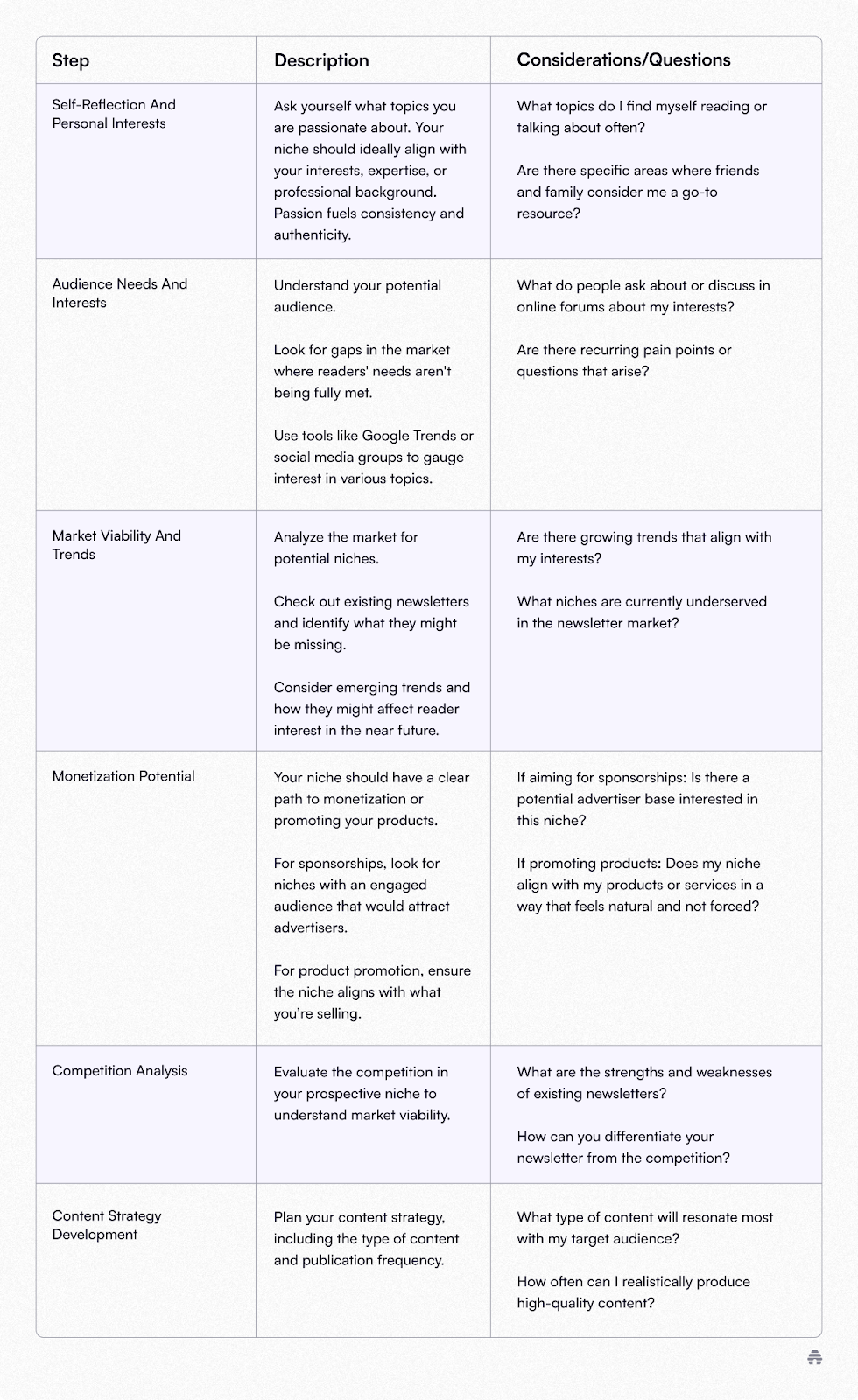
Step-By-Step Guide On Identifying A Perfect Newsletter Niche

Before we get to the best newsletter niche, we want to show you how to identify a niche for yourself.

Like building a niche site, finding the perfect niche for your newsletter is critical in establishing a successful and engaging publication.

The process involves a mix of self-reflection, market research, and strategic planning. Here’s a detailed step-by-step guide to help you identify your ideal newsletter niche.

Best Newsletter Niches in 2024

Now, before fully committing, test your concept. Start with a small group of subscribers and gather feedback. Be prepared to iterate based on what you learn. Key actions include:

  • Send out pilot editions and solicit feedback. At beehiiv, we have a Feedback Survey feature that lets you get feedback from your newsletter audience.
  • Be flexible and ready to adjust your niche or approach based on subscriber responses.

The Best Profitable Newsletter Niche Ideas

These choices are rooted in carefully analysing market trends, audience engagement levels, and monetization opportunities.

We’ve also considered the evolving interests and behaviours of online audiences.

We also factored in the versatility of these niches to accommodate different content formats and monetization strategies, whether through sponsorships, product sales, or affiliate marketing.

1. Finance and Investing

According to a report by Research and Markets, the global financial services market size was valued at $23,328.73 billion in 2021 and is expected to expand at a compound annual growth rate (CAGR) of 7.4% from 2022 to 2030.

Best Newsletter Niches in 2024

Global financial market services market growth rate

So, people are inherently interested in managing their finances and growing their wealth. This interest translates into a dedicated readership seeking expert advice and insights.

This niche also allows for diverse content formats, including market analysis, investment tips, personal finance advice, interviews with industry experts, and explanations of complex financial concepts.

Such versatility keeps the content fresh and engaging and caters to a wide range of audience segments, from beginners to seasoned investors.

What are the monetization strategies for this niche?

  • Sponsorships from financial institutions
  • Affiliate marketing for financial tools and products
  • Premium subscription models for exclusive insights

2. Technology Newsletters

Technology impacts nearly every aspect of modern life, ensuring a consistently high interest and engagement among readers.

People always want to understand the latest gadgets, software updates, or tech industry dynamics.

For example, Samsung will be releasing their flagship phones powered by AI this year, and many people are looking to get updated on the release and later reviews.

You can monetize these technology newsletters through various channels. This includes sponsorships from tech companies, affiliate marketing for gadgets and software, and paid subscriptions for in-depth analysis or exclusive content.

According to a report by Campaign Monitor, the IT/Tech/Software industry has an average open rate of 22.7% and a click-through rate of 2.

0%, so you’re sure to get a lot of viewership.

The Soulful Entrepreneur is a great example of a successful newsletter in the tech ecosystem made with beehiiv.

Best Newsletter Niches in 2024

3. Parenting Newsletters

Parenting is an evergreen and highly relatable topic, making parenting newsletters a lucrative niche.

The challenges and joys of parenting are universal yet constantly evolving with societal changes.

Pew Research data shows that 66% of U.S. parents state parenting is harder today than 20 years ago, largely due to technological advancements like social media and smartphones. This shows a clear demand for guidance and support in this area.

Your newsletter can focus on offering solutions and advice for contemporary parenting issues, such as:

  • Managing screen time
  • Navigating online safety
  • Balancing digital and real-life interactions

Collaborate with child psychologists, educators, and experienced parents to provide a well-rounded perspective on various parenting topics.

You can also offer premium content, such as in-depth guides, exclusive interviews, or early access to events, for subscribers who pay a fee.

As your newsletter grows, consider covering broader aspects of parenting, like education choices, nutritional advice, or developmental milestones for different age groups.

4. Health & Wellness Newsletters

This should be higher on the list, right? Yes.

This niche allows exploration of various topics like dietary advice, exercise routines, mental health strategies, wellness trends, and holistic health approaches, catering to a wide range of reader interests.

For example, focusing on mental health within the health and wellness niche is timely and resonates deeply with current global trends.

There has been an increasing recognition of the importance of mental health, partly accelerated by the COVID-19 pandemic.

You can cover topics like managing stress and anxiety, mindfulness practices, tips for improving mental health, interviews with mental health professionals, and personal stories of overcoming mental challenges.

While the health and wellness niche offers immense potential, it’s important to approach it with certain caveats in mind:

  • Responsibility and Accuracy: Given the sensitivity and importance of health-related information, ensure that your content is accurate, well-researched, and responsibly presented. Misinformation can have serious consequences, so always verify facts and, if possible, consult with health professionals.
  • Regulatory Compliance: Depending on the content, health newsletters may need to adhere to specific regulations or guidelines, such as those concerning medical advice or data privacy (HIPAA in the U.S., for example).
  • Sensitive Topics: Some health topics might be sensitive or trigger emotional responses. It’s important to handle such topics with empathy and discretion.

5. Conspiracy Theories & Alternative Beliefs

If you’re a person who likes to try things out of the ordinary, the niche of conspiracy theories and alternative beliefs is a unique and intriguing one.

While this niche can be fascinating and engaging, it’s important to approach it responsibly.

Your newsletter can delve into various conspiracy theories, historical mysteries, and unexplained phenomena, attracting curious readers about such subjects.

But given the sensitive nature of conspiracy theories and alternative beliefs, approach these topics responsibly.

Avoid spreading misinformation and always aim to provide well-researched, balanced viewpoints. Don’t be extreme.

Be mindful of the potential impact of your content on public opinion and individual beliefs. Distinguish between presenting alternative perspectives and endorsing unfounded claims.

Monetization opportunities for this niche include:

  • Sponsored content and affiliate marketing related to books, documentaries, or events focusing on alternative beliefs and historical mysteries.
  • Exclusive member-only content for subscribers who want in-depth analysis or early access to new theories or findings.

6. B2B (Business-to-Business) Newsletters

B2B newsletters are a specialized form of communication in the business world, targeting an audience of business professionals, decision-makers, and industry leaders.

These newsletters share industry-specific information, insights, and thought leadership.

They aim to foster a professional community, provide valuable content, and facilitate business growth and networking.

An example is the Marketing Brew newsletter by Morning Brew. This newsletter targets marketing professionals, offering the latest news, trends, and strategies in the world of marketing, with a focus on providing actionable insights.

Best Newsletter Niches in 2024

In your B2B newsletter, you can delve deeply into market analysis, technological advancements, industry best practices, and leadership strategies.

Here, you provide value through expert insights and well-researched information.

Your newsletter can influence key business decisions. By providing high-quality content, you position yourself as a thought leader, and your newsletter becomes a go-to resource for industry professionals.

To monetize a B2B newsletter, use these strategies:

  • Partner with companies whose products or services align with your audience’s interests. You can offer to feature their content or ads in your newsletter.
  • Offer a tiered subscription model. A basic subscription could be free, while a premium subscription could offer exclusive content like in-depth reports, personalized analyses, or access to industry events and webinars.
  • Leverage your expertise and the authority built through your newsletter to offer consulting services.
  • Build relationships with other businesses in your field. You might co-create content, conduct joint webinars, or collaborate on research projects, which can be monetized.

7. AI Newsletters

The AI industry is rapidly expanding from an estimated $86.9 billion in 2022 to a projected $407 billion by 2027. This is evidence of escalating interest in AI technologies.

Your AI newsletter can cater to this rising curiosity, providing insights and analyses on AI’s growth.

The audience in this niche is broad and varied. It includes AI professionals working in the field, researchers exploring new frontiers in AI, students seeking knowledge and career opportunities, and tech enthusiasts fascinated by AI’s potential.

Your content can be tailored to address the interests and informational needs of this diverse group.

To monetize, collaborate with companies that offer AI software, tools, and applications. By including affiliate links in your newsletter, you can earn commissions on sales made through these links.

This strategy generates revenue and directly provides your readers access to valuable AI resources.

Also, given the interest in AI, many companies in this domain might be interested in sponsoring sections of your newsletter or placing ads. These could be companies selling AI products, providing AI services, or hosting AI-related events.

The key is to partner with brands that align with your audience’s interests.

Success Stories of Niche Newsletters

By focusing on a particular area of interest, authors have managed to carve out unique spaces.

Their achievements highlight how understanding and catering to a defined audience’s specific needs and interests can lead to impressive results in subscriber growth and revenue generation.

1. The Brink Newsletter

When Marcus Ramsey, an e-commerce SEO expert, decided to dive into the newsletter space at the start of 2023, he had his eyes set on the growing field of Artificial Intelligence (AI).

Launching The Brink on beehiiv, he ventured to provide valuable AI content.

In just over a month, The Brink got to over 14,000 subscribers. The newsletter offers a daily dose of AI news, exclusive stories from insiders, and a human touch that resonates with its readers.

It caters to a wide audience interested in AI, business, and technology, encapsulating complex topics into three-minute reads every morning. This format appeals to time-constrained professionals and anyone interested in AI advancements.

Marcus Ramsey’s journey is a good example for aspiring newsletter creators, particularly in niche markets like AI.

His success illustrates how a well-thought-out content strategy, combined with effective use of social media and lead magnets, can result in rapid growth and a strong, engaged subscriber base.

Haroon Choudery is another example of someone putting their knowledge to good use. You can read more about his success story here.

2. Gen-Z Basketball Newsletter

Best Newsletter Niches in 2024

When Cole and Cody Hock, co-founders of Enjoy Basketball, teamed up with Kenny Beecham, a prominent basketball thought leader, to launch a newsletter, they were stepping into the unknown.

Taking this bold step, the Enjoy Basketball newsletter experienced rapid growth. It got over 45,000 subscribers just one year after its launch on beehiiv in 2022.

They attribute the newsletter’s growth to its unique approach to basketball media.

Rather than focusing on the negative aspects of sports culture, Enjoy Basketball highlights the positivity and joy of the game. This fresh perspective is particularly appealing to Millennials and Gen-Z audiences.

How do they monetize this newsletter?

Cody and Cole have established valuable partnerships with brands like the NBA, Shopify, and NBCUniversal.

These partnerships and their e-commerce venture selling basketball-themed apparel have created a robust revenue stream.

Frequently Asked Questions

How Do I Identify Which Newsletter Niche Is Right for Me?

Consider your passions and expertise first. What topics do you find yourself constantly drawn to? What do you enjoy discussing or learning about? Next, research the market to see if there’s an audience interested in these topics. Look at online forums, social media groups, and existing newsletters to gauge interest and identify gaps your newsletter could fill.

Finally, consider the monetization potential and whether you can consistently produce content in this niche. The right niche should align with your interests, have a dedicated audience, and offer potential for growth and monetization.

What Are the Key Factors in Determining the Profitability of a Newsletter Niche?

The success of a newsletter depends on its audience’s interest and spending power, whether it offers something unique, and whether it can make money through ads or subscriptions. Keeping content fresh and looking at what similar newsletters are doing also helps it do well.

How Can I Gauge the Audience Size and Engagement in My Chosen Niche?

First, explore relevant groups, forums, and pages on platforms like Facebook, LinkedIn, Twitter, and Reddit. Look at the number of members and followers and the frequency and quality of interactions.

Then, use tools like Google Trends, SEMrush, or Ahrefs to research keywords related to your niche. High search volumes indicate a significant interest.

Also, analyse existing newsletters in your niche. Check their subscriber counts (if available), social media following, and engagement levels on their posts. In addition, user-generated content sites like Quora or specialized forums give insights into how many people are asking questions or discussing topics related to your niche.

Build Your Niche Newsletter using beehiiv

If you’re inspired by the success stories of niche newsletters like The Brink and Enjoy Basketball and are ready to embark on your newsletter journey, you can use beehiiv to get started.

beehiiv’s platform is designed for simplicity and ease of use, ensuring that even beginners can get their newsletters up and running quickly.

With beehiiv, you can access various monetization options like advertising, e-commerce integrations, and subscription models, making generating revenue from your content easier.

We also provide detailed analytics, helping you understand your audience better and make data-driven decisions to enhance engagement and growth.

Sign up for your free 30-day trial and begin crafting content that resonates, engages, and generates revenue.

By Kanishka Kumawat

Sourced from beehiiv Blog