Author

editor

Browsing

By Nate Nead

Search Engine Optimization (SEO) is the practice of increasing visibility and traffic to websites by improving their rank in search engine results pages.

While there are multiple time-consuming strategies utilized to improve SEO, sponsored links offer a more direct route by carrying websites’ targeted messages directly into the top portions of search engine results with ads created from certain keywords.

Though it can be beneficial, there has yet to be an agreed-upon consensus regarding its effectiveness for SEO improvement.

This blog post examines auditing sponsored links as one aspect of SEO management by covering overarching benefits and drawbacks, important factors to consider before lowing budget resources on paid search options, and alternate strategies that should also be carefully incorporated alongside out paid methods for improved organic ranking and reach overall.

Sponsored Links

Source

Sponsored links are displayed advertisements paying for prominent display on a search engine. They can take the form of either pay-per-click ads or flat rate fees and are placed separately from natural, organic search results with clearly designed headers.

In the link building realm, sponsored links are typically paid-for ads via a backlink that is (or should be) marked with a rel=”sponsored” tag.

Customers who click through sponsored link visits yield revenue to its creators while providing potential customers quick access to relevant content mentioned in the sponsored text link itself.

Companies relying on these timely linked pages typically experience faster acquisition of marketing leads, higher website viewership, and greater profitability from within their revenue streams gained though voluntary organic search means.

Differentiating sponsored links from organic search results

Sponsored links refer to online advertisements that appear on certain websites, usually displayed as a separate box of results below the natural search engine result pages (SERPs). They are identified by an accompanying notation or symbol stating they are an advertisement/sponsored link.

Ideally, sponsored links allow businesses and organizations to quickly present users with relevant solutions using keywords that match the interests or needs of the target consumers. In contrast, organic search engine results provide unbiased combinations of keyword matches based purely on relevancy algorithms unprompted by advertising efforts.

Popular platforms offering sponsored link opportunities

Sponsored links are advertisements that appear on search engine results pages alongside organic results. They can be differentiated from organic search engine rankings in a few ways.

Firstly, sponsored listings display visible extensions such as “Ad” and use language to identify them as paid promotions.

Secondly, sponsored links lead to paid content or promotional landing pages rather than traditional web pages with accumulated content.

Thirdly, depending on the platform utilized they may offer additional features such as increased size and more prominent placement. Finally, organic search ranks websites based on relevance to key phrases while sponsored listing allocations depend partially on chance and time intervals specific to buyer’s budget constraints.

Pros of Using Sponsored Links for SEO Enhancement

Source

Increased visibility and exposure

Sponsored links present a unique opportunity to greatly increase visibility and exposure for websites, brand names, products and services. When employed strategically on popular platforms such as Google AdWords, companies are able to position their best-performing content above organic search engine results that would otherwise appear lower in the search rankings.

Increased visibility, therefore, works towards achieving higher click-through rates from users either actively or passively searching online using relevant keywords embraced through PPC optimizations which work in unison with SEO factors.

Increased visibility subsequently leads to boosted performance levels as well as enhanced reach throughout varying networks ensuring brands remain highly visible and tangible across multiple channels of communication.

Potential for targeted audience reach

Sponsored links allow businesses to develop a targeted campaign with specific messaging that prioritizes connections with users that would most likely show active interest in the product or service. Advertisers can target their audience based on location, habits and other attributes through sophisticated targeting options available through sponsored link campaigns.

Having an accurate advertising strategy helps to make sure certain messages are sent to only relevant audience and ads are intelligently displayed at opportune moments resulting in more predictive responses from customers.

In addition, by ensuring detailed targeting of ads potentially time-consuming manual labour required can be reduced significantly while simultaneously enhancing marketing results with various budgets.

Accelerated traffic generation

Sponsored links offer the potential to drive accelerated traffic generation, especially when it relates to targeting more specific audiences. Unlike organic long-term getting techniques like regular SEO strategies, sponsored link visibility can be achieved instantly with faster and direct results.

Additionally, clear direction is offered using location settings or advanced keyword searches which allows for a controlled influx of user volume. Through this method, advertisers are able to reach out to their ideal demographic group in real time with quick effective timing since many people are now online actively searching and browsing.

Improved brand recognition and authority

Sponsored links provide an excellent opportunity to leverage brand recognition and authority on a search engine. As noted by SEO experts, branded queries are great opportunities to generate leads and enhance conversion rates.

When done correctly with knowledge of keyword and marketing research, daily budget and market insights, sponsored links can often yield positive results that help businesses have higher SERP visibility via organic spot as well as get own share in the pricey paid search auction while competing against other bidder’s money bids for relevant keywords slots.

Cons of Utilizing Sponsored Links for SEO Improvement

Source

Cost considerations and budget constraints

When considering using sponsored links to improve SEO, cost considerations and budget constraints are key detriments. Utilizing sponsored link campaigns for SEO improvement requires substantial upfront costs as well as ongoing campaign maintenance fees which can quickly add up.

Additionally, industries with entrenched players tend to have much larger marketing budgets dedicated to paid advertising than smaller businesses due to the costly nature of performance bidding.

Cost is a particularly important factor to consider for digital marketing campaigns since insufficient funds due can result in ineffective initiatives leading to little-to-no return on investment.

Risk of dependency on paid advertising

Sponsored links are expensive and one could suffer from decreased ROI if their SEO requires extensive utilization of such services.

As more of the marketing budget is poured in sponsored links, it runs the risk of becoming a dependency that can become hard to sustain over time.

This may also cause an interruption in search presence for certain keyword queries when campaigns are paused due to Budget constraints, costing further organic visibility for SEO optimizations.

Ethical implications and potential negative user perception

Sponsored links can create ethical implications if utilized in a dishonest or misleading way. The use of sponsored links to promote or offer information, products, or services that may not align with the mission and values of an organization or brand might be viewed as deceptive.

Selling links as a service is also cheapened when sponsored links are involved.

Furthermore, consumers could develop negative perceptions about these practices, which could compromise their trust in the company promoting them. Sponsored links should never outshine appropriate organic SEO techniques as users value higher quality online content even more than visibility alone.

Uncertain long-term impact on organic search rankings

Sponsored links can provide short-term gains with increased traffic and improved brand visibility. However, the long-term impacts of relying heavily on sponsored links may be an issue to take into consideration.

Google algorithmologies are constantly changing and some major algorithm updates have resulted in a loss of organic search ranking for specific websites. It is difficult to predict future changes which could affected paid search performance, causing sites that rely heavily upon sponsored links for SEO improvement to see substantially reduced results.

Factors to Consider Before Employing Sponsored Links

Comprehensive analysis of SEO goals and strategy

Before beginning to use sponsored links for SEO goals, it’s essential to do a comprehensive analysis of the strategy in place. Start by evaluating existing content and appearing on how relevant and useful it is to the audience or demographic likely to answer your ad.

Furthermore, you need to predict possible outcomes of using sponsored links and make sure they would support the overall SEO goal through certain metrics such as website lead generation rate aimed activity increase after this channel implementation.

Evaluation of available budget and cost-effectiveness

When deciding to use sponsored links for SEO enhancement, it’s important to evaluate the available budget as well as cost-effectiveness. Knowing how much money can be allocated for Ads will help determine if managing a sponsored link campaign is feasible.

It’s also important to analyse how effective different channels and platforms are performance-wise in order to optimize the impact of each individual chosen Ad and maximize conversions given a specific budget.

Last but not least, ROI (Return on Investment) should be optimized from sponsored link campaigns – can enough money be earned back from sales or merely from brand recognition? Taking all these factors into account before opting in will save time, resources and provide better long-term effects from employing Sponsored Links.

Researching target audience and platform compatibility

Researching target audience and platform compatibility is an important factor to consider before employing sponsored links in enhancing your SEO performance. Understanding the needs, interests, and demographics of your visitors can help you determine where and how to best invest in sponsored links.

You should also research the platforms that offer sponsored link opportunities; learn what types of content formats they support, geographic availability and other technical requirements that may be necessary for each channel.

Balancing sponsored links with organic SEO techniques

Before investing in sponsored links to improve SEO, it is important to assess whether your strategy includes the correct balance of organic and paid techniques. It’s recommended you create a outline of expectations, organic keyword targets, and current performance gaps in order to focus on utilizing an optimal combination of both options.

To optimize performance outcomes, sites should connect their sponsored link campaigns with website analytics and measure perceived value versus costs accurately across ongoing goals. This data enables business improvements and adjustments so that a venue can consider making continual refinements going forward and achieve maximum promotional success.

 Alternatives to Sponsored Links for SEO Enhancement

On-page optimization and content quality improvement

Source

On-page optimization and content quality improvement are essential alternative strategies to sponsored links when it comes to SEO enhancement.

On-page optimization involves in-depth keyword research and the application of those keywords throughout the website (title tags, headlines, etc.) for better indexing by search engines.

Quality content is also important in that it communicates information effectively to users without looking spammy or automated and keeps them engaged over time. These methods do take longer than sponsored links but improve credibility with organic rankings in the long run.

Building high-quality backlinks

Building high-quality backlinks is an effective alternative to sponsored links that can be utilized for SEO enhancement. Backlinking helps send direct traffic to your website and sours further credibility with search engine algorithms improving rankings over time.

A mix of strong anchor texts, trusted sources, targeted audiences and varied link types should all be addressed when creating a successful backlink strategy. Additionally, finding internal link opportunities allows your own web pages to benefit from the increased SEO boost providing a more efficient use of time and resources.

Utilizing social media platforms and influencer collaborations

Using social media platforms for SEO enhancement means creating, sharing, and monitoring content. This includes optimizing website hierarchies with keyword placement, link building from quality external sources, and providing thoughtful posts and commentary – including the engagement of influencers.

Influencer collaborations open up entirely new channels for businesses to tap circles that were otherwise inaccessible or achieved with difficulties.

From organic reach among commenters on relevant feeds to actively timed sponsored posts related to the services a business has on offer – leveraging relationships between real people adds credibility and gold-lined star power that is tremendously useful when seeking potential customers’ attention away from paid advertising routes.

Conclusion

Depending on individual goals and strategy, sponsored links can be a very useful tool for SEO improvement if used correctly. Advantages include increased visibility and reach, accelerated traffic growth, enhanced brand recognition, etc.

However, such benefits have to be considered in the context of budget constraints/cost-effectiveness and ethical concerns. Therefore, an effective evaluation of available options is necessary before determining whether the use of sponsored links is worthwhile for any given SEO project in question.

By Nate Nead

Nate Nead is the CEO & Managing Member of Nead, LLC, a consulting company that provides strategic advisory services across multiple disciplines including finance, marketing and software development. For over a decade Nate had provided strategic guidance on M&A, capital procurement, technology and marketing solutions for some of the most well-known online brands. He and his team advise Fortune 500 and SMB clients alike. The team is based in Seattle, Washington; El Paso, Texas and West Palm Beach, Florida.

Sourced from readwrite


By Dawit Habtemariam

Destination marketing organizations are gaining followers fast. Now, they have to figure out what actual value Threads can bring to their marketing.

Destination marketing organizations are rushing to join Meta’s Threads: Destination Toronto, Visit Orlando, Visit Utah, Myrtle Beach, Fort Myers and many others have already signed up for the direct competitor to Twitter.

Because Meta owns Facebook and Instagram, these destinations have been able to grow their audiences quickly. Users login to Threads with their Instagram accounts and automatically follow the same people they follow on Instagram.

“We’re at about 10,000 right now. I would say a good 80% of that happened over the weekend,” said Paula Port, Destination Toronto‘s vice president of marketing. Visit Orlando has over 32,000 followers.

Instagram has over 1 billion monthly users worldwide, according to Insider Intelligence.

So far, posting activity on Threads by these groups is uneven. Some haven’t posted anything while others like Visit Orlando have been posting daily.

Threads doesn’t offer advertising at the moment, according to the Wall Street Journal. Facebook, Instagram, Pinterest and TikTok are the top spenders on social media advertising.

Destinations have been devoting fewer resources to Twitter. A new problem for Twitter has been the new blue check verification process, which requires a subscription. “We just kind of gone back and forth on what’s the value that we’re seeing there and it seems very unpredictable,” said  Utah Office of Tourism Director of Marketing and Communication Ben Cook.

Destinations haven’t developed a strategy for marketing on Threads. Destination Toronto hasn’t posted much and is reusing the text-based strategy and repurposing content it uses for Twitter. Utah is experimenting with a more humorous voice.


“There is not a huge lift and we’re not going to put a lot of time into developing a huge strategy until we just sort of see where it goes,” said Cook. Audience engagement on the platform looks good so far, he said.

What strategies destinations come up with for Threads depends on the platform’s evolution.

“It feels like it wants to be Twitter, but everyone from Instagram is there,” Port said. “Is Threads going to reduce our need for that news-driven content or is it going to be more like Instagram, which is more curated and has more of a visual aesthetic?”

Meta has not made Threads available in most European countries but hopes to in the near future, Tech Crunch reported.

By Dawit Habtemariam

Sourced from SKIFT

destination marketing, destination marketing organizations, instagram, social media, twitter,

By Chad S. White
Brands have two major levers they can pull to protect themselves from the negative effects of growing use of generative AI.

The Gist

  • AI disruption. Generative AI is set to disrupt SEO significantly.
  • Content shielding. Brands need strategies to protect their content from AI.
  • Direct relationships. Building strong direct relationships is key.

Do your customers trust your brand more than ChatGPT?

The answer to that question will determine which brands truly have credibility and authority in the years ahead and which do not.

Those who are more trustworthy than generative AI engines will:

  1. Be destinations for answer-seekers, generating strong direct traffic to their websites and robust app usage.
  2. Be able to build large first-party audiences via email, SMS, push and other channels.

Both of those will be critical for any brand wanting to insulate themselves from the search engine optimization (SEO) traffic loss that will be caused by generative AI.

The Threat to SEO

Despite racking up 100 million users just two months after launching — an all-time record — ChatGPT doesn’t appear to be having a noticeable impact on the many billions of searches that happen every day yet. However, it’s not hard to imagine it and other large language models (LLMs) taking a sizable bite out of search market share as they improve and become more reliable.

And improve they will. After all, Microsoft, Google and others are investing tens of billions of dollars into generative AI engines. Long dominating the search engine market, Google in particular is keenly aware of the enormous risk to its business, which is why it declared a Code Red and marshalled all available resources into AI development.

If you accept that generative AI will improve significantly over the next few years — and probably dramatically by the end of the decade — and therefore consumers will inevitability get more answers to their questions through zero-click engagements, which are already sizable, then it begs the question:

What should brands consider doing to maintain brand visibility and authority, as well as avoid losing value on the investments they’ve made in content?

Protective Measures From Negative Generative AI Effects

Brands have two major levers they can pull to protect themselves from the negative effects of growing use of generative AI.

1. Shielding Content From Generative AI Training

Major legal battles will be fought in the years ahead to clarify what rights copyright holders have in this new age and what still constitutes Fair Use. Content and social media platforms are likely to try to redefine the copyright landscape in their favour, amending their user agreements to give themselves more rights over the content that’s shared on their platforms.

A white robot hand holds a gavel above a sound block sitting on a wooden table.
Andrey Popov on Adobe Stock Photo

You can already see the split in how companies are deciding to proceed. For example, while Getty Images’ is suing Stable Diffusion over copyright violations in training its AI, Shutterstock is instead partnering with OpenAI, having decided that it has the right to sell its contributors’ content as training material to AI engines. Although Shutterstock says it doesn’t need to compensate its contributors, it has created a contributors fund to pay those whose works are used most by AI engines. It is also giving contributors the ability to opt out of having their content used as AI training material.

Since Google was permitted to scan and share copyrighted books without compensating authors, it’s entirely reasonable to assume that generative AI will also be allowed to use copyrighted works without agreements or compensation of copyright holders. So, content providers shouldn’t expect the law to protect them.

Given all of that, brands can protect themselves by:

  • Gating more of their web content, whether that’s behind paywalls, account logins or lead generation forms. Although there are disputes, both search and AI engines shouldn’t be crawling behind paywalls.
  • Releasing some content in password-protected PDFs. While web-hosted PDFs are crawlable, password-protected ones are not. Because consumers aren’t used to frequently encountering password-protected PDFs, some education would be necessary. Moreover, this approach would be most appropriate for your highest-value content.
  • Distributing more content via subscriber-exclusive channels, including email, push and print. Inboxes are considered privacy spaces, so crawling this content is already a no-no. While print publications like books have been scanned in the past by Google and others, smaller publications would likely be safe from scanning efforts.

In addition to those, hopefully brands will gain a noindex equivalent to tell companies not to train their large language models (LLMs) and other AI tools on the content of their webpages.

Of course, while shielding their content from external generative AI engines, brands could also deploy generative AI within their own sites as a way to help visitors and customers find the information they’re looking for. For most brands, this would be a welcome augmentation to their site search functionality.

2. Building Stronger Direct Relationships

While shielding your content is the defensive play, building your first-party audiences is the offensive play. Put another way, now that you’ve kept your valuable content out of the hands of generative AI engines, you need to get it into the hands of your target audience.

You do that by building out your subscription-based channels like email and push. On your email signup forms, highlight the exclusive nature of the content you’ll be sharing. If you’re going to be personalizing the content that you send, highlight that, too.

Brands have the opportunity to both turn their emails into personalized homepages for their subscribers, as well as to turn their subscribers’ inboxes into personalized search engines.

Email Marketing Reinvents Itself Again

Brands already have urgent reasons to build out their first-party audiences. One is the sunsetting of third-party cookies and the need for more customer data. Email marketing and loyalty programs, in particular, along with SMS, are great at collecting both zero-party data through preference centers and progressive profiling, as well as first-party data through channel engagement data.

Another is the increasingly evident dangers of building on the “rented land” of social media. For example, Facebook is slowly declining, Twitter has cut 80% of its staff to avoid bankruptcy as its value plunges, and TikTok faces growing bans around the world. Some are even claiming we’re witnessing the beginning of the end of the age of social media. I wouldn’t go that far, but brands certainly have lots of reasons to focus more on those channels they have much more control over, including the web, loyalty, SMS, and, of course, email.

So, the disruption of search engine optimization by generative AI is just providing another compelling reason to invest more into email programs, or to acquire them. It’s hard not to see this as just another case of email marketing reinventing itself and making itself more relevant to brands yet again.

Feature Image Credit: Andrey Popov on Adobe Stock Photo

By Chad S. White

Chad S. White is the author of four editions of Email Marketing Rules and Head of Research for Oracle Marketing Consulting, a global full-service digital marketing agency inside of Oracle. Connect with Chad S. White:  

Sourced from CMSWIRE

By Tina Zayas

Brands can create reliable revenue streams with the right affiliate marketing tools. Whether you’re a merchant or publisher, affiliate marketing is an excellent way to find success online.
Affiliate marketing is for everyone from mommy bloggers to mega brands. This win-win business model has grown to a $19B industry with more than 80% of online brands offering an affiliate marketing program. Naturally, affiliate marketing tools are increasingly being used to convert customers across the web. These tools can simplify workflows on both sides of the affiliate partnership and create trustworthy paths to purchase for shoppers.
The affiliate marketer’s toolbox should be equipped with marketing apps for SEO, email marketing, analytics, and content optimization. Whether you’re running a recipe blog or building a cutting-edge review site, you’ll need powerful marketing tools to reach your goals. Let’s explore eight tools you can start using today.

Best affiliate marketing tools for beginners and pros 2023

1. Post Affiliate Pro

Best overall affiliate marketing tool

Post Affiliate Pro

Post Affiliate Pro
Pros: Excellent integrations, Powerful tracking tools, Loaded with features
Cons: High learning curve, No social sharing, Expensive
Features: Advanced tracking links, affiliate management, integrated payments, marketing asset management
Cost: Plans starting at $129/mo
Post Affiliate Pro launched in 2004, a bonafide dinosaur in tech years. They are leaps and bounds more experienced in affiliate marketing than the competition and they’ve built a feature-packed platform to serve merchants. The platform hosts more than 30,000 customers worldwide and boasts 200+ integrations. Social sharing is notably absent from the tool but what it lacks there it makes up for in flexibility, enhanced tracking links, payment processing, and multi-level marketing options rebranded as Forced Tiers.
In Banner Manager, affiliate campaign assets are easily shared with publishers on the platform and banners come in all shapes and sizes. Empowering affiliates is one step and rewarding them is next. In Post Affiliate Pro merchants can award affiliates for all sorts of behaviors beyond just sales. Things like newsletter signups, registrations, and web traffic can all be monetized. There are also options for recurring commissions and split commissions between affiliates.
Read Post Affiliate Pro reviews from our community

2. Affiliate Corner

Best affiliate marketing tool for beginners

Affiliate Corner

Affiliate Corner
Pros: Database of affiliate programs, Advanced filtering, Search by earning potential, One-time access fee
Cons: No commission tracking features,
Features: Thousands of affiliate programs, SEO support, Trend data,
Cost: Starting at $149 for lifetime access
Affiliate marketing is a big, broad term. If you’re a beginner, it can be a lot of information to dig through to get started. Are you going to focus on tech, food, or the wide world of Amazon? Do you want to reach audiences on social media, buy Google ads, write SEO articles, or are you trying to be the next Wirecutter? Before you jump into making content, identify your niche with Affiliate Corner.
Affiliate Corner is not just another affiliate program database, but you’ll appreciate the search features to sift through 3000+ programs and 115+ niches. While it’s not the largest affiliate database, the pricing makes this option a winner. Pro users can unlock insights about how what makes each affiliate program unique, and you can easily filter by earning potential, average order value, and profession. You can also get access to trend data and SEO keyword research to give you a simple path to start promoting content and making sales. If you need additional support, you can make a one-time purchase to access their video course.
Read Affiliate Corner reviews from our community

3. Affilimate

Best affiliate marketing tool for commission tracking

Affilimate

Affilimate
Pros: Easy-to-use, Intuitive, Concierge onboarding experience
Cons: Price
Features: Heatmaps, Integrates with top affiliate networks, Aggregates all affiliate link data in one platform
Cost: Plans starting at $82/mo
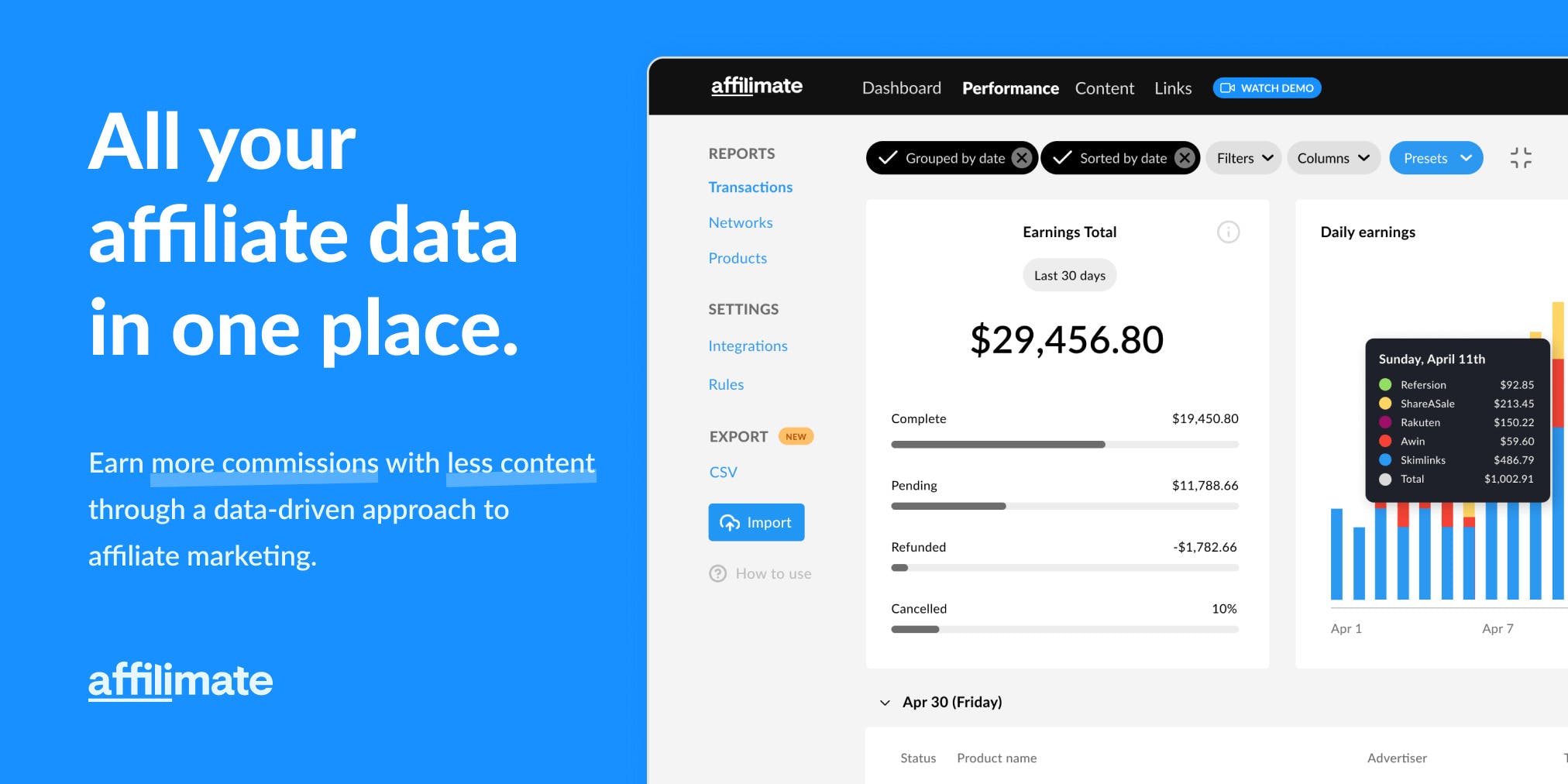
The list of affiliate marketing programs is growing every day, which means new opportunities to make money and promote a wide range of products. Affilimate knows that it can be messy to manage lots of different affiliate programs so they created a single clean dashboard to manage it all.
The tool integrates with 100+ affiliate networks to help affiliates visualize a complete overview of their campaign metrics. Eliminating this step in the program management process frees you up to focus on things that convert sales like digital marketing, content optimization, page SEO, and lead generation. The tool is packed with other features like content analytics, affiliate link management, revenue attribution, and revision monitoring.

4. Ahrefs

Best affiliate marketing tool for SEO

Ahrefs

Ahrefs
Pros: Large keyword and backlink database, Data filtering, User-friendly
Cons: Expensive, Plan limits with overage fees
Features: Keyword research, Site auditing, Backlink analysis, Rank monitoring
Cost: Plans start at $83/mo
Every website needs an SEO strategy in 2023, and affiliate sites are no exception. Ahrefs is a digital marketing and SEO tool that helps you rank higher and get more traffic. There is no free trial but the company offers a free Webmaster Tools account for website owners. The tool offers ranking monitoring, keyword tools, link building, and a backlink checker.
Ahrefs has one of the largest databases of live links which gives them a competitive edge on backlink checking. Ahrefs puts a heavy emphasis on competitive analysis and offers strategies to beat those competitors in search rankings. This is important for any business but especially so for affiliate sites when you’re competing with the brands and other affiliates trying to convert the same customers.
Read Ahrefs reviews from our community

5. Awin

Best affiliate network

Awin

Awin
Pros: Large affiliate and advertiser network, Advanced filtering, Easy-to-use dashboard
Cons: High learning curve, Long implementation, Sign-up fee
Features: Campaign management, Email marketing, Analytics, Social promotion
Cost: $50 per month
It’s easy to see why publishers flock to Awin to tap into its vast network of merchants and affiliate programs. Last year Awin affiliates earned a whopping $1.3B in commissions. Advertisers trust Awin to market their affiliate partnership opportunities to affiliates en masse. With more than 25,000 advertisers and 270,000 active affiliates, Awin is an obvious win for the best affiliate network. The platform is intuitive and easy to use and the support team is readily available to help users get set up. Publishers can easily find advertisers to work with and generate trackable links that are measured and reported in the analytics platform.

6. ThirstyAffiliates

Best affiliate plug-in

ThirstyAffiliates

ThirstyAffiliates
Pros: Easy link management, Automations, Amazon compliance tools
Cons: WordPress plug-in only
Features: Link cloaking, Auto-link keywords, Geolocation links,
Cost: Plans start at $199.50 per year
ThirstyAffiliates is an affiliate link management WordPress plug-in that gives you total control of your affiliate links. The tool allows you to cloak your links, protect yourself from commission hijacking, and easily insert your affiliate links throughout your blog posts. Link cloaking works by redirecting your unique URLs to different destination URLs.
Not only do cloaked links look pretty, but they are also more trustworthy to customers and have higher conversion rates. International audiences have a great experience with links due to automatic geolocation links serving up shoppable pages. Hello, geo-targeting! Links can also be easily uncloaked to comply with Amazon’s affiliate program rules. All in all, it’s an affordable tool that is great for WordPress websites looking to monetize their content.
Read ThirstyAffiliate reviews from our community

7. Unbounce

Best affiliate marketing tool for landing pages

Unbounce

Unbounce
Pros: Variety of eCommerce integrations, 100+ templates, clean interface, AI features
Cons: Costly, Limited control of page design, Difficult to manage multiple landing pages
Features: AI landing page builder, Integrations, A/B testing, Brand style guide
Cost: Plans start at $74/mo
Websites and landing pages have two key differences. Websites are designed for open exploration while landing pages give customers a compelling focus. Focus is especially important for affiliate marketing when you are driving traffic for a specific product or service.
Enter Unbounce, a gorgeous landing page builder packed with landing page templates, AI writing support, and plenty of other features to boost your digital marketing efforts. You can add pop-ups and sticky bars to your landing page, A/B test creative, and connect to eCommerce platforms like Shopify and WooCommerce. Smart traffic features can also help users understand how pages are performing and identify behavior patterns in as few as 50 site visits.
Read Unbounce reviews from our community

8. AnyTrack

Best affiliate marketing tool for tracking ads, referrals, and affiliates

AnyTrack

AnyTrack
Pros: Track conversion across platforms, One-click integrations, No coding skills required
Cons: Learning curve, Price
Features: ROAS tracking, One tag for all your conversions, Google Analytics and Facebook API
Cost: From $50 monthly
Slogging through a sea of data to drill down on your affiliate link campaigns is time-consuming and tedious. If you need a simpler option, no further than AnyTrack! This all-in-one conversion tracking platform is excellent at attribution and helps users make sense of marketing metrics.
With AnyTrack, you can track conversions across all your channels – Google Ads, Meta Ads, Bing Ads, and more. That means no more trying to piece together your marketing performance from multiple platforms. AnyTrack also offers automated conversion tracking, so you can quickly discover insights and use them to generate better content. Plus, with advanced attribution modeling, you’ll know exactly which campaigns and channels are driving the most conversions. It’s like having a personal data analyst right at your fingertips!
Read AnyTrack reviews from our community

What are the benefits of using affiliate marketing tools?

The affiliate marketing world is constantly growing. Upskilling and refreshing your toolset is a must if you want to stay ahead of the competition. The right tools can help automate and streamline many of the tedious and time-consuming tasks involved in managing an affiliate marketing program, freeing up time to focus on more strategic initiatives such as launching new marketing campaigns and finding new partners.
Whether it’s tracking and analyzing data, managing relationships with affiliates, or optimizing ad campaigns, there are a plethora of tools available on Product Hunt that can help marketers do their jobs more effectively. From comprehensive analytics platforms to powerful automation tools, the right affiliate marketing tools can help you save time, reduce costs, and ultimately drive more revenue for your business.


By Tina Zayas

Sourced from Product Hunt

By Jeff Bullas

How much content are we creating and publishing? Facebook users post 1.7 million pieces of content in 60 seconds, Instagram users share 95 million photos in 24 hours and Youtubers upload 720,000 hours of video.

That’s a lot of noise!

Why headlines matter

Because there is so much noise (content), capturing attention and holding reader engagement is a tough gig. And the importance of a great headline to capture eyeballs and clicks is more important than ever.

In a world of AI-driven content generation, the attention bar is going to get higher and harder and the content creation growth will be exponential.

Why are headlines important?

It’s simple.

The job of the headline is to get people to read the first line. The job of the second line is to get people to read the third line. And so on.

It’s all about holding engagement to realize the goals of the content and article.

The other reasons a headline is vital include the following:

  • Building brand awareness
  • Educating
  • To convert attention into a lead (a name and email address)
  • Or it could be to create trust and credibility
  • To start the journey to sell a product or a service
  • Or maybe just to entertain

Attention first and everything flows from that.

Next, you need to understand the power of using human emotions. Tap into the latest neuroscience and the psychology behind the art and science of headline writing.

Understanding the psychology of headlines

There are many emotions you need to use and experiment with when writing great headlines. Also, you need to understand that it is an imperfect science and you will need to have some fun and test and experiment.

As a writer, it is always satisfying to see the headline you write go viral. It is almost addictive and can lead to an almost obsessive attention-seeking behaviour.

Writing a great headline often involves tapping into fundamental emotional triggers that resonate with readers.

These triggers can spark curiosity, evoke emotions, and drive engagement.

7 key emotional triggers

Writing a great headline involves tapping into the following fundamental emotional triggers that resonate with readers:

  1. Curiosity: Curiosity is a powerful emotion that compels readers to click and learn more. Headlines that pose intriguing questions, tease a surprising revelation or offer a hint of the unknown can trigger curiosity and entice readers to engage further.
  2. Fear or Concern: Headlines that address readers’ fears or concerns can grab attention by tapping into their emotions. Highlighting potential risks, warning of common mistakes, or offering solutions to pressing problems can elicit a sense of urgency and prompt readers to seek answers.
  3. Desire for Improvement: People are constantly seeking ways to improve their lives, whether it’s achieving success, personal growth, or better relationships. Headlines that promise solutions, tips, or strategies for self-improvement appeal to the desire for progress and can attract readers who are actively seeking ways to enhance their lives.
  4. Emotional Appeal: Emotional triggers such as joy, awe, inspiration, or empathy can be highly effective in engaging readers. Headlines that evoke strong emotions by sharing heart-warming stories, inspirational achievements, or relatable experiences have a greater chance of capturing attention and resonating with readers on an emotional level.
  5. Exclusivity and FOMO (Fear of Missing Out): People have a natural inclination to be a part of exclusive or limited opportunities. Headlines that convey a sense of exclusivity, scarcity, or urgency can generate interest and create a fear of missing out. This trigger prompts readers to take action to avoid feeling left out.
  6. Surprise or Shock: Headlines that promise unexpected or shocking information have the potential to capture attention. By defying expectations or challenging common beliefs, these headlines pique curiosity and compel readers to explore further.
  7. Social Validation: Humans are social beings who seek validation and affirmation from others. Headlines that leverage social proof, testimonials, or expert endorsements can attract attention by tapping into readers’ desire for validation and credibility.

It’s important to use emotional triggers ethically and responsibly, ensuring that the content aligns with the promise made in the headline. Balancing emotional appeal with authenticity and value is key to creating compelling headlines that resonate with readers.

Crafting attention-grabbing headlines

So how do you start crafting these attention-grabbing headlines?

Well, we have already listed 7 emotional triggers. Now you need to find some words to help you create a strong hook to grab attention.

The words you need to have on your list for inspiration are called “Power Words”. You tap the emotional evoking powers that they elicit to get that initial attention.

What are “Power Words”?

In writing, the term “Power words” refers to words and phrases that carry strong emotional, persuasive, or attention-grabbing impact. These are words that evoke specific emotions, create vivid imagery, or convey a sense of urgency or importance.

Power words are carefully chosen to elicit a desired response from the reader and make the writing more compelling and engaging.

Here are 10 Power words to get you inspired:  

  1. Exclusive
  2. Sensational
  3. Revealing
  4. Proven
  5. Unveiled
  6. Unforgettable
  7. Ultimate
  8. Essential
  9. Surprising
  10. Revolutionary

Resources:

The importance of SEO in headline writing

We all love an instant hit of pleasure, and when headlines go viral that drives a ton of traffic in a short time.

But that is a short game.

If you can write an irresistible headline that is also optimized for search engines you can get traffic for years.

That’s the patience of a long game.

So…if you were wanting to follow just the logical and data-driven science of search engine optimization so that Google can find a keyword – then your headline could be very boring and lacking emotional triggers.

What is also needed is some spice to add to the science. That’s emotion.

What is the role of search engine optimization (SEO) in headline visibility?

To kick this off the answer is simple. You include the keyword in the headline and then wrap it in emotional triggers that tap human emotional drives, wants, and fears.

Let’s say we want to use the key search engine phrase “email marketing software” in a headline that still ticks the SEO technical requirements.

Here are some headlines that you could use that use emotion and the key phrase.

  • Unlock Success with Powerful Email Marketing Software Solutions
  • The Ultimate Guide to Email Marketing Software
  • The 10 Best Email Marketing Software Solutions to Boost Your Lead Generation

When conducting a search on Google the #1 ranked piece of content that came up in the first position was “The 6 Best Email Marketing Software of 2023

Something to keep in mind is that as well as being emotional Google does like “recency” and including an up-to-date piece of content is also a good SEO tactic that caters to Google’s algorithms.

How do you perform keyword research for headline optimization?

There are a few ways and it could be as simple as using ChatGPT to give you a good start and if you want to get more technical then platforms like SEMRush and AhRefs are two great tools that you could use.

What are some successful headline formulas that professionals use?

Headlines are one of the easiest marketing tactics to test. Over the decades they have been used in direct marketing, email marketing, viral headlines, YouTube videos, and on social media.

10 top headline formulas for your toolbox

  1. How-to Headline:
    • “How to [Achieve Desired Outcome] in [Specific Timeframe/Steps]”
  2. Listicle Headline:
    • “X [Benefit/Tip/Idea] to [Achieve Desired Outcome]”
  3. Question Headline:
    • “Are You [Desirable Outcome]? Here’s What You Need to Know”
  4. Problem-Solution Headline:
    • “Struggling with [Problem]? Discover the [Solution/Method] that Works”
  5. Secret/Revelation Headline:
    • “The Secret to [Desirable Outcome]: [Reveal/Discover] the [Method/Strategy]”
  6. Comparison Headline:
    • “[Option A] vs. [Option B]: Which is the Best for [Specific Outcome]?”
  7. Testimonial Headline:
    • “[Person/Brand] Shares How [Product/Service/Method] Transformed Their [Outcome]”
  8. Controversial Headline:
    • “The Shocking Truth About [Topic/Issue] Revealed”
  9. Curiosity Headline:
    • “Discover the [Number] Secrets to [Achieve Desired Outcome]”
  10. Command Headline:
    • “[Action Verb] Your Way to [Desirable Outcome]”

Examples of successful headlines and their underlying formulas

Case Study: “How I Made $100,000 in One Month: A Step-by-Step Guide”

Formula: It is a How-to Headline + Achievement + Specific Timeframe/Steps

Nothing like a headline combines the curiosity factor of a significant financial accomplishment (“$100,000”) with the promise of a detailed guide.

It appeals to readers looking for a specific outcome (“making money”) and provides a clear structure by offering a step-by-step approach.

Case Study: 20 Secrets to Living a Happier Life

Formula: Listicle Headline + Benefit/Idea + Desired Outcome

The power of a numbered list (“20 Secrets”) is always a link clicker.

It promises a positive emotional outcome (“happier life”) and taps into the desire for self-improvement. The headline format offers a clear structure and signals easy-to-digest content.

Case Study: “6 Weight Loss Myths — and What Really Works to Drop Pounds

Formula: Controversial Headline + Topic/Issue + Revealing/Debunking

Grabbing attention by challenging common beliefs (“The Truth About Weight Loss”) is a headline that should be used often.

It appeals to readers interested in weight loss and offers a promise of debunking myths. By creating controversy around a popular topic, this headline generates curiosity and prompts readers to engage.

Case Study: “How New Balance Drove 200% More Sales at Half the Cost Using Unbounce

Formula: Case Study/Testimonial Headline + Achievement + Product/Method

Leveraging the power of social proof and success by showcasing a specific achievement is a headline winner that taps emotional triggers.

It incorporates a real-life example to inspire readers and positions the featured product/method as the solution to achieving similar results.

Case Study: “The Surprising Link Between Sleep And Mental Health

Formula: Curiosity Headline + Surprising Link/Connection + Benefit/Outcome

This headline piques curiosity by highlighting a surprising connection between two seemingly unrelated topics (“Sleep and Productivity”). It suggests a valuable insight that can potentially improve readers’ lives and offers a compelling reason to explore further.

These case studies demonstrate how different headline formulas can be applied effectively to grab attention, generate curiosity, and provide value to the target audience.

Remember to adapt these formulas to your specific content and audience, and always ensure the headline accurately represents the underlying content.

Headlines for different media and content types

In the world before online video (pre-YouTube) and images (pre-Instagram) all we had to worry about was writing headlines for articles. Now we need to create headlines for different media.

This includes books, blog posts, and social media.

Here are five examples of potential great headlines for different types of content:

  1. Book Headline: “Unleashing the Power Within: A Journey of Self-Discovery and Personal Transformation”. This headline evokes curiosity and promises a transformative experience, enticing readers to explore the book’s contents.
  2. Blog Post Headline: “10 Proven Strategies to Boost Your Productivity and Conquer Your To-Do List”. This headline offers a clear benefit to the reader by promising practical strategies to enhance productivity, making it highly clickable.
  3. Social Media Content Headline: “Discover the Secrets of Mindful Living: Embrace Balance and Find Inner Peace” This headline appeals to the desire for personal growth and introduces the concept of mindfulness, generating interest and engagement on social media platforms.
  4. YouTube Video Headline: “Epic Travel Adventure: Exploring the Hidden Gems of [Destination]” This headline sparks excitement and curiosity, promising viewers an extraordinary travel experience while highlighting the specific destination.
  5. Another YouTube Video Headline: “Master the Art of Photography: Essential Tips for Capturing Breath-taking Moments” This headline offers valuable expertise and promises to enhance viewers’ photography skills, making it appealing to photography enthusiasts.

Remember, great headlines are tailored to the target audience, highlight a benefit or promise, and evoke emotions or curiosity.

Headline toolbox

ChatGPT uses Artificial intelligence and it is a good tool for writing headlines but it tends to be a bit too formulaic and predictable. It can be used but use it mainly for inspiration rather than as your “go-to” tool.

So…when I started writing headlines I kept a range of headline tools and resources at my fingertips to inspire me and sharpen my skills. It might seem overwhelming at first, but as you practice and learn they will start to become part of your writing fabric and skillset.

7 tools and resources for your headline toolbox

CoSchedule Headline Analyzer: This tool analyses your headline and provides feedback on its quality, word balance, length, and emotional appeal. It offers suggestions for improvement.

Portent’s Content Idea Generator: Generate some catchy and creative headline ideas based on a keyword or topic. It helps spark inspiration and offers unique headline suggestions.

BuzzSumo: BuzzSumo allows you to research popular headlines in your niche or industry. By analysing the most shared content, you can gain insights into headline trends and find inspiration for your own headlines.

Headline Smasher: Headline Smasher generates variations of your original headline, providing different phrasings and word choices to enhance its impact and effectiveness.

Emotional Marketing Value Headline Analyzer: This tool evaluates your headline’s emotional appeal and rates it based on the Emotional Marketing Value (EMV) score. It helps gauge how likely your headline is to resonate with readers on an emotional level.

HubSpot Blog Topic Generator: While primarily focused on generating blog post ideas, this tool can also provide headline suggestions. Just input a few relevant keywords, and it will generate topic ideas and headline prompts.

Copyblogger’s Magnetic Headlines: This resource provides a comprehensive guide to headline writing. It covers various headline formulas, techniques, and examples to help you craft compelling headlines.

Remember to use these tools and resources as aids in your headline creation process, but also rely on your own creativity and understanding of your target audience to develop unique and engaging headlines.

Action steps

Headlines are your biggest source of attention whether you are posting on social media, creating Youtube videos, launching a book, or trying to get some leads and build your email list.

Use the headline formulas, take some of the examples, and have some fun experimenting and testing headlines.

So, keep creating, publishing, and sharing your headlines. But most importantly, have some fun!

By Jeff Bullas

He is the owner of jeffbullas.com. Forbes calls him a top influencer of Chief Marketing Officers and the world’s top social marketing talent. Entrepreneur lists him among 50 online marketing influencers to watch. Inc.com has him on the list of 20 digital marketing experts to follow on Twitter. Oanalytica named him #1 Global Content Marketing Influencer. BizHUMM ranks him as the world’s #1 business blogger.

By Hannah Cranston 

Younger generations are buying from people they trust and who provide value — not brands. They are buying from thought leaders.

The term “thought leadership” has become the latest buzzword on the lips of industry experts and C-level executives alike. But what exactly is thought leadership, and why has it gained such popularity recently?

Customers are looking to founders, CEOs and other brand representatives to communicate expertise and their value proposition more than ever. In fact, almost one-third of GenZers report that they unfollow or block brand social media accounts weekly. But, 83% say they shop on social media and a whopping 97% report that social media is their top method for researching shopping options.

So what gives? Younger generations buy from *people* that they trust and who provide value, not brands. They are buying from thought leaders.

Thought leaders are individuals who not only possess expertise and knowledge but also possess the charisma and personality that captivate audiences. Establishing yourself as a thought leader is a sure fire way to elevate your brand and position yourself as an authority in your industry to drive engagement and ROI. It goes beyond being a subject matter expert and embraces the art of inspiring others, driving meaningful conversations and shaping the future of industries.

Thought leadership represents a shift from traditional expertise to a more holistic approach that combines knowledge, innovation and influence. So how do you get started?

Step 1: Establish your unique value proposition

Thought leadership starts with a laser-focused approach. Determine the niche or area of expertise where you can truly shine. Ask yourself: What unique perspective can I offer? What challenges can I address? Find your sweet spot, the intersection of your passion and expertise and stake your claim in that domain. Remember, it’s better to go an inch wide and a mile deep than to be a jack of all trades.

Step 2: Unleash your expertise

Once you establish your unique value proposition, study it inside and out. Become an expert in your niche, and I’m talking next-level knowledge. Stay on top of industry trends, devour the latest research and constantly challenge yourself to learn more. You want to be the go-to person, the one people turn to for guidance and insight. When you speak, people should feel the gravitational pull of your expertise.

Step 3: Craft your unique voice

Let’s talk about the secret sauce that sets thought leaders apart — your voice. The magic here is where your knowledge meets your personality. Are you witty? Sharp? Compassionate? Whatever it is, own it and let it shine through in everything you do. Inject your unique flavour into your content, speeches and conversations. People will be drawn to your authenticity, and that’s how you build a loyal following.

Step 4: Get social!

In this digital age, your online presence is your stage. Embrace it. Show up and show out on social media. Amplify your message on platforms like LinkedIn, Twitter, Instagram and even TikTok. Share valuable content, engage with your audience and become a regular fixture in their feeds. Consistency is key. Create a content strategy that aligns with your niche and deliver quality content consistently to build trust and grow your following.

And hey, don’t be afraid to sprinkle in a little personality. A meme here, a GIF there — let your digital swagger shine. Remember, thought leaders aren’t just knowledgeable; they’re relatable too.

Step 5: Expand your reach with PR

Partnering with a PR agency is key to maximizing your thought leadership potential and expanding your influence. These experts will help you secure valuable media opportunities that can skyrocket your reach within the industry by publishing you in relevant industry trades, prestigious publications and authoritative platforms.

A good PR agency will help you craft compelling content, such as press releases, articles and op-eds, showcasing your unique insights. They’ll also assist you in securing speaking engagements at conferences and panel discussions while arranging guest blogging opportunities and interviews with influential figures. By harnessing the power of PR, you’ll amplify your voice, establish dominance and attract a wider audience, making a lasting impact as a thought leader.

Becoming a thought leader requires more than just expertise. It demands passion, dedication and a strong personal brand. By following these five essential steps, you can begin to pave your way to thought leadership success. So, take the leap, showcase your unique perspective, and inspire others with your expertise. The world is waiting for the next thought leader to emerge. Will it be you?

By Hannah Cranston 

Entrepreneur Leadership Network Contributor. Hannah Cranston is CEO of HCM, a PR & communications agency that helps changemakers share their story with the world. HCM’s clients have run for President, developed a TV series, created a YouTube channel with millions of followers, interviewed the top business leaders in the world, and gone viral!

Sourced from Entrepreneur

In an increasingly digital world where you can do almost anything online — from paying your bills to staying in touch with loved ones — snail mail is becoming less common. However, even if you’ve completely switched to online bank statements, you can still expect a mailbox full of frustrating junk mail.

In a popular Reddit post, one user shared a photo they titled “Important Mail vs. Junk Mail,” showing the pile of advertisements and flyers they received in the mail next to a smaller stack of relevant letters addressed directly to them.

Junk mail, also known as direct mail or marketing mail, is any unsolicited advertisements one may receive in the mail that they did not ask to receive.

This Redditor is one of millions of Americans who receive junk mail every year. Americans receive an estimated 41 pounds of junk mail annually, much to their annoyance.

Not only is junk mail a nuisance, but it’s also detrimental to the environment. An estimated 5.6 million tons of junk advertisements and fliers end up in landfills every year. TreeHugger reported that the planet-overheating carbon pollution created by junk mail each year is equal to the carbon pollution from about seven U.S. states combined.

Luckily, there are many ways to reduce the amount of junk you receive to spare your mailbox.

Websites like DMAchoice can help you opt out of junk mail from select companies. If you’re constantly receiving credit card offers, you can use OptOutPresceen.com to reject pre-screening mail for credit or insurance.

These steps can save you frustration and prevent loads of unopened catalogues from wasting away in a landfill.

Fellow Reddit users expressed their shared hatred for junk mail in the post’s comment section.

“Looks like my mail every day,” one user wrote. “It’s just so wasteful. I hate it.”

“Sometimes I only get junk mail, and I hate it,” another Redditor added.

Sourced from TCD the cool down

“There were days 50 years ago that I’m sure most brands were only focusing on male sports,” Mark Kirkham, the company’s CMO of international beverages, said. “If you want to be relevant for today, you can’t do that.”

Gatorade’s roster of sponsored athletes runs deep, and it started with the GOAT himself: Michael Jordan. The brand’s second athlete was Mia Hamm, who appeared alongside Jordan in a 1997 ad set to “Anything You Can Do (I Can Do Better),” where the two squared off in soccer, basketball, and other sports.

“We were putting, I believe for the first time, a female athlete at the same stature as, ultimately, the GOAT in basketball,” Mark Kirkham, CMO of international beverages at PepsiCo, told Marketing Brew.

Gatorade and PepsiCo were among the most active non-alcoholic beverage brands in women’s sports by number of sponsorships last year, according to SponsorUnited, with deals in the LPGA, WNBA, NWSL, and Australian women’s rugby league. The parent company did a total of 44 deals, per SponsorUnited, including 30 for Gatorade alone.

Within women’s soccer, Gatorade has continued to work with stars from Abby Wambach to Mallory Swanson. It partners with teams including Angel City FC and OL Reign, and also activates around the sport at a more grassroots level.

PepsiCo’s beverage division isn’t a sponsor of this year’s FIFA Women’s World Cup, which kicks off on July 20; Coca-Cola has been an official sponsor of the event since 1978 and has a standing partnership with FIFA through 2030.

Kirkham said PepsiCo and Gatorade are still deeply invested in soccer, including the women’s game. Ahead of this month’s World Cup, we talked to Kirkham about the company’s approach to women’s sports.

This interview has been edited for clarity and length.

How do you hold a brand accountable for maintaining a somewhat equal gender split in sponsorships? (Editor’s note: Figures regarding the breakdown between PepsiCo’s investments in men’s and women’s sports were not available.)

Taking an equal approach is about ensuring that you’re looking at the opportunity from a consumer standpoint…If your brand’s job and role is to elevate sports, fueling athletes in their sport, and the athletes are now much more diverse and much more equal, then you need to take that same investment. There were days 50 years ago that I’m sure most brands were only focusing on male sports. If you want to be relevant in sports today, you can’t do that. It’s not an equation.

Why is soccer such a focal point for Gatorade?

It’s the largest participation and the largest watched sport in the world. In the US, obviously, we have huge assets in the NFL, we have assets in hockey, baseball, it’s across almost all sports…Internationally, soccer is the focus, but you’re seeing more focus on soccer in the US. The last World Cup, the upcoming World Cup in the US, is obviously driving a lot more association there. The viewership of the Premier League, the performance of US players, both men and women—it’s just changing the role that [soccer] plays.

Gatorade is the most heavily invested in the sports world, but which other PepsiCo brands are engaging with women’s sports?

Pepsi was always known to create these amazing ads not officially associated with any major tournaments, with [David] Beckham and [Lionel] Messi, even 10, 15 years ago. We’ve always been able to tap into culture through storytelling through sport in a Pepsi way…Back in 2014, we started bringing women players into our storyline. We’ve had Lucy Bronze; we had Carli Lloyd in a Pepsi ad shot for international…So Pepsi would be the second…I think there’s a role that each brand can play.

Is there anything you can share about plans for the Women’s World Cup?

The US is a partner with them on the snack side, so there’s a relationship we have there…On the beverage side, we’re less involved…I do think what’s important is, if you’re getting involved in the women’s game, it needs to be more than just sponsoring one tournament or doing one campaign. I think that is probably the most crucial thing to anyone who wants to get into women’s sports commercially, because it becomes a blip. It becomes a one-off. It becomes not part of your long-term vision in sports…We’ve been investing in players and athletes, but it’s that combination of storytelling, investment in education, and particularly with Gatorade, tying it up with key partnerships, and using those partnerships to elevate the narrative. These partnerships have to be more than just about brand awareness. These partnerships have to be about building authentic narratives that can help amplify the women’s game.

Feature Image Credit: Screenshot via Gatorade/YouTube

By Alyssa Meyers

Sourced from Marketing Brew

By Ben Thompson

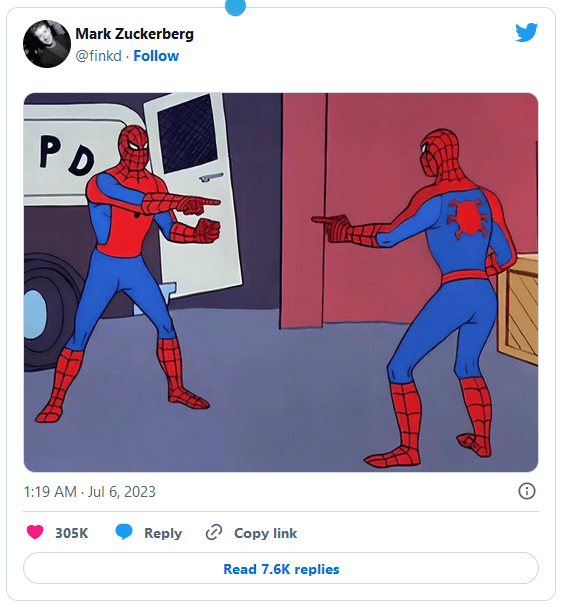
If you’re only going to tweet once every 11 years, then you better make it count; the best way to do just that is to pull off a :

This offering from Meta CEO Mark Zuckerberg works on multiple levels. The surface interpretation is obvious given the timing of the tweet, which was posted just hours after Meta launched Threads, a text-based social network built on top of the Instagram graph: Threads is a Twitter clone.

The scene from which the meme is derived, though, gets at what I think is really going on: the Spider-Man on the right is Charles Cameo, an imposter who uses disguises to steal art treasures. To extend the analogy, Threads looks like Twitter at first glance, but is in fact something much different — and what it is stealing is certainly what Elon Musk and Twitter have always wanted:

Zuck's comment on seizing Twitter's opportunity

The important takeaway is that all of the levels of the meme are connected: Threads looks like Twitter, but its essential differences are almost certainly table-stakes in being something larger than Twitter ever was. The question is if that treasure is itself a mirage.

The Social/Communications Map of 2013

Back in 2013 I created The Social/Communications Map:

A drawing of the Social/Communications Map

That map came out of an Article called The Multitudes of Social that argued that social media was not a single category destined to be won by a single app, and that Facebook could never “own social”:

The very idea of owning social is a fool’s errand. To be social is to be human, and to be human is, as Whitman wrote, to contain multitudes. Multitudes of apps, in my case…

Facebook needs to appreciate that their dominance of social on the PC was an artifact of the PC’s lack of mobility and limited application in day-to-day life. Smartphones are with us literally everywhere, and there is so much more within us than any one social network can capture.

The point about there being a multitude of ways to communicate online has held up well; I think, though, the axis about permanence versus ephemerality was less important than it seemed when the big battle was between Facebook and Snapchat. A better axis leans into the “SocialCommunications” aspect of the title: the most important new social networks of the last few years have been notable for not really being social networks at all.

I’m referring to the TikTok-ization of user-generated content: the reason why TikTok was such a blindspot for Facebook is that, unlike Snapchat, it doesn’t depend on network effects, but rather abundance. One of the first times I wrote about TikTok was in the context of Quibi, the failed mobile video app from Hollywood impresario Jeffrey Katzenberg:

The single most important fact about both movies and television is that they were defined by scarcity: there were only so many movies that would ever be made to fill only so many theater slots, and in the case of TV, there were only 24 hours in a day. That meant that there was significant value in being someone who could figure out what was going to be a hit before it was ever created, and then investing to make it so. That sort of selection and production is what Katzenberg and the rest of Hollywood have been doing for decades, and it’s understandable that Katzenberg thought he could apply the same formula to mobile.

Mobile, though, is defined by the Internet, which is to say it is defined by abundance…So it is on TikTok, or any other app with user-generated content. The goal is not to pick out the hits, but rather to attract as much content as possible, and then algorithmically boost whatever turns out to be good…The truth is that Katzenberg got a lot right: YouTube did have a vulnerability in terms of video content on mobile, in part because it was a product built for the desktop; TikTok, like Quibi, is unequivocally a mobile application. Unlike Quibi, though, it is also an entertainment entity predicated on Internet assumptions about abundance, not Hollywood assumptions about scarcity.

It’s ultimately a math question: are you more likely to find compelling content from the few hundred people in your social network, or from the millions of people posting on the service? The answer is obviously the latter, but that answer is only achievable if you have the means of discovering that compelling content, and, to be fair to both Facebook and Twitter, the sort of computational power necessary to pull off a TikTok-style network didn’t exist when those companies got started.

The Social/Communications Map of 2023

Set that point about time of origin aside just for a moment; here is what I think a better representation of the Social/Communications Map looks like in 2023:

The new structure for the Social/Communications Map

The first change is that the symmetric/asymmetric axis has been replaced by the nature of the sorting algorithm: chronological order versus algorithmic selection. However, this isn’t that big of a change; consider messaging, which is by definition about symmetric social networking. Messaging only really makes sense if it is organized by time — imagine trying to carry on a conversation if every message you saw were algorithmically selected, instead of simply displayed in order. Algorithmic sorting, though, makes much more sense when you are consuming content that is broadcast to the world, and thus has no assumptions about or expectations for in-order contextual replies.

The second change is the TikTok-ization I noted above: my new vertical axis is user-generated content, by which I mean content across the network, versus network-generated content, by which I mean content from the people you choose to follow. If you maintain the same public/private distinction I had in the original, you get a landscape that looks something like this (note that Facebook is better thought of as a private social network, given that the default nature of posts is that they are only seen by those in your network).

The starting position of social media companies in the 2023 Social/Communications Map

This is where the bit above about historical time comes in: another way to look at this map is as a representation of how content on the Internet has evolved; the early web, and early forms of user-generated content like forums and blogs, were and are still located in the upper left. This quadrant is fairly decentralized, and is Aggregated by Google and search.

The lower left quadrant came next: one site held all of the content from your network, and presented it chronologically. Some sites, like Twitter and Instagram, stayed here for years; Facebook, though, quickly jumped ahead to the lower right quadrant, and organized your feed algorithmically. This quadrant became the other major pillar of Internet advertising (along with search): figuring out what content to show you from your network wasn’t too dissimilar of a problem from figuring out what ads to show you, and the nature of a dynamically-generated feed that was unique to every individual was something that was only possible with digital media.

The final stage is, as noted, represented by TikTok: once again your network doesn’t matter, because the content comes from anywhere. This world, though, unlike the open web, is governed by the algorithm, not time or search.

Twitter, Threads, and the Upper-Right

I was honestly surprised to find out that both Twitter and Instagram were in the lower left quadrant until 2016; that is when both services started offering an algorithmic timeline. Of course the surprise for the two services ran in the opposite direction: for Twitter it’s amazing that the company managed to change anything at all, and for Instagram it’s a surprise the service stayed the same for so long. Since then Instagram has heavily invested in its direct messaging product even as it has slowly abandoned the public parts of the lower left: everything is an algorithm and, with Reels, completely disconnected from your network.

How services have expanded on the map over time

Perhaps the starkest change that Musk has made to Twitter, meanwhile, has been a headlong rush into the upper right: the “For You” tab is far more aggressive about promoting tweets from people you don’t follow, and it’s increasingly impossible to escape; the app always defaults to “For You”, and there are no more 3rd-party app alternatives. Eugene Wei argues this has blown up the timeline and ruined the Twitter experience:

What established the boundaries of Twitter? Two things primarily. The topology of its graph, and the timeline algorithm. The two are so entwined you could consider them to be a single item. The algorithm determines how the nodes of that graph interact. In a literal sense, Twitter has always just been whose tweets show up in your timeline and in what order.

In the modern world, machine learning algorithms that mediate who interacts with whom and how in social media feeds are, in essence, social institutions. When you change those algorithms you might as well be reconfiguring a city around a user while they sleep. And so, if you were to take control of such a community, with years of information accumulated inside its black box of an algorithm, the one thing you might recommend is not punching a hole in the side of that black box and inserting a grenade. So of course that seems to have been what the new management team did. By pushing everyone towards paid subscriptions and kneecapping distribution for accounts who don’t pay, by switching a TikTok style algorithm, new Twitter has redrawn the once stable “borders” of Twitter’s communities.

This new pay-to-play scheme may not have altered the lattice of the Twitter graph, but it has changed how the graph is interpreted. There’s little difference. My For You feed shows me less from people I follow, so my effective Twitter graph is diverging further and further from my literal graph. Each of us sits at the center of our Twitter graph like a spider in its web built out of follows and likes, with some empty space made of blocks and mutes. We can sense when the algorithm changes. Something changed. The web feels deadened.

I’ve never cared much about the presence or not of a blue check by a user’s name, but I do notice when tweets from people I follow make up a smaller and smaller percentage of my feed. It’s as if neighbors of years moved out from my block overnight, replaced by strangers who all came knocking on my front door carrying not a casserole but a tweetstorm about how to tune my ChatGPT and MidJourney prompts.

Instagram’s Evolution has shown that this shift is possible, but the shift has been systemic and gradual — and even then subject to occasionally intense pushback. Musk’s Twitter, though, has been haphazard and blistering in its pace. What ought to concern the company about Threads, though, is the possibility that all of the upheaval — which effectively sacrifices the niche Twitter had carved out amongst text nerds that dominate industries like media — will not actually result in the user growth Musk is hoping for, because Threads got there first.

Indeed, this map is the key to understanding why it is that Threads looks like Twitter, but is in fact a very different product: Threads is solidly planted in the upper right. When you log onto the app for the first time, your feed is populated by the algorithm; there is some context given by whom you follow on Instagram, but Meta seems aware that accounts you might want to look at may be different than accounts you want to hear from, and is thus filling the feeds with what it thinks you might find interesting. That is how it can provide an at-least-somewhat-compelling first-run experience to 100 million people in five days.

Twitter, on the other hand, faces the burden of millions having tried the service in past iterations and quickly deciding it wasn’t for them; even if the algorithm were effective, it may already be too late to gain new users, even as you sacrifice what the service’s existing users preferred.

The Threads Experiment

This leads to the biggest open question about Threads’ long-term prospects, and, by extension, Twitter’s: did those millions of abandoned Twitter users give up because text-based social networking just wasn’t that interesting to them, or because Twitter made it too hard to get started? I’ve made the case that it’s the former, which means that Threads is a grand experiment as to the validity of that thesis. If those 100 million users stay engaged (and if that number continues to grow), then the people chalking up Twitter’s inability to grow or monetize effectively to the company’s inability to execute are correct.

At the same time, as Wei notes, Musk’s tenure has highlighted the problems with doing too much: what if Twitter succeeded to the extent it did not despite management’s seeming ineffectiveness, but because of it?

I’ve written before in Status as a Service or The Network’s the Thing about how Twitter hit upon some narrow product-market fit despite itself. It has never seemed to understand why it worked for some people or what it wanted to be, and how those two were related, if at all. But in a twist of fate that is often more of a factor in finding product-market fit than most like to admit, Twitter’s indecisiveness protected it from itself. Social alchemy at some scale can be a mysterious thing. When you’re uncertain which knot is securing your body to the face of a mountain, it’s best not to start undoing any of them willy-nilly. Especially if, as I think was the case for Twitter, the knots were tied by someone else (in this case, the users of Twitter themselves).

Many of those knots are tied to that lower left quadrant: a predominantly time-based feed makes sense if a service is predominantly about “What is happening?”, to use Twitter’s long-time prompt; a graph based on who you choose to follow doesn’t just show what you want to see, it also controls what you don’t (Wei notes that this is a particularly hard problem for algorithmically generated feeds). Both qualities seem particularly pertinent for a medium (text) that is information dense and favored by people interested in harvesting information, a very different goal than looking to pass the time with an entertaining video or ten.

It follows, then, that Twitter’s best defense against Threads may be to retreat to that lower left corner: focus on what is happening now, from people you chose to follow. The problem, though, is that while this might win the battle against Threads, it means that Musk will have lost the war when it comes to ever making a return on his $44 billion. In truth, though, that war is already lost: Musk’s lurch for the upper right was probably the best path to reigniting user growth, but if that is the corner that matters then Threads will win.

Thread’s Chronological Timeline

The other question is if Threads will come for Twitter’s place on the map; Head of Instagram Adam Mosseri says that a chronological timeline is coming:

Adam Mosseri promising a chronological timeline

Placing this option in the context of Facebook and Instagram actually suggests that this feature won’t matter very much; both services make it hard to find, and revert back to the default algorithmic feed, and for good reason: users may say they want a chronological feed, but their revealed preference is the opposite. Instagram founders Kevin Systrom and Mike Krieger, who initially opposed algorithmic ranking in Instagram, told me in a Stratechery Interview:

Kevin Systrom: I remember thinking when the team was like, “We’re thinking of using machine learning to sort the Explore page,” I’m not even sure what they call it now, but basically the Explore page and I remember saying, “It just feels like that’s a bunch of hocus-pocus that won’t work. Or maybe it’ll work but you won’t really understand what it’s doing and you won’t fully understand the implications of it, so we should probably just keep it very simple.” I was so wrong and I only remember it because I was so wrong, but you asked about feed, Mike would probably give you his anecdote about feed. But on the Explore page I was very anti and then I think I became pro only once I saw what it could do. Not in terms of just usage metrics, but just the quality of what people were served compared to some of our heuristics before…

Mike Krieger: I’ll share a funny anecdote about the Explore experiment. Facebook has all these internal A/B testing tooling and we hooked into it and we ran our first machine learning on the Explore experiment and we filed a bug report and I’m like, “Hey, your tool isn’t working, that’s not reporting results here.” And they said, “No, the results are just so strong that they’re literally off the charts. The little bars that show it literally is over 200%, you just should ship this yesterday.” The data looked really good.

That noted, observe Mosseri’s stated goal for the app, as articulated to Alex Heath of The Verge:

I think success will be creating a vibrant community, particularly of creators, because I do think this sort of public space is really, even more than most other types of social networks, a place where a small number of people produce most of the content that most everyone consumes. So I think it’s really about creators more than it is about average folks who I think are much more there just to be entertained. I think [we want] a vibrant community of creators that’s really culturally relevant. It would be great if it gets really, really big, but I’m actually more interested in if it becomes culturally relevant and if it gets hundreds of millions of users. But we’ll see how it goes over the next couple of months or probably a couple of years.

“Culturally relevant” is the one game that Twitter has won, far more than Facebook, and arguably more than Instagram: Twitter drives national and international media coverage, from TV to newspapers, to an extent that drastically exceeds its monetization potential. Meta, meanwhile, has been content to provide social networking for the silent majority, making tons of money along the way. The best way to do that with text — if it is even possible — would be to stay in that upper right corner; cultural relevancy, though, is still in the bottom left, even if there aren’t nearly as many users, or money.

And, it must be noted, Twitter is vulnerable in its home territory; I’ve long argued that the importance of convenience in terms of app success is underrated (see Threads starting with your Instagram sign-in and network), but its hard to think of anything that might motivate users to make a change more than resolving cognitive dissonance. There is a sizable segment of that culturally relevant audience Mosseri wants to capture who are opposed to Musk, and yet can’t give up Twitter; I suspect that much of the outpouring of glee over Threads’ early success is from this cohort that wants nothing more than non-Musk Twitter.

Ultimately, though, I think they may be disappointed: Meta is about algorithms and scale, and I would bet that Threads will leave real time reactions, news, and pitched battles to Twitter; Musk’s most important decision may be accepting that that is enough, because it’s all he’s going to get.

By Ben Thompson

Sourced from STRATECHERY