Author

editor

Browsing

Sourced from Cryptopolitan

One of the hot topics this year is ChatGPT, an artificial intelligence technology hailed as a turning point in our lives and work. Keep up with the progress of the world.

One of the most noteworthy artificial intelligence innovations this year is the AI-Crypto Trading Bot ATPBot, which has won the reputation of “ChatGPT in the investment world” due to its integration of artificial intelligence technology and quantitative trading. It provides traders with superior asset trading performance beyond any other bot in the industry.

With its huge data processing and analysis capabilities, ATPBot is similar to ChatGPT’s natural language understanding and processing capabilities. It represents the efficient use of artificial intelligence in quantitative trading and empowers investors.

By utilizing data and algorithms to determine trade times and prices, ATPBot minimizes emotional interference and human error. Today, let us explore ATPBot together, discover the magical ability of this trading bot, and improve the efficiency and stability of quantitative trading.

What is ATPBot?

ATPBot is a platform focused on quantitative trading strategy development and services. It develops and implements quantitative trading strategies for its users with the advantages of AI technology.  ATPBot are intending to provide crypto investors with efficient and stable trading strategies.

By analyzing market data in real time and using natural language processing to extract valuable insights from news articles and other text-based data, ATPBot can quickly respond to changes in market conditions and make more profitable trades. Additionally, ATPBot uses deep learning algorithms to continually optimize its trading strategies, ensuring that they remain effective over time.

Comparing ATPBot with other trading bots

ATPBot boasts unique advantages compared to other trading bots in the market. Unlike many other trading bot platforms, which rely solely on predetermined parameters set by the trader, ATPBot adopts extensively tested and verified trading strategies. By conducting rigorous historical data analysis and market analysis, ATPBot has fine-tuned its strategies to minimize risk and losses while maximizing profits. This differs from other trading bots that have no control over the trading process and often lead to traders losing money.

Moreover, ATPBot eliminates the need for users to spend endless hours manually testing different parameters or acquiring expertise in charting and indicator operations. With ATPBot, users can rely on a reliable and mature trading bot that professionally manages their investment for an efficient and effective trading experience.

What are the advantages of ATPBot

Provide an AI strategy for 24-hour trading: Our team will develop an AI strategy for you with 24-hour trading needs. Whether trading day or night, the strategy will continuously monitor the market and make trading decisions accordingly.

Experienced Strategy Modelling Team: Our team has more than 20 years of experience and manages nearly $1 billion in capital. They will use their expertise and experience to design a strategic model for you to meet your needs.

Powerful computing power support: We will provide huge computing power support to help you determine the best strategy configuration parameters. By using high-performance computing and optimization algorithms, we can quickly and accurately find the best configuration parameters, thereby improving your trading results.

Time-saving and emotion-free trading: Our goal is to save you time and remove the influence of emotions from trading. With automated trading and AI strategies, you can let the system execute your trading decisions, avoiding emotional decisions and human errors.

Strong Profitability: Our strategies are rigorously tested and optimized to ensure their superior profitability in the market. Our actual transaction results far exceed the performance of most funds and private placements in the market, which enables you to obtain higher returns and investment income.

Why Choose ATPBot?

1. World-leading Technology: Cutting-edge algorithms that combine multiple factors are adopted to find profitable methods through complex data types.

2. Simple to Use: All strategies are ready-made that do not require tuning. All you need to begin running a profitable strategy is just a simple click.

3. Millisecond-level Trading: Real-time market monitoring to capture signals and millisecond-level response for quick operations.

4. Ultra-low Management Fee: A permanent one-time payment to achieve a higher return on investment.

5. Security and Transparency: All transactions are processed by the third-party exchange Binance; ATPBot has no access to your funds and we are committed to providing maximum protection for your security.

6.  24/7 Trading: AI trades 24/7 automatically, and you can get profits even when you are sleeping at night.

7. 24/7 Service: One-on-one service; Fix your issues quickly.

Just like ChatGPT is your trusted writing and programming assistant, ATPBot is your exclusive investment analyst and faithful trading partner. Don’t miss out on the opportunity to revolutionize your investment experience with ATPBot.

Register the ATPBot  today to open the door to AI quant trading, and share the profits of AI technology algorithms with ATPBot.

In addition to the functions of the platform itself, ATPBot also has a professional discord community, which gathers a large number of quantitative trading researchers and practitioners. In the community, you can interact with quantitative trading enthusiasts from all over the world, sharing experiences and ideas. Not only will this improve your trading knowledge and skills, but you can also learn and get inspired by other people’s trading strategies. At the same time, our community also provides professional guidance, including guidance on market trends, market analysis and trading skills, to help you go further on the road of quantitative trading.

Disclaimer. This is a sponsored post. Cryptopolitan does not endorse and is not responsible for or liable for any content, accuracy, quality, advertising, products or other materials on this page. Readers should do their own research before taking any actions related to the company. Cryptopolitan is not responsible, directly or indirectly, for any damage or loss caused or alleged to be caused by or in connection with the use of or reliance on any content, goods or services mentioned in this sponsored post.


Sourced from Cryptopolitan

By Shauna Frenté

As with many buzzwords emerging from the intersection of business and technology, the phrase “business intelligence” (BI) is often misunderstood. In a nutshell, it refers to the skill and practice of extracting insights from data to realize new goals, strategies, trends, and values. A business intelligence analyst, working with a network of other knowledge workers (such as data stewards and data governance specialists), helps an enterprise thrive.

Business Intelligence Explained

Business intelligence refers to the perspectives gained from analysing the business information that companies hold. Since that data may be spread across many locations and departments, business intelligence is an amalgam of analytics and mining that can empower management with the tools needed to make informed decisions that may not otherwise be apparent.

Today’s data-driven businesses are growing at an unprecedented pace, often along unpredictable paths. Because of this, you might think that business intelligence should largely be an automated affair – even the domain of AI. However, algorithms and automation alone cannot harness the creative connections and nuanced insights required within the field. Although IT is obviously a major part of the equation, business intelligence requires human intelligence. 

Curious about what it takes to become a business intelligence analyst? Read on for the skills and education you’ll need and the responsibilities you’ll have if you follow this career path.

What Is a Business Intelligence Analyst?

As is common among data-centric professions, a business intelligence analyst (BIA) must wear many hats and have skills that fall across various areas. Still, the core of the job boils down to creating regular reports that summarize a company’s current data holdings in relation to parallel financial reports and current market intelligence.

Typically, these reports cogently present salient trends in an identified market that could impact the goals and actionable items on a company’s agenda, plotted as a function of the various data assets at the organization’s disposal.

Although a business intelligence analyst is much more than a glorified office assistant, the job is best understood as a support role for executive decision-makers. A BIA must provide meticulously supported analytical insights that reflect the current realities of both the enterprise and markets in question. At the end of the day, the key outcomes of the analyst’s work are to bolster the company’s place in the market, streamline the efficiency of the staff, amplify overall productivity, and even upgrade performance at the level of customer experience.

The business intelligence analyst is a relatively new vocation but growing fast: Forbes recently tapped the BIA as one of the most sought-after positions in the greater STEM marketplace.

Since there’s a demand for BI expertise across so many industries – healthcare and medicine, insurance, finance, e-commerce – professionals working in the U.S. can expect to command a salary of roughly $80,000 per year (with even higher figures in especially tech-heavy states).

What Skills Do Business Intelligence Analysts Need?

Just as one would expect from the job title, the lion’s share of a business intelligence analyst’s skill set involves crunching data. They need to have a strong command of data at every level, including organization, storage, mining big data, and analysis – all with a keen and responsive eye for spotting key performance indicators and business-critical priorities in a company’s data troves.

Beyond data, a top-tier BIA will have some proficiency in tools tailored specifically for BI, programming languages, and systems analysis.

Data and tech know-how may anchor the position, but it’s nothing without a raft of communications skills to translate data insights into actionable steps. This entails critical thinking and the ability to make presentations that speak to the needs of stakeholders in easy-to-understand language and data visualizations.

Typical skills required for business intelligence analysts:

  • Extensive knowledge of software in user interface, database management, enterprise resource management (proficiency in Python, R, C#, Hadoop, and SQL)
  • Presentation and reporting in a timely and cogent manner (mastery of PowerPoint and business functions of Zoom are obvious assets)
  • Upper-level background in integrating software and programs into multiple tiers of data services
  • A knack for problem-solving in both technical and interpersonal contexts; at least five years of engagement in analytical and critical thinking skills in a professional setting
  • Ability to build rapport with both individuals in management and interdepartmental teams (especially in cases of implementing new software and tech that may result from BI recommendations)

BI Roles and Responsibilities 

As much as business intelligence can be about interpersonal action, much of an analyst’s duties are solitary ones, chief among these authoring procedures for data processing and collection. From there on, expect reporting and more reporting, including analytical reports that can be personalized for the needs of stakeholders, highlighting the most departmentally relevant findings.

A business intelligence analyst also needs to maintain an active role in the various life cycles of data as it moves throughout the organization. After all, data reports are built upon regularly monitoring the way data is collected, looking at field reports, product summaries from third parties, and even through public record.

As a function of this, a BIA may want to continually track burgeoning trends in tech or emerging markets that could potentially offer efficiency or value within the industry and their specific enterprise.

Working in concert with specialists in data governance and stewardship, a BIA must oversee the integrity, security, and location of data storage. This should be performed in the organization’s computer database and may be done in conjunction with new operational protocols that make the most of the database as it evolves in tandem with updates and unique program features. Finally, BIAs benefit from taking a step back for meta-analysis, forging new methodologies that improve analysis at every step outlined above.

Required Education and Training 

There are several routes you may follow to prepare for a career in business intelligence. Most obviously, you can earn a bachelor’s degree directly in business intelligence, which incorporates a study of analytics with elements of marketing, tech, and management.

Alternatively, a beginner in the field may want to proceed more obliquely, garnering a B.A. in a related field, such as computer science, accounting, finance, management, or business.

A bachelor’s is enough to open the door for most entry-level positions in business intelligence, but a master’s in a more comprehensive discipline such as business analytics can make the difference in landing more competitive, elite jobs.

By Shauna Frenté

Sourced from DATAVERSITY


By Siladitya Ray

Topline: Twitter owner Elon Musk has said he plans to transform the social media platform into a so-called “everything app,” an idea he has given little detail about, but whose blueprint can be found in Tencent’s WeChat, which is used by more than a billion users to do everything from sending text messages, making payments, booking flight tickets, playing games and even hailing a cab.

Key Facts

With more than 1.3 billion—mostly Chinese—monthly active users, the Tencent-owned WeChat, or Weixin, is the world’s best-known and biggest “everything app” used by consumers, businesses, celebrities and even Chinese government agencies.

WeChat launched in 2011 as a simple messaging app, similar to the Meta-owned WhatsApp, but has since evolved as one of the major gateways to the internet and e-commerce for many of China’s 1 billion internet users.

Despite starting off with only text messages, WeChat now allows its users to do a multitude of other things like video calls, payments, e-commerce, accessing the news, and official government announcements.

WeChat also serves as a platform for other “mini-apps,” which allow users to access a third-party service like ride-hailing or restaurant booking without having to download a separate app that would require its own account.

Surprising Fact

A testament to the popularity of WeChat was visible back in 2020, when the Trump administration was pushing to ban the app in the U.S. A particular clause of the proposed ban, which barred U.S. companies from carrying out “any transaction that is related to WeChat,” raised the possibility of the super app being removed from Apple’s App store. A survey on Chinese social media found that 95% of the country’s iPhone users would be willing to ditch their smartphones and switch to another brand if Apple’s devices could no longer be used to access WeChat.

Key Background

Musk is not the first executive from Silicon Valley hoping to ape WeChat’s success in the U.S. In 2019, Meta CEO Mark Zuckerberg admitted that his company ought to learn from and even emulate WeChat. Musk himself has admitted that his keenness on building an “everything app” predates his plans to acquire Twitter but he believes that transforming Twitter into “X” helps accelerate the process “by 3 to 5 years,” compared to starting from scratch with a new app.

What To Watch For

However, Musk’s ambitions, like every other silicon valley “super-app” dream before it, faces some key hurdles. The biggest one is integrating payments. One of the key elements of WeChat’s success is that alongside Ant Financial’s Alipay, it is one of the two biggest payment platforms in China—where the use of mobile payments is ubiquitous. Most of WeChat’s other integrations are built around its payments feature and it can be used by anyone with a Chinese bank account. Seemingly aware of this, Musk says he wants to transform Twitter into a Paypal competitor and even make it the “biggest financial institution in the world.” However, this plan will rely on Americans’ willingness to change their payment behaviour. Data shows that more than 80% of all Chinese adults use mobile payments, in comparison with less than 33% of U.S. adults.

Feature Image Credit: NurPhoto via Getty Images

By Siladitya Ray

I am a Breaking News Reporter at Forbes, with a focus on covering important tech policy and business news. Graduated from Columbia University with an MA in Business and Economics Journalism in 2019. Worked as a journalist in New Delhi, India from 2014 to 2018. Have a news tip? DMs are open on Twitter @SiladityaRay or drop me an email at [email protected].

Sourced from Forbes

Sourced from USA Today Opinion

Google is a serial violator of U.S. antitrust and consumer-protection laws.

This morning, Gannett, the largest news publisher in the United States including USA TODAY and hundreds of local newspapers, filed a lawsuit in federal court against Google for monopolization of advertising technology markets and deceptive commercial practices.

Our lawsuit seeks to restore fair competition in a digital advertising marketplace that Google has demolished. Since our oldest publication, the Poughkeepsie Journal, entered circulation in 1785, news coverage has depended on advertising. Today, 86% of Americans read the news online. As a result, news publishers depend on digital ad revenue to provide timely, cutting-edge reporting and content that communities across the country depend on.

The move online should have created enormous opportunities for publishers. Digital advertising is now a $200 billion business – nearly an eightfold increase since 2009.

Google’s business practices hurt local news

Yet, news publishers’ advertising revenue has significantly declined. Google’s practices have real world implications that depress not only revenue, but also force the reduction and footprint of local news at a time when it’s needed most.

Gannett sues Google: Gannett sues Google, accusing company of violating antitrust laws in digital ad practices

The data reveals a fundamental mismatch in the online marketplace. Content providers, including hundreds of our local news outlets, create enormous value but see none of the financial upside because Google, as middleman, has monopolized the markets for important software and technology products that publishers and advertisers use to buy and sell ad space.

Google controls 90% of the market for “publisher ad servers,” which publishers use to offer ad space for sale. Google also controls more than 60% of the market for “ad exchanges,” which run auctions among advertisers bidding for ad space on publishers’ websites.

Finally, Google controls the largest source of advertisers bidding on exchanges. For Gannett, 60% of all buyers come through Google. The obviously painful result is that Google unfairly controls and manipulates all sides of each online advertising transaction.

Google trades on that conflict of interest to its advantage and at the expense of publishers, readers and everyone else. Our lawsuit details more than a dozen significantly anticompetitive and deceptive acts by Google, starting as early as 2009 and persisting to present day.

Gannett, the largest news publisher in the United States including USA TODAY and hundreds of local newspapers, has filed a lawsuit in federal court against Google for monopolization of advertising technology markets and deceptive commercial practices. 
Mark Wilson, Getty Images


The core of the case and our position is that Google abuses its control over the ad server monopoly to make it increasingly difficult for rival exchanges to run competitive auctions. Further, Google’s exchange rigs its own auctions so Google’s advertisers can buy ad space at bargain prices. That means less investment in online content and fewer ad slots for publishers to sell and advertisers to buy. Google always wins because it takes a growing share of that shrinking pie.

But who loses? U.S. news outlets and their readers. In particular, local news organizations are struggling because of Google’s unlawful bid-rigging practices.

Across the industry, since 2008, newsroom employment has dropped by more than half and 20% of all newspapers have been forced to close. There is less news where it’s needed most while Google thrives from this scheme.

In 2022, Google made upward of $30 billion in revenue from the sale of ad space on publishers’ websites. That was six times the digital advertising revenue of all U.S. news publications, combined. In a functioning market, no one would expect the middleman to make more than the content creator.

Recent lawsuits against Google show what’s at stake

Google has flipped the script only because it is a serial violator of U.S. antitrust and consumer-protection laws.

Government enforcers throughout the country and across the world agree. In December 2020, a bipartisan group of 17 state attorneys general filed a lawsuit against Google raising similar allegations of ad-tech monopolization.

The U.S. Department of Justice, joined by a bipartisan coalition of 17 additional states, filed its own ad-tech lawsuit against Google earlier this year. Both lawsuits have withstood Google’s best efforts to get the cases dismissed.

And, last week, the European Union’s competition authority filed a related ad-tech case based on the same underlying conduct. The DOJ and EU are rightly seeking a breakup of Google’s ad-tech business, in addition to monetary damages and fines.

Antitrust enforcers understand what is at stake. Digital advertising is the lifeblood of the online economy. Without free and fair competition for digital ad space, publishers cannot invest in their newsrooms and content, and readers cannot get trusted news at low cost or for free. Our democracy and communities suffer when citizens are uninformed and disconnected, and when high-quality journalism is unavailable to hold those in power to account.

For more than a hundred years, Gannett has been a tireless advocate for freedom of the press empowering communities to thrive. This lawsuit seeks to ensure a free and fair marketplace so that we can continue our mission for hundreds of years more.

Mike Reed is CEO and chairman of Gannett Co., Inc.

Sourced from USA Today Opinion

By

Brands can expect more targeted ads closer to the point of sale as generative artificial intelligence (GAI) continues to roll out at Google and Microsoft, according to insights from Insider Intelligence.

Evelyn Mitchell, an analyst for Insider Intelligence, wrote in a post that ads within chat answers are prominent, and fewer high-impact placements could cause ad prices to rise.

“Despite being labelled as sponsored, these ads may also get confused for chatbot responses by users,” Mitchell wrote. “That could be good for brand marketers, whose advertisements will now look more organic. But it also clutters the search experience, and may lead to users hesitating to click any links.”

And as of today, she says advertisers on Google can’t opt out of showing ads within the search generative experience (SGE).

NP Digital Co-Founder Neil Patel in an interview in April said AI will be a huge part of the future — especially search and content.

But companies that are concerned about misinformation have good reason to be. Much of the information that is being spit out in queries is scraped from the web.

“If your inputs are off, the outputs will be off,” he said.  “If they haven’t been able to figure out what’s misinformation, and that’s being inputted into AI, for a portion of the queries and responses, you’ll get misinformation, as well as inaccurate, wrong and whatever it may be.”

Companies are advertising around this information. The real revenue, Patel said, will come from the transitional keywords. It’s not “how does Google’s algorithm work,” he said, adding that NP Digital manages billions of dollars in ad spending for companies and the majority is for transactional keywords for search.

Patel also outlines in a post the seven top misunderstandings when it comes to how companies use AI, which he writes is often due to lack of understanding of what technology and what it can do.

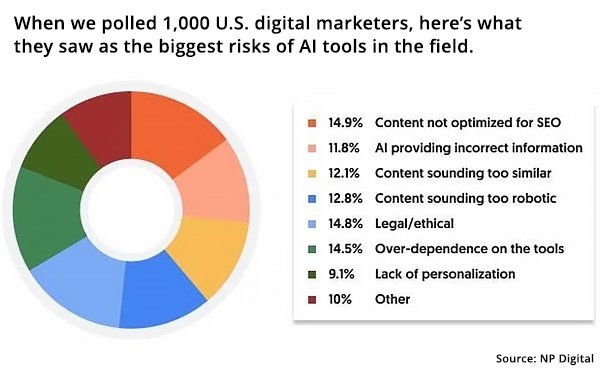
The company surveyed 1,000 digital marketers in the U.S., including those who actively work in digital marketing, including 229 freelancers, 394 who have in-house digital role, and 377 who have an agency role.

Lack of search engine optimization (SEO) is a major concern. There were a lot of answers for “what do you think is the biggest risk/issue of using AI technology in digital marketing?” The biggest, according to 149 respondents (14.9%) is the concern that content would not be optimized for SEO. In fact, it is a concern for all from freelance, in-house, or those within an agency.

Of our respondents, 12.66% of freelancers, 16.75% of in-house marketers, and 14.32% of digital marketing agencies felt similarly that SEO was the biggest risk.

The biggest risks in AI marketing include:

  • 14.9% – content not optimized for SEO
  • 11.8% – AI providing incorrect information
  • 12.1% – content sounding too similar
  • 12.8% – content sounding too robotic
  • 14.8% – legal and ethical
  • 14.5% – over dependence on the tools
  • 9.1% – lack of personalization
  • 10% – other

By

@lauriesullivan,

Sourced from MediaPost

By Sarah Cha

Does the thought of AI Marketing seem intimidating?

Do you ever feel just a tad overwhelmed when you think about how fast AI seems to be changing the digital landscape?

You’ve heard that AI is the golden ticket, the game-changer, the ‘Next Big Thing.’ With its ability to turbo-charge growth and streamline customer interactions, it’s no wonder businesses big and small are taking notice.

So if you want to stay on top of this new wave of marketing, it’s time to reassess your marketing strategies and tap into the explosive growth potential of AI.

Let’s dive right in!

AI Marketing: More Than Meets the Eye

AI marketing, in simple terms, is about employing artificial intelligence to streamline and optimize marketing strategies. But here’s the kicker: it’s not just some cold, robotic process.

On the contrary, AI gives you the power to understand and interact with your audience in ways never before possible.

Do you think AI is about replacing humans with machines?

Wrong!

The real deal with AI marketing is about augmenting human capabilities, not eliminating them. Think of it like your very own marketing superpower, helping you reach the right people, at the right time, with the right message.

Or are you worried AI might make marketing impersonal and robotic?

Well, the surprising truth is that AI can actually make your marketing more human. It can save you oodles of time and energy so that you can focus on the tasks that truly matter. But how?

5 Key Components of AI Marketing

What are the building blocks of AI marketing? With the power of artificial intelligence supporting you, you can massively upgrade five critical areas of your marketing strategy:

1. Reach Your Best Customers With Hyper-Targeted Ads

Let’s face it; nobody likes irrelevant ads. It’s like being at a party and getting stuck in a conversation about a topic you have no interest in — not fun.

But with AI, you can use hyper-targeting to ensure your ads reach the right people at the right time.

Say goodbye to wasted ad spend and hello to a flock of engaged customers!

2. Engage Customers with AI Chatbots

You know that friendly little pop-up on websites that’s always ready to help? That’s a chatbot. They’re like your personal digital concierges, ready to assist 24/7.

Chatbots aren’t just fancy digital assistants; they can be your frontline salespeople.

Picture this: it’s the middle of the night, and a potential client stumbles onto your website. Who’s there to answer their burning questions?

Your trusty chatbot, that’s who!

Chatbots don’t sleep, don’t need coffee breaks, and they’re ready to interact with visitors 24/7. This instant engagement can translate into quicker conversions. Now that’s working smart!

3. Harness The Power of Predictive Analysis

Ever wish you could read your customers’ minds?

Predictive analytics is the closest thing.

By analysing past behaviour, it helps predict future actions. With AI’s predictive analysis, you can forecast future trends and tweak your marketing strategies accordingly.

No more guesswork or gut feelings – you’ve got data-driven predictions on your side. It’s like having a roadmap to success.

4. Perfect Content Personalization

It’s no secret that customers love a personalized experience. But how about personalizing your interactions with every single individual client on your list?

Sounds like a colossal task, right? Not with AI.

Artificial Intelligence can help tailor content to individual customers’ needs based on their preferences and behaviour.

Imagine if every customer felt like your website was designed just for them. Content personalization does exactly that, providing tailored experiences for each visitor.

A personalized email in their inbox can make your customers feel seen and valued. It’s like sending a hand-written note in the digital world. Isn’t it time you made your customers feel like VIPs?

5. Demystify SEO

SEO can feel like a maze, but AI makes it a walk in the park. It can analyse algorithms, understand trends, and optimize your content to rank higher.

If SEO has been making your head spin, you can now use AI-powered SEO tools to optimize your content, suggest relevant keywords, and even improve your website’s user experience.

It’s like having a marketing pro in your pocket, helping your site rank higher and attract more traffic. Ready to give Google a run for its money?

The Role of AI in Different Marketing Channels

AI isn’t just a stand-alone solution; it’s the secret sauce that spices up all your marketing channels. Here are some ways AI can revolutionize your marketing strategy in different channels:

Email Marketing

Consider email marketing, an oldie but goodie.

You might think, “What’s new about sending emails?” Well, with AI, a lot!

It’s not just about automating campaigns anymore. AI is capable of segmenting your audience based on their behaviour, interests, and other key parameters.

This means you can send hyper-personalized messages that resonate with each recipient, increasing engagement.

For instance, imagine a customer browsed through winter jackets on your online store but didn’t make a purchase. AI can trigger an automated email offering a special discount on jackets, nudging the customer to complete the purchase.

Plus, it can even identify the most opportune time to hit ‘send’ for each recipient. It’s like having your own crystal ball!

Social Media

Then we have social media, the digital hangout spot. But how do you cut through the clutter?

AI can analyse user sentiment, helping you understand how people feel about your brand in real-time. This way, you can tailor your responses and engage in more meaningful conversations.

AI can also schedule posts at the most effective times to increase visibility and engagement. And it doesn’t stop there. AI tools like ChatGPT-4 can even generate compelling content that resonates with your audience.

And that, after all, is the heart of any successful social media marketing strategy.

Content Marketing

In content marketing, AI can be your personal assistant, identifying trending topics for you to cover. It’s like having your ear to the ground 24/7.

But it gets even better. AI can optimize your content with the most effective keywords, helping you rank higher on search engines and draw more traffic to your site.

Plus, AI can tailor your content to individual user preferences.

For instance, if a visitor frequently reads blog posts about vegan recipes on your food blog, AI can highlight similar content when they visit your site. Imagine what that can do for your content marketing strategy!

Customer Relationship Management (CRM)

When it comes to CRM, AI can segment customers into different groups based on their behaviour, purchase history, and preferences.

This allows you to provide more personalized service and build stronger relationships.

AI can also predict customer churn, giving you a heads-up before a customer jumps ship. This way, you can proactively address issues and improve customer retention.

Streamline and upgrade your customer management with AI, you won’t regret it!

The Practical Applications of AI Marketing

So how do you take this high-tech jargon and translate it into real-world applications? Let’s take a look at AI assistance in a couple hypothetical scenarios.

For example, let’s say you run an e-commerce store:

  • Hyper-Targeted Ads: First things first, you’d want your products to reach the right shoppers. No sense trying to sell vegan leather shoes to hardcore carnivores, right? Hyper-targeted ads, courtesy of AI, ensure that your marketing budget is spent on folks who are genuinely interested in what you’re offering.
  • Engage Customers with Chatbots: As your online store starts to buzz with customers, their queries will pile up. Instead of getting swamped with the surge, why not delegate to a chatbot? It’s like having an all-weather digital assistant that caters to customer questions, guiding them through their purchase journey.
  • Use Predictive Analysis: You’ve got the goods, but which ones will fly off the shelves next season? Predictive analytics can offer some clues. By crunching customer behaviour and purchase patterns, you can smartly forecast what products to stock up on.
  • Content Personalization: Online shopping isn’t just transactional — it’s experiential. You’d want your customers to feel that your store understands their needs. With AI, you can customize user interfaces, showing products and deals that align with individual customer preferences. It’s like each customer has their private aisle in your online store.
  • SEO Optimization: Of course, for all this magic to happen, customers need to find you first. With SEO optimization underpinned by AI, your store can rank higher in search results, attracting more traffic and potential sales.

Or let’s say you’re a lifestyle blogger, keen to expand your digital footprint:

  • Hyper-Targeted Ads: First off, you’d want to make sure your blog is getting in front of the right eyeballs. You don’t want to waste time attracting DIY enthusiasts when you’re doling out advice on mindfulness and yoga. That’s where AI comes in handy. Hyper-targeted ads can ensure that you’re attracting the readers who will truly connect with your content.
  • Engage Readers with Chatbots: As your blog grows, you’re bound to have visitors with questions or comments. Rather than spending hours responding, you could use a chatbot. It’s like a friendly digital receptionist, fielding common queries or directing readers to relevant articles round the clock.
  • Use Predictive Analysis: You’re creating excellent content, but what do your readers want next? Predictive analytics can help. By analyzing reader behavior and interests, you could identify what topics they’re likely to engage with in the future, ensuring you stay one step ahead.
  • Content Personalization: Personalization isn’t just for e-commerce. You want your readers to feel that your blog is tailor-made for them. AI can help here by tracking reader interests and suggesting content that aligns with their preferences. It’s like each reader has their personalized blog feed.
  • SEO Optimization: Lastly, you want to get found, right? With SEO optimization powered by AI, your blog will not only appeal to readers but also to search engine algorithms, drawing more traffic to your site.

But remember, Rome wasn’t built in a day. Implementing these strategies might take some trial and error, but the rewards are well worth the effort.

AI Marketing: The Future is Now

Embracing AI in marketing isn’t just about keeping up with the Joneses, it’s about staying ahead. It’s about enhancing efficiency, driving growth, and carving out a competitive edge.

The landscape of marketing is changing, and AI is the compass guiding the way. It’s not some distant future scenario, but a present reality. So don’t get left behind.

In this digital age, AI marketing is no longer a luxury, but a necessity. It’s not just about doing things differently, but doing different things. It’s not about working harder, but working smarter.

This is just the tip of the AI Marketing iceberg. Each technique could be your secret ingredient for explosive growth. So, are you ready to give AI Marketing a whirl and leave your competitors in the dust?

Go out there and shake things up!

By Sarah Cha

Sarah Cha is an avid writer, reader, and lifelong learner who loves making magic behind-the-scenes at Smart Blogger. When she’s not wrangling words onto a screen or page, you can find her strumming a guitar, tickling a canvas, or playing fetch with her favourite four-footed friend!

Sourced from SmartBlogger

By Justin Bariso

New Twitter CEO Linda Yaccarino cited a philosophy adored by Elon Musk. How can it help you and your business?

New Twitter CEO Linda Yaccarino sent her first memo to employees. Entitled “Building Twitter 2.0 Together,” it’s filled with boilerplate corporate-speak like:

  • “We need to think big”
  • “We need to transform”
  • “Literally everything is possible”
  • “You have to genuinely believe”

After these platitudes, though, we find an interesting sentence that indicates how Yaccarino is planning to make changes at Twitter:

“And we can do it all by starting from first principles–questioning our assumptions and building something new from the ground up.”

Let’s focus on two words:

First principles.

The concept of first-principles thinking is well-known in the world of physics, but it’s also related to emotional intelligence, the ability to understand and manage emotions.

What is first-principles thinking? What does it have to do with emotional intelligence? And how can first principles help you and your business? Let’s discuss. (If you like this article, make sure to sign up for my free course, which teaches simple frameworks that help you and your team build emotional intelligence.)

What is a “first principle”?

A first principle is a basic truth. It’s not an assumption that something is true based on popularity or analogy; rather, it is fundamentally sound and can be proved.

Thinking in terms of first principles is a great way to solve problems using emotional intelligence, because it helps you think rationally and keep emotions from clouding your judgment. It also keeps you from falling victim to social pressure, doing things because that’s what everyone else does, or because that’s the way it’s always been done.

To illustrate, consider the following:

First principle: Biology teaches us that a person needs oxygen, water, and food (in that order), or they will die.

Man has been able to send people deep underwater or into outer space for long periods of time, as long as their basic needs are provided for.

First principle: If a company hires an employee, it has significant costs and legal responsibilities to fulfil.

Early-stage and small companies can increase working capital and decrease legal risk by working with freelancers instead of hiring employees.

First principle: In basketball, the team with the most points when time runs out wins the game.

The Golden State Warriors focused on playing with a smaller, faster line up and shooting more three-pointers; doing so helped them win multiple championships and changed the way many teams approach the game.

It’s no surprise to hear Yaccarino speak of applying first-principles thinking at Twitter.

Her boss, Twitter owner Elon Musk, has credited first-principles thinking for the success of his companies. For example, Tesla gained a huge competitive advantage by focusing on producing large car batteries for less money. And SpaceX has succeeded because engineers found a way to efficiently reuse rockets, an idea scoffed at by experts years ago.

So, how can first-principles thinking help you and your business?

How can first principles help you?

The key to using first-principles thinking is to break a thing down to its most simple parts, and then work from there.

For example, your business may be struggling to get new customers. You don’t want to pay for ads, and you’ve tried to imitate competitors’ social media strategies but it hasn’t gotten you anywhere.

A first principle that can help: People like to do business with people they know, like, and trust.

Can you show a bit more of your personality in your advertising or social media? In doing so, your message, product, or service will likely resonate with more people.

Another example: You may struggle with the feeling that you never have enough time, and that you’re always behind.

In this case, remind yourself of the first principle that everyone has 24 hours a day, seven days a week–but some are much more productive than others.

So, ask yourself: How can I better structure my day and week to get more done?

These are simple examples, but the truth is first-principles thinking can help you tackle any problem you’re working on.

So, whether you’re struggling with the need to reinvent or simply recalibrate, try using first principles to take you back to basics, manage your emotions, and solve a problem from a brand-new perspective.

Feature Image Credit: Linda Yaccarino. Getty Images

By Justin Bariso

Sourced from Inc.

By

Building on a blockchain follows similar fundamental principles to building in real life.

Building on a blockchain follows similar fundamental principles to building in real life. First, you establish the foundations, then you can start laying the bricks, and only once it’s built can someone begin experiencing the building’s purpose. With blockchain, establishing a foundation involves selecting (or even designing) a first layer. Laying the bricks is akin to writing the platform code, and only then the user experience can begin.

So why, if we know the process involved in building a successful, sustainable structure from scratch, do we ignore it when it comes to our crypto marketing efforts?

The naïve crypto founder’s marketing checklist

Building a Web3 project from scratch? Here’s a typical marketing checklist for starry-eyed founders:

  • Have a logo: something from a freelancer will do to start
  • Create a whitepaper: this is a must-have for VCs
  • Have a website and social media accounts
  • Create a blog (remember: SEO matters)
  • Engage a PR agency and issue lots of press releases ahead of launch
  • Use influencers (more followers = more reach)
  • Use paid placements to establish authority
  • Participate in sponsorships and time on stage at big events

Even if a project manages to survive the next crash, it’ll invariably end up rinsing and repeating this list with endless newer and more exciting features, products and services, with little return on its marketing spend.

The problem is, when everyone is doing the same thing, nobody stands out. And during the bear markets, what’s left? All of the above costs time and money, but none of it buys loyalty.

All entrepreneurs building on blockchain understand the importance of building from the foundations up — starting with layer-1. Layer-1 underpins everything.

What are the characteristics you seek from layer-1?

  • Decentralization with distributed shared ownership
  • Immutability
  • Transparency
  • Longevity

Nothing in the extensive founder’s marketing checklist shares these non-negotiable properties.

Your brand is your layer-1 of your marketing  

Successful marketing starts with its own layer-1 — building the brand. Your layer-1 is the keystone on which your entire platform is built, and your brand is the keystone on which your entire marketing strategy should be constructed.

Your brand isn’t a logo or a catchy slogan. It’s first and foremost a memorable, relevant, credible, unique, concise and consistent brand positioning and promise. Ideally, it’s supported by a clear set of values, ideas, narratives and visuals that pull everything else together.

Your brand is what makes people recognize you. It’s what invokes what your business is known for. And it’s the only part of your marketing toolkit that creates a truly emotional tie between you and your target audience.

Remember, your brand is the only asset that you can derive from your marketing spend. However much you pay a PR or marketing agency, no matter how much they talk about ROI — without a brand, it’s all just talk. Your brand is your layer-1.

That’s not to say that all the other stuff isn’t important. Your socials, blog and PR campaigns all matter. But they are your layer-2 — your touchpoints. If we take the blockchain analogy, your layer-2 marketing activities and touchpoints are like your dApps. They’re your presence — your voice to the world.

Layer-3 is where the magic happens. Layer-3 is the experience, where your brand, product and story come together to create traction, impact and enduring value. This is why people will come back and what will propel you through the toughest of bear markets and financial hardships.

But without layer-1 — your brand — you’ll never reach layer-3 based on a foundation of layer-2 alone. It would be like trying to launch a dApp without a blockchain.

Retrofitting works

Hang on, you may be thinking. I’ve already started my business, and I didn’t build a brand before I started. I already have my website, socials, blog and campaigns set up, but without a brand. Is it all now doomed to fail?

It’s not a problem.

Unlike dApps, which can’t run without blockchains, it is possible to retroactively build your brand. In fact, the chances are that in the process of building your layer-2, you’ve already started creating an impression that can help to form the basis of your brand.

What are you good at? Why does your community come to you above the competition? Why is your offering relevant?

Arguably, if you have already started, you’re in an even stronger position to build a brand retroactively because you already have enough data and input to be able to answer these questions. Those touchpoints you set up are a valuable trove of feedback from people who have engaged with your product and formed an impression. Listen to what they have to say.

Once you know what you’re good at, and how you’re being perceived, you have the ingredients to create your brand. The rest is pure science.

By

German is co-founder and chief relevance officer of THE RELEVANCE HOUSE, a branding, marketing and growth agency focused on blockchain and Web3.

Sourced from COINTELEGRAPH

By William Arruda

Despite the prevailing concerns about the potential for artificial intelligence to eliminate jobs and harm (or even destroy) the planet, the reality is quite different. AI is not necessarily the harbinger of doom; rather, it has immense potential to enhance human capabilities and drive positive outcomes. The challenge is in understanding and applying AI without being overwhelmed by it.

To learn how leaders and career-minded professionals can embrace AI as a tool for accelerating career advancement and increasing professional happiness, I reached out to Matt Strain, the AI Whisperer, who was featured in the NY Times for using “ChatGPT to create an entire book of cocktails based on the tenets of traditional Chinese medicine written in the style of the J. Peterman catalog.” After a long career at big tech companies (Apple, Adobe …), Matt’s started his own company, The-Prompt.AI, to focus on what he calls “AI for Real People.”

William Arruda: Matt, you shared a quip that’s making the rounds online: “AI won’t replace your job, but someone using AI might.” It’s how I came up with the title of this article, and it’s a sentiment echoing across organizations, from individuals to agencies and companies alike. Interestingly, the Pew Research Center’s report A Majority of Americans Have Heard of ChatGPT, But Few Have Tried It Themselves highlights the public’s simultaneous fascination and fright with the increased use of AI. With the incredible potential that AI promises, why have so few people incorporated it into their work?

Matt Strain: You’re absolutely right. The vast potential of AI invokes fascination and fear. Many people simply don’t know where to start. We’ve seen companies condone the use of AI tools like ChatGPT and DALL-E. Others are requiring usage in the hopes of increased productivity. In addition to the natural fear of change, two main things come into play. First, the fear parlays into scepticism. Many look to find the flaws to confirm their fears. Second, most people simply don’t understand how to get the most out of the tools. Their prompts are ineffective and they have a poor experience.

Arruda: You say that rather than fearing AI, we should embrace it as a catalyst for progress. You suggest that by integrating AI into our work and leveraging its capabilities, we can unlock new opportunities, streamline processes, boost productivity and propel our careers to new heights. You make it sound like the magic bullet for career success.

Strain: There’s an opportunity to reframe this and think of AI as a creative muse that will push us to think more broadly. I believe it will become a non-judgmental co-pilot that is always eager to engage in exploratory discussions. In a nutshell, when you embrace AI right now, you will stand out from your peers and enhance the value of your personal brand.

Having said that, AI is not a magic bullet. We humans still need to invest the energy in forming the right questions and exploring the most important problems. These tools will augment—not replace—our skills.

Arruda: How else do you see AI being used by “real people?”

Strain: Everything everywhere all at once. Well, almost. For career advancement, continuous learning and adaptation are key. Generative AI systems can provide personalized learning resources. For instance, an entrepreneur venturing into the AI tech industry can employ AI for guidance on trends, opportunities, and goal-oriented recommendations. AI can aid in everything from designing research surveys to evaluating corporate strategy. AI is not some future concept. It’s a present-day tool being used by many.

Arruda: Are there any specific AI-powered platforms or applications that you believe can significantly improve networking and professional relationship-building?

Strain: There are many. AI will intelligently recommend contacts, personalize communications, and optimize engagement timings. It will nurture professional relationships through automated scheduling, social monitoring, real-time translation, and insights from data analytics.

These tools are being integrated into major networking platforms like LinkedIn and CRM tools. Microsoft’s relationship with OpenAI ensures that AI will be baked into their office suite. Google is already working on many of these tools. There’s also a new wave of AI start-ups rushing in on a daily basis.

Arruda: What are some real-world work applications that maybe we haven’t even thought about but would help us save time or take the drudgery out of monotonous work activities?

Strain: Meetings and email. In my seventeen years at Adobe, I calculated that I attended more than 40,000 meetings! Imagine a world where meetings are a breeze, and everyone actually looks forward to them. Imagine AI effortlessly aligning schedules, crafting tailor-made agendas, and making sure every voice is heard with real-time transcriptions and translations. With the mundane handled, your post-meeting world is infused with crisp summaries, clear action items, and insightful analytics, turning endless meetings into bursts of creativity and productivity. Might you actually look forward to meetings in the future?

Don’t even get me started about email. AI is coming to optimize that, but I’ll save those thoughts for the next interview.

Arruda: I have heard the emergence of generative AI compared to Oppenheimer’s nuclear bomb. What ethical considerations should career-minded professionals keep in mind when using AI in their work? What are the potential risks or pitfalls?

Strain: Yes, the comparison to Oppenheimer is in terms of AI having the capacity for both good and evil. The main ethical considerations in the short term revolve around ensuring fairness by mitigating biases, safeguarding data privacy and maintaining human accountability for AI-driven decisions. Successful companies will hold on to the human touch and be mindful of deploying AI as an augmentation, not a replacement.

We’re going to see a wave of anxiety in which employees and leaders have to manage short-term fear of change and concerns about jobs, mid-term fear of misinformation and economic disruption, and long-term fears of what it means to be human and the potential for bad actors. These are real and compounding fears. Leaders will have to draw on change management skills to proactively present a vision that demonstrates the ability to direct AI as a productive, creative force. Employees, shareholders and customers will depend on this.

On the positive side, AI can be directed to assist with all these concerns.

Arruda: How can AI assist professionals in enhancing their personal branding and online presence? Are there any specific strategies or tools you recommend? Any examples of people who are doing it right?

Strain: Absolutely. AI has the remarkable ability to study an individual, identifying their strengths and weaknesses, and distilling their authentic values and unique qualities. By observing professionals, AI can offer proactive guidance, aiding in their development and helping them create a genuine and compelling story that sets them apart. Once this story is formed, AI can further assist in creating a strategic plan to effectively communicate this narrative to the right audience. AI-infused tools will help with designing imagery, creating content and monitoring your brand mentions.

Arruda: I know you have been traveling the globe lately as a consultant to corporate leaders at companies in a variety of industries. You’re helping them establish their AI strategies. Without divulging any corporate secrets, what are these leaders’ biggest concerns and hopes for AI?

Strain: It’s a challenging time for leaders. They need to keep a positive attitude and be actively engaged, even as they tackle a long list of concerns such as where to begin, not wanting to disrupt what’s working, how to manage data, ethical issues, and the costs of bringing AI into the fold. There’s also the human element; they’re worried about how this affects their employees in terms of morale, the need for additional training, and the possibility of job losses. These are very real concerns, but they’re also manageable issues that can be addressed with a level-headed plan.

I foresee that the benefits are going to be greater than the worries. Right off the bat, AI can take over mundane work, which means people can focus on more strategic, higher-value tasks. For example, being able to use data effectively will spur innovation and enhance the experience for customers and employees alike. Once we get past this early transitionary stage, I see a future where our teams benefit from working side-by-side with AI-driven tools that can learn and augment their human counterparts.

Arruda: Thanks, Matt. It sounds like the power of AI as a tool for expanding your career success is bound only by the imagination. Readers, to see how you can push past the fear and leverage AI, check out this podcast where Matt dispels myths and reduces the stress that surrounds artificial intelligence.

Feature Image Credit: getty

By William Arruda

William Arruda is a keynote speaker, co-founder of CareerBlast.TV and creator of the 360Reach Personal Brand Survey that helps you get candid, meaningful feedback from people who know you.

Follow me on Twitter or LinkedIn. Check out my website.

Sourced from Forbes

By Jodie Cook

Co-creating with artificial intelligence can make your work better. What used to take days can now take hours, what used to require trawling through freelancers can be created in a few clicks. For individual creators, an AI co-pilot makes a lot of sense. But rather than outsourcing every part of your work to ChatGPT, use it for the preparation and the ideation. Use it for those grunt work tasks that you don’t really enjoy.

Rowan Cheung is founder of The Rundown, a fast-growing AI newsletter providing an in-depth look at the latest developments in AI. In less than 4 months, The Rundown has gained a following of over 170,000 subscribers who rely on its content to stay informed about the latest advancements in artificial intelligence. Cheung is on a mission to inform millions of people about the latest advancements in AI and highlight how technology is transforming the world. His AI database, Supertools, records the best tools mentioned in the newsletter.

Cheung shares eight ChatGPT prompts to finish hours of work in seconds, to supercharge your output without breaking a sweat.

1. Explain like I’m a beginner

Perhaps there’s a concept you haven’t fully grasped, but it’s fundamental to whatever you’re writing or working on. Rather than struggle away trying to wrap your head around what it means, ask ChatGPT to find an explanation that resonates. After using this prompt, your entire project might make more sense, opening a clear picture of the way forward.

Here’s the prompt: “Explain [topic] in simple terms. Explain to me as if I’m a beginner.” What follows should be basic concepts, simple analogies and memorable ways of demystifying the field.

2. Create unique content ideas

Perhaps you’re right at the beginning of your content creation journey and you need the ideas to get you started, optimized for a certain platform. If you have your topic and you know your audience, ask ChatGPT to come up with ideas of how you can most effectively share, in such a way that the content could go viral. Discard the bad ideas and move forward with the best.

Here’s the prompt, according to Cheung: “Topic: How to [go viral on Twitter, write a viral blog post] talking about [your topic]. Come up with unique and innovative content ideas that are unconventional for this topic for the medium of [Twitter, article, LinkedIn, etc].”

3. Quiz yourself

So you’ve been learning a new subject but you’re not sure it’s sticking. In school, you’d learn and revise to pass a test. Now, you can use ChatGPT to create that test. Ask for a quiz to test your existing knowledge on a topic, to figure out your gaps and how much is left to learn. Or, ask for a quiz about a topic you know nothing about, perhaps before you begin a project on that topic, to set the scene and motivate you to conquer it.

Cheung recommends using this very simple prompt: “Give me a short quiz that tests me on [what you want to learn]” and be sure to fact-check, because the program has been known to deviate from the facts.

4. Change the writing style or tone

Imagine you wrote something in a bad mood and now it shows in the tone. Or you sent a bio in first person and someone wants it in third. Whatever you have made can be transformed with this prompt, saving you the time of doing it manually.

The prompt: “Change the writing style of the text below to [style or tone]” then paste the text, hit return and see the new version. If you need further edits, ask for them too.

5. Consult an expert

When you know there’s room for improvement in what you have written, get ChatGPT to be your trusted editor. Whether you want it to play the part of a lawyer, subject matter expert or simply a proof-reader, ask for commentary from that point of view.

Cheung prompts ChatGPT in the following way: “I will give you a sample of my writing. I want you to criticize it as if you were [role]” Then add your writing, submit to ChatGPT and brace for its critique. Take the parts you agree with and ask it to rewrite the text with them in mind.

6. Train it to learn your writing

Not only can you train ChatGPT to learn your writing style, you can train it to create its own prompt to write in your style. And who better to create prompts for ChatGPT than the program itself? It will be instructing itself in its own preferred way of learning, a self-guiding method that brings you the best results.

The prompt is simple: “Analyse the text below for style, voice, and tone. Create a prompt to write a new paragraph in the same style, voice, and tone.” After adding your text, what follows will be the prompt that you can paste into future instructions to write in your style.

7. Specify the audience and purpose

Let’s imagine you’ve asked ChatGPT to write some articles on a certain topic, but it’s missing the mark. Or imagine you’ve written the content yourself but you know it could be better. Here’s where more specific prompting can bring forth more detailed work, that resonates far better with your audience

Within this prompt, specify the audience, tone and goal. Cheung’s example on an article with, “Topic: How to grow your Twitter following,” was to add, “Audience: Twitter users trying to grow their account. Tone: Inspiring Goal: Inspire audience to feel excited about growing their Twitter following and teach them how to do it in simple terms.” Now, the text will be reworked to fulfil that goal, without any further input from you.

8. List long articles in bullet points

Much of the content on the internet is simply curation. Academics and philosophers did the research and the thinking, and the rest of us are turning those vast studies into bite-sized nuggets that our audiences can consume. As with most tasks of this nature, there’s a prompt for that.

This prompt for ChatGPT, according to Cheung, is to: “Summarize this paragraph into bullet points that a beginner would understand.” You then copy a paragraph or more from any given text and see a summary. This summary might be used as a social media post, a LinkedIn carousel, or simply used to help you paraphrase in a way that suits your style and medium.

Don’t get stuck with writer’s block, chained to your desk struggling for inspiration to start, keep going or finish. Use these simple prompts to expand your reach, unlock new ideas and create more consistently. Build a habit of co-creating with AI and take steps in the right direction of prolific production.

Feature Image Credit: getty

By Jodie Cook

Follow me on Twitter or LinkedIn. Check out my website or some of my other work here.

Founder of Coachvox.ai – we make AI coaches. Forbes 30 under 30 class of 2017. Post-exit entrepreneur and author of Ten Year Career. Competitive powerlifter and digital nomad.

Sourced from Forbes