Author

editor

Browsing
By Chitra Iyer

Only about 30% of marketers use original research in content marketing strategies, despite numerous benefits. Why?

The Gist

  • When data is the story. Executed effectively, original research as content can put your content marketing on steroids, bringing in outsize ROI and sustaining your content calendar for months. 
  • So, why aren’t 70% of marketers telling the story? Although it’s the most trusted source for B2B buyers, fewer than 30% of content marketers generate their own original research, while nearly all writers incorporate others’ statistics in their content.
  • Because not all research is created equal. High-performing original research combines credible data, an engaging story and a solid plan for distribution and amplification through various content formats. Getting it wrong can cost your brand its credibility.

B2B content writing 101 emphasizes the importance of incorporating “evidence” — that is, trustworthy quantitative or qualitative data to substantiate our claims. By doing so, we enhance the credibility of our content, increasing the likelihood that the article will be referenced by others.

And that makes perfect sense. Even in a world where disinformation and propaganda often come cloaked in smart-looking pie charts, almost half of B2B buying committees trust research reports as their most preferred source of product research.

In fact, this 2021 report found that buying committees look for “research-backed content experiences that tell a valuable story.” That’s almost a textbook definition of original research reports.


That is why it is almost unbelievable that while 100% of content marketers use someone else’s original research stats in their content, only about 30% challenged themselves to create their own original research as a key component of their content marketing strategy.


Content Assets chart


Why? Because creating credible research is a challenging process, costs time and money, and demands an authentic and original approach. Even though the payoff is huge and the resulting content has a longer shelf life than average, the risks can be equally dramatic.

Imagine being trolled on social media by users who find chinks in your research methodology, share data that directly contradicts what your report finds, or worse, question your credibility by questioning the numbers themselves.

But first, the good stuff. Data analytics platform Databox, which has produced more than 1,300 reports over the last six years, swears by original research surveys as a key content marketing pillar. “As a result of all of the content we’ve produced on a wide range of topics, we generate nearly 300k sessions to our website every month, mostly from organic search and word of mouth. This traffic turns into 6k+ signups for our free product every month. We get all of our customers from these signups,” said Peter Caputa, CEO at Databox. That’s pretty straightforward ROI math.

So tip No. 1: Approach original research as a long-term, high-value content initiative. And if you really want people to trust the research coming out of your content marketing stable, pick a niche or a topic, and own it.

Consistently bringing out an annual survey report or update about the same topic positions you as the go-to expert in that topic, said Sarah Kimmel, vice president of research at Simpler Media Group (which owns CMSWire). The Content Marketing Institute, for example, has put out the annual B2B content marketing survey for 13 years now, and it is the first stop for anyone wanting to know the latest trends, patterns and insights about the state of content marketing.

Original research done right can supersize your content marketing ROI by sustaining the content calendar for months, building unmatched visibility, credibility, and thought leadership, and even generating leads.

The experts boil down the secret of high-ROI original research to five elements.

1. Why Original Research? The Right Purpose

“Original research” in the content marketing context is a high-value piece of content for your external audiences (not to be confused with “market research,” which is conducted to better inform internal product or strategy design).

Think of it as another arrow in the content marketing quiver, albeit the “meta arrow” with the power to turbocharge all your other arrows — blogs, articles, social media posts, event and podcast appearances, and even sales pitches.

But designing, executing, and amplifying original research is not as easy as hitting publish on a Survey Monkey form. Too many companies, said Michele Linn, co-founder of Mantis Research, end up executing without properly thinking through the purpose. When you approach it as a “content” project, you will naturally start with clarity on:

  • Who is our primary (content) audience?
  • What do we want to tell them?
  • How will original research help us get there? Why is an original survey report the right content format to help us get there?
  • What do we want them to do/feel after consuming this content?
  • How will we leverage and amplify this content to make that happen?

These questions may sometimes reveal that original research is not even the best bet for your purpose. For instance, said Linn, if you want to showcase product benefits, use case studies instead. If you want to understand consumer behaviour instead of consumer beliefs, rely on user data instead because surveys tell us what people think, not what they actually do. Beliefs and attitudes are not the same as actions and behaviour.

Key takeaway: Approach original research as a high-value content project. Start by asking the same questions you would ask before embarking on any new long-form piece of anchor content.

2. Who Will Run the Project? The Right Team

While original research will no doubt be helmed by the content marketing team, Linn suggested the project team should consist of roles such as:

  • A content strategist who will define the audience, the purpose and the narrative and help create a compelling story around the findings in a way the audience finds interesting.
  • A data analysis expert who can help ensure rigor in the research execution, data tabulation and interpretation for statistical significance and accuracy.
  • An amplification expert who can create and execute the promotion, distribution and content repurposing plan for the research to derive the maximum reach and visibility.

These resources can be expensive and hard to come by, especially for smaller teams. Teams seeking to establish credibility in new markets where they are relatively unknown may also need additional support. In these cases, third parties such as research agencies, consulting firms or industry publications can help design and execute the project, said Kimmel. People trust the editorial quality and integrity that comes from credible media companies, she added, and the brand benefits from the halo effect.

Key takeaway: Choose to commission, sponsor or co-publish research with a third-party partner, or do it in-house based on available resources and your goal, be it lead generation, building brand credibility, entering a new market or thought leadership.

3. What Story Do You Want to Tell? The Right Narrative

For original research to succeed as compelling content, you need both — the data and the story — to come together in a concrete and cohesive way. But at its core, the content you generate with original research is really a compelling story validated with data.

When asked what made content memorable enough to warrant a sales call, respondents in the 2021 B2B content preferences study noted they want content that:

  • Tells a strong story that resonates with buying committees (55%)
  • Uses data and research to support claims (52%)
  • Is research-based (40%)
  • Is packed with shareable stats and quick-hitting insights (40%)
  • Is personalized/tailored to their needs (32%)

The best approach is to start with what your customers want or need to know. What data-backed insights about their industry would really help them? Try to find angles or topics that have not been covered before.

Obviously, the topic should also be as close as possible to your own brand story, said Kimmel, which may be better served by a narrow research focus. For instance, a data analytics vendor whose brand narrative is “ease-of-use” may choose to focus research on the “data team composition.” The angle of the research could be to study how business teams use analytics software, why they don’t or can’t use them to their full potential, or what under-use of fully-loaded analytics software may actually cost the business. Adding actionable insights to fix the gaps is a bonus that the brand can add at the end of the research.

The goal, added Linn, is to study some aspect of the industry with genuine curiosity instead of trying to prove something or contriving the research to support your brand story.

So tip No. 2 is to use the research to test your hypothesis, not validate it. For that, start with a few different hypotheses about your audience and the problems they may be facing. For instance, in the above example, the hypothesis could be that marketing teams don’t fully use the analytics software they buy. The research could reveal why. Or that companies are spending more on data analytics teams despite investing in “DIY” data analytics software.

Manipulating data to suit your pre-decided narrative is obviously not useful, agrees Kimmel, so while you think of a theme and angle, don’t assume what the findings will show. “We once had a client that assumed their audience would cut benefits due to the economic slowdown. But the research found that only 1 in 6 respondents planned to cut benefits,” she said. “The best surveys can roll with such surprise findings and still tell a compelling story, warts and all.”

Key takeaway: With original research, the data is the story, but how you tell it is what really counts. Finding a unique angle to hold up the research and weave the story around is where your expertise about your industry and the audience comes in. No matter what findings emerge, find an angle to create an interesting and educative story for your audience.

4. Executing the Survey: The Right Process

Execution is made up of several moving parts. The process could take months, but the results can also sustain your editorial calendar and drive organic traffic for months, if not years.

The survey questions can make or break the research outcomes. Asking the wrong questions or the right questions in the wrong way can seriously impact data quality and credibility. The Databox team often “pre-qualify” their survey questions on social media to crowd-source feedback before actually creating the formal survey questionnaire.

The hardest part of original research surveys in the B2B context is getting enough of the right respondents. “Aside from a list of respondents we’ve built over several years, and one-on-one interviews, we’ve recently started partnering with other organizations to run joint surveys, which is a win-win in terms of reach,” said Caputa.

Smart survey tools like Survey Monkey and Alchemer help design better questions, translate and administer surveys at scale, distribute them across multiple platforms, etc. Survey analysis tools such as ResearchStory help with cleaning the data and the technical and statistical analysis needed to find meaning in the numbers. Conversational AI and AI for text or speech analysis help mine deeper insights at scale. AI also aids processes like survey scripting, content development and data visualization to tell the story better.

Turning the insights into a compelling narrative — and if possible, actionable insights is where the real magic happens. The most important thing, said Matt Powell, VP & executive director of of B2B International, a Merkle North America company, is to deliver something that customers actually need and value including useful, practical insights. A report that’s full of stats and data without context, interpretation or a unique point of view is just not useful, no matter how thorough the research process was.

So tip No. 3 is that original research needs to tell a great story and tell it well.

Key takeaway: Primary research surveys may be the last bastion for marketers seeking to say something new and original, but AI-powered tools can help make the execution more efficient, accurate and scalable.

5. Being Seen and Heard: The Right Amplification

The wonderful thing about original research is its sheer versatility. Depending on your purpose, you can do quantitative research with an online survey tool, dipstick surveys via smaller and snappier social media polls, in-depth qualitative research to a highly representative sample population, etc. And you can turn those results into a wide range of content. This annual research report by MOPros, for example, uses a combination of quantitative and qualitative research to bring readers both — the stats and the unique individual perspectives that enrich and support the data. Linn also highlights this ‘State of Workflow Automation’ report that was repurposed into a report, webinars, a podcast, an assessment tool, sales enable materials, blog content and a conference presentation among other formats.

Research content can also be used at all stages of the marketing funnel, said Powell. Recently, for instance, his team helped a B2B brand use research-based thought leadership to reposition their brand from being a provider of legacy, commoditized products, to being a solutions provider in an adjacent category, and marketing at the top of the funnel to a whole new decision-making unit. At the bottom of the funnel, the content can add to lead-gen activity and bring customers through nurture pathways.

Too many clients invest in a research project but don’t do enough with it because they did not factor that in at the start of the project, says Kimmel.

Tip No. 4: Know when you begin what you plan to do with the research. The report is just one piece of content — but the findings and the narrative should be credible and engaging enough to support a full suite of content — conference presentations, webinars, infographics, blogs, white papers, podcasts, sound bytes, social posts, etc., to amplify and deliver optimal ROI.

Key takeaway: The shelf life of original research data can often be years, not days or weeks. The more you amplify, the more backlinks you get, the higher your search engine authority and the more organic traffic you generate. An added bonus would be ChatGPT amplifying your research findings by citing them in its responses!

Done right, original research is a gift that keeps on giving. But success depends on approaching it as a high-value content project designed to serve your audience, not your agenda.

By Chitra Iyer

Chitra is a seasoned freelance B2B content writer with over 10 years of enterprise marketing experience. Having spent the first half of her career in senior corporate marketing roles for companies such as Timken Steel, Tata Sky Satellite TV, and Procter & Gamble, Chitra brings that experience to her writing. She has authored over 500 articles, white papers, eBooks, guides, and research reports on customer experience, martech, salestech, adtech, retailtech, and customer data and privacy. She holds a Masters in global media & communications from the London School of Economics and Political Science and an MBA in marketing

Sourced from CMSWIRE

By Liviu Tanase

Email lists degrade fast, and that affects your inbox reach. Here’s how to make sure your subscribers are real so you can get the most out of the emails you send.

By 2025, more than 4.5 billion people worldwide will have at least one email address. Email is a profitable marketing channel because it provides a direct and personal line of communication with prospects. But it only works if your emails land in the inbox and allow you to connect with your target audience.

Many obstacles will prevent an email from reaching the inbox, but the most common one is an outdated email list. And email lists tend to decay quickly. Within just one year, almost 23% of the average database becomes obsolete. The percentage may be higher for B2B companies, with people changing jobs more often in the past three years.

This rapid degradation of email data causes poor email deliverability, missed opportunities and a decrease in conversions. Let’s see some of the reasons why – and how you can always have a healthy email list.

How the quality of your list affects email deliverability

Reaching the inbox is closely tied to your sender reputation, also known as your sender score. Internet service providers assign this score to every sender so they can automatically determine whether your emails belong in the inbox or in the spam folder.

Everything you do as an email sender – from the content you send, to how often you send it and how much people engage with it – builds your sender reputation.

Your email list quality plays a vital role here. For instance, if you get many bounces (more than 2% per email) or too many spam reports (more than one for every 1,000 emails), your sender score takes a hit. That means your email deliverability is at risk as your behavior begins to resemble that of a spammer.

While data decays quickly, there are proactive steps you can take to always keep your email list fresh. Here are a few key habits you will benefit from.

Start by verifying your email list

With 22.71% of an email list going bad yearly, this is the best place to start. You want to run your database through an email validation service and see how many of your contacts are still safe to use. This may cause your list to decrease in size – but it will increase in effectiveness. Removing potential bounces and other obsolete emails repairs your sender score and gives you an email deliverability boost.

Prune out dormant subscribers

Nothing impacts the health of your list like invalid and fake addresses, but dormant subscribers can cause your campaigns to land in spam, too. They affect your engagement rates (opens, clicks, forwards), thus telling inbox providers that your content is irrelevant. Furthermore, some of these subscribers may not even be using those addresses anymore. So not only will they not click, but those emails may start bouncing as they get deactivated. The best way to avoid that is to remove disengaged subscribers every three to six months.

Handle complainers with care

Like bounces, spam complaints have a negative impact on your sender score. To Internet service providers, they’re a clear signal that your emails aren’t just irrelevant – they actually bother people. Spam complaints alone can be reason enough for your campaigns to start going to the junk folder.

To prevent that, make sure to remove complainers right away. Emailing those subscribers again will only make things worse. Additionally, you could use email verification to detect users who have a history of reporting many emails as spam. Taking them off your list allows you to mitigate the risk of spam complaints and protect your sender score.

Bonus tips to keep your list engaged and boost email deliverability

A healthy database is key to good email deliverability, but it’s not the only factor that contributes to your sender reputation. To keep your emails landing in the inbox, try to:

  • Send your subscribers the content they signed up for. Whether you promised great discounts or educational emails, keep your promise and strive to over-deliver.
  • Avoid long breaks from sending emails. You’ll see higher engagement when you’re present in people’s inboxes consistently.
  • Invite people to reply to your emails. Replies are the best kind of engagement – to inbox providers, they indicate a highly trustworthy sender.
  • Reassess your email service provider every year. Could there be a better one for you out there? Always go with a reputable company that ensures high deliverability.
  • Install real-time email verification software on your registration and sign-up forms. That way, you block bad data at the source and keep your email list fresh for longer.
  • Be flexible with your copy. Test your subject lines, tone and email length and notice the patterns that tend to get more clicks. The more people react to your content, the more trust you build with inbox providers.

Email lists degrade fast. To increase your deliverability, make sure to follow these tips and get the most out of the emails you send.

By Liviu Tanase

Entrepreneur Leadership Network Contributor. Founder & CEO of ZeroBounce

Liviu Tanase is a serial entrepreneur and telecommunication executive with extensive experience in the creation, growth and sale of novel technologies. He is currently the CEO of ZeroBounce, an email validation and deliverability platform.

Sourced from Entrepreneur

By Mike Froggatt

According to Gartner research, just over a quarter of all marketing budgets go toward paid media, with 56% of that spent on digital channels. Proving return on ad spend is already difficult for digital marketing leaders, and changes to cookies and walled gardens strengthening their own walls will make it even more challenging.

Third-party cookie data fuelled two decades of digital media and data-driven performance advertising. It’s no wonder cookie deprecation and restrictions on third-party data are transforming the way marketers target, buy and measure digital media.

In addition to the immediate impacts of cookie loss, the increased regulatory pressures on walled gardens is creating an environment of more black box algorithms and fewer data points with which to measure and independently verify results. Of the three privacy scenarios proposed by my colleague Andrew Frank, we are quickly moving to a walled garden world. And the biggest among them, Google, is at the front of the pack.

Aside from the (continually delayed) deprecation of the cookie, Google has another fast-approaching deadline that will impact almost every marketer with a website: the sunsetting of Universal Analytics.

As my colleague Lizzy Foo Kune shared with The Drum last year, the migration to Google Analytics 4 (GA4) entails an urgent overhaul to long-standing marketing data collection, measurement baselines and operational approaches — and deeper ties to Google’s ad ecosystem. GA4 highlights the data usage and consent gaps between acquisition-oriented advertising and retention-and-growth marketing but provides bridging mechanisms such as lookalike modelling, retargeting, pathing and attribution.

Digital advertising is vital for the success of modern brands, for driving both top-of-funnel awareness and bottom-of-funnel consideration and sales. Key to their success is access to data about their prospects’ and customers’ online behaviour, which helps marketers target and personalize their campaign efforts. Regulations on the collection and sharing of consumer data is prompting major data providers and adtech alike to change how their platforms collect, store and share this data with advertisers.

To maintain their digital media effectiveness, marketers need to build resilience and evaluate existing digital partners for cookie and walled garden alternatives.

Build a cookieless and walled garden risk profile

Purchasing display ads indirectly indicates a high reliance on third-party cookies. Brands with campaigns that rely heavily on indirect impressions could be highly susceptible to disruption from additional privacy changes from walled gardens and limits on third-party tracking from regulatory bodies.

Brands should ensure that their website and digital media campaigns – and the data collected and used to target ads – are both privacy compliant and effective in the face of those challenges by:

  • Owning, assigning someone on the team or finding a trusted partner to keep up with the latest news on privacy changes, cookies and third-party data regulation and their impact on the brand’s business.
  • Building first-party data assets by homing in on core customers and building direct-buying relationships with strategically important media partners.
  • Working across the organization to ensure compliance across user data collection and digital media activation.
  • Partnering with media companies, as well as established and emerging technology firms, to test novel targeting strategies (e.g., Google’s Topics, contextual targeting, data clean rooms) that reduce the eventual impact of the loss of cookies on existing media strategies.

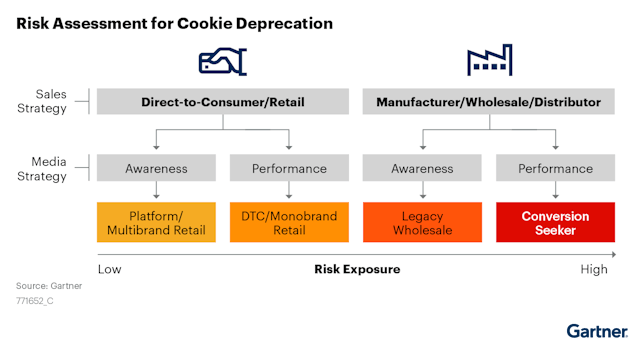
Once an organization understands how its digital media is purchased, either with an internal analysis or a report from its agency partners, determine the risk exposure to the company’s marketing programs. Privacy changes and cookie deprecation’s impact on advertising depend on two factors: sales strategy (direct or third-party sales) and media strategy (brand versus performance marketing).

Risk assessment chart from Gartner

Source: Gartner (May 2023)

Sales strategy and the proximity to the final sale are indicative of the relationship with the customer, including the receiving consent to use their data for retargeting and other conversion-oriented digital advertising tactics. Media strategy indicates the number of existing relationships brands have with their target audiences to deploy in a privacy-safe way and their reliance on advertising partners.

Limit exposure to changes in the long run

After determining the organization’s cookie risk profile and building overall resilience to disruption, follow some of these next steps, tailored for each profile, to limit exposure to changes:

  • Conversion-seeking brands should focus on the core value of their products to consumers and continue to build upon that niche in addition to investing in performance media partners. Work on increasing the loyalty of existing customers and growing through the network effects of word-of-mouth on social media and outside of digital.
  • Legacy wholesale brands should maintain mind share through their broad brand advertising strategies while leveraging emerging channels like retail media networks. These channels can help fill any potential gaps in performance advertising left by changes to walled gardens and third-party data.
  • Direct-to-consumer and mono-brand retail brands should leverage their consent-based first-party data and close relationships with customers to focus their ad spend across trusted sites and apps. With Universal Analytics’ sunset imminent, it is imperative for digital marketing leaders to start collecting data with both UA and GA4 now in order to test for data compatibility and source appropriate alternatives for signal loss.
  • Platform and multichannel retail brands must continue to innovate on their existing sites, apps and product suite to stay at the forefront of customer needs. If the brand is a Google Analytics site, it’s important to prepare for fewer granular data points on site visitors in exchange for more targeting options within the Google media properties. In addition, work with marketing technology providers to expand revenue opportunities by leveraging audience and conversion data for brands in high-risk, legacy and direct profiles.

Mike Froggatt is senior director, analyst in Gartner’s marketing practice. To read more from The Drum’s latest Deep Dive, where we’ll be demystifying data & privacy for marketers in 2023, head over to our special hub.

Feature Image Credit: Myriam Jessier

By Mike Froggatt

Mike Froggatt is senior director, analyst in Gartner’s marketing practice. To read more from The Drum’s latest Deep Dive, where we’ll be demystifying data & privacy for marketers in 2023, head over to our special hub.

Sourced from The Drum

By Ritu Marya

How D2C Founders Are Adapting Their Business To Meet Customers Where They Are Now and Where They Will Be Tomorrow

Nir Ayal has said “People don’t want something truly new. They want the familiar done differently.” New-age consumer brands have disrupted the retail market on this very mindset packaged with an omnichannel equation and combined with their unique blend of price, product innovation, and consumer experience. The inclusion of data on the whole — from anywhere and in real-time — has helped the brands make better, more informed judgments.

The culmination of technology and commerce with advanced systems such as artificial intelligence and machine learning, which can detect patterns that human logic may miss, has brought faster decision making across the entire value chain. Additionally, the increasing focus on a content first approach for customer engagement has brought more control over output. If consumer data is the new oil, the consumer is the ecosystem’s North Star and then retail, no matter how you slice it, revolves around the consumer.

Our Makers Co issue is focused on new-age brands, showcasing decisionmakers who are growing, transforming, innovating, and therefore tilting the brand ecosystem in India. They are young, hyper-focused, and with their intellectual energy are gunning for the TAM of 759 million Indian active Internet users to shift towards new-age commerce. The founders are brand obsessed from day 0 and are always looking at the bigger picture, both qualitatively by enabling a real impact on lives, and quantitatively, in terms of scale. Whether it is a revolutionary subscription model or social commerce, video-based selling, storytelling, or memorable branded experience, the Makers are one step up from their industrial counterparts who are also fast catching on to the D2C moment.

The D2C opportunity is so lucrative as we also share in this issue how traditional FMCG companies such as Dabur, ITC, Marico, Wipro and Parle Agro are also trying their luck in the space either by acquisitions or starting their own digital-first brands.

Sustainability has become paramount in today’s world. The outright need to adopt sustainable practices and products has become a priority for all size of businesses. And in recent times, seaweed has emerged as a strong candidate to make our daily products more sustainable and eco-friendly. We look into various use cases of seaweed.

The issue also looks at new regulations brought in by the Government for the online gaming sector. Under these regulations, online real money games that involve betting or wagering have been prohibited. And the government will be notifying three new self-regulatory organisations (SROs) to approve the games that can operate in the country.

Does it indicate a new dawn for real money games? The issue dives deeper to find out what steps companies are taking up besides news rules to protect consumer interest in the wake of reports of people getting addicted to such games and losing their financial savings. What are the Markets telling you today? We turn our focus toward the amended Finance Bill that has taken away the indexation benefit enjoyed by debt mutual funds for quite a long time. The story evaluates if they are still a good investment option in the debt category.

By Ritu Marya

Editor-in-Chief, Entrepreneur Media (APAC & India)

Sourced from Entrepreneur India

By Chad S. White

The potential for generative AI creating highly personalized emails may be premature, as current AI technology falls short in several areas.

The Gist

  • Scaling limitations. Generative AI struggles to efficiently create highly personalized emails without significant manual intervention, limiting its practicality at scale.
  • Traditional superiority. Existing personalization methods and machine learning models are more effective, reliable and risk-averse than current generative AI approaches for email personalization.
  • Unproven potential. The performance and return on investment of generative AI personalization in emails remain uncertain, with unclear benefits and possibly diminishing novelty.

Let me be blunt: We are so far away from generative AI writing personalized emails in any meaningful way. So very far. Yet, I keep hearing people suggest that generative AI will be writing highly personalized emails to individuals in the not-too-distant future.

I don’t think this is a realistic expectation at any significant scale, with any degree of automation and with a reliable expectation of increased performance — much less a positive return on investment. Let me explain why.

Not at Scale

The best example I’ve seen of generative artificial intelligence (AI) writing a one-to-one email was a meeting request for a salesperson. First, that’s a pretty generic request — and, in the example, amounted to 10 words. Not a big time-saver. Second, the salesperson is chaperoning the AI, and if they don’t like what’s written, they either have to edit it or write a follow up prompt for changes, which further reduces the time-savings. In that example, the degree to which it was personalized was achieved through manual intervention and not automatically driven by the recipient’s past behaviours, demographics or other criteria — which is the traditional definition of personalization.

While generative AI will get much better in the years ahead, that example is a very realistic example of how generative AI would be used in a “blank page” email situation right now, given generative AI’s many faults and limitations, including its propensity to “hallucinate.” That use case appropriately minimizes the risk by (1) asking for a routine request, (2) keeping the text short and (3) having the output monitored and approved by an employee before it’s sent.

Not Automated

To date, I’m not aware of any brands using ChatGPT or any other large language model (LLM) to incorporate personalized content into an email. And there’s a good reason for that: It’s unnecessary.

Traditional methods of personalization are highly effective and are far from fully utilized — due to siloed and unreliable data. And machine learning models for product recommendations and send time optimization are even less utilized. These existing tools are tried and true and offer solid returns with much more control — which is to say, with far less risk — than generative AI.

In fact, when generative AI is ultimately used for personalization, I predict it will be fed content that’s been personalized using traditional methods. Put another way, any personalization done by generative AI will be done on top of traditionally personalized content. That approach would minimize generative AI’s opportunities to introduce inaccuracies, biases, plagiarized material and other problematic content while simultaneously focusing generative AI on the kind of personalization that only it can do.

Just what are these new forms of personalization that only generative AI enables? Here are a few:

  • Tone. Some subscribers are receptive to more aggressive pitches while others are much less so. And, of course, there’s a whole spectrum of potential tones that could be used. Generative AI could rewrite copy on the fly to better align with what subscribers respond to best.
  • Vernacular. Language varies in significant ways by geographic region, education level, religious beliefs and other factors. Especially if it’s informed by sales and support correspondence, generative AI could adapt a brand’s messages to match the recipient’s language usage.
  • Image backgrounds. Generative AI for images can enable brands to create highly personalized images based on the subscriber’s location, industry and more. For example, an outdoors retailer could place a model in any number of national parks depending on the location of the subscriber or knowledge of where they like to hike or camp.

As with all personalization, a big part of the challenge will be securing enough data to make sound decisions. But even if that hurdle is cleared, there’s the question of performance and generating a return on investment.

Unproven Performance

Oracle Marketing Consulting has identified more than 170 segmentation and personalization criteria that can be used in digital marketing campaigns. However, just because you can personalize a message using a particular data point doesn’t mean your subscribers will respond positively to it. Through experience and testing, each brand must discover which factors truly move the needle for them. The same is true for generative AI personalization.

Even if you have the data to try to personalize the vernacular of your emails, for example, it’s currently unclear if this would be a winning approach. It’s likely that at least some subscribers would find this kind of personalization creepy and manipulative.

It’s also likely that some performance boosts likely wouldn’t be sustainable as the novelty wears off. The history of first-name personalization likely provides a good example. A decade and a half ago when it was new, first-name mail merges moved the needle for a while. But it quickly became a hollow gesture and a gimmick because it generally didn’t signal that the email’s body content was any more relevant to subscribers. First-name personalization got brief bumps when brands gained the ability to personalize images with a subscriber’s name and again when they could personalize videos with their name. But subscribers still view these as technological stunts that don’t signal anything meaningful.

Generative AI personalization may have the same effect, drawing attention away from your message and to the technological stunt of personalizing an image with the skyline of the person’s home city, for example. Sure, it will be cool the first time you encounter it, but the novelty will fade quickly because it’s based on relatively easy-to-obtain geographic data that doesn’t speak to the person’s needs or wants. Plus, attention-grabbing tactics often don’t translate into better performance.

Uncertain ROI

Even if generative AI personalization can boost performance, a positive return on investment is unlikely — definitely not at current “per token” price levels. And given email volumes, it’s possible that generative AI personalization may never make financial sense except for highly targeted campaigns.

It’s worth noting that many of our clients have seen lacklustre returns when using predictive subject line writing tools like Phrasee and Persado. These tools have been around for many years and are primarily driven by machine learning models where wording recommendations are based on the historical performance of a brand’s subject lines and other copy. If models that are trained on historical performance can’t reliably generate a strong ROI, marketers should be deeply sceptical that generative AI tools with no access to performance intelligence can.

Muddied Terminology

A big contributor to this premature idea of generative AI personalization is that some people are using the terms machine learning, AI and generative AI almost interchangeably. While they’re all loosely related, they’re far from the same. They operate using different algorithms and models, have different goals, are built on different datasets and are appropriate for different use cases.

With generative AI and AI in general being so hot right now, brands need to work extra hard to be clear-eyed about what’s possible now and what may perhaps be possible at some point in the future. Just like in the late ’90s when adding “.com” to company names was all the rage, now .ai domains are super popular. Just like then, in some cases these are just aspirational or opportunistic marketing moves.

Generative AI will ultimately be huge, and brands should absolutely experiment with and get comfortable with it. However, we’re in the hype-iest part of the hype cycle, so proceed with caution and ask lots of questions.

By Chad S. White

Chad S. White is the author of four editions of Email Marketing Rules and Head of Research for Oracle Marketing Consulting, a global full-service digital marketing agency inside of Oracle.

Sourced from CMS Wire

If you want to set your blog up for success, install these WordPress plugins.

WordPress powers millions of blogs worldwide, and the service—particularly WordPress.org—has some of the best customization options you’ll find on the web. You can choose from numerous themes to make your website look how you want it to, and you can install several plugins to enhance the site’s functionalities.

You can use WordPress plugins to make your website compliant with local regulations, stop spam, and improve your marketing campaigns. You’ll find plugins for numerous other purposes as well, and we’ll reveal a dozen of the best options today.

1. CookieYes

CookieYes Plugin on a Website

If your blog operates within the EU or EEA, you must comply with the General Data Protection Regulation (GDPR). Part of these regulations requires you to give users consent before you store cookies in their browsers.

CookieYes is a free plugin that allows you to embed a consent banner on your website. Users can alter and adjust their preferences however they want. After installing the plugin, you can sign up for a CookieYes account and set everything up on your blog.

2. Cookiebot

CookieBot User Consent Plugged In

An alternative to CookieYes is Cookiebot, which helps your site remain compliant with the GDPR. You can also use the tool to comply with the California Privacy Rights Act (CPRA), which has been in effect since January 2023.

You can use your Cookiebot banner in more than 40 languages, and the plugin is free for 50 subpages. If you need something more comprehensive as you grow your blog, you can opt for one of the various paid plans.

3. Yoast SEO

Image of the Yoast SEO WordPress Plugin

Search engine optimization (SEO) is crucial if you want others to find your blog on Google, Bing, and so on. Yoast is one of the most effective SEO plugins, and the free version is perfect for beginner bloggers.

The Yoast SEO plugin lets you choose a focus keyword, and you’ll also receive scores for your posts. If you need to fill in some gaps, the tool will give you a list of suggestions—such as adding external links. Moreover, you’ll receive a readability score.

Learning about SEO will take time and experimentation. You can speed up the process with proactive learning, and we’ve got a full guide on how to become an SEO expert.

4. Jetpack

Jetpack Plugin in WordPress

Website performance is just as important as high-quality content for building an audience, and Jetpack is probably the best WordPress plugin for helping in this respect. Jetpack has round-the-clock security features to keep your site safe from external threats, and you can automatically back up your blog.

Jetpack also makes it easier for you to move your blog to a new host later if you want to. You can get analytics tools, too, along with lots of other niceties. If you’re good at coding, you can use various JavaScript tips to optimize your performance.

5. MonsterInsights

Image showing MonsterInsights Overview in WP

MonsterInsights lets you monitor your web traffic more closely. You can look at your conversion rate, average order value, and which devices users are accessing your blog from.

Other metrics you can measure with MonsterInsights include how long people tend to stay on your blog and your total number of sessions. To use MonsterInsights, you’ll need to sign up for Google Analytics.

6. Akismet Anti-Spam

Spam comments are an unfortunate reality for online blogs, but you can minimize the risk by using anti-spam software. Akismet is one way that you can protect your blog from comments that fall into this category.

Akismet uses machine learning to determine what is spam and what isn’t, and you can integrate the service with Jetpack and other tools for your WordPress site. The basic version operates on a pay-what-you-can model, whereas more premium options have fixed pricing.

7. Creative Mail

All artists, including writers, should start an online newsletter for audience engagement, selling opportunities, and various other benefits. Creative Mail is a WordPress-designed option for creating email newsletters, and the plugin is free to use.

After integrating CreativeMail, you can go to it whenever you want from your main WordPress page. You can sync blog posts and use the feature with WooCommerce, and it also integrates with Jetpack. Creative Mail has numerous stock images that you can use to grow your newsletter as well.

8. Classic Editor

WordPress has moved toward the same block editing solutions that you’ll see on sites like Squarespace and Wix, but you can always revert to the previous editing version with the Classic Editor plugin. The Classic Editor lets you determine who is the default editor for each page or blog, and you’ll also get the old layout.

The Classic Editor plugin will continue to receive support and updates until at least 2024.

9. Elementor

Removing as much friction as possible will help you stay consistent in publishing blog posts, and Elementor does that by making editing much easier. The plugin lets you drag and drop elements like you would on some of the other most popular website builders, and you can use more than 90 widgets.

Elementor has support in over 50 languages, and the tool was designed to ensure that your blog continues to perform at an optimal speed. The service has a selection of paid plans, and you can get WooCommerce integration as well.

10. WooCommerce

Your blog probably won’t immediately make money, but you should think about monetization as soon as possible. Listing products you want to sell is one way to do that, and WooCommerce is an open-source plugin that gives you more control over your blog’s e-commerce aspects.

WooCommerce allows you to customize your product pages and choose your preferred payment methods. You can also sell both one-time purchases and subscriptions.

11. UpdraftPlus

UpdraftPlus Plugin on WordPress

You should take every step possible to stop your website content from getting deleted. But if the worst happens, knowing that you have a backup option helps—and UpdraftPlus lets you blog with more confidence by backing up your posts.

UpdraftPlus allows you to schedule your backups, and you can anonymize personal data with the service. It has free and premium versions.

12. Mailchimp4WordPress (MC4W)

Mailchimp is one of the most popular email marketing platforms, and you can integrate the service with your WordPress site via MC4W. MC4W is an unofficial plugin with more than two million active installations as of May 2023, and you can easily connect your account to your site. On top of that, you can design signup forms that can help you grow your mailing list.

Mailchimp4WordPress integrates with WooCommerce, WPForms, and several other plugins. You can manage the service from your dashboard.

Install These Plugins to Give Your WordPress Blog the Best Chance of Growing

You don’t need a perfect website when you launch your blog, but you should, at the very least, have the most essential plugins to set yourself up for long-term success. It’s also smart to think ahead and set up your monetization systems early on, which can save time later.

These plugins will help you measure website performance, stick with regulatory requirements, stop spam, and much more. So, why not integrate them with your site today?

By Danny Maiorca

Sourced from MUO 

By James Vincent

Anthropic has expanded the context window of its chatbot Claude to 75,000 words — a big improvement on current models. Anthropic says it can process a whole novel in less than a minute.

An often overlooked limitation for chatbots is memory. While it’s true that the AI language models that power these systems are trained on terabytes of text, the amount these systems can process when in use — that is, the combination of input text and output, also known as their “context window” — is limited. For ChatGPT it’s around 3,000 words. There are ways to work around this, but it’s still not a huge amount of information to play with.

Now, AI startup Anthropic (founded by former OpenAI engineers) has hugely expanded the context window of its own chatbot Claude, pushing it to around 75,000 words. As the company points out in a blog post, that’s enough to process the entirety of The Great Gatsby in one go. In fact, the company tested the system by doing just this — editing a single sentence in the novel and asking Claude to spot the change. It did so in 22 seconds.

You may have noticed my imprecision in describing the length of these context windows. That’s because AI language models measure information not by number of characters or words, but in tokens; a semantic unit that doesn’t map precisely onto these familiar quantities. It makes sense when you think about it. After all, words can be long or short, and their length does not necessarily correspond to their complexity of meaning. (The longest definitions in the dictionary are often for the shortest words.) The use of “tokens” reflects this truth, and so, to be more precise: Claude’s context window can now process 100,000 tokens, up from 9,000 before. By comparison, OpenAI’s GPT-4 processes around 8,000 tokens (that’s not the standard model available in ChatGPT — you have to pay for access) while a limited-release full-fat model of GPT-4 can handle up to 32,000 tokens.

Right now, Claude’s new capacity is only available to Anthropic’s business partners, who are tapping into the chatbot via the company’s API. The pricing is also unknown, but is certain to be a significant bump. Processing more text means spending more on compute.

But the news shows AI language models’ capacity to process information is increasing, and this will certainly make these systems more useful. As Anthropic notes, it takes a human around five hours to read 75,000 words of text, but with Claude’s expanded context window, it can potentially take on the task of reading, summarizing and analyzing a long documents in a matter of minutes. (Though it doesn’t do anything about chatbots’ persistent tendency to make information up.) A bigger context window also means the system is able to hold longer conversations. One factor in chatbots going off the rails is that when their context window fills up they forget what’s been said and it’s why Bing’s chatbot is limited to 20 turns of conversation. More context equals more conversation.

Feature Image Credit: Anthropic

By James Vincent

A senior reporter who has covered AI, robotics, and more for eight years at The Verge.

Sourced from The Verge

Amid various changes to online data collection, which have restricted how much insight digital platforms can use in ad targeting, Meta has been developing new machine learning-based ad targeting models, which are able to deliver more relevant ads to each user without requiring the same level of personal usage insight.

This is particularly important for Meta, as it’s been hit especially hard by Apple’s iOS 14 update. Following the update, many users have cut Meta off from gathering usage data in its apps.

And while that has hurt Meta’s bottom line, more recently, Meta’s ad business has seen a recovery, while marketers are also reporting much-improved performance through tools like Advantage+, Meta’s automated ad targeting process.

So how is Meta delivering more relevant ads to users with less data to go on?

This week, Meta has provided an overview of its latest systematic update on this front, with a new ad delivery process called ‘Meta Lattice’, which uses multiple data points to better predict likely ad responses through AI and other predictive technology.

Meta Lattice

As explained by Meta:

Meta Lattice is capable of improving the performance of our ads system holistically. We’ve supercharged its performance with a high-capacity architecture that allows our ads system to more broadly and deeply understand new concepts and relationships in data and benefits advertisers through joint optimization of a large number of goals.”

Okay, that’s a bit of a mouthful – but essentially, the Lattice system is able to infer more likely user responses, without requiring as much direct data insight from each person.

The process utilizes knowledge-sharing across Meta’s different surfaces (e.g. News Feed, Stories, Reels) to expand its mapping of potential user interest and activity. Previously, all of these elements were measured in isolation, but Meta’s more advanced predictive models are now able to take in a wider array of data points, in order to better understand likely individual behaviors.

It’s basically an expanded database of all of Meta’s ad response activity, which, when cross-matched with all of the other information it has on each user, enables the Lattice system to better predict likely ad interest through more advanced mapping. That makes better use of all of the data that Meta can access to show people more relevant ads.

“We’ve designed Meta Lattice to drive advertiser performance in the new digital advertising environment where we have access to less granular data. Additionally, Lattice is capable of generalizing learnings across domains and objectives, which is especially crucial when the model has limited data to train on. Fewer models also means we can proactively and efficiently update our models and adapt to the fast-evolving market landscape.”

In addition, the Lattice system is also able to better contextualize longer-term ad exposure, and its relative impact on response.

The engagement between an ad and a person viewing the ad can span from seconds (e.g., click, like) to days (e.g., considering a purchase, adding to a cart, and later making the purchase from a website or an app). Through multi-distribution modeling with temporal awareness, Meta Lattice can capture not only a person’s real-time intent from fresh signals but also long-term interest from slow, sparse, and delayed signals.”

According to Meta, this approach has already improved ad exposure quality by 8%, and it’s getting better every day, leading to better results through its automated targeting tools.

Really, if you haven’t considered Meta’s Advantage+ ads, they’re worth a look, with, again, many performance marketers reporting strong results through the use of Meta’s advancing ad targeting tools.

And, as these AI-based systems evolve using a broader range of inputs, they’re likely to become more significant drivers of response, which could help you target the right audience for your offerings without needing to manually set the parameters of each campaign.

You can read more about Meta’s Lattice ad targeting system here.

Sourced from Social Media Today

By Nick Fernandez

It’s time to start that small business or side hustle.

There are podcasts for everything, but if you’re a small business owner, you probably don’t have time to listen to podcasts like Serial or The Joe Rogan Experience. Thankfully, there are plenty of business podcasts to listen to to gain tips, insights, and advice to improve your productivity or leadership skills.

It’s not always easy to find the best business podcasts on Spotify or other platforms, but we’ve done the hard work for you. Here are the best podcasts for business owners and entrepreneurs of all shapes and sizes!

The best business podcasts


10 Minute MBA

10 minute MBA

Frequency: Daily

Length: 10 minutes

10 Minute MBA — Daily Actionable Business Lessons with Scott D. Clary might have the longest name of any business podcast on our list, but thankfully the episodes themselves are as short as the title implies. This daily podcast is filled with actionable insights, tools, and strategies for business growth. Scott D. Clary is an investor and CEO himself, with a fairly substantial YouTube presence if you want to learn more. But at just 10 minutes, this one is easy to slot into your daily commute or morning routine.

Listen on Spotify or Apple Podcasts

The BizChix Podcast

Powered by Playwire

Bizchix podcast

Frequency: Weekly

Length: 30 minutes

Most business podcasts are, quite frankly, almost exclusively filled with men. For all the women entrepreneurs out there, Natalie Eckdahl puts out this weekly podcast filled with business training and coaching calls to help you learn everything from team-building techniques to managing work/life balance.

Listen on Spotify or Apple Podcasts

The Goal Digger podcast

Gold Digger business podcast

Frequency: Twice weekly

Length: 30-60 minutes

The Goal Digger podcast is a great business and marketing resource for entrepreneurs and influencers. Host Jenna Kutcher, a self-made millionaire, shares her own experiences and lessons learned from building a thriving online business. It also features guest experts that offer insights and tips on key topics such as social media, branding, email marketing, and blogging, all essential for online success.

Listen on Spotify or Apple Podcasts

Business Accelerator

Business accelerator podcast

Frequency: Weekly

Length: 60 minutes

When it comes to the best podcasts for small business owners, Business Accelerator is right up there at the top. It’s hosted by father-and-daughter team Michael Hyatt and Megan Hyatt Miller, and it’s filled with actionable advice on how to become a better and more effective leader. Episodes are released weekly and typically run just under an hour long.

Listen on Spotify or Apple Podcasts

Mind Your Business

Mind your business podcast

Frequency: Twice weekly

Length: 60 minutes

If you listen to podcasts as much as I do, one hour a week just won’t cut it. The Mind Your Business podcast fills that gap with three episodes per week, each running anywhere from 30 minutes to an hour and a half. It’s hosted by entrepreneur James Wedmore and his girlfriend, showcasing everything from interviews and case studies to lists of tips, tools, and advice for business owners. It’s mostly focused on digital businesses, but even if you have a shop or restaurant it’s still one of the best business podcasts you can listen to.

Listen on Spotify or Apple Podcasts

Side Hustle School

Side hustle school podcast

Frequency: Daily

Length: 5 minutes

This next one is the best business podcast for anyone who isn’t quite so far along in their entrepreneurial journey. It’s a short, daily podcast that highlights a different person’s side hustle. Usually, these are modest businesses (there’s a series about making your first $1,000), but the podcast is filled with ideas to inspire you to start your own business without having to leave your day job.

Listen on Spotify or Apple Podcasts

How I Built This with Guy Raz

How I Built This podcast

Frequency: Varies

Length: 45-90 minutes

If you’d rather find out about how the world’s best-known entrepreneurs got started before they made their millions, How I Built This with Guy Raz is worth a listen. It features roughly hour-long interviews that go over the decisions founders made to grow their businesses, often into multinational conglomerates. Will you ever reach this level of success? Probably not. But it’s good to dream.

Listen on Spotify or Apple Podcasts

The Tim Ferriss Show

The Tim Ferriss show

Frequency: Weekly

Length: 2-3 hours

I’ll be the first to admit that Tim Ferriss often rubs me the wrong way, but there’s no arguing that he gets some of the greatest guests on his podcast. Topics are more focused on lifestyle coaching and productivity hacks for entrepreneurs rather than how to actually run a business, but there are some gems in there. I just wish that Tim would let guests speak more without butting in, and the conversational nature of the podcast means episodes are extremely long.

Listen on Spotify or Apple Podcasts

BBC Business Daily

BBC Business Daily podcast

Frequency: Daily

Length: 20 minutes

Most of the options on our list so far have had advice for small business owners and entrepreneurs, but the Business Daily podcast from the BBC has a much wider scope. It has stories and insights from business leaders, entrepreneurs, workers, consumers, and experts on various topics such as economics, technology, innovation, and social issues, so you’re getting a different perspective in every episode. As the name implies, episodes are released daily, and run about 20 minutes each.

Listen on Spotify or Apple Podcasts

Planet Money

The Planet Money Podcast logo.

Frequency: Daily

Length: 10 minutes

Any list of podcasts wouldn’t be complete without an NPR podcast, but thankfully Planet Money is one of the most popular and best business podcasts around. Like the BBC podcast above, it’s more focused on the wider economy, but if you want your business to thrive you’ll need to have some idea of what’s going on in the world. It’s also hugely entertaining, with three episodes a week running 20 to 30 minutes each.

Listen on Spotify or Apple Podcasts

Feature Image Credit: Lily Katz/Android Authority

By Nick Fernandez

Sourced from ANDROID AUTHORITY

By John Mullins

The author of Break the Rules explains how to rock the boat without sinking the ship and your career.

These days, it seems, most people want to either be an entrepreneur or work for a fast-growing entrepreneurial company. Even better, because innovation often holds the key to unlocking a company’s future success, many leaders today are seeking to employ people who are more “entrepreneurial” than those who are just marking time at work.

But being a counter-conventional, quick thinker in a slow-moving company can sometimes cause some bumps along the road. So how can you rock the boat as an entrepreneurial employee without sinking the ship and your career?

Start here

Why are entrepreneurial career settings so attractive, and so important, today? There’s freedom to break out and try new things. There’s the plethora of career opportunities that fast growth inevitably brings. And, if all goes well, there’s a chance to participate in changing the world, or at least your small corner of it.

Being entrepreneurial in a traditional company can often look like thinking and acting outside of your company’s unwritten rules. These are conventions that you’ll likely only know if you work within those cultures, but there are a few that are more universal.

Two of the most unfortunate, universal practices are the “rules” that well-run companies should only undertake new initiatives when the markets are “large” enough and that the first step in doing so is to dream up an “idea” of something, whether a product or a service, to offer.

Entrepreneurs know that rules are made to be broken and that new ways of thinking can hold the key to supercharged business growth. If you need a little bit of inspiration, consider the origin of one of the world’s most famous brands.

In the mid-1970s, Nestlé was the global leader in instant coffee, with the powerhouse Nescafé brand accounting for 30 per cent of global coffee sales. But after a spontaneous trip to Rome, a Swiss engineer in Nestlé’s packaging department named Eric Favre set out to recreate a machine that brewed perfect, Italian-style coffee. After some stumbling blocks with disappointing test results and low sales figures, Nestlé hired Jean-Paul Gaillard to overhaul the project, narrowing the focus to serve the individual coffee drinker market instead of restaurants, and prioritizing exclusivity with the launch of the Nespresso Club and high-end boutiques in select destinations. It’s now one of the most recognizable brands out there which shows the power of pursuing a counter-conventional approach within an established environment.

Six mindsets to start acting counter-conventionally

After over 20 years of research, I’ve found that there are six mindsets that can help you to think and act more counter-conventionally and more like an entrepreneur. These break-the-rules mindsets will bring fresh perspectives to your company’s efforts to innovate and grow but, perhaps unsurprisingly, they run counter to the conventional wisdom that may well be found in your organization’s handbook. So, you’d better proceed with your eyes wide open!

Here’s a quick summary of what they are and how you can incorporate them into your day-to-day:

  • Think narrowly: Instead of seeing that small project as a waste of your time, think like an entrepreneur who views tiny markets as opportunities to establish their brand, focus their efforts and set themselves up for learning and growth.
  • Adopt a problem-first, not product-first logic: Think of your boss or your colleagues as your customers, and work out what problems they’re facing. If you aren’t solving a genuine customer issue and are instead focusing on what you can offer them ‘off-the-shelf’, you aren’t thinking like an entrepreneur.
  • Say, yes, we can!: If you’re asked by your boss whether you can do something promising that falls outside your current competencies, remember what an entrepreneur would do say “Yes, we can!” then figure out how. That’s how many of our most popular gadgets including Amazon’s Kindle e-reader were created.
  • Beg, borrow, but don’t steal: Instead of investing in resources, entrepreneurs will find a way to borrow or outsource them, saving money and time in the process. In a big business setting, look for opportunities to “borrow” knowledge or assets from someone else—be that finding an internal expert or learning new skills online—or use existing resources for new projects at work. Your boss will likely thank you for taking the initiative.
  • Ask for the cash, ride the float: It’s an audacious act to ask for money ahead of delivering your product, but it’s precisely how Elon Musk and the founding team at Tesla made millions. If you can provide a product that customers really love, and can get your customers to pay for it ahead of time, you can put that spare cash—the “float”—into growing your project.
  • Instead of asking permission, beg forgiveness later: Entrepreneurs are known to plough ahead when there’s legal ambiguity and seek forgiveness instead of permission, so I suggest you follow the same logic—within reason. Entrepreneurs embrace failure as an opportunity to learn and pivot, so why don’t you?

If you’re someone who wants to make the world—or your small corner ther—a better place, in one way or another, as many counter-conventional thinkers have done before you, what are you waiting for?

Learning, practicing, and mastering an entrepreneurial mindset that breaks the conventional rules will give you and the place you work a fighting chance to change the world.

Feature Image Credit: Sunder Muthukumaran/Unsplash

By John Mullins

John Mullins is an associate professor of Management Practice at London Business School and the author of Break the Rules! The 6 Counter–Conventional Mindsets of Entrepreneurs That Can Help Anyone Change the World.

Sourced from Fast Company