Most, if not all, local small businesses in Northwest Arkansas that are struggling or have failed can be attributed to their lack of marketing and advertising efforts, which becomes evident once you delve into the complete truth about them.
I know of a business owner in Northwest Arkansas who says he will shut it down any day due to a lack of business, yet who still will not make even a single free Facebook or Instagram post. He also doesn’t do any internet, radio, billboard or television advertising, nor does he use hangtags for doors, send out direct mail, do email blasts, use SEO or sponsor a Little League baseball team. There is just no marketing whatsoever.
I don’t think this situation is that unusual for many small businesses. Why is this the case? There are several reasons, including:
The owners of these small businesses think they can’t afford it. They see marketing and advertising as an overhead expense, like rent or insurance, and if they can avoid spending anything there, it is money they can put in their pockets and take home to their families.
They don’t believe marketing and advertising work. My experience is that if you spend “X” on marketing and advertising, you will get a certain number of sales or dollar amount of sales from it. So spend X, and get X times 10 or X times 20. What will that kind of volume increase do in terms of business viability and profitability? Think about your own business. But for this relationship to work, it takes consistent activity and spending. I have often heard, “We tried advertising, and it didn’t work.” You can’t do it once or twice and expect that to produce results. It may not.
These small business owners are hung up on the idea that “word-of-mouth is the best advertising,” so they do nothing. They forget that to get word-of-mouth, customers have to buy from the business or use it in the first place. Without marketing and advertising, you will never get the word-of-mouth flywheel going.
They don’t know how to market. Most small business owners are good at something — they are good cooks, carpenters, sewing, or getting people to exercise correctly. That’s why they went into business in the first place. But what they don’t know anything about is marketing and advertising. So instead of going outside their business to find help, they give up. There are so many marketing companies and advertising sources that can help a small business, not to mention marketing students who would love the chance to work with a real business here in NWA, that there is no excuse for not being able to get help.
Let me conclude by saying that I am not someone who’s just done a lot of reading about this stuff and is now opining about it. In my businesses, I always invested in marketing. That’s how two of my companies got on the Inc. 500/5000 list — one of them three times. And today, the new and existing businesses I am involved with heavily invest in marketing and advertising and have a revenue growth curve that reflects that.
Contrary to what your CPA/tax advisor may tell you, a small business can be worth far more than what you can extract annually. The value of the business is directly related to the revenue growth rate, not to mention that a growing business tends to be more profitable than a stable (i.e., stagnant) business.
So now is the time for small business owners to stop handwringing and start investing in a consistent marketing and advertising program. Do it now before it’s too late.
([email protected]) Mark Zweig is the founder of two Fayetteville-based Inc. 500/5000 companies. He is also entrepreneur-in-residence in the Sam M. Walton College of Business at the University of Arkansas and author of the award-winning book, “Confessions of an Entrepreneur.” The opinions expressed are those of the author.
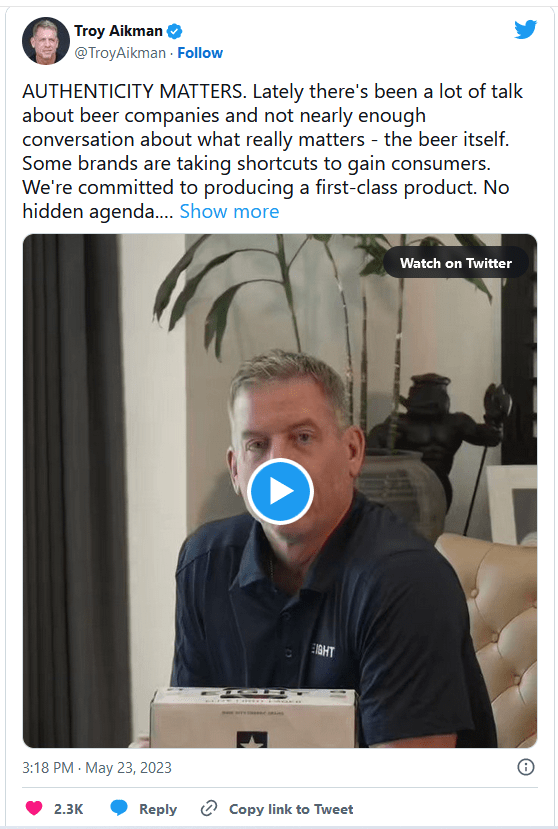
Eight co-founder Troy Aikman on brand positioning, marketing, and keeping your message as simple as possible.
Plenty of stories (including many I’ve written) describe start-up launches. But what you rarely see are stories about the middle stages of a company’s life, a period that in many ways is more difficult than the start-up phase. Achieving — and managing — steady growth. Expanding your team. Building a solid infrastructure. Creating the right culture.
For many founders, that’s when the leadership and business rubber really hits the road.
And that’s why I regularly check in with Hall of Fame quarterback and ESPN MNT analyst Troy Aikman, the co-founder of Eight, a “better for you” beer made with organic grains and antioxidant-rich hops, and without adjuncts, fillers, or sugars. Eight is the most successful independent beer ever launched in Texas, and currently the top-selling beer in the “craft” segment.
But that also means one of the brand’s next challenges is avoiding a sophomore slump, when public attention generated by a product’s launch subsides and customers are often lured away by other product launches. (“New” is great, but by definition doesn’t last forever.)
Often, brands — “sophomore” as well as established — employ a variety of advertising strategies. Partnering with influencers. Targeting a specific market segment. Publicly embracing a particular social cause.
Aikman’s approach is juuuust a bit simpler.
“I like to pare things down to their simplest form and approach,” Aikman says. “That’s how I was as a player, and how I’ve been in business. All I know is we’re working our tails off to make a great beer, and we’ve done that. I’m proud of it, and the rest of it is just a lot of conversation that really doesn’t matter.”
“As a company that is young and hungry like we are,” he says, “the message is that if you want to align with a company that’s focused on one thing, making great beer, then come join team Eight.”
As for spreading that message — industry analyst IRI considers “better-for-you” demand an industry tailwind — the key is also simple: work even harder. While Aikman spends considerable time meeting with distributors, vendors, and customers, as well as attending industry events, his presence is the icing, not the cake.
“We’ve done a lot of testing as far as what resonates with people when they think of Eight beer,” Aikman says, “and what has hit home is that it’s not my involvement. It’s also not some loose association with the Cowboys. What resonates is that we are a low calorie, low carb, all organic beer. That was the best news I could have heard, because like any product, the beer has to stand on its own, especially as we move outside of Texas.”
As for expanding beyond Texas, six months ago Aikman thought the brand would expand to border states since infrastructure and fulfilment would have been relatively simple. Today he’s focused solely on Texas.
“As well as we’ve done in Texas,” he says, “our overall brand recognition in the state is only 15 percent, so there’s still tremendous growth potential. Distributors in other states constantly ask when we’re coming, and that’s great. But still: I’d much rather be pulled into markets, rather than pushing, and the better job we do in Texas, the more likely that is to happen.”
Which might be the best way for your startup to manage a sophomor slump. Sure, you can fuel growth through more — or more “creative” — advertising, but higher customer acquisition costs could result in unprofitable growth. You could fuel growth by spreading into new territories or markets, but that often mean starting over in terms of gaining brand awareness, something that is much harder than expanding from an established base.
Or you could forget what made you successful in the first place, and complicate what should be a simple message: the problem you solve or need you meet, in a way that makes you different from any other brand — because that’s what really resonates with customers.
Everything else? It could just be a lot of conversation that doesn’t matter.
Cross-media measurement continued to dominate industry chatter in Cannes – but are we one step closer to solving the measurement puzzle? Nielsen’s Deirdre Thomas gives us the lowdown.
The advertising industry has been gunning for better attribution and cross-media measurement solutions. With consumers now moving fluidly across devices, platforms and media, it’s been a long time coming for measurement to catch up – but that change is hard.
“It’s not just the measurement and the metrics that have to change – it’s everything from the way companies are organized to the way tools are built, processes are run, and cultures,” says Deirdre Thomas, chief product officer at Nielsen.
The way that the ecosystem has developed historically has created silos where digital may be in one place, television in another, and social in another place. But if marketers want to enable cross platform measurement, all those things must come together.
“That’s really what marketers want – to reach their audience fluidly across all the places they consume media, and the dollars have to flow that way,” says Thomas. “So really, to bring the measurement that way, all the other pieces have to change as well, and it’s a really hard journey.”
To help marketers piece measurement together, Thomas offers two pieces of advice: “Build for what you want to get and organize for what you want to achieve. Organizing teams, processes and buys in a way that actually reflects cross-platform is really going to help push us there.”
The next is a bit more tactical: enable the identification of the digital and linear pieces of a campaign. “That notion does not necessarily exist and it’s certainly not scaled or identical across the ecosystem,” explains Thomas. “As an industry, we need to lean in and make it possible to understand the campaign in a cross-media way so that we’re not trying to piece things together. We need to have an identifier of some form to enable that scale.”
So where does measurement go next? Nielsen announced a tie up with EDO in Cannes to integrate its Nielsen One audience measurement data with EDO’s outcomes measurement, which will enable mutual clients, starting with Disney, Warner Bros Discovery and Mediahub, to better plan and measure the impact of campaigns.
“It’s really the next chapter for Nielsen where we want our measurement to flow out into the ecosystem to underpin all kinds of innovation and measurement, and really create interoperability for the ecosystem,” explains Thomas.
We Reveal Our Best Online Marketing Strategies for Small Business
Since Source Local Media was formed in early 2011, one of the core values of the company has been to willingly share best practices, including our best online marketing strategies for small business.
Messaging. What do we want to say to them? How can we tap into emotion that will MOVE them in the direction we want?
Reach. When and where is the right time to talk to them so they can (1) absorb what we’re saying, and (2) take the action we want? How many impressions will it take to get our desired outcome(s)?
Results. What do we need to track and report so we know whether we’re being successful or not?
The beauty of the digital environment is that you can test just about any idea. The curse of the digital environment is that you can test just about any idea.
That’s why we developed our Bullseye Method, which provides a structure for optimizing your strategy. It’s an organized way to test the most plausible ideas, track results, and make a series of iterations until you hit the bullseye where you get the best, most reliable ROI with your marketing investment.
The best online digital marketing strategies must have an organized way to test, evaluate, iterate, and ultimately optimize performance. Otherwise, you risk wasting time and money. And no one wants to do that…
How To Calculate the Budget
So how much should your budget for your online marketing strategy be? Here is an exercise we take clients through that will help you DIY your own budget calculation:
What is your average gross margin?
If your margin is 60-70%, consider a budget between 8-20% of revenue
If your margin is below 30%, consider a budget between 3-6% of revenue
How competitive is your business category?
The more competitive your environment, the higher you should be in the range
How aggressively do you want to grow?
New businesses should be on the higher end of the range
We Created Our Digital Basics Plans Just for Small Business
How should you allocate your budget to create the best online marketing strategy for your business? To help you understand our best practices, we’ve shared a link to an overview of our most common “Digital Basics” plans below.
We built these based on the most common budgets and goals our clients tend to identify. Think of them as starting points, from which we frequently customize.
We consider Digital Basics the minimum any business should be doing online. And then we build extra emphasis into certain areas based on your business type (B2B, D2C, etc.), your competitive environment, and — most of all — your growth goals and marketing ROI expectations.
If you’d like to know more about any of the line items, including why we prioritize where we do, we’re always happy to talk you through our best practices. Just schedule time with our team here. There’s no cost or obligation to you. It’s how we invest in potential clients long before they invest in us.
If you’ve ever tried to build an audience, you might have experienced the painful scenario of posting a piece of content you’re particularly proud of and… crickets.
As the supply of content increases, accelerated by the introduction of AI content tools, it’s harder than ever to earn attention.
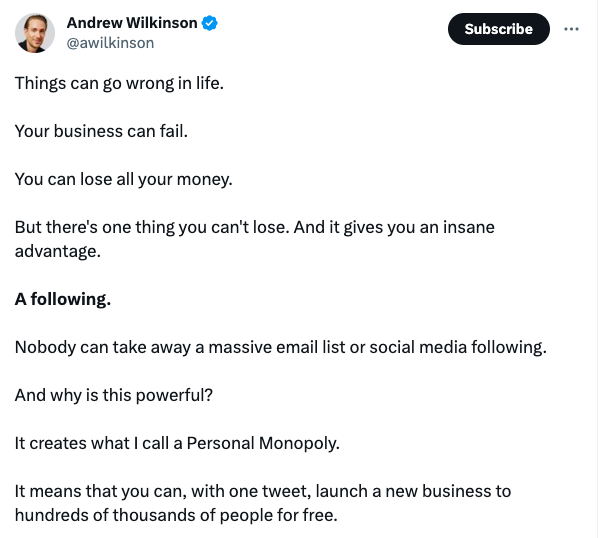
However, this also means that the value of attention is increasing, and those who succeed have more leverage than ever before. Famed investor Andrew Wilkinson sums this up well in the following tweet:
The good news is that building a new audience isn’t impossible.
It just requires a different strategy than before. So in this post, we’ll discuss a step-by-step strategy you can use to build an audience from scratch in 2023.
Step 1: Select a Topic, Medium, and Angle
If someone consumes a piece of content you created and then follows you, it’s probably because they liked it and want to see more similar content. So if you change the topic and style of your content, you might lose those subscribers because they might not like the new topic or style of content.
As a result, you’ll find that your subscribers frequently churn, and you’ll struggle to build a loyal following.
This was a key mistake Eric Siu mentioned he made when building his YouTube channel. He discussed marketing in some of his YouTube videos, while in others, he discussed NFTs and cryptocurrency. His audience began unsubscribing as the audience interested in marketing didn’t care about his NFT videos, and the NFT audience didn’t care about his marketing videos.
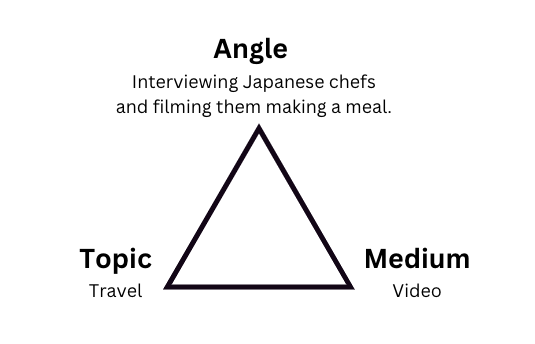
So the key to building a sticky, loyal audience is selecting a topic, angle, and medium. Here’s how I define each of these:
Topic: This is what you’ll talk about. Examples of topics include marketing, finance, food, travel, etc. Choose a topic you have unique knowledge about and are genuinely interested in. Content is a long game, and you’re much more likely to be successful if you have a genuine interest in the topic, as there will be a period of time when you won’t receive any reward for your efforts.
Medium: This is how you communicate your content. Examples of mediums include video, text, or audio content. The key to choosing the best medium is to select one you enjoy and can produce consistently. Publishing consistency is key to long-term growth, so if you don’t think you can produce that medium of content weekly, choose a different medium. For example, if you don’t think you can produce video content each week, you might want to choose text-based content.
Angle: This is how your content will provide a different perspective from other existing content. Similar to product-market fit, your angle is the differentiator that helps you achieve “content-market” fit. For example, if you’re starting a Japan travel vlog, how will it differ from existing Japan travel vlogs? Maybe you’ll interview local Japanese chefs and film them making a meal. The key to selecting a successful angle is to make it both unique and repeatable. For example, interviewing Japanese chefs and filming them making a meal is a repeatable format.
To help you choose your topic, medium, and angle, here are a few examples for inspiration.
Angle: Asks people on the street how much they pay for rent and then tours their apartments.
If you look through each of these individuals’ content, they cover roughly the same topic in a repeatable format.
Note: You’ll notice that they all have audiences across multiple different platforms (Twitter, YouTube, etc.). Below, we’ll discuss how you can take an omnichannel approach, but when you’re first starting out, it’s best to focus on just one medium on one platform.
Step 2: Create Content and Publish Regularly
The main cause of content failure is the creator quitting too soon.
Your first pieces of content probably won’t hit, and that’s okay. In the early days, the most important thing to do is to get the reps in and hone your abilities as a content creator.
So select a specific content topic, medium, and angle and commit to publishing consistently for the next three months.
Here are a few tips to help you publish consistently:
Set a reasonable content publishing frequency. If you plan to publish every day, you’ll probably burn out quickly and give up. As consistency and a long-term vision are essential for content success, create just one piece of content, see how long it took you to produce, and then select a realistic publishing schedule you can realistically commit to for at least six months.
Batch your content in advance. Many creators find it easier to produce several pieces of content in one sitting once they’re in the flow state rather than setting aside several content creation sessions throughout the week/month. Batching content also ensures you publish on time.
Outsource and automate non-creative work. Plenty of minor tasks are involved with content creation, from editing videos to scheduling social media posts, but these small tasks can quickly add up to hours each week. So use software tools to automate tasks or hire a virtual assistant on a platform like Upwork to help you. By offloading low-value tasks, you’ll have more time to dedicate to content creation, decreasing your chances of burnout.
Once you publish some content, you can ask for feedback from mentors and peer groups.
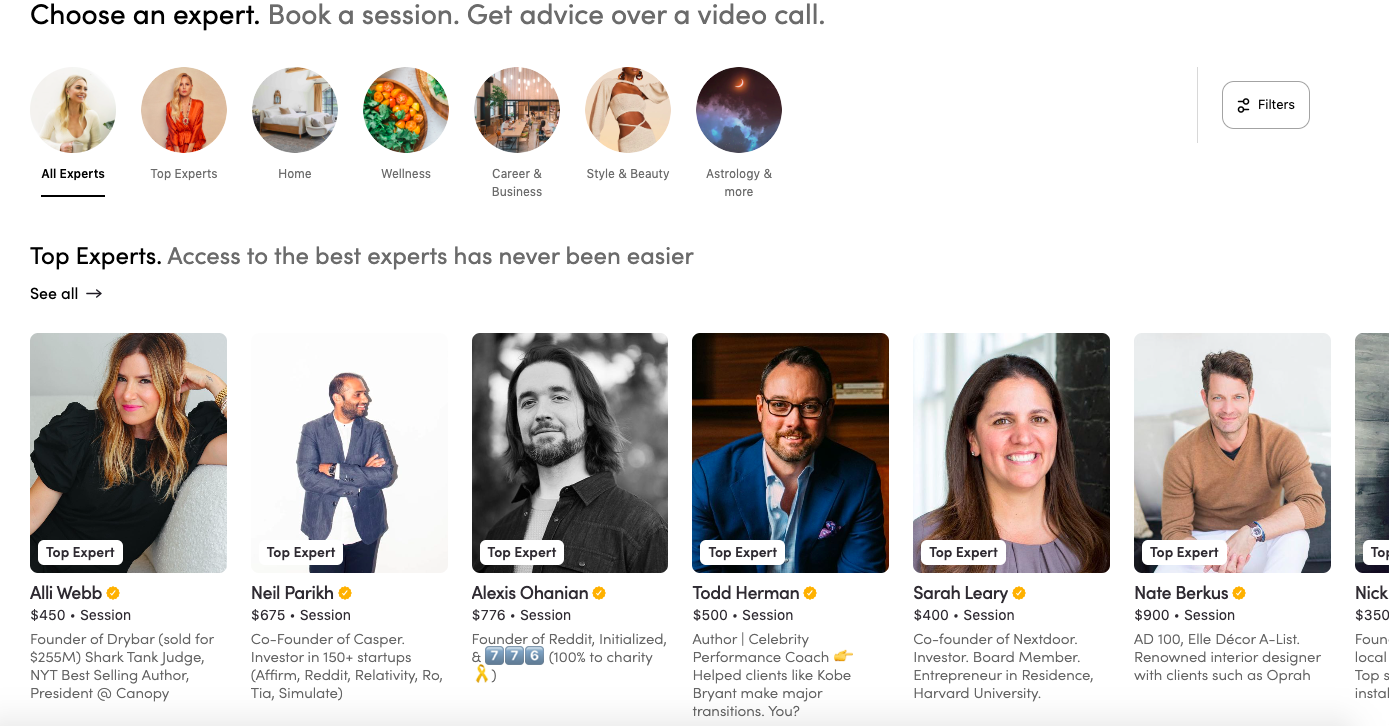
For example, platforms like Intro.co and Clarity.fm allow you to schedule mentorship calls with world-class experts.
Alternatively, you can join a community like the Copyblogger Academy, where you can ask me (Tim) questions and receive feedback from other peers. We also do Q&A sessions with top content creators.
If you want to learn more about how to level up your content creation skills, here are a few additional resources you can check out:
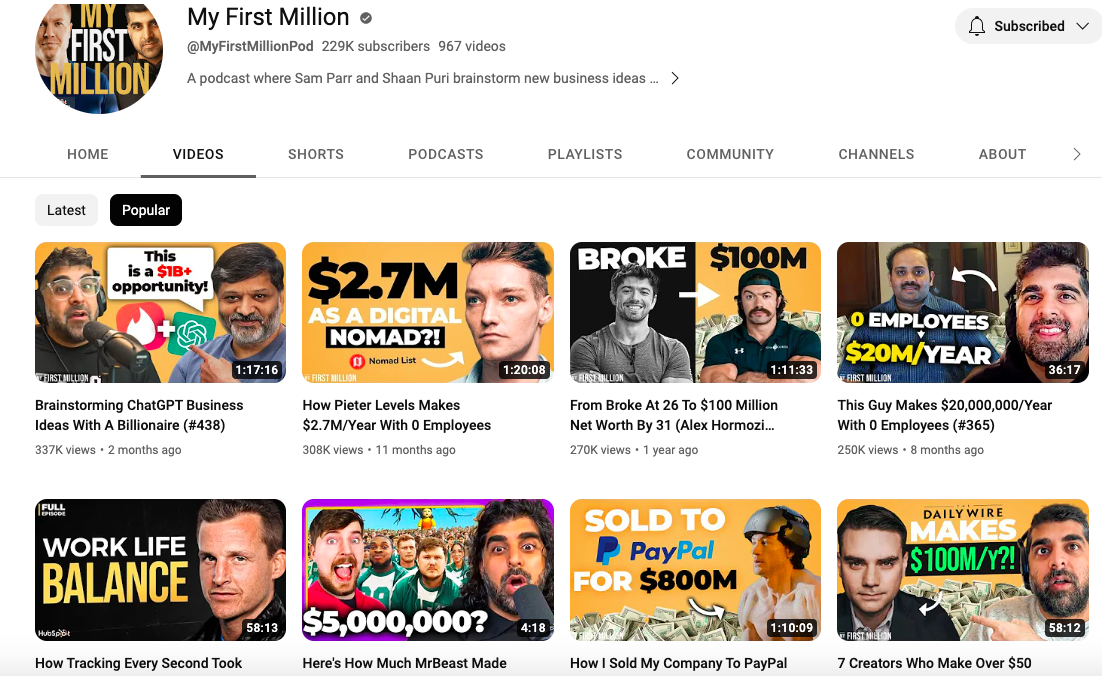
Another excellent method to improve your content is to study your competitors’ content and determine which content receives the most engagement or positive comments.
For example, if you produce video content on YouTube, you can filter by the most popular videos and then look for patterns and popular influencers to incorporate into your content:
Step 3: Partner with Existing Creators
There’s a misconception that as long as your content is high quality, it will naturally earn engagement.
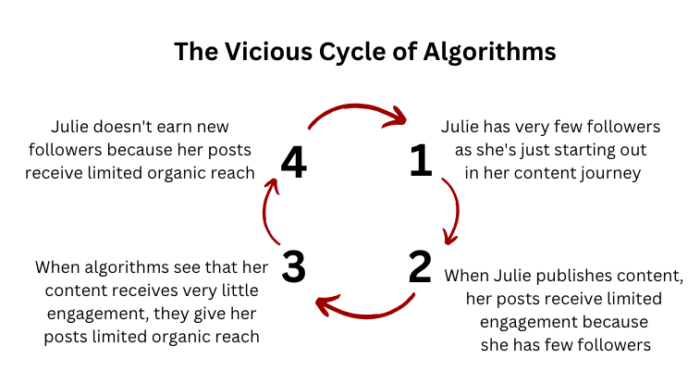
Unfortunately, most algorithms (social media, search engines, etc.) give more visibility to content that earns a lot of traction and engagement within the first few hours.
When you’re starting, you probably only have a handful of followers, so your content won’t receive much engagement within the first few hours of publishing. Unfortunately, this means your content probably won’t receive much organic reach from the algorithms – even if the content quality is next-level.
This creates a vicious cycle that makes it hard to earn a following and receive more engagement.
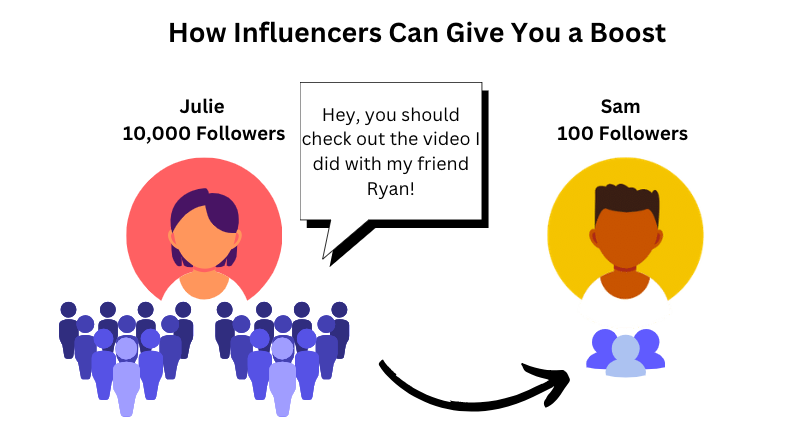
To break out of this cycle and help your content receive more organic reach, consider collaborating with an influencer that already has the attention of your target audience.
When they promote your brand to their audience, your content will naturally receive more impressions, which will help it receive more engagement and ultimately help you earn more followers.
The tricky part is getting an influencer with a larger audience to agree to do a content collaboration with a smaller brand with a small audience.
As a rule of thumb, partnerships are most successful when incentives are aligned.
So before you ask an influencer to collaborate with you, ask yourself how this partnership will benefit them.
Some influencers agree to interview smaller brands if they can repurpose the content on their own social media accounts. As most influencers are already setting aside time to create their own content, many will agree to an interview with a smaller brand if they can use that content for their personal brand.
Alex Hormozi is a great example of this in action. He often repurposes all of the interviews he does as social media content, like this clip that he swiped from an interview he did on Impact Theory:
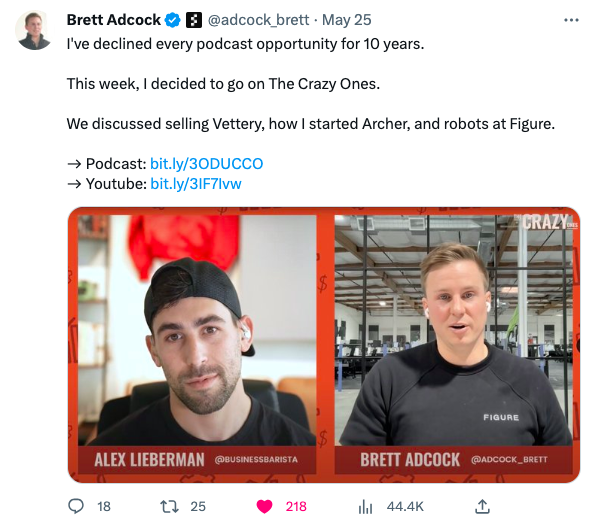
Many influencers also share the content when it goes live and give your brand a shout-out. Here’s a great example:
Not all influencers will agree to an interview, especially if you have a smaller audience. To increase your chances of receiving a “yes,” look for influencers that have recently done interviews with competitors that have a similar audience size.
You can also look for influencers launching a book, as they tend to be more open to interviews.
Note: Even if you’re just writing text-based content (like Twitter or LinkedIn threads), you can still interview someone and then write out the key points from the conversation and post that on your social media channels.
If you’re struggling to get an influencer to collaborate with you, consider paying for an interview. For example, you can use a platform like Intro.co or Clarity.fm to pay for calls with world-class experts.
You can also pay an influencer directly to promote your content. However, collaborations tend to be more effective as influencers are often more vested in the partnership when their own thought leadership is involved.
If you’re producing audio or video content, you can also offer written guest posts to blogs with similar audiences and simply ask that they insert the video or podcast link somewhere inside the guest post. For example, popular car YouTuber Doug DeMuro got his first several thousand YouTube subscribers by writing for the car blog, Jalopnik, and then inserted his videos into the written content.
Finally, you can also pay to promote your content on social media platforms like Facebook, Instagram, or Twitter.
Step 4: Adopt an Omni Channel Approach
Once you’ve established a solid publishing schedule for your main channel, the best method to increase your output and reach with minimal additional effort is to adopt an omnichannel approach.
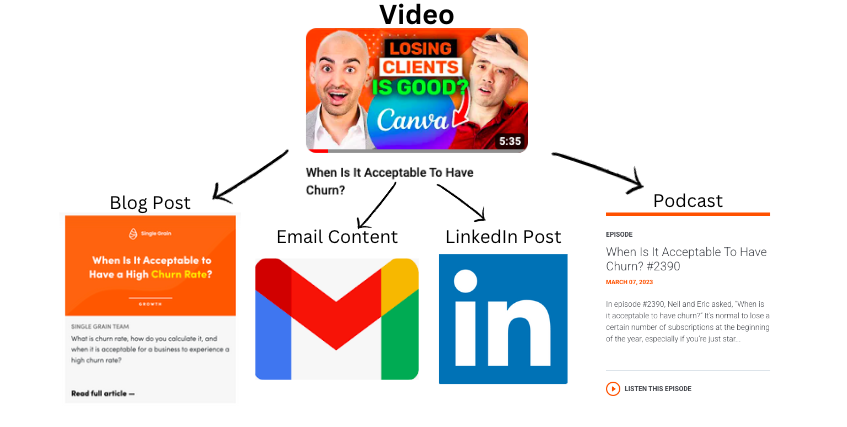
For example, if you’re already creating video or podcast content, you can chop that video up into multiple shorter clips and post it across social media platforms like LinkedIn, TikTok, and Instagram.
This allows you to scale reach and engagement exponentially, as your single long-form video is now ten or twenty pieces of content.
Eric Siu and Neil Patel do a great job of repurposing the content for Marketing School. You can see an example here:
To help you automate this process, you can use a tool like Repurpose.io. Or, if you’d prefer to outsource the entire process, you can hire an agency like Shortzy to do it for you.
For example, you can also put the video script into an AI content writer tool and ask it to write a blog post or social media content based on the script.
The key to succeeding with an omnichannel approach is optimizing each piece of content for the platform on which you intend to publish it. For example, if you’re repurposing a piece of content on TikTok, optimize it with subtitles and edit it in the fast-paced style of content that TikTok users like to consume.
If you feel overwhelmed at the prospect of repurposing your content across multiple additional platforms at once, choose just one additional platform and then add more as you become comfortable repurposing.
Step 5: Double Down On What’s Working
The content marketing landscape is always changing, and the marketing campaigns that work today might not work as well a year from now. So as you grow your audience, consistently collect audience feedback to learn what content resonates best and then produce more of that content.
The same methodology applies to your general audience growth strategy.
Look at your growth metrics and double down on the partnerships and marketing strategies that drive the most audience growth.
Many entrepreneurs become distracted by new trendy marketing tactics, but the key to long-term success is focusing on what works and doubling down on those marketing strategies.
While experimentation is a great way to discover more effective strategies, limit new marketing campaigns to just one or two per month. Other than that, focus all your efforts on the top two or three marketing campaigns currently driving the most growth.
For example, if email marketing promotions currently drive 50% of your growth, double down on doing more email campaigns.
Bonus: Consider Different Monetization Strategies
The purpose of building a following is to eventually convert them into paying customers, but when and how you monetize will significantly impact the long-term revenue you receive.
First, monetizing too early can cause your audience to lose trust in your brand, and many will either unfollow you or ignore your offer.
You can think of the trust you build like a bank account – the more value you provide and the longer you wait to withdraw, the more you can ask for when you pitch an offer.
So how do you know when you’ve built enough trust that you can make an ask?
There isn’t a hard and fast subscriber count or engagement rate, but a great test is to make a small non-monetary ask and see how many people respond. For example, you can ask your audience to respond to a specific question in the comments or on social media.
Responding and engaging with your audience is also a general audience-building best practice, so you’ll probably be able to estimate your audience’s loyalty based on the comments you read daily.
Once you feel that you’ve built a loyal following and have reached a stage in the business where it makes sense to monetize it, there are several different monetization strategies. Here are a few you might consider:
Start a business: This strategy is probably the most work, but it’s also the most profitable long-term monetization method. Ryan Reynolds’ business, Mint Mobile, is an excellent example of a billion-dollar business created mainly on the back of a single influencer’s audience.
Offer a course: This is one of the most popular audience monetization methods, and Ramit Sethi and Pay Flynn are excellent examples of content creators that have built multi-million dollar course businesses off of their audience.
Affiliate sales: There are always plenty of product businesses that need promotion, so you can partner with other brands and offer their products and services to your audience. When your audience purchases those products, you receive a commission. This is a great way to quickly generate revenue, but it isn’t as profitable or long-term focused as the previous two options. The Influencer Marketing Hub is an excellent example of a website that built its audience through SEO and monetizes primarily through affiliate sales.
Sponsored posts: This option is similar to affiliate sales, as you’ll be promoting other products or services to your audience, but instead of receiving a commission based on sales you generate, you’ll be paid a flat fee.
There isn’t a single best monetization strategy for everyone, and you can run multiple monetization strategies simultaneously.
The key to successfully monetizing your audience is taking a long-term approach and balancing the ratio of value to asks. You’ll lose credibility if you’re constantly promoting products and services, and your audience will eventually stop following you.
Start Building Your Personal Brand Today
As attention becomes more difficult to capture due to the increasing volume of content online, the value of attention will also continue to increase.
The good news is that as the volume of content increases (aided largely by the introduction of AI tools), the percentage of authentic content continues to decrease, so you can still stand out if you have a genuine, authentic message to share.
Your first few pieces of content probably won’t hit, but if you seek feedback, consistently hone your skills as a content creator and deliver an authentic message, you’ll eventually build a loyal following.
If you want to accelerate your skills as a content creator, consider joining a peer/mentorship group like the Copyblogger Academy. You can ask me (Tim) questions directly, and we also do regular collaborations with other top content creators like Amanda Natividad, Brian Clark, and Steph Smith. You’ll also have access to a group of supportive peers that you can lean on for advice, feedback, and inspiration.
Navigating the digital landscape, you’ve probably heard of the term ‘social selling.’
But what does it actually mean? And how can it turbocharge your business?
Well, think of it as the ultimate modern sales technique, leveraging your social networks to build relationships and close deals.
From reaching out to prospects on LinkedIn to leveraging customer testimonials on Facebook, there are many ways to win at this game.
So, ready to turn your social media prowess into sales power?
Let’s jump in.
What is Social Selling?
Social selling isn’t just another marketing jargon. It’s an evolved sales methodology designed to function seamlessly in the digital era.
Harnessing the power of social media platforms, it’s about finding and interacting with potential customers in their natural online habitat.
Let’s delve deeper into this concept…
Imagine you’re at a networking event. Instead of bombarding strangers with your sales pitch, you opt for a softer approach.
You mingle, listen, provide valuable input, and slowly develop relationships.
Social selling is similar, only it takes place on the virtual corridors of LinkedIn, Facebook, Twitter, and other social platforms.
But it isn’t a process of randomly approaching anyone online.
It involves strategic listening, observing potential clients’ online activity, understanding their needs, and then initiating conversations that provide value.
For instance, you might come across a LinkedIn post by a potential client who’s facing challenges your product can solve.
Instead of directly pitching your product, you could share a helpful article addressing those issues, subtly showcasing your solution.
In essence, social selling moves away from the era of cold calling and unsolicited emails, enabling you to engage in more fruitful and less anxiety-inducing sales conversations with interested buyers.
Why is Social Selling Important?
Now, you might be thinking, “Okay, so social selling involves using social media. But why should I bother?”
Well, here are a few benefits that might change your mind:
Improved lead generation: With social selling, you’re not just throwing darts in the dark. You’re able to target audiences that are already interested in what you’re offering. Hence, you can improve the quality of your leads.
Enhanced customer relationships: Social selling isn’t just about the sale; it’s about building relationships. You’re engaging with potential clients on a platform they’re comfortable with, leading to better connections and trust.
Increased sales: With improved leads and better relationships, it’s no surprise that social selling can boost your sales. According to LinkedIn’s social selling index, sales reps who leverage social selling tools are 51% more likely to exceed their quotas.
With these benefits in mind, let’s transition into some top tips and strategies to help you unlock your social selling potential.
11 Top Social Selling Tips That’ll Skyrocket Your Sales
If you’re set on embracing the world of social selling, you’ll need more than a basic understanding.
Here’s where best practices come in — consider them your survival kit in the vast digital jungle of social selling…
1. Leverage LinkedIn Sales Navigator
LinkedIn Sales Navigator is not just a tool — it’s a treasure chest filled with nuggets of invaluable customer insights.
This advanced LinkedIn tool is designed to help you find the right prospects, understand their needs, and engage them with personalized outreach.
For instance, with its lead and company search feature, you can filter by job role, company size, and industry, among others, to find your ideal customers.
Moreover, it provides real-time updates about your prospects, such as job changes and shared posts, giving you a reason to engage.
Remember, sales pitches are out; insightful, personalized engagement is in.
So use these insights to approach potential customers with something valuable to them, increasing your chances of striking up a meaningful conversation.
2. Engage in Social Listening
Social listening goes beyond merely monitoring your social media mentions. It involves analysing the conversations and trends happening not just around your brand, but your industry as a whole.
For example, you might notice a rising trend or common pain point among your customers.
By addressing these in your interactions or content, you show prospects that you understand and care about their needs, making your brand more attractive.
So, make it a daily habit to listen in on the buzz, then respond strategically, placing your brand right at the heart of the conversation.
3. Promote Employee Advocacy
Your team members are not just employees; they’re your secret brand ambassadors waiting to be activated.
When they share your company’s content, they help humanize your brand and extend your reach into their diverse social networks.
For instance, a software engineer sharing a company blog post about a new feature they developed not only promotes your product but also showcases the brains behind your operations.
This type of content adds a personal touch, which can resonate with customers and build trust in your brand.
Remember, people connect with people, so fostering employee advocacy can be a huge win for your social selling efforts.
But it’s not about picking any influencer; it’s about choosing the right one who aligns with your brand and can add value to your audience.
For example, if you’re a fitness equipment company, partnering with a respected fitness coach on Instagram can help your products get in front of the right eyes.
The influencer could share workout videos using your equipment, providing value to their followers while showcasing your products.
Thus, the key to successful influencer partnerships is finding those whose values align with yours, whose audience matches your target customers, and who can showcase your products or services in a way that adds value to their followers.
5. Prioritize Content Marketing
The value of high-quality, relevant content can’t be overstated. Effective content marketing isn’t about overt promotion; it’s about establishing yourself as a trusted thought leader within your industry.
This means sharing articles, infographics, and videos that not only pique the interest of potential buyers but also provide them with actionable insights.
For instance, if you’re in the SaaS industry, share tips on maximizing software productivity or post a how-to video for a common software problem.
By consistently offering valuable content, you attract potential customers, facilitate meaningful sales conversations, and organically boost your brand reputation.
6. Track Social Selling Statistics
While instinct plays a part in social selling, it should never be your primary decision-making tool.
Use social media analytics to track your efforts and understand which strategies work and which don’t.
For example, measure engagement rates to understand what content resonates with your audience or track conversion rates to see which tactics drive sales.
Adjust your approach based on data, not just gut feelings.
This constant analysis and adjustment make your efforts more targeted, increasing the efficacy of your social selling strategy.
7. Utilize a Variety of Social Platforms
One size doesn’t fit all when it comes to social selling.
Each platform has its unique demographic and engagement style, and your approach should reflect that.
LinkedIn, with its professional focus, is perfect for B2B outreach and networking, while Facebook and Instagram might be better suited for B2C and lifestyle brands.
Twitter, with its concise, real-time communication, is ideal for industry news and quick updates.
Be sure to optimize your messaging to align with the platform. A diversified presence allows you to reach a broader audience and tap into the unique opportunities each platform provides.
8. Focus on Building Relationships
Social selling is more about cultivating relationships than making a quick sale. It’s a long-term strategy, not a quick fix.
Engage with your followers by responding to their comments, answering their queries, and even participating in discussions on their posts when relevant.
For instance, if a potential client posts a question about industry trends, provide an insightful response or link to a helpful article.
This type of engagement builds a relationship based on trust and respect, positioning you as a go-to resource. This rapport will naturally lead to sales conversions over time.
Remember, in social selling, relationships are the soil from which sales grow.
9. Personalize Your Outreach
You’ve likely been on the receiving end of a generic sales message before — it’s about as thrilling as watching paint dry, right?
So, to truly engage with your potential customers, make sure your outreach efforts are personalized.
Study their profiles, understand their interests, and reflect on their needs. By doing this, you can tailor your messages to resonate with them on a deeper level.
For example, if you see a potential customer post about sustainability efforts in their industry, don’t just send them a message about your product. Instead, talk about how your product aligns with their sustainability goals.
By personalizing your messages in this way, you’re showing that you genuinely understand and care about their needs, which will in turn build trust and connection.
10. Stay Consistent with Posting
Consistency is the backbone of any successful social media strategy. Just as your favourite TV show has a consistent airing schedule, your social media accounts should also follow a regular posting pattern.
This keeps your brand fresh in the minds of your followers and demonstrates your dedication to engaging with them.
Establish a content calendar to keep track of what you’re posting and when.
Plus, regularly updating your social media accounts may help improve your SEO rankings, which leads to greater visibility online.
11. Always Provide Value
Social selling isn’t a one-way street; it’s about fostering a beneficial relationship between you and your audience.
This means ensuring that every interaction — be it a blog post, an insightful comment, or a helpful tip — provides value to your audience.
Think of your social media platforms as a resource hub for your followers.
Sharing helpful tips, industry insights, and useful resources not only educates your audience but also positions you as a thought leader in your industry.
For example, if you’re in the software business, regularly sharing tips on maximizing software efficiency or guides on choosing the right software can be incredibly valuable for your audience.
Embracing the Future with Social Selling
Perhaps you’re sitting there, a tad overwhelmed…
We get it.
But remember, it’s not just about selling — it’s about building relationships and connecting in meaningful ways.
You’ve got the tools, you’ve got the know-how, and now, you’ve got the insights from this definitive guide.
So, it’s time to take the reins, harness the power of your social networks, and skyrocket your sales.
The world of social selling is your oyster — go out there and make some pearls!
Sam is an Associate Editor for Smart Blogger and family man who loves to write. When he’s not goofing around with his kids, he’s honing his craft to provide lasting value to anyone who cares to listen.
New technology that converts text prompts into headlines, conversational paragraphs and images is in the early days of making its way into online ads.
Along with OpenAI’s ChatGPT, all the major online ad platforms are testing generative artificial intelligence tools.
“This is going to have a seismic impact on digital advertising,” said Cristina Lawrence, executive vice president of consumer and content experience at Razorfish.
Shortly after ChatGPT hit the market last year and instantly captured headlines for its ability to appear human in answering user queries, digital marketing veteran Shane Rasnak began experimenting.
As someone who had built a career in creating online ad campaigns for clients, Rasnak saw how generative artificial intelligence could transform his industry. Whether it was coming up with headlines for Facebook
ads or short blurbs of ad copy, Rasnak said, jobs that would have taken him 30 minutes to an hour are now 15-minute projects.
And that’s just the beginning.
Rasnak is also playing with generative AI tools such as Midjourney, which turns text-based prompts into images, as he tries to dream up compelling visuals to accompany Facebook ads. The software is particularly handy for someone without a graphic design background, Rasnak said, and can help alongside popular graphic-editing tools from Canva and Adobe’s Photoshop.
While it’s all still brand new, Rasnak said generative AI is “like the advent of social media” in terms of its impact on the digital ad industry. Facebook and Twitter made it possible for advertisers to target consumers based on their likes, friends and interests, and generative AI now gives them the ability to create tailored messaging and visuals in building and polishing campaigns.
“In terms of how we market our work, the output, the quality and the volume that they’re able to put out, and how personalized you can get as a result of that, that just completely changes everything,” Rasnak said.
Rasnak is far from alone on the hype train.
Meta, Alphabet and Amazon, the leaders in online advertising, are all betting generative AI will eventually be core to their businesses. They’ve each recentlydebuted products or announced plans to develop various tools to help companies more easily create messages, images and even videos for their respective platforms.
watch now
VIDEO04:53
Generative A.I. startups are driving VC deals
Their products are mostly still in trial phases and, in some cases, have been criticized for being rushed to market, but ad experts told CNBC that, taken as a whole, generative AI represents the next logical step in targeted online advertising.
“This is going to have a seismic impact on digital advertising,” said Cristina Lawrence, executive vice president of consumer and content experience at Razorfish, a digital marketing agency that’s part of the ad giant Publicis Groupe
In May, Meta announced its AI Sandbox testing suite for companies to more easily use generative AI software to create background images and experiment with different advertising copy. The company also introduced updates to its Meta Advantage service, which uses machine learning to improve the efficiency of ads running on its various social apps.
Meta has been pitching the Advantage suite as a way for companies to get better performance from their campaigns after Apple’s 2021 iOS privacy update limited their ability to track users across the internet.
‘Personalization at scale’
As these new offerings improve over time, a bicycle company, for example, could theoretically target Facebook users in Utah by showing AI-generated graphics of people cycling through desert canyons, while users in San Francisco could be shown cyclists cruising over the Golden Gate Bridge, ad experts predict. The text of the ad could be tailored based on the person’s age and interests.
“You can be using it for that sort of personalization at scale,” Lawrence said.
Meta’s Advantage service has been gaining traction with retailers using it for automated shopping ads, according to data shared with CNBC by online marketing firm Varos.
In May 2023, roughly 2,100 companies spent $47 million, or about 27.5% of their combined total monthly Meta advertising budgets on Advantage+, the Varos data showed. A month earlier, those companies directed 26.6% of their budget, or $44.9 million, to Advantage+.
Last August, when Meta formally debuted its Advantage+ automated shopping ads, companies put less than 1% of their Meta ad spend into the offering.
Meta Platforms CEO Mark Zuckerberg speaks at Georgetown University in Washington, Oct. 17, 2019. Andrew Caballero-Reynolds | AFP | Getty Images
Varos CEO Yarden Shaked said the increase shows Facebook is having some success in persuading advertisers to rely on its automated ad technology. However, Shaked said he’s “not sold on the creative piece yet,” regarding Meta’s nascent foray into providing generative AI tools for advertisers.
Similarly, Rasnak said Midjourney’s tool isn’t “quite there yet” when it comes to producing realistic imagery that could be incorporated into an online ad, but is effective at generating “cartoony designs” that resonate with some smaller clients.
Jay Pattisall, an analyst at Forrester, said several major hurdles prevent generative AI from having a major immediate impact on the online ad industry.
One is brand safety. Companies are uncomfortable outsourcing campaigns to generative AI, which can generate visuals and phrases that reflect certain biases or are otherwise offensive and can be inaccurate.
Earlier this year, Bloomberg News found that AI-created imagery from the popular Stable Diffusion tool produced visuals that reflected a number of stereotypes, generating images of people with darker skin tones when fed prompts such as “fast-food worker” or “social worker” and associating lighter skin tones with high-paying jobs.
There are also potential legal issues when it comes to using generative AI powered by models trained on data that’s “scraped from the internet,” Pattisall said. Reddit, Twitter and Stack Overflow have said they will charge AI companies for use of the mounds of data on their platforms.
Scott McKelvey, a longtime marketing writer and consultant, cited other limitations surrounding the quality of the output. Based on his limited experience with ChatGPT, the AI chatbot created by OpenAI, McKelvey said the technology fails to produce the kind of long-form content that companies could find useful as promotional copy.
“It can provide fairly generic content, pulling from information that’s already out there,” McKelvey said. “But there’s no distinctive voice or point of view, and while some tools claim to be able to learn your brand voice based on your prompts and your inputs, I haven’t seen that yet.”
An OpenAI spokesperson declined to comment.
A spokesperson for Meta said in an email that the company has done extensive research to try to mitigate bias in its AI systems. Additionally, the company said it has brand-safety tools intended to give advertisers more control over where their ads appear online and it will remove any AI-generated content that’s in violation of its rules.
“We are actively monitoring any new trends in AI-generated content,” the email said. “If the substance of the content, regardless of its creation mechanism, violates our Community Standards or Ads Standards, we remove the content. We are in the process of reviewing our public-facing policies to ensure that this standard is clear.”
The Meta spokesperson added that as new chatbots and other automated tools come to market, “the industry will need to find ways to meet novel challenges for responsible deployment of AI in production” and “Meta intends to remain at the forefront of that work.”
Stacy Reed, an online advertising and Facebook ads consultant, is currently incorporating generative AI into her daily work. She’s using the software to come up with variations of Facebook advertising headlines and short copy, and said it’s been helpful in a world where it’s more difficult to track users online.
Reed described generative AI as a good “starting point,” but said companies and marketers still need to hone their own brand messaging strategy and not rely on generic content. Generative AI doesn’t “think” like a human strategist when producing content and often relies on a series of prompts to refine the text, she explained.
Thus, companies shouldn’t simply rely on the technology to do the big picture thinking of knowing what themes resonate with different audiences or how to execute major campaigns across multiple platforms.
“I’m dealing with large brands that are struggling, because they’ve been so disconnected from the average customer that they’re no longer speaking their language,” Reed said.
For now, major ad agencies and big companies are using generative AI mostly for pilot projects while waiting for the technology to develop, industry experts said.
Earlier this year, Mint Mobile aired an ad featuring actor and co-owner Ryan Reynolds reading a script that he said was generated from ChatGPT. He asked the program to write the ad in his voice and use a joke, a curse word and to let the audience know that the promotion is still going.
After reading the AI-created text, Reynolds said, “That is mildly terrifying, but compelling.”
Are you interested in learning the best ways to make money online for beginners? Today, making money online from an online job is easier than ever, honestly.
People are looking to make money online for many reasons.
Whatever your reason, there are plenty of ways to make money online for beginners.
We’re covering 13 of the best beginner-friendly ways how to make money online in this ultimate guide.
Let’s get into it!
Are you looking to make some extra cash on the side? You’re not alone! A recent survey found that 45% of working Americans have a side hustle, and some of them are online.
Check out our top ideas for making money and find one perfect for you. There’s definitely something for everyone in this roundup of money-making ideas. Let’s go!
1. Start a Blog
A blog is a website. Bloggers are people who write for these websites.
Starting a blog is more than just sharing your day or venting about what’s happening in your life.
It’s a money-making vessel where you can:
Connect with your target audience online by sharing relevant news and information
Sell products and services
Build your personal brand
Develop your online reputation as an expert in the niche you blog about
This is one of my favourite ways to make money online for beginners!
This collection of over two dozen blogger income reports reveals how bloggers are making $500 to $90,000+ per month from their blogs!
Making money blogging from Google Adsense, sponsored partnerships, and other ways is possible. But, earning a full-time income as a blogger is not guaranteed, and your results may be different.
This step-by-step guide goes into detail, sharing exactly how to start your blog from scratch and write your first blog post.
Requirements:
Starting a blog requires a computer with internet access and a modest budget of up to $30 to $100 to launch your blog.
2. Affiliate Marketing
Once you have your website, it’s time to monetize it with affiliate marketing! Affiliate marketing is about sharing and promoting products to the public. You earn a commission when your referral results in an action (like a sale).
Shane Dutka makes millions from affiliate marketing sites and lead generation
L.E. McArthur earns $60K/month from affiliate marketing from her niche site portfolio
AJ Saunders makes over $6,000/month from affiliate marketing
This is a way to make money online for beginners that can be done on the side in your free time for some extra cash.
If you’re new to this, I recommend you look into Matt Diggity’s online course, Affiliate Lab. It teaches you how to create monetized, high-ranking affiliate websites with a step-by-step video blueprint and templates.
For affiliate marketing, all you need is a computer with internet access.
3. Freelancing
Freelancing is about monetizing your skills to perform service-based work for others.
For example, if you’re a computer programmer for a living, you could do freelance computer programming on the side to make some extra money online.
There are tons of freelance jobs you can do, based on your knowledge and skills.
Here are some examples:
Writing
Graphic design
Animation
Digital marketing
Freelancing is an easy way to make money online. It’s also probably one of the fastest ways for beginners to make money online.
Start by evaluating your current skillset. Think about what you do well, what you do in your day job, specialized tasks, or specific work you’ve been trained to do or have experience in.
Next, look at how you can translate those skills to freelance work. Then, start searching for freelance jobs.
You can earn a very lucrative full-time or side income as a freelancer. Freelance writer Alli Hill makes six figures as a freelance writer and coach!
To find freelance jobs, you can visit various websites like Fiverr, Upwork, or job-related sites like Textbroker or Problogger Jobs to find freelance writing work, for example.
Requirements:
To work as a freelancer, you’ll likely need a computer, depending on the freelance work you do.
4. Virtual Assistant
A virtual assistant (or VA) is an online assistant that helps others with their daily tasks. You could help a busy mom run a household, or a small business owner do daily tasks like answering emails and scheduling meetings.
Many virtual assistants are helping clients with work tasks like:
Virtual assisting is perfect for people who are naturally helpful, organized, and detail-oriented. This is one of the easiest ways to make money online for beginners.
You’ll need a computer with internet access and a quiet space to work.
5. Start a YouTube Channel
Starting your own YouTube channel is an opportunity to create content around a topic you enjoy. You can spread your knowledge and educate an audience online while making money doing it!
This source shares YouTube income ranging from $82 to $83,000 per month!
YouTubing is a great way to make money online for beginners. This is for someone who has some free time to create, edit, and publish video content on a regular basis.
Requirements:
All you need is a computer, a smartphone (or video camera or digital camera for recording), and a YouTube account.
6. Social Media Manager
A social media manager is a social media marketing specialist working with companies to manage their social media presence:
Create and publish social media posts
Respond to fan/follower messages
Organize a social media content calendar
You can work specializing in one social network or be more of a generalist where you manage all social networks, your choice.
Requirements:
You’ll need a computer, and you may employ social media tools to help you create and manage content at scale.
7. Start a Podcast
Podcasting allows you to create and share content over audio. It’s like running your own independent radio show.
From marketing podcasts to copywriting podcasts, there’s definitely something for everyone out there. And podcasters can make a substantial income, as well.
The national average salary for a podcaster is $73,300/year, according to ZipRecruiter.
Podcasting is good for people who are inquisitive, analytical, and a creative at heart.
Requirements:
Podcasters generally need a computer and podcasting software tools like podcast hosting software, audio equipment like a microphone, etc.
8. Content Creator
Content creators are creatives that produce and publish content online. It can be written content, audio-based or video content, social media content, etc.
Content creators leverage their expertise to share their knowledge with an audience across the web.
Here are some examples:
A personal finance TikToker creating short-form finance videos for beginners
True crime podcaster sharing true crime stories through a weekly podcast
A nutrition and healthy diet YouTuber making long-form YouTube videos about making healthy recipes.
Content creation can be a full-time or part-time way to make money online for beginners. It’s a great option for people that are looking for a flexible side hustle to make some extra money.
Requirements:
Content creators need a computer, tablet, or smartphone to create digital content.
9. UGC
UGC stands for user-generated content. As a UGC creator, you’ll make money creating content for companies. This is similar to being a content creator or influencer, but you won’t be paid based on the number of followers or engagement that your personal brand has.
Instead, you’ll earn a flat rate for the content you create for companies, like short-form videos or product demonstration videos.
For example, a cosmetics company may pay you $200 per TikTok post for a set of 20 posts for the month, earning you $4,000.
It’s a great option for people who like creating content but may not have a large social presence.
Requirements:
Expect to need a computer, tablet, or smartphone for communication with brands and as a tool to create content.
10. Sell eBooks
Ebook sellers make money writing and selling ebooks to an audience. You can write an ebook using various free or paid tools like Google Docs, Microsoft Word, or Canva. Publishing your book can happen on Amazon KDP, Gumroad, Sendowl, Etsy, or other websites or marketplaces.
Once your ebook is published, you’ll want to promote it through one or more marketing channels, to create awareness and drive sales.
All you need is a computer and ebook-writing software, but you can also have it formatted inexpensively on Fiverr if you don’t have the software.
11. Transcriptionist
Transcriptionists convert audio to written text in a transcript. You get paid to type what you hear. Transcription work is an online job that can easily be done on the side.
It’s task-based work.
Your client provides audio files that need transcribing, and you complete the work by a deadline.
You may work with teachers, attorneys, podcasters, content creators, journalists, and other people. You can take on one transcription project or many, your choice.
Requirements:
Start with a computer, headphones, and a quiet space. Over time, you may want to invest in transcription equipment and tools like a foot pedal, editing software, etc.
12. e-Commerce
Start an e-commerce store selling goods online. You can sell physical or digital goods and host your store on a platform like Shopify. You can make money online with e-commerce with a budget under $200!
Start with an idea to figure out what you want to sell, from digital templates to apparel.
Next, you do market research to confirm there’s a demand for what you’ll be selling. Evaluate the competition and move on to sourcing. Stock the goods (if needed) or find drop shipping suppliers, set up your online store, do marketing, and launch your store!
Requirements:
You’ll need a computer, an online store platform, and a source for your goods. This can be a print-on-demand company like Printify. It can also be a drop shipping supplier like Spocket.
13. Amazon FBA
Amazon FBA (Fulfilled by Amazon) is a program offered by Amazon that provides fulfilment services to Amazon sellers. If you’re in Amazon FBA, when an Amazon customer orders your product, instead of you picking, packing, and shipping the order, Amazon does it for you!
You’ll send your inventory to an Amazon warehouse, and they’ll handle the fulfilment process when you’re selling products.
Amazon FBA is one of the few businesses you can build with very little money.
You’ll need a computer, an Amazon FBA account, and products you’ve sourced that you can ship to an Amazon warehouse.
How Can I Make $100 a Day Online?
Making $100 a day online is possible, but it may not happen right away.
You’ll need to work hard, be patient, and understand that it can take time to work your way up to making $100 a day.
You can get to $100/day with:
2 social media management clients at $1,500/month retainer, each
1 full-time writing client paying $3,000/month
6 Podcast sponsors paying $500/month each for ad placements
There are many options available.
How Can I Make Money Online With No Experience?
Making money online with no experience is not without its challenges, but it can happen. This roundup of 13 ways to make money online for beginners is proof!
With your effort, persistence, and a willingness to learn, anything is possible.
Look at your skills, strengths, weaknesses, and interests. Explore money-making ideas that interest you and consider developing your skills before you dive in.
Bottom Line on Making Money Online for Beginners
As you can see, making money online for beginners is possible. You just read our ultimate guide, including over a dozen different beginner-friendly ways you can generate income over the internet. The next step is to choose the online job you want to pursue and take action by starting!
Ready to get started on your journey to making money online for beginners? Join the Affiliate Lab today to gain the skills you need to succeed in many of these roles and earn money from the comfort of your home!
Instagram’s Twitter rival, Threads, has surged to over 100 million users, riding a hype wave.
But the new “conversation” platform has a fatal flaw: It’s going to be boring.
Meta’s vision of a “positive” environment will be better for brands than humans.
Instagram’s Twitter rival, Threads, has surged to over 100 million users in less than a week, an eye-popping figure that shows the sheer size of the hype wave it’s riding. But the app has a fatal flaw that will ultimately doom it to mediocrity: It’s going to be boring.
You can tell how boring Threads is going to be by the way Instagram parent Meta describes its vision: “To take what Instagram does best and expand that to text, creating a positive and creative space to express your ideas.”
Here’s a question for Meta: What is it, actually, that Instagram does best? The platform has felt like a declining power since the rise of TikTok (which it copied with Reels) and hasn’t been inspiring to either everyday users or influencers for a long time. When I think about what Instagram still is best at, it’s giving creators and celebs an outlet to make money from sponsored content. That’s not a great starting point for Threads.
It’s clear that Meta wants Threads to be like Twitter (the two platforms look nearly identical), only more “positive” and advertiser-friendly — a good place for everyone to make money.
Instagram boss Adam Mosseri further outlined the company’s vision when he said last week that while politics and “hard news” would “inevitably” show up on Threads, the company wouldn’t do “anything to encourage those verticals.”
I get why Meta is scared of politics, given the polarization in the US and how badly the subject warped Facebook. But Mosseri’s comment about “hard news” shows the company’s strategy is about avoiding more than just partisan outrage.
Hard news can be nebulous to define, but generally refers to a certain seriousness of tone and a slant toward uncovering information that has widespread impact. It also tends to skew “negative” and is often not advertiser-friendly. That’s part of the reason advertisers put hard news subjects like the climate crisis and Russia’s war in Ukraine on blocklists.
I understand the impulse to create an environment less full of harassment and hate than Twitter can be. But the idea of doing that by avoiding conversation topics perceived as negative seems a recipe for creating a very boring dinner party. How many of the most interesting conversations you’ve ever had were advertiser-friendly?
It reminds me of a quote from Agent Smith in the movie “The Matrix.”
“Did you know that the first Matrix was designed to be a perfect human world?” he says, referring to the virtual world that the film’s machines use to keep human minds engaged while they harvest energy from their bodies. “Where none suffered, where everyone would be happy. It was a disaster.” The humans didn’t believe it because it didn’t feel real.
I think Threads, a “conversation” platform designed with positivity in mind, will feel like a similarly sanitized world and will fail to engage users in the long run. Things don’t get weird on Instagram, a brand-friendly paradise where users perfectly curate how they want their lives to appear to others. So, what’s to suggest things will get weird on Threads?
And that means despite the early outburst of enthusiasm, Threads — like Instagram — might end up being better for brands than for humans.
Feature Image Credit: Instagram boss Adam Mosseri. Matt Winkelmeyer/Getty Images for WIRED
In this article, we dive into five apps that are similar to Twitter and share what you need to know about each one.
Ever since Twitter’s ownership changed in late 2022, several apps have sprung up offering to be alternatives with varying degrees of popularity. Some are so recent they’re not even at the beta testing stage yet.
It may be overwhelming trying to navigate the list, but thankfully, I’ve been keeping up with them and have noted five that you may want to keep your eye on. In this article, we’ll dive into these apps, what you need to know about each one, and share some advice for your potential future on these new platforms.
Mastodon
Starting with one most of us are familiar with; Mastodon saw an uptick in users when the Twitter takeover began and has been touted as the most likely platform for users to gravitate towards.
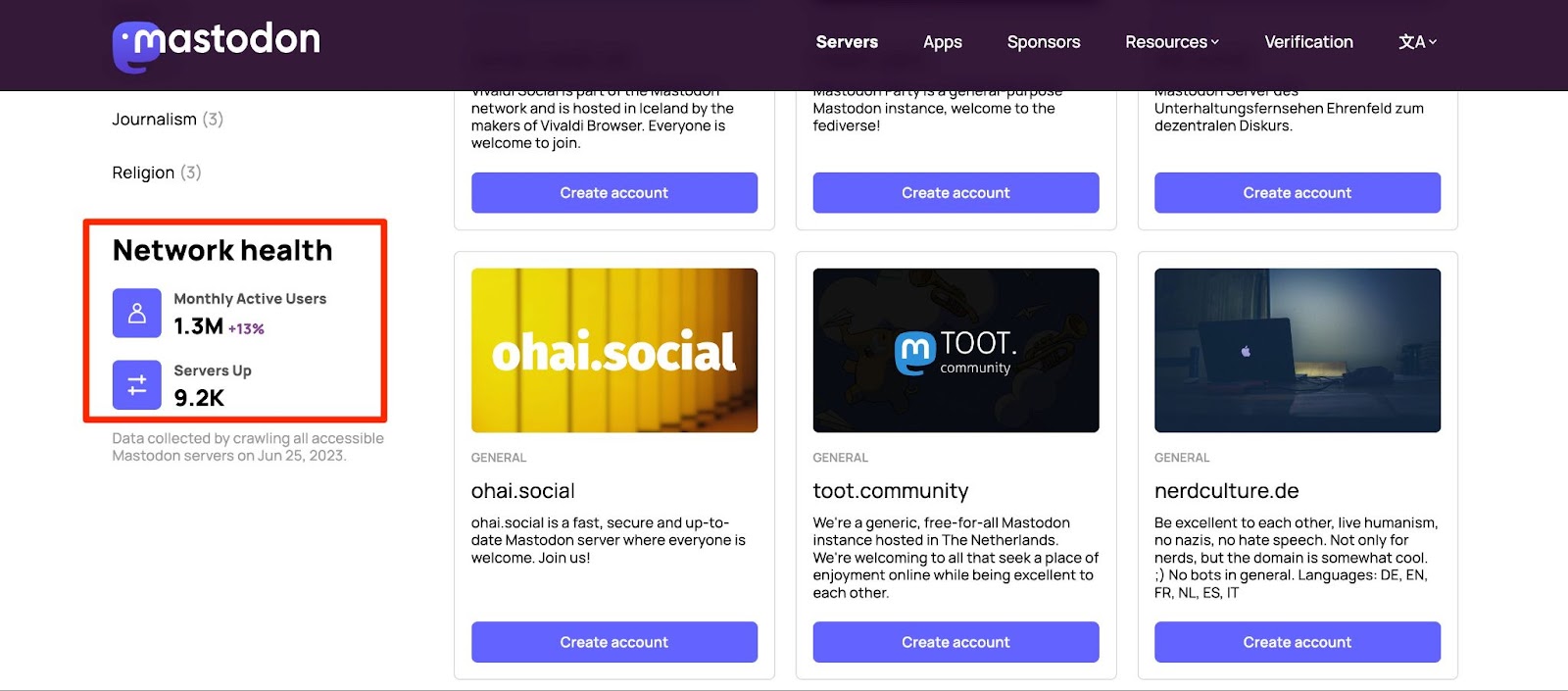
Mastodon reports over 1.3million monthly active users as of June 2023
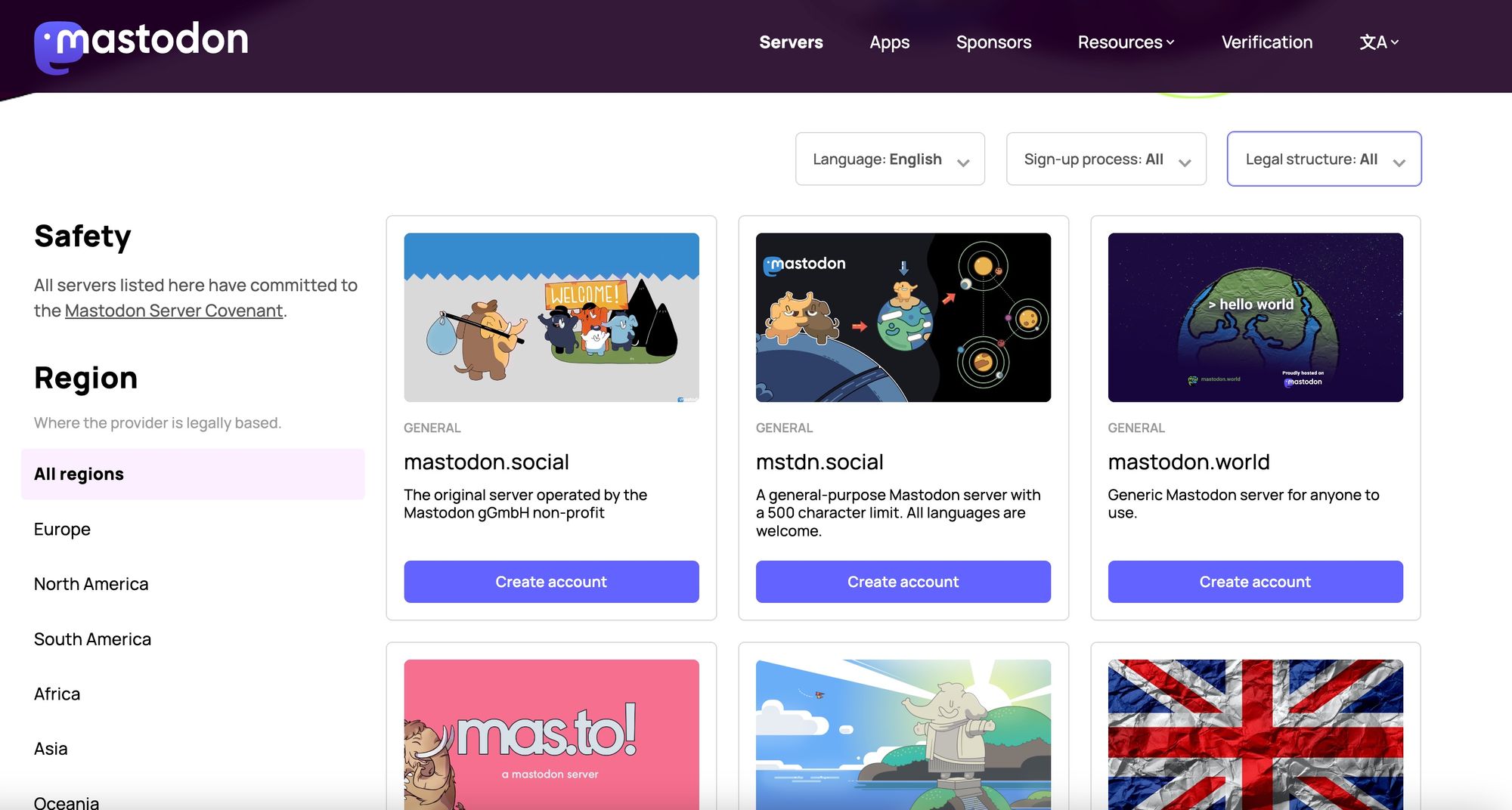
Mastodon is a decentralized network that allows users to create accounts in distinct communities while being able to access others. It’s based on an open-source, “federated” concept, where different servers use the same protocol to speak to each other and share content to one feed.
These servers (also known as instances) allow users to create communities through Mastodon without building the whole infrastructure from scratch. Server operators oversee the users’ activity registered and hosted on their respective servers.
Key Features
Users can choose the network they want to sign up on, and options abound with nearly 10,000 active communities. The default network for new users at signup is “mastodon.social”, but you can choose whichever you want.
There are no ads or plans to incorporate ads into Mastodon. Its founder has stated that he doesn’t mind if users publish ads on their servers but would do so at their own risk.
When you create an account on one server, you can still see and interact with the activity on other servers on your Feed.
Users can make up to 500 character-long posts and share images, videos, and links.
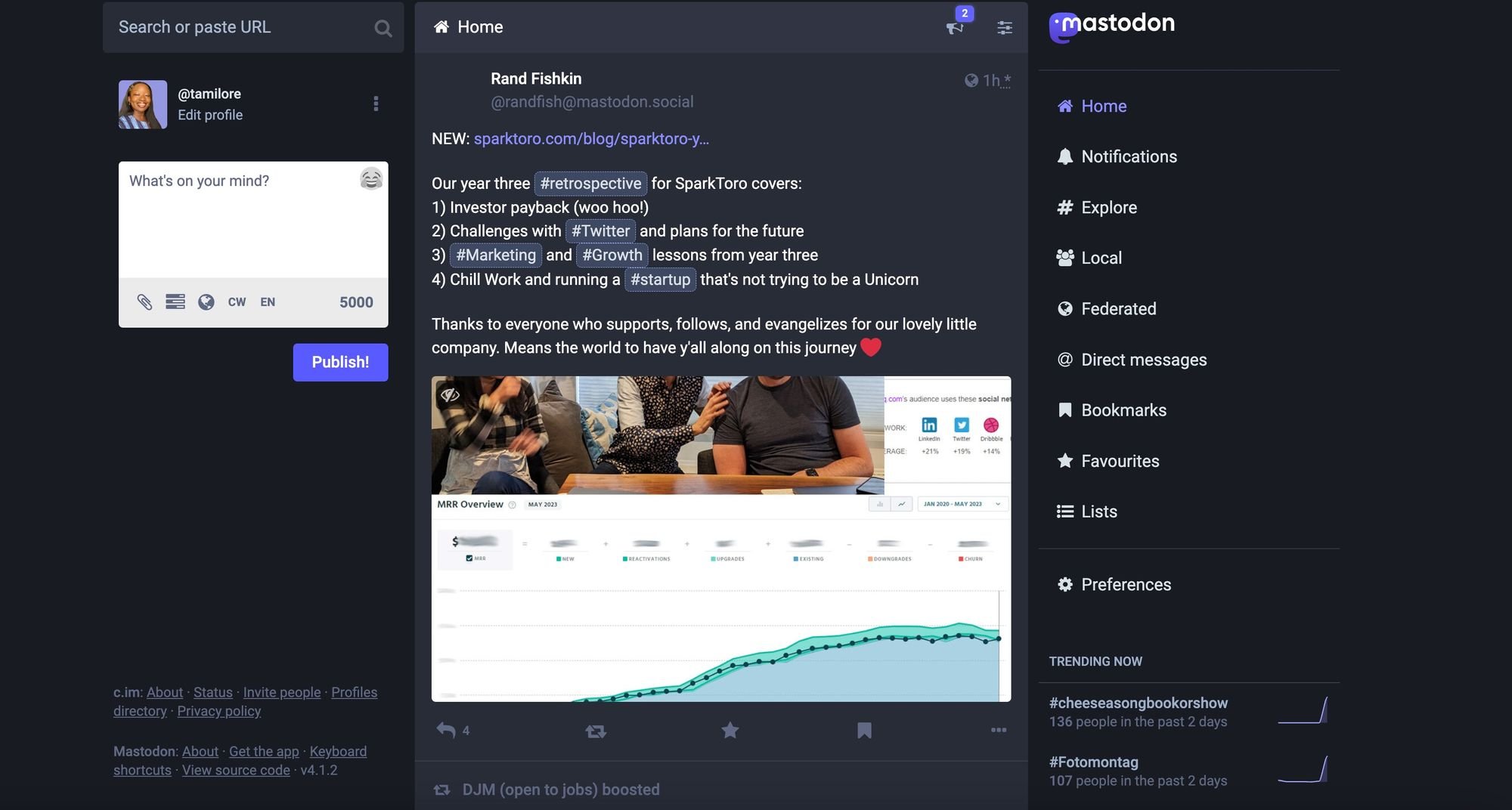
The C.IM homepage
Some Use Cases
If you target highly specific audiences and communities, there’s a Mastodon server for you.
By creating an instance for yourself or your brand, you can make a personalized feed with all the content you want to serve your audience and conversations you want to have with them while reaching a wider audience.
Find the Mastodon version of your favorite accounts from Twitter – many people and brands that moved over cross-post their content to both platforms.
Focus on thought leadership by starting and contributing to conversations without worrying about selling something or needing great visuals since that’s not the platform’s focus.
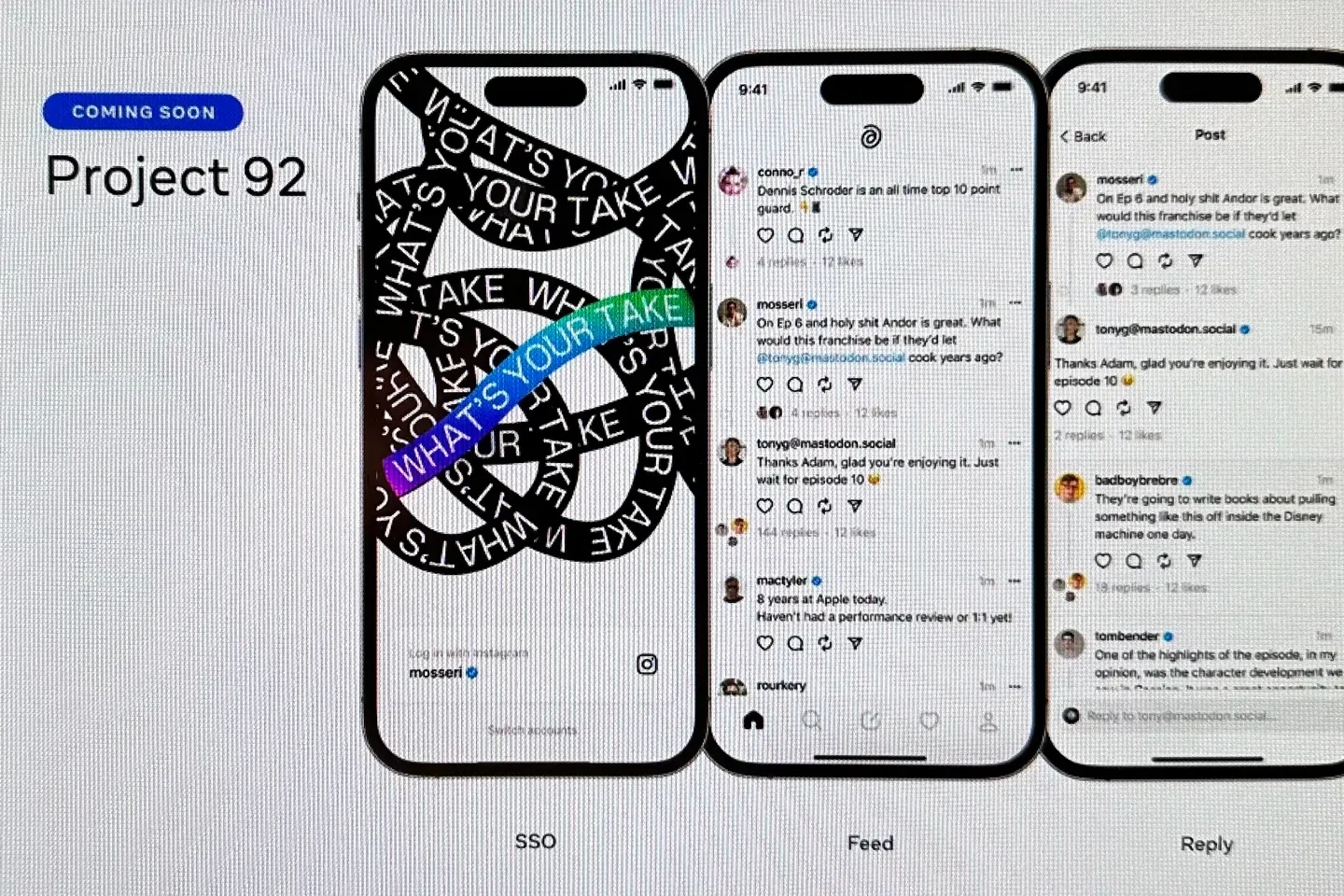
In January 2023, rumours began that Meta had started coding a “Twitter competitor,” and in May, the rumours were confirmed through a leak.
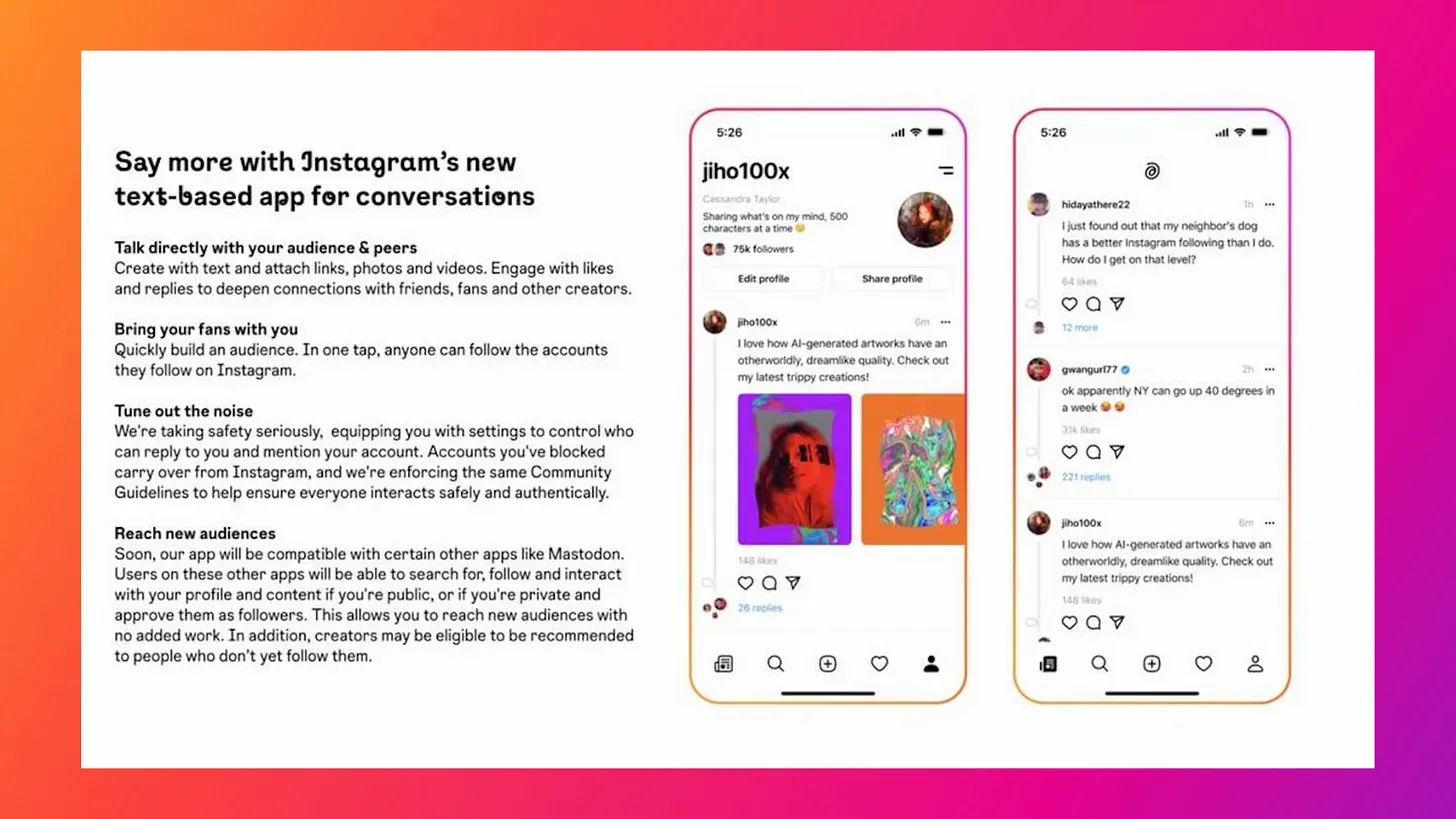
Sneak peek at the UI of Instagram’s new app. Source: ICYMI newsletter
Currently referred to internally as Project 92, the platform has been referred to as Meta’s answer to Twitter and will be integrated with users’ Instagram information. According to The Verge, “The app will use Instagram’s account system to automatically populate a user’s information.” It’s also rumoured that the app’s public name might be Threads.
Meta’s chief product officer Chris Cox reportedly shared with employees that the company’s goal for the app was “safety, ease of use, reliability” and making sure that creators have a “stable place to build and grow their audiences.”
There isn’t much out officially about the app, but according to Lia Haberman’s ICYMI newsletter, it could be out as early as July 2023. Some other details she shared in her newsletter are:
It’s built on the back of Instagram, so you can sign in with your username and password, sync your follower list and even keep your handle, bio and verification status
Users on other apps will be able to search for, follow and interact with your profile and content (so it’s likely a decentralized app built on the ActivityPub protocol)
You’ll have multiple options to create content: text updates of about 500 characters, links, photos, and videos up to 5 minutes
Sharing will remain standard with likes, replies, and reposts.
You’ll be able to control replies and mentions and easily block or report spam. Also, your blocked accounts and hidden words on Instagram will carry over
Finally, community guidelines will remain the same as on Instagram
The newsletter also shares that there are no current monetization plans, implying that there won’t be ads and the focus will be on organic content.
Available on: Nothing yet
Bluesky
Of all the apps on this list, Bluesky is second in popularity only to Mastodon, as the app has seen increasing hype, in part thanks to its Twitter co-founder and former CEO, Jack Dorsey, co-sign. The app has around 50,000 registered users but has reportedly been downloaded more than 375,000 times.
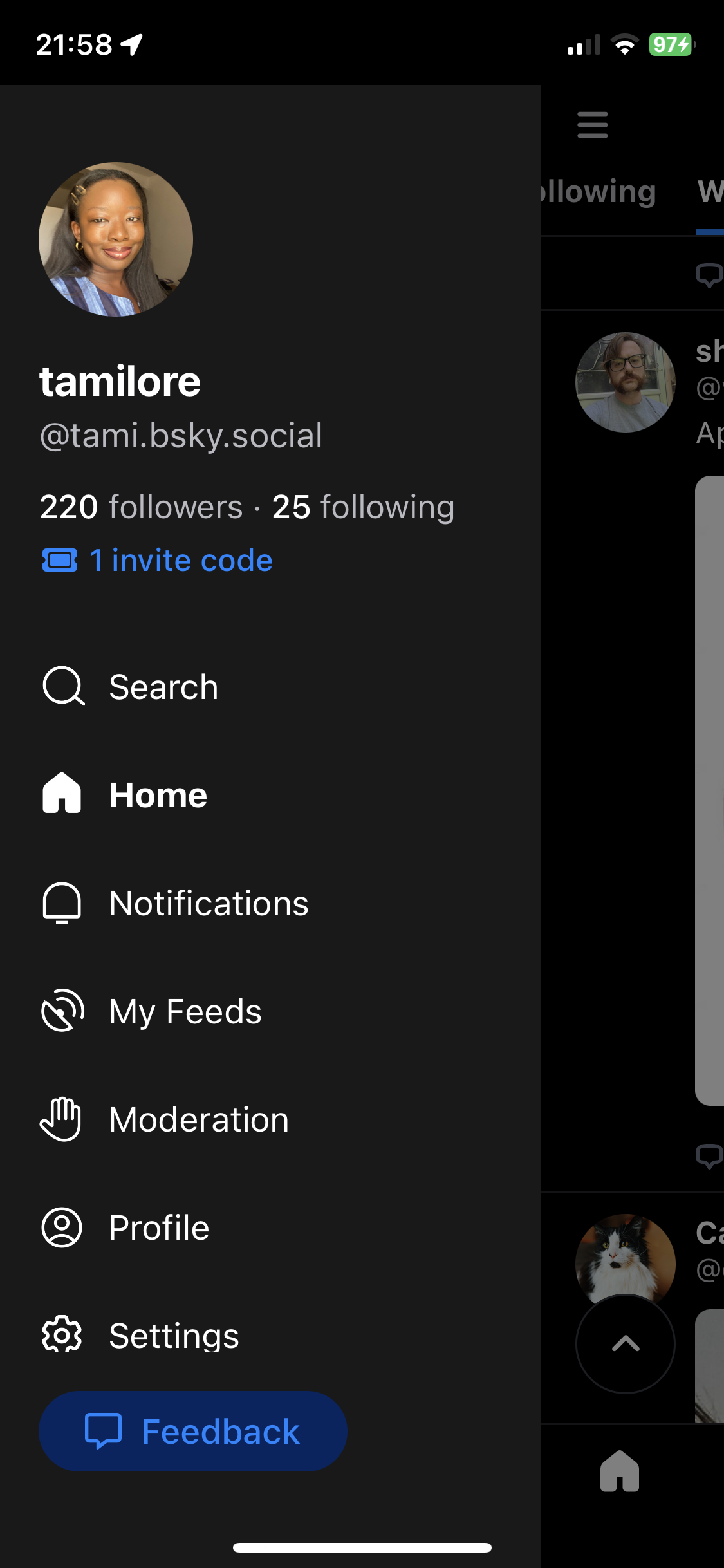
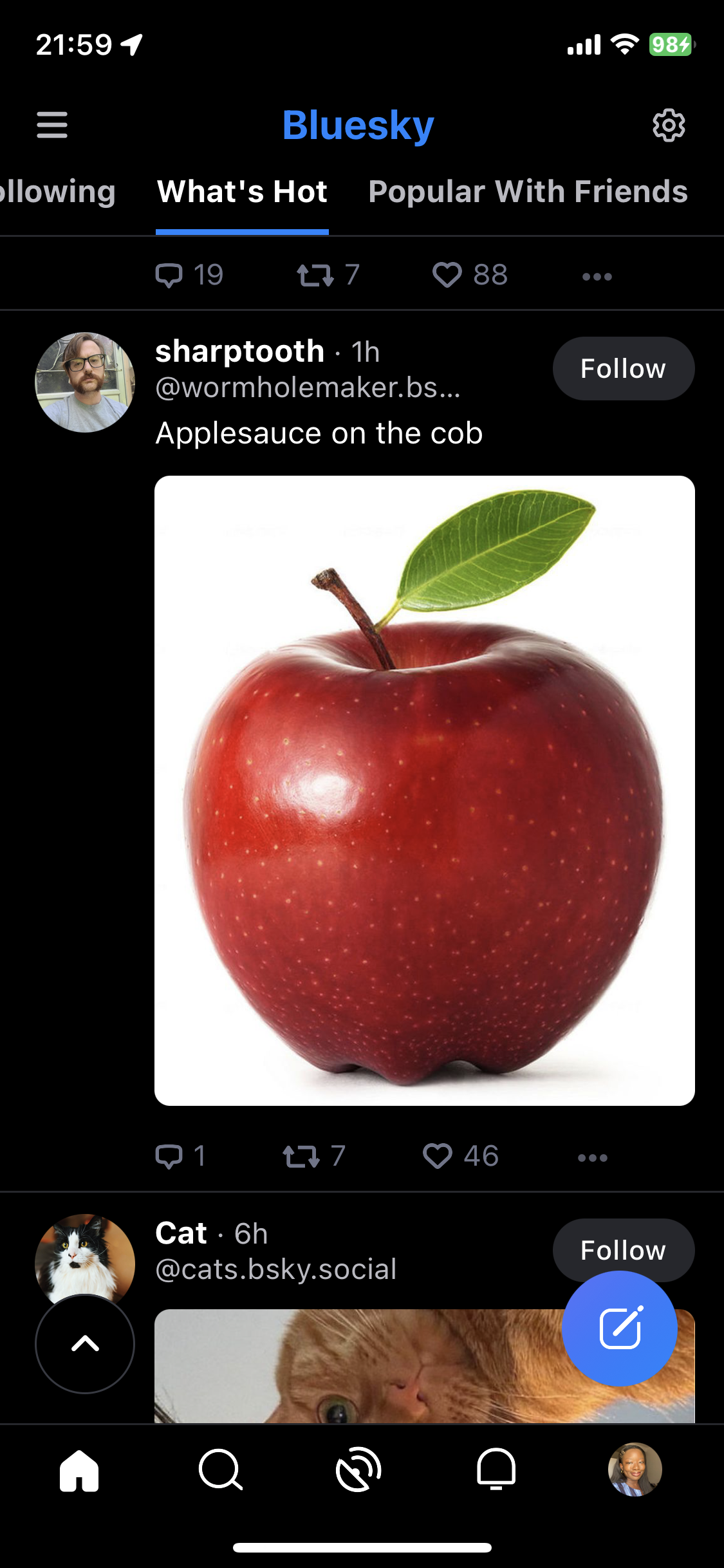
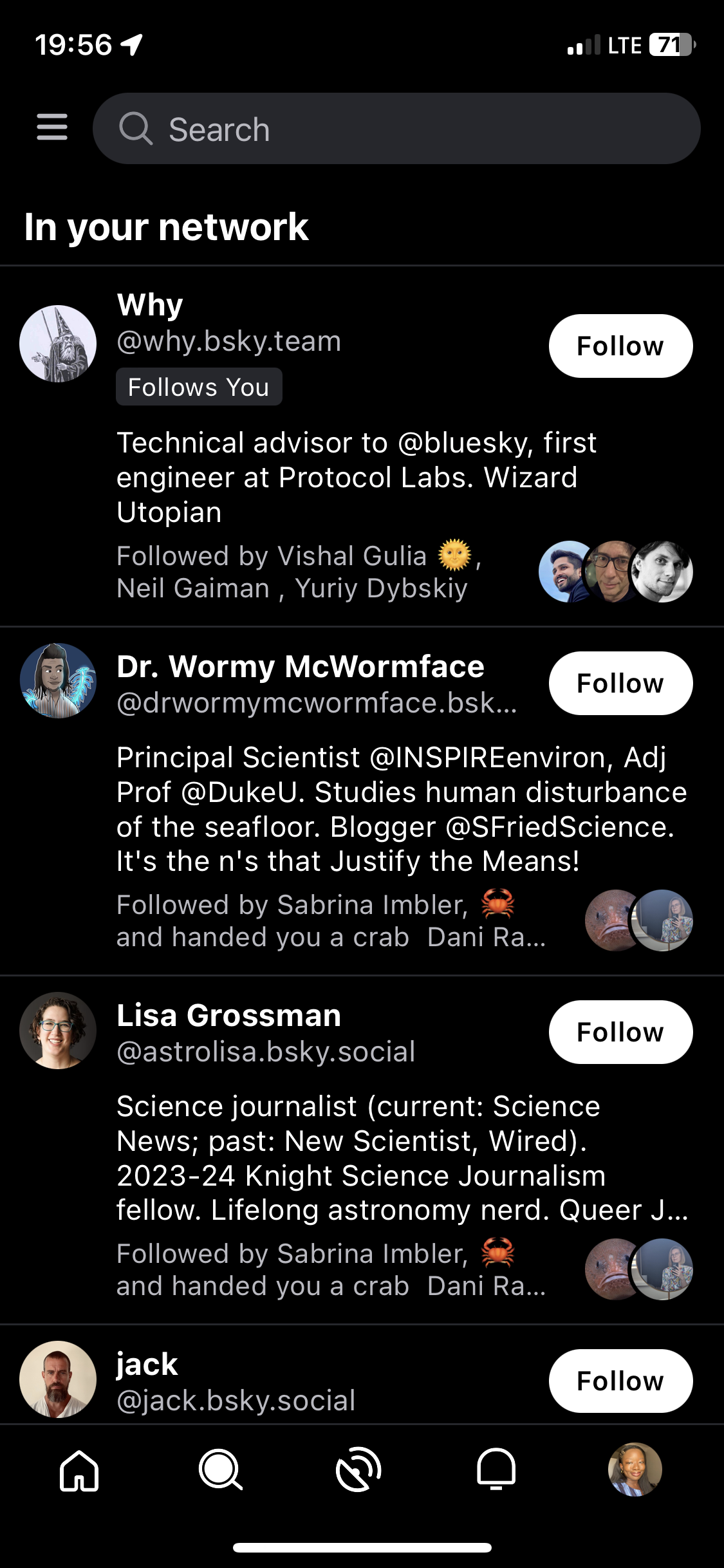
How different parts of Bluesky look
Bluesky is a decentralized social network, much like Mastodon, that allows its users to share short text updates through different providers instead of a huge central one. The default provider is bsky.social, where I’ve created my account. However, users can set their domain name as their Bluesky username while accessing the platform (instead of tami.bsky.social, I could be tami.buffer.com).
👀
We have a few teammates in Bluesky, so leave a comment if you’d like an invite code and I’ll share it with the first commenter!
Key Features
Users can create posts of up to 300 characters and add images and links.
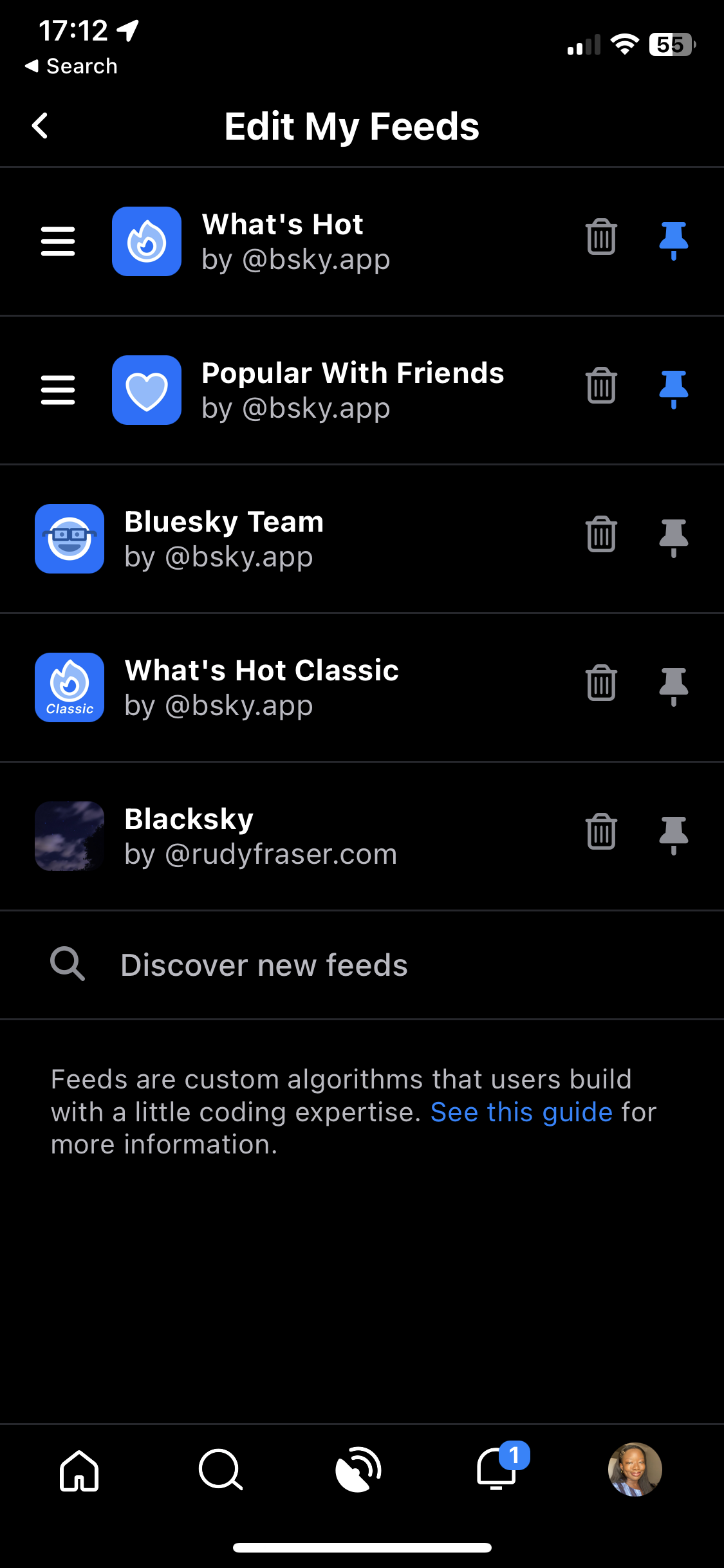
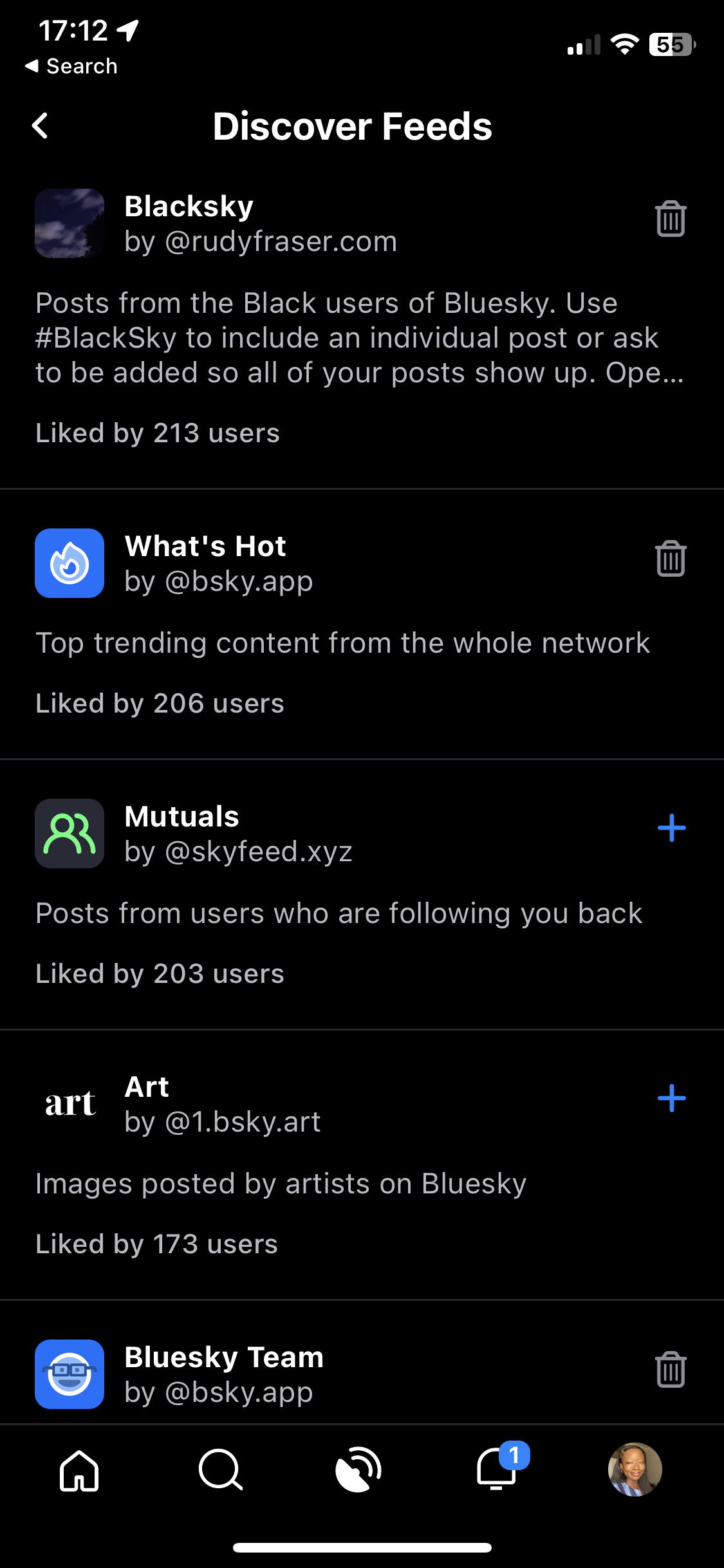
Bluesky allows its users to choose and even create their own algorithms called “Feeds.” This means you can decide which type of content shows up on your feed. Some available options are: What’s Hot, which shows all the trending content on the app; Blacksky, which shows posts from the Black users of Bluesky, among many others.
Moderation is taken quite seriously, with users allowed to filter content, mute lists, block accounts, and more updates in development.
Some of the available custom Bluesky Feeds
Some Use Cases
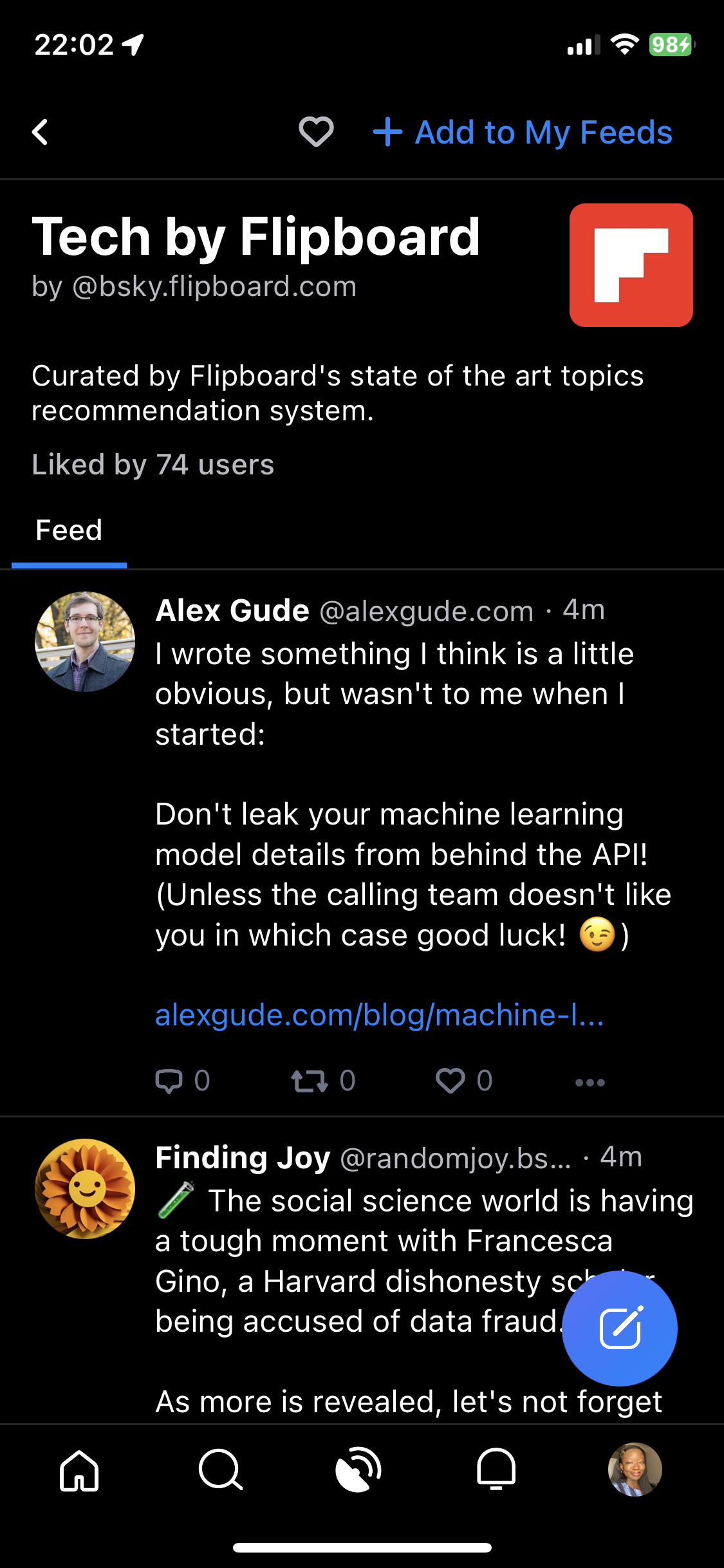
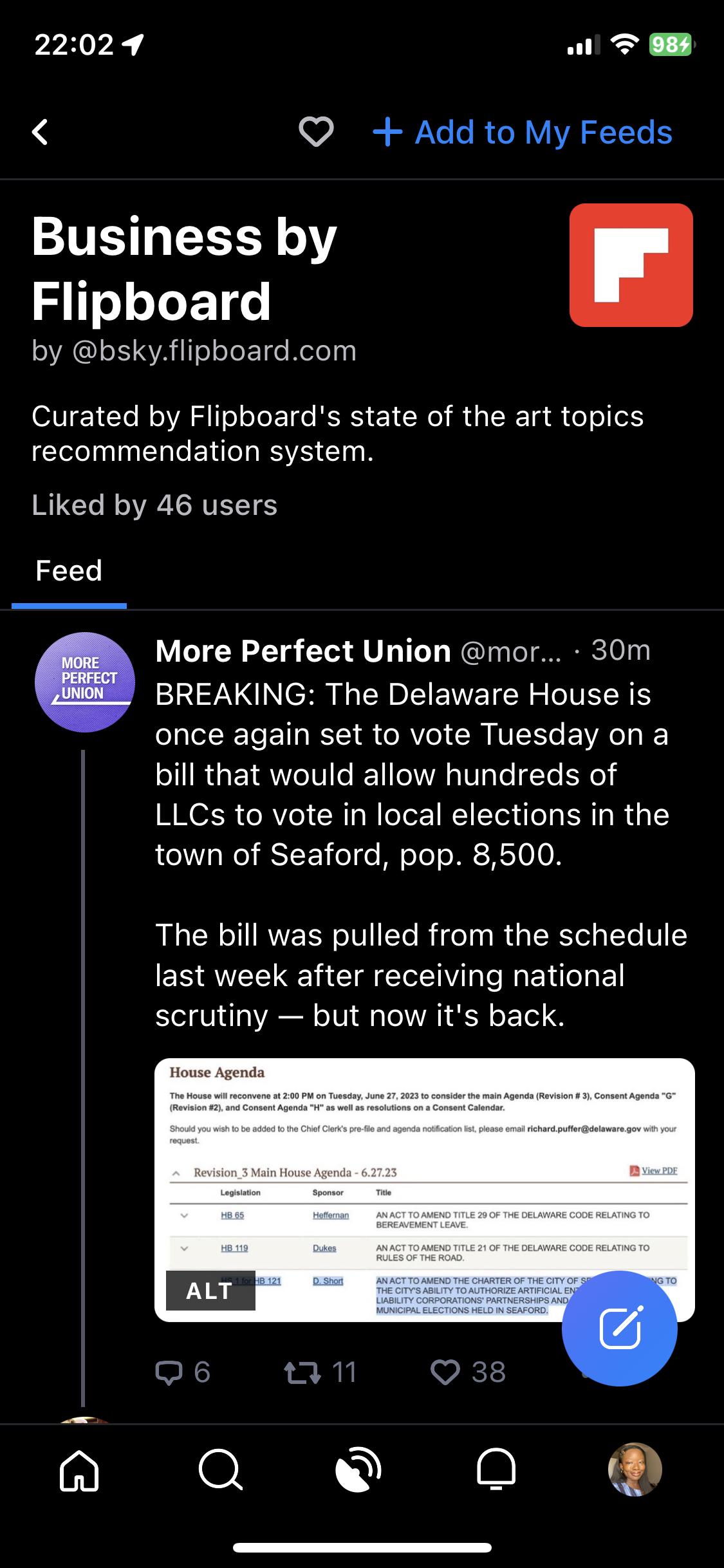
Create an algorithm that shows you and your community content from your account and other related news. If I had the technical prowess, I would create a “Creator Economy” or “Social Media Updates” feed. Flipboard has created curated Feeds for different categories.
Some of Flipboard’s Bluesky Feeds
You can set and manage your account from a custom domain – see instructions here – which can help with verification. It could also create cohesion for everyone that works with or collaborates with your brand
Available on: Web (in progress) | iOS | Android
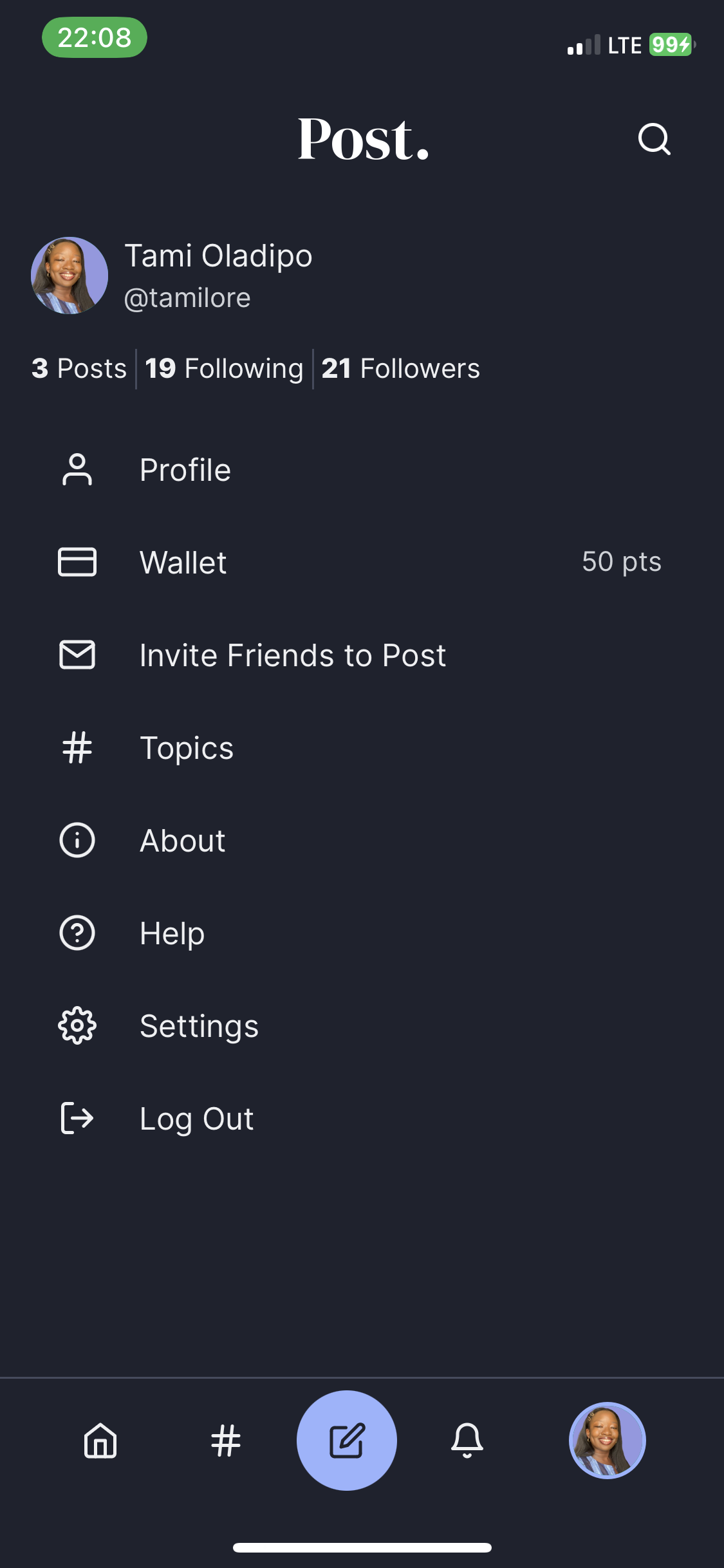
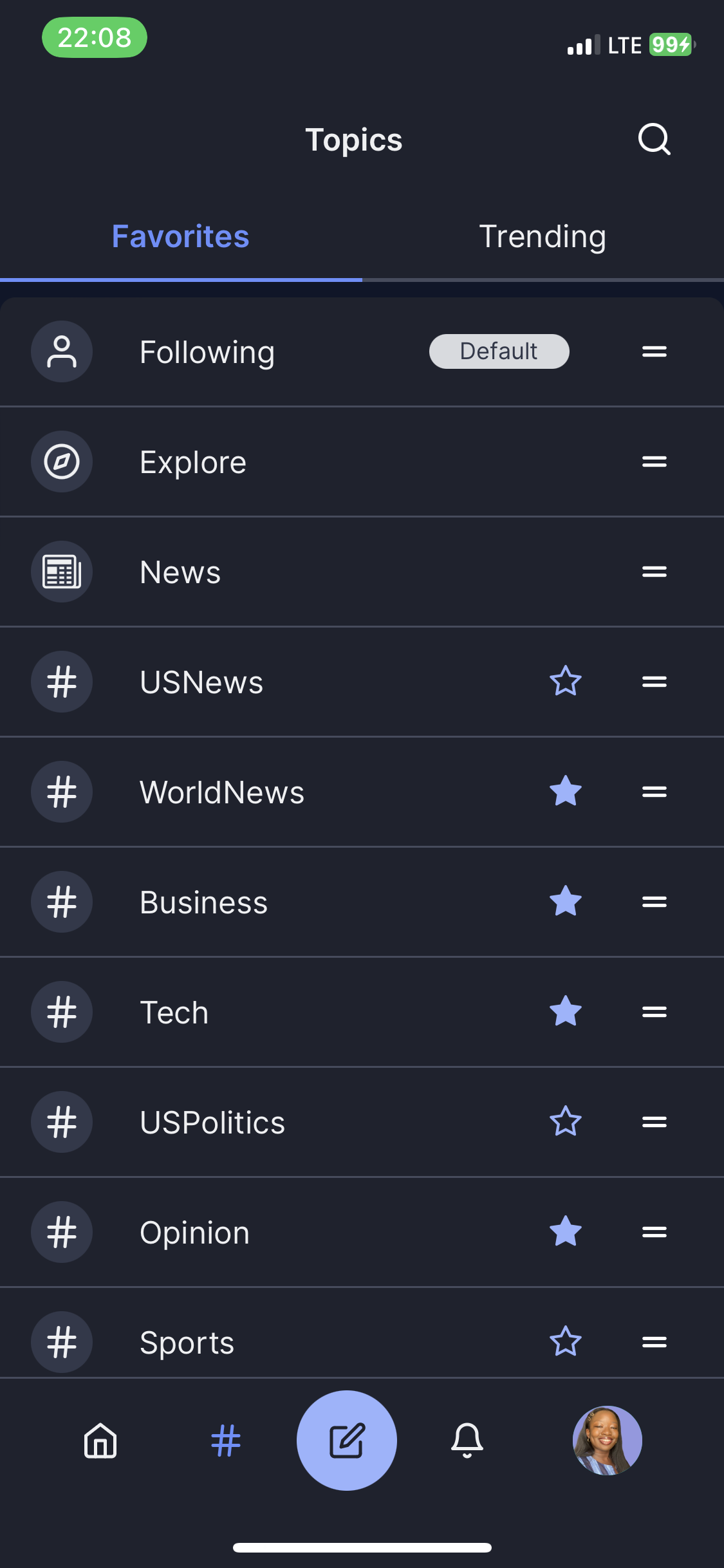
Post News
True to its name, Post News is a “social platform built for news,” according to its tagline. The main idea behind the platform is to replace the specific function of “trusted news source” that Twitter lost, along with the changes to how verification works.
How different parts of Post look
Since its public launch in February, Post has welcomed over 440,000 users ranging from journalists, subject matter experts, and academics, and more than 30 premium publishers.
Despite serving a similar function to Twitter, Post aims to “develop a platform where publishers can generate revenue from micropayments — that is, where users pay some small amount of money to read individual news items,” according to TechCrunch.
Essentially, the platform seeks to aggregate every news platform that might put a paywall and let users choose when to pay for each news item they want to read instead of paying multiple subscriptions.
Key Features
Post allows users to write articles of any length, as well as like, repost and reply
Users pay with “points” to read articles which range in cost from 1-50 points
You’re gifted 50 points at sign-up, after which you have to buy a bundle from Post’s micropayments platform. One point costs $0.01 and you can buy a bundle of 300 ($4.20) to 10,000 points ($126.70).
Post gets a percentage of each sale of points bundles.
Users can also choose to tip creators and publishers on the platform.
Some Use Cases
If you already share paywalled content through your newsletter or Patreon, for example, Post could be a great way to send updates to your existing and new audience (if it’s a relevant platform) while also being able to keep monetizing your content.
Thanks to the lack of a character limit, you can post entire articles on the platform so people don’t have to click out, but your content still gets in front of the right audience.
Available on: Web | iOS | Android (coming soon)
T2 Social
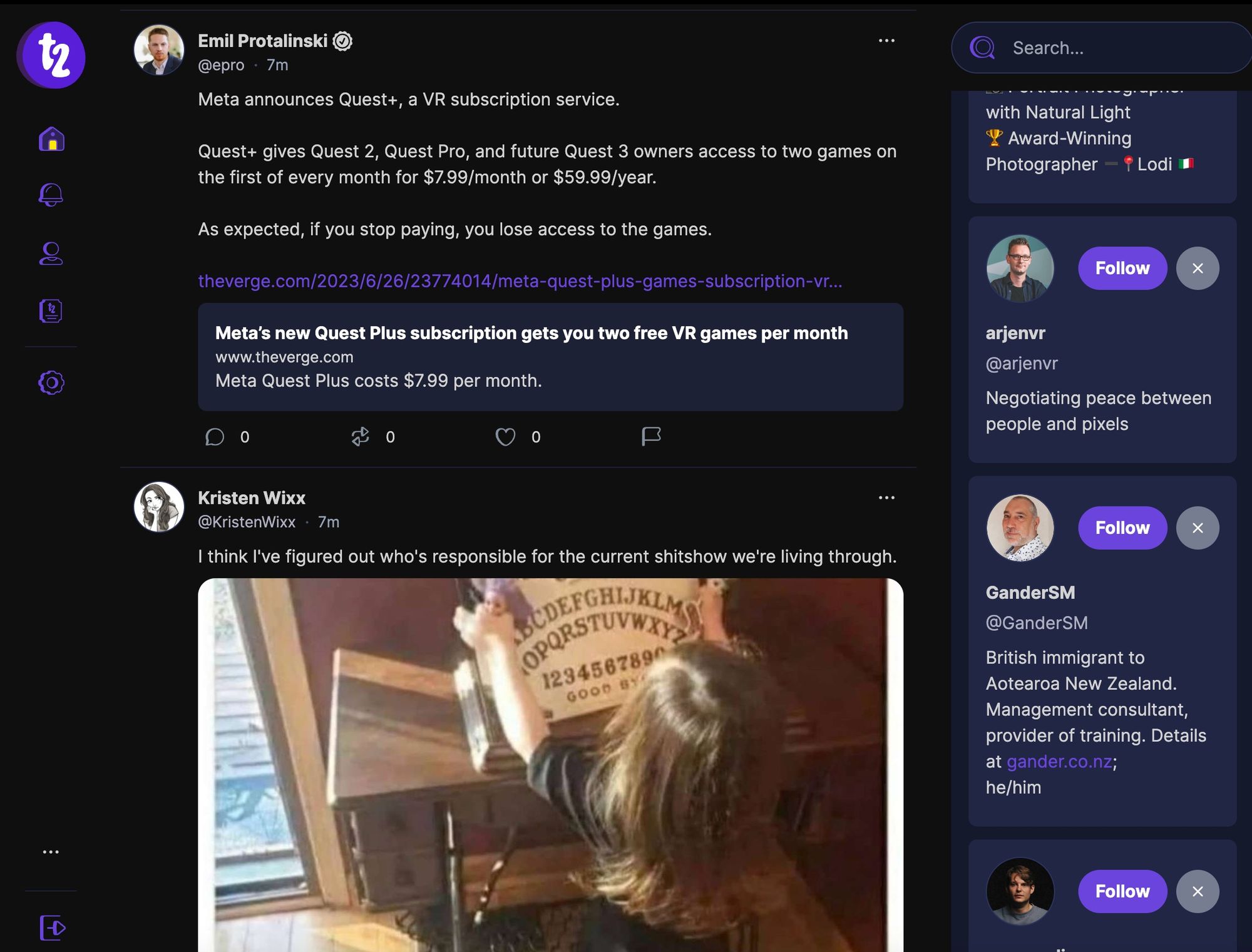
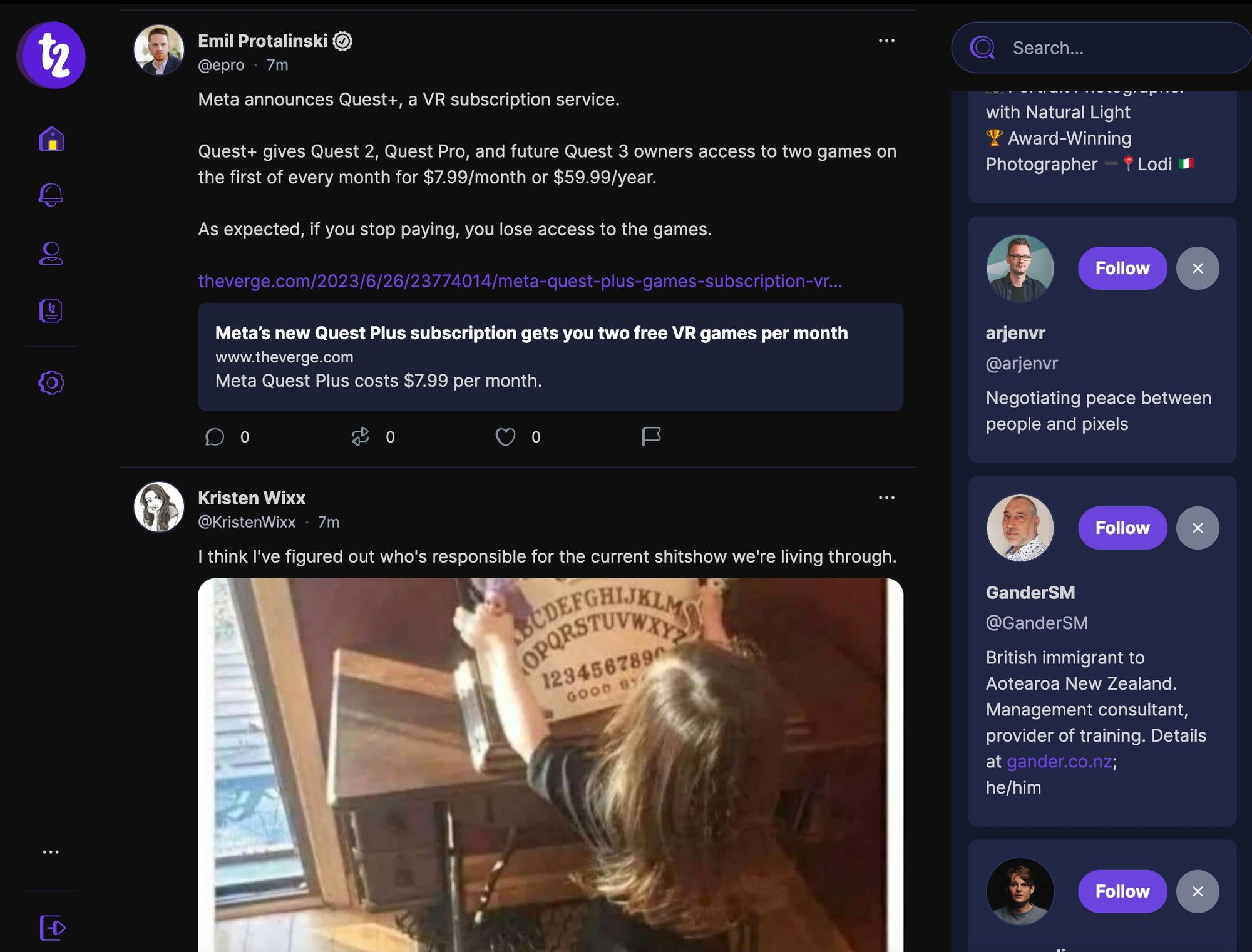
T2 Social, founded by Gabor Cselle and Sarah Oh, is the closest platform to Twitter in terms of its user interface, the style of posts, and the general vibe on the platform. This can probably be attributed to Sarah Oh’s experience as Human Rights Advisor at Twitter.
The T2 Social homepage
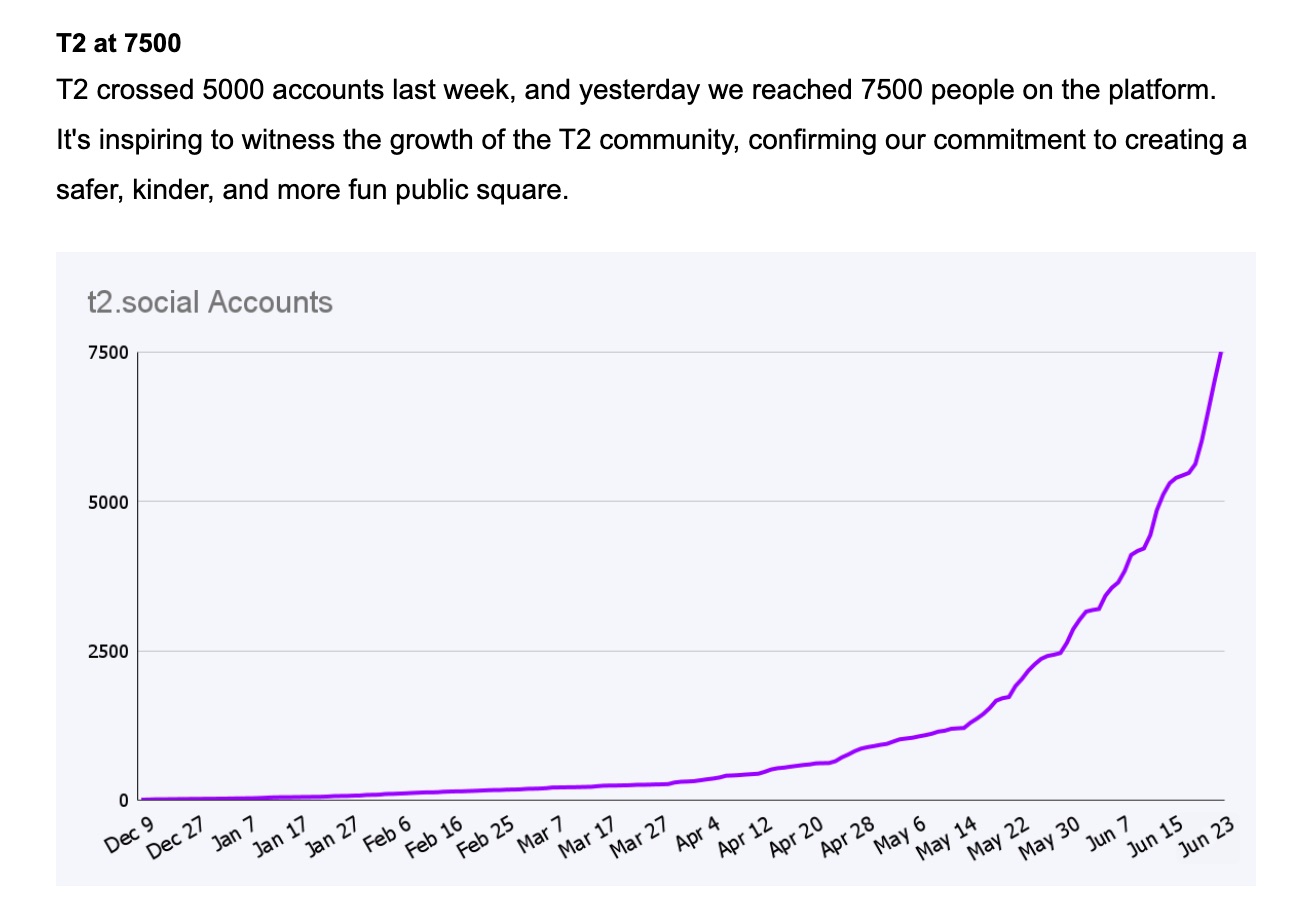
The platform has one of the smaller user bases on this list, reporting 7,500 users in an email update as of June 2023.
Key Features
Write short posts of no more than 280 characters, add a photo, post replies, and repost or like content.
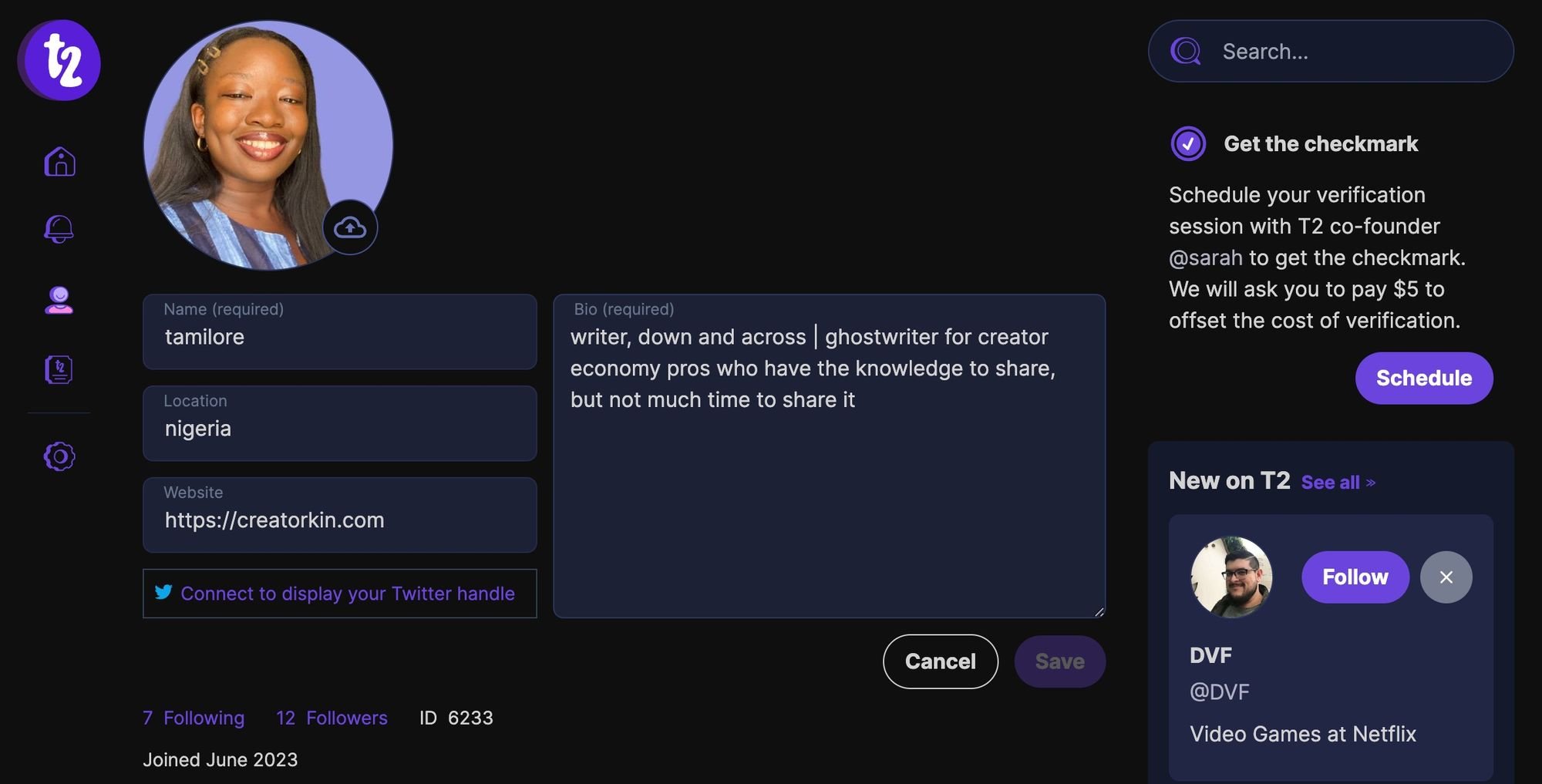
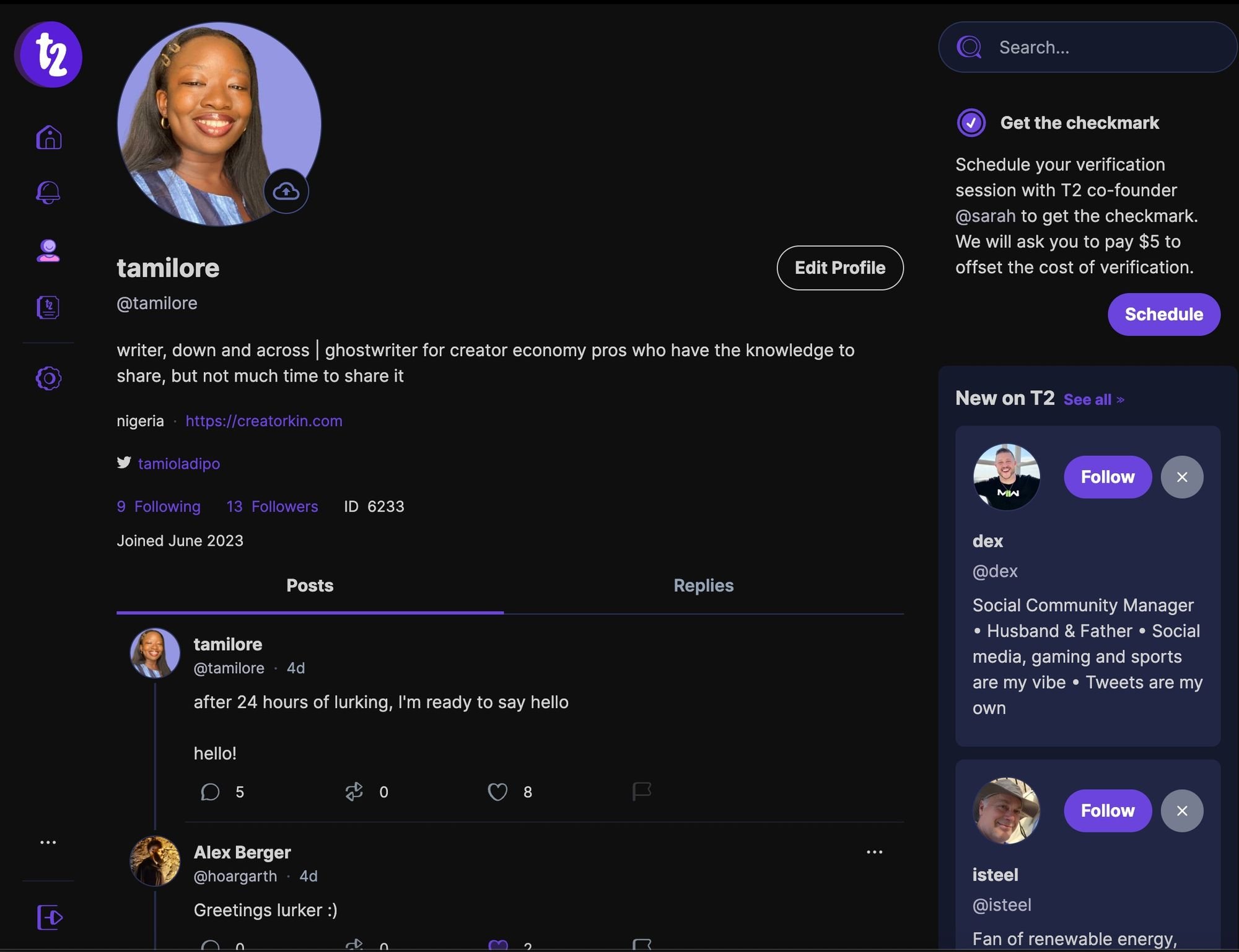
You can connect to your Twitter account to your T2.
You can link and display your Twitter in T2
Users who are legacy checkmark holders on Twitter can claim their T2 checkmark by filling out a form. Others have to schedule an interview with Sarah and availability is limited – you can only get one as soon as August. I’ll let you know how mine goes!
There’s no clear “algorithm” yet – I get served content across different verticals and in different languages (Japanese is a constant on my feed). This is probably because I just joined, so my interests haven’t fully registered yet.
👀
I have access to T2, so leave a comment if you’d like an invite code, and I’ll share it with the first commenter!
Some Use Cases
If you’re looking for a centralized, clear alternative to Twitter with a simple interface, this is the platform for you
The T2 audience is small, so engagement is high and it’s easy to grow a following and connect with like-minded folks with a bit of consistency
Available on: Web | Desktop
Spill
Another entry from ex-Twitter employees, Spill is a social platform launched more recently than any other platform on this list. However, it’s the most different from Twitter, as it’s visual-first, putting it closer to Tumblr in look and feel.
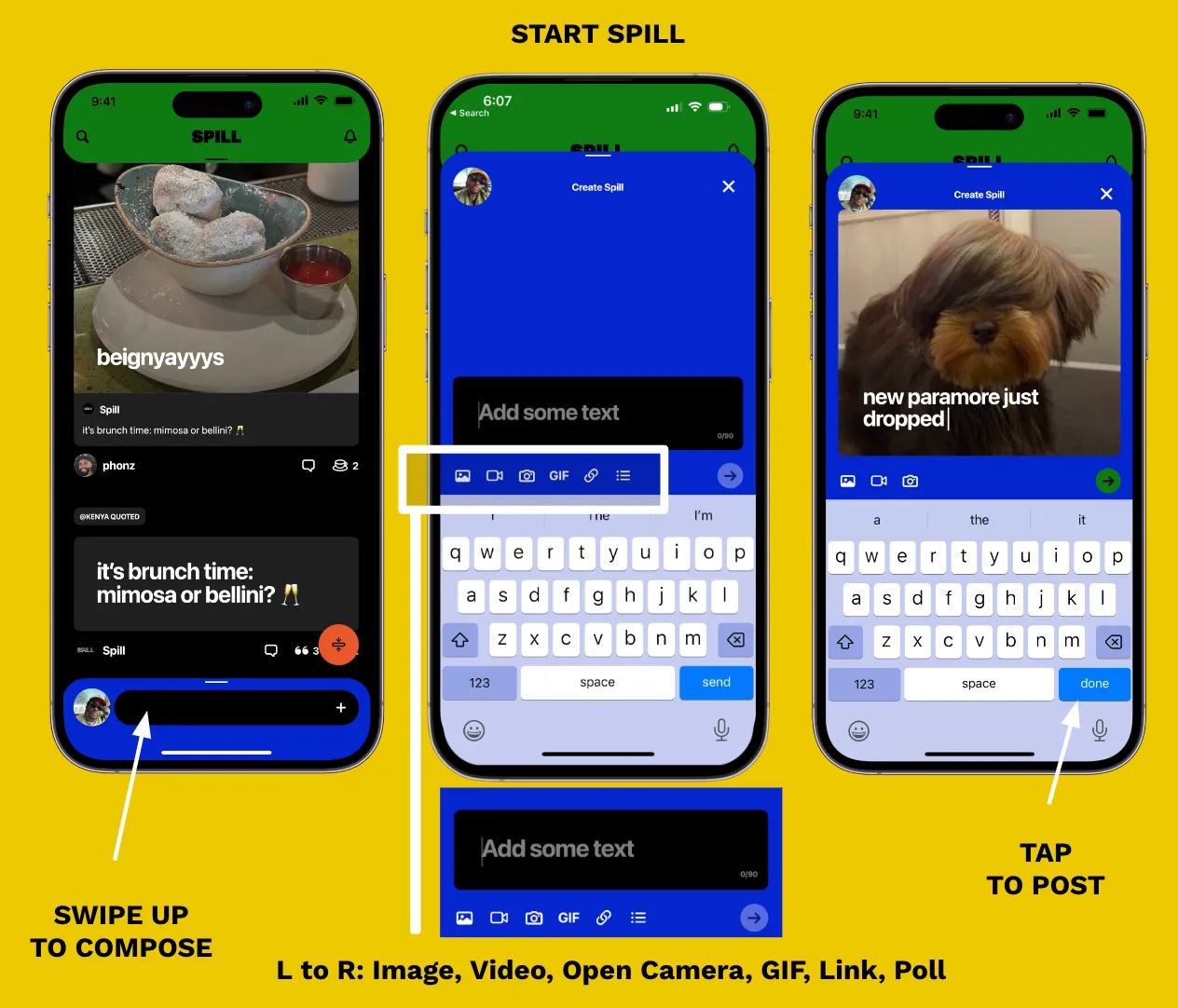
A look at Spill’s user interface and features. Source: TechCrunch
When you open the app, you land on a feed that includes recent posts from people you’re “sipping” (the platform’s version of following, taken from the Kermit the frog meme) and algorithmically served posts. From there, you can pull down a top menu showing trending posts and hashtags. From the bottom menu, users can post text, gifs, videos, photos, links and polls.
Spill stands out from other platforms, including the ones on this list and its CEO’s former company, as a platform that immediately prioritizes diverse communities. CEO Alphonso Terell shared with TechCrunch that the driving ethos behind Spill is that “building for underserved culture drivers would create a superior platform for all.”
Spill is still in beta and is invite-only, so I’ll have to report back with my observations once I’ve been given access. Till then, some key things to know about Spill are:
Like Twitter, Spill will have a live news feed where users can post “spills” (the platform’s version of posts, taken from the phrase “spill the tea” popularized by Black creators).
It’s getting its own large language learning model for better content moderation that will reportedly understand Black dialects like AAVE.
The platform also plans to add blockchain-based creator features in order to reward users who originate viral trends.
It gives users a “rep score” to incentivize good behaviour and create a system for rewarding active users regardless of their audience size.
The platform is building a feature called “tea parties,” where users can host both online and offline events and then get in-app bonuses to apply to things like boosting their posts without having to pay.
Available on: iOS (beta)
The future of social media might be decentralized
A common theme across the apps on this list is the focus on decentralization. Users have become increasingly wary of big tech companies and their goals. Worries around data privacy and content moderation are driving user behaviour to platforms where they have more control.
Most of these apps have adopted open-source protocols to improve interconnectedness and allow users to control where they settle on the Internet and how they communicate. Mastodon and Meta’s secret project are all built with ActivityPub (which powers the “Fediverse”), while Post intends to adopt it eventually. Meanwhile, Bluesky is built on the ATProtocol, a social networking technology created by the team.
This push towards decentralization means two things for creators (including businesses) and users. One, watching the developments in these apps and technologies is important to understand them better. And two, you must take the time to try them out where you can, especially if users are gravitating towards them.
The more practice you have with using decentralized social networks, the better prepared you are for whatever changes are to come for how we communicate online.


 Let me conclude by saying that I am not someone who’s just done a lot of reading about this stuff and is now opining about it. In my businesses, I always invested in marketing. That’s how two of my companies got on the Inc. 500/5000 list — one of them three times. And today, the new and existing businesses I am involved with heavily invest in marketing and advertising and have a revenue growth curve that reflects that.