Author

editor

Browsing

By Michelle Smith | Edited By Chris Kissell

Planning to retire? You literally can’t afford to ignore these 10 realities.

Whether you’re planning for early retirement or counting down the days until you can claim your pension and move to Florida, we’re guessing your dreams for old age are full of good times and easy living.

But if you ignore some tough realities about getting older, your golden years can end up gloomier than you were hoping.

Avoid a rocky retirement by wising up to these 10 hard truths about getting older.

Do you dream of retiring early?

Retiring early is a goal for many, but few of us have a plan for how to actually do it.

Instead we have questions like… How much money do we need? Where should we keep that money?

A financial advisor can help you sort through your options and come up with a solid plan. Get started today by taking this quiz from SmartAsset to get matched with a vetted financial advisor in your area.

1. Most 65-year-olds will live for another 20 years

It’s impossible to predict just how long you’ll live after retirement, but a typical U.S. adult who is 65 today will live another 20 years, according to the Social Security Administration.

About one in three will live until they’re 90, and one in seven will live until age 95 — around 30 years after the typical retirement age.

A long life is something to celebrate, but a high quality of life doesn’t come cheap. The brutal reality is that the longer you live, the more money you’ll need to have saved during your working years to maintain a nice standard of living.

2. 32% of older adults will be working in 2030

In the year 2000, just 19% of adults between the ages of 65 and 74 were still part of the American workforce, as were 5% of adults age 75-plus, according to a J.P. Morgan report. Over the next two decades, those numbers jumped to 27% and 9%, respectively.

The percentage of Americans working between ages 65 and 74 will likely increase to 32% by 2030, while 12% of Americans 75-plus will do the same.

What does this mean for your future? Depending on how close you are to retirement right now, there’s a 30% chance you’ll still be an active part of the American workforce a decade down the road.

While 52% of retired adults say they work to maintain a sense of connection, 27% work so they can afford extras and 17% say they have to work to make ends meet.

3. You should have saved at least 10% of your income

It’s a solid financial rule of thumb to save 10% to 15% of your income — at minimum — solely for retirement. So, if you earn $50,000 a year, you should put no less than $5,000 into your retirement account.

If you’re still working and aren’t currently saving 10% or more each year, increase your savings. If you’re near retirement and haven’t saved this amount, count on living off less once you retire.

4. Not saving early makes it tougher to create a big nest egg

Thanks to the reality of compound interest, saving early and consistently almost always build a bigger nest egg than investing in a retirement plan later in life.

An investment with compounding interest means you don’t just earn interest on the sum you initially invested, but also earn interest on the interest itself.

The earlier you invest, the more time you will have to let compound interest work its magic. By contrast, the longer you wait to start investing in your retirement fund, the less time you have for your investments to grow.

That means those who procrastinate need to save larger amounts of money to retire comfortably compared to if they had started preparing for retirement in their 20s.

5. Pensions are becoming less common

Pensions, or fully employer-funded retirement benefits, were more common 50 years ago than they are today.

Just over 50% of the Silent Generation retired with a pension, J.P. Morgan says. That means they were guaranteed a post-retirement stipend that they could supplement with their own savings to maintain a high quality of life into their golden years.

However, pensions are much harder to find today. Overall, just 30% of U.S. households have a pension. Today’s American workforce relies on self-funded retirement vehicles like 401(k) plans.

So, no matter how old you are right now, your ability to live comfortably in retirement will likely depend on your own savings. Aside from a 401(k) plan annual match — which you should take advantage of if you can — do not expect a lot of help from an employer.

6. Don’t withdraw more than 4% annually from savings

If you want your retirement savings to last the rest of your life, many experts say you shouldn’t withdraw more than 4% of your retirement savings each year.

That limit doesn’t give you much spending flexibility, so you might need to stick to an even stricter budget once you retire.

Additionally, if you live well into your 90s and beyond — or if your investments perform particularly poorly — you might run through your savings before the end of your life even with that 4% cap.

That’s especially true if a medical condition or family emergency requires you to withdraw a large amount from your retirement fund for a few years in a row.

Pro tip: Worried you might not have enough in savings to finance a long retirement? Look into the many ways you can make extra cash to build your nest egg.

7. Housing makes up 41% of expenses for older adults

Conventional wisdom holds that you won’t need as much money to live off once you’re retired, but the difference between your pre-retirement and post-retirement spending might not be as big as you think.

For Americans between the ages of 35 and 44, housing expenses account for more than 41% of their annual spending, J.P. Morgan says. For Americans 75-plus, that number drops — but only to 38%.

If more than one-third of your dollars are going into housing right now, count on that trend continuing into retirement.

8. Social Security checks won’t go as far as you think

In 2022, the average Social Security benefit is nearly $1,700 a month. If you postpone receiving benefits until age 70, your monthly check will be much higher than that average.

Still, it is tough to live on Social Security alone, and the Social Security Administration notes that the program was never designed to entirely fund retirement.

So, if you’re planning on living off of Social Security alone, you should probably think again.

9. You’ll spend more on health care once you retire

While costs like transportation go down in retirement, health care costs tend to increase significantly. Americans between the ages of 35 and 44 spend just 7.3% of their budget on health care costs, but that percentage nearly doubles to 14.2% for Americans 75-plus.

How much you will actually spend depends on factors such as how long you live, how active you stay, and what medical conditions you develop. But many retirees can expect to spend more on health care as they age.

10. Older adults are more likely to develop disabilities

About 36% of adults 65 and older report having at least one disability, according to the U.S. Census Bureau. This is a natural consequence of aging and partially helps explain why health care costs increase as you age.

However, if you have the misfortune of developing an expensive disability — especially early in retirement — it will be even tougher to extend your savings over the next several decades.

Bottom line

It’s hard to confront some of the harsh realities of getting older. But the earlier you face these truths and start financially preparing for your future, the better.

Planning for the changes that come with growing older can help you avoid throwing money away and put you in a position to enjoy the hard-earned retirement you’ve always hoped for.

By Michelle Smith | Edited By Chris Kissell

Sourced from Finance Buzz

By Chad S. White
From confusing signup forms to dead-end confirmation pages, learn what to avoid to maximize every signup interaction.

I recently signed up to receive promotional emails from 100 B2C brands that span the retail, travel, consumer products and media industries. I noticed five major areas of opportunity for brands to improve their signup processes:

1. Signup Forms Often Hard to Find

Unmissable signup modals and other popups are common, but far from universal. When not used, brands almost always include their email signups in their footers. If nowhere else, consumers expect to find them there, although that doesn’t mean that brands can’t increase their visibility by also including signups above the fold, but few do. Brands should seriously consider that, as many B2C homepages have grown significantly longer in recent years, which means a lot more scrolling.

Brands can also boost promotional email signups by including an actual signup form on their homepage footer. Some merely include a signup link, which is often mixed in with lots of administrative links and therefore easy to miss.

2. Too Many Ask for Phone Numbers

There’s no faster way to crater your signup form completion rate than asking for multiple forms of contact information. For that reason, I always advise brands to focus first on collecting email addresses, which is the form of contact consumers are most open to with brands.

A number of brands were clearly aware of the danger of asking for too much contact info, but instead of asking for mobile phone numbers post-signup, they included an email address field on the first page of the signup and then a required mobile phone number field on the second page.

This is likely to stop many would-be subscribers in their tracks, causing them to abandon the form. Beyond that, it then raises questions about whether the person is subscribed to the brand’s promotional emails and whether they’ll get the signup incentive that was promised. That’s a lot of anxiety and a lot of unanswered questions that have been introduced to the interaction, which may cause the person to become frustrated and angry and look to other brands.

For my part, I wasn’t interested in receiving SMS messages from any of the brands I approached, so I abandoned every signup form when I encountered this scenario. Roughly half of the time, I ended up receiving promotional emails from the brand. The others didn’t capitalize on my interest because of their overreach.

3. Unclear and Misleading Signup Commitments

Part of the issue around asking for mobile phone numbers appears to stem from many of these signup forms actually being for loyalty programs and not email programs, with the former often requiring phone numbers for some reason. That said, based on the signup appeals for these forms, it’s usually impossible to know what you’re signing up for.

That’s because these forms are almost entirely focused on promoting a signup incentive, especially when a modal is used. That emphasis undermines the relationship these programs are trying to establish and sets brands up for higher unsubscribe rates soon after signup.

4. Dead-End Confirmation and Preference Pages

When someone raises their hand and signs up to hear from your brand, that’s a moment of high engagement. Unfortunately, many brands don’t make the most of this positive momentum. In lots of instances, signup confirmation pages only confirm the signup and don’t direct new subscribers to do anything else of value.

Some brands do direct their new subscribers to select preferences — with standouts like CNN, Levi’s and Bass Pro Shops offering lots of detailed choices. However, at the end of that process, many of the brands collecting preferences also let the momentum fade by not trying to drive the next high-value action.

Ask yourself, “What’s the next one or two most valuable things a new subscriber could do?” And then build that into your signup process. Then ask yourself that same question again, and add that in. If you ask people to only do one thing, you’re unlikely to get them to do much more than that. Whereas if you ask folks to do three things, then many will do two of them and some do all three. Be optimistic!

5. DOI Increasingly Used

Eight of the 100 brands I signed up for use double opt-in confirmation for their homepage signup form. While objectively that’s a small percentage, it’s much higher than just a few years ago.

This increase in adoption is a positive sign, given the ongoing targeting of open forms (such as homepage email signup forms) by bots and the launch of Apple’s Mail Privacy Protection, which makes it hard for brands to determine if new subscribers are engaging. There is a wide spectrum of audience acquisition sources, each of which have their own risk-benefit profile. Make sure you’re selectively using tools like CAPTCHA, double-entry confirmation and DOI to protect your brand and email deliverability.

Final Thoughts on Maximizing Email Signups

With businesses preparing for a likely recession, while simultaneously trying to adapt to the sunsetting of third-party cookies and privacy changes like Apple’s MPP, growing first-party audiences has become increasingly critical.

If you haven’t audited the signup process of each of your acquisition sources in the past year, I highly recommend you make it a priority so you can maximize audience growth and create fruitful, lasting relationships.

By Chad S. White

Chad S. White is the author of Email Marketing Rules and Head of Research for Oracle Marketing Consulting, a global full-service digital marketing agency inside of Oracle.

Sourced from CMSWIRE

By , ,

A bankruptcy filing revealed new information about how the crypto exchange spent money on consultants, think tanks, and business relationships.

A filing in FTX’s bankruptcy proceedings is shedding light on the true extent of the crypto-trading powerhouse’s influence-peddling operation. Last week, FTX filed its creditor matrix, a document that lists former vendors and investors to the company.

The list includes nearly a dozen public relations experts — specialists who generate positive spin in the media on behalf of clients — as well as political consultants, think tanks, and trade groups.

Sometimes, the money went directly to political operations; Majority Forward, a dark-money group designed to elect Senate Democrats, received cash. In some cases, the hired guns, such as PR firms, were paid directly for their services. In others, the groups that received donations maintain that they are independent, but had interests aligned with FTX.

The filing, for instance, listed a donation to the Center for a New American Security, a prominent national security-focused think tank in Washington, D.C., that has worked to shape crypto regulations.

The filing offered a look under the hood of FTX’s intricate maze of influence. On the heels of its meteoric rise as a crypto exchange, FTX quickly began to spend extraordinary amounts of money to buy prestige and friends in high places. Now that the firm stands accused of siphoning off billions of its investors’ dollars — with its disgraced founder Sam Bankman-Fried charged with fraud in the matter — increased scrutiny is falling on powerbrokers’ dealings with FTX.

The relationships of many of the entities listed in the bankruptcy filing and FTX were already known — the company complied with lobbying disclosures for some of its consultants — but the creditor matrix shows the crypto giant also retained several previously undisclosed professional influence peddlers.

One seasoned political hand tied to FTX without any disclosures is former New York City Council Speaker Corey Johnson. His firm, Cojo Strategies, is featured in the FTX vendor list. Another is Susan McCue, a former aide to Sen. Harry Reid, D-Nev., who has advised many Senate Democrats and played a role in the leadership of several Democratic super PACs and dark-money outfits. Her firm, Message Global, is in the filing.

Other consulting firms with a finger on the pulse of power are sprawled through the creditor matrix, which runs over 116 pages. Another creditor, Patomak Global Partners, a firm that specializes in influencing financial regulators, is led by Paul Atkins, a former Securities and Exchange commissioner. Atkins’s company touts its roster of former government officials as providing “a telescope to anticipate trends on the horizon to help position our clients for long-term success.” (Neither Johnson, McCue, nor Patomak responded to requests for comment.)

Think Tank Crypto Regulations

The donation to CNAS — a powerful think tank with ties to both political parties but known for staffing national security roles in Democratic administrations — came at a time when the organization advocated for crypto regulations with a light touch.

“To compete in the digital-economy race with China, the United States must foster a more innovative fintech environment,” CNAS fellow Yaya J. Fanusie said in testimony to the Senate Finance Committee on July 14, 2021. “If U.S. securities regulation does not evolve to account for the new technical and entrepreneurial capabilities offered by blockchain technology and broadcast data transmission, the United States could be hamstrung in a data revolution that is only just beginning.”

CNAS also maintains a task force on crypto, on which FTX formerly served as a member. The task force corresponded with national security-focused government officials, offering policy advice that reflected the crypto industry’s contention that digital tokens on the blockchain pose a low risk for terror financing.

A readout of a CNAS meeting with the Treasury Department’s Brian Nelson, the undersecretary for terrorism and financial intelligence, included a summary of the discussion and noted that the official “recognized the work of many in industry to engage in constructive dialogue and support government efforts to mitigate the misuse of virtual assets for money laundering.” The use of crypto for “illicit activities remains below the scale of traditional finance,” Nelson said.

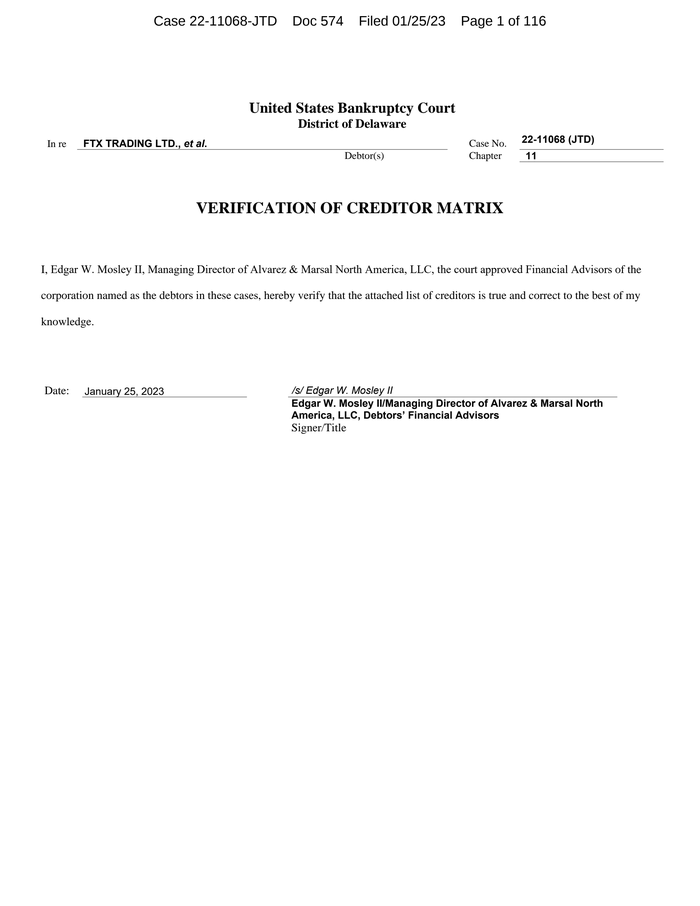
FTX Creditor Matrix Filed in Bankruptcy Proceedings116 pages

CNAS’s task force is co-chaired by Sigal Mandelker, who used to hold Nelson’s position at the Treasury before resigning in 2019 to enter the private sector. Mandelker now serves as general partner of Ribbit Capital, an investor in FTX. Mandelker spoke at SALT’s Crypto Bahamas conference last summer. The invite-only conference for “leading players in the crypto and traditional finance industry” also featured talks from Bankman-Fried, former President Bill Clinton, and ex-British Prime Minister Tony Blair.

Mandelker’s talk at Crypto Bahamas was on maintaining permissive crypto regulations.

“The instinct of government is often to focus on risk and not to put as much emphasis on opportunity,” she said. The true risk regulators should be wary of, Mandelker continued, was “shutting down [crypto] innovation.” (Mandelker did not respond to a request for comment.)

“CNAS received a $25,000 donation from FTX in 2022 in general support of CNAS’s independent research on national security,” Shai Korman, CNAS’s director of communications, told The Intercept. “FTX was also a member of the Task Force on Fintech, Crypto, and National Security. FTX is no longer a member of the task force, and CNAS has returned the donation in full.”

PR, Law Firms, and Video Games

FTX once enjoyed a near-mythical status in the media, with splashy cover stories and gushing news articles lauding the crypto powerhouse and Bankman-Fried, its youthful leader. Such coverage rarely emerges organically, and FTX hired an army of public relations firms to burnish its image.

Among them was M Group, a New York-based public relations powerhouse known for its Rolodex of elite journalists. Others under the employ of FTX included TSD Communications and Full Court Press Communications.

The creditor list includes Rational 360, a public relations firm led in part by former White House Press Secretary Joe Lockhart. Emails obtained by Matt Stoller, the director of research at the American Economic Liberties Project, show that Rational 360 pressured activists and political influencers to speak out in favor of a bill that would move crypto regulatory authority to the Commodity Futures Trading Commission. While the Securities and Exchange Commission handles many enforcement actions against crypto firms, the CFTC is seen as more friendly to crypto interests and has fewer disclosure requirements.

Powerhouse law firms also feature heavily in the most recent bankruptcy disclosure. One firm listed is Cleary Gottlieb Steen & Hamilton, which represented Russia in a $3 billion bond dispute against Ukraine before it shuttered its Moscow office last year. Buckley LLP, another large law firm based in Washington that appeared on the FTX creditor list, announced earlier this month that it would merge with the San Francisco-based Orrick to create a combined firm with a total of nearly $1.5 billion focused on “forward-looking regulatory and enforcement advice” in the fields of finance and tech.

Among FTX’s listed creditors were a handful of nations — though the contours of the financial relationships remain unknown. Nevertheless, the list of countries reads like a who’s who of nations with lax financial regulations: The British Virgin Islands, Bermuda, the Cayman Islands, Isle of Man, Liechtenstein, Luxembourg, the United Arab Emirates, Seychelles, and Switzerland all appear in the filing.

In addition to national banks and powerful firms in the corporate PR world, the creditor matrix also details luxury restaurants like Carbone in Miami and the luxury Margaritaville resort in Nassau.

The North America League of Legends Championship Series, a property of a premier video game event franchise, is also listed in the creditor matrix. Bankman-Fried, notorious for playing the video game “League of Legends” during pitch meetings with investors, arranged a $96 million sponsorship deal with Riot Games. In December, as the extent of FTX’s deception unfolded, Riot announced it would attempt to cut ties with Bankman-Fried.

The entertainment relationships provided, in some cases, an additional channel for political access. The creditor list includes the talent agency WME, with a memo mentioning actor Larry David, a celebrity endorser of FTX who appeared in a now-infamous Super Bowl commercial promoting the crypto exchange.

WME itself is owned by Endeavor, an investor in FTX that owns 38,000 shares of the company. Endeavor is also run by Ari Emanuel, the brother of Rahm Emanuel, President Joe Biden’s ambassador to Japan.

Editor’s Note: In September 2022, The Intercept received $500,000 from Sam Bankman-Fried’s foundation, Building a Stronger Future, as part of a $4 million grant to fund our pandemic prevention and biosafety coverage. That grant has been suspended. In keeping with our general practice, The Intercept disclosed the funding in subsequent reporting on Bankman-Fried’s political activities.

Feature Image Credit: Sam Bankman-Fried, co-founder of FTX, departs from court in New York City on Jan. 3, 2023. Photo: Stephanie Keith/Bloomberg via Getty Images

By , ,

Sourced from The Intercept

By Ksana Liapkova 

Social media has replaced traditional media, so it’s time to funnel your marketing budget into a better, more reliable strategy

Recent projections show that social media networks are expected to have more than 327 million regular users in the U.S. alone by 2027. In the global community, there are currently over 4.2 billion active users.

Consumer shopping habits are shifting more toward the online space, and traditional media is rapidly losing any meaningful effect on driving traffic, generating leads or encouraging customer loyalty.

Because of this, it’s no longer optional for brands to invest the time and resources needed to develop and maintain an engaging, active social media presence across all relevant platforms. Here are five ways the ConvertSocial team suggests to bring a solid social media presence that can work for your brand.

1. It is cost-effective marketing

Social media is free advertising for your brand. Even if you pay for boosted posts on Facebook or Instagram, it still typically costs less than a full-fledged digital marketing campaign.

In addition, it can often be more effective to have an active social media account because it allows people to share your posts with others, boosting your reach and engagement even further in an organic way. Brands like Moon Pie and Duolingo are great examples of this strategy. Duolingo’s TikTok presence earned them a clickthrough rate 9% higher than the market average and rocketed them to the top of the charts in the Apple and Google Play stores.

2. It boosts search engine visibility

Establishing active social media accounts increases user engagement and site traffic, but it also helps to boost your search results placement organically. It isn’t a direct factor in SEO strategy, but it does prove to Google that your brand has value and trust, which is critical for better search results.

It’s important to remember that social media sites have strong search engine capabilities in their own right because they know that users tend to search for what they want on their platform first. This means that including a little bit of strategic SEO when creating engaging social channel content can help more people connect with your brand’s profiles, increasing likes, shares, comments and backlinks.

All of this helps generate “social signals” that show Google people are interested in your content. In turn, this pushes it higher in search results.

3. It gives your brand a human touch

A recent survey found that 78% of users are more willing to buy from a company once they’ve had a positive social media interaction. This could be a customer support chat or a positive comment exchange on social media content.

Over half of the survey respondents feel great about a brand simply when they feel the company’s content is creative and relevant to them as customers, so creating these positive feelings is not difficult. In fact, a Sprout Social survey noted that 61% of consumers think that audience engagement is the most important part of a brand’s social media presence. These positive interactions show your audience that your company is made up of real people who are just like them, strengthening your “human connection” and customer loyalty.

Related: Here’s One Reason Why Your Business Could Be Failing

4. It creates a community within your target audience

Every successful brand has a brand community. This is the core group of people who identify with your brand’s persona and share many important traits with each other. Brands that can create a strong community within their niche are able to transform themselves from a storefront to a lifestyle, which goes a long way toward solidifying customer loyalty.

Communities are where you convert potential customers and deepen the emotional ties with existing customers. When people feel like they belong to something greater than themselves, they’re more eager to become further enmeshed in the lifestyle and share it with friends and family.

The important thing here is to create a genuine sense of connection. For example, Friendster’s community failed in the early 00s because it didn’t link people together in a truly meaningful way. Conversely, Red Bull has created a close-knit global community thanks to word-of-mouth and a dynamic social network.

5. It keeps your name at the forefront of customers’ minds

Statistics show that 55% of consumers learn about new-to-them businesses through social media. On top of this, at least 90% of shoppers buy from brands they follow on social media channels, and 40% actively seek out recommendations for products and services through social media platforms.

This means that an active social media presence is a simple way to keep eyes on your brand. In an era where commercials often result in a negative ROI, this is a meaningful way to generate interest in your brand.

Social media has an advantage over traditional media because it provides a two-way street for communication. Now, instead of brands simply talking to their audience, customers can talk back and engage in a dialogue. When people feel seen and heard by a brand, they are more likely to think of that brand first when making a purchase or recommendation.

Your business needs social media, so don’t wait for another second

It’s not too late to establish an active social media presence, but it’s essential to do it sooner rather than later. Customers want the experience of interacting with a like-minded community of other brand lovers and the brand itself. They need to see the human side of your company, and you need advertising channels that are proven effective.

By Ksana Liapkova 

Entrepreneur Leadership Network Contributor. Head of Admitad ConvertSocial. Ksana has been a speaker at world-class conferences on affiliate marketing and is in contact with more than 35,000 clients of Admitad ConvertSocial, involved in the blogging industry, which allows her to always be aware of the latest trends in the world of influencers.

Sourced from Entrepreneur

By Chitra Iyer

What you need to ask if you want to better understand, influence and measure your own dark funnel in 2023.

Remember the quote of debatable origins that goes something like this (I’m paraphrasing), “I know half of my advertising works. I just don’t know which half.”

The conversation around the “dark funnel” is giving B2B marketing a similar identity crisis.

The carefully constructed and measurable B2B buying funnel is not as linear and clear-cut as marketers would like to think. There are multiple nonlinear touchpoints, that we cannot control, influence or measure, but which significantly impact the buying decision. And they make up 75% or more of the path to purchase. All such unknowable, unmeasurable, un-influenceable touchpoints are, in a nutshell, the “dark funnel.”

Naysayers say what can’t be measured can’t be managed or improved. Supporters say it’s a part of the buying process, accept it or not. So, what’s an already overwhelmed B2B marketer to do?

My money is on the “don’t ignore it” camp. If you embrace the dark funnel, then you have a shot at understanding it, and indeed, making it less unknowable, uninfluenceable and even perhaps less unmeasurable.

As Paul Slack, founder and CEO of B2B digital marketing agency Vende Digital wrote in a recent LinkedIn article, the dark funnel and dark social are simply where buyers learn to buy. He added not to be afraid of the dark funnel, but adapt instead and recommended becoming part of the learning and discovery journey by educating buyers with social posts, community, monthly Zoom meetings and podcasts.

To help understand the dark funnel, I dove into — (where else?) — the dark social. I trawled dozens of conversations, comments and resources to pick these three questions you should be asking if you want to better understand, influence and measure your own dark funnel in 2023.

1. Does Our Organization Have a Clear Understanding of the Dark Funnel?

Two areas of confusion emerged repeatedly across conversations on this topic.

Does the Dark Funnel Mean Word-of-Mouth?

The dark funnel is not just word-of-mouth (WoM). It is also ads people see but don’t click on, podcast mentions that they later Google, or event sponsorships, swag and conversations filed away in the prospect’s mind for a later time.

But WoM matters too. Perhaps more than ever in an age when it’s become hard for prospects to tell what’s an advertisement and what’s real, unbiased feedback. People trust other people over brands, but the nature of “known and trusted” has changed. Digital WoM is often “one-to-many” conversations on social or private channels, communities, Q&A forums, webinars and events, product review sites, webinar chat boxes and so on. The enabling space for this digital WoM is the dark funnel.

Is Dark Social the Same as the Dark Funnel?

Chris Walker, founder and CEO of Refine Labs, makes a clear distinction. He calls “dark social” the places where “everyone in B2B hangs out right now” — communities such as Pavilion, Peak and DGMG; internal company communication platforms like Slack and Discord channels, private channels and closed Facebook groups; third-party events and meetups, social platforms, podcasts, etc.

In dark social, the buyer is likely not yet “ready to buy” but is soaking in peer-to-peer learning. Together, via discussions, shares, DMs and content consumption, people are discovering problems, opportunities, solutions and products, evaluating their own performance, learning how others are solving similar problems and so much more. “The dark social does not show obvious intent. But if you are waiting for intent signals to start your engagement and nurturing, you are already too late,” said Walker.

So where does the dark funnel begin? After spending a long period on dark social, when learning, shortlisting and evaluation have already happened, people often transition to the dark funnel. They then come to organic search and review sites — aka the dark funnel, and finally on to your website. This shows up as “direct traffic,” “other sources” and “organic search traffic” on your Google Analytics reports.

Note that this is not a linear transition — prospects may weave in and out of both for a long time before they respond to any inbound marketing tactic if they do at all.

Expert tip: On an episode of the Demand Gen Live podcast, Chris Walker highlights a common mistake — not recognizing that much of their site traffic has already been through the dark social and the dark funnel. That means knowledgeable visitors are automatically pushed into nurture workflows when in reality, this prospect is close to a decision.

What can you do instead? Replace standard form fills and nurtures with bot-powered contextual conversations to give each visitor what they want at that moment. I came across The Bot Lab’s Helium platform, which claims to let advertisers have contextual conversations with readers right on the publisher’s page, instead of having to click out with an ad link. Ungated bottom-funnel content also helps makes it easier and friction-free for prospects to ask for a trial or demo.

2. How Can I Better Integrate Dark Funnel Traffic Into My Attribution and Analytics?

Attribution has its challenges, but it’s still one of the most powerful tools for revenue-driven marketers. You can’t give up on it — especially when revenue attribution and intelligence solutions are getting smarter by the day, several with the capability to track full-funnel customer journeys (and not just individual contacts or accounts).

At the same time, ignoring what dark social and the dark funnel have to tell us is impractical. In this LinkedIn post, Ryan Reisert of Phone Ready Leads shares how a comment left on another post received just about 22 engagements on LinkedIn. On the same day, the company’s website traffic showed a 10 times surge. A clear indicator of the impact dark social can have on web traffic, but which will show up as “direct traffic” on the analytics.

Here are some ways to get a better understanding of the dark funnel:


Correlate: if direct traffic or organic search is going up, understand what could be causing those spikes. Have you sponsored a podcast or event recently that had a lot of listens?

  • Set your conversational intelligence platforms such as Gong, Chorus or Outreach to listen for dark funnel keywords such as “podcast” or “LinkedIn,” and set your CRM to mark these as “dark funnel” sources.
  • Connect social monitoring tools such as Oktopost or Meltwater to your CRM to track brand mentions and other solution or category-related keywords to track spikes.
  • Get paid subscriptions to review sites for more insights into who reviewed your products or category. When combined with other intent data, this may provide stronger context and signals.
  • Sort out your UTM processes. Missed or messed up UTM codes often end up unleashing a big dump of “other” or “direct” traffic, especially if hundreds of campaigns leading to hundreds of landing pages are on in parallel. A solid UTM workflow narrows the dark funnel by ensuring as much traffic as possible is tagged to the right source.
  • Institutionalize a self-reported attribution process. Ask mid and late-stage prospects, converted customers, and even churned customers how they heard about you and why they chose your brand. Make it scalable with onboarding and off-boarding microsurveys.
    dark iceberg
    LinkedIn post by Strategic ABM/ Dan Mulkeen


Do these enough times, with a consistent process, and patterns will start to emerge about dark sources that are helping generate demand. Declan Mulkeen, CEO of Strategic ABM, who calls it the dark iceberg in his viral LinkedIn post, reminds us that our B2B marketing metrics need a better balance between what can and cannot be seen.

Expert tip: in this post titled “Why B2B revenue attribution is broken,” B2B marketing leader Naseef KPO shares the reasons why single-touch, first-and-last touch and multitouch attribution models are all problematic. The issue, he says, is that most of them “focus on demand capture alone and not demand creation or generation,” referring to the dark social and dark funnel. Instead, he suggests a ‘mixed attribution model’ composed of:

  • The hybrid attribution model, which focuses on a combination of self-reported attribution and software-based attribution.
  • The influencer attribution method, where you look at the contribution of multiple demand capture channels and attribute revenue proportionately.

The core principle of this approach, KPO added, is to separate demand generation and demand capture channels and attribute revenue among these channels in such a way that “you are able to come up with the right budget allocation for future marketing activities.”

Ultimately, marketing strategy should be based on where customers are, not which channels can be measured. Even Google is moving away from last-click attribution toward an intelligent data-driven system.

3. What Mindset Shifts Can Help Leverage Dark Funnel Insights Better?

Mindset is a key part of winning the dark funnel. Needless to say, dark social, dark web and almost all B2B marketing itself today should be not about selling, but about helping people buy.

You cannot track the dark social or the dark funnel 100 percent, so stop focusing on that. Instead, focus on how you can best be a part of it and influence it by providing genuine value.

Train employees to fan out across dark social and amplify — without selling — that value, with meaningful insights, comments and content about the category, problem and solution rather than the brand. When it comes to communities, do not think of prospects as “us” and “them.” Instead, be a member of the community, giving and taking value from it.

To drive leadership buy-in and help sales open more doors, track and share screen-shots of useful engagements and DMs, including those of competitors. The currency here is not conversion, but attention and engagement from the right people.

Expert tip: In this episode of Insightly’s Closing Time podcast, Shama Hyder, founder and CEO of Zen Media, makes a great case for why marketers should spend more time on dark social and the dark funnel. The problem, she says, is a marketers’ work today is more about working on known intent. They end up as an on-demand collateral factory for sales, churning out white papers and brochures for the 5% of people already showing intent and ready to buy.

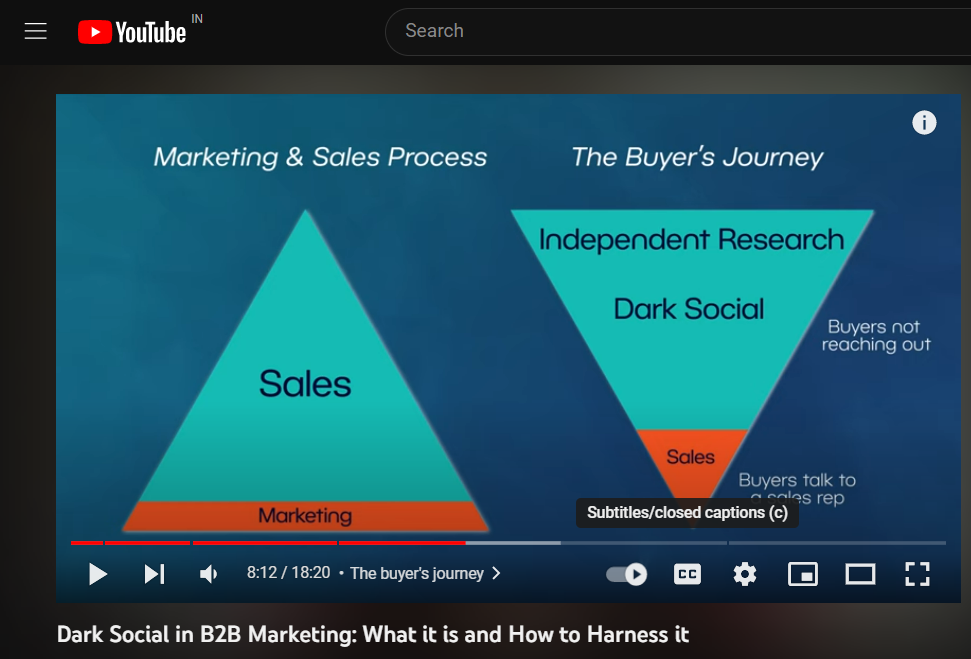
Instead, marketing should focus on creating demand. They should be on dark social and dark funnel channels, interacting with the 95% of potential customers who are not yet “ready to buy,” but are in the process of learning, collaborating and evaluating with peers. That is where the real opportunity to create demand exists. But you can’t rush it. When it comes to creating value and engagement on dark social, Hyder advised, play the long game.

Like all great marketing, content, conversations, context and connections are the key to getting the most out of the dark funnel as well.

youtube screengrab
Screengrab showing how most marketing is focused on converting high-intent prospects instead of creating demand across the dark social. Closing Time Podcast episode: Dark Social in B2B Marketing: What it is and How to Harness it.


By Chitra Iyer

Chitra is a seasoned freelance B2B content writer with over 10 years of enterprise marketing experience. Having spent the first half of her career in senior corporate marketing roles for companies such as Timken Steel, Tata Sky Satellite TV, and Procter & Gamble, Chitra brings that experience to her writing. She has authored over 500 articles, white papers, eBooks, guides, and research reports on customer experience, martech, salestech, adtech, retailtech, and customer data and privacy. She holds a Masters in global media & communications from the London School of Economics and Political Science and an MBA in marketing.

Sourced from CMSWire

By Amy Houston 

To mark the one-year anniversary of Russia’s invasion of Ukraine, creative agency And Us has devised the world’s first interactive street view of a war zone. Here’s how.

On February 24, 2022, Vladimir Putin waged an illegal war with Ukraine, inflicting mass devastation on the country, resulting in thousands of deaths and millions of innocent displaced people. In the year that has passed, a ravaged Ukraine is totally unrecognizable.

“There’s been quite a clear pattern of targeting civilian areas,” says Jamie Kennaway, executive creative director at And Us. “We had the idea of bringing it to life in a way that people can explore and see in a visceral way. It brings it home in a different way.”

“Whether it was Yemen or Iraq, there’s never been an accurate representation of a war-torn country [on Google Street View]. [Google], understandably, don’t want to show violence.” With this in mind, just how difficult would it be to get someone on the ground to document the conflict?

Through previous projects, the indie agency had a network of people that could help. Diego Borges, the agency’s tech director, was able to connect with an exec working at Google Street View who, in turn, happened to know someone that was in Ukraine at the time who could get images. From the beginning, the duo says that the entire project has been both serendipitous and scary.

Taking a Street View car camera through an active war zone is obviously not an advisable plan, admits Kennaway. There were many times they would be on the phone with their Ukrainian contact and he was in an area that was under attack or experiencing power cuts. With a project like this, there are always going to be trepidations, no matter how important the cause is. “We didn’t want to put anyone at risk and we don’t put anyone at risk from a security point of view either,” he adds, stating clearly that the photographer and agencies safety was always front of mind.

Potential issues with Google were also a consideration as the photographer had previously worked with the tech giant and had been supplied with equipment under strict conditions. After talks, they came to an agreement. “There’s a situation on the ground that people need to see.”

The original plan was to get their Ukrainian partner there with a remote-controlled armored car fitted with cameras and drones. But in the planning stages, the photographer suggested using the masses of footage he had on file from his posting in Ukraine. Quickly, the creatives realized they could use scenes from various cities and not just one “symbolic area” in order to give an accurate representation of what was really happening on the ground. They could show the real devastation in Kyiv, Irpin, Kharkiv, Izyum and Cherigiv and Sumy.

“There’s no bigger documentation of what is happening,” says Kennaway. “There’s lots of other footage like drone shots, stuff on CNN and the BBC, a clip here and something there, but to say, come see for yourself, essentially, we realized that the angle was that we were asking people to bear witness.” This, he adds, has been important throughout horrific events in history and is extremely powerful.

For the immersive user journey itself, the team wanted to show what seemed to be the “deliberate targeting of civilian areas” and to highlight that they were “accessing something that was quite obviously a crime.” The notion of their being an undeniable truth eventually led the team to the frank campaign name.

“Obviously mistruth is a weapon of war. You take the camera down the street and it goes up onto this, there’s something very raw and untouched about it.” Looking through the before and after images were shocking, they say.

The end result is a dedicated website that allows the user to make their way through the streets of the chosen six Ukrainian cities, similar to Google Maps. By zooming in and looking around, people get a full 360 view of the devastation inflicted upon those areas.

But to guarantee the project would be seen by millions, the agency needed the backing of a client. “There’s a bit of virtue signaling. There’s a lot of stuff going on [there], versus actual people and institutions on the ground who are trusted with where the money goes,” he said. The more they spoke with Ukrainians on the ground, the more they realized some ‘charities’ were not as trusted or helpful as others.

This meant laborious research and a vetting process to ensure the partners they brought on were valid and doing vital work on the ground. The collective includes President Zelenskyy’s United24 initiative), Voices of Children, which offers long-term psychological support to children affected by war, plus Nova Ukraine and Vostok-Sos, both provide humanitarian supplies. Specifically, feedback from United24 suggested that they get approached constantly to partner on projects and they don’t go with everything. “We weren’t relying on United24, it was just a big surprise that in the end, they wanted to partner. We weren’t expecting that.”

The campaign rollout was decided early on, with a huge emphasis on the press and social media. “It is essentially a carrot that we’re going to give PR for the wider conversation,” admits Kennaway. He says they sought advice to see if it was “PR-able” and if not, they might have reconsidered what they were doing because that was the one chance it had and nobody has a “billion dollars of media money.”

“We’re going to try and get this through mainstream media and obviously the marketing world I mean, I was a bit hesitant about marketing media at first, but we said to our clients that marketing media is important because we can get it spreading in a different way, in different load channels that will also then give it exposure.”

Kennaway is super conscious that he doesn’t want this project to come off as all about the agency, which would feel wrong. The initiative itself has to lead, he wants people to see the efficacy of it and why it’s important. It’s about the “causes involved, the story behind it, and maybe some of the technicality,” he concludes.

“We’re just the puppeteers.”

By Amy Houston 

Sourced from The Drum

By Christa Greaves

Finding email marketing examples to follow takes a lot of work.

But it’s essential to find a way to engage with your readers and promote your products.

You need to know which type of email campaign to compose and when.

So, we curated this list.

We subscribed to email lists, so you don’t have to and narrowed it down to the top 9 best email marketing examples.

Our post explains why each email stands out and offers 8 tips to help you achieve your lucrative email marketing strategy.

Are you ready to stimulate a successful campaign?

Read on!

What is an Email Marketing Campaign — Definition & Purpose

Email marketing campaigns are marketing strategies where emails sent gain leads and turn readers into customers.

The purpose is to build familiarity and trust with your subscribers through marketing automation. Thus creating a marketing funnel that will segment and target your desired customers.

9 Top Email Marketing Examples (& Why They Are So Powerful)

On any given day, your inbox can be full of emails reminding you of an email campaign you might want to unsubscribe from or delete.

Yet every so often, you come across a great example that stands out.

But how do you create these emails?

We picked 9 email campaigns that reflect the best email marketing examples to follow and emulate.

We’ll show you examples of transactional, relational and promotional emails.

All campaigns have a time and place to be used, but first, the examples…

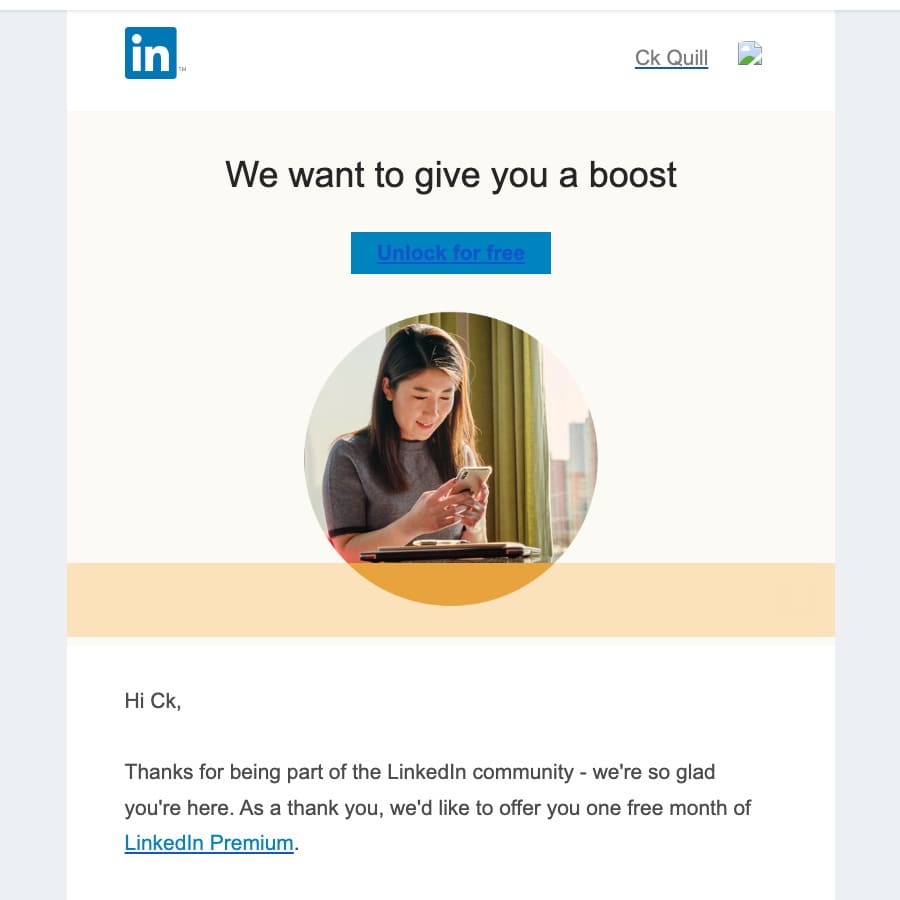
1. LinkedIn

email marketing example from LinkedIn

Type of Email:

Relational email — thank you promotion.

Email Intention:

The primary purpose is to gain leads by turning existing subscribers into buyers.

What Makes This Email Standout:

  • Everyone likes to feel appreciated, and the top of the email newsletter states, “Thanks for being part of the LinkedIn community – we’re so glad you’re here.”
  • We all like free things — the perfect engagement from a company is to offer something free as a thank you for being a “loyal subscriber.”
  • CTA (Call to Action) is attractive and uses branded colours to stand out.

2. Paramount

email marketing example from Paramount

Type of Email:

Promotional email — re-engagement with the customer.

Email Intention:

The primary purpose of the email campaign is to offer a personalized sale to regain a lost customer.

What Makes This Email Standout:

  • Being offered a sale of 50% off is enticing, and if they left because of cost, this might be enough incentive to re-join.
  • The visual flashing sign at the top is eye-catching and bold.
  • There are several embedded CTA buttons, which will direct customers to their website if they click on the email almost anywhere.

3. Eyebuydirect

email marketing example from eyebuydirect

Type of Email:

Transactional email — seasonal limited time sale.

Email Intention:

The primary purpose of the marketing campaign is to create a sense of urgency. The business wants customers to act upon a time-limited sale (Black Friday) and make a purchase.

What Makes This Email Standout:

  • A large countdown clock at the top creates a sense of urgency.
  • Rich, colourful photos that rotate under the countdown clock, demonstrating the products worn by various cultures and genders. It’s appealing and offers a “virtual try-on” before purchasing.
  • A clever CTA at the bottom, “Still thinking about it,” to entice customers who haven’t clicked yet or might be wavering on price or purchase.

4. Canva

email marketing example from Canva

Type of Email:

Relational email — educational marketing campaign.

Email Intention:

The primary purpose is to share tips to help users learn how to use their tool. It adds an element of engagement and gets readers to return to their site, thus creating a loyal customer base.

What Makes This Email Standout:

  • The skill level needed varies for each user, and Canva has a brilliant marketing campaign to educate each user and help them succeed using their tool.
  • Simplicity that nurtures and attracts subscribers’ attention.
  • It uses a CTA to show how to implement the tips.

5. Starbucks

email marketing example from Starbucks

Type of Email:

Promotional email — time limited sale.

Email Intention:

The primary purpose is to create a sense of urgency by nudging email subscribers to complete their purchases.

Also, Starbucks has added another element by giving subscribers rewards for their transactions.

What Makes This Email Standout:

  • A single image with light colours on the background draws the reader in and has them thinking about that coffee.
  • A large contrasting CTA button is like a beacon to readers — encourages them to click and sign up for the membership.
  • The date range is given to create a sense of urgency.

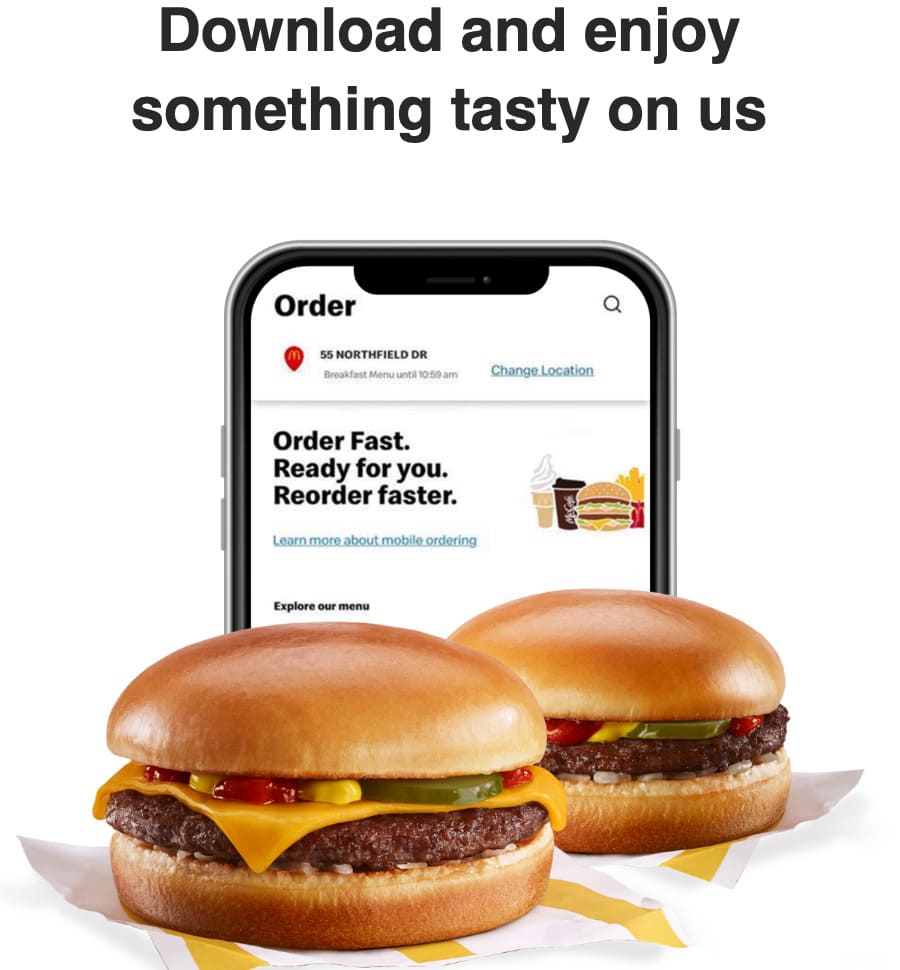
6. McDonald’s

email marketing examlpe from McDonalds

Type of Email:

Promotional email — mobile app engagement.

Email Intention:

The primary purpose of the marketing strategy is to convert subscribers into buyers by downloading the McDonald’s app.

What Makes This Email Standout:

  • A simplistic email draws the reader’s attention to the product, using lots of white space and relevant images.
  • Offers free food to entice subscribers to sign up for the app.
  • Scheduled email to arrive in your inbox at lunchtime to increase sales.

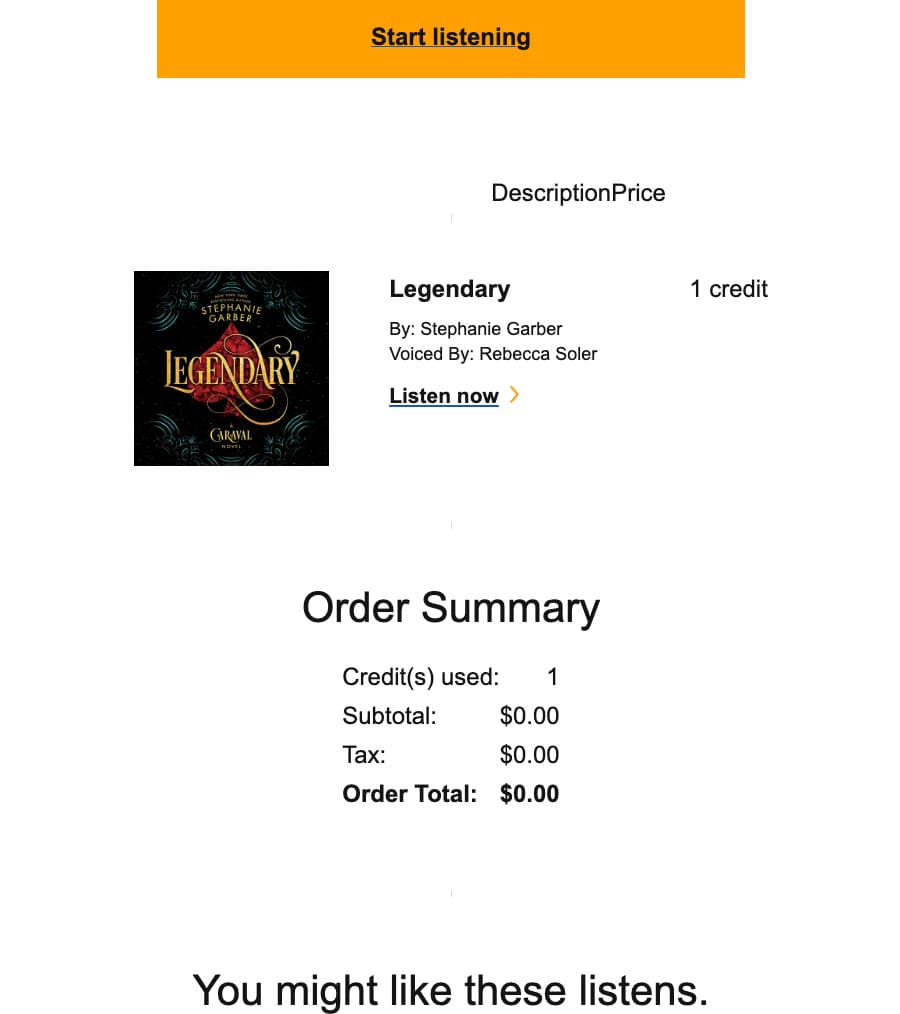
7. Audible

email marketing example from Audible

Type of Email:

Transactional email — order confirmation and cross-selling to subscribers.

Email Intention:

The primary purpose is to give email subscribers a visual receipt of their purchase and cross-sell relevant items.

What Makes This Email Standout:

  • The CTA button, “start listening,” at the top allows readers to easily click and start their book.
  • The simplistic layout draws the reader’s attention to the primary points in the email.
  • Strategically places other product suggestions to encourage cross-selling.

8. Sephora

email marketing examples from Sephora

Type of Email:

Relational email — birthday email sent on the subscriber’s birthday, offering a free gift.

Email Intention:

The primary purpose is personalized email marketing to acknowledge the subscribers’ birthday and offer a free birthday gift. It creates a connection between the business and the email subscriber.

What Makes This Email Standout:

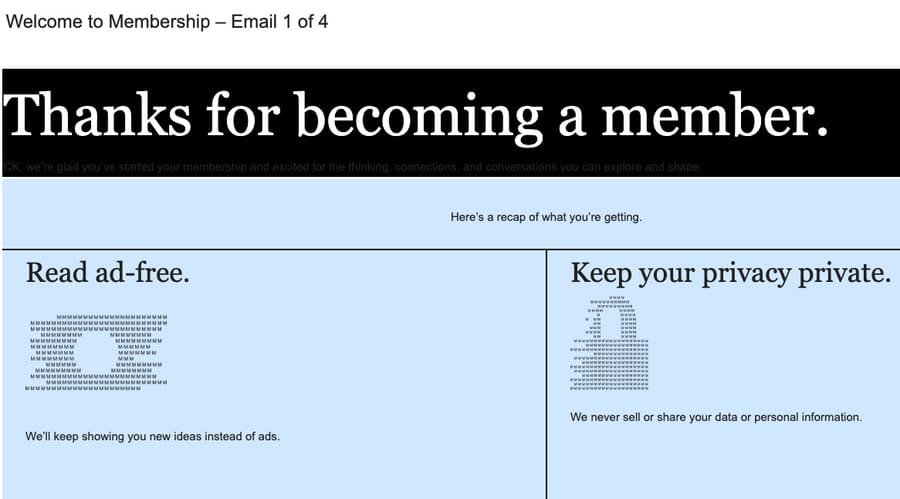
9. Medium

email marketing example from Medium

Type of Email:

Relational email — welcome campaign.

Email Intention:

The primary purpose is to thank subscribers for signing up for the email list with a recap of what they get.

What Makes This Email Standout:

  • It states “1 of 4 welcome emails,” showing readers there is more to come and learn about the membership.
  • It eliminates all distractions and draws the readers to the benefits by opting for a simplistic background.
  • Contrasting green CTA button at the bottom of the email to draw the readers in and encourage them to click.

8 Top Tips For A Lucrative Email Marketing Campaign

We’ve explored the ten best email marketing examples, so let’s dive deeper and see the 8 steps needed to create your own lucrative email marketing campaign.

1. Pick a Goal To Focus On

Each marketing campaign will have a different goal, depending on what outcome you’re trying to achieve.

Whether you’re welcoming a potential customer, email subscribers, sending abandoned cart emails or cleaning up an inactive subscriber, picking your goal is the first step.

Essentially, you need to determine what outcome you have in mind.

For example, you may be a new company trying to build your email list, nurture leads and build relationships with your customers.

So, sending a new subscriber, birthday, or referral email is just some of the starting emails a new company should include to the target audience they are trying to reach.

Yet, your primary goal should always be to develop a connection with your audience. You’ll need to show the readers you can be a source of trusted information; only then will they become loyal.

2. Talk to Your Subscribers and Advance Them Down the Marketing Funnel

Talking to your subscribers about your business allows you to build rapport and advance subscribers down the email marketing funnel.

Your first email should be the welcome email and is your one shot at making that big first impression.

So, you want to appeal to every subscriber on the email list, but not in a sales pitch way. You are making that first contact to thank them and impress them.

As Aman states, “welcome emails have the highest open rate.”

So it’s imperative to get it right.

After that initial welcome email, subscribers will continue to open your emails and newsletters as they will be informative and beneficial to them.

You are creating the marketing funnel where you cultivate the relationship until the subscriber is ready to buy.

Furthermore, regardless of your subscriber’s stage in the marketing funnel, you should deliver content they find valuable. This indirect approach will build trust with your readership and boost open rates.

Plus, when they are loyal subscribers, they share it with family, friends and social media.

Word of mouth is your golden key!

3. Personalise Emails With Your Subscriber’s Name

Everyone wants to feel special in some form, so having personalized emails in your inbox grabs your attention.

How often have you breezed over an email with a generic Mr./Ms./Mrs.?

It demonstrates a lack of customer knowledge and could be considered spam.

So, use your subscriber’s chosen name, speak directly to them and keep them engaged with your content.

After all, creating a reason for them to open your email will lead to higher click-through rates. Statistic show 84% of users will share their data for a more personal experience.

Given such a high rate — it’s a wonder why more companies don’t personalize their emails.

Their loss is your gain, as you just have to create personalized emails!

4. Enchant Them With Relevant Images

When someone opens an email, they don’t want to stare at white screens filled with black text. They want to be wowed and encouraged to scroll. They need a reason to pause on your email.

But a white screen filled with text would bore most. Email readers are scanning; they will likely delete and unsubscribe without anything to pizzazz or engage them.

So, captivate your readers with colour and style through fun images and fonts.

For example, include relevant images to captivate your readers and show a product launch, new features or specials you are having.

Offering a clear, crisp image will charm readers and arouse their interest to know more. They will want to read about the product or marketing campaign.

In simple terms, it’s like the kid in a candy shop. They want the most prominent and brightest candy. Children are captivated by the shiny candy, just as your readers are by your images.

5. Optimize For Mobile

We are in a time when almost everyone has a mobile device of some sort that they use to check their social media and emails, plus communicate with work, friends, and loved ones.

Since nearly everyone has a screen, from kids to seniors, you should optimize emails for computers, tablets, phones, etc.

After all, as Greg Hickman pointed out, 65% of marketing emails get opened first on a mobile device. That’s a high open rate!

So, follow this quick video to learn how to optimize your emails for mobile devices today!

6. Your Subject Line is Crucial

One of the most crucial parts of marketing emails is the subject line, as it could make or break the open rates of your marketing campaign.

So, ensure it’s short, sweet, and clearly beneficial to the reader. You can even add an element of curiosity.

For example, let’s say you offer a productivity class and want to encourage subscribers to sign up. Your subject line could be:

“Stop wasting time on mindless work.”

There is a clear benefit; it intrigues the reader to open the email.

Furthermore, you don’t want it to be truncated and have the reader miss your message.

So, check with your Email Service Provider (ESP) to see your character limit.

With an attention-grabbing subject line and a mobile-optimized email design, you’ve almost constructed perfect marketing emails.

7. End Your Email with an Enticing Offer

The enticing offer or CTA is the last piece to add to the perfect email marketing strategy.

You’re missing a valuable opportunity if you create an email with just knowledge and no follow-up.

So, give subscribers a reason to click through to your website or landing page by creating a clear CTA with contrasting colours to ensure it stands out.

For example, you could use a primary CTA such as signing up for a service, more information on a product hunt, clicking through to your webpage, social media, etc.

Then as shown in the examples above, you could use secondary CTA’s to further prompt subscribers that aren’t quite ready to convert to being a customer yet.

8. Use Email Marketing Templates

An email marketing template is pre-made. It gives you a starting point for any email you want to send, saving you time and energy for other tasks — like running your business.

Furthermore, all email templates consist of reusable code, where you copy and paste your content, links or images, and then an email is created for you.

So, there is no need for hours of creating or hiring it out to others with a technical or graphic design background.

Equally, when you use a ready-made template, email marketing can be less stressful, and you can become more efficient and consistent in customer engagement.

There are several options for an email template that all have the same goal in mind.

To give you the gift of time.

Email Marketing Examples That Inspire Confidence

The essence of email marketing examples is to increase email subscribers and convert leads to sales.

But gaining sales can only happen after your company has established trust with their readers.

By connecting with current and potential customers around the globe, you build that trust and gain followers and email subscribers.

Engage with readers, so they will want to know more about you and your company.

Then you can promote your products seamlessly through the emails you send.

You might initially feel overwhelmed, but your email campaigns will thrive if you follow the steps above.

You just need to take the bull by the horns and start today!

By Christa Greaves

Sourced from SmartBlogger

Sourced from Association of Advertisers in Ireland

With Garry Blair from Nielsen Media Ireland.

We are delighted to welcome Garry Blair to take part in our next Toolkit session on Wednesday March 1st at 9AM.

Date: March 1st
Time: 9am
Location: Online

In this session, Garry will look back through advertising spend in 2022 and look forward to some key category insights and trends to watch out for in 2023.

Register below to join us on March 1st for what should be a very interesting toolkit session.

REGISTER NOW

Sourced from Association of Advertisers in Ireland

Sourced from Inker Street

With the rise of digital marketing, more and more small businesses are turning to digital marketing agencies for help. A digital marketing agency is a company that specializes in providing digital marketing services, like Inker Street Digital Marketing.

Digital marketing agencies are a great way to help your business grow. They can help you create a strong online presence, develop marketing plans, and manage your online marketing campaigns.

They also can provide you with the necessary tools and resources to stay ahead of the competition. If you’re looking for help growing your business, consider hiring a digital marketing agency.

They offer services that include search engine optimization (SEO), social media management, content creation, email marketing, and other online marketing services.

Digital marketing agencies can help small businesses make more money through their expertise in the field and provide valuable insights into the most effective strategies for marketing and promotion.

They can also help small businesses create an effective online presence and reach their target audience.

They can also provide valuable insights into the most effective strategies for marketing and promotion. By engaging a digital marketing agency, small businesses can benefit from their expertise in the field and get ahead of their competitors.

Digital Marketing Agencies Small BusinessThe Growth of the Internet

Marketing is not what it used to be. Not too long ago, there were very few ways a business could promote its services. Today, with the ever-growing Internet, a small business has more channels to connect with potential audiences.

The history of the internet is a story of innovation and growth. The internet first emerged in the early 1960s, but it wasn’t until the late 1970s that it really began to take off. The early internet was very primitive, consisting of a few thousand computers linked together.

In the late 1990s, the internet began to grow rapidly. This was due to the development of new technology, such as the World Wide Web, and the growth of internet usage. By the early 2000s, the internet had become a widespread phenomenon, with billions of people using it every day.

The Internet has grown to become the best medium for small businesses to level the marketing playing field. It allows small businesses to reach their customers without spending millions on advertising.

How Do Digital Marketing Agencies Help Small Businesses?

87% of shoppers begin their search for companies that provide a residential service online, this could include everything from plumbing to electrical. It’s a huge market size to not be a part of! And it’s unquestionably the most compelling incentive to invest in digital marketing.

You can’t ignore the impact of digital marketing on business growth.

Without a doubt, digital marketing plays a critical part in the growth of small businesses. Companies need to boost their sales, revenue, and overall growth, and digital marketing is an art form that allows them to turn their audience into consumers.

This allows them to earn additional cash by selling their products or services. As a result, the impact of digital marketing on startup and small business success is undeniable.

Understanding Your Target Audience and Building an Effective Marketing Campaign

Understanding your target audience is essential to creating an effective marketing campaign. Digital marketing agencies conduct audience research, that can give you valuable insights into the needs and desires of your customers.

This information can be used to create customer profiles that will help them tailor a marketing campaign to reach the right people at the right time.

With a well-crafted ad campaign, they can maximize your return on investment and ensure that you are reaching the right people with the right message.

Which Digital Marketing Techniques Should Digital Agencies Use?

Digital marketing is the use of electronic channels such as the internet, blogs, web pages, social media, and mobile apps to promote and sell products or services. It is the process of creating, optimizing, and delivering an advertisement or communication that uses digital technologies.

There are many different digital marketing strategies that a digital marketing agency can use to grow your online presence. Some common strategies include search engine optimization (SEO), online advertising, email marketing, and social media marketing.

Search engine optimization (SEO) is the process of making a website’s content and on-page elements (title tags, meta descriptions, etc.) effective at attracting search engines. Many digital marketing agencies will start with SEO as the first step to improving your online presence.

Using Social Media to Attract Customers Online

Social media platforms are a great way to reach potential customers online at a low cost. It allows businesses to engage with their target audience, build relationships and generate leads.

With the right strategies in place, digital marketing agencies can use social media platforms to reach out to their target audience, build trust and generate more leads.

Social media platforms provide businesses with an opportunity to showcase their products and services in an engaging manner. This helps them connect with potential customers, which is essential for building relationships and generating leads.

These agencies can use a variety of tactics to boost their presence on social media and reach out to potential customers. They can create content that resonates with their target audience, promote it through paid campaigns, or even build relationships with influencers who can help spread the word about their brand.

Additionally, agencies can use social media platforms for content marketing purposes such as creating blog posts or videos that will appeal to their target audience.

By leveraging the power of social media, digital marketing agencies can easily reach your potential customers online at a low cost and generate more leads than ever before.

Social media platforms are an effective way to reach potential customers quickly and cheaply. With the right strategy, businesses can use social media to engage with their target audience and generate leads.

With the right approach, businesses can tap into the power of social media platforms to reach out to more people and generate more leads. By leveraging these platforms effectively, businesses can increase their customer base and grow their business online.

Five Areas Digital Marketing Agencies Should Focus On

Digital marketing is an essential part of any small business’s success. With the right strategies, small businesses can reach a wider audience and increase their sales.  There are five areas that every agency should focus on to maximize their success.

These five areas include:
1. Social Media Management
2. Email Marketing
3. Content Creation
4. Search Engine Optimization (SEO)
5. Local Listing Optimization

By understanding how each area can help your business grow, you can ensure the agencies efforts are successful.

A Digital Marketing Strategies Every Small Business Should Know

Strategy for Digital Marketing AgenciesDigital marketing is a powerful tool for small businesses to reach their target audience. A digital marketing agency can help convert website visitors into leads and customers.

With the right strategies and tactics, these agencies can create effective marketing campaigns. These campaigns will boost your brand awareness, generate more leads, and increase sales.

Strategy: Build a Strong Brand Awareness, a strong brand awareness is the most important factor in any marketing campaign. Without one, your marketing campaign will produce limited results.

Many small business owners struggle with building a strong brand awareness because they are so focused on their product or service that they forget about the impact of messaging and communication strategy.

If you haven’t already, get clear on your brand messaging to ensure you are telling your audience who you are before telling them what you have to offer.

Once your messaging is locked down, a digital marketing agency can incorporate it into all of your marketing efforts.

In Conclusion

Whether your goal is to increase brand awareness, entice a purchase, or foster brand loyalty, there is a digital marketing agency will help you engage with your audience. Depending on your marketing strategy, a digital marketing agency can help your business:

  • Actively use social media to engage with new and existing users.
  • Create original and exciting content to position your brand as a trusted resource in its field.
  • Use website marketing tools to draw new traffic to your website.
  • Leverage the power of SEO (search engine optimization) to increase your organic search engine traffic.

Thanks to the internet, businesses of all sizes have the power to expand their reach, whether it’s attracting new consumers in a local market or developing new markets that would have previously been unattainable.

Without breaking the bank, digital marketing has levelled the playing field for smaller businesses to compete with larger enterprises.

If your business is ready to explore the world beyond traditional marketing channels, Inker Street can help develop an effective digital marketing strategy to make it happen.

Sourced from Inker Street

By Carol Howley

The customer buying journey has changed fundamentally in recent years. Customer behaviour has become more self-directed, and customers often need valid proof points along the way.

Gartner’s research projects that by 2025, “80% of B2B sales interactions between suppliers and buyers will occur in digital channels.” That’s in part because 33% of all buyers desire a seller-free sales experience—a preference that climbs to 44% for millennials.

Piquing buyer interest at an early stage is crucial for lead conversion. You can’t do this without understanding your audience. In a competitive landscape, if a brand fails to engage with people where they’re looking for answers, they are simply not relevant.

The Buyer Journey Revamped

It’s no longer the case that sales teams are the primary source of knowledge for buyers. With search engines putting information at our fingertips and with less reliance on face-to-face interactions, buyers are armed with an understanding of what they need almost instantly.

As such, understanding your audience’s journey is essential: how they think, what answers they seek and how they find solutions. This research will enable you to develop a documented strategy that maps your content to the various stages of the buyer’s journey.

However, you can create a disconnect between your business and potential customers if you do not fully understand your audience. This often leads to putting out content your readers don’t really relate to, which results in a loss of interest.

Typically, the average B2B buyer will loop through their buying journey a few times, revisiting each of the six buying jobs identified by Gartner:

• “Problem identification. ‘We need to do something.’”

• “Solution exploration. ‘What’s out there to solve our problem?’”

• “Requirements building. ‘What exactly do we need the purchase to do?’”

• “Supplier selection. ‘Does this do what we want it to do?’”

• “Validation. ‘We think we know the right answer, but we need to be sure.’”

• “Consensus creation. ‘We need to get everyone on board.’”

To avoid losing potential leads, consider the stage the buyer is at in their journey, how to communicate with them and the channels you’ll use to reach them.

Marketing Your Digital Channels

According to research by Ah Um, “two out of every three business leaders (65%) are drawn in by visuals when searching for B2B content,” and according to HubSpot, “short-form videos and influencer marketing are top marketing channels that businesses plan to invest more time and resources into in 2023”—so what you publish on your owned channels can make or break a buyer’s interest in your business.

Let’s look at each stage of the marketing-to-sales journey so you can build out an omnichannel approach that ensures brand consistency.

Problem Identification And Solution Exploration

The first stage is when buyers see a problem that needs a solution. Initial exploratory research might be done, but details may not be considered.

Here, keep your educational content high-level. Content that is easily digestible is important for capturing potential leads and should be highly visual to sustain attention. Think social media posts, short-form blogs, email marketing and infographics that reflect your organization’s point of view on issues relating to your target audience. Video marketing is crucial to drawing eyes to your content, especially short-form video that can be utilized across multiple channels once created. This stage should address a problem the buyer is trying to solve and build out your organization’s credibility in your industry.

Requirements Building And Supplier Selection

At this stage, buyers are likely to be researching different organizations in more depth, so encouraging them to make informed decisions about their solution is key.

In the days of old-school marketing, gated content such as e-books and white papers worked well at this stage. Its advantage is that you can remarket to leads further down the funnel. However, many marketers are moving away from this in favour of offering value and opening up content to potential buyers by relying on that content to pull in more people and support the journey to a sales demo.

Here, you should maximize your email marketing strategy using messaging and personalization to create tracks triggered by specific content downloads. Your emails should include links to dedicated website product pages that reinforce your solutions, as well as blogs, guides and brand videos that explain how your product solves the buyer’s problem.

A huge role will also be played by social media in this process. Globally, there were roughly 4.76 billion social media users in 2022, according to Kepios; that equates to 59.4% of the total global population. A B2C brand’s biggest social media investment typically goes to Facebook, Instagram and YouTube, while a B2B brand’s top source is often LinkedIn. If you don’t use social media to actively distribute multimedia content, you’re missing out on a huge audience.

Validation And Consensus Creation

This is also known as the decision stage. This is where your buyer is ready to select an organization and where you should concentrate marketing efforts to generate qualified leads. This should bridge the gap between marketing and sales with testimonials, in-depth case studies from the previous stage, detailed vendor comparison guides and solution-centred white papers to shout about how your product solves buyer problems.

You also want to nurture those previous email tracks and make sure they are highly customizable to the buyer’s pain points in their decision stage with clear and concise calls to action—like a free trial, demo, discount or the opportunity to discuss the proposition with an expert.

Influencer Marketing Across The Mix

As more buyers turn to social media, introducing influencer marketing can be a key way to combat brand mistrust and build rapport with potential customers through “word of mouth.” In addition to providing a familiar face and personality for brands, influencers can also generate social proof for businesses, with 86% of B2B brands finding success, so leveraging this channel to build credibility throughout is a no-brainer.

By building out your marketing strategy to follow the shifting buyer journey, you can target your audiences correctly while building brand credibility, piquing interest from potential buyers straight out of the gate.

Feature Image Credit: getty

By Carol Howley

Carol is the CMO at Exclaimer, an email signature platform. She is a senior leader with over 15 years’ experience in the technology space. Read Carol Howley’s full executive profile here.

Sourced from Forbes