Spending is forecast to reach $727.9 billion in 2023, and increase 4.7% next year
Advertising spend is expected to grow globally this year, with inflation driving it to $727.9 billion and $3 of every $5 going to digital channels over the next three years. However, according to Dentsu’s latest biannual global forecast, digital spend is likely to slow to single-digit growth in the future.
Dentsu is predicting a 3.3% rise globally in ad investment this year—up $23 billion from 2022—followed by a further increase of 4.7% in 2024 and 3.8% in 2025. The growth forecast has been downgraded by 0.2% since last December’s report due to macroeconomic factors.
The forecasts are provided for 58 markets including the Americas, Europe, Middle East and Africa, and Asia-Pacific across digital, television, print, out-of-home, audio and cinema.
Putting on the brakes
The previous forecast from Dentsu revealed that following a period of record spend, the ad sector would see a slowdown this year and in 2024 it’s expected to accelerate again to reach $762.5 billion, partially due to the Olympics and Paralympics in Paris, the UEFA European Championship and the U.S. presidential election.
We still expect global advertising spend to grow despite the economic uncertainty.
Peter Huijboom, CEO of international media, Dentsu
Digital ad spend will grow to $424.2 billion this year and account for 58.3% of all ad spend, increasing to 59.1% in 2024. While digital ad spend will continue to grow, it is expected to at a slower pace, 7.8% this year.
Emerging digital channels such as retail media and connected TV will remain in high demand, while programmatic buying is also set to increase by 14.4% to reach 71.4% of digital spend in 2023.
In revealing the latest forecast, Peter Huijboom, CEO of international media at Dentsu said: “For years now we’ve seen the industry pivot toward digital, more than doubling investment in the last five years thanks in part to the almost unlimited potential to reach, engage and sell to individual consumers. It has been one of the big drivers for growth, but with finite marketing budgets available to brands—it’s clear we are now starting to reach a point of digital maturation within the campaign mix alongside more traditional channels.”
He added that markets such as India, where digital was still in its “adolescence,” would continue to witness rapid growth in spending. Tech and platform innovations, alongside new channels and changed planning behaviours, would also mean that digital investment would still see “consistent growth” worldwide.
“We still expect global advertising spend to grow despite the economic uncertainty,” Huijboom highlighted in the report. “However, media price inflation is the true driver of this increase and hides the more lacklustre reality: 2023 will be a flat year for ad spend.”
Asia-Pacific is projected to grow the fastest in 2023 by 4.6%, followed by the Americas by 2.9% and EMEA by 1.9%. Earlier this year, reports on the U.K. market indicated that advertising spend there would virtually stagnate, with growth in spend of only 0.5%.
The Americas will witness the largest growth in ad spend at $334.9 billion
Spending increases across most media
One of the categories set to decline will be TV ad spend (-3.1%) at $170.2 billion by the end of the year, with positive growth expected to return next year. Print advertising will also continue to decline by 4.8% to $48.4 billion.
Media channels set for year-over-year increases are out-of-home (3.8%), cinema (2.1%) and audio (0.8%).
Search investment will be up by 8.9% to $150 billion, with search behaviour expanding from traditional search engines to social media and commerce platforms through innovation powered by artificial intelligence.
The forecast had not yet researched the impact that generative AI could have on the advertising sector and the potential opportunities it could afford brands, but it was mentioned by Huijboom as something that will be monitored in the future.
“Of course, we’re excited about the impact generative AI could have on our industry with the arrival of new in-channel opportunities for brands to embrace, so we’ll need to see if it remains the case.”
Twitter is now worth just one-third of what Elon Musk paid for the social-media platform, according to Fidelity, which recently marked down the value of its equity stake in the company.
Musk has acknowledged he overpaid for Twitter, which he bought for $44 billion, including $33.5 billion in equity. More recently, he said Twitter is worth less than half what he paid for it. It’s unclear how Fidelity arrived at its new, lower valuation or whether it receives any non-public information from the company.
Fidelity first reduced the value of its Twitter stake in November, to 44% of the purchase price. That was followed by further markdowns in December and February.
Twitter has struggled financially since Musk took over. After saddling the company with $13 billion of debt, Musk’s erratic decision making and challenges with content moderation led advertising revenue to decline by 50%, Musk said in March. An attempt to recoup that revenue by selling Twitter Blue subscriptions has so far failed to take off. At the end of March, less than 1% of Twitter’s monthly users had signed up.
Twitter didn’t specifically respond to a request for comment.
Musk’s investment in Twitter is now worth $8.8 billion, according to the Bloomberg Billionaires Index, which uses Fidelity’s valuation to calculate the value of his holding. Musk spent more than $25 billion to acquire an estimated 79% stake in the company last year.
The latest markdown erases about $850 million from Musk’s $187 billion fortune, according to the index. Despite Twitter’s issues, Musk’s wealth is up more than $48 billion this year, largely due to a 63% surge in Tesla Inc.’s share price.
At the Google Marketing Live event, the search giant announced further plans for its AI tools, promising that it will ‘continue to shape the future of marketing’. Here are the five most important insights for marketers.
AI ads are launching in Search results
For marketers, the most interesting development is likely to be the integration of AI-generated ads into search results across Google’s properties, under the title of ‘Search Generative Experience (SGE)’. The ads, which take the user’s prompt or query and build out a few paragraphs of information with associated and relevant products, are set to be deployed across the US initially.
The ads will be distinguished from other search results and labelled as ‘sponsored’ in bold text.
It has been suggested by multiple marketers and analysts that search is set to be among the most thoroughly disrupted areas of marketing due to AI tools, explaining why Google is so keen to prove its existing search-based marketing options are compatible with the tech.
Human interaction is a must
Following that process, Google’s AI tech will generate a list of suggested keywords, images from both the company’s site or a stock library, and headlines for the ad. The advertiser will be able to provide feedback and fine-tune the ad before it is deployed into search. Ultimately, despite the hype around AI, it is being marketed as a tool that requires human sign-off before the ads are deployed.
Cheaper and faster
Despite the allure of the tech, the big selling point to marketers is around bringing the cost of advertising down. Maximizing marketing efficiencies are seen as a big priority for advertisers this year, so a large part of the selling point is around bringing costs down.
Google has stated that early adopters have reported 2% more conversions at a similar cost per conversion. Because the tool is integrated into the existing Search and Performance Max campaigns, there are no pricing differences for its use.
Generative AI images
In addition to the in-search ads, Google also announced that marketers in the US will be among the first to use its generative AI tool for product images. Noting that multiple images have an impact on the success of ads – generating up to 76% increase in impressions and a 32% increase in clickthrough – Google’s team also pointed out that it is costly to manually create those ads.
As a result, the new tool is designed to streamline that process, by using generative AI to create multiple iterations of an image on the fly with different backgrounds, colour tones, increased resolution and more.
Ahead of the curve
Microsoft founder Bill Gates has recently stated that AI-powered personal assistants will severely impact the business models of Google and Amazon in particular. Speaking at the AI Forward 2023, he said: “Whoever wins the personal agent, that’s the big thing, because you will never go to a search site again, you will never go to a productivity site, you’ll never go to Amazon again”.
Google, like most of the major tech companies, has been working on AI tools for years, and it already powers many marketing transactions behind the scenes. With the advent of consumer-facing tools like ChatGPT, however, the pressure has been on large tech firms to prove they are keeping pace with generative AI. An early demonstration of Google’s AI tool Bard was met with a negative reception due to a perceived error in one of its answers, and has in part led to concerns of safety and misinformation across the AI ecosystem.
For Google, then, the opportunity related to AI-generated ads with its search results is to demonstrate to marketers that it is still at the head of the pack with the new tech. By providing figures that demonstrate the cost- and time-saving nature of the tool it will be hoping to prove Bill Gates wrong and ensure that marketers continue spending on its owned and operated platforms.
A few years ago, you couldn’t go three sentences at an advertising conference without hearing the word “omnichannel.” The notion of omnichannel marketing went hand-in-hand with digital transformation, and promised to seamlessly integrate the consumer experience across digital and physical environments.
It was the ultimate challenge for the CMO in 2015. But since then, many of us have come to understand that omnichannel marketing is a myth. Seamlessly integrating experiences across environments, it turns out, is not exactly what humans want. What we actually want is context-dependent experiences that are customized based on channel and behaviour. And for those experiences to be personalized, but also make us feel like part of an exclusive community – all while protecting the sanctity of our data.
Enter branded ecosystems
So what’s the next iteration of omnichannel? How do you capture the touchpoints that you have with consumers, but honour that those interactions should look different depending on the moment and the environment?
Today’s best brand marketers are those that thoughtfully orchestrate interactions across an ecosystem (a collection of brand touchpoints) in ways that build sustainable and context-based relationships with audiences. In other words, being intentional about building ecosystems can foster deeper relationships across environments – from mobile devices to in-person events and immersive web experiences.
One of the best environments to create those relationships has always been in real life. The dwell time and actual engagement with in-person events consistently over-delivers compared to other areas of channel marketing and the post-pandemic landscape has shifted attention toward physical touchpoints and experiences.
Capturing this formula and experience and implementing it into bespoke ecosystems is the creative challenge of marketers today. Moreover, owned ecosystems can give advertisers first party data at a time when direct relationships with consumers is more critical than ever.
The new data landscape
When Google introduced paid search, it solidified our ad-supported internet. For a while, advertisers felt like they had hit the Holy Grail – brands had never had access to such rich and actionable data about how consumers behave.
Fast-forward to 2023, and consumers are increasingly aware of the ramifications of an internet that’s powered by ads. From political polarization to mental health crises, it turns out that exploiting our digital behaviour has serious consequences.
This has spurred a call for legislation which has been codified with Europe’s GDPR and California’s CCPA and subsequent CPRA. These pieces of legislation are largely felt to be incomplete, but they signal the beginning of a reckoning with the “surveillance capitalism” structure that’s been the bread and butter for Big Tech.
Even Google responded, vowing to rid Chrome of the third party tracking cookie by next year. This move could turn digital advertising on its head and leave advertisers and publishers scrambling for ways to meaningfully target consumers online. Meanwhile, digital ad practices have made it all the way to the US Supreme Court, with a case about the potential for algorithmic distribution to lead to violence.
In light of heightened sensitivity to data privacy, in addition to emerging technologies like generative AI that threaten to use data in more invasive ways, the major consulting firms point to trust as a key focus area for consumers.
What does this mean for brands? Traditional digital ad targeting is on the decline, and a premium is placed on direct relationships between brand and consumer. Put another way, first party data is the new Holy Grail in the advertising ecosystem and the brands without a first party data strategy are at risk of becoming obsolete.
Experiential media
Advertisers pairing back investments in social media and programmatic advertising are likely to point to brand safety concerns and budget cuts as a reason to moderate display ad spend. As social media content becomes more extreme and polarizing, and targeting becomes less certain, brands forced to rethink their digital ad allocations are looking at where display advertising is most effective in their customer journey.
What they’re learning is that display advertising, at least with respect to conversion and ROI, may be more lucrative in theory. In The Subprime Attention Crisis by Tim Hwang, Hwang paints a picture of an advertising ecosystem built on a house of cards, rife with fraud and falsely attributed ad conversions.
Faced with budget cuts, an uncertain economy and a precarious tech industry and supply chain, advertisers need to identify media buys that are sure to provide a return on investment while authentically engaging with and providing value to real audiences. It turns out, the road to ROI is to own the supply.
Investing in building owned ecosystems is one way to have unmitigated access to data that’s not corrupted by advertising fraud like bots or beholden to the walled gardens of Big Tech. We call this type of media buy “experiential media,” and it’s attracting advertisers for good reason.
Creating an owned infrastructure for meaningful touch points with brand ambassadors has several perks. Ensuring accurate and transparent relationships with consumer data enables a brand to personalize without overstepping privacy bounds. Moreover, owning the media channel eliminates a large percentage of ad spend that’s traditionally spent on fraud at a time when marketing leaders need to be more agile with their approach to brand-building. The media channels that will earn spend focus on advertising that leads directly to conversion and increased lifetime value of the consumer.
Moving fans through the ecosystem
In short, experiential media understands that brand experiences are far more than data points. It captures an understanding of how to build a brand across all landscapes simultaneously while fortifying relationships into increased lifetime value of the consumer through reciprocal exchange of value.
It’s different from omnichannel marketing, in that it activates a customer base through meaningful campaigns, and leverages the power of different channels for different events while capturing data transparently and mindfully to serve and delight members of the ecosystem.
Here’s how it works: brands orchestrate touch points across platforms in the ecosystem, from display advertising and earned media to digital and in-person events. Touch points serve as an entry point into a platform of brand-managed exclusive experiences that enhance relationships and move customers from a transactional piece of data to a complex individual in an enriching and engaging community.
If the pandemic taught us anything, it’s that integration and collaboration is a must and real human relationships matter. Advertisers that are thoughtful about the integration across channels through experiential media spend will be the brand leaders in the new age of advertising.
Mike White has been a leader in the brand experience industry for 25 years. His agency, Lively Worldwide, is leading the charge for the future to be hybrid. The agency was launched in 2017 to champion Live Marketing, which Mike describes as the sweet spot between physical and digital where they create engaging campaigns for brands. Mike has created immersive, interactive, and entertaining experiences for Spotify, Ericsson, Twitter, Virgin, Mazda, and The Guardian, making him one of the leading figures in the world of hybrid activity. Mike is a hybrid and virtual strategist, live marketing leader, speaker, and influencer.
Branding means creating an image in the minds of your audience.
Few phrases generate grimaces from professionals at the same rate as “personal branding.”
In fact, be honest—did your stomach turn a little bit when you just read it?
For many, when they read that phrase, their minds immediately go to people who have ego-driven, “Hey, look at me” kind of brands.
In my experience, having this kind of aversion to personal branding is typically a good sign because it means that you’re not interested in building visibility focused on your ego which is a foundational mindset for building a great brand. But just because many people don’t build their brand the right way doesn’t mean you can’t—or shouldn’t.
Your personal brand matters more today than ever before, and it not only needs to be visible and authentic, but also must build trust before you get in the room. Today, the first place most potential employers, partners, clients, and employees will come in contact with you likely won’t be in person—it will be online after a quick search of your name.
The frank reality is that your brand is what Google says it is. Branding means creating an image in the minds of your audience, and if the first image your audience sees is online, you need to be intentional about it.
The good news is that the more visible and authentic your personal brand is, the more of an impact you can make on others, and the more leverage it gives you personally. Here are five ways to build a personal brand that is focused on impact, not ego:
1. Understand your “why”
The best personal brands are built when an individual is focused on being the messenger, not the message. To do this well, you must have a clear impact that you want to make. Get clear on your message from the start because building a strong brand takes commitment.
2. Conduct an online-brand audit
Before you can focus on growing your brand, you must understand your foundation. Do you have a “brand name” you can own? If someone does find you, is what they find going to encourage them to take a next step with you, or cause them to question whether you are the right fit? This first impression is happening based on your online brand whether you like it or not, so you should be thoughtful about it.
3. Build authority-by-association
Ideally, you want the visuals that make up your brand to say what you shouldn’t say about yourself. For instance, “She’s a credible thought leader with something to teach and not an operator with something to sell.” Make sure you are associating yourself with brands that your audience knows, trusts, and respects by going beyond stock photos or headshots. Be sure to highlight any media coverage you may have received, photos of you speaking, and other images that establish trust by putting you in a setting that builds credibility. Even if you don’t have a ton of media or speaking experience, you can showcase visuals that put you in a setting that connotes authority.
4. Create an intentional content strategy
Most well-meaning people who try to build thought leadership end up focusing entirely on strictly professional content, which often results in slow growth. Instead, blend “you-driven” content (your perspective, pictures, and stories), news-driven content (timely content that connects to the headlines), and relationship-driven content (such as an interview series or podcast) with your professional content.
5. Be your fullest self
In this age of ChatGPT, more content is getting created than ever before, so the only thing that will set you apart is you. Resist the urge to play some kind of role you think you need to play to be a thought leader, and instead be more of yourself by leaning into your personality, interests, and quirks. This will give real value to your audience. Who you are and what makes you different is ultimately the only reason why people will follow you instead of all the other choices out there.
Whether you like it or not, others are getting an image of you online, so be intentional about creating one that accelerates trust and is authentic to who you are. By doing so, you’ll create a bigger impact and avoid the ego-driven branding trap.
We hear a lot about influencers in marketing circles today. It’s a relatively new term, but the concept is not a new one. When mass media advertising was king, brands used the term “endorsement.” The trend skyrocketed in the 1980s, leading to sports celebrities like Michael Jordan, Tiger Woods, Serena Williams and Cristiano Ronaldo, who reportedly earned more money from endorsements than from athletics.
The word “influencer” arose in the early 2000s along with the rise of reality shows like The Bachelor, Big Brother and especially Keeping Up with the Kardashians. Then came the great leveller, social media, where user-generated content transformed some everyday content creators into influencers in their own right.
Distinguishing Between Content Creators And Influencers
It’s become important to distinguish between content creators and influencers in our current social media landscape. Today, influencers typically focus on compensation from the brands they promote, whereas content creators engage in labors of love. Content creators produce their work because they’re passionate about self-expression. Brands may approach them with unsolicited sponsorship offers, but compensation isn’t their top priority.
I believe this distinction explains the backlash arising toward influencer marketing. Increasingly, social media users are demanding authenticity in content marketing while denouncing sponsored content.
From a hard-nosed business perspective, social media platforms produce audiences to sell to advertisers. They view content as the raw material that drives their audience-manufacturing processes. Media outlets have always chosen content that appeals to their sponsors’ targeted demographic. However, there’s a fine line between content that attracts an audience and content created to exploit it.
The difference has to do with intent. Social media audiences trust passionate content creators who have a sincere desire to share experiences. They also tend to shun those influencers they deem to be in it for the money.
Authenticity Outweighs Production Values On Social Media
Content that is raw, unfiltered and even amateurish can easily go viral if it has something genuine and heartfelt to say. That’s why industry watchers see video as the future of content marketing. It’s harder to be insincere on video, and video imagery is more difficult (although not impossible) to fake.
Raw footage uploaded straight from a smartphone has a distinctive authenticity. For example, heavily doctored videos depicting pristine tourist destinations lower trust, while unadulterated footage of locations in their natural state can inspire confidence. Recruiting paid influencers may work for massive, multinational brands, but I would argue that neighborhood businesses should focus their social media marketing on attracting authentic content creators.
For example, local restaurants tend to benefit far more from sincere online reviews from paying customers than from “internet-famous” influencers. Customer-generated videos capturing a restaurant’s ambiance may be the most trustworthy marketing content available today.
Case Study: Frankensons
Recently, Joseph Labour of the Today Show reported on an encounter between a local Las Vegas pizzeria, Frankensons, and an up-and-coming TikToker named Keith Lee. Without informing Frank Steele, Frankensons’ owner, an employee of the struggling restaurant emailed Lee, inviting him to sample the fare.
Lee received no compensation for his onsite video review, and paid for all the food he sampled, leaving him out of pocket by $86.73. He gave the venue a sincere, positive review, specifically recommending the lemon pepper wings and the garlic knots.
Only hours after Lee’s video review went live, Frankensons had a new lease on life. The TikToker’s review drew over 31 million views in its first week.
“Our phone never stopped ringing,” Steele told the Today Show. “I’ve sold more lemon pepper wings in the last two days than I have in the past four months. I made more garlic knots yesterday and the day before than I’ve ever made.”
This is just one example of the impact sincere video reviews from objective content creators can deliver to local restaurateurs. Lee’s unpaid recommendation did more for Frankensons’ traffic than any paid advertising could ever have achieved.
I believe content creators are the future for business promotion. Online customer videos can lift establishments above the deluge of questionable and ineffective reviews swamping the internet. To succeed, businesses should focus on finding ways to attract authentic content creators to their locations. It costs nothing, and the results can be priceless.
Everything you need to know to get started with Bard, Google’s experimental conversational AI chatbot.
Bard is Google’s artificial intelligence chatbot which generates responses to user-provided natural language prompts. In response to a prompt, Bard can pull information from the internet and present a response. The large language model behind Bard delivers the response in natural language — in contrast to a standard Google search, where a result consists of a snippet of information or a list of links.
Google announced Bard in February 2023 after OpenAI and Microsoft both garnered attention for AI chatbot systems. And in May 2023, Bard and related AI advancements featured prominently in Google’s I/O event.
According to Sundar Pichai, CEO of Google and Alphabet, Bard is “an experimental conversational AI service.”
In fact, Google places the word “Experiment” next to the system’s name to show it is still a work in progress. Additionally, Google indicates that “Bard may display inaccurate or offensive information that doesn’t represent Google’s views” in a disclaimer placed below the prompt box.
Bard’s prompt-response process can help you obtain answers faster than a standard Google search sequence.
A classic Google search requires you to enter keywords, follow links, review content, then compile the results or repeat the process with a refined keyword search string.
You also can suggest a specific length if you want a particular degree of brevity, such as “Please summarize in 100 words.”
Google Bard can compare
Bard can compare two or more items. In many cases, when you ask Bard to compare things, the system will display some of the data in a table. For example, if you prompt Bard:
Compare a Pixel 7, Pixel 7a and Samsung Galaxy S23.
Similarly, you may ask Bard to compare web pages.
Google Bard can suggest
Bard may serve as a suggestion engine for products, services or activities. Enter the title of books, music or movies you like, then ask Bard to suggest others. This can be useful when you’re researching unfamiliar topics. For example, you might try:
I am interested in learning the history of machine learning.

Can you recommend 10 useful and highly respected books on the topic?
Google Bard can explain
When you want to learn about a topic or historical event, you can ask Bard to explain it to you. If you like, you may suggest a desired level in order to guide the system toward an explanation that may be either easier to understand or more detailed. For a general overview of a core technology that helps make Bard work, you might ask:
Can you explain the basics of how neural networks operate? Explain it to me as if I am in my first year of college.
Google Bard can brainstorm
One of the best uses of a chatbot is to gather a long list of ideas. Ask Bard to “Brainstorm ideas for…” followed by whatever topic you wish, such as a new project, promotional effort or paper. Encourage Bard to provide creative, unusual or inventive ideas for additional variety in the responses.
Google Bard can code and debug
In April 2023, Bard added the ability to create and help debug code in more than 20 programming languages. When you ask for code, make sure to specify the programming language and describe in as much detail as possible the code you need. If the code generated doesn’t work, let Bard know what exactly went awry, and ask for a suggested fix or for help interpreting an error code.
Bard can help you write, too. As with most prompts, provide as much detail about the topic, length, format (blog post, poem, essay, book report, etc.) and style as possible. If you have a rough outline of a blog post, you might include the desired points in your prompt. For this section of text, for example, you might prompt:
Using the following points as an outline, can you draft

examples and explanatory text? "Bard can summarize. Bard can compare.

Bard can suggest. Bard can explain. Bard can brainstorm. Bard can draft

text. Bard can code (and debug). Bard can search."
The responses Bard generated were reasonable and might have required only a little editing and correction to be usable.
Google makes it easy to move Bard text elsewhere. Select the response export button to move content to either a new Google Doc or Gmail. Alternatively, select the More button (the three vertical dots), then choose Copy to place the response text on the system clipboard for pasting into any app of your choice.
Bard can search
Since Bard can access internet content, many conventional keyword searches will also work in Bard. Ask about current news topics, weather forecasts or pretty much any standard keyword search string. However, Bard will provide responses mostly in conventional text, sometimes supplemented with images, whereas Google search may show content in custom formats (e.g., weather forecasts often display a chart). When you seek a set of links, switch out of Bard back to a standard Google search.
Bard can be wrong
Bard can get things wrong. Never rely solely on content provided in Bard responses without verification. When Bard does provide an inaccurate, misleading or inappropriate response, select the thumbs down icon to convey to the system that it provided a bad response. Remember, Bard is an experiment.
When was Google Bard released?
At launch in March 2023, Google limited Bard access via a waitlist to people with personal Google accounts. In early May 2023, Google eliminated the waitlist and made Bard more widely available.
How can you get access to Google Bard?
To access Bard, go to https://bard.google.com in a web browser, and sign in with a Google account (Figure A).
Figure A
Go to bard.google.com in any modern browser, then sign in with a Google account.
If your account is managed by a Google Workspace administrator, such as an account for work or school, the administrator may adjust settings to either allow or prevent access to Bard. Check with your administrator, should you have any questions.
If you are a Google Workspace administrator and wish to review or adjust the settings that affect Bard availability for people in your organization, access the Admin console | Apps | Additional Google services | Early Access Apps, then modify the Service status and Core Data Access Permissions as desired.
What countries and languages is Google Bard available in?
As of May 10, 2023, Google expanded Bard to support Japanese and Korean in addition to U.S. English. Simultaneously, Google made Bard available in more than 180 countries and territories. However, Bard was not made available on that date to people in European Union countries, such as Germany, France, Italy and Spain. By the end of 2023, Google intends to make Bard available in the 40 most spoken languages.
Can I manage my Bard activity history?
Yes, Google gives you control over your Bard activity history, much as it does your search and browsing history. To adjust the settings, select Bard Activity from the left menu. Then, you may choose whether Bard Activity history is on or off (Figure B).
Figure B
While access to previous prompts can be helpful, Google gives you full control over whether or not your Bard Activity history is stored.
If on, you may choose to Auto-delete activity after three, 18 or 36 months or not at all. Additionally, you may access your Bard activity history, which can be helpful if you wish to review or rerun a previous prompt.
Is Google Bard free to use?
Yes, Google Bard is available to use for free. As of May 2023, Google Bard remains free of advertising, as well.
Is Google Bard using PaLM 2?
In May 2023 Google announced that Bard had switched to using Pathways Language Model 2 rather than Language Model for Dialogue Applications. Google promotes PaLM 2 as a “state-of-the-art language model with improved multilingual, reasoning and coding capabilities.”
Google plans to make PaLM 2 available in four distinct sizes: Gecko, Otto, Bison and Unicorn. The distinct sizes are intended to serve a wide range of computing environments. The smallest, Gecko, is intended to be functional even on a mobile device without an internet connection.
What are alternatives to Google Bard?
The ability to access current internet content is a key differentiator between Google Bard and many other chatbot AI systems. Many large language model chatbot systems were trained on older data and lack access to information about current events. This inability to browse the internet limits the usefulness of many of these systems.
Three alternatives to Bard that can access current internet content and are worth exploring are:
Perplexity.ai: Available free on the web with account sign in optional.
Bing: Available free on the web in Microsoft Edge with Microsoft account sign in.
ChatGPT Plus: Available for $20 per month in a web browser or in an iPhone app. In late May 2023, Microsoft announced that the free edition of ChatGPT will gain access to Bing, as well.
LinkedIn remains one of the most essential platforms to establish a professional online presence and showcase your skills and accomplishments. With over 930 million users (and counting), LinkedIn remains the go-to platform for recruiters, hiring managers, and professionals looking for potential candidates.
“Your LinkedIn profile is your digital brand,” says Lianne Zhang, a director of talent at Milestone Technologies. “I can’t tell you the number of times where we had two equally qualified candidates and the one with the stronger LinkedIn profile got the job.”
In the personal branding workshops I regularly host, I often get questions about what recruiters and hiring managers prefer candidates include (and exclude) on their LinkedIn profiles. Since I’m not a recruiter myself, I solicited and compiled guidance from over 100 experienced recruiters and hiring managers around the world to find out exactly how to craft a LinkedIn profile that stands out to recruiters.
While I haven’t featured quotes from all 100 of them in this single article, the guidance that emerged from their collective views in response to the most frequently asked questions I receive about each LinkedIn section follows.
1. Photos: Upload Professional Images
At the photo studio a model is posing for a photograph: getty
What are the characteristics of a good headshot? Does customizing your background banner photo make a difference?
Two primary photos create the initial personal branding people see when visiting your profile: your profile photo and your background banner photo. Make sure to use a professional profile photo.
First, upload a current picture of yourself. You should absolutely include your face on your profile. The lack of a profile photo tends to create a negative impression with recruiters. “The absence of a photo on LinkedIn in some cases can cause distrust for a particular account,” says Oleksandra Syzonets, a recruiter at Reply.io. She says that when a headshot is missing, some employers may question if a real person is behind a profile.
Emma Lindberg, recruiting manager at IT staffing agency Advantis Global agrees that headshots make a big difference to recruiters trying to differentiate between real and fake accounts. “Real accounts are likely to have their background images personalized without stock photos,” Lindberg says.
Second, the photo should be an actual headshot. “Avoid using full-body shots or a photo that looks like a selfie or includes a cluttered or busy background,” says Stacey Mallory, managing director at Altis Recruitment. The photo should ideally not be cropped from another photo because it rarely conveys the same level of professionalism as a solo headshot from the shoulders up.
Third, your headshot should feel professional. “There’s a delicate balance [between] having a profile picture that represents your character or personality while still maintaining some professionalism,” says Trent Cotton, senior global director of talent acquisition at Hatchworks. While you may want to have your personality come through, the picture should still be business focused according to Maciej Kubiak, Head of People at PhotoAiD. “LinkedIn is not Facebook, so the profile picture needs to be business-related,” Kubiak states.
Lindberg does concede that those in the arts, design, or fashion can potentially break away from the typical ‘business professional’ standards of wearing neutral groomed hair, makeup, and formal clothing. “However, across all industries, a clear, well-lit photo is the minimum standard of a good headshot,” she says.
Finally, the image should be high quality. Mallory suggests always using a professional headshot that offers a clear, well-lit view of your face. “Anything that looks amateur or DIY can be a turn-off for recruiters.” These days, you can take a high-quality picture with most phone cameras in a bright room against a neutral background.
“The most important thing is to have a flattering, professional picture,” says Arno Markus, a former recruiter and founder of iCareerSolutions. “This doesn’t mean you need to go out and get a studio headshot, but you want to make sure that the photo is recent, well-lit, and shows you at your best.”
Customizing your background photo is helpful, but not mandatory. Behind your round profile photo sits the rectangular banner image area that appears as a plain grey box by default, but can also be customized. Most recruiters I connected with stated that customizing your background image can be helpful but not absolutely required.
“Having any photo, whether it is a background or a headshot, is a form of self-branding. First impressions are 100% real, and those two images are the first thing people see when they visit someone’s profile,” says Piotr Sosnowski, head of HR at hiJunior. “A background photo is not a must. Some of our best employees didn’t have one during their recruitment process, but it definitely helps recruiters understand what type of person you are.”
According to other recruiters though, while customizing your LinkedIn background image doesn’t hurt, it may not necessarily help either. “Background images don’t really make too much of a difference when you’re being sourced by a recruiter since they are most likely viewing your profile from the LinkedIn Recruiter view, which does not show the background image,” says Weronika Pajdak, talent acquisition manager at Mighty.
2. Headline: Highlight Unique Skills
microphone for audio record or Podcast concept, single microphone on soft blue background with copy … [+]: getty
What’s your view on candidates saying “Ex-[company name]”? What should candidates include in a headline?
Your headline is one of the first parts of your profile someone will see, so it deserves some extra attention. “When we run a search on our LinkedIn Recruiter account, the first thing that shows up underneath your name is your headline,” says Pajdak. “More importantly, it’s the only part of your profile in that search view that doesn’t get cut off by a See All button. It’s literally a recruiter’s first introduction to your experience and a great place to make yourself stand out,” she says.
Selectively Articulate Your Unique Value
Use the 220 characters available in your headline statement to specifically and selectively highlight the title, skills, or areas of expertise for which you want to be known. Margaret Buj, a senior talent partner at Mixmax, shared a few useful frameworks to optimize your headline for keyword searches:
1. Role | Specific achievement
B2B Inside Sales Rep | $2.4MM generated in 2020
Digital Ads Manager | 5 Years Experience Managing 7-figure ad budgets
2. Role | Years of experience in industry | Fun fact
Human Resources Manager | 10+ Years of People Experience |Disneyland Annual Passholder
3. Role | Helping ___ (type of company) do ___ (result)
Social Media Manager | Helping software start-ups manage and grow their social media to drive more sales
4. Role | specializing in _____, _____ and _____
Content Marketing Strategist specializing in press releases, blog content, and social media
The vast majority of recruiters don’t prefer the use of Ex-Company. “I’d advise against using ‘ex-[Company]’ in the headline because a recruiter will be reviewing the candidate’s whole profile anyway,” says Mallory. “Use your Headline to list your job title, skills or areas of expertise rather than using an ambiguous line.” Nathan Deily, chief people officer at nth Venture agrees. “Ex-Company does a candidate no favors in my book. Any recruiter or hiring manager who’s paying attention will see that the candidate worked those places without them bragging about it in a headline,” Deily says.
Note, a small minority of recruiters felt there could be some upside to mentioning your former organization in the headline. “Having a well-known company name in the headline gives me the impression that the candidate has already been vigorously screened and may be very capable of delivering quality projects,” says Lindberg. Although she doesn’t prefer to see “Ex-Company” in a headline, Sosnowski states some recruiters and hiring managers will hire someone who worked at a well-known company rather than someone with similar skills from a lesser-known company.
Nima Mirpourian, a former recruiter and CEO of Will Be Live says candidates should ultimately focus on crafting a headline that highlights their unique skills, experiences, and accomplishments. “Stating you worked for a well-known company does not provide any specific information about your experience or skills,” Mirpourian says.
3. About: Summarize Your Unique Value
Pile of business document files: getty
How long should this be? What’s the ideal scope of info captured? Err on the side of brevity. Most recruiters prefer candidates to get straight to the point about their professional ambitions, personal brand, and unique skillset in no more than two paragraphs. Mallory believes the About section on LinkedIn is one of the most important. “It’s a career synopsis or professional summary of a resume. In one succinct paragraph, candidates should summarize the types of industries they’ve worked in, areas of expertise, projects they are proud of, and key deliverables.” Mallory states this section also offers a glimpse into a candidate’s writing style.
Selectively Highlight Non-Work Interests
While the About section should be primarily focused on your professional life, selectively highlighting personal interests can help humanize your profile. “Your summary doesn’t need to be entirely focused on your work,” says Kimberley Tyler-Smith, VP of strategy and growth at Resume Worded. “A couple of details about your interests and activities outside of the office will help you seem more relatable and personable,” she says.
End With An Invitation
Markus also recommends including a clear call-to-action at the end of your summary. “Let people know what you’re looking for and how they can get in touch with you,” he recommends. For example, the call-to-action could be an invitation to contact you, visit your website, or check out a certain resource of yours.
4. Featured Content: Highlight Key Accomplishments
One woman looking at white frames in an art gallery: getty
How much do recruiters pay attention to your Featured section?
LinkedIn gives you the option to manually populate your Featured Section with posts, a newsletter, articles, links, or media. Most recruiters recommend utilizing this area to draw attention to specific aspects of your skills and expertise you feel are most relevant to those working in areas you’re trying to target. “Use the Featured section to showcase your achievements. Include links, articles and case studies of your work,” says Mallory.
Reinforce Your Personal Brand
Selectively highlight articles, presentations, conference talks, or projects that build credibility around the skills you claim to possess. From a branding standpoint, using eye-catching visuals can increase the chances of this section grabbing a recruiter’s attention. You should also ensure you keep this section up to date, removing outdated or irrelevant content, which can also signal you’ve made the effort to keep your profile current.
5. Activity: Signal You’re Professional Engaged
close up of hands of business person working on computer, man using internet and social media: getty
What impact does one’s Activity feed have on your perceptions of a candidate?
Your Activity section provides a running feed of what you’ve shared, published, and commented on. Being active on LinkedIn can also demonstrate to recruiters that the candidate is actively seeking ways to grow their professional network and skills according to Steven Waudby, senior recruiter at Delta Hire. “Sharing insightful articles, congratulating your network on professional achievements, and updating one’s network on their professional journey shows that the candidate is engaged and motivated to advance their professional career,” Waudby states.
Engage Regularly With Your Network
Most recruiters agree a candidate who’s active on LinkedIn creates a more positive impression compared to those with more static profiles. “Seeing a candidate who is active on LinkedIn – posting, commenting, sharing, connecting with others on the platforms shows a high level of engagement within their networks,” says Jonathan Reynolds, CEO of Titus Talent Strategies.
Share Useful Commentary
Your commentary can also give a recruiter a glimpse into your professional approach, values, or personality. “A post advocating for diversity and inclusivity could reveal a commitment to social justice and equality. A comment praising a colleague for their accomplishments could demonstrate a collaborative and supportive attitude,” says Mirpourian.
Thoughtful activity can even make a difference when deciding between two candidates. “Intelligent and well-written posts, shares or commentary could be a differentiator in a tight decision between two otherwise well-qualified candidates,” says Deily.
6. Experience: Include More Detail
Cropped view of business woman hands working, typing on laptop computer and making notes in notebook … [+]: getty
What level of detail is best? Just role & company? Summary of responsibilities? Bulleted list of accomplishments? All of the above? Do you prefer more or less detail?
You can certainly find LinkedIn “experts” who recommend simply including your role titles and company names. I’ve crossed paths with plenty of career coaches who claim a “less is more” approach to the LinkedIn Experience section is more appropriate for an online medium. However, recruiters who weighed in on this article overwhelmingly prefer seeing more detail about your professional experiences.
Include Accomplishments
Detailing out your accomplishments can help recruiters immediately assess your viability as a candidate without having to go through the extra step of requesting your resume. “Your Linkedin profile should be able to act as your resume,” says Brianna Rooney, founder and CEO of TalentPerch.
Your experience section should be treated almost like a resume says Lindberg. “If the resume is not available on the candidate profile, I prefer more detail. Having the roles and companies listed, summaries of responsibilities, and bulleted accomplishments are important.” Lindberg also states that when working for a smaller or lesser-known company, candidates should also include a few sentences about what the company does, which can save recruiters time in having to research that company.
The Experience section should mirror the candidate’s resume, highlighting their skills and experience in as much detail as possible says Mallory. “Since a LinkedIn profile is sometimes the recruiter’s only source of information about a candidate, the more detail they provide in the Experience section, the better because it makes it easier to determine their suitability for the role at a glance. If the recruiter can’t easily see what they’re looking for, they might move on to other candidates,” says Mallory.
Use Bullet Points
A job title and company name are not enough for a recruiter to draw meaningful conclusions about your qualifications. “I’d recommend having a few bullet points listed, ideally tangible achievements,” Buj says. Yes, you can use bullet points, just as you would in a resume, when detailing accomplishments.
“A candidate should list out bullets describing their responsibilities and any measurable achievements from their time at that position,” says Waudby. “Recruiters want to know quantifiable metrics in addition to the soft skills that helped you achieve success and grow your professional development.”
Bullets are indeed an effective format for the Experience section according to Reynolds. “Long paragraphs are hard to read so keep it in bullet formatting and make sure to tie it back to your headline,” says Reynolds.
Buj also recommends starting (rather than ending) bullet points with a quantifiable result. She shared this example: “Instead of saying: ‘Promoted to my current position where I excelled in sales, increasing them by 12% in the first year,’ say ‘Increased sales by 12% in the first year following my promotion.” Leading with quantified results enables someone scanning through your accomplishments to quickly understand your measurable impact.
7. Education
Closeup of a 2022 Graduation Tassel at a graduation ceremony: getty
Does it matter if dates attended are included? The verdict on whether to include dates on your Education section is a bit split.
Including Dates Can Introduce Age Biases
The dates of your schooling may have no impact on how a recruiter perceives you, but it does introduce some risk around age discrimination. “I don’t recommend including education dates on your LinkedIn profile because it can trigger unconscious bias related to age,” says Molly McIlvaine, executive recruiter at Hanover Search.
“As someone in HR, I’m concerned that this might create an occasion for discrimination,” says Jennifer Miller, head of people and coaching for Lingo Live. “As candidates hit the category where they’re in a protected class (i.e., ages 40+), including these dates may put them at risk for discrimination.”
But Excluding Dates Can Also Raise Questions
Other recruiters stated that including dates is actually helpful to recruiters trying to make sense of how your education fits into your broader professional narrative. According to Mirpourian, leaving out dates in the Education section can raise questions and appear misleading. “Potential employers may wonder if you are trying to hide gaps in your education or work history. By including dates, you can provide a clear and transparent history of your academic achievements.”
Waudby agrees that Education dates are important to include because they help to illustrate a complete timeline of your career. “At the very least, candidates should include the year they completed their education so that recruiters are able to better gauge the timeline of their professional development,” he says.
You could also take an in-between approach, keeping dates in if you are a recent graduate, but removing them after a certain period. Mallory states, “If the education or past roles took place more than 15 years ago, I don’t recommend including the dates.”
8. Licenses & Certifications
A close up of a gold seal adorned with a blue ribbon is attached to the corner of a certificate of … [+]: getty
How much does this section matter? What types of certifications are worth mentioning?
Mention Relevant, Prerequisite Licenses Only
Including licenses and certifications on your LinkedIn profile is a good way to showcase your professional credentials and highlight your skills and expertise according to Danielle Bedford, senior manager at Coople. “While there is no hard and fast rule about which licenses and certifications should be included on a LinkedIn profile, as a general rule of thumb, only list those relevant to your current occupation or industry,” says Bedford.
McIlvaine agrees that industry recognized certifications are extremely important to detail on your LinkedIn profile. “Particularly in finance, CFA CFA+0.6%, CFP, or Series 7 are some important requirements we search for, particularly regulatory ones.”
Signal Professional Commitment
“Not everyone wants to add the letters after their name but adding certifications to your profile shows dedication to continued development,” says Reynolds. “Certifications are a great way to showcase additional knowledge and professional achievements to your profile.”
A certification can signal how much importance a candidate places on continuous learning and skills development says Rooney. “This means this person makes a conscious effort to better themselves and this makes them an excellent addition to your team.”
9. Recommendations
Businessman Signing An Official Document: getty
How much does this section matter? Which recommendations carry more weight?
While recruiters are aware that solicited recommendations may contain some positive bias, most agree they can help support your candidacy. “Recruiters are aware that a lot of people trade recommendations, and achievements and skills can be blown out of proportion,” says Sosnowski. However, he states that recommendations do more good than bad because they provide social proof to support the claims a candidate makes in the other profile sections.
Markus agrees written recommendations generally help. “If other people are vouching for your skills and experience, then recruiters will be more likely to take you seriously as a candidate,” he says.
Source Recommendations Through Direct Relationships
Waudby states recommendations from current or past managers carry the most weight when trying to showcase your skills and experiences. He also suggests managers get recommendations from direct reports who can speak to their leadership abilities. “If a candidate has sufficient, relevant recent recommendations, it may even decrease due diligence time and the need for multiple reference checks,” says Waudby.
Use Keywords To Increase Visibility
Having a robust recommendation section on LinkedIn can enhance an individual’s profile’s visibility and searchability. “Recommendations that contain relevant keywords and phrases that can improve an individual’s search engine optimization (SEO) and increase their chances of appearing in relevant search results,” says Mirpourian.
Pace Yourself
Having too many recommendations suddenly appear on your profile, especially before a job change, may be less effective according to Himanshu Jain, managing director of recruitment company ReachExt K.K. “Avoid too many recommendations during a short period of time or several recommendations just before any job change,” Jain says. Instead, consider drip-feeding these out periodically over time to demonstrate a steady track record of positive work relationships across various roles and organizations.
10. Endorsements
Close-up Of Business Man Hand Pressing Rubber Stamp On Document: getty
Does this section matter at all to recruiters?
Endorsements Carry Little Weight
In short, no, endorsements don’t count for much on one’s LinkedIn profile. While a very small handful of recruiters say endorsements can feed into a candidate’s overall personal brand, the vast majority feel endorsements are not necessarily related to a candidate’s actual skills. “These have very little weight since people can endorse you who don’t even know you,” says Charlie Saffro, president of CS Recruiting. For this reason, Mallory also agrees the Endorsements section “carries very little weight when our recruiters are assessing candidates.”
Get Recommendations, Not Endorsements
Eva Chung of Advantis Medical Staffing explains that endorsements aren’t meaningful because they’re not linked with any concrete details or measurable outcomes. “Looking at the Experience and Recommendations section is more valuable for me as a recruiter to understand where they applied these skills,” Chung says.
Optimizing Your LinkedIn Profile Helps You Stand Out
Confident male entrepreneur: getty
Your digital persona is part of your personal and professional brand. It often creates that important first impression when someone looks you up online, so taking some extra time to shape your professional narrative is absolutely worth the investment. “Your LinkedIn profile is your personal presentation to the professional world. Don’t miss this opportunity to present yourself properly,” says Syzonets.
Following this guidance from recruiters on how to optimize your profile can help you stand out as a candidate, remain top-of-mind for relevant roles, and increase your chances of landing your dream job in a competitive job market.
Joseph Liu helps people bravely pursue more meaningful careers during professional transitions, applying principles from his 10 years of international brand management experiences. Based in London, he’s a professional speaker, personal branding consultant, and host of the Career Relaunch® podcast, featuring personal stories of career reinvention with listeners in 170+ countries.
In May 2019, Coca-Cola European Partners unleashed a premium range of signature mixers on the UK market. At launch, the range was heralded as an ‘exciting new frontier’ for the brand: building on its proud history in drinks and cocktail culture, updated to reflect a growing appetite for more complex flavours from an emergent generation of enthusiasts. The company collaborated with an international brand consultancy to develop an identity for the range, as well as investing significantly in a launch campaign that spanned social media, digital, outdoor, experiential events, bartender training, bespoke glassware, back-bar displays and menus.
Three years later (in October 2022), the range was discontinued. Why?
Certainly not through a lack of investment. The product had been co-created with mixologists. The opportunity had been validated through consumer research. The identity communicated the proposition clearly.
While the pandemic certainly didn’t help, a spokesperson for the brand explained to that the business was focusing instead on a streamlined portfolio of ‘hero’ products. Based on sales performance and feedback from consumers and customers, the decision was taken to focus on maintaining Schweppes’ leadership of the mixer category, rather than attempting to evolve Coca-Cola into a premium mixer brand.
This isn’t an exceptional case. It’s easy to find failed attempts at premiumisation. And if the world’s most valuable packaged goods brand can fall short, anybody can. Despite this, ‘premiumisation’ is a trend that never seems to go away. I work on brand portfolios across all sorts of categories (B2B, B2C and everything in between), and the question of when, where and how to premiumise crops up as frequently in B2B software and professional services as it does in tea and biscuits.
The sense is often that there’s a party going on and everybody wants to be a part of it. But there are good reasons to hold back.
I generally try to dissuade clients from making any assumptions about the attractiveness of the ‘premium’ segment of their market or sector. It’s easy to be seduced by the size-of-prize analysis, the high price points, the low price elasticity and the ability to talk about ‘craft’ or ‘provenance’ or ‘authenticity’. Instead, I try to focus on three questions:
Is the party worth joining?
What, if anything, can we bring to the party?
Will joining the party enhance, complement, distract or detract from our current business?
Is the party worth joining?
It seems an obvious place to start, but you’d be amazed how frequently it is taken for granted that the ‘premium’ end of a market is a good place to be, particularly when ‘premiumisation’ is so often presented as a macro trend. I’m going to use anonymised data to illustrate my thinking here: they are real-world data points, with all the labels either stripped out or genericised. The below data is taken from a retail packaged goods sector in which brands have been categorised as either ‘budget’, ‘mainstream’, ‘premium’, ‘super premium’ or ‘artisanal’. I selected this example because the client was extremely keen to discuss premiumisation: the belief was that our (mainstream) brand was under threat from Private Label and that there was significant headroom for growth in more premium parts of the market.
For each segment, the visual below indicates average price index (versus mainstream), value share of the total market, 2-year historical growth, segment share of the largest competitor brand and indicative competitor media spend. The ‘Our Brand’s Share’ column relates to our client’s brand: it has an 8% share of the ‘mainstream’ segment (far behind the segment leader, which has a 32% share).
So, based on the data below, is there an opportunity to premiumise?
Although our client’s brand doesn’t currently have a foothold in the ‘premium’ part of the market, this segment does look attractive: it accounts for just over a quarter of total value, it’s the fastest-growing part of the market, and brands in this space don’t seem to spend much on media, yet they command an average 21% price premium over mainstream equivalents. And based on the share of the biggest competitor in this space, the segment looks less intensely competitive than the mainstream space where we currently compete, which is dominated by a brand with 33% share.
The ‘super premium’ space is also potentially interesting: it’s also around a quarter of the total market value, it’s also growing impressively and brands in this space can command an average premium of around 60% over mainstream equivalents. However, the price premium comes at an obvious cost: a lot of money is being pumped into media by brands in this segment. This could be an expensive segment to enter.
The artisanal segment looks far less attractive: this is a tiny segment in value terms and isn’t growing significantly.
This is a small data set, but illustrates two general truths about premiumisation:
Firstly, premiumisation isn’t a ‘thing’. Opportunities to premiumise are highly category-specific and there are typically different levels and types of premiumness to consider (and different ways to premiumise within each of these levels, so beware any catch-all advice on how to premiumise successfully).
Secondly, the opportunity tends to tail off towards the upper echelons, as the distance from the ‘hump’ part of the market becomes greater.
So, we know based on the data above that there are two parties we’re potentially interested in joining.
Who’s at those parties? Will we be competing for space on a packed dancefloor? Or are there some empty spaces we could fill?
It’s helpful to map out the competition visually to see how crowded each space is, and if any gaps are revealed. The diagram below provides an indication of who the competition is and where they sit in terms of a price ladder (in practice, we’d look at a much broader data set across more dimensions but I’m trying to avoid this article becoming a thesis). At the bottom of the ladder are Private Label brands, which sell at a 50% discount to the mainstream average (indexed at 100 on the vertical scale). At the top of the ladder are artisanal brands in standard size packs, mainstream brands in large formats and premium/super premium brands in twin packs.
Our client’s brand (the red circle) competes in the mainstream segment with Brand A, which has a 33% share of the segment. It’s worth noting that the brand is priced to undercut Brand A’s standard pack: we’re the challenger brand in a segment dominated by a single large brand (which is available in a variety of pack sizes that stretch the brand across the price ladder). It’s also worth noting that while there’s space below us (only PL is cheaper in standard packs), there’s very little space above us: every rung on the price ladder contains at least one brand available in a standard pack. To extend our party analogy, these dancefloors are already busy and it’s difficult to see an obvious or large space we could fill.
The artisanal party in particular is bursting at the seams: eight of the fourteen competitor brands are packed into this tiny space and many of these have clearly been squeezed down the price ladder: Brand G is selling at parity with mainstream Brand A in standard packs. In pure commercial and competitive terms, the artisan segment looks like one to avoid.
But the premium and super premium segments are also busy. We’ll have to contend with Brands B and C if we want to compete in the premium segment, as well as a ‘premium’ subbrand from Brand A (our mainstream rival). From a price perspective, this presents us with a challenge: our main rival has arrived at this party before us and is undercutting the incumbent brands. Our ‘challenger’ status has been challenged. And the super premium segment is being driven by Brand D, which has grown aggressively through a high and sustained marketing investment. There are few obvious gaps to fill: we’re late to both parties and they are in full swing. If we want to gate crash successfully, then we’d better make sure we can bring something interesting with us.
What, if anything, can we bring to the party?
Below is some example data from our client’s brand equity study: top two box agreement with brand image statements (based on all consumers in the category who are aware of each brand).
One obvious point to note is that there are few genuinely strong brands in the category: Brands A and C have strong associations with enjoyment, but beyond this most image associations are weak. This isn’t good news for a category that’s worried about the threat of Private Label brands. Our brand trades heavily on value for money associations, so our client’s concern about this threat is well-grounded. But this is also likely to limit our ability to compete in premium and super premium segments of the market, where the leading brands rely more on emotive attributes, such as enjoyment, tradition, modernity and authenticity. Our brand is too weak to compete on those terms, so we’d either need to reposition our brand (away from value) to be able to stretch into more premium spaces, or we’d need to create an entirely new brand to compete in these spaces. There’s very little in the data to suggest that our brand has any chance of stretching successfully into premium segments.
This is a strategic issue that many brands face when they contemplate premiumising: there’s a great party going on, but they’ve got nothing (or at least nothing compelling) to bring to it.
In 2019, Coca-Cola saw that premium mixer brands like Fever Tree, San Pellegrino and Fentimans were attracting significant attention with stories of exceptional growth and decided it wanted to muscle in on the action with its enormously powerful mass market brand. By 2023 the GB market made it abundantly clear to Coca-Cola that they didn’t want to mix their super premium spirits with an enormously powerful mass market mixer. In the end, the people at Coke clearly decided that there are other opportunities out there that the brands in their portfolio are better suited to meet.
Will joining the party enhance, complement, distract or detract from our current business?
To recap: our client’s business is reliant on a brand that competes as a value-for-money challenger to the mainstream category leader. Although the premium and super premium spaces are commercially attractive and the brands in these spaces generally have a weak image, our brand is ill-equipped to compete. We could respond by creating and launching a new premium brand with a stronger positioning and identity than the competitive set, but we have finite resources and the Private Label threat to our existing brand remains a concern.
So, what do we do?
Brands A, B, C and D all sell twin packs and large format packs, in addition to their standard packs. In fact, a significant proportion of their sales are through these formats, which also give them greater visibility at fixture and more room to manoeuvre when contemplating pricing and promotional strategy. Our brand is currently only available as a standard pack, so a more obvious route to growth would be to expand the existing brand into new pack formats.
Brand equity data also suggest that we’ve got significant work to do to strengthen our brand, particularly if we are to fend off Private Label brands. So, the next most obvious thing to do would be to cultivate a clearer and more compelling brand image: priority number one is to strengthen the brand’s ability to compete against Private Label brands and Brand A in the mainstream segment, but there’s also an opportunity to explore whether repositioning the brand could help us to stretch into premium spaces in future. It was reasonable of our client to explore the premium opportunity, but closer examination suggests this should be regarded as a slow burn: there is a risk that committing to a strategy of premiumisation could have distracted our client from growth opportunities that are more significant and more attainable in the short-term.
So far, I’ve focused on a client with a single brand and a single product, but what about portfolios involving multiple brands, subbrands and ranges that compete at different levels of premiumness? Here’s another anonymised data set from a client in another category:
Each dot represents a distinct product line and the chart above maps their level of premiumness (measured based on a price index, where 100 is the category average) against their average margin, expressed as a percentage of net sales. The average margin across the portfolio is 59%: any ranges that deliver below the horizontal line are margin dilutive, while ranges above the line are margin accretive.
The eagle-eyed amongst you will have noticed there’s some odd stuff going on here.
Most obviously, the range with the highest-price premium is also contributing the lowest margin (the solitary red dot at the far bottom right of the chart). More generally, there is no obvious relationship between the premiumness of a product line and the margin it delivers.
This is both a good thing and a bad thing.
On the positive side, this is because the business is actually pretty good at generating strong margins from product lines that carry a low price: you don’t need to have a premium product to generate strong margins. And that’s good news for this client, as 80% of their sales are in the top left quadrant of this chart: low-priced, high margin lines.
On the negative side, this also means that the business is poor at generating strong margins from higher priced product lines. And that’s a huge issue because all those dots in the bottom right quadrant are undoing the great work that the core product lines in the top left are delivering. Nearly half of the product lines in the portfolio are premium (or above), but every time the business successfully persuades a consumer to ‘trade up’ to one of these more expensive lines, it loses money (with two or three exceptions). This is the opposite of what should happen: if we’re going to ask people to trade up to more expensive lines, then we should make more money as a result. In cold, hard financial terms, premium ranges are detracting from the core business.
And this isn’t an exceptional or weird example: it’s very typical of the type of data I see. Premium brands and product lines are more expensive to deliver than budget and mainstream equivalents. This is something that’s easy to forget but vital to bear in mind if you’re contemplating premiumisation: being able to create a desirable premium brand or line is only half the problem: you have to be able to deliver it more profitably. I wouldn’t be at all surprised to find out this was part of the reason for Coca-Cola’s discontinuation of its signature mixers. Coke has hundreds of years of practice at producing fizzy drinks efficiently at large volumes for the mass market. Inevitably, it is less experienced in how to produce artisanal mixers for a discerning niche audience and still make a healthy margin.
Succeeding in premium segments often involves learning to play by a different set of rules.
And that’s what explains the solitary red dot at the bottom right of the previous chart: it belongs to a small, artisanal pilot brand. The intention is not to try to find a formula for immediate success in the premium space, but to learn by managing a brand at the extreme end of the category. It sells through a channel that the business has no prior experience of (direct-to-consumer). It’s reaching an audience that the business has never traditionally interacted with. And it’s enabling the business to work with suppliers and partners that it wouldn’t normally deal with. Everything the business learns will eventually inform a better and more profitable approach to unlocking premium opportunities.
The charts and data that I’ve peppered throughout this article may have given you the impression that premiumisation is best approached with a cold and critical eye, but that’s only partly true.
Brands that live and breathe ‘premium’ are a different beast to mainstream and value brands.
Premiumness is embedded in their culture and decision-making. A large part of the difficulty in managing a portfolio that extends from mainstream to premium segments is that success involves deliberately cultivating cultural differences. Most organisations prefer to have a strong, single culture, rather than one where a ‘premium’ team invests lavishly while everyone else keeps one eye on costs and the other on consumers. Consultants like me experience this all the time: working with Prada and Wimbledon is different to working with Mars and Hyundai. It’s no simple thing for an organisation to be able to accommodate both ways of working.
That solitary red dot represents an organisation’s desire to learn to walk and chew gum at the same time. Premium lines are currently detracting from their business (and in many cases are distracting time and attention away from the lines that deserve greater investment). In the short-term, there will be an inevitable scaling back of premium lines and a focus on driving greater profitability across the portfolio. But the long-term opportunity is significant enough that the organisation is willing to channel some of those profits into experiments that help people gain first-hand experience of how to deliver ‘premium’ brilliantly.
The goal is to develop an approach to premium lines that complements the approach to budget and mainstream lines: the business will have learned to work at two different speeds.
Seen this way, it’s very possible that Coca-Cola’s signature mixers experiment will yield long-term dividends. Lessons may have been learned the painful way, but I’d expect that the teams involved have gained some valuable insights, relationships and ways of working that will carry forward into future successes. There’s no shame in an organisation dipping its toes into the premium space and often this is a more realistic approach than expecting to ‘win in premium’ by employing a playbook that has only been applied successfully to the mainstream.
The move from ‘mainstream’ to ‘premium’ is often larger than first appears. And not every organisation needs to make it. I’ve seen first-hand that the opportunity is easily overstated and the comparatively boring business of getting better at what you already do is often a quicker and surer way to create value. If you feel like there’s a party going on and you’re feeling a sense of FOMO, then ask yourself:
Am I sure the party is worth joining?
Am I clear on what I’m bringing to the party?
And will joining the party enhance, complement, distract or detract from my current business?
Only once you’re happy that you can answer all three questions should you contemplate putting on your dancing shoes.
I’m a brand strategist with over 20 years of experience. I began my career at Interbrand, where I led their brand valuation offer, and have subsequently developed and spearheaded the consultancy teams at M&C Saatchi Clear, Dragon Rouge, and The Clearing. I’m a member of the Superbrands Council in the UK, as well as a regular conference speaker, contributor to marketing publications, and author of two books on business, branding, and sustainability.
Newsletters are being supercharged with brand money.
Have you noticed that at the end of almost every Tweet, LinkedIn post, or Instagram post, creators seem to be asking their audience to subscribe to their newsletter?
Newsletters have been around for decades, but have recently resurged in popularity and skyrocketed in value. In 2020, Insider purchased a majority stake in Morning Brew (which at the time had 4 million subscribers), valuing its business at $75 million. And in 2021, Hubspot acquired The Hustle (which had some 1.5 million subscribers) in a deal worth $27 million.
This trend of companies acquiring niche newsletters appears to be accelerating. This year, a crypto newsletter, Milk Road and its 250,000 subscribers was acquired, just 10 months after launching.
And newsletter distribution giants, such as LinkedIn, say the category is growing significantly. According to LinkedIn editor-in-chief Daniel Roth, “LinkedIn has 284 million total subscriptions (up 3x year-over-year) to 90 thousand different newsletters (up 5x year-over-year) among 64 million individual newsletter subscribers (up 2x year-over-year).”
Here’s why newsletters are set to be the hottest side hustle of 2023.
Newsletters give readers more intimacy
To put it simply, there is no marketing channel more intimate than a newsletter.
Newsletter audiences pay more attention than social media audiences, said Josh Kaplan, cofounder of The Publish Press newsletter, which covers topics impacting digital creators. “Newsletters offer 1-on-1 private communication with the creator (since you can just hit reply via email), whereas social media offers a public communication channel and is not as intimate,” said Kaplan via email.
In a world of increasingly cluttered marketing channels, newsletters offer a unique opportunity to reach your audience directly. Unlike banner ads or social media campaigns, which are often seen by a wide range of people, newsletters are delivered directly to the inboxes of people who have opted in to receive them.
Newsletters are being supercharged with brand money
The intimacy that newsletters offer is leading brands to invest heavily in newsletters through sponsorships and acquisitions.
Kaplan has seen a “huge appetite from brands wanting to sponsor our newsletter since brands see creators as the next class of small to midsize businesses. We are able to sponsor about 70% of our newsletter editions.”
The Publish Press (which has 60,000 subscribers) charges $7,000 for a primary ad slot and $2,000 for a listed ad, shared Kaplan.
The Rundown newsletter, which gives its 160,000 daily readers “the rundown” on the latest developments in AI, charges $2,000 for a main ad and $1,000 for a trending ad. Founder Rowan Cheung says there is “significant appetite for AI-specific sponsorships.”
Brands also love sponsoring newsletters due to guaranteed distribution—meaning, brands know their message will be received by consumers. Alex Valaitis, founder of the Big Brain newsletter, says there is “definitely a market out there for brand sponsorships, especially since with email you have guaranteed distribution versus unclear distribution with social media.”
Newsletters give writers ownership
This guaranteed distribution gives newsletter creators a unique level of ownership, which can be rare in the world of digital-content creation. Many creators have shifted to writing newsletters this year because of the allure of independence, said Kaplan.
“2023 brings a new class of creators . . . ones who don’t want to build solely on rented land,” he explained. “Owning an email newsletter offers more ownership over your audience, whereas social media platforms control your distribution and can be unstable.”
To be sure, many social media platforms have been especially unstable this year. From the Elon Musk takeover of Twitter to Montana banning TikTok, creators need to be extra cautious about relying too heavily on one platform. “It all comes down to ownership, which you can’t do with most social media platforms,” argues Valaitis. “Especially with all the turmoil going on with social media platforms, creators are preparing for the worst.”
Newsletters offer monetization options
Many creators are also focusing on diversifying monetization options outside of brand sponsorships, paid subscriptions, affiliates, and community memberships.
Cheung shares that “there are more monetization options today for newsletters. For example, Sparkloop enables newsletters to earn revenue for every subscriber they receive from another newsletter.”
Newsletters also give creators opportunities to sell physical products. Look no further than Gemma Roberts, founder of the Mindset Matters newsletter, who provides her 600,000 subscribers with tools and advice to help people thrive at work. Roberts turned her newsletter hustle into a physical book launch that’s a direct spin off of her newsletter.
Even newsletter distribution platforms have weighed in on the multitude of monetization options newsletter creators have today. Tyler Denk, CEO of Beehiiv, says that “there are several ways to monetize newsletters. With just a few subscriptions and an occasional ad, you can quickly turn a profit for your newsletter.”
Beehiiv helps creators monetize their newsletters through premium subscriptions. Denk shared that Beehiiv has facilitated $1 million in earnings paid out to newsletters in paid subscriptions and $100k paid out to newsletters for ads. The largest newsletters source their own ads, says Denk, adding that he believes these newsletters generated up to seven-figures in ad revenue in just the past year.
Having more intimacy with an audience, brand money flocking to this space, more ownership, and the ability to offer several monetization options are all reasons why I started my own newsletter, the Knockout Newsletter.
Creating a quality newsletter takes relentless consistency and dedication, yet the opportunity could not be hotter—it’s up to you whether you “subscribe” to the hype and take the leap.
AJ Eckstein is a global speaker and writer focusing on Gen Z, career advice, leadership, and the future of work. He’s also the founder of The Final Round.




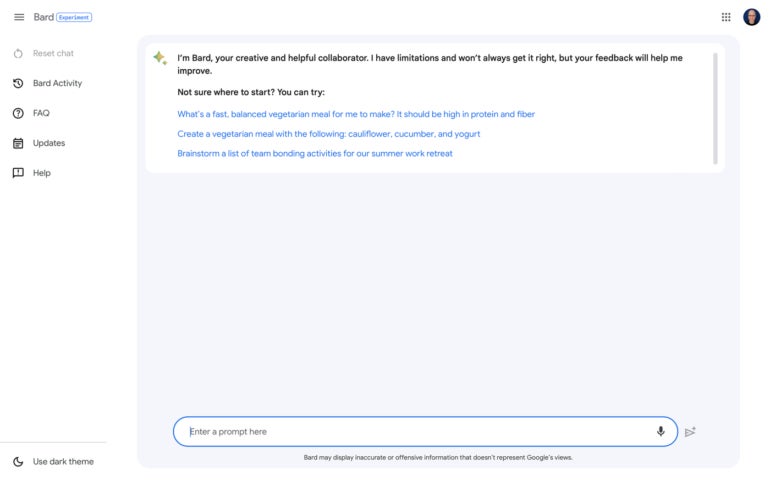
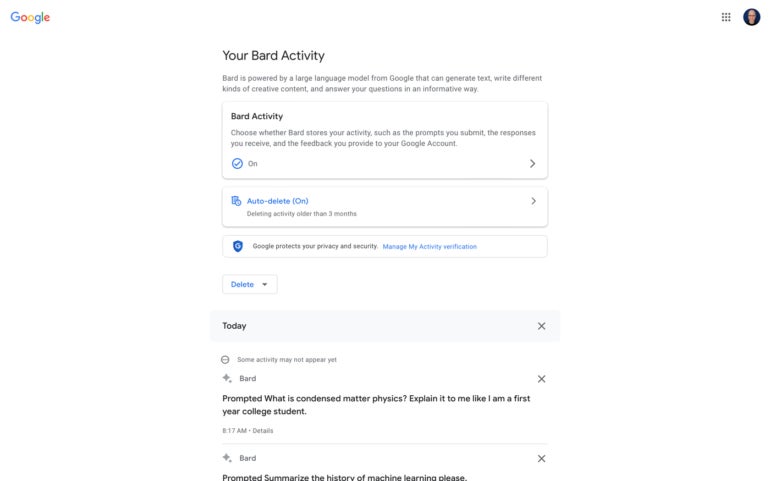




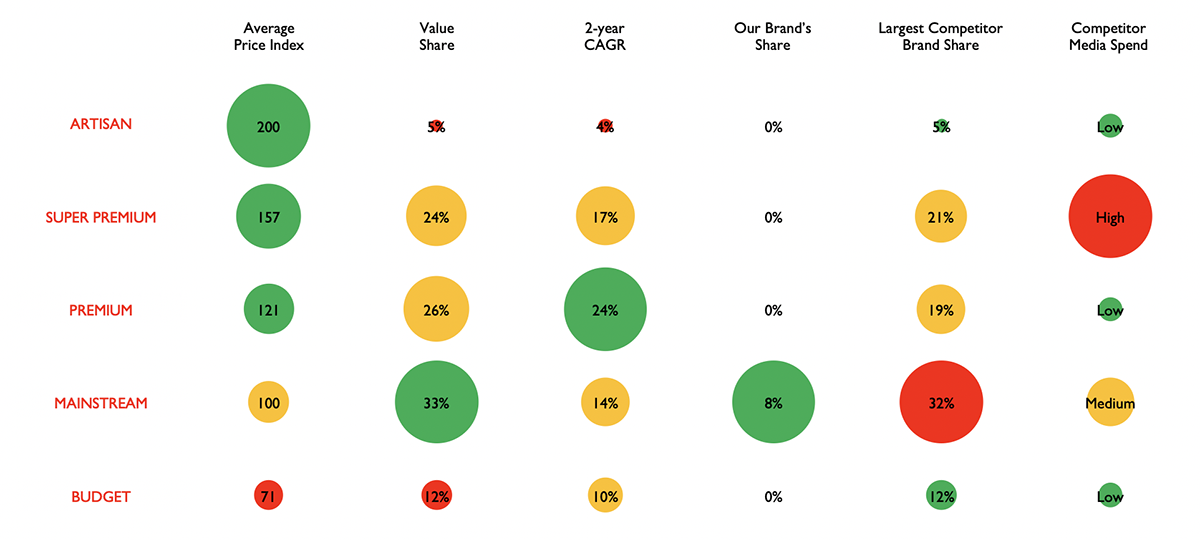
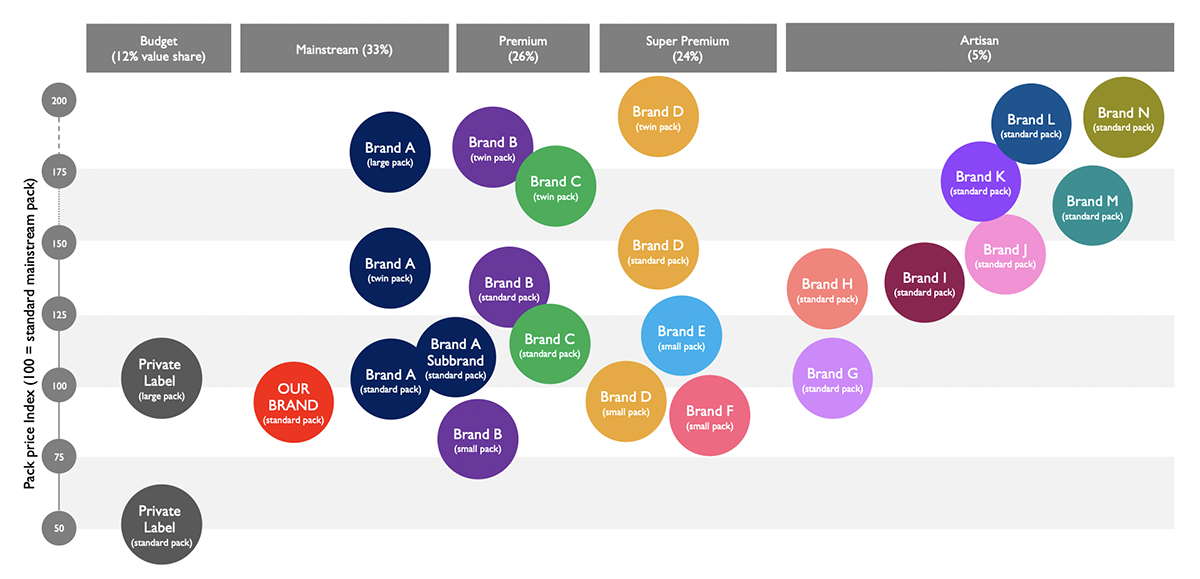 Our client’s brand (the red circle) competes in the mainstream segment with Brand A, which has a 33% share of the segment. It’s worth noting that the brand is priced to undercut Brand A’s standard pack: we’re the challenger brand in a segment dominated by a single large brand (which is available in a variety of pack sizes that stretch the brand across the price ladder). It’s also worth noting that while there’s space below us (only PL is cheaper in standard packs), there’s very little space above us: every rung on the price ladder contains at least one brand available in a standard pack. To extend our party analogy, these dancefloors are already busy and it’s difficult to see an obvious or large space we could fill.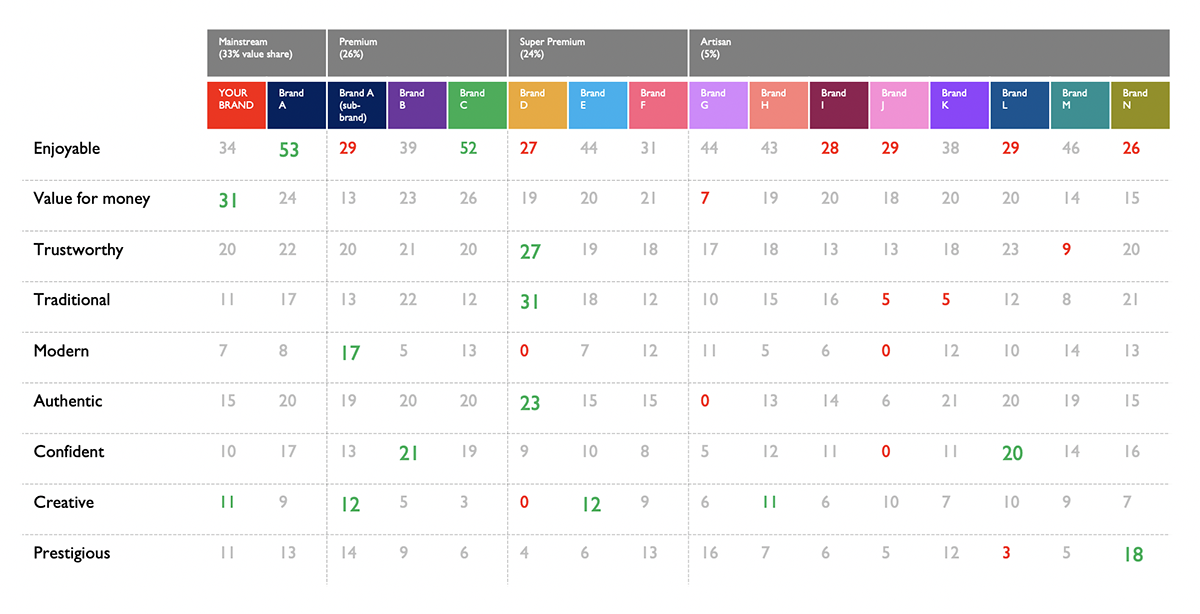
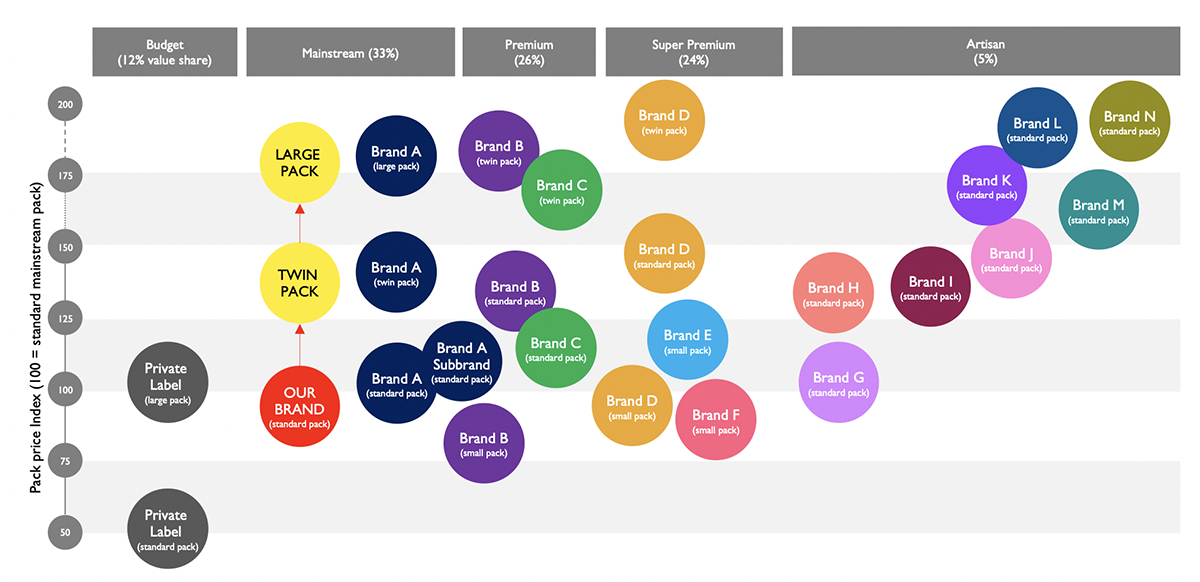
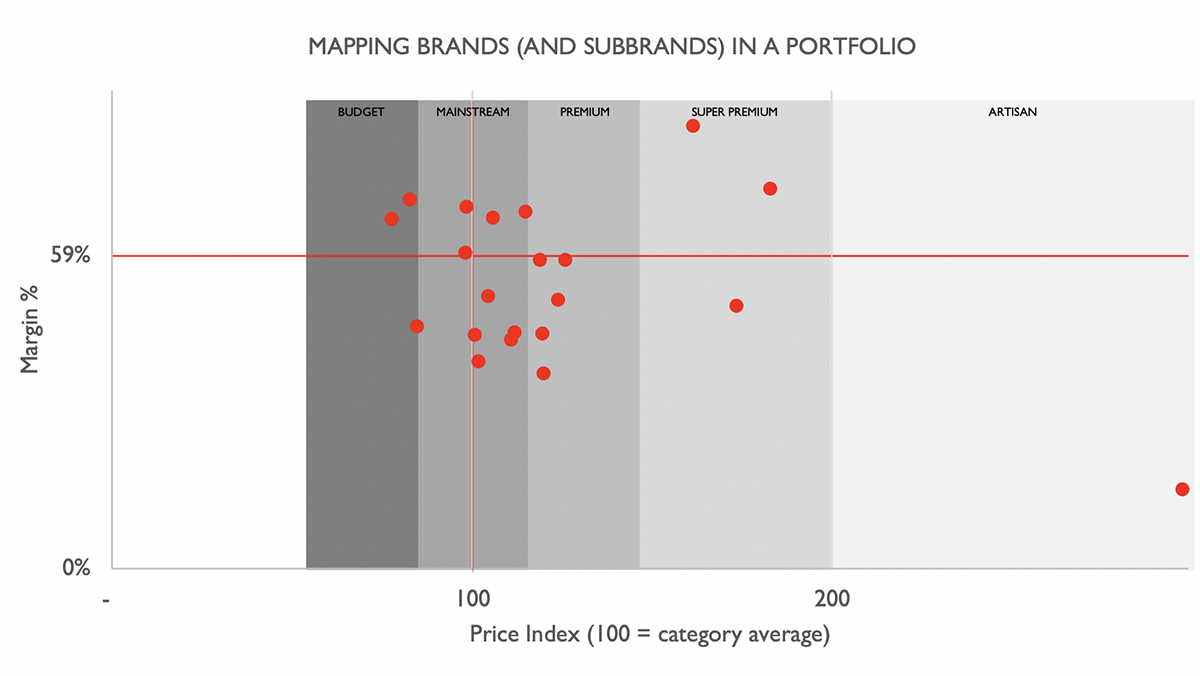 Each dot represents a distinct product line and the chart above maps their level of premiumness (measured based on a price index, where 100 is the category average) against their average margin, expressed as a percentage of net sales. The average margin across the portfolio is 59%: any ranges that deliver below the horizontal line are margin dilutive, while ranges above the line are margin accretive.