Author

editor

Browsing

By

For founders to most effectively bridge the valuation gap between themselves and investors, they must establish trust through the following four approaches.

With nearly 25 years on the ground both building sales organizations and generating business growth at scale, I understand the factors influencing a company’s valuation. Nine times out of ten, these metrics are driven by a genuine confidence in a product and its market potential. However, as a founder, it is crucial to fully comprehend and play into the current investor landscape to secure funding in this turbulent market successfully.

In Q3 of this year, VC investment in the U.S. dropped to $43 billion — the lowest since Q2 of 2020 due to high inflation, rising interest rates and fears of a potential recession. Now, the state of the market reveals two competing perspectives.

Amid market corrections, an overall IPO slowdown and pressure on returns, investors are more frugal than they were even a year ago and are adjusting their vision-based valuations accordingly.

At the same time, entrepreneurs are hesitant to accept funding at a level below what they’ve seen in the market over the past few years. Growing companies at all stages are posed with the challenge of raising funds at a time when it’s difficult to get their preferred valuations, and investors are extra conscious of the time it will take to see a return on their spending.

Valuation has always been a major stumbling block when negotiating with investors. Here’s what you should look out for:

Identify changing venture capital criteria

The funding environment is changing, and pretending it’s not won’t get founders anywhere. Rather than relying on old tactics, founders and CEOs can stand out to investors by realistically valuing their company and allocating resources appropriately. Looking back at past deals to vie for a higher valuation is an uphill battle that those seeking funding will not win in this market. By accepting the now and understanding the paradigm shift that is taking place in the investor/business relationship today, company leaders will have more success aligning with investors on their valuation.

Entrepreneurs will also need to lean into investors’ new criteria to prove their company’s value, whether in the early start-up stage or in the midst of seeking a later round of funding. To ensure investors are confident in their decision and will see a return, company leaders should go back to the basics — no matter the size of the business.

For example, startup founders must do their research to ensure they have a solid product that fills a real market need while remaining objective. They will need to answer hard-hitting questions from investors, such as:

  • Have you found a problem worth solving, and will your product do that seamlessly?
  • How is your product genuinely different from that of your competitors?
  • How will you prove this to your potential customers?
  • Have you interviewed potential customers and conducted experiments?
  • Have you fine-tuned your prices?

By the same token, more mature enterprises will need to remain nimble by leaning into what investors are looking for at later stages, asking themselves questions like:

  • Do I understand the investor’s portfolio?
  • Their investment strategy?
  • Have they successfully invested in a company within the same vertical?
  • Do I have hard success metrics I can point to?

It’s time for companies to drop the “I have a unicorn” mentality, which means actively challenging their own assumptions about a product’s market potential. Unicorns are rare, and it’s time to acknowledge that — overvaluing a company will deter investor trust.

In this market, investors have the power and may opt for referential treatment from businesses in exchange for investment. This can include liquidation preferences, preferred shares, allocation of board seats and more. In conjunction with approaching investors with realistic expectations, leaders should be prepared and open-minded to these negotiations, as it could help secure a higher valuation.

Leverage leadership

When trying to secure funding, team credibility is huge in gaining attention and trust from investors, especially in a turbulent market. Companies must build a team of reliable leaders with dedicated roles in their business — those with a proven track record of creating efficiencies and executing go-to-market (GTM) plans.

A company or product backed by leaders who have built successful businesses and understand how to fine-tune a GTM plan goes a long way toward rallying enthusiasm and interest. Successful executives know how to get an idea off the ground and have the network to help it reach fruition — and investors take note. In addition, having a well-connected team also helps to rally general interest from the entrepreneurial community and potential customers.

It is easy for founders and CEOs to narrow their focus on current funding efforts. However, it is also paramount to look ahead by nourishing existing connections. Leaders should surround themselves with hard-working visionaries with similar business interests and values to open the door for a later-stage partnership or collaboration in a future venture.

Approach with hard data

Under the current market conditions, attracting funding requires more than simply having an intriguing product and a big idea. Today, companies must be prepared to show hard data and how that will translate into their GTM strategy– saying no to theoretical numbers and showcasing proof of concept and scalability through data is critical.

With strong data to help support their vision, founders and all business leaders can easily field questions like: How is your company truly performing? How will you continue to drive revenue six months down the line?

Identifying the ROI a company can offer an investor will be vital in securing a preferred valuation and investment.

Adjust in real-time

A solid GTM plan is crucial in securing a desired valuation and maintaining investor interest. To do this, companies must establish a “single source of truth.” When metrics are pulled from multiple sources with different processes and standards, investors will see holes in the plan, which will show a lack of consistency and be deemed non-credible to investors – an observation that is very difficult to bounce back from.

Traditionally, GTM and operating plans are siloed based on misaligned priorities, insufficient data and subjective perspectives. Not only does this cost businesses time and energy, but misaligned business functions and unorganized budget allocation is bad news for investors. Companies that can present metrics from a single source will see greater operational transparency, a more unified planning experience, and more calculated growth. A consistent reporting format like this will allow teams and investors to know where they stand concerning sales goals and how to adjust strategies to optimize success.

To achieve a more unified planning process, business leaders can leverage data-informed AI platforms, which use ML insights to identify patterns and discrepancies that can maximize success. In this context, AI can provide insights that empower organizations of any size to look to the future to see which decisions will have the biggest impact on the bottom line, which mitigates risk. Additionally, these models enable companies to gather data and continuously re-evaluate the allocation of funds.

It all comes down to trust

Understanding what investors want to know and providing transparent access to those metrics in the current market will make or break these partnerships. Researching current investor criteria is crucial in being prepared for what investors are looking for in a funding pitch while leveraging leadership will increase confidence in their projections. Investors will need to trust where entrepreneurs are getting their data and their ability to adjust GTM plans in real-time to cater to ever-changing priorities.


By

Sourced from Entrepreneur

Sourced from Infinity Masculine

Launching a business can be an exhilarating prospect for many, yet the reality of becoming an entrepreneur is rarely a walk in the park. It’s essential to be aware of the harsh realities associated with owning and managing your own venture. This article will cover those difficult truths and provide advice on how to forge ahead toward success despite them.

Being a business owner can be arduous, intimidating, and demanding. It often involves taking huge risks and placing considerable amounts of energy and resources into something that may not yield the desired outcome. Additionally, it can be emotionally draining due to having to deal with public scrutiny, customer relationships, and financial instability. Moreover, you might find yourself wearing multiple hats at once as you oversee marketing campaigns, handle branding initiatives, create strategies for growth, and make essential decisions regarding operations.

On top of that, there are unexpected hardships that come with self-employment, such as having to wear many hats at once or dealing with unpredictable circumstances like changes in the industry or economic fluctuations. Finally, it’s important to remember that failure is always a possibility, no matter how hard you work or how well you plan; sometimes, it is impossible to defy unfavourable odds.

Although entrepreneurship contains its fair share of troubles and tribulations, it doesn’t mean potential business owners should shy away from pursuing their dreams. Those who are properly prepared for what lies ahead have a greater chance of prevailing in spite of these challenges. Here are some helpful tips on being ready: research your field extensively; identify your skillset; create a detailed strategy for success; develop sources for guidance; build supportive networks; ensure financial stability; maintain a proper work-life balance; remain open-minded throughout the journey; and don’t forget to embrace failure & learn from setbacks along the way.

If you want to take on the rewarding but complex role of the business owner, then do so armed with knowledge & an understanding that hard work pays off rather than running into it blind-sighted unprepared & over-ambitious. Take charge today by educating yourself on entrepreneurship & its delightful opportunities in addition to its daunting obstacles.

1. Financial Risk

Enterprising individuals who set out to start their own businesses must confront the spectre of financial risk. Nothing is certain when it comes to launching a business, and entrepreneurs have much to lose, including time, money, energy, and mental health. The potential for significant debt or even total loss cannot be ignored. Fortunately, there are ways to mitigate the financial hazards associated with ownership, such as prudent budgeting and seeking investors or venture capital funding. Nevertheless, despite taking precautions, the ambitious businessperson still faces an unavoidable danger that can never truly be eliminated.

2. Lack of Job Security

As an entrepreneur, there is an inherent lack of job security. Securing and retaining clients requires consistent work and effort, often even in times when demand for your services may be low. It’s up to you to ensure the survival of your company and drive the business forwards, which can take its toll both physically and mentally; it’s a seemingly never-ending cycle of searching for new opportunities, keeping customers satisfied, and addressing problems swiftly. This precarious lifestyle is taxing, unyielding, and unpredictable, making it difficult to plan ahead with any assurance.

3. Unpredictable Income

Being an entrepreneur entails a financially unsteady livelihood. At times, you might have lucrative months where you make a considerable amount of money, while other months may be quite challenging to make ends meet. Such a precarious situation can cause immense stress, and that’s why it is crucial to strategize your expenses and plan ahead so that any potential slow times won’t leave you in dire straits.

4. Isolation

Entrepreneurship can be lonely, leaving entrepreneurs feeling isolated and lacking meaningful connections with others. Working from home brings the risk of succumbing to days without interacting with people, and this can have a potentially damaging impact on mental health and motivation. This social detachment can significantly hamper an entrepreneur’s efforts leading to extreme exhaustion and tediousness.

Therefore, it is important for entrepreneurs to explore ways of creating meaningful networking opportunities and actively seek out dialogue with fellow business owners in order to realize their ambitions. Additionally, breaking away from the comfort zone of the home office is vital since loneliness restricts creativity and impairs productivity. Taking part in discussions with peers helps forge connections that are essential for a fruitful entrepreneurial journey.

By being proactive, nurturing relationships as well as utilizing digital communication networks such as LinkedIn, founders can remain engaged with their peers whilst avoiding the negative repercussions of isolation. Although becoming an entrepreneur may involve periods of solitude, by taking effective measures such as joining professional organizations or reaching out virtually to other professionals, one can remain connected to their industry in an invigorating, stimulating, and inspiring way.

5. Time Management

For entrepreneurs, time management can be a daunting undertaking. Responsible for all business aspects, they often have to juggle many tasks simultaneously and may end up working long hours and weekends. To survive this workload, it is vital to craft a schedule and adhere to it strictly. Following this plan will ensure that essential undertakings are completed quickly while also ensuring enough breaks to prevent burnout – a major problem in the entrepreneur landscape. Adequate time management can yield superior results and aid immensely in running the business efficiently and competently.

6. Lack of Guidance

Becoming an entrepreneur can be both a splendid chance and a pitfall. You have the autonomy to make decisions that are beneficial for your business, but it may also mean a lack of advice and direction. To succeed, finding mentors offering support and insights is imperative. Additionally, you must network with fellow entrepreneurs or attend courses to gain the necessary know-how. Thus, it is essential to locate reliable guides that can provide guidance and feedback in order to steer you in the proper direction. Moreover, meeting other entrepreneurs and taking classes is vital for attaining the required information needed for success in your venture. Therefore, don’t overlook the need to seek out wise counsellors who will offer judicious opinions and helpful suggestions.

7. Public Perception

As a business owner, the challenge of public perception looms large. After all, the successes and errors you make in your business are a direct reflection of you and how you work. It’s only natural to make mistakes from time to time, but it is vital that these mistakes be quickly acknowledged, accepted, and owned up to. Doing so demonstrates courage and integrity on your part, which can go far in restoring or even enhancing public opinion about your company. Building a positive reputation takes time and effort; one misstep can easily erase months or even years of progress. However, if handled properly by taking responsibility for a said mistake, it can often strengthen the bonds between you and your customers – allowing you to continue building a strong, reliable brand.‍

8. Time Investment

Taking the plunge into entrepreneurship can require a massive time commitment in order to reap the rewards. Business owners must be prepared to invest countless hours researching, networking, and strategizing for success. This may include overseeing not only their own activities but also managing any employees or contractors brought on board. As such, entrepreneurs may find themselves dealing with high levels of stress and extended working hours. Becoming an entrepreneur is no small feat: it takes dedication, resourcefulness, and fortitude to make it in the business world.

9. Legal Risk

When establishing a business, there is an array of legal issues that must be taken into account. This could involve selecting the proper corporate structure, abiding by tax regulations, procuring valid permits and licenses, and so forth. If any of these steps are found to have been completed incorrectly, companies may face serious financial penalties or even potential criminal proceedings. It is, therefore, essential for entrepreneurs to thoroughly review all legal documents and contact a lawyer if needed for further guidance.

To guarantee sufficient protection from legal risks, businesses must remain up-to-date on current legal regulations and actively work to avoid costly mistakes. Thoroughly studying paperwork, seeking knowledgeable advice from attorneys, and staying informed through reliable channels are all important proactive measures that can help reduce the probability of facing hefty fines or criminal liability.

10. Competition

Navigating the modern business world is often challenging and full of obstacles. It’s no secret that competition can be overwhelming, with established companies as well as startups vying for clients and investors alike. This means taking a proactive approach to staying ahead of the curve – monitoring current trends in pricing strategies and marketing techniques, understanding the risks that come with starting your own business and having the courage to succeed despite these hard truths being essential. Through careful planning and diligent effort, an intrepid entrepreneur can achieve great rewards.

The key takeaway here is that entrepreneurship requires dedication, perseverance and a comprehensive strategy if it’s to provide true success. From assessing potential difficulties to taking advantage of lucrative opportunities, it’s important to maintain a positive outlook while balancing realistic expectations. With enough diligence and ingenuity, it’s possible to establish a successful venture regardless of the fierce competition in today’s market – an endeavour accompanied by its own set of unique, exhilarating and fulfilling rewards.

11. Time Commitment

Being an entrepreneur is an endeavour that calls for massive amounts of time and effort. Long hours and late nights are the norms, making it essential to be committed if you want to succeed. What’s more, hard choices must be made in regard to how much time can be dedicated away from work in favour of other areas of life. Thus, substantial dedication and tedious organization are necessary for achieving a healthy balance between work and leisure. From preparatory research and planning through to the final stretches, it takes rigorous perseverance and mindful composure to conquer the arduous task of becoming a triumphant business owner.‍

12. Relationships

It is essential to be mindful of the relationships you have with your loved ones. Starting a business can be all-consuming, causing distance and disconnection if not managed carefully. This, in turn, may lead to feeling lonely, isolated, and even clinically depressed. It is crucial to keep in touch with important people in your life despite being busy. Being an entrepreneur has many positive aspects as well and should not dissuade anyone; with strong determination, proper planning, and the right mindset, success awaits.

13. Stress & Anxiety

Running a business can be an incredibly demanding endeavour, filled with stress and anxiety. It’s important for entrepreneurs to make sure they are taking care of their mental health by setting aside time for themselves, finding activities that reduce or help manage stress levels like yoga or meditation, and having support systems in place through family members or friends. Self-care is essential in order to ensure that the emerging pressures of being an entrepreneur don’t have a long-term detrimental effect on one’s emotional well-being. Adopting mindful, beneficial, restorative, constructive, preventative, all-encompassing, and purposeful approaches to self-care can all help entrepreneurs stay grounded and focused on their goals.

The Bottom Line

It takes a lot of grit and dedication to become an entrepreneur – mental and financial strength is essential. But when done correctly, the rewards can be abundant. You must be aware that there will always be highs and lows, yet success is possible through proper planning and hard work. With know-how and the right preparation in hand, embarking on the entrepreneurial path can prove to be an extraordinary, fruitful, successful, rewarding, ambitious, gratifying, and life-changing decision.

Feature Image Credit: Unsplash

Sourced from Infinity Masculine

By

Creating a landing page to attract investors as a VC can be a challenging task, especially in today’s market where safety of the investment is a top concern. With the number of scams and mistakes that have taken place in the industry, investors are looking for assurance that their money is in safe hands. In order to attract these investors, it’s important to understand what they are looking for and update your landing page consistently.

Here are some key factors to consider when creating a landing page that will attract investors:

  • Show the process and steps taken to protect investors: Investors want to know how their money is being safeguarded. This includes information on how due diligence is conducted and any data that supports the process. Be sure to present this information in a simple, step-by-step manner.
  • Include information about the people involved in the investment decision: Investors want to know who they are entrusting their money to. This includes information on the board of members, their qualifications, and how the investment decision is made.
  • Highlight past investment success with specific numbers: Including information on your portfolio and past investments can build trust. However, it’s important to also include specific numbers to show that these investments have paid off. This includes information on how the fund or portfolio companies performed across different market conditions.
  • Include feedback from other investors: Crypto space runs quite a lot anonymously, but when you can put faces out there and build trust that will come in very handy. Include feedback from other members who have been part of the investment for a longer period of time. This can be in the form of videos, audio, or text.
  • Include media publications and other places where you’ve been featured: Any publicity that can help build trust and interest in your fund should be included on the landing page. This includes media publications where you’ve been featured and events where you’ve spoken.
  • Have a structured, corporate-looking website: A well-organized website can attract traditional investors who value structure and trust. However, it’s important to consider the type of investor market you’re trying to attract.
  • Showcase the team’s backgrounds and expertise: Investors want to know that the team behind the fund has the technical ability to understand a project, the ability to foresee the marketing, financial, and compliance side, and diverse expertise in the team.
  • Do not appear desperate or needy: The landing page should clearly state that the kind of investors you’re looking for is not everyone but a very specific type. The more you qualify them, the more boundaries or barriers you set, the more interested the target group would be to be part of it.
  • Create a demand by requiring mandatory training or testing: Funds can require that investors pass a mandatory test or training course before they can invest. This creates a sense of exclusivity and demand that can attract more investors.

Ultimately, every investor segment is different, and it’s important to market effectively and build trust and interest in your fund. By understanding what investors are looking for, creating a structured and organized landing page, and showcasing the team’s expertise, you can attract the right investors for your fund.

Disclaimer. The information provided is not trading advice. Cryptopolitan.com holds no liability for any investments made based on the information provided on this page. We strongly recommend independent research and/or consultation with a qualified professional before making any investment decisions.

By

A prolific writer, KEY brings an insider perspective to blockchain ventures and crypto startups. He shares cutting edge content marketing strategies from his 11 years of management experience. Perfectly balanced in mind and body, he runs marathons, target-shoots, engages in extreme sports and takes a vacation break in 5+ countries annually.

Sourced from Cryptopolitan

Sourced from Forbes

In business, dire situations can sometimes arise that cause panic across company leadership. During those trying times, it can be difficult to remain calm. However, it’s important for leaders to keep their cool, especially since these circumstances may have a long-term impact on business.

As experienced business leaders, the members of Forbes Business Council understand that keeping one’s cool is the key to mitigating the impact of challenging situations. Below, 15 of them share tips for entrepreneurs to help them remain calm during a dire situation.

1. Look At A Situation With Empathy

Stephen Covey answered this one perfectly, “Seek first to understand, then to be understood.” Entrepreneurs are constantly working to maintain control of their businesses, and challenges to that control can feel like a personal attack. Often, working to understand the situation empathically gives entrepreneurs a different path to a solution—one that feels like a choice instead of a forced capitulation. – Bryan Howard, Mercury Performance Group, LLC

2. Remind Yourself That Hardships Will Pass

Take a pause and recall some disastrous situations from your past—the ones where you thought “Okay, now it’s all over, I’m screwed.” Then remember that after all, you got out of it. Remind yourself that everything is water under the bridge, and even the worst situations pass and you go on. Now, once you’ve got your nerve back, pull yourself together and get back to solving it. – Alexander Shevchenko, Guavus

3. Write Down Your Problems And Solutions

The best way to deal with a tense business situation without losing your cool is to take a step back and assess the situation objectively. Take a few deep breaths and count to 10, if necessary. Ask yourself what’s the worst that can happen. Write down a list of the possible outcomes and the steps you can take to mitigate them. A clearer sense of the situation will help make an informed decision. – Ritesh Dalal, Intellective

4. Be Open About Your Challenges

Being transparent and open about challenging issues can help you solve them. I have always found that talking about challenges makes their power over your mental preparation to deal with them immediately shrink. And if you share with the right people, you may get ideas to remedy the situation that you wouldn’t have thought of on your own. Teamwork makes the dream work! – Jennifer Coy, Beauty Care Choices

5. Maintain Your Composure For Your Team

You must have an outlet outside of the company, and you cannot show fear, stress or uncertainty to your team at any time. As leaders, we have to maintain composure so our team can have confidence in our abilities and in the health of the organization. I’ve always liked the notion of acting like a duck—calm above the water but kicking like crazy beneath. – Laura Silver, Blue Door Communications

6. Find The Positives In Every Situation

Keep a positive mindset and never allow your emotions to get to you. If you draw positive thoughts in every difficult situation, you’ll eventually find the beauty of hardships as you learn ways to overcome them. – Pavel Stepanov, Virtudesk

7. Know That It’s Okay To Fail

Understand that it can not be “your time” every time. A positive and learning approach never fails. It is okay to not have the best output as per what you predicted, but learning from it and coming back with double the experience is amazing. – Neha Madaan, Vanator

8. Take A Pause

It’s important to let the immediate reaction settle so action steps can be made with a clear mind. It also allows for the whole picture to be seen, including what is not going wrong, instead of the narrow scope of the situation. This will help develop a strategic, solution-oriented mindset without being driven by an emotional response. – Melanie Ammerman, VaVa Virtual Assistants

9. Move On To A Different Subject, Then Come Back Later

Think through your decisions and don’t decide anything as quickly as you lose your cool. Everything in business changes and you have to be able to realize that in certain situations. Oscillate to a different subject and then come back to the difficult situation later with a clear head. – Kirt Linington, Linear Roofing & General Contractors, LLC

10. Take The Emotion Out Of The Conversation

Take a few minutes or time to temporarily compartmentalize or sleep on it. Then, when you’re ready, begin the conversation. Get the facts, process the information and once you have all the information, voice your thoughts and potential solutions. Removing emotion forces you to be objective and focus on the solution rather than acting rashly. – Deyman Doolittle, ShipSigma

11. Let Your Emotions Settle

The best way to keep your cool is to remember to not act a fool. The life we live is one of human emotion. Knowing this allows you to control this ball of tense energy waiting to explode at any minute. Walk away and schedule a follow-up conversation to healthily communicate that is when you’re less emotionally charged. – Joshua Steinberger, NextGen Restoration

12. Acknowledge The Other’s Perspective

Taking deep breaths, counting to ten and repeating positive affirmations can all help reduce stress and give you time to assess the situation more objectively. Remember, exchanging civilities with your colleagues shows that you are open to working together in a constructive manner which will inevitably lead to a better resolution. – Michael Shribman, APS Global Partners Inc.

13. Remember What Your End Goal Is

Successful entrepreneurs learn early on to deal with respect, due diligence and patience when it comes to people’s issues or operations’ challenges. Before reacting or losing your temper, you must remind yourself what the end goal is. Demonstrating your leadership skills by clearly understanding and focusing on the result helps diffuse the tension and create a positive environment. – Francisco Ramirez, The ACE Group (TAG)

14. Understand The Pressure That Comes With The Entrepreneurial Journey

Accept the difficult truth that this is part of the journey of entrepreneurship. Involuntary and voluntary friction are guardrails towards success. The mind has the ability to calm the heart. Science is proving the wisdom of the heart when the mind drives thoughts that allow elevation of it. View the pressure as necessary, similar to how the eagle rises above the storm for a smoother flight. – Paul L. Gunn, KUOG Corporation

15. Assume Positive Intent

Assume positive intent. Remember that working with people is the most difficult, yet most rewarding aspect of business. Believe that everything happens for a reason, and remember that it’s not personal. – Martina Seferovic, OIP Inc

Sourced from Forbes

By Deanna Ritchie

For writers and artists of all kinds, making a living isn’t always straightforward. Regardless of the medium or genre, competition abounds, and even with some online success, it can be challenging to break through to a broader market.

The internet has made it both easier and more challenging to get your work out there. On the one hand, social media platforms allow writers and artists to connect with their audience, but this also means more people are trying to do the same thing as you.

As you look for ways to use new avenues of technology, finding ways to let technology and the internet help you as an artist or writer is essential.

How Tech-Fueled Self-Publishing Can Help Varying Artists

One area that many creators are utilizing is self-publishing. In the music industry, this usually means creating a SoundCloud or posting your new songs on TikTok. For visual artists, this can include creating dedicated social media profiles for their art. But for writers, things can be more complex. Those who wish to publish their own books might be unsure of how to utilize technology or the internet to get to that point, but the truth is that self-publishing is a sensible route for many aspiring authors. Self-publishing is similar in many ways to start a business.

With more and more channels available for writers across all genres and topics, many people are pursuing self-publishing instead of going with publishing companies. There are pros and cons to both routes, but self-publishing allows anyone with a dream to make their book vision come true.

You may wonder about the steps you need to take to self-publish. Here’s an essential guide to getting started.

Why Self-Publishing is a Good Idea For Some Authors, Especially New Ones

The traditional publishing industry has the resources and reputation that many writers look for when trying to publish their books. If you can get a publishing house to accept your book, you’ll get paid and get the resources to market and sell your book.

However, it’s rarely that straightforward. Even a well-written book that’s original and creative might not be what traditional publishers look for in their acquisitions. Larger publishing houses may have preconceived notions of what will and won’t sell, and they also receive countless submissions. In some cases, an indie publisher might be a good alternative, but these also have downsides.

So, for new writers, self-publishing is a way to get your name out there and build an audience. The truth is that pitching your book to an agent is time-consuming. You may end up querying dozens upon dozens of literary agents with hardly a word back. This is especially true if you still need to build a reputation for yourself as an author. Instead, self-publishing allows you to harness any online traction you already have and then further your audience base. Once you publish something, you can point interested people to where your book is sold, which is an excellent way to build up social media buzz and spread the word.

Six Essential Steps For Self-Publishing Your Book (Regardless of Genre)

Self-publishing isn’t for everyone, but it is a viable option for many. Depending on your situation, self-publishing may be the only realistic route to getting a book in physical copy. But if you want to pursue self-publishing, you’ll likely have many questions about the process. Whether you want to publish a poetry book, sci-fi novel, or short story anthology, the approach to self-publish is much the same. Of course, as with most aspects of writing, the steps are often more complicated than can be put on paper.

To get you started, here are some steps to take when self-publishing:

Step 1: Ensure Your Book Has a Market

While you can self-publish nearly anything you want to write, you do have to look at the cost of production versus how much you’re likely to make. Of course, if you have the money to self-publish and aren’t worried about profit, you should go for it. However, for most writers, profit is at least a factor. To ensure you can make a profit now, or later as you build an audience, research the market for your genre. You can confirm you have a unique idea or at least a premise that is appealing to your potential readers.

Step 2: Focus Heavily On Editing

One potential downside to self-publishing is you won’t have access to qualified, professional editors. However, editing is still vital. If you want to succeed as an author, you need to publish a book that is free from grammar and spelling errors, and it’s also wise to do broader edits to things like plot and continuity. You’ll need to find editors to help you. If you’re lucky, you’ll already know someone in your network who can assist you. But keep in mind you will need to pay editors for their time and expertise.

Step 3: Figure Out the Cover

The design of your book cover also matters. The cover is the first thing readers see, and it’s a significant part of drawing an audience. Many people specialize in designing book covers, and this is a part of self-publishing where you’ll want to devote some extra time and money. If you need help with graphic design services, you can reach out to freelancers for help.

Step 4: Consider Where and How You Want to Sell the Book

Overall, it’s much easier to self-publish today because there are more platforms. Amazon has a program for self-published authors. With them, you can have your book be printed-on-demand, which means books are only created once they are ordered. But, if you self-publish through Amazon, you won’t be able to sell your book in other places. As an alternative, you could also choose to publish on your own website. But, in this case, you’ll need to find a printing company to create the book for you.

Step 5: Consider Your Budget

Self-publishing saves a lot of time and stress, but it isn’t free. The cost of hiring editors, graphic designers, and more adds up. And, if you’re choosing to pay to have the books printed yourself, the budget can get out of hand. So, before you get too far into the process, be sure you’ve planned your budget. You only want to spend what you have.

And, as you do all the hard work to write and then bring your book to the world, remember to take time to unwind and relax. Here are some tips on how to unplug.

Step 6: Launch Your Book Like You Would Any Business Product

After you have your book formatted and ready, you need to work on the marketing. This step is vital to your success as a self-published author. While there’s no one right way to market, you’re likely to succeed more if you consider your book launch as a professional would. Figure out how much money you have in your budget to do things like making social media ads. It’s also helpful to use analytics tools.

Also, be sure you have your social media pages all setup. You’ll want to post on them regularly and engage with your audience.

Final Notes on Self-Publishing

As you start this process, look online for communities of writers in the same situation. This is a great way to learn tips and tricks for people who have self-published already. Remember that self-publishing isn’t a one-size-fits-all model.

If you don’t sell as many books as you’d hoped, don’t give up. Many authors don’t see success until they’ve published more than one book, and this is true regardless of how their book got published.

Featured Image Credit: Suzy Hazelwood; Pexels.com

By Deanna Ritchie

Managing Editor at ReadWrite

Deanna is the Managing Editor at ReadWrite. Previously she worked as the Editor in Chief for Startup Grind and has over 20+ years of experience in content management and content development.

Sourced from readwrite

By Jennifer Ortakales Dawkins

Everyone’s asking ChatGPT to do something for them — which is no surprise, since artificial intelligence is expected to be a game changer for business in 2023.

If you’re unfamiliar with the tool, imagine typing a question into Google’s search bar, but rather than sending you to a highlighted answer followed by pages of search results, it talks back in a private chat window. It uses stored information from books, articles, and websites to give you an answer, in complete sentences and paragraphs.

ChatGPT, which is free to use, launched in November as a research prototype. Professionals have used it to write cover letters, and students have used it to write their papers — then New York City banned the app from public-school devices and networks.

ChatGPT may be able to write an English essay, but there are some things it can’t do, like help you start a business.

While it’s very smart, ChatGPT is only a chatbot; I knew it couldn’t physically start a business for me. But I wondered if it would at least walk me through the initial steps.

So I asked this AI program a series of questions about starting a business.

Here’s how it went.

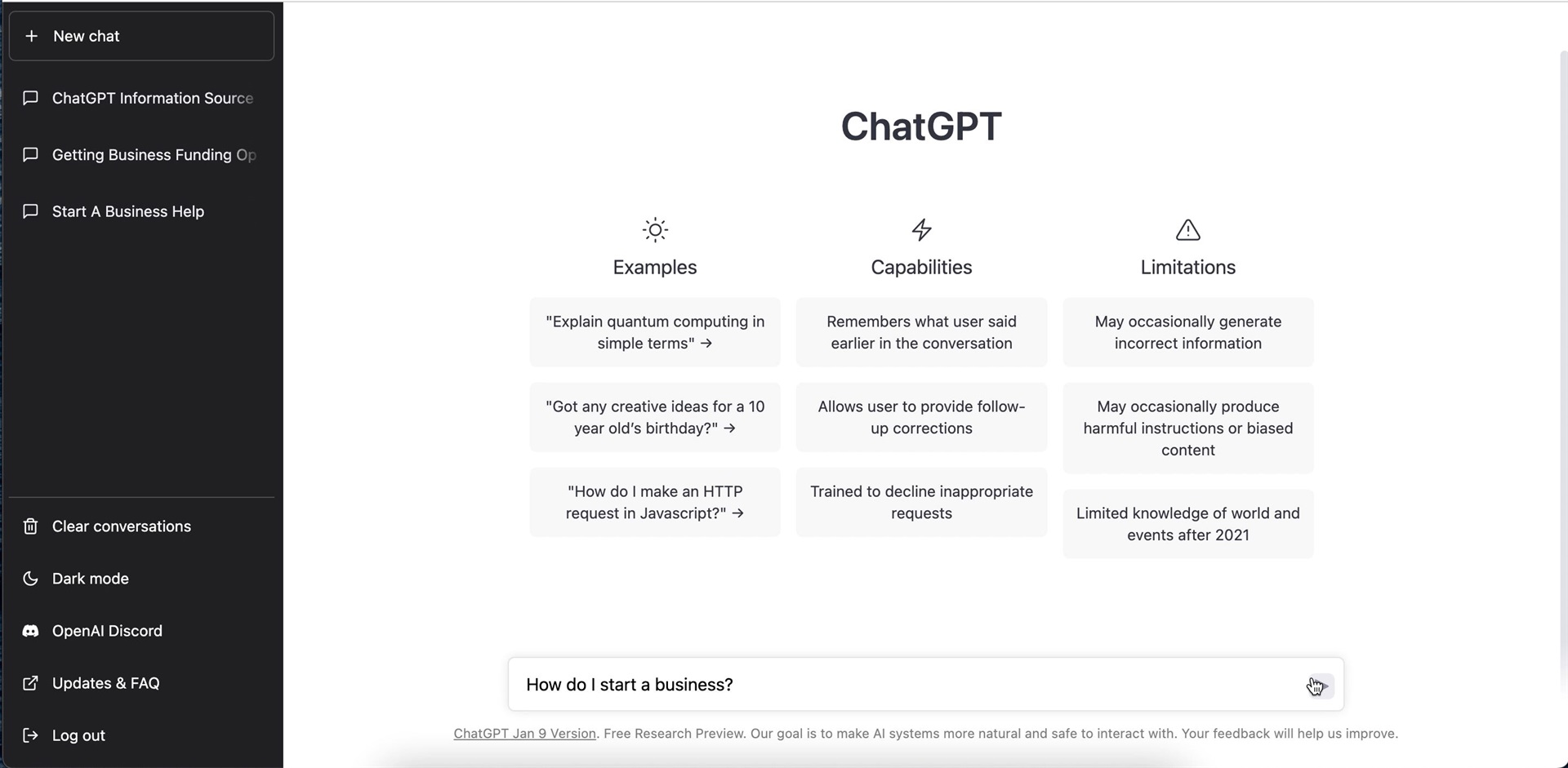
8 generic steps for starting a business

The main page where you can ask ChatGPT for information.

ChatGPT


When I initially visited the site, ChatGPT served me a 404 page — regular outages are a side effect of its sudden popularity. I refreshed the page a few hours later and was finally able to log on.

ChatGPT doesn’t do much heavy lifting. Its responses tend to be formulaic and broad, lack inspiration, and leave out a lot of useful information.

When I asked ChatGPT how to start a business, it gave me the following eight generic steps:

Starting a business can be a challenging but rewarding process. Here are some steps to help you get started:

  1. Develop a business idea: Identify a problem or need in the market that your business can solve. Conduct market research to validate the demand for your product or service.
  2. Create a business plan: Develop a detailed business plan that includes financial projections, marketing strategy, and a plan for setting up your business.
  3. Raise capital: Determine how much capital you will need to start your business and secure funding through investors, loans, or personal savings.
  4. Register your business: Register your business with the appropriate government agencies and obtain any necessary licenses and permits.
  5. Build a team: Hire employees or contractors to help you run your business, if necessary.
  6. Set up your business operations: Establish your business’s legal structure, obtain any necessary business insurance, and set up your accounting and financial systems.
  7. Develop a marketing plan: Develop a marketing plan that outlines how you will reach your target market and promote your business.
  8. Launch your business: Launch your business, and be prepared to adapt your business plan as you learn more about the market and your customers.

Starting a business requires hard work, dedication, and the ability to adapt to change. It also requires a good understanding of the market, the competition, and the legal requirements. It’s important to have a solid plan, a clear vision, and the right team in place to increase your chances of success.

ChatGPT can cater its answers to the type of business

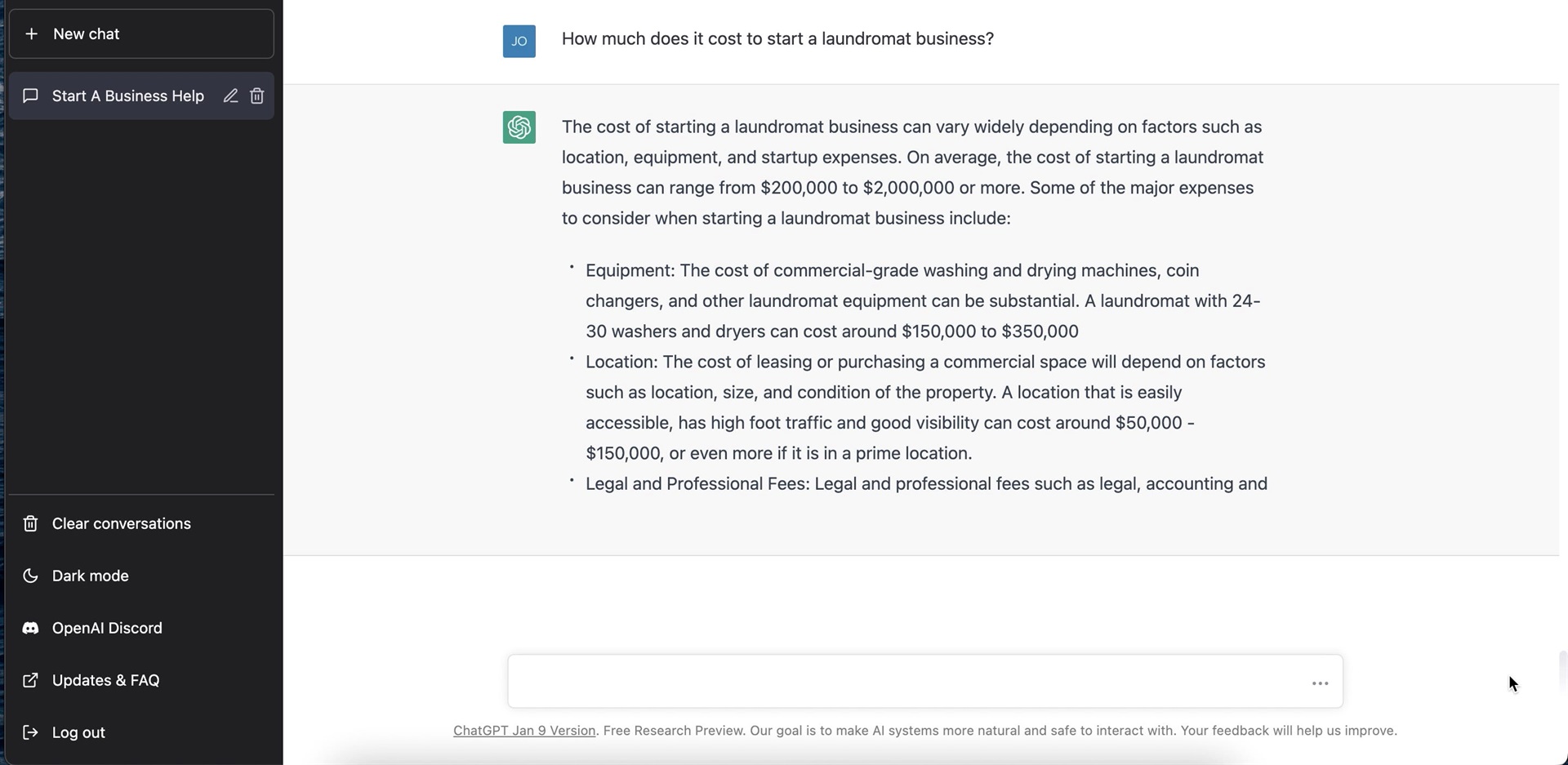
ChatGPT answering how much it costs to start a laundromat business.

ChatGPT


After asking the chatbot how to start a business, I tried more specific questions, like “How do I start a vending-machine business?” and “How do I start a laundromat business?”

These prompts led to slightly more detailed answers catered to the type of business, though they still fit within the same eight-step format. It suggested identifying potential locations for the vending machines and hiring staff for the laundromat.

Finally, I tested ChatGPT’s knowledge of startup costs. It outlined six overhead costs such as equipment, legal fees, and renovation.

In conclusion, ChatGPT is not a great source for answers to your deepest business questions, but it could be a helpful starting point to gather ideas, get cost estimates, and outline your business plan.

Feature Image Credit: Getty

By Jennifer Ortakales Dawkins

Sourced from Business Insider South Africa

By Jack Smith

“Sustained business success” refers to an organization’s ability to meet the demands and expectations of its customers, as well as stakeholders, over time. To achieve this, I believe aspiring business owners must commit to the following non-negotiables.

Starting a business is easy and every year, millions of new businesses are launched. However, to be a successful entrepreneur, you must take more steps than simply registering an LLC. Unfortunately, most people only succeed in launching new businesses. Reality eventually settles in, and difficulties arise.

It is tough to build a business that is sustainable, and it is challenging for entrepreneurs to attain long-term continued growth. Competent entrepreneurs understand that nothing is as good or as bad as it seems, and following a methodical approach in pursuit of their vision will allow them to maintain the growth that will enable them to do more.

In general, “sustained business success” refers to an organization’s ability to meet the demands and expectations of its customers, as well as stakeholders, over time. To achieve this, I believe aspiring business owners must commit to the following non-negotiables.

AIM FOR IT: HAVE A BOLD VISION

There is no amount of money that can achieve business success without a bold vision. Entrepreneurs must be prepared to take a full, perhaps painful, look at where they are today, and have the guts to draw out a bold vision for the future. A clear, compelling vision sustains the path when the going gets tough—when an organization experiences the growing pains of meaningful change.

Having a bold vision inspires an organization and draws together a team that can act. To effect change, your vision must be bold enough to be the change people want to see in the world. Be bold. Be daring. If your dream and vision isn’t bold enough to inspire action, it’s not big enough.

CARE FOR IT: KNOW YOUR WHY

Having a bold vision goes along with knowing your why. Everything you do should be motivated by purpose. Businesses with a clear sense of purpose increase consumer engagement, strengthen relationships with employees, and boost financial performance. Being able to define how your business or service impacts the community and adds value to people’s lives is crucial to becoming a successful entrepreneur.

Knowing the “why” of your business gives your team and your customers a way to connect with you on a personal level and view your business as a dynamic entity.

ACT ON IT: TEST YOUR BUSINESS IDEA

Successful entrepreneurs are aware that the first step in anyone’s entrepreneurial journey is a great business idea. But how do you know when you have a winner? Even though you believe your idea is great, it’s best to test it before you invest time and resources in a business or product for which there is no market. Testing is key to see if you have a viable business model.

Business is a trial-and-error process and being willing to act mindfully is critical to success.

LEARN FROM IT: UNDERSTAND YOUR CUSTOMERS

Testing a business involves both failure and learning; how entrepreneurs deal with failure determines whether it ultimately leads to success. Starting a business also requires you to be open to learning from potential customers. Successful entrepreneurs know how to become partners with their customers, understanding what they want and thereby creating the opportunity to be the solution their customers need when they need it. Without this knowledge, marketing efforts may be ineffective and no matter how brilliant a business idea may be, it may fail to take off.

Understanding, learning from and building on your customer knowledge and relationships will put you ahead of the game.

WORK FOR IT: ACCOMPLISH YOUR TASKS

A successful business is not magic: It meets its customers’ expectations while taking care of its employees. Instead of waiting for opportunities to present themselves, successful entrepreneurs create them. While the real entrepreneur closes deals, a “wantrepreneur” outsources development.

If thriving is your aim, you must stop procrastinating, stop writing that 100-page business plan, and start executing the tasks at hand. Turn your blueprint into a battle plan focused on outcomes. It’s simple: if you want it to happen, make it happen. Just keep moving.

FINAL THOUGHTS

Entrepreneurial non-negotiables are based on sound principles, and once you are clear on these, they will serve as your compass as you navigate toward sustained business success and overcome the challenges along the way. You must be tenacious and fully committed to the necessary effort and work. You must believe that achieving business success is not only possible, but also necessary.

Feature Image Credit: bnenin/Adobe Stock

By Jack Smith

Jack Smith is the Chief Executive Officer of Fortuna Business Management Consulting, a California-based, veteran-owned IT consulting firm.

Sourced from FASTCOMPANY

By Constantine Andriopoulos

Constantine Andriopoulos is a Professor of Innovation and Entrepreneurship at Bayes Business School, in City, University of London, and the Director of Avyssos Advisors, an innovation management consultancy.

Below, Constantine shares 5 key insights from his new book, Purposeful Curiosity: The Power of Asking the Right Questions at the Right Time. Listen to the audio version—read by Constantine himself—in the Next Big Idea App.

1. Uncover your itch and turn it into a project.

On November 20, 2020, Rocket Lab, a leading California-based aerospace manufacturer, launched its Electron rocket, a small reusable rocket. The launch was the brainchild of Peter Beck, an engineer from New Zealand and the founder and CEO of Rocket Lab. Beck’s itch was to figure out a cheaper way to get things into orbit. To do so, he had to figure out ways to bring down the cost of his rockets. While NASA’s rockets can cost up to $1.6 billion to launch, each Rocket Lab small-satellite low-orbit launch, costs about $5 million.

Beck’s fascination with rockets started at a young age. As a teenager, he became curious as to whether he could build one. He started by reading as much as he could about the subject and then began to experiment with different designs in his garden shed. At the age of 18, he strapped a rocket engine to the back of a custom-made bicycle and managed to ride at about a hundred miles an hour. Instead of attending university, he accepted a toolmaking apprenticeship, while at night, he continued to develop his rocket engines. In 2006, he founded Rocket Lab. Like Beck, we should start by focusing on a purpose that gets us up in the morning, and with a conviction that everything is understandable. So how can you ignite that spark?

First, you need to get yourself into the right mindset. You must activate a sense of wonder. Then you need to look for inspiration. Inspiration may come from everywhere. Try asking questions like; What if? Am I sure? What’s next? Have I looked closely enough? Have I looked everywhere?

Then select a topic that interests you enough and that you can pursue deeply for a long time. How do you choose which curiosity journey to follow? Three things make an itch worth focusing on: boundaries, purpose, and belief.

Pushing boundaries is about addressing hard problems, seizing exciting opportunities, or going where no one has gone before. This way, your curiosity journeys will be fuelled by lots and lots of smaller puzzles or mysteries. The purpose must be personal. Be emotionally connected to a worthwhile cause and immerse yourself in it. The belief must be concrete. As a point of departure, believe that everything is understandable or will eventually become understandable, with the help of others.

Then, grant yourself permission to explore. You have fallen in love with your puzzle but wonder if you can pull it off. It is all too easy to think of all the issues that stop us from embarking on a journey. You may have caught yourself thinking about starting projects, and then jumping from idea to idea without getting started. None of us is immune to this approach, but it is impossible to start a curiosity project if we explore haphazardly and butterfly-like. You must take control.

“Don’t wait for others to tell you what to do or confirm that it is OK to start.”

Take ownership of your curiosity project. Don’t wait for others to tell you what to do or confirm that it is OK to start. Grant yourself permission! When you find something that you are passionately curious about, rather than initiating your exploration in private, go public. Declare it to the whole world! Start investing time, energy, and resources. Hand yourself over to your curiosity either gradually, or by going all in.

2. Become an expert fast.

When Marshall Culpepper, the American serial software entrepreneur, founded KubOS with an aim to develop a secure, open-source platform for space-flight software, he had to become an expert quickly. He faced a significant challenge though: he had neither the formal qualifications nor any relevant experience in astronomy. Undeterred by his own naivety and seduced by the business opportunity, Culpepper immersed himself in the science of astronomy. Searching online for insights proved very useful, but what he found particularly beneficial was Coursera’s online course on astronomy and aerospace engineering. Like Culpepper, many people who work nine to five jobs decide to teach themselves new skills, launch a business, or explore a new area of interest. They shouldn’t let their lack of relevant formal qualifications or experience deter them from pursuing their curiosity journeys.

When you are passionate to learn as much as you can about the subject that stirs your curiosity, you can create your own learning environment, set your own learning goals, and plan your own lessons. How do you go about this?

First, establish your framework. Be specific about your learning goals. What do you want to know? Develop a timetable for the subjects that you want to study. Create your schedule and stick to it!

Now create your own curriculum. You have set aside the time you need to study, and you have claimed a distraction-free place for your work. Now comes the hard part, but it is also the fun part: Gather the resources you require to fulfil your curiosity. The internet has excellent resources, but be disciplined. Before you run every conceivable search you can think of, set some time constraints and focus your search. Start by gaining a broader understanding of your new area by reviewing other people’s work online. Knowledge that has already been collected and disseminated by others has two key benefits.

First, you understand the state of the field by looking at what others are doing, and you can build on that to make further improvements. During your research, ask two questions: What is really new? What is really interesting? Soak up expertise from a wide range of internet sources: articles, academic studies, reports, blog posts, online tutorials, and courses which are easily accessible. Select what is important by filtering the noise and questioning everything you read. Search online, immerse yourself in your new domain, and practice disciplined serendipity.

At the same time, build your own community. Reach out to experts, find fellow curious seekers, and crowdsource wisdom by developing an outreach program. Don’t be afraid to ask questions. Always dig deeper. Curious people do not rely exclusively on digitized resources. They balance screen time with field trips. They search through archives, learn from specialists, and ask experts for recommendations. Piece together the puzzle by actively reading, looking for interesting insights, and spotting what others have missed.

3. Ask: Who is with me?

Click HERE to read the remainder of the article.

By Constantine Andriopoulos

Sourced from Next Big Idea Club

By Bill Murphy Jr.

Believe me, some of us need all the help we can get.

Feature Image Credit: Getty Images

By Bill Murphy Jr.

www.billmurphyjr.com@BillMurphyJr

Sourced from Inc.


By Kyle Krahl

As a startup, finding and procuring funding for your business is a vital step to enable growth. Impressing potential investors is only the first step in securing funding. Passing the due diligence process is just as important as putting together a stunning pitch deck. To ensure this all-important discovery phase goes well, avoid the red flags that may cause venture capital and angel investors to back out of a potential partnership.

Eventually, startups will require more funding than friends and family can provide, funding that angel investors or venture capital firms can supply. The first step to a partnership with one of these investors is the pitch meeting to interest them in your startup. If the meeting goes well and a partnership is agreed to, the startup must still go through the due diligence process.

Unorganized or nonexistent data room

To properly prepare for the due diligence process, a good first step would be to create a data room for your startup and grant investors access. A data room is typically a virtual file room where important documents and data, such as financial documents or customer contracts, can be securely stored.

The data room can be preloaded with standard due diligence requests but can also be added to as additional requests are made. Having a preexisting data room available can speed up the due diligence process and convey a sense of organization and professionalism.

Lack of founder integrity

Trust is irreplaceable for any partnership to work, including a financial one. As such, breaking that trust between the potential investor and the founder, even in a minor way, will eliminate the possibility of an investment. Behaviors to avoid include:

  • Overstating historical results.
  • Misrepresenting the use of investor funds.
  • Misrepresenting the development progress of a product.

An investment in a startup is the start of a long-term relationship between the investor and the founder. That relationship needs to be based on trust and any display of a lack of integrity will rightly cause the investor to walk away.

A weak or misunderstood customer base

As part of their investigation, investors may also review your current client or customer base. After speaking to customers, if investors discover that customers aren’t as enthralled with the product or service as had been represented, this can suggest a lack of customer outreach or a fundamental misunderstanding of customer wants.

Similarly, a small customer base can also be a red flag for investors, particularly in cases where a single customer accounts for the majority of revenue. In both cases, this may indicate that the potential growth of the startup may be limited unless it is better able to accommodate its clients.

Issues or incompetence within the founding team

One question investors consistently ask themselves during the due diligence process: Are they coachable? Refusing to accept advice or listen to an opinion doesn’t bode well for a potential partnership. Investors often have experience some startup founders may lack and, after investing so much capital behind your business and your idea, they’d like you to succeed. Guidance, mentorship and general advice are part and parcel of a relationship with a VC or angel investor and are one of the benefits of such a relationship.

In addition to coachability, investors will assess whether the founding team is competent. There will typically be three to four areas that need to be covered: operational, technical, financial and marketing. These areas do not need to be covered by separate individuals. Often, a founder can cover two or three and the others can be covered by other founders, employees, previous investors or maybe even a mentor. Investors will often probe for competence with some standard questions, based on company type.

If the company is:

  • A manufacturer, what is the contribution margin?
  • A software company, who does the coding?
  • A subscription company, what is the monthly recurring revenue?
  • A consumer products company, what demographics are you targeting?

Failure to answer any of these questions, correctly or at all, reveals a gap in the founding team that may increase the risk of investment beyond what the investor will accept.

Other considerations

Startups raise multiple rounds of funding from multiple funding sources, so a complex cap table isn’t an aberration. However, a cap table can move from complex to messy and drive off potential investors. Investors need to understand how they will get a return on their investment. If the cap table is so complex that they can’t determine how, when or why their investment will be returned, then the cap table itself has become a risk to the investment.

Investors will also examine any intellectual property (IP) a startup relies upon. This includes verifying whether the IP is owned by the company. If it isn’t, and it’s owned by a founder, an affiliated university or another third party, they need to understand what rights and exclusive rights the startup has to that IP.

The relationship between investor and startup founder is based on trust, so it stands to reason that the most impactful red flag for potential investors is either a lack of trust or a breach of trust. No sound financial partnership can be established on inaccuracies, whether they were purposeful or not. Impressing potential investors with a pitch is just the first step, now you’ll need to show them you are a trustworthy organization.

Need guidance on next steps with your startup? Anders CPAs + Advisors works with startups and entrepreneurs on their financial needs so they can focus on what they do best. Contact an Anders advisor to discuss your goals and how we can help you achieve them.

Every day at Anders, we serve as a catalyst for those striving to achieve their highest potential and carry this mentality on to our clients and community. Through a collaborative approach and a combination of tax, audit and advisory services, we help our clients achieve their goals.

By Kyle Krahl

Kyle Krahl is a manager in forensic, valuation and litigation at Anders with more than 10 years of experience valuing businesses and performing merger and acquisition due diligence. With experience seeing all angles of the financial due diligence process, Krahl is an asset for companies throughout M&A transactions.

Sourced from ST. LOUISINNO