Welcome to Elon Musk’s Twitter, where the rules are made up and the check marks don’t matter.
The Tesla and SpaceX CEO first announced his bid to buy Twitter in April 2022, zealously driven to rid the platform of spam bots and protect free speech.
“This is just my strong, intuitive sense that having a public platform that is maximally trusted and broadly inclusive is extremely important to the future of civilization,” Musk said at a TED conference on the day he made his offer. “I don’t care about the economics at all.”
Even for one of the richest men in the world, $44 billion is a lot of money to cough up to buy a middling social platform. Despite his fervent declarations about expanding “the scope and scale of consciousness” through public discourse, the billionaire got cold feet. A month later in May, he tried to kill the deal, claiming that Twitter had more bots than its public filings let on. After a truly chaotic legal discovery process, which even included some embarrassing texts, Musk was forced to seal the deal. By October, the platform was his.
Since Musk bought Twitter and took the company private, the news around the microblogging platform has been a whirlwind, rife with verification chaos, API access shakeups, ban reversals and staggering layoffs. Most recently, Musk tweeted that he will transition from his role as Twitter CEO to serving as its executive chair and CTO.
If you’re just catching up, here’s a complete timeline of what’s going down at the bird app, starting with the most recent news:
May 2023
Twitter made changes to its paid plan, allowing subscribers to upload two-hour videos — expanding the previous 60-minute limit.
The company also modified its Twitter Blue page and said the video file size limit for paid users is now increased from 2GB to 8GB. While earlier longer video upload was only possible from the web, now it’s also possible through the iOS app. Despite these changes, the maximum quality for upload still remains 1080p.
Musk confirmed Yaccarino’s new role in a tweet this morning (May 12), a day after he announced that he had completed his search for a new CEO.
“Excited to announce that I’ve a new CEO for X/Twitter,” Musk wrote in a tweet on May 11. “She will be starting in ~6 weeks! My role will transition to being exec chair & CTO, overseeing product, software & sysops.”
Currently, this feature is only available to verified Blue users or accounts associated with verified organizations. Additionally, the encryption feature isn’t compatible with group messages and Twitter doesn’t offer protection against man-in-the-middle attacks.
Twitter has introduced a new feature that lets users choose almost any emoji to react to a DM in a conversation. Previously, the company allowed you to react to only the most recent DM with only a select set of emojis. CEO Elon Musk tweeted that the new feature is rolling out with the latest app update.
According to recent tweets by Twitter owner Elon Musk, Twitter is purging inactive accounts that have had “no activity at all for several years.”

Twitter is thinking about an organizational verification plan that doesn’t cost $1,000 a month. Over the Cinco de Mayo weekend, Elon Musk said on Twitter that the company is working on a cheaper plan for small businesses, but didn’t give any details about the cost.

Twitter confirmed a security error that made Circle tweets surface publicly. TechCrunch reported the glitch in early April, but the platform confirmed the issue May 5 in an email sent to Twitter Circle users.
“In April 2023, a security incident may have allowed users outside of your Twitter Circle to see tweets that should have otherwise been limited to the Circle to which you were posting,” the email said. Twitter claims that the bug has now been fixed, and that the team knows what caused it.
Twitter announced on May 2 that it is making its API free for verified government or public-owned services posting about public utility alerts such as weather alerts, transportation information and emergency warnings. This comes a month after the company announced its new API pricing tiers.
After reporting earlier that Twitter was experiencing a bug that was allowing people to edit their bios to briefly regain their Verified checkmarks, the Twitter website this afternoon has begun to forcefully log out users at random. There are a number of complaints about the problem on Twitter itself, indicating that at least some are able to get back in after being booted from the site.
The issue appears to be impacting desktop users at this time who are using Twitter via the web. Some claim they’re being logged out repeatedly.
It doesn’t seem to matter what text you’re adding to your bio — TechCrunch reporter Amanda Silberling added a few spaces, then got her check back for a moment. It even showed up with the old text that designates that she is “notable in government, news, entertainment, or another designated category,” and she did not, in fact, pay for this. But once you refresh the page it disappears. In fact, it’s unclear whether anyone else can even see your check briefly reappear.
April 2023
Twitter was confirmed April 25 as one of 19 major tech platforms subject to centralized oversight by the European Union’s executive starting this fall, when so-called very large online platforms (VLOPs) are expected to be compliant with the Digital Services Act (DSA). But the Commission has not wasted any time warning the Elon Musk-owned social network that things aren’t looking good for staying on the right side of the incoming law.
In a pair of tweets, Vera Jourova, the EU’s values and transparency VP, warned of “yet another negative sign” by Twitter — accusing the platform under Musk of “not making digital information space any safer and free from the Kremlin #disinformation & malicious influence”.
Twitter said that labels will be shown to both authors and viewers. Usually, these tweets will show text such as “Visibility limited: this Tweet may violate Twitter’s rules against Hateful Conduct.”
Twitter’s enforcement policy says that tweets with such labels will not show up in search results, recommendations or timelines — those tweets will be hidden in both the “For You” and “Following timelines. Additionally, there will be no ads placed adjacent to posts with reduced visibility.
Over the April 21st weekend, multiple top accounts (with more than 1 million followers) got their verification marks back. However, many of them, including writer Neil Gaiman, footballer Riyad Mahrez, musician Lil Nas X, actress Janel Parrish Long and British TV presenter Richard Osman said that they didn’t pay for the blue badge.
In March, The New York Times reported that Twitter was considering handing out a free verification mark to the top 10,000 brands and companies. It’s not clear if Twitter is applying the same policy to personal accounts.
Twitter has removed “government-funded media” labels on all accounts, from NPR to the Chinese state-affiliated Xinhua News. Twitter even appears to have deleted its web page explaining the “government-funded media” labels.
Several Twitter users have posted screenshots of an email reportedly sent by Twitter, which states that starting from April 21, verified checkmarks are required to continue running ads on the platform.

With the legacy checks gone, Twitter will have verification marks only for paid users and businesses, as well as government entities and officials. Now if a user sees a blue check mark and clicks on it, the label reads: “This account is verified because they are subscribed to Twitter Blue and verified their phone number.”
Microsoft is dropping Twitter from its advertising platform starting on April 25, nearly two months after Twitter announced that it will begin charging a minimum of $42,000 per month to users of its API, including enterprises and research institutions. The moves mean users will no longer be able to access their Twitter account, or create, schedule or otherwise manage tweets through Microsoft’s free social media management service.
Twitter owner Elon Musk threatened to take legal action:

Twitter updated its content moderation guidelines regarding hateful content, removing a policy that prohibited the targeted deadnaming or misgendering of transgender people. Enacted in 2018, the policy explicitly stated that it violated Twitter’s rules to repeatedly and purposefully call a transgender person by the wrong name or pronouns.
Twitter plans to “soon” begin adding visible labels on tweets that have been identified as potentially violating its policies, which has impacted their visibility. It did not say when exactly the system would be fully rolled out across its network.
Typically, when tweets violate Twitter’s policies, one of the actions the company can take is to limit the reach of those tweets — or something it calls “visibility filtering.” In these scenarios, the tweets remain online but become less discoverable, as they’re excluded from areas like search results, trends, recommended notifications, For You and Following timelines, and more.
Historically, the wider public would not necessarily know if a tweet had been moderated in this way. Now Twitter says that will change.
Twitter’s new feature will let Blue subscribers post 10,000-character-long posts — as if the social network is trying to compete with a rival newsletter platform. Twitter has also added support for bold and italic text formatting.
Long-form writing is also not entirely new. Last June, the company introduced a program called Twitter Notes for select writers. However, that program was shut down under Musk. After taking over the company he also killed newsletter tool Revue, a startup Twitter had acquired in 2021.
A PBS spokesperson confirmed to Axios that PBS had “no plans to resume tweeting” after Twitter gave it a murky “government-funded media” label over the weekend. A few other news entities appeared to have followed suit, including the prominent Boston NPR affiliate WBUR, Hawaii Public Radio and LA-based local news source LAist.
The Australian Broadcasting Company (ABC Australia), Australia’s Special Broadcasting Service (SBS), New Zealand’s public broadcaster RNZ, Sweden’s SR Ekot and SVT, and Catalonia’s TV3.cat a were labeled “government-funded media” weeks later.
This expands upon the social network’s Cashtag feature, which provided info about a limited number of stocks and crypto coins through TradingView data.
The new partnership with eToro goes beyond just displaying information. It also redirects users to the eToro site where they can engage in trading. If you search for a stock on Twitter, you will see a button saying “View on eToro,” which redirects to the site.

Elon Musk gave a rare interview to an actual reporter late on Tuesday, speaking to BBC reporter James Clayton on Twitter Spaces. During the interview, Clayton pressed Musk on whether his purchase of Twitter was, in the end, something he went through with willingly, or whether it was something he did because the active court case at the time in which Twitter was trying to force him to go through with the sale was going badly.
The answer was that Musk did indeed only do the deal because he believed legally, he was going to be forced to do so anyway.
This is the “final date,” he said in a tweet. If the move goes through, Twitter will have verification marks only for paid users and businesses, and government entities and officials.
Twitter, Inc. is now called X Corp., according to a court filing in California.
Since Twitter is no longer a public company, it does not have to report updates like name changes to the SEC. But in any case, the new name was spotted in an April 4 document related to far-right activist Laura Loomer’s lawsuit against Twitter and Facebook.
“Twitter, Inc. has been merged into X Corp. and no longer exists,” the document states.
The lawsuit, filed in Delaware Chancery Court, alleged that Twitter has to pay more than $1 million to the former executives for legal bills they incurred while at the company to respond to requests by the Department of Justice and Securities and Exchange Commission.
Numerous Twitter users reported a bug on April 10 in which Circle tweets are surfacing on the algorithmically generated For You timeline. That means that your supposedly private posts might breach containment to reach an unintended audience, which could quickly spark some uncomfortable situations.
TechCrunch has spoken to multiple users who have also experienced this glitch firsthand; many more have reported the glitch in their tweets. Most often, it seems that Circle tweets are being surfaced in the For You timeline to users who follow the poster, but are not in their Circle. Others have reported that their Circle tweets are reaching even further than those who follow them.
The Elon Musk-owned platform has resumed surfacing accounts of Vladimir Putin and the Russian Embassy in search results. A former Twitter employee told the publication that this move is likely because of a policy change.
Twitter is censoring Substack links by making the posts impossible to reply to, like or retweet. While quote-tweeting works, simply pressing the retweet button surfaces an error message: “Some actions on this Tweet have been disabled by Twitter.”
You didn’t hear this from us, but if you link to a Substack via a redirected URL, it seems to post without restrictions.
Twitter is rolling out additional features for Blue subscribers including showing 50% of ads in their timeline compared to non-paid users and a visibility boost in search.
“As you scroll, you will see approximately twice as many organic or non-promoted Tweets placed in between promoted Tweets or ads. There may be times when there are more or fewer non-promoted Tweets between promoted Tweets,” Twitter’s description of the feature says.
While Twitter is claiming to reduce ads on paid subscribers’ feeds, it is hard to prove if they are actually seeing fewer ads apart from anecdotal experiences.
NPR’s Twitter account on the platform now comes with a tag denoting it as “US state-affiliated media.” But NPR doesn’t meet Twitter’s own definition for a state-affiliated account:
State-affiliated media is defined as outlets where the state exercises control over editorial content through financial resources, direct or indirect political pressures, and/or control over production and distribution…
State-financed media organizations with editorial independence, like the BBC in the UK for example, are not defined as state-affiliated media for the purposes of this policy.
NPR later announced that it will no longer be posting content to its 52 official Twitter feeds, becoming the first major news organization to go silent on the social media platform.
Musk had claimed that starting on April 1, blue checkmarks that previously indicated that an account was legitimate, verified and notable would be maintained only for those who have a subscription to Twitter Blue. The change would be part of a wider push for Twitter to gate previously free features, and bundle new ones, under the $8 per month Twitter Blue subscription, which costs $11 on iOS and Android devices.
As numerous celebrities and businesses spoke out to say they wouldn’t pay the $8 fee, it appeared that removing so many blue checks would be easier said than done. Instead, Twitter merely updated the text accompanying a blue check to make it unclear whether someone was verified for being notable, or for paying for Twitter Blue. In an ultimate act of pettiness, Twitter removed The New York Times’ verification check when the news giant said it wouldn’t pay for verification.
Based on early returns, the revamped Twitter Blue has yet to contribute significantly to Twitter’s bottom line, with just $11 million generated from mobile signups in its first three months.
March 2023
The three API tiers include a free level meant for content posting bots, a $100/month basic level and a costly enterprise level. Subscribing to any level gets access to the Ads API at no additional cost.
Twitter mentioned that over the next 30 days, the company will discontinue old access levels, including Standard (for v1.1), Essential and Elevated (for v2), and Premium.
Developers remain unhappy with Twitter’s new API structure.

Musk justified the move by saying this was the “only realistic way to address advanced AI bot swarms taking over.”
Twitter decreases the wait to purchase Twitter Blue for newly created Twitter accounts from 90 days to 30 days.
“New subscriptions to Twitter Blue are available globally on web, iOS, or Android. Not all features are available on all platforms. Newly created Twitter accounts will not be able to subscribe to Twitter Blue for 30 days. We may also impose waiting periods for new accounts in the future at our discretion, and without notice,” the Twitter Blue page reads.
Twitter announced that the removal of legacy blue checkmarks will begin April 1 for users that are not subscribed to Twitter Blue.
Elon tweeted back in December that the company will remove legacy checkmarks “in a few months.” After that, users with legacy blue checks had been seeing a pop-up when they clicked on their checkmark, which read, “This is a legacy verified account. It may or may not be notable.” But once Twitter botched this removal of checkmarks, they changed the copy again — as of now, users cannot distinguish whether someone has a checkmark because they paid, or because they were deemed notable.

Twitter’s Tor service, a version of the site that could be accessed even in countries where the social network is banned, has gone dark after the company failed to renew its certificate, which expired on March 6.
Pavel Zoneff, director of strategic communications at the Tor Project, told TechCrunch that the site “is no longer available seemingly with no plans to renew.”
This expansion makes the social network’s subscription service available in more than 35 countries across the world.
These countries include Netherlands, Poland, Ireland, Belgium, Sweden, Romania, Czech Republic, Finland, Denmark, Greece, Austria, Hungary, Bulgaria, Lithuania, Slovakia, Latvia, Slovenia, Estonia, Croatia, Luxembourg, Malta and Cyprus.
February 2023
Twitter laid off more than 200 employees in its fourth round of cuts, including loyalist Esther Crawford — the chief executive of Twitter payments who oversaw the company’s Twitter Blue verification subscription.
Twitter’s staff is down from about 7,500 employees to less than 2,000 since Musk.

One of the numerous rounds of cuts eliminated the platform’s entire accessibility team. Senator Ed Markey (D-MA) called on Elon Musk to bring the accessibility team back in an open letter. Markey requested a response by March 17.
After updating its ad policy on February 15, Twitter became the first social media app in the U.S. to allow cannabis advertising. Cannabis ads will run on Twitter in U.S. states where cannabis is legal and in Canada.
The initial date set to cut free access to Twitter’s API was February 9, which was then extended to February 13. Now, the social network has delayed the shutdown again, this time with no date set.
The delay jeopardizes the plans of developers and startups building tools around the Twitter API as they wouldn’t have any clarity on future spending and budget allocation on the developer platform.
The company originally planned to shut down free access to its API on February 9. Now it has extended this deadline to February 13. Twitter said that it will charge $100 per month for the basic tier of API. This will get developers access to a “low level of API usage,” as well as the Ads API.

When developers trying to seek clarity around the new API rules went to the developer forum website, they found that the site had been put behind a login. The forum was finally accessible four days later on February 13.
Twitter announced the ability to post longer tweets for paid users on February 8. Instead of being limited to 280 characters, paying Blue subscribers can post tweets that are up to 4,000 characters.
While only Twitter Blue subscribers can post long tweets, all users will be able to read them. You will see only the first 280 characters on the timeline, and if you want to read more, you can click on “Show more.”

Elon Musk announced in a tweet on February 3 that the company would soon begin sharing advertising revenue with creators on the platform for the first time. He follows up the announcement with a catch: Eligible users must be signed up for Twitter Blue.
Payouts have yet to reach creators’ wallets.
Twitter Blue subscriptions are now available in Saudi Arabia, France, Germany, Italy, Portugal and Spain, making it 12 regions in total to which users can subscribe to it as of February 2. On February 8, Twitter Blue extended services further to India, Indonesia and Brazil.
Twitter also announced launching a new Spaces tab with curated stations for live and recorded spaces, along with podcasts. The social network is making podcasts available only to Blue subscribers and “some people on Twitter for iOS and Twitter for Android apps.”
Twitter will discontinue offering free access to the Twitter API starting February 9 and will launch a paid version, Twitter said as it looks for more avenues to monetize the platform.
A week later and days before the February 9 deadline, Elon Musk said that after getting feedback from developers, Twitter will provide a write-only API for “bots providing good content that is free.”
Twitter announced February 1 that it is discontinuing CoTweeting, a feature that allowed two users to co-author a tweet. Users will be able to view the set of co-tweets for a month. After that, they will be automatically converted to retweets on the co-author’s profile.
January 2023
Due to declining ad revenue and advertiser exits, Twitter announced on January 25 that it has teamed up with adtech companies DoubleVerify and Integral Ad Science (IAS) to tell advertisers if their ad is placed around inappropriate content. The program, available first for U.S.-based advertising campaigns, allows brands to analyze the content adjacent to — primarily tweets above and below the ad — all types of ads, including promoted tweets.
The new design displays the bookmark button under the expanded tweet view, making it easier to add a post to your bookmarks.
Before the change, you had to tap on the share button to open the sharing card and then tap on the bookmark option to save a tweet. In addition to the new button, as soon as you tap on the button, you will see a banner at the top of the screen that says “Show all bookmarks.”
The option is currently visible only on the iOS app, but we can expect that Twitter will roll this out to Android and the web soon.
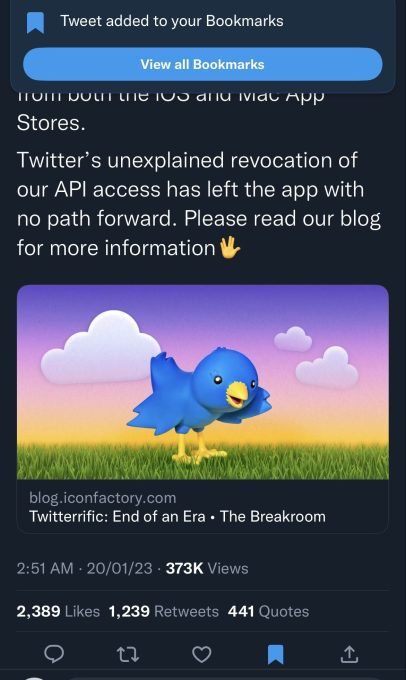
Image Credits: Twitter
After cutting off prominent app makers like Tweetbot and Twitterific, Twitter quietly updated its developer terms to ban third-party clients altogether on January 19.
The “restrictions” section of Twitter’s developer agreement was updated with a clause prohibiting “use or access the Licensed Materials to create or attempt to create a substitute or similar service or product to the Twitter Applications.” Earlier in the week, Twitter said that it was “enforcing long-standing API rules” in disallowing clients access to its platform but didn’t cite which specific rules developers were violating.
As a result, third-party Twitter clients began offloading their apps from App Stores.
Users now have a chance to get a discount for $84/year if they purchase an annual Blue subscription on the web.
Twitter Blue, including the new annual plan, is currently available in the U.S., the U.K., Canada, Australia, New Zealand and Japan.
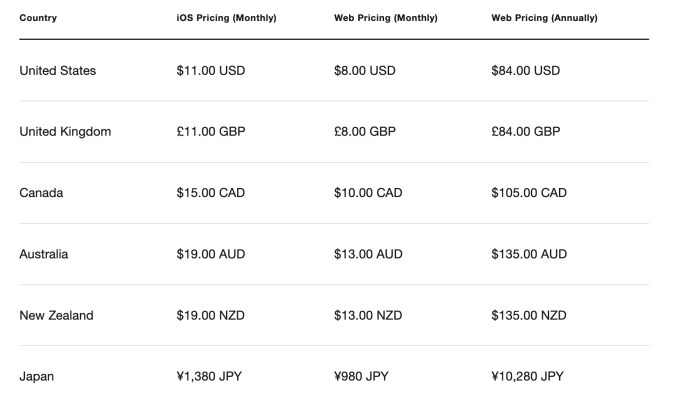
Image Credits: Twitter
In a strange attempt to make money, Twitter is auctioning off surplus office furniture (auction is now closed) that it doesn’t need anymore, now that thousands of employees have either left the company or been laid off. When you’re rapidly losing advertisers and apparently not paying your rent, why not go for the hail mary?
The company has tried to pull this stunt previously, only to give the option to switch back to a chronological timeline after a lot of backlashes.
What’s different this time? The Elon Musk-led company is now showing both algorithmic and chronological feeds side-by-side. Users can switch between them by swiping on their phone screens. Until now, users had to tap on the sparkle icon in the top-right corner to switch between the “Home” and “Latest” timelines. Twitter is justifying its latest change by saying that users can now easily swipe between the renamed “For You” and “Following” timelines.
- January 13: Twitter rolled out the dual-timeline update to the web but at that time the social network used to remember your choice.
- January 20: The company made the “For You” feed default on the web when users first opened Twitter in a tab or refreshed the page.
- January 24: Now, Twitter remembers your choices again.
- February 7: Twitter remembers your choices again on iOS and Android, too.
According to social media analyst Matt Navarra, Twitter’s advanced search filters for mobile are coming soon.
Here’s what it looks like:
The company originally enforced the ban back in 2019. At that time, it said that “political message reach should be earned, not bought.” Twitter charted a different path from other social networks like Facebook and Instagram, which allowed political ads.
Twitter’s announcement to lift the political ad ban comes at a time when advertisers have been pulling back spending on the platform, and the company has been cutting down its internal revenue projections.
December 2022
On December 23, Twitter updated the Twitter Blue page declaring that subscribers can now upload 60-minute videos from the web at 1080p resolution and 2GB in file size.
According to posts on Twitter and LinkedIn from a former public policy employee on December 22, Twitter cut half of its public policy team.
Twitter also laid off some engineers in infrastructure via email on December 16. Across all of Twitter, it’s estimated that about 75% of employees have either chosen to leave or have been laid off since Elon Musk took ownership of the company in October.
To access the new feature, users have to just type the dollar symbol followed by the relevant ticker symbol, e.g. “$GOOG” or “$ETH” (minus the quote marks), in the search bar and Twitter will display the current price. This also works without using the $ symbol in some instances, but it’s less consistent and doesn’t always return the stock or crypto prices as requested.
If someone wants to know more details about a stock or cryptocurrency, they can hit the “View on Robinhood” button.

A tweet’s View Count will be visible to everyone, not just the owner of the account.
“Twitter is rolling out View Count, so you can see how many times a tweet has been seen! This is normal for video,” Elon Musk wrote in a tweet. “Shows how much more alive Twitter is than it may seem, as over 90% of Twitter users read, but don’t tweet, reply or like, as those are public actions.”
Twitter’s product manager Esther Crawford said the social media platform is launching a pilot program for Blue for Business with select businesses. The company plans to expand this to more organizations next year.

A day after Twitter crafted a new policy to explain its decision to ban an account that tracks Elon Musk’s private jet, Twitter also suspended its open source competitor Mastodon from the service.
Within the same day, Twitter suspended a number of prominent journalists on the platform without warning. “Same doxxing rules apply to ‘journalists’ as to everyone else,” Elon Musk tweeted in a reply about the journalists’ suspensions.
Twitter seemingly had a glitch that allowed banned users to still participate in Twitter Spaces. A group of the banned journalists started a group conversation on Spaces where Musk himself joined in. Shortly after, Twitter pulled its Spaces group audio feature temporarily.
Revue, the newsletter platform acquired by Twitter in January 2021, sent a message to newsletter writers on December 14 declaring, “We’ve made the difficult decision to shut down Revue.” Writers had until January 18, 2023 to retrieve their data before everything was deleted.
Twitter dispersed the advisory group consisting of roughly 100 independent researchers and human rights activists from around the world. The council members received an email on Monday, December 12 from Twitter saying that the Trust & Safety Council is “not the best structure” to get external insights into the company product and policy strategy.
Twitter will remove all legacy blue checkmarks “in a few months,” Elon Musk tweeted on December 12. Before Musk bought Twitter, checkmarks were used to verify individuals and entities as active, authentic and notable accounts of interest.
This past week, many blue checkmark holders have been seeing a pop-up when they click on their blue checkmark that reads, “This is a legacy verified account. It may or may not be notable.”
Twitter is officially bringing back the Twitter Blue subscription on December 12, starting in five countries before rapidly expanding to others. Twitter updated its terms to specify that users will need to verify their phone numbers before purchasing the Twitter Blue subscription.
Web sign-ups will cost $8 per month and iOS sign ups will cost $11 per month for “access to subscriber-only features, including the blue checkmark,” per a tweet from the company account. Twitter Blue became available on Android at the same price as iOS in January 2023.
In addition to the relaunch of Twitter Blue, the company also began rolling out a new offering called Blue for Business that adds a gold checkmark to company accounts.
Twitter announced Community Notes, previously known as Birdwatch, are now visible around the world. Community Notes is the social media giant’s crowdsourced fact-checking system.
Moderators who are part of the program can add notes to tweets to add context and users can then vote if they determine the context to be helpful. Prior to this global expansion, Community Notes were only visible to users in the U.S. Twitter added moderators from the U.K., Ireland, Australia and New Zealand in January 2023.
When Twitter launched its new subscription plan with a verification mark on November 9, it charged users $7.99 per month. In an attempt to offset App Store fees, Twitter is charging iOS users $11 for the new subscription plan — though the Twitter Blue plan is on halt.
November 2022
The platform’s crowdsourced fact-checking system, Community Notes, are notes written by Twitter users that are appended to tweets to provide further clarification and context.
The Community Notes algorithm change involves scoring notes where contributors explain why a tweet shouldn’t be deemed misleading.
Elon Musk announces that Twitter will tentatively roll out a new multicolored verification system where companies will get a gold checkmark, government officials will get a grey checkmark and the blue checkmark will be dedicated to individuals even if they are not celebrities. That means the blue checkmark will be used with legacy verified accounts and folks who buy Twitter’s proposed $8 per month paid plan.
If you’re confused about all the checkmarks, you’re not alone. Here’s a quick guide on what each checkmark and badge means on Twitter.
On November 9, Twitter CEO Elon Musk floated changes to Twitter’s system for verifying user accounts, including charging $8 per month for it. The social media company seemingly began rolling out a new tier of Twitter Blue, its premium subscription service. According to a tweet by Esther Crawford, a former product lead at Twitter, the new Twitter Blue plan wasn’t yet live, but some users saw notifications as part of a live test.

Twitter also launched grey-colored official checkmarks for notable accounts such as companies and politicians. But within hours of the launch, Elon Musk killed it. Crawford clarified that the grey “Official” labels are still going out as part of the new Twitter Blue product.
The new $8 Twitter Blue plan began rolling out to iOS users in the U.S., Canada, Australia, New Zealand and the U.K with the only feature available at the time being the blue “verified” checkmark. This caused a number of fake accounts pretending to be celebrities, brands and otherwise influential people to create accounts and spread misinformation.
Elon Musk laid off 3,700 people from Twitter on November 3, almost half its staff, shortly after completing the acquisition. Twitter was sued in a class action lawsuit in response to not giving employees advance notice of a mass layoff, alleging Twitter violated worker protection laws.
A week later, Twitter reached out to some former employees to return as they were laid off “by mistake.”
In addition to layoffs, a round of executive departures also swept through the company. In Musk’s first email to his new staff, he talked about ending remote work and making the fight against spam a priority.
October 2022
Twitter begins overhauling a new and more expensive version of Twitter Blue, the platform’s paid plan, that will reportedly cost $19.99 per month and give users a verified badge. At the time, Twitter Blue cost $4.99 per month in the U.S.
According to a report from The Verge, Twitter plans to remove verification badges from current holders if they don’t pay for Twitter Blue within 90 days of launching the new verification system.
Elon Musk closed on his $44 billion acquisition of Twitter on October 27, 2022. The deal came after months of legal drama, bad memes and will-they-or-won’t-they-chaos. After sealing the deal, Musk took Twitter private and began clearing house. On day one, he fired former CEO Parag Agrawal, CFO Ned Segal, general counsel Sean Edgett and head of Legal, Trust and Safety Vijaya Gadde.