Author

editor

Browsing

By NyRee Ausler

here is a meme that reads, “I don’t want to go outside. It’s too peopley out there.” As funny as that sounds, there are people in our society that prefer to be alone.

We might call them introverts, loners, antisocial or shy, but the common theme is that they prefer their own company over that of others. They are people who hate people, essentially.

Being a person who dislikes being around people can limit your career options, but despite what you may think, there are a ton of paying jobs for people who prefer to work alone. Your personality doesn’t have to limit your job opportunities.

Below are jobs that you can do without changing your social behaviour. You just might find the perfect job for yourself.

1. Video Editor

Video editors spend hours at a time going through footage and combining clips into a masterpiece. This job requires a lot of quiet, alone time and is perfect for people who hate people.

2. Graphic Designer

Like a video editor, a graphic designer does editing, too. They edit existing images for public consumption and create them based on business needs. This job is a solo venture.

3. Accountant

If you have a love for working with numbers and organizing finances, a job as an accountant might be ideal for you. You get to spend all day with numbers instead of people!

4. Auditor

An auditor is someone who follows paper trails to resolve issues and ensure compliance. This position is ideal for someone who wants to be left to their own devices.

5. Veterinarian

If animals are your thing, although people are not, a career as a veterinarian may be just right for you. Also consider a dog walker, an animal trainer, groomer, or breeder.

6. Computer Programmer

A computer programmer codes and creates websites. In addition, they make computer applications that save users time and money. This is a lucrative career to get into.

7. Content Manager

If you enjoy strategically creating content that amplifies a company’s brand, a job as a content manager may suit you well. Editorial calendars, publishing, and writing are among the duties.

8. Drafter

Is drawing your thing? Do you love to put the puzzle pieces together to create beautiful structures? Look into a job as a drafter where you can design buildings or machinery.

9. Writer

Writing requires a lot of alone time and downtime. But it also means you have to be imaginative, creative, be attentive to detail, and self-motivated. If this is you, look into a career as a writer.

10. Editor

Every writer needs a good editor to make sure their words make sense. There are several different editing jobs, including proofreading, copy, line content, or structural and developmental editing.

11. Engineer

If you are interested in being an engineer, the first step is to get your bachelor’s degree in computer science. It’s a secure career and a good way to keep an introvert busy and engaged.

12. IT Manager

Computer security is a field that will always be in demand. If you like learning every aspect of the software programs people use, an IT manager is a great field for you.

13. Librarian

By nature, libraries are quiet, so an introvert would find a job as a librarian a perfect fit. You get the opportunity to learn all about books and be around people who do the same.

14. Social Media Manager

If you are more comfortable interacting with people virtually, you could make an awesome social media manager. You can communicate with others without having to be in their presence.

15. Researcher

If the thought of finding answers to complex questions excites you, a job as a researcher might be what you are looking for. History or science lovers would do well in this field.

16. Tradesperson

There are many skilled trades that require specialized expertise but limited human interaction. This includes laborers, plumbers, and electricians. These jobs can be pursued through the local union.

17. Voice Actor

If you like reading out loud and have a compelling voice, you should consider becoming a voice actor. You can do this as a part of a publishing company or as a freelancer.

18. Blogger

Blogging is the same as writing except that it’s on your own platform and you control the narrative. As a blogger, you can join other platforms or simply get started on your own.

19. Archivist

If you happen to have a master’s degree in archival science, a career as an archivist could be just what you’re looking for. You get to dive deep into history and organize the details.

20. Mortician

Maybe you don’t like being around people but are okay with the dead. As a mortician, you can make decent money and spend most of your time alone, except for meeting grieving family members.

As you can see, not being a people person does not have to stunt your career growth. You just need to find the right path for your unique personality.

Feature Image Credit: Jacob Lund via Canva

By NyRee Ausler

NyRee Ausler is a writer from Seattle, Washington, and author of seven books. She covers lifestyle and entertainment and news, as well as navigating the workplace and social issues.

Sourced from Your Tango

By Jason Aten

This is not how you get people to do what you want.

Over the past six weeks, Elon Musk has spent a lot of time tinkering with his newest toy, Twitter. By tinkering, mostly I mean that he’s been poking around and breaking things.

First, he fired most of the senior leaders who knew how things worked. Then, he laid off half of the staff. Next, he asked the remaining staff to pledge to be “extremely hardcore,” or he would consider them as having resigned. Reports suggest that as many as a third of the remaining employees said “No, thanks.”

Finally, he initiated “code reviews” that resulted in more employees being fired because their submissions weren’t up to Musk’s extremely high standard for code screenshots. None of that, however, is quite like what he’s been up to most recently.

Musk spent most of the past week touting the release of what have become known as the Twitter Files. It’s a series of threads by a hand-selected group of journalists releasing internal information about how the company has operated for the past five years.

Those threads include internal emails about policy discussions and decisions about moderating content. They also happened to include the personal email address of a sitting member of Congress, and Twitter’s founder and former CEO, Jack Dorsey. That tweet was later deleted.

This weekend, however, Musk sent an email to his remaining employees letting them know that leaking confidential information will not be tolerated. In fact, the wealthiest man in the world says he will sue any employee caught sharing information with the press.

Zoë Schiffer of Platformer was given a copy of the email, excerpts of which she shared on Twitter:

From her thread:

As evidenced by the many detailed leaks of confidential Twitter information, a few people at our company continue to act in a manner contrary to the company’s interests and in violation of their NDA. This will be said only once: If you clearly and deliberately violate the NDA that you signed when you joined, you accept liability to the full extent of the law & Twitter will immediately seek damages.

Apparently, Musk is cool with leaking internal information only if it serves his own purpose–even if it’s hard to fully understand what that purpose might be.

According to Schiffer, Twitter’s employees also had until 5 p.m. to acknowledge that they understood that it’s very bad to leak and that Musk will be super unhappy with them if they do. The problem is, if the goal is to cultivate loyalty, Musk seems to be going about it all wrong.

To be fair, no boss wants to feel like their employees are working against them, or that they can’t trust their team. If your employees are regularly leaking sensitive information, it’s not surprising that you might be upset.

Also, if those employees signed a non-disclosure agreement when they were hired, they are well aware that they would be expected to keep certain information private. That’s pretty common, especially at tech companies. It’s reasonable that Musk would want to remind employees that it’s not helpful when they disclose information to the press.

The thing is, instead of threatening to sue, you might want to figure out what’s wrong with your company culture. As soon as you play that “I’m going to hold you all legally accountable for making my life more challenging” card, it seems like you’ve lost the argument.

It also seems obvious that Musk has no sense at all of the people who work for him at Twitter. He hasn’t taken the time to understand the culture or earn their trust. Sure, he’s in charge, and he owns the company, but those two things alone don’t build trust.

There’s a reason the people who work at Twitter are leaking information, and it’s because they aren’t on Musk’s team. The thing Musk really wants is loyalty. He wants employees who will carry out his vision and be loyal to him personally. He takes any leak of information as not just a breach of confidentiality, but also as a personal offense.

Musk seems to think that ultimatums and threats are the best way to motivate people, but that’s almost never true. The biggest irony is that he could get what he wants by building trust with his team. This email is the perfect example of how not to do just that.

Feature Image Credit: Getty Images

By Jason Aten

Sourced from Inc.

Sourced from WATC

With this highly recommended online course by Cassius Rayner, you can learn all the fundamentals of mobile cinematography to create captivating videos that tell a story using your iPhone or Android.

Telling a story is one of the most gateways into someone’s heart. And what could be a more perfect medium to do so than through movies? This is where documentary filmmaking comes in, allowing you to establish and build a connection with your viewers. Cassius Rayner, an award-winning filmmaker, takes his filming techniques to new heights by using only his mobile phone as camera equipment.

In this online course, students will learn the essentials of filmmaking and how to produce professional-grade content using only their phones. They’ll discover how to plan, write, shoot, and edit an entire documentary or audiovisual piece from start to finish under the guidance of a skilled instructor.

Mobile Filmmaking Online Course: Capture Stories With Your Phone

What will you learn in this online course?

In this course, you will be meeting Cassius Rayner. He is an award-winning filmmaker and an iPhone cinematographer who will be sharing his creative journey with you that led him into the world of mobile filmmaking. You will get to learn about his creative process and find out more about the people who have influenced his work throughout the years.

You will also get a general overview of how a camera works on a mobile phone before delving deeper into exploring various mobile accessories and applications that can come in handy. By the end of it all, hopefully, you would have picked up some valuable tips from Cassius regarding the basics of operating a camera along with some composition and lighting pointers too!

Before you begin to work on your documentary, it is important to first understand how to record sound. This course will explore the basics of scriptwriting and address some pre-production concerns including permissions, scheduling, safety, and equipment.

By the end of this course, you will know how to shoot and edit your interview footage, including adding cutaways. You will also learn how to organize and grade your video before sharing it with the world.

The course is in English with subtitles available in English, Spanish, Portuguese, German, French, Italian, Polish, and Dutch. You don’t need any experience for this course. All you’ll need is a mobile phone and a laptop.

Do not hesitate to find more online courses on WE AND THE COLOR.

By Dirk Petzold

Instagram: @weandthecolor 🙂

Sourced from WATC

By Marcel Schwantes

Google found these traits led to significant improvements in managerial effectiveness and performance.

Becoming a successful manager is not easy; it requires their developing trust with their team members and continuous development to become better. So what exactly makes a successful manager? Back in 2009, Google’s Project Oxygen was birthed with a fundamental mission: to build better bosses.

As only a data-mining behemoth like Google can do, the Project Oxygen team in Google’s People Innovation Lab spent a whole year gathering more than 10,000 observations about managers–across more than 100 variables. They then interviewed managers to gather more data, and to look for evidence that supported their notions. Finally, researchers coded more than 400 pages of interview notes and data, and rolled out the results to employees. Later, these results became the source of various training programs for managers. By November 2012, the program had been in place for several years, and the company could point to statistically significant improvements in managerial effectiveness and performance.

Statisticians at Project Oxygen found that successful managers consistently had eight qualities. Among them, highlighted here, are:

1. Being good coaches

Coaching is the process of fully engaging a team and bringing out the best qualities and skill sets of each member. The best manager-coaches are deeply engaged and care about each team member. Their challenge is to organize their team such that everyone is working in their sweet spot–that role where they can use their strengths and are highly motivated to contribute. From there, they can challenge them to perform their best. But to sustain the work of your team, managers need to engage with them to help them solve problems. This is what great coaching managers do.

2. Not micromanaging

What Google found in their best managers was more empowerment of people and less micromanagement–bosses’ insisting on getting their hands on every aspect of their people’s work. When micromanagers don’t let go and trust their team members to perform their work, as a result, the employee experience can be downright demoralizing.

3. Showing interest in their employees’ well-being

Most organizations are set up to plan for what happens after an employee is at risk for burnout. Far more needs to be done. Leaders need to look at a more holistic view of their employees’ health, including mental and emotional health, stress management, and preventive care options for the whole person. To make well-being a top priority, leaders should start by surveying their employees to screen and measure them on all dimensions of well-being. Gallup research identifies six dimensions of well-being: emotional, career, social, financial, physical, and community. All six dimensions are interrelated and crucial to well-being and a life well-lived.

4. Listening to the team

Strong active listening skills in conversation are the foundation for superb human communication. Few behaviours enhance a conversation as much as attending to what people have to say. It signals respect and a sense of curiosity for what they have to say.

Unfortunately, active listening is one of the least taught skills in leadership. Studies confirm that most of us are poor and inefficient listeners. When you talk to your boss, co-workers, or customers for 10 minutes, studies indicate you pay attention to less than half of the conversation. As managers, building up your active listening skills is crucial for solving problems, developing trust, and winning the hearts and minds of people.

5. Helping employees with career development

Managers hold the key here and must start believing in their team members by maintaining a high view of them, and by showing an interest in their jobs and career aspirations and creating learning and development opportunities for their people.

Feature Image Credit: Getty Images

By Marcel Schwantes

Sourced from Inc.

By Neal Schaffer

LinkedIn is a paradise for many types of business professionals, and if you are not finding success on the platform, it might just come down to your personal branding as manifested in your LinkedIn profile. I hope to inspire you to revise your profile by showcasing some standout LinkedIn profile examples.

Since LinkedIn is a great place to find a job or recruit a new employee, everyone on LinkedIn should have a profile that gives their experience and qualifications, which makes it easy to identify opportunities. Likewise, people in sales use LinkedIn to find sales prospects and decision-makers.

Of course, people don’t only use LinkedIn to locate immediate opportunities. Instead, it’s a place for networking and relationship building. Then, when the time comes, professionals have a network they can rely on for help. This could be a job, help fill a position or even a sale.

With that said, LinkedIn wouldn’t be a powerful tool if people didn’t have high-quality profiles to represent themselves online. Here are some tips to create a great profile, and some LinkedIn profile examples to inspire you.

What’s a LinkedIn Profile?

A LinkedIn profile is a LinkedIn member’s page, where they have a picture, career goals, and other material. In other words, it’s like a business card or personal website but with a social media twist. LinkedIn calls the profile a “professional landing page” because it’s supposed to be the first impression people have of you on the platform. Often, this is the “actual” first impression because LinkedIn introduces a lot of people who’ve never met in person.

Why Should You Update Your LinkedIn Profile?

Updating your LinkedIn profile makes sure that your profile accurately reflects your professional life. People go through a lot of transitions, both personally and professionally, over the years. By keeping your profile updated, you’ll make it easier to meet the right people, find the right opportunities online, and put your best foot forward.

Here’s an example. Especially during a recession, lots of people look for new opportunities. They might go get a degree or new certification, get laid off, or decide a new career is their best bet. Some people even start a business or retire early. In turn, their goals and needs on LinkedIn change. If someone switches from recruiting to operational management in another company or industry, they won’t need to find recruiting candidates anymore. Or, a person starting a business might need new employees. Either way, their LinkedIn profiles should reflect the job changes.

The Elements of a Great LinkedIn Profile

It’s difficult to talk about the best LinkedIn profile examples without talking about what makes them great. After all, some profiles are more effective than others. In addition, LinkedIn profiles can be quite different depending on the member, whether that’s related to their career, their personal goals, or individual branding. With that said, here are some “must haves” for a good profile.

Professional Profile Photo

Having a professional picture is important because profiles with photos are 14 times more likely to be viewed. Besides this, a great picture helps you introduce yourself, especially in an era where there are fewer in-person meetings than there used to be. Therefore, a nice profile picture also helps people recognize you when they meet or see you at some in-person event.

However, you should always use a full-focus photo, and it needs to be a close-up shot. This isn’t where you use special effects or a blurry, poorly focused selfie that you adapted from Instagram. Remember, your LinkedIn profile picture is part of what provides a good (or not so good) first impression.

Besides the need for clarity and professionalism, you’ll need these parameters:

  • PNG or JPG file, because this is what LinkedIn requires.
  • LinkedIn recommends a square photo shape of 400 x 400 pixels. You can get this by cropping a rectangular picture to showcase your smiling face.
  • Generally, you’ll want a file size under 8 MB, though you can go larger if needed.

In other words, choose a small, high-resolution photo that has a relatively small file size. These parameters will get you the best results. Otherwise, the photo might not look nice once it’s posted online.

Cover Photo or Background Picture

This is the picture or graphic that you see at the top of someone’s profile, and it’s a great opportunity to make a splash. Generally, I recommend something that promotes a professional accomplishment or other parts of your online presence. For instance, you can promote a portfolio of work, a website, free resources, books you’ve written, or client testimonials.

These aren’t as difficult to make as you might think. A graphics editing tool like Canva can help you create awesome content for social media. You can use several design elements with this tool and others, offering the opportunity to create something special.

Finally, your cover photo should always reinforce your personal brand. While most people are used to a personal brand when job hunting, in the social media age you should project your brand whenever possible. Ideally, people will see you as a go-to person when they need what you have to offer.

A Brief, Powerful Profile Headline

A great headline is one of the most important elements of great profiles, and you’ll see some of our LinkedIn profile examples highlight this element. One reason for this high level of importance is that the headline text gets shown in search results within LinkedIn and Google SERPs. This means that your profile will get discovered more easily if you have a great headline. Plus, a good headline can help you edge out the competition for that often-critical profile view.

Technically speaking, a headline can be difficult to write. That’s because the headline is limited to 120 characters long, so you need to say it quickly. Be sure to include your industry-related keywords, skills, and interests.

Summary or the About Section

Next, there’s the summary. This is the piece of text below your headline, and it allows for more detail about why you’re special. When people click through your headline and see your profile, they are often on the fence about following up, especially if they are looking for an opportunity more than a particular person (you). The job of your summary or about section is to convince people to contact you.

12 Killer LinkedIn Profile Examples to Inspire You to Update Your Own

Even the best LinkedIn profile tips can be hard to follow if you don’t have some examples. After all, these examples can help you understand the best way to apply the tips. In addition, some inspiration is always useful when you’re writing an expressive piece like this. Here are some of the best LinkedIn profile examples I could find. Each of these can give you some inspiration to write a killer profile yourself.

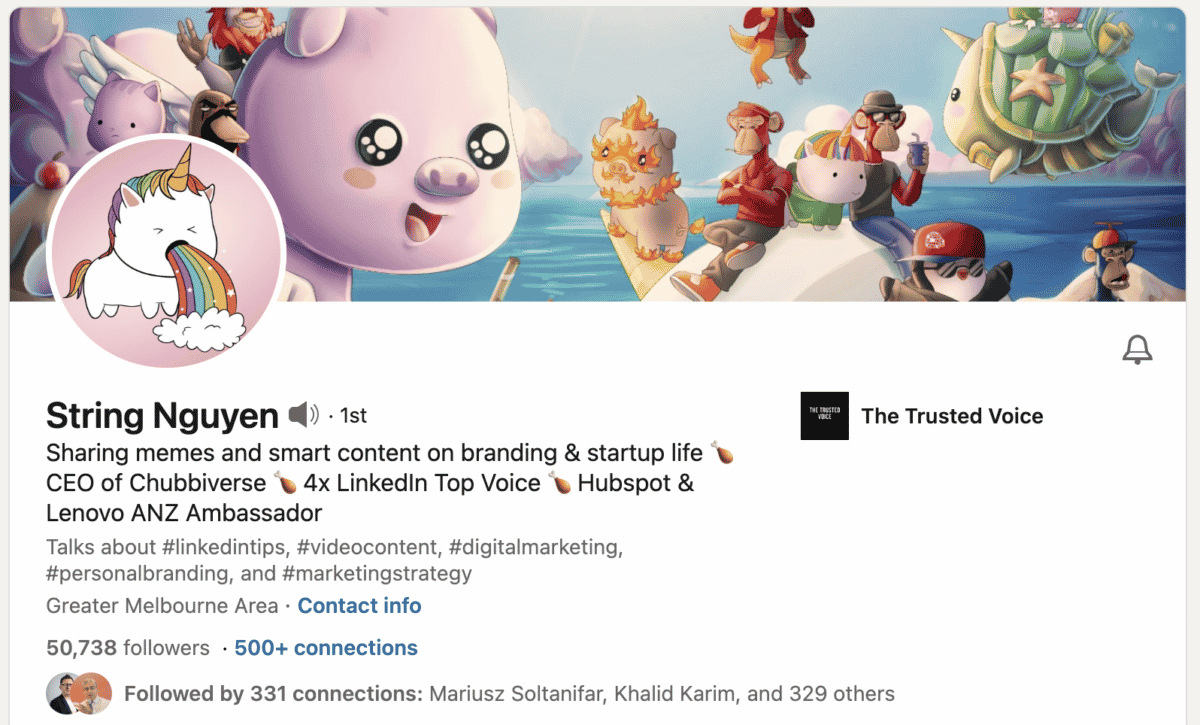
1. String Nguyen

String Nguyen
String Nguyen

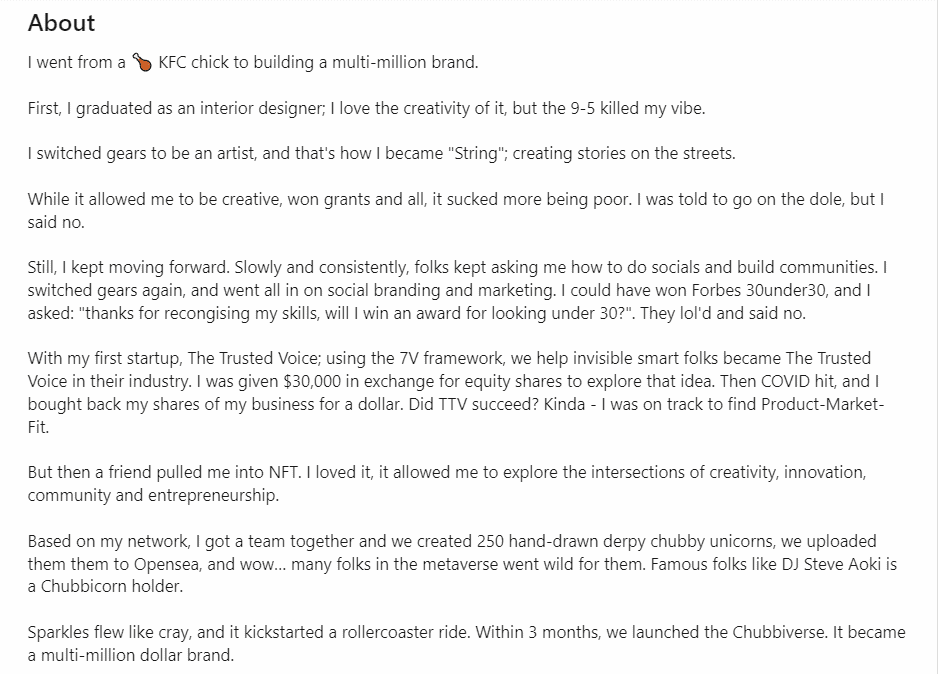
Why is this profile great? At first, her profile immediately grabs your attention. You can tell she is an artist at heart (her qualifications bear this out) and that she’s both unique and motivated. However, this is also one of our better LinkedIn profile examples because of its technical excellence.

  • Her headline precisely describes what she does. The string is a serial entrepreneur and creative who makes plenty of money helping other people create wealth (while doing it herself).
  • She uses emojis to make her message more memorable. For instance, since her name is String, she inserts violins (stringed instruments) in several places.
  • Presents a captivating story about her roller coaster ride from a “KFC Chick to building a multi-million brand.” That includes working a 9-5 job in a conventional career and deciding it wasn’t for her.
  • Uses self-deprecating humour: “I could have won Forbes 30 under 30, and I asked: “thanks for recognizing my skills, will I win an award for looking under 30?” They lol’d and said no. ” Somebody who talks like this is generally a competent person who doesn’t let success get to their head.
  • Is inspirational – “If a KFC chick can do it, so can you. ” In other words, String knows what she wants, and will work hard to achieve it. This is very attractive to many employers and potential business partners.

2. Laszlo Block

Laszlo Block
Laszlo Block

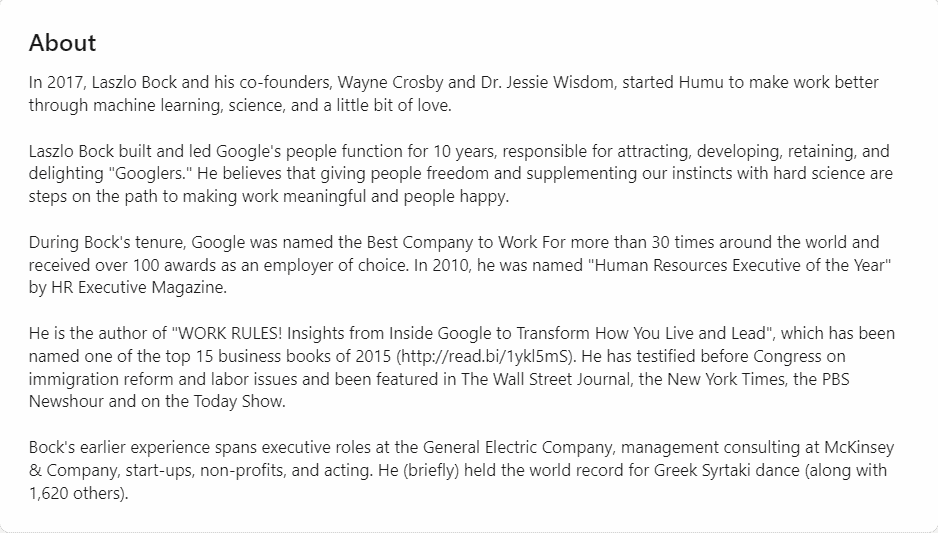
Laszlo is actually a prominent business leader, having served as an executive at Google. However, he left Google to start a new business that takes a more humane approach to human resources. This need for humanity in HR is deeply felt by many within the business community.

Why is this a great profile?

  • Besides checking on all boxes, what stands out is the summary section of Laszlo. In five succinct paragraphs, Laszlo weaves his professional story by highlighting his accomplishments and achievements while he was at Google. Then, he talks about his current activities.
  • Then, Laszlo gives you a reason to connect with him on a human level: he has a world record for Greek Syrtaki dance which reveals his personal passion. Of course, choosing this particular fun fact helps paint a picture of someone who knows how to relax and have fun.

3. Lalaina Rabary

Lalaina Rabary
Lalaina Rabary

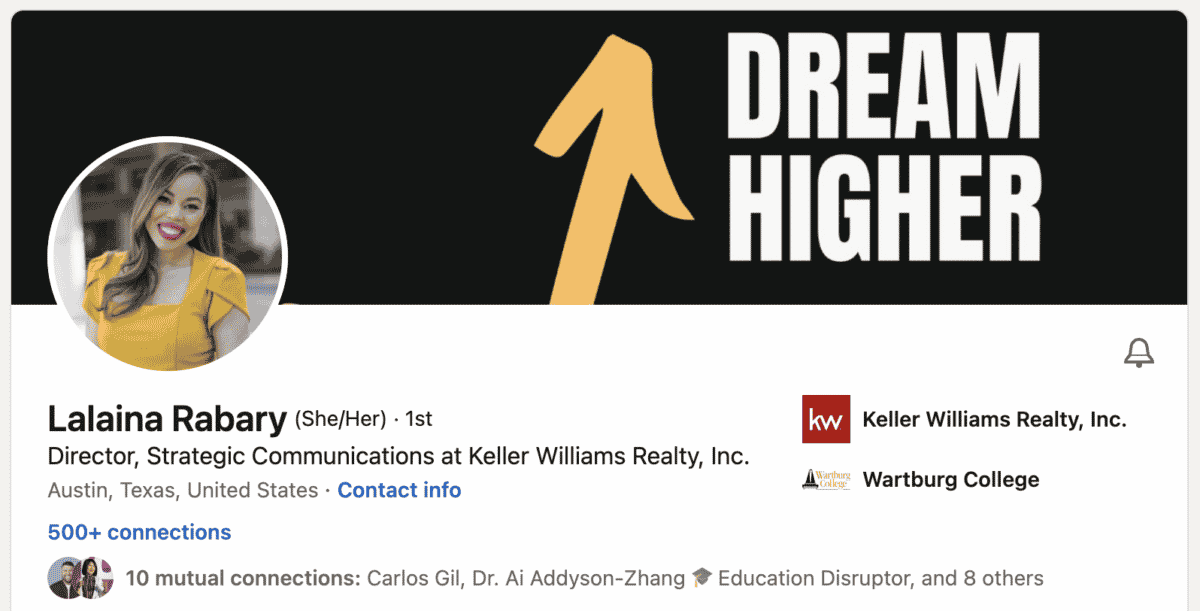
Among the LinkedIn profile examples we’ve discussed so far, Lalaina’s profile is the most conventional. She tells you what she’s like in simple terms, but doesn’t use humor or fun facts to make herself out. It’s all business.

Why is this profile great?

  • Her simple background image is impactful because it uses simple symbolism to define her personal brand. In addition, she wears an outfit for her profile picture that’s the same color as her background image, boosting the brand message.
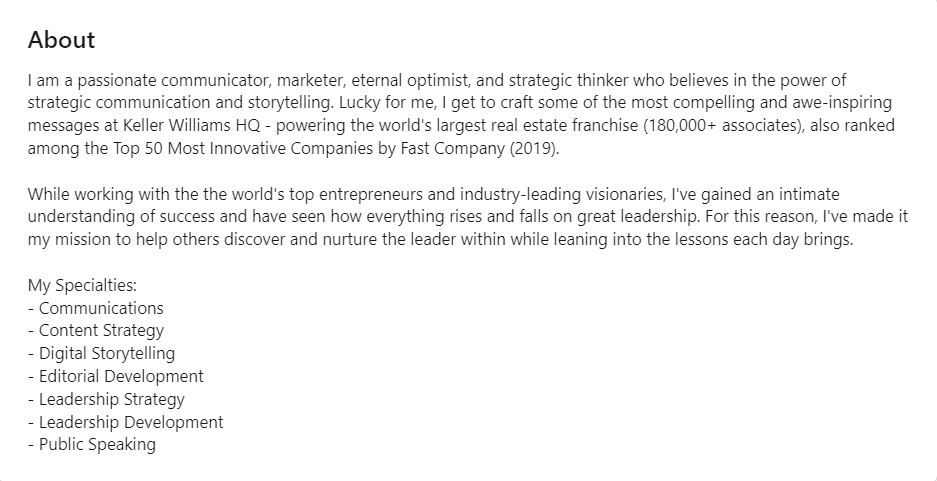
  • Reading her summary, you can easily see her passion for her job: She loves it and finds her work very satisfying.
  • She ties the messaging of her background photo as well as the passion for her job together in a convincing way to understand her mission, “to help others discover and nurture the leader within,” in a very memorable way.
  • Lalaina lists her volunteer work, which also helps support her personal brand as someone who dreams big with heart.

4. Ted Schachter

Ted Schachter
Ted Schachter

Ted is someone who’s spent a lot of his career in academia. Nowadays, he teaches marketing and communications to the next generation while staying active in the business.

Why is this a great profile?

  • Note the consistent branding of his glasses, from his background photo to his profile photo to the emoji in his name. Even better, he tries to use glasses on his profile that are similar to the ones in his photograph. Makes me wonder if similar frames are part of his signature look.
  • Ted uses the Featured section smartly to showcase a New York Times article in which he is quoted. Because the New York Times is a well-respected publication, being quoted there is often prestigious.
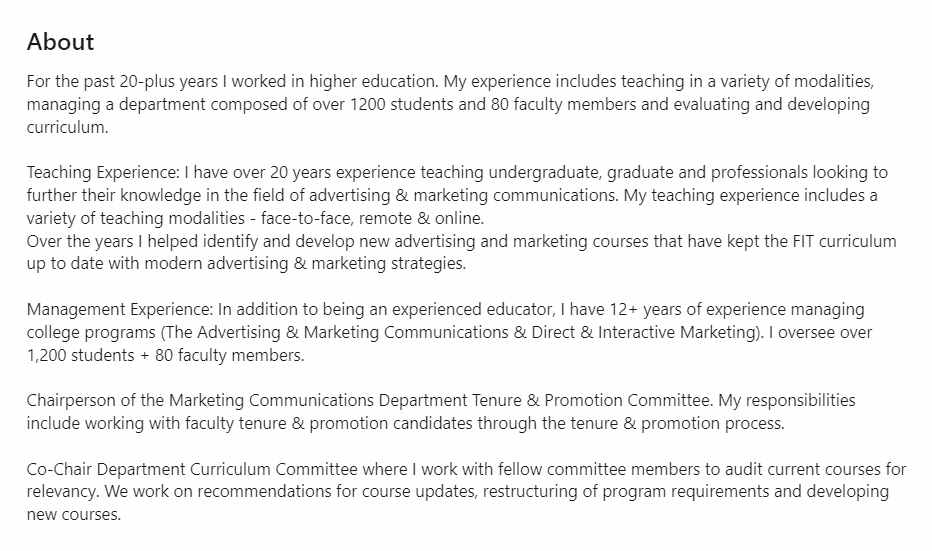
  • He clearly spells out his experiences in a succinct manner in his summary, including numbers so that we can better understand the scale of his many accomplishments. In other words, as someone who’s always looking for additional opportunities (Ted wears many hats), he makes it easy to see what value he can bring.

5. Beth Kanter

Beth Kanter
Beth Kanter

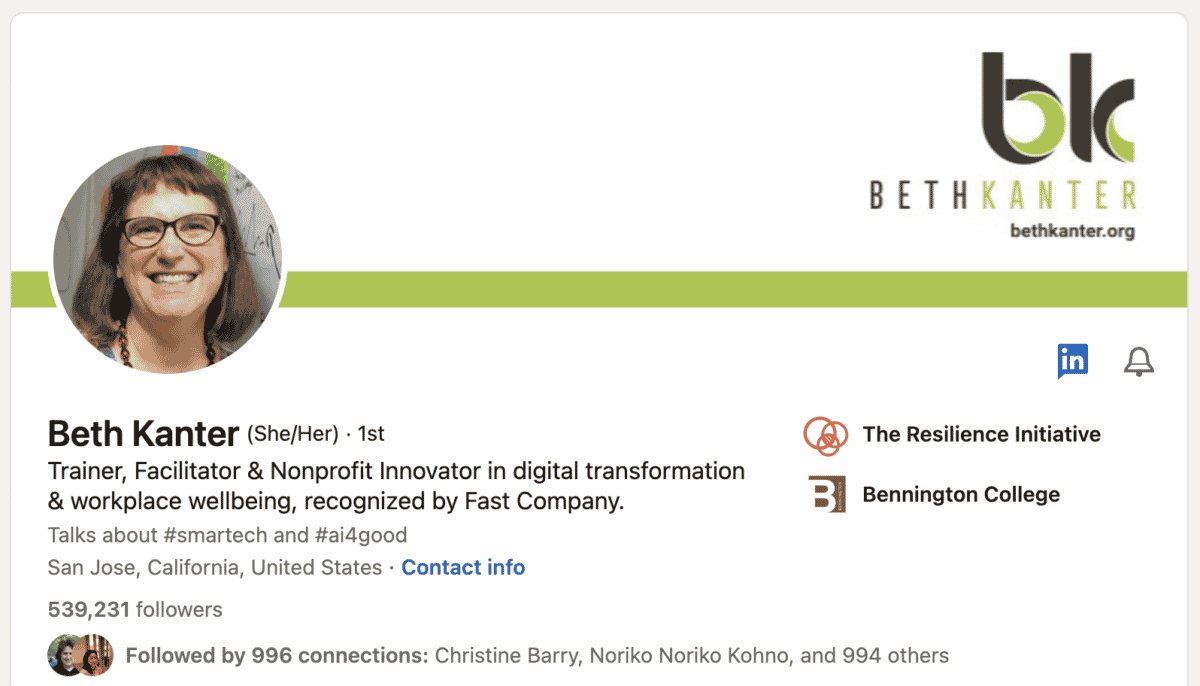
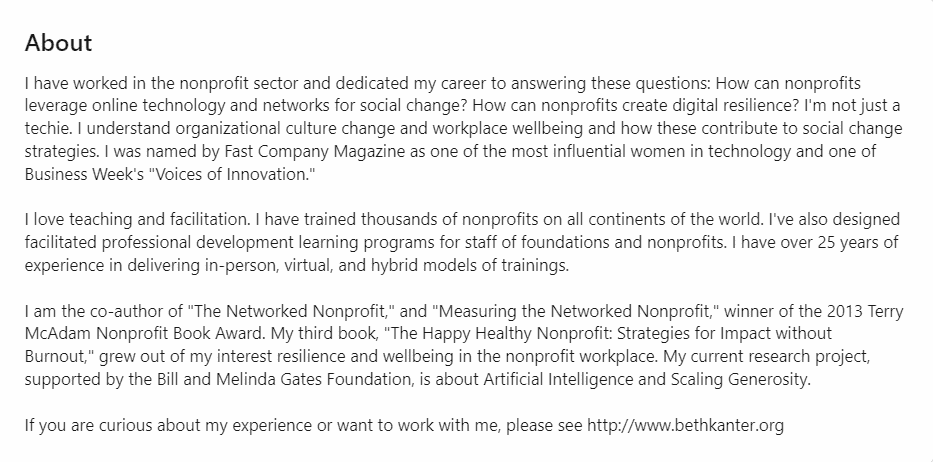
Beth specializes in helping non-profits navigate the digital age, including through a digital transformation. She also helps them reach out to donors and other stakeholders. Her goal is to keep non-profits focused on their human mission even with technology.

Why is this profile great?

  • Beth uses a mix of powerful keywords in her headline to convey that not only is she an innovator in the non-profit world for which she is best known. Beth is also known for both digital transformation and workplace wellbeing, creating a truly unique and compelling brand.
  • Beth speaks to us directly in her summary where she talks about the questions that have guided her career, leaving a lasting impression on the reader of her passion for serving others.
  • At the end of her summary, she not only talks about her past books but also about her present research, supported by the Bill and Melinda Gates Foundation, about Artificial Intelligence and Scaling Generosity. Talking about her sponsored research ties her branding together in a very concise and powerful way.

6. Neil Patel

Neil Patel
Neil Patel

Neil is a world-famous marketer and technology person that lectures all over the world and owns an agency.

Why is this profile great?

  • If you searched Google for anything related to marketing, chances are that you have come across Neil Patel. His profile reflects the wide circulation of his work.
  • Neil’s got a professional profile photo and his cover photo lists his expertise in different aspects of digital marketing that reinforce his personal brand.
  • The summary section outlines his achievements, including being recognized by President Obama. He says all of this without bragging or coming across as arrogant.

7. Pam Moore

Pam Moore
Pam Moore

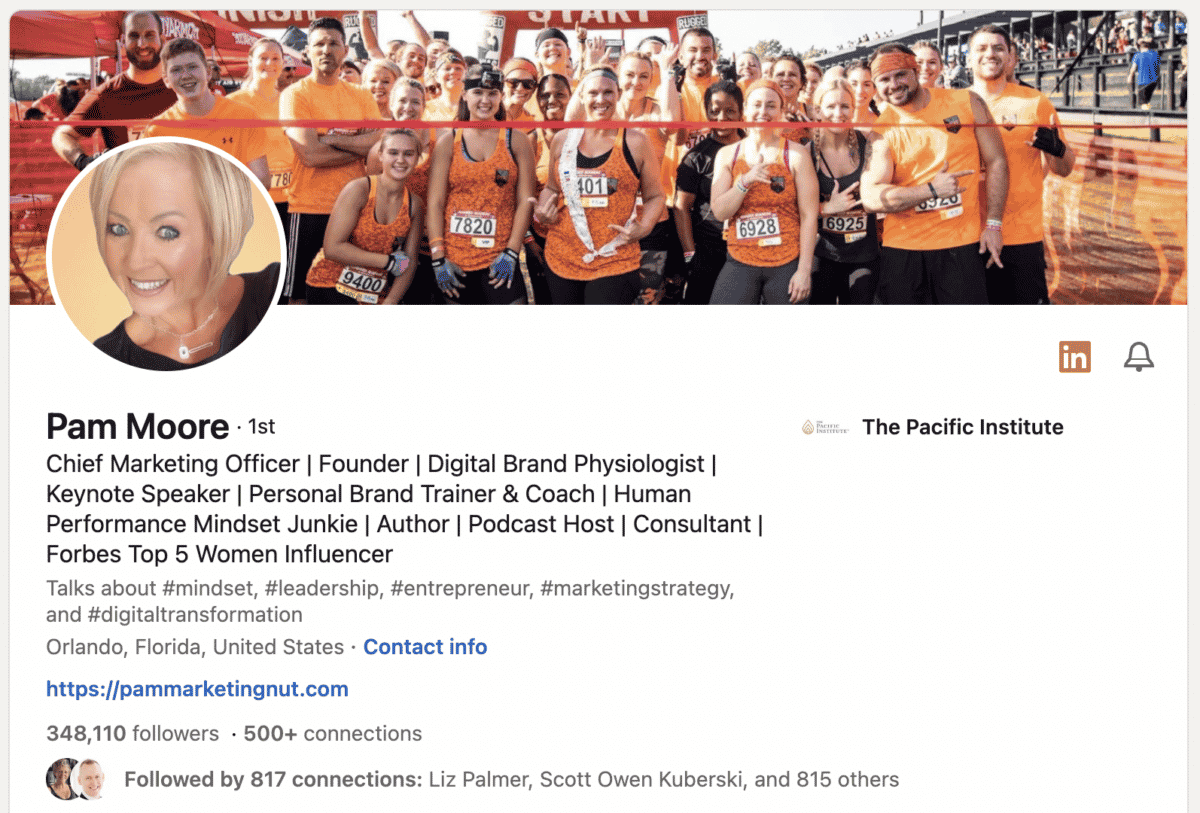
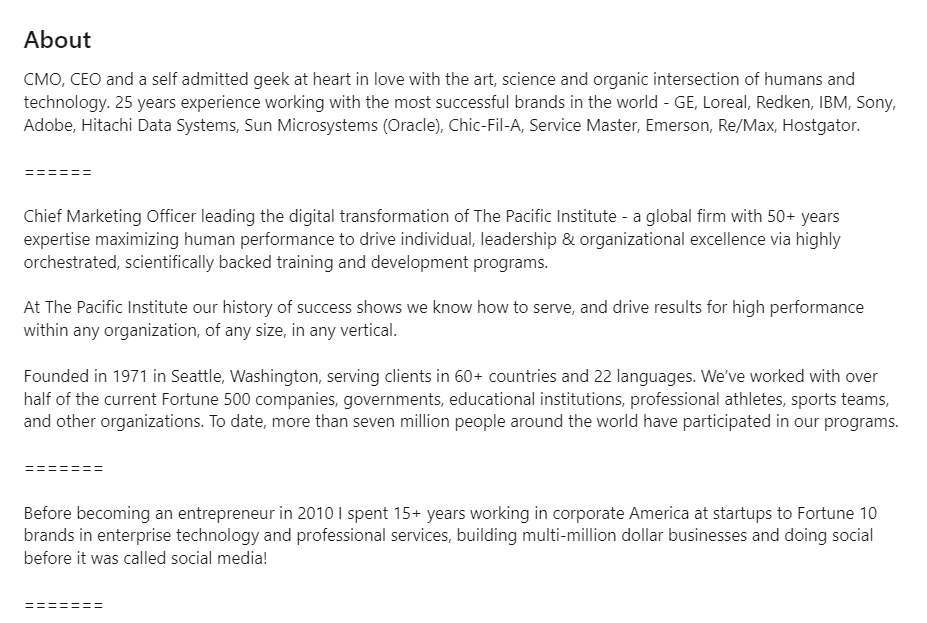
Pam is another veteran marketer, and she’s had a recent job change.

Why is this profile perfect?

  • Pam has a nice picture that looks like it came straight out of a magazine and was probably taken by a professional. Besides this great picture, Pam has a cover photo of a foot race. That picture piques the viewer’s interest because there isn’t anything else about running on her profile.
  • Her headline has a list of keywords that describe exactly who she is. As a result, you not only know why you should contact Pam, but the keywords help her profile show up on a lot of searches.
  • Pam’s summary is quite elaborate, but without being overbearing. In other words, you can quickly see her many accomplishments.
  • She has a very complete profile, with information that includes courses, projects, honors, and awards.

8. Anthony Gioeli

Anthony Gioeli
Anthony Gioeli

Anthony is another marketer, and he specializes in the AI space. Overall, his profile is very down-to-earth and businesslike, without any humor.

Why is this profile great?

  • Anthony has a well-rounded profile with a clear focus on his key accomplishments. This way, you can see at a glance what he can do for your company.
  • He uses bullet points to highlight his most important points, so busy readers can extract the important information quickly.
  • There is an ample amount of endorsed skills and recommendations, which adds to social proof.
  • Anthony includes a link to his publication. This way, you can buy the book but also connect the man and the author.

9. Elise Micheals

Elise Michaels
Elise Micheals

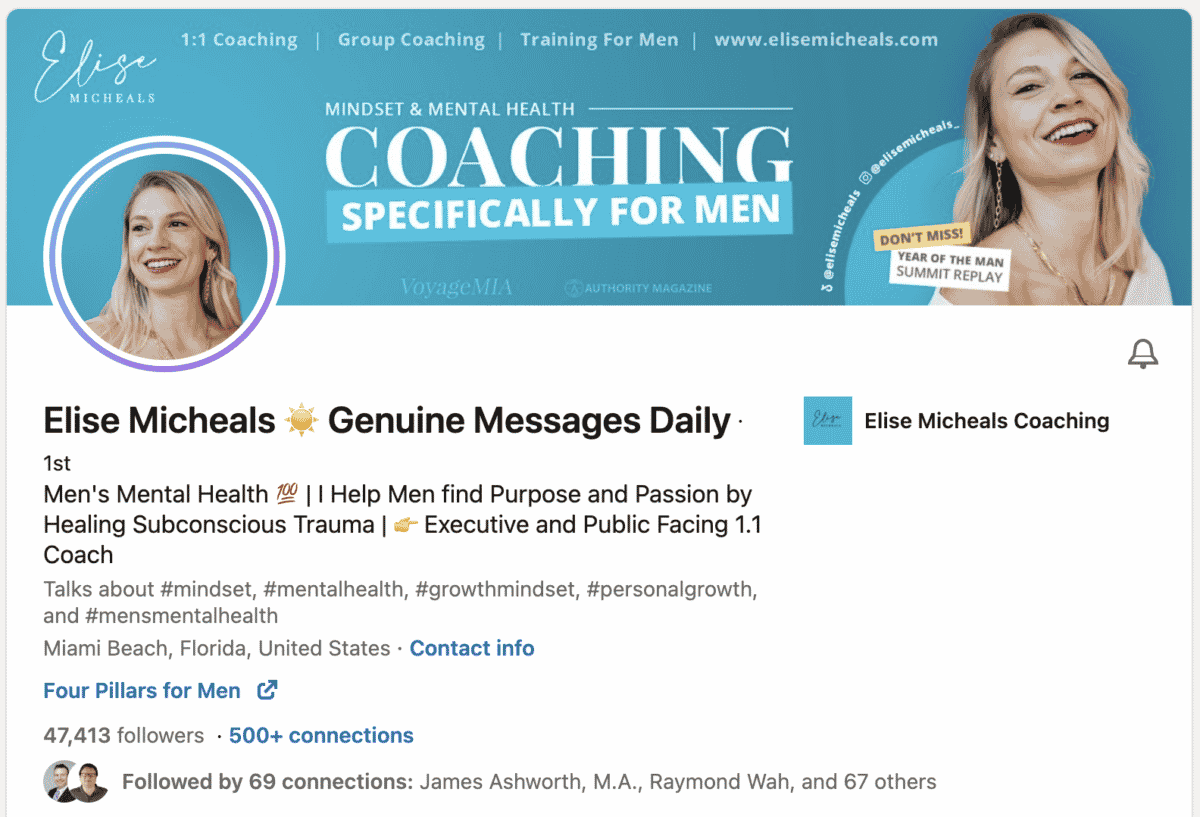
Elise has a sales background, but she’s turned her skills into a new career: coaching.

What’s awesome about this profile?

  • Elise’s profile picture has a video behind it if you click. The video message makes her likable and approachable instantly, which is especially important for someone in her field.
  • Her banner image precisely says what she does – Coaching, specifically for men. She also helps men push past their failures and work through what’s holding them back.
  • The headline clearly states what problem she solves, how she does it, and for whom.
  • Elise’s summary uses bulleted lists to outline the problems and solutions she offers, being more specific than her headline.
  • As a professional coach, she has listed all her licenses and certifications to establish credibility.

10. Jay Baer

Jay Baer
Jay Baer

Jay is a superstar marketer for Convince and Convert, as well as a conference speaker and writer. However, that doesn’t mean that his profile has to be boring. Far from it.

Why is this profile incredible?

  • Jay has a great headshot that makes one want to know more about him. In particular, his smile is friendly and engaging.
  • A branded cover photo shows off his skill set and his tagline while remaining minimalist.
  • Jay’s headline is precise and punchy so you’ll remember it easily.
  • The opening lines of his summary are to the point and give an immediate impression of his expertise in marketing.

11. Juhli Selby

Juhli Selby
Juhli Selby

Juhli is a trainer who specializes in teaching small businesses to do marketing. Her practice focuses on social media techniques.

What is good about this profile?

  • Juhli uses a very inviting profile photo combined with her background photo to almost personally welcome us into her backyard in British Columbia. For someone who works with small business owners, this is highly effective because SMBs thrive on personal relationships.
  • Her headline is equally inviting, not just in making it clear as to what her specialties are, but also that she is about building relationships online and connecting with opportunity. In other words, Juhli pitches herself as approachable.
  • She continues this welcoming environment by featuring her women’s business networking LinkedIn Live replays. Of course, it’s also a great example of simple content marketing.
  • Finally, her profile summary begins by focusing on her passion ”to help get more positive voices online” and ends with her real-life passions, humanizing her profile and truly completing a welcoming presence on LinkedIn.

12. Anthony English

Anthony English
Anthony English

Anthony is a business coach, but he also has a heavy IT background. This makes him a multifaceted professional with a diverse point of view. In this profile, Anthony emphasizes coaching because he runs a business doing it.

Why does this profile rock?

  • In the headline, he talks about someone named Rachel who charges what she’s worth. This is bound to immediately pique your interest. It also tells what problem he solves for people: not knowing what they are worth professionally, and how to ask for it.
  • You will never see another about section like this one. It tells a fictional story about Rachel who is struggling with imposter syndrome. The story is relatable because it talks about the struggles and aspirations of his target audience: small business owners.
  •  The summary also has a clever CTA that subtly nudges the reader to connect with him – “Do you know a Rachel? She probably wants to connect with me.” Best of all, the CTA drives home his point that someone who is stuck in a rut business-wise needs a coach like him.

LinkedIn Profile Examples Conclusion

Writing a killer LinkedIn profile is important for professionals. After all, LinkedIn these days is more than a resume site. Instead, it’s a place where professionals build their personal brands and look for new opportunities. I hope that these LinkedIn profile examples have helped you to see where your own profile is great, and where it might be lacking.
By Neal Schaffer

Neal Schaffer is an authority on helping innovative businesses digitally transform their sales and marketing. Founder of the digital marketing consultancy PDCA Social, Neal currently serves as a Fractional CMO to several companies. He also teaches at Rutgers Business School and the Irish Management Institute. Fluent in Japanese and Mandarin Chinese, Neal is a popular keynote speaker and has spoken on four continents in more than a dozen countries. He is also the author of 4 sales and marketing books, including Maximize Your Social (Wiley) and the recently published The Age of Influence (HarperCollins Leadership), a ground-breaking book redefining digital influence. Check out Neal’s Maximize Your Social Influence podcast for marketing inspiration.
Sourced from WATC

For amazing typographic designs in the year 2023, take advantage of our top 10 free fonts selection that graphic designers can download.

We have searched through many free fonts on different platforms and gathered a collection of the 10 best fonts for graphic designers to download in 2023. This set contains a variety of styles, as mentioned before all selected fonts are available for free with designated options for private or commercial use.

10. Bigilla – Free Display Serif Font

Bigilla - Free Display Serif Font
Bigilla – Free Display Serif Font

Bigilla is a trustworthy display serif typeface that was created by Jérémie Gauthier. The design includes multiple font weights, such as Regular and Bold. The free Bigilla font also comes with included ligatures and several alternate options. This typeface is perfect for multilingual purposes and can be used in an array of designs, including but not limited to branding, posters, magazines, packaging designs, etc.
Free Download

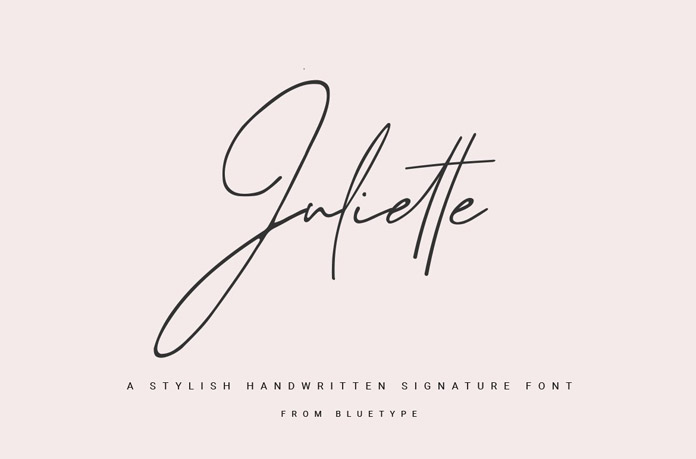
9. Juliette – Free Handwritten Signature Font

Juliette - Free Handwritten Signature Font
Juliette – Free Handwritten Signature Font

Juliette is the perfect font for creating sophisticated, yet natural and simple signatures in the style of real handwriting. With Juliette’s refined style you can create elegant designs without appearing stuffy. This free handwritten signature font is a great choice for a wide range of projects.
Free Download

8. Projekt Blackbird – Free Sans Serif Font

Projekt Blackbird - Free Sans Serif Font by by Leonit Gashi
Projekt Blackbird – Free Sans Serif Font by by Leonit Gashi

Projekt Blackbird, designed by Leonit Gashi, is a free font that looks great in headlines and web design projects. It can be used for both personal and commercial purposes. The typeface provides a unique and contemporary look.
Free Download

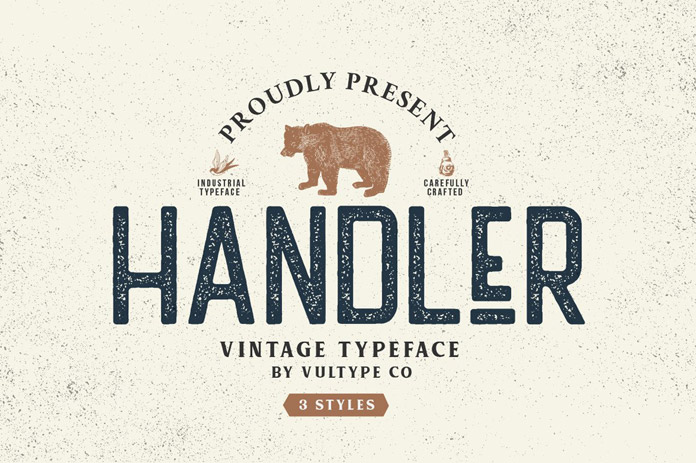
7. Handler – Free Vintage Sans Serif Font

Handler - Free Vintage Sans Serif Font
Handler – Free Vintage Sans Serif Font

If you’re looking for a fantastic new vintage typeface, look no further than Handler! This retro-style font has three different character options – regular, stamp, and rough. Mix them up or use them separately to create unique interest in your projects or designs. Handler is perfect for logos, branding, vintage apparel, packaging, and more!
Free Download

6. Margaret Serif Font

Margaret Serif Font
Margaret Serif Font

The Margaret Serif font is a beautifully classic display typeface created by Kacper Janusiak and the team at K94 Studio. This free serif font can be used in headlines, branding, and logotypes. It is perfect for adding a touch of elegance to any project. Just click on the link below to get further information about all features.
Free Download

5. Gilroy Font

Gilroy font family by Radomir Tinkov.
Gilroy Font

Designed by Radomir Tinkov, Gilroy is a fully functional sans-serif font family, which is actually not free of charge but two styles (Light and Extra Bold) can be downloaded for free on Fontspring. Gilroy is a fantastic choice for a wide range of print and digital applications like websites, mobile apps, branding, signage, and editorial design. Learn more by reading below or clicking the link below!
Free Download

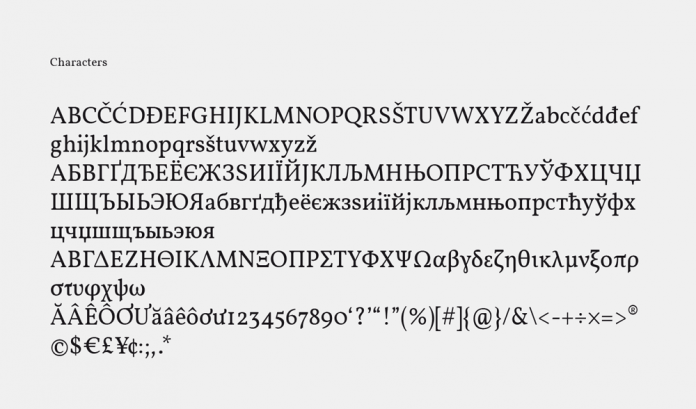
4. Vollkorn – Free Google Font

Vollkorn - Free Google Font
Vollkorn – Free Google Font

Vollkorn is a serif font family that takes inspiration from classic designs. Its regular style was Friedrich Althausen’s first type designing attempt, which he published in 2005 under a Creative-Commons-License. The typeface quickly gained popularity and after only two years, it had been downloaded thousands of times. Today, Vollkorn is available as a free Google Font in 4 weights (Regular, Semi-Bold, Bold, and Black) plus matching Italics for each weight. With its dark and meaty serifsVollkorn can accommodate both print and web design projects equally well.
Free Download

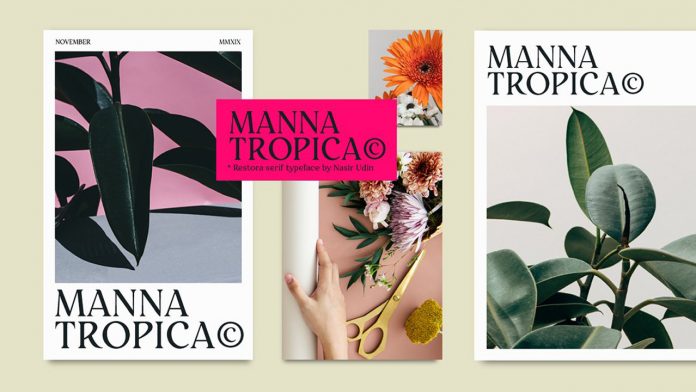
3. Restora – Old-Style Roman Serif Font

Restora Font
Restora Font

Restora is a popular roman serif font family that offers both a free version and a paid version. The full family includes eight weights ranging from thin to black, plus matching italics for each weight. The free version of Restora includes Extra Light and Thin Italic styles. You can purchase the complete family of 16 fonts here or follow the link below to download the two free styles.
Free Download

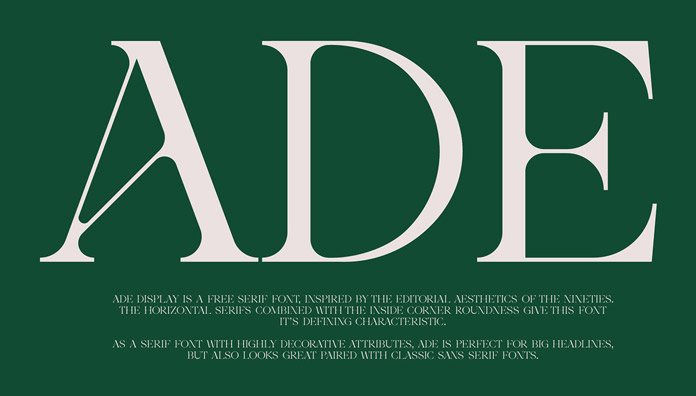
2. Ade Display – Free Serif Font

Ade Display - Free Serif Font
Ade Display – Free Serif Font

Ade Display is a free sans-serif font created by Thunder Studio. It was inspired by the editorial look of fonts from the nineties and combines horizontal serifs with inside corner roundness to create its unique character. The elegant typeface is ideal for big headlines.
Free Download

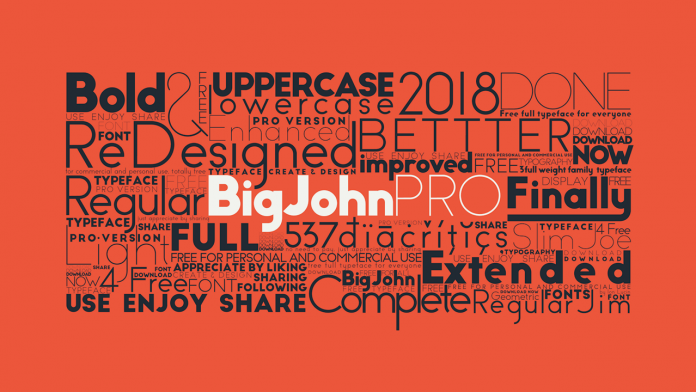
1. Big John Pro – The Best Free Fonts

Big John Pro free fonts
The Best Free Fonts: Big John Pro

Big John PRO is one of our all-time favourite free fonts. Designed by Ion Lucin, it’s the updated version of Big John and Slim Joe font which you can find here. The new Pro edition has bold, light, and regular font styles for both personal or commercial use—and absolutely free of charge! To download, just click on the link in the bio section of the Instagram account belonging to Mr. Lucin himself.
Free Download

We hope you found our top ten free fonts for 2023 helpful and that you were able to find the right typeface for your next project. If you want to explore more of our recommended typefaces, we suggest browsing through our recommended Fonts category. You can also find great design assets in our Templates​ category.

By Dirk Petzold

Instagram: @weandthecolor

Sourced from WATC

EU privacy regulators declared that Meta can’t force users to agree to data collection.

Privacy regulators in the European Union have ruled that Meta, parent company of Facebook and Instagram, can’t make giving up data for targeted ads a condition of joining the social networks, according to reports published Tuesday in the Wall Street Journal and Reuters. The decision threatens to upend the social media giant’s business model and alter the financial underpinnings of the internet.

Signing up for Facebook or Instagram means clicking past a privacy policy and consenting to the social networks’ digital surveillance for advertising purposes. If you don’t agree, you can’t have an account. But a board of Europe’s privacy regulators issued a series of new decisions Monday declaring that this kind of coerced consent violates the General Data Protection Regulation (GDPR), the EU’s sweeping privacy law.

While the ruling hasn’t been made public, key details leaked to the press Tuesday. The decision wouldn’t just affect Meta. Every company that serves targeted ads works in much the same way as the social media giant. You can sometimes opt out of having data from other parts of the internet used for advertising on social media, but the new ruling seeks to limit company’s from using the data they collect on their own networks. It would be a sea change to how privacy works online.

“The EU regulators’ decision, if it is upheld, would have a dramatic impact on Meta’s revenue in Europe, kneecapping its ability to use information about its users’ on-platform activities in order to sell targeted advertising,” said Debra Aho Williamson, a principal analyst at Insider Intelligence, in an email. “However, we expect Meta to fight vigorously to defend its business, and it could be months, if not years, before any impact is truly felt.”

Meta did not immediately respond to a request for comment on the ruling.

The ruling doesn’t immediately force Meta to change its practices. Instead, it calls on Ireland’s Data Protection Commission to issue specific orders within a month, which are likely to include substantial fines, Reuters reported. Meta will likely appeal the decision as well, which may allow the status quo to continue during litigation.

But depending on how the ruling plays out, it could mean that Meta and other companies it owns have to get real, informed consent before they chew up all your personal information and spit out ads. What would that look like? It’s not clear yet.

When people are presented with a choice of whether to be tracked online (and still use a given site or app), they tend to say no. Over the last year, Apple rolled out a privacy setting which makes apps ask permission before they track users, “Ask App not to Track.” The vast majority of people say no, and Meta’s business took a nosedive as a result—the company said it lost $10 billion thanks to Apple’s privacy setting alone. An EU ruling against Meta could spell financial crisis for the company, whose share price has already fallen like a rock this year. Meta’s stock was down 6.79% at the closing bell Tuesday after the news.

But the ruling is likely far bigger than Meta. Lots of other companies, from Google to TikTok to smaller players, operate via a similar legal model: consent to targeted adds or go use some other platform. It’s unclear how widely the EU ruling would apply across the continent, but it’s possible that one of the foundational models of online business could be disrupted.

The open secret of the tech industry is lots of companies, apps and websites haven’t come up with a way to make money aside from harvesting data and targeting ads. If company’s can’t use your data, they can still show you “contextual” ads, which are based on the content you’re looking at (imagine an ad for Honda’s on an article about cars). But contextual advertising is cheaper than ads tailored via your personal information, and therefore less profitable for the company’s selling it.

An EU ruling only has a direct effect on businesses operating in the EU, but it’s a sign that governments may finally be changing their tune when it comes to privacy. So far, lawmakers have been willing to pass privacy rules that make certain data practices more cumbersome for the business world, but this is the first time that a major government body has taken steps to curtail targeted ads outright.

But the GDPR serves as a model for the privacy laws in the United States and across the globe. If this strict interpretation of the law is successful—however you define success—it could hint at a far more private future.

Feature Image Credit: Sergei Elagin (Shutterstock)

By Thomas Germain

Sourced from GIZMODO

By

David Palmer, the owner and ECD of Manchester-based creative agency LOVE, has spent his career learning to love failure. But then again, he hasn’t had much choice.

“Creative people face more regular rejection than just about anyone else on the planet,” he tells Creative Boom. Palmer estimates that LOVE, whose star client list includes Jim Beam, Nike, and Vogue, loses three times the pitches it wins – and he says that failure rate is pretty standard for creative businesses.

“Failing is simply part of your day-to-day when you work in the creative industries,” he says. “You can pour your heart and soul into a project and apply the best strategy, thinking and design skills, only for a senior or a client to say they don’t like it.”

For Palmer, dealing with this means you have to have the skin of a rhino and be a rubber ball: always ready to bounce back. But Palmer is adamant that having tough skin and a resilient attitude doesn’t mean ignoring your failures or rushing past them. Instead, Palmer advocates for his team of creatives – and the industry at large – to develop a healthier relationship with creative success by being willing to acknowledge and embrace creative losses.

“Handling failure is like going through the five stages of grief,” Palmer tells Creative Boom while recounting a time he got the call about a lost pitch while on holiday in Greece, effectively ruining any chance for some much-needed R&R.

The five stages of grief were originally laid out by psychologist and author Elisabeth Kübler-Ross in 1969 as a framework for navigating one’s own end of life. The use of the Kübler-Ross method has been expanded and reconceptualised in many ways over the past 50 years and has been transformed into a powerful tool for confronting loss of all kinds.

According to the trajectory laid out by Kübler-Ross, a griever moves gradually from shock and denial to pleading, bargaining, or desperation, then on to anger – an experience David Palmer of LOVE says he can relate to every time he and his team lose a pitch. “It really can feel like the world is falling down around you, and it’s totally normal to feel really angry in the beginning,” Palmer tells Creative Boom.

As a leader, Palmer thinks it’s healthy to make room for negative emotions – that by accepting the anger that comes with creative rejection or failure, you’re one step closer to accepting the failure and moving on. “It’s useful for young creatives to know that it’s just perfectly natural to feel like that,” Palmer says.

Photo Credit: LOVE
Photo Credit: LOVE

According to Kübler-Ross’s five stages of grief, depression and/or anxiety often follow the stage of anger. In a creative context, Palmer likens this stage to the period of flatness, discouragement, and self-doubt that often accompany creative failure – once the rage passes, the real grief starts to set in. From this low point, someone with healthy coping mechanisms will ultimately find themselves ready to take action toward recovery and learn to accept their loss or failure. In contrast, someone with unhealthy coping mechanisms may remain stuck at rock bottom.

And that’s where Palmer gets concerned because he’s not convinced that creatives today have the coping skills they need to sustain a career path that’s inevitably studded with failure and rejection.

“In sports and school, kids are taught that failure is a bad thing, that it has to be avoided or ignored,” he tells Creative Boom. “But failure is unavoidable. Especially in this industry, because it’s so subjective, you need to be aware of it. And you need to find healthy ways to deal with it.”

Because, at the end of the day, failure isn’t a bad thing. “Rejection can be a catalyst for really positive things,” Palmer says. “The sting of failure propels you forward in a way that gives you more energy and momentum than if you didn’t have it at the beginning.”

To prove his point, Palmer recounts an experience from his first job out of design school, working for a boss who seemed deadset on keeping him down. “I couldn’t win,” Palmer says, recalling a particularly discouraging event in which he watched his work be crumpled up and tossed in a skip. At that moment, it was as if he went through all five stages of grief at warp speed. “I’d been working for two years, but I had nothing to show in my portfolio, and I was at a point where I realised: every which way, I’m going to fail. And from there, I went: you know, you’re a problem solver. So what are you going to do?”

Once he’d gotten through the shock, anger, and blow to his self-esteem, Palmer accepted that the way he was working wasn’t working. So he decided to change his approach. Instead of offering the big, original ideas that appeared to make his boss feel threatened, he found ways of prioritising his boss’s approach while still managing to leave his own mark… it was a lesson in compromise that’s served him well in a long-term client-facing career. He’s living proof that approaching failure and rejection with curiosity and determination are the building blocks of a sustainable creative career.

Photo Credit: LOVE
Photo Credit: LOVE

While it’s important for creatives to learn to take individual responsibility for themselves and develop healthy coping mechanisms for acknowledging and dealing with their failures and rejections, Palmer thinks that agency leaders and even clients should also be taking responsibility for the part they play in creating a more positive culture in the creative industries.

He’s aware that the way feedback is delivered can have a lot to do with the way it’s received and that creative leaders and clients alike may lean toward unnecessarily brutal feedback without giving much thought to the effect their response will have on the creative behind the work.

At LOVE, feedback is mitigated first through the accounts team, who can help separate the helpful feedback from the not-so-helpful feedback before sharing it with the creative team. “That way, we can ensure feedback is framed constructively, giving our team a more positive place to start that journey toward accepting rejection.”

Ultimately, Palmer questions whether the industry as a whole needs to reevaluate its relationship with and vocabulary around failure. A working understanding of the five stages of grief and how those stages manifest in experiences of creative failure is a good start – but he’s open to ideas and conversation, telling Creative Boom: “As an industry, I wonder all the time how everyone else is doing it, and what could be improved.”

Feature Image Credit: LOVE

By

Sourced from CREATIVE BOOM

By Jess Phillips of The Social Standard

Trends for 2023 in social media and beyond

As we wrap up this year, it’s time to pick up the crystal ball and look to 2023 and the potential changes in consumer and cultural behaviour, social media platforms and what brands might have in store.

Think ‘Shorts’ Term

YouTube Shorts will take over as the primary platform for social media influencers. In 2022, Shorts hit over 30 billion views per day, began distributing $100 million from the the Shorts Fund, and announced a 45 percent rev-split with creators starting in 2023. On his Full Send Podcast, MrBeast (114 million YouTube subscribers) explained: “You’re gonna be crazy to be a TikTok-first content creator.”

TikTok’s E-commerce Push

TikTok is expanding from a social network to an e-commerce empire with trending products readily available, shipping from distribution centers. This will incentivize the platform to promote in-stock inventory on its algorithm. Creators that push available products may also see a boost in users’ feeds.

Pinterest Video Content

Pinterest is rapidly evolving into a hub for video content and live e-commerce. The platform added an in-app video feed similar to TikTok and hosts Pinterest TV, a pre-approved set of live programming. Expect brands to partner with Pinfluencers, pitch content for the TV series and use short-form videos to promote paid integrations.

Twitter Goes ‘Super’

Elon Musk, the “chief Twit” at Twitter, has teased a “super update” to extend functionality and improve user experience. A complete rehaul of messaging, search optimization and peer-to-peer crypto donations is possible. Musk is also a proponent of free speech, so ousted content creators and their audiences may return.

BeReal Gets Real Serious

The popularity of the “authentic” social media app hit 53 million installs in October. BeReal’s next journey will focus on attracting brands and ad monetization. Users of the top charting social networking app should expect sponsored content in feed, paid subscriptions for extra features (like Snapchat+), and an influx of brands seeking to compete with early adopters like Chiptole and E.l.f. cosmetics for of Gen Z consumers. Brands will use their other platforms like Instagram and YouTube to draw attention to BeReal and provide freebies, discounts and exclusive offers for fans who join them.

Gaming Goes Hollywood

Stars of the silver screen are using their influence to promote mobile games aligned with film franchises. Iconic actor Samuel L. Jackson reprised his role as Nick Fury to promote the Marvel Snap mobile game. The game surged to number two in the App Store’s top charts for free games and number one in the Strategy category. In another example, Ben Stiller recently teamed up with LeBron James and John Travolta to promote the release of Sony’s popular franchise God of War. As the gaming industry continues to grow, expect to see popular creators move towards promoting mobile entertainment activations.

BTS Takes Center Stage

Overly produced professional content will take a backseat to behind-the-scenes influencer UGC as brands seek to fulfill Gen Z’s desire for authenticity. One example is the Adobe activation with video editor Motoki. His short-form BTS content went viral achieving over 10 million views total (exceeding performance expectations) and outperformed his traditional activations. The trend remained consistent on YouTube, Instagram and TikTok.

All-in-One Platforms

Social media platforms are all starting to look alike and this trend seems to have no way of stopping. TikTok has long-form video and detailed descriptions like YouTube, YouTube has vertical short-form videos like TikTok, and the list goes on and on. Even newcomer BeReal has had its unique dual function camera feature implemented by Snapchat, Instagram and most notably TikTok, which even limits posting a photo to once per day. As Twitter owner Elon Musk prepares for his “super app” update, it’s likely the platform will have all of these available and more.

Financially Responsible Advertising

Economic uncertainty will force second tier e-commerce social media platforms like TikTok, Snapchat and BeReal to provide advertising structures that optimize ad performance. TikTok is currently leading innovation with pay-if-you-engage ads, which charges marketers for advertisements if consumers watch six or more seconds of an ad. With the holiday season quickly approaching, it’s likely that we will see other platforms adopt this option to draw in small and mid-sized businesses.

Trends Launch Pad for Films

In addition to traditional advertisements like commercials and billboards, films and television shows will launch influencer marketing campaigns ahead of premiers. The trend #TopGunMode rocketed the ’80s film reboot to prime discussion with a Gen Z audience that was highly unlikely to have seen its predecessor. Streaming platforms like #Netflix are already massively popular, so they have a massive opportunity to capitalize and create viral trends.

By Jess Phillips of The Social Standard

More from Jess Phillips

Sourced from Muse by Clio

By Jessica Stillman

Who should you look to for public speaking advice? Author Ted Gioia suggests thinking more like a jazz musician.

Feature Image Credit: Getty Images

By Jessica Stillman

Sourced from Inc.