Author

editor

Browsing

By Christopher Jan Benitez

Search engine optimization (SEO) enterprise tools perform a host of functions. These tools can be invaluable in your marketing slack, from keyword research to site error detection.

But which among the platforms available in the market suits your organization’s unique digital marketing needs?

Answering this question as part of a large organization is important. You need a platform that considers your company’s size to help you launch and implement a well-coordinated SEO campaign.

So, if you’re facing the same problem in your organization, this post is for you!

It lists the enterprise SEO tools that can help you create a well-developed SEO plan from the ground up, no matter how big your company is.

Semrush
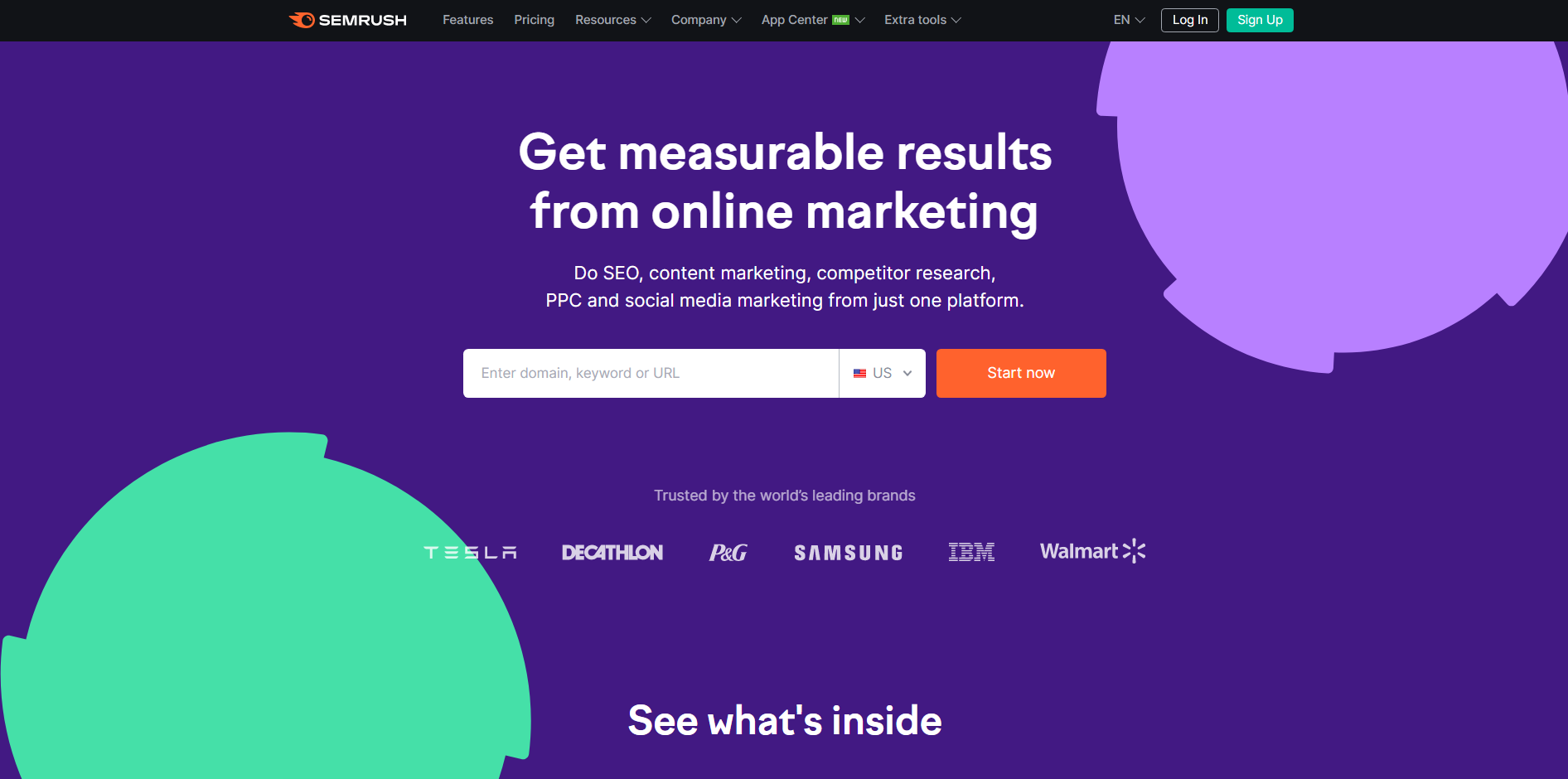
semrush, one of the best seo enterprise tools

Semrush is one of the most recognizable names in the SEO industry, and it’s easy to see why.

Its vast array of highly versatile enterprise SEO features will help solidify your digital marketing strategy. But don’t take our word for it. PCMag ranked it as “excellent.” And actual users on TrustRadius, have given it a cumulative score of 9 out of 10.

Features

With the Semrush enterprise SEO platform, you get immediate access to 55+ nifty tools that have been carefully designed to accomplish various tasks, such as:

  • Keyword research – It helps you find the best and most relevant keywords. Next, filter them according to search volume, difficulty, and others. You can also see which keywords your competitors are ranking for.
  • On-page SEO – Run a website audit to spot issues so you can fix them immediately. It also tells you how to improve the SEO score of your site pages to improve their rankings.
  • Competitor analysis – Find out how much organic traffic your competitors are getting. Also, monitor how the competition leverage paid search and social media to their advantage. Then use the gathered data to help you make better marketing decisions.
  • Content marketing – Brainstorm content topics and create optimized content for each. Then manage your content strategy by filling out your editorial calendar with these topics.
  • Local SEO – Automatically distribute your business data to reputable local online directories. And optimize your Google Maps listings for local search.

Pricing
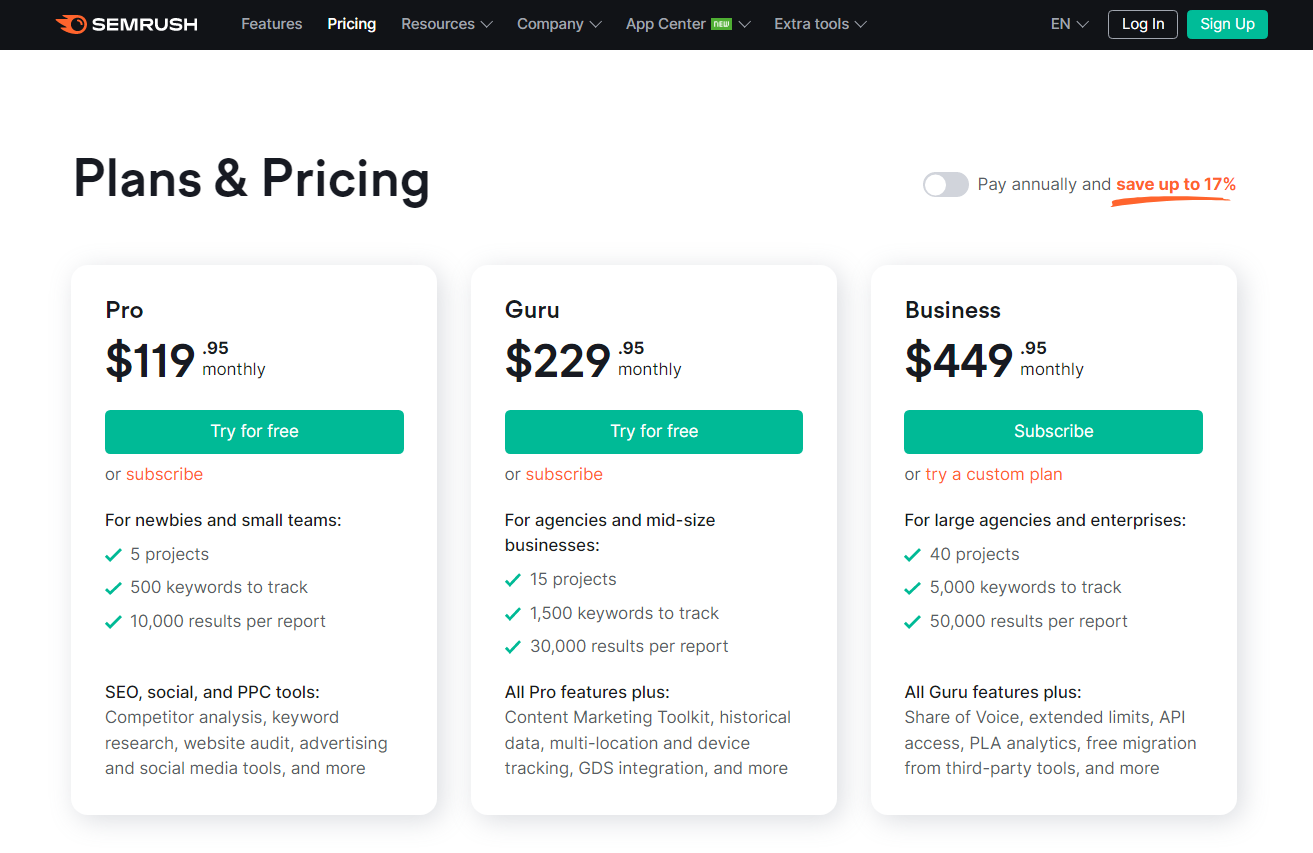
semrush pricing

Subscription to Semrush starts at $119.95/month. The enterprise SEO Business plan, priced at $449.95/month, is available to large enterprises and agencies. It includes 40 projects, 50,000 results per report, and 50,000 keywords to track.


Frase
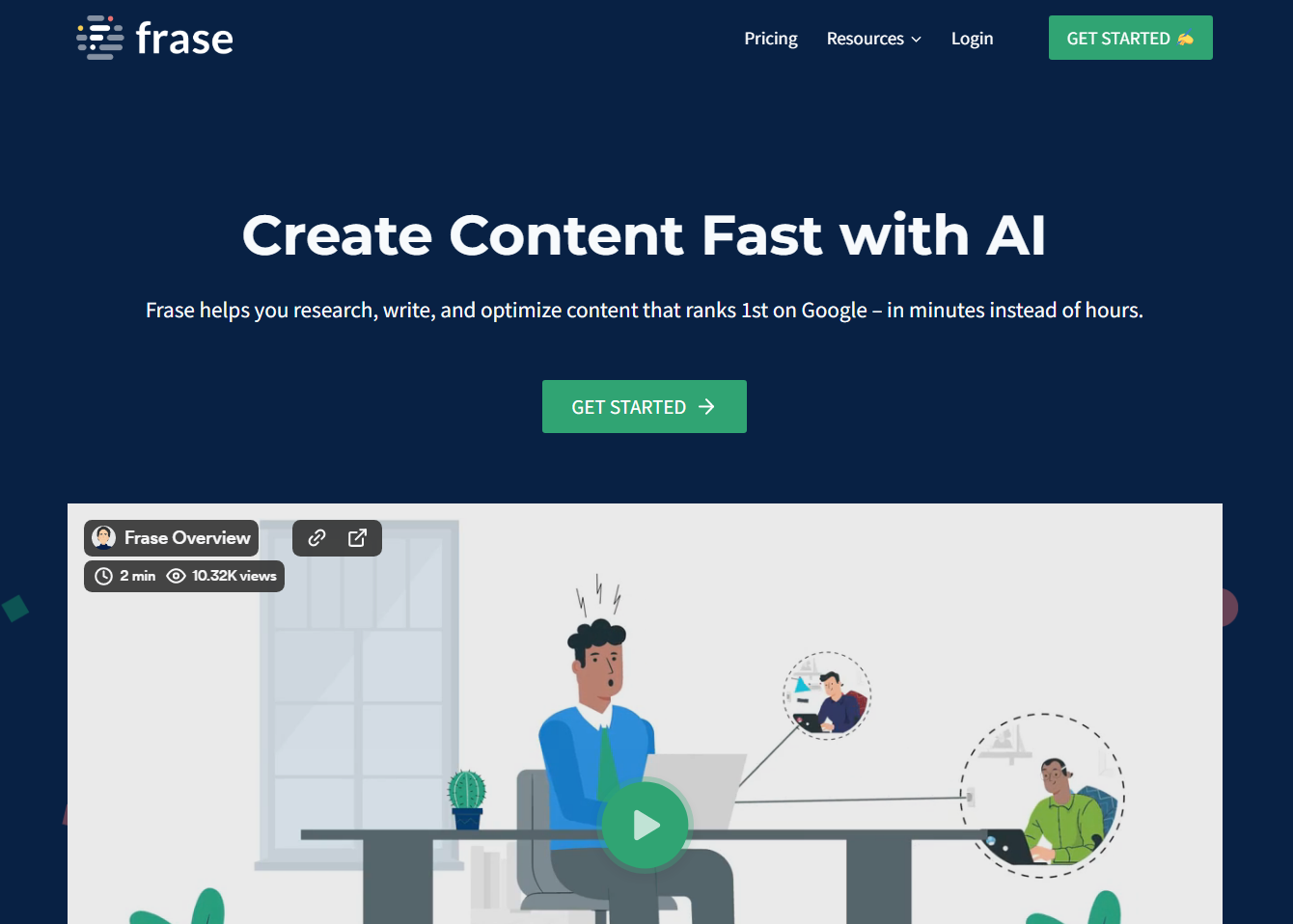
frase homepage

Frase is an AI-powered enterprise-grade SEO platform allowing content creators to create briefs and optimize content quickly and easily.

This enterprise SEO software also helps content teams create SEO-focused content in half the time. This is because its AI content features expedite the research, writing, and optimization process for you.

Features

Frase helps teams amplify the effectiveness of their enterprise SEO efforts with these features:

  • Question research – Frase removes the need to spend hours researching questions on Reddit, Quora, forums, search engines, and other resources. You type in a keyword, and Frase returns a list of questions within seconds.
  • AI-generated content briefs – Unwilling to spend copious amounts of time creating briefs? Don’t know how to create a content brief? No problem! Frase can automatically create a content brief based on your search queries in seconds.
  • Templates – Frase offers various templates to help expedite the writing process. These include Content Brief, Best Post, Listicle, Alternatives, and more.
  • Answer engine – Frase Answers is a chatbot that helps deliver content to site visitors asking questions on your website. It crawls and analyzes all your site’s content and shares them as answers to their questions.

Pricing
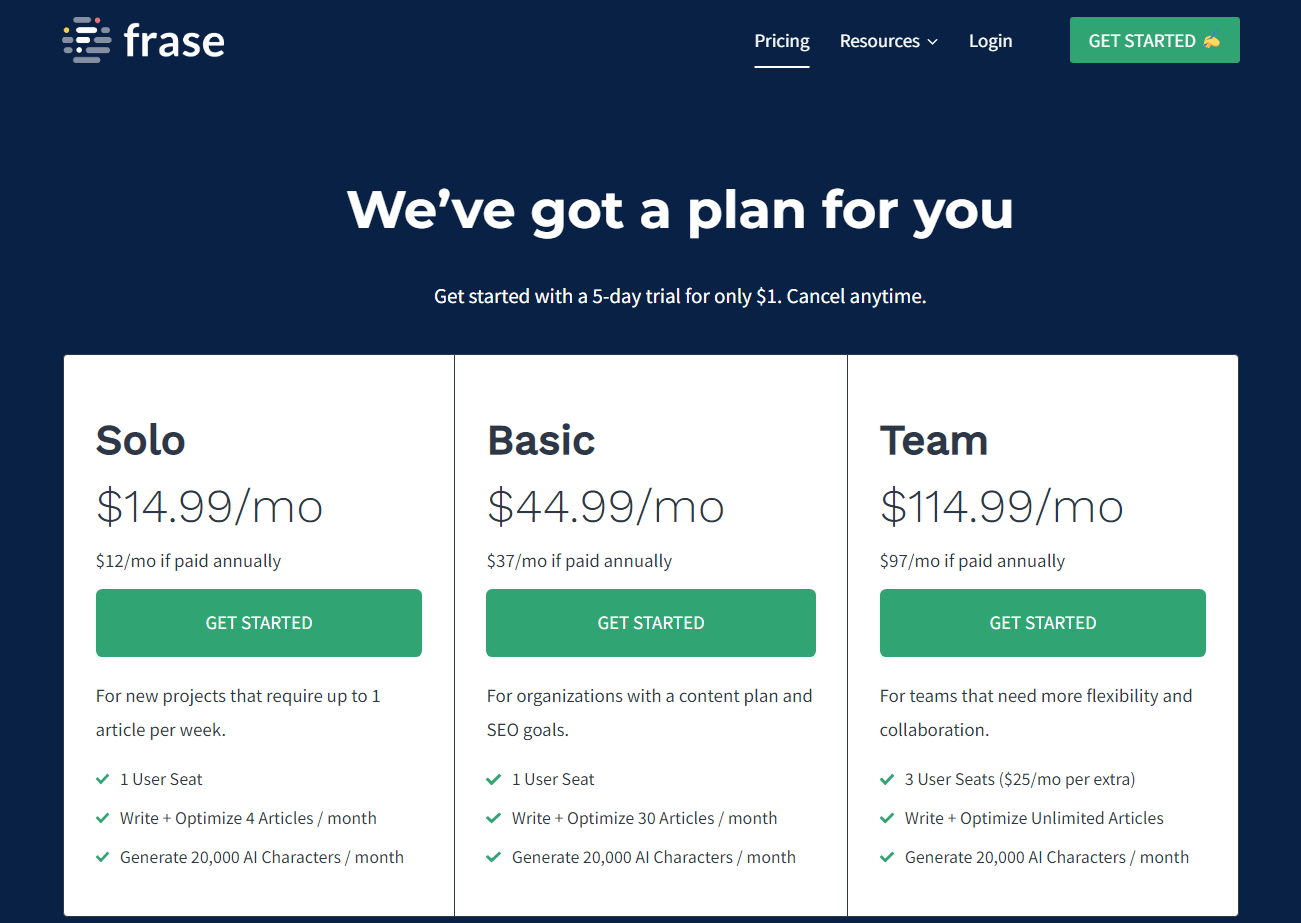
frase pricing

Frase has three pricing tiers. All three include an AI writing plan that can generate up to 20,000 characters per month:

  • Solo – $14.99/month, one user seat with the ability to write and optimize four articles.
  • Basic – $44.99.month, one user seat with the ability to write and optimize 30 articles.
  • Team – $114.99/month, three user seats with the ability to write and optimize unlimited articles. Each extra user seat is an additional $25/month.

You can also get the Pro add-on for $35/month to unlock more features, such as:

  • Keyword search volume
  • Search engine results page (SERP) data enrichment
  • Unlimited access to the Frase AI writer

MarketMuse
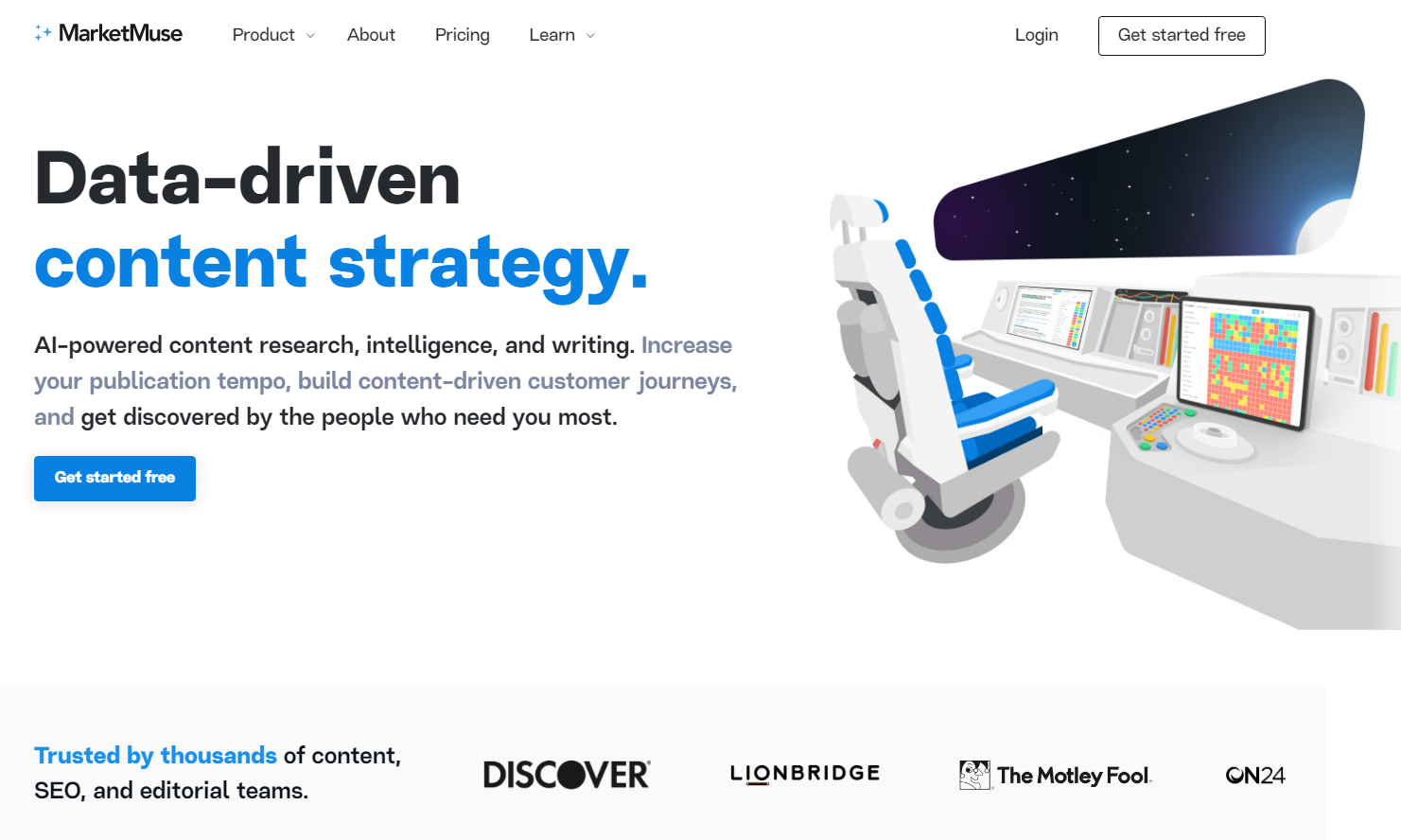
marketmuse homepage

MarketMuse is an enterprise SEO platform that boosts website ranking in search engines through data-driven content optimized for your target audience. It uses patented artificial intelligence (AI) technology to accelerate content research and development.

Features

To help your SEO team create remarkable content, MarketMuse offers the following features:

  • Automated inventory collection and audit – You can automatically collect, organize, and analyze your pages for better accessibility.
  • Content metrics – MarketMuse offers AI-powered metrics such as Authority, Content Score, User Intent, and Personalized Difficulty. These help enterprise SEO and content teams identify and leverage the best content opportunities.
  • Content briefs – No more guessing which types of content get the most search traffic. With MarketMuse’s content briefs, your team can confidently produce comprehensive content that addresses user pain points.
  • Optimization – With MarketMuse’s AI-powered text editor, content creators get real-time feedback on content quality and how well they cover a topic. This way, you produce content that search spiders would want to index.

Pricing
marketmuse pricing

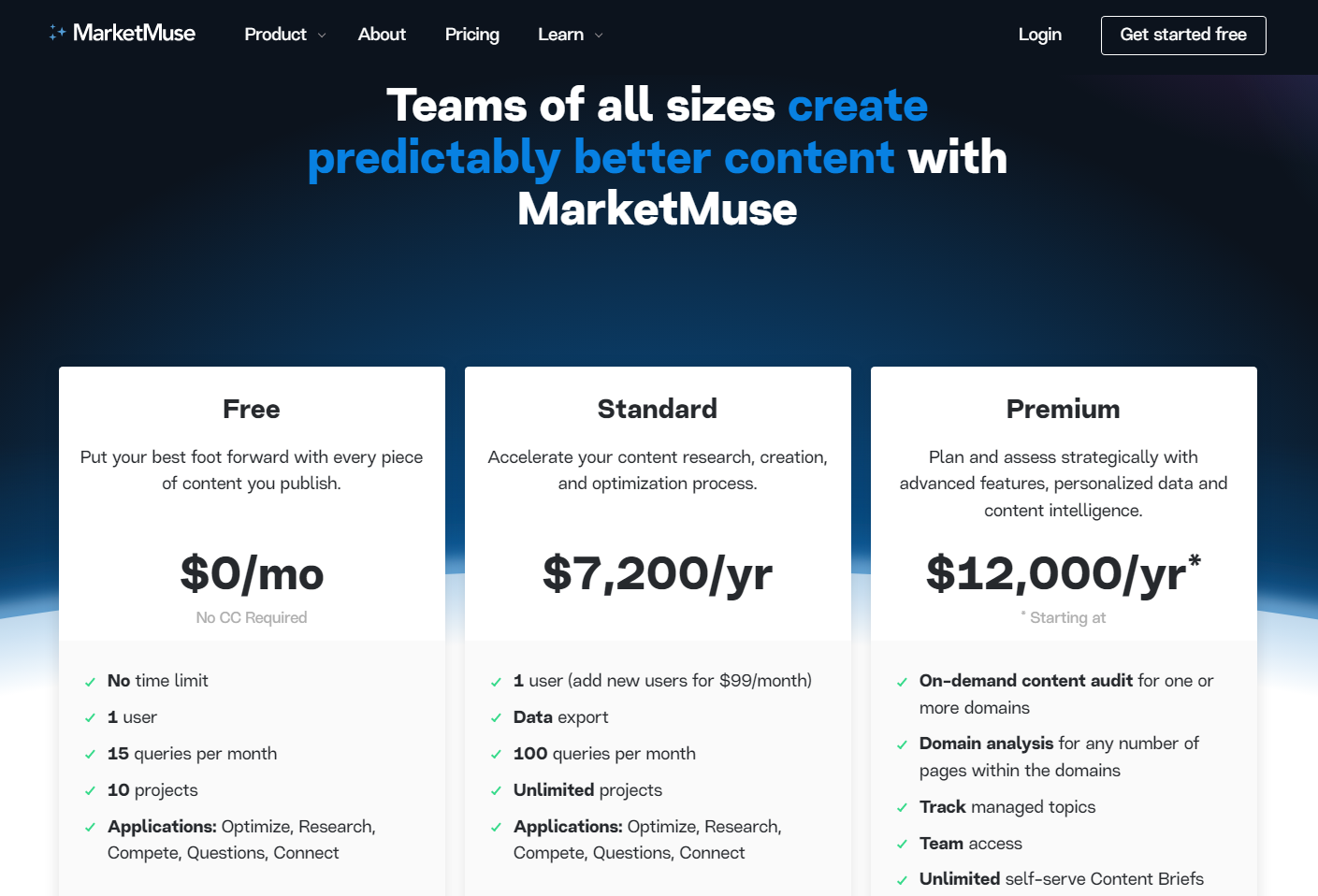
MarketMuse has three subscription tiers. And Optimize, Research, Compete, Questions, and Connect are available applications for all tiers.

  • Free – At $0/month, one user can execute 15 queries per month and work on 10 projects. A query happens whenever you enter a URL or focus topic into a MarketMuse application and press “Run.”
  • Standard – Priced at $7,200/year ($600/month), this subscription plan allows one user to export data, perform 100 queries per month, and complete an unlimited number of projects. Each additional user costs $99/month.
  • Premium – This plan starts at $12,000/year ($1,000/month). It comes with on-demand content audit capabilities, managed topics tracking, domain analysis, unlimited queries, unlimited projects, a dedicated account manager, and workflow/platform training for teams.

Botify
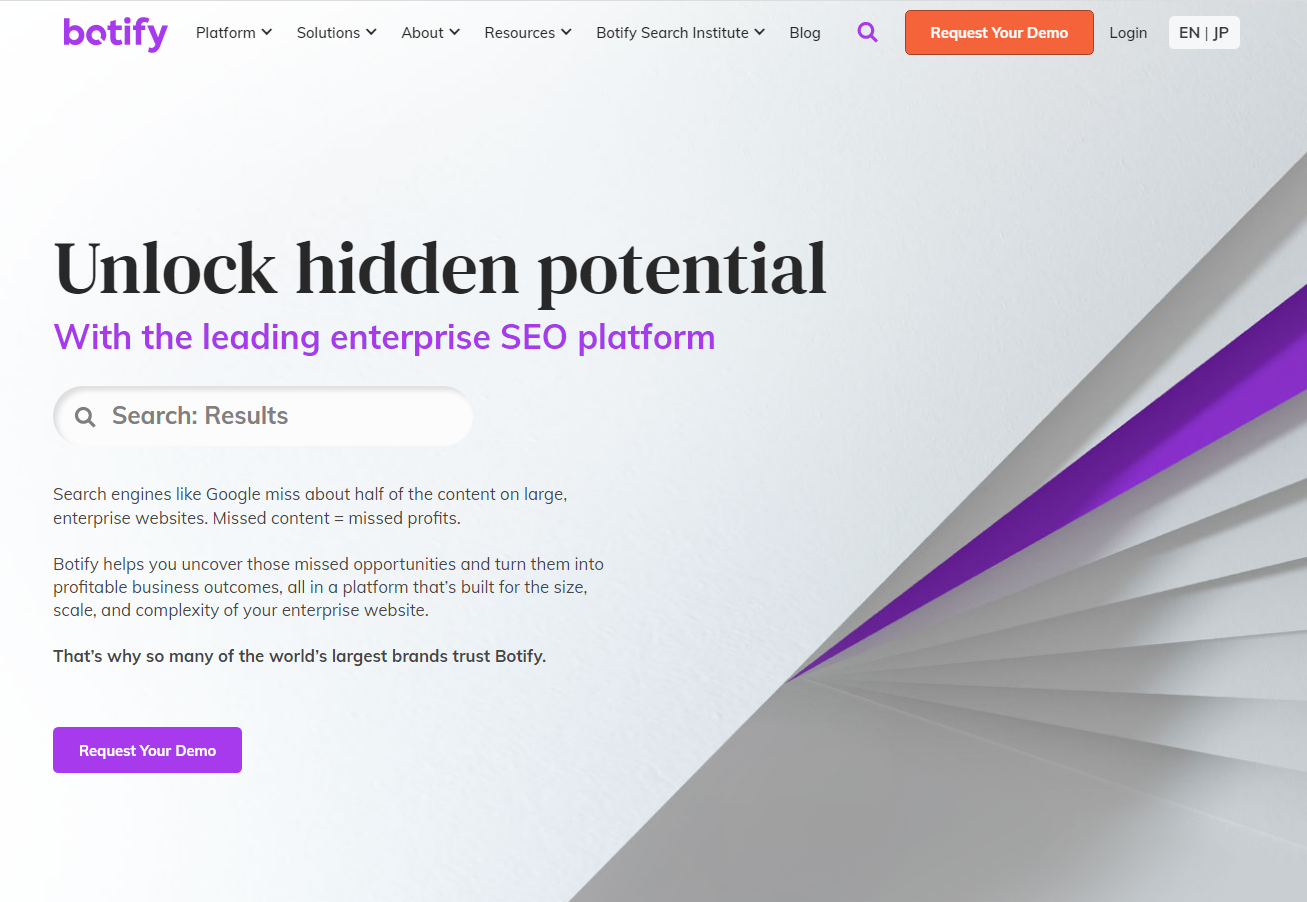
botify homepage

Botify is another enterprise SEO platform worth considering. It enables executives, content teams, and technical SEO professionals to prioritize the SEO tasks that yield the most impact. It can be leveraged for various use cases, including:

  • Keyword research
  • Keyword tracking
  • Site migrations
  • Mobile SEO
  • JavaScript SEO
  • Content analysis

Features

Botify offers essential enterprise SEO features that can maximize the potential of your online assets:

  • Botify Analytics – All the data you need about your websites from various search phases—crawl, render, index, rank, and convert—is available here. There’s also an option to import log files for additional crawl insights. From here, you can analyze your site’s bounce rate, conversions, and other SEO metrics.
  • Botify Intelligence – Powered by machine learning, the tool lets you identify technical SEO and content opportunities prioritized by impact. It also has an early warning system for catching SEO issues before they become real problems.
  • Botify Activation – Faster, autonomous implementation of SEO initiatives such as quick and easy submission of new and updated pages. This allows for faster content indexing.
  • Professional Services – Need help making the most of Botify to power your SEO strategy? You can tap its SEO professionals for various enterprise SEO services, such as site migration, understanding how JavaScript impacts your website, and more.

Pricing
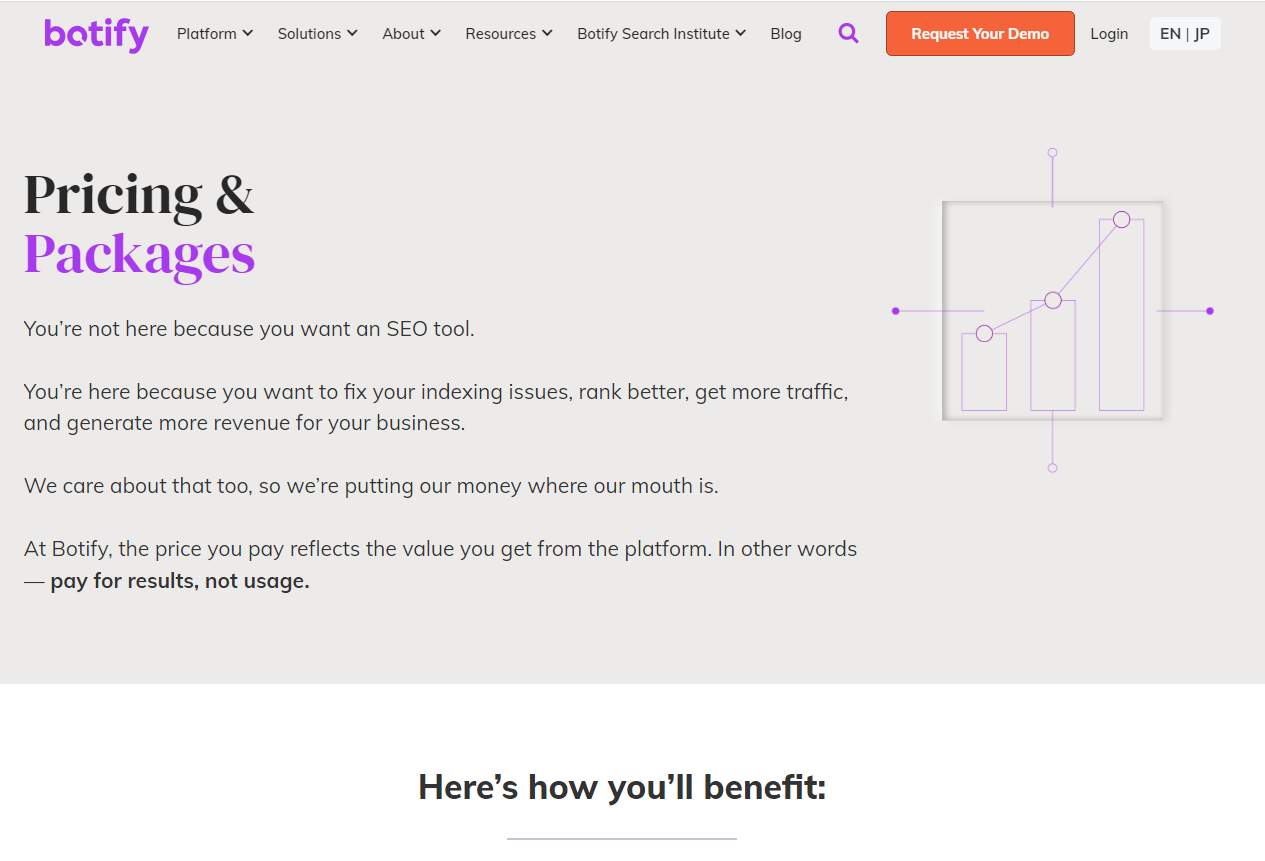
botify pricing

Botify offers three subscription plans:

  • Essential – For websites that want end-to-end SEO data plus prescriptive recommendations for better performance
  • Pro – For organizations that get the bulk of their revenue from organic search
  • Enterprise – For organizations with complex, large, or multiple websites

Botify doesn’t list pricing on its website, as each package is unique to each customer’s needs. Reach out to their sales team for a custom quote.


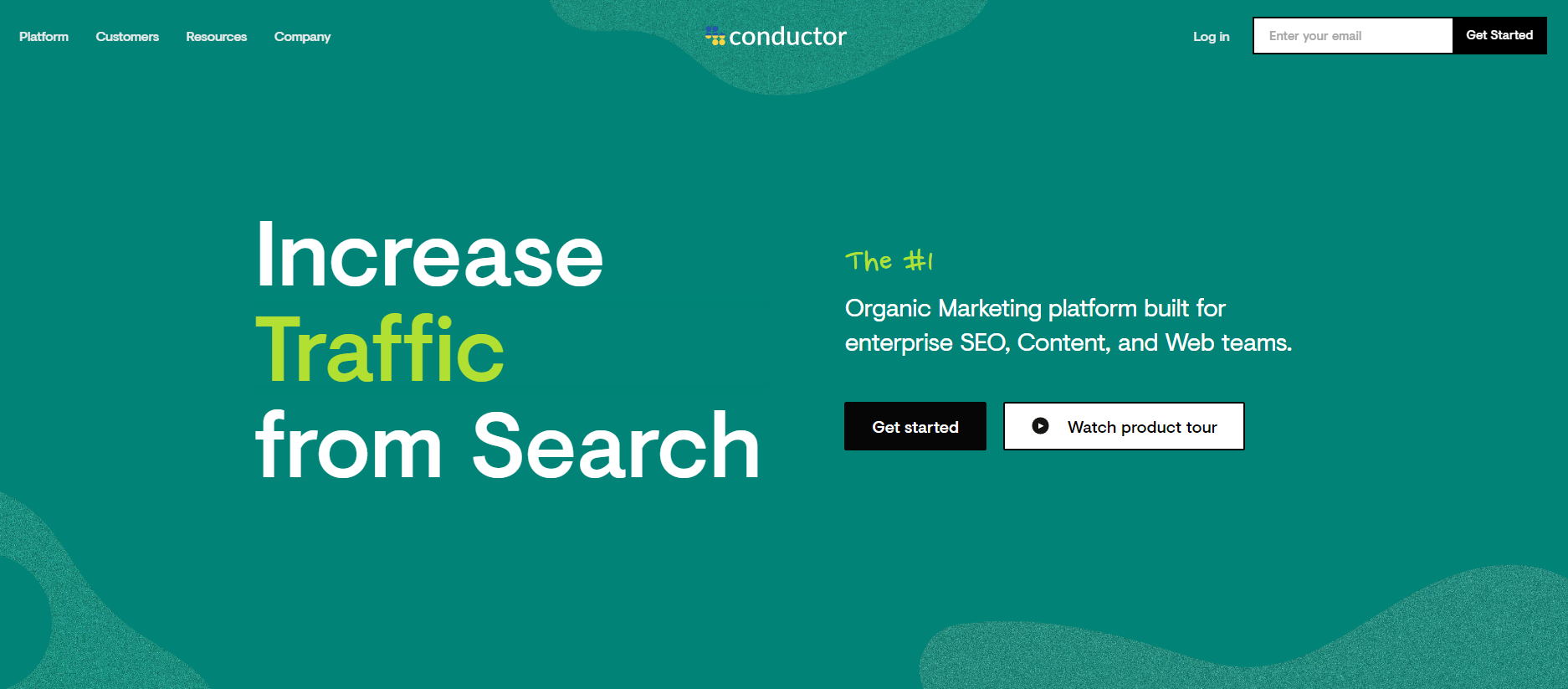
Conductor
conductor, one of the best seo enterprise tools

Built for enterprise SEO, web, and content teams, Conductor tracks search and content performance. It is a search engine optimization tool that integrates with a wide range of technology tools, including:

  • Analytics tools such as Google Analytics and Adobe Analytics.
  • Project management platforms such as Asana.
  • Consumer intelligence tools like Talkwalker.
  • Other SEO tools, such as Semrush.
  • And so many others!

Features

This enterprise SEO software offers powerful features such as:

  • Keyword explorer – Helps with research into keywords (organic and paid), topics, demographic insights, audience sentiment, competitive research, social insights, etc.
  • Content guidance – Provides AI-powered recommendations for creating content that resonates with your target audience.
  • Digital presence tracking – Monitors the visibility of your digital assets across channels. This includes search engines, social media, press coverage, owned content, and earned media.
  • Technical SEO – Assists with ensuring your website is technically sound and provides the best user experience possible. Choose between ContentKing or Lumar for real-time technical monitoring.
  • Chrome extension – Free SEO tool that delivers advanced SEO intelligence about any page. Insights include page fundamentals such as metadata, media, technical SEO, and many more.

Pricing
conductor pricing

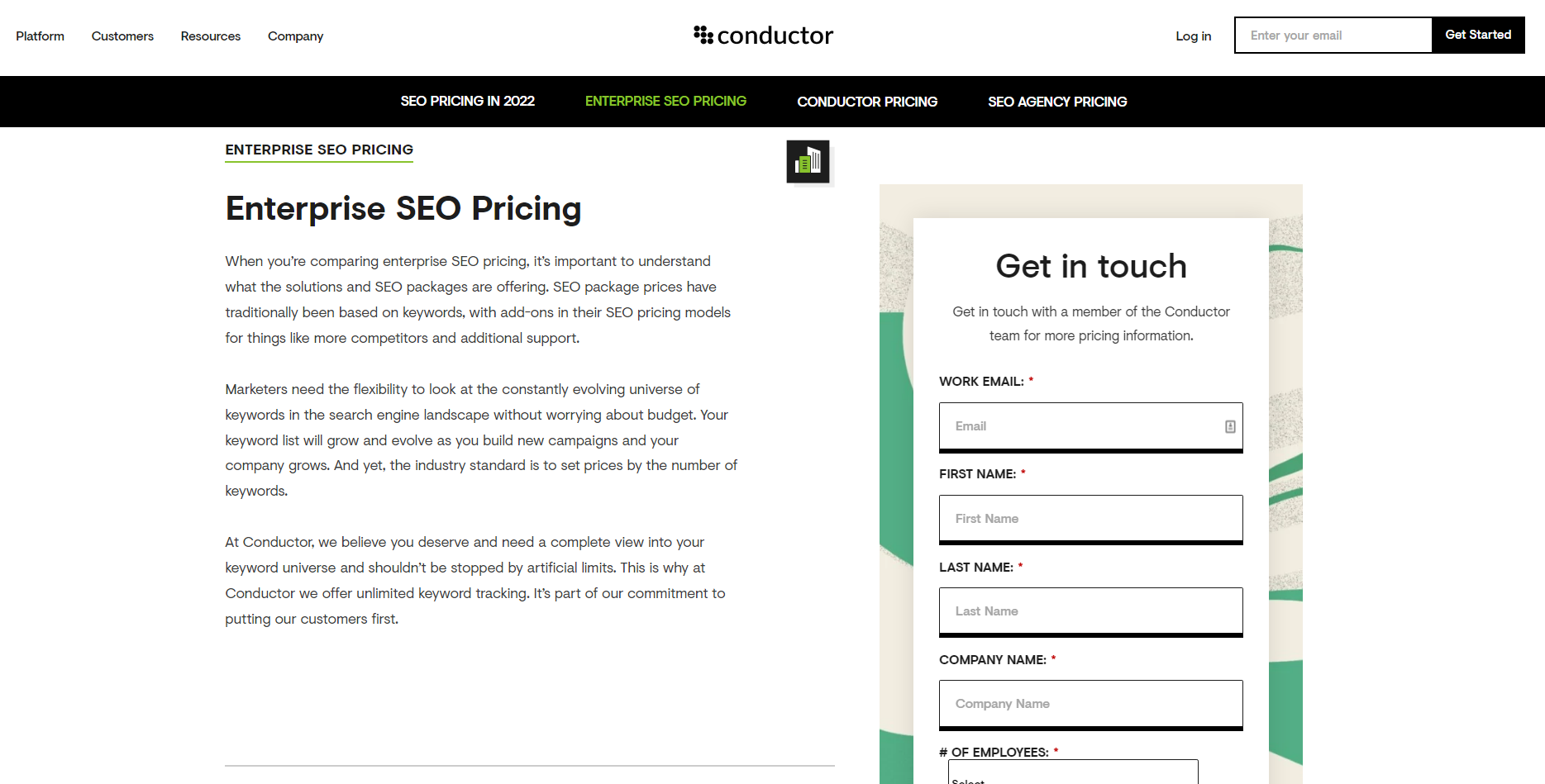
Conductor builds unique enterprise SEO subscription packages according to your needs and budget. Contact their sales team for a custom quote.


BrightEdge
brightedge homepage

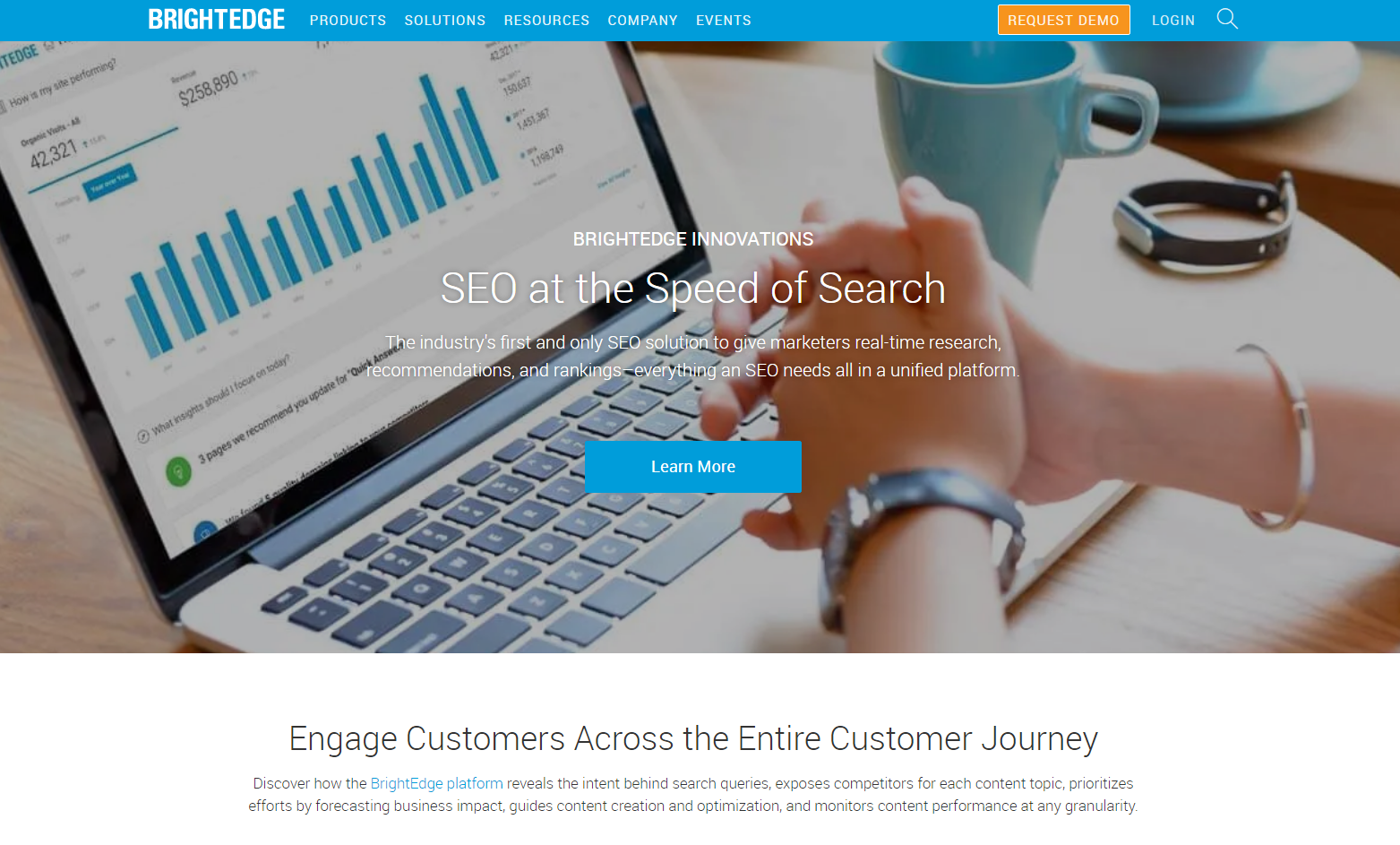
BrightEdge is a comprehensive enterprise SEO tool offering an impressive set of features from search, content, social, and local. It provides SEOs and digital marketers with the actionable insights necessary to boost website visibility and increase search traffic.

Features

This enterprise SEO software provides the tools your SEO team needs to more effectively and quickly optimize website content. Below are other things it can do:

  • Demand discovery – Create a list of target keywords that delivers the best results. You can then determine which search queries generate the most organic traffic to your site.
  • Content creation and optimization – Receive SEO suggestions on boosting content relevance and visibility. And you can monitor existing pages for potential errors and fix them before they become critical issues.
  • Content performance prediction – Identify which content type ranks for a search term before writing it. Then estimate the impact of your content initiative so you can better prioritize tasks and campaigns.
  • Results measurement – Generate website performance reports to help communicate to stakeholders for high-value keywords and best-performing content.

Pricing

Pricing information is not available on the BrightEdge website. Call their sales hotline to get a custom quote.


Linkdex
homepage of one of the best seo enterprise tools, linkdex

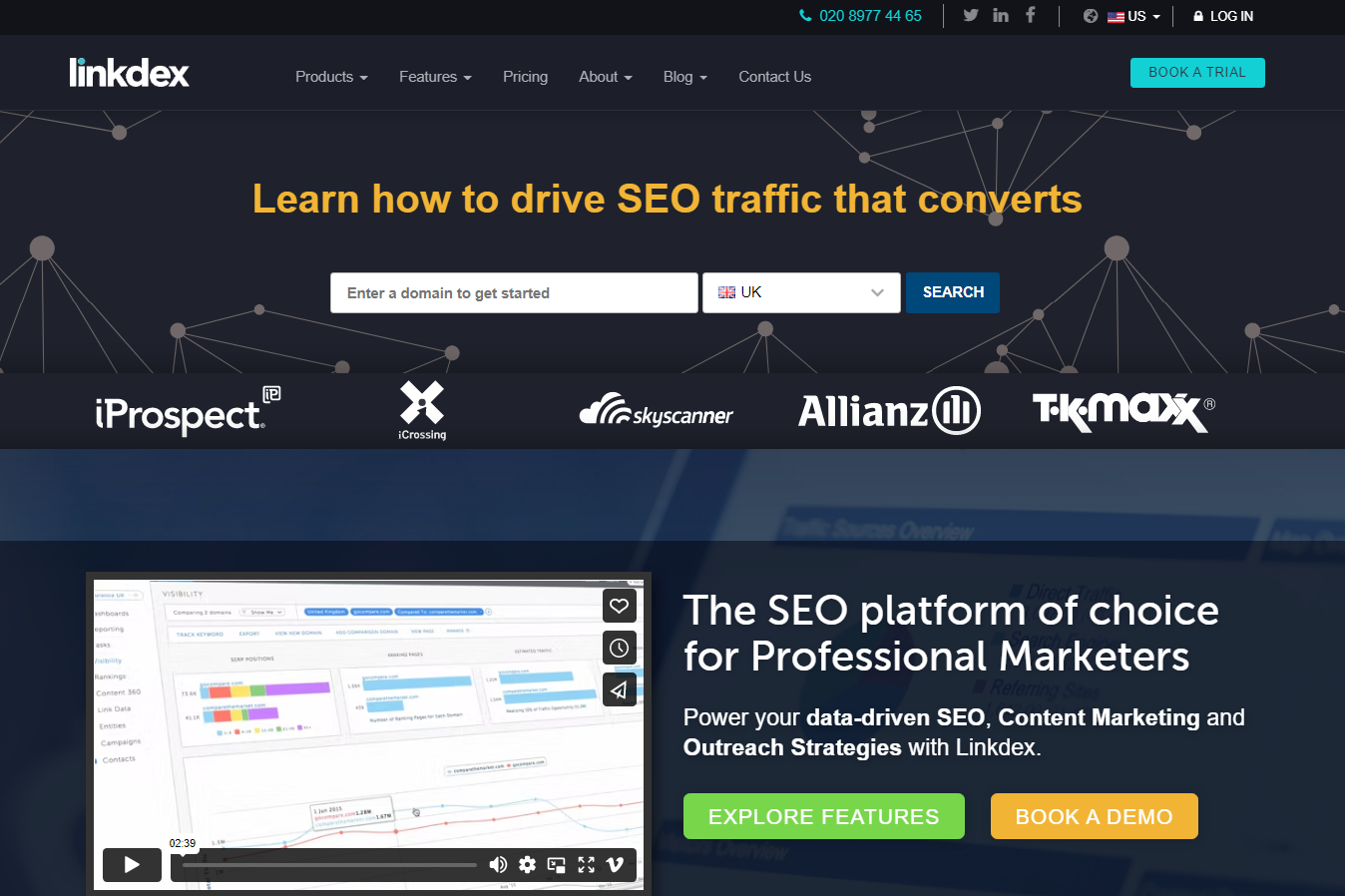
Another enterprise SEO tool that deserves its place on this list is Linkdex. It aggregates insights from various channels like search engines, social networks, and influencer marketing. This way, all the data you need is available via a centralized enterprise SEO platform.

Features

Linkdex carries many features to help enterprise SEO and marketing teams maximize their SEO efforts. These include:

  • Visibility and crawl analytics – Compare multiple domains using domain and keyword filters. Crawl thousands of pages, even your competitors, to uncover performance issues and opportunities to optimize your pages.
  • Ranking intelligence – Get better insights into your (and your competitors’) keyword rankings. Then analyze the search traffic value and ranking of any page to gauge how you’re faring against competitors.
  • SEO reporting and forecasting – Using Linkdex data, create smart, insightful SEO reports with just a few clicks. Next, turn data into smart forecasts to better communicate your content marketing and SEO efforts.
  • Author discovery – Using targeted keywords, find influencers and the people behind high-ranking content. Reach out and build relationships with topical influencers to boost your website’s authority.
  • Content strategy – Comb through various SEO data like technical SEO, analytics, social, rank, and link. This way, you can create content that’s highly shareable and link-worthy.
  • Smart SEO alerting – Create custom alerts through email or in-app so you know immediately when to take action. Fix lost or broken links, investigate significant traffic drops, enact appropriate changes, etc.

Pricing
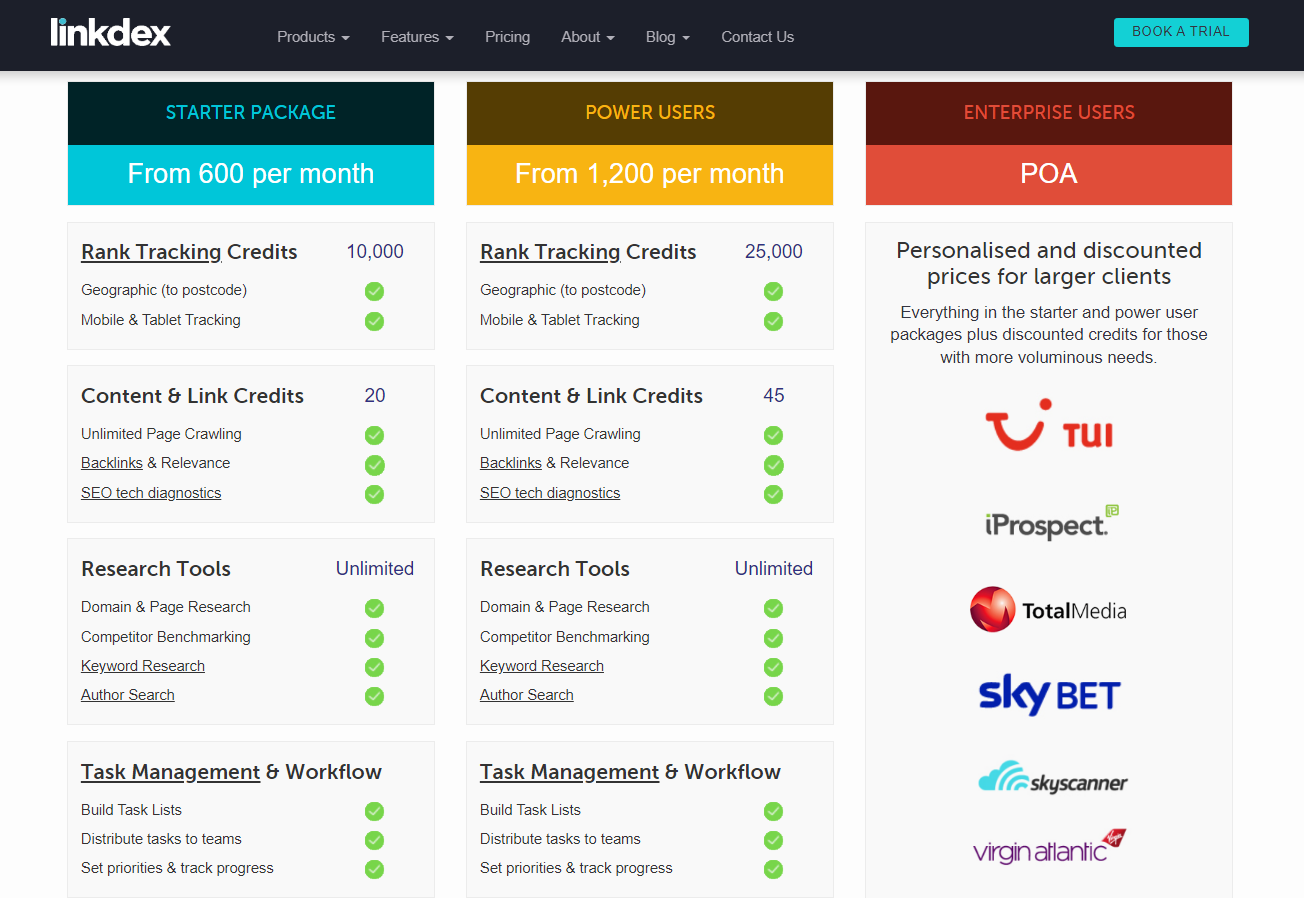
linkdex pricing

Linkdex offers three subscription plans:

  • Starter Package – For $600/month, you get 10,000 rank tracking credits and 20 content and link credits. Linkdex SEO tools for research, task management, and workflow engine are also unlimited.
  • Power Users – This plan has the same features as the Starter Package but with more credits. It includes 25,000 rank tracking credits, 45 content, and link credits. Starting price is $1,200/month.
  • Enterprise Users: Discounted custom plans are available for enterprise users. Contact the sales team for more details.

Pitchbox
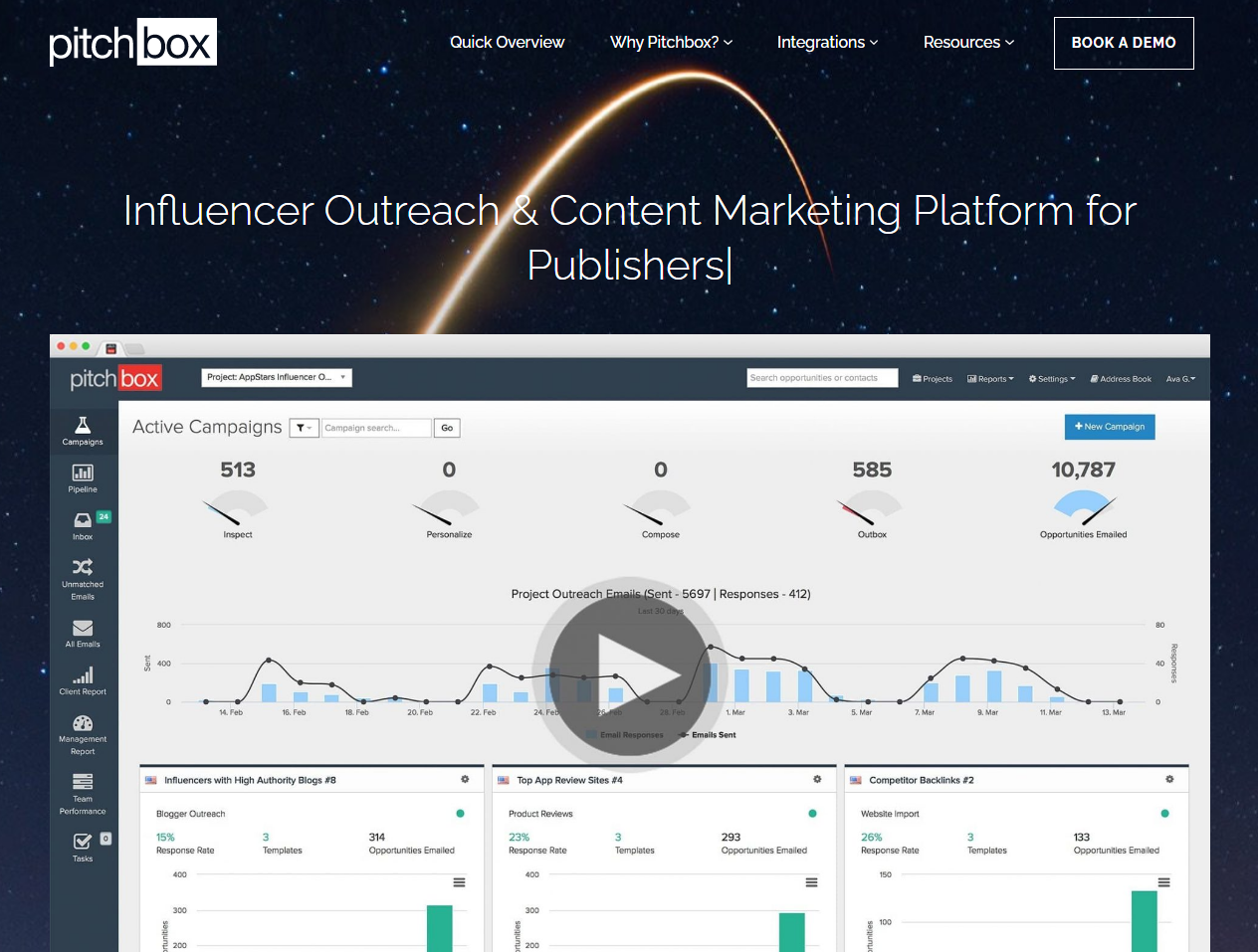
pitchbox, the best link building tool among the seo enterprise tools in this list

Looking for an enterprise SEO platform to help you build quality backlinks, boost visibility, and increase credibility? Then, Pitchbox is for you.

Pitchbox is an email outreach platform for building backlinks using various link building strategies more effectively.

It’s an end-to-end link-building and prospecting tool that increases team productivity.

Features

Pitchbox enables enterprise SEO teams to build links at scale through the following features:

  • Prospecting – Take advantage of built-in targeting and prospecting features to identify the best link building opportunities in less time. Find relevant blogs and articles in any niche. You can also import domain lists and other data from other SEO tools.
  • Outreach and follow-up – Reach out to prospects at scale using smart templates. You can also schedule your messages and follow-ups to reach prospects’ inboxes at the right time. This way, you receive more responses and close more deals.
  • CRM – Aggregate all link-building and prospecting data and information in one place. Segment leads by relationship status, SEO metrics, age, etc. This allows you real-time visibility into your pipeline, making it easier to turn opportunities into wins.
  • Reports – Pitchbox reports provide deep-dive insights into the performance of your campaigns and how they’re progressing. Track team activity and identify monthly, quarterly, and yearly trends.

Pricing
pitchbox private demo page

Pitchbox doesn’t provide pricing details on its website, but some review sites say plans start at approximately $500/month. Contact their sales team for more information and a private walkthrough.

Quattr
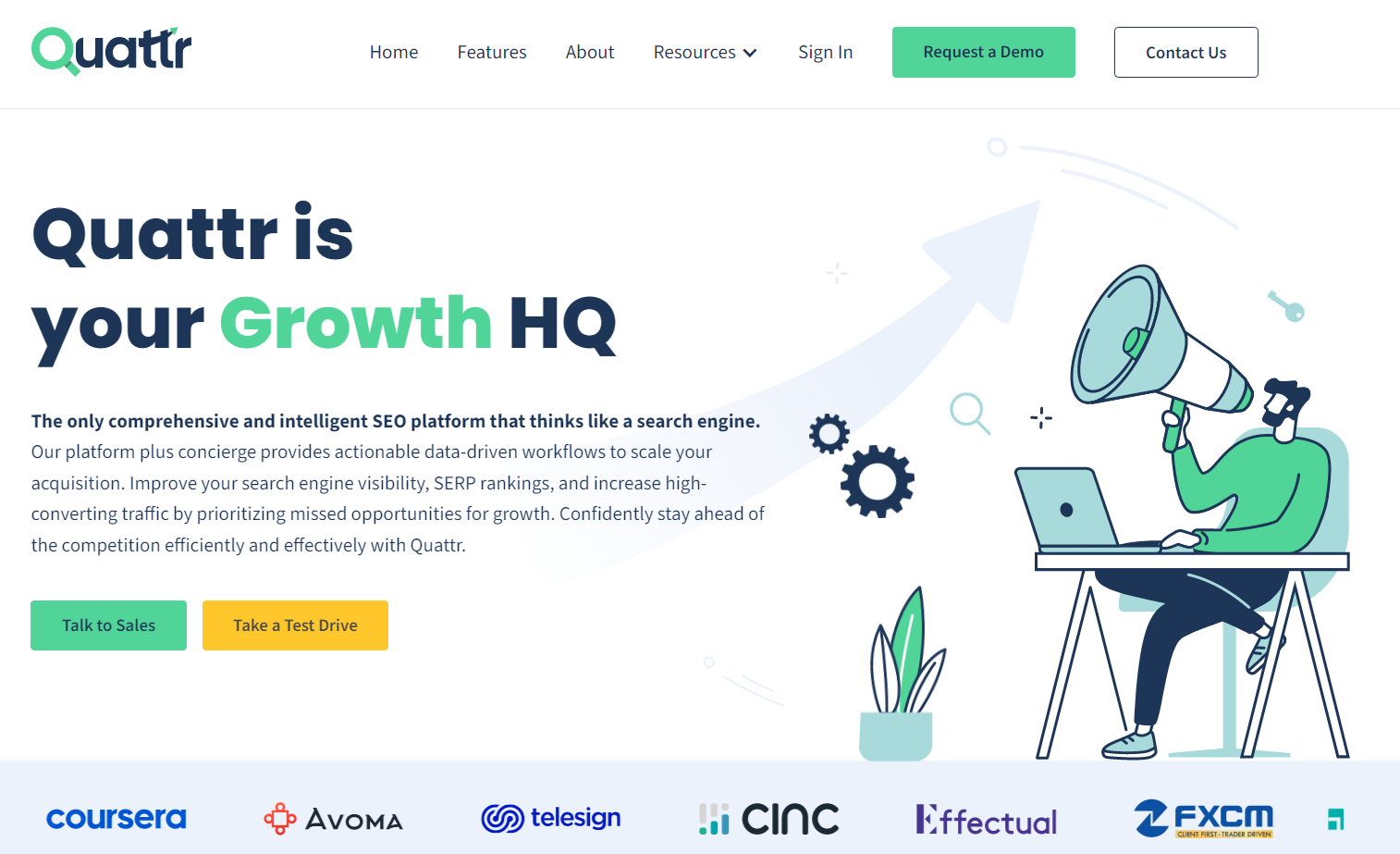
quattr homepage

Quattr is an AI-driven enterprise SEO tool that empowers digital marketing teams. With it, they can leverage data-driven SEO insights to boost their search rankings and capture highly targeted traffic.

If you need help maximizing the tool’s power, Quattr’s SEO Concierge team is available for personalized consulting.

Features

Features you get when you subscribe to Quattr include:

  • Competitive trends – Quattr identifies which pages on your website are underperforming and provides optimization suggestions. It gives you real-time visibility into your market share and how much traffic competitors are getting.
  • Ranking factors – This enterprise SEO platform tracks your site’s ranking based on various SEO factors. Plus, it shows how you’re doing against competitors. And if you identify any problems, you can fix them directly from the Quattr platform.
  • Prioritized keyword recommendations – Quattr’s recommendations let you optimize your content to rank them higher in SERPs. You can then preview how your changes improve your site’s search performance. If the results are positive, only then should you implement them.
  • Usability recommendations – Unlock the technical insights necessary to improve your site. To do this, fix any issues surrounding accessibility, performance, and mobile-friendliness.

Pricing

Quattr has not provided any pricing details. The amount you pay will vary greatly depending on your enterprise SEO requirements. Contact their sales team for more information.

SearchMetrics
searchmetrics, one of the seo enterprise tools to look out for

Another notable contender on this list of enterprise SEO tools is SearchMetrics. It helps enterprises:

  • Identify market opportunities to increase sales from organic search using actual data from the search engines.
  • Build comprehensive plans tailored to boost search engine rankings and visibility.
  • Implement and monitor those plans.
  • Perform competitor analysis for benchmarking and outranking them.
  • Track performance and tweak as needed.
  • Create reports for management to justify SEO spending (and get funding increases, if necessary).

Features

The SearchMetrics Suite allows organizations to take control of their search revenue via features such as:

  • Research Cloud – Run a competitive analysis to identify content gaps and factors enabling winning content. Then launch real-time ranking performance monitoring and search visibility auditing to uncover more SEO opportunities.
  • Content Experience – You can create topic-aligned briefs to help write your content. Refer to its real-time Content Score to further optimize your content. There’s also Topic Explorer, a WordPress plugin to help you identify the topics people are searching for.
  • Search Experience – Enterprise SEO users like yourself can track top-performing keywords and ranking dips and analyze URL performance and competitor search features.
  • Site Experience – This web crawler alerts you and other enterprise SEO agencies to risks and opportunities for improving site performance.

Pricing
searchmetrics quotation page

The SearchMetrics website doesn’t provide pricing details. A PCMag review, however, says their plans start at $69/month. But this was from 2019, so the amount may no longer apply. Contact the SearchMetrics sales team for more details.

seoClarity
seoclarity, one of the best seo enterprise tools

Last but not least on our list of market-leading SEO platforms is seoClarity. As its name suggests, it provides clarity and visibility into your SEO efforts through AI-powered insights.

It does the following:

  • Crawl data
  • Deliver ranking and search demand insights
  • Provide content optimization recommendations
  • Perform technical SEO analysis
  • One-click automated SEO execution
  • Create and send automated reporting

Features

Get the following features and capabilities when you subscribe to seoClarity:

  • Daily rankings – Manage site performance on organic search by knowing where your site ranks for its target keywords. You can also find insights on securing the Google featured snippet to position your website on top of SERPs.
  • Technical and on-page optimization – Crawl pages to identify and remedy site errors. Analyze log files to get the bigger SEO picture about performance, rankings, and search bots. From here, you can optimize your web pages to improve their crawlability and indexability.
  • Insights from real-time analysis – Leverage advanced AI analysis to help you provide actionable items. You can also compare your sites with competitors based on SEO metrics to benchmark their performances. Finally, determine if you have a healthy link profile through constant link analysis and monitoring.
  • Content ideas and gaps – Identify content gaps and opportunities using People Also Ask datasets. From here, you can write compelling, authoritative content to answer their questions using seoClarity’s AI writer.

Pricing
seoclarity pricing

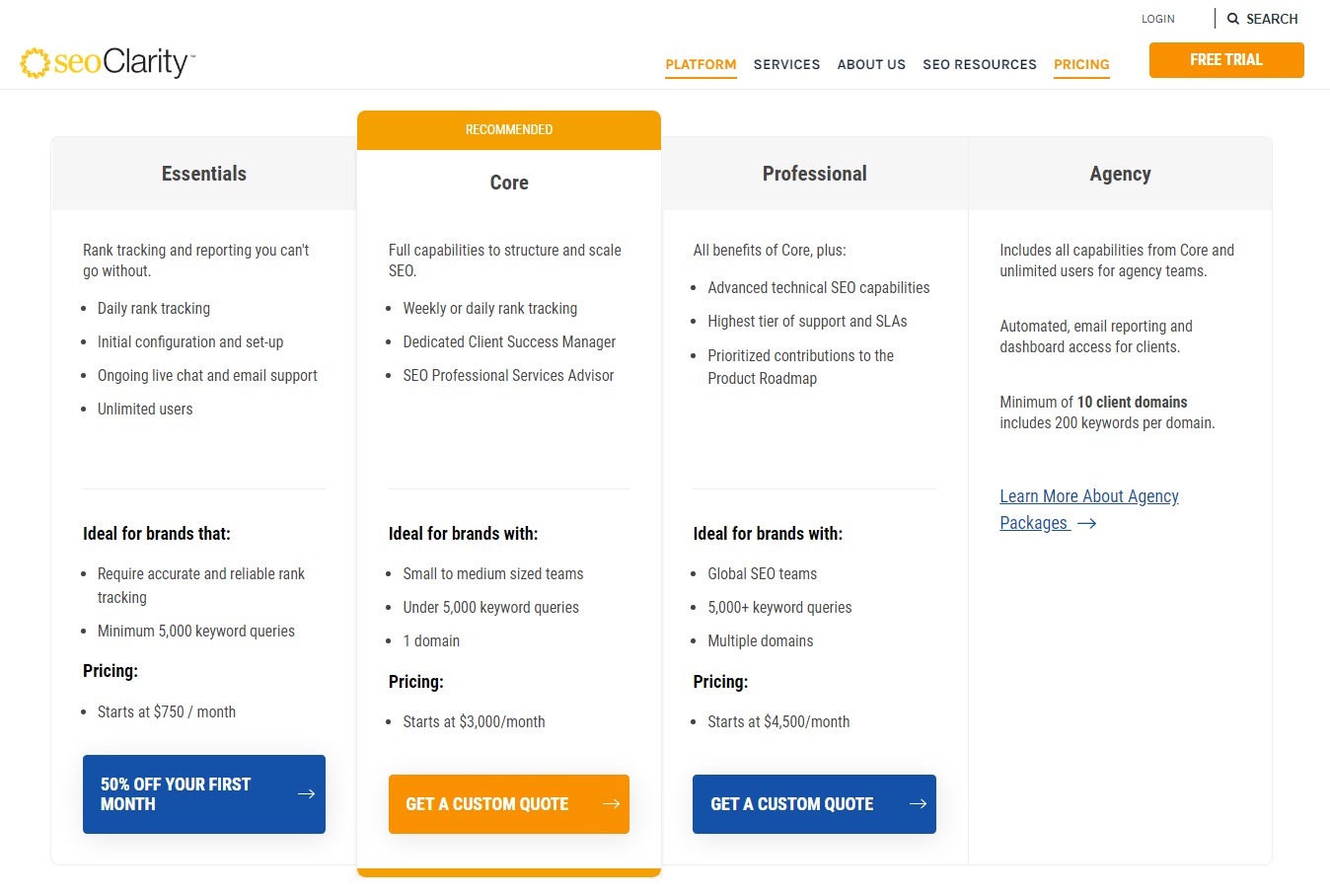
seoClarity offers multiple subscription options:

  • Essentials – Price starts at $750/month. Essentials provide daily rank tracking, live chat, and email support.
  • Core – Price starts at $3,000/month. Core offers daily and weekly rank tracking, a dedicated success manager, and an SEO advisor.
  • Professional – Price starts at $4,500/month. It gives you everything Core provides, advanced technical SEO tools and the highest level of support.
  • Agency: This subscription tier includes all the elements of Core plus an unlimited number of users. Get a custom quote by contacting the seoClarity sales team.

How to Choose an Enterprise SEO Tool from the List Above

There’s a lot of feature overlap among the SEO enterprise software above. This makes choosing the right one for your corporation much more difficult.

But to help with the selection process, below are the things you must do:

Determine Your Needs

Start by looking at what you expect from an enterprise SEO platform based on the needs of the business. Create a list of all the features you want, the must-haves and nice-to-haves.

Any vendor that doesn’t offer the features your SEO and digital marketing strategies can’t live without is not a good fit.

Schedule Demos with Applicable Vendors

Once you’re ready with a shortlist of vendors, it’s time to schedule demos. When on the demo call, ask questions if something isn’t clear. And be sure to watch out for the following:

  • Presence of critical features.
  • The vendor’s understanding of your marketing and business needs.
  • Ease of use.
  • The type of after-sales support you’ll be getting.

Negotiate Contract

Enterprise SEO software providers generally don’t advertise that they’re amenable to negotiating contracts.

Not only can you get the best pricing and discounts for multi-year contracts. But you can also negotiate the support facilities available, warranties, backups and recovery plans, service level agreements (SLA), etc.

Which Among the Enterprise SEO Tools do I Recommend?

So there you have it—our list of some of the best enterprise SEO platforms on the market today.

And since we know you’re expecting us to suggest a tool or two, here are our top picks:

  • Semrush: It’s an all-in-one solution and, therefore, ideal for large SEO and content teams. Plus, it’s a household name in the SEO industry—meaning it’s reliable.
  • Conductor: Want high-performing content? Take Conductor with you. Most tools on this list help drive content that converts, but Conductor’s ability to integrate with various business tools makes it stand out.

As mentioned above, however, the needs of your business come first. Determine your must-haves and choosing the best fit should be smooth sailing.

By Christopher Jan Benitez

Christopher Jan Benitez is a professional freelance writer who provides small businesses and startups with content that aims to grow their engagement and conversion with their audience. To learn more about Christopher, you can follow him on Twitter.

Sourced from Niche Pursuits

By Alison Coleman

Being an entrepreneur can be overwhelming and all-encompassing, with an ‘always on’ working style that pulls them in multiple directions, answering the phone, sending emails and managing their social media. All the while, some of the most crucial business tasks end up unfinished. Some apps and tools can help focus the mind and boost productivity, but some entrepreneurs have discovered their own ways of staying focused in business.

Ditch the multitasking

The ability to multitask, performing two tasks simultaneously, or switching from one task to another, is a skill often held in high regard, especially among entrepreneurs. But according to Sarah Knight, founder of the Mind The Gap Business Academy, multitasking is a myth that should never be a badge of honour.

She says: “There’s something called the switch cost effect. Switching from one task to another incurs a cost in your attention and focus, as you have to switch your brain off from one thing to another.”

By focusing on one task at a time, whether it’s responding to emails or doing business accounts, and focusing on only that one thing, you’ll be more efficient and more productive. “By reducing your load, you are achieving and setting yourself up for success,” adds Knight.

Stand up to the task

One way of enhancing productivity and reducing mental fatigue is to use a standing desk, as revealed in a study by the BMJ. Paulomi Debnath, jewellery designer and founder of Handmade by Tinni, uses hers to help her focus. She breaks up her work schedule with regular intervals of standing, especially when on Zoom calls or presenting. She says: “I try to stand and work for 30 minutes followed by a one-hour interval. When I’m on my feet, I’m less relaxed, which helps me focus on the task. I also feel more energetic and less stressed. However, I prefer the relaxed mode that comes with sitting when doing my jewellery design, which is more intricate work.”

Plan ahead

Sarah Willingham, CEO of Nightcap PLC, has found the perfect solution to keep her focus; creating a pie chart every year and dividing up her time to show where she is currently and where she wants to go. The former Dragons’ Den dragon and serial investor and her husband came up with the idea as a way of looking at how they were spending their time and ensuring they had the balance right.

“We start in January, reflect on the year before, and think about the year ahead,” she says. “We may want to do more exercise or learn a new skill, so we will out the pie chart accordingly. You need to put in a sensible amount of time for work which will show the direct impact what you choose to do has on everything else. It’s a great way of maintaining the right balance and looking at what you need to change, and it helps me to keep focused.”

Take the plunge

The thought of a daily cold water swim may not be everyone’s idea of a great start to the day. Still, Matt Connelly, founder and CEO of laundry service firm ihateironing, finds the short sharp shock keeps him centered, focused and calm, especially when under pressure. He says: “A cold water swim has an incredible effect on the body and the mind. It takes a lot of willpower to get into a freezing pool first thing in the morning and then a lot of endurance to keep going. After a swim, I feel calm and centered for the next few hours, which helps me be focused at work and get the important tasks done.”

Make a list

Creating a to-do list is one of the simplest ways of working out what needs to be done and in what order, allowing the list maker to write the tasks down, carry them out and cross them off the list one by one. It creates a sense of control and provides a clear plan that can be followed, a key to solid focus. It’s a method favoured by Lewis Raymond Taylor, CEO of The Coaching Masters.

He says: “Each week, I make a list of everything that needs to be done in order of priority and delegate what I can, which leaves me with the most important, high-level tasks that will make the biggest difference in the business.” He segments the most critical income-generating tasks and goes large with them, which could mean him spending a whole day filming video content, in meetings with the team, or planning business strategy.

Stay tuned

Many people say that background music helps them focus on their work, but unless it is the right sort of music, it can have the opposite effect. Listening to music allows Richard Mabey, cofounder and CEO of lawtech firm Juro, to increase his focus and do good, deep work. His preferred background music is movie scores.

He says: “There are two advantages to this; the tracks are longer, so you don’t have a change every three minutes as you would with an album, and the music is generally a little less upbeat and consequently, for me, less distracting. I’m convinced that I owe my best work to Hans Zimmer mixes on YouTube.”

Feature Image Credit: Getty

By Alison Coleman

A freelance journalist, founder of Coleman Media. For the last 20 years I’ve covered business stories for national and international online and print publications, with a special interest in entrepreneurs and their startups. Away from business, I’m an accomplished ghostwriter: ‘Pure Dynamite – The Autobiography of the Dynamite Kid’, was a satisfying journalistic diversion. Follow me on Twitter @alisonbcoleman or see my latest work at www.alisoncoleman.co.uk

Sourced from Forbes

By

What are the best tips to make LinkedIn your champion marketing channel? Here’s your answer.

LinkedIn is “the place to be” for online professional networking. But why is that? Why do more than 830 million business professionals from over 200 countries use the platform?

There’s no simple answer, but there are a few foundational reasons to employ a LinkedIn marketing campaign: to grow your professional network, to identify high-quality leads, to drive targeted traffic to your website and to share thought-leadership content.

Knowing why you should use LinkedIn is a good start, but it’s only that. A generic approach isn’t likely to generate the results you’re seeking. You need to supercharge your LinkedIn marketing efforts, and here are three of the best ways to do so.

Ask your team for help

You can make a lot of noise on LinkedIn as a single person, but there’s no reason to stop there. Ask your team to get involved. As the most reputable and reliable advocates of your brand, they can expand your reach in just a few short minutes each day.

Ensure that all employees have updated their profiles to reflect their position at your company. Request that they follow your company page. Encourage them to share personal and brand-related updates. And of course, support them on their quest to provide value to their audience.

Another idea is to create a LinkedIn Group related to your industry. This is a win-win. It’s a place for your team to share news, guidance, and advice with interested parties, while also building an audience that you can use to your advantage in the future.

If resources allow for it, hire a dedicated employee or contractor to manage your LinkedIn marketing strategy. With a singular focus, this person can make a bigger impact in a shorter period of time. It’s not required, but keep it on your radar.

Consistently publish relevant, insightful content

A social network with so many users is sure to generate quite a bit of low-quality content, but you don’t want to be part of this group. Be part of the group that consistently publishes relevant, insightful and actionable content. That’s how you stand out from the crowd.

Creating engaging content is a trial-and-error process. It takes time to pinpoint your audience’s needs and find a cadence that works for you, so don’t jump ship too soon. It could take days, weeks or even months to hit your content-related goals for the first time.

Increase your odds of success by:

  • Consistently sharing content (1x/day, 2x/day, 5x/week, etc.).
  • Publishing unique (not rehashed) insights
  • Tracking what does and doesn’t work and adjusting accordingly

Also, keep in mind that publishing original content is only one piece of the puzzle. It’s good practice to engage with your audience in the comment section of their posts. Share your take, answer questions and — when appropriate — send direct messages to continue the conversation in private.

Don’t bite off more than you can chew early on. Start slowly to gain your footing and to better understand the wants and needs of your audience. As you settle in, ramp up content production without sacrificing quality. A slow and steady ascent is the best approach.

Get serious about analytics for your content

This one word — analytics — can be the difference between success and failure on LinkedIn. Creating content is only the start. Knowing what’s resonating with your audience is what really matters. This allows you to continually adjust your strategy with the goal of reaching a larger audience and boosting engagement.

You can view analytics for all types of LinkedIn content including short-form posts, articles, videos, images, polls and events. This includes data such as:

  • Engagements
  • Discovery
  • Impressions by demographics
  • Article performance
  • Video performance

These insights are needed to understand the impact your content has on your audience. Soon enough, you’ll have the data you need to determine what type of content generates the best response. You can then create more content that matches what’s worked to date.

While it’s important to get serious about analytics for your LinkedIn content, don’t let it cloud your vision. Know what matters most to you — such as making industry connections or generating leads — and create content that points you in that direction. Vanity metrics will make you feel good, but they don’t always have the intended impact on your bottom line.

Repurpose your LinkedIn content

The guidance above will help you supercharge your LinkedIn marketing, but it can do more than that. It’s a good jumping-off point for growth on other platforms and channels marketing professionals will use to their advantage.

Examples include repurposing the content for publication on Twitter and Facebook, using it as a foundation for blog content or sharing it with your email list via a weekly newsletter. When you repurpose content, you give it new life. And with that, you’re taking the steps necessary to establish your authority and grow your brand on other platforms.

By

Sourced from Entrepreneur

By David Finkel

As a business coach, I have witnessed a lot of businesses that started to thrive once they went to a remote-only format, but I have also seen an equal number of business owners really struggle with the change — and the difference between the two almost always came down to their management styles and management mindset. So today, I want to share with you a few things you can do to have a rock star remote team and keep everyone engaged and working toward the same goals for your business.

Hire the Right People

The first step to having a rock star remote team has to do with your ability to hire the right people. And what’s important to note here is that the right person for the in-person position might not be the right fit for your remote team — in fact, they often aren’t. The perfect remote candidate has some experience working remotely and is able to work independently and troubleshoot with minimal handholding. Again, this can vary by person and position, but those that thrive in a remote environment are often more comfortable working under these conditions.

Change Your Focus

The second principle of doing remote extremely well is to focus not on the tasks that your team is doing but on the value it creates. Let’s say you hire a new team member and you have a job description that lays out in great detail all the tasks and responsibilities they are supposed to take on. You are setting yourself up for failure. Instead of having a list of all the things you want them to do, you need to focus on the results you want that person to achieve. As in, “Here’s what you’re on the payroll to actually accomplish. Here’s what you are being measured on for success.” If all you’re focused on is the job description, you’ll end up someone who is responsive but who gets lost in activity.  And that could be OK, depending on the person, but it’s not optimal. You want someone who will look at the bigger picture and focus on the things that generate the results you want.

Create Transparency

The last mindset change that I want to discuss has to do with creating transparency within your business. This starts with changing your focus to one of value and continues with clarifying what everyone on the team is responsible for and how they fit into the bigger picture. Furthermore, you want to make sure that the action steps, project steps, and so forth, that each person needs to take to fulfill their role are very clear, so that everyone in your organization knows where you are. Project management tools are great for helping to create transparency and foster an easy way for people on your team to keep tabs and do regular updates. You want to move away from interactions between just two people and move it to where all of the relevant stakeholders can see the progress.

When it comes to doing remote extremely well, you need to have the right team, the right focus, and you need to create transparency. With those three things in mind, you are set up to get the results you want and everyone can reap the benefits.

Feature Image Credit: Getty Images

By David Finkel

David Finkel, Author, ‘The Freedom Formula: How to Succeed in Business Without Sacrificing Your Family, Health, o

Sourced from Inc.

By Joshua Hawkins

A Paris-based startup has created a genetically engineered houseplant that can literally clean the air within your home. The plant builds off the natural purifying properties that houseplants already offer. So, while it adds some colour to whatever room you put it in, it’s also actively keeping the air cleaner than 30 houseplants can together.

The company, called Neoplants, modified both a pothos plant as well as its root microbiome to pump the plant’s natural air-cleaning properties up quite a bit. Called Neo P1, the genetically engineered houseplant recently hit the market, and you can purchase it right now.

Plants can offer quite a bit to your home. Not only can they boost your mood and help reduce anxiety, according to researchers, but they can also clean the air thanks to their natural air-purifying properties. With this genetically engineered houseplant, though, you’re getting more than that basic level of purifying. In fact, Neoplants say that the Neo P1 is 30 times more effective than the top NASA plants.

But how exactly does this genetically engineered houseplant work better than an air purifier? Well, for starters, plants are better equipped to handle volatile organic compounds (VOCs), which are highly reactive chemicals found in cleaning supplies, building materials, paints, and the list goes on. VOCs are notoriously terrible for human health and can cause irritation in the human body.

houseplants
Houseplants provide natural air purification qualities to your home. Image source: DimaBerlin / Adobe

While air purifiers can help, they don’t typically tend to completely neutralize these harmful compounds, which means they aren’t ever truly removed from the air. See the problem? But plants like this genetically engineered houseplant are better equipped to neutralize VOCs, which is why having houseplants in your home can help improve the quality of the air within it.

Neoplants started with the pothos because it’s one of the most popular plants in North America. But, the job wasn’t easy, as the company had to completely map the pothos’ genome itself, something that a molecular biologist and the chief technical officer at the company equated to building a plane while flying. (via Inverse) As a result, the genetically engineered houseplant is better equipped to eliminate VOCs.

Additionally, Neoplants say that the air-purifying effectiveness of the houseplant is the only thing the company touched. It doesn’t grow faster, and it isn’t anymore resistant to pesticides than normal pothos plants. The genetically engineered houseplant will retail for $179, making it more expensive than most typical houseplants.

But, considering it also acts as one of the best air purifiers out there, the price is pretty justifiable.


By Joshua Hawkins

Sourced from BGR

By Arielle Garcia

Ad industry stakeholders play a key role in abating data-based discrimination, argues UM Worldwide’s Arielle Garcia as part of The Drum’s Data & Privacy Deep Dive.

In a recent report, the Interactive Advertising Bureau aptly asserts that the “looming peril” facing the industry is regulation and not the third-party cookie deprecation that has held a fixed place on marketers’ agendas for nearly three years.

Recent headlines have been dominated by social platforms’ restructuring actions following disappointing earnings, several of which vaguely cite the challenging ‘macro environment’ – triggering speculation by industry experts on platforms’ reluctance to acknowledge the profound impact of Apple’s AppTrackingTransparency changes on their advertising business.

With five US state privacy laws set to be effective in 2023, the EU’s digital reform progressing via the Digital Markets Act and Digital Services Act, and sustained regulatory and enforcement momentum, the headwinds caused by Apple-induced signal loss are a harbinger for challenges that will impact all corners of the online ad ecosystem.

Yet, like platform-driven changes, regulation itself is a downstream symptom of a deeper root cause. It is one that EU lawmakers and regulators around the world, including the increasingly vocal and resourced US Federal Trade Commission (FTC) continues to expound: the risks to individuals and to society bred from the unchecked commercial data collection and use that underpins the online advertising industry – and sustains the business models of platforms that wield tremendous influence on the information economy.

The growth of data-based discrimination

The FTC held its annual PrivacyCon event on November 2 this year, featuring research across several of these topics ranging from consumer surveillance, children’s privacy, dark patterns, along with an entire panel focused specifically on adtech. A particularly salient presentation interrogated whether cookie-less solutions would indeed deliver on the promise of enhanced privacy. Among the findings of Patrick Parnham’s research is that alternative identifier solutions create dynamics that increase the likelihood that audiences syndicated to platforms for activation may “override existing targeting restrictions” – or the “loosely-enforced” platform policies purported to prevent targeting on sensitive data such as health information and prohibiting discriminatory targeting of opportunity ads like that which relates to a target’s housing, employment and credit data.

Put simply, this means that proposed solutions are at risk of leading to more – rather than less – data-driven discriminatory outcomes. The US Department of Justice’s recent settlement with Meta requiring the sunsetting of ‘Special Ad Audiences’ and fundamental changes to Meta’s ad delivery systems to mitigate disparate impact further emphasizes the real-world harms associated with these gaps in accountability.

This paradoxical outcome underscores the importance for marketers and the broader ecosystem to recognize the deeper challenge – one that is far more profound than what is traditionally associated with ‘privacy’ in the collective conscience of the industry.

The fundamental challenge is not about cookie banners or liability volleyball – it is about realigning incentives to foster accountability and to serve as a check on optimizing engagement and attention in exclusive contemplation of commercial outcomes, even where at the expense of societal and individual harms.

The call to action is about restoring trust in industry and institutions, promoting equitable access to opportunities, mitigating information asymmetry and algorithmic amplification of misinformation and disinformation, enabling personal autonomy, protecting liberty and safeguarding democracy.

For lawmakers, the task at hand is striking the right balance of protecting consumers and promoting innovation and competition in a healthy digital economy – while safeguarding individual privacy, human rights and civil liberties, preventing discriminatory data use and sustaining national security.

Establishing a new paradigm

Advertising is not the cause of these challenges, but making meaningful progress requires open and active engagement of stakeholders across the online advertising ecosystem. Advertising undoubtedly plays an important role in society; and of course, relevant advertising is mutually beneficial to brands and consumers alike. However, where unchecked, relevance can become a euphemism for discrimination and intrusion. Transparency and fairness are the fenceposts that separate personalization from manipulation, exploitation and the erosion of trust.

Preserving the benefits that the ad-funded web offers to society requires collaboration across the industry in the development of a new paradigm for data collection and use in which each party in the online advertising supply chain has unique responsibilities to fulfil.

Feature Image Credit: Adobe Stock

By Arielle Garcia

Sourced from The Drum

SEO is one of the most popular branches of online marketing today. And there’s a good reason for that – SEO continues to produce great results and the ROI is incredible, especially compared to paid media.

But with the growth of SEO, many businesses became interested in using SEO to grow their companies. With that interest came a challenge for agencies… How do you present the work you’ve done for your clients and which SEO metrics do you choose to showcase your success?

Having worked with hundreds of agencies, we know the exact SEO metrics you need to show your clients to prove that you’re getting them the results they seek. And in this article, we’ll reveal what those SEO metrics are!

Organic traffic

There are plenty of vanity metrics in SEO, but organic traffic is not one of them. Simply put, if your agency is doing its job well, your client’s organic traffic should be increasing steadily each month.

Of course, you should let your clients know that they cannot expect meaningful results after just one month of content marketing and SEO.

However, beyond 2-3 months, your clients will expect a steady increase in organic traffic and this is a KPI you should always include in your reports.

With the average conversion rate hovering around 2% depending on the industry, the difference between 10,000 and 100,000 website visitors can make a huge impact on your client’s bottom line.

It doesn’t take a marketing expert to know that more people on your client’s website usually translates to higher profits. This brings us to our next point.

Conversions from organic traffic

If you set up your SEO reporting tool properly, tracking this metric is a breeze. Clients want to know the immediate impact of SEO activities on their bottom line and this is the easiest way to show them that.

With each new conversion that came in from organic search and content marketing, you can show your clients the exact value and effectiveness of SEO as a strategy. The key here is to do two things.

One, set up proper attribution so you and your clients are on the same page when it comes to what a conversion is. Two, set up a baseline so you can compare organic traffic conversions compared to PPC, social media and other channels.

Keyword rankings

Even if your client knows nothing about SEO, they likely understand the value of ranking well for their desired keywords. Even without an SEO expert, they know well enough which keywords they want to rank for and which of them brings in new revenue.

First off, make sure to report on keyword movements for existing keywords, especially the money keywords that bring in conversions. If there are any movements at all, they’ll want to know about them.

Moreover, update your clients about the total number of keywords they’re ranking for. While not the ultimate SEO metric, this is a pretty good signal that your SEO and content marketing efforts are going in the right direction.

New and lost backlinks

If your client is fairly new to SEO, understanding the importance of backlinks for their website and SEO is crucial. Make sure to educate your client base about what a backlink is, how it influences search engine results and what differentiates a good from a bad backlink.

The problem that often happens with backlinks is that they cost a lot of money to do right. White hat link building requires lots of hands-on work and many times, there are hidden costs involved, such as paying writers, editors and people in charge of outreach.

When you want to report on backlinks, be sure to include both new and lost backlinks in your report, especially in correlation with new pages that are ranking. This is a surefire way to convince any client about the importance of backlinks for SEO and overall business growth.

Bounce rate from organic traffic

A bounce happens when a visitor lands on a page and leaves it without going any further or taking any action. A bounce in itself is not a bad thing, but it usually signals that the visitor found nothing of value on the page and decided to leave.

A bounce rate is a good signal that you need to work on your content and provide a meaningful, engaging experience for your visitors. Make sure the content is structured well, with plenty of internal links to help them move on to other pages on your website.

More importantly, a high bounce rate is a ranking signal for search engines such as Google. Your clients should be aware that a high bounce rate can significantly impact not just their rankings but also their revenue. This is a metric that belongs on every SEO report.

Page load speed

It doesn’t take much to figure out why a fast website matters in 2022 and beyond. A website that loads fast provides a great user experience and makes visitors want to stay and click through.

Your website page load speed is more of a technical website issue but it should be included in your monthly or weekly SEO report. If you see a sudden slump in page load speed, this means that there’s a technical aspect of your client’s website that needs to be addressed.

More importantly, page load speed is another major ranking factor for Google and other search engines. If a website takes too long to load, the visitor will bounce immediately after opening a link, resulting in high bounce rates and short session duration. The end result? Poor user experience and a drop in rankings.

Wrapping up

With so many buzzwords and mysteries surrounding SEO, focusing on what really matters can be difficult. And when you’re dealing with clients who have little understanding of internet marketing, you really need to be proactive and choose the metrics that make an impact and are easy to understand.

Mile Zivkovic is the Head of Content at Whatagraph, the ultimate marketing reporting tool for agencies and in-house marketers

Sourced from Jeff Bullas


By Jason Aten

Twitter has plenty of problems, but this isn’t solving any of them.

lon Musk has an interesting way of making sure the world knows exactly how hard he’s working. On Monday, he tweeted that he would be working and sleeping at Twitter’s San Francisco headquarters until the “org is fixed.” I guess he thinks the ultimate measure of dedication to your work is that you never leave the office–not even to sleep.

Maybe that’s just how Musk likes to work. Perhaps it makes him feel like he’s getting things done, or that there’s too much to do to waste time sleeping. After the chaotic last few weeks, I think he could use a good night’s sleep. It might help him reconsider a few of his worst ideas for the $44 billion toy he now controls.

It’s not the first time Musk has felt like it was important to make sure people know he sleeps at the office. When Tesla was trying to launch the Model 3, Musk said he slept on the factory floor during what he has described as the most difficult period of his life. I would agree that sleeping on a factory floor would be less than enjoyable.

The thing is, Musk seems to think that “working all the time” is the same as “making it better.” I think we can all agree that’s not always true. Doing lots of things is not necessarily the same as doing the right things. So far, I think many people outside of Musk’s inner circle would say Twitter is not “better” than the day he bought it.

Yes, Twitter was kind of a mess under the previous owners, and it has never been a particularly good business. It’s small, relative to its social-media peers, and it doesn’t make very much money (about $4 billion a year compared to Facebook’s $117 billion last year). But it wasn’t at imminent risk of going bankrupt, something Musk now says is on the table.

Perhaps Musk is trying to motivate Twitter’s remaining employees to double down on his vision for the company. The thing is, it’s not clear anyone has any idea what Musk’s vision is for Twitter. Aside from changing what seem to be Musk’s personal pet peeves with the platform, there is no coherent strategy to turn it into something better.

Musk has said the reason he wanted to buy Twitter in the first place was to fix the problem with bots and spam. Instead, he just sold a blue check mark to any troll willing to pay $8. Also — and this is the most important point — sleeping on the floor isn’t going to fix any of what’s wrong with Twitter.

Look, I think that there is a period in the life of every startup where the founder spends an unhealthy amount of time willing his or her company to survive by the sheer force of his or her own determination. They give up sleep and showers and eating because they are all-in on building a company. There is something admirable about the level of dedication and perseverance that comes with turning an idea into a business.

Twitter, however, is not a startup. It’s a 16-year-old company with a few thousand employees. And it’s now owned by the wealthiest man on earth. It might not be profitable, but it’s far from the sleep-on-the-floor stage. If Musk’s goal is to motivate his employees with a sense of urgency, he’d be better off rallying them around some kind of vision.

Actually, the thing that Musk could do right now to make Twitter better, both for the users as well as the people who work there, is to simply stop making it worse. Stop with the crazy timelines to ship features that haven’t been thought through to their logical conclusion.

Stop trying to recoup all of the money you blew on your new toy with one major change. Stop threatening to fire people if they don’t meet your unreasonable deadlines. Stop firing the people who actually understand how to run, well, Twitter.

The things that have gotten worse under Musk’s leadership are all in service of a problem he created. He’s tried a number of things–like selling the blue check–none of which have made Twitter any better, and none of which have actually worked to do what Musk says he wants to do, which is to generate more revenue to pay the massive amount of debt he took on when he overpaid for the company last month.

Also, there’s the fact that Musk is the CEO of three other companies, one of which is publicly traded, which means Musk has an obligation to shareholders. Spending all night playing with his new toy is probably not the best way to fulfill that obligation.

Fixing Twitter is a great idea. Sleeping on the floor until it’s fixed is a terrible idea.

Feature Image Credit: Getty

By Jason Aten

Sourced from Inc.

By Karthik Suresh

Good key performance indicators (KPIs) round out a technology product launch plan by providing concrete ways to measure the launch’s success. KPIs give you visibility into different aspects of your launch, including how you market the launch and how many sales you generate, so you can identify what worked well and what you can improve on.

Business Metrics

Tracking metrics that demonstrate how the technology product launch supports larger business goals helps prove the value of your launch to stakeholders outside of the product team.

1. Revenue: Unless you’re launching a completely free product, you’re hoping to turn a profit. And tracking revenue shows exactly how much money your launch generates. It also helps you predict future revenue, which can boost profits by improving financial planning. And sharing those insights with executives and investors will help them understand how your launch supports the financial health of your business overall.

2. Leads: Whether you’re launching a completely new brand or releasing a new product to an already existing customer base, you’ll generate leads from multiple sources. To get a full picture of your lead generation efforts, it’s important to track all of the channels that generate leads, including social platforms and paid Google ads.

3. Attach Rate: Your new product’s attach rate shows you the percentage of your existing customers who actually buy the product post-launch. A high attach rate is a good indicator that what you’re launching resonates with your customers. And if you can keep impressing customers, you’re likely to see success with future launches.

You can find a product’s attach rate by dividing the number of customers who buy the new product or adopt the new feature by your brand’s total number of customers. So, if a brand has 100 customers and 70 buy the newly launched product, the attach rate is 70%.

4. Audience Penetration: The percentage of your target audience who become customers is known as audience penetration. And the higher the audience penetration is, the more likely customers are to be loyal to your brand.

The basic formula to calculate audience penetration is to divide the total number of customers who buy your newly launched product by the number of people in your target audience. Then, multiply the answer you get by 100 to get a percentage that you can compare to industry averages.

Usage Metrics

Your launch is about more than just selling the new product—you want to grow your customer base and build loyalty that translates into a dedicated user base.

1. Activation Rates: A product’s activation rate is the percentage of users who sign up and actually become active users. What this looks like will vary depending on the product and your own definition of what makes a user “active.” To measure your own product’s activation rate, you’ll need to consider what the core action of your product is. The number of users who complete that action can then be considered “active.”

2. Retention Rates: Your launch isn’t truly successful unless a high percentage of original signups remain active well after the launch is over. To measure how many of your original customers you retain, you’ll first need to define a timeframe, like one year after the launch. Then, pull data from your CRM (or product analytics tool) to see how many of those original customers are still loyal to your product at the end of your defined timeframe. If your retention rate is high, you know you’re delivering an experience that customers are happy with.

3. NPS: A product’s net promoter score (NPS) is a simple metric that gauges customer loyalty and gives insight into the customer experience. Typically, brands collect this score by asking customers a single survey question: “How likely are you to recommend the product to a friend on a scale of one to 10?”

Brand Metrics

If you want to continue driving sales post-launch and set yourself up for success on future launches, you need to make sure you have a good reputation with customers so they continue to support your brand.

1. Awareness: Awareness refers to the percentage of people in your target demographic who know about your brand. When you assess awareness, you’re really trying to figure out how close you are to becoming a leader in your industry and making your brand a household name, like Nike is for athletics. To successfully gauge this kind of brand awareness, it’s helpful to break it into two types:

• Unaided awareness is the percentage of your target audience who recognize your product or brand when asked broader, open-ended survey questions, like “What are some brands that offer payroll software?”

• Aided awareness describes the percentage of people who recognize your brand or product when they’re directly asked a question like, “Which of the products in the following list do you recognize?” followed by a list of options that includes your brand.

2. Definite Purchase Intent: Identifying the number of shoppers interested in your product who will actually buy it once it launches helps you predict how successful the launch will be. And this can help you decide whether you want to invest more heavily in marketing to drive sales.

The basic survey methodology to measure this is a question that asks, “How likely are you to buy the product in the next 12 months?” with four options (definitely won’t purchase, unlikely to purchase, somewhat likely to purchase and definitely likely to purchase).

3. Social Media Mentions: People tag brands on social media for many reasons—to enter social media contests, ask for help or shout out a great customer experience. Whatever the reason, every time they tag your launch, they’re giving you free publicity by putting your brand in front of their own audiences. And the better your messaging connects with your target demographic, the more likely they are to tag your launch, use your hashtags and repost your content.

Companies tend to leave a lot of money on the table by not having a structured product launch process. By defining the launch metrics clearly, product and technology leaders can ensure their people and resources are focused on what’s important for the business.

Feature Image Credit: Getty

By Karthik Suresh

Co-Founder, Ignition. Read Karthik Suresh’s full executive profile here.

Sourced from Forbes

By Malcolm Harris

How social media, celebrity promoters, and banks looking for a quick buck transformed the markets.

In his 1910 book, Finance Capital, the Austrian-born economist Rudolf Hilferding introduced the idea of “promoter’s profit.” Unlike an industrial capitalist, the promoter harvests their gains not from the sale of a widget at a price above its cost but from the sale of promises — of claims to future profits. Hilferding saw the promoter as being particularly useful for selling stocks, to the benefit of big banks and others that managed those sales, and he predicted that corporate dividends would dwindle as the financiers captured an increasing profit share for themselves. For a promoter, being famous clearly helped. If you’re famous, someone will want you to promote their stock, and if you promote a lot of stocks, you might find yourself getting famous all on your own — as well as very wealthy. It’s an old tradition.

Finance Capital was received as a worthy update to Marx, and Hilferding became a leading voice on economic policy for the German left in the Weimar period, rising to finance minister. An Austrian Jew by birth, he died in Gestapo custody, but his predictions were harder to kill. Soon after Hilferding’s book, Charles A. Lindbergh helped define the modern celebrity, starting with the inaugural transatlantic flight of 1927. The Guggenheim family, which invested millions in aviation-related programs, paid him to barnstorm around the country, boosting the idea of air travel and convincing capital to invest in air companies. It worked, helping to create a “Lindbergh Boom” as Wall Street raced to finance the new industry. But Lindbergh was more than a celebrity endorser; he was also a promoter with a stake in what he was promoting. In 1934, facing rumours of impropriety, Lindbergh’s team released financial statements revealing millions of dollars in inflation-adjusted profits from the sale of airline stocks over the previous six years, with more still held in Pan Am shares. Not bad, especially considering it was the Great Depression. In comparison, his annual salaries from two airlines were token.

There were echoes of Lindbergh and Hilferding when Amazon founder Jeff Bezos took the inaugural spaceflight on his Blue Origin rocket ship in the summer of 2021. He too was trying to interest people — and capital — in flight, and, like Lindbergh, he was personally invested in the result, though his company is closely held and not yet on the public markets. Still, doing an ostensibly death-defying stunt while yelling “Look at my company!” is perhaps the ultimate act of a promoter.

If the figure of the promoter isn’t new, it has made a qualitative jump during the young 21st century. More than anyone else, Tesla CEO Elon Musk defines the archetype. In the supercharged pandemic stock market, he proved the value of a celebrity profile by vaulting over rivals like Bezos and Mark Zuckerberg to become, by some measures, the richest man in the world. Tesla is at least partly propelled by Musk’s personal brand, and the equity markets translate celebrity into cash. “It’s hard to fathom how somebody could make more money faster than anyone ever has by tweeting, yet that’s pretty much what happened,” as Lane Brown has written of Musk for this magazine.

Convincing people to buy something regardless of its underlying value is the job description of our era’s version of the celebrity spokesperson: the influencer. In “influencer marketing,” firms hire — or, on the lower end, offer freebies to — popular social-media users to post about a product or service. These influencers are taking over an increasingly large slice of promotional budgets, with some even dancing off the screen into real-world branded collaborations, such as fast-casual chain Cava’s deal with YouTube influencer Emma Chamberlain to promote a $14 falafel salad as “Emma’s Fire Bowl” — a conceit that, for some reason, included aggressively barefoot posters of the then-20-year-old. Reviewing estimates about the size of the influencer market, The Economist cited numbers between the tens and hundreds of billions of dollars, concluding, “Their posts seem frivolous. Their business isn’t.”

In terms of bang for your buck, influencers have quickly become the gold standard for marketing products and creating fast wealth. Even the multimillionaire investors on Shark Tank have started to value their social-media influence more than their capital, and now they promise to promote prospective partners as often as they offer to handle manufacturing. In this situation, you want Mark Cuban to buy part of your company not so much because he can run it well or finance growth but because he’ll tell people about you. That’s often worth more — and when it works, it’s certainly a quicker and easier path to success than a traditional business plan. And if being a company founder is about influencing the capital markets more than it is about running a business, then it makes sense to get the most influential founder you can.

In 2017, George Clooney and a couple of buddies sold their superpremium tequila brand, Casamigos, to the British multinational Diageo for up to a mind-boggling billion dollars only four years after the bros launched their project. Stories about the deal emphasize the tequila’s quality, but Diageo wasn’t paying ten figures for the secret recipe. Analysts evinced concern: Diageo was obviously overpaying from a numbers perspective; only star power could explain the price. Yet the purchase came in the middle of a great year for the firm, whose stock ended the year up 40 percent, more than 20 points ahead of the extraordinarily hot S&P 500. What’s $1 billion when your market capitalization is up $25 billion?

Clooney was hardly the first celebrity to start a brand — he wasn’t even the first to make a deal with Diageo, which offered Sean Combs a fifty-fifty profit split to develop and market the vodka brand Cîroc — but the Casamigos billion marked a new era. No longer was it enough to vouch for a product; now we expect celebrities to have ownership stakes. Even when they’re dressed up in partnership language, it’s important to distinguish these more traditional celebrity endorsement deals from genuine promotional plays like Casamigos. The difference here isn’t just the tax category — labor income versus capital gains — it’s volume: In the age of promoter’s profit, successful owners make much more money than even the most elite workers.

After Casamigos, a comically large number of celebs followed Clooney into the liquor business — and not usually from the ground up, the way he did. His fellow Hollywood leading man Ryan Reynolds, for example, bought a significant minority stake in a reputable Portland, Oregon, gin brand in early 2018. He ostensibly took the controls of Aviation Gin as owner, spokesman, board member, and creative director, starring in a series of commercials that drew on his sarcastic Marvel character, Deadpool. Though majority owned by Davos Brands, “Ryan Reynolds’s gin company,” as everyone now calls it, landed a $600-million-plus sale to Diageo in 2020. Charles Lindbergh, eat your heart out.

While founding a middle-fancy hard-liquor brand was the best way for male celebrities to make big, fast money, women accomplished something similar in fashion and makeup. In 2013, the venture-funded JustFab set out to leverage increasingly social-media-based celebrity promotion to skip the store and sell clothing directly to consumers. It purchased the ShoeDazzle subscription service, co-founded by Kim Kardashian, and launched Fabletics with actress Kate Hudson. Fabletics was a huge success, racking up hundreds of millions of dollars in revenue from customers, most of whom probably realized they were signing up for monthly athleticwear subscriptions.

The somewhat scammy precedent was so strong that JustFab — renamed TechStyle Fashion Group — teamed with Rihanna in 2018 to launch a lingerie version of Fabletics: Savage X Fenty. In 2021, Fabletics entered serious talks with Morgan Stanley, Goldman Sachs, Barclays, and Bank of America about what it expected would be a $5 billion IPO, though the plan seemed to stall amid market volatility. After over $300 million in venture funding, Bloomberg reported that Savage X Fenty has been working with Goldman Sachs and Morgan Stanley on an IPO in the $3 billion range.

Though ShoeDazzle wasn’t exactly a hit, and neither were some other early attempts at branded products, the Kardashian crew has been among the most successful celebrity promoters. Teaming with more experienced industry figures, the family has launched a series of brands. With fashion strategist Emma Grede, Khloé created Good American jeans and Kim did Skims shapewear. With beauty incubator Seed Beauty, Kylie Jenner made Kylie Cosmetics and Kim had KKW, both of which later attracted nine-figure investments at billion-dollar valuations from French American beauty conglomerate Coty. These are not mere product endorsements or licensing deals — they’re start-ups, built with a venture capitalist’s eye toward exit via acquisition at a puffed-up price or a hyped public offering. Selling stuff is just a way to sell a dream; that’s where the quick billions are.

What scrappier industry players lack in existing cachet they make up for in growth potential. Beauty for All Industries — parent of subscription beauty services Ipsy and BoxyCharm — launched the Madeby Collective incubator in 2019. In a cover story for The New York Times Magazine in 2021, Vanessa Grigoriadis profiled TikTok star Addison Rae, spending time with her as she launched and co-founded Item Beauty, the first Madeby brand. Item was followed by Becky G’s Treslúce, and they’ve been successful enough to convince the big capitalists, yielding Beauty for All Industries a $96 million investment from private-equity firm TPG this past February.

One of the most successful attempts to parlay influencer fame into direct-to-consumer promoter’s profit is in the ghost-kitchen space, where entrepreneurs set up “restaurants” that function exclusively through delivery apps like Uber Eats and Grubhub, avoiding costly real-world overhead. The reigning champ is MrBeast Burger, the fast-food brand extension of YouTube performer Jimmy Donaldson, which offers simple burger-and-fry meals wrapped in MrBeast logos. The brainchild of Virtual Dining Concepts, MrBeast Burger is just the top name in a series of similar partnerships, including Mariah’s Cookies and Pardon My Cheesesteak. These are profit-sharing deals, and VDC makes sure to talk about participating celebs as partners rather than endorsers.

To help propel the explosive growth of the MrBeast footprint, VDC raised a $20 million round in the fall of 2021 led by Swiss private-equity firm Spice. The financiers’ hope, I have to imagine, is that a conglomerate or holding company in the fast-food space, such as JAB Holdings, will show up sometime in the next couple years with a billion dollars for MrBeast. It does not seem like a bad bet. JAB, in turn, might look to float MrBeast onto the open market, like it did with Krispy Kreme and planned to do with Panera until the deal ran aground earlier this past summer. You can see how, by following this financial path, these promoters can plausibly ascend from start-up to billions in an exceptionally short time frame. The end goal is a big pool of capital in the sky, either the public markets or one of the institutionally owned conglomerates. Whether MrBeast Burger’s burger is any good — based on reviews, it is not — is largely irrelevant.

After the promoters unload their shares for what they consider a worthwhile return, the pressure slacks off. Though divested celebrity owners like Clooney and Reynolds might sign promotional contracts to keep them involved, the underwriting banks don’t have to convince anyone once the shares are out the door. “Entrepreneurial profit is a continuous stream of income, but it is paid to the [issuing] bank as a lump sum in the form of promoter’s profit,” Hilferding wrote back in 1910. “The bank is thus compensated once and for all, and it has no claim to further compensation if this distribution of property is abolished. It already has its reward.” What happens after, in other words, is literally no longer its business.

As the levels of promotional abstraction increase and the tie to actual products and services grows tenuous, there appears a new efficiency: If what people really want is the MrBeast wrapper, then why bother with the burger? Go for pure promoter’s profit. The big problem with selling nothing, however, is that someone else can always knock you off and beat you on the price. How do you get a monopoly on nothing? That was the question to which non-fungible tokens were the answer. Digital instances of artificial scarcity, the only relationship NFTs have to generating operational revenue is that sometimes the promotional stories suggest there will be brand-licensing deals in the future. In practice, they’re nothing but promotion.

Some celebs hawked their own NFT collections directly to fans, grabbing cash in exchange for limited-edition electronic postcards. Many A-listers signed traditional promotional deals for cryptocurrency services, spawning the era’s first celebrity anti-promoter, actor Ben McKenzie, who began speaking out against the crypto space in general and endorsements from his fellow celebrities in particular. Crypto also launched its own category of capitalist promoters whose fundamentally insubstantial projects managed to break through and attract serious money. These men — such as Do Kwon (terra/luna), Alex Mashinsky (Celsius), Changpeng Zhao (Binance), Michael Saylor (MicroStrategy), and Sam Bankman-Fried (FTX, or what remains of it) — conjured larger-than-life personas and alleged fortunes out of code, and the phenomenon they represent deserves its own essay. But the person who ties this story together and illustrates the reductio ad absurdum of promoter’s profit is a guy named Gary Vee.

If you’re not involved with digital marketing and so-called hustle culture, you might not know the name Gary Vaynerchuk, but if you are, then you definitely do. He does not claim to be the richest in the game, but he’s the consummate promoter’s promoter. After getting his start trading baseball cards, Vaynerchuk turned his father’s New Jersey retail business, Shoppers Discount Liquors, into Wine Library, an online store with a YouTube channel and videos by Vee. A dot-com-era success, Wine Library turned its young promoter into an online-marketing expert at a time when there weren’t very many of those and everyone wanted one. Since then, he has become one of the industry’s top names, headlining conferences and inspiring the future business leaders of America with books like Crush It! and Crushing It! A fountain of energy and enthusiasm, Vaynerchuk is an icon to business-minded influencers and other would-be professional promoters.

“Everyone shut the fuck up. Here’s what you’re going to do, and you’re going to do it right now: You’re going to buy a bunch of CryptoPunks.” That’s what Gary Vee told a private video call full of top promoters in February 2021, according to a conversation between MrBeast and YouTuber Logan Paul. CryptoPunks are unique digital items — low definition, artistically worthless cartoon portraits — catalogued on a decentralized online register. MrBeast recalls of the conversation, “We’re asking questions, and he’s like, ‘Just buy it.’ I was just so pulled by his conviction that I bought a bunch.” Amid the Vee push and increasing NFThusiasm, the floor price for CryptoPunks tripled that February. At tens of thousands of dollars a pop, that’s a substantial chunk of change from MrBeast, but by the time of the conversation with Paul in September, he’d already made good, claiming returns of 20 to 30 times on some of the Punks, an absolute killing. “I basically sold them all and moved the money into VeeFriends,” he told the incredulous Paul. “It was the same thing. Gary called: ‘VeeFriends!’ I don’t fucking know, but last time I made money, so, sure!” VeeFriends, of course, was Vaynerchuk’s own NFT project.

At the very end of July 2021, CryptoPunks purchases led by Gary Vee and an anonymous whale drove the price for Punks up into six-figure averages. On Thursday, August 5, sales spiked again. On August 6, MrBeast tweeted, “@garyvee I’m loaded up on some Vee friends, can’t wait to see what you do :)”. According to VeeFriends data, four of the five largest sales came in the days after the MrBeast tweet as Vee released previously withheld tokens from his “personal collection” onto the market. But aren’t they all from his personal collection? And what the hell is a VeeFriend anyway?

If you were trying to make a joke about finance and art, it would be hard to beat VeeFriends. Vee personally sketched 286 characters, mostly animals. To call them childish would be an insult to children; these drawings are flagrantly artless. Using them, he generated 10,255 NFTs, assigning the characters ridiculous modifiers, yielding tokens like Entrepreneur Elf and Adaptable Alien. Then he sold the pile of NFTs for tens of millions of dollars. Vaynerchuk claims to have put over $50 million into his personal pocket in the first month. If that’s true, and it appears plausible, that’s some of the most mind-blowing pure promotional profit-making I can imagine, far more than celebrities make on their NFT lines. As I wrote this piece, Vaynerchuk raised a $50 million round for VeeFriends led by Silicon Valley venture firm Andreessen Horowitz and its $7.6 billion crypto fund. Even the socialist Rudolf Hilferding would have to be impressed. Crushing it indeed.

Gary Vee doesn’t just play a money guru on YouTube; he’s also a lieutenant for serious capital, and in the age of the promoter, the guy who drew Entrepreneur Elf is also the guy who decides where you can go to lunch.

Vaynerchuk launched his marketing company, VaynerMedia, in 2009, and its first client was the NFL’s New York Jets, which is how he met and struck up a close working relationship with team executive vice-president Matt Higgins. (You might recognize Higgins from Shark Tank, on which he’s a recurring guest shark.) Together, they turned the Jets into a social-media leader, and within a few years, billionaire real-estate mogul and Miami Dolphins owner Stephen Ross brought in Higgins to lead his new investment firm, RSE Ventures, as well as to help out with the football team. Higgins’s job was to leverage Ross’s resources for new plays, and he knew by then that Vaynerchuk was one of the bigger assets he had; RSE’s first investment was in VaynerMedia.

In 2016, Vaynerchuk and Higgins must have realized that between Ross’s real-estate access and their marketing capacity, they were in a great place to run the same promotional sequence using fast-growing food-service chains, which, like liquor brands, can sell for big bucks. Ross’s half-billion-dollar renovation of the Dolphins’ stadium and his Hudson Yards development in New York City both offered mouthwatering opportunities for ambitious restaurant concepts that fit with the promotional program.

Two years later, Eater reported on a meeting of RSE brands at Ross’s Hamptons mansion, including celebrity chef Christina Tosi’s dessert brand, Milk Bar; David Chang’s Momofuku and its associated casual chain, Fuku; Australian coffee shop Bluestone Lane; and &pizza, a made-to-order personal-pizza concept. The flashy food strategy looks to be working for them, at least well enough for a double-down: In the summer of 2021, RSE acquired the Magnolia Bakery chain for an undisclosed amount.

RSE’s synergies give Ross’s chains a leg up, and so does his giant pile of capital. Profit matters, Higgins told Eater, but it’s not an immediate priority — business-speak for “profit doesn’t matter.” As promoters, they’re not thinking about near-term returns; they’re thinking about the brands’ speculative promise, and they’re willing to sink, say, tens of millions on expansion without a dollar of operating profit in sight. If Bluestone Lane or Milk Bar or Magnolia has a multibillion-dollar IPO valuation like Peet’s Coffee and Krispy Kreme both had for JAB Holdings, then it’ll all be worth it, whether or not they make any money from actually selling stuff. Krispy Kreme didn’t. After JAB took the doughnut company private in 2016 for $1.35 billion, it pushed expansion, turning a roughly $37 million annual profit into an approximately $33 million annual deficit. Still, the 2021 IPO valued DNUT at $2.7 billion and JAB wound down its position to 44 percent, recouping just fine.

If, when you’re taking a stroll through one of urban America’s new commercial developments, you start to hear an urgent voice in the back of your head saying, “Shut the fuck up. Here’s what you’re going to do, and you’re going to do it right now: You’re going to buy a bunch of Bluestone Lane coffee,” that’s the spirit of Gary Vee. And don’t be surprised to find Magnolia serving Bluestone with its cupcakes, too. As for the consumers whose preferences are supposed to drive retail competition, we’re just proof of concept: The promoters want our attention more than our cash.

Feature Image Credit: Getty Images

By Malcolm Harris

Sourced from New York Intelligencer