Author

editor

Browsing

By Gidyon Thompson

For years marketers have obsessed about finding and exploring a singular narrative that galvanizes all brand communication efforts and delivers a unified story. This quest for a singular idea is the reason every brand communication sequence is expected to start with a Big Idea. However, ideas are fleeting so brands need something more.

What is the Big Idea?

According to Smart Insights, “Any new campaign will need a hook or theme that you’ll want people to recall, share and act upon. A campaign’s big idea is the overarching message that underpins all elements of a campaign in order to resonate with the target audience. The big idea will need to be rooted in a piercing insight and linked to the campaign’s objectives to ensure it has maximum impact and relevance.”

A Big Idea is a core concept or proposition based on research and informed by insight that serves as the focal point or springboard for tactical engagement. Big Ideas are anchors that give a strong sense of direction for brand communications and actions.

However, Big Ideas are limited in their longevity of application. Since the Big Idea is expected to anchor a brand’s specific action or communication sequence, it means at the start of every new sequence, a new Big Idea must be identified and adopted. This impacts cumulative brand equity over time and requires extra upkeep to achieve a singular, abridged, and long-lasting narrative that will drive the business forward.

This is where brand platforms have the advantage. They are the springboard as well as the anchor for the brand’s ideas. Creative ideas can be continually weaved out of a strong Brand Platform.

What is a Brand Platform?

According to SendPulse, A Brand Platform is a marketing idea created to describe the distinctive features of a brand both ideologically and visually. It is essential to form the holistic image of the business and provide a unique offering for the target audience. The Brand Platform is often regarded as being timeless because it takes its form from the brand’s identity, and serves as the constant foundation for the brand. While the Big Idea for brand communication can change as competitive context and target audiences change, the Brand Platform doesn’t change.

Coherent brand communication is often based on a clear and compelling Brand Platform. With Brand Platforms we can synthesize all the elements of the brand identity including the history, vision, values, positioning, promise, visual identity, tone, and more.

A Big Idea is timely as it strives to connect a brand’s identity to culture whereas a Brand Platform is timeless because it is a foundational philosophy inherent to the brand’s identity.

Think of a Brand Platform as ground zero for brand communication. It is the epicenter for all brand expressions and the core philosophical center for the brand’s activities.
– Gidyon Thompson, strategist @ eikon grae

Distilled from a brand’s purpose, a platform defines a brand’s personality and is enriched by a brand’s cohesive communication. It can start as a brand’s slogan, or as a campaign tagline like Nike’s “Just do it”, but it must reflect a fundamental human truth that isn’t necessarily only focused on the sales of a product, but on a philosophy.

Big Ideas change and are retired after a campaign, while a Brand Platform evolves and adapts to innovations and market trends.

Progress with every walk: Johnnie Walker

In 1999, Johnnie Walker launched the Keep Walking campaign. It was strongly influenced by The Striding Man, which cartoonist Tom Browne first sketched on a napkin over lunch. Previously, Johnnie Walker was promoted through seven separate advertising campaigns, that means seven different Big Ideas with seven disconnected creative executions. The seven ideas didn’t support each other or build a singular narrative. However, on 8 June 1999, it was time to bring the whole thing under one roof and give Johnnie Walker the coordinated strategy it deserved. The brand moved beyond introducing new ideas to articulating a singular framework that guides all of the brand’s expressions.

The “Keep Walking” Brand Platform core message was to “inspire men to progress” (a fundamental human truth that isn’t necessarily focused on sales of a product but of a philosophy). Johnnie Walker describes it as a rallying cry for progress, encouragement in adversity, a joyful expression of optimism, and as the best piece of advice you’re ever likely to hear.

While a Big Idea would’ve only been relevant within the lifetime of a campaign, this Brand Platform guides the overall brand communications and brand experiences, before, during, and after a campaign – and even the future of the brand.

Working with actor Harvey Keitel, Johnnie Walker released a TVC to launch the campaign. They have since created brand films to embolden and enrich the narrative by showcasing people and their journeys of progress. The brand only focuses on showing many different ways to talk about progress.

More recently, the brand invested about £185m into an experiential dimension of the Brand Platform by creating Johnnie Walker Princes Street, an eight-floor visitor attraction located in Edinburgh that features shops, a whisky cellar and two rooftop bars. This is not a temporary installation designed to just sell products. It is a physical location designed to help customers experience the brand’s message. It is where “Keep Walking” comes to life.

Since they created a clearly defined Brand Platform, they were able to evolve to launch the facility and invest in the physical structure that is now an integral part of the overall brand experience. According to Edinburgh News, despite the pandemic the facility welcomed more than 300,000 visitors from 97 different countries around the world in 2021. Through consistency of messaging and the utilization of their Brand Platform, the location has become a pilgrimage for whisky lovers globally.

Johnnie Walker broke into the top 10 of Kantar BrandZ’s Most Valuable UK Brands 2021 ranking, coming in ninth with an estimated value of $8.3bn. The whisky brand is in good company, in a list topped by Vodafone ($30.9bn), HSBC ($15.6bn) and Shell ($15.4bn), and is worth more than Unilever’s Dove ($7.3bn) in tenth position.

Why building a brand platform is important

  • Brand clarity
    Brand Platforms are a singular idea that serves as the single running manifesto of the brand. It is the “one thing” the brand is about. For years, Coca-Cola drove their entire brand vehicle on the premise of “Happiness For All.” Customers know Coca-Cola as the happiness brand. Whether in the development and execution of campaigns under multiple slogans like “Open Happiness” and “Choose Happiness,” or in product immersive experiences like the Coca-Cola Happiness Machine, the manifesto and message is always clear to consumers. A Brand Platform helps your audience make sense of what your brand is really about.
  • Brand propositional cohesion
    One struggle for marketing communication professionals are narratives. Across the business engagement journey, multiple propositions are introduced and maintained like the advertising idea, the brand positioning statement, the PR policy, etc. New thinking is constantly introduced to all aspects of the business. However, when a brand evolves a Brand Platform, clear synthesization of all brand propositions becomes possible because the brand is saying just one thing across the board. Brand Platforms can easily evolve without losing the thread of the brand.
  • Faster and richer brand salience
    Brand salience refers specifically to whether people are aware enough of your brand to immediately think of you when it’s time to make a purchase. For example, if people feel like buying shoes to live an active life, they think of Nike first. They think Nike because the “Just Do It” Brand Platform has effectively positioned the brand as the brand for action. With a well-developed Brand Platform your brand will build faster salience.
  • Positive brand association
    Brand platforms are philosophical propositions about an ideal world that the brand promotes. This means they offer a beautiful perspective on how the world could be better. Guinness’ brand platform “Made of Black” speaks to originality, authenticity and self-awareness. Coca-Cola’s “Real Magic” is based on connectivity. Coca-Cola believes, “Real magic happens when people get together and when what we share in common is greater than what sets us apart.” These propositions quickly build positive associations for the brand. Through these platforms, the brand is seen as an active participant in building a great world.
  • Increase in brand loyalty
    With resonance comes a deep desire to pay more attention, engage with and even follow the brand. You want your customers to go beyond buying your product to feeling like they are part of the vision you are building. You want customers to feel like they are part of a movement.

How to build brand platforms 

  • Articulate a brand truth
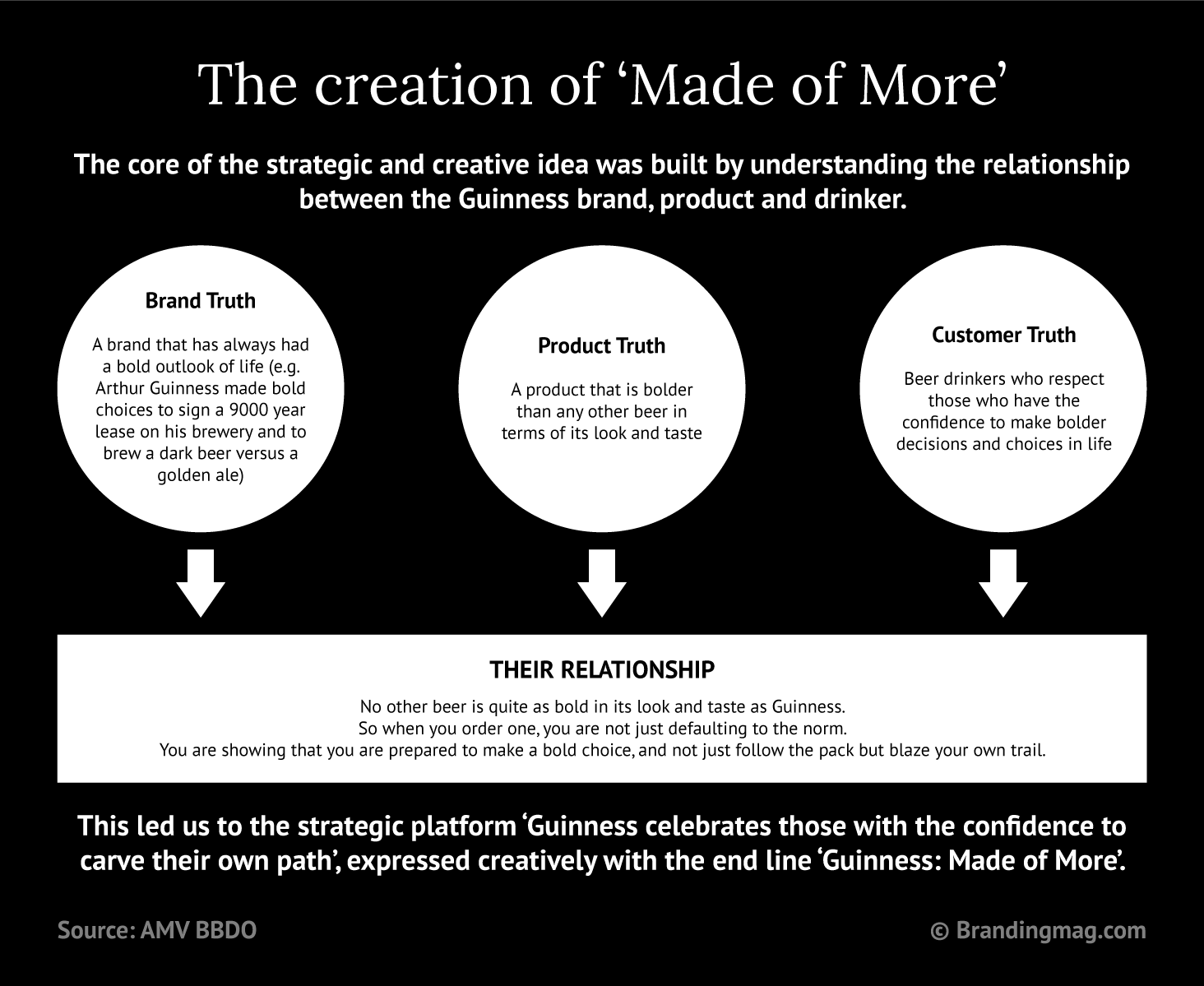
    Brand Platforms are not just nice catch-phrases. It goes beyond that, it’s a fundamental human truth that the brand can champion because of its relationship to the reality the truth describes. To build a strong platform you need to ask, what is true about your brand? You could focus on the truth about the product formulation like Guinness does, or a brand journey like Johnnie Walker, or generally how consumers perceive or see the brand. Then, tie that to how consumers see themselves or want to see themselves. At this level, you are simply looking for a fundamental human truth that your brand is better suited to defend, promote and grow with. The intersection of brand truth and consumer truth is a good place to start drawing inspiration for your Brand Platform. No matter what the proposition is, never forget that the consumer should care enough about it. They should see how it impacts their everyday life, with or without your product. 

    Click image to view case study
  • Spread the Word
    A platform can be introduced as a tagline or campaign slogan, but the ultimate goal is to give it enough visibility that it will slowly begin to catch the eyes and ears of people and start to make sense. As you embark on spreading your new brand gospel, remember people will not line up behind a manifesto they don’t understand. Be creative with your brand education to demonstrate the density of the proposition and work it till it becomes a brand asset. Go beyond visibility and engage them through storytelling that enriches the perspective of the proposition so that your audience clearly understands the “what” and “why” of your proposition. All Brand Platforms are brand assets but not all brand assets are Brand Platforms. I’ve seen many brand managers and brand owners try to force a campaign tagline into a Brand Platform. For a proposition to become a Brand Platform it must represent a core human truth that resonates with the realities of the consumers, seen and understood. Then, it must be malleable enough to guide the thinking of the brand across all dimensions. It should be the guiding philosophy for integrated marketing communication, but not necessarily tied to a brand sales agenda.
  • Bring it to the center
    When you are sure that you’ve found the truth, and it’s gaining resonance, you can make your entire brand engagement process ride on the thinking.

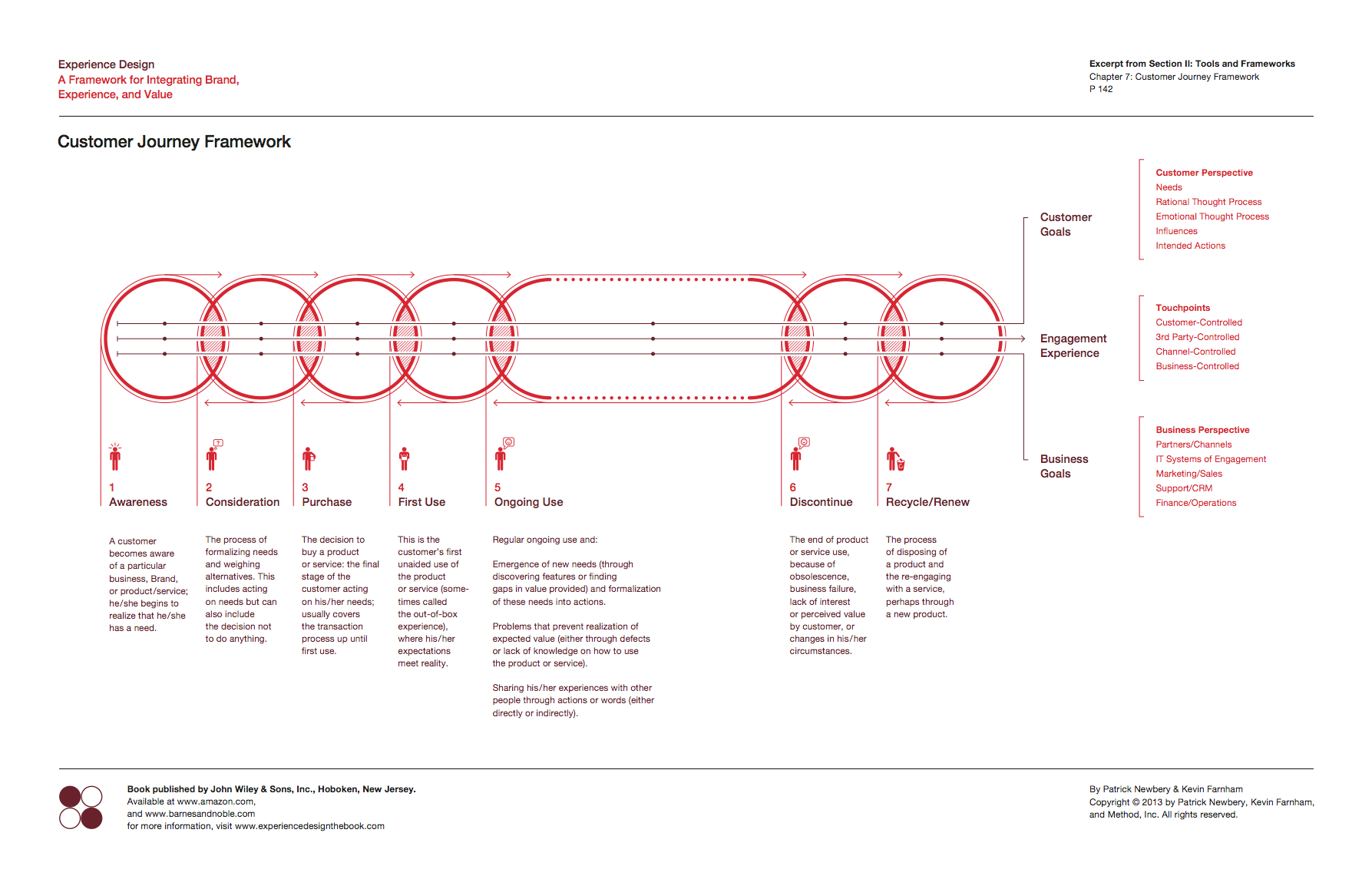
    Click image to enlarge – Customer Journey Framework by Method

    Using the Patrick Newberry, Kevin Farnham and Method brand engagement framework, the Brand Platform will be the running line sandwiched between the customer goals and business goals. It will be the thinking that the engagement experience is built around. At every touchpoint, the philosophy of the Brand Platform will have to be seen, heard, felt, and understood. It must permeate every realm of business communication and engagement. “Keep Walking” isn’t just a spot or print ad, it’s locked into a physical location, packaging policy, influencer engagement, global campaign, etc. It is the Johnnie Walker brand’s thinking.

Every touchpoint that defines the brand must be an outlet to sharing the brand’s thinking. The thinking must connect with consumers where they are in a very authentic and human way. This is why it is called a platform, because every brand engagement activity across the customer engagement journey map will have to take its life from and be enriched by the thinking.

It takes time, effort, and budget to build a solid Brand Platform. However, that investment is justified in the stability, structure, and focus that Brand Platforms deliver. Don’t just think about the Big Idea for your next campaign, take it a step further and build a platform that will sustain your brand experience into the future.

Feature Image Credit: Daniel Vogel 

By Gidyon Thompson

Sourced from Brandingmag

Sourced from BOSS Magazine

A great way to improve your brand is by creating a community of customers, fans, or followers who are passionate about what you do.

Your brand is your business’s most valuable asset, as it sets you apart from your competitors and determines how customers perceive and interact with your company. That’s why investing time and resources is essential to develop and maintain a positive brand identity. Thankfully, there are several different strategies you can use to improve your brand.

Foster a Community Around Your Brand 

A great way to improve your brand is by creating a community of customers, fans, or followers who are passionate about what you do. You can provide helpful content, e-books, blog posts, host events or webinars, or offer exclusive discounts or deals for community members. Not only does this help build loyalty among current customers, but it also attracts new customers and helps you become known as an industry leader.

Rethink Your Brand Voice  

Ensure your message is clear, consistent, and aligned with your core values. If unsure where to start, conduct a brand audit to evaluate how well your current branding aligns with your desired image. Your goal should be to create a brand voice that accurately reflects who you are as a company and resonates with your target audience. In a world of faceless brands, being personal and human can make all the difference. Ensure your brand voice is friendly and relatable. Avoid jargon and technical language that can alienate consumers.

Evaluate Your Visuals  

In today’s highly visual world, ensuring your visuals positively reflect your brand identity is more important than ever. You need to consider everything from the colors you use on your website and in marketing materials to the logo on your products and packaging to create a consistent, professional image for customers. That is where grand format printing services come in. Grand format printers specialize in large-scale printing, and they can produce high-quality visuals that will make a lasting impression on potential customers. In addition, grand format printing is relatively inexpensive, making it a great option for businesses on a tight budget.

Foster Positive Customer Relationships

There are many ways to foster positive customer relationships, but one of the most effective is simply providing outstanding customer service at every opportunity. Whether you’re handling an inquiry over email or resolving a problem over the phone, always go above and beyond to ensure that the customer feels valued and satisfied with their experience.

Partner With Other Businesses

Collaborating with other businesses can be an effective way to reach new audiences and improve your overall visibility both online and offline. When selecting business partners, look for companies that complement rather than compete with yours so that you can cross-promote each other’s products or services without cannibalizing sales from within your own customer base. For example, if you sell natural pet food, consider teaming up with a local pet store or dog groomer for cross-promotional opportunities like joint social media giveaways or in-store events featuring samples of your products.

Improving your brand doesn’t happen overnight. It takes time, effort, and dedication. However, by taking things one step at a time and utilizing unique strategies like those outlined above, you can gradually build a strong, positive brand identity that will serve as the foundation for long-term success.

Sourced from BOSS Magazine

By Nathan Dale

Is low-performing content draining the life from your website? Nathan Dale of Impression explains how to identify it and bring it back to life, in light of Google’s most recent algorithm updates.

In August and September 2022, Google rolled out two major updates to its core search algorithms. First, there was the Helpful Content Update, which was completed on September 9, followed by the routine September Core Update.

It can be a spine-chilling moment when Google introduces an update outside of the routine, causing ghoulish screams amongst digital marketers (OK, maybe not quite that bad) who are concerned about what might happen to the performance of their websites.

But really, these updates aren’t so scary at all. Google’s update is intended to reward the good content you’ve been producing.

Trick, or treat?

There were two important lines from the Helpful Content Update documentation: ‘The update generates a site-wide signal. For this reason, removing unhelpful content could help the rankings of your other content.’

It has long been the view of SEO professionals that the overall quality of a website was considered by Google when it ranks individual pieces of content. You could write a great article with detailed information, examples, a how-to guide and a video thrown in for good measure. However, if the rest of your site’s content is low-res, it’s likely your article won’t perform well in search engine result pages (SERPs).

Is there zombie content lurking on your site?

Web pages with no SERP impressions, clicks or traffic are often referred to as ‘dead content’ since they seemingly have no life in them, although a more accurate term might be ‘zombie content,’ because the page is technically still alive, and search engines could therefore bump into it during a (presumably late-night) crawl.

If Google finds this content and classifies it as ‘unhelpful,’ it will take this into account when ranking your other high-quality, helpful content too. The more unhelpful content you have, the more likely Google will think that your website is providing lower overall value to its search results and users.

Taking steps to identify and remove poor-quality, unhelpful content is no longer an ‘as and when’ task to be done during a period of downtime. The Helpful Content Update means this task should now be high on your list of priorities.

There are very few (if any) websites that have 100% perfect content on every single one of their pages. While Google understands that this is an impossible standard, it would prefer to invest less time and money crawling and evaluating content only to realize that it’s as much use as a rotten pumpkin on November 1.

This is likely why it’s explicitly asking content managers to remove low-quality, unhelpful content, and rewarding sites that action this with potential overall ranking improvements.

Lack of continuity in the ownership of web content is usually the hidden monster that results in unhelpful content. As web content is inherited by new starters, passed around departments or simply left unattended, chances are you’ll find some skeletons in the closet.

How to identify unhelpful content

Identifying low-performing content is straightforward. One approach is to use Screaming Frog SEO Spider, which can either crawl your entire website, a specific directory or a list of URLs.

In Screaming Frog’s configuration menu, select API access and add your Google Analytics account. Set the segment to Organic Traffic and the date range to the last 12 months, then your traffic data will be added to the crawl. We advise looking at this over a 12-month time period to give a truer picture (eg seasonal content might not get any clicks in June, but lots in December).

Once the crawl is finished, you’ll have a list of content with the session data shown in the Analytics tab. Simply sort by lowest to highest and you’ll find the zombie content that’s haunting your website.

Exorcise dead content (or bring it back to life)

Once you’ve identified the content with the lowest session data, you essentially have three choices. One: if it has the potential to be made helpful, you can update it with new and improved content. Two: consolidate any content that is useful into another page on the same topic, then remove and redirect the page. Three: remove the page entirely.

Side note: if you are considering totally removing a piece of content, you should check the ‘all users’ and ‘page views’ in Google Analytics as it is possible the page is being found in other ways.

For more information on Google algorithm updates, check out Impression’s search industry update blog series.

Feature Image Credit: Georgi Kalaydzhi via Unsplash

By Nathan Dale

Sourced from The Drum

By

If you’re looking for a side gig on your own terms, look no further than this list of the best virtual side hustles.

The past few years have seen the rise of the side hustle, a term used in ‘s book, The $100 Startup. In it, he talks about how he was able to generate multiple streams of income from various ventures outside of his primary career and how others like him can do the same.

Ecommerce sales

You know how to make a good product, so why not sell it? There are so many options for e-commerce platforms today, including Amazon, , eBay and Shopify. You can also start a blog and sell products through it. If you already have an Instagram account or Pinterest page with many followers, you might want to try selling there instead.

If your business is more geared toward physical goods than digital ones (or if you want more control over the entire process), setting up an e-commerce store might be right for you. The great thing about starting your own online store is that several paid and free platforms are available that will help with everything from hosting to payment processing — all without requiring coding skills.

Graphic design

Graphic design is one of the most popular side hustle ideas. Graphic designers are in demand because they create logos, websites, posters and other graphics for clients. They can also design and sell their graphics as prints or products on platforms like Etsy.

Website development

Website development is a great way to earn some extra money on the side. If you have time and energy, this side hustle could become your full-time career.

You can use your website development skills to create a personal website or become an internet entrepreneur by creating and maintaining websites for others. When deciding whether to pursue this as your side hustle, it’s essential to consider how much time you want to put into it because it could take up quite a bit of your free time if you’re going to do it right!

SEO Consultant

As a freelancer, you’ll be able to set your hours and work from home. You can also choose your clients based on their needs rather than having to accept whatever comes along.

In addition, SEO consultants have average annual salaries ranging from $60,000-$80,000. That means that if you’re good at what you do and make 5-10% of the project’s total value (which is about $5k-10k for most people), this side hustle could easily earn you an additional $30k-$50k per year.

Day trading is a form of trading that involves buying and selling financial instruments within the same day. Trading can be a very lucrative side hustle, but it takes deep focus and immense concentration to ensure you actualize your goals. Day traders may buy and sell stocks, bonds, commodities, currencies, options and futures contracts. Day traders use technical analysis to identify trends in market prices and profit from them.

Day trading is often done through special-purpose entities known as day trading firms or electronic communications networks (ECNs). These firms offer investors direct access to the markets via hardwired connections to stock exchanges. Most of these outfits charge a commission on each trade, but some do not charge a commission at all because they generate revenue through advertising instead of commissions on transactions.

eBook author

As an e-book author, you’re in good company. Millions of people buy and sell ebooks every year, and authors make money from their books in various ways.

You can sell your eBooks on Amazon and other platforms (e.g., Kobo). You can also sell your eBooks on your website through membership or a recurring payment model (which many authors are doing). You can even offer them for free in exchange for customer data.

Many people are attracted to the idea of being able to make money by doing something they love. YouTube video creators can do just that, and they have the advantage of having an audience already on the platform, ready to watch their content.

YouTube’s power as a search engine continues to grow. It’s now the second largest search engine after and has more than 1 billion users worldwide. While this is great for creators who want their videos found by viewers, it also means there’s plenty of competition — and it’s getting more complex every day for creators to stand out in this crowded space. If your content is unique, continual, and has an audience base that has the potential for growth, you can cash in through YouTube’s monetization program, which matches advertisers’ commercials with your content.

Affiliate marketing

Affiliate marketing is a great side hustle because it can be done anywhere in the world. You don’t need a degree or specialized skills to start affiliate marketing, but you need to be willing to work hard and put in long hours at home if you want to make real money with this type of business.

You can start by choosing one product or niche that interests you and research what products are the best-selling in that niche. After choosing your product, it’s time to promote it. There are many ways to promote products through affiliate marketing, including social media posts, review videos and blog articles.

To track how much money your links have earned for each brand (this is called “tracking links”), I would recommend using Google Analytics which gives an overview of all traffic sources coming into your website so that you know where new visitors are coming from when they land on your site after clicking on one of those tracking links.

Feature Image Credit: Pekic | Getty Images

By

Sourced from Entrepreneur

By Charlie Terry

The internet doesn’t have to signal the end for every high street retailer, but it should indicate a time to change, adapt, and innovate. This has been brought into even sharper focus amid the pandemic; while a new era of speed and convenience was creating an increasingly competitive retail landscape long before then, now, as we emerge from almost three years of disruption and transformation, the savvy retailers that have been investing in digital and a more modern brand positioning are looking even stronger.

Meanwhile, those that have failed to evolve with changing consumer behaviours and expectations have suffered the consequences. The likes of Debenhams, House of Fraser and Dorothy Perkins provide clear proof that it is no longer enough to rely on heritage alone.

Alarm bells will no doubt be ringing for shareholders of WHSmith, then, which recently reported lower high street sales than before the pandemic. Bosses have been quick to blame this on a cybersecurity issue which caused disruption to its digital greeting cards brand, Funky Pigeon, and maintains its high street business is performing in line with expectations.

I, however, see a retailer in trouble.

Like those above, WHSmith was once a darling of the high street and had a presence in every town and city. Today, though, it has been largely relegated to airports and train stations, taking on the role of a convenience retailer more than anything: average grab-and-go sandwiches, last-minute holiday reads and overpriced travel adapters.

The trouble with WHSmith is that it does lots of things in an average way. Compare it to a retailer like Waterstones – who is confident in its positioning, does it well and has a revamped digital offering to go with it – and WHSmith’s position in the retail market feels weak and confused. Combine this with the fact that it continues to sell magazines and newspapers which have largely shifted online, and that Moonpig dominates the digital greeting card market, and people would rather spend money on more modern and personalised stationery from the likes of Paperchase and even the more upmarket Papier, and you can start to see why WHSmith is in this position.

What’s frustrating is that WHSmith already had everything it needed to compete with its more agile and innovative digital rivals – a solid customer base and tons of revenue – yet it somehow missed the opportunity to innovate while others have embraced it.

Marks & Spencer was in a very different position a few years ago when it announced it would close over 100 high street stores as part of a radical plan to tackle years of sales and profit declines and move customers online.

M&S now has 40 clothing brands on its fashion brands platform, sells food online through its partnership with Ocado Retail, and has expanded its international ecommerce business to 100 markets. Its willingness to adapt has meant profits and sales are now higher than pre-Covid levels.

Similarly, Next’s digital focus has seen online sales grow consistently over the past five years, with the expansion of its third-party brand business – which includes Calvin Klein, Lipsy, Adidas and Boohoo – making it an increasingly attractive destination for a younger audience. So much so that it is now growing faster than its own brand.

This feels like an obvious route for WHSmith to go down, but there are other things it can do to refresh its brand and gain the attention of a younger audience in the shorter-term.

While WHSmith has a website and social media presence, its online brand is in desperate need of some TLC – both visually and in terms of establishing a modern tone of voice. Its TikTok account shows it at least knows where a younger audience is and is trying to engage with them. The next logical step would be to start partnering with influencers and ambassadors in order to build and deepen those relationships with Gen Z, who are significantly more likely to follow influencers and trust their recommendations.

The path forward 

Having said that, looking forward and adapting for the modern world certainly doesn’t mean leaving your brand heritage behind. WHSmith is 230 years old and that’s something that should be celebrated and used to its advantage.

Fortnum & Mason has done a great job of using its brand heritage to move people to an online-centric journey. Its new website, which launched amid the first year of the pandemic, mirrors the in-store aesthetic and experience perfectly – even including an online version of its signature ‘create your own hamper’ service. Proving it is a 315-year-old retailer fit for the modern world, online sales haven’t slowed since reopening its doors, with ecommerce now accounting for half of all revenue compared with a fifth before the pandemic.

If WHSmith can learn anything from these retailers past and present, it’s that it needs to make some big changes to revitalise its offering in line with behaviours that have been irreversibly shaped by the pandemic. Proving that your heritage brand is fit for the modern world is a monumental task but not an impossible one. If WHSmith starts investing in adapting, updating, and innovating now, it might be able to avoid joining the list of ghosts of high street’s past.

Feature Image Credit: Adam Rhodes 

By Charlie Terry

Charlie is a Digital Marketing specialist, working with the best brands across the globe to leverage their online presence to increase revenue. Charlie sits on the board of various businesses advising on marketing strategy and growth.

Sourced from Brandingmag

By Lida Citroën

I get it. Social media can feel like a waste of time. It seems to be all about self-promotion and reads like a popularity contest. If you’re in a job search or looking to grow your career after the military, how necessary is it to be active online?

Here, we’ll look at the pros and cons of being on social media while in a job search.

Cons of Social Media During a Job Search

It seems every day we hear about another influencer, celebrity or peer who’s made an online gaffe and landed themselves in career hot water. The negatives of being online include:

1. Mistakes can happen and, when they happen online, they’re public. An ill-placed post, comment or photo shared online can go viral quickly. Trolls may respond and use your comment out of context. This is terrifying. To ensure you don’t fall prey to online mistakes, it’s important to monitor your behaviour, relationships and conversations. This all takes time.

2.  It takes a lot of time to establish your online presence, build a following and become known for the values and contribution you can offer. How much time? That’s up to you. But if you simply build a LinkedIn profile and wait for job offers to roll in, you’re being naïve. Instead, the more you engage with others, form meaningful connections, post content that’s valuable and show your expertise and passion, the more your social media efforts pay off. 3. You must share to get found. During your time in the military, it likely served you best to keep a low profile. Now, it’s tempting to want to keep things close to the vest and protect your reputation, goals and career aspirations. But if you’re hidden from recruiters and others who might want to know or refer you to others, this could prove challenging to your career.

While not having an online presence doesn’t mean you won’t find a job, you will need to consciously put more effort into other self-marketing efforts. Your in-person networking, visibility and executive presence will need to be amplified to get the attention of potential employers.

Pros of Social Media During a Job Search

Why should you embark on an online strategy and routine practice during a job search (or when growing your civilian career)? Here are some reasons:

1. You become findable. Today more than ever before, recruiters and hiring managers scour online profiles to find potential candidates, evaluate them and appraise their value, skills and talents. Your online profiles can show you in a professional, polished and appropriate way to the companies you want to attract. Being found online makes it easier for recruiters to see what you focus on, what you’re passionate about and how you interact with others. These insights help them decide whether you could do the job and whether you’d fit in with the company’s culture.

2.  You can focus on specific jobs and employers. Using targeted keywords, filters and networking makes it easier for the right employers to find your profile for the right job. Discover the right keywords by reading job descriptions, talking to colleagues and doing online research. When your online profiles match up with keywords employers are searching, they find you! 3. You can control the social media platforms you engage on and how you show up. After you exit the military, your online strategy should be refined to build and grow your civilian career. Consider each social networking platform for the value it offers you to connect with your target audience, position yourself authentically and in line with your personal brand goals, and provide you the opportunity to share, contribute, serve and receive benefits. Not all social media platforms are the same.

Then, you can position yourself with intention and strategy, marketing yourself and your skills. When you approach social media armed with a plan, you’ll be intentional about where you show up online, how you interact, the content you share and with whom you connect.

While you’ll give up some privacy by being found online, you likely will find that you have a lot of control over how you appear, what you say and what others can learn about you. This can prove valuable for employers, customers and networking contacts to get to know you before having a conversation. Over time, these powerful online connections can provide you with insight for your career, mentor and counsel you around your transition, and help you build the civilian job skills you’ll need to succeed.

Before you decide you don’t need to be on social media to find a job or grow your career, check your assumptions and have a clear reason why. You will likely be asked about your decision as you move through your civilian career.

— The author of “Success After Service: How to Take Control of Your Job Search and Career After Military Duty” (2020) and “Your Next Mission: A personal branding guide for the military-to-civilian transition” (2014), Lida Citroën is a keynote speaker and presenter, executive coach, popular TEDx speaker and instructor of multiple courses on LinkedIn Learning. She regularly presents workshops on personal branding, executive presence, leadership communication, and reputation risk management.

A contributing writer for Military.com, Lida is a passionate supporter of the military, volunteering her time to help veterans transition to civilian careers and assist employers who seek to hire military talent. She regularly speaks at conferences, corporate meetings and events focused on military transition.

Want to Know More About Veteran Jobs?

Be sure to get the latest news about post-military careers, as well as critical info about veteran jobs and all the benefits of service. Subscribe to Military.com and receive customized updates delivered straight to your inbox.

By Lida Citroën

Sourced from Military.com

By William Arruda

Maximizing your personal brand value in the hybrid world seems like a piece of cake. After all, in the before times (before Covid, that is) you practiced the techniques of real-world branding regularly in meetings, at networking events, etc. Then, Covid gave you a crash course in virtual personal branding thanks to ubiquitous, back-to-back Zoom meetings and reliance on online team platforms like Slack. So mastering the hybrid world is just a mixture of the two, right?

Yes. And no. Sure, you’ve learned skills and you have some experience in real- and virtual-world personal branding—but growing your personal brand in this new hybrid or WFA (Work From Anywhere) world is all about nuance, congruence and prioritization. When those three elements are managed correctly, your virtual and real-world versions will work together seamlessly, which accelerates your personal brand

According to the folks at Webex, hybrid work is defined as a flexible model that supports a blend of in-office, remote, and on-the-go workers. It offers employees the autonomy to choose to work wherever and however they are most productive. All good. But there are challenges too.

To build your personal brand so you can achieve your goals and increase your happiness at work, you need to master the virtual and the real in equal measure. The most important part of maximizing the hybrid world of work is knowing when to be real, when to be virtual and how to integrate the two.

Let’s focus on the most important opportunities for personal branding and how you should think about—and act on—them in this new mixed-up work world. In the hybrid world, you need to polish your presence in both realms.

Ace your first impression.

Your first impression will likely be formed in the virtual world. That’s because, even pre-Covid, we got pretty good at using Google and LinkedIn to learn about people before ever meeting them in person (even when they worked down the hall from us). When you focus on page 1 Google results and build a stellar, authentic, focused LinkedIn profile, you’ll be sure to build a powerful first impression. For the virtual world, prioritize video and images over text. For example, share video thought-leadership in your LinkedIn profile and add videos to YouTube so they show up when someone googles you, thanks to universal search. Just make sure what you put out there is fully aligned with who you really are.

Lead hybrid meetings.

Perhaps the newest challenge spawned by WFA is leading the hybrid meeting. First, you must acknowledge that the people who are together in the meeting room are having an experience that’s different from those who are connecting remotely. And each of the remote participants is having an experience that’s different from everyone else. To succeed in these meetings, prioritize virtual over real. That means overemphasize the folks who are not in the room because what they’re experiencing is a far less visceral. And being remote comes with more temptation to multitask—both of which mean you need to work hard to keep that part of your audience connected and engaged.

Be ever visible to your team and company.

Appoint yourself the company’s chief brand steward. This means whether you’re at the physical office or working remotely, you’re increasing your virtual visibility by sharing relevant company content with your online community. Make sure you’re connected to everyone on your team, to your internal/external clients, and to others so when you are out of site (not at the office) you can be top of mind (in people’s social media feeds). Just make sure what you share is relevant to how you want to be known, delivers value and gives you the opportunity to express your point of view.

Building your brand while WFA requires deliberate and steadfast commitment. The ultimate key to building your personal brand in our WFA world is to make sure there is congruence between the real and virtual—so regardless of whether your human interactions occur in a shared physical space or are happening via a mobile phone screen they convey your brilliance, authenticity and differentiation.

Feature Image Credit: getty

By William Arruda

William Arruda is a keynote speaker, co-founder of CareerBlast.TV and co-creator of the Personal Brand Power Audit – a complimentary quiz that helps you measure the strength of personal brand.

Follow me on Twitter or LinkedIn. Check out my website.

Sourced from Forbes

If you’re an extrovert, you probably love being around people and interacting with others. Here are some careers which are best suited for extroverts.

Your personality trait plays a significant role in your career choice. Being extroverted or introverted determines, to a large extent, the job that suits you and how well you will thrive in it. If you are often described as energetic, charismatic, outgoing, and a social butterfly, you are most likely an extrovert.

Extroverts have amazing qualities that, if channelled in the right direction, can help them attain excellence. However, the issue lies in identifying a career that suits you in the job industry. We have put together eight high-paying careers that are great fits for extroverts. Let’s discuss them below.

1. Social Media Influencer

Social media apps on a smartphone

Social media influencer is one of the next big careers in the entertainment industry. As a social butterfly and one who loves being in the spotlight, you can build large, organic followership. This could consist of different audiences on several social media platforms like Facebook, Instagram, and TikTok.

You can also use your natural charisma to influence your audiences’ buying power and build trust. Of course, this attracts brands to utilize your social engagements and promote their products and services that appeal to your audience. Furthermore, the average annual pay for a social media influencer is $41,047 per year, according to ZipRecruiter.

Nonetheless, you can still set your own fees and terms of engagement by yourself. In addition, you can simultaneously leverage more than one niche, such as fashion, travel, education, and lifestyle. However, if you are diving into the lifestyle industry, which requires you to use your life as content, take note of things you should never share on social media for content’s sake.

2. Customer Support Specialist

A person in black blazers with a microphone headset.

A customer support specialist is a direct link between a company and its customers. This position requires social and people skills, which makes it suitable for extroverts. In the face of conflict, you can use your interpersonal skills, like quick decision-making and problem-solving, to resolve issues before they escalate.

You can work as front desk personnel, call centre agent, or concierge. Meanwhile, the average salary for a customer support specialist is $47,400 per year, according to Payscale.

3. Public Relations Manager

A man in a gray suit holding a microphone

Extroverts are naturally more given to public relations than their introverted counterparts. They can steer discussions physically and virtually. And being a PR personnel might be the best choice for you. A public relations manager is responsible for internal and external communications, public affairs, and all forms of media coverage in a company.

In other words, your primary responsibility is to improve a brand’s image and oversee campaigns for products/services. You can be part of an organization’s workforce (profit or non-profit) or an independent PR specialist. According to Payscale, public relations managers earn an average of $72,604 annually.

4. Sales or Marketing Manager

Being a sales or marketing manager is one of the best careers for extroverts because it involves a lot of socializing and networking. As a sales manager, your major role is to oversee the sales team in a company, organize training, and ensure your team meets the sales quota for a period.

You will also continuously have to engage in small talk and use your natural enthusiastic charm to propel people to purchase a product or service. Meanwhile, you can major in business-to-business sales (B2B), business-to-consumer sales (B2C), direct, SaaS, or affiliate sales. Besides, you can expect to earn up to $63,359 annually, according to Payscale.

5. Counsellor or Coach

A person talking to a counselor.

Typically, an extrovert is compassionate, a great communicator, and loves being involved in other people’s lives. This makes counselling a suitable career path for one. Counsellors help people achieve positive changes in different aspects of their life, such as careers, relationships, and academics.

While you still need to acquire specific counselling techniques and certifications, your natural extrovert traits already give you solid grounds to flourish in the industry. You can render your services independently or work with a psychotherapy company. Meanwhile, the average annual salary for a licensed professional counsellor is $50,298—according to Payscale.

6. Human Resource Manager

Human resource managers act as a liaison between employees and employers. They often oversee the hiring of new employees, alongside staff training and management. In addition, they help organizations develop their work culture and benefits, payroll, and handle workplace disputes.

These responsibilities and more require high-level people skills to enable you to connect with diverse personalities on different levels, making it a great fit for extroverts. According to Payscale, human resource managers earn up to $74,000 annually.

However, your pay can be above or below, depending on your skills and certifications. You can work as a freelance human resource consultant or limit your services to one company.

7. Event Planner

A woman in a brown suit jacket standing and looking at a laptop on a table.

Event planning involves creating and developing small and large-scale personal or corporate events, such as weddings, conferences, concerts, and festivals. Having the innate ability to manage interactions with a variety of people—including clients, vendors, and the event workforce—gives you an edge in pulling off successful events.

You can also leverage different mobile apps for event management to streamline your responsibilities. Moreover, you can be a contractor and set your own rates or work for an interior decoration firm. According to Payscale, the average annual salary for event planners is $51,596. The demand for event planners is on the rise. So whichever path you choose, you can be confident of earning well.

8. UX Designer

A man scribbling on white paper.

UX designing is a people-oriented career that involves developing and managing a digital product’s user experience. Most times, the role requires you to work directly with the marketing team in an organization to understand customer needs and demands and integrate the brand message into the product.

Besides, it’s a versatile profession, not limited to one industry. In other words, you can work in the health, finance, education, or blockchain industry. You can also work as a freelancer or a full-time on-site employee. According to Payscale, the average salary for a UX designer is $76,341 per year.

Know Your Personality Type Before Choosing Your Career

Choosing your target industry and career path can be challenging. Therefore, we suggest you first analyze your personality and identify your interests, strengths, and weaknesses to help you make rational decisions about your career. You can see a psychologist or use apps to learn about your personality type to erase every iota of uncertainty.

By Joshua Adegoke

Sourced from MUO

By 

Here are four free marketing hacks most first-time entrepreneurs gravely underestimate and underutilize, plus a fifth bonus hack that can make you millions.

Many entrepreneurs are great visionaries, proficient builders and competent operators; however, when it comes to being creative, flexible and innovative marketers and salespeople, many of us — especially first-timers — fall flat. I can’t tell you how many entrepreneurs have come to me with the assumption they’ll simply “run ads” or “pay influencers” to grow from an idea to multi-million-dollar profits. While I’m not suggesting ads and influencer promotions can’t work wonders for some companies, it should come as no surprise that with their ubiquitous proliferation, their efficacy has waned.

Audiences have come to expect, and therefore oftentimes ignore, these  methods, which means a lot more capital (money) may be required to reach a critical mass of prospects to arrive at an acceptable conversion rate that ultimately leads to actual profits. That’s a long-winded way of saying pay-to-play digital marketing is doable, but oftentimes more difficult, time-consuming and costly than  expect.

That said, the vast majority of first-time and early-stage entrepreneurs fail to recognize or take advantage of the multitude of free, highly-effective marketing tactics sitting at their fingertips. These commonly overlooked growth hacks can yield millions in low-CAC (, and I’ve experienced this firsthand, as have a handful of my fellow profit-focused founder friends. Here are four underrated, free marketing hacks you can utilize to catapult your venture’s growth — plus, a fifth bonus hack that made my friend millions without a dime spent on ads or .

1. Customization

This first hack isn’t scalable, but it is a great launchpad. When you’re first building your business, the most important thing is creating happy customers, even if that means doing the unreasonable or unscalable. Why? Because these first customers will create the testimonials, reinforced confidence, potential referrals and the overall inertia to push you from a handful of customers to hundreds of customers to thousands and so on. One of the biggest mistakes forward-thinking entrepreneurs make is attempting to build a well-oiled, scalable machine at the expense of the customer experience.

Simply put, customization is one of the greatest free hacks you have at your disposal as a first-time, early-stage entrepreneur and CEO of a small, fledgling venture. While you shouldn’t plan or expect to bend over backward for every customer as you grow, doing so for a few key clients early on can pay dividends for months, years and even decades to come. Don’t be afraid to win over your first customers with unscalable customization; it may pay off tenfold (or more) if you leverage it wisely.

2. Leverage customer testimonials

Speaking of leveraging unscalable customization wisely, that all begins with robust client testimonials. One of the most devastating missed opportunities I’ve witnessed far too many entrepreneurs suffer is the lack of testimonials, simply because they never thought to ask the customers. It is ten times harder to track down customers weeks or months later and reach them, let alone actually capture an enthusiastic, contagiously positive testimonial in comparison to doing so during a customer’s current experience with your company.

One of the most strategic moves I made early on was to include a customer testimonial and feedback form that all clients have to fill out before the last piece of their service is delivered for one of my companies. In so doing, my team has garnered hundreds (maybe thousands) of detailed glowing testimonials without lifting a finger. These are in your own backyard if you act swiftly.

3. Tap into your former clients’ networks

Along the lines of leveraging former customer testimonials as a growth hack (to wildly increase your free marketing content and purchase conversions, due to the plethora of  and social proof), you can also tap into those former clients’ networks. One mistake I’ve made in serving a client base who may compete with one another is capping their likelihood of recommending others for our service. If, however, you serve a broad client base that isn’t competitive with one another, then offering an attractive (lucrative) affiliate incentive program to those early customers can be a great way to grow sales passively, thanks to your motivated crew of evangelist former customers who love your product, money, and spreading the gospel of their positive experience with their friends (for a financial upside).

4. Don’t underestimate email marketing

People can knock email and the written word all they want, claiming video or audio is all that matters these days, but as someone who’s sent close to 100 million emails over the past three years — and profited handsomely from them — my results prove otherwise. The biggest mistake entrepreneurs make with email marketing is to assume that sending one, three or even “seven” (that’s commonly touted as the magical number) emails is enough to judge a sequence’s success. There are customers who were on my company’s email list for over two years, received over 60 messages from us and ultimately spent hundreds or thousands of dollars when that right time, subject line or message hit them. There are also customers who purchase within the first few emails they receive, making up for the former.

The point being: If you’re willing to be patient, experiment and analyse the data from your email marketing, it’s entirely possible to build a marketing strategy all around the written word. It won’t, however, likely happen overnight, and you can’t simply pay your way into accelerated success with this channel.

5. This free tool built my friend’s multi-million-dollar agency (ad-free)

Though my current companies don’t employ this method, I have peer founders and friends who’ve built multi-million-dollar businesses all around DMs (direct messages) on channels ranging from  groups to . No, they didn’t have large followings prior; they simply identified the right audience, crafted a client-centric message (or many) and began testing their luck. Similar to email, this strategy is a bit of a numbers game and will surely take some trial, error and improvement — but it’s a free option first-time founders shouldn’t sleep on.

The early-stage advantage

So many bootstrapped, first-time and early-stage (pre-revenue or pre-profit) founders lament their lack of funds or marketing muscle. While capital can surely expedite some methods of marketing, it’s oftentimes a crutch used to minimize the amount of time and hands-on effort founders need to put into marketing. That said, one of the advantages of being a first-time, bootstrapped and early-stage founder is that time, creativity, flexibility and resourcefulness should all be growth hacks you have on your side. You may not be able to out-spend a VC-backed startup’s digital marketing blitz, but you can out-strategy them if you’re willing to get a little bit creative, roll up your sleeves and do a few things that may not scale.

By 

Sourced from Entrepreneur