Author

editor

Browsing

By

U.S. workers are distracted by incoming email, and 30% have declared “email bankruptcy,” deleting or abandoning their inbox, according to Inbox Intelligence Report, a study from Gated.

Email is the primary source of internal at work for 82%. And 71% say it is the primary method of external communication. But 62% say it is difficult to focus because of digital distractions, with 30% saying they strongly agree. And 67% feel overwhelmed by their inbox.

Moreover, 82% miss important emails because of inbox clutter.

It is easy to see how: the average working person receives 87 emails per day in their executive work email on weekendays, and 71% in all work email accounts.  In addition, they receive 42 emails a day in their personal accounts, from Monday to Sunday.

Tuesdays and Thursdays are the days when people receive the most inbound email.

Nevertheless, 77% feel that cold email from unknown senders can be useful for learning about interesting or relevant opportunities.

In a finding with import for marketers, 73% agree they get too much unsolicited email, and 36% strongly concur. In addition, 38% spend 31-60 minutes per day dealing with the flow of email. Another 22% take 1-2 hours.

On average, 37% of all emails are not of immediate value to the inbox owner, even after automatic spam filters were applied. This includes 28% of all emails received at work and 32% of those that reach executives.

Yet 74% of the individuals polled report feeling guilt or stress over emails they have not read or replied to.

Working with Gated, Centiment surveyed 560 professionals who use email at work in October 2022. Gated is an email management that challenges unknown senders to donate to charity to reach the inbox.

By

Sourced from MediaPost

By Gavin Jordan

Gavin Jordan is the publishing manager of Open Mic – The Drum’s self-publishing content marketing platform. For The Drum’s Content Marketing in Focus, he predicts the most likely content marketing trends for 2023, and how marketers can tackle them head-on.

In 1999, Jeff Cannon wrote, “In content marketing, content is created to provide consumers with the information they seek.”

Almost a quarter of a century on, it’s amazing how many content marketers still fall at this first hurdle. They provide information – yes – but it’s not information that anyone is actually looking for. It’s no doubt why 71% of decision-makers say that half or less of the thought-leadership content they consume offers any sort of valuable insights.

A lot of the time, the line between content that thrives and content that dives is relevance. Content marketers who look inwardly (What can I say about my business? Why is my product/service so valuable? What are the benefits of my offering?), will always lose out to those looking outwardly (What is the target audience interested in? What are they searching for? What do they want to engage with?).

One of the top ways to stay relevant with your target audience is to keep up with current industry trends (i.e. the topics that your audience are flocking to time and again). To help guide your content strategy next year, we’ve scoured through a trove of readership data to predict the most-likely content marketing trends for 2023. Here are our top five.

1. E-commerce

While there was an understandable growth in e-commerce vs brick and mortar sales in 2020 (largely due to the Covid-19 pandemic), e-commerce continues to grow at record speed. A recent report by Morgan Stanley predicts that e-commerce could reach 36% of all retail sales by 2026 (up from 32% now), as more shoppers prioritize convenience.

As e-commerce’s popularity rises, so too will competition between online retail brands. Retail marketers will therefore be watching this area closely to see how to stay ahead of the curve, and where the newest wave of growth will come from. But it’s not just retail marketers. The future of retail will affect media owners and tech providers alike – making it a critical topic to stay informed on from all angles.

What topics are likely to thrive? If the past few months are anything to go by, eagle-eyed marketers will be on the lookout for content that covers:

Buy into all the latest e-commerce marketing trends by bookmarking The Drum’s e-commerce hub here.

2. Metaverse and gaming

Most are familiar with the old marketing adage, “meet your audience where they’re at.” And if marketers are serious about reaching younger generations, then where they’re ‘at’ is the metaverse.

Mostly populated with Gen-Z and Gen-Alpha audiences, ‘metaverse’ is a catch-all term to define a virtual space where people meet, play, socialize, shop – and so on. But really, as Chris Sutcliffe says, the metaverse ultimately represents potential. To many, the virtual worlds (including, but not exclusive to, gaming worlds) that collectively make up ‘the metaverse’ are part of a shift from one era of the internet (Web2) to another (Web3). And no marketer wants to get left behind.

With some analysts predicting that the metaverse will grow into an $800bn market by 2024, and the number of gamers worldwide totalling a staggering 3.2 billion, good metaverse and gaming content will undoubtedly attract marketers’ attention in 2023. This year, readers not only flocked to content that provided an answer to what the metaverse means for the industry, but also how their own brand might succeed in the metaverse, taking especial note of how major brands like Nike and adidas developed their own (albeit very different) metaverse strategies.

In 2023, with a better understanding of what the metaverse means (or is likely to mean), brands will be looking for actionable advice on how to enter the metaverse/hone their metaverse strategies, as well as the marketing opportunities within these virtual worlds, be it in-game advertising, audio ad opportunities or by utilizing virtual influencer marketing.

To stay plugged-in with the latest metaverse & gaming news, trends and insights, bookmark The Drum’s Metaverse hub.

3. Data & privacy

Google announced earlier this year that they’re postponing the end of third-party cookies on Chrome until 2024, giving the industry more time to innovate for a privacy-centric, anti-tracking world. But despite all the delays, there’s no denying the inevitable: one day the cookie will crumble.

Mixed with Apple’s App Tracking Transparency (ATT) framework (which has been described as hypocritical by some), this will spell the end of collecting, measuring and utilizing audience data with relative ease. In 2023, marketers will be preparing to fill the cookie-shaped hole of the future, and content that helps them do this will reign king.

As well as how to obtain post-cookie data, marketers will also be looking closer at how to best analyze data. 76% of digital marketers evaluate their digital marketing using attribution models, but the so called “walled gardens” that govern these models are making it increasingly difficult for marketers to analyze the data effectively. In 2023, marketers will look to content that helps them overcome attribution challenges, or else provides a clear alternative.

Another opportunity in this space lies in providing genuinely enjoyable, engaging content. Because of its analytical – often jargon-heavy – nature, data & privacy can often be a dry subject to swallow. For content marketers to excel with this topic, content should be accessible, comprehensive and have personality. A lot of content might claim to have the best way to collect first-party data, for example, but it’s the most engaging of these that’ll get the most attention.

Track the latest data privacy news, trends and insights by bookmarking The Drum’s Data & Privacy hub here.

4. Audio

2022 saw a sharp rise in audience interest surrounding ad opportunities in the audio space. This should come as no surprise. With the almost unstoppable rise of podcast listeners, and the multitude of genres to meet their needs, brands have a new way to target niche audiences – and ensure they’re highly engaged. Marketers will be looking to understand how best to advertise on podcasts, how to ensure brand suitability and how to measure results. They may also look to understand how their own brand can utilize an effective podcast content strategy.

But podcasting isn’t the only space that audio can succeed in. With the boom in gamers worldwide, brands are not only using in-game advertising for visual ads – they’re looking to audio ads too. According to a study by AudioMob and YouGov, 75% of mobile gamers prefer audio ads over video. With arguably smoother integration, and less risk of interrupting gameplay, the growing opportunity of audio ads in gaming is likely to spark a lot of interest as we head into 2023 – as is the audio opportunity in the metaverse.

Keep your ears open to all the latest audio news, insights and thought-leadership by bookmarking The Drum’s Audio hub here.

5. Influencer marketing

The past few years have seen a huge shift in attitude towards influencers. The stereotype of the vacuous, Starbucks-sipping, fame-hungry narcissist is dead. Brands have finally come to recognize influencers for what they really are: publishers. And, like any publisher, they use content to build and maintain highly relevant and engaged audiences. For brands, that’s golden.

But influencer marketing is ultimately still in its infancy. For brands wanting to leverage it, there’s still a ton of education that can be supplied through content marketing. How do you find the right influencer? Should you go for one with broad appeal, or opt for a more niche micro-influencer? Do you choose paid content or branded content? What social media is most effective for using influencers?

But beyond these practical questions, marketers will be on the look out to see how influencer marketing continues to evolve. The rise of virtual influencers and live shopping have disrupted traditional notions of influencer marketing, and brands will be looking at thought-leadership closely to monitor these areas.

How to keep up with content marketing trends in 2023

At Open Mic, we keep all our members up to speed with the latest content marketing trends, so that they can target their audience with the right content at the right time. Find out more about how Open Mic can help your 2023 content strategy here.

By Gavin Jordan

Sourced from The Drum

By Rachyl Jones

Start a publication? In this economy? These media moguls say there is enough need for something new and unique.

Semafor, an online publication covering a range of topics from climate change to technology, launched today (Oct. 18). Created by former New York Times columnist and Buzzfeed editor Ben Smith and Bloomberg Media ex-CEO Justin Smith (who are not related), Semafor seeks to combat news bias and misinformation by sectioning out different viewpoints in its articles.

Of all times to start a publication, the present news economy isn’t favorable. Inflation is at its highest 12-month point in decades. Publications are “ferociously” competing for eyeballs and advertising dollars, said Craig Huber, media analyst at Huber Research Partners, a media research firm. Smith and Smith are in some sense leaving the cushion of legacy media for the Wild West of a startup—not to say the New York Times and Bloomberg haven’t had their own struggles in the market, but they are still more secure than a startup. The question of Semafor’s success relies upon if audiences will buy into its alternate news sharing model enough to appeal to advertisers in a tumultuous market.

“Semafor’s mission is to address the very real consumer frustrations of today, including trust in news, bias and polarization,” said a Semafor spokesperson. “Brands and clients are also looking for opportunities to solve these issues.”

The demand for clear, unbiased information exists, because media outlets haven’t been supplying it, even the New York Times, said Luis Cabral, economics professor at New York University. At the same time, there’s a creeping shakeout in digital media, where a fraction of players will drop out, as they have from the newspaper industry over the last two decades, he said.  From an economics standpoint, “It’s not the right moment [to start a business]. It’s an extremely risky proposition,” he said.

The startup will finance itself with ads and sponsorships, and it will offer subscriptions in the future, said Rachel Oppenheim, chief revenue officer. Semafor says it has eight corporate partners. The site currently displays ads from four companies, including Mastercard and Verizon.

There’s still money out there in advertising, and digital advertising is holding up better than other segments, said Brian Wieser, a business executive at GroupM, a media investment group. Digital advertising grew by 30 percent last year alone. When a startup first launches, advertising partners can often come from preexisting relationships, he said. And startups don’t actually need too many advertisers to start successfully.

Semafor isn’t going to be a huge company its first year, and it isn’t actually relevant how the broader industry is doing, he said. Starting a business in a downturn could actually benefit Semafor, because its competitors have likely “taken the foot off the gas,” he said. “It’s corporate habit.”

Feature Image Credit: Semafor’s homepage Semafor

By Rachyl Jones

Sourced from OBSERVER


By

Wondering whether your YouTube shorts, remixes, or videos are working for you? Having trouble finding the YouTube analytics you need?

In this article, you’ll learn how to analyse all types of YouTube content.

YouTube Studio Analytics: What’s New for 2022?

In May 2022, YouTube announced a series of new analytics features and a complete redesign of the platform’s channel-level analytics. These new Youtube metrics features began rolling out in the first half of 2022. As of September 2022, all channels should have access to them in YouTube Studio.

According to YouTube’s Creator Insider channel, the changes largely came about because of the growing popularity of Shorts with YouTube viewers. With the redesigned YouTube Studio analytics, creators can more easily differentiate shorts from other channel content and glean more useful insights.

Although YouTube Studio has released several new features and redesigned existing options, the platform hasn’t removed any analytics. That means you can still find all of the data you’re accustomed to reviewing in YouTube Studio, as long as you know where to look for it in your YouTube account.

#1: Channel-Level Content Analytics

You can find the biggest update to YouTube Studio analytics at the channel level. In the past, when you opened YouTube Studio and selected Analytics from the left-hand menu, you would have seen Reach and Engagement tabs to the right of the Overview tab.

The Reach and Engagement tabs no longer appear in YouTube Studio’s channel-level analytics. In their place, the Content tab is your destination for all reach and engagement metrics related to the content you’ve published.

YouTube Studio automatically customizes the Content tab for your channel analytics based on the type of content you publish. If you stick to long-form content, for example, you’ll only see the Videos chip at the top of the tab. But if you publish shorts, livestreams, or community posts, relevant chips will appear in your account. Let’s take a look at the available metrics.

All-Content Metrics

Select the All chip on the Content tab to see an overview of all your channel’s content and compare results from different types of content. To find out which type of content is getting the most traction, take a look at the Views panel.

Here, you can see a tally of all the views your channel has generated, broken down by content type. Between the bar graph and the percentage breakdown, you can easily pinpoint the most popular type of content for your channel.

Click HERE to read the remainder of the article

By

Sourced from SocialMedia Examiner

By

The ad sector is set to score a much-needed goal this winter with the Qatar World Cup driving up advertising spend.

According to new data from the Advertising Association (AA), ad spend for the final quarter is set to climb by 4.5 per cent from last year’s record high, to a total of £9.5bn. This would also set a new record level of investment during the festive period.

Although the advertising trade body said linear TV advertising spend is expected to remain flat during the quarter at £1.7bn, it reckons the biggest winners will be video-on-demand services, like Amazon Video or ITV Hub, which are set to rise ahead of the wider market, with expected growth of 4.2 per cent.

Liz Duff, head of commercial and operations at London-based media planning firm Total Media, said it was no surprise that spending was on the up as brands enter “unfamiliar territory” of a Christmas World Cup.

“Some major brands tend to spend less in Q4, but there are new opportunities to advertise, so they are running campaigns to ensure brand awareness and continue brand loyalty as we enter a recession and economic uncertainty in 2023,” she told City A.M.

Analysts at UBS said that ITV in particular has an “upside risk” from the football tournament, citing broadcasters’ deteriorating ad market share but ripe opportunity for eyeballs with international matches.

Overall the report, which collects revenue data directly from media owners, has forecasted that the value of the UK’s advertising market will grow by 9.2 per cent in 2022, to a total of £34.9bn.

World Advertising Research Center (WARC), which co-wrote the report with AA, explained that this near 10 per cent climb would be “impressive” given the “deteriorating economic backdrop” that has dominated much of the narrative in 2022.

Feature Image Credit: Christopher Pike/Getty Images for Supreme Committee 2022

By

Sourced from CITY A.M.

By Evan Nesterak

In his new book, How to Stay Smart in a Smart World, Gerd Gigerenzer takes a clear-eyed look at how we’re using technology to make decisions—its capabilities and limits.

“Should we simply lean back and relax while software makes our personal decisions?” he asks. “Definitely not.”

Gigerenzer, a psychologist who directs the Harding Center for Risk Literacy at the Max Planck Institute for Human Development in Berlin, has spent his five-decade career studying decision-making. In How to Stay Smart, he takes aim at two opposing camps who share the same assumption—that algorithms know better than humans. There’s the tech-savior camp, who claim we are on an inevitable path toward algorithmic superiority and that’s a good thing; only technology can save us from our feeble-minded selves. And then there are those in the doomsday camp, who claim it’s only a matter of time before an artificial superintelligence wipes us out.

The task Gigerenzer sets out for himself is to articulate why their shared assumption is flawed—there are times when algorithms will perform better than humans and times when they won’t. And these differences matter for how we think about and behave in our relationship with technology.

Gigerenzer shows that a deeper understanding of what algorithms do and how they’re being deployed can save us from the whiplash between reverence and resignation. The outcome of this understanding, Gigerenzer hopes, is the realization that we have a choice. That we need not blindly trust or fear the algorithms but can “stay smart” even as technology advances.

Gigerenzer shows that a deeper understanding of what algorithms do and how they’re being deployed can save us from the whiplash between reverence and resignation.

“Staying smart does not mean obliviously trusting technology, nor does it mean anxiously mistrusting it,” he writes. “Instead, it is about understanding what AI can do and what remains the fancy of marketing hype and techno-religious faiths. It is also about one’s personal strength to control a device rather than being remote-controlled by it.”

How to Stay Smart covers a lot of terrain. From dating algorithms that promise love to mass surveillance that promises protection to the limits of algorithms in an unstable world, as well as the psychology of social media. Throughout, Gigerenzer connects these topics to discussions about human freedom and dignity and reminds us what’s at stake if we give up our personal control. The book, he writes, is “a passionate call to keep the hard-fought legacies of personal liberty and democracy alive.”

This summer I had a chance to speak with Gigerenzer about his new book over video call. He joined from his summer cottage in Germany, I from my office in Prague. In our conversation, we focused on the consequences of the internet’s original sin, mass surveillance, social credit scores, and why what we’re experiencing is less like 1984 than something B. F. Skinner might have dreamed up. We also touch on why understanding what algorithms can and cannot do might help us find the courage to stay smart and stay in control.

Our conversation has been edited for clarity and length.

Click HERE to read remainder of the article.

By Evan Nesterak

Evan Nesterak is the co-founder and editor-in-chief of the Behavioral Scientist.

Sourced from BEHAVIORAL Scientist


By Ali Azhar

Data mining tools can collect and analyse data in much the same way a human can, but much faster. Learn what data mining is, how it works and how to use it effectively.

Data mining is an important big data management strategy that is gaining steam, especially as organizations realize how many patterns and problems data mining operations can detect across their data sets. In this guide, learn what data mining is, how it operates and why it might be the next data management strategy you need to incorporate into your business.

Jump to:

What is data mining?

Data mining is used to identify patterns, correlations and anomalies in large data sets for data analysis. This helps turn raw data into actionable information to make informed business decisions, predict outcomes and develop business strategies.

Although the term “data mining” wasn’t coined until the 1990s, data mining techniques were used long before that. As the quality and complexity of data increased, software applications were used for data mining. The potential of data mining continues to increase with technological advancements in computing power and the enormous potential of big data.

Benefits of data mining

Data mining helps organizations analyse a large amount of data, deriving useful insights that allow an organization to become more efficient or profitable. With increases in data complexity and the volumes of data that are available to an organization, data mining provides a semi-automated way to process large data sets.

SEE: Data governance checklist for your organization (TechRepublic Premium)

An organization can make informed decisions and improve its strategic planning by uncovering data patterns, data anomalies and data correlations. Business executives can also use data mining to reduce legal, financial, cybersecurity and other types of risks to the organization.

How data mining operates

Data mining works by exploring and analysing large volumes of data to derive meaningful trends, relationships and patterns. Data mining software solutions are versatile tools that can be used for different objectives and functions like fraud detection, customer sentiment analysis and credit risk management.

Although data mining can be used in various ways, the process includes a few common steps. The first step is to gather and load the data. This step is followed by preparing the data through methods such as data cleansing or data transformation.

Once the data is prepared, it is ready to be mined. Computer applications with data mining algorithms are most frequently used to perform data mining. From there, data mining results are often translated into visual or statistical representations for further analysis.

Different types of data mining

There are several types of data mining techniques that businesses can apply to their big data. The right data mining technique to use depends on several factors, including the type of data and the objective of the data mining project. Here are some of the most common types of data mining:

Affinity grouping

Data elements that share the same characteristics are grouped. For example, customers that have the same buyer intent, interests or goals can be grouped. This type of data mining is also known as clustering.

Regression

Predicting data values based on a set of variables. This type of data mining is often used to find relationships between data sets.

Neural networks

Computing systems that are inspired by biological neural networks, such as the human brain. The algorithms in neural networks are useful for recognizing complex patterns in data.

Association rule

Association rules are established to determine the relationship between data elements. This includes determining co-occurrences and patterns in data.

Data mining examples

Telecommunications and media

Several industries use data mining, including the telecom and media industries, where it is often used to analyse consumer data. These companies use data mining to map customer behaviour and run highly targeted marketing campaigns.

Insurance

Similarly, data mining is commonly used in the insurance industry, where it helps companies solve complex problems related to compliance, customer attrition and risk management. Health insurance companies use data mining to map the patient’s medical history, examination results and treatment patterns. This helps them develop and execute an efficient health resource management strategy.

Manufacturing

Data mining is also used in the manufacturing industry to align supply chains with sales forecasts and for early detection of future problems. Through data mining, manufacturers are able to anticipate maintenance and predict the depreciation of production assets.

Banking

Finally, the banking industry uses data mining algorithms to detect fraud and other anomalies in their data. Data mining helps banks and other financial institutions achieve optimum ROI on marketing investments, meet compliance requirements and have a better view of market risks.

Top 3 GRC Solutions

1Domo

Visit website

Build a modern business, driven by data. Connect to any data source to bring your data together into one unified view, then make analytics available to drive insight-based actions—all while maintaining security and control. Domo serves enterprise customers in all industries looking to manage their entire organization from a single platform.

Learn more about Domo

2RSA

Visit website

RSA Archer removes silos from the risk management process so that all efforts are streamlined and the information is accurate, consolidated, and comprehensive. The platform’s configurability enables users to quickly make changes with no coding or database development required. Archer was named a Leader in Gartner’s 2020 Magic Quadrant for IT risk management and IT vendor risk management tools. Additionally, Forrester named it a Contender in its Q1 2020 GRC Wave.

Learn more about RSA

3LogicManager

Visit website

LogicManager’s GRC solution has specific use cases across financial services, education, government, healthcare, retail, and technology industries, among others. Like other competitive GRC solutions, it speeds the process of aggregating and mining data, building reports, and managing files. LogicManager is lauded for its user experience and technical training and was named a Challenger in Gartner’s 2020 Magic Quadrant for IT risk management. Forrester named it a Leader in its Q1 2020 GRC Wave.

Learn more about LogicManager

Feature Image Credit: ZinetroN/Adobe Stock

By Ali Azhar

Ali is a professional writer with diverse experience in content writing, technical writing, social media posts, SEO/SEM website optimization, and other types of projects. Ali has a background in engineering, allowing him to use his analytical skills and attention to detail for his writing projects.

Sourced from TechRepublic

By Dirk Petzold

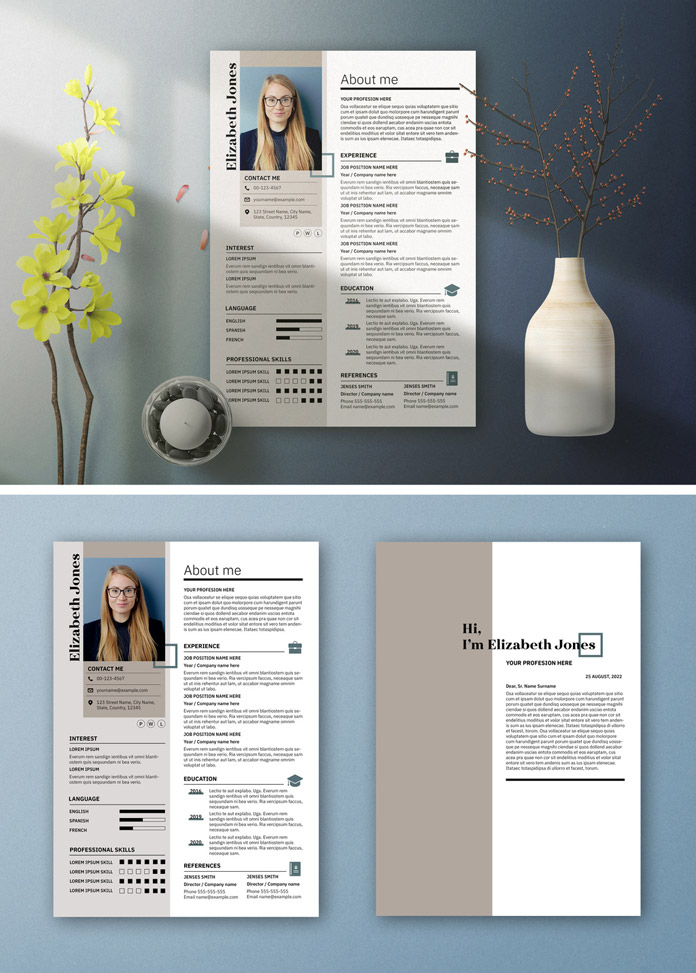
Available for use in Adobe InDesign, this easy-to-use resume/cv template provides a professional look.

Applying made easy—with this professional resume/curriculum vitae template you will have a good chance to get the job of your dreams. Created by freelance graphic designer, illustrator, and Adobe Stock contributor @Roverto Castillo, this Adobe InDesign is based on the standard size of A4. It consists of a cover letter and a resume page. Every section is fully editable. You can also add as many pages as you want. Customizing the pages is quite easy—with just a few clicks, you can add your own content to the predesigned layout. Based on a modern and simple design, this resume/cv template is the perfect solution to showcase your personality and skills in style. The layout consists of various, well-ordered subject areas.

Please note that this customizable resume/cv template requires Adobe InDesign. You can get the latest version from the Adobe Creative Cloud website—just take a look here. For those who want to learn more about this professional Adobe InDesign template, feel free to click on the following link. Using this template, you will definitely stand out from the crowd of competitors.

Download a professional resume and curriculum vitae template for Adobe InDesign
You can download this professional resume/curriculum vitae template for Adobe InDesign here. By the way, with an Adobe Stock trial subscription, you can download this high-quality InDesign file for free.


Do not hesitate to find more trending graphic design templates on WE AND THE COLOR. The category includes plenty of useful graphic stock material for different needs such as logos, patterns, countless vector files, or PSD mockups. For creative inspiration, we recommend having a look at our extensive Graphic Design category.

By Dirk Petzold

Sourced from WATC

Sourced from Forbes

When a company partners with an agency, leaders working on marketing typically have ideas about what they think their business needs. If the business sells directly to customers or clients, for example, its leaders know a strong inbound strategy is key. Often, a company will opt to handle certain inbound marketing tactics in-house, leaning on agency partners to help integrate both their efforts into a more comprehensive strategy.

After a client contracts with an agency to help define and shape the strategy for nurturing prospects’ journey through the funnel, it sometimes becomes clearer how invaluable their agency partners’ expertise in the inbound process really is, and the client starts wondering about other ways they could leverage the partnership. Here, 16 members of Forbes Agency Council share specific parts of the inbound marketing process that their clients frequently need more help with than they realized at first, and why this is the case.

1. Content Strategy

Companies often focus on turning out content and don’t do enough to make sure it is the right content for the right audience. Any inbound campaign will generate leads, but how you convert the leads to a purchase is key. This requires programmatic structure, strategy and content, identifying buyer personas and key performance indicators to nurture leads with content through the pipeline to purchase. – Maria Orozova, MODintelechy

2. A Social Media Presence For Marketing

The pressures of owning and operating a business are immense. Operational and service challenges aside, building a presence on social media for marketing is even more challenging. Those who approach social media as a side marketing effort to maintain relevance find little returns. Companies must invest the time, money and energy into a balanced marketing effort—including social media—to succeed. – Cagan Sean Yuksel, Dream Space

3. Audience Research

Usually, the understanding of the audience is based on anecdotes from leaders. Rarely is it rigorously researched and backed by reliable data. Everything flows from understanding target audiences. Spend time and money conducting both quantitative and qualitative research. It will make all of your inbound marketing more effective. – Gyi Tsakalakis, AttorneySync & EPL Digital

4. A Clear Messaging Framework

Too often, organizations jump into tactics before they have a clear understanding of their strategy. A great communications program is built on a foundation of a clearly defined objective, a targeted audience and a strong message that aligns your audience with your objective. Taking time to answer the basic questions and hone the messaging framework at the outset makes the tactics easier to execute. – Nathan Miller, Miller Ink, Inc.

5. Content Creation

Content creation is often one of the most difficult things for companies to execute. We often think, “How hard can it be to write such and such?” The reality is that good content is difficult to execute consistently and frequently. Writer’s block is a real problem for those who don’t do it regularly, and sometimes for those who do it professionally. Save yourself some frustration and outsource your content. – Jason Wilson, Strategy, LLC

6. Effective Copywriting

Many companies drastically underestimate their copywriting needs for organic search, product detail pages, marketplaces and other marketing channels. Companies love the low-cost traffic that SEO brings, but often think it’s a one-and-done project, or think it can be pulsed on and off. It’s a workstream, and many brands only have one copywriter on staff to address all copy needs across their business. – Antonella Pisani, Eyeful Media

7. The Call To Action

There’s a lot to be said around the importance of the offer/call to action when creating inbound marketing content. After a prospect has read your blog post or article, an effective CTA will move them further down the funnel (whether that’s to a sign-up form or an e-book download). Your CTA should be benefit-driven, action-oriented and tested regularly to optimize conversions. – Erik Koenig, SeQuel Response

8. Blog Production

Blogs remain a direct, effective tool for inbound traffic. But we often underestimate the strategy, TLC and even outsourcing they require to generate the desired return on investment. Before launching your blog, write down actionable goals, a distinct purpose and a deployment plan. Cover your bases on a topic bank, publishing frequency, audience, tone and delivery, writing and editing roles, SEO, and analytics. – Samantha Reynolds, ECHO Storytelling Agency

9. Thought Leadership

Thought leadership is the one area where companies seeking inbound marketing results need the most help. Mainly, this is due to their concern of giving away a competitive edge. Their concern is misplaced—being a great resource is its own competitive advantage. Your potential customers need help, and thought leadership is the best way to provide it. – Roger Hurni, Off Madison Ave

10. A Newsworthy Angle For PR

Coming up with your own newsworthy angle isn’t easy. Before they get in contact with me, so many entrepreneurs have tried to do their own PR and have failed because they haven’t identified a strong media hook about themselves. Everyone has their own unique story, and PR is all about bringing this story out of each individual and making sure it’s conveyed in a newsworthy manner. – Adrian Falk, Believe Advertising & PR

11. Personalized Landing Pages For Influencer Marketing

Influencer marketing is an incredibly effective way to drive inbound traffic to a brand’s website. A key part of the strategy is ensuring the destination you’re driving followers to is fully optimized for the desired action. Personalization of a landing page and clear calls to action may seem like table stakes, but companies often need a greater level of counsel to achieve success in this area. – Cooper Munroe, The Motherhood Inc.

12. Unique Brand Creatives

A brand always needs to invest in creativity, as the rest of any inbound marketing layers are purely process-oriented. Anything that is process-specific can be iterated quickly, except creativity. If your content lacks creative charm and fails to connect with customers, the rest of the inbound marketing process cannot rescue your brand from an apparent failure. – Candice Georgiadis, Digital Day

13. Search Engine Optimization

SEO is an incredibly integral part of discovery for many brands. It is not a set-it-and-forget-it project, as search engines are constantly retooling and revising the algorithms that determine search engine results. SEO requires knowledgeable and dedicated technicians who regularly adjust and integrate the latest best practices for optimal SEO success. – Jonathan Schwartz, Bullseye Strategy

14. Analysis Of Funnel Stages Where Leads Drop

The most common thing in inbound is that leads drop at a specific funnel stage where companies need more help than they realize. Finding out the actual reasons for leads dropping is not very easy, as it takes a lot of time to understand the user behavior. Even after doing everything correctly and by the book, when the leads drop, businesses realize that they actually need help with it. – Ajay Prasad, GMR Web Team

15. Conversion Rate Optimization

One area that applies to almost every inbound effort that is usually overlooked is conversion rate optimization. How many site visitors are converting into leads? How many blog readers are subscribing? Beyond this, CRO helps uncover the friction points through most inbound processes. CRO helps brands focus on what will move the needle. – Bernard May, National Positions

16. A Cohesive Web Profile Across Platforms

Creating a cohesive Web profile across various platforms is essential for a presence deemed trustworthy by search engines such as Google or Bing. A revamped SEO strategy should account for social media profiles and Web content, including service pages and blogs. In addition to presenting a unified brand experience to consumers, your organization will also be ranked better on SERPs. – Evan Nison, NisonCo

Sourced from Forbes

By Romain Dillet

Meet Omneky, a startup that leverages OpenAI’s DALLE-2 and GPT-3 models to generate visuals and text that can be used in ads for social platforms.

The company wants to make online ads both cheaper and more effective thanks to recent innovations in artificial intelligence and computer vision. Omneky is participating in Startup Battlefield at TechCrunch Disrupt 2022.

While many fields have been automated in one way or another, creating ads is still mostly a manual process. It takes a lot of back and forth between a creative team and the person in charge of running online ad campaigns.

Even when you manage to reach a final design, the new ads might not perform as well as expected. You often have to go back to the drawing board to iterate and create more ads.

Omneky aims to simplify all those steps. It starts with a nice software-as-a-service platform that centralizes all things related to your online advertising strategy.

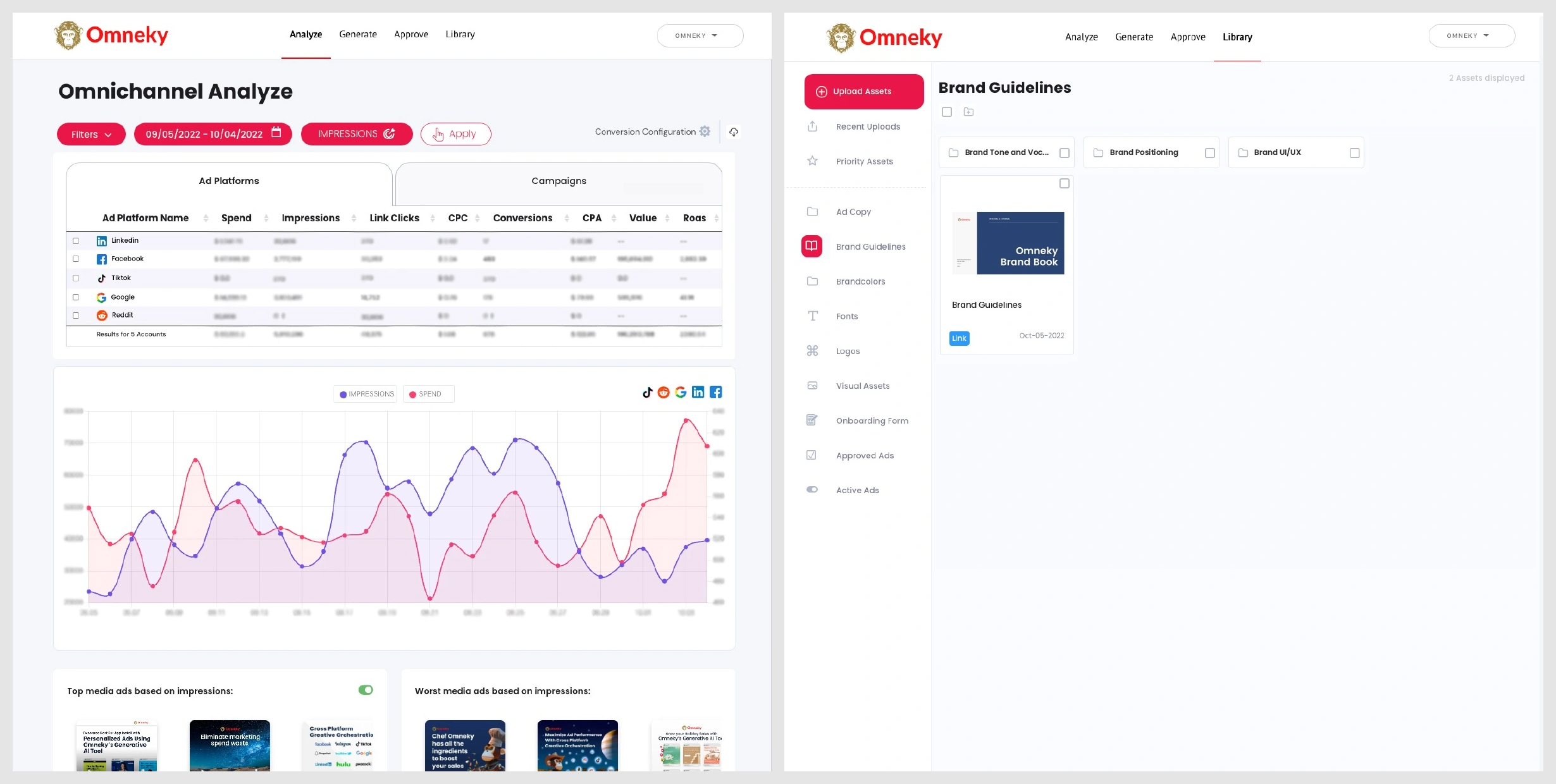
After connecting Omneky with your accounts on Facebook, Google, LinkedIn and Snapchat, the platform pulls performance data from your past advertising campaigns. From this analytics dashboard, you can see how much you’re spending, how many clicks you’re getting, the average cost per click and more.

But it gets more interesting once you start diving a bit deeper. Omneky lists your top-performing and worst-performing images and text used in your ads. Customers can click on individual ads to see more details.

Omneky automatically adds tags to each ad using computer vision and text analysis. The result is a dashboard with useful insights, such as the dominant color you should use, the optimal number of people in the ad and some keywords that work well in the tagline.

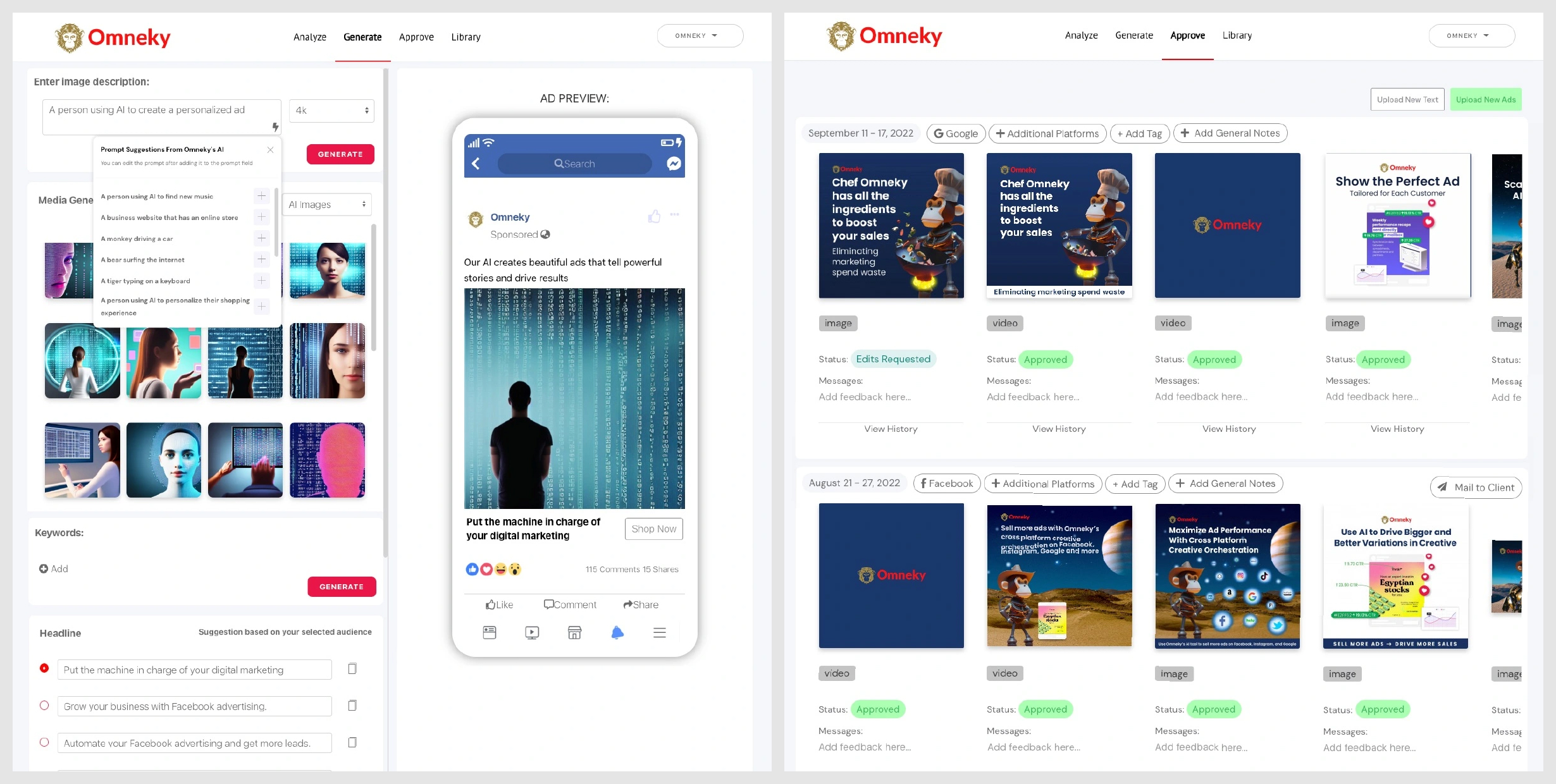
This data will be used to generate new ads. Customers write a prompt and generate new visuals using DALLE-2. Omneky also helps you with those prompts as it also uses GPT-3 to generate prompts based on top-performing keywords from past campaigns.

Customers then get dozens of different AI-generated images that can be used in online ads. Similarly, Omneky can generate ad copy for the text portion of your ads.

If you have a strong brand identity, Omneky can take this into account. On the platform, customers can upload digital assets and historical ads so that the platform acts as the central repository.

“Customers can upload the brand guidelines, the font, the logo. All of this is integrated into our AI to generate content that is on brand,” Omneky founder and CEO Hikari Senju told me in a call before TechCrunch Disrupt.

Image Credits: Omneky

Of course, some images and text don’t work well for one reason or another. That’s why Omneky doesn’t run any ad campaign without the customer’s approval. Team members can add comments, provide feedback and request approval from the platform directly.

As soon as customers approve a new ad, it is automatically uploaded and displayed on social platforms — Facebook, Google, LinkedIn and Snapchat.

After that, you are back to square one. You can track the performance of your new ads from the analytics dashboard, iterate and improve your ad performance.

The company charges a subscription fee that varies depending on the number of integrations with social platforms that you want to use. Omneky’s long-term vision expands beyond advertising.

There’s a lot of data involved with online ads, that’s why it’s easy to automate some of the steps needed to run an online ad campaign. But the startup thinks it could apply the same methodology to other products, such as AI-generated landing pages.

If you extrapolate even more, it’s clear that AI-generated content will cause a revolution in the martech and adtech industries — and Omneky plans to participate in that revolution.

Feature Image Credit: Omneky

By Romain Dillet

Sourced from TechCrunch