Bye-bye cookies, hello customer-centricity… This is the year it all happens, writes Treasure Data’s Kazuki Ohta.
The ad business is approaching a transformative moment. New privacy rules enacted by both state governments and tech giants have made digital advertising more expensive yet less effective. Innovative strategies designed by marketers to overcome these hurdles have not yet made it into media plans. If 2022 was a year of reaction to dynamic forces, 2023 is set to be a year of assertive action. Brands should keep these data-related predictions in mind as they begin to consider annual budgets and map out their avenues of escape.
1. Campaigns will go completely cookieless
The impending death of third-party cookies has petrified nearly every advertiser. At this point, many brands seem committed to going down with the ship, relying on third-party identifiers until they are gone forever. While Google’s depreciation delay this year offered a reprieve, there have been some forward-thinking brands that pushed onward and are pioneering the post-cookie landscape.
These brands have already started to test the effectiveness of alternative identity solutions, which enable media buyers to transact based on pseudonymous identifiers rather than cookies. Cookieless campaigns have mostly been experimental to date, but early success that has come in the form of increased reach and click-through rates suggests that they are ready to go mainstream.
Trying to predict what the cookieless future will look like is not easy, as there are competing technologies and visions fighting to shape the ecosystem. Doomsayers believe that alternative IDs will fail to scale and that advertisers will just flock to the walled gardens once the cookie crumbles. This may ultimately end up being true, but brands are not going to give up that easily.
As opposed to walled gardens, an open web backed by universal identifiers can provide the interoperability necessary for cross-screen marketing opportunities. In an effort to preserve this vision, the majority of the top 100 US advertisers will be completely cookieless in their digital campaigns by the end of 2023.
2. Time will run out on the old privacy regime
The era of unrestricted customer tracking is coming to an end. Apple’s rewriting of digital ad tracking rules is just one omen. California, Colorado, Virginia, Connecticut and Utah have promulgated their own laws and regulations. Without comprehensive privacy legislation at the federal level, brands have been forced to adapt and comply through ad hoc measures. And because there are new laws and regulations being debated, it has become increasingly difficult to anticipate what the next set of rules will look like.
As stewards of customer data, advertisers cannot afford to continue down this uncertain path. Brands require a safety net so that they can stop worrying about costly violations and instead start focusing on improving the overall customer experience. Fortunately, many of the leading adtech solutions on the market today have built-in privacy controls and data governance capabilities. Privacy and security are no longer a technology problem, but rather a business one, requiring a top-down approach and continuous consensus building.
As a result, some brands will begin to voluntarily take their data governance to the next level by adopting internal data privacy policies and measures that are more stringent than some of the new rules being discussed. That way, marketers will have confidence knowing that their practices are compliant now and in the future.
Some brands have had recent success by narrowing their audience pool: one-day-a-week dating app Thursday, or no-January-sign-ups gym Equinox. Should more brands follow suit? We asked six marketers.
Nitin Sinha, vice president, head of paid media, Laundry Service
‘Brands that want to connect with generation Z need to be authentic.’ We’ve heard this repeated often enough to know that it’s exercised in a wide variety of ways: good, bad, and ugly.
One of these ways is something we might call ‘anti-targeting’: turning away potential customers in favour of unequivocally establishing your brand positioning. My favourite example is REI shutting down on Black Friday, asking customers instead to #OptOutside.
REI likely projected that the long-term revenue impact from #OptOutside would outweigh the short-term loss. But I like to think that the idea originated from a simpler place: REI encouraging its customers and employees to avoid Black Friday chaos.
Authenticity through marketing can be a paradox. How do you show that yours is the real thing? It’s not easy. Smart brands put their money where their proverbial mouths are.
Lavinea Morris, head of planning, EMEA, M&C Saatchi Performance
Targeting niche audiences can make sense but only if its data-driven and not assumptive. If used correctly, it can be an effective part of your marketing mix, driving performance by up-weighting activity toward your most valuable customers. For brands who are willing to consider lifetime value and return on ad spend over customer acquisition cost, it can make your spend stretch much further and build long-term success.
The problem emerges when you become so obsessed with these audience groups that you miss out on opportunities with new customers. When you don’t balance niche with broader targeting testing, you will oversaturate your existing audience base and eventually stagnate your growth and bottom line. Niche targeting may be tempting but you have to think about the impact on your marketing priorities.
Becky Simms, co-founder and chief executive officer, Reflect Digital
Humans are complex systems, and ultimately every ad or marketing campaign is a human. Niche audience groups and targeting rely on truly understanding your market, their motivations, needs and drivers.
Behavioural nudges are a fantastic toolkit for marketers looking to target niche audiences. One such nudge is the ‘self-reference effect’, which demonstrates that people are more likely to remember information that is more relevant to them. Therefore, if an ad is hyper-specific to a user’s interests or behaviour, it can lead to ‘unexpectancy’ (pairing interest with an unexpected third party) and can cause cognitive strain. This cognitive strain helps with memorability and brand recall.
Nudges with niche audiences are a great way to increase the potential for engagement, immediately and later down the line.
Helen Androlia, director of strategy, Canada, Momentum Worldwide
While advertising is usually thought of as ‘mass’, I believe that we have always been niche to a degree. Some of the biggest brands in the world aren’t speaking to ‘everyone’ but to a specific target audience that is clearly realized. Whole Foods and the affluent, health-conscious consumer, for instance, or Square and its focus on small business.
As mainstream social media struggles to keep users, younger consumers especially are spending more time in closed, interest-based communities. Many Canadians – in Toronto especially – are also using platforms outside of North America to connect with friends and families overseas. Leveraging these channels means you can have more focused conversations and interactions.
Ultimately, most brand experiences are about space and place, from social to shopper to out-of-home. While you may not speak to everyone when you go niche, you can be sure that who you are speaking to really hears what you have to say.
Carli Pring, marketing manager, Tug
Should marketers be targeting ever-nicher audiences? Yes and no. There’s no right or wrong answer, but there is a need for a strong marketing strategy. Niche audience marketing can be an effective way for brands to target specific groups who are more likely to be interested in their products or services. It can also be a more efficient use of marketing efforts and have a higher return on investment. However, while it’s important to find a core demographic, reaching out to a new or a sizable target market can also pay off.
In 1998, Netflix was a direct-to-consumer DVD service designed and limited to ‘hardcore’ movie fans. Now, it’s a subscription service that allows consumers to access movies and TV shows, streaming from all devices, with cartoons to original TV shows (including the likes of Wednesday) targeting a diverse audience demographic.
That’s not to say that niche marketing isn’t effective. Axe (or Lynx in some markets), the Unilever body fragrance has been advertising products to pique the interest of young males since 1983, with core messaging around the brand’s property of seduction. Recently promoting the new limited-edition Lynx AI with British rapper Aitch, the brand has remained consistent throughout the years with its niche target audience, remaining the go-to smell of male adolescence.
In case you’ve missed the buzz, OpenAI just publicly launched its latest language generation robot, ChatGPT. ChatGPT is a powerful language model that uses deep learning techniques to generate human-like text. In other words, the robot is capable of answering all of your questions and prompts like an intelligent human would.
The model can be fine-tuned for specific tasks, such as language translation, summarization, and question answering. Here are 10 different ways you can use ChatGPT to do work for you and increase your productivity.
1. Write emails
Are you the kind of person who spends too much time thinking about what to write in emails? Say no more (to ChatGPT). By giving a simple prompt such as “write a cold email introducing myself and my company and inviting someone for a meeting,” ChatGPT will give you an example that will work just fine. Didn’t like the output? No worries, you can modify your prompt a little and ask again. The model almost never creates two identical answers.
2. Read faster
Did you forget to read important documents before a meeting? ChatGPT has your back. Copy and paste the document into the chat and ask the model to summarize the most important points for you. No one would ever suspect.
3. Summarize your own documents
Do you need to write a summary version of an article you’ve been working on? ChatGPT can summarize it. If you think the summary misses any details you find important, just say in your prompt what you want it to include.
4. Review your code
Did you spend an entire day coding but now you’re too tired to go back to review everything? Just ask ChatGPT to do it. You can ask the model to spot any possible mistakes in the code and to better organize it.
5. Comment on your code
This is probably one of the most mind-blowing things ChatGPT can do. If you give it a piece of code and ask it to make comments to explain what each block is doing, ChatGPT will give you a commented code. I know it sounds perplexing, and it is.
6. Translate research documents
If you’re a researcher like me, you sometimes find articles that seem interesting but they are in languages that you don’t speak. If you want to be sure that the article contains what you’re interested in, simply ask ChatGPT to summarize the document in the language you want.
7. Study efficiently
If you’re a student, you can use ChatGPT for your own learning. Let’s say you’ve spent the entire afternoon studying about the French revolution and now you want to test your knowledge. Ask ChatGPT to give you 10 questions about the French revolution. You can even ask it to correct your answers!
8. Create content
Content creators out there: Use ChatGPT in your favor! Simply ask the model to create content about the subject you want. Maybe the output won’t be exactly what you want, but it’s always good to have a place to start from. Take advantage of it, since everyone else is.
Personal Uses
9. Have philosophical discussions
Maybe you’re really into a niche topic but have no one to talk to, or you have a deep philosophical question but have no idea who has written about it before. ChatGPT can be your new mentor. Ask broad questions and wait for comprehensive answers. For instance, you can ask “Is there meaning in life? What are some philosophical stances on that topic?” I’m sure the answer will entertain you for at least an entire afternoon.
10. Play games
The games ChatGPT can play are still unknown territory. But you can always explore. Users have reported successfully playing tic-tac-toe and chess with the model. I have played a version of Akinator, a game to try to guess which character the other person is thinking of by asking questions that can be answered only with yes or no. Can you think of other games that the model might be able to play?
Sometimes, you need to write, but you don’t have the time or energy to do it for yourself. But that’s okay. In 2023, we have AI writing generator tools to help you at work — no matter what you’re working on. With the rise of artificial intelligence being used in content creation, customer support and more, AI writing generator tools are becoming essential tools in helping stay competitive, efficient and thorough in your work.
Whether you’re looking to create a prompt for a project, write a business plan or simply answer an email, we’ve gathered the six best (and free!) AI text generator tools to use at work in 2023.
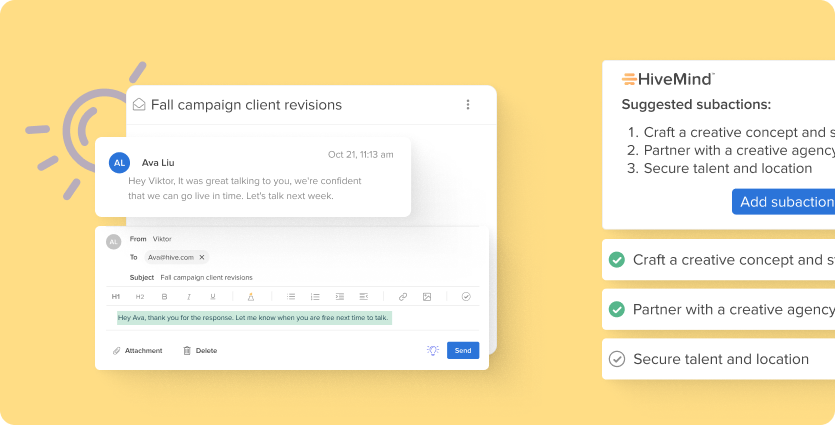
Looking to write a list of must-haves for a company party? What about a new article for your content calendar? HiveMind —Hive’s newest feature — has got your back. Using this innovative, free and brand-new tool, you can take full advantage of AI technology to make your workday run more efficiently, streamline your workflow, and best of all, write amazing content. All you had to do is write a prompt, such as: “Write an email back to John about meeting for coffee next Wednesday.”
Use HiveMind to:
Write amazing articles
Respond to emails automatically
Generate business plans
Create lists
Create original graphics to use on social media, your website, etc.
And more. In a matter of seconds, there you have it. This is truly a top pick for AI text generator tools that is easy, simple and extremely proficient in helping anyone write.
WordAi is an AI writing generator that helps you create:
Quick and easy blog posts
White papers
Web content.
It uses natural language technologies to create human-quality content, ensuring that content appears more unique and professional. WordAi is also available in a range of languages, making it a perfect tool for companies looking to do business in international markets.
Quillbot is an AI writing tool that allows users to produce high-quality content in just minutes. It uses a powerful algorithm to automatically generate personalized content. It can:
Provide accurate and interesting reading experiences
Offer potential customers an improved level of engagement with your brand
DeepCrawl is an AI writing tool that helps users create content that is optimized for search engines. It can:
Use natural language processing techniques to scrape content from the web and create content that is more relevant and visible in search engine results
As AI writing technologies become more accessible and affordable, they are likely to become indispensable tools in business operations in 2023. Are you ready to try it out an AI text generator for yourself?
On-platform checkout has reduced friction for online shoppers, but you’ll still have to strategize wisely to turn surfers into purchasers.
If you’ve got something to sell, it’s time to get social.
Social commerce — using social media to directly sell products or services on-platform — is far from a new phenomenon. But it is a fast-growing market: In 2023, social-commerce sales in the U.S. are expected to hit $56.2 billion, making up about 4.7 percent of overall e-commerce sales, according to an October 2022 report by McKinsey. Even if that percentage seems unremarkable, there’s still good reason to invest in this growing e-commerce channel.
Approximately 70 percent of all online purchases are influenced by social media, explains Jay Myers, co-founder of the Winnipeg, Manitoba-headquartered B2B e-commerce business Bold Commerce. “There’s huge promise, huge potential,” he says — if businesses can figure out how they can use social media to convert on-platform sales: “The reason why a lot of brands are not seeing success is because they just see [social commerce] as a shiny new tool. They think, ‘Well I’ve got followers, maybe they’re even engaged, so if I put a buy button somewhere it should just work.’ ” Unfortunately, it’s not that simple.
The best social-commerce strategies for your business will take into consideration a number of factors, including but not limited to your target demographic, your existing social-media presence, and what, exactly, you’re trying to sell. Sometimes, the best social-commerce strategy for a brand isn’t even purely social commerce: Social selling, the act of using social media to sell products or services on a separate site or channel, can be another great way to target customers, says Myers. What’s most important is figuring out what tactics will resonate most with your desired audience.
Here’s how you can make the most of on-platform checkout and social selling to meet your customers where they are: on social media.
Strategize your on-platform selling approach
Some products are easier to sell directly on social media than others. A low-cost product that doesn’t require a lot of research — cheap sunglasses, for instance — will have a much different buyer journey than a pricey pair of shoes. “Understanding the input that a customer needs to make a decision determines whether you should do social commerce,” Myers explains. Ultimately, not every product or service will be a fit for on-platform selling or even social commerce: A person is unlikely to book a hotel stay through Instagram, for instance.
Image Skincare’s eye mask.Photo: Courtesy Company
But brands that push their most accessible products on social will likely see results. Image Skincare, a Palm Beach, Florida-based professional skincare line, found particular success promoting its $55 eye masks through on-platform shopping on Facebook, Instagram, Pinterest, and TikTok; the product drove 20 percent of all traffic from its social shops on Facebook and Instagram to Image Skincare’s own website. The product’s success on social platforms is likely a result of its accessibility, explains Image chief marketing officer Yaso Murray; a visual product, like an eye mask, requires a lesser degree of customer education than a more complex and expensive serum. Although Image has invested in expanding customer education on social media — the brand grew its social-media team to six people in 2022 — Murray says it’s no coincidence that products requiring a low level of research by customers tend to perform better when it comes to on-platform checkout. “Simplicity is one of our core pillars. On social, I think even more so,” she says. “So a cleanser is going to do well. You know?”
Because Image’s products are only sold direct-to-consumer and at select spas across the country, the brand faces an additional challenge securing customers. “Because we’re not a Sephora, for instance, we have to think extra hard about how we can reach customers in a way that’s relevant to them,” Murray says. “It’s a business-building endeavour to wrap our heads around how to market to Gen-Z, who are the largest consumer generation. But that’s going to provide a lot of lifetime value for both our brand and our spas.” Investing in social commerce, then, is a worthwhile investment.
Partnering with the right influencers
Influencer marketing — a tactic that has increased in popularity as brands have experienced decreased returns from paid social advertising — can also help brands expand their reach on social. Image, as a professional skincare line, almost exclusively taps estheticians for its influencer strategy. By partnering with influencers who can use their professional experience to increase customer education, the brand can more easily push sales on social media. “They have very organic advocacy and can speak authentically about the product,” Murray says. “When you use celebrity influencers, your reach may increase, but the trust and credibility that comes with estheticians is much higher.”
Mavely’s mobile view.Photo: Courtesy Company
For some brands, though, the opposite approach may work just as well. Mavely, a Chicago-based influencer marketing platform, pairs more than 650 brands, including Gap and Honest Company, with over 25,000 “everyday influencers” who can freely share affiliate links for those companies on their social-media platforms.
That might sound like a recipe for disaster to brands that are used to having close control of their influencer relations strategy, but it’s actually proven hugely beneficial for retailers that have signed on to the platform, says co-founder and CEO Evan Wray. “A lot of brands have had very negative experiences with influencer marketing agencies because they’ll pay $100,000 and get five sales — that puts a bad taste in their mouth,” he says. “My view is that the future of influencer marketing is actually performance-based.”
A peer-to-peer social commerce strategy that taps people with authentic, relatable social media presences, he says, can turn into a massively scaled distribution channel for a brand — even if that brand has no control over the content that these influencers produce. And this form of influencer marketing isn’t just for “Instagrammable” DTC brands, either: Mavely’s top-performing brands are major big box retailers.
Finding your livestream shopping fit
Livestream shopping, a $423 billion market in China, led to $17 billion in sales in the U.S. in 2022, and is expected to triple to a $55 billion market by 2026. It’s a rapidly growing social-commerce strategy — but it’s not one that will work for any brand or product, says Aaron Levant, founder and CEO of the Los Angeles-based B2C live shopping platform Ntwrk. “A product has to have a lot of different attributes that can make it interesting enough for livestream shopping,” he says. Basic household commodities — which sell successfully on Chinese livestream platforms like Taobao — likely won’t appeal to U.S. consumers in the same context. Limited edition drops, collectibles, and products that benefit from some kind of live demonstration — like clothing and makeup — are better suited to the medium.
Where a brand decides to host its livestream also matters, Levant says. Although Facebook, Instagram, YouTube, Pinterest, and TikTok all offer livestream functionalities, he argues that smaller, more niche platforms could lead to better conversion: “I’ve done some experiments on [bigger] platforms, and their conversion rates are around 0.00003 percent. On a platform like Ntwrk, we get 5 percent conversion rates.”
The growing livestream market, Levant adds, may not be a winner-take-all industry, either: He sees just as much space for other livestream platforms, such as the beauty-focused app Flip, as he does for Ntwrk, which focuses on art, sneakers, and collectibles. “Intentionality is important, and niche communities assimilate together in different places,” Levant says. “Every platform has to speak the language of the community they’re speaking to, and I don’t believe one platform can be a catch-all for everybody.”
The global pandemic caused a paradigm shift in the businesses conducted across all industries, this led to a majority of brick-and-mortar stores shifting online while also giving impetus to the growth of exclusive online businesses
“We set out to create a direct-to-customer (D2C) distribution network that eventually transcended into a live manifestation of the expression – ‘Steal the Deal’. Our ideology with Combonation has been quite rudimentary in the sense that we kept ourselves in the shoes of a common customer and observed the gaps they experience in retail shopping,” said Pooja Sodhi, co-founder and CEO of Combonation.
The global pandemic caused a paradigm shift in the businesses conducted across all industries, this led to a majority of brick-and-mortar stores shifting online while also giving impetus to the growth of exclusive online businesses. India’s e-retail market registered a CAGR of over 35% to reach INR 1.8 trillion in FY20, as per market insights. Easy, quick, and frequent transactions raising small ticket sizes in bulk have also been a significant contributing factor to the growth of e-commerce.
On this backdrop, while revealing the company’s smart move to scale up in the sector, the CEO asserted that Combonation works at a slightly different tangent than most of the e-commerce marketplaces, without disrupting existing distribution networks of brands and their pricing, we aim to curate combos that excite and delight our customers from personal care to beauty and wellness to home décor, etc.
She further disclosed that the company’s plan of scalability is not linear, but a dual approach that has both geographical expansion for targeted market penetration and enhancing the Combonation e- marketplace for a better customer shopping experience.
“Faster cart conversions, better API integrations, discount applications, and post-purchase experience are arenas where we are deploying the majority of our resources. We constantly work on making the website more user-friendly and also leverage big data to provide customized recommendations ensuring that our audience does not miss out on lucrative brand deals,” said Pooja Sodhi.
It is reportedly estimated that D2C brands in India are growing at a CAGR of 40% but there is no certain hack so to speak, value addition above all is the key for any business, not just e-commerce. It is also expected that some recent trends that will for the foreseeable future be prevalent in the D2C space are health and wellness-based commodities, adoption of an omni-channel approach, front-footing with social-commerce, and subscription-sales model among others.
Being asked on the secret recipe for success in the D2C sector, Pooja said that, “Brands can only thrive by being relevant to their respective target audience and perpetually giving customers something to look forward to; this is the philosophy followed in Combonation as well. It is crucial for brands to cope with the rapidly changing demands of the end consumer. By design the D2C market is extremely sensitive to trends and brands that are able to cater to such dynamic needs are surely going to come out on top. As expectations of customers from their favourite brands are rising across the country, D2C players are expected to dig deeper into their resources to provide more customer-centric solutions in 2023.”
When speaking about the key ingredients of a successful D2C brand, it is to be noted that marketing the product effectively plays a pivotal role in determining the success of a D2C brand. According to market studies, the high search volume from this year indicates that more brands want to choose a D2C marketing model. With reference to some approximate statistics, Indian D2C brands spent $157 million on advertising in FY21. Further, it was observed that the median advertising budget for top-funded D2C brands in India was $2.6 million in FY21.
As per Pooja’s words, a prerequisite to good branding and marketing strategies is to ensure the quality of products and services because that will surpass everything, once that area of business is sorted then companies should start building campaigns that are self-explanatory and intuitive but not misleading or shammy.
“We at Combonation have always had a customer-centric approach and given the D2C model of our business, this becomes all the more relevant. Our aim remains to make the shopping experience a delight for the end consumer regardless of the mode of purchase, be it online or offline. We ensure that our deals are never subject to a specific brand or a certain product portfolio,” she noted.
In the precariousness of the modern marketing landscape, brands across every sector are facing challenges. India’s 700 million internet users and 180-190 million online shoppers claimed to make it the third- largest market for D2C brands after the US and China. In 2020, consumer demand for most D2C brands via website said to have risen by 88% compared to the years before Covid-19. The Indian D2C market is currently believed to be worth $1.9 billion, about 1% of the domestic market for consumer goods, home goods, and consumer accessories.
“For D2C brands, product and marketing are the two biggest focus areas. They should explore outsourcing other functions to partners who have domain expertise. The challenges faced by D2C brands in the early breakthrough periods can hinder e-commerce growth from sales conversion to logistical delays. Within the Indian D2C ecosystems, factors such as – Cost of customer acquisition and maintenance of brand loyalty; hiring and talent management; bottom-line challenges; working capital management, and ESG obligation as well as other sustainability factors are areas where a lot can be done smatter and are also places where there’s a constant tussle. The success of D2C brands, therefore, depends a lot on tech-enabled fulfilment,” said Pooja Sodhi.
Keeping all these challenges in mind, Pooja Sodhi advised the beginners in the sector to have a UVP (Unique Value Proposition) or take notes from the precedents and build the best version of it. She also added that it is important to evaluate the market budget for a said company and then focus on how your D2C brand can achieve the first set of goals without exhausting a big chunk of resources.
“Be aware of the difference between pivoting and devoting; pivoting is change but deviation will only lead to purpose dilution and make your brand unstable,” said Pooja.
The D2C market in India is said to be growing at an incredible pace. In the D2C sector, consumer behaviour is said to be one of the common focuses of market theory. The market behaviour varies from place-to-place and time-to-time. Considering the Indian states’ behavioural pattern, according to reports, the top 2 cities Delhi and Mumbai accounted for $71 billion of the overall retail spending across different city types. Followed by the next 6 which are Bangalore, Chennai, Ahmedabad, Pune, and Kolkata, contributed $79 billion. The rest of the states and cities accounted for 685 billion USD. Therefore, one thing is very evident, even though the metropolis cities have contributed significantly to e-commerce growth, over the years, tier 2 and tier 3 states have also absorbed market trends and they now make up for a huge chunk of the Indian e-commerce market.
Referring to this scenario while explaining the competition in the D2C ecosystem, Pooja Sodhi elaborated that, “The Indian e-commerce ecosystem has been blessed with the influx of new players; approximately, there are more than 19,000+ e-commerce companies in India today. A majority of the new players are now discovering more niche market segments; whereas other players are now trying to pivot from what they were initially. E-commerce by nature is a very demand-sensitive domain and suppliers are often hyper-respondents to trends. Today’s competition goes beyond just the numbers but is more about who is more relevant in the long run.”
Though the competition is evidently high, with the right spirit and focus, Combonation plans to grow multi-folds in terms of their overall market presence. Dwelling more into the company’s vision, Pooja divulged that, “We are constantly in touch with brands to design the best possible deals and enlist new brands on our panel as well. We are actively deploying the best of tech-talent to enhance the Combonation website and make it an extremely user-friendly, fast as well as a secure place for all to shop without any apprehensions.”
“Additionally, our offline retail stores are also growing; with further geographical expansion across metro and non-metro markets, we will be able to reach more of our online customers while bringing on board a new set of customers too,” she added.
Feature Image Credit: Company handout, Pooja Sodhi
Making your products stand out from the competition is essential if you want to succeed in business. But how can you make sure that your products are truly unique? When it comes to product uniqueness, creativity is key! Here are six creative ways to make your products more unique and help them stand out.
1. Find Your Niche
Finding your niche is a great way to make your products stand out. Finding your business niche allows you to be creative and offer something unique that no one else can. It also helps customers easily identify what you’re selling and why they should choose it over similar products.
When looking for a niche to focus on, consider the market size and competition to determine whether or not it is worth pursuing. You will also want to research any potential customer needs in the space so that you can create an offering tailored specifically to them. Take the time to figure out how exactly you will differentiate your product or service from others on the market and tailor this to your target audience.
Finding your niche also allows you to create more personal connections with customers, as you can tailor your marketing and sales approach based on the needs of a specific niche market. You can build relationships with potential customers by showing them that you understand their wants and needs and offering an offering that meets those requirements.
The key to making your niche search work is focusing on one thing and doing it well instead of trying to be everything for everyone. It’s better to focus on a smaller number of products or services but do them exceptionally well rather than spreading yourself too thin across different sectors or markets.
2. Offer Personalization Options
Personalization options have become increasingly popular in recent years, and for a good reason. By offering personalization options to customers, you can make your products stand out from the competition by giving them something unique. Personalized products help make your offerings more creative and memorable, as each item is just for that customer.
In addition to making your products truly unique, excellent prints are a great option to add a touch of quality and sophistication to any product. Adding quality prints gives items like metals, mugs, or t-shirts an extra level of quality and detail while ensuring they’re completely customized with whatever text or image the customer chooses. These prints will last longer than other printing methods and create a special item that customers won’t find anywhere else.
3. Use Unusual Materials
Unconventional materials are an effective way to make your products stand out from the competition. By using unexpected materials, you can create innovative products that will set you apart from the rest. Unconventional materials often come with unique properties, such as textures, patterns, and colors that cannot be found in traditional materials. This makes them perfect for creating aesthetically pleasing items that capture consumers’ attention.
Furthermore, unconventional materials can be used to create products with higher durability than those made with traditional materials. For example, bamboo is a highly durable material resistant to water and mould, making it ideal for outdoor applications. Similarly, cork is known for its strong soundproofing properties and can be used to create items that are highly effective at muffling sound. Using unconventional materials, you can craft products that will last for years and offer superior performance.
4. Create Limited Edition Products
Creating limited-edition products is a great way to make them stand out from others on the market. You can do this by offering special discounts or bundle deals for certain time periods, or you can create custom packaging for certain items that will be released in limited numbers. This will help your product become exclusive and give customers an incentive to purchase it before it’s gone forever!
5. Re-brand Your Product
Another creative way to make your product more unique is by re-branding it with a new name, logo, design, or colour scheme. This can help it stand apart from other products in its category and give customers an extra reason to buy. Additionally, re-branding can help you attract a new audience and update your product to appeal to current trends and preferences.
6. Collaborate with Others
Finally, collaborating with other businesses or influencers in your industry is another great way to make your product stand out from the competition. This could involve sharing products, offering discounts for customers who purchase from both companies, or even creating joint marketing campaigns that feature both brands. Collaborating will not only help boost the visibility of both companies’ products but also create more interest and trust among customers.
Regardless of your business type, finding creative ways to make your products unique is essential if you want them to stand out from the competition. By following these six tips, you can ensure that your products will be one-of-a-kind and attract more customers.
The billionaire drastically cut costs, which included massive job losses after taking control of the platform.
Elon Musk has finally lifted the veil on the workforce at Twitter.
After taking control of the microblogging website at the end of October in exchange for a check for $44 billion, the serial entrepreneur immediately embarked on an austerity cure to make the platform profitable.
It was urgent.
On the one hand, Musk had contracted a debt of $13 billion, which comes from interest payments of around $1.5 billion a year. This debt had been transferred to the company’s balance sheet.
On the other hand, Twitter faced an exodus of advertisers who had chosen to pause the promotion of their products and services while waiting to have a clear idea of the content management policy that Musk was going to put in place.
Half the Jobs Cut in One Day
The tech mogul has always marketed himself as a “free speech absolutist,” meaning he believes any tweet is okay as long as it doesn’t violate the law. For many advertisers, this laissez-faire approach risked turning the platform into a “hellscape.”
The advertiser exodus had a big impact on Twitter’s finances, with Musk saying the company was losing $4 million a day. The billionaire then announced an unprecedented massive reduction in the workforce. He cut half the company’s workers, or 3,750 jobs, in one day.
A few days after these job cuts, the new owner of the social network then asked the remaining employees to work long hours or leave.
“Going forward, to build a breakthrough Twitter 2.0 and succeed in an increasingly competitive world, we will need to be extremely hardcore. This will mean working long hours at high intensity. Only exceptional performance will constitute a passing grade,” the billionaire wrote in an email sent to employees on Nov. 16.
“If you are sure that you want to be part of the new Twitter, please click yes on the link below,” he continued. “Anyone who has not done so by 5pm ET tomorrow will receive three months of severance.”
It is difficult to know what response the whimsical and visionary entrepreneur expected from this ultimatum. More than a thousand employees had decided to leave, which had caused general chaos, forcing Musk to temporarily close offices of Twitter including the headquarters in San Francisco.
The Number Is ‘Incorrect’
Since then, there was a blur on the workforce of the company.
Musk has just clarified things after a CNBC article, citing “internal records,” indicated that the company has “approximately 1,300 active, working employees, including fewer than 550 full-time engineers by title.”
The billionaire claims that CNBC’s figures are false, at least those relating to the total number of Twitter employees.
“The note is incorrect,” the billionaire said on January 21, referring to the article. “There are ~2300 active, working employees at Twitter.”
To another Twitter user mentioning the article, Musk repeated: “It is actually not true. Employee headcount is almost double that.”
Basically, Twitter, which had 7,500 employees at the beginning of November, lost 5,200 employees in just over two months.
In addition, Musk took the opportunity to talk about the staff allocated to security while civil rights associations are concerned that the sharp reduction in staff has weakened the management of the platform’s content.
“There are still hundreds of employees working on trust & safety, along with several thousand contractors.”
Finally, the billionaire has appeared to respond to critics who accuse him of using employees of his other companies, including Tesla (TSLA) – Get Free Report engineers, to work at Twitter.
“Less than 10 people from my other companies are working at Twitter,” Musk said.
Musk has also indicated that Twitter will be hiring this year but he did not say what functions or roles the company plans to fill.
“Will Twitter be hiring in 2023?” he was asked.
“Yes,” the Techno King, as he’s known at Tesla, answered.
He did not give further details, such as when the company was planning to start hiring.
The tech sector is in the midst of an austerity cure. In 2022, tech companies cut nearly 100,000 jobs, according to a recent report from outplacement services firm Challenger, Gray & Christmas. This was more than seven times the number of 2021, when 12,975 jobs were lost in the tech sector.
Over the first 20 days of 2023, more than 55,300 jobs have already been cut, including 12,000 by Google (GOOGL) – Get Free Report and 10,000 by Microsoft (MSFT) – Get Free Report, according to data startup Layoffs.fyi.
Twitter CEO Elon Musk gave a statement that has the internet divided — and it’s about the prominence of the social media platform as a reliable “source of truth.”
What Happened: Musk took to Twitter to share an update about Community Notes, but before that, he said that the microblogging site is “arguably already the least wrong source of truth on the internet.”
Musk’s statement didn’t go well with many Twitter users, while others like Dogecoin
DOGE/USD-4.60%+ Free Alerts
co-creator Billy Markus, also known by his Twitter handle, Shibetoshi Nakamoto, said that “crowdsourcing is much better than a ministry of truth.”
Here are a few more reactions to Musk’s tweet:
This is how you can potentially earn extra income every single month.. Benzinga’s full-time trader Chris Capre is sending simple options trade alerts to traders like you. Click Here to get his trades for only $0.99!
Why It’s Important: Before Musk’s tweet, Community Notes’ official Twitter handle announced that the notes would also be shown on Quote Tweets. The feature is already live on the web app and will soon launch in iOS and Android versions.
Besides the Community Notes update, Twitter has been working on other features. Developer Alessandro Paluzzi shared a series of posts saying that the platform has discarded the downvotes features in the latest Android alpha release and is working on the long-format tweets.
Business blogging is an interesting concept. Many businesses have a blog, and yet, in most cases, there isn’t much planning going into how those blogs fit into larger business goals. Someone on the team is just assigned to publish content regularly, and that’s what they do.
A business blog is usually an island within a company: There’s likely, not much measuring, so no one has any idea if it is generating any traffic, sales, or rankings.
And yet, despite a lack of planning or measuring, there may be some good traffic coming.
Blogging is a good way to achieve “aссidental rankings” (those you didn’t necessarily plan for) and discover more search-driven sales channels. But many business owners or marketing managers have no idea what their blogs are ranking for. Consequently, there’s no buying journey set up for someone who lands on a blog post.
Clicks may come, but a blog remains an island. So, how can you include your blog in your overall marketing strategy to convert those clicks?
Step 1: Identify your blog’s current rankings that may bring sales
In other words, let’s see if there’s anything to worry about in the first place. Normally, the good old 20/80 rule works for blogs as well: About 20% of your content will be bringing 80% of your traffic. So, you need to know what 20% of your blog content actually does bring traffic.
Navigate Performance > Create a filter to see all the pages that contain “blog” (or whatever domain or subdomain you have your blog at) and click on the “Pages” tab.
The list is going to be sorted by the number of clicks your blog is driving.
Don’t forget to use Moz Pro’s rank tracker to set up position monitoring of those pages that are driving organic traffic.
Step 2: Plan your buying journeys from your blog
Make sure your blog makes it clear that this is a business blog and you are selling something. Define the major conversion funnels for your readers to follow.
At the very least, there should be a site-wide call to action (CTA) inviting readers to check your product or products, but the best idea is to create contextual CTAs and lead generation forms, which could better align with the searchers’ intent.
Hubspot is a great example of contextual CTAs that differ in each article and engage readers by providing “upgrades” to the article content:
There are many more content-based B2B lead generation strategies, but contextual CTAs work in e-commerce and retail as well.
HomeDepot is another prime example of including contextual CTAs (and automating them). They always show related products right next to each of their guides. Not only are these products actually helpful for following the tutorial and solving the searcher’s problem, they also create the right expectation that this content has a business behind it:
Look at your blog and open any individual article. Do you offer readers ways from that blog to follow the sales funnel? You may also want to set up a heat-map and button click tracking to better understand what your blog readers interact with on your blog post.
Step 3: Revive lost rankings
An important reminder: Blogs inevitably lose rankings.
The essence of any blog is that the more content you add, the further your older content is moving down the archive, away from the home page. And gradually, but inevitably, that content is going to lose rankings.
Thus, checking your blog’s traffic and rankings should be done regularly because blogs tend to lose rankings over time. You can do that using the same tools. Search Console has a “Compare” option allowing you to see pages losing clicks…
Click the “Click difference” header twice to sort by pages that lost the most clicks. You can only go as far as 16 months back, though.
And again, once you set up tracking, the Moz Pro rank tracker will tell you exactly which keywords are losing rankings. You can compare your current positions to what you had when we first started recording any particular keyword.
So now that you have a list of articles that are losing rankings, what to do with those?
Is this something that can be saved?
First of all, figure out if this is something worth saving. There will always be rankings that you can just let go of. These include old news or press releases, articles that stand no chance of converting readers into buyers, expired product reviews or listicles, etc.
Update the content
If it looks like a page that is ranked for something with transactional potential, think about whether you should update that content to align it better to those keywords as well as relevant contextual CTAs. Maybe there’s a new video you created after writing that article, so now you can add it there.
Also, study your organic competitors to see where they might be better. You can use IMN’s Side-by-Side Tool to see the content of pages that gained rankings that you lost. The tool will compare various important on-page elements like titles, subheadings, keyword usage, etc. This will give you lots of clues about what needs to be expanded, added to, and improved.
SE Ranking on-page SEO checker is another great tool to see where your content needs to be updated and optimized better based on your competitor research:
Using SEO change monitoring, you can also be on top of your competitors’ content updates so that you can timely update yours and avoid losing rankings.
WebCEO is another cool tool that analyzes around 30 competing URLs for your target search queries and suggests what needs to be added for your content to catch up with your competitors:
Next, republish your refreshed content with a new date to push that article back to the top of your blog’s archive. For seasonal content, it’s especially important to time those content updates with the upcoming holiday or season.
Depending on those keywords (i.e. their relevancy and search volume), you may want to make that page more evergreen and prevent it from ever getting lost in your blog’s archives. Internal linking is one way to do that.
You can link to that page from relevant static landing pages that always remain at the same level in the site structure. Or include static site-wide or blog-wide “Featured guides” sections linking to those important blog posts. Here’s an example of a product category page linking to related guides:
Not only do these links help buyers make more informed decisions, they also help those linked guides maintain more consistent and long-term rankings.
What if your blog has no traffic at all?
But there’s another possibility, a bigger and broader one that probably deserves a separate discussion: What if your blog doesn’t rank at all, and there’s no organic traffic to convert? Sometimes those unexpected rankings never come, so what can you do?
Ask yourself why you have a blog in the first place and what you’d like to achieve with it. Is it sales? Then research your keywords and create effective contextual CTAs. If it’s links and connections? Then research journalists in your niche and what they are interested in, to better create content for successful outreach.
Researching your keywords and aligning your content to your goals is a huge topic, which is covered in-depth in Moz’s Keyword Research Master Guide, so start there.
Make your blog part of your whole company
The above steps help you revive and improve your blog’s rankings and utilize those clicks better. But without solving an underlying issue, you won’t see your blogging strategy succeed in the long run.
You need to integrate blogging into your company’s life and marketing strategy. Let your whole company submit content ideas for your blog, encourage everyone to share those articles that go live, and invite your current employees to write articles and create graphics for your blog.
Make sure your blog writers talk to your customer support and sales teams because those talk to your actual customers, so they will have a lot of insight into what those people are struggling with and how to help them. Give your blog writers access to your CRM to be able to assign certain clients’ questions and interactions to them as content ideas.
Keep an eye on your blog’s metrics and share important milestones with your company. A blog can make a big difference to your company’s bottom line, but only if you are taking it seriously.