Author

editor

Browsing
USB is somehow both the simplest thing in the world, streamlining how we charge our devices, transfer data, and connect accessories, yet also an impenetrably confusing mess of inscrutable standards — who knows if you’ll need a new cable to charge your phone at full speed? Thankfully, the powers that be (the USB Implementers Forum, or USB-IF) aren’t unsympathetic to our plight and following efforts last year to clean up power rating logos, the group’s rebranding effort is now looking to simplify the nomenclature for the SuperSpeed and USB4 standards.
Speaking to The Verge, USB-IF President and COO Jeff Ravencraft explains that studies revealed consumers don’t quite understand the meaning of the basic USB branding, let alone any of the more advanced features that can be supported. One of those that hasn’t proven very helpful is the SuperSpeed branding — which doesn’t even immediately communicate what data speeds it supports, nor what charging wattage. In an effort to avoid confusing branding like USB4 Gen3x2 and USB4 Version 2.0, the group instead wants to place the data transfer speed and wattage (where applicable) front and centre.

The big changes you’ll notice as a consequence of this rebrand are the dropping of SuperSpeed and simplifying USB4 to just USB. Legacy USB 1.0 and USB 2.0 (now called USB Hi-Speed) branding remains unaffected — you won’t see the latter changed to USB 480Mbps, because the USB-IF rightly fears customers may equate the higher numerical value to a faster data transfer speed, completely ignoring the difference between MB and GB.
Source: USB-IF

For USB-C cables used to transfer power and data, the maximum rated wattage will now be appended to the USB branding. Products certified before this shift can continue using the older branding, and while manufacturers may breathe a collective sigh of relief, this might only spell more confusion for consumers if it takes years for the new stuff to really penetrate the market.
Source: USB-IF

Of course, companies aren’t forced to undergo USB-IF certification for their products in the first place — although respectable brands will, since they need to in order to feature the USB logo. So, while this may not solve all of our USB headaches, it admittedly sounds like a step in the right direction.

By Chandraveer Mathur

Sourced from Android Police

By Kylie Smith  & Edited By Chris Kissell

Noticing these red flags can save you from a disappointing job change.

You’ve finally scored an interview with your dream company and couldn’t be more excited.

But as visions of making more money dance through your head, you might find that the interviewer has some strange questions to ask.

It sounds bizarre, but some companies ask off-the-wall questions when interviewing potential employees. But is a weird question a red flag, or does it mean you’ve found a fun, quirky company?

You can decide as you dive into the following list of some of the oddest interview questions.

1. If you were an animal, what would you be and why?

Asking you to compare yourself to something else can help an interviewer get a read on your personality. For instance, are you more of a dog person (friendly and collaborative) or a cat person (happiest working on your own)?

It might also be a fun, low-stakes question that helps set a more casual tone for the interview. This odd question is more common than most, and it doesn’t scream “run” too loudly for some folks.

But others might start looking for the exit. If the company is already acting weird during the interview, what kind of weirdness will reveal itself once you start working there?

5. If you were a brand, what would be your motto?

According to reports, interviewers for Boston Consulting Group asked the question above. You can think of it as a spin on a more typical question like, “What are your strengths?” Or “What are you the most proud of in your work life?”

It’s not the best question, but it’s far from the worst. This might not be a red flag if you’re applying at an ad agency or public relations company. But for other types of jobs, this question might be just annoying enough to send you back to the “help wanted” ads.

6. Red or yellow?

This question — or a variation like “Purple or pink?” — is completely open-ended, so bring whatever energy you want to the table here. Strict “this or that” questions don’t give an interviewer much information about you.

An interviewer asking you one offhand question like this isn’t a warning sign. But if you’re only getting arbitrary questions with no obvious link to your work experience, you might want to look elsewhere.

7. If a train leaves Busan at 12 p.m. going 60 mph and another train leaves Seoul at 1 a.m. going 47 mph …

Unless you’re a mathematician or train engineer, you shouldn’t be answering complicated story problems in an interview.

Depending on the job, it might be fair to ask you to show an ability to think on your feet. But again, unless you’re a walking calculator, you can’t come up with the right answer to a question like this off the top of your head.

A company that wants you to do so needs an expectation reset.

8. Do you think I’m a good interviewer?

If you’re asked this question, it’s time to stand up and sprint for the nearest exit.

We’ll make an exception if you’re interviewing for the position of interviewer. Otherwise, this one’s a hard pass.

9. What is your biggest weakness?

This question isn’t an unusual one: It’s simply a bad question with no good answer.

If you say you don’t have any weaknesses, you sound egotistical. On the other hand, if you can’t stop talking about your main problems, you run the risk of making yourself sound like a bad hiring choice.

If your interviewer asks about your weaknesses, feel free to be honest while using specific examples of how you’ve overcome such shortcomings in previous jobs. But definitely weigh whether you would be happy working for a company that asks you to outline flaws before it hires you.

10. What would your current manager say about you?

Far too many companies ask this question, so it’s not necessarily odd. However, it is unfair.

You can’t evaluate yourself from another person’s perspective, which is why companies ask for references.

Additionally, people often leave jobs because they don’t get along with their manager. How are you supposed to evaluate yourself from the perspective of someone who doesn’t like you, or who you don’t like?

By Kylie Smith  & Edited By Chris Kissell

Sourced from Finance Buzz

Sourced from Entrepreneur

The Ultimate Guide To Shopify has all the tools you need to start and grow your own online business.

The Ultimate Guide To Shopify by Jason R. Rich from Entrepreneur Press offers all the tools and guidance you need to start and run your own ecommerce business. With proven marketing strategies that will boost sales, tactics to differentiate your website and advice from industry experts, The Ultimate Guide To Shopify sets you up for success when starting an online business. Read on for an excerpted interview from the book with ecommerce veteran Bob Herman, co-founder of Luv To Laugh. Herman discusses the process of building his business and how it evolved and ultimately thrived using Shopify to expand his .

Luv To Laugh is a Shopify-based ecommerce website that sells T-shirts and other apparel printed with graphic designs created by Herman’s brother and business partner Scott. Most of the company’s orders are created and fulfilled by print-on-demand services.

In this interview, you’ll learn more about Herman’s experience creating and managing Luv To Laugh using Shopify.

Q: How did the concept for Luv To Laugh evolve into an ecommerce website?

My brother and I wanted to create something to honor the memory of our grandmother, who we called Bubby. She always loved to laugh, and the graphic designs featured on our apparel are based on her adventures. Once we determined what our goals would be for the company, we conducted research to learn about the ecommerce platforms that could best meet our needs. We wound up choosing Shopify because we felt that the admin console for managing the site was the most intuitive and the third-party apps that can be incorporated into the site to add functionality are expansive. The cost to operate an ecommerce business using Shopify is also very affordable, especially considering that website hosting is included. By providing us with the technological tools needed to easily create and manage the website, this allowed us to focus more on creating the products we wanted to launch.

Q: Part of your company’s brand and philosophy includes supporting the charity Feed the Hungry, and you donate 5 percent of your net profits to this organization. What made you decide to do this?

There are many charities out there that support causes around feeding people who are hungry. As we were first coming up with ideas for Luv To Laugh, we knew that we wanted to support some type of charity. We chose a charity that we believed was important to the world and that our bubby would also have supported and believed in. Ultimately, as we learned about Feed the Hungry, we decided that this was a great cause that we wanted to support.

Q: Why did you decide to use a print-on-demand service to imprint your products?

We actually work with several different print-on-demand services, and we love the fact that they integrate seamlessly with Shopify. Choosing to use a print-on-demand service to create our products and fulfill our orders was purely a financial decision. We simply could not afford to initially create and maintain an inventory. As we grow, we plan to begin having our products manufactured in bulk and carrying our own inventory, because ultimately this would allow us to earn higher profits from each sale.

Q: What was the biggest misconception you initially had about starting an ecommerce business?

We had inaccurate expectations for sales volume. When we were telling our friends and family about the business idea, everyone was incredibly supportive, so we thought that quickly getting a bunch of orders would be easy because everyone would just love the idea once they discovered our website. We did not have the initial marketing budget to generate the traffic and sales we initially expected.

Q: What would you say are some of the key skills someone needs to create and manage a successful ecommerce business?

While much of the Shopify platform relies on an intuitive user interface, there’s still an overall learning curve when it comes to understanding how ecommerce, as well as online sales and marketing, actually works. People need to understand the Shopify platform and learn how to use it before they launch their business on the platform. It’s important to understand how everything works and understand things like shipping rates and how the various online ad platforms work. Most of our paid is done through and email marketing, and it’s important to learn how to do this properly, or you can easily wind up misspending your money.

Q: From the time you and your brother came up with the idea for Luv To Laugh to the time your website was launched, how long did the process take?

We spent about six months putting everything together, creating the designs for our products, and developing a business plan we were comfortable with. Initially, we chose to launch the business with a specific number of designs, with the plan to continuously launch new designs. We did not want to provide customers with too many choices initially, so the goal was to create four distinct collections, and then have about 10 different products in each collection.

Q: How did the brand for your business evolve?

We wanted to establish our brand first, before ever launching the website. We came up with the business name and Luv To Laugh brand knowing we wanted something that could have a broad focus and that would allow us to expand in the future. A name like Bubby’s Adventures would have been too narrow a focus. After brainstorming the name, we didn’t finalize it till we knew we could get the domain name and had a logo that could be trademarked. The company name and brand project exactly the message we want to convey. I believe it’s important to establish a brand for a company at the very beginning, and the brand should represent something you’re very passionate about that has a definable and reachable —not too broad or too niche.

Q: What type of research did you do about the competition you’d encounter?

We thought a lot about the competition as we were developing the concept for and focus of the business. When creating our products, we were very careful not to create something that would have to compete directly in the already-crowded marketplace for low-priced T-shirts with imprinted funny sayings. Our focus was on creating unique artwork, for which we hoped people would be willing to pay a premium. It’s very tricky coming up with a price for your products that allows you to earn a profit yet stay in line with the competition. A lot depends on what you’re selling, who you’re selling to, and the perceived value you can create for your products. Creating a premium brand that sells higher-quality products and then differentiating your products from the competition are strategies that allow a company like ours to charge higher prices.

Q: On your website, what are some of the strategies you use to quickly establish your company as a premium-priced brand?

We promote that our products are all custom-made using premium-quality materials, inks, and fabrics, and that we use a higher-quality printing process than most of our competitors. Our printing process does not peel or fade over time. We use our product descriptions to communicate this information to the prospective buyer. When creating product titles and descriptions, it’s important to provide a lot of information in a very concise manner. For example, you want to keep your product titles to 65 characters in length or shorter, especially if you’re integrating your website with advertising platforms. You also want to incorporate SEO-appropriate keywords and phrases into your product titles and descriptions. Of course, you absolutely need to proofread everything before publishing it.

Q: Once you decided to use the Shopify platform, how did you choose the theme for your website?

We had a vision in mind for what we wanted the website to look like. We ultimately chose a free theme called Debut, but now that the website is established, we’re looking at changing the theme. Applying a theme and previewing what your entire site will look like is very easy with Shopify. Choosing the right theme for your business is important. Some themes are only appropriate for specific types of businesses. Regardless of which theme you choose, make sure you understand how to customize it. Otherwise, you need to be willing to hire someone to help you with the customization process.

Q: Between you and your brother, you have professional and creative skills that are very conducive to creating and managing an ecommerce business. As you were getting started, did you need to hire any experts to help you accomplish specific tasks?

We have hired a professional photographer on a freelance basis to help us with product photography, although several print-on-demand services we work with provide us with high-quality mock-ups of the products that can be used online. Keep in mind, the photographer you hire should be able and willing to edit the photos as needed, so they can be incorporated directly onto your website in the appropriate file format and size.

Q: You mentioned that you use social media as an advertising and marketing tool. Which social media services have proved most successful for you?

For us, has worked well. We have a Facebook page for the company, and we use Facebook advertising as well. Right from Day One, get all your friends and family involved with your company’s social media presence, and get those people to invite their online friends to your company’s Facebook page. I have found that paid Facebook advertising works well for us. Shopify makes it easy to use Facebook advertising in an effective and affordable way. When it comes to , always start off small and perform tests before investing lots of money. Also try experimenting with different target audiences for your ads. With Facebook, you can get very granular in how you target people. Doing this will allow you to see how your products resonate with various niche audiences. One thing I have learned firsthand is that it’s going to take more online advertising dollars than you think to get your brand out there, build momentum, and drive a steady flow of traffic to your site. One we’re currently looking at is how we can attract social media influencers to help promote our products through paid endorsements. I believe this is something that could work well for us, but it has not yet been within our marketing budget. Cameo is a great service for finding affordable B-list celebrities to record short promotional videos for your brand that can be featured on your website and on social media, for example. The approach you take with your product listings, photography, and videography will depend on what you’re selling, who you’re selling to, and what story you want to communicate with the people who visit your website.

The Ultimate Guide To Shopify offers dozens of resources and experts like Herman who have cracked the code to excel in the ecommerce world. The book teaches you how to get started, the different methods of selling, how to promote your brand and ultimately how to thrive and run your own ecommerce business. Read a free preview of the book here, get your copy of The Ultimate Guide to Shopify from Amazon, Barnes & Noble or Bookshop.

Sourced from Entrepreneur

By George Sanders

What are the sorts of problems a B2B marketing agency can help you fix? In the first of a mini-series, George Sanders of Earnest goes back to basics.

When you’re thinking about employing the services of a B2B marketing agency, one of your first questions should be, “Do I actually need one?” Frustratingly, there’s often no one to ask, so here’s a guide on what to consider for B2B brand marketers left feeling stranded.

The right agency can do incredible things for your brand by providing experience and expertise that supplements, augments and amplifies your own, and solving the problems that you can’t internally. But you need to know what those problems are first; you don’t want to approach an agency with a vague, “how can you help me?” If you say to a car salesperson, “I think I need a car,” they’ll probably reply, “here’s our fastest, most expensive and reddest one.”

By first understanding and defining your goals, requirements, priorities and budgets, you can ensure you find the suitable agency partner to meet your needs efficiently, effectively and enjoyably – and avoid succumbing to greasy, glad-handing hustlers.

Defining your objectives

What are your needs and objectives? Think about both business objectives and marketing objectives. The former should already exist as a commercial strategy, and the latter should be captured in a marketing plan, defining opportunities, challenges and requirements to define the agency brief.

If you don’t have a marketing plan, create one yourself or employ the services of a freelance marketing consultant. To progress without one risks directionless activity, no clear line to commercial objectives, and wasted time and budget.

Business objectives

Business objectives are too often overlooked, forgotten or unknown by marketing teams. You should find them in company strategy presentations or board/investor reports, and might focus on international expansion, improving profitability or growing product lines.

By clearly connecting them to marketing strategy, marketers can ensure their work is more visibly and meaningfully contributing to actual business success, and that the metrics provide value outside of the marketing department.

Marketing objectives

Marketing objectives should be part of a marketing strategy and plan that helps make the business objectives happen. If your business objective is to grow revenue in the US market by 50%, your marketing objectives should work to make that happen (for example, by increasing brand awareness in the US by X%, provisioning for demand generation and providing local sales teams with tools and assets).

By defining these objectives, you can then determine what’s possible internally, and where you need external support. It may be that what you’re looking to achieve isn’t something that an agency can help with (sometimes businesses need to ‘get their house in order’ before they go outside).

For brands without a marketing strategy, marketing consultants can be invaluable. The right consultant will develop a picture of what you have, what you need, how to achieve it, and where (if at all) agency support would be most valuable. A common objection is, “Christ, they charge how much per day?” But the upfront cost of a marketing strategy could save the cost of going with the wrong agency. This is the architect before bringing the builders onsite.

Define your agency needs

Next, determine what kind of agency is required. This depends on objectives, your teams’ expertise and your work capacity.

B2B agency services range from strategic big-thinking (brand story and identity, campaign strategies, creative ideas, full-funnel development and production – this is where we at Earnest mostly sit), to more tactical and production-only (tactical or business-as-usual content and asset production, digital marketing, event production).

There are agencies that provide both ends of the spectrum; others specialize in one or the other. Understanding what you need and where the agency provides the most value will help you decide which one is right for you. Another clumsy house-building analogy: a handyman can do a bit of everything, but for a swimming pool you’ll probably want a specialist. The task dictates the service, not the other way around.

It’s important to realize what agencies cannot help you with, such as selling the need for external agency support to stakeholders; promoting the role of marketing internally; securing budget; and developing strategies and objectives. They can offer guidance and support, but these typically wouldn’t be in their remit.

Defining KPIs and the brief

Next, how will you measure the success of your work together?

Project KPIs should align with marketing strategy, determined by the task. That could be ‘increase visitors to the website by X%’ or ‘deliver a new brand identity by the end of December.’ This will help you find the right agency, help agencies determine if they’re right for you and inform the brief.

The importance of the written brief to agencies can’t be overstated. The quality of work from an agency is directly related to the quality of the brief; incorrect information, missing details and changing direction will lead to work that’s inaccurate, irrelevant and eventually costly.

Once the above are in place, determine what the engagement process looks like. Is it a request for proposal or a full-on strategic/creative pitch?

Engaging with an agency can supercharge your marketing with robust insight, informed strategy and inspiring creative. But don’t run into the unknown without foundational elements in place. The reality of the working world (aggressive deadlines, demanding stakeholders and tight budgets) make it difficult to have these in place when you need them, but taking a step back and communicating the importance of planning and objective-setting can pay off disproportionately.

Feature Image Credit: Matthew Waring via Unsplash

By George Sanders

Soured from The Drum

By Rebecca Brooks

Most shoppers today aren’t loyal; they’re always looking for the next best thing that will fit their exact needs. This evolution has been occurring for years, driven by powerful forces: technology, category disruption, socioeconomics and more. Shoppers have exponentially more choices and information at their fingertips, so they are making more informed decisions. World events, such as the global recession of 2008, ongoing political upheaval, the arrival of Covid-19 and now looming inflation, are accelerating a fundamental change in the way people shop. They are more willing than ever before to try new brands, products and categories.

We’ve coined this evolution as “shopper promiscuity” to indicate not a moral judgment but a distinct movement away from traditional brand loyalty. In our new book, Influencing Shopper Decisions, my co-author and I outline four key forces that are driving shopper promiscuity: innovation, unlimited access to information, the need for personal expression and the reprioritization by shoppers of what’s important to them. Inflation can now be added to today’s list of factors that are driving down brand loyalty and creating a new kind of shopper.

First, let’s talk a bit about the initial four forces that we identify in the book so we can understand how new inflationary trends are playing into the picture.

Innovation: Advancements in technology are driving innovation at a rapid pace, causing consumers to expect constant change and improvement as they seek the latest, greatest thing. Traditions and nostalgia no longer play into the picture for many shoppers, as they believe they deserve something new, shiny and leading-edge every single time they buy.

Unlimited access: From DTC products to the ubiquitous Amazon, new brands and shopping channels are constantly emerging. Shoppers are becoming increasingly accustomed to the new and unorthodox, and they don’t hesitate to adopt shopping behaviour that takes advantage of these new channels and technologies.

Need for expression: Consumers understand that what they buy says something about themselves, and they use purchases to tell their “story.” Consumers are looking for more than form, function, price and performance—they want to feel a connection to what they are buying and show their peers/social networks how their purchases contribute to their identity.

Reprioritization: People are redefining what “value” means to them, and it consists of more than just price. Over the past few months—years even—we’ve seen a major shift in how people think about their safety in the world, social justice, corporate responsibility and “needs” vs. “wants.” And it makes them reprioritize their resources.

Inflation is now also influencing the reprioritization of resources, driving shopper promiscuity in a very tangible way: at the pocketbook. In the United States alone, inflation is at its highest rate in 40 years. It stands to reason that this will have a huge impact on the way people spend money. In addition to looking for purchases that are innovative, reflect their personality or are a product of reprioritization, shoppers are now looking for products that will fit a new spending budget forced on them by rising prices.

Consumers are willing to try new things that are less expensive or more readily available to them as supply chain issues persist and impact inflation overall. Worry about financial instability can make people more cautious and less likely to spend more on a premium product. Higher prices on the things they need leave them with less disposable income as dollars become earmarked for more “survival” type purchases. It’s a trade-off that is boosting shopping promiscuity once again.

While this inflationary environment does present an opportunity for discount brands and competition based on pricing, that isn’t the only thing brands should be focusing on to be successful. Value adds, such as retailer loyalty rewards, can appeal to shoppers, as well as educational materials, transparency and information about pricing from brands on ways to make dollars go further. From a business standpoint, brands should focus on building an understanding of a changing customer in order to meet shopper needs head-on. It’s important to also remember that every category is being affected differently by inflation. By conducting the right market research, brands can gain insights into where their marketing or product development spend will have the most impact with their audiences, even as their behaviour shifts.

Feature Image Credit: getty

By Rebecca Brooks

Founder and CEO of market research consultancy, Alter Agents; believer that powerful insights can change businesses. Read Rebecca Brooks’ full executive profile here.

Sourced from Forbes

By Zachary McAuliffe

Not every iPhone app needs access to your photos and contacts. Here’s how to stop them.

When you use an iPhone app for the first time, you might be asked to give the app access to other features on your phone like your camera. If you’re like me and just want a new app to work you’ve probably tapped “Allow” without a second thought. However, you might not realize that tapping “Allow” gives the app access to other information on yourself and those closest to you.

Those apps could be sharing your data with digital marketing and ad tech companies without your knowledge. Companies like Apple and Facebook have faced lawsuits and fines for allegedly misusing customer data.

If you’ve granted a third-party iPhone app certain permissions, you can revoke them at any time. Here’s how to stop third-party apps from accessing your data.

How to change third-party app permissions

Here’s how to change permissions in iOS 15 and later:

1. Tap Settings on your iPhone.

2. Tap Privacy.

In the Privacy menu you can select functions like Contacts, Photos and Camera to see which third-party apps have requested permission to access this information. Tapping Contacts might show that a note taking app has access to the names and numbers of people in your contacts list. You can tap the slider next to these apps to halt access.

More in the Privacy menu

In addition to revoking app permissions in the Privacy menu, you can also customize which apps can access your location data. If you tap Location Services near the top of the menu, you can turn these services on or off for all or some apps on your phone. You can also tap the Share My Location menu to enable or disable Find My iPhone, as well as with which contacts you share your location.

There’s also an option in the Privacy menu called Apple Advertising. Tap this to view Apple’s ad targeting information, and turn these personalized ads on or off. Apple said turning personalized ads off will make ads you see in the App Store, Apple News and Stocks less relevant to you, but it might not reduce the number of ads you see in those apps.

For more, check out how to stop iPhone apps from tracking you, how to use Sign In With Apple to improve your privacy and the best iPhone VPNs.

Feature Image Credit: Patrick Holland/CNET

By Zachary McAuliffe

Sourced from CNET

By Taruka Srivastava 

Pinterest’s latest campaign is urging people to believe in themselves by advising them to ‘Don’t Don’t Yourself’

Share


The campaign aims to highlight how people can be their own worst enemies, as we have the power to silence negative feelings of fear and self-censorship.

Five spots – ‘Fear of Failure,’ ‘Judgment,’ ‘Doomscrolling,’ ‘Procrastination’ and ‘Inner Critic’ – have been launched. Every spot features protagonists alongside their negative twin, who is always criticizing, being negative and condescending – but the ads show how Pinterest helps all protagonists to overcome those fears by just doing things and believing in themselves. The single-take cinematic films are shot by acclaimed director Kim Gehrig.

In the ‘Inner Critic’ spot, the negative twin of the protagonist is trying to demotivate the protagonist by telling her how her art during childhood wasn’t up to the mark and her junior ballet performance wasn’t “on point,” and then mocks her personal style. The protagonist, however, shuts the twin back in the cupboard and confidently says she can pull off what she is wearing.

The campaign will run in the US, UK and Germany across TV, cinema, video on demand (VOD), out-of-home (OOH), digital out-of-home (DOOH), social and media partnerships. Developed in partnership with award-winning UK creative studio Uncommon, the campaign introduces Pinterest as the inspiring ‘anti-don’t.’ The complementary media strategy was developed in partnership with global media agency Mediahub.

Andréa Mallard, Pinterest chief marketing officer, said: “Our latest campaign highlights how Pinterest is a different side of the internet, where you can focus more on doing and less on viewing, where you can find what you love and forget about likes and where you can plan your life and try something new, free of judgment.”

Credits

Project Name: Don’t Don’t Yourself

Creative Studio: Uncommon

Client: Pinterest

Production company: Somesuch

Director: Kim Gehrig

Producer: Lucy Gossage

Executive producer: Chris Watling

DOP: Kasper Tuxen

Production designer: KK Barrett

Costume designer: April Napier

Casting: Jody Sonnenberg

Service company: The Lift

Editor: Fouad Gaber @ Trim

Post production: Time Based Arts

Colorist: Simone Grattarola

VFX: Stephen Grasso

Post producer: Sian Jenkins

Soundtrack composer: Soundtree Music

Composer: Benjamin Jones

Audio post-production: Soundtree Music

Media agency: MediaHub

By Taruka Srivastava |

Sourced from The Drum

By Douglas A. McIntyre

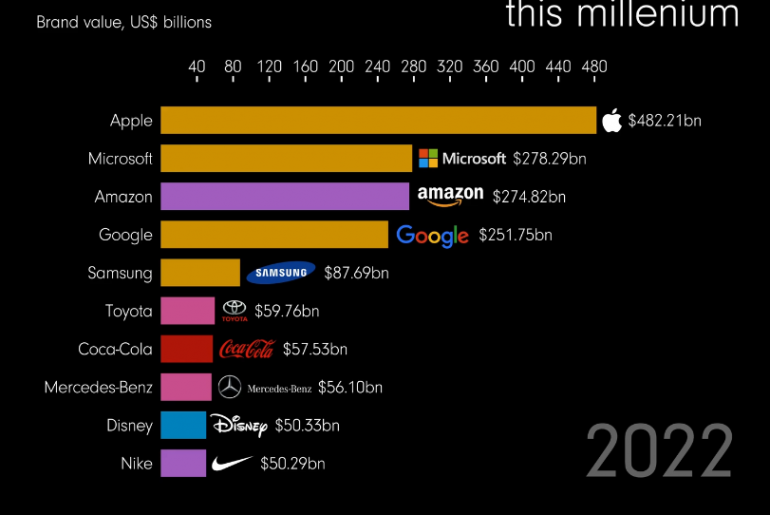
Brand value and loyalty studies have become a major part of the American marketing industry. Several of these studies involve brand value. Interbrand is the best known of these. It considers 100 brands, based on its own mix of criteria. Not surprisingly, tech brands such as Apple and Microsoft are in the lead with brands worth well into the hundreds of billions of dollars.

Another take on brands is based on reputation. Among the most well known of these is the Axios/Harris study, which ranks 100 companies on reputation. Grocery, retail and food brands tend to be near the top, with Trader Joe’s in first place. The Trump Organization is at the bottom.

Still another cut at brand research is the Brand Keys Loyalty Leaders, another list of 100. Its yardsticks are the companies that have the “best-practice guidelines for creating and nurturing customer loyalty.” The study covered 1,624 brands in 142 categories.

One of the points of the study is that brand reputation results have moved back to “normal” after some distortion over the COVID-19 pandemic’s first two years. Robert Passikoff, Brand Keys founder and president, commented: “The significant re-distribution of loyalty identified in the 2022 loyalty rankings are leading indicators of what a return-to-normalcy marketplace will look like.”

The study looks at brand loyalty rank and how much this has changed year over year by brand. The top brands on the loyalty rank list are Apple and Amazon, which typically rank high in all the brand studies. They were followed by Domino’s and Disney+. Although still considered a brand to which people are loyal, Tesla was at the bottom of the list.

In terms of brands that gained and lost the most in the study, State Farm rose 25 places on the list. MSNBC was second, rising 19 places.

The brand that lost the most ground was Purell, which dropped by 52 places. Clorox fell by 41. The only reasonable explanation is that when the COVID-19 pandemic was at its worst, these were products people used to protect themselves from the spread of the virus.

By Douglas A. McIntyre

Sourced from 24/7 Wall St

As the media landscape evolves, so do our preferences for communication. Rose Skews at Favoured delves into the changing world of online comms, audience segmentation and what it takes to engage the younger generation.

With the rise of short-form video content on platforms including TikTok and Instagram, three-minute videos are affecting our attention span. As online communications move toward Facebook Messenger, WhatsApp and social media direct messaging, the phasing out of email as a communication platform begs the question: are consumers still engaging with email marketing?

The short answer is yes. The long answer? Also yes, so long as you’re doing it well and know who you’re doing it for. More than half of generation Z and over a third of millennials still enjoy getting brand emails. With that in mind, let’s look at how you can create engaging emails that even gen Z will want to read.

Don’t be boring

Dull, plain text emails that waffle on won’t engage your impatient audience. So, what can you do?

  • Use short emails: try testing short-form emails. Get to the point of your email quickly and efficiently
  • Hook them in: create hooks for your subject lines and the headers that highlight the crux of the email. This will help with your open and click-through rate
  • Get personal: adding in a recipient’s name can be a little technical at first but it’s totally worth it. If you’re able to personalize things such as names, this makes your emails more trustworthy and engaging
  • Include a strong call to action (CTA): ‘Read more’ and ‘Discover now’ just won’t cut it. Add a little spice to CTAs, like ‘You won’t want to miss this’

Your copy and message need to be clear, concise and interesting. Try bringing your tone to a more personable level to better engage with your audience.

Flows and broadcasts

Email marketing can be a great tool if you can plan and set it up well. At Favoured, we typically split email marketing into two: flows and broadcasts.

Flows are automations where you can segment your audience, create cohorts and triggers, and (after an initial set-up) run them continuously. Broadcasts are monthly newsletters that give you an opportunity to update your audience on anything new.

You can create manual, ad hoc campaigns for an extra burst of comms (around a sale, for instance).

Flows

With email marketing and segmentation, you can capture audiences’ personas. Your main cohorts will be active users, inactive users and new users. Email flows for active users might be:

  • Repeat purchase: thank the customer for their continued support. This flow normally has a refer-a-friend scheme in later emails
  • ‘Superusers’: especially for app companies – when a customer has triggered an event within the app a certain number of times and you want to maintain their engagement

Inactive users will have email flows such as:

  • Abandoned cart: with an average conversion rate of 80%, this is one of the most important flows you can set up
  • Re-engage: this flow should focus on offering small discounts as a temptation to get customers back on track. If you have an app, try explaining a new feature as an incentive to click

New users will have email flows such as:

  • Onboarding: this is your opportunity to show the customer who you are and what you can offer them
  • ‘Web catch all’: if anyone submits a form on your website you can catch them here – a great place to convert them to onboard and/or purchase

Now that we have the flows sorted, let’s look at how you can bring engagement with monthly newsletters.

Broadcasts

The trick is to break your newsletter into sizeable chunks. Try highlights, news and testimonials. You could even connect with national marketing days to make sure you’re hitting key dates relevant to your brand.

News and updates sections give you the opportunity to chat with customers about what you’ve been up to. Adding a testimonial or two brings credibility to your brand and/or product, while adding an extra level of desire.

Who’s doing it well?

Some companies have been smashing email marketing. One is Estrid. It had a hard task ahead of it as its main target audience is gen Z and millennials – the prime suspects for a lack of attention span. It has smashed it: its emails are engaging; it has bought movement into its design with the use of gifs; and its tone is personable and fun.

Maybe you were on the fence about email marketing. We’re hoping that now you see the value it could add to your marketing strategy. Email marketing can capture and engage your audience in a different way than social media. If you ever need any advice, the expert team at Favoured is always available to help.

Feature Image Credit: Volodymyr Hryshchenko via Unsplash

By Rose Skews

Sourced from The Drum