Author

editor

Browsing

By Mitchell Glass

How to prepare questions for your interview

The purpose of an interview isn’t just for the company to see whether you’re a good fit for them — it’s also to make sure the company is a good fit for you.

That’s why you should always prepare questions to ask in an interview. While it’s likely that questions will come up naturally during the conversation, you will want to have a list ready for the end of the interview just in case.

Career counsellors recommend that each question on your list serves at least one of three purposes:

  1. To confirm the job is a good fit for you.
  2. To demonstrate your drive and passion for the position.
  3. To uncover and overcome any doubts your interviewer may have about you.

As you brainstorm potential questions, consider topics like company culture, work environment, expectations and growth opportunities.

How many questions should you ask during your interview?

If you don’t have any questions to ask at the end of your interview, you may look disinterested and unprepared.

Put yourself in the interviewer’s shoes. What would impress you more: a candidate who doesn’t want to know anything about the company or role, or one who confidently slides out a prepared list of insightful questions?

Recruiting experts recommend choosing your number of questions based on the stage of the application process. For example, you wouldn’t want to unleash a fire hose of questions during an initial phone screening. During preliminary stages, limit yourself to five questions max.

If you have more, save them for later interviews. During in-person interviews, shoot for a minimum of two or three questions. It’s useful to have several backup questions ready and listed in order of importance.

During your final interview, it’s about quality over quantity. One dumb question is one question too many. But if you have insightful questions that serve a specific purpose, don’t limit yourself.

7 questions to ask at the end of an interview

1. What objectives do you expect the person in this position to achieve in the first six months?

Job descriptions cover general requirements, but they don’t usually get into the nitty-gritty. By uncovering what a company is hoping to achieve, you can show how you’re equipped to accomplish those specific goals.

2. Is this a new role, or did it recently open up?

There are two reasons companies hire: for growth or because someone has left a position. If the company is hiring because someone left, dig deeper. How long were they in the position? Did they get promoted? The answer could offer you important insights into the position, including potential red flags.

3. Is there anything that makes you doubt my ability to take on this role?

This question takes guts. But if you can handle a bit of criticism, it’s an opportunity to speak to whatever may be making your interviewer hesitant. It’s similar to a sales meeting — the more objections you can snuff out on the spot, the more likely you are to close the deal. Even if you aren’t hired, you’ll leave knowing how to improve for your next interview.

4. What growth opportunities are available?

Good employees want to keep growing. Good employers want their employees to keep growing. If the company supports professional development, asking this question shows that your goals align. If you discover the role has limited growth opportunities, it’s good to know now, before accepting the job.

5. How is extra workflow managed?

This question may help you determine whether the company respects work-life boundaries. Most businesses have never-ending to-do lists, which tend to leak beyond normal work hours. If there is extra work to do, will your boss expect you to work long hours or make yourself available from home? If their policies and expectations don’t align with your vision, it might not be a good fit.

6. In what ways would you gauge my success, and how could I exceed your expectations?

Clarifying expectations can help you decide if you’re up for the job. It also shows your interviewer how serious you are about helping the company. Asking this question indicates that you’re not content to simply meet the status quo and collect your paycheck.

7. How did you come to work for the company?

If all of your questions were covered during the interview, this is a clever backup option. People love talking about themselves, so getting your interviewer to share their story can make your time together seem more enjoyable and memorable for them.

What not to ask during an interview

Asking the wrong questions at the end of an interview might leave a bad impression. Experts recommend that you never ask questions about:

  • Easy-to-find information. Asking questions you could find with a quick Google search shows you don’t respect your interviewer’s time.
  • Background checks. If you ask about the company’s background checks or drug-testing policies, you’re guaranteed to look suspicious.
  • Overly personal information. You want your interviewers to like you. Don’t pry into personal matters and make them feel uncomfortable.

Know you’re a great match

We tell you if you’re a strong candidate so you can prioritize where to apply. ZipRecruiter uses AI technology to match your skills to jobs you may not have found otherwise.

Feature Image Credit: TeodorLazarev / Shutterstock

By Mitchell Glass

Sourced from MoneyWise

By

It took a global pandemic to slow many of us down and make others reassess their entire lives. For Sarah Madden, a graphic designer based in Leeds, she realised she wanted to embrace freelance illustration and design full-time to explore a better lifestyle.

Now, for those of you working as sole traders, you might think freelancing doesn’t quite offer the escape from the rat race many of us dream of, but Sarah Madden has made it possible. Having previously worked for a couple of design studios in Leeds, Sarah worked longer hours when other staff had been put on furlough.

Verging on the edge of burnout, an affliction sadly imposed on so many of us recently, Sarah decided enough was enough. She’d been illustrating on the side to make some extra cash and had the realisation that she could go for it and make illustration part of her full-time gig. So at the beginning of June, she handed in her notice to her agency boss and declared herself an official freelance illustrator and designer.

With clients already ranging from Adobe, Facebook, Google and – the dream for any artist – The New Yorker, Sarah’s future looks very promising. We wanted to hear more about her epiphany and move to launch her own business. And we wanted to discover how she’s made it all possible and whether that dream of escape has come true.

You’ve had a lot of success so far. Have you always been a driven person?

I’ve always been interested in art, drawing, and being creative. My parents were supportive and allowed me to explore and flourish in this space. They didn’t go to university and were from working-class backgrounds. My dad was a welder, and my mother was a support worker. There was never any pressure to go to uni or focus on maths and science. I was also the third child, so I’m sure they just wanted me to get on with it and do my own thing. [Laughs]

I’ve had a few pivots during my career. I’ve made changes and followed my gut. Truthfully, though, I don’t really feel like I know what I’m doing. [Laughs]

That’s refreshing to hear. It feels like the creative industry is becoming more honest. Would you agree with that?

Yes. I worked for a couple of design agencies around Leeds before going freelance. The managing director at my last workplace was very honest and talked openly about her mental health, encouraging her staff to do the same. She would admit when she felt anxious or overwhelmed. That shared vulnerability was something we appreciated. It made me realise that we’re all figuring things out, and none of us is working at 100% all of the time. Successful people are human like me. It’s a relief.

You’re based in Leeds?

Yes, I’m from Sheffield, where my mum still lives, and I came here to study Fine Art at Leeds University. I graduated and found a job in marketing initially. It was a role linked to the industry I was hoping to eventually break into. And that would give me relative experience and insights. It was a really useful experience.

You’re lucky because you live in a city where the first thing someone asks you isn’t ‘What do you do?’. It’s not like London.

Yeah, we were always told that London was the place to be – particularly if you want a decent creative career or to be a successful artist. The impression was that London was home to the best agencies and galleries and was the only real city to consider. But, to be honest, even though I love visiting London, I can’t imagine myself living there. I’m not keen on crowds. Being a girl from Yorkshire, I just wanted to stay near my home.

Do you think this idea that you only “make it” in London is true?

I don’t know what “make it” means. I’ve been questioning this a lot lately. What does it mean to be successful, and what does success even look like? It means different things to different people. As for London, the tutors on my course hadn’t worked in the creative industry for some time, so it’s no surprise they considered the capital a great career move. But today, there are so many thriving studios and agencies outside of London that it’s possible to be a success anywhere. For instance, there’s loads of opportunity blossoming here in the North, especially in Leeds and Manchester. And there are loads of talented individuals up this way, too.

So, what does success look like to you?

I’m not sure. It’s interesting that you previously described me as ‘driven’. That’s definitely true. But I didn’t realise I was like that until about a year ago. After speaking to friends, it seems to be one of my traits. In that, I take the initiative, set goals, and work hard. I figure out what I need to do to achieve whatever I’ve set my heart on. If that’s a definition of success – the ability to be constantly improving – then that’s enough for me.

There has been so much self-doubt and imposter syndrome throughout my career that I’ve had to fight. It’s a common thing for all of us. Every day you have to overcome it. Otherwise, it will keep eating away at your ability to succeed.

You’ve just gone freelance. How does that feel?

You know, it’s interesting. I’m usually risk-averse and have a lot of financial anxiety because I didn’t grow up in a super stable environment – money was sometimes tight. But on this occasion, I’ve just gone for it. I’m totally unprepared. My website hasn’t yet been updated. And to not have a consistent income every month is terrifying. [Laughs] Despite all that, I felt I had no other choice. I was doing really well at my former agency, and my boss was happy with my performance. But there was something not quite right. I couldn’t put my finger on it, but I knew I had to leave.

But you were somewhat prepared?

Absolutely. I was lucky enough to have been freelancing on the side for 18 months. It meant I’d built a portfolio and clients, so it wasn’t a cold start. I also saved money to have a buffer zone, just in case.

So, would you define yourself as an illustrator now? Is it difficult to describe what you do, given you’re also a designer?

Hybrid jobs are a thing. Job titles don’t really relate to the creative multidisciplinary roles we now have. You could be doing UX design as a graphic designer or dabbling in illustration, so what would you call that?

Having enjoyed a varied background, you’ll only add strength to your list of skills as an illustrator.

There has been so much self-doubt and imposter syndrome throughout my career that I’ve had to fight. It’s a common thing for many of us. You have to actively overcome it with every challenge and every career stepping stone. Otherwise, it will keep eating away at your ability to succeed. I’ve had to throw myself into freelancing and embrace those low confidence days, reminding myself that we all struggle. And that it’s normal.

A big thing that has helped me is to believe that I add value. I’m constantly reminding myself that I got the job because I do good work. I am in this meeting because I have good ideas and opinions. Creative Boom has asked me to do an interview because I’m doing something interesting.

Give yourself a deadline of September to refresh your website. But take this summer to prioritise yourself and rest.

I appreciate that so much. Do you have any other tips? [Laughs]

[Laughs] Well, I think we’re all feeling exhausted now. It’s no surprise, given we’ve just endured a pandemic.

It feels a bit bleak, doesn’t it! I’m counting my blessings, though. My family and friends are safe and well. I worked throughout the pandemic and avoided furlough, which felt like I had more of a sense of security than others. And working from home was lovely, as I have a nice peaceful flat. I had a very easy ride compared to others. But gosh, it was a massive world-changer. I wondered what the world might look like in future.

It also made me reevaluate my life. Do I want to slow down? Well, yes. Agency life has hard deadlines and crazy hours, occasionally working until the early hours. And that was normal and doable for me. But it’s hard to manage if your mental health and wellbeing take a hit. I am questioning whether there is a different way, a better way. I hope to figure that out during my time freelancing.

It makes you question what’s important. We’re all still figuring out what’s next.

I don’t know what it looks like. It’s important to keep an open mind and address these thoughts and questions. And to know that everything is going to be ok.

Looking at your illustration style, how would you describe it?

It’s a space I’m still exploring. It feels like the beginning of an exciting journey. Illustration might be new to me, given I only got into it three years ago, but it follows from the painting I did during my Fine Arts degree at Leeds. When I stepped onto the career ladder, I was thrown into the world of marketing and graphic design – typography, layouts, brand and logos. There was an element of illustration but not much. Until one day, an illustrator came into our agency to help with storyboarding, and the penny dropped: Ah, this guy draws for a living. That’s when I started to explore illustration more and integrate it into my skillset.

Around that time, my dad passed away, and I’d had a breakup, plus my mother was struggling with her mental health. I wanted to do something positive to help me cope, so I turned to illustration as a way of therapy. And I started an Instagram account that included drawings and thoughts on themes of mental health. My work had a lot of self-reflection, so there was an element of vulnerability and humility. It helped when others engaged and wrote about how they had the same challenges. It also attracted the attention of potential clients and made me realise I could become an illustrator. It was then that I started to explore my style. I love simple illustrations with simple compositions, line work and bold colours. I feel like I’ve got back into an old hobby, so I’m still exploring it.

You’ve come full circle – that’s wonderful to see. It’s been almost a decade since you graduated. What do you think you’ve learnt the most about yourself?

I find myself in the self-doubt camp way too often. I tend to think about all the things I want to do and all the ways I want to get better at what I do. Which is good, but I need to make time to recognise my current achievements and abilities – otherwise, that will hold me back in its own way. I’ve also learnt that it’s ok to make mistakes and trust that I’ll always figure it out. That’s all any of us can hope for – that we do our best at the time.

By

Sourced from Creative Boom

By Efrat Ravid

Speak to your people about your own failures—not just in terms of how far you fell, but how you came back. That’s where the focus needs to be. It’s not about failing fast. It’s about learning fast.

My life experiences with failure started as a child. In sixth grade, I failed in math—dismally. But when I brought my test report home to my mother, she celebrated by popping a bottle of champagne. She said, “Now you know how to fail. Good for you!”

She understood that the only way I would truly grow as a person was by failing—and by learning from that failure.

Of course, the most important part about failing is how you respond to it. Do you give up, or do you dust yourself off and try again? My mother encouraged me to do the latter, to improve one step at a time. I didn’t find immediate success in math, but with hard work, I managed to eventually score a D, then a C, and finally an A in my exams.

THE PROBLEM WITH STIGMATIZING FAILURE

At school in Israel, if I didn’t score the marks I hoped for on an exam, I could take it as many times as I wanted. In the U.S., when a student fails a test, there’s usually no chance for them to learn from their mistakes and try again.

If we instil a fear of failure in children at school, we’re not teaching them about learning, only about grading. Worse still, it can create the perception that you need to be seen as perfect or correct in every instance. It allows no space to be human.

Conventionally, the concept of “failure”‘ means being unsuccessful, making mistakes, or not achieving your goals. By contrast, as an engineering student, I was taught to iterate often, and failing fast was encouraged.

What if we applied this thinking in other ways to overcome perfectionism? What if we could put it to work to create more opportunities for employee growth, innovation, and retention?

THE ROLE OF FAILURE IN BUSINESS

In my own career, I’ve adopted a mindset of accepting—even embracing—my failures because I know they’ll make me a better, wiser leader. For example, in a former role, I once set KPIs that didn’t align across my different teams. The unintended consequence of this was that I created a divide between my teams and obstructed the flow of communication.

From this experience—my failure—I learned the importance of sharing goals to avoid misalignment. Without experiencing that tough failure, I would never have become the effective team leader I am today.

Working with digital leaders teaches us how to leverage any challenges or friction they face as new opportunities. As long as you have the processes and the tools to achieve the right visibility and the speed for fast iteration, failure can become the best tool for success.

Fear of failure limits our ability to innovate. Conversely, when employees have permission to fail occasionally, they flourish.

I want my team to be successful, but it doesn’t have to happen the very first time. I’d rather they make multiple attempts, earn their success, and learn along the way.

The outcome? My team takes more risks. More importantly, it transforms them into better team members. If you don’t fear failure, you have no need for a scapegoat when something goes wrong. You can take accountability for your actions and ideas. This helps build that collaborative and innovative environment we all strive for.

ENTREPRENEURS SHOULD LEAD—AND FAIL—BY EXAMPLE

Every successful leader or entrepreneur has failed at one point or another. It’s part of the fabric of business and life. I believe that business leaders should be intentional about never cultivating a culture of fear in their organizations.

Speak to your people about your own failures—not just in terms of how far you fell, but how you came back. That’s where the focus needs to be. It’s not about failing fast. It’s about learning fast.

When you’re about to embark on a big project or new venture, have discussions with your team about how you might fail and how you’ll recover. What will you learn? How will you make sure you don’t repeat the same mistakes in the next project?

Your message to them needs to be: “Go ahead, try out something new, and get creative with that idea. I appreciate that you’ll be entering uncharted territory, and you might encounter some treacherous ground. If that causes a temporary setback, well, that’s OK.”

Feature Image Credit: Sergey Nivens/AdobeStock

By Efrat Ravid

Efrat is CMO at Quantum Metric, with extensive experience in tech leadership and customer-centric organization strategies.

Sourced from Fast Company

By Amy Balliett

Modern customers are evolving faster than ever expected, and marketers must evolve with them. Here’s how.

The verdict is in: A whopping 76 percent of marketers know that deep customer understanding is the key to unlocking sustained success, but only two in five are actually conducting market research to fuel this understanding. As a marketer myself, I understand this conflict.

Great marketers prioritize the end audience in all the content they produce. They target marketing campaigns to connect with customers across their various need states. They centre their content strategies on the channels where their customers can be found. They adjust the tone, visual styles, and messaging of content to ensure it resonates with diverse customer segments. But even many of the best marketers admit to relying on their gut instincts over hard data to inform these decisions.

It can be easy to rest on one’s laurels as a marketer, especially if you’ve celebrated a history of successful campaigns and steady growth. But, thanks to the pandemic and a wave of new innovations, the modern customer is evolving faster than ever expected. Nearly half of marketing professionals surveyed admit to fear in this new normal. They fear they won’t be able to keep up with this state of constant change. They fear their teams do not have the skills or tools necessary to be fully present for their customers. And they fear a future where new data collected on their customers one day will feel old and dated the next.

From these fears comes great opportunity. In a world where fewer than half of marketers compile relevant insights, it’s those who are willing to adapt who have the upper hand. Modern marketers must change the way they think about marketing entirely. They must become truly customer-centric by thinking like researchers and designers first, before letting this new mentality inform their forward-looking strategies.

Ultimately, if you are a marketer seeking long-term success, you must become an expert in CX. How you achieve this may vary, but here are some changes you can make today to revolutionize your marketing strategy tomorrow:

1. Invest in nimble learning systems to support proactive strategy adjustments

Collecting relevant insights about your customers can be an arduous task. For many brands, it’s a manual process requiring months of field research, one-on-one interviews with brand loyalists, and in-depth surveying to get a thorough understanding of one’s customer base. While this method is extremely valuable and one that can validate or challenge long-held assumptions, it can be hard to invest in this approach more than once every two to three years. And with the rate of change the modern customer is experiencing, data gathered more than a year ago might already be moot.

Marketers rely heavily on analytics tools to measure the digital actions of their customers. Through tools like Google Analytics, for example, we can determine onsite user behaviour and adjust the user experience to drive more conversions. We can identify the channels our customers find us on, the pages in which they lose interest, and the content that truly matters to them. This data is a gold mine for marketers eager to optimize and adjust campaigns. But onsite analytics doesn’t have to be our only tool.

Marketers looking to compete in this new world must think beyond onsite analytics and invest in customer and social analytics solutions as well. These powerful insights programs can deliver data at a regular cadence to support proactive strategy adjustments. They can be used in addition to more robust field studies or as standalone tools to keep your finger on the pulse of your customer in real time.

Most marketers, however, continue to ignore this opportunity. Only 44 percent of marketers today even conduct research to re-evaluate their predetermined target audiences, only 42 percent are taking action to better understand their existing customers, and only 40 percent are segmenting their audiences to better target their campaigns. To get ahead of your competitors, start investing in more nimble, real-time analytics systems that can take some of the guesswork out of your CX strategy.

2. Consider your whole marketplaceconsumers, competitors, and category

While you might feel that knowing your customer is all you need to become an expert in CX, its actually just one leg in a three-legged stool of sorts. Understanding your customers is essential, but you must also stay on top of changes in your category and moves among your competitors. By culling insights in these two arenas, you will have a far better understanding of your customer needs, motivations, and loyalties.

For example, finding out that your customers are choosing to purchase from a competitor might encourage a re-evaluation of your strategy. But understanding why your customers have chosen the competitor can prove even more valuable. A shift in your category may have impacted your customer’s ability to buy from you. Maybe a competitor changed its value proposition just slightly and that resonated better with your customer. Whatever the shift may be, simply knowing that you are losing out to the competition is not enough to provide deep insights into your customer’s motivations for choosing that brand over yours.

Prioritizing data collection that will fuel insights into your brand awareness in your category, your competitors’ movements in the marketplace, and how your customers perceive your overall industry can make a huge impact on your marketing strategy. But marketers continue to deprioritize this trifecta of understanding. Only 37 percent of marketers spent the previous year learning about their competitors, only 31 percent took the time to learn more about their category, and only 34 percent invest in competitive research. Join this small group of marketers by prioritizing research beyond your customer and you’ll have a great competitive edge.

3. Pursue data-driven execution to drive future success

The next time you plan a marketing campaign without up-to-date customer, competitor, and category data to support it, consider the adage “to assume is to make a fool out of you and me.” It’s wrong to assume that your customer hasn’t evolved over the years. From the pandemic to political unrest and so much more, we have all shifted our behaviours greatly.

Today’s customers have changed where they shop, how they shop, what they believe, how they want to interact with brands, how they hold brands accountable, and so much more. It’s clear that most marketers are not gathering the data necessary to adjust their strategies to meet the current moment. Marketers who become experts in CX, on the other hand, have a real opportunity to leap ahead of the competition.

Feature Image Credit: Getty Images

By Amy Balliett

Sourced from Inc.

By

Starting a business is hard. Starting a business without funding is even harder.

I started selling social media services when I was 17 years old. After spending $9 on a logo and domain for my newly created brand, I sat back and waited for my email to fill with orders and partnership opportunities — but that didn’t happen.

Four weeks later, my inbox was completely empty. I had no way to advertise to customers, my social channels weren’t generating leads and nobody knew my company’s name or what we did.

It became strikingly apparent that I wouldn’t get by without some kind of . But I knew that I’d have to find unorthodox ways to match my competitors if I didn’t want to break the bank. These are the three strategies I utilized to elevate my company’s marketing with a budget of $0.

1. Targeted online forums

The first (and most successful) strategy that I employed was finding websites, group chats and marketplaces for people in need of the services that I provide.

The founding principle of marketing is pretty simple: Reach people that you can sell to. What they don’t tell you, though, is that you can access your target demographics without a full-scale campaign. In fact, online marketplaces make it easy to find free hotspots for advertising your services.

Targeted forums like , for example, are a surprisingly frequent destination for two types of customers: those looking to purchase services directly, and companies who need something for a client. The second group can be incredibly important to your success — building a relationship with brands that manage a variety of clients can lead to repeat purchases. Becoming a company’s supplier via freelance forums thus represents a unique way to access large groups of customers without spending money on marketing.

Even more advantageous than larger freelance platforms like Fiverr and Upwork, the niche-specific forums and marketplaces are typically the best way to reach your . Being the Behances (creative art), the StockXs (fashion), and the Steams (video games), these hyper-targeted markets represent the most effective opportunities for conversions.

For me, those outlets came in surprising forms. They were random group chats for buyers and sellers of social media services, aforementioned larger forums similar to Fiverr, and talent forums like Publicist.

Being an active member of my niche’s targeted forums gave me access to a client base of active customers and marketing agency representatives. In doing so, it allowed me to sell my services and build relationships with other social media professionals.

2. Networking and outreach

Branding experts tend to tout networking as the best way to build a resource base for your business. But, what does that actually look like? For my brand, it meant messaging other industry figures by any means necessary. , , , TikTok, email and support phone numbers were all fair game. I’d write a letter explaining my services, attach my portfolio and send it out to hundreds of companies. Eventually, some of my “Hail Mary” attempts were received by people with the power to bring me on board.

The second part of my outreach plan was more personalized. I sent messages to smaller brands and creators who were in similar positions to me, and I offered to trade my non-rival resources. By swapping lists of profitable niche forums, descriptions of social media growth mechanisms and other industry knowledge, I was able to expand my marketing strategies and company verticals.

Offering to combine resources ended up being one of the best outreach strategies I’ve ever pursued, especially when I didn’t have to worry about competing with anyone. Provided that my disclosure of a strategy didn’t prevent me from utilizing it, every exchange was a net positive.

While most narratives portray sharing information as a recipe for compromising market share, they neglect that it can be a useful tool for catapulting smaller businesses into the realm of owning a market share at all. Especially for inexperienced companies on a small budget, mutual collaboration can yield the same results as an expensive consultancy, a lot of research or a year of prerequisite industry experience.

3. Diversify your verticals

The extent to which marketing matters varies significantly by the area you choose to pursue. Certain products or services may only require one client to sustain a relatively profitable business, while others may need 10 consistent customers to break even.

I found that focusing on services that required smaller customer bases (and thereby a smaller marketing effort) was significantly easier to handle in the early stages of my company. I then used the budget and knowledge to open and market a larger array of products, and now have an aggressive service with a safety net of relationships that lead to consistent purchases.

Diversification isn’t easy, and the way I went about it involved pulling from all the strategies listed above. I used targeted forums to build relationships and target an active clientele, then subsequently used my newfound connections to learn more about the industry and how certain services could be pragmatically provided.

Listing a wide variety of services eventually led to more customers. By using my prior collaborations to learn about certain strategies, I was able to appeal to a larger percentage of my already incredibly narrow targeted audience.

In the end, building a brand takes time and consistency. By trusting your process, drive and structure, you’ll ensure that your business reflects the effort you put into it.

By

Sourced from Entrepreneur

By Chris Christoff

Video marketing is a powerful way to connect with existing customers, improve brand awareness with new prospects and improve sales. You can also use video to grow your email list, build social proof and much more. Here are a few video-related statistics worth considering:

55% (download required) of adults in the U.S. between 18-34 watch online videos daily.

80% of small business owners say that YouTube helped them grow their customer base.

54% of consumers want to see more videos from brands they love

It’s easy to see that video marketing is here to stay. If you want to learn how to boost the ROI of your content, keep reading. Today, I’m going to share four ways you can get started.

Create content with your audience in mind.

The key to boosting video conversions is to make sure your content resonates with your target audience. It doesn’t matter how many videos you upload; if your subscribers don’t care about the content, you will lose out on a lot of potential traffic and sales.

I recommend using your customer personas to create high-quality content that touches on your subscribers’ goals, interests and pain points. You can also learn more about the people watching your videos through feedback forms.

Social media, email and your website are all excellent ways to connect with your audience and learn more about what types of content they would like to see. As you develop more relevant videos, you’ll see more users engage with your content and your online store.

Optimize for search.

Another way to see better results from your videos is to optimize your content for searchability. If users can’t find your content organically, you’re going to have a difficult time seeing noticeable results.

The good news is there are a few quick ways to easily improve the odds of appearing for your chosen keywords on YouTube or through Google search.

First, choose long-tail keywords and use them strategically throughout your video. Not only should you say it a few times, but make sure it’s included in the description and title.

You’ll also want to transcribe your videos manually. Captions can help the hearing impaired understand your video, which is crucial for building a welcoming and accessible platform. The keywords you picked for your videos will also appear in the transcript, which will make it easier for Google and YouTube to rank your video accurately.

If you’re adding videos to your website, don’t forget to include them in your sitemap. Google uses your sitemap to rank and determine the intent of your content. Adding videos with relevant copy can help draw more traffic to your site, which is a surefire way to boost your ROI.

Use a clear call to action.

Each video you create should have a clear purpose. Your goal is to direct visitors to take action in one way or another after watching your video. For example, you may want to ask your audience to join your email list. Alternatively, you might upload a product demonstration video and include a coupon code at the end.

Whatever your marketing goals are, make sure it’s clear to the viewer at the end of your video. A compelling call to action can help you clarify your message and drive people to take the next step.

Before you ask users to take action, explain the benefits in a way that makes sense to them. So, if you want to talk people into joining your email list, tell them how it will benefit them and add value to their lives. You have to sell the idea of your call to action if you want to maximize your conversions.

Harness the power of user-generated content.

Finally, let’s talk about user-generated content. UGC is any content created by a customer in an attempt to engage with your brand. This type of content can vary across different industries, but the benefits are usually the same.

UGC is an excellent way to build social proof for your business. Social proof in marketing is the idea that people are more likely to trust your company if they see that other people also trust you.

Despite UGC being video content not created in-house, I still consider it a factor in terms of ROI. Social proof, such as video reviews, can be incredibly compelling for new visitors who have never heard of your brand. Research shows that 70% of people check one to six reviews before buying something online. Visitors who see positive video reviews on your website and social media from real customers are more likely to engage with your brand.

As you can see, video is a great way to grow your audience and improve sales. But it takes some time to truly unlock the potential of your campaigns. The tips I outlined today can give you the framework you need to add to your existing video marketing strategy and increase your ROI.

Feature Image Credit: Getty

By Chris Christoff

Co-founder of MonsterInsights, a leading WordPress plug-in for Google Analytics.

Sourced from Forbes

By Hillel Fuld

Start producing industry content now and watch everything else get easier.

How important is content as part of your overall marketing strategy? The answer is that if done well, content is the foundation for the entire building that is marketing.

To be clear, when I say content, I don’t mean PR as in a journalist writing about you. I also don’t mean the copy that’s on your website. When I say content, I am referring to you producing industry content on the company blog, podcast, YouTube channel, or elsewhere.

Once you jump into the content game, the rest of your marketing efforts are made increasingly simpler.

Here are five parts of your marketing that become easier once you start producing content.

Your social media accounts finally offer some value.

By now, if your company is not on social media, you should fire your marketing team. Everyone knows how potentially powerful social media is, but not many companies really think about what they are doing on social media.

Too many people and companies use platforms like Twitter as a broadcast platform. They think of these platforms as a megaphone. Instead of focusing on the media, they should try focusing on social.

That means they need to start thinking of how to provide real value instead of obsessing over how many followers they have. Well, if a company produces content regularly, now they have what to share on social media.

If you’re an AI company and you produce content about AI, all of a sudden, people interested in AI have a reason to follow you on social.

The foundation of all search engine optimization is content.

Anyone who knows how search engine optimization(SEO) works will tell you that content is the foundation. To simplify it, the goal of offsite SEO is to get as many incoming links as possible. When Google sees a site with thousands of incoming links, they understand that that site must be an authority in its space.

The question is how do you get links. Some SEO people go and buy links thinking they’re going to trick Google. Instead, focus on organically getting people to link to you and encouraging people to talk about you on the internet. How do you do that? Content. The more you write, the more people talk about you. The more people talk about you, the more they link to you. Period.

All of a sudden, your PR isn’t PR.

What is the first thing a journalist will do after receiving a pitch from you? That’s right, they’ll Google you.

When they Google you and come across all your industry content,  all of a sudden, you’re not just another company pitching that journalist. Now you’re a content creator just like they are. Content changes the whole dynamic and shortens the road to getting press coverage.

Your business development benefits from a head start.

Think about your business development efforts. Whether you’re a start-up or a larger company, surely you are looking for strategic partners to help grow your business.

Now think of the other side. What is that potential partner looking for? They’re looking to partner with leaders, not followers. They’re looking to collaborate with brands, not companies.

Well, when that potential partner Googles you and they see no footprint on the internet, that is a huge red flag. Alternatively, if they Google you and see you are producing a ton of industry content, suddenly you are the leader and the brand they are looking for.

Investors are looking to invest in good people so make sure you are what they’re looking for.

Every tech investor I’ve ever met says the same thing. “We are looking to invest in people.” That’s very nice but before that first meeting, how do they determine if a company has good people when evaluating whether to take that first meeting?

The answer is that they do their due diligence. Part of that process involves them looking at your site, your web presence, and of course, they look to see your thoughts on your specific space.

So to answer the question, your content becomes your company’s business card and if an investor wants to learn more about you before that first meeting, give them that opportunity by showing them how much of a thought leader you are in your space.

To summarize, content isn’t just a part of your marketing strategy, it is the foundation of it all and if done right, every other aspect of your marketing will be exponentially more successful.

Feature Image Credit: Getty Images

By Hillel Fuld

Sourced from Inc.

By Vijay Chattha

The founder and CEO of VSC says the supporting employees’ work styles is the foundation of a brand they will want to work for. Everything else—the logos, swag, perks, website—is all window dressing.

When Apple’s director of machine learning Ian Goodfellow resigned from the company last month over its return to office mandate, it should have been a wake-up call for executives everywhere. In the post-COVID-19 world, the job feature that employees care most about is the flexibility to work from anywhere. There is an overwhelming amount of data to back this up. Yet, many executives would rather put their blinders on and pretend that things will go back to how they were before March 2020. Instead of giving their employees what they really want, they double down on elevated swag, pandering mission statements, and open bars to lure employees back to their fancy new offices.

These executives believe that their efforts are building a brand that will draw employees. But what they don’t realize is that things have changed. Today, a company’s office policy is its brand—full stop.

This was explicitly acknowledged by a group of Apple employees last year in an open letter to CEO Tim Cook about the company’s return to office policies. These Apple employees spoke for knowledge workers everywhere when they wrote:

Without the inclusivity that flexibility brings, many of us feel we have to choose between either a combination of our families, our well-being, and being empowered to do our best work, or being a part of Apple. This is a decision none of us take lightly, and a decision many would prefer not to have to make.

If a company like Apple—which has one of the strongest brands ever created and is among those with the largest market caps in the world—can’t retain talent due to its return-to-office policy, do you really think other businesses will fare much better? I doubt it. Executives who don’t acknowledge that all the branding tricks in the world won’t work without a flexible work policy are going to haemorrhage talent until their business bleeds out. On the flip side, companies that embrace flexible work arrangements as a core element of their brand identity will enjoy a once-in-a-generation hiring opportunity by attracting talent away from businesses that ignore their employees’ needs.

A company’s decision about its work arrangements is above every other business function. For example, high employee satisfaction is directly correlated with high productivity, which often hinges on whether they are granted a flexible work arrangement. Moreover, dissatisfied employees will reflect negatively on the company itself, which can have a negative impact on sales, given the increasing importance that consumers place on the working conditions at their favourite brands. While external and internal branding efforts may once have been disconnected, they are now intimately linked. This means the choice of working arrangements will not just affect hiring, but productivity and revenue as well.

To be clear, implementing a flexible work policy does not necessarily preclude having an office or building an amazing culture. It’s fundamentally about giving employees options and the support they need regardless of the choices they make. This is the foundation of a brand that employees will want to work for. Everything else—the logos, swag, perks, website—is all window dressing. This can be tough to swallow for companies who have spent so much time, money, and effort building their brand around “nice-to-haves” rather than the one thing employees actually care about. But changing course and building a brand around flexible work doesn’t have to be difficult. Here are a few changes that companies can make right away.

Reallocating resources from offices to events

A work-from-anywhere policy needn’t come at the expense of a great company culture. The key is to shift resources that would have otherwise gone to office leases and facilities management into experiences that bring employees together on a semi-regular basis. There are many forms this could take, ranging from an annual retreat to a quarterly get-together. The important thing is to strengthen bonds throughout the company by giving employees the opportunity to hang out together in a fun and relaxing environment.

Ditching perks for supplies

Many companies spend an enormous amount of money on perks that are rarely used. Instead, they should shift this spending to purchasing supplies for employees that will enable them to work from anywhere. This could be a mobile WiFi subscription, an upgraded laptop, a better desk for their home office, or a pass to a local coworking space. Better yet, just give the employees money to spend on upgrading their work from anywhere arrangement and let them decide how to use it.

Picking a policy and stick to it

Over the past few years, a number of Fortune 500 companies have switched positions on their return to office policy, which creates uncertainty and stress for their employees. The best way for a business to show they care about their employees is by being dependable. Regardless of whether a business decides to adopt a work-from-anywhere policy or wants their employees to return to the office five days a week, they must clearly communicate their expectations and stick to them. The rules should apply to everyone equally—an organization where leadership is allowed to work remotely and employees must come into the office will only stoke resentment.

There is a real opportunity in the Great Resignation for companies that build a brand based on a work-from-anywhere policy. Some companies like 3M, Twitter, and Dropbox recognized this early and proactively gave their employees the option to work-from-anywhere in perpetuity, and I’ve seen the incredible effects of embracing a work-from-anywhere lifestyle first hand at my own company. Public relations, like many industries, is facing a labour shortage. Yet since we’ve transitioned to being a work-from-anywhere company, our quality of our applicants has soared. When we polled new hires on what brought them to our organization, they consistently named our flexible work policies as a major factor in their decision.

So, before you spend money on your brand, start with your policies of work.

Feature Image Credit: an_vision/Unsplash

By Vijay Chattha

Vijay Chattha is the founder and CEO of VSC, cofounder of the 100kPledge and WorldWithoutCovid, and general partner of recently launched VSC Ventures.

Sourced from Fast Company

Whether you’re presenting a slideshow to your executives, clients, or peers, you want to convey your message clearly and successfully. Unfortunately, many mistakes can be made when creating PowerPoint presentations.

From hard-to-read fonts to colours that hurt the eyes of your audience, here are some best practices to keep in mind for your next PowerPoint slideshow.

Choose the fonts wisely

Using a fancy, dramatic, or even whimsical font can be tempting. But you must consider the readability of the font. You want your audience to easily see your headings and bullet points. Consider the two basic font styles: serif and sans serif.

Serif fonts are more decorative, have a classic appearance, and are frequently used in print publications. Each letter has a stroke that extends from a point in the letter. Popular serif styles include Times New Roman, Garamond, Georgia, and Baskerville.

List of serif fonts in PowerPoint.

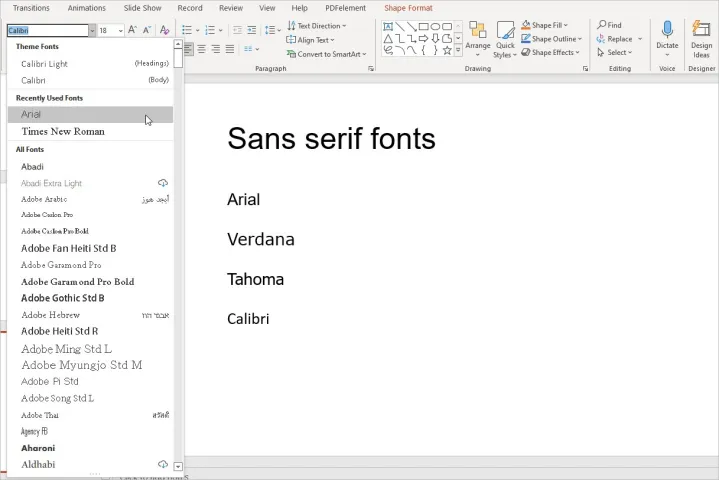
Sans serif fonts are more precise, have a clean appearance, and are frequently used in digital publications. Each letter is clear-cut without wings or curves at its points. Popular sans serif styles include Arial, Verdana, Tahoma, and Calibri.

List of sans serif fonts in PowerPoint.

Because of the extended strokes, serif fonts can appear a bit blurry on a screen. This makes a sans serif font the favoured choice. The bottom line is that you should remain consistent and use the same type, serif or sans serif, for all fonts in the slideshow.

Select pleasing colours

The colours you use in your PowerPoint presentation can be just as important as the content. You want to use those that enhance the appearance of the slideshow, not distract or give your audience a headache.

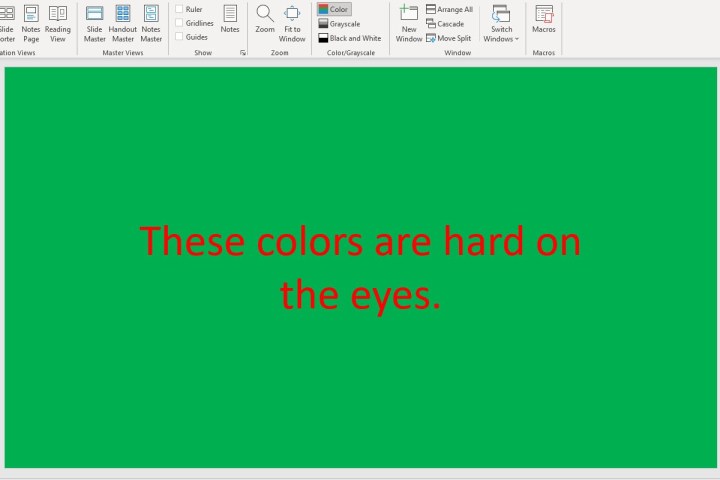
As Robert Lane explains in his article about combining colors in PowerPoint, mixing red and blue or red and green can cause eye strain. Plus, red and green mixtures are difficult to see for those with colour blindness.

Red text on green slide in PowerPoint.

The article mentions that warm colours like reds, oranges, and yellows are eye-catching, whereas cool colours like blues, greens, and purples draw less attention. Additionally, lighter colours are more noticeable than dark.

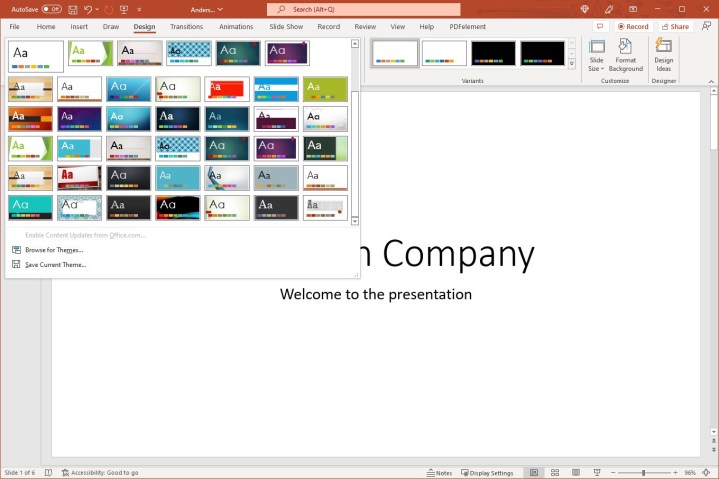
One of the easiest ways to choose the colours for your presentation is to use a built-in theme. Select the Design tab and you’ll see a collection of Themes in the ribbon.

Theme collection in PowerPoint.

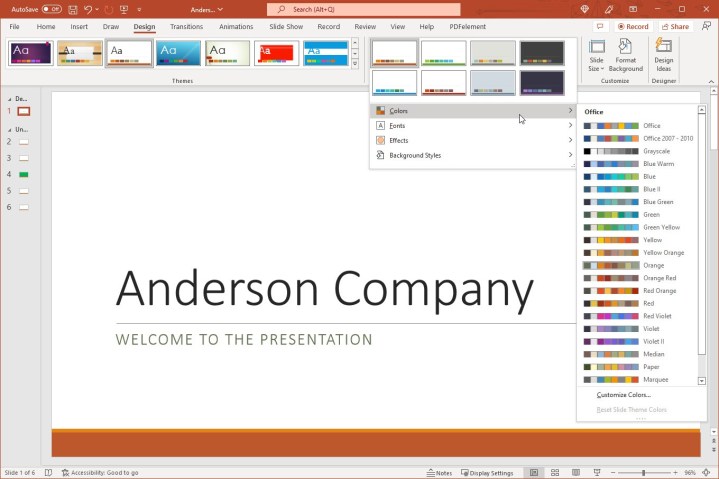
Once you select a theme, you can then use the Variants section to choose a different colour scheme. Each scheme includes eight complementing colours. You can also pick the font style you want to use in the Variants drop-down menu.

Color schemes for a theme in PowerPoint.

Tip: You can also check out the Design Ideas if you need help with the layouts for your slides.

Don’t overuse animations and effects

Animations can be attention-grabbing additions to a slideshow. But if you overuse or misuse them, they can be detrimental to your presentation and actually turn off viewers. The best thing to do is consider your audience and slideshow’s purpose.

For instance, if you are presenting the slideshow to a classroom of 8-year-old students, animations can grab and hold their attention more than simple images or words. However, if you’re presenting to your company’s executive team or board of directors, animations can come across as unprofessional.

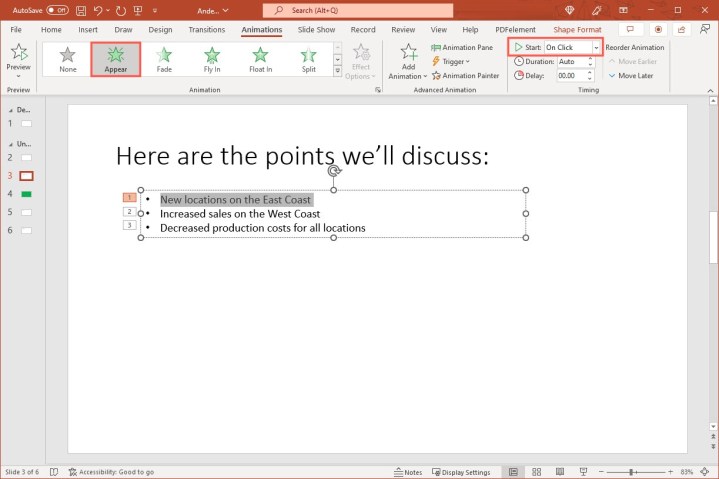
If you really want to include animations, make them subtle or purposeful. As an example, you may want to expand on each bullet point in your list. You can create an animation to display the bullet points one by one and only when you click.

To do this, select the first bullet point, go to the Animations tab, and choose the Appear effect. Then, in the Timing section of the ribbon, choose On click in the Start drop-down list. Do the same for each bullet point in your list.

Animations tab showing the Appear effect and On Click for Start.

This creates a simple animation that benefits your presentation. It doesn’t distract but instead keeps your audience focused on your current talking point.

Use a standard presentation rule

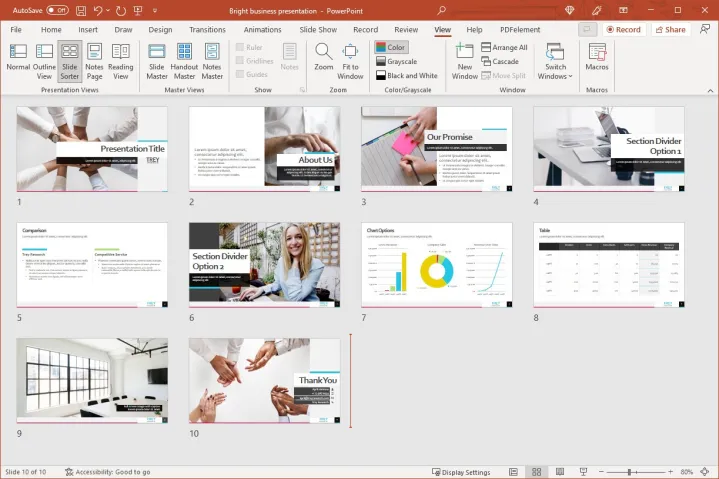
What is the 10/20/30 rule of PowerPoint? What is the five-by-five rule? What about the 5/5/5 and seven-by-seven rules? Rules, rules, rules. These are different standards that many recommend using when it comes to creating PowerPoint presentations.

  • The 10/20/30 rule: Have no more than 10 slides, a presentation no longer than 20 minutes, and a font size no smaller than 30 points.
  • The five-by-five rule: Have no more than five words per line and five lines per slide.
  • The 5/5/5 rule: Have no more than five words per line, five lines per slide, and five text-heavy slides in a row.
  • The seven-by-seven rule: Have no more than seven words per line and seven lines per slide.
Slide sorter view in PowerPoint showing 10 slides.

What each of these rules basically means is: Keep it simple.

The first rule, 10/20/30, is a good rule to follow for your overall presentation. While it may not always be possible, the more succinct a presentation, the more successful it will be.

The last three rules are helpful ones to follow when you’re adding text to your slides. As you know, presentations are visual. Using too much text means your audience is reading more than watching.

Hopefully, these best practices will help you create a memorable and effective slideshow. For other ways to enhance your presentation, look at how to add audio to the slides or how to include music in PowerPoint.

Sourced from digitaltrends


By Anton Volovyk

People like to be entertained. But despite the global growth of the advertising market, the level of fun in advertising – that thing which amuses people so much – has steadily declined over the past 20 years. Its new resurgence has been strongly influenced by the disastrous events of the last few months and even years: elections, the pandemic, and wars.

It’s time for more businesses to upgrade their sales efforts and start taking fun more seriously, because, the truth is, if users are having fun, they’re also buying.

Before we get into how this works, it’s worth asking one fundamental question.

What makes content “fun”?

Perhaps it’s all about a sense of pleasure, expression, and fellowship – or is it literally funny? Or all of this at once. Let’s identify “fun” as high-virality content that causes strong emotions (predominantly positive) and great user engagement.

We’ll also discuss the power of humour in a marketing strategy, so let’s figure out how the fun works and why brand communication should be more diverse and entertaining.

1. The anchor of user attention

Technologies are on the rise, and businesses are implementing new approaches to creative advertising, as marketers have just three seconds to convince a user and grab their attention. These seconds before scrolling or skipping are the most valuable, so you should be 100% confident in the catchiness of your message.

Social media and information websites suffer the most from banner blindness because, while advertising makes up part of their income, users tend to skip the ads to get to the content. The average click-through rate for display ads is around 0.46%. But fun has become a unique feature that makes an ad noticeable and memorable.

According to research by HubSpot, 35% of Americans surveyed in 2021 remembered an ad because it contained elements of fun. And if you remember the Super Bowl, it’s more likely because of its creative and fun ads or the Halftime Show, and not because of the champion teams. This year, humour made a big comeback in Super Bowl LVI, like in the BMW commercial starring Arnold Schwarzenegger and Salma Hayek as ancient gods retiring from Mount Olympus to Palm Springs.

Global brands and even small, young, and creatively savvy companies have learned to sell emotions and make it a part of their strategy. In recent years, fun has become one of these key emotions.

2. The level of engagement

Humour is the second most popular type of content that people share on social media, and its appeal is stable. Savvy marketers are aware of this and often slip a hint of fun into advertisements: contests, short videos, games, pranks, etc.

Humour doesn’t just overtake the old-school, rational, message-based ad formats. It also surpasses other methods for selling emotions methods, such as “televisual senses” in food advertising.

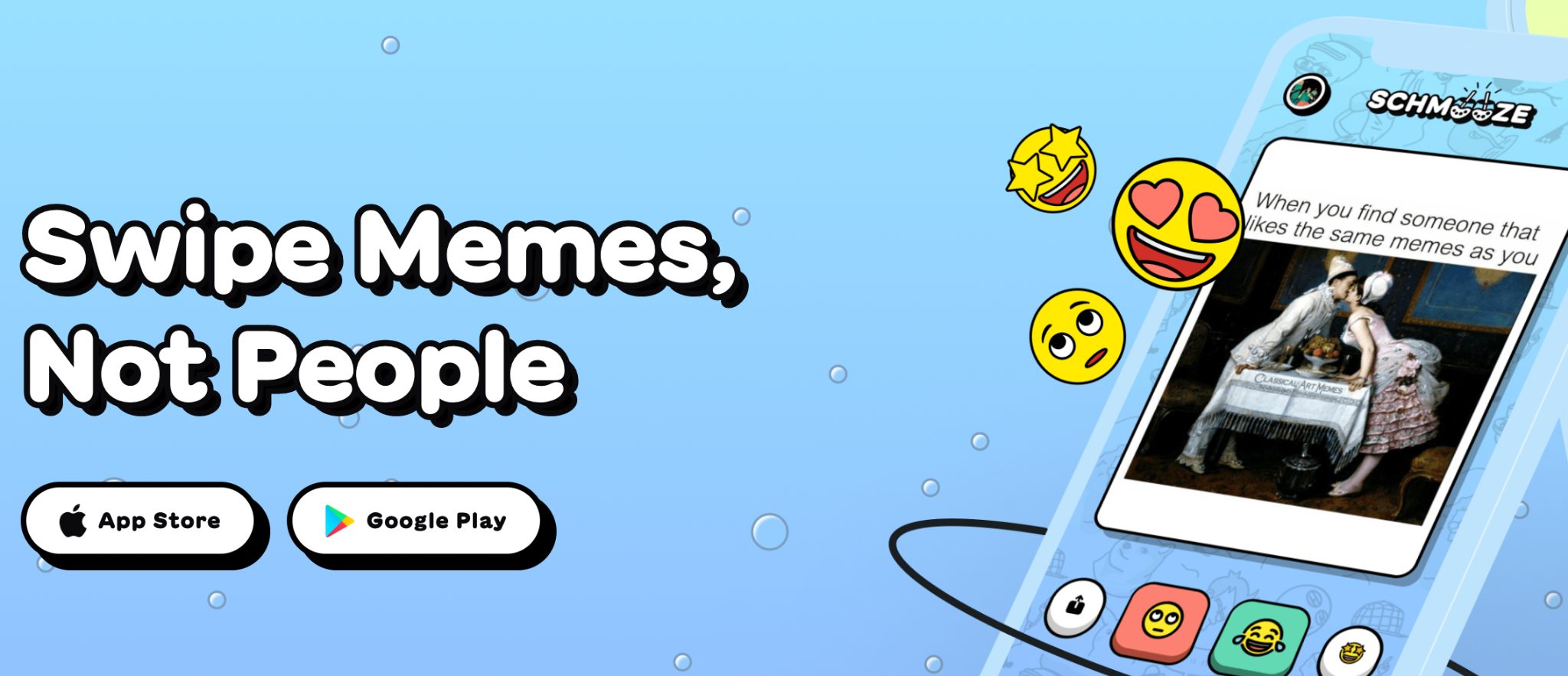
The dating app Schmooze allows users to “swipe memes, not people”, matching each other based on their sense of humour. This meme-centric approach has gained over 300,000 users since it was launched on a college campus in 2020.

People share content for various reasons: to communicate or be helpful, to raise their self-esteem or reputation, etc. However, according to psychological theory, novelty-seeking is another solid digital drug. Anything that seems new or fills in information gaps can trigger dopamine release.

Humour has long been used as a tool of communication and public diplomacy – even during wars. And still, humour is at the top of social media content because it generates virality.

The Reddit experiment “Place” (2017) caused an epic war of pixels on a collaborative digital art canvas, where users from all over the world could place a pixel every five minutes. It went viral in just 72 hours and involved more than 200,000 participants. The reasons are – novelty, fun, and unpredictability.

Is synthetically generated content the new fun?

Content consumption is on the rise. Emerging technologies and their applications, such as NFT, ML mechanics, and AR/VR tools create stronger emotional ties with users through new types of content. Synthetic media creation has become yet another endless source of enjoyment.

Try not to overcook fries in the virtual IKEA kitchen, swap your face into the trailer of an upcoming movie, or join Justin Bieber for an immersive live show in the metaverse. Campaigns using synthetic media and immersive ads can take an integrated approach and facilitate an emotional response from viewers, because people enjoy humorous images and sharing unusual content.

In 2018, McDonald’s designed an AR effect to celebrate the 50th anniversary of the Big Mac. The next year, the company took its business to the next level by purchasing an artificial intelligence marketing startup for over $300 million, one of its most significant acquisitions to date.

3. The tool for social influence

Among the obvious reasons for implementing fun into your advertising campaigns, there is one more that many creatives don’t usually take into account. Fun is a powerful tool for influencing public opinion that can be used to launch social campaigns. Humour allows you to pack a strong message into a simple shape that is easily understandable to many.

The Silicon Valley FoodTech unicorn JUST Egg knows how this works. To draw attention to the problem of global warming during Earth Month, the eco-friendly brand JUST Egg elegantly trolled American legislators on their own territory in Washington. JUST Egg has captured a 98% market share in egg substitutes in the US, which can be considered a huge product influencer.

During the last two months, social media has also added another ingredient, bringing immediacy into strategic communication as a new kind of fun. Joining the war against Russian propaganda, the Ukrainian government’s Twitter account uses humour as a tool of information warfare.

Whether you own a brand of corn flakes or represent a major government organization, implementing and packing fun into your creative commercial is another way to cultivate and engage a community.

There’s no need to turn every business marketing strategy into a humour-centric one, especially if the entertainment industry is not related to your project. However, in general, brand communication and marketing are moving toward giving emotions and a sense of unity. The easier it is to make your customers laugh, the more gladly they will interact with your product.

Feature Image Credit: Daniel Salcius

By Anton Volovyk

Anton Volovyk holds an MBA degree from Harvard Business School and a Master in Finance degree from IE Business School. Anton is an expert in app-monetization, business development, and leadership. Before Reface, he worked at the Boston Consulting Group, a global strategy consulting company working with clients across consumer, tech, and media. Prior to BCG, Anton worked in investment banking in the M&A department and Private Equity as a tech and consumer investor.

Sourced from Brandingmag