Author

editor

Browsing

Elon Musk discussed his stance on what types of content should be allowed on Twitter Inc.’s social network, saying that people should be allowed to say “pretty outrageous things” but that the platform doesn’t have to give those posts reach.

Musk elaborated on his beliefs Thursday during an all-hands gathering at Twitter, according to staff who participated in the virtual meeting. It marked the first time the billionaire, who is chief executive officer of Tesla Inc., has addressed Twitter employees since agreeing in late April to buy the company for $44 billion.

Twitter needs to allow more space for people to say whatever they want, Musk said, as long as it doesn’t violate the law. But he added that the company needs to balance that by making sure people “feel comfortable” on the service, otherwise they won’t use it, according to people familiar with the discussion. His goal is to expand Twitter’s user base to 1 billion users, he said. The company had about 229 million daily active users as of March.

Employees who attended the meeting said Musk—who attended the video call wearing a white button-down shirt and appeared to be joining from his phone—also talked about possible product changes, including the idea that users should have to pay to be verified as a real human user, through a tool like subscription service Twitter Blue. He also proposed that Twitter use verification as a way of ranking content on the platform. His goal is to “maximize usefulness of the service,” Musk said.

When asked about potential layoffs, Musk didn’t dismiss the idea, saying that Twitter “needs to get healthy.”

“Anyone who is a significant contributor should have nothing to worry about,” he added.

Twitter started allowing full-time remote work more than two years ago, and Musk was asked multiple questions at the meeting about the staff’s future ability to keep working from home. Musk said that the priority would be for people to work together in person, but if someone is “exceptional at their job” then it’s possible for those people to continue working remotely.

Many employees posted in an internal Slack channel as the conversation unfolded, and Musk’s comments about remote work being reserved for “exceptional” workers prompted a number of heated replies, according to people with knowledge of the situation.

Musk wasn’t directly asked and didn’t address the question of whether he is committed to buying Twitter. He has created concern over recent weeks that he was no longer interested in acquiring Twitter, or might want to lower the per-share price. First he said he wanted to put the deal “on hold” while he investigated the number of bots on the service, and later he sent a formal letter to Twitter executives saying he might walk away from the deal if the company didn’t do more to prove the size of its user base.

The Tesla CEO, who is also the world’s richest person, has publicly criticized Twitter’s products, executives and policies since striking the deal agreement, frustrating some employees who are concerned that he doesn’t understand the complexities of running a large social networking company.

Musk reiterated that he’s not against advertising as a model, noting that it’s very important to Twitter’s business, but that ads and subscriptions are both key to boosting revenue. He said ads should be entertaining, and he doesn’t want to let businesses advertise “bad products.” He told a story about how he recently bought a “scammy product” from a YouTube ad and it didn’t work as advertised.

“That’s totally not cool,” Musk told employees.

Musk was also asked if he plans to take the CEO role at Twitter. He didn’t give a clear answer, saying he’s not hung up on titles, but does want to “drive the product in a particular direction.”

“There’s a lot of chores if you’re the CEO,” he said. “I don’t really care what the title is, but obviously people do need to listen to me.”

By Kurt Wagner, Edward Ludlow, Maxwell Adler and Bloomberg

Sourced from Fortune

By Cecily Mauran

Words of wisdom from the viral aperitif brand.

While scrolling through Instagram, if you’ve ever come across images of a laid-back yet sophisticated cocktail party filled with effortlessly cool people drinking colourful cocktails and spritzes, that’s probably because of Helena Hambrecht.

Hambrecht is the CEO, co-founder, and branding mastermind of aperitif brand Haus. Before Haus, Hambrecht cut her teeth in brand consulting for big names like Facebook, Google, Twitter, Uber, and Airbnb. In other words, Hambrecht has “this really weird, but useful skill set of learning how the internet sausage is made.”

Haus isn’t like other alcohol brands, it’s a cool brand

“Historically, there just hasn’t been a lot of innovation in liquor,” says Hambrecht. From ingredients to distribution, Big Liquor is very much a gatekeeper industry that Hambrecht and her co-founder saw an opportunity to shake up. (Pardon the pun.)

Other brands add sugar, preservatives, aren’t transparent about their ingredients or where they’re sourced, and have high alcohol content, which is a pretty nasty combination for a hangover. Instead, according to the website, Haus uses responsibly-sourced “natural fruits, herbs, and botanicals,” has lower alcohol content (more than wine, less than whiskey), and is made sustainably.

But it’s not just a better-tasting booze with less of a hangover. According to alcohol distribution laws, aperitifs that are mostly grape-based, like Haus’s product, can be sold online. And that’s how Haus became a business-to-consumer brand for the Instagram era.

“Because we have the freedom to sell online, we just re-thought what a brand could look like.”

The Instagram effect

Since launching in 2019, Instagram was an inherent part of brand strategy. Today, Haus has 65,000 followers. “I wanted to make something that you could recognize from 200 feet away,” says Hambrecht. “That has made Instagram really successful for us, because when you see the Haus bottle, there’s nothing else that looks like it, even if it’s 10 pixels high, you can recognize it.”

Image of a bar cart filled with bottles that people are picking up
From day one, Instagram was a part of Haus’s strategy. Credit: Haus

Building an online presence had a major advantage of working with distributors that normally wouldn’t give indie alcohol brands like Haus the time of day, said Hambrecht. “We could go to them and be like, ‘Look, we built the brand for you. We already have this national audience that knows who we are and they’re all waiting for us to get into wholesale. So all you have to do is clear it for us and take a chunk of our money.”

Currently, Haus is in the middle of launching wholesale in 24 states.

Yes, TikTok is currently the most popular app, but Instagram is a key asset for consumer brands who want to build a following. We asked Hambrecht our burning questions about the importance of promoting your business on Instagram and here’s what we learned.

1. Define an aesthetic.

Instagram is all about aesthetics, which is why it works best for consumer brands like Haus.

“A big reason why people will buy food or beverage or really anything online is that they can see how it lives in the world,” says Hambrecht. “For us, we’ve been able to use photography on Instagram to show, ‘this is how you drink it, this is where you drink it, this is who you invite over, where you put the bottle.’ All of those things can be answered visually and that’s where Instagram is just so much better at education and brand marketing than most social channels.”

Hambrecht says they wanted to create a visual style that was aspirational, but attainable. “What we found is it resonates a lot with people, it makes it feel approachable, it makes it feel like maybe something that they could bookmark as inspiration.”

2. ‘The less you sell, the more you’ll sell.’

Sound counterintuitive? Allow Hambrecht to explain. “It’s obvious that you want them to buy [the product], you don’t need to say that.” Customers should want to buy a product based on what they see and feel, Hambrecht explains. “It’s less about selling and more about how can we use this as a brand extension to give our community what they want?”

3. Give the people what they want.

A key part of promoting your business on Instagram is figuring out what your followers may want. “You may not even have a community yet, but say you’re making a food product. You can take a wild guess that the community might want to have some food recipes, or they may want to have your recommendations for other products that could accompany food,” says Hambrecht.

“What can you give your community that isn’t necessarily tied to your product, but makes them really love your brand and think of you as creative and generous and thinking about what the community cares about,” she continues. “That’s how you build that brand loyalty and that’s going to make people want to follow you.”

If you’re thinking of Instagram as more of a content and community engagement channel instead of a sales channel, your posts will be genuine and align with the followers you’re looking for.

4. Build community around your brand.

According to Hambrecht, Haus learned from its customers that they loved seeing other members of the community, so the company started featuring them in more Instagram posts. “It’s really awesome for our audience who wants to see who else is part of this community, who else is drinking this product and they can follow them or they could reach out to them.”

Haus didn’t spend any money on marketing for the first six months, which Hambrecht attributes to investing in branding and customer experience early on, which generated lots of word-of-mouth buzz. Having a strong engaged community proved to be critical when the worst happened…


5. Always be willing to adapt.

Haus was just six months old when the pandemic hit. For a business that built its brand around gathering, Haus suddenly faced huge challenges. Hambrecht says they had to rethink how Haus would live in their customers’ lives during that time. “We shifted our focus to things that were still relevant, like educating our community on the product, how it’s made, the ingredients and where they come from, and recipes they can make at home.”

There was also the practical issue of how to photograph and create new content during social isolation. Hambrecht says they crowdsourced their customers and team about how they were staying connected to each other during the pandemic, which became the genesis for an interview series called “My Haus.”

“We were like, ‘Well, we can’t go and like meet these people in person, it’s dangerous to send a photographer. So why don’t we start sending disposable cameras?'”

“It’s an interview series where we send members of our community disposable cameras, and they photograph a day in the life in their home. We interview them about their home rituals and how they stay connected with the people in their lives in this strange time, whether that’s over zoom, or in person with whoever they live with at home.”

Of course, these were extreme circumstances that forced businesses to adapt for their very survival, but it taught Haus some important lessons.

“Don’t feel so stuck in one strategy. Whatever works today, may need to change six months from now or a year from now,” says Hambrecht. “It’s just a matter of paying attention to what’s going on in the world, and paying attention to what your community cares about or what they need help with.”

6. Play it cool — and be patient.

In other words, it’s all about the long game. “We didn’t take shortcuts, we weren’t begging for followers. You just gotta be cool. Play it cool and be patient.”

Hambrecht built Haus’s following through “building genuine connections,” which has carried the brand through a global pandemic. “Whether it’s with your customers, reporters, retailers, partners, or investors, you’ve just got to play the long game and know that those the relationships you’re making today might come around in two to three years for you.”

Feature Image Credit: Mashable composite: Bob Al-Green / Haus

By Cecily Mauran

Sourced from Mashable

B

Chatbots today are revolutionizing the manner in which people shop. They are providing improved customer experiences in product selection, shopping, customer service, and more.

According to Statista, an estimated 2.14 billion people purchased goods or services online in 2021.

Statista

Image Source

The number of active chatbots is growing at its quickest rate yet. In 2017, Facebook Messenger had 100,000 chatbots, which quickly rose to 300,000 within 12 months. This rapid expansion shows that the collaboration between humans and chatbots is and will continue to improve as time passes.

If that isn’t indication enough of how useful people find chatbots, take a look at the stats below:

  • 40% of millennials claim that they use chatbots daily
  • 64% of internet users say round-the-clock service is the best chatbot attribute
  • 67% of millennials say that they are more likely to shop from websites using a chatbot

Do you want to know how this theory of eCommerce chatbots works in practice? Let’s take a look at Masha.ai, a shopping assistant chatbot by Facebook Messenger.

Masha.ai

Image Source

Masha.ai began as an experiment to help customers reduce the amount of time they needed to accomplish their shopping and soon grew in popularity among users. The chatbot, which was designed to assist buyers with shopping options and assist them in placing orders, also provided consultation to its users and sent them news of new stock updates.

The need for eCommerce chatbots

You can save a great deal of time for both your employees and consumers by using a chatbot while also improving your revenue.

Let’s look at the most popular eCommerce use case – placing orders online. As an eCommerce business owner, you must guide customers through the three stages of the customer journey before they make a purchase:

  • Awareness
  • Consideration
  • Decision/Purchase

On paper, the development appears to be straightforward. However, it might be challenging to properly guide online shoppers through all three stages.

So, what do you do here to help prospects along the customer journey so that they end up at the Decision stage more frequently?

Simple. You deploy a chatbot.

These bots can be built to offer a variety of services to prospects while gently nudging them towards the final stage. Here’s how to do it:

  • Engage during the Awareness stage: A chatbot can go beyond simply luring prospects to your brand and the problem(s) that your product(s) solve. They can even engage them in a unique way that distinguishes your business and prepares them for the next stage.
  • Inform during the Consideration stage: It is up to you to educate leads to assist them so that they progress smoothly to the consideration stage – a job well-suited to a chatbot. These bots can tell consumers your brand’s story, promote your products, and pique the curiosity of potential buyers as well. These bots can also service customer queries and satisfy the objections of prospects so that they are more ready to buy.
  • Convert at the Decision stage: Bots can make the purchasing process simpler and more appealing. Furthermore, they can follow up with individuals who were on the verge of converting and encourage those who did purchase to return and buy again.

5 Examples of successful eCommerce chatbots

Chatbots that are well-designed can have a favourable impact on customer experience. The channels on which they are most popular are often the ones with the best user experience and simplicity of interaction. What role do chatbots play in the world of big brands? Let’s take a closer look.

1. Nike StyleBot

Brand: Nike

Industry: Sports apparel, accessories, and equipment.

Major takeaway: Chatbots can improve conversions for retail campaigns.

Key stats:

  • The average click-through rate (CTR) is 12.5 times higher than other brand campaigns
  • Conversions improved by 4 times the brand average

In an effort to promote Nike AirMax Day, Nike considered adopting a conversational marketing campaign that utilized a chatbot for the purpose. An AI eCommerce bot, aka the Nike StyleBot, the brand brought its exclusive Nike ID platform to Facebook Messenger. Customers could create their custom shoe designs or go through previously submitted versions for ideas.

Image Source

Among other things, users can communicate with the chatbot in natural language and receive multiple-choice responses in the form of text, interactive buttons, gifs, and photos. Of all the functionalities, though, the customized sneaker-creation one remains the most fascinating part of the bot. All you have to do is submit a photograph of your favorite pair of shoes and select a color theme from NIKEiD. The opportunity to play with colors and create their own sneakers all through the chatbot helped make Nike StyleBot a huge hit.

2. Michael Kors

Brand: Michael Kors

Industry: Fashion

Key stats:

  • Gained more than 350,000 active users
  • 55% decrease in inbound service volume
  • 90% containment rate

Major takeaway: AI chatbots can reduce service volume and improve customer satisfaction.

Michael Kors spent the year 2018 focusing on creating and deploying an improved chatbot for its worldwide audience. The chatbot that came about not only provided existing deals and item suggestions but also supports consumers in making the right purchase by redirecting them to their eCommerce store to complete the transaction.

Image Source

Michael Kors’ chatbot also provides FAQ help and reroutes customers to real human agents when the need emerges. The chatbot allows you to learn about the brand’s products. Users can ask the bot their questions and it will respond and keep them interested.

The chatbot not only continues to attract new clients but also accurately responds to more than 80% of consumer concerns and retains them with a 90% containment rate.

3. Sephora Kik Bot

Brand: Sephora

Industry: Beauty and makeup

Key stats:

  • Achieved a 4.4-25% increase in conversions across platforms
  • 18% of Sephora’s customers now make purchases online

Major takeaway: Chatbots can provide personalized recommendations to foster a unique virtual shopping experience.

Mary Beth Laughton, Sephora’s Senior VP of Digital Marketing, delivered a keynote speech in which she announced that Sephora would partner with Kik Messenger to create a chatbot to provide its clients with engaging shopping experiences. Users could now have one-on-one chat experiences via phone with Sephora’s Kik chatbot.

Image Source

If you have ever been inside a Sephora store, you’ve definitely been startled by the vast array of items. This is where Sephora’s Kik bot comes into play. Users can learn about makeup through Sephora’s video clips, special tips, and photo tutorials seamlessly. What’s more, Sephora’s Kik bot also assists users in discovering the items used in makeup tutorials and recommends top-rated items for a specific category.

4. Betty Bot

Brand: GearBunch

Industry: Apparel and accessories retail

Key stats:

  • Hit $100,000 in revenue within the first month of operation
  • Increased overall revenue by $5,000,000 in a span of 12 months

Major takeaway: Chatbots can act as personal shopping assistants to improve engagement.

GearBunch is a clothing company established in the United States that specializes in goods with unique patterns. Their highest-selling and most popular products are women’s leggings, but they also sell other apparel like caps, accessories, and shoes. They also designed a chatbot named Betty to assist with sales.

Image Source

Betty operates as a personal shopper for users, recommending certain products and even intervening when a user fails to convert. As a consequence, prospective buyers who would otherwise be lost can be reengaged and persuaded to buy. If a customer does not convert after their first encounter with Betty, the bot targets them by:

  1. Offering discount coupons: GearBunch sends out sale notices and coupon deals to its customers. Given that 48% of consumers believe they are more likely to purchase a product sooner than usual to take advantage of a deal, this is a highly beneficial tactic for GearBunch.
  2. Following up on cart abandonment: If a user adds something to their cart on the GearBunch website but does not purchase it, the bot will contact them again. It will send a cart abandonment notification to the consumer via Messenger that also contains a link to take them back to where they left off.

This has aided GearBunch in increasing conversions by offering its users a personalized shopping experience and assisting them in finding the perfect product, increasing the likelihood that they’ll convert.

5. Freddy Bot

Brand: HelloFresh

Industry: Meal-kit industry

Key stats:

  • Improved conversion rate by 64%
  • Increased message volume by 47%
  • Decreased response times by 76%

Major takeaway: AI chatbots can decrease response times to provide improved customer satisfaction and consequently boost conversions.

HelloFresh is a meal kit startup established in Berlin. In 2017, their Facebook page released Freddy, a chatbot, to assist them:

  • Increasing message volume from prospective buyers
  • Reducing the time it takes to respond to those messages

Freddy began this exercise by interacting with visitors in an innovative way as they progressed through the Awareness stage. It enticed prospects with engaging, seasonal content to lure them in. For Black Friday 2017 and 2018, HelloFresh made Facebook posts containing a question or a riddle. Whenever a user gave the correct answer, Freddy would contact them over Messenger and send them a promo code. This campaign was so successful in 2018 that it had a conversion rate of 64%.

Image Source

The HelloFresh team also gave Freddy a few amusing features in order to offer visitors a distinctive brand experience that would retain them by keeping them interested. Freddy’s Breakfast Quiz, for instance, is the perfect example of an engaging way for users to learn about HelloFresh’s products.

Freddy paid off big time as part of this bot effort in the following ways:

  • Once configured and deployed, the process of delivering discounts, generating leads, and closing purchases were essentially totally automated, saving the team at HelloFresh both time and energy.
  • It provided users with a memorable, delightful experience with the brand, increasing their likelihood of conversion and/or re-engagement in the future – an important part of this stage in the customer journey.

To bot or not to bot?

As the chatbot examples above demonstrate, the future presents nearly endless possibilities for eCommerce companies.

Irrespective of the industry you are from, a chatbot may increase your brand’s performance and revenue by attracting new customers, teaching them about your offerings, and improving customer satisfaction by lowering the time it takes to respond to support issues.

So, regardless of which method you adopt, this revolutionary technology can help your brand improve its performance to reap substantial benefits.

B

Guest author: Srushti Shah is an ambitious, passionate, and out-of-the-box thinking woman having vast exposure in Digital Marketing. Her key focus is to serve her clients with the latest innovation in her field leading to fast and effective results. Working beyond expectations and delivering the best possible results is her professional motto. Other than work, she loves traveling, exploring new things and spending quality time with family. Reach out to Srushti Shah on Twitter or LinkedIn

Sourced from Jeff Bullas

Social natives ≠ digital natives.

Media organizations around the world can agree on one thing: Young people — despite being critical audiences for publishers and journalists, and to the sustainability of news — are increasingly hard to reach and engage.

Using data from the 2022 Reuters Institute Digital News Report, we show that younger audiences increasingly consume and think about news differently than older audiences do. They are more casual news users, rely more on social media, and are less connected to (and therefore less loyal to) news brands. They also have different perceptions of what news is and how it’s practiced.

Of course, it’s long been the case that young people’s behaviours and preferences are different from those of their older peers. They long have been.

But as more young adults who grew up with social media enter our sample, the differences seem to be growing, even between social natives — those aged 18–24, who largely grew up with social media — and digital natives, those aged 25-34, who largely grew up with the web but before the rise of social networks. Many of these shifts are so fundamental that it doesn’t seem likely that they will be reversed with time.

How do younger audiences get their news?

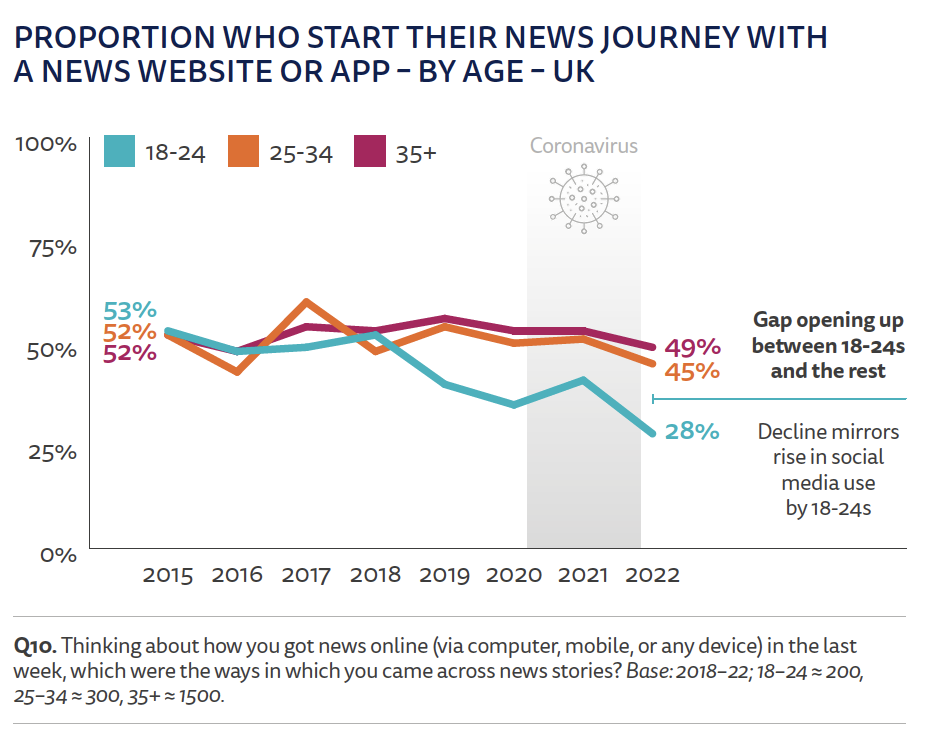
As we track people’s main sources of news over time, we find direct access to news apps and websites steadily becoming less important and social media becoming more important. These changes are largely driven by the emerging habits of social natives (18-24s) as they come into adulthood and don’t often form strong brand connections.

When we look at main access by age in the U.K., for instance, we see social natives (turquoise line) have become significantly less likely to use a news website/app — differing not just from the oldest groups but also from digital natives. This group is far more likely to access news using “side-door” sources such as social media, aggregators, and search engines than their older peers.

As the social media landscape continues to evolve dramatically, social natives have also shifted their attention away from Facebook — or never started using it in the first place. In its stead, visual platforms such as Instagram and TikTok have become increasingly popular for news use among this group. On average across 46 markets, social natives are now five times more likely to use TikTok for news in 2022 (15%) than they were in 2020 (3%). Here’s the data for the U.S.:

These patterns do not hold up for all young people. While digital natives have largely embraced many of the same networks, they remain far more loyal to Facebook, the network this cohort largely grew up with, and have been slower to move to new networks like TikTok.

And despite the meteoric rise of online video formats, text- and audio-based formats still have a big role to play in young people’s news habits. Under-35s still largely say they prefer to mostly read (58%) rather than mostly watch (15%) news. Some seek out a mix of formats to better understand information, while others are drawn to audio-based formats like podcasts that allow users to multitask while they listen. There is not a one-size-fits-all approach or medium through which newsrooms can attract younger audiences.

How do younger audiences think about the news?

Young people — particularly social natives — don’t just have different news behaviors than older groups. They also have different attitudes toward the news and how it’s practiced. They are more likely than older groups to believe media organizations should take a stand on issues like climate change and to think journalists should be free to express their personal views on social media.

Many young people also have a wider definition of what news is. We find younger audiences often distinguish between “the news” as the narrow agenda of politics and current affairs and “news” as a wider umbrella encompassing topics like sports, entertainment, celebrity gossip, culture, and science. Under-35s are less interested than older groups in what they consider to be “the news” — traditional beats like politics, international, or Covid-19 news — and are more interested in a broader array of “news” umbrella topics, including entertainment and celebrity, education, and fun news.

But contrary to conventional narratives of “young people” as socially engaged digital activists, particularly when it comes to climate change, mental health, and social justice issues, we don’t find greater interest in news specifically about these topics among young people broadly.

Instead, younger audiences’ interest in these topics varies dramatically by country and demographics. For example, interest in social justice news is 9 percentage points higher among under-35s than those 35 and older in the U.K., on a par across both groups in Brazil, and 7 percentage points lower among under-35s in Germany. And, on average, older groups are more likely than younger groups to say they are interested in environment and climate change news.

Why are young people turning away from the news?

As more news outlets and formats compete for audiences’ time and attention, we continue to see longer-term falls in interest and trust in news across age groups and markets — particularly among younger audiences, who are generally less interested in news, access it less frequently, and actively avoid it more often than older audiences. On average across all 46 markets, around four in ten social natives (40%) and digital natives (42%) often or sometimes actively avoid the news.

Even those who remain engaged with news increasingly choose to ration their exposure to it — not often necessarily avoiding all news, but instead avoiding specific topics. Most often, younger audiences (43% of under-35s) say they avoid the news because there is too much coverage of topics like politics and Covid-19. We call this behaviour selective news avoidance, and while this is not limited to younger audiences, we see substantial rises in avoidance among social natives, in particular, since we last asked this question in 2019.

The longstanding criticism of the depressing or overwhelming nature of news also persists among younger audiences. Our interviewees mentioned forming news habits to avoid negativity: “I tend to try and limit the amount of negative news I consume, especially first thing in the morning and last thing at night,” a 29-year-old U.K. woman said.

And we find that younger people — particularly social natives — are more likely than older groups to say they find the news hard to follow or understand. In moments of crisis, such as the pandemic or the Ukraine war, we’ve seen some news outlets using explainer and Q&A formats to try to address these issues. Our data suggest this process needs to go much further.

What does this mean for news brands?

Over time, key differences among (and within) younger news audiences continue to become clearer. Social natives’ reliance on social media and weak connection with brands make it harder for media organizations to attract and engage the newest group of news consumers. At the same time, young people’s perceptions of what news is are also wider. And while these groups do not all have the same needs, many are looking for more diverse agendas and voices and for stories that don’t depress or confuse them.

Recognizing the variety of preferences and tastes that exist within these incredibly diverse cohorts presents a new set of challenges and opportunities for media organizations. But it is clear that news brands can’t expect young people to eventually come around to what has always been done.

Kirsten Eddy is a postdoctoral research fellow at the Reuters Institute for the Study of Journalism, a senior researcher with the Geena Davis Institute on Gender in Media, and a research affiliate with UNC’s Center for Information, Technology, and Public Life.

Sourced from NiemanLab

By Eric Bush

They say the only constant in life is change itself, but that sounds an awful lot like a paradox, and my brain doesn’t like those. To me, the only constant in life is adapting to change. And that’s exactly what we need to do right now.

No, I’m not talking about the post-pandemic world’s “new normal” (anyone else getting sick of hearing that?). I’m actually talking about Google’s decision to say goodbye to expanded text ads (ETAs). Whether you’re just hearing about this for the first time or have been worrying about it for months, you’ve come to the right place.

Let’s take a look at what this change is, what it means for you and how you can adapt to it.

What’s Changing?

In 2016, Google introduced expanded text ads — a bigger, better way to communicate with your target audience. Now, 6 years later, Google is sunsetting this option. As of June 30, 2022, you will no longer be able to create or edit ETAs in your standard Search campaigns.

Hey, all good things must come to an end, right?

Don’t worry, though: Your existing ETAs won’t go to waste. Google says you’ll still be able to track their progress and even pause, resume or remove them at your leisure. You just can’t make new ones or edit the structure of those you already have.

Why Is This Happening? 

According to Google, the sunset of ETAs is all part of “making it easier to show the right message on Search.” The goal is to keep up with changing consumer needs and expectations.

For example, did you know that 15% of daily search queries are totally new to Google? The company uses this stat to point out that search habits are changing — which means your ad strategy needs to change, too.

The key, Google tells us, is automation. Unfortunately, we’re not talking about robot butlers here; for now, automation is mostly focused on ad bidding and placement, so you can’t put your feet up just yet. You can, however, use automation to simplify your ad strategy.

That’s because Google is replacing ETAs with their younger, sharper siblings, responsive search ads (RSAs). These little guys use automation to “show the right message for the right query.” You provide your ad assets, Google uses its algorithms to choose the best combinations of headlines and graphics for a specific audience and voilà — an advanced ad strategy.

Even the biggest fans of ETAs will probably have to admit that this new approach has its advantages. Plus, RSAs can be bigger (300 characters vs. 150 for ETAs), so you don’t have to worry about cutting out your great content. Perhaps most importantly, Google says the return on investment (ROI) is promising: “Advertisers that switch from expanded text ads to responsive search ads, using the same assets, see an average of 7% more conversions at a similar cost per conversion.”

What Now?

Don’t panic: Your ad strategy can and will live on without ETAs. But say your goodbyes now, because RSAs are poised to become the next big thing in advertising.

To turn this change into an opportunity instead of a source of stress, brush up on these best practices:

Learn About Ad Automation

There’s a whole world of ad automation out there — one you might never have embraced if you were busy juggling your ETAs. Now you have a perfect excuse to do some research on Google’s algorithms, automated solutions and more. This will help you get more out of RSAs as you add them to your strategy.

Repurpose Your ETAs

Don’t trash all your hard work. Instead, Google recommends choosing high-performing ETA content and repurposing it in RSA format. You can also use the built-in ad strength analyser to make sure you’re on the right track. After all, as Google explains, “Advertisers who improve Ad strength for their responsive search ads from ‘Poor’ to ‘Excellent’ see 9% more clicks and conversions on average.”

Use RSAs to Tell New Stories

Advertising is all about telling stories, right? Well, RSAs make it easier for you to tell those stories without having to plot out every detail. All you have to do is fill in your characters and settings (that is, your headlines and images) and let Google’s automated system combine them in different ways depending on your audience, ad placement, campaign goals and more.

Remember, the only constant in life is adapting to changes like this one. But that doesn’t mean you have to idly wait for whatever the marketing and advertising worlds throw at you. Instead, you should stay informed — and with a resource like our newsletter in your inbox, you’ll be the first to know what’s coming around the corner.

By Eric Bush

Eric Bush is the Manager of Paid Search at Brafton. He has helped grow the Brafton consulting services department to focus on multiple PPC platforms/channels and expanded its partner program to include both Google and Microsoft. His expertise ranges from multichannel marketing and planning to data performance analysis, with a focus on paid search strategies.

Sourced from Brafton

By Cory Doctorow

In December, 2020, Apple did something insanely great. They changed how iOS, their mobile operating system, handled users’ privacy preferences, so that owners of iPhones and other iOS devices could indicate that they don’t want to be tracked by any of the apps on their devices. If they did, Apple would block those apps from harvesting users’ data.

This made Facebook really, really mad.

As far as Apple -and Facebook, and Google, and other large tech companies – are concerned, we’re entitled to just as much privacy as they want to give us, and no more.

It’s not hard to see why! Nearly all iOS users opted out of tracking. Without that tracking, Facebook could no longer build the non-consensual behavioural dossiers that are its stock-in-trade. According to Facebook, empowering Apple’s users to opt out of tracking cost the company $10,000,000,000 in the first year, with more losses to come after that.

Facebook really pulled out the stops in its bid to get those billions back. The company bombarded its users with messages begging them to turn tracking back on. It threatened an antitrust suit against Apple. It got small businesses to defend user-tracking, claiming that when a giant corporation spies on billions of people, that’s a form of small business development.

For years, Facebook – and the surveillance advertising industry – have insisted that people actually like targeted ads, because all that surveillance produces ads that are “relevant” and “interesting.” The basis for this claim? People used Facebook and visited websites that had ads on them, so they must enjoy targeted ads.

Unfortunately, reality has an anti-surveillance bias. Long before Apple offered its users a meaningful choice about whether they wanted to be spied on, hundreds of millions of web-users had installed ad-blockers (and tracker-blockers, like our own Privacy Badger), in what amounts to the largest consumer boycott in history. If those teeming millions value ad-targeting, they’ve sure got a funny way of showing it.

Time and again, when internet users are given the choice of whether or not to be spied on, they choose not. Apple gave its customers that choice, and for that we should be truly grateful.

And yet…Facebook’s got a point.

When “users” are “hostages”

In Facebook’s comments to the National Telecommunications and Information Administration’s “Developing a Report on Competition in the Mobile App Ecosystem” docket, Facebook laments Apple’s ability to override its customers’ choices about which apps they want to run. iOS devices like the iPhone use technological countermeasures to block “sideloading” (installing an app directly, without downloading it from Apple’s App Store) and to prevent third parties from offering alternative app stores.

This is the subject of ongoing legislation on both sides of the Atlantic. In the USA, The Open App Markets Act would force Apple to get out of the way of customers who want to use third party app stores and apps; in the EU, the Digital Markets Act contains similar provisions. Some app makers, upset with the commercial requirements Apple imposes on the companies that sell through its App Store, have sued Apple for abusing its monopoly power.

Fights over what goes in the App Store usually focus on the commissions that Apple extracts from its software vendors – historically, these were 30 percent, though recently some vendors have been moved into a discounted 15 percent tier. That’s understandable: lots of businesses operate on margins that make paying a 30 percent (or even 15 percent) commission untenable.

For example, the retail discount for sellers of wholesale audiobooks – which compete with Apple’s iBooks platform – is 20 percent. That means that selling audiobooks on Apple’s platform is a money-losing proposition unless you’re Apple or its preferred partner, the market-dominating Amazon subsidiary Audible. Audiobook stores with iPhone apps have to use bizarre workarounds, like forcing users to login to their websites using a browser to buy their books, then go back to their phones and use their app to download their books.

That means that Apple doesn’t just control which apps its mobile customers can use; it also has near-total control over which literary works they can listen to. Apple may have not set out to control its customers’ reading habits, but having attained it, it jealously guards that control. When Apple’s customers express interest in using rival app stores, Apple goes to extraordinary technical and legal lengths to prevent them from doing so.

The iOS business model is based on selling hardware and collecting commissions on apps. Facebook’s charges that these two factors combine to impose high “switching costs” on Apple’s customers. “Switching costs” is the economist’s term for all the things you have to give up when you change loyalties from one company to another. In the case of iOS, switching to a rival mobile device doesn’t just entail the cost of buying a new phone, but also buying new apps:

[F]ee-based apps often require switching consumers to repurchase apps, forfeit in-app purchases or subscriptions, or expend time and effort cancelling current subscriptions and establishing new ones.

Facebook is right. Apple’s restrictions on third-party browsers, and the limitations it puts on Safari/WebKit (its own browser tools) have hobbled “web apps,” which run seamlessly inside a browser. This means that app makers can’t deliver a single, browser-based app that works on all tablets and phones – they have to pay to develop separate apps for each mobile platform.

That also means that app users can’t just switch from one platform to another and access all their apps by typing a URL into a browser of their choice.

Facebook is very well situated to comment on how high switching costs can lock users into a service they don’t like very much, because, as much as they dislike that platform, the costs of using it are outstripped by the costs the company imposes on users who leave.

That’s how Facebook operates.

Facebook has devoted substantial engineering effort to keeping its switching costs as high as possible. In internal memos – published by the FTC – the company’s executives, project managers and engineers frankly discuss plans to design Facebook’s services so that users who leave for a rival pay as high a price as possible. Facebook is fully committed to ensuring that deleting your account means leaving behind the friends, family, communities and customers who stay.

So when Facebook points out that Apple is using switching costs to take its users hostage, they know what they’re talking about.

Benevolent Dictators Are Still Dictators

Facebook’s argument is that when Apple’s users disagree with Apple, user choice should trump corporate preference. If users want to use an app that Apple dislikes, they should be able to choose that app. If users want to leave Apple behind and go to a rival, Apple shouldn’t be allowed to lock them in with high switching costs.

Facebook’s right.

Apple’s App Tracking Transparency program – the company’s name for the change to iOS that let you block apps from spying on you – was based on the idea that when you disagree with Facebook (or other surveillance-tech companies), your choice should trump their corporate preferences. If you want to use an app without being spied on, you should be able to choose that. If you want to quit Facebook and go to a rival, Facebook shouldn’t be able to lock you in with high switching costs.

It’s great when Apple chooses to defend your privacy. Indeed, you should demand nothing less. But if Apple chooses not to defend your privacy, you should have the right to override the company’s choice. Facebook spied on iOS users for more than a decade before App Tracking Transparency, after all.

Like Facebook – and Google, and other companies – Apple tolerates a lot of surveillance on its platform. In spring of 2021, Apple and Google kicked some of the worst location-data brokers out of their app stores – but left plenty behind to spy on your movements and sell them to third parties.

The problem with iOS isn’t that Apple operates an App Store – it’s that Apple prevents others from offering competing app stores. If you like Apple’s decisions about which apps you should be able to use, that’s great! But that’s a system that only works well – and fails badly. No matter how much you trust Apple’s judgments today, there’s no guarantee that you’ll feel that way tomorrow.

After all, Apple’s editorial choices are, and always have been driven by a mix of wanting to deliver a quality experience to its users, and wanting to deliver profits to its shareholders. The inability of iOS users to switch to a rival app store means that Apple has more leeway to take down apps its users like without losing customers over it.

The US Congress is wrestling with this issue, as are the courts, and one of the solutions they’ve proposed is to order Apple to carry apps it doesn’t like in its App Store. This isn’t how we’d do it. There are lots of ways that forcing Apple to publish software it objects to can go wrong. The US government has an ugly habit of ordering Apple to sabotage the encryption its users depend on.

But Apple also sometimes decides to sabotage its encryption, in ways that expose its customers to terrible risk.

Like Facebook, Apple makes a big deal out of those times where it really does stick up for its users – but like Facebook, Apple insists that when it chooses to sell those users out, they shouldn’t be able to help themselves.

As far as Apple -and Facebook, and Google, and other large tech companies – are concerned, we’re entitled to just as much privacy as they want to give us, and no more.

That’s not enough. Facebook is right that users should be able to choose app stores other than Apple, and Apple is wrong to claim that users who are given this choice will be exposed to predatory and invasive apps. Apple’s objections imply that its often fantastic privacy choices can’t possibly be improved upon. That’s categorically wrong. There’s lots of room for improvement, especially in a mass-market product that can’t possibly cater to all the specific, individual needs of billions of users.

Apple is right, too. Facebook users shouldn’t have to opt into spying to use Facebook.

The rights of users shouldn’t be left to the discretion of corporate boardrooms. Rather than waiting for Apple (or even Facebook) to stand up for their users, the public deserves a legally enforceable right to privacy, one that applies to Facebook and Apple…and the small companies that might pop up to offer alternative app stores or user interfaces.

By Cory Doctorow

Sourced from Electronic Frontier Foundation

By

The more technical aspects of this indispensable tool shouldn’t derail your content marketing efforts. How to ensure that doesn’t happen.

According to GrowthBadger, more than 3 billion blog posts are published each year. In the U.S. alone, some 31 million bloggers post at least monthly. For many businesses and influencers, this tool has become a cornerstone, helping drive web traffic and brand awareness and greatly influencing sales.

Of course, there’s more to a successful post than typing thoughts in a Word document. The process is surprisingly tech-heavy, and ensuring that these technical aspects are functioning properly is key to providing an enjoyable reading experience.

1. Use Google Search to Find SEO Keywords

Search engine optimization is heavily focused on using relevant keywords to improve search rankings. Topics chosen for blog entries should be relevant to the site as a whole, so you can naturally include the keyword in the title and content of the blog. And while you aren’t going to get much traction with short keywords like “shoes,” long-form keywords can be a powerful way to strengthen SEO rankings.

Fortunately, you don’t have to do tech-heavy research to find them. As best-selling author and podcaster Jeff Goins recommends in a recent blog entry, “Use Google Suggest, also called autocomplete. When you start typing a word into Google and it fills in the rest of the search for you, this is Google Suggest at work. Before you finish, you’ll see phrases that pop up as most relevant (and the occasional ridiculous results). Start here before getting into more advanced forms of keyword research.”

2. Use Plugins to Incorporate Extra Features

If you’ve spent much time scrolling through blogs, you’ve doubtless seen a wide variety of added features besides text: video embeds, social share features, interactive polls and contact forms are just a few used to make content more engaging. While this process may seem complex, it can be done via user-friendly plugins that allow you to take more of a “drag and drop” approach to formatting.

Regardless of which platform you use to host or create your blog, a variety of plugins or widgets can streamline the user experience and help a site appear more professional and user-friendly. The task is then to consider which features would be most beneficial to your audience, as well as which ones will enhance a particular post.

3. Engage New Visitors by Pinning High-Performing Content

As Jesse Schoberg writes for DropInBlog, “A visitor to your site will probably enter by way of one of your many blog posts. They then click around your site and see what else you have and are bombarded with information. A pinned post can serve as a great entry point into your site. You can pin the post with the highest conversion rate at the top or just a general post introducing the site to your user. The pinned post functions the same way a sign on a storefront would. It should be something inviting or exciting to entice your reader further into your site.”

You can look at your website metrics to identify posts with higher performance metrics, such as views, shares or comments, and/or select according to what you think would be the most interesting to your readers (such as a contest or giveaway), or evergreen content that serves as a strong introduction to your business.

4. Let Coding Happen in the Background

There are a variety of platforms for hosting a purely blog-oriented website, some of which can add blog content to a pre-existing website, and you don’t have to engage an IT team to make this happen. Many platforms use drag-and-drop design functions, or give you the ability to copy and paste a specific code to make the appropriate update. In using these tools, the coding aspect of a blog essentially happens in the background. This not only ensures that text, images and other content looks right when it’s published, it also ensures that transferring a blog post to the live version of your site doesn’t mess things up elsewhere. The key is selecting a platform with publishing and editing features that you are comfortable with based on your level of tech expertise.

5. Make Sharing Easier

Sharing blog content is key to reaching and growing a target audience. As noted previously, a widget can enable readers to share content they enjoy through their own accounts, and the use of other automation tools streamlines the process of sharing content through your own social media accounts.

By ensuring that blog content is automatically shared to your accounts after it’s published, you don’t have to worry about the technical aspect of correctly copying the link and scheduling an attractive post for social media. By automating this process, you can spend more time focused on creating material that will compel followers to click.

When all the technical aspects of a blog are properly in place, you don’t have to worry about glitches and errors disrupting the reading experience. You can have confidence that content will be delivered to readers in a compelling manner, while also providing opportunities for them to easily share it with those in their circle.

By

Sourced from Entrepreneur

By Sharon Goldman

More than ever, organizations are putting their confidence – and investment – into the potential of artificial intelligence (AI) and machine learning (ML).

According to the 2022 IBM Global AI Adoption Index, 35% of companies report using AI today in their business, while an additional 42% say they are exploring AI. Meanwhile, a McKinsey survey found that 56% of respondents reported they had adopted AI in at least one function in 2021, up from 50% in 2020.

“We know that we cannot change the diagnosis, but we can help change the outcome”- Cigna C-suite Executives Discuss the Impact of AI and Digital Interactions in Transforming the Health of Their Customers 1

But can investments in AI deliver true ROI that directly impacts a company’s bottom line?

According to Domino Data Lab’s recent REVelate survey, which surveyed attendees at New York City’s Rev3 conference in May, many respondents seem to think so. Nearly half, in fact, expect double-digit growth as a result of data science. And 4 in 5 respondents (79%) said that data science, ML and AI are critical to the overall future growth of their company, with 36% calling it the single most critical factor.

Implementing AI, of course, is no easy task. Other survey data shows another side of the confidence coin. For example, recent survey data by AI engineering firm CognitiveScale finds that, although execs know that data quality and deployment are critical success factors for successful app development to drive digital transformation, more than 76% aren’t sure how to get there in their target 12–18 month window. In addition, 32% of execs say that it has taken longer than expected to get an AI system into production.

AI must be accountable

ROI from AI is possible, but it must be accurately described and personified according to a business goal, Bob Picciano, CEO of Cognitive Scale, told VentureBeat.

“If the business goal is to get more long-range prediction and increased prediction accuracy with historical data, that’s where AI can come into play,” he said. “But AI has to be accountable to drive business effectiveness – it’s not sufficient to say a ML model was 98% accurate.”

Instead, the ROI could be, for example, that in order to improve call centre effectiveness, AI-driven capabilities ensure that the average call handling time is reduced.

“That kind of ROI is what they talk about in the C-suite,” he explained. “They don’t talk about whether the model is accurate or robust or drifting.”

Shay Sabhikhi, cofounder and COO at Cognitive Scale, added that he’s not surprised by the fact that 76% of respondents reported having trouble scaling their AI efforts. “That’s exactly what we’re hearing from our enterprise clients,” he said. One problem is friction between data science teams and the rest of the organization, he explained, that doesn’t know what to do with the models that they develop.

“Those models may have potentially the best algorithms and precision recall, but sit on the shelf because they literally get thrown over to the development team that then has to scramble, trying to assemble the application together,” he said.

At this point, however, organizations have to be accountable for their investments in AI because AI is no longer a series of science experiments, Picciano pointed out. “We call it going from the lab to life,” he said. “I was at a chief data analytics officer conference and they all said, how do I scale? How do I industrialize AI?”

Is ROI the right metric for AI?

However, not everyone agrees that ROI is even the best way to measure whether AI drives value in the organization. According to Nicola Morini Bianzino, global chief technology officer, EY, thinking of artificial intelligence and the enterprise in terms of “use cases” that are then measured through ROI is the wrong way to go about AI.

“To me, AI is a set of techniques that will be deployed pretty much everywhere across the enterprise – there is not going to be an isolation of a use case with the associated ROI analysis,” he said.

Instead, he explained, organizations simply have to use AI – everywhere. “It’s almost like the cloud, where two or three years ago I had a lot of conversations with clients who asked, ‘What is the ROI? What’s the business case for me to move to the cloud?’ Now, post-pandemic, that conversation doesn’t happen anymore. Everybody just says, ‘I’ve got to do it.’”

Also, Bianzino pointed out, discussing AI and ROI depends on what you mean by “using AI.”

“Let’s say you are trying to apply some self-driving capabilities – that is, computer vision as a branch of AI,” he said. “Is that a business case? No, because you cannot implement self-driving without AI.” The same is true for a company like EY, which ingests massive amounts of data and provides advice to clients – which can’t be done without AI. “It’s something that you cannot isolate away from the process – it’s built into it,” he said.

In addition, AI, by definition, is not productive or efficient on day one. It takes time to get the data, train the models, evolve the models and scale up the models. “It’s not like one day you can say, I’m done with the AI and 100% of the value is right there – no, this is an ongoing capability that gets better in time,” he said. “There is not really an end in terms of value that can be generated.”

In a way, Bianzino said, AI is becoming part of the cost of doing business. “If you are in a business that involves data analysis, you cannot not have AI capabilities,” he explained. “Can you isolate the business case of these models? It is very difficult and I don’t think it’s necessary. To me, it’s almost like it’s a cost of the infrastructure to run your business.”

ROI of AI is hard to measure

Kjell Carlsson, head of data science strategy and evangelism at enterprise MLops provider Domino Data Lab, says that at the end of the day, what organizations want is a measure of the business impact of ROI – how much it contributed to the bottom line. But one problem is that this can be quite disconnected from how much work has gone into developing the model.

“So if you create a model which improves click-through conversion by a percentage point, you’ve just added several million dollars to the bottom line of the organization,” he said. “But you could also have created a good predictive maintenance model which helped give advance warning to a piece of machinery needing maintenance before it happens.” In that case, the dollar-value impact to the organization could be entirely different, “even though one of them might end up being a much harder problem,” he added.

Overall, organizations do need a “balanced scorecard” where they are tracking AI production. “Because if you’re not getting anything into production, then that’s probably a sign that you’ve got an issue,” he said. “On the other hand, if you are getting too much into production, that can also be a sign that there’s an issue.”

For example, the more models data science teams deploy, the more models they’re on the hook for managing and maintaining, he explained. “So [if] you deployed this many models in the last year, so you can’t actually undertake these other high-value ones that are coming your way,” he said.

But another issue in measuring the ROI of AI is that for a lot of data science projects, the outcome isn’t a model that goes into production. “If you want to do a quantitative win-loss analysis of deals in the last year, you might want to do a rigorous statistical investigation of that,” he said. “But there’s no model that would go into production, you’re using the AI for the insights you get along the way.”

Data science activities must be tracked

Still, organizations can’t measure the role of AI if data science activities aren’t tracked. “One of the problems right now is that so few data science activities are really being collected and analysed,” said Carlsson. “If you ask folks, they say they don’t really know how the model is performing, or how many projects they have, or how many CodeCommits your data scientists have made within the last week.”

One reason for that is the very disconnected tools data scientists are required to use. “This is one of the reasons why Git has become all the more popular as a repository, a single source of truth for your data scientist in an organization,” he explained. MLops tools such as Domino Data Lab offer platforms that support these different tools. “The degree to which organizations can create these more centralized platforms … is important,” he said.

AI outcomes are top of mind

Wallaroo CEO and founder Vid Jain spent close to a decade in the high-frequency trading business in Merrill Lynch, where his role, he said, was to deploy ML at scale and do so with a positive ROI.

The challenge was not actually developing the data science, cleansing the data or building the trade repositories, now called data lakes. By far, the biggest challenge was taking those models, operationalizing them and delivering the business value, he said.

“Delivering the ROI turns out to be very hard – 90% of these AI initiatives don’t generate their ROI, or they don’t generate enough ROI to be worth the investment,” he said. “But this is top of mind for everybody. And the answer is not one thing.”

A fundamental issue is that many assume that operationalizing ML is not much different than operationalizing a standard kind of application, he explained, adding that there is a big difference, because AI is not static.

“It’s almost like tending a farm, because the data is living, the data changes and you’re not done,” he said. “It’s not like you build a recommendation algorithm and then people’s behaviour of how they buy is frozen in time. People change how they buy. All of a sudden, your competitor has a promotion. They stop buying from you. They go to the competitor. You have to constantly tend to it.”

Ultimately, every organization needs to decide how they will align their culture to the end goal around implementing AI. “Then you really have to empower the people to drive this transformation, and then make the people that are critical to your existing lines of business feel like they’re going to get some value out of the AI,” he said.

Most companies are still early in that journey, he added. “I don’t think most companies are there yet, but I’ve certainly seen over the last six to nine months that there’s been a shift towards getting serious about the business outcome and the business value.”

ROI of AI remains elusive

But the question of how to measure the ROI of AI remains elusive for many organizations. “For some there are some basic things, like they can’t even get their models into production, or they can but they’re flying blind, or they are successful but now they want to scale,” Jain said. “But as far as the ROI, there is often no P&L associated with machine learning.”

Often, AI initiatives are part of a Centre of Excellence and the ROI is grabbed by the business units, he explained, while in other cases it’s simply difficult to measure.

“The problem is, is the AI part of the business? Or is it a utility? If you’re a digital native, AI might be part of the fuel the business runs on,” he said. “But in a large organization that has legacy businesses or is pivoting, how to measure ROI is a fundamental question they have to wrestle with.”

By Sharon Goldman

Sourced from VentureBeat

By Tanuja Mahdavi

Google holds over 85% of global desktop search traffic and gets billions of searches per day. Google’s advertising revenue through Google Ads was $209.49 billion in 2021, the majority of which came from search advertising.

Google Ads is very competitive and Google uses an auction system to decide which ads to show. When a search query is made with a keyword that has multiple bidders, Google Ads runs an auction to determine which ads are eligible to be shown for that keyword and their ad positions. Only ads that meet minimum quality requirements will be shown for a relevant search term.

With so much competition, how can advertisers improve their performance on Google Ads? In this blog post, I cover the importance of Quality Score in the Google Ads auction. For more details about the Google Ads auction process and Ad Rank, read my last post on Understanding the Google Ads Auction & Why Ad Rank is important.

What is Quality Score?

Quality Score is Google’s estimate of the quality of your ads, as compared to those of other advertisers. It helps ensure that the ads that are most relevant to the search term are shown at a higher position in the search results, so it is based on the relevance of your ad to the search term, the likelihood that your ad will receive clicks when shown, and the user experience offered by your landing page. Every keyword in your account is assigned a Quality Score from 1 (bad) to 10 (excellent) and can be viewed in the keyword table.

Quality Score should be used as a diagnostic tool to improve the quality of your ads, keywords, and landing pages to increase ad performance, and is measured by the performance of three components:

1. Expected CTR

2. Ad relevance

3. Landing page experience

Each of these components is given a rating of “Above Average”, “Average”, or “Below Average”. This rating is determined by comparing your ads with other advertisers who ran ads for the same keyword in the past 90 days.

Why is Quality Score important?

The Quality Score of your ads and keywords is important for the success of your Google Ads PPC (pay per click) campaigns, as they can impact:

  • Whether your ads are shown — Quality Score determines if your ads are eligible to be shown at all in the results for a search query.
  • Your ad position — Quality Score is one of the main factors that is used to determine your ad position or Ad Rank on the search results
  • Your Cost Per Click (CPC) — Your Quality Score determines the actual cost per click (CPC) you pay for your ads. Ads with a higher Quality Score pay a lower CPC, while lower quality ads are charged a higher CPC which may be closer to their max CPC.
  • Whether ad extensions are shown — Ads have to have a high Quality Score for ad extensions to be shown with the ads. Ad extensions provide additional business information and can include call extensions, location extensions, and site links. Ad extensions help to increase the clickthrough rate (CTR).
  • Your ad performance — Higher quality ads and landing pages tend to have a higher CTR, higher conversion rates, and lower bounce rates.
  • How often your ads are shown — More relevant ads will have higher ad impressions on the SERP.

How to improve Quality Score and ad performance

To improve your ad performance, and compete successfully in Google Ads auctions, you should focus on optimizing the three components of Quality Score.

1. Review the Quality Score of your search keywords

The first step is to review the Quality Score of your search keywords in the keywords table. For each keyword, you’ll see the Quality Score along with ratings for expected CTR, landing page relevance, and ad relevance. If you get a rating of “Average” or “Below Average” on any of these components, follow the tips listed below to better optimize. If you get a “-” in the Quality Score columns, it means there aren’t enough clicks and impressions for that keyword to determine the values.

Figure: Example of Quality Score(historical) columns in Google Ads keyword table

Note that the Quality Score status columns need to be enabled in your keywords table to show the values. For tips on how to enable the Quality Score status columns, refer to my post on Understanding the Google Ads Auction & Why Ad Rank Is Important

2. Select relevant keywords

Selecting the right keywords for each search query is essential for success with Google Ads. You need to make sure to select relevant keywords that are specific to the ads and match the intent behind the search query. Use the Keyword Planner tool in Google Ads to pick specific keywords based on search volume and competition.

Figure: Example of Google Ads Keyword Planner

Don’t use generic keywords, as they’ll result in your ad being shown for unrelated searches and that will waste your ad budget. For example, if you sell natural dog food, use “natural dog food” as the keyword in your ad, not the generic keyword “dogs”. You can also use long-tail keywords to target specific search queries.

3. Create ads with specific keywords 

Creating ads with specific keywords helps to increase ad relevance and expected CTR. Use the keywords from the previous step in your ad text, especially the headlines, to show that the ad is directly relevant to the search query and fulfills search intent. You can use dynamic keyword insertion to update ads with keywords from successful ads in your ad group.

Figure: The top 3 ads that were shown for a search for “natural dog food”. Note that all the ads use the primary keyword in ad headlines and descriptions.

You can also add more headlines and descriptions. Responsive search ads, now the default ad format in Google Ads, allows you to enter up to 15 headlines and four descriptions, and uses machine learning to combine them into multiple ad combinations. Create at least 10 headlines and multiple descriptions so that there are more ad combinations available to show, and make sure they’re unique.

If your ads are targeting a local area, mention relevant locations in your ads. You can use location insertion in responsive search ads to dynamically enter a city, state or country. Locations are selected from your campaign location targeting.

When creating responsive search ads, utilize the ad strength indicator to gauge your progress, and aim for ad strength of “Good” or “ Excellent”. Ad strength measures the relevance, quality, and diversity of your ads.

4.  Organize keywords into relevant ad groups

A Google Ads PPC campaign will typically contain several ad groups. Ad groups help to organize your keywords and ads by a common theme, such as the products and services that are being promoted in the ads.

All the keywords in an ad group should be specific to the ads in that ad group. To increase ad relevance and keep your targeting specific, don’t have more than 20 keywords in one group. If you have ads targeting different search terms, you should create different ad groups for each target.

Since Google Ads is pay-per-click bidding, you can set a CPC bid at the ad group level, which would apply to all the keywords in that ad group. You can also set CPC bids for individual keywords. The CPC bids help to determine your ad position and the amount you are willing to pay for a click on your ad.

Figure: Example of the Ad Groups dashboard
Figure: Example of keywords in the ad group for dog food

As seen in the examples, to advertise dog food and dog beds, I would create an ad group for dog food and a separate ad group for dog beds. Each ad group would contain only the keywords and the ads that are specific to that service.

5. Use negative keywords

To build a targeted Google Ads PPC campaign that’s focused on your target customers, you need to exclude search terms that aren’t relevant to your campaign. Negative keywords increase ad relevance by ensuring that your ads are triggered only for the keywords you want to target and shown for relevant search queries. They also decrease unwanted clicks on your ads, which helps to reduce wasted ad spend and increases ROI.

When building a negative keyword list, you want to exclude search terms for items that you do not sell. However, it’s important to choose negative keywords carefully and make sure that they don’t overlap with keywords you are targeting, since they’ll prevent your ads from being shown for those terms.

After your PPC campaign runs for a while, there will be search terms that you aren’t targeting that you’ll want to add as negative keywords.

To add negative keywords to your ad group or campaign, or to build a list of negative keywords from search terms:

  1. Sign into your google ads account
  2. Click “keywords” on the left dashboard
  3. Click “search terms” on the left dashboard
  4. Check the box next to the search term you want to add as a negative keyword
  5. Click “add as negative keyword” on top

For example, if I want my ads to show only to customers searching for dog food and not for dog beds, I would add “dog beds” to my list of negative keywords so that my ads are not shown for those search queries.

6. Improve CTR

The expected CTR is one of the factors that is used to calculate the Quality Score of your ads. To improve the clickthrough rate of your ads:

  • Use responsive search ads (responsive search ads can achieve up to 10% more clicks and conversions).
  • Your ads should highlight a unique or compelling benefit of your product or service (extended return policy, one year warranty), which include seasonal and time-sensitive offers around holidays and special events. Always make sure the offer advertised is reflected on the ad’s landing page.
  • Your ads should have strong CTAs (Buy now, Call now, Order now, Get a Quote). Ensure the CTAs and ads are consistent with the landing page as well.

If your ad meets the quality thresholds mentioned above, up to four ad extensions (links with extra business information) can be shown, so make use of these to improve CTR even more.

Figure: Example of an ad from Google. Note the compelling offer, list of benefits and use of ad extensions for supporting information.

7.   Improve the landing page experience 

The landing page linked to the ad must be relevant and consistent with the ad, matching any offers. It should have high quality content, related images and a strong CTA. In addition, your website should be mobile-friendly, fast-loading, and easy to navigate to provide a great user experience.

So don’t send all ad clicks to a generic home page. For example, if your ad is selling dog food, your landing page should be specific to dog food. If you also sell dog beds, create a different landing page with ads and keywords that are specific to dog beds.

Always be sure the landing page follows optimization best practices, using an H1 header with a clear page title and the the main keywords used in the ad. Place the primary keyword towards the beginning of the title.

Your business contact information should be easy to find on the landing page to help build trust with your customers and let them know how they can reach you. Also include trust symbols like industry mentions and awards to further build trust.

Figure: Example of a great landing page for dog food

The landing page shown for dog food above is a great example of a Google Ads landing page. I searched for “natural dog food” and clicked through from the Google Ad shown. The landing page is specific and relevant and continues the conversation from the ad. It has quality content, clear images, and a strong call to action which is visible above the fold.

It’s filled with reasons why I should choose their dog food: “fresh, whole ingredients”, “powered by science”, “tailored to their needs”, “change you can see”, etc. If a consumer is still unsure, they add plenty of trust symbols at the end of the page to convince them. Their landing page speaks to their target customer, dog owners,  and will be effective in converting them.

Conclusion

Google Ads is very competitive and Quality Score is an important factor in the Google Ads Auction. It is used to determine which ads are shown on the Google search results, how often the ads are shown, and what the ad ranking will be. It also determines how much you pay for a click on your ads.

By improving the three components of Quality Score, you can improve your ad quality and performance in Google Ads. You can also decrease your CPC costs, increase your ad position, compete effectively with other advertisers, and better reach your target customers on Google.

By: Tanuja Mahdavi

Tanuja Mahdavi, MBA, is a digital marketing consultant and engineer. She is the owner of Gold Mango Design LLC, a digital marketing company in Plano, TX that specializes in PPC, SEO, & web development. She helps businesses increase leads & conversions with effective digital marketing strategies. Tanuja has over eight years of experience in digital marketing and web development, and over 12 years in telecom systems engineering. Follow her on Twitter @tanujamahdavi.

Sourced from Moz