Author

editor

Browsing

By 

What does a privacy-first approach to data collection actually look like?

When you purchase through links on our site, we may earn an affiliate commission. Here’s how it works.

Personalized content is now a fact of life – what was once considered innovative is now standard for online marketing. As anybody who has indulged in a bit of online retail therapy can tell you, websites are now surprisingly accurate in what they recommend, with promotions appearing at just the right time and content adapting as if by magic.

Whilst that’s the super power of personalization, it’s also a bit… disconcerting? As convenient as it might be to see exactly the right product at exactly the right time, this also raises a lot of questions: where does all of this information actually come from? Exactly how much does this company know about me? Did I really consent to sharing all of this data?

These questions are only becoming more frequent as consumers become more aware of the value of their data. A recent Deloitte study showed over two-thirds of smartphone users worry about data security and privacy on their devices, whilst in the US 86% of consumers are more worried about their data privacy than the state of the economy.

These are sobering statistics and beg the question: if consumers are crying out for better data protection, how can businesses enact a privacy-first approach to data-driven personalization?

Thinking strategically about personalization

The first important part of making personalization fit for our privacy-conscious age is ensuring that it’s done with purpose. Thinking strategically about personalization, as opposed to just considering the technical aspects of it, is crucial to building a model which is both useful to a business and respects data privacy demands from consumers.

Personalizing without a clear goal risks losing consumer trust: just because a business can collect a certain piece of data or display content to a specific target group, it doesn’t mean they should. Over-personalization or irrelevant suggestions can cause rejection – especially when it’s unclear where the information comes from, so it is always better to personalize with purpose.

This also applies to the data that businesses collect. Even with consent, users today expect to decide what information they share. The starting point shouldn’t be a tracking script, but a deliberate content strategy: Which data is truly necessary? What do we want to achieve with it? And how can we explain it clearly and understandably?

Doing this properly brings two benefits: the data is legally secure and often significantly better in quality. Transparency also builds trust – which is more important than ever in digital marketing. Instead of asking for a full set of personalization data upfront, businesses should consider asking for smaller data points like a postcode to show local offers. This approach creates value for both sides and, crucially, builds consumer trust.

Segments rather than individuals

Advances in technology now mean that personalization can be really granular – but is that always desirable? In a privacy-conscious world, definitely not.

Not every user wants to be individually addressed, and not every website needs to do so. Often, it’s more effective to tailor content for groups with similar interests, behaviour, or needs. Common segments include first-time visitors vs. return users, mobile vs. desktop users, regional audiences, or browsers who never add items to their cart.

Targeting these groups allows for impactful content variation – without the complexity of individual personalization. Privacy preferences can also be respected: cautious users are addressed neutrally, while opt-in users get a more personal experience.

Flexibility is key

Many companies struggle to reconcile data protection and personalization – often because they see them as contradictory. But the opposite is true: taking data protection seriously builds trust and allows for better personalization.

Take consent banners as an example: one which clearly differentiates data types and allows easy management of preferences is more transparent and, so consistent data shows, reduces bounce rates.

The key is to recognize that flexibility on what consumers expect is king. Personalization is not a one-time project and, just as regulation is continuously evolving, so are user expectations. Successful privacy-first personalization means regularly reviewing and adapting content, processes, and technology.

The bottom line is that personalization is not an end in itself. Rather, it’s meant to help deliver the right content to the right audience at the right time – without crossing lines. Focusing on what users truly need and are willing to share often leads to better results than collecting as much data as possible.

A privacy-first approach to personalization isn’t an oxymoron, it’s a necessity in the modern world. Personalization shouldn’t just be a technical concept, but one that places consumers at the heart of what a business does and offers – not just relevant content, but a brand built on clarity, consistency and respect for consumer attitudes towards privacy.

Feature image credit: Shutterstock

By 

Senior Privacy Expert at Usercentrics.

Sourced from techradar.pro

By Jodie Cook,

Think of your LinkedIn profile as a pitch for your business. What’s it telling your potential clients? Every time one lands on it, you’ve got a few seconds to prove you’re worth their time before they go and find someone who actually gets it. Don’t leave this to chance. You decide whether you land the meeting or lose the prospect forever.

If you don’t know what you’re doing on LinkedIn, you could cause problems for your personal brand. You are overlooked for opportunities, you waste money on other marketing channels, and you give off the wrong signals that undermine your work.

Your LinkedIn is not a digital resume. It’s more than that. If you simply upload your work history and add a passable headshot, high-value relationships will never materialize. Fix these five credibility killers and watch how fast the right people start paying attention.

Your LinkedIn profile needs to work harder than you do: here’s how

Generic headlines waste prime real estate

Your headline appears in eight places on LinkedIn. In search results, comment sections, connection requests, and message previews. Yet most people squander this visibility on meaningless job titles. “Marketing manager | Digital strategist | MBA” tells me nothing about the problems you solve or the value you create. You’re undermining yourself by being generic, showing clients you don’t really get it. Stop using the most valuable real estate on your profile to blend in.

Write a headline that makes your ideal client stop scrolling. Name exactly who you help and what transformation you deliver. “I help SaaS founders double revenue without doubling their team” beats “Business consultant” every time. Get specific about your superpower. The right people need to recognize themselves in your headline within two seconds.

Profile photos from your cousin’s wedding

Amateur hour arrives when your profile picture looks grabbed from last weekend’s barbecue. You can still see someone else’s shoulder in the frame. Professional credibility tanks when you show up looking unprepared. You wouldn’t arrive at a client meeting in a wrinkled t-shirt. Why let that be their first impression online?

Invest in a proper headshot that positions you as the expert you claim to be. Wear what you’d wear to close a six-figure deal. Look directly at the camera like you’re making eye contact with your next client. Profiles with professional photos get 21 times more views and 36 times more messages. Your photo either opens doors or keeps them locked. Choose accordingly.

About sections written by robots

Third-person bios make you sound like you hired your assistant to write about you. “John is a results-driven professional with 15 years of experience” creates instant distance between you and the reader. Nobody talks about themselves like that in conversation. Your about section should feel like the start of a meaningful dialogue, not a Wikipedia entry.

Write directly to one person, and open with their biggest challenge. Follow immediately with proof you can solve it. Share specific client wins using numbers they care about. Break up text walls with single-line punchy paragraphs. End with exactly what they should do next. If someone can’t understand how you’ll change their business within 30 seconds of reading, you’ve already lost them.

Experience sections that list duties

If your LinkedIn experience section reads like a job description instead of a victory lap, something has to change. “Responsible for managing social media accounts” means nothing, and it undersells the work you actually did. “Grew Instagram following from 5k to 50k in 6 months, generating $2million in attributed revenue” tells a story that grabs attention. Every position should showcase what you achieved. Don’t make readers have to fill in the gaps.

Transform your work history into a results showcase. Lead with the outcome, then explain how you created it. Include specific metrics, percentages, and dollar amounts. Show the scale of businesses you’ve impacted. Say you “increased sales by 67% in Q4 2023 by implementing a LinkedIn outreach strategy that generated 143 qualified leads.” Make your track record impossible to ignore. Make this section do you justice.

Dead recommendations and empty skills

Recommendations from 2018 might as well be ancient history. Outdated endorsements signal you peaked years ago and haven’t done anything worth talking about since. But we both know that’s not true. Skills sections filled with buzzwords like “leadership” and “communication” waste space that could showcase your actual expertise. Your profile should radiate with current energy based on what you actually do today.

You are awesome, so get up to date. Request fresh recommendations from clients you’ve helped transform in the last six months. Guide them to share specific results and transformations. Replace generic skills with niche expertise that sets you apart. “B2B LinkedIn lead-generation” beats “marketing.” Feature case studies, client wins, and recent content that proves you’re actively creating value right now. LinkedIn profiles should be living documents, not time capsules.

Your LinkedIn reputation builds one profile section at a time

Professional credibility evaporates when LinkedIn headlines overflow with meaningless buzzwords instead of clear value propositions, instantly signalling surface-level thinking to potential connections. Wedding photos cropped for profile pictures display a fundamental misunderstanding of professional standards, while third-person about sections create distance instead of connection. Outdated recommendations suggest professional stagnation, especially when paired with generic banner images that match countless other profiles. Oversights compound into a mediocre profile. And that’s not you. Fix your LinkedIn profile and watch how quickly the right opportunities find you.

Feature image credit: Getty

By Jodie Cook

Find Jodie Cook on LinkedIn. Visit Jodie’s website.

Sourced from Forbes

By Tamilore Oladipo

Instagram isn’t just a photo-sharing app anymore. In 2025, it’s a digital town square — part search engine, part shopping mall, part entertainment hub, all rolled into one ✨aesthetic✨  platform.

It’s where creators build brands, where brands tap into culture, and where billions of users scroll every day.

We’ve pulled together the most important Instagram statistics for 2025 — blending industry-wide research with real insights from Buffer’s tools and data — so you can make informed decisions about your Instagram strategy this year.

Whether you’re there to build reach, drive revenue, or just stay visible in the scroll, these numbers will help you understand what’s happening on Instagram and why it matters.

Let’s dive in.

Instagram by the numbers: How big is the platform?

Before diving into strategy, let’s start with the size and shape of Instagram in 2025 — who’s on it, where they are, and how fast the platform is still growing. Because even if Instagram isn’t the newest app on the block, it’s still one of the biggest — and one of the most deeply embedded in how we share, discover, and connect online.

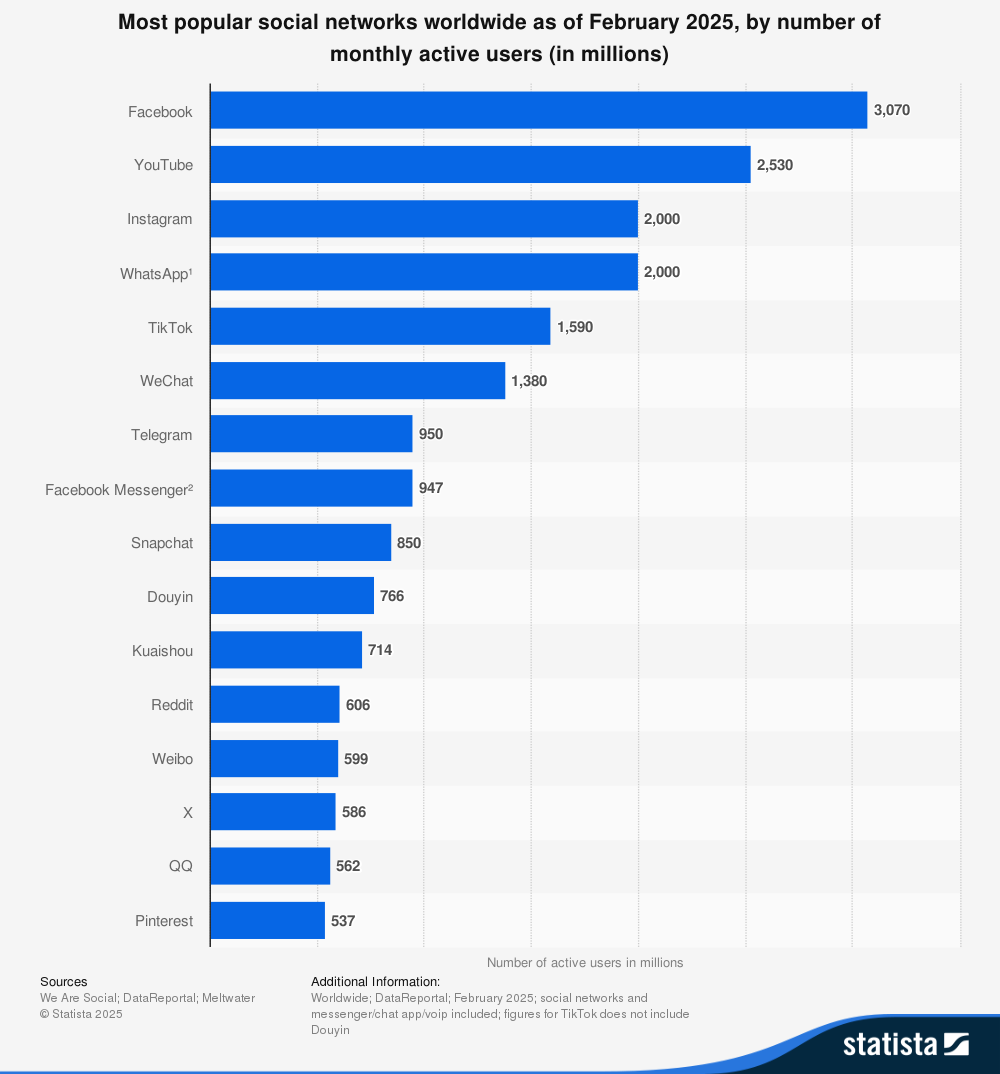
Instagram has over 2 billion monthly active users — and counting

Instagram hit 2 billion monthly active users — and it happened in just over 11 years, reaching the number faster than Facebook and YouTube. With that many eyes on the content of brands and creators, there’s more than enough opportunity to grow on the platform.

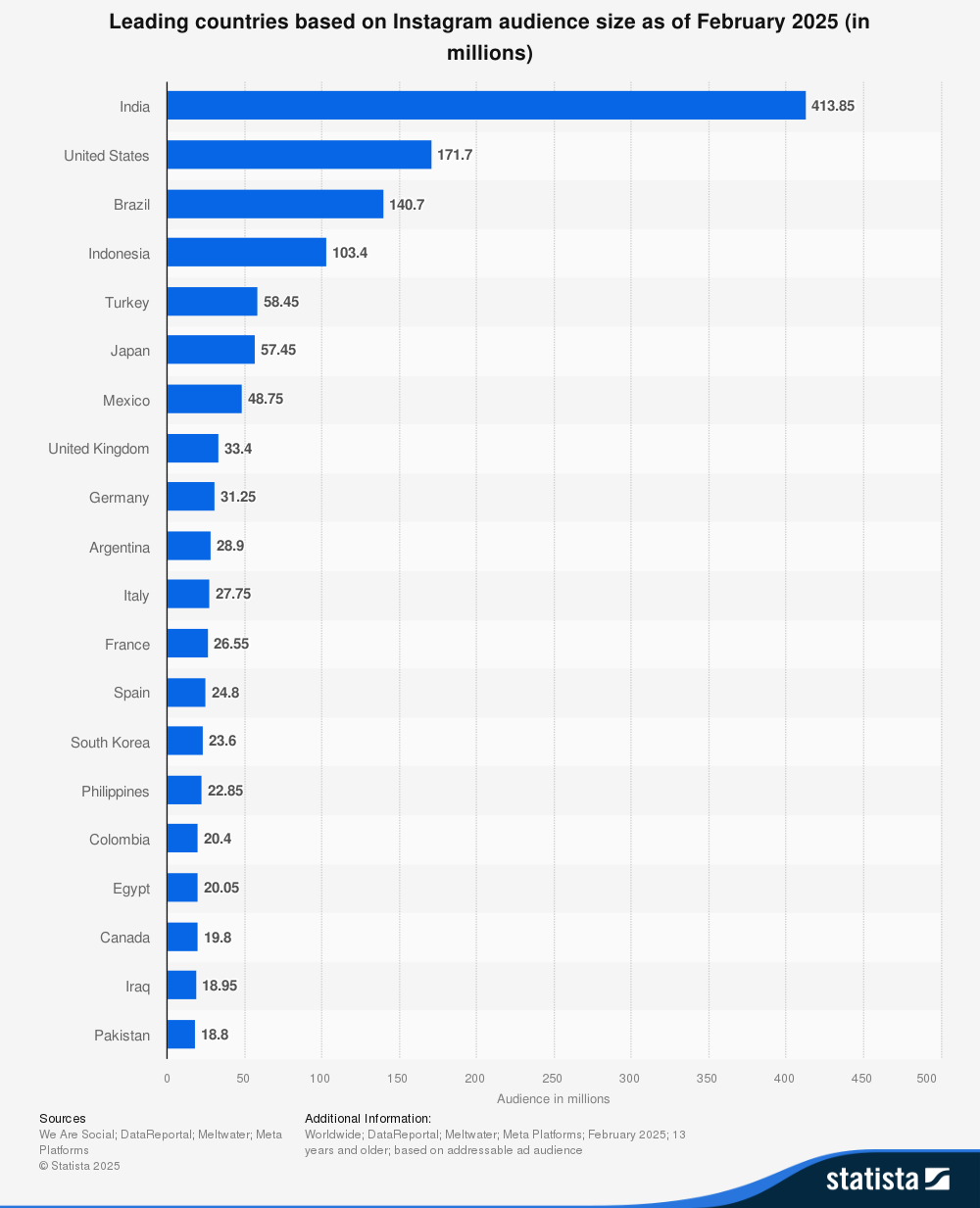
India, the U.S., and Brazil top the charts — but other countries are climbing fast

The countries with the largest Instagram user bases are:

  • India: 414 million
  • United States: 172 million
  • Brazil: 141 million
  • Indonesia: 103 million
  • Turkey: 58 million
  • Japan: 57 million

But size isn’t the only story. When it comes to uptake — the percentage of a country’s population that uses Instagram — you’ll find small nations like Kazakhstan (89.3%) ahead of the pack.

Turkey also has a high Instagram audience uptake rate (88.8%) of the population using the social network. In Uruguay, the United Arab Emirates, and Brazil, the photo-sharing platform is used by more than 86% of each country’s population.

This information is handy for marketers running international campaigns. A country might not have that many users, but higher uptake might offer stronger community engagement than a massive user base that’s more passive.

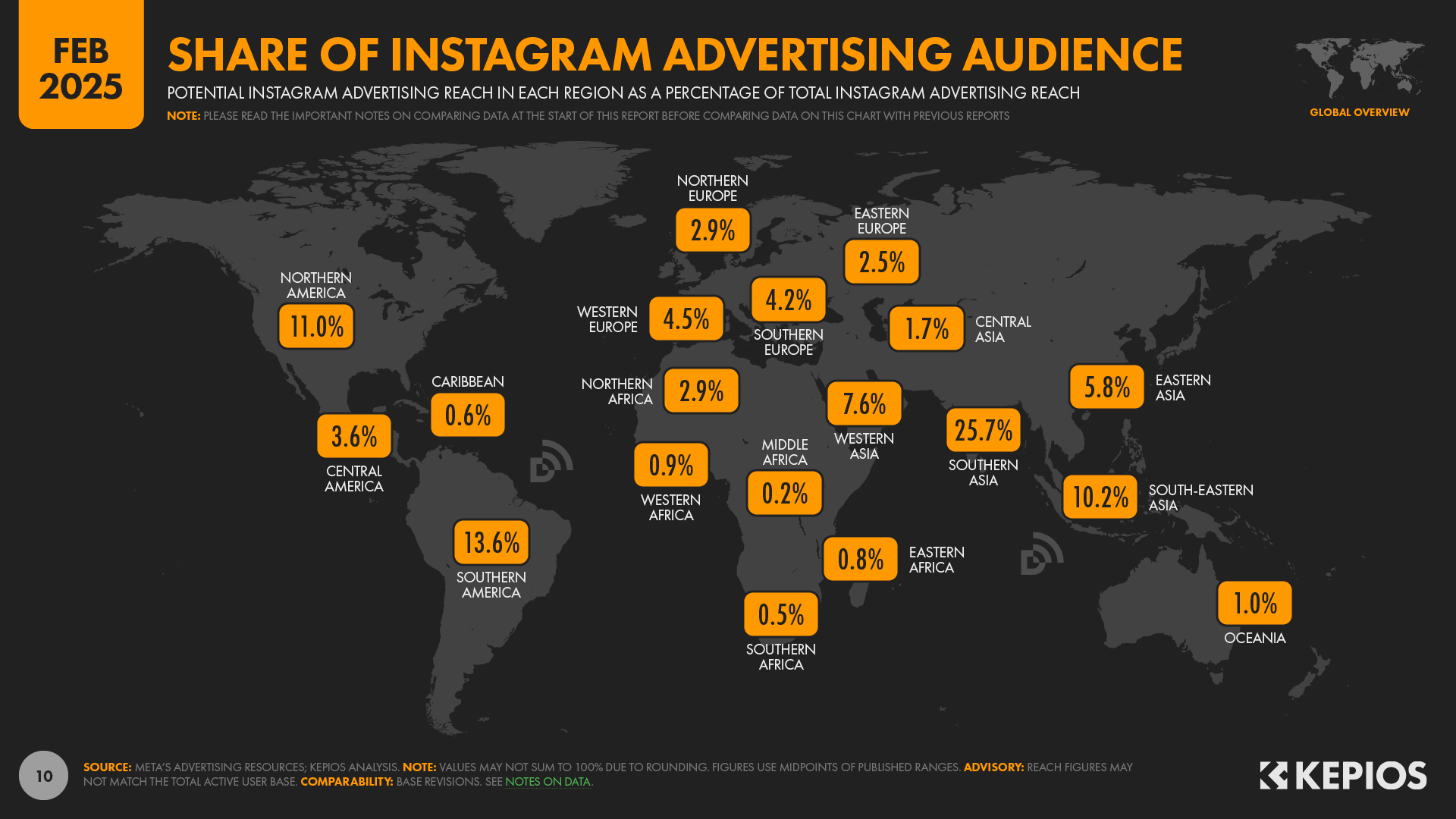
Southern Asia holds the largest regional share of Instagram users

Broken down by region, Southern Asia now accounts for over a quarter of all Instagram users worldwide, with India as the clear heavyweight. The full picture:

  • Southern Asia: 448 million users
  • South-Eastern Asia: 177 million
  • Northern America: 192 million
  • Southern America: 237 million
  • Western Europe: 78 million
  • Western Asia: 133 million
  • Eastern Asia: 101 million
  • Africa (all regions combined): ~91 million
Source

If your audience spans more than one country or continent, these stats are a reminder to think regionally — not just nationally — when planning your Instagram strategy.

84% of social users have an Instagram profile

Instagram doesn’t just dominate by user count — it’s also the most widely adopted platform among global internet users with a social media presence. According to recent reports, 84% of social media users have an Instagram account. That’s more than TikTok, YouTube, or even X (formerly Twitter).

While this stat doesn’t tell you how often people post or engage, it confirms one thing: Instagram is still the default social identity for most people online.

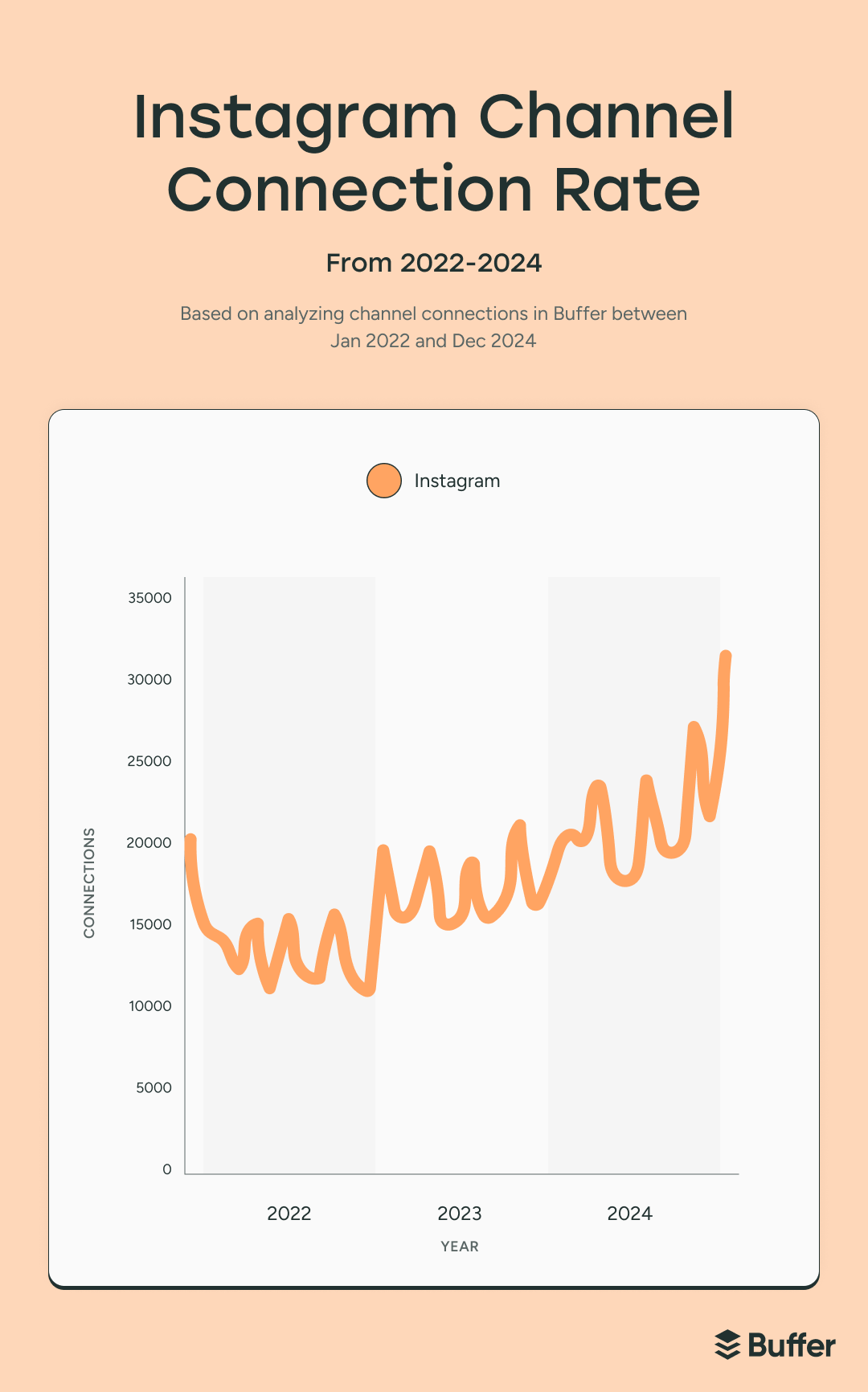
Instagram connections in Buffer have nearly doubled since 2022

Among the 11 social networks our users can connect to Buffer, Instagram has grown 94.7% since 2022, climbing from 657,000 to 1.28 million total channel connections, with 104,000 of those accounts actively publishing through Buffer today.

This internal spike confirms Instagram’s staying power for creators and small businesses alike.

Who’s on Instagram: Demographics in 2025

Knowing how many people use Instagram is one thing — but understanding who they are is what actually drives smart content decisions. In 2025, Instagram’s audience skews young, global, and increasingly balanced across gender. But there’s nuance in the numbers — and opportunity in the margins.

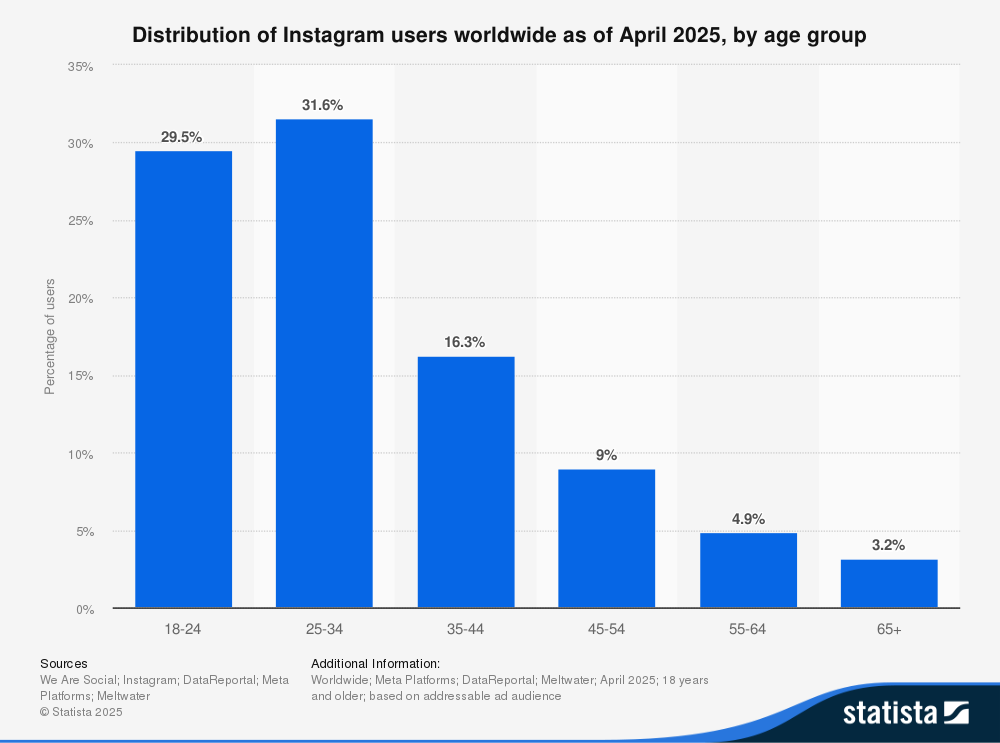
The average Instagram user is aged 25–34

The data puts the average user in the 25–34 age bracket, a sweet spot for both creator and consumer content. This age group makes up the largest share of global users, followed closely by 18–24 year-olds.

Source

But don’t mistake that for a Gen Z monopoly. There’s a solid presence of users in their 30s, 40s, and even 50s — especially in Western countries, where the platform has matured alongside its user base.

So if you’re only creating content for Gen Z, you may be overlooking a high-intent, high-spending segment just outside that range.

Users aged 18–34 account for over 60% of Instagram’s global audience

Here’s the age breakdown across key groups:

  • 18–24: 31.7%
  • 25–34: 30.6%
  • 35–44: 16%
  • 45–54: 8.7%
  • 55–64: 4.6%
  • 65+: 2.9%

This split shows that while Gen Z and Millennials are still the dominant force, 1 in 3 users are older than 35. That opens the door for more lifestyle, family, finance, and career content that speaks to an aging-but-active cohort.

Additionally, Meta reports that male users aged 25–34 make up the largest single segment on the platform.

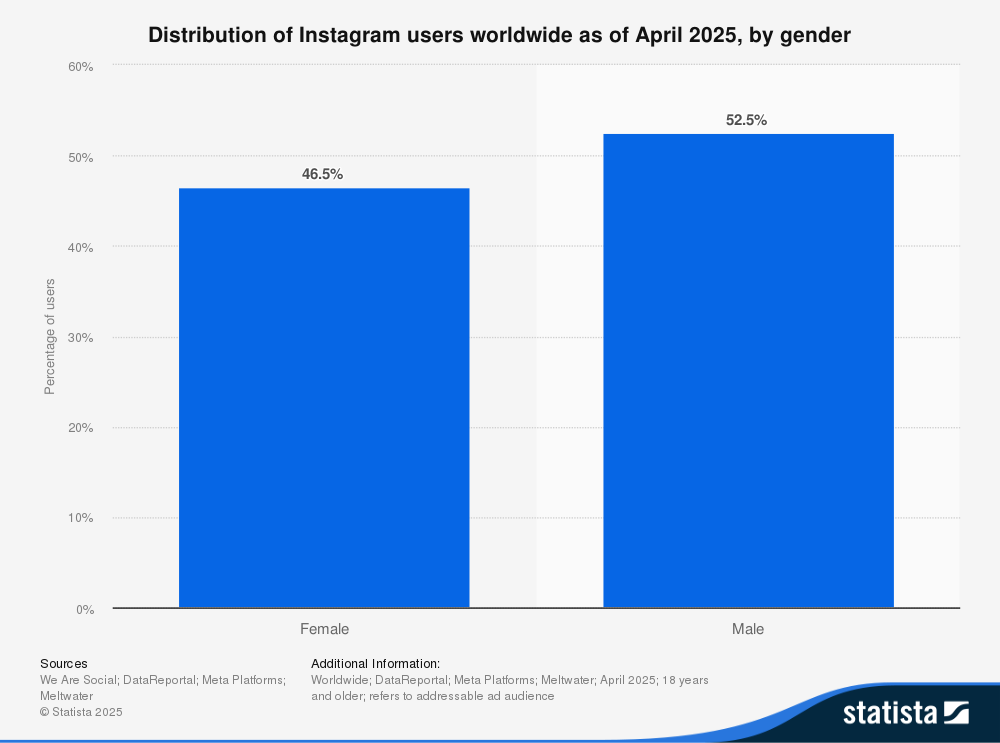
The gender split is nearly even — and still shifting

🖊️
Note: The data only included binary gender options (male and female). No additional gender identities were captured or reported.

Globally, Instagram’s gender distribution in 2025 is 52.5% male and 46.5% female — a near balance. In some regions, like the U.S., women actually edge ahead in usage. And while Meta’s data still reports only binary gender categories, the trend is clear: Instagram is no longer skewed to one side.

This means you’re not speaking to just one demographic. Your content should reflect a mix of perspectives (or at least not assume a default voice).

Demographic makeup varies widely by country

In India, the platform skews towards male, younger audiences. In the U.S., it leans female with more representation across the 25–44 age range. Emerging markets like Indonesia and Nigeria show rising Gen Z adoption, while Western Europe sees stronger retention in older brackets.

“Instagram users” is not a monolith. If you’re marketing globally (or even regionally), it pays to check the local data, not just the global averages.

How people use Instagram in 2025

Instagram isn’t just a place to post — it’s a place to explore, connect, message, shop, and scroll for hours. While the platform might look like one big feed, it’s really a network of micro-behaviours.

Understanding how people actually use Instagram in 2025 helps you create content that meets them where they are — and how they like to engage.

People spend 12 hours/month on Instagram

Most Instagram users spend an average of 33 minutes per day on the platform. That’s less than TikTok (53 minutes), but ahead of platforms like Snapchat and Facebook.

What this tells us: Instagram hits a sweet spot. It’s more “scrollable” than LinkedIn or Pinterest, but still feels intentional — a platform where people come to consume, but also to create, comment, and connect.

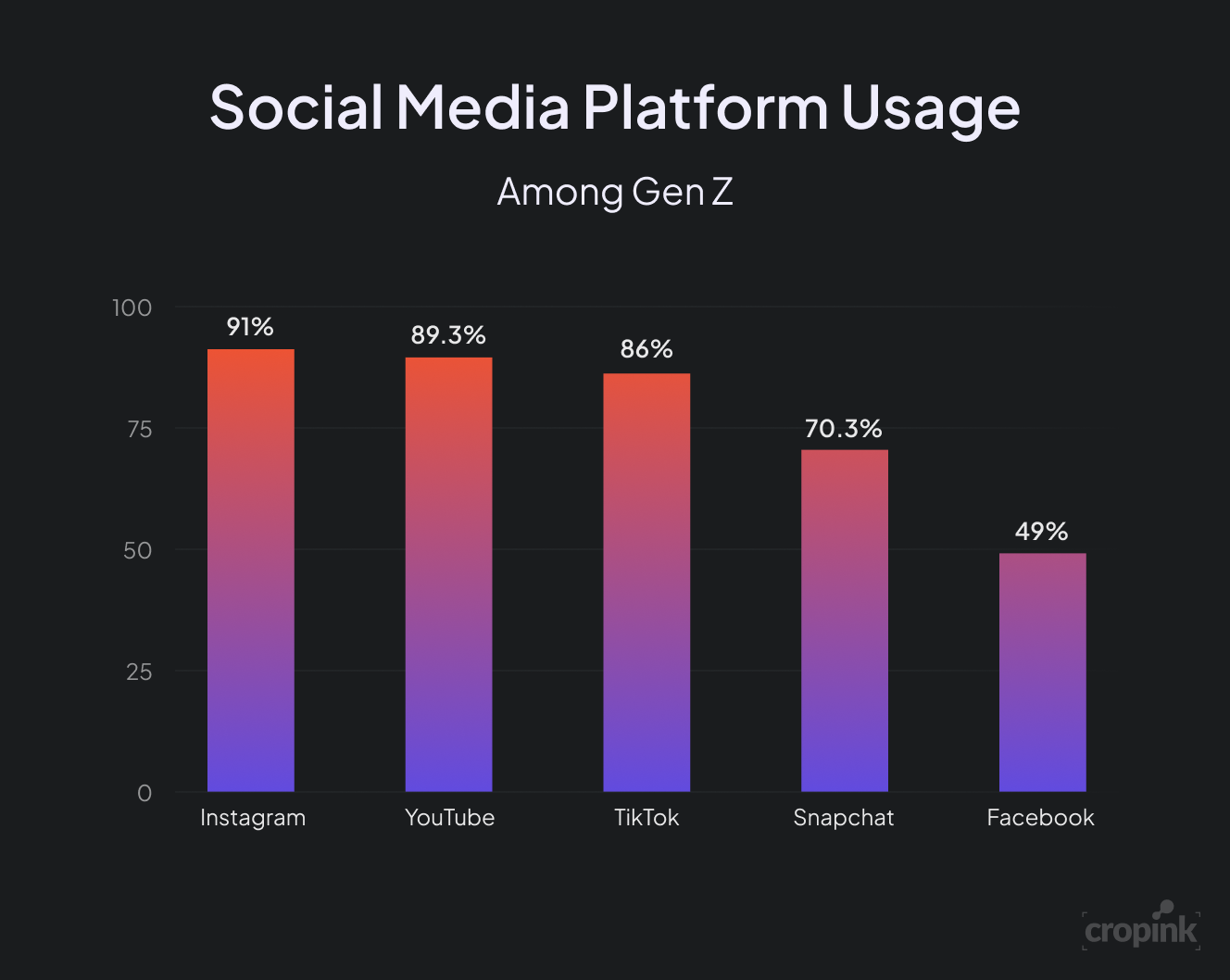
91% of Gen Z have a profile — but they’re not the only ones posting

Instagram remains Gen Z’s go-to social platform, with 91% of Gen Z users maintaining a profile. But they’re not the only ones engaging. Over 32% of the platform’s global audience is aged 35 and up, and many of them are actively gathering Instagram followers, not just lurking.

If you’re creating content that only targets one generation, you might be missing the full opportunity.

Create in formats Gen Z favours (reels, stories), but use messaging that resonates across age groups — like education, value, or personal storytelling.

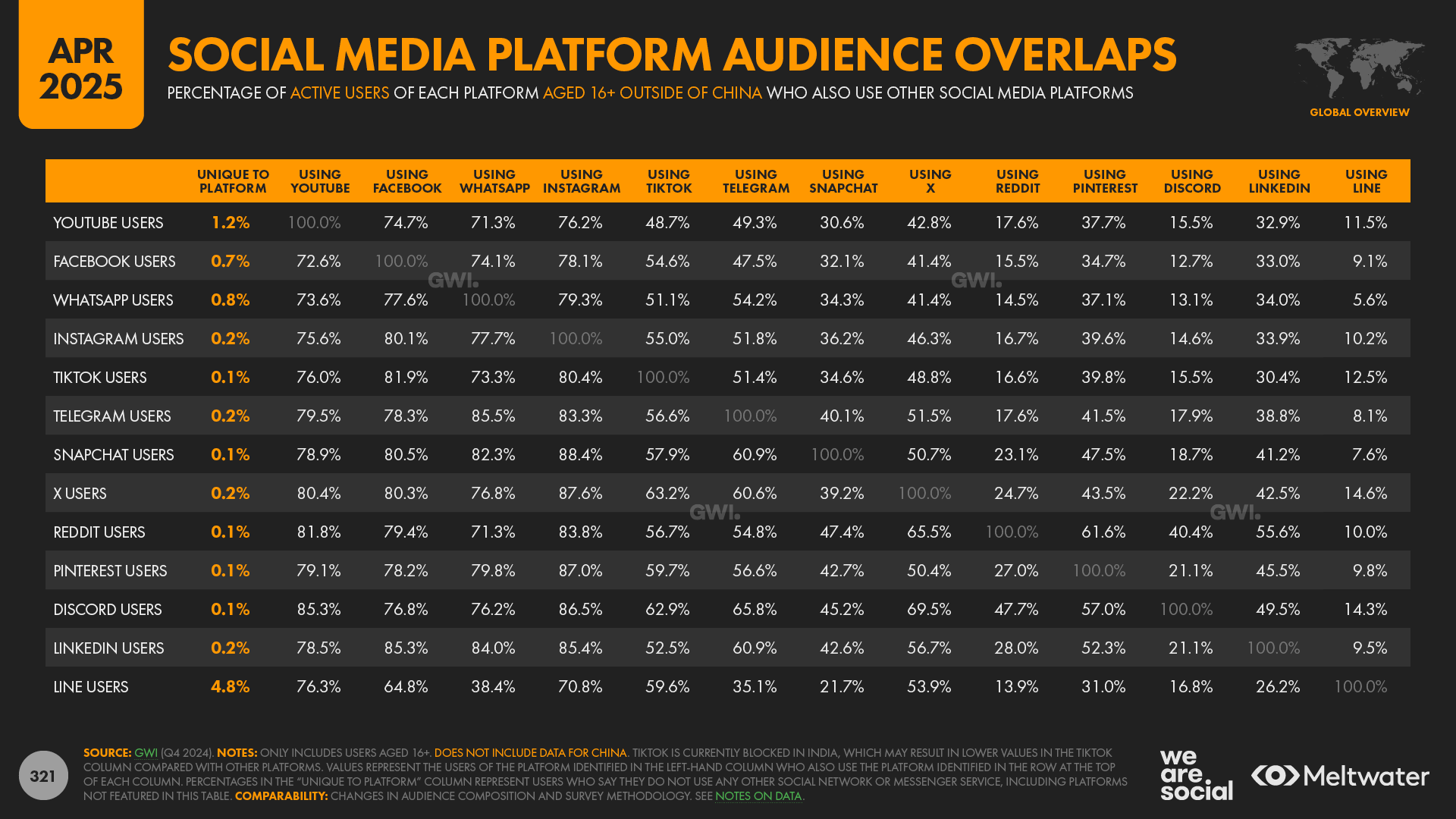
Instagram users also use other platforms

Only 0.2% of Instagram users use it as their only social platform. The rest are active elsewhere:

  • 80.3% also use Facebook
  • 76.9% also use YouTube
  • 54.3% also use TikTok

This makes Instagram a perfect place to reinforce — not repeat — your brand or creator message. Think cross-posting but specific to each platform: behind-the-scenes from a YouTube upload, shorter takes from a long LinkedIn post, or expanded ideas from a trending Reel.

Those overlaps echo our data: creators aren’t replacing Instagram — they’re layering it into an ecosystem of text-first apps, short-form video feeds, and carousel-friendly networks. Repurposing isn’t optional anymore; it’s how modern audiences actually consume.

Users are spending less time on static content — and more on video

While users still post more single images than any other format, the time they spend engaging has shifted. Meta reports that reels now account for over 50% of time spent on Instagram.

View on Threads

This means that video is no longer optional. Luckily, it doesn’t have to be high-production. Reels, stories, and behind-the-scenes moments all drive time-on-platform. And if video just isn’t your thing, don’t worry — by adding music to carousel posts, your content will still show up in the reels and suggested content feeds.

Engagement is shifting to Instagram direct messages

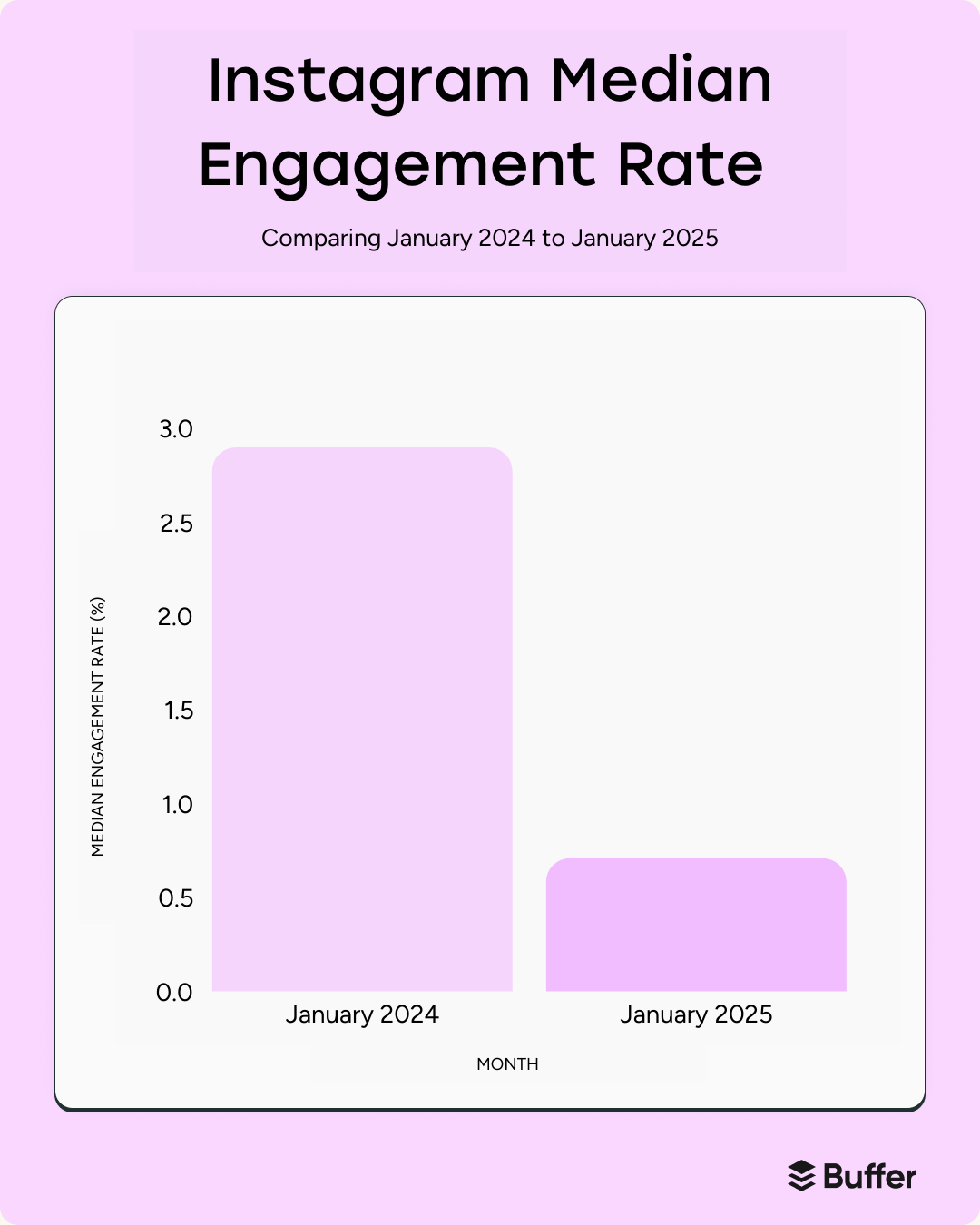
In our report on average engagement rate across different social platforms, we found that in January 2024, Instagram’s median engagement rate was 2.94%. By January 2025, it had adjusted to 0.61%.

This change reflects a broader shift in how users engage with content rather than a loss of platform relevance.

But the average engagement rate on Instagram isn’t disappearing — it’s moving behind the scenes. You need to create content that people want to interact with publicly and share privately. Think saveable, shareable, or response-driven.

For creators and brands alike, direct messages have become a go-to place for audience questions, customer support, feedback loops, and even sales conversions.

Meta has emphasized the “growing importance of private messaging” across all their platforms. They noted a shift in user behaviour from feed engagement to “meaningful private interactions”, leaning in with features like Instagram Broadcast Channels, DM automation tools, and shopping integrations directly inside chats.

So if your only call-to-action is “comment below,” you might be missing half the conversation. Treat your inbox like a micro-community — set up a broadcast channel, use DM automation tools, and engage your audience directly.

How content performs on Instagram

You’ve got the audience. You’ve got the strategy. But if you don’t know how each format actually performs, you’re guessing in the dark. In 2025, content on Instagram behaves differently depending on format, the size of your account, and how users engage across feeds. The following Instagram statistics break down what’s working — and what isn’t — so you can create with purpose.

Reels still dominate reach, especially for small accounts

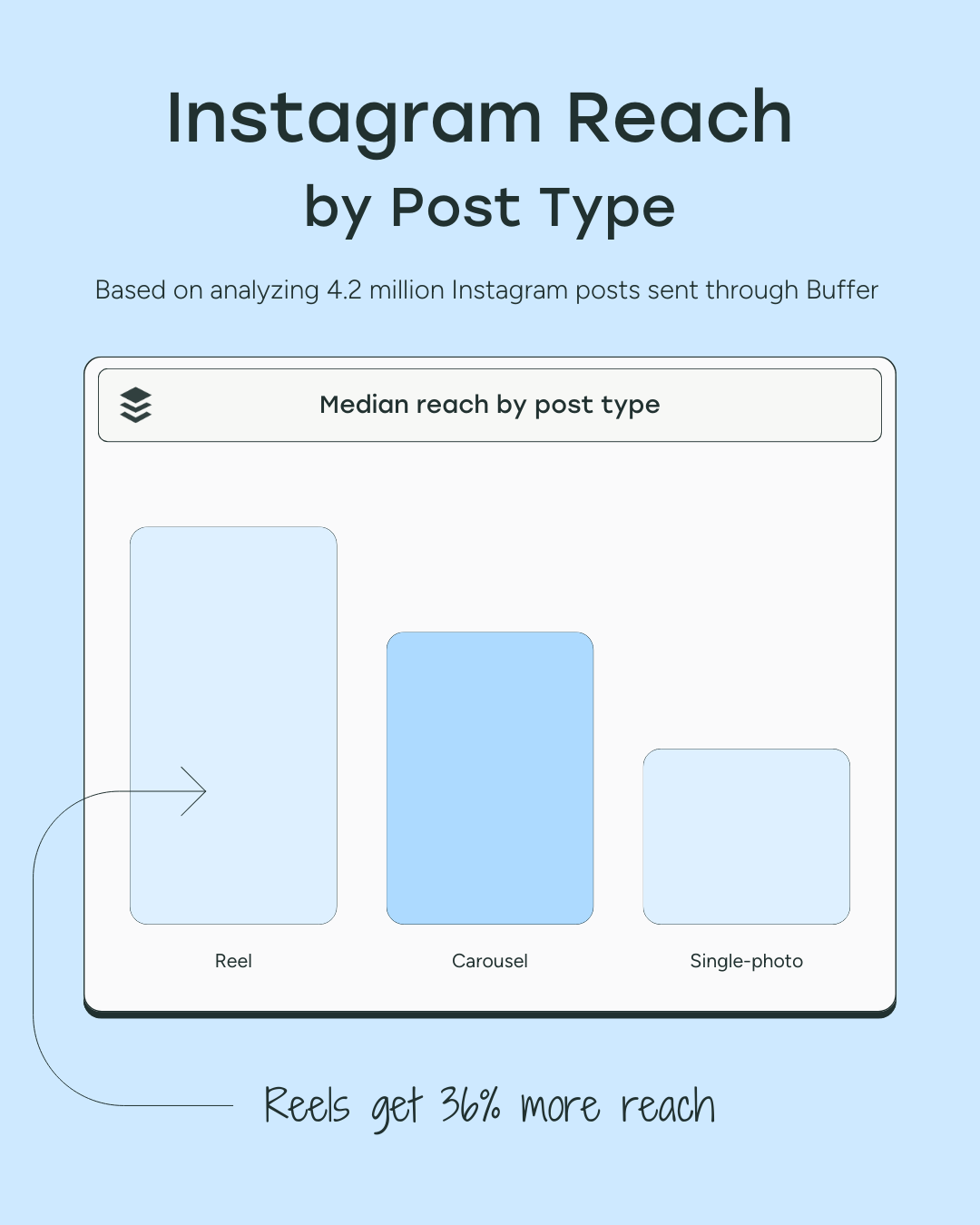
In our analysis of over 4 million Instagram posts, we confirmed what many creators already know: Reels consistently outperform all other formats for reach.

  • Reels get 36% more reach than carousels
  • 125% more reach than single-image posts

The Instagram Reels feed itself is built for discoverability — meaning even small accounts can go viral

Reels are still your best bet if your goal is visibility. Use them to grow your audience, test ideas, and introduce new content series. And try out features like trial reels or adopt new hashtags to reach new eyes.

And Buffer’s connection growth for TikToks, shorts, and reels all point the same way — audiences are primed for quick, vertical video no matter where they scroll. That appetite is exactly what keeps Reels at the top for reach on Instagram.

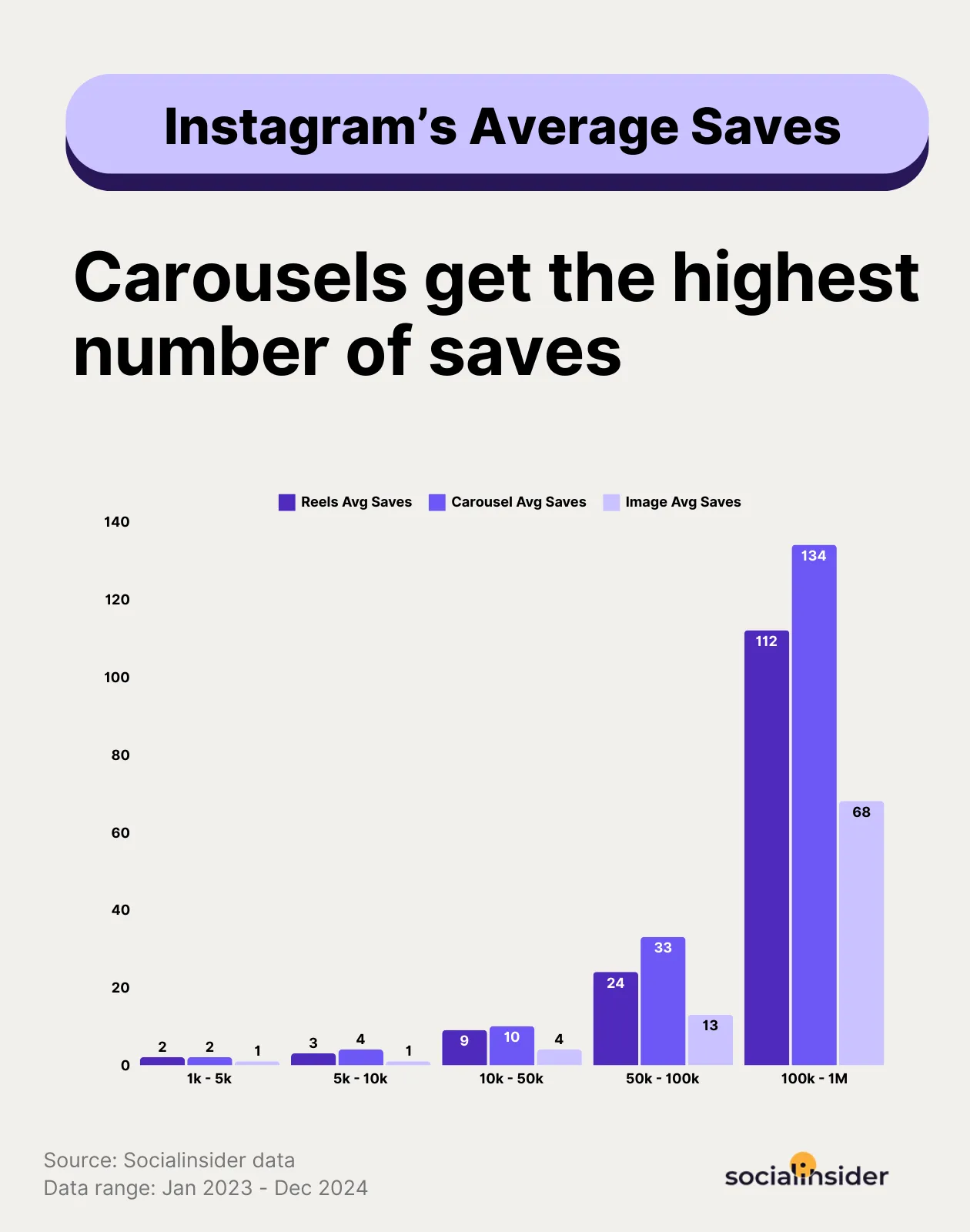
Carousels drive the most engagement — by a clear margin

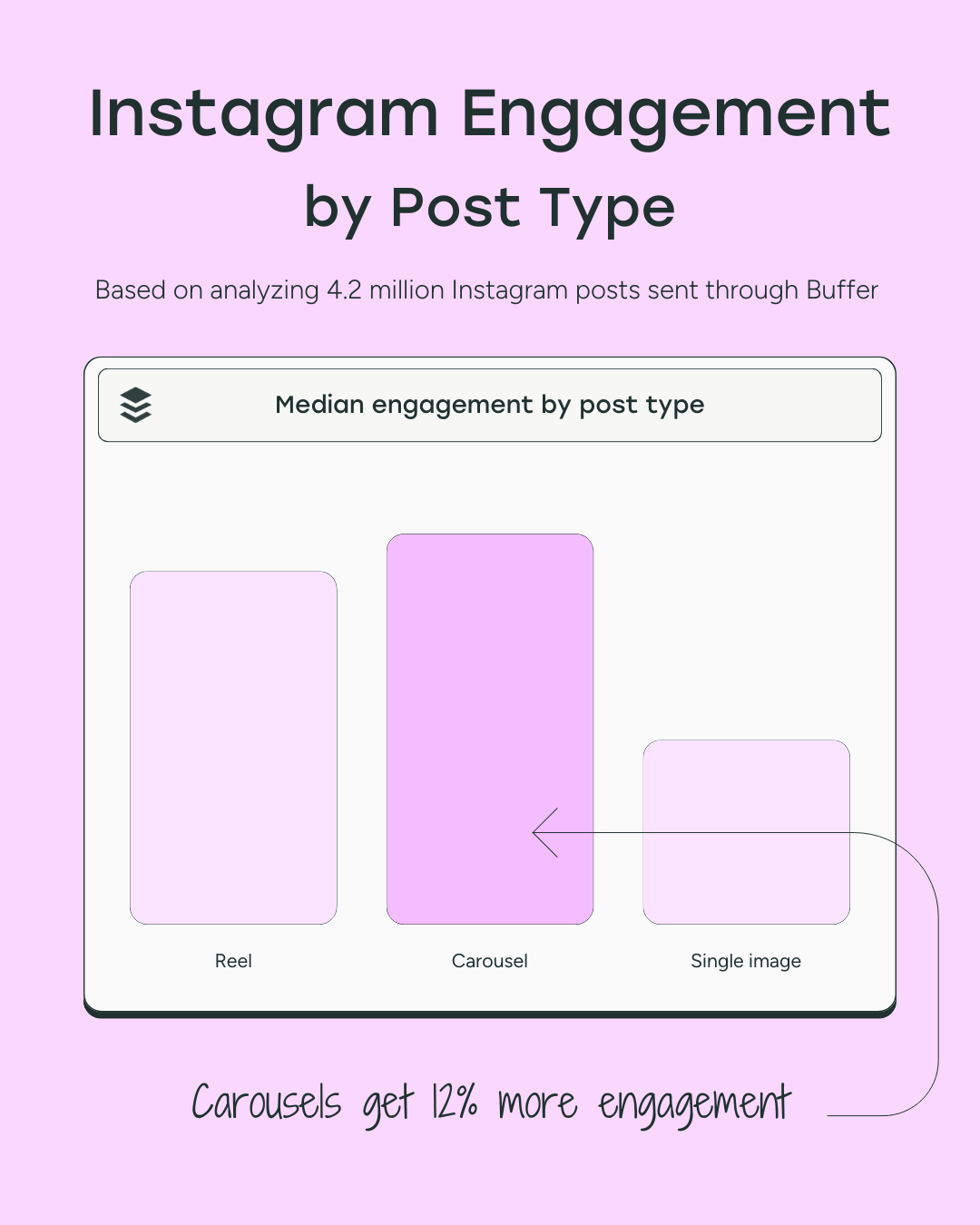
When it comes to likes, comments, and shares, carousels win. They receive:

  • 12% more engagement than Reels
  • 114% more engagement than static images
  • The highest save rate across all post types

The reason for this is pretty clear: Carousels keep people swiping, and the Instagram algorithm loves content that keeps people on the platform. Carousels are also perfect for educational content, story-driven visuals, or value-packed slides that people want to revisit later.

Use carousels to go deep on a topic. Think checklists, breakdowns, before-and-afters, or multi-step guides.

Content performance shifts by account size

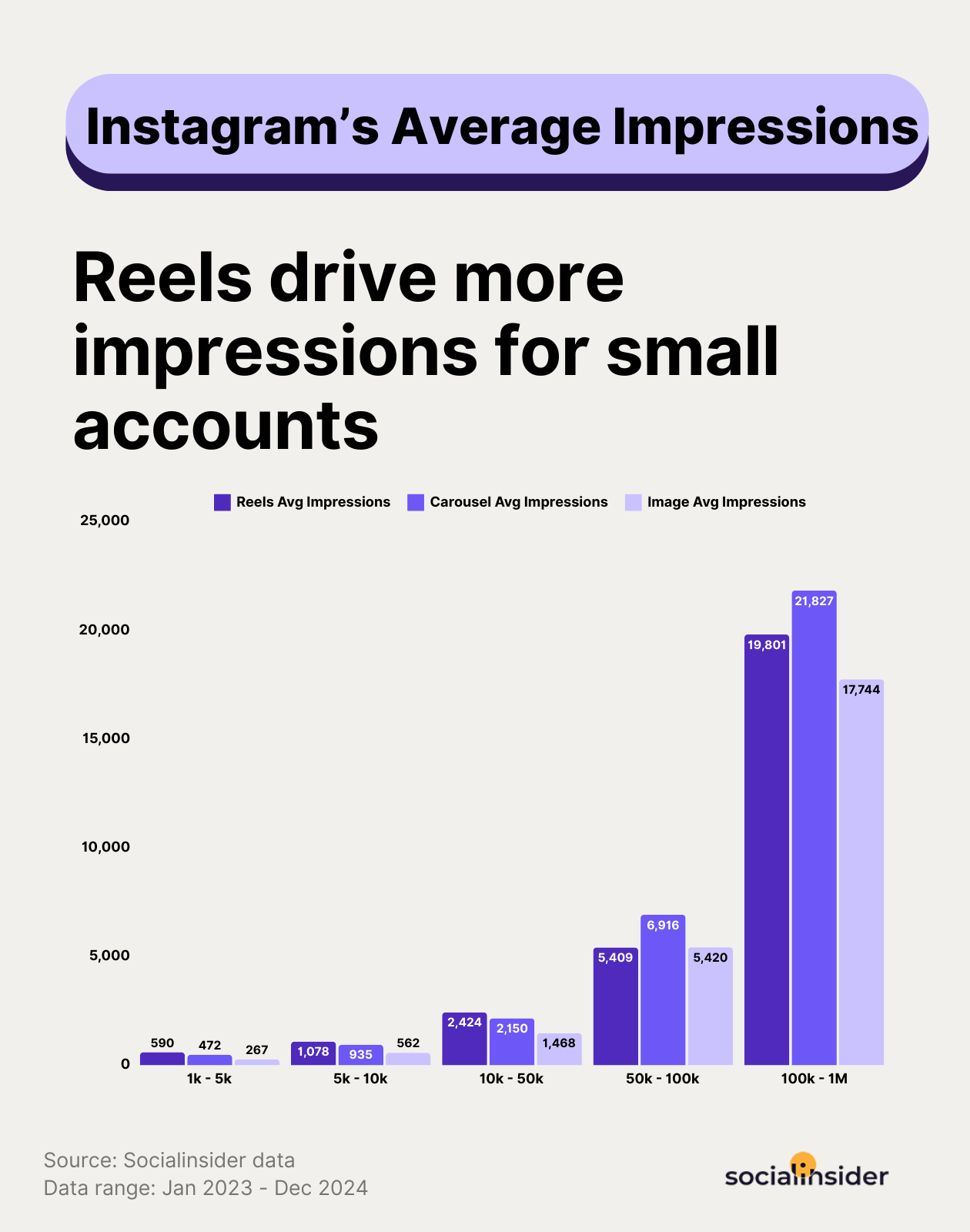
What works for an account with 5,000 followers won’t always work for one with 500,000. Here’s how performance scales on Instagram, according to Socialinsider:

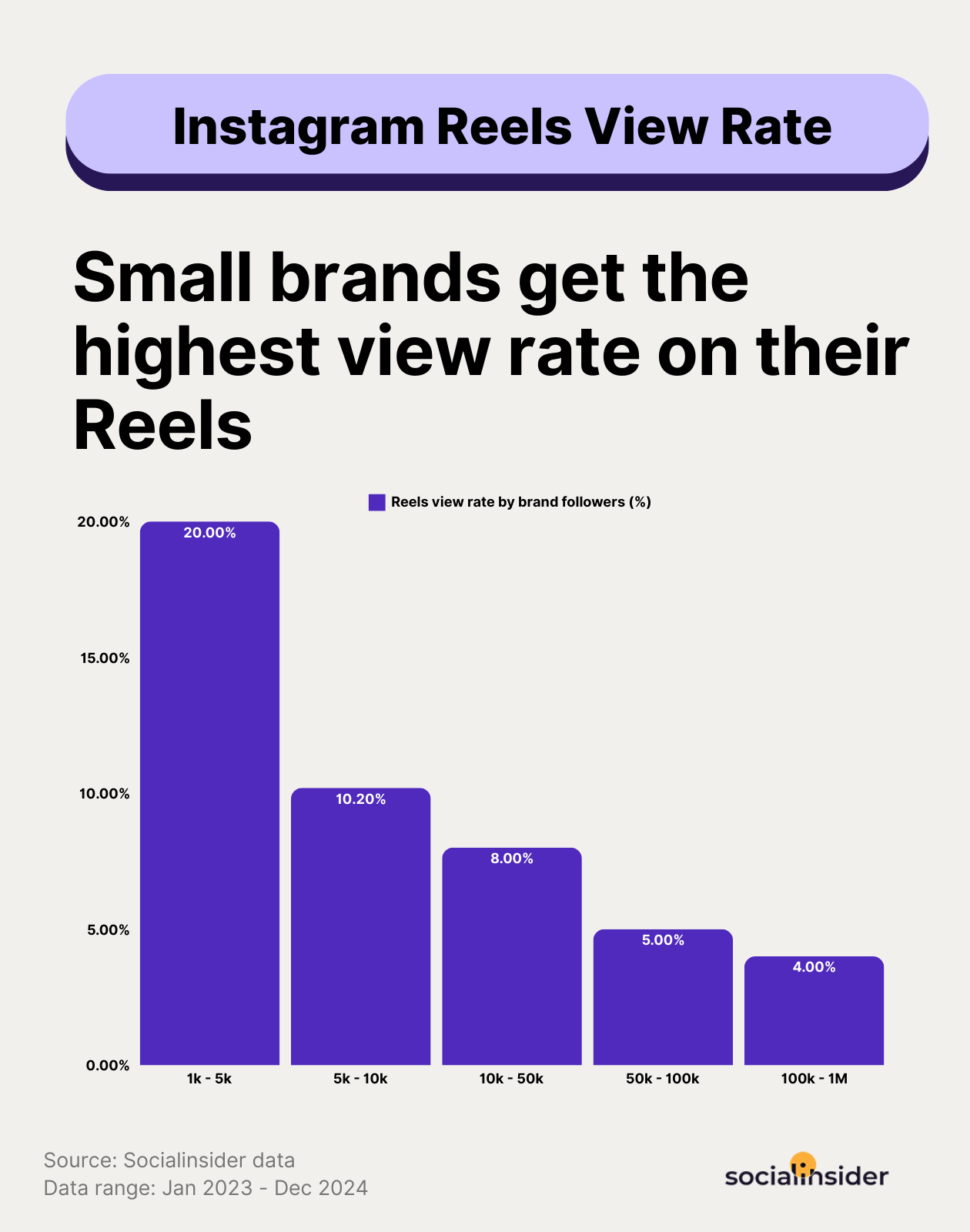
  • Smaller accounts (under 10k) see higher reels view rates (up to 20%) and stronger story reach
  • Mid-sized accounts (50k–200k) benefit from balanced strategies — reels for reach, carousels for community
  • Large accounts (100k+) see better comment and save rates on static images and carousels — likely due to loyal audience behaviour

The lesson here is to tailor your content format to your growth stage. Small accounts should create content that gets them discovered. And the bigger you get, the more the content should resonate to keep existing followers engaged.

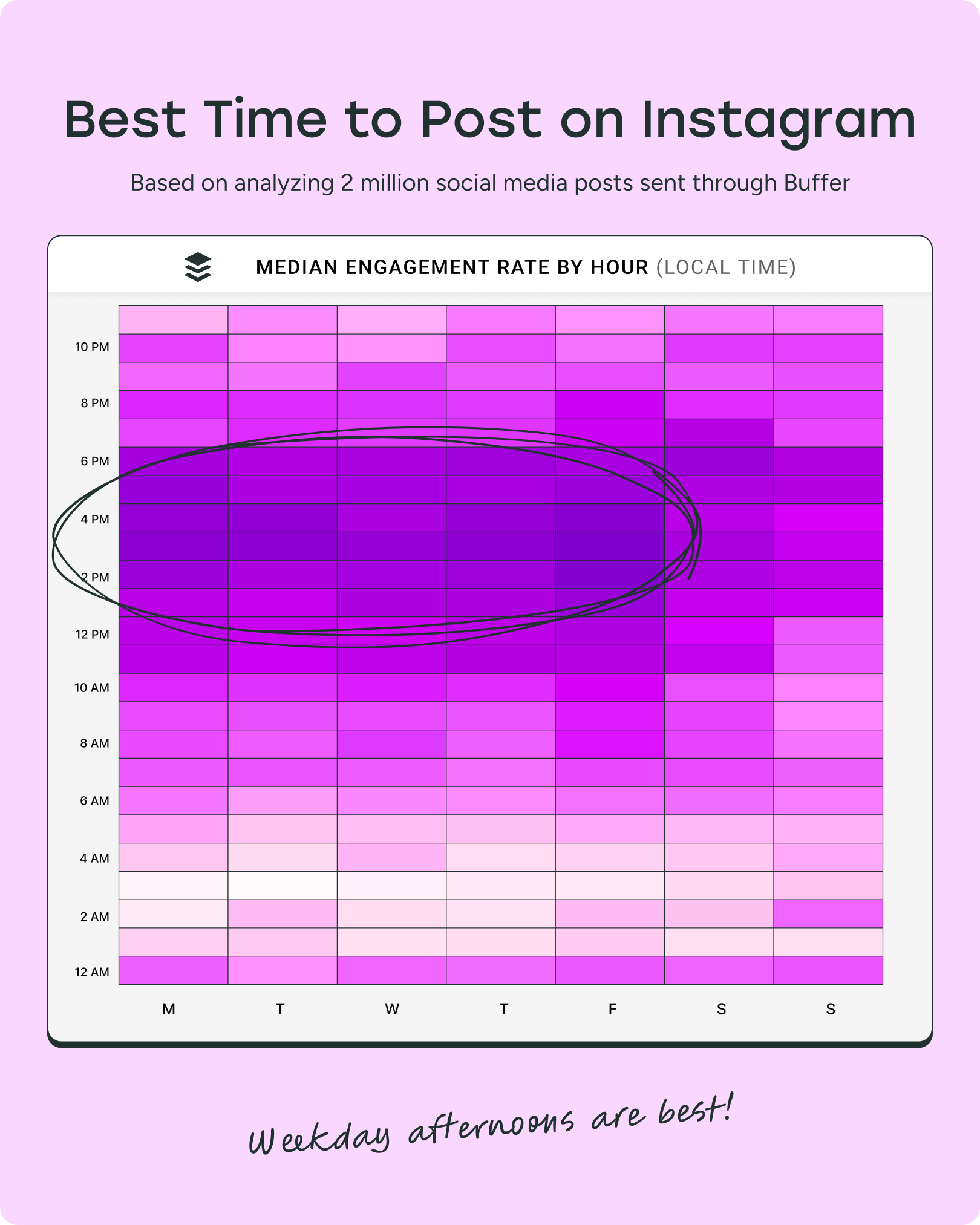
The best time to post on Instagram is between 3 and 6 p.m. on weekdays

After analysing more than 2 million Instagram posts, we found that the best time to post on Instagram is generally 3 p.m. and 6 p.m. on weekdays.

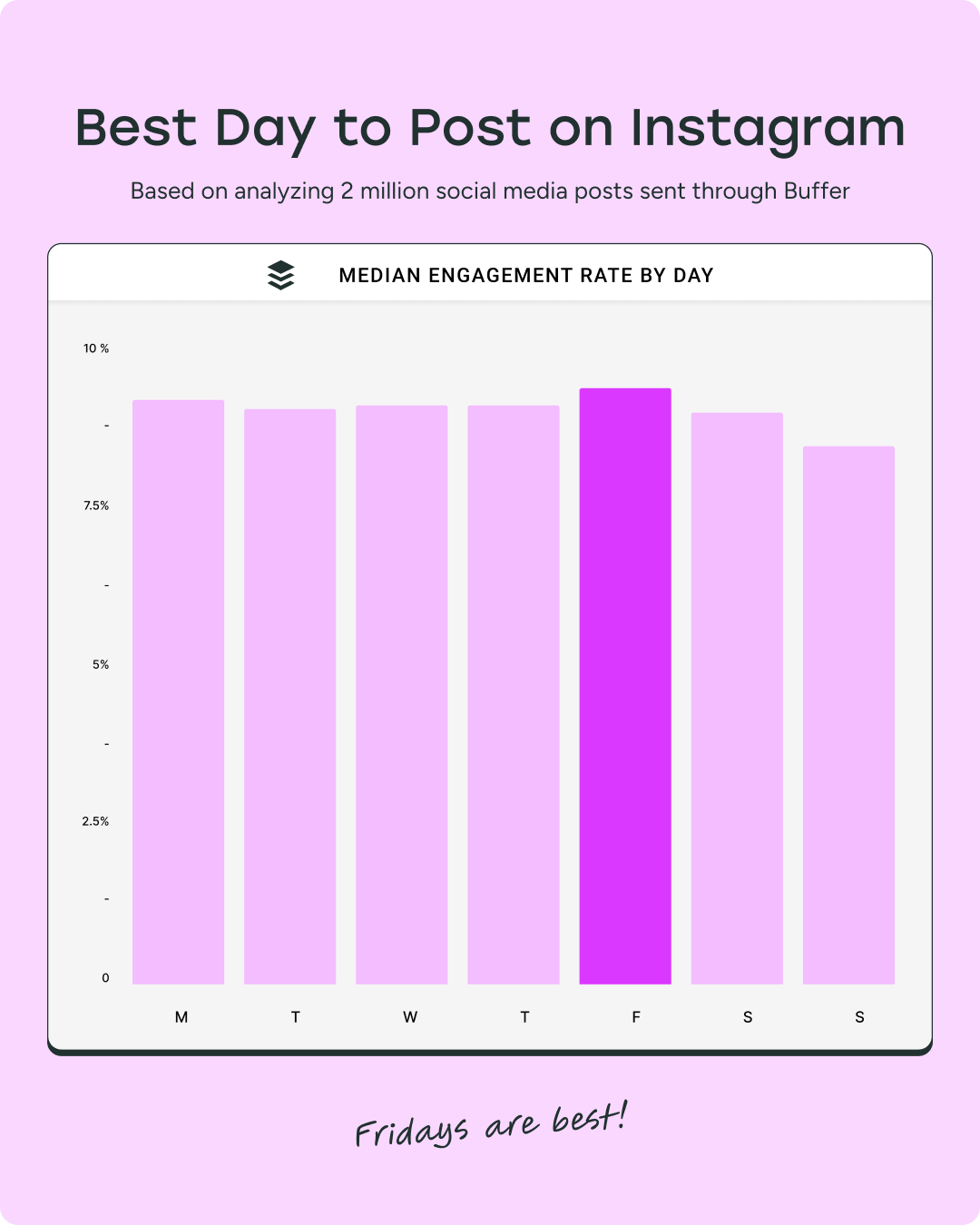
The best day to post on Instagram is Friday

Our research also found that Friday is the best day to post on Instagram, closely followed by Monday. But overall, you can’t go wrong posting on a weekday.

Brands and creators on Instagram

Instagram has long been the go-to platform for visual storytelling, and in 2025, creators and brands are doubling down. But what’s changing isn’t whether they show up — it’s how. From nano-influencer dominance to format strategies that actually drive results, this section unpacks what’s working right now for the people using Instagram to grow a business, build trust, and create community.

Nano-influencers make up 77% of all creators on Instagram

According to Statista, nano-influencers (1k–10k followers) account for 75.9% of all influencers on the platform. Micro-influencers (10k–100k) make up another 13.6%, with only a small fraction falling into the macro or celebrity tier (3.5%).

You don’t need a massive following to have impact. For brands, this means there’s a huge pool of niche creators with high engagement across the platform’s audience — ideal for authentic partnerships and lower-cost campaigns.

Smaller accounts get more reach per post

Accounts under 10k followers aren’t just more common — they often outperform larger accounts in key metrics:

  • Reels view rate: 20%
  • Instagram Stories reach rate: up 35% YoY
  • Higher save rates per follower

This is because Instagram’s algorithm favours newer or smaller creators to keep the content feed fresh. Plus, smaller accounts often feel more personal and approachable — a major driver for engagement.

If you’re growing from scratch, lean into reels + Instagram Stories + educational carousels. Don’t wait to “look big” before showing up consistently.

Follower growth is fastest for small and mid-sized accounts

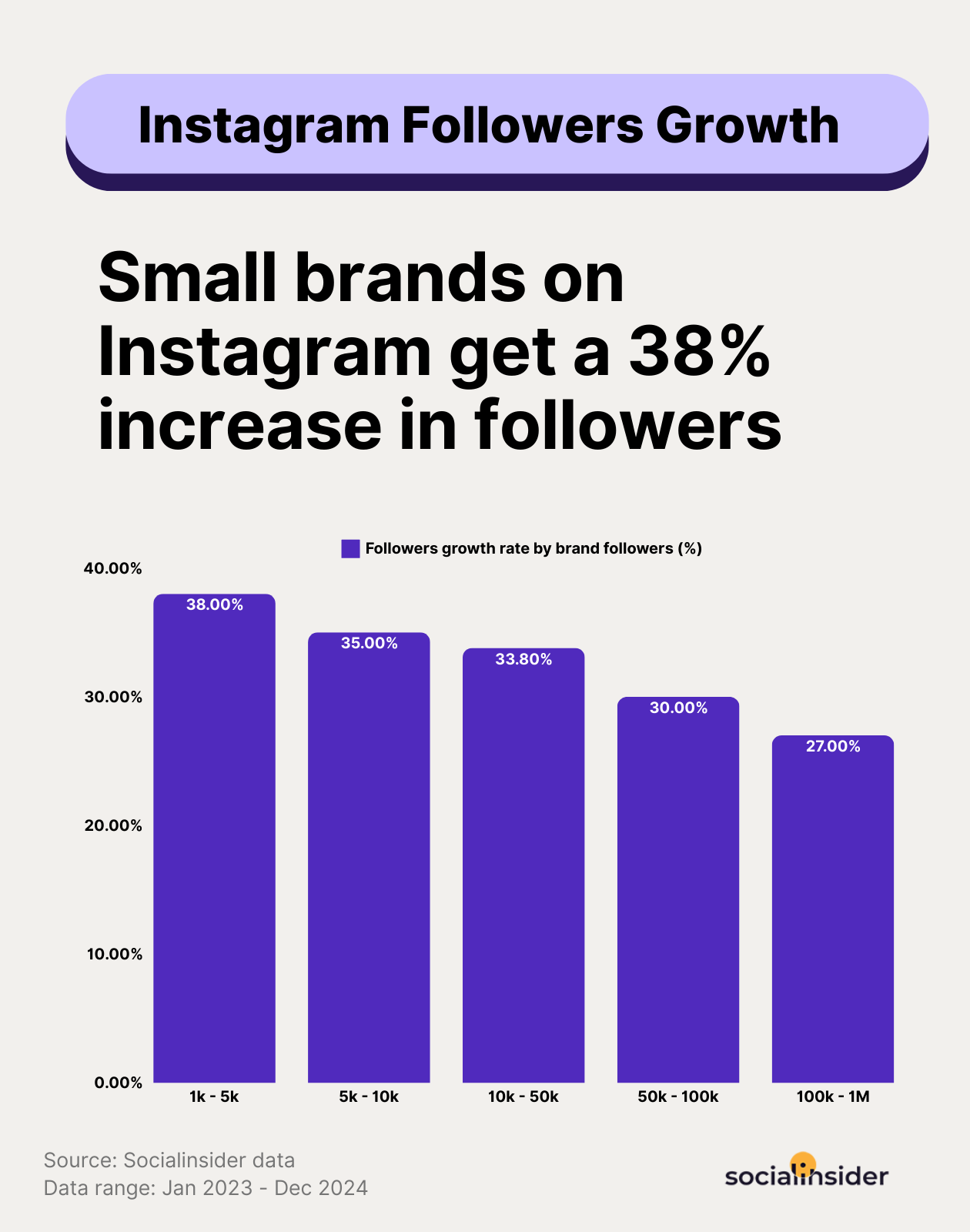
Socialinsider found that the fastest-growing Instagram accounts in 2025 are still in the 1k–50k range:

  • 1k–5k: 38% average growth
  • 5k–10k: 35%
  • 10k–50k: 33.8%

The bigger an Instagram account gets, the harder it is to grow. That doesn’t mean growth stops; it just happens more slowly, and the strategy for growth changes accordingly. That means every stage of growth has a strategy:

  • Small accounts → focus on visibility
  • Mid-sized accounts → build community
  • Large accounts → double down on value and retention

Reminder: Don’t copy a content strategy from an account 100x your size. What works for them may not serve you — yet.

Where the money goes on Instagram

Instagram isn’t just where people scroll — it’s where people spend. In 2025, Instagram remains one of the most commercially active platforms, whether it’s through influencer partnerships, product discovery, or DMs that lead to real sales. These Instagram statistics explores how money moves on the platform — and how smart brands and creators are turning attention into action.

44% of users shop on Instagram weekly

Instagram isn’t just a discovery platform — it’s a storefront. According to Instagram’s own research, 44% of users interact with shoppable content or browse for products at least once per week.

Even without the dedicated “Shop” tab, product discovery happens through:

  • Creator and influencer partnerships
  • Tagged products in Reels and carousels
  • Stories with direct links
  • DM-based selling (especially for small businesses)

Even if you’re not “selling on Instagram,” your audience might be ready to buy. Make it easy for them to act.

The smallest Instagram influencer rates start from $100

Instagram influencers across all tiers are highly sought after for good reason. Between the potential eyes on their content with the platform’s 2-billion-strong user base and various features, there are many options for brands across different industries.

There’s a generally accepted Instagram influencer rate of $100 per 10,000 followers, which can change based on the number of posts requested, the influencer’s metrics, the industry in play, the value of an influencer’s audience to a brand, and many other factors.

According to a survey by Impact.com, estimated Instagram rates break down as follows:

  • Nano-influencers (500–10,000 followers): $500 to $2000 per post
  • Micro-influencers (10,000–50,000 followers): $2000 to $8000 per post
  • Mid-tier influencers (50,000–100,000 followers): $8000 to $20,000 per post
  • Macro-influencers (100,000–500,000 followers): $20,000 to $45,000 per post
  • Mega-influencers (500,000+ followers): $45,000+ per post

Instagram influences more purchases than any other platform (after YouTube)

2024 RetailDive study found that Instagram influences more consumer purchasing decisions than TikTok, Facebook, or Pinterest — second only to YouTube.

It’s not always about conversion on-platform. Instagram content often drives:

  • Brand awareness
  • DM inquiries
  • Site traffic
  • Wishlist saves or screenshot purchases

The lesson here is that Instagram’s value for generating sales goes beyond that discovery on the platform. It’s often the first place someone finds you — or the last place they get convinced to purchase from you.

What these Instagram statistics mean for your strategy in 2025

In 2025, Instagram still has the range, but standing out means getting specific. With over 2 billion monthly users and several content formats and features competing for attention, growth no longer comes from posting more but from posting strategically.

These Instagram stats show us that:

  • Reels still drive the most reach
  • Carousels spark the most saves, and
  • Smaller accounts often outperform larger ones on core engagement metrics.

But behind those numbers is a deeper shift: audiences are more fragmented, engagement is increasingly private, and success looks different depending on your size, goals, and niche. That’s why the best Instagram strategies right now don’t involve virality or trend-chasing but lean into consistency, building a core audience, and make space for both discovery and depth.

You don’t need to go viral every week. You just need to be memorable, helpful, and worth returning to. Let the numbers guide you and let clarity drive your next post.

By Tamilore Oladipo

Sourced from Buffer

Sourced from Yahoo! finance

Digital Giants Such as Google, Meta, Amazon, and TikTok Reshape Ad Spending as Retail Media, CTV, and DOOH Lead Emerging Trends

Key market opportunities in online advertising include expanding targeted reach and real-time performance tracking across digital platforms. The shift towards mobile, social media, and streaming content drives increased ad spending. Innovations in AI, programmatic ads, and data analytics enhance personalization and engagement, while privacy regulations propel new targeting strategies.

Online Advertising Market

Online Advertising Market

Dublin, July 24, 2025 (GLOBE NEWSWIRE) — The “Online Advertising – Global Strategic Business Report” report has been added to ResearchAndMarkets.com’s offering.

The global market for Online Advertising was estimated at US$219.1 Billion in 2024 and is projected to reach US$352.3 Billion by 2030, growing at a CAGR of 8.2% from 2024 to 2030. This comprehensive report provides an in-depth analysis of market trends, drivers, and forecasts, helping you make informed business decisions. The report includes the most recent global tariff developments and how they impact the Online Advertising market.

Growth in the online advertising market is driven by several factors. Rapid digitization of consumer behaviour and media consumption is expanding available ad inventory across mobile, video, and social platforms. Advancements in automation, analytics, and personalization technologies are enhancing campaign effectiveness and operational efficiency. Increased use of e-commerce and digital services is pushing brands to compete for online visibility and conversion.

Regulatory shifts and privacy concerns are spurring innovation in ethical data practices and ad delivery models. Additionally, growing investment from small and medium enterprises, facilitated by self-serve ad platforms and affordable pricing models, is expanding market participation. These factors collectively support the sustained evolution and expansion of online advertising as a dominant force in the global marketing landscape.

Why Online Advertising Continues to Dominate Global Marketing Strategies?

Online advertising has become a cornerstone of modern marketing, offering targeted reach, real-time performance tracking, and high scalability across digital platforms. As consumers increasingly shift toward mobile devices, social media, and streaming content, businesses are allocating larger shares of their budgets to online channels. Unlike traditional media, online advertising enables precision targeting based on user behaviour, demographics, interests, and location, making campaigns more efficient and measurable.

The broad spectrum of digital ad formats-such as display ads, video ads, native content, paid search, and influencer marketing-allows brands to engage users at multiple touchpoints. E-commerce growth, digital media consumption, and the rise of app-based services have further expanded advertising inventory across platforms. With its cost-effectiveness, performance-based pricing models, and data-driven optimization, online advertising continues to outpace conventional channels in both reach and return on investment.

How Are Technologies and Data Analytics Transforming Online Ad Ecosystems?

Technological innovation is driving significant transformation in how online ads are created, delivered, and optimized. Programmatic advertising, which uses automated platforms and real-time bidding (RTB), has streamlined media buying and improved ad targeting efficiency. Artificial intelligence and machine learning algorithms are being used to personalize ad content, forecast campaign performance, and identify high-converting audiences.

Data analytics tools provide advertisers with granular insights into user engagement, click-through rates, and conversion paths, enabling continuous campaign refinement. Dynamic ad serving technologies customize messages in real-time based on context, such as user location, time of day, or device. Additionally, augmented reality (AR), interactive video, and shoppable content are enriching the user experience and driving higher interaction rates. These developments are making digital campaigns more responsive, immersive, and performance-oriented.

What Market Shifts Are Reshaping Online Advertising Strategies?

The shift away from third-party cookies and growing privacy regulations are prompting advertisers to rethink data collection and targeting methods. Platforms are transitioning to privacy-compliant frameworks, emphasizing first-party data, contextual advertising, and consent-based personalization. Apple`s App Tracking Transparency and Google’s planned cookie phaseout are accelerating adoption of alternative identity solutions and clean-room technologies.

Meanwhile, the dominance of digital platforms such as Google, Meta, Amazon, and TikTok continues to influence ad spending patterns. Retail media networks, connected TV (CTV), and digital out-of-home (DOOH) advertising are emerging as fast-growing segments, offering brands new avenues to reach audiences across devices and locations. In response to ad fatigue and banner blindness, marketers are investing more in branded content, influencer partnerships, and user-generated content to maintain engagement and authenticity.

Report Features:

  • Comprehensive Market Data: Independent analysis of annual sales and market forecasts in US$ Million from 2024 to 2030.
  • In-Depth Regional Analysis: Detailed insights into key markets, including the U.S., China, Japan, Canada, Europe, Asia-Pacific, Latin America, Middle East, and Africa.
  • Company Profiles: Coverage of players such as Adobe Inc., Amazon.com, Inc., Alphabet Inc. (Google Ads/YouTube), Baidu, Inc., Criteo S.A. and more.
  • Complimentary Updates: Receive free report updates for one year to keep you informed of the latest market developments.

Key Insights:

  • Market Growth: Understand the significant growth trajectory of the Social Media Advertising segment, which is expected to reach US$94.3 Billion by 2030 with a CAGR of a 10.6%. The Search Engine Advertising & PPC segment is also set to grow at 5.8% CAGR over the analysis period.
  • Regional Analysis: Gain insights into the U.S. market, estimated at $59.7 Billion in 2024, and China, forecasted to grow at an impressive 13.2% CAGR to reach $77.4 Billion by 2030. Discover growth trends in other key regions, including Japan, Canada, Germany, and the Asia-Pacific.

Scope Of Study:

  • Ad Format (Social Media Advertising, Search Engine Advertising & PPC, Email Marketing, Display Advertising, Native Advertising, Other Ad Formats)
  • Platform (Mobile Advertising, Web / Desktop Advertising)
  • Vertical (Automotive Vertical, Healthcare & Medical Vertical, Retail & CPG Vertical, Education Vertical, BFSI Vertical, Telecom Vertical, Other Verticals)

Key Attributes:

Report Attribute

Details

No. of Pages

393

Forecast Period

2024 – 2030

Estimated Market Value in 2024

219.1 Billion

Forecasted Market Value by 2030

352.3 Billion

Compound Annual Growth Rate

8.2%

Regions Covered

Global

MARKET OVERVIEW

  • Influencer Market Insights
  • World Market Trajectories
  • Tariff Impact on Global Supply Chain Patterns
  • Online Advertising – Global Key Competitors Percentage Market Share in 2025 (E)
  • Competitive Market Presence – Strong/Active/Niche/Trivial for Players Worldwide in 2025 (E)

MARKET TRENDS & DRIVERS

  • Shift Toward Digital-First Marketing Strategies Propels Growth in Online Advertising Budgets Across Industries
  • Rising Penetration of Mobile Devices and Apps Expands Addressable Market for Mobile-Optimized Ad Formats
  • Increased Use of Programmatic Advertising Platforms Drives Automation and Real-Time Bidding Efficiency
  • Growth in Social Media Engagement Strengthens Business Case for Influencer Marketing and Native Ads
  • Integration of AI and Machine Learning Enhances Targeting Accuracy and Personalization in Ad Campaigns
  • Stricter Data Privacy Regulations Throw Spotlight on First-Party Data Strategies and Consent-Based Targeting
  • Emergence of Retail Media Networks and E-Commerce Advertising Generates New Revenue Streams for Brands
  • Adoption of Video-Based Content on Streaming Platforms Spurs Demand for Dynamic and Interactive Video Ads
  • Decline in Traditional TV Viewership Accelerates Brand Shifts to Connected TV (CTV) and OTT Advertising
  • Expansion of Voice Search and Smart Devices Creates Opportunities for Contextual and Audio Advertising Formats
  • Widespread Use of Analytics and Attribution Tools Strengthens ROI Tracking and Campaign Optimization
  • Rising Digital Ad Fraud Risks Encourage Investment in Verification Tools and Ad Quality Control
  • Integration of Augmented Reality and Immersive Experiences Enhances Engagement in Online Ad Campaigns

FOCUS ON SELECT PLAYERS |Some of the 42 companies featured in this Online Advertising market report

  • Adobe Inc.
  • Amazon.com, Inc.
  • Alphabet Inc. (Google Ads/YouTube)
  • Baidu, Inc.
  • Criteo S.A.
  • Dentsu Group Inc.
  • Havas Group
  • IAC / InterActiveCorp
  • Integral Ad Science (IAS)
  • Microsoft Advertising
  • Omnicom Group Inc.
  • Outbrain Inc.
  • PubMatic Inc.
  • Quantcast
  • Rubicon Project
  • Snap Inc.
  • Taboola, Inc.
  • The Trade Desk, Inc.
  • Yahoo (Verizon Media)
  • Zeta Global

For more information about this report visit https://www.researchandmarkets.com/r/s2zvry

About ResearchAndMarkets.com
ResearchAndMarkets.com is the world’s leading source for international market research reports and market data. We provide you with the latest data on international and regional markets, key industries, the top companies, new products and the latest trends.

Attachment

Sourced from Yahoo! finance

By 

Reddit is one of the last thriving islands of the old web. Can it survive AI?

t doesn’t really matter who you are, how you spend your time online, or what you imagine your relationship with the internet to be. However you scroll, wherever you browse, and whatever you want to see on your screens, it has probably happened to you, and if you haven’t noticed yet, you may now: Your world has become more Reddit.

The 20-year-old platform, which began as a niche link aggregator and gradually grew into the web’s default community of communities, has gone from optional to inescapable, its little red alien logo manifesting no matter which way you look. For my zoomer cousin, a professional TikToker who was still learning to read when Reddit was founded, it’s obviously “the only place where you know there are real people.” For 82-year-old user LogyBayer, who grew up programming FORTRAN on punch-card computers in the 1960s, Reddit, where he has posted thousands of times, is the closest thing he can find to “the wondrous world of Usenet,” the online discussion system that predates the web. Many of the less online people I know, who had maybe heard of Reddit, are now tapping through threads about life advice and HVAC repair; at the same time, some of the most online people I know, who for years saw Reddit as a sort of internet playpen, a meme aggregator downstream of more vital communities, are now logging in daily.

It’s happened to me, too, a screen-addled tech reporter who has been covering the platform’s growth — and various problems — for well over a decade with at least notional remove: When it’s time again to pick up that phone and incinerate a few more seconds of my one life on earth, more often than not, I shovel them into Reddit.

This isn’t just a feeling. Reddit, after two decades of gradual and uneven growth, is exploding. According to Similarweb, it’s one of the largest properties online; if you take away social apps like Facebook, Instagram, and TikTok, and utilities like Google and ChatGPT, its closest competition among websites is Wikipedia. In 2023, according to the company, Reddit had around 60 million unique visitors a day; its latest earnings report puts the number at 108 million a day, 400 million a week, and, according to conservative estimates, well over a billion different people using it every month. About those earnings reports: In 2024, Reddit went public. Its stock price popped, then climbed alongside its traffic. Revenue is way up, and after years of losses, the company eked out a slim profit in the last quarter.

Why now? Reddit’s co-founder and current CEO, Steven Huffman, suggests the answer is obvious. “When we started Reddit, it was a web page of 25 links from around the internet,” he says. “Now, 20 years later, you’re stumbling into some thread where people are telling stories they’ve never told before and it drifts into life advice for someone who lives 2,000 miles away.” He didn’t see that coming, he says, but “in hindsight, it actually makes a lot of sense.”

For years, Reddit, which is made up of thousands of sub-Reddits moderated by volunteers, offered a centralized and streamlined alternative to the web’s thousands of small and scattered forums, message boards, and independent communities. At the same time, in contrast with the much larger social-media platforms that rose around it, it looked niche. “The word social media didn’t exist” when the site was launched, Huffman says. Since then, in his telling, the company has steered away from influencer culture and growth-at-all-costs social-media scaling — “we don’t want people to be famous because of Reddit,” he says — and toward realizing “the vision of the old web.” Another way to tell the story is that the platform largely just stayed put. In any case, as the mega-platforms merge into TikTok-clone sameness, Reddit’s steady focus on giving online randos a place to pseudonymously post with one another is paying off. In Huffman’s view, Reddit’s growth is simply its reward for stubbornly — maybe accidentally — “fulfilling the promise of the internet.”

It’s a good story, and there’s something to it. But just out of frame, there are … a few other relevant things happening online, each as obvious to the typical browser as Reddit’s sudden come-up. The World Wide Web from which Reddit grew, and for which Huffman expresses so much reverence, has been going through something akin to ecological collapse after being poisoned, then abandoned, by advertisers that have little use for independent websites anymore. At the same time, the rise of generative AI suggests a lot of people are just as happy — if not happier — getting life advice, news, and conversation from a robot that has read a bunch of sub-Reddits as they are chatting with internet strangers themselves.

Reddit’s place in the collapsing web is both valuable and risk-laden. Google’s response to the gradual breakdown of the digital commons has been to send more and more people to Reddit, where relevant results are at least probably written by human beings, lavishing the site with traffic but binding the companies’ fates together.

Reddit’s relationship with AI is similarly tense: As a training corpus, Reddit is immensely valuable; after years of unauthorized scraping, the company has official licensing deals with Google, which sometimes turns its content into AI-generated search “Answers,” and with OpenAI, which uses Reddit’s vast archives to give its chatbot depth and outside sourcing and to help it sound like a normal person — or at least a normal redditor. Meanwhile, Reddit moderators are battling a flood of inauthentic content generated by chatbots that were trained, of course, on Reddit. They’re getting tired while users, less certain that other commenters are real — and less sure of their ability to tell and noticing the rising tides of slop elsewhere — are drifting into mutual suspicion.

Huffman suggests that, just as Reddit was rewarded for offering an alternative to more baldly growth-and-ad-driven social media, it could serve a similar role in the post-ChatGPT world as a refuge for actual human interaction in a sea of generated text. “Social media made Reddit make more sense, and I think now that the web is kind of dying, sadly, that evolution helps Reddit make more sense,” he says. “Reddit in that era is, Reddit is not social media. And now, we’re entering this new era where Reddit is not AI. 

It’s a powerful pitch, to the extent it remains true. But it doesn’t quite capture just how strange and risky Reddit’s position is in 2025. Being one of the last islands of humanity on a dying web may make you more appealing to, well, humans. But it also makes you even more valuable to the companies doing the killing. Reddit is an alternative to a web that’s harvested, polluted, and depleted by tech firms in a race to dominate AI. It’s also an increasingly valuable data source for tech firms in a race to dominate AI. How long can it be both?

Reddit has occupied a series of strange, sometimes contradictory positions in the public imagination over its 20 years of existence: a nerdier alternative to Digg, whose users it inherited after a redesign gone wrong; a platform overwhelmed by young men who were, at different times, in the tank for Ron Paul, Barack Obama, and Bernie Sanders; the world’s leading aggregator of revenge porn; a crusading platform against revenge porn; and a staging ground for Donald Trump’s online campaign, among many others. At different times, and to different people, it was an obscure “dark corner” of the web, an unbearably “cringe” platform downstream from real internet culture (akin to 4chan or, actually, its polar opposite); a platform of free-speech crusaders; a hive of groupthink and censorship; and ground zero for an ongoing retail stock-trading boom that has since outgrown it.

Through it all, the platform has remained in some ways remarkably consistent. (As the critic Alex Pareene wrote a few years ago, Reddit went “from merely embarrassing but occasionally amusing, to actively harmful, to — mainly by accident — essential.”) In 2005, Reddit looked a lot like it does now, a list of links on which users voted up or down. By 2008, it worked a lot like it does now, with comments, sub-Reddits created and run by the community, and the rise of self-posts — threads without links, created to talk, argue, or share things directly.

To a user in 2008, Reddit was legible as a forum of forums, a new and centralized take on the sorts of scattered web communities where people used to spend a lot of time on a much smaller internet. To a user in 2025, this can make it feel like a throwback. We’re further from Reddit’s founding than Reddit’s founding was from the creation of the web browser. It still basically operates within structures and norms established on dial-up bulletin-board services and email lists: communities sorted by interest, volunteer policing, and threads upon threads of text.

Reddit’s formal and cultural stubbornness — and its roots as a mid-aughts gathering place for (mostly) young men interested in technology and the stunted online culture of the time — has helped and haunted it for its entire existence. Huffman, who co-founded the site with his college roommate, Alexis Ohanian, and the late activist Aaron Swartz, left the company after it was acquired by Condé Nast in 2009. (In 2011, Condé Nast spun off Reddit into an investable subsidiary of Advance Publications. Its $10 million investment would eventually be worth more than $2 billion.)

Huffman returned in 2015 after a series of user and moderator revolts driven, in part if not completely, by the attempts of CEO Ellen Pao to figure out what to do about growing communities with names like Jailbait, Pics of Dead Kids, Fat People Hate, and Beating Women. He did so with a mandate to square the platform’s need for growth with the desires of a user base that was incredibly allergic to being told by the company what it could and couldn’t do. “It’s kind of an egotistical thought,” Huffman told New York Magazine at the time, “but I felt like I’m literally the only person in the world who can fix this and I had a moral obligation to do so.” There was resistance within the company, too. “Huffman stepped into what was basically a company on fire and was met by employees who were either disgruntled, burned out, or just done with the drama,” says Christine Lagorio-Chafkin, author of We Are the Nerds, a book about Reddit’s history. “Half the staff left within days.”

This was, in hindsight, the beginning of a long process of growth-and-revenue-oriented taming and professionalization with occasional top-down mandates and a few more user revolts — the most recent in 2023 after the company limited access to developers, threatening third-party apps and tools used by moderators, resulting in mass sub-Reddit blackouts and a moderator exodus. The company by turns tolerated, managed, or crushed user backlash on the way to the big prize: Reddit’s IPO. In May 2024, shares in Reddit started trading on the New York Stock Exchange, its $34 listing price valuing the company at $6.5 billion. In July 2025, shares trade above $150.

Reddit IPO at the NYSE in New York
Huffman at Reddit’s IPO. Photo: Brendan McDermid/REUTERS

“It’s almost as if he made a list of all the things that had haunted Reddit as a site for years and built systems to dismantle them,” Lagorio-Chafkin says of Huffman. In person and as the trollish and frequently maligned “spez” on Reddit, he served for years as a representative of and foil for some of the site’s most vocal (or at least stereotypical) users: a millennial white-guy programmer who enjoys arguing a little too much for his own good. Post-IPO, Huffman is now much wealthier — his shares in the company are worth north $600 million — and, as is customary in his San Francisco cohort, conspicuously muscular. After years of corporate expansion, Reddit is starting to resemble the larger tech companies he likes to use as foils. In 2015, when he returned, Reddit had fewer than 75 employees. Now, it has more than 2,300 staffers and a market cap of $28 billion. It’s also — finally — turning a profit.

It would be an overstatement to say Reddit’s transition into a publicly traded online platform was smooth. “We’ve lost a lot of moderator skill since the IPO,” says one long time volunteer who communicates regularly with Reddit’s leadership. These tens of thousands of moderators aren’t just helpful — they’re operationally crucial, keeping the site organized and (relatively) hospitable.

The 2023 revolt drove a lot of people out, and the loss of third-party tools for dealing with the workload was a pain for the ones who remained. (At the time, Huffman compared protesting mods to entitled “landed gentry”; among volunteers, the episode is still referred to as “fuck spez.”) Before Reddit developed its own replacement tools, another moderator tells me, “We had a solid year of unchecked spam hitting all sub-Reddits.” At the same time, mods were dealing with a new problem: AI. “With text-only subs, we see increased attempts by people generating fake stories,” the moderator says, and discerning the difference between AI posts and typical Reddit comments was suddenly much harder. Image-based sub-Reddits, suddenly glutted with generated material, scrambled to come up with rules — “constantly disputed,” the mod says — and struggled to enforce them. Suddenly, spammers and trolls had superpowers. Earlier this year, researchers at the University of Zurich dispatched “semi-automated, AI-powered accounts,” which identified themselves variously as rape victims, trauma counsellors, and Black men opposed to Black Lives Matter, to a sub-Reddit called /r/changemyview, where the researchers claimed they achieved “persuasive rates between three and six times higher than the human baseline,” leaving users annoyed and moderators enraged. (A majority of the accounts used in the study, however, were flagged at the time by Reddit’s automated systems.)

Meanwhile, the long time mod says, recruiting new help has gotten harder. “People hate you. The people who want to do it are power hungry, and the really good ones burn out.” They also have somewhat less control than they used to (they can no longer lock down their sub-Reddits in protest, for example). “I think the company is under a lot of pressure to remove power for moderators,” he says. “I need more people, but Reddit would like people to have less power.” Laura Nestler, Reddit’s VP of community, says managing mods is crucial to the platform’s survival. “They’re stewarding their communities, they’re building the norms, building the rules and enforcing their independent individual rules,” she says. “Our goal is just to empower moderators and communities to do what they’re gonna do.” Mod drama isn’t a sideshow. Like Wikipedia, Reddit works only if people feel like posting there and if moderators feel like volunteering hours a week — or a day — to keep things clean, civil, or at least functional. Unlike Wikipedia, Reddit is a for-profit company, which makes its volunteer model fragile in different ways. (For an idea of what happens when your army of volunteer contributors loses interest in boosting your company’s bottom line, look no further than the rotting corpse of Quora.) Before the IPO, Reddit offered some long time moderators early access to its stock. Now that they’re volunteering for a public company, though, some are floating another idea: Maybe they’ll need to get paid.

Still, the transition happened, and the admin-mod-user relationship that keeps Reddit running remains more or less intact. “I think what’s underappreciated is that he continued what Ellen started,” Lagorio-Chafkin says — cracking down on hate speech and harassment and building “sturdier internal teams.” As a result, she suggests, Reddit is far larger, more functional, and more diverse than ever, with sub-Reddits for just about any pastime or interest you might come up with, often filled with more people than you might expect. According to the company, Reddit is now used by slightly more women than men, and, unlike a lot of other large platforms, its share of young users is growing. Fandoms have sub-Reddits, and so do brands. The platform functions broadly enough to host, for example, a massive sub-Reddit for Uber-rider stories and complaints (“Driver picked me up with her infant and boyfriend in the car”) as well as a sub-Reddit with more than 420,000 subscribers for Uber drivers (“She peed herself in my car. I can’t blame her”). Any sufficiently popular sub-Reddit eventually spawns a “circlejerk” counterpart in which users mock the host sub-Reddit.

Reddit is also far more international despite English still being the dominant language. It’s not uncommon, particularly in sub-Reddits devoted to personal stories and advice, to realize that the difficult in-laws in question live in Bhopal or that the requested product recommendations need to be available for purchase in Jakarta. More surprising, perhaps, is the persistence of one of Reddit’s less publicized functions, even through its IPO and efforts to court mainstream advertisers: There are still massive amounts of porn on it with thousands of sub-Reddits filled with just about any sort of adult content you can think of and quite a bit more. The largest isn’t even an aggregator: On /r/gonewild, which has more than 5 million subscribers, redditors post nude photos of themselves.

Plenty of the dynamics resemble, as Huffman suggests, an extension of the “old web” ethos of community and connection, albeit enabled by new internet techniques. Once built purely around a unified front page and followed sub-Reddits, users now get algorithmic recommendations. As with any such system, this has the effect of making the platform feel larger and, at times, more isolating. There are also more ads than there used to be (Reddit’s revenue last year was just $1.3 billion, $1.2 billion of which came from advertising).

Still, from the inside, Reddit remains recognizably Reddit. Strains of its dominant 2010s culture have become less important if not less obvious, aging and mutating with some of its most devoted longtime users. There are plenty of kids there talking about kid things, and a surprising number of elderly people, too, but there are also, unmistakably, a ton of American college-educated millennials, many of whom now have jobs and children and whose once-nerdy interests and sensibilities have become, with some help from Reddit itself, genuinely mainstream — so much so that the site’s name on the platform and elsewhere has become a pejorative shorthand for normie millennial tastes.

A Reddit mascot is shown at the company’s headquarters in San Francisco
Reddit’s offices. Photo: REUTERS/Robert Galbraith

There are large and active conservative and pro-Trump sub-Reddits, but the largest and most extreme MAGA communities have been officially banned by the company or marginalized in the community, meaning America’s dominant political movement is rendered on the platform’s most popular sub-Reddits as an absurd and enraging external force and as fundamentally incompatible even with Reddit’s commercialized approximation of a shared, deliberative commons. Posts fishing for earnest responses from Trump supporters are more likely to be answered by young liberal redditors venting about their parents. Years of failed attempts to create a conservative alternative to Reddit have instead culminated with a migration back to X, with which Reddit is now engaged in a sort of simmering mega-scale forum war. (Early this year, Elon Musk lashed out at Reddit, where some sub-Reddits had banned links to X, and privately pressured Huffman to step in.)

One way to understand Reddit is as a largely functional, self-sustaining community that its leadership managed to avoid fucking up — an old and sturdy system that remains, against all odds, basically intact. But this alone doesn’t explain its growth or the situation it finds itself in now. For Reddit to grow as it has — suddenly and massively despite largely staying the course — it required some help. First, it needed the web to collapse around it and social networks to chase TikTok into video-recommendation oblivion, leaving readers desperate for anything resembling actual human discussion. Then it needed Google.

In 2019, on the tech-industry Reddit clone Hacker News, users discussed a blog post about missing the “old internet,” pining for the days before it was ruined by the “commercial smog thrown up by Google.” Multiple commenters shared the same advice: “I’ve taken to appending ‘reddit’ to many of my search queries, because flawed though it is, Reddit is one of the few places you can read an actual human thought,” one wrote. Sure, Reddit was still a “cesspool,” full of bullshitters and tiresome “in-jokes” of its own, commenters said, but the advice was well received — and prescient. Reddit users shared the tip, the company itself publicized it, and the “reddit” hack went mainstream.

By 2022, Google had taken notice and adjusted its search algorithms in a way that surfaced Reddit more often, particularly in response to open-ended questions, and said it would guide users toward “helpful content” and more “first-person perspectives.” By 2023, search analysts were tracking dramatic increases in Reddit’s visibility on Google; one report estimated that Reddit had gone from “57 million visits from Google U.S. … in July 2023 to 427 million in April 2024.” Reddit’s own numbers told a similar story: The mature, newly public company, which had been fighting for incremental growth its whole life, was suddenly tracking like a viral start-up, its total traffic growing yearly by half with no signs of slowing down.

At first in its earnings reports, the company was slightly coy about what was going on, emphasizing how important Reddit had become to Google, not the other way around. (“Reddit was the sixth-most-Googled word in the U.S.,” Huffman noted at the time.) Reddit’s disclosures told the story more clearly: It reported that logged-in users — i.e., people who already had Reddit accounts — were up 27 percent globally, while its logged-out visitor numbers were up 70 percent. There are plenty of reasons the internet feels more Reddit these days, but none are as important, nor as straightforward, as this: Google, in an effort to cope with its own rotting search index, has been sending us there by the hundred million.

In an interview, Huffman emphasized that this isn’t entirely new and that Google has been sending people to Reddit in unpredictable quantities for years: “We get a ton of traffic from Google today. We know that’s not forever. We’ve seen it in our history. It comes and goes.” While a recent collapse in Google traffic has been a disaster for e-commerce operations and online publishers, Huffman says, such changes wouldn’t be a disaster because — again — Reddit remains Reddit. “We have a lot of content that Google likes, and the reason Google likes it is because we didn’t generate it for them,” he says.

But without the massive assist from Google, the past few years of Reddit’s story look quite different. Adam Bumas, an analyst with research firm Garbage Media, has been tracking upvotes on popular sub-Reddits since Reddit shut off access for most outside tracking tools. Despite the influx of new visitors, this sort of active participation has remained flat — a story, Bumas says, of “maintaining rather than growing.” Without Google’s firehose of visitors, other risks come to the fore: competition from platforms like Discord, the real-time chat platform popular with younger users, where many sub-Reddits already have a presence; the growing preference among advertisers for video rather than text; and, of course, the rise of chatbots.

There are also reasons to suspect that, today, Reddit’s past relationship with Google may not be a reliable guide. Google’s uses for Reddit aren’t just about search, nor have they been merely convenient: In February 2024, the company announced it was “expanding its partnership” with Google, allowing for “new ways for Reddit content to be displayed across Google products” but also for Google — which was by then spending tens of billions of dollars a quarter pivoting to AI — to train its models on Reddit’s vast corpus of “authentic human conversations and experiences.” For Google, spooked by the rise of ChatGPT, this was urgent. By May, it had rolled out AI-generated “answers” above its search results, many of which were clearly drawn from the platform, but which, by design, were far less likely to send users there.

When the feature made headlines for a viral AI-generated search result that suggested adding glue to a pizza recipe, the backstory implicated Reddit: Google’s AI had misread an 11-year-old joke from a Reddit user called “fucksmith.” It was funny, of course, but also told a particular story about the future of the platform. Reddit — the last website, the imperfect and commercially conflicted steward of the “promise of the internet” — was being harvested to train tools that purport to be able to do a lot of what Reddit users do for one another: answer questions, provide recommendations, open rabbit holes, indulge argument, and waste time. It was training its own replacement.

From inside the platform, Reddit’s relationship with AI is unremarkable. There are large active communities of AI enthusiasts sharing productivity hacks as well as sub-Reddits full of apocalyptic doomers, sci-fi optimists, and total skeptics. Users routinely call out comments that appear to be AI-generated and lament the rise of AI slop outside of Reddit’s (relatively) safe perimeter. Moderators see a rise in AI-generated engagement bait and comments — more, they say, than Huffman admits — but they don’t see it as a crisis, at least not yet. As a business, Reddit has been pushing further into AI-powered moderation and has polled users about AI content-creation tools. With users, it has moved cautiously, launching an internal AI search tool that lets users browse threads through a chat interface. To advertisers, it has been a little more aggressive, pitching them an “AI-powered social listening tool designed to unlock strategic value from Reddit’s 20 years of conversations.”

But Reddit’s careful approach to AI features is misleading: Except for Wikipedia, maybe, no independent website has provided as much raw training data for as many AI firms, authorized or not, as Reddit. As a corpus for machines trying to sound or reason like people, it’s immensely valuable: pre-organized, pre-moderated, cleaned and sorted by the input of millions of volunteers and users, and written, unlike so much else on the web, without SEO, traffic, or advertisers in mind. Likewise, its relationship with OpenAI runs deeper than the deal announced in early 2024 through which Reddit licensed data to OpenAI for training and to bring Reddit content directly into ChatGPT. In 2015, the day after OpenAI was founded, Sam Altman, in a joint interview with Musk, mused that “all of the Reddit data would be a very useful training set” for building future AI; earlier that year, Altman, who had by then known Huffman for a decade, helped orchestrate his return as CEO but not before serving as CEO himself for a week. Altman was an early investor in Reddit and sat on its board until 2022.

Huffman, who still regularly speaks with Altman, is hardly an AI skeptic. But when it comes to AI’s impact on Reddit — at least in his capacity as a CEO — he’s fairly sanguine about the future. “There are times the AI is superpowerful, and there are times when you just don’t want it,” he says. Sure, some of what people get from Reddit, they may soon be able to get from chatbots trained on it. “It can give you lots of decent answers to a wide variety of questions,” Huffman says. And there’s no doubt AI will rip through the economy of the web, which is already filled with cheap and largely replaceable content. “AI is going to kill the bullshit because AI is better at bullshit,” he adds.

Reddit has plenty of bullshit too. But a lot of questions brought to Reddit, Huffman says, are questions without clear answers — the sorts of questions where, even if you’re not asking them yourself, you’re there to read what other people think, work things through, argue, and joke around. “I think what will stay constant is that human beings want to talk to each other,” he says. “People like talking. They like asking questions, they like hearing answers, they like giving answers, they like having a few laughs, they like being helpful.” The big social platforms don’t offer that anymore, and chatbots can’t either. “The core of Reddit actually becomes more valuable over time when the rest of the internet turns into AI.”

In the background, though, Reddit has started acting a bit more paranoid. As a measure against bot-generated content, Reddit is reportedly considering partnering with World ID, an iris-scanning crypto and identity start-up (started, of course, by Sam Altman). The company recently sued OpenAI competitor Anthropic for allegedly scraping its “vast corpus of public content” for its “enormous utility” and has threatened to sue the university researchers who ran the undercover AI experiment. Meanwhile, brands, advertisers, and spammers are reportedly swarming the platform hoping to cash in on Reddit’s visibility in both Google Search and in AIs trained on and monitoring its posts.

As insular and resilient as Reddit has been, it’s a resource that needs to be maintained and one that could be depleted. The through-line in Reddit’s history is that it has always been forced to answer to its users and thousands of volunteer moderators, whether or not what they were demanding made sense for Reddit as a community or a company. In some ways, this dynamic surely held them back. But just as clearly, in hindsight, it probably kept the entire project alive.

Huffman likes to emphasize that Reddit has been through a lot. When it launched, nobody was using the internet on smartphones, and the tiny company saw MySpace, Friendster, and Xanga as unassailable incumbents. It watched as they collapsed and were replaced with true giants, which shape-shifted as they grew, all the while remaining fundamentally and stubbornly the same. “Look, we’ve been around 20 years,” he says. “So we have, I think, some perspective and comfort with the way the internet evolves.”

When I ask about risks, he spins to synergies. The trashing of the web, the lavish attention from Google and AI firms, the scrutiny of investors who care about returns above all — these are fundamentally aligned with Reddit’s interests and will carry it to the next billion users. Huffman is more optimistic than ever about Reddit’s internal tensions, too, having gotten, in his view, the platform’s worst instincts under control. He recalls with clear satisfaction a recent conversation with a longtime moderator: “He’s like, ‘As a shareholder, how are you thinking about growth?’ And I was just like, Oh, hallelujah.” Reddit’s most devoted volunteers, he says, “used to tell us not to grow.”

By 

Sourced from Intelligencer

By Jodie Cook

You don’t need money to grow on LinkedIn. You need sharp opinions and strong proof.

Most people stay invisible because they say the same things as everyone else. Playing it safe keeps you broke. The pain of playing small is watching louder, less qualified people get the clients you wanted.

If you’re tired of watching opportunities pass you by while others claim your market share and dream clients, this changes now. These five LinkedIn hacks transform your presence from invisible to irresistible. No ad spend required. Just strategy, consistency, and the courage to stand out.

Master the art of LinkedIn disruption: become famous in your niche

Post contrarian takes that challenge beliefs

Your niche has accepted truths that nobody questions. Challenge them. Not to be difficult, but to start conversations that make you memorable. When you post something that means people pause and think “wait, is that true?” you’ve won half the battle.

Start with industry assumptions everyone accepts. Maybe your field believes cold outreach is dead. Share why it’s more alive than ever, with proof. Perhaps everyone thinks you need certifications to succeed. Show them your results that prove otherwise. The goal isn’t controversy for attention. It’s offering fresh perspectives backed by real experience. Your contrarian view consistently delivers insights others miss.

Comment with original ideas that build authority

Comments build your brand faster than posts, and they’re easier to write. But the opportunity in comments is even bigger because fewer people do them well. AI-generated platitudes arrive in droves, so when someone adds something real, people notice.

Contribute effectively by adding layers to the conversation. When someone shares a strategy, share the edge case where it failed for you and what you learned. When they celebrate a win, ask the question that digs deeper into the process. Your comments should make the original poster think “I hadn’t considered that.” Original thinking in comments positions you as someone worth following. And best of all, it’s free.

Share weekly proof that demonstrates results

Screenshots tell stories. Once every week, share visual proof of your work. Client transformations. Revenue graphs. Behind-the-scenes processes. Keep a folder on your computer called “wins” and add every casual testimonial until you have a bunch.

Your proof doesn’t need to be million-dollar wins. Share the email where a client thanked you. The before-and-after of a project you transformed. The metric that moved because of your expert insight. Weekly proof posts accomplish two things: they show you’re actively working (not just talking), and they demonstrate exactly how you create value. No one can argue with results they can see.

DM engaged followers with strong offers

Now you have the visibility, take action. Dominating your niche only matters if people are willing to pay for your specialist knowledge. When someone engages with your content, assume they are interested and have raised their hand. Then don’t let the moment pass. Turn every comment, every reaction, every profile view from your dream clients into a conversation.

Get in the habit of sending DMs. Not “thanks for the like” messages. Chats you’d have with a friend. Ask a question that shows you noticed what they’re building. Share a resource that solves their specific problem. Make an introduction to someone in your network who can help them. Build familiarity on a one-to-one basis as part of your daily routine.

Pin proof posts for instant credibility

Your profile’s featured section is your billboard. It’s one of the first things visitors to your profile see. Pin your best proof post, the one that instantly shows your authority within your niche. Update it monthly as you generate better results. Don’t let someone scroll down your profile without knowing the extent of your effectiveness.

Maybe it’s the case study where you 10x’d someone’s leads. Perhaps it’s the framework that changed how your industry operates. Whatever you pin should make visitors think “I need to work with this person.” No one cares how long you’ve been in business. They care what you believe, who you help, and how fast you get results.

Dominate on LinkedIn by showing up differently: get serious about your personal brand

Say it clearly, say it often, and dominate your niche by showing up daily on LinkedIn and optimizing everything around your main message. Post contrarian takes, comment with original messages, and share weekly proof. DM your engaged followers and make your results impossible to miss. You’re probably wasting time on LinkedIn right now. You could be spending that same amount of time getting actual results. Follow these steps to do it.

Optimize your LinkedIn profile to attract ideal coaching and consultancy clients.

Feature Image Credit: Getty

By Jodie Cook

Find Jodie Cook on LinkedIn. Visit Jodie’s website.

Sourced from Forbes

By Melanie De Caprio

In an era where AI is amplifying content production at unprecedented scale, the real differentiator for brands isn’t volume — it’s relevance, resonance and strategic alignment. Business leaders aren’t just seeking to publish more content; they’re striving to build content engines that scale with growth, support long-term business goals, and still connect meaningfully with the people they’re meant to serve.

To explore what that looks like in practice, I turned to members of Women Executives Group, a Forbes Communications Council community I lead. Here’s what they shared about the content strategies their teams rely on to scale without sacrificing quality or impact.

1. Build A Content Hub

A content hub is a powerful strategy for aligning with business goals, scaling easily and engaging your target audience. By creating a centralized platform with valuable, evergreen content, you can drive traffic, generate leads and establish authority. It allows continuous expansion, supports SEO and caters to diverse audience preferences through various content formats. This also builds trust and loyalty over time. – Heather Stickler, Tidal Basin Group

2. Have Every Asset Of Your Content Ecosystem Feed Into A larger Narrative

Build a strategic content ecosystem where every asset feeds a larger narrative. Start with cornerstone content (e.g. white papers, reports, in-depth analyses) that reinforces business goals. Then, distil key insights into multi-channel assets —thought leadership articles, short-form videos, executive commentary and social storytelling. This keeps messaging consistent, extends content lifespan and keeps your brand top of mind. Scalability isn’t about volume — it’s about precision and impact. – Janita Pannu, OPIIA Inc.

3. Define A Core Set Of Aspirational Messages

Define a core set of foundational and aspirational messages that position your business against peers, industry trends and where your company will be in 10+ years. This should be super concise (think: elevator pitch length) and be memorable, so all leaders and employees can easily sing from that same song sheet. Then start building messages around that core talk track that resonates with and is specifically speaking to your various target audiences. – Diana Scholz, Bayer AG

4. Focus On Authentic Stories

My fail-proof method is to tell authentic impact stories. They’re scalable, goal-driven and impossible for your audience to ignore. – Amber Roussel Cavallo, Civic Builders

5. Have A ‘Message House’ Be The Backbone Of your Strategy

Building a “message house” to be the backbone of content manifestations is the most effective content strategy, which stems from alignment with business goals. In companies like Accenture, there are training programs for content strategists to build them. I am also a great believer of turning to customer and prospects for insights based content. A named customer testimonial highlighting benefits over features of the product is more impactful that a product literature brochure. – Namita Tiwari, Namita Tiwari

6. Choose A Common Theme for Quarterly Campaigns

Choosing a common theme for your quarterly or annual campaigns is important for a successful content strategy. A single thematic area of focus makes sure all content creators focus on the same audience, align with your business goals and leverage shared research. A single theme provides clear guidance while giving teams the flexibility and creativity to develop unique content and activate it in various ways. – Rekha Thomas, Path Forward Marketing

7. Have A Couple Of Strategic Pillars That Stand The Test Of Time

Making sure you have at least two or three strategic pillars that your content stands up against in categories of foundational blocks, growth opportunities and challenges. Most professionals run towards the tactical and executing thought leadership episodically, but the strategy to thread common themes through and exercise a consistent POV is missing. Once you have the strategic pillars set up, the type of content, how it is deployed, the right audiences and the proper cadence will more easily be determined. – Melissa Sierra, USIM

Feature image credit: Rostislav Sedlacek – stock.adobe.com

By Melanie De Caprio

Find Melanie De Caprio on LinkedIn. Visit Melanie’s website.

COUNCIL POST | Membership (fee-based)

Melanie De Caprio, Vice President, Lead Generation, at Freedom Graphic Systems. Read Melanie De Caprio’s full executive profile here.

Sourced from Forbes

Meta enhances Threads Insights to support content creators.

Meta has announced a significant update to Threads, its microblogging platform, aimed at giving content creators a better understanding of how their posts are performing. Revealed on Tuesday, the improved Threads Insights will provide deeper analytics and visibility into content discovery, a move that could help attract more creators to the growing platform.

In a blog post, Meta explained that the upgraded Insights feature is designed to offer creators a more detailed view of post performance. Unlike earlier, when Threads only offered basic analytics, users will now be able to track various metrics including total views, interactions, and follower growth. This overhaul marks a major step in Meta’s strategy to make Threads a more creator-friendly space, especially as its daily active users (DAUs) continue to grow, reportedly hitting 115.1 million across iOS and Android.

One of the key features of the new Threads Insights is the ability to tap into specific metrics. Users can now explore detailed breakdowns of engagement, including likes, replies, quotes, and reposts, directly through the Interactions section. The platform also now highlights a user’s top-performing posts and gives visibility into how many views, comments, and likes each piece of content has received.

In addition, the Followers section has been improved to show follower growth trends, top cities and countries where audiences are based, and demographic information like age and gender. These features give creators valuable audience data to help tailor content strategies more effectively.

Threads is also introducing performance tracking over time, with new charts that display trends in views and interactions across a selectable range of seven to 90 days. This allows content creators to analyze what types of content perform well and when. Importantly, the updated Insights tool will now reveal where a post was discovered, even if it surfaced through other Meta apps, providing greater clarity on content reach and visibility.

The move follows the recent appointment of Connor Hayes, a long-time Meta executive, as the new Head of Threads. Hayes has been involved in developing several Meta products and is now tasked with overseeing the platform’s daily operations.

As Threads seeks to challenge platforms like X (formerly Twitter), these improved analytics features appear to be part of a broader push to bring more creators on board. With better tools to track engagement and audience growth, Threads is positioning itself as a serious contender in the social media space.

By Omair Pall

Sourced from Mashable India

Sourced from ALL HIPHOP

Growing on Instagram in 2025 is brutal without social proof. This guide breaks down the top trusted sites—like Goread.io, Buzzoid, and Rushmax—to buy real, active followers safely.

Instagram remains one of the hottest social media platforms for individuals and brands looking to build an audience. However, simply creating great content is no longer enough to stand out in this hypercompetitive landscape. The brutal truth is that most users won’t follow your profile unless you already have a substantial following as social proof.

Fortunately, there are now services that allow you to buy real Instagram followers from active accounts that match your target demographic. When used strategically, buying followers can give your brand the initial boost it needs to trigger organic growth. One of the most trusted platforms for this is Goread.io, known for delivering high-quality followers safely and efficiently.

In this article, we’ll review the top sites to safely and effectively buy Instagram followers in 2025 based on criteria like follower quality, customer support, delivery speed, pricing, and more.

The Challenges of Gaining Followers Organically

Gaining followers organically often feels like an impossible uphill battle. The Instagram algorithm makes it harder than ever for new posts to gain traction, and users have endless content vying for their attention.

Without an existing following and engagement, your brand likely won’t make it onto the Explore page where accounts go viral. You might feel stuck watching your high-quality content disappear into the void without any growth to show for your efforts.

This catch-22 makes buying followers so appealing – you need followers to get followers. Once you have initial social proof, the algorithm starts working in your favour to drive real engagement.

Key Benefits of Buying Followers

Purchasing followers offers a shortcut for new accounts to build credibility and appear more established. While bought followers should supplement, not replace, an organic growth strategy, the key benefits include:

  1. Social Proof. Followers signal to others that your brand is worth following.
  2. Explore Page Reach. More followers mean a higher chance of hitting the coveted Explore page.
  3. Brand Credibility. A substantial following makes your brand seem more legitimate and influential.
  4. Organic Growth. Having an initial following triggers real engagement and followers.
  5. Market Testing. See if your target audience connects with your brand before investing heavily in content.

However, not all sites for buying followers are created equal. Low-quality services deliver fake bot followers that can damage your account. The key is finding a reputable provider of real, active followers.

Vetting Follower Quality and Safety

The best sites connect you with real human accounts as followers. Here are the top signs that a service offers high-quality followers:

💯 Percent Human Accounts. Services should manually verify that followers are active human users. Bots don’t drive meaningful engagement.

📈 Gradual, Staggered Delivery. Reputable sites slowly deliver followers to mimic organic growth patterns. Sites that promise thousands of followers delivered in seconds likely use fake accounts.

📊 Niche Targeting. You want real followers genuinely interested in your content, not random accounts. Quality providers target followers based on your brand’s niche.

🛡️ Drop Protection. Even real followers may unfollow later. Good services replace any lost followers for a certain period to protect your numbers.

📋 No Password Requests. Beware of services asking for your login credentials, which may violate Instagram’s terms and pose account security risks.

✅ Refund Policies. The best sites stand behind their service quality with money-back guarantees if you lose followers.

When assessing safety, prioritize services with a long-standing reputation for delivering real followers from human accounts. They understand how to strategically grow your followers without getting your account flagged.

Research reviews to confirm they have a track record of successful delivery without compromising client accounts. With the right provider, buying followers is a safe, effective growth tactic.

The Top Services for Buying Instagram Followers

After comparing dozens of sites offering to boost Instagram followers, we narrowed it down to the top services meeting the above criteria across factors like safety, quality, reliability, support, and affordability.

GoreAD – Best for Niche Targeting and Retention

GoreAD tops our list as the premier service for buying niche-targeted Instagram and TikTok followers. Their industry-leading retention rate keeps new followers engaged with your brand long-term.

With options ranging from 100 to 400k followers, GoRead offers packages for all account sizes. Count on their responsive 24/7 live chat support team to expertly guide you through the setup.

Standout Features:

✔️ Drop Protection.

✔️ Gradual Delivery.

Ezoic

✔️ 99.7% Human Accounts.

✔️ 400k Followers Maximum.

✔️ 24/7 Support.

Buzzoid – Best for Brand Awareness and Social Proof

As an Instagram-focused platform with over seven years of experience, Buzzoid knows exactly how to deliver results. Their expertise has helped thousands of brands launch viral growth campaigns.

Choose high-quality followers from their extensive database or premium followers boasting above-average engagement. Buzzoid’s managed growth packages will keep the momentum going with a steady stream of relevant new followers.

Standout Features:

✔️ Managed Growth Plans.

✔️ Premium Active Followers.

✔️ 20k Followers Daily Maximum.

✔️ Exceptional Customer Support.

Rushmax – Best for Speed and Reliability

For those who want to boost their numbers quickly, Rushmax reliably delivers between 100 to 5,000 high-quality Instagram followers instantly. Their long track record cements them as a trusted industry leader.

Rushmax pledges never to use fake bot accounts or jeopardize your account safety – only genuine followers. With their 24/7 support team, you can get personalized assistance tailored to your brand’s specific growth goals.

Standout Features:

✔️ 5,000 Followers Maximum Daily.

✔️ Lightning-Fast Delivery.

✔️ Simple Buying Process.

✔️ Stellar Customer Reviews.

✔️ Buy Followers + Likes / Views.

Although purchasing your followers should never be an alternative to the organic growth strategy, it is a priceless shortcut to get you going on Instagram. When applied in the right way purchasing followers assists in generating actual engagement which becomes a self-perpetuating loop of growth.

It is important to remember that the finest services will spend much on providing high-quality followers who have real accounts and interact with your niche. Sign up with one of the above-mentioned reputable providers to take your Instagram marketing to a new level in 2025!

Sourced from ALL HIPHOP

By: Staff Writer

By Amy Houston,

The social media director just launched a new venture with Michael Corcoran following the abrupt closure of Frankly amid allegations its financial controller misappropriated company funds. We reflect on her career so far and what the future holds in store.

Born and bred in Wales, Beth Thomas dreamed of working in the beauty space. What that might look like, though, she wasn’t sure. Social media was still in its infancy at the time and blogs were thriving. Inspired by Brit Crew members such as Zoe Sugg, or ‘Zoella’ as she was known then, Thomas began writing about beauty brands and posting on YouTube in 2013. “I’ve always really enjoyed storytelling, creating content and connecting people,” she explains. “Social media, accidentally, gave me a career where I could do that.”

Thomas still creates content today, though it’s more “thoughtfully” curated and draws on over a decade of experience in the industry. Along with her friend Molly, she has amassed 1.2m likes on TikTok and 35,200 followers.

“The people who are best at social always have their hats in the ring,” she adds. “Because there are certain things that you would never know unless you were literally in the back end of TikTok.”

Her next dream was to move to London, which seemed a “magical” place for a young creative. In 2019, she began working at Birchbox, a beauty subscription service, and would go live once or twice a week on Facebook to host a “game show” for a few hours. “It was the first idea that I felt confident in pitching and making happen,” Thomas recalls. “And it ranked in the top three lives globally that year; it ended up with 1,600 comments a minute.” Building this relationship with customers (Thomas doesn’t use the word community lightly) laid the groundwork for everything that would come next in her career.

“I don’t think brands build communities, but I think in this case we really did. And that was from spending so much time live with audiences every week, with the same people. I knew about people getting married, people having babies. People in the chat were becoming friends, so it really was such a special place.”

Toothpaste brands don’t have ‘communities’

The topic of communities on social media is a hot one. “Community management,” as it is sold, means that people need to reply to comments, says Thomas. “If you’re a toothpaste brand, what do you mean you have a community?” Thomas believes that a true community on social media forms when people in the comments share a common interest or belief.

“I think a community on social is where people in the comment section actually have something in common with each other and share this thing they believe in,” she says. “So if you’re a fan of a football team or Call of Duty… If you’re in places where people have this passion and shared love, then, yes, I think people are part of those communities.”

She says that while brands strive to have a personality online, more often than not that is just the personality of the admin managing the account. She’s a firm believer that social shouldn’t sit apart from the brand; the tone-of-voice, so to speak, should be consistent throughout the entire business.

She emphasizes the importance of strategic thinking in social media, noting that many brands still treat it as a siloed space. In her view, there is often too much focus on being different on social platforms without considering how those efforts contribute to the broader goals of the business.

Social media managers face ‘tough’ questions

While standing out can be effective, she believes brands should take a step back and evaluate the bigger picture. Increasingly, those working in social media will face tougher questions about the real impact of their work and how it supports the overall business strategy.

Over the past week, in typical fashion, we’ve seen brands jump on the ‘Astronomer CEO’ meme, which Thomas has thoughts about. “Every piece of social content is an ad – and not in the sense of paying money, but you creating something to show to an audience,” she explains. “If you wouldn’t put that on the TV – obviously, social content and TV content are very different – but if you wouldn’t confidently as a brand put it somewhere else, why do we think it’s OK for it to live on social?”

In 2022, Thomas joined TikTok as its UK live content and campaign operations manager. It was a dream role that came at a time when she felt incredibly confident in her abilities. With a boss who truly believed in her vision, Thomas helped grow the Live team from 13 people to 130 in two years.

“At the time, live content was the biggest revenue maker for the platform,” she says. “It wasn’t this kid dancing app any more. That perception had already shifted. But the live content team was so new. And that was quite cool.”

Working at Frankly with Michael Corcoran

In 2024, Thomas left TikTok to join social media consultancy Frankly as director of social media. There, she worked closely with Michael Corcoran, known for his standout marketing work with budget airline Ryanair. While there, Frankly partnered with global brands across the industrial goods, pharma and finance sectors.

However, just two weeks ago, on Friday the 13th, the company made headlines for alleged financial misappropriation. According to The Irish Times, liquidators were appointed to Frankly’s parent company, Frank & Bear. The company, which employed 12 people, was reportedly “unable to meet its debts” and “two of its three directors” were said to be involved in “promoting a petition through the courts for the winding up of the firm.”

Thomas was gutted. “€1.75m. That’s how much our company’s financial controller is alleged to have misappropriated. According to the reports, it funded house renovations, holidays, cars and even a Premier League season ticket,” she wrote on LinkedIn to her 17,000 followers.

Thomas says the news was “unexpected” and tells The Drum she was “gutted.”

“Frankly was a business I helped build and then for it to all crumble and us not have a chance to do anything about it was a hard pill to swallow.”

Legal proceedings are still ongoing, so it’s a touchy subject for Thomas. She explained that, after she posted the news on social media, she received so much support from people in the form of messages and calls, even from people she didn’t realize had been following her career.

“I’ve spent my whole career trying to build a ‘network,’ a ‘community,’ because I didn’t have one starting out. I didn’t intern at a big name. I didn’t know the right people. I didn’t grow up around this world – as I’ve said 63,939 times, I really thought The Apprentice was what this world was like. But I do love people.”

A look to the future

From the ashes of Frankly, Thomas, Cochoran and Chris Barton have rebounded this week to open a new social media consultancy, Slice. “We’re here to slice through the BS,” she laughs. “We know that, when you do social right, you can actually have an impact for businesses. And Michael is the poster boy of that. How he changed Ryanair is insane, building this cult brand that Gen Z and Millennials now love. So we decided to do it together. We wanted to create a consultancy that helps brands get more serious about how they think about social because it’s still not taken very seriously.”

In addition to developing a strategy that genuinely drives business impact, the team recognizes that many social media managers and heads of social often aren’t operating at the level they need to be. As part of their approach, they not only deliver the strategy but also work closely with internal teams, coaching them, running workshops and holding weekly meetings. The goal is to upskill everyone involved so that, by the time the engagement ends, the team is in a significantly stronger position than when it began. A key part of that process is also building confidence within the team.

“By having a strategy, this one pager that everybody buys into, it gives social teams the ability to push back,” Thomas adds. “Because if you don’t have it – which most don’t, they have some content pillars and a little tone of voice document – you don’t get the respect from people [within brands]. They just see it as a channel on which to dump whatever messages they want. And we know that, so it’s about giving everyone confidence to deliver something better for the brands.”

Thomas says she’s excited to do something different now and feels that will set Slice apart in the industry. It will operate as a consultancy rather than a traditional agency. She explains that, unlike many agencies that push for retainers or encourage clients to produce large volumes of content, this team often advises the opposite. It focuses on what’s truly effective, often recommending that clients create significantly less content but with greater strategic impact.

“Having my own name as part of it, that was so far away from anything I imagined, being from this little Welsh valley. Even working at the brands I’ve worked at was so far out of whatever I had previously thought was possible. So now to co-found a company doesn’t seem real, but I’m really excited.”

Feature image credit: Beth Thomas / Slice

By Amy Houston,

Sourced from The Drum