But he may have no greater and more longstanding infatuation than the microblogging service Twitter, which he joined in 2009 and has consistently used as a megaphone to grow his personal brand, issue proclamations and predictions about the future, and occasionally nurse feuds with a staggeringlybroadselection of otherfamouspeople and institutions.
Now it appears that Musk has turned his sights on a new foe: Twitter itself. In a series of messages on the platform — yes, he’s using Twitter to complain about Twitter — the mercurial CEO griped over the past day that the site’s algorithm isn’t fair, and that there should be more transparency around how it works.
“The algorithm needs to be open source,” he wrote.
Poll Position
That wasn’t all. Soon afterward, Musk expressed amusement at a meme making fun of coders’ use of the word “algorithm.” Then, perhaps in a fit of self-doubt, he reframed his initial anti-Twitter tweet as a poll, asking his followers to weigh in on whether the site’s algorithm should be open source (at press time, 82.7 percent had agreed.)
Perhaps most striking is his single-minded focus on Twitter. It’s difficult to argue with the critique that social media companies’ opaque algorithms have a worrisome amount of control over public discourse in this extremely online era, but compared to a heavily algorithm-mediated service like Facebook, Twitter’s algorithm is relatively unobtrusive. And, while Twitter makes the setting fairly difficult to activate, it does still offer a purely reverse chronological feed.
Perhaps most intriguing is why Musk is irate at Twitter’s algorithm at this precise moment. If it’s burying anybody’s posts, Musk isn’t a very prominent victim — not only is he one of the site’s most popular users, but his poll complaining about its algorithm received more than a million votes.
New research offers insight into why Facebook’s targeted ads can sometimes be way off base.
Researchers already knew Facebook creates interest profiles for users based on each user’s activities, but the new study finds this process doesn’t seem to account for the context of these activities.
“For example, if you posted something about how much you dislike green cheese, the algorithm Facebook uses to infer your interests would likely notice that you shared something about green cheese,” says Aafaq Sabir, lead author of a paper on the work and a PhD student at North Carolina State University. “But Facebook’s algorithm wouldn’t register the context of your post: that you do not like green cheese. As a result, you may start getting targeted ads for green cheese.”
Facebook has been open about targeting advertising to individual users based on each user’s interests. It has also made clear that it infers a user’s interests based on that person’s activities. However, it hasn’t been clear exactly how that process works.
“It’s well established that Facebook’s targeting algorithm often sends people ads for things they have no interest in,” Sabir says. “But it wasn’t clear why people were getting the wrong ads.”
“The implications of inferring inaccurate interests on one of the largest social media platforms in the world are significant in two ways,” says Anupam Das, coauthor of the paper and an assistant professor of computer science. “This inaccuracy has both economic ramifications—since it is relevant to the effectiveness of paid ads—and privacy ramifications, since it raises the possibility of inaccurate data being shared about individuals across multiple platforms.”
To learn more about how Facebook generates its interest profiles for users, the researchers performed two studies.
In the first experiment, researchers created 14 new user accounts on Facebook. Researchers controlled the demographic data and behavior of each account and tracked the list of interests that Facebook generated for each account. (Every user can see the list of interests Facebook has compiled for them by clicking on their ad preferences, then “Categories used to reach you,” and then “Interest Categories.”)
“This first experiment allowed us to see which activities were associated with Facebook inferring an interest,” Sabir says. “And the key finding here is that Facebook takes an aggressive approach to interest inference.
“Even something as simple as scrolling through a page led to Facebook determining that a user has an interest in that subject. For the 14 accounts we created for this study, we found 33.22% of the inferred interests were inaccurate or irrelevant.”
“We then wanted to see if these findings would hold true for a larger, more diverse group of users, which was the impetus for the second experiment,” Das says.
In the second experiment, the researchers recruited 146 study participants from different parts of the world. Study participants downloaded a browser extension that allowed researchers to collect data from each participant’s Facebook account about their interests. Researchers then asked participants questions about the accuracy of the interests Facebook had inferred.
“We found that 29.3% of the interests Facebook had listed for the study participants were actually not of interest,” says Das. “That’s comparable to what we saw in our controlled experiments.
“We also found that most study participants didn’t even know Facebook’s ad preference manager exists. They didn’t know there was a list of interests they could look at, or that Facebook provides at least a basic explanation of why it has assigned a given interest to a user.
“This is an interesting finding in itself,” Das says. “Because the goal of providing all of this information regarding interests is ostensibly to be transparent with users. But given that many users don’t even know this information is available, Facebook is not achieving that goal.”
From chatbots and other remote helpers to producing content, improving client encounters, AI companies are now rolling out significant improvements to the advanced promoting scene. While it might be hard to foresee what’s to come, it’s not difficult to see that AI will proceed to advance and assume an undeniably focal point in computerized advertising.
Advertisers are currently swimming in such an ocean of information that occasionally it seems like they are simultaneously suffocating and staying afloat.
What will AI mean for Internet advertising in 2022?
Designated promoting
One basic part of designated advertising is persuading your possibility. Notwithstanding, how might you persuade somebody you don’t have any idea?
Whether in menial helpers, prescient client division, or shrewd plans for customized client encounters, AI is the eventual fate of advanced advertising in the approaching year.
Promoting those objectives to individuals in view of their overall inclinations are more important than customary publicizing. Advertisers on the seller dashboard can utilize individualized information to decide if clients will be keen on an item prior to requesting that they pay anything by any means.
Showcasing robotization and personalization
Contemplating whether you could computerize your substance creation and have it impeccably customized simultaneously? Indeed, you can. Showcasing computerization and personalization with man-made consciousness is an extraordinary mix that draws out an interesting degree of customization in advertising.
Would you be able to hear it? That weak sound of man-made consciousness encompassing you as you read this? Suddenly, an email is arriving in your inbox with a mechanized response to the assistance you requested. It is automated, but customized.
Advertisers can utilize AI answers for robotizing pay-per-click (PPC) publicizing, show promoting, transformation rates, internet searcher showcasing (SEM), watchword research, SEO, web-based media showcasing (SMM), and site investigation.
The group at Facebook fostered an undertaking called Rosetta. This undertaking centers around utilizing AI and AI to comprehend messages in pictures and recordings to work on the nature of the substance clients see on their news channels, IOS ideas, and different areas of Facebook. This venture investigates utilizing AI to improve the client experience by getting what individuals are keen on and enhancing their commitment to Facebook.
With AI in advanced promotion, we engage clients with customized proposals, driving recurrent utilization and better client maintenance.
Simulated intelligence is driven content advertising
Publicists are observing increasingly more that utilizing devices to assist them with acquiring better experiences into buyer conduct is giving them an upper hand in the computerized age.
At times, this is finished by leading statistical surveying to figure out what individuals are worried about from a social and social viewpoint and seeing full-scale level insights about your objective market (age bunch, pay, training level). Fragmenting that data and forming it into something you can pitch to your crowd is vital to convincing them to pursue your message. This is the place where AI comes in.
Man-made brainpower is starting to assume a significant part in satisfying appropriation. It helps by anticipating points that are probably going to draw in rush hour gridlock and circulating substance around those topics with pinpoint precision.
B2B organizations and independent ventures utilize computerized reasoning to make content suggestions to clients in view of the client’s previous buys, perusing interests and segment information.
Client relationship the board (CRM)
Organizations like Zendesk, Salesforce, and IBM put boatloads of money into creating AI that can associate with their clients all the more humanly.
Man-made brainpower helps organizations to:
Acquire ongoing bits of knowledge into how your clients are collaborating with you across the wide scope of channels you use to interface with them.
Consequently allocate cases to the most fitting care group, then, at that point, utilize prescient investigation to decide the best strategy.
Use of chatbots to convey information through robotized work processes.
Review client information and identify the leads that will likely become clients and assist organizations in maintaining these relationships.
According to my viewpoint, the most fascinating patterns are AI, huge information, the capacity to understand individuals at their core, and the 3 V’s (Verification, Validation, and Veracity). Over the long haul, a portion of these patterns might start to wind down, however, they are intriguing issues at this moment. By 2022, computerized showcasing sagacious advertisers will benefit from AI’s capacity to peruse the opinion, e.g., how dazzled their clients are by their item. Utilizing instruments like seller dashboard, chatbots, advertisers can follow directions towards their item or administration and as soon as possible follow up on it (whether that implies changing their item or offering a return).
Last Words
The truth of the matter is, computerized reasoning isn’t new. Propels in innovation have made it feasible for additional organizations to execute AI. Furthermore, as more organizations do as such, the normal B2B business visionary will benefit enormously. Come 2022, AI will assume a fundamental part in advanced advertising and business overall. However, similarly significant is the way these organizations can utilize and secure access to their AI successfully to offer important types of assistance rather than basically supplanting their human partners.
Having near-term realistic and well-sequenced goals that foster a rock-solid foundation are “the pixels that create the picture.”
Whether for a personal or corporate brand, primary objectives of a leadership branding endeavour include gaining traction, relationships and awareness. This as it relates to specific initiatives, an overarching mission or a persona at large. Since the potential is often significant and the opportunities seemingly endless, it is important to be intentional and incremental in the approach to ensure you stay on your strategic course. This includes developing achievable milestones that are well-sequenced and provide demonstrable ROI (relative to both impact and profit) along the way for either a personal or business brand. As always, there are various fundamental bases to cover at the onset.
Outline Desired Outcomes
With the endgame in mind at the onset, first identify key strategic outcomes and then develop a road map that will help ensure you stay laser-focused on those desired results. Based on your objectives for a leadership or CEO branding initiative, your strategic outcomes will vary. These might include developing easily articulated and understood brand positioning; elevating a personal or corporate profile to bolster public relations and speaking pursuits; increasing event participation; developing new (or escalating existing) strategic partnerships; and building a strategic thought leadership footprint that demonstrates the calibre of expertise and reach among other outcome types and categories.
In working toward such concerted goals, it is also imperative to consider brand challenges. This can also widely vary and might include managing the tone of the brand to better ensure likeability and relatability; addressing unclear branding that requires messaging and positioning refinement; and recalibrating imagery and visuals that are not impactful or, worse, do not aptly position the personal or business brand.
For CEO branding — or any leadership branding pursuit — to work effectively, it is important to strike the right emotional chords. This can be achieved, in part, through innovative, integrated communications that consistently engages audiences. A simple, unified message is a galvanizing tool for the entire team and serves as the backdrop for consistent messaging to all types of audiences, at all levels, to promote cohesive brand awareness. The key to effective brand planning begins with establishing a solid internal awareness and then continues with the clear articulation of brand strengths — ideas that are supported by consistent, powerful marketplace messaging to target audiences.
Accurate Positioning Is Paramount
In the positioning ideation phase, assess the marketplace to identify its current needs and anticipate those in the future. Then, structure the leader’s message and brand strengths to meet those needs. This will heavily rely on a keen understanding of conceptual brand assets. These perceptions can be outlined by brainstorming specific terms that represent the authenticity and desired feel for the brand (or that for the direction you intend to go). This might include concepts such as “inspiring,” “composed,” “credible,” “logical” and “supportive” — whatever duly represents the brand in the mind of individual customers, and even the marketplace at large. Once determined, prioritize those concepts based on those that best align with overarching branding objectives. Of course, these terms are also mission-critical to guide the direction of messaging, photoshoots and other content creation. With positioning, endeavour to structure the brand so it “intuitively connects” with the target audience at any and every touchpoint.
Of course, part of due diligence for positioning strategy requires competitive intelligence. While you might have throngs of competitors, take a sample of those deemed most relevant and then compare and contrast key points. This might include how they are excelling on social media and in the press, what they are achieving in the publishing world and on the speaking circuit and other such easily accessible barometers.
To cultivate a strong and authentic brand, leaders need to be active and engaged on social media — not just passively posting ads. Grow your brand, and company, by being visible on key social media platforms. Strive to be as transparent as possible when communicating on those platforms, rather than overly formal and stuffy — no matter your C-suite rank. Post achievements, share goals, announce exciting innovations and give shout-outs. Even in a business context, people use social media because it is fun. Just because you are serious about the success of your personal or business brand doesn’t mean your posts have to be serious and boring. Being honest and downright vulnerable can go a very long way. Tell your audience when plans fail and how you intend to move forward so they can relate to you on a human level and cheer for your success. Society values honesty, which will translate into trust and loyalty.
Also, disregard the “trolls,” but do take social user feedback seriously, since it can often serve as bona fide market research. Feedback can often be an indicator of what is currently trending and reflect emerging marketplace mindsets that will help you anticipate the needs and wants of your constituents. In order to take full advantage of this “data,” you need to take time and truly hear what users are saying so that you can strategically plan — and pivot — accordingly. This includes knowing that you sometimes need to make the hard decision to change direction despite the best-laid original plans and intentions.
While it is always wise to keep your eye on the “big picture” and know what you’re working toward with a leadership branding endeavour, having near-term, realistic and well-sequenced goals that foster a rock-solid foundation are “the pixels that create the picture.”
A few years ago, I shared my perspective on the notable rise the industry as I was tracking in businesses adopting a headless architecture. At that time there was no doubt that a headless system would become a significant enabler of today’s visual economy.
Fast forward to today, and it has become even more apparent that headless is more than tech vendor jargon. It’s a must-have for businesses, especially those that rely heavily on a media-first, highly visual user experience.
As I explained back then, a headless digital asset management (DAM) system decouples the master asset library from one centralized interface, enabling asset consumption from other systems via custom or pre-built interfaces. Adoption of headless DAMs is accelerating, and I have a front-row seat to watching brands today reap the benefits.
Modern marketing teams — especially within organizations that have a complex technology stack with multiple content systems — must evaluate how they can take advantage of headless DAMs to increase flexibility and stay competitive in the visual economy.
Pain Points of Traditional SaaS Applications
A side-effect of the pandemic is the massive investment businesses have made in their online presence to create user experiences that engage, convert and cultivate long term loyalty. With 84% of consumers saying that a video has influenced them to buy something, it’s more important than ever for brands to deliver the images and videos online shoppers are drawn to.
Because of this, managing rich media quickly and efficiently has become a necessary yet daunting challenge. Basic features of content management systems (CMSes) cannot efficiently organize, source, optimize and deliver visual assets at the scale needed today.
Traditionally, SaaS applications are deployed in either of these two ways, both of which have significant downsides:
Best-of-breed applications: Despite their innovative features for business functions, independent best-of-breed applications tend to render operations more complex and create silos. Fixing the related issues is a time-sink for developers and marketers alike.
All-in-one platforms: This is a unified and streamlined approach through which applications seamlessly integrate with one another. Though efficient, all-in-one platforms can lack advanced components.
With headless applications, brands can eliminate these roadblocks and deliver engaging experiences to their audiences.
Well-Structured APIs and Path to Going Headless
Headless DAMs are ideal for organizations with a complex technology stack with multiple content systems, teams and workflows.
For these organizations, having concise and well-structured APIs that efficiently process media assets and metadata creates an appealing user experience. They must have well-tested technology integrations to store their metadata along with the media assets.
That way, businesses can seamlessly integrate their other platforms and best-of-breed applications to organize, search and manage visuals through an embedded or customized UI.
Headless Leads to Agility, Customization
To keep pace with the rise in media demands and consumption, brands must have a consistent structure in which to successfully manage, transform and deliver those assets. Headless technologies makes this possible by providing features that are:
Scalable: Different teams can share the same content repository across all the websites, apps and systems for creating and delivering experiences, ensuring consistency and efficiency. Besides being accessible through the main UI, all DAM functionalities can be extended into existing systems and workflows, leading to higher user adoption and creating a true single silo-less source of truth.
Flexible: With robust APIs and SDKs, developers can use their programming language of choice to build a custom interface or to integrate with other systems, simultaneously increasing developer productivity.
Agile: Building a best-of-breed stack with a headless architecture allows for agile replacements or upgrades to the stack, adapting to changing business needs while adopting new trends and technologies.
Customizable: In contrast to the one-size-fits-all approach of even the best-performing traditional DAMs, a custom UI built on top of APIs enables functionalities that meet specific business needs.
These distinct advantages enable businesses to process all media types efficiently and create more compelling visual storytelling across different channels. It also enables faster time-to-market to meet consumer demands.
Enabling Faster, More Engaging Visual Storytelling
Headless commerce, headless content management, headless DAM — these phrases reverberate throughout conversations in enterprise software today, as brands strive to meet consumer needs and acquire the technology necessary to manage each piece of the storytelling puzzle. Every industry has a story to tell.
Marketing teams across all industries, from retail and ecommerce to media and technology, are always looking for ways to improve customer engagement without sacrificing internal efficiencies. And going headless may well be the answer.
Sanjay Sarathy is VP developer experience at Cloudinary, a provider of end-to-end digital media management solutions. With more than twenty years experience in leading global marketing programs, his work spans tech start-ups and established market leaders in SaaS, Big Data, analytics and e-commerce.
Agencies’ in-house marketing teams have a unique job – what Propellernet’s marketing director Georgie Monaghan calls ‘marketing marketers.’ How can they navigate it? She takes us through those challenges, from managing resources to dealing with the struggle of not being able to talk about some of your best work.
It’s the question that I’ve begun to dread and I’m not sure why: “So, what do you do?” Oh, shit. My brain runs through all possible answers. “I’m in marketing.” Nope, they will collar me in to helping with their aunt’s dog grooming company. “B2B marketing.” Do they know what B2B means? “I market marketers.” Well, that is what I do but now I sound like a dick; there’s a blank nod; the conversation changes. The moment’s gone.
Rob Mayhew’s hilarious and very honest portrayal of agency life has got me reflecting on my own role recently – which is ultimately to market some of the UK’s leading marketers. It’s a role that comes with its own unique challenges. So, for the brave marketer marketers, this one is for you.
Finding resource
There is none. If you’re doing your job right, everyone is manically busy and resourced to the max. But to do your job, you need resource – to write content, to write award entries, to run an event… the list goes on.
This is a good problem to have, and it’s one that I’ve faced a lot in agency roles. How do you tackle it?
First, you’ve got to be clear why an opportunity deserves resource. It’s not just about monetary investment – for a business that sells time, why is this important?
Second, be proactive: what can you do to limit the resource needed? Can you ghost write elements of response you need? Everyone works differently, so learn how key stakeholders like to operate and create a plan based around them individually.
Finally, be flexible. Agency life is fast-paced; to enjoy the role, you have to be able to flex. Yes, set your deadlines and meet them, but don’t beat yourself up if everything on your well-articulated marketing strategy doesn’t happen. Keep track of those things, monitor and report on them, and voice when things really are impacting your performance.
And yes, you will invariably be there with one minute to go still trying to get an award entry uploaded.
Marketing agency budgets
Often, the events you would love to target are astronomically out of reach. Award entries add up. And random expenses from across the business get thrown your way.
As with resource, be flexible and proactive and build business cases. Beyond the data you can see, business development, client services and HR need to be your best friends to keep track of incoming leads; common threads across upsell opportunities; and brand perception when it comes to recruitment.
We’re doing the most amazing work – but you can’t tell anyone about it
This happens so often in agency life. You win a new client… but you can’t announce it. And of course, you’re getting the most amazing results for that client, but you can’t case study them or put them forward for an award. There’s nothing we can do about it. It’s just one of those things. It cuts deep. Smile, move on and drink a large glass of wine while reading the new win updates the following week.
Brand messaging
I vividly remember sitting in a meeting with the recommended agency register and them saying: “Don’t say it’s your people that make you different… of course it is, everyone says that. What really makes you different as an agency?” This has stuck with me throughout my career, brand and agency side. People, their skills and their contacts often come and go. Why should a client work with you as an agency? What can you bring them over another agency? What is true and genuine to your brand? These are big questions that you won’t be able to answer on your own. But you’ll be flying when you know what they are.
You’re marketing the experts
No one said this was going to be easy, but let’s be honest: that’s why we love it. When you present your marketing strategy for the year, you are doing this to a room full of people who are paid to build out marketing strategies day in and day out for some of the world’s leading brands. Intimidating or what? But you know your agency, you’ve got under the skin of your brand and have used all the data and insights you can to build out those recommendations into a strategy. You’ve got this.
And, in regards to being at the forefront of a fantastic industry, full of brilliant minds – well, there’s no other place I’d rather be. Here’s to the silent army of marketing marketers. I salute you.
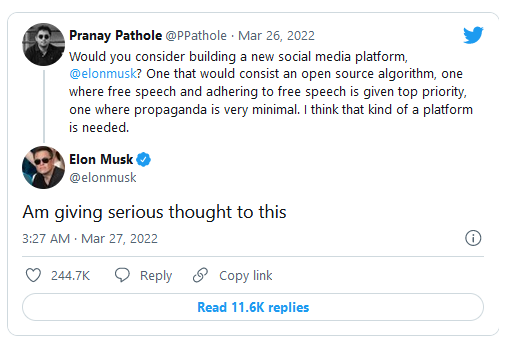
Musk made the statement after an earlier set of Saturday tweets sharing his discontent with the microblogging and social networking company. He later replied to a follower who asked if Musk would consider creating a new platform to give free speech top priority.
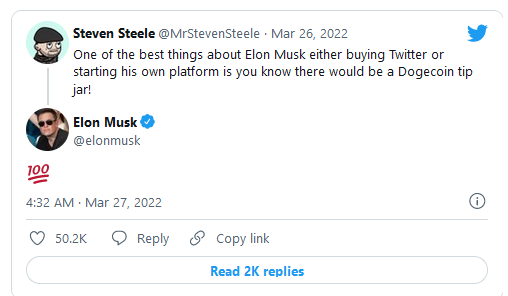
Musk also continued to support the idea of incorporating Dogecoin DOGE/USD into a potential alternative platform.
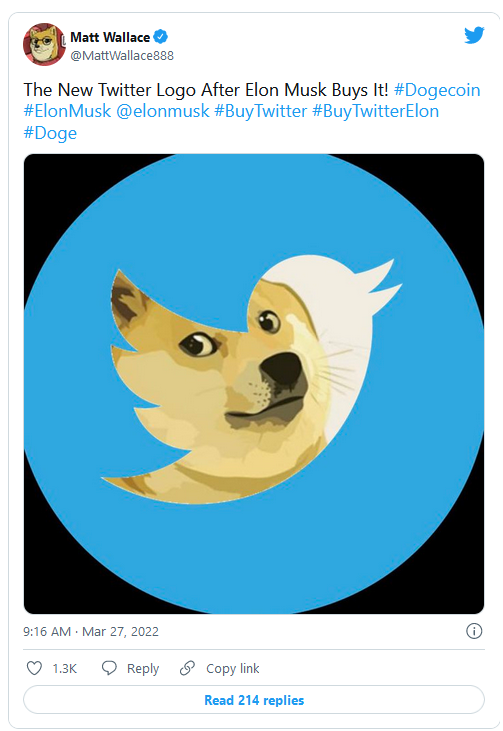
Crypto YouTuber Matt Wallace suggested a new logo for Twitter, if Musk decides to buy the company, instead of creating one of his own.
The latest set of tweets come after Musk questioned if it was time to replace Twitter, as reported by Benzinga. Musk has criticized the social media platform for “failing to adhere to free speech principles,” which he says “fundamentally undermines democracy.”
Former President Donald Trump has also taken issue with Twitter’s objectivity, and launched his own social media platform called TRUTH Social, to take on Twitter and Meta Platforms FB+ Free Alerts unit Facebook.
If you are not using this trading strategy, you are leaving money on the table…
If you are blindly looking up and trading stocks the way 99% of traders are, you are missing on HUGE potential returns. Even new traders who started following this options trading strategy instantly began seeing returns they wouldn’t have had otherwise. With even two trades per month with this strategy, you will start seeing the difference in your trading account. Don’t waste any more time “guessing” and “getting lucky”. Click Here to See if you Qualify for Benzinga Options!
Don’t pull your hair out when commercials take over your videos. Here are six ways to jump right to the content you want.
Online video streaming is big business; YouTube made $28.8 billion in advertising revenue alone last year, a 3.5x increase over what it made with ads five years ago, according to data gathered by Tubics. Plus, YouTube Premium, the paid version of the service, has 50 million subscribers.
What’s amazing is that the majority of that ad revenue goes back to the content makers, giving them plenty of incentive to keep making more videos—at least until Instagram or TikTok poaches them. (Here’s a calculator that will tell you how many views and how much engagement videos require to make money. It’s not easy, but it’s hard to break through on Insta and TikTok, too.)
With 2 billion monthly users worldwide, YouTube’s a content-sharing juggernaut with a unique place on the internet because the majority of its videos are also easily shared or embedded on other websites. That increases the reach of the service well beyond the confines of YouTube.com or even some apps. It’s competing now with Roku, Plex, and others by offering hundreds of ad-supported TV and movies for free.
That all sounds great for the creators and the viewers…until you run into an interminable number of ads. The worst ones are the in-stream ads that run before, or sometimes during a video. But the standard banner ad that appears overtop a video is also annoying as it obscures the view.
Maybe you grew up with commercial breaks on TV, or the popups on websites, and can accept them as the cost of doing (free viewing) business. But for most, YouTube advertising is obtrusive and frustrating. Fortunately, there are ways to get around the commercials.
1. Pay Up for YouTube Premium
Not to be confused with YouTube TV, which can replace your cable TV viewing, YouTube Premium is the same as YouTube but without that ads. It comes bundled with YouTube Music Premium and lets subscribers play songs and videos in the background on the desktop, and allows video “downloads” to watch later. That freedom from ads extends to mobile devices and even TVs with a YouTube app on them. And it strips out the ads on shares you make to YouTube Kids for the youngsters.
A YouTube Premium subscription costs $11.99 per month after a one-month free trial. You can also get a five-member (plus yourself) family plan for $17.99 per month. If you’re a student, you pay only $6.99 a month.
Paying for Premium is the legal, ethical way to skip YouTube ads because it ensures the people making the videos you watch get paid. The real trick would be to get Premium for free somehow after that initial trial. One option is to subscribe to Google One and get YouTube Premium free for three months.
However, there are caveats. YouTube Premium isn’t available everywhere, so if you travel to an unsupported region, you may see adds when your geographic location is identified (usually via your IP address). (A VPN that spoofs your location can probably fix this.) You may also see ads in embedded YouTube videos if they’re on a site where you block browser cookies. Make sure you are signed in with the Google account you used when you signed up for YouTube Premium.
2. Wait Just a Few Seconds
The majority of the in-stream ads that pop up before/during a YouTube video are short—usually 15 seconds or less. You can typically (but not always) skip the ad with a click of the Skip Ads link at the lower right after five seconds.
That’s a pretty good compromise between ad watching and ad avoidance. But creators have the option to make ads unskippable because if you click “Skip Ads” immediately after five seconds elapses, the ad in question does not count for the video maker. It’s not what YouTube calls an “engaged-view conversion.” For it to be an engaged view, you have to watch at least 10 seconds of a skippable ad, or the whole thing if it’s under 10 seconds.
Here’s an explainer for the video makers on how it impacts them—and how viewers can sometimes become “engaged” even after the video ad gets skipped.
Other tricks you can try:
If your video has a lot of pop-up banner ads, drag the red progress bar all the way to the end, then click the Replay button. This doesn’t help you skip the initial pre-roll ad, but may help skip some of the banners.
I also frequently see people recommending that you type an extra character at the end of a URL, like a period. By the time I usually got an extra character typed and hit return on the keyboard, the five-second skip had already come up. In my tests, this worked sometimes, but not all the time, and it doesn’t do anything to get rid of banner ads.
3. Try Tab+Enter
During the pre-roll ad on a YouTube video, hit Tab+Enter. It brings up the About This Ad box, telling you why you got it and who the advertiser is, and you can then report the ad or at least ask to stop seeing the ad in the future.
If you select Stop seeing this ad, you’ll get a warning that the particular ad shouldn’t be showing again, but it won’t stop you from seeing ads from that same advertiser in the future.
When you report the ad, you go to a whole new page where you can tell on the advertiser for violating YouTube’s policies on trademarks, counterfeit goods, or even just showing multiple ads (which is against the company’s “unfair advantage” policy).
Use that dialog to go into your own Google Ad Settings (or visit adssettings.google.com/authenticated). This isn’t going to stop you from seeing ads, of course, but it can at least limit exposure to the ads that aren’t tailored for you. Or if you hate that customization aspect—because it requires so much tracking of what you’re doing—turn ad personalization to OFF.
4. Install an Adblocker
Google allows an extension for the Chrome browser in its Chrome Web Store, so who are we to argue? Install Adblock for YouTube. (There are multiple extensions with a variation on this name, but the one you want has over 10 million users.)
Reboot the browser after installation just in case, but otherwise, you’re likely to see results instantly. This extension puts a little “cleaned by Adblock for Youtube” [sic] line under each video.
You can also get similar extensions for Firefox (AdBlocker for YouTube), Microsoft Edge, and other desktop browsers.
Go nuclear on ads with something like the preferred AdBlocker Ultimate, which works on multiple desktops, Android, and iOS browsers. That one will cost you (after a 14-day trial) $29.88 per year for up to three devices. And yes, it works on display and video ads on YouTube. However, the popular AdBlock will also let you create a list of YouTube channels you want to support by showing advertisements while blocking commercials on all the rest.
5. Try YouTube Clones
The above methods are best for desktop use. You can’t really block ads at all in the YouTube mobile apps. However, a select few apps can provide an approximation of the YouTube interface while offering access to the service’s videos. Many work on both Android phones and even streaming hubs, like the Amazon Fire, that use a variation on the Android OS—you just need to be able to sideload the apps. You’re typically not going to find them in a legit company store like Google Play. The upside of using one is they strip out the ads, of course.
Apps you can try include SmartTubeNext, NewPipe, and SkyTube. Be aware that Google doesn’t like them. It allegedly already got at least one, called YouTube Vanced, shut down via a cease-and-desist letter. That could happen to any of these other tools as well. They may work for a while even if they go under, but it’s unlikely to last if that happens.
6. Download Your Favourites
If you have videos you watch over and over for your personal pleasure, you can download them from YouTube to store on your computer. This is indeed still taking money away from creators. But if it’s for personal reasons, you’re probably not running completely afoul of the terms of service, or the law for that matter. For the full scoop on how to do that, read our complete YouTube video download tutorial.
Bonus: Stopping Ads on Your Own Content
Maybe you make your own videos for YouTube and you’re not interested in any of that filthy lucre. You do it for your art. You can turn off the advertising so people can view your vids unfettered by crass commerce.
In YouTube, click your avatar icon at the upper right and select YouTube Studio. Click Continue, then on the left Content. Put a check in the box next to any videos for which you don’t want ads, then in the drop-down menu on the left, select Monetization. The top box should say Off > Apply. Save the changes and you’ll never have to worry about any money coming in.
For B2B business, the pandemic was a magnifying glass pointing out the cracks in systems. We discovered just how fast digital transformation can be when our livelihoods are on the line. We found that global supply chains aren’t as resilient as we thought. We found that remote work is far more viable an option than we’d been led to believe.
None of these realizations were brand new — we were just able to see them clearly for the first time.
The same is true of B2B buyer behaviour. When we talk about how the pandemic changed B2B sales and marketing, what we mean is that we can finally see what we have missed before.
As we rebuild what’s broken and seek to evolve to the next level, we have a chance to put the buyer at the centre of our efforts. Here are some of the biggest challenges ahead, and how we can meet them.
Solving B2B Business Problems with Content Marketing
1 — Communicating Empathy
You don’t get through collective trauma like we’ve all experienced for the past two years without a few scars. People are still adjusting, processing, struggling, even grieving. At the same time, businesses have needs that your solution can meet, problems you can solve. But how can brands help without seeming insensitive?
Content marketing is our most powerful tool for communicating human-to-human, offering actual value. Now is not the time for bland corporate-speak, either — showcase your people in your content, along with others in your industry who have earned respect and trust.
Be helpful and kind in your content. Be a caring companion to your audience. After all, marketers are the keepers of data — we know these people and what they’re struggling with. We’re in a unique position to create uplifting content.
Lately, businesses have come to the ground-breaking realization that people care deeply about social issues. This is a discovery on par with the earth-shattering epiphany that B2B buyers are human beings who need emotional appeal as well as facts.
This epiphany has led to serious discussions about “purpose.” What does your brand stand for besides shareholder profit? What issues are top of mind and how is the brand helping address them? How can we let people know that we share their values?
Content is key for a brand that’s looking to lead with purpose. It’s the medium to tell the brand’s purpose story, of course. But we can go deeper: Content can be a way to amplify other voices and help tell their stories.
A brand can post a Martin Luther King, Jr. day message, complete with one of his safer quotes. But a content marketer can publish a blog post from a leading voice in the Black community. A brand can say they stand with Ukraine. A content marketer can bring refugee voices directly to a sympathetic audience. That’s leading with purpose, not purpose as an afterthought.
3 — Humanizing the Brand
I’ve written before about humanizing B2B marketing — specifically about how easy it is to overthink the whole thing. What’s the line between relatable and unprofessional? Will we lose trust in our competency if our content is too light-hearted? How do we relate to our entire audience without alienating a segment?
Here’s the thing: You can’t humanize a brand.
I say again: You CAN’T humanize a BRAND.
The exception that proves the rule.
Brands are not humans. People are. Content marketing can feature people on behalf of the brand, rather than attempting to speak for the brand.
Bring your executives into your content. Bring employees, influencers, external experts. Bring — I’m begging you — your customers and prospects in as well.
If you want to truly humanize, let the humans come out from behind the brand. Content marketers can lead the way.
4 — Building Relationships
I have talked more about building relationships in a decade of being a marketer than I did in a decade of being single. But in the world post-pandemic (and our current world of ongoing but milder pandemic), relationship-building is an even more crucial part of success for B2B business. Repeat customers, referrals and brand advocacy are all a more reliable source of revenue than even the most targeted advertising.
Content marketing can help build these relationships. The first three points I made are all about laying the groundwork for a relationship. Content can offer helpful advice, information about the state of the industry, best practices — in other words, what your audience needs to succeed in their professional and even personal lives.
The quickest way to build a relationship? Give your potential customer that crucial bit of advice to make them look brilliant in front of their boss. Give your existing customers recognition and highlight the awesome success your brand helped them achieve. The more you lift up and celebrate your buyers, the more they are likely to do the same for your brand.
It’s been a rough couple of years. Human beings have experienced individual and collective trauma, and we’re still processing and rebuilding. That’s true both of the marketers creating content and the people consuming it.
The way forward is to use content for what it’s really good at: Telling stories, amplifying human voices, and providing value. That’s not to say content should be doing all of the above instead of driving a business outcome — I’m saying that helpful, human content is the way to drive a business outcome.
We have the privilege, as content marketers, to create something that serves both the brand and the audience, and might even be fun for us to create. It’s a unique opportunity and one we should all embrace.
A funny thing happens when you get far enough into your career: you’re often expected to lead, coach, or mentor others. It’s a great idea, but being a leader requires an entirely new skill set, one that may have nothing to do with your success up until now. So to fast-track your leadership learning curve, check out the ten remarkable reads below.
CEO Excellence: The Six Mindsets That Distinguish the Best Leaders from the Rest
By Carolyn Dewar, Scott Keller, and Vikram Malhotra
From the world’s most influential management consulting firm, McKinsey & Company, an insight-packed, revelatory look at how the best CEOs do their jobs based on extensive interviews with today’s most successful corporate leaders—including chiefs at Netflix, JPMorgan Chase, General Motors, and Sony. Listen to our Book Bite summary, read by co-author Scott Keller, in the Next Big Idea App
Boundless Leadership: The Breakthrough Method to Realize Your Vision, Empower Others, and Ignite Positive Change
Lead with We: The Business Revolution That Will Save Our Future
By Simon Mainwaring
By leading with “we”—putting the collective above the individual, holding the sum above the parts, and emphasizing the importance of the role that everyone plays—you can not only help solve the escalating challenges of today but also unlock extraordinary growth for your business, and abundance on our planet. Listen to our Book Bite summary, read by author Simon Mainwaring, in the Next Big Idea App
Inclusify: The Power of Uniqueness and Belonging to Build Innovative Teams