Author

editor

Browsing

By

Collaborating with these influencers doesn’t have to be a chilling experience.

Some brands are still “afraid” of venturing into influencer marketing despite being an industry that is in full growth. In fact, it is estimated that social commerce can reach a global value of 604 billion dollars by 2027, with an annual growth rate of 31.4 percent over the next seven years, according to data cited from Internet Retailing.

Collaborating with these influencers doesn’t have to be a chilling experience. It’s about creating key and valuable relationships with them; understand that they are not employees but strategic partners, with whom brands can effectively manage their relationships.

Before starting a collaboration with influencers, consider these seven terrifying mistakes to avoid if you want your campaign to have an impact:

1. Have a ghost target

Image: Depositphotos.com

The first step in creating a winning strategy is setting your goals and objectives. Without goals, there is no way to measure success and return on investment (ROI).

In the same way, you have to know what the brand’s target is and what its budget is. If you do not have a set goal at the start, the campaign will be created without direction, will be subject to course changes midway, and will be doomed.

2. View the audience as a zombie

Image: Depositphotos.com

If you believe that audiences are behaving like zombies, that is, that they are all looking for the same thing, your campaign will fail horribly. Before thinking about a collaboration with influencers, you need to make sure that your audience matches your buyer persona. For example, it wouldn’t do any good to ask a swimming influencer to share soccer tips. Although most swimmers play another sport, your audience won’t take it very seriously if you give advice on soccer socks.

However, choosing people who represent your brand values and avoiding misleading metrics can be challenging.

3. Believe that influencers are Frankenstein’s monster

Image: Depositphotos.com

Obviously, influencers promote brands for monetary or other compensation, but they also choose to collaborate for other reasons. This applies particularly to micro-influencers: the suggestion is to treat them as customers and not as a monster over which you think you have control.

After all, if they don’t like the products or services the brand offers or the treatment they receive, they probably wouldn’t join the campaign in the first place (unless they are offered a huge monetary compensation that makes them rethink their decision ). The public knows when their favorite people in the networks endorse something that they really like. The goal of collaborating with influencers is to nurture and leverage that trust.

Followers trust influencers and it’s not easy to create a community of people who like and trust you as a brand. What is easy is losing their trust, so they will only promote companies they trust and like to work with.

4. Treat your motivation like the invisible man

Image: Depositphotos.com

Don’t ignore what motivates them. You have to see what moves them. A great long-term relationship between the brand and the influencers it works with can only be achieved if both parties are happy. It can be achieved if the brand asks the influencers directly what their expectations of this collaboration are and if there is something they specifically want from whoever contacted them.

For example, some micro-influencers prefer exposure over monetary compensation. Those influencers can be made happier if the brand shares some of their posts in which they talk about their products or services instead of paying them.

Other influencers who are interested in what the company offers might want product or service discounts, while some might prefer samples that they can offer to their followers. To find out, you have to ask them at the beginning.

5. Scare away your creativity

Image: Depositphotos.com

Creative freedom is of the utmost importance to successfully collaborate with influencers. Who knows the audience best? The brand or the influencer? Without a doubt, the influencer.

They know better the tastes, preferences and opinions of their followers. This means that the influencer knows what type of content will engage their audience in an authentic and organic way. Their motto is to publish content that not only attracts followers, but also hooks them.

6. Forgetting to do a good “spell” for the campaigns

Image: Depositphotos.com

To see what works and what doesn’t, you need to track the content of each campaign. Members of the company that hired the campaign can do this daily or weekly, but the important thing is to have a monitoring system and record the results of how each post has worked.

7. Drive them away with a scare compensation

Image: Depositphotos.com

When managing the team of influencers, it is very important to motivate each of them. Like any company that wants to obtain the greatest benefit for the investment it has made, motivating influencers, especially micro-influencers, is crucial in this process.

If the deal is with smaller micro-influencers, you can exclude the monetary reward if you have some other lucrative and creative way to compensate them. This is important because if they are rewarded exclusively with money, they could lose their intrinsic motivation and see this collaboration as just another job.

Brands can also offer promo codes and giveaways that influencers can give to their followers and create a win-win situation for both them and the brand.

Feature Image Credit: Depositphotos.com
By

Sourced from Entrepreneur Europe

By Michael Kan

The pilot ad program will help support continued free access to the video-conferencing service, Zoom says.

To keep its service free, Zoom will experiment with displaying ads after video calls.

On Monday, the company announced that it’s rolling out a “pilot advertising program” for non-paying Basic users in certain countries. For now, it seems the ads will only appear for Zoom calls viewed on a web browser.

“For this initial program, ads will be rolled out only on the browser page users see once they end their meeting,” the company says. “Only free Basic users in certain countries will see these ads if they join meetings that are hosted by other free Basic users.”

How the ads will appear. How the ads will appear.
Zoom says the ads will “enable us to support investment and continue providing free Basic users with access to our robust platform.” Its growth exploded last year during the pandemic, and the video-conferencing service continues to be in demand to this day.

“​​With this in mind, today we are excited to roll out a pilot advertising program that we expect will enable us to support investment and continue providing free Basic users with access to our robust platform,” the company says.

However, Zoom stresses it won’t be using data from user video calls for ad-targeting purposes. “As noted in our Privacy Statement, we will not use meeting, webinar, or messaging content (specifically, audio, video, files, and messages) for any marketing, promotions, or third-party advertising purposes,” the company says.

Instead, the ads will rely on browser-based cookies to serve up relevant marketing to users. The banner ads on Zoom’s website will also feature a link, enabling users to access the cookie management tool.

Zoom didn’t provide a list of countries where the ads will appear. But the program is poised to pave the way for a larger expansion in the future. We’ve reached out to Zoom for more information, and we’ll update the story if we hear back.

By Michael Kan

Sourced from PC Mag

By Kana Ruhalter

Facebook announced that it will be shutting down its controversial facial recognition system this month, the New York Times reports. The embattled social-media giant says it will be deleting the face scan data of over a billion users, a move that comes during a tumultuous time for the company, as it’s been met with fierce scrutiny over privacy and regulation concerns and is the subject of official probes.

Jerome Pesenti, vice president of artificial intelligence at Meta—Facebook’s newly-rebranded parent company—explained why the network was axing the system in a blog post: “We need to weigh the positive use cases for facial recognition against growing societal concerns, especially as regulators have yet to provide clear rules.”

The facial-recognition system identifies people through pictures uploaded onto Facebook and suggests the users “tag” and link friends’ accounts in the photos. Growing concern about the abuse of such software—including by China’s government, as it tracks the minority Uighur population, and by law-enforcement in the United States—has prompted immense criticism.

Read it at New York Times

Feature Image Credit: Justin Sullivan/Getty Images

By Kana Ruhalter

Sourced from Daily Beast

By Ronan Shields

Google Ads today announced the rollout of an ad unit that it claims will help advertisers bolster their incremental reach.

Top line

Dubbed Performance Max, the new offering lets media buyers book inventory across a range of Google properties including YouTube, Search, Discover, Gmail and Maps as part of a single campaign.

The Google Ads team is pitching it as a complementary service to keyword-based Search campaigns—still the bulk of its business—in a further bid to boost advertiser-spend.

Between the lines

Performance Max campaigns launched in beta last year with the Google Ads team reporting that advertisers that trialled the service saw a 13% increase in incremental conversions on average.

Brands including Allianz, Deezer, and MG used Performance Max since it was rolled out in beta with marketers reporting that it helped them increase conversion rates, find new customers and bolster their consumer insights.

Bottom line

The Google Ads team claimed it will introduce more features specifically geared towards marketers that want to attract consumers to their brick-and-mortar outlets, such as retailers, to Performance Max in the coming year.

“We know the holidays are a critical time of year for your business. You should continue using Smart Shopping and Local campaigns to reach more shoppers across online and in-store experiences this holiday season,” wrote Eduardo Indacochea, Google, senior director, product management, in a blog post.

“However, when the time is right for your business, you can start testing Performance Max campaigns before next year’s campaign upgrades.”

Feature Image Credit: Performance Max lets brands further boost their campaign reach of their keyword-based campaigns.Google

By Ronan Shields

Ronan Shields is Adweek’s programmatic editor.

Sourced from ADWEEK

By Eric Franklin

Getting off the grid isn’t as easy as it should be, but we’ll show you where to start.

If you’re reading this, it’s highly likely your personal information is available to the public. And by “public” I mean everyone everywhere. So, how can deleting yourself from the internet stop companies from getting hold of your info? Short answer: It can’t. Unfortunately, you can never completely remove yourself from the internet, but there are ways to minimize your digital footprint, which would lower the chances of your personal data being out there. Here are some ways to do that. We’ll update these tips periodically.

Be forewarned, however: Removing your information from the internet, as I’ve outlined below, could adversely affect your ability to communicate with potential employers.

1. Delete or deactivate your shopping, social media and web service accounts

Think about which networks you have social media profiles on. Aside from the big ones (Facebook, Instagram, Twitter, LinkedIn), do you still have old accounts on sites like Tumblr? MySpace? What about your Reddit account? Which shopping sites have you registered on? Common ones might include information stored on Amazon, Gap.com, Macys.com and others.

screen-shot-2018-02-27-at-2-35-06-pm
Using a service like DeleteMe can make removing yourself from the internet less of a headache.

Screenshot by Eric Franklin/CNET

To get rid of these accounts, go to your account settings and look for an option to either deactivate, remove or close your account. Depending on the account, you may find it under Privacy or Security, or something similar.

If you’re having trouble with a particular online account, try searching online for “How to delete,” followed by the name of the account you wish to delete. You should be able to find some instructions on how to delete that particular account. (Here’s how to permanently delete your Facebook account without losing your photos.)

If for some reason there are any undeletable accounts, change the info in the account to something other than your actual info. Something fake or completely random.

2. Remove yourself from data collection sites

There are companies out there that collect your information. They’re called data brokers, and they have names like Spokeo, Whitepages.com and PeopleFinder, as well as plenty of others. They collect data from everything you do online and then sell that data to interested parties, mostly in order to more specifically advertise to you and sell stuff.

Now you could search for yourself on these sites and then deal with each site individually to get your name removed. Problem is, the procedure for opting out from each site is different and sometimes involves sending faxes and filling out actual physical paperwork. Physical. Paperwork. What year is this, again?

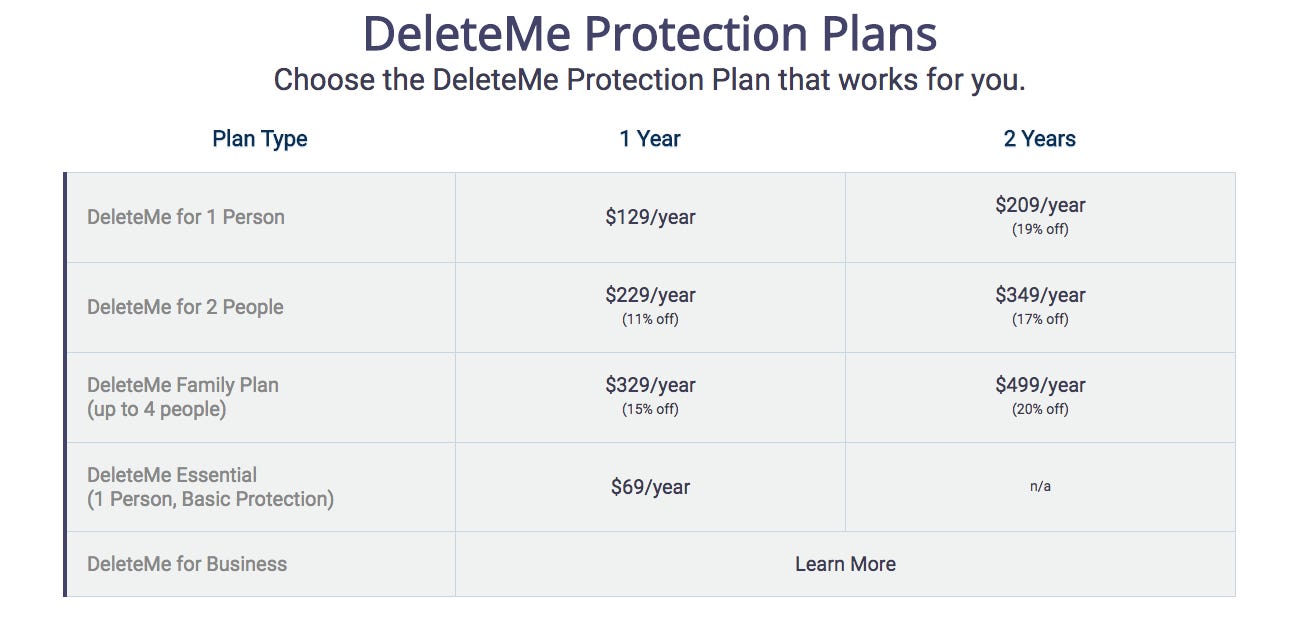
Anyway, an easier way to do it is to use a service like DeleteMe at joindeletme.comFor just $129 per year, the service will jump through all those monotonous hoops for you. It’ll even check back every few months to make sure your name hasn’t been re-added to these sites.

Be warned: If you remove yourself from these data broker sites, you’ll also mostly remove yourself from Google search results, therefore making it much harder for people to find you. DeleteMe also gives you a set of DIY guides on how to remove yourself from each individual data broker if you’d like to do the process yourself.

3. Remove your info directly from websites

First, check with your phone company or cell provider to make sure you aren’t listed online and have them remove your name if you are.

If you want to remove an old forum post or an old embarrassing blog you wrote back in the day, you’ll have to contact the webmaster of those sites individually. You can either look at the About us or Contacts section of the site to find the right person to contact or go to www.whois.com and search for the domain name you wish to contact. There you should find information on who exactly to contact.

Unfortunately, private website operators are under no obligation to remove your posts. So, when contacting these sites be polite and clearly state why you want the post removed. Hopefully they’ll actually follow through and remove it.

If they don’t, tip No. 4 is a less effective, but viable option.

4. Remove personal info from websites

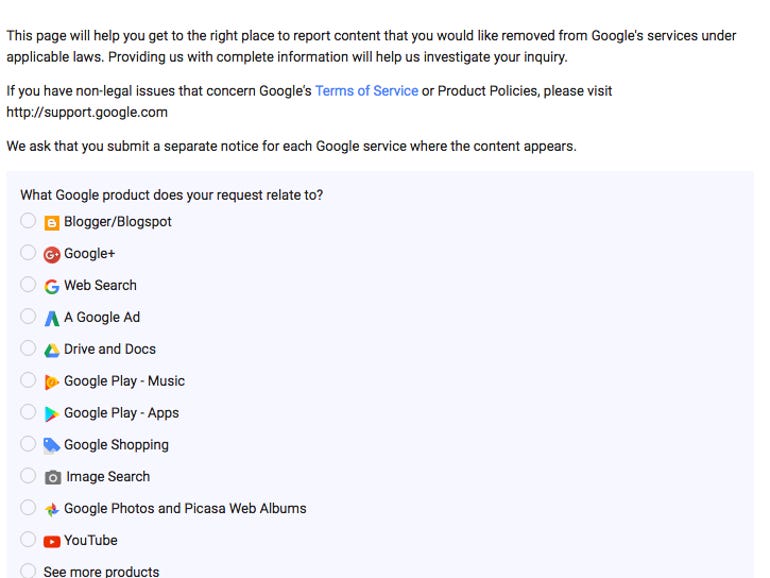
If someone’s posted sensitive information of yours such as a Social Security number or a bank account number and the webmaster of the site where it was posted won’t remove it, you can send a legal removal request to Google to have it removed.

screen-shot-2016-10-19-at-9-29-42-am.png
You may have to exercise Google’s legal powers to get your personal information removed from a stubborn site.

Screenshot by Eric Franklin/CNET

The removal process could take some time, and there’s no guarantee it’ll be successful, but it’s also your best recourse if you find yourself in this vulnerable situation.

5. Remove outdated search results

screen-shot-2016-10-19-at-9-12-24-am.png
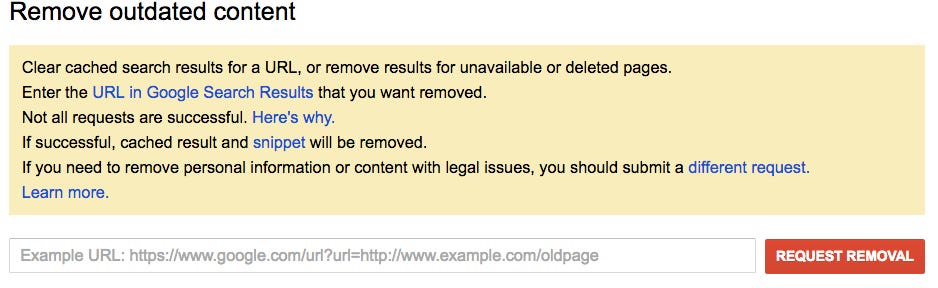
Google’s URL removal tool is handy for erasing evidence of past mistakes from the internet.

Screenshot by Eric Franklin/CNET

Let’s say there’s a webpage with information about you on it you’d like to get rid of — like your former employer’s staff page, months after you’ve changed jobs. You reach out to get them to update the page. They do, but when you Google your name, the page still shows up in your search results — even though your name isn’t anywhere to be found when you click the link. This means the old version of the page is cached on Google’s servers.

Here’s where this tool comes in. Submit the URL to Google in hopes it’ll update its servers, deleting the cached search result so you’re no longer associated with the page. There’s no guarantee Google will remove the cached info for reasons, but it’s worth a try to exorcise as much of your online presence as possible from the internet.

6. And finally, the last step you’ll want to take is to remove your email accounts

Depending on the type of email account you have, the number of steps this will take will vary.

You’ll have to sign into your account and find the option to delete or close the account. Some accounts will stay open for a certain amount of time if you want to reactivate them.

An email address is necessary to complete the previous steps, so make sure this one is your last.

One last thing…

Remember to be patient when going through this process, and don’t expect to complete it in one day. You may also have to accept that there are some things you won’t be able to permanently delete from the internet.

Feature Image Credit: Josh Miller/CNET

By Eric Franklin

Sourced form C/Net


Do you need a better strategy? Wondering how to use data to gauge when to start, stop, or scale your marketing efforts?

In this article, you’ll discover why data is important, what data to look at, and how to use data to inform your strategy.

Why Data Is Crucial to Your Marketing Strategy

It’s important to understand that data is for everyone, whether you’re a new business owner or have been in business for a long time and already know your ideal customer very well. Without data, as you’re building your strategy, you’re flying blind with little more than a feeling and some hope that you’re right.

We tend to develop our strategies focusing on things we like, things we’ve been told, and ideas that we see others finding success in, and put blinders on to whether these things are actually working. Are your time, money, and effort being returned to you in the form of conversions moving toward your goal?

Data removes those blinders.

Additionally, data makes it easier to connect each of your efforts to dollars. Whether you’re a marketer or business owner running all of your own marketing, understanding exactly how each point within your marketing strategy connects to that revenue helps identify the value of that point in the big picture. This is one of the ways in which data becomes so powerful in the realm of social media marketing because it lets you see exactly where you’re leaking money.

Pro Tip: As a best practice, you should start collecting the data even before you need it. If you’re starting a brand-new business and you don’t need the data right away, track it anyway. Because once you need the data, you need the data. As with anything else, data takes a while to collect, and Google Analytics doesn’t work retroactively. So while you may not look at the data right away, having it collected as early in the business as possible will only help you in the long run.

Click HERE to read the remainder of the article.

Sourced from Social Media Examiner

If your Photoshop skills aren’t sharp, try Cleanup.pictures

Ever needed to quickly edit something or someone out of an image?

Maybe it’s the stranger who wandered into your family photo, or the stand holding up your final artwork for school? Whatever the job, if you don’t have the time or Photoshop skills needed to edit the thing yourself, why not try Cleanup.pictures — a handy web tool that does exactly what it promises in the URL.

Just upload your picture, paint over the thing you want removed with the brush tool, and hey presto: new image. The results aren’t up to the standards of professionals, especially if the picture is particularly busy or complex, but they’re surprisingly good. The tool is also just quite fun to play around with. You can check out some examples in the gallery below:

Cleanup.pictures seems to be from the same team that made a fun augmented reality demo that lets you “copy and paste” the real world, and is open-source (you can find the underlying code here). Obviously, tools of this sort have long been available, dating back at least to the launch of Photoshop’s Clone Stamp tool, but the quality of these automated programs has increased considerably in recent years thanks to AI.

Machine learning systems are now not only better at the problem of segmentation (marking the divisions between an object and the background) but also inpainting, or filling in the new content. Just last week, Google launched its new Pixel 6 tools with an identical “Magic Eraser” feature, but Cleanup.pictures shows how this feature has become a commodity.

I think my favourite use of this tool, though, is this fantastic series of pictures removing the people from Edward Hopper paintings:

Sourced from The Verge

By

One of the ways Instagram content creators make money through the app is by looking for sponsors who might pay them for their posts. But how do these creators find sponsors to begin with? There may be an easier way.

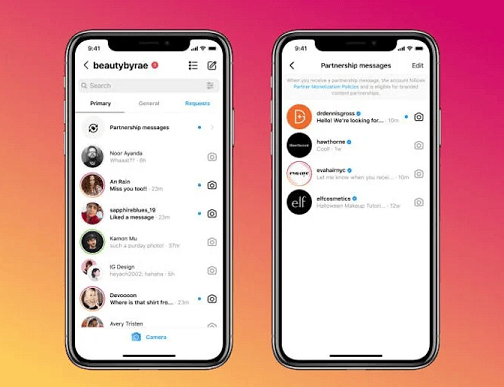
It turns out that’s what Instagram thinks too. The company has announced that they are working on tools that will make it easier for creators to be matched with brands who might be willing to sponsor them. These tools will let creators express an interest in the brands that they might be interested in working with, while brands can also use the tool to find creators who they think will match their needs.

Instagram is also working on a separate inbox for sponsors, which means that it will be easier for creators to identify messages sent to them from a potential sponsor instead of getting lost in their messages. These tools are still in the early stages of development and only a handful of brands and creators are taking part in a test, but we can likely expect that these tools will eventually expand to cover more brands and creators in the very near future. This will make things easier for creators.

Source Ubergizmo

By

Sourced from Geeky Gadgets

By Shreeya Deshpande

Not sure where to get started with vlogging? Check out these platforms.

Have you been looking to make it big in vlogging? There are many platforms where you can showcase your talent and build your identity. But with so many online platforms available today, it can be overwhelming to choose the right ones.

Here, we’ve rounded up the best vlogging platforms for you to become a successful vlogger. Let’s jump right in.

1. YouTube

When it comes to vlogging, YouTube has to be the number one platform to consider. In fact, vlogging has only really taken off since YouTube came into existence. This long-established platform has gained over 1 billion users and over 500 hours of videos are uploaded every minute.

You can create your own channel on YouTube and uploading your content is straightforward. Also, YouTube allows you to monetize your channel by putting ads in your videos. You can leverage your channel by promoting it too.

Keep in mind, with YouTube being the most popular vlogging platform, it’s highly competitive. But with some creativity and consistent posting, you have a shot at garnering an audience on the platform.

2. Instagram

instagram live feature

With a large userbase of around a billion users and counting, Instagram has rapidly soared into popularity as a photo-sharing social media platform. However, with the introduction of Instagram Reels and Instagram Video, videos have made a home on the platform too.

With Instagram Video you get to share longer vlogs that can include your daily routine, travel vlogs, and more. As short videos are trending nowadays, you can use Instagram Reels to upload shorter clips of your vlog to grab your audience’s attention. Adding to that, Instagram Live and Stories will allow you to create a stronger bond with your followers.

You can make the most out of Instagram with the platform’s strong advertising options and use hashtags to get your vlogs discovered by the right audience.

3. Facebook

facebook watch video

Facebook is not often considered when it comes to vlogging. However, the platform’s popularity and extensive user-base can prove highly useful for getting more exposure.

With Facebook, you can create pages, gain followers, and run paid ad campaigns to increase your visibility. Similar to YouTube and Instagram, this social media platform allows you to live-stream your videos with Facebook Live.

When you create a vlog and upload it to Facebook, it assures a guaranteed reach within your friends’ or followers’ list. And if they share it with their own friends, the reach of your vlog multiplies instantly.

Along with that, Facebook offers you the freedom to design your page layout as you like, save live videos to the video library, and interact with your audience in real-time.

4. TikTok

tiktok app

As short videos have become increasingly trendy, there are many benefits to uploading your shorter vlogs to TikTok. It’s a great platform for gaining popularity in a short amount of time. Since its inception in 2016, TikTok has proven to be the fastest-growing social media app with over 1 billion users.

With short videos ranging from 15 seconds to 3 minutes long, you can create quick and engaging vlogs on TikTok. You can play around with filters, add soundtracks, and use cool effects on your videos.

You can also create content on trending topics and do challenges to increase your reach. If you’re new to this platform, have a look at our tips for TikTok beginners.

5. Vimeo

vimeo home page

If you’re a professional vlogger or aspiring to become one, Vimeo can be a fantastic place to showcase your creativity. On Vimeo, you won’t see any low-quality content as it’s known for its high-quality artistic videos. The platform even has tutorials that can help you make better videos.

As a vlogger or a content creator, you can track how your content performs using the analytics dashboard. You can get this feature and as well as more storage and advanced privacy control by upgrading to one of the premium subscription plans.

On top of that, there are no ads. And if your content is really good, your vlogs can get featured in a Staff Pick.

6. Dailymotion

daily motion home

Dailymotion is another platform that focuses on professional, high-quality video content. Similar to Vimeo, this might be a good platform if you already have some vlogging experience or use high-end vlogging equipment.

Dailymotion is YouTube’s oldest competitor. It has a similar intuitive user interface, therefore, uploading your vlogs to the site is straightforward.

Additionally, Dailymotion allows you to monetize your content. Just remember to take note of the restricted time duration and storage capacity of the videos you upload.

7. Twitch

twitch home feature

With more than 15 million daily visits, Twitch is one of the most popular streaming platforms and a favourite among beginners. As a vlogger, there’s a lot to benefit from the platform’s dedication to live-streaming.

Twitch has always been a go-to platform for gamers to live-stream their lets-plays. With the introduction of the IRL category, we can see the platform opening the doors to other niches. IRL is short for “in real life” and, on Twitch, includes content beyond gaming streams such as art creation, reaction videos, and GRWM (get ready with me) streams.

You also get to interact with your audience in the live chat where you can do Q-and-A’s, thank them for donations, and welcome new subscribers.

8. DTube

dtube home

DTube is the first video-sharing platform leveraging the power of blockchain technology. If you’re looking for a Youtube alternative, consider switching to DTube. This decentralized platform is secure, ad-free, has no hidden algorithms, and allows you to monetize your vlogs in cryptocurrency.

Another unique DTube feature is instead of displaying view counts, each video shows the amount it has earned. Note that you can only earn for seven days per video upload, and once you upload your vlog it cannot be edited or deleted.

As DTube has an active community, you can take advantage of it to collaborate with other creators and attract more audiences.

This platform might be the right choice if you like the idea of creating content around cryptocurrency.

By Shreeya Deshpande

Sourced from MUO


Sourced from TECH2

The metaverse is a world of endless, interconnected virtual communities where people can meet, work and play, using virtual reality headsets, augmented reality glasses, smartphone apps or other devices.

The term “metaverse” seems to be everywhere. Facebook is hiring thousands of engineers in Europe to work on it, while video-game companies are outlining their long-term visions for what some consider the next big thing online.

The metaverse, which could spring up again when Facebook releases earnings Monday, is the latest buzzword to capture the tech industry’s imagination.

It could be the future, or it could be the latest grandiose vision by Facebook CEO Mark Zuckerberg that doesn’t turn out as expected or isn’t widely adopted for years — if at all.

Plus, many have concerns about a new online world tied to a social media giant that could get access to even more personal data and is accused of failing to stop harmful content.

Here’s what this online world is all about:

What is the metaverse?

Think of it as the internet brought to life, or at least rendered in 3D. Zuckerberg has described it as a “virtual environment” you can go inside of — instead of just looking at on a screen. Essentially, it’s a world of endless, interconnected virtual communities where people can meet, work and play, using virtual reality headsets, augmented reality glasses, smartphone apps or other devices.

It also will incorporate other aspects of online life such as shopping and social media, according to Victoria Petrock, an analyst who follows emerging technologies.

“It’s the next evolution of connectivity where all of those things start to come together in a seamless, doppelganger universe, so you’re living your virtual life the same way you’re living your physical life,” she said.

But keep in mind that “it’s hard to define a label to something that hasn’t been created,” said Tuong Nguyen, an analyst who tracks immersive technologies for research firm Gartner.

Facebook warned it would take 10 to 15 years to develop responsible products for the metaverse, a term coined by writer Neal Stephenson for his 1992 science fiction novel “Snow Crash.”

What will I be able to do in the metaverse?

Things like go to a virtual concert, take a trip online, and buy and try on digital clothing.

The metaverse also could be a game-changer for the work-from-home shift amid the coronavirus pandemic. Instead of seeing co-workers on a video call grid, employees could see them virtually.

Facebook has launched meeting software for companies, called Horizon Workrooms, to use with its Oculus VR headsets, though early reviews have not been great. The headsets cost $300 or more, putting the metaverse’s most cutting-edge experiences out of reach for many.

For those who can afford it, users would be able, through their avatars, to flit between virtual worlds created by different companies.

“A lot of the metaverse experience is going to be around being able to teleport from one experience to another,” Zuckerberg says.

Tech companies still have to figure out how to connect their online platforms to each other. Making it work will require competing technology platforms to agree on a set of standards, so there aren’t “people in the Facebook metaverse and other people in the Microsoft metaverse,” Petrock said.

Is Facebook going all in on the metaverse?

Indeed, Zuckerberg is going big on what he sees as the next generation of the internet because he thinks it’s going to be a big part of the digital economy. He expects people to start seeing Facebook as a metaverse company in coming years rather than a social media company.

A report by tech news site The Verge said Zuckerberg is looking at using Facebook’s annual virtual reality conference this coming week to announce a corporate name change, putting legacy apps like Facebook and Instagram under a metaverse-focused parent company. Facebook hasn’t commented on the report.

Critics wonder if the potential pivot could be an effort to distract from the company’s crises, including antitrust crackdowns, testimony by whistleblowing former employees and concerns about its handling of misinformation.

Former employee Frances Haugen, who accused Facebook’s platforms of harming children and inciting political violence, plans to testify Monday before a United Kingdom parliamentary committee looking to pass online safety legislation.

Is the metaverse just a Facebook project?

No. Zuckerberg has acknowledged that “no one company” will build the metaverse by itself.

Just because Facebook is making a big deal about the metaverse doesn’t mean that it or another tech giant will dominate the space, Nguyen said.

“There are also a lot of start-ups that could be potential competitors,” he said. “There are new technologies and trends and applications that we’ve yet to discover.”

Video game companies also are taking a leading role. Epic Games, the company behind the popular Fortnite video game, has raised $1 billion from investors to help with its long-term plans for building the metaverse. Game platform Roblox is another big player, outlining its vision of the metaverse as a place where “people can come together within millions of 3D experiences to learn, work, play, create and socialize.”

Consumer brands are getting in on it, too. Italian fashion house Gucci collaborated in June with Roblox to sell a collection of digital-only accessories. Coca-Cola and Clinique have sold digital tokens pitched as a stepping stone to the metaverse.

Zuckerberg’s embrace of the metaverse in some ways contradicts a central tenet of its biggest enthusiasts. They envision the metaverse as online culture’s liberation from tech platforms like Facebook that assumed ownership of people’s accounts, photos, posts and playlists and traded off what they gleaned from that data.

“We want to be able to move around the internet with ease, but we also want to be able to move around the internet in a way we’re not tracked and monitored,” said venture capitalist Steve Jang, a managing partner at Kindred Ventures who focuses on cryptocurrency technology.

Will this be another way to get more of my data?

It seems clear that Facebook wants to carry its business model, which is based on using personal data to sell targeted advertising, into the metaverse.

“Ads are going to continue being an important part of the strategy across the social media parts of what we do, and it will probably be a meaningful part of the metaverse, too,” Zuckerberg said in the company’s most recent earnings call.

That raises fresh privacy concerns, Nguyen said, involving “all the issues that we have today, and then some we’ve yet to discover because we’re still figuring out what the metaverse will do.”

Petrock she said she’s concerned about Facebook trying to lead the way into a virtual world that could require even more personal data and offer greater potential for abuse and misinformation when it hasn’t fixed those problems in its current platforms.

“I don’t think they fully thought through all the pitfalls,” she said. “I worry they’re not necessarily thinking through all the privacy implications of the metaverse.”

Feature Image: Mark Zuckerberg has described the metaverse as a “virtual environment” you can go inside of — instead of just looking at on a screen.

Sourced from TECH2