Author

editor

Browsing

By Cyrus Shepard

You may already be familiar with STAT Search Analytics and its rank tracking abilities, but did you know it can also help you discover SEO opportunities on a massive scale? In today’s Whiteboard Friday, Cyrus shows you how to dig into STAT to do just that.

Photo of the whiteboard with examples of how STAT can help you find SEO opportunities on large scales.
Click on the whiteboard image above to open a larger version in a new tab!


Video Transcription

Hi, everybody. Welcome. My name is Cyrus. Today the thing I want to talk about is how to use STAT to find SEO opportunities at scale, and I mean massive scale.

Now a lot of you have probably heard of STAT. You may know that it has an excellent reputation. But it’s possible you haven’t actually used it or have a very good understanding of what it actually does.

So that’s what I’m going to try to cover today and explain how powerful it is at discovering SEO opportunities in ways that can inform content strategy, competitive analysis, and a lot more.

What is STAT?

So STAT, the full name of STAT is actually STAT Search Analytics. On the surface, what a lot of people understand is that it is a rank tracker, tracking thousands of keywords at a time anywhere across the globe. But underneath the hood, it’s actually a lot more than a rank tracker. It’s a rank tracker. It’s a competitive landscape tool. It’s SERP analysis and intent. It allows you to do some pretty incredible things once you dig into the data.

Keyword attribution

So let me dig into a little bit about how it actually works. So like a lot of keyword rank trackers, you start with keywords. But one of the differences is all the different attributes that you can assign to each of your keywords.

So first is very familiar, the market or the search engine. So you want Canadian English results or Canadian French results. Any market in the world that’s available it’s pretty much available for you to use in STAT.

The second is location, which is a slightly different concept. So you can define ZIP Codes, cities, be as specific as you want. This is very important for multiple location businesses or if you’re running an advertising campaign in a certain part of the country and you want to track very specific results. But you can define location very specifically for each of your keywords.

Third is device, mobile or desktop, especially important with mobile-first indexing and increasing mobile results. But also tags, smart tags, and this is where the true power of STAT comes in, the ways that you can use smart tagging.

Smart tagging

So you can tag your keywords in multiple ways, assigning multiple tags to slice them and dice them any way you want.

So different ways that you can tag keywords in STAT is anything that’s important to your business. For example, you can create keyword groups based on what’s important to you. On Moz, we tag keywords with “SEO” in it or anything that’s important to your business that you want to create a keyword cohort out of. Or location, like we were talking about, if you’re running an advertising campaign in Indiana and you want to tag certain keywords that you’re targeting there, something like that. Or all your Kansas city keywords or your London or Berlin keywords.

Product categories. So if you sell multiple categories, you sell TVs, books, dresses, anything you want, you might want to tag all of those into a particular keyword category. Or attributes, such as a 55-inch television versus a 48-inch television, when you want to get very, very specific across your product line.

Also your brand. At Moz, we track everything with the word “Moz” in it, or Nike or Apple or whatever your brand is or if you have multiple brands. Basically, anything that’s important to your business, any KPI that you measure, anything that’s relevant to your marketing department or finance or anything else like that, you can tag, and that’s where the true power comes in, because once you tag, you’ve created a keyword cohort or a group.

Share of voice

Then you can see your share of voice across that entire market using just that group. So if you want to track yourself against a very specific set of keywords, you can see your share of voice, share of voice meaning how much visibility you have in Google search results, and STAT will show you your exact competitors and how you rank among those.

Hand drawn example of a STAT Share of Voice chart.

Generally, you want to see yourself going up and to the right. But if you’re not, you can see exactly who’s beating you and where their movement is, and how you’re doing for that specific keyword group, which is incredibly valuable when you’re working on a particular set of keywords or a campaign.

SERP features + intent

But my favorite part — and this is where the true power comes in, because it can inform your content strategy and this is where the SEO opportunities are actually at — is the analysis of SERP features and intent. Because what STAT will do is, out of the thousands of keywords that you put into it, it will analyze the entire SERP of each of those and it will collect all the SERP features that it finds and tell you exactly what you own and don’t own and where your opportunities are.

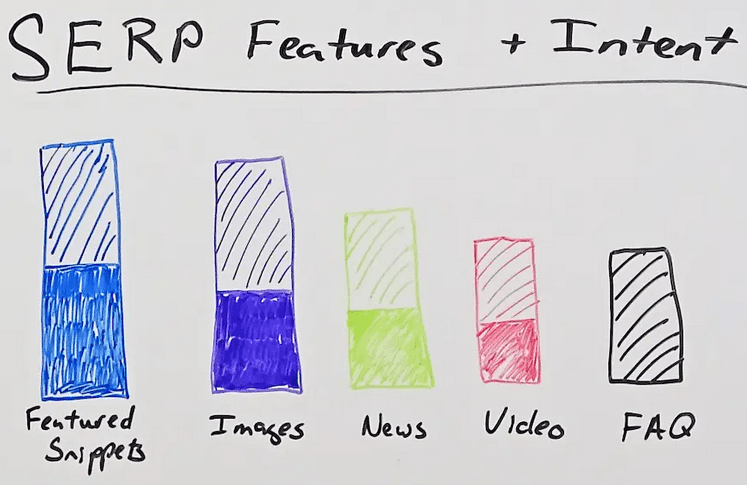
Hand drawn bar graph showing examples of SERP features and ownership of those SERP features.

So let’s give an example that’s a little more concrete. So let’s say you track a bunch of keywords within a particular cohort and you see that most of the results have a featured snippet. STAT will show you exactly what you own and what you don’t own. Now what’s cool about this is you can click into what you don’t own and you can see the exact featured snippets that your competitors own that you can actually create some content strategy around and try and go steal those.

A different way is images or news. So let’s say that you notice that you’re selling TVs or something like that and almost all the SERPs have images and you don’t own any of them. So something like that can inform your content strategy, where you go to your team and you say, “Hey, folks, we need to create more images, or we need better structured data to get Google to show the images because this is the intent for this type of keyword, and we’re simply not owning it in this way.”

Same thing with news. If you notice a lot of news results and you’re not a news organization but you’re competing for these keywords, that can inform your content strategy and maybe you need to go after those news keywords or try something else. Video is another one. More and more SERPs have video results with video carousel and things like that. You can see exactly what you own and what you don’t own.

A lot of times you’re going to find that certain domains are beating you on those videos and that may inform, especially for the high volume keywords that you want to go after, you may want to be creating more video content for that. But it all depends on the SERP, and you’re going to find different feature sets and different combinations for every keyword cohort that you do.

So what’s important to you and what’s important to track it’s going to show up differently every time, but it’s going to show you exactly where the opportunities are. FAQs are another thing, rich snippets sort of results. You may find that your competitors are all using FAQ markup. You’re not using any. That could inform your SEO strategy, and you might start incorporating more FAQs because Google is obviously rewarding those in the SERPs and your competitors are gaining those and not you.

Other things, virtually any SERP feature that’s trackable. You can find local results. Twitter boxes. You may find that for certain queries Google is surfacing Twitter results and maybe that means you need to be on Twitter more than you actually are right now and see who’s ranking for those results instead of something that you’re doing on-site.

Maybe it’s you need to do more YouTube. It’s not all necessarily on your site. But this will tell you where you need to invest those opportunities. Review stars, podcasts, and more. All of this will tell you what’s important and where the opportunities are and where you’re winning and losing and the exact keywords that you can go after if you want to win and the exact feature sets where your competitors are getting traffic and you aren’t.

So I use STAT, I love it, every week. It’s a great tool. If you want to try it out, I encourage you to do so. That’s it for me. Thanks, everybody.

Video transcription by Speechpad.com.

By Cyrus Shepard

Cyrus Shepard is the founder of Zyppy SEO, an SEO consulting and software company. He writes/tweets about Google ranking signals, SEO best practices, experiments, tactics, and industry updates.


Sourced from MOZ

Balmain, Gucci and Louis Vuitton are experimenting with low-key marketing strategies to engage with key opinion customers. Unexpected ad platforms are also coming into favour.

Louis Vuitton and Gucci quietly hosted pop-ups in lower-profile locations of Somerset and Brooklyn respectively, in the past 10 months. While traditionally, a new launch is followed with media interviews and influencer previews, both of these pop-ups were left to be discovered by their local communities. In turn, this prompted user-generated social media responses, says Todd Sachse, founder of Sachse Construction, who built the stores for both brands. For Gucci, it was part of its continual “test and learn” approach to engage with its community. Louis Vuitton declined to comment.

Similarly, Balmain halted print campaigns in fashion magazines including Vogue this year, in favour of spending some of its marketing budget on full-look styling. Clothes are presented on a model as directed by the brand for a fee instead of being chosen by the magazine’s stylist, sources close to the company told Vogue Business. It’s not the only luxury brand to have invested in full-look styling in recent years, industry professionals say.

As consumers seek out newness and authenticity and designers look to stand out from crowded advertising channels, luxury brands are using more subtle marketing tactics to get their message across. Low-key marketing strategies that are less interruptive and, ideally, more organic are being tested. No longer should a brand’s main focus be the key opinion leaders (KOLs) or influencers, instead it should be on connecting with the key opinion customer (KOCs) – highly engaged, everyday customers of a brand – experts say. For luxury companies it marks a continual shift away from a top-down approach of selling the luxury ideal, towards so-called “stealth marketing” where consumers are made aware of a brand without realising it.

Fashion week attendees holding magazines. Some brands have pulled ads in publications and are paying for styled...
Fashion week attendees holding magazines. Some brands have pulled ads in publications and are paying for styled editorial looks instead. Edward Berthelot/Getty Images

“We’re all getting a bit jaded and tired of the hard sell. Marketing that is in our faces is just not clever, so customers end up blocking it out,” says Nicole Armstrong, executive strategy director at R/GA, the ad agency for luxury brands including Givenchy, Nike and Moncler. “[Stealth marketing] is basically a relationship-building tactic that can also be shared and talked about. You do that by creating moments.”

Stealth marketing is making more of an impact because people are overloaded with paid media, adds Armstrong. Screen fatigue is also growing: 75 per cent of respondents surveyed in January 2021 by the OAAA and The Harris Poll said they were paying less attention to online ads. R/GA’s brands are prioritising building long-term relationships with their customers to incentivise them to shop over longer periods of time, as opposed to a specific moment.

Retention vs recruitment

Unlike flashy billboards and sponsored social media posts, the primary objective of stealth marketing isn’t recruitment but retention, a challenge for brands of all sizes as customer loyalty becomes a priority. Nike has gradually shied away from big-budget print and television ads over the past decade and is instead investing in smaller neighbourhood stores and events, and value-added services that lets it engage with more localised audiences. “There is a new desire from brands to get closer to local communities, and to make it feel like an authentic connection,” Armstrong says.

True loyalty is the end goal; the feeling is emotional and leads to customers believing they’re part of an exclusive group, Armstrong says. It’s why the key opinion consumers are becoming increasingly important in luxury, she explains. Not only do they appear more trustworthy and relatable than KOLs, they require less spending from brands.

KOCs, whose potential was first recognised in China and are in their infancy in terms of awareness among Western marketers, are long overdue in fashion, Institut Français de la Mode professor Benjamin Simmenauer believes. Many fashion influencers found fame because of their glamorous lifestyle or inspirational style, rather than through any “recognisable expertise,” he argues. This is unlike other industries such as photography, gaming or cars, where key opinion leaders tend to be experts in the subject. KOCs fill this gap, he says.

Unexpected platforms

Some brands are diversifying their media buy and are experimenting with advertising on unexpected platforms such as WeTransfer. Kering, parent company to Gucci, Saint Laurent and Balenciaga, as well as Stella McCartney have recently hosted ads on the file transfer service’s site. The spike in the platform’s revenue from luxury fashion clients began in 2018, when “brands were looking for alternative platforms [to advertise] in the digital space,” says WeTransfer’s chief advertising officer Natascha Chamuleau.

Over 70 per cent of WeTransfer’s users work in the creative industries, according to the company, which means being able to offer partners a gateway into a premium creative community, explains Chamuleau. Brand safety is another perk. “We offer full screen exclusivity where you’re not advertised alongside other content that could potentially damage your reputation,” she says. An ad space for a few days on Wetransfer ranges between five and six figures, according to the company. Kering and Stella McCartney declined to comment.

Stealth marketing is simply another tactic in a brand’s toolbox to engage and grow their communities, but how much a brand wants to invest in a quieter marketing approach depends on how much control they are willing to relinquish, explains R/GA’s Armstrong: “If you’re not in the ether and being talked about, you will naturally be forgotten, so there is a need to have some form of messaging shared. But as a brand, how much do you want to own that message?”

Not looking to be trying too hard is another key benefit of stealth marketing. “When an advertisement is too obvious, it’s not credible anymore and can be harmful to a brand’s image,” says Simmenauer. This isn’t to say lifestyle influencers and product placements are over, but shifting consumer preferences mean that brands will need more subtle strategies in the mix, he says. Luxury is no longer about exclusivity, but identity and belonging, and people take pleasure in the intimacy of consuming and interacting with a like-minded community, he adds.

Some brands may struggle, because the approach only engages with specific individuals who have like-minded interests, rather than multiple segments of a brand’s customer base. The key is to find the right balance between retention and recruitment marketing.

“The biggest benefit of stealth marketing is that there is often a high level of involvement, so consumers will walk away with an innate understanding of what a brand is about and what their universe entails.” She references a Confucious proverb: “Tell me and I’ll forget, show me and I might remember, but involve me and I will understand.” In that sense, stealth marketing can be incredibly powerful, she says.

Feature Image Credit: Edward Berthelot/Getty Images

By Kati Chitrakorn

Sourced from Vogue Business

By Jessica Wong

Branding strategy is more than a logo and a name; it is about making yourself instantly recognizable.

Branding is your organization’s fingerprint. It is unique to your business and helps you stand out in a crowded market. Successful branding encompasses both tangible and intangible characteristics.

According to the Chartered Institute of Marketing (CIM), a company’s brand unites a “set of physical attributes of a product or service, together with the beliefs and expectations surrounding it. It is a unique combination which the name or logo of the product or service should evoke in the mind of the audience.”

A successful brand is built on a tangible product or service and the less tangible perceptions potential customers have of it. The second part of the definition introduces brand identity. More about that later.

Developing a strong brand is not something you do once and then forget about. Strong brands are usually the result of a long-term brand strategy that starts with well-defined goals and is refined and honed as the business evolves.

Benefits of solid branding

Branding improves recognition, builds trust, supports other marketing activities and increases the value of your business.

A business’s brand is the simplest way for potential customers to identify a company and distinguish it from its competitors. It is the first step in the sales funnel and helps drive new business as well as return business. Recognizing a brand reassures customers that they made a good choice when purchasing a product or subscribing to a service.

The ability to build consumer trust is another huge benefit of successful branding. While consumer loyalty is declining, especially among Gen Z shoppers, branding can help bind your customers to your company.

Switching brands forces customers to take a risk. Buying from a company whose brand is recognized as trustworthy and reliable limits the perceived risk. As a consequence, potential customers will find it easier to choose that brand.

Branding is one of the cornerstones that other marketing activities your business undertakes hinge on. For example, your identity and your brand values form the basis of your advertising messages. The same recognizable values will also be reflected in your social-media marketing. What’s important is that each of those activities is cohesive and allows customers to differentiate your business easily.

Developing a strong brand makes your business more valuable. According to Statista, owners of well-known brands can generate more money than owners of lesser-known brands. Your ability to generate investment is crucial to the development and growth of your company.

Brand values have undergone dramatic changes over the last 12 months. While airline companies were hit badly by the pandemic, the world’s 100 most valuable brands increased their value by 42%. Unsurprisingly, technology brands were at the top of the leader board.

Brand identity

With the importance of branding established, it is time to look at how you create a successful brand identity.

Creating a brand identity that is memorable starts with your organization’s values. Colors, designs, logos, straplines and other elements are graphic and written representations of those values. If your business is working with a professional graphic designer, he or she needs to understand your business before translating your unique attributes into a look.

Cohesion and consistency are the keys to impactful branding. Once the elements of your brand identity have been created, they need to inform every piece of marketing activity. Every time a potential customer interacts with your business, he or she should be able to identify the company clearly.

Incorporating your brand identity in your website development, the content published on your blog and your social-media interactions are great starting points.

Many successful brands create a brand manual containing brand guidelines. Far from being overly controlling, this document will become the critical set-in-stone reference for employees and suppliers working with your brand.

Setting guidelines for the use of your brand will help create the recognizable, cohesive image that defines the world’s leading brands.

Branding challenges

Branding is a long-term exercise that requires persistence and repetition. For a marketing message to stick, experts believe it must be seen seven times by potential customers. With that in mind, avoid losing opportunities because of inconsistent branding. Don’t expect to be recognized immediately. Consistent messaging takes dedication and hard work, but it will pay off over time.

Don’t underestimate the importance of a good story. Most businesses have an interesting background and history. Whether you are a start-up founded in a university dorm room or a family business spanning generations, telling your story makes you relatable. It also helps customers remember you and distinguish your organization from its competitors.

As important as your roots are, your brand needs to stay relevant. The most successful brands grow and change with their customers. As your audience’s needs change, your products and services need to adjust if you want to grow and develop with your customers.

Staying current does not necessarily mean giving up on or changing your brand values. However, setting aside time to review and evaluate your brand regularly is important. It will help your business attract and retain customers for decades to come.

Successful branding can make the difference between your business taking off and growing exponentially  or disappearing slowly. While you are best placed to understand your business values, an outside, expert perspective can be invaluable to drive your organization’s growth.

By Jessica Wong

Founder & CEO of Valux Digital

Sourced from Entrepreneur Europe

By Nick Chernets

Without a doubt, Google Analytics is the best gift that Google has given us — a free website analysis service that provides information on how users find and use company websites.

Web Analytics refers to the measurement and analysis of data meant to inform and provide a clear understanding of user behaviour on web pages.

It includes audience data; the number of visits, unique users, what type of device they use, etc., audience behaviour; the most visited pages, time spent on pages, bounce rate, etc., campaign data; campaigns that generate more traffic, keyword searches that resulted in a visit, etc. and SEO positioning which refers to the strategies and techniques that a website utilizes to place as high as possible in the search engines.

The vast majority of SEO actions can be measurable and quantifiable using Google Analytics, taking into account the three fundamental insights of web traffic: engagement, user behaviour and conversion.

Related: Why Exceptional SEO is Crucial For a Successful Business

Web, organic and referral traffic

Web traffic represents the users who visit a website. It’s measured in visits, also called sessions, and is a common way to analyse the ability and effectiveness of attracting an audience. There are different types of web traffic, but organic and referral traffic insights are truly significant for SEO.

Organic traffic refers to the number of visitors that come directly from the search results of a search engine. This is the most important traffic as it is directly linked to the website’s positioning in the SERPs.

Referral traffic provides you with the data about visits that arrived at the website via external sources other than a search engine, such as a link on another website.

Desktop, mobile and brand traffic

These days, more and more people opt to use their smartphones to access the web. Therefore, it’s essential to differentiate between and consider the percentage of incoming traffic from mobile phones and incoming traffic from desktops.

It’s exciting to analyse the type of searches users make that land them on your website. Users can reach your page from a third-party website, by generic keyword searches or by brand search. Brand traffic is the most important and occurs when a user accesses your website by typing the name of your brand or one of your specific products in the search engine.

Location tracking is key

Knowing where visitors come from will make it easier for you to improve your local SEO strategies and make them more specific and effective. For example, if part of your traffic comes from Eastern Europe, you can generate related content for that particular audience.

In addition, make sure to distinguish between different types of users when analyzing your web traffic. New users land on the website for the first time and are registered by Google Analytics through an ID. Recurring users are those already assigned an ID by Google Analytics and are recognized as already “known” users.

Keep in mind, though, that sometimes these particular analytics Insights can be misleading. For example, if a recurring user accesses the website from another browser, they are counted as a new user. The same happens when cookies get deleted.

Engagement behaviours and bounce rate

One of the most potent qualities of Google Analytics is that we get to learn about the behavior of users while they’re on our website. It’s important to pay attention to several insights regarding the way these users interact with the site. This concept is vital as it quantifies the percentage of users who leave the website without interaction.

A high bounce rate means that we fail to offer interesting content to the audience or possibly miss the opportunity to respond to the user’s search intention appropriately. The bounce rate is a variable that can differ depending on the type of website and content. Therefore, it is possible to configure the average time to consider for the bounce rate analysis.

Pageviews and average time on page

A session represents the set of actions that a user performs in a given time. For instance, a user who visits several pages per session indicates that the content is attractive and optimized.

This particular insight defines the average duration of the session for each user. Obviously, the longer the average duration, the better the content that’s offered to the audience. Google Analytics allows studying user behaviour by grouping similar content. This makes it a lot easier to understand the user’s journey and interaction as well.

Conversion rate and ROI

Conversion is the ultimate goal of every business website: a subscription, a download, a purchase, etc. Conversion rate refers to the percentage of visitors (out of the total number of visitors) who have completed the desired goal. A high conversion rate is indicative of successful web design and marketing efforts. It means that people search for what is being offered and find it without issues. This is, essentially, an indicator that shows the performance obtained from SEO (or any other)  investment. The formula to calculate ROI is as follows: ROI = (Profit – Investment) / Investment.

Keep in mind that there are other calculation options where it’s possible to use other indicators, such as the number of visits without final conversion and others.

Improving SEO using Analytics Insights

Google Analytics can help develop considerably more effective SEO optimization by analyzing all the information that it provides. As mentioned, looking into the web traffic insight is a valuable piece of data that will show the actual reality of your website’s functionality and usefulness. And it’s with Audience Reports that you can establish different criteria to determine the quantity and quality of traffic on your website.

Therefore, you can temporarily adjust metrics such as the number of sessions, number of users, page views, average duration or bounce rate.

Acquisition reports deal with the insights regarding visits, the originating channels, and the number of conversions. In these reports, the type of traffic is crucial to conclude the audience, i.e., whether it’s organic, direct, referred or social traffic. The secondary dimension function allows you to expand the information within a primary dimension. For example, in the Audience by Device report, the default dimension is “Source” However, if you select a secondary dimension, for example, “City,” you will see where the traffic originated from.

Another way to perform in-depth analysis in Google Analytics is by using segments. A segment is a subset of data that shares common characteristics. For example, a segment could be users from a specific geo-location out of a complete set of users. Another segment could be users visiting a particular page on your website.

Google Search Console reports and queries

The integration of Google Analytics and Search Console will allow you to analyse and improve the presence of your websites in Google search results from the same platform. With Google Search Console, you can analyse web traffic, learn about the positioning of your pages, analyse performance, measure the conversion rate, detect errors, and delete URLs that you don’t want to appear in searches.

Improving SEO positioning depends on how much valuable information you can collect and how you decide to use it. Google Analytics is a great resource that every business should implement as the main tool to help them achieve their goals.

By Nick Chernets

Sourced from Entrepreneur Europe

By Simone Sloan

Everyone needs a personal brand. Taking control of your public image is no longer optional.

The information age demands that we share an authentic image of ourselves, and failure to manage personal branding can lead to misinformation about you or your company.

Here are five things to consider when optimizing your personal brand.

Define your brand.

You’re in control of shaping your brand. Ideally, you want to define yourself publicly in a way that’s true to your real self.

Start with a personal mantra – a positive statement that motivates and inspires you to be your best self. My personal mantra, which I also use for my business, is “voice, power, and confidence.” This mantra manifests itself in my leadership style and the approach I take with clients.

Identifying your mantra requires a lot of self-reflection in order to identify strengths, areas to develop, and places where you get derailed. This process allows you to leverage, develop, or stop specific characteristics, skills, and/or behaviours.

Next, define your personal brand values. Think of your values as one of your personal brand’s foundational elements. It is paramount to get clear on what you believe, what drives your decision making, and how you choose to show up.

We all have stated values. These are the things we say we do and don’t believe. We also have aspirational values, or what we aspire to believe, and demonstrated values, which is how we actually show up. It’s useful to reflect on the ways you’re showing up with integrity to your personal brand even when no one is watching. This tells others what you truly believe.

Reality check your brand.

Obtaining a reality check is essential for building or optimizing your personal brand. We all operate from a lens derived from our experiences and beliefs. Stepping outside of ourselves is required to get an objective sense of who we are. During this process, you take inventory of your likes, character strengths, values, motivators, and the way you communicate who you are to others. These form the baseline of your personal brand.

The next step is to validate your judgments through feedback from others. This lets you see how close your self-assessment is to how others are experiencing you. Take the time to listen and receive constructive feedback about yourself. 360s are a popular workplace tool that provides valuable information for self-improvement. Ask for feedback from people in your life such as family, friends, and colleagues.

Personality assessment tools such as Myers Briggs, DISC, and Emotional Intelligence can provide additional information to gain a better understanding of both your drivers and triggers. The more you know about yourself, the better. The feedback you receive will help you discover gaps and other information crucial to forge a future vision for your brand.

Define your brand promise.

Your personal brand promise is the expected experience others will have of you. Showing up consistently demonstrates to others that they can trust and rely on that promise. It takes commitment and consistency. My brand promise is that you will gain the tools you need to become more energized and mobilized to achieve your results.

If you promise to be prompt for meetings and in communication, then you should be on time for meetings and follow up with a meeting recap. Your brand promise is communicated both verbally and nonverbally, and you must be mindful of your nonverbal communication. Do you make eye contact? Are you more prone to frowns or smiles, interested nods or bored yawns?

Dress for success, even if you work from home. Your appearance creates your first impression and can set the stage for how others experience you.

Moving from brand planning to brand activation.

The key objective for you during brand activation is to be seen and heard consistently. You want to stand out in a positive way. Part of activation is crafting and communicating your value proposition, which conveys your value and the benefits of working with you.

Identify what makes you unique. I call this your superpower: the thing(s) you’re able to do that come easily. My superpowers are listening actively and reflectively.

Be bold with your brand or you may have difficulty escaping obscurity. The purpose of your brand is to engage, be relevant, and stay top-of-mind for your audience. As you activate your brand, you’ll find more opportunities to obtain feedback, learn, change, and build a stronger brand.

Refining your brand is not a finite, stagnant activity you engage in for a brief period every couple of years. Markets, people, and companies change. It is important to re-evaluate your brand frequently to stay current and known.

After each client engagement, I survey them to obtain feedback. Then I evaluate the experience and ask how I can improve my service. Every six months I check in on my brand messaging, services, and my presence to ensure they are still relevant and aligned.

Build rapport with others.

Part of personal branding requires building a rapport. It allows you to develop a cross-promotion between your personal and professional life that will lead to opportunities from potential employers, employees, advocates, and customers.

Authenticity is key.

People are drawn to authenticity, and it’s not an easy thing to fake. Show your true authenticity through honesty and consistency.

Use your three C’s. Clarity, consistency, and constancy.

Ensure your message is clear and consistent across all mediums, and shared constantly.

You are the CEO of your personal brand. Determine your objectives and align your actions and communications to those objectives. Be creative and original while remaining clear and consistent. Own your narrative. Don’t be shy about promoting yourself – you need to remind people of your value. Your personal brand is working for you when others see and hear you.

Feature Image Credit: Getty

By Simone Sloan

Simone Sloan is the founder of Your Choice Coach, an executive coaching and diversity and inclusion consulting firm. She applies expertise in business strategy, executive coaching, and emotional intelligence to help organizations align activities with strategy and become more human to realize results. To learn how emotional intelligence can help your teams, leadership style, or business, contact her. Follow me on Twitter or LinkedIn. Check out my website

Sourced from Forbes

Ellevate Network is a community of professional women committed to helping each other succeed. We use the power of community to help you take the next step in your career.

By

Your phone can help stop the billions of malicious spam calls being placed

Phone scams caused a total loss of around $19.7 billion in 2020 alone, according to recent findings by analytics company The Harris Poll (via Statista). This number is expected to increase, but iPhone and Android phones can help stop malicious spam calls.

As spotted by ExpressVPN, call protection app service YouMail estimates that 22 billion annoying robocalls were placed in the United States so far in 2021. This averages out to 67 calls per person, and seeing how unsuspecting victims can be fooled into forking over private and financial information, spam calls are becoming an even bigger threat.

While there are multiple methods to prevent unknown callers from harassing you, including third-party apps on the App Store and Google Play Store, smartphones already have a way to protect your privacy by silencing any potentially malicious phone scams.

How to block spam calls on an iPhone

By simply blocking calls from unknown callers, Apple iPhone users can prevent any spam call threats.

Available on iOS 13 and later (on the iPhone 6S and later), the Silence Unknown Callers feature blocks phone numbers that haven’t contacted a user before and aren’t saved in a contacts list. To turn it on, go to the Settings app and navigate to “Phone”, then scroll down, tap “Silence Unknown Callers” and switch on the feature.

(Image credit: Apple)

These calls from unknown numbers will be silenced and sent to voicemail, and will appear in the recent calls list. However, Apple states a person who shared their phone number with a user in an email will be able to call. Watch out for phishing emails.

How to block spam calls on an Android phone

Android phones vary from one another, from the Samsung S21 Ultra to the Google Pixel 5a. But each one should have a similar method to block any unknown caller.

In the “Phone” app, tap on the three dots and navigate to Settings. From here, there should be a number of options to block unfamiliar incoming calls. For example, a Vivo smartphone brings up a “Block harassing calls” option after pressing the three dots, while the Samsung S21 offers “Call blocking” allowing users to switch on “Block anonymous calls.”

While these options on both iOS and Android aren’t new, the recent surge in robocalls and spam calls over the past year shows smartphone users should seek better protection. Speaking of phones, check out how to do 2FA right.

Feature Image credit: Dimitri Karastelev on Unsplash

By

Sourced from laptop

By

Are you a content writer? here are 5 ways to earn more!

Being a content creator is currently one of the most sought-after job descriptions, because who wouldn’t want to make a living by being themselves online?

With influencer marketing on the rise, there are now millions of brands willing to pay premiums to place their products in front of the right audience. To stay ahead of the curve, I spoke with Shahrzad Rafati, CEO of BBTV and one of the world’s largest creator solution providers, on her tips for turning your content into a career.

Be discoverable

In 2020, over 3.6 billion people were using social media, which is projected to increase to 4.41 billion in 2025. With numbers like these, there’s no reason you can’t achieve massive reach. To hit that next level it’s all about optimization. Details such as keywords, descriptions and titles may seem small and irrelevant compared to the content itself but they can actually be equally important.

You can’t simply press post and expect to receive millions of views without optimizing the content itself. This is where tools such as BBTV’s VISO Catalyst can be indispensable. This software automatically finds the optimal keywords and metadata to maximize your content’s performance.

Brand safety

Many tools are available to constantly monitor your brand, not only protecting it but elevating its reach. Nowadays creators can calculate an overall “Brand Safety Score”, based on the metadata of your content: the title, the description, the tags, the video and image detection.

A multi-platform approach

Growing an audience in today’s world is about using all of the platforms you can. Once you cultivate a significant following on one platform, e.g. TikTok, your followers will literally follow you from platform-to-platform and that’s when you can begin to diversify and increase your content. Follow the three E’s: expandable (does the post encourage continuous discussion?), evergreen (is the post going to remain relevant and topical?), and engaging (does the post fit your target audience or does it alienate them?).

Use analytics   

Knowing your audience is one of the most valuable tools you can have.  Any social media account can give you your analytics, it’s usually just a simple move from a personal account to a business or pro account. Comparing and contrasting how your reel, video or post performs is a great way to understand the bigger picture of what your really wants.

However, to reach the next level, it’s important to have a little bit of help. For example, a video comparison tool. With built-in key metrics for comparison and defaulted to comparing the first 48 hours of video data, this tool levels the playing field between videos to offer you the best insights for your content strategy. Through their in-depth knowledge of trends and data, it can help you figure out your follower activity, other videos your followers have watched, how long they stay on your page etc. in order to increase your brand visibility, follower count and ultimately your pay check.

Protect your pockets

Thanks to innovation in the influencer market there are more ways than ever to make money. Have you ever found stolen content reposted without your permission? Now there are tools to help creators reclaim this lost revenue. The Plus solutions toolkit ensures that earnings from your content go right to your pocket, and no one else’s. Plus solutions have already helped reclaim billions of views that would have otherwise been completely lost.

Ultimately a combination of engaging content and a savvy toolkit will take any creator to the next level. The key is finding the right combination that works best for your audience, content and career.

By

Sourced from Entrepreneur Europe

Experts say the privacy promise—ubiquitous in online services and apps—obscures the truth about how companies use personal data

You’ve likely run into this claim from tech giants before: “We do not sell your personal data.”

Companies from Facebook to Google to Twitter repeat versions of this statement in their privacy policies, public statements, and congressional testimony. And when taken very literally, the promise is true: Despite gathering masses of personal data on their users and converting that data into billions of dollars in profits, these tech giants do not directly sell their users’ information the same way data brokers directly sell data in bulk to advertisers.

But the disclaimers are also a distraction from all the other ways tech giants use personal data for profit and, in the process, put users’ privacy at risk, experts say.

[Companies] saying they don’t sell data to third parties is like a yogurt company saying they’re gluten-free…. It’s a misdirection.

Ari Ezra Waldman, Northeastern University School of Law

Lawmakers, watchdog organizations, and privacy advocates have all pointed out ways that advertisers can still pay for access to data from companies like Facebook, Google, and Twitter without directly purchasing it. (Facebook spokesperson Emil Vazquez declined to comment and Twitter spokesperson Laura Pacas referred us to Twitter’s privacy policy. Google did not respond to requests for comment.)

And focusing on the term “sell” is essentially a sleight of hand by tech giants, said Ari Ezra Waldman, a professor of law and computer science at Northeastern University.

“[Their] saying that they don’t sell data to third parties is like a yogurt company saying they’re gluten-free. Yogurt is naturally gluten-free,” Waldman said. “It’s a misdirection from all the other ways that may be more subtle but still are deep and profound invasions of privacy.”

Those other ways include everything from data collected from real-time bidding streams (more on that later), to targeted ads directing traffic to websites that collect data, to companies using the data internally.

How Is My Data at Risk if It’s Not Being Sold? 

Even though companies like Facebook and Google aren’t directly selling your data, they are using it for targeted advertising, which creates plenty of opportunities for advertisers to pay and get your personal information in return.

The simplest way is through an ad that links to a website with its own trackers embedded, which can gather information on visitors including their IP address and their device IDs.

Advertising companies are quick to point out that they sell ads, not data, but don’t disclose that clicking on these ads often results in a website collecting personal data. In other words, you can easily give away your information to companies that have paid to get an ad in front of you.

If the ad is targeted toward a certain demographic, then advertisers would also be able to infer personal information about visitors who came from that ad, Bennett Cyphers, a staff technologist at the Electronic Frontier Foundation, said.

For example, if there’s an ad targeted at expectant mothers on Facebook, the advertiser can infer that everyone who came from that link is someone Facebook believes is expecting a child. Once a person clicks on that link, the website could collect device IDs and an IP address, which can be used to identify a person. Personal information like “expecting parent” could become associated with that IP address.

“You can say, ‘Hey, Google, I want a list of people ages 18–35 who watched the Super Bowl last year.’ They won’t give you that list, but they will let you serve ads to all those people,” Cyphers said. “Some of those people will click on those ads, and you can pretty easily figure out who those people are. You can buy data, in a sense, that way.”

Then there’s the complicated but much more common way that advertisers can pay for data without it being considered a sale, through a process known as “real-time bidding.”

Often, when an ad appears on your screen, it wasn’t already there waiting for you to show up. Digital auctions are happening in milliseconds before the ads load, where websites are selling screen real estate to the highest bidder in an automated process.

Visiting a page kicks off a bidding process where hundreds of advertisers are simultaneously sent data like an IP address, a device ID, the visitor’s interests, demographics, and location. The advertisers use this data to determine how much they’d like to pay to show an ad to that visitor, but even if they don’t make the winning bid, they have already captured what may be a lot of personal information.

With Google ads, for instance, the Google Ad Exchange sends data associated with your Google account during this ad auction process, which can include information like your age, location, and interests.

The advertisers aren’t paying for that data, per se; they’re paying for the right to show an advertisement on a page you visited. But they still get the data as part of the bidding process, and some advertisers compile that information and sell it, privacy advocates said.

In May, a group of Google users filed a federal class action lawsuit against Google in the U.S. District Court for the Northern District of California alleging the company is violating its claims to not sell personal information by operating its real-time bidding service.

The lawsuit argues that even though Google wasn’t directly handing over your personal data in exchange for money, its advertising services allowed hundreds of third parties to essentially pay and get access to information on millions of people. The case is ongoing.

“We never sell people’s personal information and we have strict policies specifically prohibiting personalized ads based on sensitive categories,” Google spokesperson José Castañeda told the San Francisco Chronicle in May.

Real-time bidding has also drawn scrutiny from lawmakers and watchdog organizations for its privacy implications.

In January, Simon McDougall, deputy commissioner of the United Kingdom’s Information Commissioner’s Office, announced in a statement that the agency was continuing its investigation of real-time bidding (RTB), which if not properly disclosed, may violate the European Union’s General Data Protection Regulation.

“The complex system of RTB can use people’s sensitive personal data to serve adverts and requires people’s explicit consent, which is not happening right now,” McDougall said. “Sharing people’s data with potentially hundreds of companies, without properly assessing and addressing the risk of these counterparties, also raises questions around the security and retention of this data.”

Few Americans realize that some auction participants are siphoning off and storing ‘bidstream’ data to compile exhaustive dossiers about them.

Letter to ad tech companies from six U.S. senators

And in April, a bipartisan group of U.S. senators sent a letter to ad tech companies involved in real-time bidding, including Google. Their main concern: foreign companies and governments potentially capturing massive amounts of personal data about Americans.

“Few Americans realize that some auction participants are siphoning off and storing ‘bidstream’ data to compile exhaustive dossiers about them,” the letter said. “In turn, these dossiers are being openly sold to anyone with a credit card, including to hedge funds, political campaigns, and even to governments.”

On May 4, Google responded to the letter, telling lawmakers that it doesn’t share personally identifiable information in bid requests and doesn’t share demographic information during the process.

“We never sell people’s personal information and all ad buyers using our systems are subject to stringent policies and standards, including restrictions on the use and retention of information they receive,” Mark Isakowitz, Google’s vice president of government affairs and public policy, said in the letter.

What Does It Mean to “Sell” Data?

Advocates have been trying to expand the definition of “sell” beyond a straightforward transaction.

The California Consumer Privacy Act, which went into effect in January 2020, attempted to cast a wide net when defining “sale,” beyond just exchanging data for money. The law considers it a sale if personal information is sold, rented, released, shared, transferred, or communicated (either orally or in writing) from one business to another for “monetary or other valuable consideration.”

If you are a social media company and you’re providing advertising and people pay you a lot of money, you are selling access to them.

Mary Stone Ross, a co-author of the California Consumer Privacy Act

And companies that sell such data are required to disclose that they’re doing so and allow consumers to opt out.

“We wrote the law trying to reflect how the data economy actually works, where most of the time, unless you’re a data broker, you’re not actually selling a person’s personal information,” said Mary Stone Ross, chief privacy officer at OSOM Products and a co-author of the law. “But you essentially are. If you are a social media company and you’re providing advertising and people pay you a lot of money, you are selling access to them.”

But that doesn’t mean it’s always obvious what sorts of personal data a company collects and sells.

In T-Mobile’s privacy policy, for instance, the company says it sells compiled data in bulk, which it calls “audience segments.” The policy states that audience segment data for sale doesn’t contain identifiers like your name and address but does include your mobile advertising ID.

Mobile advertising IDs can easily be connected to individuals through third-party companies.

Nevertheless, T-Mobile’s privacy policy says the company does “not sell information that directly identifies customers.”

T-Mobile spokesperson Taylor Prewitt didn’t provide an answer to why the company doesn’t consider advertising IDs to be personal information but said customers have the right to opt out of that data being sold.

So What Should I Be Looking for in a Privacy Policy? 

The next time you look at a privacy policy, which few people ever really do, don’t just focus on whether or not the company says it sells your data. That’s not necessarily the best way to assess how your information is traveling and being used.

And even if a privacy policy says that it doesn’t share private information beyond company walls, the data collected can still be used for purposes you might feel uncomfortable with, like training internal algorithms and machine learning models. (See Facebook’s use of one billion pictures from Instagram, which it owns, to improve its image recognition capability.)

Consumers should look for deletion and retention policies instead, said Lindsey Barrett, a privacy expert and until recently a fellow at Georgetown Law. These are policies that spell out how long companies keep data, and how to get it removed.

She noted that these statements hold a lot more weight than companies promising not to sell your data.

“People don’t have any meaningful transparency into what companies are doing with their data, and too often, there are too few limits on what they can do with it,” Barrett said. “The whole ‘We don’t sell your data’ doesn’t say anything about what the company is doing behind closed doors.”

Feature Image Credit: Gabriel Hongsdusit

Sourced from The Markup

By

YouTube is a video-sharing platform that ranks videos by how many views they receive. To rank higher on search engines, it’s important to optimize your videos for YouTube by following proven techniques that Youtube loves.

In this article, I’ll give you some tips and ideas on how to optimize your YouTube channel so that you can get maximum exposure for your videos, increase traffic to your website and generate more leads.

Add keywords to videos that are relevant to the content

With 4 billion videos being viewed every day, including your keywords appropriately is crucial if you want to be successful.

Make sure to include appropriate keywords in the title and description of each video. The first few sentences should be written as though they would be used for a search engine snippet if possible.

If you have a video about “Lead Generation,” add the word in your title and description. If possible, include keywords that are relevant to your product or industry. When people search for keywords related to videos found on YouTube, they will sometimes see other recommendations based on their search.

Both Google and Bing use information from YouTube when ranking keyword-related searches so it’s important to optimize the metadata of your videos appropriately if you want them to be found by customers searching for topics related to your business.

Include a call-to-action in the annotations of each video

Within YouTube’s annotation tool, you can overlay text onto your video that viewers must click before accessing additional details relating to the content displayed in this space.

This is an excellent way to direct your viewers to a specific page on your website including a “resource center” that will provide tutorials, videos, reports, or press releases.

If you want people who’ve watched your video to get in touch with you, download a PDF file, or move down your sales funnel, this is an incredible opportunity to do so.

Don’t forget the tags and description

Tags

Image Source

When it comes to tags, be careful not to make them sound spammy by stuffing keywords where they don’t belong. Write naturally while still incorporating important phrases into your tags. Also, remember that you can upload up to 30 tags per video – though I don’t recommend that you use up all 30.

Create keyword-focused playlists

On your YouTube channel, you can create various sections or “playlists” that separate the videos you choose to have listed under each of these headings. Don’t forget to label them in such a way to make it easy for people searching for specific topics to find what they’re after.

A good playlist will help people find more videos on topics that interest them. Additionally, you can include relevant playlists to optimize your channel’s overall presence online.

Get other YouTube users involved

Invite other people who have relevant or appropriate content to collaborate with you by adding their video links on the “resource center” page of your channel. This will help both of you connect with like-minded viewers and provide useful information in one spot for anyone browsing through these various videos.

You can also ask these partners if they would be willing to mention any website promotions or offers happening on your site in their content.

Inform influencers about your channel

If you are in a related field where it may make sense to approach other YouTube channels and personalities with the offer of collaborating, this is a great way for them to promote content from their viewers and followers.

Sometimes people feel less inclined to link back or mention products featured in videos hosted on YouTube, however, if another YouTuber has demonstrated interest by featuring content from your website in one of their videos, they’re far more likely to provide some type of acknowledgment as well.

Create an appealing banner image

You should have already uploaded an eye-catching graphic that will be displayed at the top of your channel page when someone views it through either Google search results or YouTube itself.

Televisions-Desktop-Tablet

Image Source

This image seems minor but it’s very important to include keywords in this space so that people who are browsing through search results can find your channel and start to remember your personal brand.

Use a similar graphic on all videos uploaded to your channel(s). This way people who click through from one of these videos can still recognize the organization responsible for uploading this content in the first place. Be sure to title it appropriately and include tags that make sense with each video.

Don’t forget video transcripts

You don’t want someone trying to engage with your videos because they’re interested in a specific topic, only to be frustrated by the fact that it hasn’t been captioned and now they must rely on audio alone. This will likely lead them to click elsewhere to view an option where they can avoid this hassle.

Also, transcriptions are an awesome tool for showing videos to people who may not have visual access to the entire video. This might include people that are using screen readers due to vision impairments.

Participate in related YouTube channels

There is a huge community of YouTubers online and many of them will be more than happy to help promote your content if you participate in their channel as well. Highlight any relevant information that ties into yours.

Be sure to add a link back to your site within the description or annotation fields of whichever video you choose to promote and encourage viewers to follow up with either you or whoever owns that particular channel directly. This will allow you to grow your YouTube channel and get more people to come across what you’re creating.

Get creative when it comes to embedding your videos elsewhere

Embedding your videos on other websites is a great way to go viral and get the most out of your YouTube content.

Be sure to add this to your website, blog, or relevant forum posts. You can even include links within your description field that direct interested viewers back to your channel as well as show them more videos and related information.

Optimize videos for search engines by using a keyword research tool

You’ve probably heard the term “SEO”, but what does it mean, and why is it important for your YouTube channel? SEO stands for search engine optimization and is a marketing term that relates to optimizing your video as best as possible.

This will allow more people to find it in YouTube searches as well as search engines like Google, Bing, and Yahoo.

There are many ways to do this; one of the most effective methods is through keyword research. Keyword research allows you to discover long-tail keywords or phrases people use when they’re searching online. For example: if someone searched, “How to make chocolate chip cookies” and you optimized your video for that keyword, your video will rank higher in search engines and you’ll get more traffic.

Using tools to find the right long-tail keyword

Here are some great tools to use to find long-tail keywords:

  • Ubersuggest – Ubersuggest is a free tool that helps you find related keywords in relation to the main keyword. Enter your keyword and select which search engine you want to use: Google, YouTube, or Bing.
  • Keywordtool.io – This is another free tool that offers suggestions for additional keywords if you enter in the main keyword phrase.

This is also an easy way to discover new long-tail keywords related to your business idea without any extra work. You can just enter your keyword and hit the “show me more” button to get some great long-tail recommendations.

Once you have discovered these phrases, simply add them into YouTube’s video editor box under “tags.” This will help boost your overall views as well as your SEO.

What happens if you don’t do the right keyword research?

You might create a great video or even a series of videos, but no one ever finds them. So don’t leave this critical step out of your video creation process. There’s nothing worse than creating a video and then realizing that your title, tags, or descriptions aren’t optimized for these long-tail keywords.

If you don’t optimize your videos correctly, they won’t rank highly in YouTube search results; not only that, but the SEO process will take longer to work because Google needs to understand what the content is about. If you do this correctly, when someone searches for something on Google, they can find your video right away even if it doesn’t show up in YouTube’s main feed.

The most important tip we can give you when it comes to optimizing your YouTube channel and finding keywords: do your research beforehand. You can do a quick search on Google and find tons of keywords you didn’t even know existed (for example: “how to make homemade ice cream” is not just one keyword, but you can come up with many different long-tail keywords based on that).

If you’re planning a series of videos, try and plan so that you can easily add the new keywords into each video description, tag, or annotation.

Expected results with proper keyword research

If you’ve done the proper keyword research, YouTube’s search engine will start to recognize the kind of videos that your channel has and you’ll begin showing up on Google when someone is searching for a topic related to your video.

This allows you to get more traffic right away without having to wait for views and then hope it shows up in the feeds or search results.

Final thoughts on YouTube SEO

In conclusion, you want to spend some time on YouTube keyword research before actually creating your videos. It’s one of the most important steps you can take when creating your channel and making new videos – and the results will start showing both in the short-term and the long term.

It takes some time to plan, but eventually, it’ll pay off with more views, more traffic, and better overall SEO results for your videos. This means that people will find your videos and take the actions you want them to.

By

Guest author: Hanson Cheng is the founder of Freedom to Ascend. He empowers online entrepreneurs and business owners to 10x their business and become financially independent. You can connect with him here.

Sourced from Jeff Bullas

By

What separates those brands that deliver great customer experience from the rest? What qualities are consistently present and what can we learn from them?

When it came to understanding more about how, where and why CX was so effective and important for my book When A Customer Wins, Nobody Loses!, I looked closer at some of the companies that really do have customer experience working for them, and found strong evidence of Four Principles that are vital to the development and sustainability of a customer experience program: Culture, Commitment, Community and Communication.

Let’s look closer and see how these principles relate to, and inspire, our customer experience journey.

1. Culture

Your culture is effectively the bedrock of your company. It is a set of shared beliefs, values, and practices that is developed from the inside out and based on additional, complimentary principles such as fairness, courtesy and empathy. The key word here is ‘shared’, and by doing that you create an environment where it is real, actionable and constantly under review.

Businesses that continue to be successful financially, reputationally and have a strong ethical workforce have almost assuredly done it by involving everyone in the endeavour. Just like other life affirming actions, corporate culture is very much founded on a discipline and a set of behaviours and skills that are defined, refined and guarded by the very people responsible for delivery on the company’s customer promises. Jack Ewing notes in his book Faster, Higher, Farther, “Corporate culture is never written down; it’s just what everyone knows.”

Let’s look at few people who have done this well.

Zappos

While the decision to create an uncompromising customer centric culture often comes, or is influenced from the top, everyone can and should play a role in consistently delivering the company’s customer service culture. In the case of Zappos, the online retailer who took customer experience to new levels, it wasn’t just Tony Hsieh, the former CEO, and his senior team; all of the employees have always had a strong voice, and are directly responsible for designing the core values on which their service culture is built. Their yearly Culture Book is a consistent and evolving testament to the strength and durability of this approach.

Tony Hsieh articulately and succinctly captured the upside of starting with culture in his book Delivering Happiness: “At Zappos, our belief is that if you get the culture right, most of the other stuff – like great customer service, or building a long term brand or passionate employees and customers – will happen naturally on its own.”

John Lewis

A visit to the John Lewis website sums up the importance of culture very simply and succinctly: “Our Partners will tell you that the John Lewis Partnership is a very special place to work. We believe our distinctive culture – our spirit – lies at the heart of this feeling.”

It goes on to say, “The John Lewis Partnership has a visionary and successful way of doing business, putting the happiness of Partners at the centre of everything it does. It’s the embodiment of an ideal, the outcome of nearly a century of endeavour to create a different sort of company, owned by Partners dedicated to serving customers with flair and fairness.”

Senior executive ownership, on an on-going and visibly participatory basis, is a vital element in demonstrating commitment.

If this was something that was very new, then it’s possible that the sceptics among us may suggest that “It can’t last.” But the partnership model, and the values it embodies, was introduced in 1929 and has stood the test of many challenging times and changes in both the retail market and the wider world.

2. Commitment throughout the company

Getting the culture right is a key cornerstone in the foundations of customer experience, but unless and until there is commitment throughout the company, it won’t have the staying power or game changing influence on the company’s DNA to ensure that customer experience is a living, breathing organism and not just an empty promise or a marketing slogan. As with culture, senior executive ownership, on an on-going and visibly participatory basis, is a vital element in demonstrating commitment.

Ritz Carlton

In his book about Ritz Carlton Hotels, The New Gold Standard, Joseph Michelli told us about a general manager who endured fourteen interviews to land his role. Four were with the owners of the hotel, but ten were with other front line staff members who saw that their commitment to quality included having a voice in who joins them as colleagues. This commitment is also visibly and measurably apparent in the fact that any employee has the ability to spend up to $2,000 to satisfy a customer need, without referral to a senior manager, or fear of reprisal.

American author and business guru Stephen Covey pointedly said: “No involvement, no commitment” and goes on “Many organizations have people whose goals are totally different from the goals of the enterprise with reward systems that are completely out of alignment with stated value systems.”

Another way to look at this is to see if business leaders are committed to having customer experience metrics that determine how everyone in the organisation is measured and paid, as American Express has done.

American Express

Jim Bush, former president global network at American Express, put this principle into practice very effectively and measurably. His team of customer service people, known as customer care professionals, were part of a measurement system that surveyed the customer and got the feedback for every servicing transaction which is used that measure their performance, complemented by some productivity indicators.

Those two measures were used to drive incentives that were the basis for compensation for the customer care professionals, and indeed all of the management team. This not only led to increasingly happy customers, but has also contributed handsomely to the bottom line at American Express.

3. Creating a community

In customer experience terms, community resides comfortably and symbiotically with the other three principles. It is dependent on intertwining and bringing together the different parts of an organisation to agree common goals, and ways of achieving them, in a spirit of cooperation and collaboration.

When a business is successful in creating this internal spirit of community, then extending it to customers, partners and the wider geographic community just feels like a natural and rewarding thing to do.

Waitrose (John Lewis Partnership)

When you look at almost any UK customer satisfaction survey, you can always expect to see John Lewis and Waitrose high on the list. John Lewis is not only highly regarded reputationally, but is also highly profitable and the clue to why they are so successful is in the name “The John Lewis Partnership.”

When a business is successful in creating this internal spirit of community, then extending it to customers just feels like a natural and rewarding thing to do.

John Spedan Lewis, the founder’s son, introduced the first profit-sharing scheme in 1920 along with a representative staff council. These ‘radical ideas’ were based on seven basic principles which are still the driving force behind the company today and are prominently featured on the company’s website. Their definition of community is that “The Partnership aims to obey the spirit as well as the letter of the law and to contribute to the wellbeing of the communities where it operates.” What part of this wouldn’t appeal to any right thinking and ambitious organization?

Ace Hardware

Shep Hyken, in his book Amaze Every Customer Every Time, features Ace Hardware as a great example of an extremely successful, but perhaps little-known company whose community spirit is legendary. This has made it stand out against many of its larger, perhaps better known DIY rivals in the US such as Lowes and Home Depot, and outpaces them in terms of revenue, reputation and employee growth. While primarily a US organisation, they also have operations in much of Latin America and Asia, and wherever they go they make a profound and lasting impact on the community. In the USA since 1991, the Ace Foundation has raised over $54 million to help sick and injured kids.

The Ace store owner is totally focused on clearly identifying and standing out within their customer community, and being helpful for each and every person in that community. Their reward for this commitment is being ranked highest in customer satisfaction among home improvement retailers for a several consecutive years in the JD Power and Associates surveys.

4. Successful communication

A lack of communication is why many businesses fail so spectacularly. These often self-inflicted operational failures are usually accompanied by news stories featuring angry customers complaining of “There being nobody to let us know what was going on.”

Proactivity is the key to successful communication and even if there is no news, it’s vital to let people know that at least somebody is aware of the issue and is seeking a resolution. In order to keep customers happy, it helps if your people are able to respond in a powerful and immediate way to service failures — using their own initiative, without waiting for a manager’s okay.

It’s possible though that people are not really in the position to use their initiative, or are prevented from doing so. But communicating with passengers, customers or guests is very much dependent on a company having an open and honest communication policy that builds trust, and provides reinforcement for employees to act with integrity and compassion in those critical moments of truth that can define a great customer experience.

Companies like Four Seasons, Zappos and John Lewis all feature regular two-way feedback sessions, employee briefings and councils, that give all employees and managers a voice in any decisions or issues that positively affect the quality of customer care. When employees have been involved in defining and developing the culture and committing to its delivery, having them act in harmony with the values and principles they helped create and communicate is almost second nature.

In order to keep customers happy, it helps if your people are able to respond in a powerful and immediate way to service failures — using their own initiative, without waiting for a manager’s okay.

In each Four Seasons hotel there is a centrally located hotline that allows front line staff to immediately communicate any customer problems as they arise.

At John Lewis, power in the partnership is shared between three governing authorities: the Partnership Council, the Partnership Board and the Chairman. This ensures that communication is open, frequent, visible and truly participatory throughout the business.

Once again, I’ll turn to Stephen Covey to describe the theme that runs through the communication principle of successful and caring companies. He says “Seek first to understand and then to be understood.” Most companies are so busy with the second part, which is certainly important, that they neglect or pay lip service to the first.

This is an abridged extract from ‘When A Customer Wins, Nobody Loses!’ by Gerry Brown.

By

Sourced from MYCUSTOMER