Author

editor

Browsing

By Joe Procopio

Engaging your Sales Brain and Build Brain at the right time can make growth an actionable, repeatable process.

Growth hacking isn’t just a marketing concept. And it’s more than just trying ideas until one goes viral. Growth hacking is a process that starts with your product development and ends with a larger customer base.

It sounds like magic. So how do you do it?

I’ve taken the lessons learned from successful growth hacking stories like AirBnB, Hubspot, and DropBox, and applied them with my own start-ups. Over time, I’ve defined a three-stage “growth hacking” process that’s both actionable and repeatable.

The key to executing these “hacks” is one of the growth concepts I hammer on a lot. You have to learn to engage both your Sales Brain and your Build Brain.

Your Build Brain is thoughtful. Your Sales Brain is aggressive.

The Build Brain is the creator. When you engage your Build Brain, you need time to focus on clarifying your vision, making your solution maximum useful, and building maximum value into your product.

The Sales Brain closes the deal. When you engage your Sales Brain, you need to act much more quickly, and without much thinking. The results from the actions you take using your Sales Brain need to happen immediately. Time kills deals.

When you try to engage both sides of your brain at the same time, that’s when things like paralysis, stagnation, overbuilding, and chasing perfection creep in to take your business down.

After learning this lesson repeatedly, I’ve developed a three-stage process to introduce perpetual growth cycles into my start-ups. I’ll use three known growth hacking examples and how I used them at each stage of the process.

Stage 1 is all Build Brain.

One of the most well-known growth hacks is when AirBnB realized that potential renters often searched on Craigslist for accommodations, so they built a feature for their customers to automatically copy their AirBnB listing to Craigslist.

Lesson: Get customers where they congregate.

I applied this to Teaching Start-up in a little different manner. The plan was to create a partner program using invite codes to reach our customers where they already were.

One of Hubspot’s better growth hacks is its free website grader tool, which also offers tips on how to improve website effectiveness. This free information gets their customer prospects thinking about marketing funnel performance, which Hubspot can then help them maximize.

Lesson: Get over the learning curve.

I used this same hack but built it into the product itself. When you offer a new concept to an established market, the sales process always includes a learning curve. So my product is built to offer a lot of free looks with access limited at various points.

Dropbox has a great take on a referral program hack, gamifying their onboarding process to offer existing users more free storage for linking their Dropbox account to social media accounts, which promotes sharing and spreads the Dropbox brand.

Lesson: Get more  by giving more.

I took a different twist on this hack, resulting in a two-tier free trial. Getting a prospect to give up their credit card information is the biggest blocker. So while anyone can use my product for free, all the limits of the free trial come off just by adding a credit card.

Stage 2 is when the Build Brain informs the Sales Brain.

The Sales Brain needs to engage without thinking, so this stage is when I build, test, and second-guess. I’ll walk through my partner program example from above.

  • Survey and research. I brought the program idea to every partner type I could think of, and did one-on-one calls and surveys to understand what they needed.

  • Prototype. I applied the learnings from my research, built a prototype, and revised it based on partner feedback.

  • Beta test. Once I narrowed down to the simplest prototype that worked the best, I built a beta and tested that.

  • Minimum Viable Product. Once the beta worked well, I ran a pilot with those partners who were interested, and measured the results.

Then it’s time for a go-or-no-go decision.

Stage 3 is all Sales Brain.

If the hack is a go, it’s time to engage your Sales Brain. This is the execution stage, so don’t look back, don’t re-evaluate, don’t hesitate, just close deals. If you do any second-guessing here (and your Build Brain will be screaming at you to let it be more involved), it’ll just slow down the process and maybe force you to change course mid-flight, which will result in bad data.

Let Stage 3 play out until the end. If the hack resulted in acceptable growth, accelerate your efforts. If the hack didn’t result in growth, ditch it completely. And if the results were somewhere in the middle, which is where a lot of them land, weigh the ongoing costs and decide if you should merge it into your offering or not.

I’m actually going through Stage 3 myself right now. And every day I remind my Sales Brain not to think, just trust what my Build Brain came up with and execute.

Feature Image Credit: Getty Images

By Joe Procopio

Founder, TeachingStartup.com@jproco

Sourced from Inc.

By Minda Zetlin

Five or six hours of sleep a few nights in a row can affect your judgment even if you don’t feel sleepy.

You probably already know how important sleep is to your health and general well-being. You may even know that you need deep sleep every night to clear out the toxins that lead to Alzheimer’s. But if you’re running a company or managing a business, or just have a lot of work to do, it may seem to you that there’s a trade-off between getting as much sleep as you know you need and doing all the work that you need to get done. At least, I often feel that way.

It turns out that’s the wrong way to look at it because scientific research shows exactly how much we suck at our jobs when we don’t get plenty of sleep–at least seven hours a night and ideally eight-and-a-half hours. So it really isn’t a trade-off between getting enough sleep and getting the important stuff done.

There’s a small but growing group of Inc.com readers who get a daily text from me with a self-care or motivational micro-challenge or idea. Often they text me back and we wind up in an ongoing conversation. (Interested in joining? You can learn more here.) Many are entrepreneurs, solopreneurs, or authors, and they tell me that getting at least seven to eight hours of sleep a night is essential for their ability to function and their continued success.

Some recent experiments show why that is, as physician Austin Perlmutter explains in a fascinating article on the Psychology Today website. Here are some scientifically demonstrated ways that not getting enough sleep can affect you as a leader.

1. You can’t focus.

A series of experiments at Washington State University in Spokane showed that participants who haven’t had enough sleep performed poorly on the Psychomotor Vigilance Test, a simple 10-minute test in which subjects must push a button every time a light turns on and that is widely used to measure the effects of sleep deprivation. Not surprisingly, researchers found that participants who’d been kept awake for 62 hours performed very badly on the test. But they also restricted some participants’ time in bed to six hours a night over two weeks. Those participants’ performance also suffered–even though they didn’t feel particularly sleepy. Keep these findings in mind if you think you’re just fine on six hours of sleep a night.

2. Your judgment may be off.

In another experiment at the University of L’Aquila in Italy, 42 subjects were restricted to five hours of sleep a night for five nights. Then the subjects were shown 90 images designed to elicit emotional responses that were positive, negative, or neutral. The subjects consistently viewed the negative images in a negative way. But when they were sleep deprived, they also viewed the positive and neutral images more negatively than when saw those images after plenty of sleep. This wasn’t just a matter of tiredness making people grumpy because the effect was the same even when participants were in a good mood.

For a business leader, the implications are obvious, and they should scare you. If five nights without enough sleep can make you think, say, that a piece of good news is really bad news, imagine how weeks or months of insufficient sleep might affect your ability to make good decisions.

3. You can’t solve tough problems.

Researchers have long explored the association between creativity and dreams. And of course, many of today’s most famous creations, including the Beatles song “Yesterday” and the algorithm for Google’s search engine, came to their creators in dreams. Creativity is essential for problem-solving and researchers have long suspected that the lack of both REM (dreaming) sleep and deep sleep can hamper your creativity.

It can definitely impede your ability to solve difficult problems. Researchers at Lancaster University in England gave a series of problems, varying in difficulty, to 63 subjects. As expected, they were able to solve some of these problems, but not others. Subjects were given the chance to try again, either immediately, a few hours later, or after a good night’s sleep. Those who had slept were better able than the others to solve tough problems that had stumped them the day before.

Are focus, good judgment, and the ability to solve difficult problems necessary in your job? I’m guessing your answer is yes. So next time you decide to skimp on sleep because there’s a task you just have to get done or a meeting you really must attend, stop for a moment and consider what you’re giving up. It might be something even more important.

Feature Image Credit: Getty Images

By Minda Zetlin

Sourced from Inc.

By Dirk Petzold

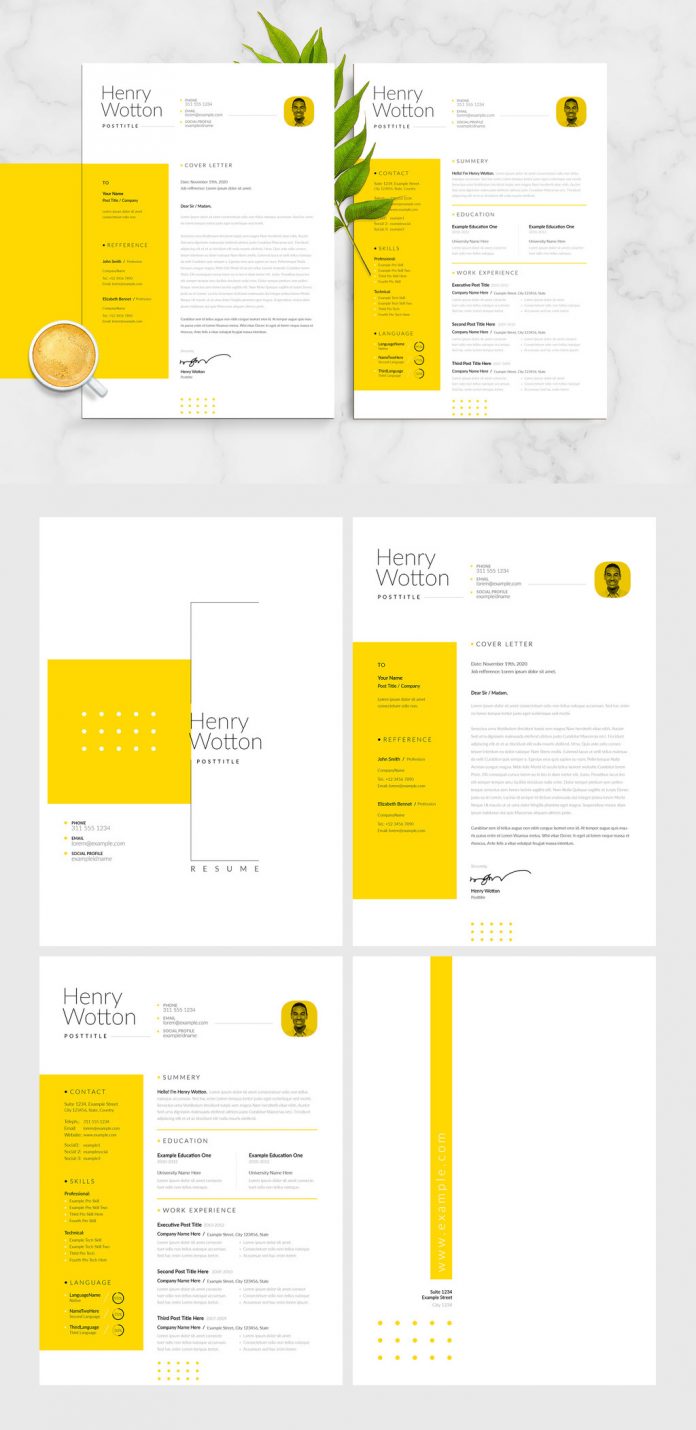
This well-designed resume template is available for download on Adobe Stock.

Consisting of four pages including cover, letter, cv, and closing page, this high-quality resume template is a real eye-catcher. Designed by Adobe Stock contributor @GraphicArtist, this beautiful template can be edited very easily. You only need basic knowledge of how to work with Adobe InDesign. Using this modern and minimalist resume template, you are sure to stand out from the crowd of competitors. Created with a uniform layout and delicate yellow accents, this resume and cv template will hopefully help you to get your desired job.

As mentioned before, this customizable resume template requires Adobe InDesign. You can get the latest version from the Adobe Creative Cloud website, just have a look here. Feel free to learn more about this Adobe InDesign template by clicking on the following link or have a look at the images below.

Modern and minimal resume, CV, and cover letter InDesign templates with yellow accents.
This modern and minimal resume, CV, and cover letter InDesign templates with yellow accents can be downloaded here.

Take a look at our recommended Templates category to find more design assets.

By Dirk Petzold

Sourced from WATC

By Shubham Agarwal

“Advertising income often provides an incentive to provide poor quality search results,” Google’s founders, Sergey Brin and Larry Page, argued in a research paper when they were still working out of their Stanford dorm rooms.

Today, Google is synonymous with the web — but it’s also far from the sort of “competitive and transparent” search engine Brin and Page set out to develop decades ago. Google’s journey into the dictionary and becoming a trillion-dollar empire demanded a slate of fatal modifications to its original blueprint. The result is a search engine that buries organic links under an avalanche of ads, keeps tabs on its visitors’ every move and click, and manipulates results by tapping into the giant pool of data Google harvests from the rest of its services.

An emerging roster of competitors thinks it can offer you a better deal. Their search engines vow not to track you or even show ads if you’re willing to shell out a couple of bucks. Can they save us from Google’s invasive and monopolistic rule, or are they doomed to fizzle out after fighting fruitlessly against an unstoppable behemoth?

The rise of private search engines

Josep Pujol, the chief of search at Brave browser, calls Google the web’s “toll-booth” where “producers of information have to abide by certain rules or directly pay to be reachable.”

Screenshot of Brave Browser on mobile and desktop.
Brave Browser

Google may appear simply as one cog in the larger internet machine, but it has more sway than you’d think. For most people, it’s the main avenue through which they access information online, and if something can’t be found via Google, it practically doesn’t exist. Therefore, having only one (or two) ways to access the web is very problematic, Pujol adds.

The startup behind Brave browser, which now hosts about 34 million users, rolled out its search engine a few weeks ago. Unlike Google, it doesn’t profile users and claims it won’t use any “secret methods or algorithms to bias results.”

Brave is indexing the web’s trenches from scratch, which means it ultimately won’t rely on aggregators like Bing and attempts to be everything Google is not. It’s private, offers you more control over how anonymous you want to be while searching, and most importantly, it doesn’t have a vested interest in showing you ads.

Would you pay for a private search engine?

While Brave plans to offer both ad-supported and ad-free premium subscriptions, Neeva, a new private search engine from a pair of ex-Googlers, believes as soon as advertisements enter the picture, the focus shifts away from the user and to figuring out how to “squeeze an additional dollar out of another click” for advertisers.

iPhone screens comparing what it's like without Neeva versus with Neeva.
Without Neeva versus with Neeva Neeva

Neeva’s CEO and co-founder, Sridhar Ramaswamy, who previously spearheaded Google’s crown jewel (its $115 billion advertising arm) for over a decade, says, in a way, people are already paying for search engines like Google — by letting them siphon up their personal data, settling for a “bad user experience with wall-to-wall ads, and substandard content.”

Neeva, therefore, has an upfront $5 monthly fee, and in exchange, it gets you a private, ad-free search engine that can also surface your information from third-party apps like Gmail, Dropbox, and Microsoft Office 365.

Although Neeva could potentially shape up to be a compelling, ad-free alternative for those who can afford it, experts say its success and the underlying pay-for-privacy model, in general, present a difficult socioeconomic problem.

“If it’s necessary to pay for privacy,” Dr. Shomir Wilson, the director of the Human Language Technologies Lab at Penn State, said to Digital Trends, “then it becomes a luxury that not everyone can afford.”

Not a level playing field

Neeva and Brave aren’t the first ones to challenge Google, however, and there’s a good reason why it’s been nearly impossible for competitors like Bing to even put a dent in its monopoly. Google controls over 90% of the search engine market, and going up against its swathes of resources has been an uphill battle for newcomers offering alternatives. It has accomplished that by practically starving its opponents of any room to grow.

Google pays platform owners such as Apple, Mozilla, and others billions of dollars to be the default search engine on the most popular operating systems and browsers, including Macs, iPhones, Android phones, and Google Chrome. And there’s little chance users of these platforms will go out of their way to switch search engines, let alone be even aware of choices.

“We build durable habits around search engines,” Dr. Wilson said. “Once a search engine is familiar and useful, going back to the one we like can be kind of reflexive.”

But as awareness for privacy-first products soars among people and Big Tech faces its greatest antitrust battle, Kamyl Bazbaz, vice president of communications at DuckDuckGo, a private search engine that has been up at arms with Google since 2008, is hopeful that the tides are turning.

DuckDuckGo has witnessed unprecedented growth over the past year, and its active users have doubled from 50 million to 100 million. It’s also now the second most used search engine on phones in several countries, including the United States. In addition to a search engine, DuckDuckGo offers tools to protect your identity from third-party trackers and other malicious online practices.

Fighting for a future without Google defaults

Cooper Quintin, a senior security researcher at the Electronic Frontier Foundation, agrees breaking Google’s default power is key for competitors to thrive, but it would take “strong action on behalf of the government to actually enforce such antitrust laws.”

Luckily for Neeva, Brave, DuckDuckGo, and rest, the Justice Department — along with eleven state Attorneys General — has sued Google on those exact grounds.

“Google’s control of search access points,” the antitrust lawsuit says, “means that new search models are denied the tools to become true rivals: Effective paths to market and access, at scale, to consumers, advertisers, or data.”

If history is any indication, the odds are against Google. Last year, the search engine giant lost a similar suit in Europe and now allows Android users to pick their default search engine at startup instead of making that choice for them.

Whatever the outcome of these lawsuits may be, Google’s rivals have a long way ahead of them before they even have a chance at threatening its search engine monopoly, and they realize that.

In the meantime, though, Pujol says Brave is focusing on what it can do, which is building an alternative. “We are crazy or bold enough to try because we know there’s a demand out there.”

By Shubham Agarwal

Sourced from digitaltrends


By Kunal Gupta

HubPages is a platform that lets you write articles and get paid for doing so. Here’s what you need to know about HubPages.

Are you a creative person who loves to produce written content? Or do you like to create written content for any other reason?

With HubPages, you can earn some extra bucks while you simultaneously fulfil your creative desires.

HubPages is a platform that has been around since 2006. It allows users to produce written content—such as blog posts and articles—and publish them on HubPages. You can earn money in two ways:

  1. By adding Amazon affiliate links (Amazon Program by HubPages)
  2. By displaying Google Ads (Ad Program by HubPages)

What Are HubPages’ Network Sites?

Hundreds of thousands of visitors consume content that is published on the HubPages network sites every month. HubPages has a variety of niches that they call “Network Sites.”

You can write for any niche once you sign up and become a member. There is no restriction as to which niche you have to choose, and you can produce content for one niche today and another niche the next day.

Here are some of the websites and their niches that make up the HubPages Network:

  1. Tatring: Everything about tattoos and piercings
  2. Pethelpful: For the love of animals
  3. Bellatory: Everything about fashion and beauty
  4. Delishably: Everything about food and drinks
  5. Axleaddict: Everything about auto (cars and bikes)
  6. Caloriebee: For diet and exercise
  7. Dengarden: Everything about home and garden

HubPages has more than twenty-five websites in their network, and each website serves a specific audience and niche.

Click here to find out more about all the websites and niches under HubPages.

How to Sign Up for HubPages

The first step toward publishing articles and earning through HubPages is to sign-up for HubPages. Go to the signup option on the HubPages website, and you will find this page.

Hubpages-signup-screenshot-No-1

Fill in the necessary details and create your account. Once you create your account, the next step is to update your “Profile” and “My Account” information to start earning money and get paid.

Hubpages-signup-screenshot-No-2
Setting Up Your HubPages Profile

Once you log in to your account, you need to go to the section that says “More.” (You will find this in the top left corner of your screen.)

Once you click on “More,” you will land on a page where you can see many tabs:

Hubpages-more-tabs-screenshot-1

Set up your profile and fill in your account information in the tabs of the “More” section.

Next, click on the “Earnings” tab and start configuring the programs you want to use to earn money. I use both programs as it helps to give readers a better experience if we add something relevant from Amazon.

It would be best if you configure your “Google Analytics” as well, since it gives you a better and more detailed analysis of how your articles are performing. You will be able to see things like:

  1. Where your traffic is coming from (Google, Facebook, Instagram, etc.)
  2. Which countries have the most viewers for your article?
  3. How many people read your article.
  4. For how long a person stayed on your article.

And a lot more.

However, you can choose to skip setting up the Analytics step if you choose to. It depends on how serious you are about HubPages and the performance of your articles.

The final step is to set up your payment system. HubPages pays through PayPal, so you need to have a PayPal account for this. If you already don’t have one, you can create one right away. It’s pretty straightforward, and you won’t take more than five to ten minutes to create a PayPal account.

What to Expect From HubPages

HubPages is an excellent way to earn extra money for those who love to write and want to make money while doing it. It’s like killing two birds with one stone.

However, there are a few things that you need to be mindful of before you start your journey with HubPages:

  • It’s not a get-rich-quick scheme where you can earn thousands of dollars from the get-go.
  • It might take you months or even years to get significant traffic to your articles.
  • Most people give up after a couple of months because it’s a slow and gradual process. Don’t expect results overnight.
  • If you stick around and write quality articles, it’s feasible to make a few hundred dollars every month.
  • Your earnings can go into the thousands, but you need to understand that it’ll take a lot of effort, consistency, quality, dedication, and hard work to get those results.

Click here to find the FAQs for HubPages. You can learn a lot about what you should expect from them and what they expect from you.

The First Steps Towards Earning Big on HubPages

When you sign up with HubPages, you need to familiarize yourself with the quality standards HubPages wants to maintain. For this, they have a system in place that is known as “The Bootcamp.”

In this, you need to write five quality articles to get featured on the HubPages website. Featured articles are the articles that you will be eligible to get paid for. HubPages will run ads on featured articles only, so you need to ensure that you write high-quality articles every time to get featured.

Hubpages-featured-article-screenshot-1

Things to Remember When Using HubPages

  1. You cannot upload plagiarized content, nor can you upload any content that’s published on HubPages anywhere else.
  2. HubPages has a team that monitors your articles, and you should not try to outsmart them.
  3. If you violate any of their terms and conditions, your account can get banned and you will lose all your hard work.

Click here to find the Learning Center for HubPages. You can learn a lot about what you should and can be doing on HubPages.

Follow Your Passion on HubPages

It’s great to have an affinity for something. It’s even better when that something turns into a money-making affair. If writing sparks a fire in you, you can happily do it and earn from it as well. HubPages will allow you to make your dreams come true.

You don’t need to be unhappy at a job that you don’t like. You can follow your passion for writing and make money doing it. You can start today and see for yourself whether it is something that you like or not!

By Kunal Gupta

Sourced from MUO


By Stephanie Burns

Some days a little healthy competition can keep you on your toes. Other days, it can knock you off your feet. Few people know that better than Kelly Wackerman, the creator and co-founder of theLONDONmethod, a barre fitness class based on the original teachings of Lotte Berk.

Boutique fitness, including Barre, is a multi-billion dollar industry. “There are hundreds of techniques that fall under the category of barre classes,” says Wackerman. “It’s everything from ballet classes to hybrid Pilates and yoga classes. It’s a very competitive industry where everyone thinks their way is best.”

With rivalry this fierce, it can feel impossible to get the attention (and the dollars) of paying customers who have so much variety to choose from. “At first, competition in the industry frustrated me, but now it inspires me,” says Wackerman, who has trained thousands of students and teachers in eighteen different countries across the globe. I asked Wackerman for her best strategies for standing out from the crowd.

1. Find Your Unique Angle

What elements can you pinpoint in your business that make you different from everyone else? After all, not every coach inspires clients the same way. Not every artist uses the same techniques. For Wackerman, answering this question was easy because of the foundation she built her theLONDONmethod on.

“If you really want to learn and understand English, you’ll probably spend some time studying Latin,” says Wackerman, who began her career as a fitness instructor 15 years ago. “After getting interested in learning and teaching barre classes, I did my research and uncovered the teachings of Lotte Berk, the woman who is credited with creating barre.” Realizing that many of Lotte’s original tutelage had been abandoned or changed by other instructors, Wackerman decided to revive them with Lotte’s daughter, Esther Farifax. She travelled to Berk’s home in England to study the moves and theLONDONmethod was born.

“Your own story doesn’t have to be that extreme,” says Wackerman. “But whatever it is, it’s unique because it’s yours.” Even if you can’t go back to the source of your particular practice, perhaps you can differentiate yourself by the clients you serve, the science behind your technique, the results you’re able to achieve or the way you deliver your service. Whatever that distinct approach is, be sure to tout it to your clients.

2. Get Collaborative

Spread the word about your technique far and wide so it’s not drowned out by the sound of others talking about their methods. Wackerman not only pitched herself to podcasts that might be considered competitors, but also invited near competitors on her own podcast to talk about their methods. “If you have knowledge you’re willing to share with others, everyone will come to you as a source,” says Wackerman, who picked up additional clients from her guest appearances. “I had foundational knowledge of this technique that other instructors were interested in.”

Wackerman also developed an international training program. “I decided that this was one way I could try to unify all barre teachers and keep the true legacy of Lotte Berk alive,” says Wackerman. “In an industry where everyone is literally fighting over who owns the bicep curl, we allowed our community to learn and teach the original work of Lotte Berk at their own studios.”

3. Adopt an Abundance Mindset

Even if you’ve niched down your clientele, chances are that it’s still in the millions. That’s a fairly unlimited number for you to reach out and offer your services to. The fitness industry is no different. From 2013 to 2017, boutique fitness brands grew 121%. That’s more locations and more teachers for a growing number of students.

“Knowing that there is enough out there for everyone and being confident that what you offer is valuable will set you apart from your competition,” says Wackerman. “There are no limits to who can benefit from what I offer and it’s likely the same for you too.”

By Stephanie Burns

Follow me on Twitter or LinkedIn. Check out my website or some of my other work here.

Stephanie Burns is the founder of The Wyld Agency, an amplification and visibility agency focused on building the legacy and personal brands of company founders. With a background in brand building, media buying, strategy and entrepreneurship, Stephanie has wide experience with an eclectic portfolio of industries.

Sourced from Forbes

By

As part of The Drum’s Retail Deep Dive, Netmums managing director Rimi Atwal argues that by comparing and contrasting pre and post-pandemic family mindsets, brands can effectively target this demographic.

The pandemic has driven seismic change in virtually all aspects of our daily lives – from workplace norms, to the provision of education; from travel to entertainment, and how, why and when we shop.

At Netmums, we conducted in-depth quantitative and qualitative research into the lives of UK families to mark our 20-year anniversary at the end of 2019.

Although we didn’t know it at the time, our insight captured the priorities for UK families in that key moment immediately preceding the pandemic, and the dramatic impact it would have on our lives and values.

To fully understand the shifts that have taken place for all UK families, Netmums conducted further research in May 2021. We revisited the questions we had posed 18 months previously and were able to track how families’ priorities and lifestyles had changed, and what new factors are shaping how they spend their money and time.

It became immediately apparent that attitudes to shopping and spending have shifted significantly. In our 2021 survey, 34% of parents say, ’since the pandemic I have changed the brands I buy’, 59% agree ’since the pandemic, delivery efficiency and cost is most important to me’, and 65% say now that, ’price is usually my first consideration’.

Digging deeper into our insight, the story is a complex one. Obvious pressure points like cost and convenience come to the fore, but even more striking is the shifting sense of family priorities and concerns from global to local, outwards-facing to inwards-facing, and from environmental to social.

Global to local

A core 2019 finding was 90% of parents declaring the environment a key consideration in their everyday purchasing decisions.

However, in 2021, the environment has fallen down the pecking order. When asked to rank family priorities:

  • 82% cited equal opportunities for their children
  • 76% said managing screen-time
  • 65% said environment/climate change

By 2021, 66% parents, ‘wish brands and retailers made it easier to purchase sustainably and ethically‘ – down from 75% in 2019. Today, less than half (48%) of parents agree ‘I would be prepared to pay a little bit more if a brand I like demonstrated a real commitment to the environment‘.

In terms of global issues, today, social inequality and mental health emerge more frequently than environmental concerns, probably as a direct result of the way the pandemic has emphasised the impact of social inequalities on health outcomes and underlining the importance of good mental and physical health.

Outward-looking to inward looking

In 2021 family worries about the outside world have been replaced by a focus on improving and investing in self, the family unit and the home. Parents cite ‘family bonding time’ as a key priority and emphasise their desire to invest in special occasions and spend more on family time:

  • 61% are focused on getting fitter
  • 50% are planning to spend on home improvements
  • 68% want to invest in more family events/entertaining
  • 52% want to save money

Greater ambivalence to tech as a positive force

Another emerging trend is a shifting attitude to technology in our lives – just three per cent of parents want to buy more tech in 2021, compared to the 76% of parents in 2019 who enthused technology made their lives easier through time-saving solutions like online shopping and internet banking.

Moreover, 76% of parents cited managing everyone’s screen-time as a major challenge in their lives in 2021, versus the 52% of parents in 2019.

Lessons for retail brands

It’s not surprising that the past two years have shifted the dial on family spending behaviours and priorities. But as we emerge from the third national lockdown, what can retail brands do to connect with UK families and align with their new priorities?

Judging by successful campaigns recently created by Netmums for high profile family brands, it’s clear that marrying brand credentials with what families want right now, is key.

Our recent Quorn campaign is a strong example of a brand who understands the mindset shift. While the campaign maintains its pre-existing focus on sustainability, it also positions the brand as one that easily enables healthy eating and family time. Bringing this concept to life, are family cookalong videos, co-created with Netmums’ editorial team and celebrity chef, Lisa Faulkner, with Netmums users joining virtually from their own kitchens.

Family stalwart brand, Fairy, is another example of a brand demonstrating clear understanding of an evolving customer mindset. The ‘Fairy Cares’ campaign, set to launch in September, will empathise with families’ challenges post-pandemic by offering both practical advice and resources, and emotional support. At the campaign’s heart is a clear commitment from Fairy to support all parents, boost their inner confidence and help celebrate family moments at a time when traditional support systems are reduced and anxiety at an all-time high.

And building out of 2021’s key insight that 98% of parents rank family health and wellbeing as their top priority, Petits Filous’ partnership with Netmums in creating a ‘Happy Healthy Kids’ hub, has been a resounding success. Delivering on parents’ needs for fun and healthy lifestyle ideas for the whole family, from healthy snack recipes to activity ideas, Petit Filous is positioning itself as the brand that will keep kids healthy and happy all year round.

As these brand partnerships show, connecting with a family-focused customer base must be about positioning the brand as the answer to what families need, right here, right now. And the only way to find out what families need, right here, right now, is to ask them and listen to what they say and how they feel.

For more on the reinvention of retail, check out The Drum’s Retail hub, where we explore everything from livestreaming e-commerce to AR shopping and conscious consumerism.

Feature Image Credit: Netmums 

By

Sourced from The Drum

By Steve Hall

Email marketing is probably the highest-value marketing strategy to grow your business. Businesses of all sizes are using email marketing to reach their new and existing audience. If done right, email copywriting can be the driving force of your business growth. Besides, email marketing is a highly cost-effective strategy. One study shows that it can earn you an incredibly high ROI of $44 for every dollar spent.

The hardest part is getting your audience to open and actually read the emails. So, to make your subscribers open the email and read it, you have to visualize your audience and create emails with the reader in mind.

Are you struggling with writing an email marketing copy that converts?
In this post, we have listed 7 Email Copywriting Tips that will help improve conversions and get more leads and sales.

1. Grab Attention with a Compelling Subject Line

First things first! Give maximum time to crafting an engaging subject line that will prompt your recipient to open the email. As stated above, the most challenging part about a marketing email is to get your audience to open it. You only have a few seconds to engage your customers in their inbox. You may not like it, but the fact is about 80% of emails get deleted immediately.

It’s the subject line that will decide the fate of your email, which means either the recipient will open it, delete it or report it as spam. Although a subject line takes up the least space, we recommend you spend the most time crafting the perfect subject line. Your subject line should give them food for thought. They must get this feeling that the content in this email will benefit them, their business/cause.

2. Insert a Preview Text

The next most important thing is the preview text of your email. Studies show that email opening rate increases when you use a preview text. Wondering why? For most of the modern email subscribers, it’s not just the subject line that inspires them to open an email. They look at the preview text as well to get a better idea of the email content.

Your preview text is a teaser displaying below the subject line, providing an insight into the email. In most email clients, it is just the first line of the email. But some email tools give you a chance to select a preview of your choice.

In either case, craft it carefully. The preview provides you an additional space to draw in your subscribers.

3. Improve click-through rate with Visual Content

They say, “a picture is worth a thousand words.” Whether it’s a blog post, a marketing email, or a digital ad, finding and using the right image can help engage your reader effectively.

Adding images and infographics can significantly increase email performance levels, including open rates and click-through rates. Wondering how?

  • Your subscribers don’t have time to read paragraphs after paragraphs.
  • Images make messages easy to understand and almost at a single glance.
  • Recipients respond far more quickly to visuals as compared to text.
  • Visual content can lead to better retention.

You can use a variety of images to connect with your subscribers. For example, you can take real pictures, create graphics or you can use free stock photos.

Nevertheless, it is pertinent to mention here that while adding pictures can strengthen your message, irrelevant or stuffy images can be intimidating.

4. Ensure You Communicate Effectively

When crafting a marketing email, don’t think of it as an electronically sent message to a random reader. Instead, take it as a chance to communicate with your subscribers in an effective way. Therefore, curate it carefully, thinking of it as a direct conversation with the subscriber.

One study shows that personalized email messages increase click-through rates by 14% on average and conversions by 10%.

So, rather than sending a robotic email-for-all, use emails to give subscribers something of interest – from information to inspiration or even a discount or a deal – whatever you think could be the area of interest of the target email recipient.

Once done crafting an email, give it a critical read. Will the recipient find himself/herself in a better place after reading it? If not, start over again!

5. Keep it Simple!

You don’t need to use all caps and multiple exclamation marks in the subject line or preview text, only to grab the reader’s attention. In email marketing, using an all-caps or numerous exclamation marks technique is considered shouting online. Besides, overusing them makes your email look spammy and ultimately hurts the performance levels of your email, such as click-through and open rate.

Having that said, you don’t have to sound boring either. No marketing rule requires a business email to be dull and dry. Use your email content to stir readers’ imagination by using whatever technique you feel can help the cause. One tip, as discussed earlier, is using visuals.

6. Prefer Clarity Over Catchiness

When writing a marketing copy, clarity should always be your first preference. Make sure your email is clear first and catchy second. A clear statement can be made catchy and funny, but if your entertaining email content does not have clarity on the subject, it will go to the trash.

The subject line’s clarity is particularly essential. The first look at an unopened email should give your subscribers a clear image of what’s it for them inside the email. Never sacrifice clarity for entertainment value.

7. Establish Relevancy

From the subject line to preview text to the message in the email, every part of your copy should establish relevance through personalization. Always write your email copy with the target segment in mind.

The relevancy rule applies particularly to the subject line and preview text. This will convince the recipients that what’s inside is relevant to them. Emails with personalized subject lines are 26% more likely to be opened. So use the very beginning of the email to explain why you are writing to them.

Final Words!

When a person receives an email from an unknown sender, or even from a business, few questions that strike his/her mind include:

  • Why are you emailing me about it?
  • Why would I want your product/service or idea?
  • Why from you?
  • Why now?
  • How would it benefit me?

Make sure your curated email copy answers all of these questions. If you write an email keeping the tips mentioned above as well as these questions in mind, there’s a greater likelihood that the recipient will click through and redeem the offer in the email.

By Steve Hall

Sourced from AdRANTS

Sourced from The Drum

This month’s Ideal Insights from Adstra highlights privacy issues and growing trends on the national and state level.

“Renewal is not just innovation and change. It is also the process of bringing the results of change into line with our purposes.” — John W. Gardner

This month’s update

As the world around us is starting to awaken from the pandemic, so too is the level of marketing we are seeing at our clients. We are seeing increases with our clients on both our direct mail and digital audience activities. Interestingly enough, we are also seeing an increase in combined direct mail and digital marketing campaigns. On our Non-profit side, we are seeing more than twice the number of multi-channel campaigns than we have in either of the last two years. So, what is driving this interest? Multi-channel or omnichannel marketing has always been one of those often discussed but has yet to catch fire ideas. While we cannot offer a definitive answer, we can certainly provide some insight and guidance behind the recent increase in efforts.

First up, the need to solve the impact of the announced postal increases. While digital marketers fear the impending changes of cookie deprecation and MAID tracking, direct mail marketers fear the announced cost increases in postal and printing rates. The return on direct mail campaigns is equally driven by response rates and executional costs. Marketers can adjust to small changes in cost but are challenged by major shifts like those proposed. Direct mail certainly has a place for marketers in the future, but it needs an enhancement to make the ROIs continue to work at scale and enable access to newer and younger audiences.

Second up, marketers are faced with the continuous shift away from engagement with mail by the younger generations and the bifurcation of consumers’ attention across multiple media channels. No single media has the scale of mindshare and engagement to make many traditional marketing approaches work. The walled gardens certainly offer some of the best opportunities to engage customers, but it is often on the garden’s terms and eliminates most of a brand’s ability to effectively manage the communication journey. For those brands that can exist off the older traditional direct mail audience, they can still get by, but the runway is shortening as that audience continues to age out of the business sweet spot. Never is this more true than in the non-profit space, where organizations are desperate to find younger donors and secure their long-term relevancy.

Together these two factors are driving the need to try something new. And this is where multi-channel campaigns fit in. Direct mail still has the many benefits of delivering the relevant materials to help convert customers to buy or donate, but digital offers the low-cost opportunity to build brand awareness and stimulate the discussion around a potential purchase or donation. Like anything that is new, however, success on multi-channel campaigns has been limited. In many instances, we see brands simply declare that it just doesn’t work.

Much of this we believe has to do with the starting audiences. Models tuned to direct mail response often misrepresent the value or promise of digitally engaged prospects. And digitally defined audiences do not reflect the ability to engage in a direct mail piece. Brands need to start the audience definition process anew, just like they might with any new product launch. If you haven’t looked into or understand how a multivariate test works, we might suggest educating yourself here. There needs to be far more testing of ideas and approaches before declaring multi-channel marketing as a no-go. Marketers need to better understand the entire customer engagement process and make sure their campaigns fully and effectively support that engagement.

For many campaigns, marketers see the digital component as simply brand awareness building and the direct mail piece still as the method of transaction. But in some cases, and with some audiences, it may be better to invert the thinking. Couldn’t the direct mail piece be the brand awareness piece and the digital component of the transaction vehicle? The problem with this scenario for many brands is that their websites are not tuned to transact but rather to support the company’s broader brand-building efforts.

In one of our client’s recent tests, we saw a 250-300% increase in traffic to their website out of the campaign, but effectively no increase in conversion. This was a clear case of opportunity missed because the website was not set up to close the deal. The overall campaign results showed no lift in performance, but it was clear this was more a self-inflicted failure vs a failure of the campaign itself.

In thinking about customer engagement, we would also point out here the need for consistency and alignment in messaging among channels. Where the messages are aligned at the individual level, brands are far more likely to see success than in those situations where they are not. For one publisher client of ours, they were able to drive an 80+% lift in direct mail performance for an insurance company they were working with by supporting the highlights of the direct mail materials and telling customers to keep a lookout for the mail piece. Given the success of that campaign, the publisher tried to support their own direct mail subscription offers digitally, only to find out they depressed response rates around 20%. The reason, the direct mail piece had long been designed to look like a “bill”, so customers simply paid for the subscription. By raising awareness in the digital campaign that it was an “offer”, not a “bill”, the response lift is driven by a sense of obligation disappeared.

Overall, our experience suggests that if you stay aligned and consistent in messaging at an individual level you should expect to see a 5-20% improvement in ROI. And we believe that will only get better as experience and ability to market at an individual level improve. As we learn more through the campaigns we have in the market now with our clients, we will continue to report back on the successes and failures. There is a future in multi-channel marketing, we just need to get there together.

Privacy highlights on the national level

Senators Amy Klobuchar, John Kennedy, Joe Manchin, and Richard Burr introduced the Social Media Privacy Protection and Consumer Rights Act of 2021. The bill would “give consumers the right to opt-out and keep their information private by disabling data tracking and collection” and “mandate that users be notified of a breach of their information within 72 hours,” the sponsors said. The Verge, Gizmodo, andArs Technica reported on the bill.

Senator Kirsten Gillibrand introduced the Data Protection Act of 2021, which would create an independent Data Protection Agency to “protect Americans’ data, safeguard their privacy, and ensure data practices that are fair and transparent.” The legislation expands on similar legislation the Senator introduced last year. “In today’s digital age, Big Tech companies are free to sell individuals’ data to the highest bidder without fear of real consequences, posing a severe threat to modern-day privacy and civil rights. A data privacy crisis is looming over the everyday lives of Americans and we need to hold these bad actors accountable,” said Senator Gillibrand.

R Street called on Congress to take steps to protect Americans’ data from its adversaries by passing a federal data security law and data privacy law. A white paper published by the group “seeks to reframe the need for data security and privacy legislation to acknowledge a stark reality.

Greg Bensinger, a member of The New York Times editorial board, cited the 6% of U.S. daily users who have opted into data collection on Apple’s latest software update as evidence of consumers’ demand for more privacy. “Consumers have no federal rights to privacy, leaving tech companies to put in place policies as they see fit. And critics allege Apple may be coming out with the changes to get ahead of regulatory pressure and an ongoing antitrust lawsuit over its app store. Advertising is only a small part of Apple’s business, meaning it can afford to take a cut in revenue while sticking it to competitors. Ironically, Apple will have to act even more like a regulator itself to ensure that app developers are following the rules of its new software,” he wrote. “Companies did just fine for decades marketing to consumers without access to their every movement or keyboard and mouse click. And with 94 percent of Americans saying they liked it that way, it’s time for advertisers to listen.”

Consumer concerns about data privacy and the need to meet regulatory requirements like GDPR are the main barriers to growth in mobile marketing, according to WARC’s survey of over 500 marketing professionals in Europe, the Middle East, and Africa (EMEA).

Privacy highlights on the state level

Connecticut – Bloomberg Law, Connecticut Post, and Hartford Courant reported on failed efforts to include data privacy legislation in omnibus budget legislation in Connecticut.

New York – Legislation that would require companies to obtain opt-in consent from consumers before processing their data for ad targeting and would allow class-action lawsuits over violations was approved by the Senate Consumer Protection Committee in New York.

As we are constantly trying to feed helpful content out to our client community, we encourage you to visit our content blog where you can get our latest thoughts on industry issues. While you are there, you can also check out the new look and feel of our website. Our goal was to provide a clearer understanding of Identity, Data, and all the services we have to offer.

Should you look for more help on these topics, please reach out and we would be happy to help. Email us at [email protected]

Connect with Adstra

If you like what Adstra has to share or want to learn more about what we do, follow us on LinkedIn @Adstra, Twitter @Adstradata or Facebook @Adstradata. We welcome you to the new ideal in data.

Sourced from The Drum

By Mary Juetten

If you’re anything like me, you’re annoyed by the amount of daily physical mail, as much of it feels wasteful of time and resources. That’s doubly true for mass marketing material that has no bearing on my interests or spending habits, all of which ends up directly deposited into the recycling bin.

So, I was a bit sceptical to speak with Andrew Field, Founder and CEO of PFL, a Montana-based firm working in the space of print marketing. To Andrew’s credit, his company’s model aims to be less wasteful both in its targeting and its use of recycled materials and sustainable energy.  Perhaps most interesting was learning about how his company has navigated the digital era as a print marketing company, and succeeded at a time when most assumed print to be dead.

Mary Juetten: When did you start?

Andrew Field: I cofounded the company in 1996. The idea for PFL came to me while I was fly-fishing on the Yellowstone River with a friend. At first, we were a six-person print shop dedicated to small businesses who needed access to affordable printing without compromising quality.

As the internet and ecommerce rose to the ubiquity we know today, I realized more businesses were turning to the internet for products and services. So, in 1999, we launched the first U.S. ecommerce site for full-line commercial printing. For much of the early 2000s, the business was focused on printing for small and medium businesses (SMBs) across the country.

With the rise of SaaS, I saw an opportunity to make direct mail part of marketing automation – as easy as building in an email as part of the customer journey. So in 2014, we created another category, Tactile Marketing Automation.

Juetten: What problem are you solving?

Field: Businesses need a way to cut through digital clutter and make lasting impressions with prospects and customers. Direct mail does this in a way that digital marketing just can’t. Our 2020 Multichannel Marketing Report (in conjunction with Demand Metric) found multichannel campaigns including direct mail report an 18 percent higher ROI than those without direct mail, and 84 percent of respondents indicate direct mail improves multichannel campaign performance.

We create a smarter way for organizations to incorporate direct mail as an intentional part of the customer journey versus batching and blasting. Our solution works with existing CRMs and marketing automation platforms like Salesforce, Oracle or Marketo and enables marketers to send personalized, targeted, and trackable collateral to create a memorable and engaging experience for the customer.

Juetten: Who are your customers and how do you find them?

Field: Our ideal customer cares about branding, security, scalability and ROI. We have a wide range of customers from enterprise SaaS to higher education, financial services, healthcare and retail. We practice account-based marketing and use our own solution, Tactile Marketing Automation, to build relationships with our ideal customers. We delight our customers with relevant brand experiences, and then show them how they can do the same to get the attention of their audience. Also, as the category creator and leader, many customers find us through word of mouth.

Juetten: Did you raise money?

Field: Yes. In 2018, we secured $25 million in growth capital from Goldman Sachs Growth Equity. The funds support R&D, product development, and sales team growth for our TMA platform.

Juetten: Direct mail can be perceived as wasteful to some. What’s your response to this?

Field: The way we enable direct mail isn’t just batching and blasting. It is targeted, and actually reduces waste.

For example, let’s say Company A is hosting a webinar and Customer X attended webinars in the past and signed up to attend the upcoming webinar. Company A could send Customer X related content and a snack to enjoy while watching the webinar.

Here’s another example in the nonprofit world. If a past donor opens an email or visits the homepage of a nonprofit’s website, and hasn’t donated this past year, TMA could trigger a piece of direct mail to spur the individual to donate.

This way, organizations leverage the power of direct mail but in a more intentional, less wasteful way.

Speaking of the environment, our manufacturing facility and processes are green. PFL is wind-powered, and we use soy-based inks, and minimal VOCs.

Juetten: Who is on your team?

Field: I’m proud to work with a top-notch team. It includes a very experienced senior team, the usual roles in a SaaS company like sales, marketing, software development, etc. Unlike other SaaS companies, our team also includes a large contingent of people in manufacturing and fulfillment, working 24×7.

Juetten: Any tips to add for early-stage founders or CEOs in growth mode?

Field: Get processes ironed out before you rapidly increase headcount in any given area. Then, hit the gas!

Juetten: What’s the long-term vision for your company?

Field: To help millions of marketers around the world market more effectively, and eventually to take the company public.

Thanks to Andrew for providing insight into how his business works. Ironically, we received a direct mail advertisement from a family owned moving company when we listed a property for sale and we are actually now hiring them. There is something to be said for differentiating yourself in a world of overwhelming marketing emails that are placed in the digital recycling bin (unsubscribe), and PFL’s success speaks for itself. #onwards.

Feature Image Credit: Technician worker operator works on large premium industrial printer and plotter machine in digital. GETTY 

By Mary Juetten

Follow me on Twitter or LinkedIn. Check out my website.

I am the founder and CEO of Traklight, the only self-guided software platform that creates your custom intellectual property (IP) strategy and assesses business risk. I dedicated my more-than-30-year career to helping businesses achieve and protect their success, specializing in transition or start-up phases and helping companies create sustainable financial growth.

Sourced from Forbes