Author

editor

Browsing

Sourced from WNIP

It is no secret that trust in certain sections of the media are low, right at a time when the health and welfare of the globe is reliant on accuracy.

Whether cowed into submission by right-leaning politicians, or not helping themselves with ambiguous storytelling and a questionable relationship with the provable truth, the veracity of some publishers – particularly in the news sphere – is continually being questioned.

In a recent survey of more than 2,000 respondents in February 2021, only 44% of the British public trusted traditional media for news and information. The least trusted outlet was social media with just 19%.

These damning numbers would – and should – be an issue for any self-respecting media source, but during a pandemic, they are potentially fatal.

Media coverage has been shown to shape public opinion unlike any other form of mass messaging, as it moulds people’s perceptions and responses to health crises and other social issues.

Misinformation, bias and the formatting of coverage comes at a large cost, directly affecting the public’s notion of the pandemic’s dangers – or otherwise.

The Press Gazette recently spoke to leading editors around the world, as they outlined the biggest challenges for journalism in 2021. Surprise, surprise, truth and trust were top of the pile.

Gina Chua, global managing editor at Reuters, summed up the issues.

“With the rise of misinformation, the impact of social media and stark political divisions around the world, the erosion of public trust on the news industry will be a significant challenge to address in 2021. Fact-based and impartial reporting is more important than ever.”

Never underestimate the value of trust

As danced around above, the public’s perception of our media is not exactly exemplary. But there are publications witnessing growth and recognition despite these turbulent times.

New Statesman announced digital subscription growth of 75% in just one year, with subscription revenues up 77% in three years following significant investment in its journalism and the launch of new brands and associated digital services.

Registered users on its website rose by 83% to more than 200,000 from January 2020 to February 2021, and 86% of New Statesman’s circulation is now paid for.

By recognising the worth and need for fact-based independent journalism, the New Statesman shows a clear position on the use of hard data and truth-finding within its reporting is popular.

Yet, as Marty Baron, executive editor at Washington Post, told the Press Gazette: “The biggest challenge for journalism is that facts aren’t accepted as facts any longer. Societies can’t agree on a common set of facts. We can’t even agree on what constitutes a fact.

“We can certainly be more transparent, revealing more about how we go about our work.”

This could be a seismic change in journalism, and media in general. The more people understand and appreciate the processes and the raw data drawing indisputable facts, the better the trust.

Social media is not king

The elephant in the press room was brought out front and centre during Covid-19 times.

While individual social media platforms are vital for media outlets to reach all demographics in a modern world (there were 53 million social media users in the UK as of January 2021, according to DataReportal), they share this space with politicians, celebrities, non-celebrities and self-appointed spokespeople.

As an experiment, scroll through the replies to a Sky or BBC update on coronavirus cases if you want to gauge the public’s mistrust.

Accepting quality media will shape public opinion in a positive fashion is surely the best argument towards a modern-day renaissance.

New independent research from the Reuters Institute for the Study of Journalism suggests we already have a good base from which to build.

They found that ‘people are generally sceptical of information they see on social media and are broadly able to identify false or partly false information’, and suggest the use of ‘fact-checking’ labels.

Director of Reuters Institute Dr Rasmus Kleis Nielsen commented: “Most people are sceptical of information they come across online, especially on social media and other platforms, and research suggests that independent fact-checkers not only help set the record straight, but also have a disciplining effect on anyone who may be tempted to share misinformation.”

Commercially speaking…

One of the pandemic’s more positive offshoots has been to remind everyone within and outside the industry how crucial a functioning media industry is for society as a whole.

Despite the protestations of the anti-MSM cliques, it remains the first place people turn to when honest and accurate information is required.

It is for that reason media outlets have always been such a key part of the advertiser’s relationship with its customers.

After all, any renaissance’s main goal must be to reduce the general mistrust of the media, which in turn produces a ‘safe space’ for advertisers.

As Press Gazette editor Dominic Ponsford concludes: “Our reporting suggests that the coronavirus slump has been far kinder to the news industry than the last big downturn in 2008. Back then lasting damage was done to the media as property, jobs and car advertising disappeared from the news media never to return.

“Looking at the 16 leading news and information companies, they were worth $38bn more in April this year than they were a year earlier.

“While advertising revenue is down across the board, digital advertising is growing for everyone except local news brands. And the biggest and most positive trend to come out of the last year has been huge growth in the number of people willing to pay for news online.

Press Gazette research shows that English language news websites now have more than 23m paying subscribers. Titles like the New York Times, Wall Street Journal and The Athletic are proving that readers will pay a premium for high quality news.

“At Press Gazette we have hit record traffic numbers this year (more than 300,000 readers) but we are not focused on that number. Like many publishers we are focusing purely on serving our core market of media decision makers better, in terms that has paid off with a record quarter at the start of this year for commercial content deals.

“This has been helped by the fact that for the first time we are able to back our editorial commercial content product with Lead Monitor, a high-tech AI-driven marketing tool which helps our partners turn readers into leads.”

Phillip Othen
News Statesman Media Group

The New Statesman Media Group aims to tell stories about how the world is changing for the people delivering that change. New Statesman, the Group’s flagship title, is one of the leading progressive political and cultural magazines in the UK. The group has recently launched a number of ‘Monitor’ titles, headed by seasoned editors, covering Energy, Investment, ESG and the Technology sectors. These brands are Investment Monitor, Energy Monitor, Capital Monitor, Tech Monitor and Press Gazette. They offer content specifically created for high-value audiences, helping to attract the key players in the market and positioning clients in front of them as thought-leaders, across sectors such as luxury consumer lifestyle; public sector and government; technology; energy and infrastructure.
Sourced from WNIP

By ,

Social media giant Twitter tops US tech firms applying an EU code to tackle disinformation – even if it does so only partially.

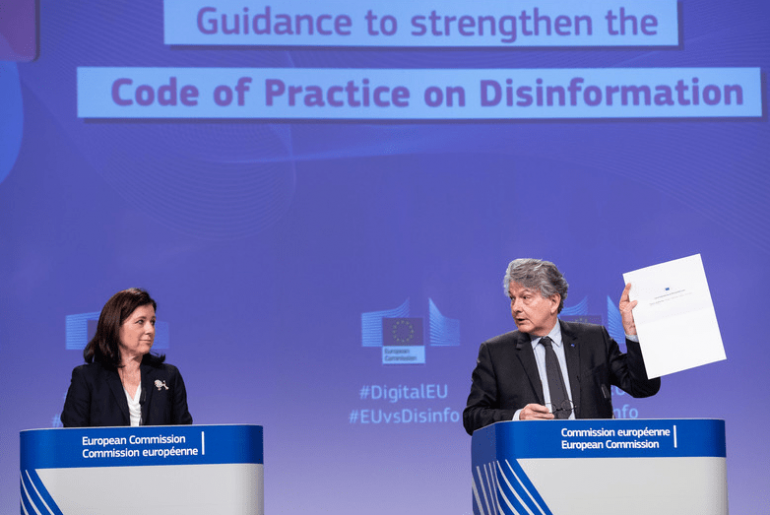
“Nobody has really fully respected the code,” Thierry Breton, the EU’s internal market commissioner, told reporters on Wednesday (26 May).

  • Twitter in March had suspended 149 accounts and removed 5,371 pieces of content which violated their Covid-19 misinformation policy (Photo: Tom Raftery)

“I would tell you if somebody had. But from Google, Facebook, Twitter, Microsoft and TikTok, one did better than the others.”

EUobserver was informed it was Twitter. All five had signed up to the voluntary 2018 code.

But given the overall poor results, the code is now being revamped.

The reform comes at a time when Covid-related conspiracies are pushing some against getting vaccinated, while others push bogus cures.

Speaking alongside Breton, EU commission vice-president Vera Jourova said the disinformation has put people’s lives at risk.

Twitter in March had suspended 149 unique accounts and removed 5,371 pieces of content, which violated their Covid-19 misinformation policy.

Facebook says it pulled 620,000 pieces of content on Facebook and Instagram globally, and another 52,000 in Europe, over the same period. Google removed 30,000 YouTube videos in the last quarter of 2020.

On Wednesday, Jourova announced the commission’s latest proposal for a beefed-up code of practice on disinformation.

The plan is to reach an agreement before the end of the year and then have it embedded into the Digital Services Act (DSA).

The DSA is set to come into force in 2022, allowing for greater oversight and possible sanctions for firms that do not follow the code.

“This is fundamental,” said Luca Nicotra, a campaign director at Avaaz, as US activist NGO.

“I think they are going all in on this and it’s really exciting,” he said – cautioning that the commission’s proposal could still be watered down later on.

Aside from the DSA embed, the code presented by the commission also introduces other novelties.

Among them is a completely new focus on algorithmic accountability and transparency.

The aim is not to reveal the algorithmic source code.

Platforms will instead have to prove they are making changes to prevent the spread of disinformation.

“We would like them to embed the fact-checking into their system,” said Jourova.

It means platforms will not have to decide what is disinformation or misinformation, she said.

“We are deeply convinced that there should be no one authorised to be the arbitrator of the truth,” she added.

The new code would require platforms to tackle disinformation across different languages.

It also introduces other measures as well, requiring them to provide more data for researchers, tackle political adverts and curb election manipulation.

“Disinformation is still something that sells well, so we want to engage also the advertising industry not to place the ads next to disinformation,” said Jourova.

Users will also be encouraged to flag harmful content. And anyone whose content is removed, can appeal.

The commission wants to monitor oversight, along with the EU’s foreign policy branch EEAS.

The European Regulators Group for Audiovisual Media Services (ERGA) and the European Digital Media Observatory (EDMO) would also help monitor.

The commission then plans to adapt rules in November on political advertising with an aim to stop foreign interference.

“We are working very closely with Josep Borrell [EU foreign policy chief] on this subject,” noted Breton.

Feature Image Credit: “Nobody has really fully respected the code, I would tell you if somebody had. But from Google, Facebook, Twitter, Microsoft and TikTok, one did better than the others,” said Thierry Breton (r) (Photo: European Union, 2021)

By

Sourced from euobserver

By

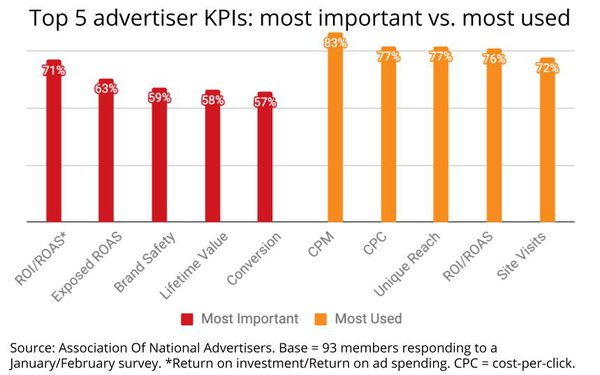
The most important KPIs, or key performance indicators, used by advertisers to assess the value and effectiveness of their advertising and media aren’t necessarily the ones they use most often, according to the findings of a new report from the Association of National Advertisers.

The report, “Media KPIs That Matter,” is based on a survey the ANA’s Media Leadership and Digital & Social Media committees fielded among their members in January and February, and found that while returns on advertising investment, followed by brand safety, lifetime customer value, and conversions and/or sales are the most important indicators, the most common ones used are by far ones that rely on the efficiency of advertising: CPMs (cost-per-thousand), CPC (cost-per-click), unique reach and site visits.

“Marketers now demand  specific and accurate indicators measuring the efficiency of their media buys,” ANA CEO Bob Liodice said in a statement released with the report, adding, “This report demonstrates  they  are keeping a keen eye on every aspect of their investments.”

The report identifies and ranks 39 KPIs, only five which rank among the top dozen for both most important and most used: ROI/ROAS; conversions; unique reach; site visits, and viewable impressions.

The report represents an important benchmark for the ad industry’s often subjective and illusive valuation standards, and it also provides a valuable snapshot of newer and emerging performance indicators:

  • Data Source Quality
  • ROI/ROAS
  • Customer Lifetime Value
  • Conversion
  • Targeting Information Quality


By

Sourced from MediaPost

By Benton Crane,

It drives sales, profits and helps businesses thrive.

Analysts are forecasting the advertising industry is surging back this year.

Brian Wieser from GroupM predicts “In 2021, the American advertising industry is poised to regain all that it lost in 2020 and more.”

As a owner and entrepreneur, that can be discouraging news. In a world flooded with text messages, news, advertisements and constant connection to social media apps, you already know how hard it is to cut through all the noise and connect with both your customers and potential customers.

It’s been well established that advertising — and the world in which we consume advertising — has changed in the last several decades. In the 1970s, the average person saw between 500 and 1,600 ads per day. Today, the average person is estimated to see between 6,000 and 10,000 ads every day.

Social media platforms have played a large role in that increase. Users upload at least 300 hours of video to every minute. processes 40,000 searches every second. Users post 46,740 new photos to every minute, and 300 million photos to every day.

So as a business owner, how do you cut through that noise? The answer lies in your ability to tell a story worth repeating.

Storybrand-style marketing has almost become a cliché in the last 10 years. And like all good clichés, it’s a cliché for a reason. It’s formulaic because it works. Great storytelling drives , profits and helps businesses thrive.

But it’s one thing to tell a story. It’s another to tell a story that stands out enough to trigger a response from your audience, to get them to engage and share your content.

Telling a good story is actually very nuanced. Think about how many stories you hear on a daily basis. From the stories your toddlers or teens tell you to the news you hear on your drive to work to the stories you read online, you can only remember so many. Only a few stick in your mind for very long. And only the very best end up being good enough to repeat to your friends or co-workers.

Good stories — the best stories — move people so much they want to engage with them and tell them to others.

You can break down these effective, noise-cutting storytelling into four main categories:

Controversial stories

This is the type of story or content that gets shared because it riles people up. The problem with controversy is that people know half of their audience will like the story, while the other half might be put off by it, so people think twice about sharing it.

Fear-inducing stories

Fear can also be a powerful motivator in stories, because it strikes at people’s tribal instincts to act in their best interest. They might share the content you create out of concern for others’ best interests, but it also might reveal vulnerability they aren’t ready to share.

Endearing stories

These perform well because they are heart-warming. People want to feel good, and stories that endear your brand to them give them positive feelings.

Humorous stories

People choose to share content because they want to add value to their network, and humour always does that. It’s universally about putting a smile on people’s faces. can take advantage of this by providing humour that adds value to their customers — and potential customers — by incorporating humour into their stories and ads.

But how can you tell if your stories are actually effective and are resonating with your target audience?

The most basic baseline for judging effective advertising is conversions. This is especially crucial when your business is first starting out, because if your product or service isn’t selling you won’t stay alive for long.

But even after making it past the early stages of growth, many businesses and marketers fail to move past the conversion-only metric. The problem is conversion-driven storytelling can make you appear like a used car salesman, doing whatever it takes to get someone’s attention and make a quick sale. This strategy can yield short-term gains but jeopardize the longevity of your business.

You’ll need more if you truly want to cut through the noise, drive sales and engender lasting customer loyalty.

For long-term success, advertisers need to expand their metrics beyond just conversion results to examine how people are engaging with and sharing their stories. These longevity-minded marketers also take into consideration reactions, comments and shares.

You might protest that these are just vanity metrics. And they can be. But they’re also more than that. They help you know whether you’re effectively communicating with your potential customers and creating lifelong, loyal customers.

These so-called vanity metrics are the digital equivalent of a face-to-face conversation with your customer, allowing you to see if your message is resonating and making an emotional connection.

So rather than dismissing responses and engagement as mere window dressing, realize that they can hold the key to creating an emotional connection with your customers. A connection that will establish your customers as loyal brand advocates, giving you the opportunity to bring longevity and security to your business.

By Benton Crane,

Sourced from Entrepreneur Europe

Chances are good that you’ve used Microsoft Outlook one way or another for sending an email or scheduling a meeting. But while these are the most common tasks that you can get done in Outlook, there are some tricks that you can leverage to improve your experience.

Recalling an email is one which we’ve covered before, but there is also color-coding emails or setting different time zones. We’ve spent some time digging through the menus for you, and to show you all that plus more.

Without further ado, here are seven things you didn’t know you could do in Outlook on the desktop, and Outlook on the web.

Set two time zones

Arif Bacchus/Digital Trends

We’ll start first with time zones because time is everything! This s useful if you’re based in a different location from your job — say you’re in New York, and your job is based in Portland, Oregon. To help keep your emails on the same page, and avoid being late to meetings, you can set multiple time zones in the Outlook desktop app.

This is one of the easiest things you can configure in Outlook. All you need to do is head into your Calendar potion of the Outlook desktop app, then visit the File menu. From there, click Options and then click on Calendar. You’ll then want to look for the Time Zones option. You should see a check box for Show a Second Time zone. Click the check box, and then choose your desired second or third Time Zone. You’ll now see this across Outlook.

Set colours for emails from certain people

Arif Bacchus/Digital Trends

Want your emails to look a bit different so your inbox is fancier or easier to read? Outlook has your back with what’s known as conditional formatting. This feature is a way to make messages that meet your own defines conditions stand out in the message list by using colour, fonts, and styles. It lands at No. 2 on our list.

You can tell Outlook to change the colour of certain messages based on a sender’s name or email address; say, if you want to make all emails from your boss appear in red.

To set up a conditional formatting rule, toggle to your inbox, in the Outlook desktop app and visit the View tab. From there, select the Current View setting. Then, after that, select View Settings. You’ll then want to click in the Advanced View Settings dialog box and select Conditional Formatting. Microsoft has a list of steps you can follow here, but we’re focusing on how you can make messages from certain people appear in a certain colour.

To accomplish this, click Add and then enter in a name for the rule. Select Font, and then under Colour choose a color that you want and then click OK. After that, select Condition and choose a Condition. In the From box, type out the contact or sender name you want to see appear in a different colour in your inbox. Then, in Filter, Conditional Formatting, and Advanced View Settings dialog boxes, select OK.

Use the Outlook hotkeys

Arif Bacchus/Digital Trends

You’re probably familiar with keyboard shortcuts like CTRL+C and CTRL+V, but did you know that the Outlook desktop app also has a set of hotkeys you can use? These keys can help you save time during your busy day, by avoiding having to drag your mouse over icons and menus to do common tasks like composing, replying, or forwarding messages.  We collected our favourite Outlook hotkeys for number three on our list. Keep in mind these are for Windows 10.

Keyboard Shortcut Task
CTRL + Shift + M Create a new message
CTRL + R Open the reply Window
CTRL + F Opens the Forward window
CTRL+ Shift+ R Open the reply window, to reply to an entire group
CTRL+K Insert hyperlinks into emails
CTRL+ Shift+ G Flag a message
F4 Search for text in an email
CTRL+ 3 Opens the contacts list
CTRL+ 2 Opens Outlook calendar

Again, we just collected some of the most common hotkeys. Microsoft has a full list on its website, covering the Outlook shortcuts for MacOS, as well as the Web. Their list is a bit more comprehensive, covering dictation, folders, reading panes, printing, and more.

Resize your files to send large picture attachments

Arif Bacchus/Digital Trends

A common roadblock you might face when sending emails with images is that the files you might want the recipient to receive are a bit too big for the limits of the web. When this happens, you can try to resize your image attachments through the Outlook desktop app so they’re not too large.

You can resize your image attachments in a few steps. Once you composed a fresh message, you must first attempt to attach all the images you want to send. You’ll likely get an error message, but don’t worry. Just head into the File tab of that email, and then look for the error message on the top. Choose the option that says Resize large images when I send this message.

Outlook will attempt to mail out the message by compressing your images down to a smaller size. In the event that the message still doesn’t go through, then you can try Zipping your files in Windows 10 or MacOS to make them smaller and then attaching the ZIP file in an email message.

Start Teams meetings, open Sticky Notes and OneNote right from Outlook on the web

Arif Bacchus/ Digital Trends

Though we’ve focused on the Outlook desktop app, Outlook on the web has some secrets, too. While you’re probably already spending time sorting through your Calendar or your emails in Outlook on the web, Microsoft did plug in some integrations with Sticky Notes, as well as OneNote there, too.

With the integration, if you sign in with the same Microsoft 365 email you use for work (or even a personal Microsoft account email) on Sticky Notes in Windows 10, or in the OneNote app, you’ll have quick access to the same things with that account Outlook on the web. This is known as the OneNote feed.

You can toggle to this at any time by heading up top and clicking the OneNote icon on the right side of the screen. This works with both personal Microsoft Accounts, as well as work Microsoft 365 accounts. So, give it a try and take notes while emailing!

We also want to note the ability to “Meet Now.”  This option shows at the top of your inbox in Outlook on the web. If you click this, you’ll be able to instantly start a Teams meeting (with work accounts) or a Skype meeting (with personal accounts.) It’s a quick way to jump through some hoops and not have to go through a lot of menus to get into a meeting right away.

Get to inbox zero with conversation cleanup

Arif Bacchus/Digital Trends

If your inbox is full of messages, then you might want to try the Conversation Cleanup feature in Outlook. It is yet another feature that you might not have known exists.

As Microsoft explains, the Conversation Clean Up feature in Outlook is designed to help you reduce the number of messages in your folders. Redundant messages throughout a conversation that are cleaned up are moved to the Deleted Items folder. Just keep in mind this is for conversations in an email thread or a collection of messages.

You can use conversation cleanup by going to your Outlook inbox on your desktop and then click the Home tab. From there, you can choose the Delete group and then choose Clean up.

You can choose to Clean up the Conversation to clean up the current conversation. Then, choose to Clean up Folder to clean up an entire folder, with the redundant messages being deleted. You also can opt to Clean Up Folder & Subfolders. With this option, all conversations in the selected folder and any folder that it contains are reviewed, and redundant messages are deleted.

Set rules to move, flag, and respond to email messages automatically

While conversation clean-up is one way to get to a clean inbox, setting rules is another. You can move, flag, and respond to emails automatically if you set rules in your Outlook desktop app. These rules can even be used to play specific sounds when you get messages, too.

To set up a rule, all you need to do is right-click on a message in your inbox and select Rules From there, you can select one of the options. Outlook will automatically suggest creating a rule based on the sender and the recipients. If you want to create more rules, you can right-click it and choose Create Rule.

Follow the on-screen prompts, and in the Create Rule dialog box, select one or more of the first three checkboxes. Microsoft has a complete guide on Outlook rules here if you need further assistance.

Sourced from digitaltrends

By Adam Speight

For years now Google’s phones have been a critical success but a sales flop. What gives?

“Awesome screen, awesome camera, long-lasting battery life,” was a tune that may still ring in the ears of many who turned on a TV around the launch of the Samsung Galaxy A51 – a few months before the launch of the Google Pixel 5.

Later in the year, you were likely greeted by advertisements of the lavish colour variations on offer from the Samsung Galaxy S20 FE and its pulse-raising domino-like showcase. Apple’s ad assault started strong, of course, with Ridley Scott’s iconic 1984 Mac ad, which ran for a full minute, and carried on it the same manner with dancing jelly iMac G3s, pop art silhouette iPod spots, the “there’s an app for that” campaign, and more.

This begs the question, do you remember anything from Pixel 5 adverts? In fact, when was the last time you saw a Google Pixel advertisement? At £599, Google Pixel 5 looks like one of the best value phones on the market, while the Pixel 4a is similarly inviting, providing a top contender for the best camera and software for any phone under £400.

Yet, the popularity of the Pixel range still wanes in the face of competition from more widely adopted and promoted rivals. In the US, Google phones have a lower market share than both LG and Huawei. The former recently chose to ditch its smartphone business while the latter has not sold new phones in the country for over a year. At just over two per cent, Google market share is dwarfed by the respective 25 and 54 per cents of Samsung and Apple.

One thing is clear, there is little point in the bumps in specs and performance of the Pixel 6 if Google continues to do a poor job of shouting about it.

The Pixel 5 and Pixel 4a are great phones, and, aside from a rocky time with the Pixel 4, Google’s smartphones have delivered when it comes to hardware and software. What’s not to love about the Pixel? From a camera that is praised year-on-year and great software to well-built hardware and, recently, attractive pricing, it’s a compelling package. However, the market speaks for itself and the Pixel just isn’t that popular.

An area that may go some way to explain the Pixel range’s lack of popularity, despite them being great phones, is advertising. According to Nielsen, since the start of 2016, Google has spent just over £40 million on smartphone advertising in the UK. By comparison, Apple and Samsung have spent around four and five times more than that.

If you don’t recall seeing a Pixel advert on TV, or think it’s a rarity, the breakdown of Google’s ad spend explains this. Google spent just £14 million on TV ad spend in the same period while Apple spent £75 million and Samsung shelled out a whopping £124 million. Samsung is spending more than three times as much on just its TV campaigns than Google’s entire Pixel ad spend in the UK.

Google isn’t short on resource, so this begs the question, why isn’t it spending more to get the Pixel out there? This question was being posed way back in 2016, with Wharton University publishing an article titled “Why Google’s Pixel is more about strategy than smartphones.” Professor of management David Hsu stated: “The main business of Google is enabling their advertising revenue model. Hardware is always going to pale in comparison.”

Also, in 2016, both Hsu and assistant professor of business economics and public policy Michael Sinkinson suggested the Pixel range should’ve been priced more aggressively. Since then, the “a” series of Pixels and Pixel 5 have done just that, yet not much else has changed. In the same article, Gerald Faulhauber, professor emeritus of business economics and public policy, argued Pixel would likely be around for “a couple of years and go away”. You’d forgive Faulhauber for thinking this, given Google’s track record, but the company is sticking at it.

Google’s Pixel marketing plan has demonstrated there’s plenty of room for it to invest more. But Counterpoint Research’s Neil Shah thinks Google may be stuck between a rock and a hard place. “Google is in a Catch-22 situation with its hardware strategy. Google’s DNA is cloud, software and AI – it’s not hardware. Also, building your own hardware and competing with your partners, especially Samsung or Chinese vendors, is not healthy in long run.” This argument was made before the launch of the Pixel though, whether vendors would be happy about the company behind Android making its own phone, but Google pushed on.

Shah points towards a “lack of distribution and scale” as one of the reasons the Pixel hasn’t taken off. “Investing in hardware is expensive,” he says. “But it is also lucrative once you gain scale. I see Google trying to figure out the right timing for its investments and try to be truly vertically integrated, like Apple, to reap the benefits and go [full] throttle.” This vertical integration, where the company controls absolutely everything about the Pixel phone, could be inbound, with mounting speculation that the Pixel 6 will be powered by a new Google-created chip, Whitechapel.

Whether a new chip is a catalyst for Pixel to finally make its mark will very much be up to Google. It’s the company that will determine whether it chooses to throw itself properly into the mobile phone business or continue to play around at the edges.

Aside from Google’s lacklustre ad spend in the UK, the quality of Pixel ads has also been criticised. Meanwhile, indicators of Google’s strategy for phones still seems unclear. It took the savvy step in the US of partnering with a carrier (T-Mobile). Then, on the launch of a Pixel 5a, it listed just two countries (US and Japan) as release locations.

From new partnerships and chip development, to better distribution and good old-fashioned advertising spend, Google has plenty of options to make Pixel more than a minor entrant in the mobile race. Yet for much of the above this has been the case for years.

Through no fault of the hardware, the Pixel has existed in mobile limbo since the range’s launch almost five years ago. At this rate, another half decade of underperformance doesn’t seem out of the question. Google needs to get serious about its worthwhile phones or put the Pixel out of its misery.

Feature Image Credit: Google / WIRED

By Adam Speight

Sourced from WIRED

By Isabel Khalili,

Optimize your Google My Business profile to make sure it works for you. Use these simple tips to get started.

With the Google My Business App, your business can stay up-to-date on Google Search and Google Maps to stand out among your competition.

This app will help you be easier to find, make it easier for customers to visit your offices, respond to reviews, messages, or questions.

Although you can’t remove listings or transfer ownership in the app, you’ll be able to see your followers and review them. Keep track of your business analytics to know your customers better. See how other features can help your business grow.

How to Set Up Google My Business

To set up the Google My Business App, you need to go to PlayStore and download it to your Android device. To add your business:

1. Enter the name of your business.

Google My Business Name

2. Choose a business category that suits your company. You can also change this later.

Business Category on GMB

3. Add a location, phone number, and Website URL.

Website details and phone number on GMB

How to Verify/Claim Your Business

To verify your business on the Google My Business app, you need to click ‘Verify‘ from the app or your computer. After filling in these details, you can choose between email or postal address to receive the verification code.

The address you provide is hidden from the public if you are concerned about safety issues.

Verify Google My business Account

After inputting the code, you will have verified or claimed your business on Google. You can now create public posts, make edits to these posts, and respond to reviews from your customers. Your edits will only appear on Google after you verify your account.

Useful Features to Improve Your Business

Here are some useful features you can use on the Google My Business app to help your business grow.

1. Business Description

Image Gallery (2 Images)

With the Google My Business app, you can create a profile about your business and describe to your customers what you do. You can also add a logo to your profile.

Adding your logo to your online business presence will raise your visibility. Customers will be able to identify you easily from your competition. Logos are also memorable, fostering brand loyalty among potential and existing customers.

2. Photos

Image Gallery (2 Images)

Pictures are worth a thousand words, and with Google My Business, you can add photos to share on your listing with your customers. This is an easier way to showcase the products you have to offer.

If you want to make a great first impression online, add as many high-quality images as you like. You can upload the images directly from the Google My Business app. Your customers can also post images and videos with their reviews.

3. Reviews and Followers

Image Gallery (2 Images)

To succeed in your local SEO, you need to rank well among your competitors. Customer reviews are a critical element in your ranking, and they help customers share their experiences with your services.

Reviews positively affect your Google ranking, so it is better to have raving ones than negative ones. Reviews will also help you gain more customers via your star rating. You will have to verify your account to access your reviews and followers.

4. Services and Working Hours

Image Gallery (3 Images)

If customers are aware of the services you provide, they can make an informed buying decision. You can use this platform to display the services you offer or the products you sell to your customers. You can also detail the modes of payment that you accept from customers.

Google My Business also allows you to state your business’s working hours so that your customers can contact you at the right time. This kind of information also reflects positively on the fact that your business is ready to offer its services.

5. Website URL

With Google My Business, you won’t have to waste time on creating a website for your business. You get a free website to let customers see your services and products. This website also lets you advertise new products and special offers. A website is essential when launching an online business today.

Free website on Google My Business

Get More Visibility With Google My Business App

The Google My Business app is essential no matter if you are new to business or looking to expand. With this app, you can make sure your business shows up when customers search for it on Google or Google Maps.

This allows you to better interact with customers by responding to reviews, updating your working hours, and sharing photos of your products and services. Using the Google My Business app will help you stand out from the competition and increase revenue. Check out these features today and see your business and customer relationships grow.

By Isabel Khalili

Sourced from MUO

By ,

Millions of Chinese smart TVs were scanning users WiFi and sending personal data to a data analytics company.

According to the South China Morning Post, a user of the Chinese developer forum V2EX published a post last week detailing that his Skyworth smart TV was scanning data every 10 minutes and gathered information such as the WiFi network the TV was connected to, the user’s IP address, device names and network latency.

“I felt that the TV was a bit slow before, and I looked at what background services were turned on. I found that there is something called “GoZheng Data Service,” and I don’t know what it is,” the user wrote on the developer forum V2EX.

“The TV is an Android system. I researched the packet and found that this thing scans my family’s connected devices every 10 minutes, and sends back the hostname, mac, ip and even the network delay time. It also detects the surrounding wifi SSID names, The mac address is also packaged and sent to this domain name of gz-data.com.”

As the user’s post noted, the data collected was being sent to the Beijing-based firm Gozen Data, which is a data analytics company that collects TV viewership data.

The Gozen Data website, gz-data.com, states that its data collection service operates in 149 million households, 140 million smart TVs and covers 457 million Chinese residents. The data analytics firm has been working with smart TV manufacturers since 2014. It is unclear if Gozen Data operates on any smart TVs sold in the U.S.

Shortly after the post on the V2EX forum gained traction, the smart TV manufacturer and Gozen Data faced backlash, with users accusing the two of spying on them.

In response to the criticism, Skyworth and Gozen Data issued statements apologizing for the issue.

According to the South China Morning Post, in a post to its WeChat account, Gozen wrote that it has collected data for viewership purposes, including “television ratings for households and individuals, viewership analysis, advertising analysis and optimization.”

Gozen also apologized and said the company will “improve our user privacy policy and ensure we are collecting information with users’ consent and within the scope of legal compliance.” Gozen published a separate web page to outline 21 different data types that it collects from users.

In a statement sent to the South China Morning Post, Skyworth wrote: “Data security and user privacy are our highest priorities … we will continue to safeguard our users’ privacy, data, rights and interests.” According to the Post, the statement also noted that Skyworth’s TVs sold in Hong Kong were never pre-installed with the Gozen Data application.

By

Sourced from Newsweek

By Rodney Laws.

While lockdowns and quarantine restrictions drove online shopping to an all-time high, as the world starts to open up again it’s important that ecommerce businesses prepare and adapt. These are five of the most important things for online stores to focus on post- COVID.

Establishing a clear brand identity

As more and more online stores have opened up during COVID and ecommerce continues to grow, it’s crucial that your shop can stand out from the competition. Establishing a clear brand identity is going to help you differentiate yourself and build up awareness of your online store.

With so much choice when your target customers are shopping online you want your store to be instantly recognizable so that it sticks in people’s minds.

To effectively establish your brand you need to do some research into your target market and your competition, identify your values and mission and also incorporate your business’s personality. You then need to outline your brand and put together brand guidelines that cover everything from your logo and brand colours to the messages and tone of voice you want to use.

Brand guidelines will help you to be consistent across all aspects of your business such as your content marketing and social media posts so that everything has a clear brand identity that your target customers and existing customers will be able to recognize.

Streamlining operations

People’s expectations when it comes to online shopping are continually increasing — they expect websites to be easy to use, a simple checkout, speedy delivery, and convenient returns. With so many online stores out there now, if any part of the ordering or delivery process is too difficult or takes too long, then your shoppers are likely to go to one of your competitors instead.

Post-COVID you need to look at ways in which you can streamline your operations and make sure that they can scale as your business grows and orders increase.

One of the key aspects is to make sure you’re using the right ecommerce platform to run your store. It needs to have all the right tools and features so that you can effectively manage your website, process and track orders, and monitor inventory levels.

If you need to upgrade your ecommerce platform then two good options are Shopify and Squarespace. They offer all the essential tools, the ability to customize your site, as well as additional plugins and features that can help you with things like customer service and marketing.

Omnichannel strategy

Focusing on omnichannel marketing is another key way to ensure you give your customers the best possible experience with your brand and stand out from the competition. Shopping needs to be a seamless experience across every channel and device and it needs to be as convenient and simple as possible for people to make a purchase.

This means that if someone comes across your brand when they’re scrolling through social media on their phone, they can easily click through to buy your products. If they don’t buy straight away, the next time they’re on their computer they’ll see a targeted ad for the product so they can pick up where they left off.

As people’s buying journey becomes more fragmented, it’s important that you’re focusing on catching people on whatever platform, channel, or device they’re using.

Building strong relationships with customers

Once someone has made a purchase from your online store it’s important that you build up loyalty so that they’ll keep coming back. They have so much choice when shopping online that providing a great shopping experience isn’t enough, and many people will just look for the best price for an item if they have no connection with a particular brand. You need to follow up with your customers, stay connected, and provide them with more value that ensures the next time they buy from you again.

Post-COVID you can focus on customer retention by encouraging shoppers to create an account with your store, improving customer support, and following up after they’ve purchased.

You should encourage shoppers to sign up to your mailing list so that you can send them relevant products or promotions that encourage them to come back again. Use an email marketing tool like Hubspot or Mailchimp to streamline the process. Setting up a loyalty program is also a good way to increase customer retention and it can motivate them to purchase more often to earn rewards. You can use a platform such as Kangaroo to create a loyalty program that’s simple to run and easy for customers to use.

Focusing on building up customer loyalty and increasing retention is going to be important post-COVID as online competition increases and shoppers have so many different options.

Planning for future disruption

Many businesses were caught off guard at the beginning of the pandemic because everything changed overnight. Now it’s important that your online store focuses on planning for future disruptions and crises. Your plans should cover:

  • Handling disruptions to supply chains and operations
  • Communications strategy for keeping customers informed
  • Key staff and business operations you need to keep things running
  • How to effectively operate remotely
  • Monitoring customer trends and reacting to them

Going forward your online store needs to be flexible and reactive so that you can easily adapt when things change and stay competitive in a crowded market.

Post-COVID online stores are facing a lot more competition and tighter profit margins, so it’s important that you focus on improving the way you run your business so that you can streamline operations and offer a great service. But you also need to be focused on your customers — building up a strong brand that sticks in people’s minds and establishing loyalty with shoppers is going to be key to succeeding as things go back to normal.

Feature Image Credit: Pexels

By Rodney Laws

Editor at Ecommerce Platforms www.ecommerceplatforms.io

By Matt Doyle,

Bad reviews can hurt, but every one of them can tell you a little about how to do better.

Bad reviews are a serious matter for any business. They could be dangerous to your reputation, even when they are only passed through word-of-mouth. These days, they can live forever online.

I build homes as a business, so when a single customer relationship falls apart, it can affect my team for an entire season– or even longer. It is worth it for me to do a deep dive on every bad review that happens. In doing so, I’ve learned that they can be highly informative.

In this short guide, I’m going to cover three significant insights that you can pull out of bad reviews.

1. They Can Help You Identify Communication Breakdowns

Sometimes, you’ll be aware that a bad review is coming. It may be because you dropped the ball or because the customer simply didn’t understand the service. The reviews that really hurt, though, are the ones that come out of nowhere.

When these bad reviews happen, it’s often because the customer was left stranded. They may not have received an email reply to an important question they asked. They may have tried to call you, only to get a busy signal over and over.

Communication is essential to resolving any problem before it escalates, so you should act immediately if you ever receive a bad review because a customer couldn’t reach you. Review your policies, train your staff, update your contact information — whatever you need to do to make sure every customer can reach someone.

2. They Can Help You Craft Better Messages About Your Services

Bad reviews can happen because the customer didn’t understand the service and, as a result, had unrealistic expectations about what was possible.

In my home building industry, tension can happen when a client doesn’t understand the limits of building codes and zoning restrictions. It’s simply not possible for me to give them everything they want without violating safety standards or the law. Even if a client is angry about something that resulted from a misunderstanding, it can be an opportunity for you.

Use these reviews as a guide to improve how you describe your services. You can’t assume that every client is going to be aware of the limits in your industry. Bad reviews like this can tell you where knowledge gaps exist so that you can explain your services better.

3. They Can Help You Direct Your Training Resources

Sometimes, bad reviews happen because a client is angry about the treatment they received from one of your team members. If you have team members who are ever abusive to clients, a bad review may help you identify them. However, sometimes your team members are just limited by inexperience and inflexible guidelines.

You can use these bad reviews to learn where your training may be failing everyone. One common source of interaction complaints is clients who have to hear the hated phrase: “Hold on, let me transfer you.”

This can happen when your team members don’t have the information they need to answer important questions. They may also not have the authority to make requested adjustments. Consider carefully how you can train your employees to provide more direct service in the future. Sometimes, it just takes trusting them more.

Feature Image Credit: Getty Images

By Matt Doyle,

VP and Co-Founder of Excel Builders, a custom home builder.

Sourced from Inc.