Author

editor

Browsing

By Valery Kurilov

2020 was a very challenging year for everyone, with Covid-19 causing the global economy to plummet. As a result, brick-and-mortar companies and businesses with a limited online presence had to seriously consider their digital marketing strategy.

However, many businesses jumped on the bandwagon without carefully planning out their strategy. So, they ended up blowing their budget on driving traffic through ads without first building a solid foundation—an optimized website.

Now is the time, more than ever, to master your digital marketing strategy to get your business in front of more eyes. But strap yourself in for a journey rather than a two-stop trip—digital marketing is not a one-off effort, but rather an ongoing objective that needs daily monitoring.

So, what steps should you take to get your digital marketing campaign off the ground?

1. Highly Optimized, Mobile-Friendly, Scalable Online Environment 

I could’ve simply said that you need a website, but what you need is an online environment that is secure, has a clear structure and works fast.

Here are three vitally important things any modern website needs:

• Speed: Create a clear site structure so that people can quickly find what they need. And with Google confirming that Core Web Vitals will be ranking signals in May 2021, you must pay extra attention to how users experience the speed, responsiveness and visual stability of your site’s pages.

• Mobile-Friendliness: Desktop searches fell behind mobile back in 2017, with over 55% of global web traffic now falling on mobile devices. Moreover, mobile is no longer a growing trend, but the norm, especially in Asia, Africa and Latin America. If your website isn’t optimized for mobile, don’t even think about going online.

• Security: Web security is critical in preventing hackers and cyber-thieves from getting access to sensitive data, including that of your users. Without a proactive security strategy and an HTTPS connection, businesses risk the development of malware attacks and attacks on other sites, networks and so on.

Search engine optimization (SEO) isn’t easy, but it’s essential when it comes to digital marketing. Don’t think that a set-it-and-forget-it approach will work here. You need to be consistent so that potential customers can always find your website for relevant searches.

2. Get On Google My Business

Another way to help customers find you is through Google My Business (GMB).

Google My Business puts your details where potential customers can find them more easily. It also puts your business on Google Maps where it can be reviewed. This can also ensure your business is ranking on the map alongside other similar businesses, giving you a massive boost in visibility, thanks to the Google Local Pack. Optimizing a GMB account is trickier than it looks to begin with. But there are plenty of sources online that provide extensive guides on this topic.

3. Social Media Profiles And Activity 

Besides being on Google, you need to actively engage your audience on social media. Think of the difference between eating at a chain restaurant or at a small local one. You never see chefs at restaurant chains, but at your local diner, if a chef talks to you, you find out more about the place and the ingredients used, and unless the food’s awful, you’re likely to spread the word and go back. As a small business, this is the approach you need to take on social networks: Actually talk to and engage with your customers.

Learn what social media platform is popular among your potential customers and get on it too. The most obvious option, Facebook, even has tools for promoting business pages to segmented audiences. If your clients use Twitter, LinkedIn, YouTube and Instagram, expand your presence there too. This is something business owners may need help with, as the most effective way to grow an audience on social media is to consistently create and publish interesting, engaging content.

And if your audience has migrated to newer platforms like TikTok or Clubhouse, try them out. The point is, follow your audience to attract the right traffic.

4. Figure Out What’s Right For Your Business: SEO Or PPC 

Before making a decision, assess your financial capabilities and understand if you need to go for search engine optimization, pay-per-click advertising or both at the same time.

SEO and PPC are both digital marketing strategies that ultimately get your site to appear on Google page one. But to yield positive results, both strategies need a lot of expertise, tech knowledge and a marketing budget.

PPC is perfect for quick sales if you have a new website that isn’t performing well in organic search, if you think you have a great product/service and want to test it out or if you have reasonable profit margins.

On the flip side, SEO is what you need if you’re looking for long-term growth and can afford to invest in it, if you want to build up your brand over time or if you want to optimize your marketing costs.

Unlike with paid advertising, once you start ranking at the top of Google searches using SEO, you’ll start driving high-quality traffic to your business at no cost. In PPC, you won’t get any clicks if you don’t regularly fork over a small fortune.

Alternatively, you can choose to do SEO and PPC at the same time. This totally depends on your opportunities.

Everything covered here is fundamental to boosting your business’s online visibility. For businesses new to digital marketing, these steps may feel huge to begin with, but once you get the hang of it, it will seem as natural as wearing a seatbelt in a car. With the right set of tools—a well-optimized website, a Google My Business account, an active social media presence and constantly-published engaging content—you can drive web traffic, generate new sales and even get customers to fall in love with your brand.

Feature Image Credit: getty

By Valery Kurilov

Co-Founder & CEO at SE Ranking, Serial Investor, IT Entrepreneur with 10+ years of experience in marketing and software development. Read Valery Kurilov’s full executive profile here.


Sourced from Forbes

On the Internet, ads support businesses like Google, which give people around the world free access to information. Ads also help media companies, publishers, and small businesses draw attention to their offerings.

But the ad industry today—Google included—is facing an erosion of trust. Some 72% of Americans feel that almost all of what they do online is being tracked by advertisers, technology firms, or other companies, and 81% say that the potential risks they face because of data collection outweigh the benefits, according to a study by Pew Research Centre.

It is understandable that consumers feel this way, given how hard it is to follow how individual data is shared these days. Now, increasingly, we’re seeing government respond to people’s demands for privacy, with the enactment of Europe’s General Data Protection Regulation (GDPR) and U.S. state laws governing consumer online privacy.

It’s become clear that the ad-supported web needs to evolve to better support privacy and restore trust. We need to rethink the type of tools we have relied on to fund the open web, like third-party cookies—bits of code that help advertisers track people across the Internet.

It would be easier, in the short term, for advertising companies to put our collective heads in the sand or make minimal changes based on data privacy regulations. But these approaches will continue to degrade trust with users and spark concerns from regulators. To move forward as an industry, we need to take bold action.

The largest browsers, including Chrome, have either already phased out third-party cookies or are in the process of doing so. Last month Google announced that once these cookies go away, we will not replace them with new types of identifiers that are being created to enable the same level of individual tracking.

At Google, we’re choosing a new path toward privacy-cantered advertising. Instead of tracking individual users across the web to determine their preferences, as we had previously done, we’ll now rely on other methods to determine which ads to show them.

The centrepiece of our strategy is the Privacy Sandbox, a group of new technologies built in collaboration with others in the web and advertising communities. Its goal is to help protect individual privacy and restore trust in ads. Without ads, the web could become a series of paywalls, limiting access to content to those who can afford to pay for it.

With the Privacy Sandbox, we’re putting a great deal of effort into keeping individuals anonymous by observing their behaviour and placing them in large groups of people with similar interests—but not based on who they are. Advertisers can then serve ads based on those groupings, instead of targeting people individually.

It’s like going to a county fair—the vendors don’t know who you are, but they know lots of people will be looking for art, food, or gifts, and so they set up their booths to serve that audience. The advertisers trying to reach funnel cake fans can’t see who exactly in the crowd is seeking out funnel cake, and they don’t need to.

This innovative technology, and others like it, shows a path where relevant advertising and ad-supported content can coexist with a private and secure experience for people browsing the web.

To ensure we’re successful in this new approach, we’re already collaborating with the advertising industry, including groups such as the Partnership for Responsible Addressable Media and the Interactive Advertising Bureau, as we work to create industrywide user privacy standards.

We hope other ad-supported companies will join us. It’s already been encouraging to see support from ad leaders including Unilever, Nestlé, Mondelez, and PMG as we collectively take action to restore individual privacy.

Today, individuals are tracked closely by many companies—including Google—as they travel the web. If an ad has ever followed you around, even after you’ve purchased a product, you’ve experienced this first-hand. Through the Privacy Sandbox, we’re encouraging a shift away from this approach.

Internet access is for everyone. Privacy should be too.

Feature Image Credit: ljubaphoto/Getty Images

By Jerry Dischler

Sourced from FORTUNE

By Chris J “Mohawk

LinkedIn likes to create new features, but I’ve noticed that most are a waste of time and a mere distraction. Focus on the basics, and you can become a LinkedIn rock star. To do that, you also should know what not to focus on, which typically includes the features that are declining in use. Here are eight things that you shouldn’t worry about on LinkedIn:

1. LinkedIn Live

LinkedIn Live was only given to non-LinkedIn marketing people, which I believe was a mistake, as LinkedIn advocates like me would have used it better. Then it became ubiquitous and its quality and delivery waned. People were getting bored, and the number of watchers declined. Then the pandemic and Zoom came along, and suddenly people were on webinars all day and night and the last thing they wanted was yet another one. So, don’t waste time on it.

2. LinkedIn Groups

Groups began dying years ago. LinkedIn has tried several times to revamp them, and each time they get less and less engagement.

3. Company Pages

Posts on LinkedIn company pages are typically only liked by people who work there or want to work there, and you probably won’t see comments unless the post features the CEO/founder. This often pales in significance when compared with the amount of engagement a CEO/founder will get by posting directly from his/her profile, even if they have fewer followers. People buy people on LinkedIn, not companies.

4. LinkedIn Polls

It took me a day after polls were released on LinkedIn to see the first poll that said “Are you sick of polls?” And sure enough, you don’t see them now, or if you do, they have a minimal amount of votes and lack quality.

5. LinkedIn Stories

No sooner was Stories released and it was killed by lack of user interest. This is not Instagram. It didn’t work, so it’s time to move on. Why would you want to spend time and effort creating content that disappears? The best content on LinkedIn gets liked and commented on even weeks later, which enhances your personal brand.

6. Long Articles

Although studies vary, people spend roughly 20 minutes a month on LinkedIn, and I’ve noticed that they don’t have time to read long articles. They go to Forbes for that! LinkedIn used to promote articles but then stopped and removed them from the profile, too, which made them totally invisible. People on LinkedIn like to view photos of you, videos of you and short posts of 200 words that they can read easily. They don’t want to click through to an article or a website to read the rest. Work on improving your feed.

7. Skills And Endorsements

Unlike recommendations, which are personally written and usually by people who have worked with you, there is no context to endorsements and skills on LinkedIn. Skills can be endorsed by anyone with no background, so I believe this makes them pretty meaningless. Instead, make recommendations a priority.

8. LinkedIn Advertising

The number of potential clients that came to me after trying and wasting tens of thousands of dollars on LinkedIn is incredible. In my opinion, LinkedIn advertising is for people, companies and CMOs who typically don’t know how LinkedIn works. Organic content by your CEO will always beat anything you do on Linkedin Advertising. Additionally, since people care more about your CEO/founder’s content and not your company page, why spend money advertising on a page that no one cares about? Create more content for your CEO/founder’s page, and skip the LinkedIn adverts that don’t work well.

Focus on the live elements of LinkedIn that work and create long-term engagement that enhances your personal brand and will win you clients, not the features that won’t.

Feature Image Credit: getty

By Chris J “Mohawk

LinkedIn & Personal Branding Expert – CEO & Founder of Black Marketing – 1,000+ LinkedIn Recommendations, 4 Best Selling Books. Read Chris J “Mohawk” Reed’s full executive profile here.

Sourced from Forbes


By Jason Aten

Colour is back on the iMac.

Feature Image Credit: Getty

By Jason Aten

@jasonaten

Sourced from Inc.

By Lesa Hastings MJ DePalma

As outlined in Guide to growth: Four strategies, there’s an opportunity to grow your business in the face of constant change through Marketing with Purpose. By being more inclusive of your customers’ values and lived experiences, you can increase trust and improve advertising performance. 85% of people will only consider a brand if they trust  it. Mining for inclusive keywords and using them authentically is one actionable way to increase trust and drive growth.

Creating inclusive advertising strategies is more important than ever. It’s no longer enough only to advertise product features to a target audience because people’s expectations have shifted according to generational values, and people will buy from brands when they stand for something more than just their product, and when they align to their values. 50% of adult consumers actively consider company values when making a purchase. 63% of global consumers prefer to buy goods and services from companies that have shared values. There’s a clear need to shift from merely focusing on the usual search terms for products, features, or services to mining for inclusive keyword sets as a key strategy for growth.

Mindset shift towards values

Values-led search queries are driving a change in the marketplace, as consumers identify companies that align with their priorities as part of their research process. 88% of people want brands to step up and help them with societal problems and their environmental footprint in daily life. Our research also found that inclusive advertising improves brand perceptions around trustworthiness, market leadership, and the likelihood to recommend a brand.

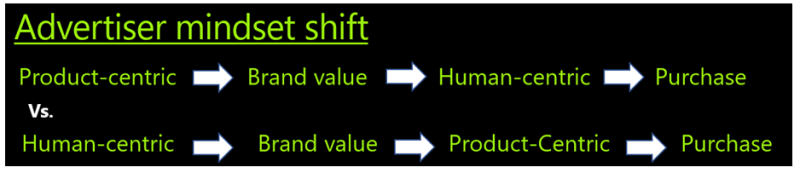
If you want growth, you must start to rethink not only how people are shopping, but also how your campaigns consider a values-based purchase journey with evolved ad copy and keywords. Advertisers who can try on a new mindset with inclusive advertising can expand reach and will uncover more opportunities to connect with people. Shift from product-centric to human-centric to uncover keywords and expand your reach.

Diagram illustrating advertiser mindset shifts from product-centric to human-centric. Product-centric leads to brand value, which leads to human-centric, which leads to purchase, versus human-centric, which leads to brand value, which leads to product-centric, which leads to purchase.Source: The Psychology of Inclusion and the Effects in Advertising phase 3 study, Microsoft Advertising, 2020.
Shared values drive growth

Any good advertising effort begins with rich, relevant content rooted in product truth, but there’s more needed to make good advertising great. People’s trust, respect, and loyalty for a brand grow when its advertising, product truths, and mission statement are aligned. It’s worth reflecting the beliefs, needs, and ​values of people in your advertising, but only when it’s aligned to your brand values as well. When mining new keywords to build trust by looking for shared values between people and your brand, it’s important for you to create ad experiences that make people feel your brand “is for someone like them.”

How to get started:

80% of people believe brands should play a role in solving societal problems, but many companies aren’t prominently featuring their mission statements nor their corporate responsibility efforts on their websites, which could be used to demonstrate how they engage with the world, or how they take a stand. This is a missed opportunity.

If you don’t already have an established mission statement, now is the time to identify your company’s core values. Consider the following:

  1. Does your brand mission focus on values, responsibility, and inclusion? If not, consider doing so as these are the core building blocks of trust.
  2. How are your brand values important to people?
  3. Do your brand values align with people’s values to build trust, love, and loyalty?
  4. Do you know what people are actively searching for? If not, examine search query trends.

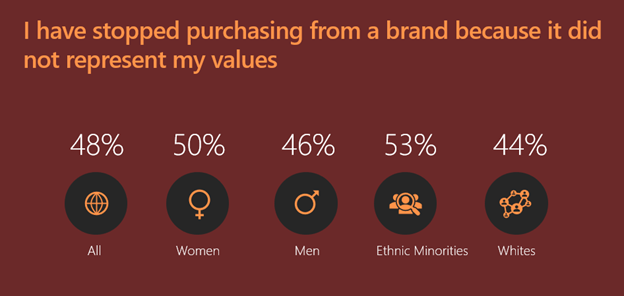
Questions 3 and 4 above are the key to keyword mining for inclusive marketing. With some simple analysis of your Search Query Report (SQR), you might be surprised to see how your audience is engaging with values-led search queries.

Graphic with research results as follows: I have stopped purchasing from a brand because it did not represent my values. 48%25 of all respondents, 50%25 women, 46%25 Men, 53%25 Ethnical minorities, 44%25 White
Source: The Psychology of Inclusion and the Effects in Advertising phase 3 study, Microsoft Advertising, 2020.

Inclusive keyword mining

Mining inclusive keywords can make your brand appeal to new potential customers or make your current customers more loyal, but you might be wondering how you can do this. The process is outlined below, but since keyword discovery will vary between verticals, marketplaces, products, and services, let’s first calibrate some of the levers we have to pull with inclusive keyword mining.

• Diverse set of keywords: Reflecting a full range of human identities and/or organizational differences, both visible and invisible (e.g., beliefs, experiences, backgrounds, ages, abilities, socioeconomics, faiths, ethnicities, sexual orientations, gender identities or expressions, languages, nationalities, and more)
Inclusive set of keywords: Comprehensive; open to everyone; not limited to certain people; enclosing. Embracing inclusion is the act of intentionally creating a respectful, supportive, and empowering environment by engaging each other’s strengths, experiences, and perspectives to achieve a common objective.

Now let’s dig into how to build and expand a diverse and inclusive keyword list. There are four basic tools to use:

Dynamic Search Ads (DSA) Search Query Report

While all four tools can help you expand your inclusive keyword lists, let’s focus on using the SQR, as it shows which keywords people are already actively searching to trigger your ads. Once you know these queries are already being used, the goal is to maximize opportunity by identifying queries on which you’re not currently bidding.

Step 1

Confirm if you’re bidding on all value-based phrases that are in your mission statement or related to your brand values. If not, add them to your list for keyword expansion.

Step 2

Pull a 60- or 90-day SQR.

Step 3

Filter for any search queries that have values-based keywords and variations you would like to identify. For example, but not limited to:

  • Accessible
  • Adaptive
  • Authentic
  • Black-owned
  • Community
  • Eco-friendly
  • Equality
  • Equitable
  • Ethical
  • Gay-friendly
  • Genuine
  • Inclusive
  • LGBTQ
  • Pet-friendly
  • Progressive
  • Supportive
  • Sustainable
  • Unique
  • Valued
  • Vegan
  • Women-owned

Step 4

Do a Microsoft Excel VLOOKUP to compare the filtered search queries (new inclusive keywords) to the existing keywords on which you’re bidding. Anything in the search query set that’s not currently being bid on is a new keyword opportunity. And that can mean new connections with people.

  • As for the look-up, look for the term within the keyword (i.e., “IF(ISNUMBER(SEARCH())” ) so you can identify whether the term is included anywhere in the keyword

Step 5

Pivot the keywords to get a clear view of value-based search trends.

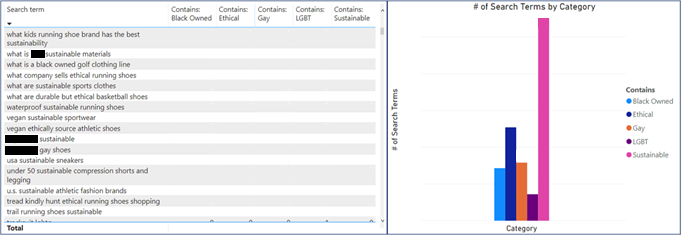
As an example, we performed an Inclusive Search Term Analysis for the prior 90 days for a shoe brand on October 15, 2020. It contained the following phrases in frequency: “black owned” appeared 143 times, “ethical” 254 times, “gay” 158 times, “LGBTQ” 72 times, and “sustainable” 557 times. The following chart shows these data across a sample of the various search term phrases where these inclusive keywords appeared, like “what are durable but ethical basketball shoes,” “usa sustainable sneakers,” and “waterproof sustainable running shoes.” Sustainability value-based search terms are a clear front runner to add to the keyword list for this brand, with ethical considerations second, gay and Black-owned next, and then LGBTQ. This is just one simple exercise that can help guide your growth with mining for inclusive keywords.

A list of search terms with frequency of inclusive keywords across search terms and a bar graph showing the frequency of types of inclusive keywords. The results were described in the paragraph preceding the graph.

Step 6

If you want to take this process one step further, use an n-gram analysis (contiguous sequence of words from a given sample of text). N-gram analysis is a great tool for sorting through thousands, or even millions, of keywords to find your best and most significant opportunities; it allows you to get actionable insights through aggregating keyword data.

Bringing it all together

Brand trust is more important than ever, and meeting consumers with values-led, inclusive, and diverse keywords should be part of any advertising strategy, because inclusive advertising increases purchase intent by an average increase of 23 points. Language discovery with values-led purchasing is only a start to an inclusive marketing strategy. Also consider how imagery in your ads reflects people’s lived experiences. Imagery is as important as words, as images can speak a thousand words. To learn more tips and tactics for more inclusive keywords and marketing strategies, review the “Role of Inclusion” in the Marketing with Purpose Playbook. It gives you the fifty words that signal inclusion, the nine feelings of inclusion for product marketing, and the three metaphors for inclusion that you can apply to your images and ad copy.

This is a journey of learning, and as marketers we have great opportunity in considering, understanding, and supporting the broad spectrum of human experiences. We hope these inclusive keyword strategies help you unlock the enormous potential — within your teams, and for your clients and their customers.

Additional resources

If you would like to learn more about accessible and inclusive marketing, check out these additional Microsoft Advertising resources:

  • Download the Marketing with Purpose Playbook for detailed guidance on accessibility strategies and inclusion’s impact on advertising performance, plus free open-source technology to help you evaluate and fix your website for accessibility.
  • Use our key takeaways from the Modern Marketing is Accessible Marketing webcast to understand the business case for inclusive design and accessibility in your marketing, advertising, and overall customer experience.
  • Download our Modern Marketing is Accessible Marketing eBook for comprehensive tips and checklists on how to build accessibility into your marketing to reach, resonate with, and serve more people.
  • Stay up to date with our latest growth strategies automatically by signing up for the biweekly Microsoft Advertising Insider newsletter.

By Lesa Hastings MJ DePalma

Lesa Hastings-Account Manager, Microsoft Advertising

MJ DePalma-Head of Global Multicultural & Inclusive Marketing, Microsoft Advertising

Sourced from Microsoft Advertising Blog

McDonald’s and GoFundMe do it well

In today’s digital world, we are constantly bombarded with noise, information and marketing, making it near impossible to remember every message that you scroll past on social media. However, if they do it right, you remember what those brands made you feel.

People do not want to be sold to.  They want to feel safe. They want to feel heard. They want to feel some sense of normalcy.

No industry practices empathy marketing better than the music industry.

Think about the latest album that you listened to on repeat. What made you love that music so much? Most likely the campaign, music or artist made you feel something. The artist and their team use empathy to relate to their target audiences, and they frame the music in a way that makes the album/single super relevant to their audience. Even in music, there are campaign best practices. There is no one end-all-be-all growth hack to make a song soar to the charts. What made artists successful was their ability to connect with their audience on an emotional, intimate and meaningful level.

For example, Justin Bieber put out a song called “Lonely” this year, and it spent 23 weeks on Billboard’s Global 200 Chart and peaked at Number 5. Bieber used vulnerability to share his own story and empathy to connect with us all on a deeper level.

So how does this translate to brands? How can brands embody empathy to build trust with their audiences? Here are recent examples of brands doing it well:

McDonald’s has been leaning into the most impactful emotion there is: nostalgia, making us crave their experience as we scroll through social. Something as obscure and random as popping the buttons on a soda lid conjures up the emotions associated with McDonalds, e.g., road trips, memories with friends, etc.

GoFundMe felt the fear and anger of the world as cases of hate crimes toward the Asian American & Pacific Islander community surged. They did not simply make a statement, but they also used their platform to build the AAPI Community Relief Fund to create a centralized resource for people to turn to and support. They felt the universal emotions of fear and anger and acted upon it with empathy.

Webflow created a whole new event experience for its community. The company used empathy to understand that its community was burned out. Zoom fatigue was real. Webflow created a custom Gather Town space that made the event interactive, gamified and fun. The physical action of sitting at their desks was the same, but the experience was personal and full of empathy and will be extremely memorable for the company’s guests.

You can use your superpower of empathy in a meaningful way. It’s the importance of writing to people’s emotions, not just the target demographic. By using language that involves them and makes them the focus of the conversation, you can make your audience feel something.

By Pat Timmons

Sourced from ADWEEK

By Joy Chatterjee

Whenever a crisis looms, it is the ideal time for bold and creative marketers to learn from it and disrupt the market

The COVID-19 pandemic has subsequently influenced the way marketers and advertisers strategize and execute the marketing plans for their respective brands. Last year, the industry witnessed a surge of changes in business paradigms, which also unveiled new ways of marketing channels to approach consumers.

Without a second thought, the crisis has changed the business landscape and the consequences have been felt around the world. Whenever a crisis looms, it is the ideal time for bold and creative marketers to learn from it and disrupt the market.

The COVID-19 has altered the consumer behaviour pattern, pushing marketers to not stop but re-invent themselves. Hence, there is a definite shift to e-commerce across industries. Though the e-commerce model has been a hit among various brands, but it was seen as a go-to approach when everything was closed. Other than this, it initiated brands to work on D2C channels and create their shopping portals rather than just relying on other e-commerce channels.

Another thing which marketers have focused on instead of betting big on premium products, brands are conveying more on everyday used items. Marketers are adjusting marketing spends as per the industry dynamic. For example, companies during the testing times are not focusing on contextual advertising but are more focused on personalised ads to relate with the audience on an individual level. With such insights, brands are in favour of creating positive engagement with consumers, and by this brands have the window to develop a feeling of connection.

Vernacular ads

While Internet penetration deepens across tier II and III cities, the demand for regional content has been growing at a trajectory speed. In the last few years, regional content has led to a surge in media consumption among native people, and the COVID-19 induced lockdown has further accelerated the thirst for more content among viewers. This has led advertisers to prioritise their ad spends accordingly, in which regional spending has seen an upward rise in the latter half of the year. This year as well, the trend will continue to grow. With the increasing reach of content to every corner of the world, brands have started realising the potential. While defining the advertising strategies, brands are effectively focusing on regional ads to diversify their reach and talk to their audience in the affable regional expression with the right regional nuance.

When the retail shops were closed for consecutive months, brands were in predicament to run the business. Though e-commerce played a crucial role and aid people to order from the comfort of their home, the situation gave an added advantage to e-commerce portals in the consumer supply chain.

However, many brands decided to expand their business shelf with the help of D2C channels, this phenomenon increased the number of online shoppers and-sales gradually increased. Mankind Pharma also launched their D2C channel to target the consumers directly. COVID-19 has transformed consumer behaviour buying patterns and people have become more inclined towards e-commerce to buy daily essentials. This trend indicates a massive opportunity for D2C brands to succeed.

Digital media 

Digital media has taken the centre stage in the brand’s marketing strategies. The key focus areas which have been in the highlight are social media, influencers and content marketing. The shift happened due to the restrictions imposed due to the lockdown leading companies to extensively focus on influencer marketing, one of the best ways to reach the target audience.

Though the brands have associated with influencers earlier as well, COVID-19 has completely transformed the industries approach. Companies considered influencer marketing as a short-term framework but now the marketing campaigns revolve around it. Due to the vast shape up, brands are focusing on regional influencers also. To share a glimpse of it, we have also roped in multiple regional influencers for our diverse brands such as Manforce, AcneStar, Gas-O-Fast, Prega News intending to connect with them on better grounds.

Considering all of these changes happened so swiftly; it is always better to go with the time, instead of just relying on the traditional methods. As innovation is essential to evolve and grow the business.

By Joy Chatterjee

General Manager-Sales & Marketing, Mankind Pharma

Sourced from Entrepreneur India

By Michael Bürgi

This article is part of the Digiday Privacy Preview, a digital issue of stories examining what the coming changes to Chrome and iOS will do to the worlds of media and marketing. Read the rest of that coverage here.

As privacy-related issues slide up into marketing conundrums across the advertising landscape, every participant in the buy-sell equation is trying to figure out how to proceed with minimal change and maximum results.

At the top of the food chain are CMOs, the execs holding the purse strings of advertising and in the seat of power. But they’re also under greater pressure than ever before from their CEOs and CFOs to deliver results for the tens or hundreds of millions of dollars they spend marketing their products and services.

How are CMOs dealing with the raft of privacy regulations, as well as Apple and Google’s recent moves to inhibit behavioural tracking? How big a priority are these issues to them?

It’s telling that the CMOs contacted for this story either declined to comment on the record, or didn’t return calls requesting interviews.

Speaking with other marketing experts though, one gets the sense CMOs know the identity issue has huge implications for the future health of their companies, but haven’t come close to solving it. For starters they’ve learned they need to stay flexible to adapt to changing circumstances. “Clients aren’t unsettled,” said Eileen Kiernan, global CEO of IPG agency UM. “At the end of the day, modern marketing is about being fluid and agile — whether it’s in response to changes in market, consumer or competitor activity or changes in regulations and technology.”

Greg Stuart, CEO of MMA Global, an industry non-profit that tackles major issues on behalf of its marketing leader and solutions company clients, has been mapping the consumer privacy landscape closely. Stuart recently polled his global board of directors, which is made up of two-thirds top-level marketers, and the topic of identifiers ranked as their No. 2 priority, just behind marketing effectiveness (identifiers play a key role in measuring marketing effectiveness) but ahead of issues like data and marketing organization

“Based on conversations with my board, I think marketers’ biggest concern around privacy issues is around risk management and assessment, and avoiding liability issues,” said Stuart, himself a CMO in a previous career stop at Cars.com. Given their desire to avoid paying possibly significant penalties that might incur the wrath of the CFO, Stuart said, CMOs are paying particular attention to ensuring they are in compliance with current laws.

To what degree are agencies involved in helping their clients figure out solutions? “Intimately involved — but I would say we’re looking for solutions, not workarounds. We’re working with our clients and CMOs to ensure that they’re well informed about what the changes mean in real terms,” said Kiernan. “For some clients, it’s about strengthening their first-party data capabilities, for others it’s about helping them scenario-plan media and data partnerships, alternative solutions in the market, and how to manage for the lack of certainty.”

Kiernan agrees that the issue goes beyond marketing: “CMOs are drawing on the cross-functional expertise in their teams, whether it’s their data scientists working in partnership with us, but also increasingly having their corporate legal and privacy teams as part of the conversation.”

In recent months, major brands have made clear their desire to secure more first-party data directly from consumers, as a way of getting around these identity obstacles put in their path. But there’s also talk among agencies and brands that the narrowing of privacy limitations offers a wakeup call of sorts to inch away from lower-funnel tactics that relied on the very information that’s now being blocked.

“Maybe it’s about going back to this idea of context,” said one marketing executive speaking off the record during Digiday’s Media Buying Summit in March. “Years ago, contextual buying was the way you [bought media], then we morphed to this purchase-based targeting where we used third party, purchase-based targeting vendors that was very cookie-based. Now it’s going back to contextual again for more equity-based advertising.”

“There’s no question that all these changes will drive a change and evolution in marketing,” said Kiernan. “It’s about being pragmatic, commercial and identifying solutions that respect the law and individual rights while ensuring that marketing can both drive and be accountable for business results.”

For his part, MMA’s Stuart doesn’t believe there will be a huge return to contextual advertising as a way of sidestepping privacy limitations, but he adds that today’s tools enable a much more robust way to execute it. He argues that it boils down to whether marketers are pursuing attribution goals versus orchestration goals — the latter being the ability to serve up an ad in a targeted way, which is exactly what’s being inhibited by Apple’s and Google’s moves.

“There’s a real understanding that this is not just about media investment, addressable media and attribution, and that it’s also about a shift in public sentiment on data and privacy,” added Kiernan. “It’s my role as a CEO — and our role as an agency committed to helping futureproof our clients’ businesses — to balance both the art and science of data-driven marketing — in a continually evolving landscape.”

By Michael Bürgi

Sourced from DIGIDAY

By

1. If brands are hoping to stay relevant and keep up with the content creation phenomenon, 2021 needs to be the year of Empowering Employees to Power your Brand. It is plain and simple—employee censorship on social channels is a disaster for brands. We can no longer control the message folks. The social framework is “bigger and stronger” than our puny frameworks. Instead of fighting it every step of the way, USE it to your advantage, or you’ll pay a steep price in diminished return… especially during these times of change and uncertainty. Your employees are the best way to humanize and personalize your brand… and truly the best way to scale relevant, contextual content creation

Did you know that employee created content (ECC) receives eight times more engagement than content shared from the company itself? On top of that, employee content extends brand messaging by over 500%. Crazy, right? So why aren’t more companies getting employees engaged in content creation? It’s well known that companies with engaged employees outperform their peers; involving employees in content creation can help to create a sense of common purpose.

The truth of the matter is that the social evolution is a business evolution. Only by changing our old frameworks can we possibly hope to keep up—because social media and the way communication is evolving, along with so many other applications during the pandemic, have completely altered the business landscape. #ROE… Return on Employees.

2. Changing shopper behaviour creates a land grab for retailers and brands alike. Established brands like Nike are making huge strides to connect directly with shoppers, preparing for a future where a good portion of retail is direct. Upstart brands including AllBirds, Warby Parker and Dollar Shave Club have been pushing incumbents to embrace more flexible channel strategies as well, and the trend is expanding exponentially in 2021. Incumbents and challengers alike are exploring all kinds of channel mix combinations although with a common tactical thread… all brands are seeking direct relationships with shoppers instead of relying on third party retailers… especially with how the #Covid19 pandemic has dramatically altered shopping behaviour.

3. Customer Experience with our Marketing… we worry all the time about customer experience with our employees, product, purchase, and service, BUT we have overlooked a critical part of the customer experience, and that IS how “our” marketing affects “them.” We’ve got data coming out of our ears, so tracking the results of our marketing efforts in terms of dollars and cents is becoming easier and easier. However, all these efforts only measure the upside of banging consumers over the head (how many more clicks, shares, engagements, and ultimately sales, do we get). No regard is given to the downside numbers. What we are NOT tracking is the point at which our customers turn from just annoyed, too fed up with our bot stalking and algorithm tweaking.

I think we need to spend as much time finding ways to track the negative effect of our marketing efforts as we do the positive ones. Every brand that continues to bang your customers or followers over the head again, and again, and again – without regard to the damage it is doing to brand equity – is going to suffer as we move forward in this customer, “my media, my commerce, my way”, world.

Marketing will truly win when humans control the machines, instead of the machines controlling the humans. 

By

Sourced from Ted Rubin Straight Talk

Google’s business is built on data. But it doesn’t have to be this way

Google makes its money through selling advertising – the more targeted an ad is to you and your interests, the more money Google makes. And to do this, Google needs data – lots of data. Every search, every click, every swipe of an app, it’s all combined to turn Google into one of the richest companies in the world.

In recent years Google has improved the ways you can control the data it collects but there’s still more that can be done to help people understand what they’re handing over. Enter Apple.

In December Apple introduced privacy labels in its App Store to show what information each app collects and how it might be linked to you. This can include everything from browsing history to your location. Google, perhaps unimpressed by Apple’s move, was slow to update its apps with the details of what it collects and how. Consider this: more than more than 60 apps and nine of its products have one billion people than a billion people use Google’s apps. That’s a lot of data.

Here’s all the data that three of Google’s biggest apps – Gmail, Chrome and its search app – collect about you and what you can do to take control.

Google app

Google’s search app adds widgets and its own voice search to iPhones, as well as giving personalised recommendations for news stories and topics you may be interested in. As with a large number of Google’s apps the data that’s linked to you can be very rich, however for a number of device-level settings (such as photos and videos) you’ll need to give the app permission to access them.

Data that is sent to advertisers (who aren’t Google): Location information, search history, browsing history, and other usage data.

Data that is sent to Google for advertising or marketing: Location information, contact info (including physical address, email and name), search history, browsing history, user identifiers (user ID and device ID), and usage data (product interaction and advertising data).

Data used for analytics: Location, contact info (physical and email address), contacts, audio data, search history, browsing history, user identifiers (user ID and device ID), usage data (including product interaction and advertising data), crash and performance data, and ‘other data types’.

Data gathered for product personalisation: Location, contact info (physical and email address), photos or videos, search history, browsing history, user identifiers (user ID and device ID), usage data (including product interaction and advertising data), and advertising data.

Data collected for app functionality: Payment information, location, contact information (including physical address, email, name and phone number), contacts, user content (including photos or videos, audio data, customer support details), search history, browsing data, user identifiers (user ID and device ID), usage data (including product interaction and advertising data), diagnostics (crash data and performance data), plus other data types that aren’t defined.

Gmail

Data that is sent to advertisers (who aren’t Google): location, user IDs and advertising data.

Data used for analytics: purchase history, location, email address, user content (including photos or videos, audio data, customer support and ‘other’ content), search history, user identifiers (user ID and device ID), usage data (including product interaction and advertising data, crash data and performance data and ‘other’ data types.

Data used for product personalisation: email address, contacts, emails or text messages, audio data, search history, user identifiers (user ID and device ID), and usage data.

Data collected for app functionality: purchase history, location, email and name, contacts, emails or text messages, photos or videos, audio data, customer support and other user content, search history, user identifiers (user ID and device ID), product interaction, diagnostics (crash data and performance data), and other data types.

Chrome

Data used for analytics: location, audio data and customer support, browsing history, user identifiers (user ID and device ID), product interaction data, diagnostics (crash data and performance data) and other data types.

Data used for product personalisation: location, browsing history, user identifiers (user ID and device ID), and product interaction data.

Data collected for app functionality: payment information, location, audio data, customer support data, browsing history, user identifiers (user ID and device ID), product interaction, crash and performance data, and other data types.

What this data means and what you can do about it

While much of the data Google collects will be used to help the company personalise and target advertising towards you, particularly data that’s linked to user IDs, there’s also some data that will be used by Google for making sure its apps continue to work as intended. This can include diagnostics and crash data that will tell the company why the app stopped working at various times.

Google’s rivals have been quick to point out that their apps – as shown through their own privacy labels in the App Store – don’t collect anywhere near as much data. For instance, search engine and browser DuckDuckGo says it doesn’t collect any data that can be linked to users. The app store shows its app collecting usage and diagnostics data but this is labelled as ‘data not linked to you’.

So what can you do about the data collection? In Chrome, Google’s privacy settings can help you limit what’s collected about you. Here you can turn off the third-party cookies that follow you about the web and send out requests for you not to be tracked online (although this setting is largely ineffective). In settings you can also turn off sync so that your browsing history isn’t passed across all your devices.

Perhaps the biggest control you can put on what Google collects comes from its Activity Controls. Here you can stop Google from saving your web activity, turn off its access to your location, and stop personalised ads.

All of the above will limit what Google can access about you to a degree, but it is only a sticking plaster. If you’re going to use Google, you’re agreeing to have data collected about you. Of course, this is the case for many of the free apps and services you use.

An alternative is not to use Google’s apps or services. While this can be beneficial for data collection and privacy, it does come with some trade-offs. Google’s vast resources mean it has developed some of the most feature-rich and well functioning services around – competitors can’t recreate exactly the same results as Google produces in search, for instance.

That doesn’t mean that it’s not worth trying out or making the move to more privacy-friendly alternatives. Arguably the easiest Google product to move away from is Chrome. There are a number of privacy browsers that limit the collection of user data and stop advertising tracking you across the web. Our favourites include Brave, DuckDuckGo, Tor and Firefox Focus.

Moving away from Gmail is harder as there aren’t as many well-developed competitors. Switzerland-based ProtonMail, which uses end-to-end encryption for messages, is the main Gmail alternative to consider.

Feature Image Credit: Google / Getty Images / WIRED

Matt Burgess is WIRED’s deputy digital editor. He tweets from @mattburgess1

Sourced from WIRED