Author

editor

Browsing

By

Building a successful consumer brand for the Millennial or Gen Z market is undoubtedly a challenge. Both are notoriously fickle, and are often driven more by principles and self-education than by fixed habits or blind loyalty to a brand, much less the celebrity endorsing it.

This has significant implications for brands creating products aimed at this audience. Indeed, it’s possible that many companies may have their branding strategy back-to-front. Instead of following the latest trends, start-ups with ambitions to create value in these markets should think about driving them.

Why brands should put category before trend

When launching a new brand, companies will typically aim to differentiate themselves from their competitors. But that brand will have little value if the category or market in which it’s being sold isn’t growing. This is especially important when it comes to Millennial and Gen Z consumers — because they are decidedly less loyal to a singular brand, they take greater cues from the whole category of brands.

The habits and interests of Millennials and Gen Z are constantly in flux because there is so much more information thrown at them through social media and other channels. It’s almost impossible for a company to predict what the next big thing will be in six months’ time, let alone the next big brand strategy.

Companies that opt to follow these allegiance-shifting consumers down the rabbit hole will find themselves constantly having to reinvent their identity, which can lead to them bleeding market share. A better way to approach this audience is by inventing new consumer habits through categories of product and subsets of brands within these categories, rather than purely trying to time the market.

Changing habits of the new generation

At the moment, big corporations have the infrastructure and resources to quickly turn out products that will capitalize on the latest trends. But, in saying that Millennials like this, and Gen Z likes that, brands can be in danger of seriously misunderstanding their target audiences and why they choose to buy what they do.

The habits of an entire generation are changing quicker than ever before. 22-year-olds, for example, are among the last to remember how speaking with their friends on the phone required them to call their parents first. 12-year-olds, on the other hand, probably don’t even know what a landline is.

The way Millennial and Gen Z consumers interact with brands — and the stimuli that capture their attention spans — are changing at an unprecedented rate. On the plus side, this effectively makes them a canvas on which brands can superimpose their trends.

As consumer attention spans shrink, the ability for firms to retain customers becomes more difficult and the lifecycle of brands gets shorter and shorter. This is where the category build comes in. The category presents an opportunity for industries to codify branding rules that are less vulnerable to changing trends. Done correctly, they can even create more value for firms over the long term.

Putting categories into practice

A good example of the category build is in Scotch whisky. For a drink to be a scotch, the liquid cannot be less than 40% ABV. However, scotch loses alcoholic content as it ages. The older the scotch, the more precisely the master distiller had to be in predicting when it could sell. The ability of the category’s distillers to predict — often decades in advance — that a certain scotch can be bottled and sold at 40% ABV at year 30 and not become worthless at year 28 is one of the reasons that premium Scotch whiskey has outperformed every other asset class over the last two decades.

This category rule has also contributed to the growth of the spirits industry despite declining sales volume. Millennials and Gen Z are drinking less, but they are spending more when they do. For them, it’s not about getting drunk — it’s about the experience. For Millennials and Gen Z consumers, brands are only fully appreciated when they see a brand in the context of its category.

By

Founder & Principal, Delarki

Sourced from Entrepreneur Europe

By

Agency mergers are a fact of life in the ad industry, but a badly managed process can wreck what was originally great about a business. We gather advice and wisdom from agency chiefs on navigating the M&A maze.

A smart merger or acquisition can take a business to the next level. But after the champagne’s been corked and the confetti swept aside, the hard work isn’t over.

To find out how best to dodge the pitfalls and potholes of the M&A road, we picked the brains of agency bosses at recently acquired or merged businesses.

For Lee Beattie, managing partner and chief executive officer of John Doe Group, a merger was the best way forward for her business, Glasgow-based Wire, to grow. ”We’d reached a point in Scotland where we had won all the best agency awards and we had what we considered the best clients.”

While she and business partner Pam Scobbie had seen success pitching to bigger clients down south, the lack of a London outpost was holding them back. ”It was really bloody difficult,” she says.

So, building on an existing relationship with fellow PR firm John Doe, they embarked on a merger to bring the two firms together. ”We wanted to be up for certain brands… and [John Doe managing director Magin Trewhella] wanted to grow the agency. It felt like a jigsaw puzzle coming together,” she says.

In an ideal world, Beattie says she and her three now-co-owners would have taken a week to sit down and ”bolt through all this stuff.” Instead, the process took a year, longer than is typical – there has been a pandemic to deal with, after all. The newly merged John Doe Group is now pitching for work with a combined headcount of 40, and just announced its first win as a combined enterprise with the Highland Spring account.

Nicolas Roope, co-founder of Poke, recalls its 2013 acquisition, and later merger with two other agencies, by Publicis. He and his partners wanted to continue to grow their business, but market conditions were hardening.

”We thrived in our first 10 years because the incumbents didn’t have a clue,” he says. ”But we got to the end of that period and thought that there probably wasn’t long left for agencies like us as independents. Scale was going to be a problem if we didn’t act.”

Poke shopped around for buyers for about a year before choosing the French conglomerate. ”A lot of the value we’d created at Poke was intangible. We wanted to find somewhere where they appreciated what we’d created. Arthur Sadoun [now chief executive of Publicis Groupe] was driving our acquisition… he was very ambitious, he understood the challenges their network faced – and he understood where we were coming from, the value we were bringing to the table.”

After the original sale in 2013, the company was bedded into the wider network over five years; Roope departed in 2018, after organising its merger as Publicis. Poke. ”It was a parting gift – figuring out how to strategically position this merger enterprise and create something new. But once that merger was completed… I didn’t really have a natural position to occupy, so that was the moment to step out.”

Without the hurdle of an acquisition to deal with, mergers between network agencies can generally proceed quicker. So when WPP decided to merge digital shop VML and storied ad agency Y&R in 2018, it moved fast. Planning for the consolidation began just two months before the merger was unveiled, according to global chief executive officer Jon Cook.

”We moved from conception to launch very quickly,” he tells The Drum. ”We announced we were going to merge at the start of the next year… which bought us some time. While everyone knows it happening, you still have a moment to breathe and put the infrastructure in place. It was a good lesson.”

Team journey

Mergers can rearrange the tectonic plates of a business, leading staff to fear that career trajectories are askew. Moving at speed meant Cook’s team could quickly address one of the biggest areas of concern: assuring the staff of both agencies that they still had a berth.

Transparency and timing are key, he says. ”I learned to be very transparent about what I knew. If you can identify why you’re doing this, what the new brand will be and why it will have value – and communicate that with complete confidence while at the same time being very clear about what you don’t yet know – people are generally going to understand.”

According to Stephen Maher, chair and chief executive officer of the freshly merged customer experience agency MBAstack (formed after MSQ acquired MBA), it’s important to ”reassure everyone that there aren’t going to be redundancies.”

”I just think you have to be upfront. We said that, fundamentally, nothing’s changing. It’ll be the same people, the same relationships and the same culture. There will be refinements, but there will also be more resources because we’ll have more people.”

Beattie advises: ”You have to talk to the team at the right time, when you’re certain that it is definitely going to happen and you can actually answer their questions. Everyone’s going be thinking: what does this mean for me? If you can’t answer that, you probably shouldn’t be having the conversation.”

Managing internal announcements is a little easier when staff number in the dozens. For VMLY&R, hundreds of agency leaders needed to be brought into the fold in advance. ”You need to make a judgement on how many people you need, and can trust, to get the right amount of work done before an announcement. If you have too few you’ll be ill-prepared when you announce. And if you have too many, you’ll run the risk of communications being leaked,” Cook warns.

As the agencies integrated together, Cook says that particular attention was given to managing staff concerns. ”I was sure people would see the value and the strategy in it. But I was nervous – would everybody be able to find their place in that new company? My ultimate fear was that someone would feel smaller as the company got bigger.

”We put a lot of work into making sure that no person felt smaller. We have a lot of people so I can’t say without exception, but I feel we’ve done a good job of making it so you get bigger as we get bigger,” he explains.

Still, some departures are to be expected. Between location changes and the transition to a larger organization, ”you’re going to lose a bunch of people,” says Roope.

He recalls that persuading Poke’s ”extraordinary, eccentric” team was tough. ”One of the biggest challenges of the whole thing is taking the team on the journey. You have to accept you’re moving into a new reality – you can’t take everything that you’ve built. For more seasoned staff who’ve seen these things before, they’ll know what’s coming. But it’s particularly acute people for who’ve been with you for a long time.

”There’s a lot of fear about the consequences of being acquired – did that mean we were going to be like every other Publicis agency?”

Despite occurring during a pandemic-fuelled recession, both the MBAstack and John Doe Group mergers were completed without redundancies. VMLY&R lost about 1% of its global headcount in the wake of the move, though Cook states this was due to ”natural efficiencies” rather than a concerted cost-cutting effort, and that its staff numbers have since grown anew.

Client confidence

Just as important is communicating a new consolidation to clients. A spokesperson for AKQA, which merged with Grey last year, tells The Drum: ”The key focus areas are our clients and employees. This is also in line with key decisions around communications and operations.

”Clients were consulted early in the process to gain their feedback and highlight the additional benefits of the businesses working more closely together.”

For Beattie, ”the important thing is: what does it mean for them? What are the benefits each client is going to get from the merger? Or is absolutely nothing going to change?”

Cook explains: ”It’s critical to reach a certain amount of your client base before it happens, so they have some trust, a heads-up and a feeling of ownership about the decision.”

He emphasizes the need ”to communicate clearly what you’re doing and why you’re doing it… to communicate that nothing of the goodness of your relationship will change or go away. And to communicate the new value of the bigger company.”

”Once those assurances are in place,” says Cook, ”client partners become start to become very interested in what new capability you have that can help them move their brand forward.”

Name games

When it comes to unveiling the new combined agency, language is important. A consolidated agency’s name can broadcast continuity – as in the case of double-barrelled monikers such as Wunderman Thompson – or a new start, as in the case of Superunion, which was formed from five older branding shops.

While VMLY&R’s acronym doesn’t quite roll off the tongue, Cook argues it was important to keep the identities of its constituent parts intact. ”We have a lot of letters. I’m the first one to make fun of our long name… but in exchange, you’re not losing the heritage of either of these two brands.

”There’s no way we wanted any part of the company to feel marginalized or lesser. It was too bad we didn’t merge with a company with some vowels, because we could have made a word out of it.”

Similarly at MBAstack, Maher says the name was settled after a collective decision to retain both brands. ”We felt it was the right thing for the market. And it sounds a bit better, with MBA first and Stack second.”

For Dentsu agency iProspect, which recently relaunched after absorbing Vizeum, a new handle wasn’t deemed necessary. Amanda Morrissey, global president of iProspect, explains: ”The reason for this is two-fold… firstly, and most crucially, we wanted to spend more of our time and energy on building solutions for our clients than building our own agency brand.

”Secondly, the iProspect brand name already has a huge global footprint and is universally synonymous with digital excellence that has performance at the centre. We therefore felt that keeping the name was the right thing to do, as so much of the brand notoriety is already in place.”

Culture clashes

Definitions of a successful merger also differ. For AKQA, it’s simple enough: ”Success of the collaboration is measured by the recognized increased opportunity for both our clients and employees.” Elsewhere, success isn’t so closely tied to balance sheets. Much of the post-merger work focuses on making sure the working cultures of each agency still exist in a meaningful way.

Maher admits it’s ”a journey not a destination,” and says MBAstack will likely take six months to knit together. The business has a new website in the works, and both the Stack and MBA teams will soon be moving to MSQ’s new offices in Covent Garden when lockdown subsides. ”It’s a work in progress. We’re going to keep evolving,” he says.

Roope says that the benefits of Poke’s sale to Publicis only were only illuminated when its team reluctantly moved from its Shoreditch base to bigger premises across London. ”It was only really when we stepped into the building that network started to pay… because we were much more integrated,” he says.

True success came, he says, when Poke began to influence the rest of Publicis’ operations. ”We brought fresh thinking, a different perspective when at the time it was a monoculture that was absolutely above-the-line. We weren’t the only catalyst in that, but it reinvigorated the London side of the network,” he says.

While merging two global giants together is a complex endeavour, Cook says he was confident of success just two months in. ”We gathered 200 of our top leaders to [VML headquarters] Kansas City, from all over the world. And you could just feel a sense of unity, a sense of pride. We knew this was going to work.” By the time the team touched down at Cannes the following summer, things were coming together and business had picked up, with a 14% increase in billings in the UK.

”Walking into Cannes, we already felt we had a swagger. We were getting recognition for the work for our clients that this new company had done… that was a good message that we’re doing what a great agency is supposed to do, and that’s great work.”

A month after from her business’ rebirth as John Doe Group, Beattie doesn’t yet have the privilege of hindsight. The teams of each agency were already well acquainted, with the merger built upon an existing relationship; the two businesses already shared client work. Having avoided a direct culture clash, she’s confident the consolidation has already begun to yield results and achieve their major goal – puncturing the London bubble.

”It’s definitely already working. We’ve just won our first new account. We’ve done more pitching in the last couple of months than I did in over the whole of last year.”

By

Sourced from The Drum

By

Keyword optimization, building backlinks, and writing brilliant blog posts aren’t the only way you can increase your website’s visibility through SEO.

You can now use Twitter to improve your SEO ratings.

Google cracked a deal with Twitter a few years ago to get access to its live tweets data, which indexes tweets on the Google search engine. This makes Twitter a big player in the world of search engine optimization.

With 330 million users on Twitter, you are missing out if not promoting your brand on the platform. Apart from offering such a vast audience, Twitter also offers paid promotions for your brand.

How Twitter improves SEO and your online presence

Number-Of-Monthly-Active-Users-In-Millions-Twitter-For-SEO-1

According to Statista, there are more than 330 million monthly active Twitter users

Does social media really impact SEO ranking? Given that social media is more about pictures, one platform is more about words, Twitter. Google and Twitter struck a deal in 2015 where Twitter provides Google with its live tweet data and more.

This has in fact affected SEO in ways marketers didn’t think possible. Google now uses real-time tweets to showcase its search results. So, when you search a hashtag, Google showcases Twitter results with the most recent tweets that use the hashtag in its search results. This makes Twitter absolutely essential for businesses.

Twitter helps businesses get in touch with their customers, and interact with them. Twitter’s hashtags about a product can give insights about how the product is and businesses can learn how people are responding to their products/services. Twitter strengthens the PR relationship a company has with its customers, as well as employees.

Here are some ways you can leverage Twitter to its full potential for growth and visibility online.

#1. Paid promotions

Undeveloped-Domain-Marketplace-1

An ad by Undeveloped on Twitter

Paid promotions are the easiest way to reach your target audience, not only can you promote your tweets, but you can also promote your account.

Be mindful of what you write in your Twitter Bio. Deploying your brand’s Twitter Bio carefully is key. Make sure to add the correct keywords and hashtags in the Bio. The summary on Twitter should be effective and use keywords that are most relevant for your brand. This will increase your brand’s visibility on Google.

Creating a username with the brand’s name is crucial to bring you on top of Google’s search engine results. When someone searches for a brand name, Google also displays their Twitter accounts in the search list.

There are various tools that can be used to optimize reach on Twitter. By posting during the time most of your followers are online. Make sure to keep in mind the time for paid promotions too.

#2. Trending hashtags

Use-Trending-Hashtags-United-States-Trends-1

Twitter has a feature that showcases various trending topics from around the world as “trends”.

What is a “trend”? Basically, it’s a topic a lot of people on Twitter are talking about. It can range from politics to fashion, from technology to food, literally anything.

Find the latest trending topics that suit your brand’s image and get into the conversation. This helps with visibility on Twitter and will also bring up tweets on Google.

#3. Re-sharing content

Re-sharing old content shouldn’t be frowned upon. Re-sharing old content from your website or any content that may be relevant with the current time should be shared again with your Twitter audience.

Your new audience will probably miss out on good content that was posted in the past. So pick up the most educational/informative content and post it again.

Do it a couple of times, or you can just pin those tweets to the top of your profile, giving important content visibility on your page.

#4. Engaging in relevant conversations

Engage-In-Relevant-Conversation-On-Twitter-Tweet-Your-Reply-1

You can search for hashtags and keywords on Twitter in connection to your brand. Hop onto conversations that you might think speak in the tone of your brand. Retweet, share tweets, or just reply to tweets that are discussing your product, by giving information or just having a simple conversation.

Being responsive to complaints, queries, etc, prompts the consumer to make a purchase. Make a Twitter plan that also includes engaging your audience, and engaging an audience that reposts and shares tweets is very important.

A few tools that help with Twitter growth and engagement

  • MeetEdgar – This app helps with posting your content on a schedule and will also write your tweets on a lazy day.
  • TweetDeck – A twitter owned app, helps you see multiple feeds in a side-by-side view. You can follow hashtags, conversations, and even your competitors’ feeds.
  • Bitly – If you want to post your website links on Twitter, make Bitly your best friend. It gives you a shorter version of any link. Not only a link shortening app, but Bitly is also very informative about data analysis for Twitter.

While building social media for a brand, always have a reliable monitoring tool for insights, study the insights and make changes. Blending all the steps with your brand’s goals for Twitter will help it reach a better and larger audience. Be consistent, and patient to see growth, it doesn’t miraculously happen overnight.

By

Semil Shah, Chief Marketer at Shrushti Digital Marketing

According to his team, Semil Shah can take any digital marketing profile to the next level. With over 15 years of experience in the SEO world, he is a certified SEO specialist, who mainly focuses on growing businesses. He is the Chief Marketer at Shrushti Digital Marketing. In his free time you will catch him either listening to podcasts or trekking in the jungle clicking some really cool pictures.

Sourced from Jeff Bullas

In this article, we discuss an effective strategy to help you find trending, high-quality hashtags for your social media networking, and we also talk about why trending hashtags are important.

Hashtags across all social media networks these days are a powerful tool for brands both big and small. Using relevant hashtags on your social networks can serve a number of different purposes for your company.

Using trending hashtags can help you reach your target audience more, attract more followers to your networks, and increase your overall engagement.

Statistics show that social media posts that have more than one hashtag associated with them receive more engagement than posts that don’t include any hashtags.

However, it’s not simply about the number of hashtags that you use on your content, it’s about the quality of those hashtags. It used to be more about the quantity, but these days quality prevails, and the relevance and quality of your hashtags can significantly influence their impact.

In this article, we discuss an effective strategy to help you find trending, high-quality hashtags for your social media networking, and we also talk about why trending hashtags are important.

We will also share the best hashtag generator in the industry right now, Task Ant, and talk about why they can help you not only find the best hashtags for your content, but you can get help organizing them so that you keep your hashtag strategy unique, creative and varied.

Why Hashtags Are Important

Hashtags

Hashtags are basically the sorting mechanism for any social network out there, like Twitter, Facebook, or Instagram. What’s interesting is that hashtags don’t really have too much of an impact on Facebook these days; they are more relevant to networks like Instagram and Twitter.

Hashtags determine the social media reach of your content, and how discoverable that content is. They connect categories to your posts, which helps you to reach a wider audience.

Most social networks these days like Instagram and Twitter have millions of people posting new content every day. This makes it really difficult for most people to connect their content with the right people.

Hashtags make your content a lot more discoverable, especially by people who are actually going to be interested in your niche and industry. This is why hashtags are considered the most efficient tool if you are wanting to grow your social media network successfully.

On a fundamental level, hashtags are used to categorize your content more efficiently. They link you directly with your target audience and help your target audience find you as well, which is exactly what you need to do well with your social media profiles.

When you use hashtags on your content, you are more likely to have people interacting with your posts, because it includes content they are on the network looking for. It is essential that you understand that you might not always get the interactions that you want just because you have included some popular hashtags on your posts.

Millions of users out there make the most of popular hashtags, which means that you will be competing with a high number of others to rank well for that particular hashtag. This is why it’s important to narrow this down and get as specific as you can with your hashtag topic, which we will talk about a little bit later.

On social media networks like Instagram, you are allowed 30 hashtags in your caption. You need to be smart with the words that you choose to include, because you don’t want to go over this number, but you also don’t want to include too few as well.

Why Trending Hashtags Are Important
Hashtags

Trending hashtags, in particular, are important for your social media networking in general because they connect you with the relevant audience for your content right now.

Your brand’s ethos and products might not change too much over the course of a few years, but your audience will. This is why if you plan on investing a lot of time and money into social media marketing, you’ve got to constantly keep up with what’s happening in your industry.

When you use hashtags that are trending within your niche, you are giving your content a good chance of being seen by your target audience, and you are keeping up with what people are finding interesting right now.

Your products might not be changing all that much, but how you connect with your target audience through social media will change and switching up your hashtags to fall in line with what’s trending is really important.

Are All Trending Hashtags Good for Your Business?

Trending Hashtags

With trending hashtags in mind, are all of them good for your business? There is a relatively short list of popular and trending hashtags that users make the most of all around the world.

Influencers on Twitter and Instagram make the most of these hashtags because they help them build their audience. For example, using the #likeforlike hashtag is a popular way to encourage people to like your content. The most popular hashtag on Instagram is #love.

When you use popular and trending hashtags on social media networks, this allows your posts to appear in places where there are millions of people that could potentially be interacting with your content. However, there are some aspects of trending hashtags that you need to be aware of if you choose to use them.

  • Might target the wrong audience: If you choose to build your audience with some of the most popular hashtags in the world because you are competing against millions of others who are also using that hashtag, there’s every chance that you might be targeting the wrong audience. Additionally, if you use hashtags like #likeforlike, while this might encourage people to interact with their content, it might not be for the right reasons. They might be simply liking your content because you’ve asked them to, and not because they are genuinely interested in your content. If you want to find the most relevant users for your content, then you need to get specific with the hashtags that you use and try not to be too general.
  • Hard to stand out: when you use hashtags that are really popular, this means that you are competing for attention with millions of other people and their posts. It means that even those posts that you have put a lot of time and effort into are going to quickly drown in the sea of competition and will wash up with a mix of content that doesn’t even fall into the same category as yours. There are some experts out there that believe that if you share a post with a hashtag that has more than 10 million posts associated with it, your post is going to appear in someone’s feed for only three minutes, before falling down the visibility list again.
  • Could end up using irrelevant or inappropriate hashtags: If the hashtags that you use for your content are too popular, they could potentially be irrelevant to your content, and not even trending in your industry. What’s more, they might even be considered inappropriate by Instagram, as Instagram has been known to ban hashtags in the past. When you are trying to find the right hashtags for your content by yourself, is difficult to know whether that hashtag has a history of being banned or not, and you could get yourself into hot water as a result.

How to Know Which Trending Hashtags to Use
Trending Hashtags

So, we’ve talked a little bit about the downside to trending hashtags, but this shouldn’t be enough to put you off. You have just got to know what you are getting yourself into and understand how to use trending hashtags to your advantage so that you can stick to relevant, targeted hashtags that connect you straight to your ideal audience.

Becoming successful with hashtags happens when you are able to maintain a strategic approach towards using them. Even though some of the most popular hashtags out there have been used with millions of posts, this doesn’t guarantee that your post is going to get a lot of interaction.

So, instead of trying to find the most popular hashtags out there, we recommend that you find trending hashtags that have an active community behind them, and are highly relevant to your target audience and industry.

So, how do you find trending hashtags like this? Well, we think that one of the best ways is to see what hashtags are being used by your competitors, target users, and industry leaders.

Remember, when you narrow down the scope of your hashtag, the more engaged your audience will be. When you start researching, you might be surprised to discover the kind of hashtags that are being used by your rivals.

Let’s take a little look at how to determine the best trending hashtags for your content.

  • Understand your audience

There’s no way that you are going to be able to find the best trending hashtags for your content on social media without learning all about your target audience. As we already talked about, including random hashtags on your Instagram posts is not going to increase your followers.

First, you need to do a bit of research, and figure out what hashtags your audience is using on their content and choose ones that align with these. Most social media networks out there have a search bar, where you can search up relevant hashtags.

Just remember that your tags need to be relevant to the target users that you are actually searching for. This is why you need to include keywords that relate not only to your content, but to the people that are going to be looking at it.

  •   Understand your rivals

While you might be a bit more excited about understanding your audience then understanding your competitors, your competitors can actually teach you a lot about what the industry is like, and how to be successful in it. If you want to do really well with your brand online, then it is extremely smart to keep a close eye on what your competitors are doing at all times.

Similar to how you can look up relevant hashtags on most social media networks, you can also find hashtags that your competitors are using. This is going to help you work out which hashtags are going to improve your engagement.

You might not always want to use the hashtags that you find on your competitor’s pages, but it’s going to definitely help you figure out how everyone else is growing their social media profiles. You might end up discovering completely new hashtags that you’ve never thought of that you can add to your list.

  •   Understand the industry leaders

As well as your competitors, there will be some influencers and industry leaders in your niche that you look up to and wish you could be like one day. One of the most practical ways to find trending hashtags for your content is to follow industry leaders that have similar interests to your target audience.

Influencers are people on social media networks like Twitter and Instagram that perform really well with their content. You can make the most of their success by finding relevant tags to add to your content.

Make sure that you find those people that have done really well within your industry and are continuing to do really well. Because they are already strongly connected with their target audience, you will only learn good things from researching them.

  •   Use Related Hashtags

Another effective, easy way to grow your community is to find trends that relate to your own hashtag. All you have to do is enter your hashtag in the search bar of any social network, and you will get some results.

You might even want to search for an Instagram image or video that contains a hashtag that is already working really well on your content. This is a great place to start, and it’s going to give you a lot of options that are directly related to the tags that you already use.

  •   Look on the Explore Page on Instagram

If Instagram is one of your main social networks that you use for your brand, then you will be well aware of the Explore Page.

The Explore Page is where a collection of posts are generated by what you have previously liked and interacted with. Believe it or not, this is a great place to get hashtag suggestions, so that you can keep your content connected with your target audience.

The best part about the Explore Page is that you can access it both on desktop and mobile. The first thing that you will want to do is scroll down until you see posts that are relevant to what you’re trying to post yourself.

Click on these posts and look at the hashtags they are using. Make sure to use the ones that you think are the most relevant to your content.

  •   Follow your favourite hashtags

If you have discovered a hashtag that is relevant to your content, try following it and seeing top posts once people share them. Looking up certain hashtags is going to help you develop new ideas and come up with even more tags that go along with the original.

All of the content that you put up that uses these hashtags will be pushed onto these hashtag pages, so you can easily follow other hashtags, and look at the top posts that fall into these categories.

Checking top posts can help you get new ideas for your hashtags and engaging with these posts can actually bring people over to your page.

Just make sure that the selection of hashtags you are including on your posts are relevant and directly reflect what your post is about. We don’t suggest that you create a crowded post that has a lot of hashtags.

Quality over Quantity

Quality Over Quantity

Speaking of crowded posts, let’s talk a little bit about why quality is more important than quality at this point when it comes to your trending hashtags.

If you have just started implementing certain techniques in your hashtag strategy, then you might be a little overenthusiastic about how many hashtags you include in your post.

However, if you want to do really well, and not compromise the potential of your content before it’s even out there and in front of the right people, we suggest that you take time to figure out a sweet spot when it comes to the number of hashtags that you use.

We mentioned above that Instagram has a post limit of 30 hashtags. However, we don’t think that you should use this many every time.

In fact, there are many people out there that think you should be using less than 10 hashtags per post – some people think that seven is ideal. The key here is to focus first on the quality of the tags, and the quantity will follow.

If you find three or four highly relevant, targeted tags for your content, then you won’t need to use any more than this to get your content in front of the right people. However, while you are still looking for those perfect hashtags, you might want to increase this number slightly.

One way to do this is to experiment a little bit and figure out what works best for your content and your engagement rate. If the number of tags you are using is resonating well with your target audience, then stick with this.

The good news is that your hashtag strategy can be ever-changing, and there’s always room for improvement. If you find a hashtag that you want to use, you can always add it to your existing list, or even replace one that you don’t think is as effective as it used to be.

As long as you are including more than one and less than 30, you will be able to find the right fit for your niche and industry.

Task Ant for Finding Trending Hashtags
Task Ant - Trending Hashtags

Another way to find trending hashtags for your content is to make the most of a hashtag generator. Sometimes, you don’t have the brainpower or the time to figure out your hashtag strategy for yourself, and sometimes it seems like everyone has taken all the good hashtags.

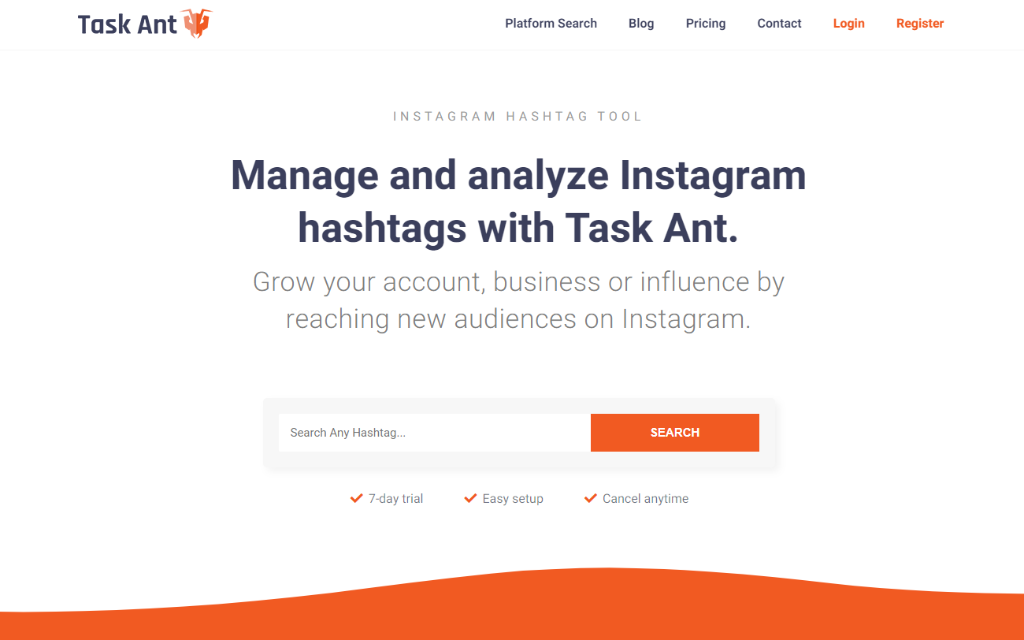
This is where a hashtag generator comes in. A hashtag generator like Task Ant has the experience and expertise that you need to get ahead of your competition and polish your hashtag strategy until you’ve perfected it.

Task Ant has a search bar for hashtags that you will see on their homepage when you visit them for the first time. All you need to do is enter a keyword or hashtag that you use already, and they will suggest relevant tags.

The best part is that they include data and analytics around their suggestions so that you can work out which ones are relevant to your content, and which ones aren’t worth your time.

One of the things that we like the most about Task Ant is that they are willing to go the extra mile for their clients. They understand that finding relevant hashtags is only half the battle – you’ve got to keep things interesting on your content if you want to keep up with what’s trending.
Task Ant - Finding Hashtags

This is why Task Ant helps you organize your tags into different sets so that you can apply different hashtags to each piece of content and keep it dynamic.

There aren’t too many hashtag generators out there that are prepared to do this on top of suggesting relevant tags to their clients, which is why Task Ant comes so highly recommended.

Final Thoughts

So, there you have it – everything you need to know about trending hashtags, how to use them, and what to look out for when you are doing your research. Remember that your hashtag strategy is a fluid thing – this means that it’s always changing, just like industry trends.

It’s important to keep up with the play and learn how to adapt your hashtag strategy to what’s going on with social media networks like Twitter and Instagram. Also, don’t be afraid to play around with the numbers, and try a different list of hashtags on each piece of content, until you’ve found a good match.

Mix it up from time-to-time as well so that you’re never relying on the same five or six hashtags for each post. Good luck!

Sourced from INFLUENCIVE

By Henry DeVries

If you want to use LinkedIn to attract high-paying clients, don’t talk about how you are going to help. Be the rare consultant or professional on the platform who just starts helping.

That’s the advice of the person who is arguably America’s top LinkedIn thought leader, Ellen Melko Moore. She has consulted with the Oprah Winfrey Book Club, the Zappos guys and now teaches LinkedIn social selling strategies for some of the top thought leaders in the digital marketing space. She is the LinkedIn trainer of the year for the American Marketing Association.

“If you’re looking to connect with ambitious, successful, high-fee B2B clients, LinkedIn is the place you will find them,” says Moore.  “For the most part, they are not hanging out on Facebook or Instagram looking for real solutions to their business problems.”

As for those important leaders who weren’t using LinkedIn much prior to the quarantine adventures of 2020, they’re active now.

“Anyone can make themselves look expert on other platforms, but only LinkedIn lets you see the whole history of that person’s actual work,” says Moore. “You can draw your own conclusions.”

Here are four ways from Moore to up your LinkedIn game:

Slow down; focus on quality over quantity. Social media trends of the last decade have most experts convinced that digital marketing and sales is always about the numbers, but LinkedIn often works much better if professionals and consultants treat their LinkedIn network as a highly valuable asset. “In other words, slow down, go steady, and focus on the quality of your network rather than the quantity,” says Moore. “Work on developing deeper relationships with the people who are best suited to be desirable clients or best placed to be powerful referral partners. We have one thought leader client who has 150 connections, but every single one of those people has real influence. He is killing it.”

Redo your personal LinkedIn profile and make it for your target audience. “Instead of making your personal LinkedIn profile about you, or about your company, make it for your most important target audience, client, or partner,” says Moore. Think of your profile in a content marketing context versus a promotional or historical context. The majority of professionals on LinkedIn—when they are ready to buy—are going to buy from the first person who gives them a significant shift in insight. So, don’t waste your LinkedIn profile—especially the “About” section—talking about yourself or your company. Instead, focus on dropping those value bombs, so visitors to your profile can learn something that’s important to them.

Stay away from automation and go easy on templates. Many professionals want a “Done For Me” strategy on LinkedIn, which has given rise to multiple LinkedIn lead generation companies who will help leaders craft templated messages and then use automation to send those messages, inviting hundreds of professionals a day to connect and communicate with that leader. “The only problem is that LinkedIn is cracking down on these companies, and using automation can get you kicked off the platform,” says Moore. “LinkedIn really wants to emphasize their platform as a network, not a place to ‘buy leads’ on social media. Consider adopting this strategy instead: each day, find two to five high quality people with whom you’d like to connect. Send a connection request that is personal and specific versus something that could be sent to thousands of people who resemble this person.”

LinkedIn is a mystery to almost everyone on the platform. The pandemic has boosted LinkedIn’s popularity, with 660 million users at the start of 2021. “More importantly, 55% of decision makers use LinkedIn content to choose the organizations with whom they want to work,” says Moore. “And one in five investors say it’s the best place to learn about a topic. But despite LinkedIn’s growing popularity, it’s hard to find people who express confidence in using the platform for professional or business development. Many thought leaders who are powerful and popular in other mediums aren’t sure how to handle LinkedIn.”

The bottom line: All this is good news for those who choose to optimize LinkedIn. It means you have a real chance of making progress quickly if you put in some attention, intention and practice offering help, not hype.

Feature Image Credit: getty

By Henry DeVries

Henry DeVries, M.B.A., cofounder and CEO of Indie Books International, speaks to thousands of business people each year on how to persuade with a story. In his writing and speaking he shares, in humorous ways, pragmatic strategies that can double sales results and achieve marketing returns of 400% to 2,000%. He is also the president of the New Client Marketing Institute, a training company he founded in 1999. He is the former president of an Ad Age 500 advertising and PR agency and has served as a marketing faculty member and assistant dean of continuing education at the University of California, San Diego. In the last ten years, he has helped ghostwrite, edit, and coauthor more than 300 business books, including his McGraw-Hill bestseller, “How to Close a Deal Like Warren Buffett”—now in five languages, including Chinese. He earned his bachelor’s degree from UC San Diego, his MBA from San Diego State University, and has completed certificate programs at the Harvard Business School. As a result of his work, consultants and business owners get the four Bs: more bookings, more blogs, more buzz, and a path and plan to more business. On a personal note, he is a baseball nut. A former Associated Press sportswriter, he has visited forty-one major league ball parks and has three to go before he “touches ‘em all.” His hobby is writing comedy screenplays that he hopes will one day be made into films.

Sourced from Forbes

By Josh Weiss

What exactly is public relations? I think every PR pro has been asked this question a hundred times.

However, it’s sometimes worse when people think they know what public relations is and start referring to a TV show like Scandal or a movie where the public relations professional is “the fixer” for a celebrity trying to hide the truth from the mass public. This scenario is amusing at first until you realize that the person truly has no idea what you do for a living.

When I’m asked what I do, I occasionally explain with a smile that I’m a perception engineer.

After a long pregnant pause, a fellow PR flack who overhears my description usually audibly chuckles or gives me a knowing glare. But think about it. The term perception engineer is actually an appropriate description of public relations. Our ultimate goal in PR is to influence what others think about a company, product, person or topic.

While the target audience may be unique depending on the situation, the overarching goal to influence what people think remains the same regardless of the tools we use (e.g., social media, pitching reporters, op-eds). The effort to influence also remains the same regardless of the communication need (e.g., crisis, pro-active, reactive, internal).

Being a perception engineer is significantly different than being an “influence peddler.” Our job is to engineer strategies that will actually influence our target audience to change the way they think about or perceive something. Forget about thinking outside the box; we, as perception engineers, reshape the box. In contrast, an influence peddler pushes the same wallpaper messaging from the box to everyone in sight. For PR pros, it’s that personalization of the message and risk of failure that keeps public relations fun, challenging and vital.

There are different examples of how to engineer perception. Sometimes an entire business can be built around selling a perception. Other times, the strategy can be cantered on breaking a long-held practice, demonstrating and highlighting something uncommon.

Let me share some business examples:

Open rates for email or mass mailings are statistically very small, so if you want 1,000 people to see what you’ve sent them, you need to send several thousand more, knowing that most of your efforts will be ignored. Yet an actual, handwritten (not computer printed) first-class stamped letter sent to your home has an extremely high open rate because the person the letter is addressed to believes it is a personalized letter just for them. Simply Noted is an automated handwritten letter company that helps businesses communicate and build relationships through real, pen-written letters. Companies send in addresses and messages, and the company’s proprietary technology writes out the personalized cards and envelopes with real pens at scale. The perception is that it’s truly handwritten, and the goal is for this to increase open rates.

Another example would be a local Phoenix-area company called Forrest Anderson Plumbing and Air Conditioning. The family-owned business is now in its third generation but has one glaring difference compared to nearly 90% of plumbing and HVAC companies–it’s led by a woman. The company doesn’t spend a lot of money on paid advertising but has done a great job sharing its story as a women-led business. Its leader, Audrey Monell, has been featured on the cover of national industry magazines and has won numerous local and national awards as a female owner in a heavily male-dominated industry. By breaking a long-held perception and highlighting how the company is different, the company has engineered its own perception, which has helped the company grow and expand.

Now, when you think of public relations, think of “perception engineering.” Companies that excel at this or implement strategic public relations plans can generate impressive results to benefit the company’s overall goals, ranging from selling products, landing clients, employee retention, and more.

By Josh Weiss

Sourced from Entrepreneur Europe

By Kirsty Sharman.

After launching in April 2020, Clubhouse has already been downloaded 10 million times and has around two million weekly active users. In the grand scheme of things, this might sound like a small amount — especially if you consider that Facebook has 2.7 billion active users on its platform, Instagram 1 billion, Twitter 330 million, and Snapchat 301 million.

But the amount of hype that Clubhouse has generated in its relatively short lifetime is oddly disproportionate to the number of users it had acquired. I’ve heard and seen Clubhouse references every single day for the last few weeks, which would usually be expected for an app that just hit 100 million downloads… not 10 million! What gives?

Although Clubhouse is a social network where all members can do is talk (and listen), a remarkable amount of the conversation (and attention) is actually happening beyond the app itself.

While this could be down to the fact that it has several high-profile members — I’m talking about Elon Musk, Mark Zuckerberg, Oprah Winfrey, Kanye West, and Drake, for example — its clout is being driven by the fact that it’s so hard to get into.

The FOMO is real!

[Read: Oh no… ‘Senior Clubhouse Executive’ is now a thing]

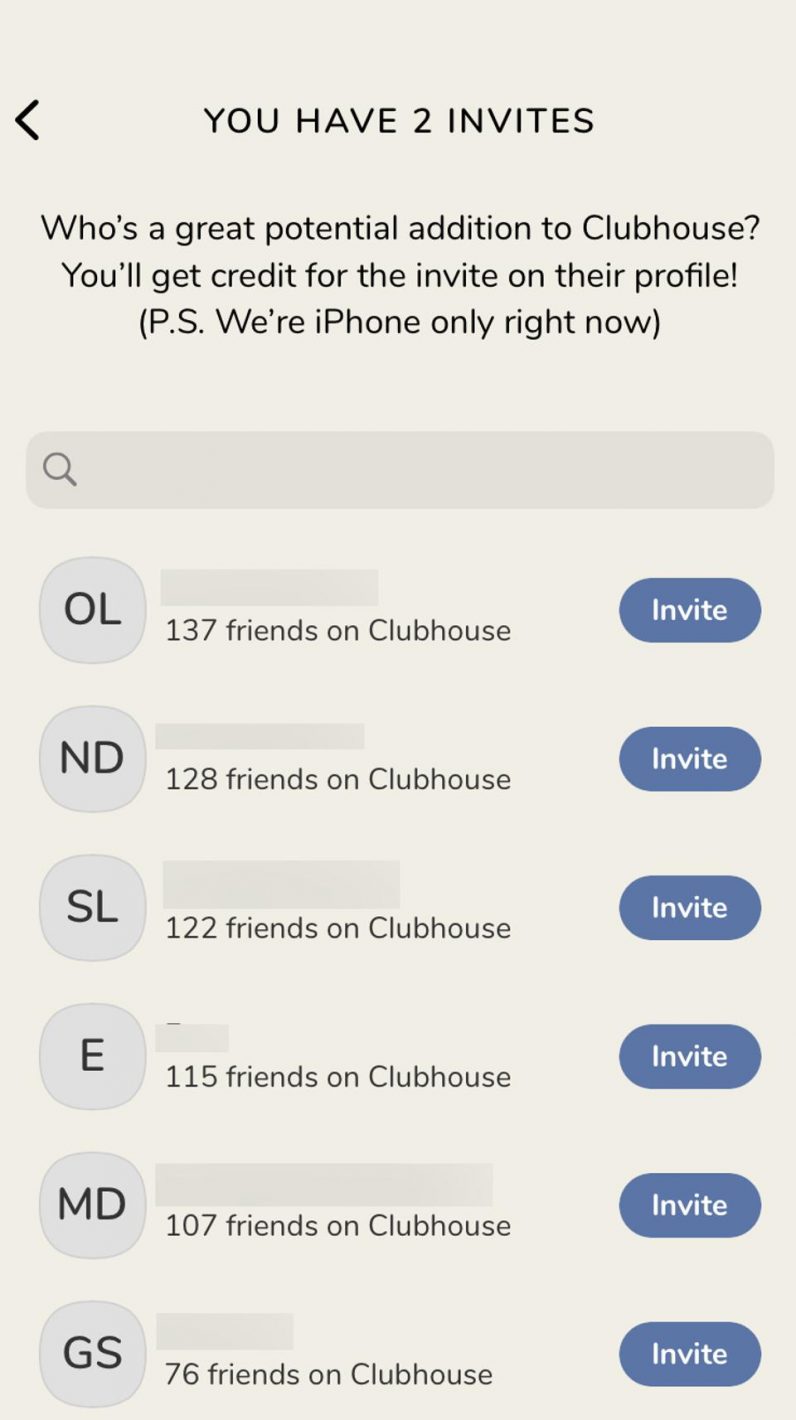
Clubhouse might have opened its doors around a year ago, but there’s always been a burly bouncer standing outside. A digital queue that feels like it never ends. And if your name’s not down – you’re not coming in. Even now, if you download the app, the best you’re going to do is be put on the waiting list… unless you are directly invited.

Clubhouse has got everyone wanting to get inside, without blowing a fortune on marketing. This kind of hype usually costs millions of marketing dollars to achieve. 🤑

How exactly has Clubhouse achieved this?

By modernizing the oldest marketing channel in the book — word of mouth — or referral marketing as we call it these days.


Word of mouth works, just ask Google 

We can go all the way back to 2004 for a great example of word-of-mouth marketing in action. Gmail is obviously now a Unicorn with 1.8 billion users around the world, but 17 years ago the name Google was not in any way one that would have been associated with email.

When it was first launched, Google only allowed a few people access to the service, offering each of these ‘beta’ users the ability to invite a few more friends and family. The referral program was so successful that invites to Gmail were up for auction on eBay at the time.


FOMO is a potent human emotion, and it can be engineered 

Exclusivity might not seem like the best way to build a business. Common sense surely dictates that you want to get as many customers as possible. But this isn’t necessarily true — it’s no good tempting millions of people onto your platform all at once if they don’t stick around.

Clubhouse’s reliance on referrals also means it’s able to attract the right kind of members in the right kinds of circles — a key ingredient to create FOMO.

It really is this simple: if a product or service is worth talking about, people want to tell their friends. By growing its membership through a referral-based model, Clubhouse is tapping into existing networks of friends, families, and colleagues. People who already trust each other and know each other’s tastes, likes, and dislikes.

This means that when your friend recommends a product, you find yourself wanting it even before you’ve clicked that link.

Referrals can save you millions 

If a company has a good product or service, customers will want to refer their friends. You just have to give them a reason to refer and make it easy for them to do so. If you get this right you could save millions on marketing. 🚀

To me, Clubhouse’s incredible success showcases the true power of referral marketing and also its simplicity. By contrast, countless businesses have spent millions on ads attempting to build that kind of trust (and noise), when all they needed to do was ask their customers to refer their friends…

It’s now easier than ever to follow the likes of Clubhouse and Google — so go for it! Easy-to-use marketing tools have made launching a referral program simple and affordable, so there really is no reason not to give it a try!

By Kirsty Sharman

Kirsty founded Referral Factory, a leading referral marketing platform that makes it incredibly easy for any business to build their own referral program. Besides being an entrepreneurial powerhouse, she acts as a growth marketer, product builder and was Listed in M&G as one of 200 Young South Africans to watch.

Sourced from TNW

By Todd Spangler

Facebook says it wants to “empower” independent writers and journalists by letting them make money from their work.

The social giant on Tuesday confirmed plans to launch a new platform for writers to self-publish their content, grow their audience and make money through monetization tools starting with subscriptions. Facebook said the platform will roll out in the coming months in the U.S.

Facebook’s new platform will face a range of competitors in the expanding newsletter/self-publishing space, including Substack and Twitter, which is gearing up to launch “Super Follows,” which will let individual users and publishers earn money from subscriptions. In January, Twitter acquired Revue, a startup that lets writers self-publish subscription newsletters.

“A large part of this initiative is aimed at supporting independent local journalists who are often the lone voice covering a given community,” Campbell Brown, Facebook’s VP of global news partnerships, and product manager for news Anthea Watson Strong wrote in a blog post.

The move also comes after Facebook’s spat with the Australian government over the country’s new law requiring internet platforms to pay for news content — and as other countries contemplate similar measures. On Monday, Rupert Murdoch’s News Corp announced a three-year pact with Facebook covering the media company’s Australian news outlets.

Facebook’s plans include the intro of a free, self-publishing tool with “robust styling options” to create individual websites and email newsletters. That will be integrated with Facebook Pages to enable publishing across multimedia formats including photos, live videos and stories, according to the company. In addition, indie writers and journalists will be able to create Facebook Groups and tap into analytics to understand how their content is performing.

The company also intends to launch features “to help audiences easily discover new content and writers,” according to the Facebook execs.

Facebook says that since 2018 it has invested $600 million to support journalism and recently said it plans to invest $1 billion in news over the next three years.

By Todd Spangler

Sourced from Variety

By Sara London

Feeling burnt out? Exhausted and unmotivated? Even if you’re attempting to reach your business goals, you could still feel trapped and dragged down by the day-to-day doldrums. But external forces could be dragging you down rather than bringing you up.

You may just be surrounded by uncreative people – those who don’t foster an environment of excitement and innovation, and who inhibit your ability to access your true potential.

Traits of uncreative people

Uncreative people can be anywhere, from your workplace to your home, from bosses to business partners and everything in between. How their lack of creativity manifests could be dependent on their role, but sometimes, there are overarching themes.

The first trait of an uncreative person is that they have inhibitory linear thinking. This just means that an uncreative person will want things done a certain way, even if that way isn’t as effective or productive. Think of a football coach who only wants to run the ball when their quarterback has the strongest arm of the NFL or a boss who only wants you to add numbers by hand, because “that’s the way we’ve always done it.

Mossy Brain recommends asking yourself, “can you restrict their influence over your life? Can you find space from them, and grow?” It may be impossible to cut people out of your life entirely, especially if you find yourself in a grey area of people who are occasionally supportive, or only rigid on some topics. In this way, it’s best to diversify your investments and know your audience.

If you keep different creative friends for different creative choices, you’re more likely to feel encouraged, but if you bring up ideas with people you know will arbitrarily shoot them down, you’re setting yourself up for failure. And don’t cut someone out just because they feel constraining — sometimes, they might be amenable to compromise, and their counterargument could be a helpful tool in finding gaps in your ideas, and ultimately, bolstering your own enterprise.

Where to find creatives

There isn’t some secret meeting place or underground club where creative people can secretly be found. It’s a misnomer that you have to be an artist to be creative, as creativity can be found in business, science, and math as well. The most important thing is to find out in what arena you wish to be creative and find a place where people who value similar things tend to gather.

If you do try to join a club, coalition, or host a Meetup for like-minded individuals, Medium says, “don’t just show up. You have to contribute to be a part of it.” While attending events is fun, volunteering can often cause one to feel more “united with the club,” and form “deeper relationships with many of the members.”


By Sara London

Sourced from LADDERS

By

Thinking outside the box can get you those sweet likes.

o one would blame you for thinking Instagram’s customization options for Stories are somewhat limited. You can add text, a GIF, draw something, and plug in a tune. But when used in creative ways, these tools are more than enough to create stories that’ll capture your followers’ attention.

Periods can become polka dots or squares to compose a trendy, geometric background for your pictures. Dashes can turn into lines, GIFs can create flashy effects, and the right colours can disguise the zillion hashtags you used to ensure your post is noticed.

There’s a plethora of possibilities. These are just a few to get you started.

Keep those hashtags hidden

If you want your posts to go beyond your tight-knit group of friends, you need to make them more social. There’s no official guidebook on exactly how to do this, but users have picked up a few things after years of experimenting. The main takeaway is that the more social elements you add to your story, the more traction it’ll gain in general searches. This includes mentions, location tags, and, of course, hashtags.

The more of these labels, the better, but nothing is less aesthetically pleasing than a bunch of words you can barely read. The solution is simple: hide them. The algorithm will pick them up even if people can’t see them. This works for mentions too, and there are three ways to do it.

Drag them beyond the margins

Your Instagram stories have some space beyond the margins of your screen; it’s not much, but it’s a great spot to hide things.

1. Use the text tool to type all the hashtags you need. If you’re using too many, consider doing it in batches.

2. Using your index finger and thumb, shrink the text pieces as small as you can.

3. Drag the text to the right or left until they’re no longer noticeable. Repeat if you have more text you need to hide.

Hide them behind your post

If you’re sharing a post from your feed or timeline, you can paste that on top of the hashtags to hide them away.

1. Choose a post you want to add to your story and use the paper plane icon to share it. Tap Add to your story on the dialog that pops up from the bottom of the screen.

2. Use the text tool to type the hashtags you want to use. You can do this multiple times if you want.

3. If necessary, adjust the size of the text with your thumb and index finger to make sure it’s smaller than the picture of the post you’re sharing.

4. Drag the text on top of the post and then tap the post to bring it to the front. Your hashtags will no longer be visible.

Camouflage your hashtags

No one will see your hashtags if they’re in the same colour as your background.

1. Choose a post you want to add to your story and use the paper plane icon to share it. Tap Add to your story on the dialog that pops up from the bottom of the screen.

2. Select the drawing tool (the squiggly line at the top of your screen) and choose a colour.

3. Press on any space not covered by the post you’re sharing to set a background colour. To finish, tap the check mark in the top right corner of the screen.

4. Select the text tool and type your hashtags.

5. Tap on the colour wheel at the top of the screen and select the same colour you used for your background colour. If you need to, use the eyedropper tool in the bottom left corner of the screen to select the exact shade. Tap the check mark in the top right corner to finish.

6. Drag your hashtags into the space around the post you’re sharing. If necessary, use your index finger and thumb to modify the size of the text.

Hide the music player sticker

You have many options when you use a Spotify sticker on an Instagram story. Tap it once, and you’ll see the song’s cover art. Tap it again and again, and you’ll see the lyrics displayed in different ways. The default is a white label sticker that, no matter how much you try minimizing it, most of the time looks like an eyesore. Plus, the artist and name of the song are already listed under your username, so there’s no need for it if you want your followers to know what song you’re playing. You can simply stash it beyond the edge of the screen—noticing a trend?

1. First, add a music sticker. Keep the default display option and figure out the exact snippet of the song you want to feature on your story. Tap the check mark in the top right corner to finish.

2. Then use your thumbs to flip the sticker to a vertical position. You’ll see a yellow dotted guideline appear to make sure it’s perfectly parallel to the sides of your screen.

3. Use your thumbs to shrink it as much as possible.

4. Drag the sticker to the side of your screen. If you still see a thin white line, move it up and down to hide it completely.

Create a flashing effect using GIF stickers

8 creative ways to add flair to your Instagram stories
Some glittery fun.
Sandra Gutierrez G.

With this trick, you’ll turn your Instagram stories into a flashing sign to catch your followers’ attention. You’ll need to perfect your free-hand drawing and writing skills, but if you’re already an enthusiast, there’s a lot you can do with this technique.

[Related: Make your own Instagram filters]

1. Open Instagram and tap the plus sign at the top of the screen. Then tap Story at the bottom

2. Tap the shutter button (it doesn’t matter what kind of pic you took) and then touch the sticker tool (it’s the third one from the right at the top of the screen). There, tap the GIF option and search for something flashy. Words like “flash” and “glitter” yield strobe-rrific results. Keep in mind that bright, flashing effects can provoke discomfort, headaches, or even seizures in some people.

3. Using your thumb and index finger, enlarge the GIF until the flashy or animated part covers the entire screen.

4. Hit the download button (looks like a downward arrow) on the top of your screen to save the story to your device.

5. Tap the X button in the top left corner of the screen to close the story editor and choose Discard on the popup prompt.

6. You’ll be redirected back to the camera view of the Instagram stories editor. There, tap the Gallery button in the bottom left corner of the screen and select the story you just saved.

7. Open the drawing options, choose a colour, and press anywhere on the screen to paint over the video.

8. Choose the eraser tool (at the top of your screen, third from the right) and use it as a brush to delete the top layer of colour you just created. As you write or draw, you’ll reveal the GIF underneath, and the finished product will start flashing before you.

Use characters as design elements

When a platform only gives you basic tools, you have to get creative. And that’s exactly what Instagram users all over the world have done by turning characters such as dashes, periods, and other punctuation marks into design elements.

Unfortunately, this is a technique that you may not be able to take full advantage of on Android. If you have an iPhone, though, the possibilities are endless, and the results will mainly depend on how you use them. For now, this is how you start.

Add lines and blocks to your Instagram story

8 creative ways to add flair to your Instagram stories
Using dashes and periods you can make a film reel to feature your favourite photos.
Sandra Gutierrez G.

1. Open the text tool and select your font. The one you choose will depend on what you want to do. Type a period and see if it’s a circle or a square, and choose the style that best aligns with your idea. If you want to make a line, type a hyphen or a dash.

2. Tap the check mark button in the top right corner to exit the tool.

3. Use your thumbs to make the text as big as you want it to be. This is where the waters of possibility separate depending on what phone you have. When trying to enlarge these elements, Android users will hit a relatively small size limit. This limitation keeps characters looking like characters instead of geometric shapes, defeating the purpose of this technique. As an alternative, Android users can use the highlight function when typing (the third button at the top of your screen; it looks like an A with sparkles) to make characters bigger.

4. Drag and position the element where you want it and change the colour if you’d like.

Superimpose text to give it volume

Plain text is boring. 3D text is way cooler.

1. Use the text tool and type what you want to say. Tap the check mark button in the upper right corner to finish.

2. Repeat Step 1 as many times as necessary.

3. Use your thumbs to enlarge all pieces of text and make sure they are the exact same size. A great way to help you do this is to use Instagram’s automatic guidelines that appear when you centre the text.

4. Change the colours of the text as you like. You can do a rainbow or a gradient of colours. If you want them to match a photo or post, use the eyedropper tool.

5. Align your text to create a volume effect. This requires some practice, but you can start by placing them on top of each other and moving the upper layers of text slightly to the right or left. The piece of text on the very top should be the farthest away from the one on the bottom. Don’t despair if it takes a long time to achieve the desired effect, but we recommend you don’t try to align 20 layers of text on your first try. Start small.

Add pictures to your Instagram story straight from your phone

Stickers and GIFs are fun, but you can paste your own pics, too. If you’re promoting a post with multiple photos, this is a great way to display them in all their glory.

1. Select the photo you want to use from your device. Tap the Share button and choose Copy. If you don’t see it, this is because it’s not possible with some versions of Android. All iPhone users can use this feature.

If you have stock Android, you’ll only be able to do this by using a browser to copy images directly from the web, as Google’s operating system doesn’t allow you to copy an image as a sharing option. If you want to do this, you can go to Google Images or directly to the website featuring the photo you want to use, press on it to select it, and tap Copy.

2. In the Instagram story editor, open the text tool and paste the photo as if it were text. Now you have a sticker you can drag and resize as you please.

By

Sourced from Popular Science