Author

editor

Browsing

By

By now, we all know that key to cultivating a creative business — one driven by — is to ask lots of . Warren Berger wrote a best-selling book about this back in 2014, called A More Beautiful Question: The Power of Inquiry to Spark Breakthrough Ideas, which laid out the path to innovation in three parts: Why? What Ii? And how?

A good example of the Why-What If-How paradigm is the origin story of the camera. It started, as Berger explains, with a Why question from the daughter of Polaroid co-founder Edwin Land: Why did it take so long to see the photographs Land had just taken, using a traditional camera? That “why” led to a “what if”: Could he build a darkroom within the camera? And then, “how”: What combination of chemicals and paper would make that magic happen? In 1948 — five years after that first question was asked — the instant camera was born.

Market researchers help companies stay innovative by asking important questions of consumers all the time. But we also know, from experience, that it’s not just what questions are asked, but how they’re asked; in the media maelstrom facing consumers today, many people speed through traditional surveys, doing anything to get to the end.

Here are six things to consider, from context to timing to tone, when building your survey of “beautiful questions,” while ensuring that the experience is both fruitful and enjoyable.

1. Show that you understand the brand personality

Brands that are fun and edgy speak a different language. Take REVOLT TV, Sean “Diddy” Combs’ digital media company dedicated to urban contemporary music. They have a large and very engaged community (which, full disclosure, my company does  with) and use words I barely understand (like “that’s really wig,” which means something so good your wig flies off your head). If I sent one of these REVOLT surveys to some of my colleagues, it might go over their wigs, but the slang and tone makes sense for Revolt’s audience.

2. Mirror the way actual human conversation works

When I’m talking with a friend, there is a natural cadence. One person says something, and the other person responds. (“I really enjoy hiking in the mountains.” “Yeah, hiking is great. What do you like most about it?”) It’s all about listening, then acknowledging what was said. You don’t throw away the research script, but by “piping” part of a consumer’s response back into the next question, you’re keeping them engaged in organic conversation.

3. Make your survey snack-sized

Asking one question doesn’t give you enough to drive much insight, but asking somebody 30 or 40 questions guarantees you lose them forever. Consumers don’t want a survey experience that takes more than two or three minutes — max. While there may be a subset of people, like retirees, who will happily spend hours doing your long survey, just about every other demographic is looking for one that’s short and sweet.

4. Balance ‘things I want’ with ‘things you want’

A meeting host rarely dives into Agenda Item No. 1 without a warmup. A journalist won’t start an without an icebreaker. In any serious conversation, it’s never 100% about business. Think about when you have to give somebody criticism. You offer up a “praise sandwich,” with the negative sandwiched between two positives. Same thing with surveys. Along with the necessary client questions — “the meat” — ask some questions that show you care about the consumer.

5. Be vulnerable and share back

If you expect consumers to give you video feedback, upload a video of yourself and tell consumers something you’ve learned along the research process, particularly how their efforts are helping your client’s business. “Your input is going to drive some huge decisions in our product team,” you might say. Or: “Because of your feedback, we are launching this ad campaign. We want to share it with you first, one day before it is released to the public.”

6. Say thank you

Showing is essential in any business transaction, and research is no different. Maybe you share a fun meme or emoji or a video from an internal team member. Perhaps you make a charity donation in the consumer’s name as a way of saying thanks. These things are not the reasons people participate — not the goal that is driving them forward — but it makes them feel appreciated just the same.

Bottom line: Every engagement you have with consumers is a branded one, including research. So make sure your approach reflects the brand, and make the experience actually engaging.

Feature Image Credit: Omar Osman | Getty Images 

By

Entrepreneur Leadership Network Contributor. Founder and CEO, Rival Technologies

Sourced from Entrepreneur

By Daniel Lubetzky

You have an innovative and differentiated product that has withstood your relentless scrutiny and you are ready to go forth and conquer. (In other words, you’ve mastered what I call the “3 Cs of Entrepreneurship,” which you can read about here.)  Now it’s time to talk about how to build your ideas into reality. I approach this process by working through five key steps. It’s critical to give all of them your equal attention and to understand how they influence one another.

Here are my “5 Steps to Strategic Execution”:

Vision: This is your dream—what you want to be and where you want your enterprise (whether social, business, or hybrid) to be in 20 years. Some may say your mission should come first, but I start with vision, because you need to know where you are headed to forge a road to get there.

While dreaming can be criticized as undermining an entrepreneur’s ability to stay grounded and focused, it is an extremely valuable pursuit, because it orients us toward where we are going. As Henry David Thoreau said, “If you have built castles in the air, your work need not be lost; that is where they should be. Now put the foundations under them.” Let’s talk about building those foundations.

Mission: This is what you were put on this Earth for, what gives you meaning and sense of purpose, and what you are ultimately aiming to accomplish. If your mission were to be fulfilled, what would the outcome look like? Mission is your raison d’être, imbuing everything you do with a higher purpose that can be highly motivating.

Sometimes it is useful to begin with understanding the mission underlying your vision before you begin to dream about the future. But the passion and meaning you derive from your mission can catapult you toward your vision, in which case it’s helpful to first uncover where you want to go. Whichever approach you take, you will need a strategy to get there.

Strategy: This is a big-picture, top-level construct aimed at building a pathway between your mission and your vision. Strategies should help you determine which forces you will rely on—do you want to be available to everyone, everywhere? Or should you build your anchor expertise in a particular channel before you branch out? Will you pursue retailers and wholesale accounts or focus on selling direct-to-consumer? Are you a premium service or mainstream?

I often think of strategy as what not to do. One of our greatest strengths as entrepreneurs is our drive to do. But this can also be the source of our undoing. Strategy forces us to focus. It helps us to set priorities and double down on our greatest opportunities without letting the smallest ones derail or distract us.  If you haven’t thoroughly figured out from which pursuits you will abstain, regardless of the temptations, you haven’t done enough strategic planning.

Tactics: People often think of “tactics” as the boring or easy part. But just as a strategy can arm you with an entirely new playbook, so too can tactics help you outperform by doing things differently through how you execute.

If your strategy is to have best-in-class customer service, one tactic may be to ensure that team members are evaluated regularly based on the value with which they leave consumers. How can your evaluation practice be better than others? What incentives will you offer and what technology will you use for tracking? These details will go a long way in distinguishing you from your competitors.

Execution: To carry out your tactics effectively, you must maintain a commitment to excellence, relentless productivity, entrepreneurial spirit and tenacity, and integrity too. Take all the values that are important to you and make them part of your company culture and leadership style so that they permeate through every action, big or small, that you take.

Execution is about giving it your best, your gritty relentless best, and outperforming by running faster, with better form and better posture than others. Ultimately, it will make or break your success—you could have every other piece in place but then falter on your execution, and the rest would be worthless.

As you prepare to bring your product or service to market, working through these steps will help you to refine your launch plan. Now what are you waiting for? It’s time to make your vision a reality.

Feature Image Credit: [Photo: oatawa/iStock; rawpixel 

By Daniel Lubetzky

Daniel Lubetzky is the founder and executive chairman of global snack company Kind and the Kind Foundation. Through his family office, Equilibra, he invests in companies that help people live and eat well. 

Sourced from Fast Company

By

The top six Google tools to help grow your website SEO score

Building a website has never been easier than it is today. However, building a successful website is getting harder and harder in a highly crowded space, especially when considering the importance of website SEO (search engine optimization).

While choosing the best web hosting for your website will go a long way to helping you succeed, there are numerous  other tools you should be make use of, and Google’s toolkit is a great place to start.

In this article, we look at six of the best Google tools. If you’re not already taking advantage of them, it might be time to change the way you work.

1. Google Ads

website seo

Google Ads is a powerful marketing tool (Image credit: Google)

Most experienced website owners will agree that Google Ads (formerly Google AdWords) is one of the most powerful marketing tools available. It includes a suite of smaller tools, effectively allowing you to perform keyword research, low-key competition analysis, and PPC (pay-per-click) marketing from one central hub.

Of course, this isn’t free, and it can cost quite a bit if you don’t know what you’re doing. But learn how to run effective ads, and you will soon be driving a decent amount of traffic to your website, no matter your budget.

2. Google Analytics

website seo

Google Analytics is a very powerful website statistics tracker (Image credit: Google)

When you own a website, it’s important to understand how it’s performing at all times. It might be that you’re suffering from a high bounce rate, but don’t know why. Or perhaps you’d like to know what your main traffic sources are. Whatever information you’re looking for, Google Analytics can help.

To get started, you will have to link your website to your analytics console. There are a few ways to do this, but the easiest is to paste a small code snippet into your website source code. Google provides a full tutorial on how to do this.

Once you’re connected, you will be able to access your analytics portal, where you will find information on everything from visitor demographics and source to your most popular content. And as you can imagine, this information is extremely useful for making future business decisions.

website seo

Google Trends is a great way to track keyword search volume over time (Image credit: Google)

One of the hardest things to do as a webmaster is to keep track of your keywords. Keyword research is all well and good, but search volumes are constantly changing, and it can be difficult to identify up-and-coming keywords or phrases with normal research.

This is where Google Trends is useful. Basically, it allows you to view the search volumes for specific keywords or keyphrases over time. You can compare the performance of different search terms while filtering by location, search platform, time period, and more.

4. Google Search Console

website seo

Any webmaster who is serious about developing a strong online presence should take advantage of the Google Search Console (Image credit: Google)

SEO is difficult at the best of times, but it’s almost impossible if you aren’t using the tools at your disposal. All webmasters should be using the Google Search Console in some way or another, largely because it’s a great source of information about the effectiveness of your SEO campaigns.

For starters, it allows you to submit sitemaps and individual URLs directly to Google to ensure your entire website is indexed properly. Keep track of search analytics, and get notified when Google finds any problems with your site and its content.

5. Google AdSense

website seo

Google AdSense provides a great way for small website owners to monetize their sites (Image credit: Google)

If you run a content-based website, there aren’t a lot of ways to monetize your work. You could sell premium content or add a little ecommerce store, but these both require a lot of effort. Alternatively, you could include some form of advertising on your website by signing up for Google AdSense.

Once you’ve signed up, you will need to be approved by Google to become part of the Google Network of publishers. Once approved, you will be able to place small ads on your site. These are usually targeted at your audience according to their interests and past browsing history, and you will be paid whenever ads are published and/or clicked on.

6. Google Alerts

website seo

Google Alerts is basic yet powerful (Image credit: Google)

Google Alerts certainly isn’t the most powerful tool in the search engine’s toolbox, but it’s extremely useful nonetheless. It allows you to set alerts for keywords, phrases, or anything else you want to monitor on the web. When a relevant piece of content is published, you will be notified. A lot of webmasters use this to monitor the exposure their website is getting across the web. Simply create an alert for your brand or website name, and wait for the results to start rolling in.

Summary

Google is the most popular search engine in the world, and it comes complete with a suite of tools to help webmasters improve their website’s performance and search engine ranking. The above six are some of the best Google tools available, and now you know what they’re useful for and why you should be taking advantage of them.

Feature Image credit: Edho Pratama (Unsplash)

By

Sourced from tom’s guide

Apple has discontinued the iMac Pro. After introducing it in 2017 as “the fastest, most powerful Mac ever made,” the company has apparently decided it has become redundant. It is a spectacular fall in a mere four years for the machine that signalled Apple’s renewed commitment to the Mac.So, what went wrong? Did it lose its way among the upcoming Apple Silicon Macs or was it doomed from the beginning? As we pour one out for the iMac Pro, let’s consider what its failure tells us about the future of professional-level Macs.

The flaw at the heart of the design

Despite all the onstage bluster at its unveiling, Apple likely knew it was taking a gamble with the iMac Pro.

Although it was housed in an iMac’s shell, the iMac Pro was a step above its all-in-one sibling. It married sleek design with workstation-class components, including Intel Xeon processors and AMD Radeon Pro Vega graphics chips. It was the first pro-level desktop Mac to come with an integrated display (a 5K one at that), as all previous efforts — from the Power Mac to the trash can-like Mac Pro from 2013 — consisted solely of the computer itself.

As impressive as it sounded on paper, the iMac Pro was fatally compromised by its design. For the creative professionals it was designed for, unhampered performance and upgradability are both must-have features. These areas were exactly where the iMac Pro tripped up, which was a repeat of the maligned 2013 Mac Pro.

Although Apple boasted of a top-notch cooling system in the iMac Pro, there would always be limitations to stuffing all those components behind the screen in a slim, all-in-one form factor. There just wasn’t the thermal headroom needed to fully utilize the components inside. But the lack of modularity was an even bigger issue.

It was wrong for its core audience (creative professionals) because it was not upgradable, leaving customers stuck with the same components even as their workloads got more demanding. Replacing an expensive computer every few years just isn’t tenable — at least not compared to the flexibility of a traditional desktop tower. Hence, the eventual return of that design with the 2019 Mac Pro. In the end, the iMac Pro was just a stopgap until we got to the Mac Pro — and it has lived in the shadow of the former ever since.

The shadow of the Mac Pro

Julian Chokkattu/Digital Trends

Even before the iMac Pro came out, rumours abounded that Apple was revamping the Mac Pro into a machine that combined power with modularity — something Apple itself confirmed before the iMac Pro launch. You would be able to swap out any of its components for whatever you wanted, giving you a perpetually upgradable machin, the likes of which Apple had never made. Or so said the industry gossip.

In the end, the Mac Pro was never quite as modular as some of the more fervent dreamers had hoped, but all the talk inevitably cast a shadow over the decidedly non-upgradable iMac Pro, most likely stifling interest in it.

With the Mac Pro in the offering, convincing creative pros to opt for something with none of the upgradability and that would likely quickly be surpassed by the Mac Pro was a tough sell. After all, the shape of the iMac — its scooped back and razor-thin wedges — heavily limits how much power you can put inside it because it is exceedingly difficult to keep cool. A desktop machine with a focus on modularity like the Mac Pro would necessarily come with a more spacious chassis, thus increasing its cooling capacity and the power of its internal components.

And that is what we got. Apple had designed a range of attachable upgrades, from the Afterburner card to the MPX Modules, that would be impossible in the iMac Pro. For the first time in well over a decade, creative professionals had an Apple option that made more sense from a future-proofing perspective.

As soon as the Mac Pro launched in 2019, it was clear there was no real place for the iMac Pro. Even worse, rumours about Apple Silicon would create a whole new problem for the all-in-one.

The Apple Silicon dilemma

Apple iMac Pro News

Before diving into the topic of Apple Silicon, I should first address just what came in the original iMac Pro. What did “the most powerful Mac ever made” get you in terms of processor performance? Well, it originally shipped with 8-core and 10-core Intel Xeon chips, plus an 18-core version that John Ternus, Apple’s vice president of hardware engineering, described as “really nutty.”

At the time, this seemed like a huge step for the Mac, which many people felt had been increasingly side-lined by the all-powerful iPhone. Yet, Apple knew that even the 18-core behemoth would soon be superseded by its own Apple Silicon chips — chips that the company was already working on in secret.

The difference between Intel’s and Apple’s chips has already been starkly outlined, especially in the Mac Mini, the most performant Apple Silicon computer yet. But the difference is even more glaring when the iMac Pro is thrown into the mix.

Today, you can buy a 10-core iMac Pro that scores 1117 in Geekbench 5’s single-core test and 9386 in its multi-core test. When we reviewed the Mac Mini, it scored 1744 and 7659, respectively. Trading blows, right? Although Geekbench results are far from a comprehensive look at performance, they demonstrate the pickle that these high-end Intel-based Macs have been in.

That’s especially true when you consider the price. The 10-core iMac Pro will set you back $4,999. The Mac Mini? $699.

Of course, Apple knew it couldn’t just snap its fingers and give the iMac Pro an Apple Silicon chip — it had to wait for Pro apps to be ready. It also had to develop its own professional-level performance. But the longer Apple waited, the more irrelevant the iMac Pro’s Intel chips would become compared to the M1 and its successors.

Something much better is coming

The death of the iMac Pro, though, is far from the death of high-performance Macs. If you need a professional workstation to get your work done, the outlook is still very favourable in Apple land. The Mac Pro, while expensive, is laser-focused on creative pros and still offers a great option if power is what you need. There are rumours that Apple is planning to update it with more powerful Intel chips, potentially this year, so it is not going the same way as the iMac Pro.

At the same time, Apple is reportedly working on a half-size Mac Pro that would come with an Apple Silicon chip and look like an enlarged Mac Mini.

Apple could easily stuff a high-powered M-series chip into the iMac Pro, but the Apple Silicon chips make it unnecessary. The regular iMac is due for a major revamp as early as this spring, when it is widely expected to come with Apple Silicon chips of its own. This could bring a big performance boost and put the standard iMac near the level of the current iMac Pro.

Yet at the same time, top-end Apple Silicon chips of the type that would be perfect for the iMac Pro are likely not ready yet. With the entry-level iMac offering what was previously considered pro-level performance on the one hand, and a lack of truly iMac Pro-class Apple Silicon chips on the horizon, there is no place for the iMac Pro to go.

So yes, the future of the iMac Pro is grim. The good news? For creative pros, the death of the iMac Pro doesn’t mean Apple is getting cold feet about catering to this audience. It’s merely making room for all the exciting Macs ahead.

Sourced from digitaltrends


HP Spectre 13 2017 Review
Photo of MacOS Catalina Photos screen


By Maria Haggerty

As the collapse of the traditional retail model progresses, consumers by and large now defer to shopping online for everything from daily essentials to luxury purchases, paving the way for direct-to-consumer (DTC) brands to take the place of traditional retail stores.

I’ve purchased everything from toothpaste to cars online. In this heightened e-commerce landscape, consumers’ expectations that products and experiences be crafted to meet their exact needs have escalated.

To that end, DTC brands are re-targeting their sights — and their sites — on providing the perfect solutions rather than simply comparable alternatives. If you’re competing here, in order to thrive, you must be mindful of, and responsive to the latest trends and best practices.

Know your niche

In a growing market of specialty consumer preferences, shoppers aren’t just looking for an item to add to their cart; they’re looking for an experience that makes them feel seen. They want confirmation that a solution has been created specifically to meet their unique need or desire. And in order to discover that solution, it needs to be presented to them through the right channels, at the right time, and with the right tone.

DTC brands have the singular advantage of being able to offer a distinctive experience to their customers. That mindset should inform the entire brand strategy, from product development to packaging design, fulfilment, marketing, and anything else that touches the customer experience. One of my company’s clients customized offers based on the order code on a packing slip. If a customer used a first-purchase discount code, for example, that order would be packed with a postcard offering an exclusive discount on a future order. This was part of a strategy to convert first-time buyers into returning customers and build brand trust to increase satisfaction and retention.

Successful DTC brands win on the personalization front by using historical and real-time customer behaviour data to recognize purchase intent, make tailored product recommendations, and create value add experiences that leave customers feeling understood, satisfied, and excited for more.

Harness the power of data

Major carriers have increased shipping rates. With shipping being one of the primary costs of doing business as a DTC brand, having visibility into transportation data provides the insights necessary to ensure optimal efficiencies, improved bottom lines, and a better experience for both shippers and customers.

Look into your shipping and billing data. With this information, identify areas where you can reduce waste, decrease transportation spending, and make better business decisions on an ongoing basis.

Make returns a cinch

More and more brands are embracing ‘returnless refunds,’ whereby customers are fully refunded for a return without actually having to return the item. This strategy ticks off several boxes for sellers including reducing carbon footprint and eliminating the return shipping and customs fees, which can end up amounting to more than an item costs to manufacture.

Not to mention, sending a customer an email that says, “feel free to keep or donate the item you were planning to return,” scores major points for customer experience and satisfaction.

Channel your efforts wisely

If you apply the “if a tree falls in the forest” philosophy to DTC, the question becomes, if a product is promoted on a platform your audience doesn’t use, does anyone see it?

Successful DTC brands provide customers with a seamless online shopping journey from research through purchase. This starts with knowing what channels customers are relying on for information. In other words, location is everything.

There are a lot of choices — social media, email marketing, search engines, affiliate networks, for starters. You can start narrowing down your channel mix by looking at factors such as your budget, competitor presence, and your bandwidth to manage efforts. Then, it’s time to test the waters. To avoid wasting time, money, and resources, you can get a good baseline by promoting only your best-sellers through the channels you’re considering.

Make an impact

Today’s savvy, socially conscious consumers flock to brands that project an image with values that reflect their own, and that’s a key insight for DTC brands in 2021. Shoppers evaluate a brand not only by the breadth and quality of its commodities, but by its reputation.

Criteria being factored into purchasing decisions today include sustainability efforts, stance on racial and social justice issues, and the standard of their customer experience. If you haven’t already, 2021 is the year to commit to a cause that speaks to your brand’s — and your customers’— identity.

DTC brands are taking commerce to new levels, creating the products and experiences they know their customers desire. By studying your core audience, you’ll gain an intimate understanding of what challenges and opportunities exist for them, providing the opportunity to convince them that your brand should be their go-to solution.

Feature Image Credit: Direct-to-consumer brands have the advantage of being able to offer personalized experiences. Eva-Katalin/Getty Images

By Maria Haggerty

Sourced from Business Insider

By Tanner Simkins

Which marketing plan works best for the modern entrepreneur: outside or in-house? Here are four important factors to consider.

As your grows, at some point you’ll need to take your to the next level. While many leaders of new and are used to taking on a variety of roles, there will come a time when it makes sense to pass marketing roles on to the experts. Doing so is vital for making sure that your business continues to develop new customers, build its brand, and stay competitive in its industry.

For many leaders the realization that they need to work with marketing professionals leads to questions of whether to turn to a or hire an in-house marketing team. There is no right answer to this question, as it depends on the business’s resources and needs. That said, there are a few issues that leaders should consider when determining whether to hire a marketing agency or to develop an in-house team. Here are a few key factors to think about.

Type of expertise

What type of expertise do you want? An in-house marketing professional offers in-depth knowledge of your business. This person (or these people) will know exactly what your team does and exactly what your team is about. Additionally, every moment will be spent on your business, and they’ll be fully invested in your business’s success.

In contrast, when working with a marketing agency, you’ll get access to an entire team of marketing professionals with an array of expertise. While you might not get the same level of knowledge and investment in your business, you will get a team on the cutting-edge of the industry with a variety of applicable skill sets. In addition, you’ll get a fresh perspective and a new look at what your business is doing. Finally, marketing agencies have the benefit of working with a variety of businesses, which means they bring a wealth of industry knowledge to each client.

In-house marketing professionals and marketing agencies both bring unique areas of expertise. When determining what’s best for your business, it’s important to consider the type of expertise your business wants and needs.

Budget

Budget is an important factor to consider as it’s generally more expensive to hire your own marketing professional than it is to work with a marketing agency. When you hire a marketing expert, you need to keep in mind that you’re not only going to have to pay their salary but also all of the additional expenses that come with hiring quality employees including recruitment costs, payroll taxes, pensions, benefits and training.

As a result, while you might think the salary of one employee is equivalent to the retainer for a marketing agency, it’s also important to factor in all of the additional costs. In most cases, the reality is that working with an agency is less expensive than having in-house marketing experts.

Timeline

Timeline is another key factor to consider. In some cases, small businesses find themselves pressured to develop a marketing strategy. This can happen if customer growth plateaus, competitors begin gaining , or new products are not taking off as anticipated.

In these situations, businesses need immediate action and should consider a market agency.

Marketing agencies can jump in immediately and quickly develop a marketing strategy. It takes much longer to recruit, hire and train your own marketing professional.

Communication style

Another factor to consider is what sort of communication you’d like to have with your marketing team. Having someone in-house means that you are working side-by-side, have regular communication, and can get ongoing, immediate updates.

You won’t have this sort of access if you work with a marketing agency. Generally, when working with an agency, there are a lot of in-person meetings in the beginning as a strategy is developed. After that, things shift to primarily e-mail and phone communication, and you won’t have the same sort of constant communication and access. For some leaders, this is fine, for others, it’s a major negative for working with an agency. Either way, it’s important to think through this difference and determine what’s best for you and your team.

Working with marketing professionals to develop an effective marketing strategy is an important part of sustaining and growing your business. While marketing is something that most leaders take on in the beginning, it’s a consuming job that at some point will need to be delegated to maximize results and to effectively manage your team’s time.

Marketing is never done, it is a long haul. With that in mind, it’s important to turn to marketing professionals who are fully dedicated to growing businesses. Determining whether to work with an agency or to build your own team can be tricky, but weighing the right factors will enable your business to make the right choice and to move forward with the right team.

Feature Image credit: golero | Getty Images 

By Tanner Simkins

Sourced from Entrepreneur

By Conrad Saam

Lead generation service providers are aplenty, but how do they really work and are they right for each lawyer?

Marketing has undergone a radical transformation right under the noses of many lawyers. Lead generation for lawyers is the low (financial) risk marketing channel usually shrouded in some layer of fuzziness—i.e., “how” exactly are these “leads” being “generated” and by “whom”?

Lead Generation Fundamentals

Many law firms have been built on the backs of lead generation services—some with multiple vendors driving a variety of leads. Lead gen companies typically charge lawyers on the pay-per-lead (PPL) model—i.e., law firms pay a set price for each inbound opportunity delivered. Predictably, the pricing is highly variable by practice area, ranging from $20 to north of $700 per inbound opportunity.

One of the reasons law firms like lead generation, especially the pay-per-lead model, is the simplicity in evaluating the cost effectiveness of the vendor. For example, a lawyer can easily think, “If a lead costs $45 and I typically convert 10 percent of my inquiries, then that’s a $450 cost per client while my clients are worth $4,000.” The problem with this overly simplistic approach is twofold: (1) the quality of PPL companies is highly variable; and (2) many lead generation companies cycle the lead to multiple lawyers. This shotgun approach generates a mad rush of phone calls to a prospect who quickly becomes overwhelmed by lawyers and paralegals.

Simply put, turning leads into actual paying clients requires an extremely efficient, responsive, professional intake staff. Applying the typical assumption of a firm’s conversion rate (which is probably overly optimistic already) to lead generation often results in poor cost-per-client numbers (read: poor ROI). Therefore, success in the lead generation market also requires extremely accurate and efficient tracking infrastructure that can track the lead throughout the law firm’s sales cycle.

The Many Players And Models in Legal Lead Generation

There are a variety of lead generation companies—some known brands, some obscure and some operating from the shadows of the legal search engine optimization (SEO) market. Large-branded players in the legal field include Lawyers.com, FindLaw, Nolo and Martindale-Avvo. These cover the gamut of consumer-focused practice areas and rely on SEO-driven traffic to their directory pages. Some, like FindLaw, have extensive content libraries that drive a large volume of inquiries.

While these directory services are used by many, they have drawbacks. One of the nefarious realities of these directories is that many of their leads are driven by a name search for a specific attorney and then resold back to other law firms. For example, a prospective client (PC) may be recommended to Bill Jones. The PC researches Bill Jones through Google, lands on an Avvo listing for Bill Jones and eventually fills out a form that goes to . . . a paying lawyer (or lawyers) other than Bill Jones. These changes can be a detriment to an individual’s marketing efforts as a result.

Some providers have modified their marketing models, while others provide a slightly different approach to marketing for professionals. In 2016, Avvo ran afoul of fee-sharing decisions with its Legal Services—Avvo fixed fees for a consultation for which attorneys paid Avvo a fee. Martindale-Avvo (unlikely brand bedfellows spawned by the acquisition of Avvo by Internet Brands) recently launched pay-per-lead services along with its more traditional advertising blocks. FindLaw’s network, which includes Superlawyers and LawInfo, drives a PPL model driven by basiconline form fills. LegalMatch functions like the eHarmony of legal services, with prospective clients filling out a “case” for lawyers to review and operating on a subscription basis with longer-term commitment requirements.

Innumerable lesser known brands exist in the legal generation business. Unbundled Attorney provides leads for attorneys offering flat-fee services (this makes the all-important ROI calculation even more straightforward). Another brand is 4LegalLeads, which offers a rotation model for its leads—contacting one lawyer after another. This rotation model is a welcome spin on the shotgun approach (blasting a single lead simultaneously to multiple attorneys).

Nonlaw-focused firms have entered the lead generation business as well—most interestingly Thumbtack. This extremely deeply funded tech service provides lead generation for an array of businesses, including law firms. Thumbtack shepherds prospective clients through a series of rudimentary questions in an attempt to prequalify those leads and match them to an attorney. Attorneys provide prospective Thumbtack clients with a quote to review. While lead generation options are abundant, the real issue comes with obtaining results from the lead generation service of choice.

Elusive Economic Success of Lead Generation

In general, the economics of lead generation companies are poor, especially for those who rely heavily on advertising to generate those leads. Consider a simple scenario where a lead gen company drives website traffic through pay-per-click (PPC) advertising and then simply resells that traffic to lawyers. Very little additional intrinsic value exists for the consumer to go through that resource to find a lawyer. (Perhaps the consumer can contact more lawyers from one resource or is shepherded through a “qualifying” series of form questions.) In general, the lawyer is much better off attracting that prospective client directly to her own website instead of through the lead generation middleman who is engaged in advertising arbitrage—aka buying PPC traffic, marking it up and repackaging it in a PPL model.

Having said that, lead generation is a frequent supplement to many marketing portfolios. A smattering of my clients rely extensively on lead generation for the majority of their client development efforts. Anecdotally, these firms tend to be aggressively growth minded, volume-based, midsize personal injury firms with exceptionally well-run intake processes and highly accurate reporting infrastructure. Given the cost, success at scale with lead gen simply requires converting a high percentage of prospects into clients and a firm structure that accepts lower margins.

Lead Generation and Local Spam

For years, local search (the map in a Google search with the red pins in it) has been polluted by fake listings. From a Google perspective, fake listings include local law firms pretending to have an office at a location that isn’t really staffed (think a mailbox at a Regus office), out-of-state law firms pretending to be in state, and nonlaw firms masquerading as law firms. The latter category is the foundation of many leads that are resold to law firms. With the right experience and technical know-how, it is possible to set up a fake business and get it to rank on Google local search results. The legal industry has been particularly targeted with these tactics, because the industry is both very lucrative and very competitive. These tactics have been used by foreign actors, enterprising (albeit unethical) individuals and lawyers themselves.

Even more commonplace is a nonlawyer pretending to be a law firm. The giveaway for identifying these listings is the website that looks very much like a law firm’s until you realize there is not a single lawyer listed anywhere on the site. These listings also tend to have no (or very few) Google client reviews. Leads generated through these fake businesses are then sold back to attorneys—sometimes laundered through the more recognized branded lead generation companies.

The “New” 800-Pound Lead Generation Gorilla

Not to be left behind, Google has entered the lead generation game with its new (to legal) Local Service ads (LSA) that operate on a PPL model. LSA popped up in August 2020 and have been slowly rolling out ever since. They are extremely effective—supplanting Google Ads for the prime position at the top of the search engine results pages (SERPs) and pushing local search and organic search even farther down the page.

The Google LSA aren’t entirely new—they rolled out in 2017 to the home services industry and now cover 48 different types of businesses. Just look for a plumber or roofer in Google, and three ads will appear at the very top of the page with the word “Guaranteed” next to them. Google (wisely) decided not to guarantee legal work, but instead provides a green “Google Screened” checkbox for participating law firms.

To be included within the Google Screened advertisements, law firms need to jump through three hoops. First, Google validates if the attorney is licensed to practice law in the specific state. I had hoped that this would be used to drastically reduce the aforementioned spam on the local search results; however, the data going into the LSA do not impact the other listings on the SERPs (i.e., no green screen check mark next to a local search listing). Second, Google does a background check through a third-party agency called Pinkerton. Third, for states where the state bar requires it, Google confirms insurance coverage. These three elements offer very high value to consumers and are affirmed by the green check mark.

Google has evolved its PPC model into the much simpler PPL model for these LSAs. Further, it has split out legal practice areas into very finite levels of detail to provide an efficient marketplace. For example, there is even a category for red-light traffic tickets. Currently, in typical Google fashion, these ads are being rolled out both geographically and by practice area; so depending on your search, you might not see them yet. But know they are coming.

The firms that are ahead in LSA ads are currently experiencing extremely positive economic returns from their first-mover advantage, with cost-per-client rates hovering around 60 to 80 percent below what a comparable Google Ads campaign would return. This economic windfall will last for a short time. Cost-per-lead numbers for the earliest personal injury ads were pinned at $75, they quickly grew to $150, and now we are seeing numbers in the $250 range.

Lead generation companies are far more sophisticated with better targeting capabilities than previous iterations. For the right type of practice, lead generation could be a worthy financial investment that grows your practice without the lengthy time investment of more traditional forms of new client location and development.

Feature Image Credit: Turning leads into actual paying clients requires an extremely efficient, responsive, professional intake staff. via MikkelWilliam / E+ / Getty Images

By Conrad Saam

Sourced from ABA

Summary: Nothing builds new business more reliably than a sustained effort in gaining referrals from existing clients. What’s more, as a marketing approach to fill the “top of the funnel,” it is more likely to succeed than other campaigns and carries virtually no incremental costs. The author offers three ways to accelerate revenue through referrals.

There is no better source of leads and revenue than referrals that come from a company’s clients. New clients that come from referrals advance through the sales process faster, have more forgiving negotiations and healthier margins, and tend towards greater loyalty. Why? Because they are already qualified and you begin with the credibility of a trusted peer.

Yet most companies leave securing referrals from existing clients to chance or engage passively, if at all. The companies that successfully harvest this crop do so with intention and a clear strategy to leverage their current client relationships to drive new business. Here is a no-fail approach to accelerating revenue through referrals that I’ve implemented with companies ranging from the Fortune 500 to mid-market businesses, and even other consulting firms.

1. Make referral business a central part of your go-to-market strategy.

The Sales Organization has to execute your strategy. So, in addition to your ideal client profile, competitive advantages, and precision about how your sales experience creates value, your strategy should clarify how you intend to attract new opportunities. Make it clear that proactive pursuit of referrals is a primary driver to increase pipeline growth and accelerate new business. Along with trade shows, advertising campaigns, and content marketing, all of which likely have detailed execution plans, ensure that proactive referrals are included as a priority initiative.

2. Manage the acquisition of referrals as a process.

Many companies have a sales process that helps guide the stages and actions required to advance an opportunity from contact to contract. In order to operationalize referral business, you’ll want to do the same with discreet stages and actions for each stage. A simple process could look like this:

Identification.

The first stage is similar to prospecting in the sales process. It is entirely about determining which existing customers could refer you to another potential customer. While it’s easy to say everyone can provide a referral (and they can), it’s important to determine who is most likely to provide you with quality referrals. What are quality referrals? Those that match your ideal client profile and are at a level they can buy from you. Each of your sellers should have a target list of contacts they can begin reaching out to request referrals.

Request.

This stage consists of conversations with current clients asking them for an introduction to a new potential client. Let them know you have a favour to ask and set aside a time to talk. This will carve out a moment for your request so that it doesn’t get lost amidst other conversation points. Let them know that your best clients usually come from your best clients. I recommend that you make two promises for anyone a client introduces you to. The first is that the conversation will be valuable and provide insight and expertise that will be useful to the referral, whether or not they do business with you. The second is that there will be zero sales pressure to buy anything at all. This demonstrates your commitment to the importance of relationships that are based on value, especially since you are asking someone to share their professional network with you. Your clients may not immediately know who else they can refer you to so expect a few interactions before there is a bona fide connection is made.

Preparation.

Make it easy for your clients to refer you to others by providing them with a sample email to use to make the introduction. Less tends to be more here as the goal here is to ensure your clients have an easy way to make the introduction.

Introduction.

Follow up is key in this stage as it may take a number of conversations or reminders before your client makes the introduction. Until you have been introduced, the follow up is with your client and like managing a sales cycle, there is a balance between professional and persistent and being a nudge. I suggest following up 3–4 times, and if no introduction is made, let it go and come back to it 6–9 months later. Referral business is a long game.

Appreciation.

Once you’ve connected with the new referral, close out this process with a thank you to your client. It can be a simple handwritten note or something more elaborate, but don’t forget this important task. After all, you want to recognize the trust they’ve put in you and encourage them to do it again. Some clients may make many referrals for you over time and you can continue to go back to them. If you’ve concluded the process properly, you lay the foundation to make the request again in the future.

3. Focus sales talent on execution of the process.

When revenue, net income, and business measures dominate discussions, it’s easy to lose sight of other disciplines that create positive results. To create a sustainable stream of referral opportunities, make each stage of the referral process a priority in your sales organization. The skills of consultative selling are directly transferable to executing the referral process. All that’s needed is leadership attention to keep it front and centre. Individual coaching sessions will help to focus your sales team on the process, discuss any challenges sellers are having, and let them know how progress will be measured.

When considering metrics, use the scientific approach posited by Daniel Stufflebeam: measure to improve — not to prove. Too much emphasis on metrics can yield lower quality referrals. If you overdo the drive to achieve a specific number of introductions or a certain level of activity, you’ll probably get it — but it may not have the impact you wish for. Make your metrics a guideline for managing the activity but not an end unto themselves. Use them to coach areas of improvement in using the referral process and as a diagnostic to discover issues your team may be struggling with.

Companies are always looking for approaches to drive the development of new business. Nothing builds new business more reliably than a sustained effort in gaining referrals from existing clients. What’s more, as a marketing approach to fill the “top of the funnel,” it is more likely to succeed than other campaigns and carries virtually no incremental costs. What it does require is a commitment to the strategy of leveraging existing client relationships and developing and managing referral acquisition as a prioritized process.

Feature Image Credit: Ryan Matthew Smith/Stocksy

By Scott Edinger

Scott Edingerfounder of Edinger Consultingis a co-author of Making Yourself Indispensable and author of The Hidden Leader: Discover and Develop Greatness Within Your Company. Scott’s next book, The Butterfly Effect, is coming out summer of 2021. Follow Scott on Twitter twitter.com/ScottKEdinger or on LinkedIn

Sourced from Harvard Business Review

By Lee Odden

It’s no mystery that we’re big fans of influencer marketing where B2B brands engage with industry experts and key opinion leaders to drive conversations, consideration and conversions.

Marketing leaders at B2B companies large and small are realizing how much influence can play a role in virtually every customer communication. As 2021 picks up steam, the practice of influencer marketing presents unique opportunities to optimize digitally transformed B2B marketing.

That said, while the role of influence can be universally present in content and communications, the approach that will work for any given B2B brand is by no means cookie cutter. Influencer engagement is not simply an advertising buy or some kind of programmatic marketing tactic. It’s simultaneously dynamic and open to certain kinds of optimization and scale through process, operations and expertise.

Before embarking on a pilot, campaigns or an evolved always-on influencer program, it’s important for B2B marketers to answer a few key questions to make sure the rationale is sound, the approach has merit and the expectations line up with resources and goals.

At TopRank Marketing we’ve helped numerous B2B brands run their very first influencer marketing pilot projects and campaigns. Our work with B2B brands like LinkedIn, SAP and Dell over the past 9 years has taught us that there are many key questions to be answered in order to ensure

  • Influencer marketing makes sense for a particular B2B brand
  • That a specific approach matches goals, resources and expectations
  • The tactics of identifying and engaging influencers are appropriate to content formats, channels and audience
  • The program reaches expected KPIs and drives value both for the business and influencers
  • Early efforts set the stage for future success

To help B2B brands thinking about launching an influencer marketing initiative, here are 5 of the most important questions to answer:

1. What is a B2B influencer for our brand? Our customers?

Success with B2B influence means avoiding falling into the popularity trap and thinking that all influencers must have a massive following.

An influencer in the B2B world is someone that has domain expertise, is recognized by peers for that expertise, creates content or communicates about that expertise, and has attracted the attention and trust of a network.

B2B influencers are also often called subject matter experts, key opinion leaders, or simply experts about a certain topic. This differs than in B2C where popularity and being able to publish influencer-created content on their own channels to a large audience reigns supreme. B2C influencers are most often very self aware of their actual or aspirational influence and bring content creation, personality, persuasion and publishing skills to the situation.

For B2B influencers, the idea of being an “influencer” may not be a priority, so B2B brands need to find ways to activate and engage them in ways that might be new to the influencer. Fortunately, there are best practices around how to nurture both external and internal subject matter experts to collaborate with marketing in ways that can drive authentic conversations amongst a desirable audience.

There are several key characteristics to look for in a B2B influencer: Proficiency, Popularity, Personality, Publisher, Promoter.  For a deeper dive into what top B2B influencers look and sound like, check out Season 3 of Break Free B2B in progress.

Understanding that everyone has some degree of influence is as important for a new influencer marketing effort as is understanding that B2B brands need to be clear about what topics they want to be influential about. Finding B2B influencers for a specific brand means identifying the topics that matter to customers in the context of the B2B brand’s marketing narrative. Topics of importance to customers relative to the B2B brand’s key messages, products and solutions helps us understand whether a particular influencer has the attention and ability to influence their network. We do that by using software that helps evaluate a given influencer’s audience for topical relevance, resonance and reach.

There are different types of influencers to engage according to the type of influencer marketing project being implemented. Some programs might call for celebrity level “brandividuals“, others might focus more on those with industry analyst level expertise, or niche influencers that have deep product expertise and specific media creation skills that align with the content preferences of a B2B brand’s audience. At the same time, some influencers might already be fans of your B2B brand and others might be strong advocates of ideas that align with your brand but not be advocates yet.

The opportunity in identifying what a B2B influencer looks like for your brand starts with understanding the topics of influence that matter to your customers and that are most relevant to your solutions. That topic understanding can be extended to the creation of an ideal influencer profile and the matching of influencer types to the expectations and experiences created for customers.

To answer, “Where can I find B2B influencers?” marketers need to look beyond their own opinions and experiences and towards data. Influencers that create evidence of their expertise through digital content can be identified with influencer marketing software or social media software. However, keep in mind that many B2B influencers do not focus solely on social media to proclaim their expertise and more in-depth research into industry associations, special interest groups, events, publications, email newsletters and emerging formats like Clubhouse should be conducted.

2. What can we expect to achieve working with influencers?

Virtually all B2B brand communications with customers is a consideration for including 3rd party expertise for credibility and help with distribution.

Fundamentally, influencers can create value for B2B brands in a few different ways:

  • Add credibility to brand content
  • Help brand content reach new audiences through promotion
  • Provide B2B brands with advisory services
  • Perform as a brand advocate through ongoing content engagement
  • Help create content for thought leadership and demand gen purposes
  • Add signals of credibility to content for SEO
  • Facilitate content distribution and brand social network growth
  • Provide expertise for earned media, events and marketing content

In our research as reported in the State of B2B Influencer Marketing Report, we found that the measurable benefits for B2B brands to work with influencers included:
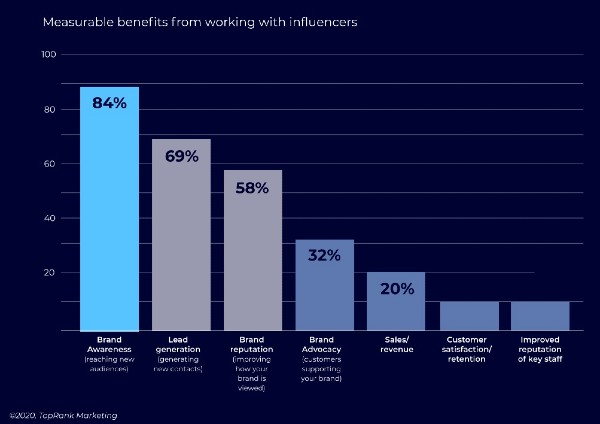
benefits working with B2B influencers

What’s important for B2B marketers to understand when it comes to what’s possible with influencers is that we’re talking about partnering with people, not simply using them to some brand end. Rather than thinking of influencers only as a means to an end or a tool for content creation and distribution, it is more valuable for all when B2B brands think of influencers as partners they can work with to achieve mutual goals. That partnership can turn to authentic and enthusiastic brand advocacy more quickly than a transactional approach.

For more specific ideas, check out this list of 25 B2B influencer marketing campaign and engagement ideas.

3. What are some good influencer engagement models?

Many early stage influencer programs start with micro-activations as part of a nurturing effort to develop relationships between brand and influencer. In many cases, an agency is tasked with creating these connections because they have unique expertise at influencer outreach and/or may already have the desired influencers in the agency network.

The right engagement model really depends on the approach.

For a pilot influencer content marketing campaign designed to create a business case for potential expansion of an influencer marketing program that has some lead time, it might be best to develop quick rapport with influencers by recognizing their expertise publicly. Then follow up and invite them to collaborate on small asks with great exposure. Through these early micro-activations, the right influencers can be sorted for a larger contribution to the pilot content project. See this case study on how LinkedIn has taken a relationship building approach to their always-on influence program working with sales and marketing influencers.

Alternatively, if there is not much lead time for organic relationship building with a pilot, then professional influencers can be engaged for their services to contribute to the pilot. The cost and perceived authenticity of content disclaimed as sponsored may be worth it to get a pilot out quickly. Or some combination of organic relationship building and paid influencer engagement might be most appropriate.

Understanding the right engagement model can be helped in part by reviewing solid B2B influencer marketing examples and case studies to understand what goes into successful B2B influencer marketing campaigns.

Also, it’s important to understand that working with influencers for an industrial or manufacturing business might be a bit different than how influencer marketing for tech companies might work. The topics of interest to customers and of most relevance to influencers and the brand will help identify the right influencer program approach, influencer identification and engagement.

Many pilots lead to sequences of campaigns which may engage the same influencers or different influencers each time. Lack of engagement in between campaigns will make securing influencers more difficult. B2B brands that are more mature in their influencer marketing efforts engage in always-on influencer programs. In fact, the State of B2B Influencer Marketing Report found that 12X more B2B marketers using an always-on approach were very successful with their influencer marketing compared to those marketers that implementing periodic campaigns.

Working with a small group of influencers can be a great place to start, but that small group should be backed by a much larger list of researched candidate influencers. As relationships develop through the course of different collaborations, B2B marketers will refine and find the right influencers. A VIP group of influencers might be created as Adobe has with its 60+ Adobe Insiders being activated at individual, small group or large group levels depending on the situation.

4. How does “dark influence” fit in our mix?

Understanding the channels where customers are spending time discovering, consuming and engaging with content is central to identifying sources of influence. But not all B2B influencers are social media rockstars. To understand where and how the right experts are influential to the customers of a B2B brand, thoughtful research must be conducted to identify customer preferences for content and people that they trust, subscribe to and are influenced by.

In some cases, the social media connection to B2B influence is indirect. While many business people are doing business during their 9-5, increasing numbers of business people are following industry experts on social channels. They access those channels before and after work as well as periodically during the day.

For those influencers and customers that are not engaging via social media, content discovery, consumption and engagement preferences research will reveal the email newsletters, publications, associations, events, groups and even search terms they use to connect. These non-social media channels are opportunities for influence as well. B2B marketers need to do the research to map these sources of engagement and identify influencers that might be good partners for those channels.

Another consideration is the role that LinkedIn plays in terms of influencer performance tracking. Since the vast majority of LinkedIn is not public nor do they provide easy access via API, the social data cannot be crawled in the way that Twitter, some Facebook content and other social networks are. Influencer engagement on LinkedIn may require use of tools made available from LinkedIn like Sales Navigator. Here are some ideas on how to engage influencers on the LinkedIn platform.

Working within the world of dark social for influencer marketing means connecting with influencers that use these channels and engaging them on collaborations where they exert influence.

5. What are the most important operational considerations for a B2B influencer marketing program?

For large enterprise organizations, there is often a debate about how much influencer marketing should be centralized in the organization vs. with business units, divisions and regions. When influencer marketing is new to an organization, there is centralization and programs are dictated as such. Some influencers may be universally relevant across and organization but within each market where a B2B brand operates, there will likely be more niche influencers specific to those markets.

How an influencer marketing program is defined will often include both the universal truths that are relevant for the brand overall and specific programs with unique goals, topics and measures of success.

Some of the most important operational considerations for an influencer marketing program include:

  • What department owns influencer marketing?
  • What processes will be used to to perform the functions of influencer marketing to ensure consistency and quality?
  • What software will be used to identify, engage, communicate with and measure influencers?
  • What budgets, staffing and external resources will be needed short and long term?

Beyond measures of success, software and ownership with the B2B brand of an influencer program is how to work with a specialist B2B influencer marketing agency to help develop strategy and planning, influencer identification and recruitment, collaboration and creation of influencer / brand content assets. In the State of B2B Influencer Marketing Report that surveyed hundreds of B2B marketers, the top tasks handled by agencies included:

  • Identifying influencers 79%
  • Managing influencer relationships 76%
  • Developing the strategy 71%
  • Measuring effectiveness 66%
  • Integrating with other marketing efforts 63%
  • Implementing campaigns 60%
  • Managing influencer marketing technology 44%

While there are many B2B marketing resources out there to help brands with everything from research and strategy to planning, implementation and measurement, there are simply not that many B2B influencer marketing agencies that have:

  • Established influencer marketing strategy frameworks based on years of experience
  • Extensive relationships with a network of B2B influencers in various verticals
  • Tried and true tactics for accelerating B2B brand and influencer relationships
  • Content creation and repurposing capabilities that are unique to influencer collaborations
  • Influencer marketing measurement and reporting expertise
  • Savvy on how to maintain ongoing influencer relationships in between campaigns

The good news is that the number of B2B influencer marketing agencies with legitimate skills and experience is growing as awareness grows around the role of influence across the entire customer lifecycle for business customers.

There are certainly more questions than these to be considered as well as variations on the questions that have been listed in order for B2B marketers to gain confidence that their particular approach to an influencer marketing effort creates the expected value for all involved. In many cases, marketing missteps can be avoided by ensuring the fundamentals are solid and that’s what this list of questions is meant to do – cover the bases that are essential for a thoughtful, meaningful and productive influencer marketing effort.

Influencer marketing is a relationship focused business and that means it’s dynamic and there are no silver bullet answers.

Remember, influencer marketing is a relationship focused business and that means it’s dynamic and there are no silver bullet answers. B2B brands that stumble blindly into an influencer engagement effort may experience disappointing results without the “been there, done that” and “we do this every. single. day.” type of expertise that is rare, but available through specialist agencies and consultants.

By Lee Odden

@LeeOdden is the CEO of TopRank Marketing and editor of TopRank’s B2B Marketing Blog. Cited for his expertise by The Economist, Forbes and the Wall Street Journal, he’s the author of the book Optimize and presents internationally on B2B marketing topics including content, search, social media and influencer marketing. When not at conferences, consulting, or working with his talented team, he’s likely running, traveling or cooking up something new.


Sourced from TopRank Marketing