Not a single day goes by without my speaking to an early-stage entrepreneur who wants to discuss marketing and how to get quick results. So let’s just get this out of the way from the beginning: Marketing takes time.
There are some tactics you can use that will generate a return on investment (ROI) in the relatively short term, but achieving real long-lasting results takes time. Put simply, anything you achieve in the short term will go down as fast as it went up. You want to play the long game. This is true even if you’re tempted to try some things that are less organic but might look good on the surface, such as buying likes or followers. Don’t do that.
Instead, here are five reasons you should start generating content on your own company blog as soon as you can:
Search engine optimization (SEO) is very much a thing
I know that social media gets all the hype nowadays and no one is talking about search anymore, but they’re wrong not to. A quick glance at the numbers will show you that search drives just as much traffic as social does, at least for the time being.
Once you’re sold on the importance of search, now the question is how to leverage it. I am obviously oversimplifying here, but the more incoming links to your site, the better. How do you get people to link to you? Well, some SEO experts would tell you to buy links. I say listen to Google and produce good content people want to talk about and link to.
Getting social on social media
Let’s break down what social media means. The “media” part is obvious, but what about the “social” part? Are you engaging with people like you do offline or are you using Twitter as a glorified RSS feed or sales platform?
I once heard a speech from the guy who invented the “Like” button at Facebook. He explained that he wanted to give people the ability to express appreciation for someone else’s content. What did it do? We ruined it by begging for likes.
How about instead of asking me to follow you, giving me a reason to click “Like” or “Follow”? What’s the best reason to get someone to do that? Fill your feed with quality content, yours or someone else’s, and that’s how you increase your numbers across social media.
Public relations is not the same as content marketing
Let’s clear one thing up: When you or someone on your team writes an article about the industry on the company blog, that’s called content marketing. When a journalist writes about the company, that’s called public relations (PR).
So why does content help with PR? When you pitch a journalist, the first thing he or she is going to do is Google your name or the company’s name. When there is no footprint on the internet, that raises a red flag.
However, when he or she encounters all of your content, all of a sudden you are now a colleague, and not just a company pitching that journalist. Just like he or she produces content, you produce content.
Content changes the whole dynamic between you and journalists.
Your user acquisition can be much more frictionless
Whether you are running ads or acquiring users in another way, content makes the whole process that much easier.
It’s fairly straightforward. If I come across an ad for a company I’ve never heard of, I might click, I might not, but even if I do, it’s a very cold click, and converting me will be quite the challenge.
If, however, I see that ad and think to myself, “Oh, I know that company. I read their blog, listen to their podcast, or follow them on Twitter,” the chances of engaging me are significantly higher. Simply put, content elevates your brand.
Business development with a stranger is not as fun as with someone who trusts you
Finally, last but not least, content marketing helps with business development. Imagine going out to dinner with a potential customer and the person sits across from you with a look on his face that says, “What are you selling this time?”
Now contrast that with the look on his face that says, “I am loving your content. You clearly know your stuff, and I want to work with professionals. So how do we get started?”
That right there is the difference between cold business development and warm business development. That’s the difference between a company that produces valuable industry content and a company that only focuses on promoting itself.
So, the bottom line, in case it wasn’t clear? Stop reading this and start producing content of your own.
If you’re anything like me, you’re probably sick and tired of all of the gurus telling you how easy it is to make extra income from a side hustle. This isn’t because those side hustles don’t work, but they don’t always provide the same successful outcome for everyone who tries them — especially introverts.
Since introverts are known to be reserved, quiet and thoughtful, the opportunity to earn some spare cash from side hustles remotely are perfect for them. Remote side hustles also provide introverts with the opportunity to make money on their own time without worry of a daily commute.
1. Freelance writing
Spending a few years freelancing to bulk up your writing portfolio of both clients and content can lead to a well-paying and flexible career.
Along with copywriting, blog writing and ghost-writing, finding a niche as a freelance writer for more technical pieces will allow you to charge clients more due to the dedication and focus they require. Sites like USA Wire will actually pay you to contribute content.
2. Graphic design
Many introverts who start dabbling in design — even if they haven’t designed before — find they have a talent for it.
Tools like Canva can help you design infographics, email templates, fonts and more. Before getting started in graphic design, consider:
What kind of services you want to offer
Your target customer market(s) and pricing
Which software(s) you will use
3. Web design
Every brand in today’s world needs a website. Though building websites as a freelancer today is more challenging due to market saturation, it remains a strong side hustle option from the flexibility, creativity and control it provides.
Introverted web designers can set themselves apart from other web designers by becoming more talented in niche areas of web design, such as:
SEO optimization
Content strategy and creation
Copywriting
Social media management
Establishing pay-per-click advertising campaigns
4. Video editing
Video editing provides introverts with the freedom to create their own schedule and negotiate pricing with clients. Tools like Magisto and Splice make the video editing process much easier than in years past, too.
Here are just a handful of markets to give you some ideas on which to target for a video editing side hustle:
Conference videos
Explainer/educational videos
Marketing/promotional videos
Recorded presentations
Recorded speaking events
5. Audio engineering
If introverts have the essential tools at their disposal, they can quickly start offering audio engineering services like mixing, producing and tracking. Here are some things you need to do:
Audio engineers also offer their produced soundtracks to other industries such as podcasters or stock audio platforms, and even earn money by streaming their music online through apps like Spotify or YouTube.
6. Social media management
Social media can be a very lucrative side hustle for introverts. The trick to making real money from managing social media as a side hustle lies in the power of networking.
As a social media manager, your time will mostly be spent managing clients’ websites and social media accounts, approving comments and reviews and ensuring web pages are published on time.
Having a virtual assistant job as a side hustle entails routinely interfacing with only one other person. It can typically be done entirely remotely, too, making it more appealing to introverts.
Virtual assistants can expect to make between $10-20 per hour (depending on your employer) for a number of tasks like:
Reading/writing/responding to emails
Scheduling appointments
Managing calendars
Posting content on websites/social media
8. Taking surveys
There are plenty of legitimate ways to get paid by answering surveys, as many companies outsource survey agencies to gain insight on consumer behaviour. Most pay between $0.50-2.00 per survey, and each one shouldn’t take more than 5-15 minutes to complete.
9. Book reviews
Reading is a common hobby for many introverts, so why not get paid to read and review some books?
Some of the best sites to use to get paid for your reviews (and even get some free books) include:
If you already have an existing blog, you can also make money by writing sponsored posts or book reviews. If you have enough clients as a freelancer, you could also earn money as a freelance book reviewer.
10. Read emails
For introverts who shy away from the conversation, getting paid to read emails can end up being a dream side hustle.
Thankfully, there are now a ton of different sites you can sign up for that pay you to read other peoples’ emails, including the following sites:
Blogging is a great way to make money that requires minimal interaction with others. Monetizing your blog may take a few months to see its potential, but the ability to create a winning blog you can monetize lies in:
Creating quality content
Producing content that can be consistently consumed and shared
Partnering with advertisers to sell digital ad space on your blog
If you stick to this process, your blog can make money off the content you want to write.
12. Affiliate marketing
If you already have a strong following on Instagram, you can promote a brand’s latest product or service. Each sale you facilitate earns you a portion of the sale.
The potential income you can make through affiliate marketing is virtually unlimited, depending on the size of your target audience and their buying trends as consumers.
13. House sitting
If you’re looking to make money each month with almost no work or social interaction, becoming a professional house sitter may be your best bet.
As a house sitter, your mission is simple: stay at the client’s residence and occupy it in their absence.
House sitting is a common need for homeowners who routinely leave town or travel. If a client’s pet needs care, you can charge even more per day or week, depending on the client.
14. Podcasting
Starting a podcast as an introvert can prove to be a very lucrative side hustle depending on the topic(s) of audio content you produce, as well as the quality and consistency of that content.
Many podcasts are recorded solo, meaning introverts don’t need to worry about outreach to potential interviewees. Instead, spend that time to learn about how you can best market your podcast, and to who.
15. Transcription
If you’re an introvert with crazy-awesome typing skills, look into online transcriptions as a side hustle.
Transcriptionists convert audible conversations or content into typed documents. Today, everything from YouTube videos to legal proceedings requires transcription.
Transcriptionist work can pay very well for those with a knack for it, and most employer’s transcription guidelines tend to follow the most basic transcription training courses, which you can easily find available for free online.
16. Dog walking
Let’s be real: As an introvert, there are times when you will simply grow tired of dealing with other people. As a dog walker, the most interaction you’ll have with other people is through the dog’s owner.
Getting started as a dog walker is made even easier with apps like Rover or Wag. Depending on where/when/who you walk for, you can make between $15-30 for less than an hour of time that you spend walking!
17. Food delivery
Since the Covid-19 pandemic began, food delivery sales have been at an all-time high. For introverts with reliable transportation, this presents a great side hustle opportunity.
Becoming a designated driver for apps like DoorDash or Instacart offers ways to make extra money, including tips. Since the bulk of the work is driving, introverts may find this an appealing way to earn $10-15+ per hour, depending on where they live and the number of deliveries completed each day.
18. Day trading
The recent rise in cryptocurrencies such as Bitcoin and Dogecoin has seen millions become more aware of the earnings day trading can bring. However, trading on the stock, futures or foreign exchange market is where most day traders make their money.
According to one trading expert, the best trading times are when markets officially open and close (around 9:30am and 4:00pm) each day. Because the first hour of each day tends to be when trade prices are most volatile, trading at these times provides the best potential for profits.
Remember: you never lose money off of stocks you don’t sell, you only lose money when you sell (rather than buy) during the dip.
It’s an unpredictable time for us marketers. People are still recovering from a rough year, financially, mentally, or both. The last thing you’d think people want are dozens of telemarketing or cold calls, automated emails and clickbait headlines — and you’re right.
The idea of trustworthy and transparent marketing — or simply, responsible marketing — isn’t new. Still, it’s taken on more meaning as many companies with initially small online presences finally moved more assets and more effort into digital marketing. The recent increase in digital marketing seems to mean an endless glut of spam from companies indiscriminately marketing to the masses.
So how do we define responsible marketing? For me, it means smarter, targeted marketing with the customer and their pain points always in mind.
Target the Customers Who You Can Benefit
Marketing has a truly awesome ability. It has the power to reach people at a primal level and heavily influence their thoughts and actions. Because our actions as marketers can significantly impact people, it’s our responsibility to promote our product or service in a way that limits the reach only to those whom we believe can benefit from what we are offering.
There is a lot of really great marketing out there, but let’s admit it, a lot of marketing is really spammy. Spam significantly reduces the quality of leads, and more importantly, it’s annoying and gives all marketers a bad name. We need to evolve past the lazy approach of tossing a wide net with the hope of catching the right fish and instead prioritize reaching a smaller, more targeted audience, specifically relating our solutions to the audience’s pain points. Your resulting lead pool may be smaller, but it will also be filled with far higher-quality leads.
How can you tell if you’re in the spammy vs. good marketing camp? First, take a look at who you’re marketing to. Do you know who your ideal customer is? Are you doing your best to reach that customer? Is your content purely promotional, or are you helping that ideal customer understand how your solution will solve their problem?
Your marketing material should first educate. It should demonstrate understanding of a customer’s problem while describing how your offering can help. At Moz, we provide free educational resources on our website because we know that the more we educate people about how to use SEO to increase the visibility of website (for example), the more likely we are to reach the customers who will benefit from our SEO solutions.
It takes patience. You need to respect your audience enough that you allow them the time and space to take the next step and convert or buy at their own pace — not yours.
Build Trust and Connect With Your Customers
I’ve talked before about how storytelling is the best way for marketers to create lasting relationships with customers. People want to experience something human and latch on to a greater narrative. When people feel you’re talking directly to them, it evokes a greater sense of connection and sparks interest in whatever you’re marketing.
Connection creates lifelong customers. Lifers, as we call them, have more value in the long run than higher volumes of entry-level customers. They’ll spend more on premium products, stick with you through rough times and recommend your brand to others. We connect with and retain lifers through a few core values — empathy, transparency and generosity.
Recently, everyone has had a rough time of it. Adjusting to new standards is exhausting, and the last thing a customer wants is to have to wade through clickbait and spam to find the answers to their problems. When I say empathy, I mean taking the time to see the world from your customer’s point of view. It ties back into your responsibility as a marketer to meet the customer where they’re at and guide them through the journey, rather than pushing them towards something they may not yet want or need. When customers see your commitment to allow them to experience the buying process in their own time, they’ll be far more inclined to trust you.
In light of recent data breaches and questionable data collection, transparency is essential right now . Customers and those interacting with your material need to know their data and information are safe with you. It’s also about showing your interest in new prospects and truthfully communicating who your product is right for.
Respect, Responsibility and Success
People get used to the status quo. Right now, the status quo is dozens of robocalls a day, irrelevant emails and other forms of spam. Is this marketing’s future? I would hope not. Imagine what a beautiful world it would be if we all worked hard to truly understand who could benefit from what we’re offering and only reached out to those prospects. Then focused on educating those prospects about how we can help.
The hope is we all use this power we have as marketers to reach targeted audiences, creating lifelong customers and responsibly guiding them along their journey.
Christina Mautz has served as a strategic marketing leader for some of the world’s largest technology companies, including Amazon and Yahoo!, as well as a few Seattle SaaS startups where she earned the nickname “Chief Problem Solver.” She currently serves as the CMO and Head of Sales for Moz, the world’s leading SEO software company. In this role, she brings her passion for strategic problem-solving to the sales and marketing teams, aligning them with creative strategies to drive growth.
It’s no secret that e-commerce is growing. It’s estimated that there will be 2.14 billion global digital buyers in 2021. The global pandemic has fast-tracked a change in how we, as a society, now purchase goods and services.
Customers are becoming more tech-savvy and are now familiar with making and taking payments online. People today want speed, choice and convenience. They’re often willing to browse and shop around to find the best deals, and as a result, they may not remain brand loyal to traditional brick-and-mortar businesses. Instead, with the click of a mouse, shoppers can compare features, prices and shipping costs.
The following are five ways to drive traffic to your online store.
1. Facebook Ads
Facebook Ads is an ad system for businesses that allows them to showcase their products and services to Facebook’s users. The platform has a number of different ad types that you can choose from. These include image ads, video ads, carousel ads, collection ads, canvas ads, lead generation ads, offer ads and event response ads.
In terms of e-commerce, I find that one of the most popular ads is the website conversion ad. This type of ad allows you to optimize your ads for people who are most likely to perform an action, like making a purchase. These ads are easy to start with on Facebook, and you can set a daily budget of just $5 to get up and running.
Facebook has various data points on its users; it knows the posts users interact with, the brands they follow and the stores that they visit. As a result, the platform is extremely clever at finding your ideal customers. Further, by installing Facebook Pixel, you can track site activity, which gives you information and data on what’s happening in your store.
When creating your ads, you can target people based on age, interest, demographic, location, occupation and even salary. For example, dog moms in California, who are 45 and older and earn over $100,000 per year.
2. Google Ads
Google Ads are similar to Facebook Ads, but the main difference is that Google Ads are intent-based. What this means is that the ads are designed to attract people who are actively searching for the products you’re selling. An example might be, “best coffee in Miami.” The power of intent-based advertising is that the shopper who’s performing the search is already committed and interested in purchasing the product or service you may be selling.
Some of the Google ad types available to you include search campaigns (text), display campaigns (images) and video campaigns. Again, you can start for as little as $5 per day.
3. Influencers
Influencer marketing has become popular over the last few years due to the explosion and growth of social media marketing. Think of an influencer as someone with a specialized skill or knowledge that has amassed a large, loyal and passionate following. Their following might be on Facebook, Instagram or TikTok.
Let’s say you sell a fitness product that helps mothers lose weight post-pregnancy. You can search for influencers within that niche who may have an audience that you can leverage. Perhaps, the influencer is someone who coaches women with weight loss but isn’t selling a physical product. The agreement is usually made between the influencer and brand based on a number of story and feed posts or based on the number of sales made through their link.
One important factor to consider when finding the right influencer is to check the level of engagement on their posts and whether the audience is a good fit for your brand. An influencer might have one million followers but the engagement rate might be low. This usually means that the influencer might have purchased those followers, or they don’t really have an engaged enough audience to make the promotion worthwhile.
It’s often best to start with a low-budget promotion and test the results.
4. Email Marketing
Email marketing has been around for years and isn’t going anywhere. Email marketing allows you to essentially remarket for free to your existing subscribers.
You can create campaigns that are one-time promotions, like Valentine’s Day or Black Friday offers, or you can set up flows that are automatically sent based on a user’s profile activity. An example might be when someone subscribes to your newsletter and you send them a welcome email where you nurture them, talk about your product and brand and, at the end of the email, offer them a one-time special offer to become a customer at a discounted rate.
Building an email list is hugely powerful; in my experience, I’ve been able to reach up to $1 per subscriber in monthly revenue. You can use pop-ups and exit intents to capture emails by incentivizing visitors to subscribe to your newsletter for value or offer some type of discount coupon code.
5. Blog Posts
I highly encourage you to start creating blog posts. It does take time to create blog content and be consistent, but it’s so important to the long-term success of your business.
Ideas for blogs are endless and can be scheduled out automatically over the month. You can also invite guest bloggers to help you write if you find that your time can be more valuable elsewhere.
When I sold in the dog niche, I had a very passionate dog customer of mine who found a blog article I wrote and asked me if she could write about her life with dogs. Of course, I said yes, and to make it a win-win for everyone and to encourage her to write great articles, I offered her free dog merchandise.
These are just a few of the many ways to drive traffic to your store. Remember, not everyone who visits your store is going to buy. In fact, I’ve found average store conversion rates are usually 5% or less. Keep delivering great content and run retargeting strategies to convert your non-buyers to buyers.
Want to reach new audiences on Instagram without running ads? Have you considered branded content but weren’t sure where to start?
In this article, you’ll learn five simple steps to create, launch, and promote Instagram branded content campaigns to reach new people.
What Is Branded Content on Instagram?
Here’s what you need to know before you dive into the world of branded content creation, influencer marketing, and Instagram settings.
Branded content is one of the most powerful tools for Instagram marketing. It bridges the gap between organic content and paid ads, commercial partnerships and authentic recommendations. But as you might imagine, building that bridge takes some skill.
You need to find the right partnerships, set guidelines for your content, and finally, have a plan for boosting and resharing branded content.
Let’s start with some definitions. You might think that any content you produce as a social media manager is branded content: It’s content by a brand.
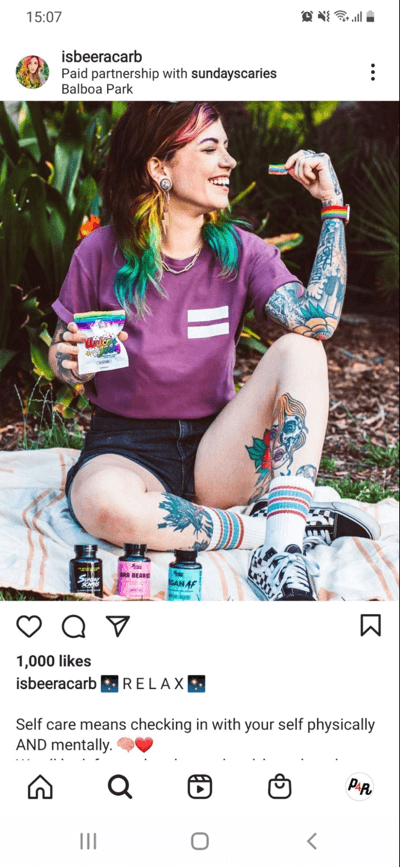
But Instagram thinks differently. Within this social network, “branded content” has a specific meaning. It’s content that markets your brand but it’s not created or posted by you.
Influencers or creators create this content on your behalf. They receive “an exchange of value” in return, whether that’s payment, product samples, or gifts. And that exchange of value has to be disclosed by using the branded content tools on Instagram.
Social media offers new brands an incredible opportunity to launch a new product to a highly targeted, engaged, wallet-out audience.
Social media provides new brands with an incredible opportunity to launch a new product to a highly targeted, engaged, wallet-out audience. You have access to consumers located all over the world along with the ability to target them based on very specific parameters.
Brands today have such a massive advantage over brands that got their start just ten years ago. While this all sounds great, it’s not as simple as making a few posts on launch day and watching the sales snowball.
It takes a lot of preparation and planning, along with a great product, to have a successful launch on social media. Here are the seven steps required to expertly launch a new brand on social media, regardless of the niche.
1. Establish a clear set of goals
You need to identify your KPIs and goals before anything else. What is going to make your particular launch successful? This will be drastically different for every brand. It might be based on sales, email-list growth or just the generation of buzz that translates into long-term brand awareness.
If it’s sales- and revenue-based, be specific. How many sales? How much revenue? You need to have all of this figured out ahead of time. Determine how much money you are going to invest in the launch and be sure that whatever your goals are, you break even, at the very least.
2. Develop a timeline
When you have your launch date set, you will need to back up and map out the timeline from the current date to the launch date. Then, break that window of time into blocks. Every step of creating a launch will require time. If you feel that your timeline is too tight, push it back.
The last thing you want to do is commit to a launch date and then a week prior have to push it back. That can be a death sentence for a brand, especially if you have already hyped up the date to a social audience that’s waiting in anticipation.
3. Select the best social-media platforms
This is where your strategy starts to play out. What social-media platforms are you going to want to focus on to reach your target audience? While you may think going super wide and launching on every platform available is the correct play, it’s the opposite.
Focus on the two to three best platforms for your launch. This allows you to put more effort into each one, which will greatly impact the return on investment. Pick the social-media platforms that best match your brand and its target audience.
Going after a younger 18- to 20-year-old demographic? TikTok is the place to be. Interested in connecting with a 32- to 45-year-old homeowning demographic? Then Facebook should be your number one platform. Don’t worry about what social platform is the most popular: Select based on where your target audience is active.
4. Map out an influencer-marketing strategy
Aligning with the right influencers to help give your launch a boost can give you momentum unobtainable elsewhere. Try to work out deals with influencers who have engaged audiences that match your target market.
From a flat fee per post to a revenue-sharing agreement, work out something that makes sense and allows you to tap into those followings. If you break even or even take a slight hit, consider the upside, which is gaining a large customer base on day one that can be marketed to down the line multiple times.
And here’s a pro tip: Let the influencer introduce and announce your brand and product to his or her audience as he or she sees fit. The response will be much better if this is done naturally and not something that feels staged and planned. Giving influencers total creative control will yield the best results.
5. Design launch-campaign assets
You’re going to need a wide variety of content assets and formats. On launch day, you will need to have several campaigns loaded up and ready to go that you will closely monitor and optimize in real time.
If one format or image is performing better, you will need to adjust. Will a meme outperform a GIF? What about a video? You need variety to collect as much data as possible. Some examples of campaign assets include high-quality product images; lifestyle images; videos, both long and short; GIFs and memes.
It’s also important to design each content asset specifically for the platform it will be used on. This includes formatting video run times for the specific social channel and making images the correct size to ensure proper display.
6. Schedule your social-media content
Once you have your social platforms identified and all of your content assets created, you now have to schedule it. You have your official launch date, but don’t forget the days leading up to it. This is a perfect time to build anticipation with teaser content.
You can schedule your entire organic campaign in one of the SaaS tools like Hootsuite, which helps you organize the launch as well as reply and engage during the launch. You are going to want to be available to answer questions and reply in real time.
Participating in the discussion will drive more sales, and the engagement boost will help further your organic reach. Even if your launch strategy revolves around paid social-media ads, you still want to have an organic campaign scheduled.
7. Launch your campaign
If you planned for enough time to get everything mapped out and situated, you will be ready to go on launch day. Be sure to have extra hands on deck to handle customer-service issues, answer pre-sales questions and ensure everything goes smoothly.
A poorly executed launch can sink a brand before it even has a chance to thrive. Be sure to plan for every possible mishap because a launch without some hiccups is unheard of. Be prepared for the unexpected and ready to make adjustments as you go.
This woman was influencing me across social media platforms for the best part of a decade. She once influenced me to buy a Fitbit that I never used. I watched her relationship form and marriage crumble and was influenced to feel a great deal of sympathy for her. I saw her decorate her house in meticulous detail, reminding me that I too wanted to one day buy a property, and influencing me to feel shameful about the fact I can’t (and to also make a mental note that I need a Smeg fridge).
Then she posted a video like many others have – women in particular – about “influencer” being a shameful word and that she didn’t want to associate with it. What a curious thing to say, I thought, when I couldn’t think of a better word to describe her.
You’ve probably seen crotchety British Gen Xers on social media say a variant of “everyone’s an influencer now”. What they really mean is that everyone is too online and has a personal brand, always pushing something, whether it’s their opinions or their work; a persona that’s only loosely related to the person you know or suspect them to be in real life. But it’s also true that “influencer” is now a sweeping term that is used to mean anything from “aspirational career path to riches” to “talentless internet shill for brands”, depending on how old or how online (or not) the individual using it is.
“‘Influencer’ is a weird term in that it both works perfectly – in that the direct connection online celebrities and creators have with their audience makes them more influential and able to affect the likelihood of purchases – and is also essentially so broad as to be meaningless,” tech journalist and author Chris Stokel-Walker tells me. Does it mean your sister who recently signed up to an MLM business flogging essential oil blends, or your Dad sharing anti-vax memes with all his Facebook friends? The way people use the word colloquially now, who can say?
I suspect much of this amorphousness is down to the power of the word “influencer” in the first place. It says “I can make you do what I want”. It has clout and energy. You can also “influence” anyone in any manner of ways – emotionally, psychologically. In 2019, the year the Mirriam-Webster Dictionary added “influencer” to its lexicon, its editor-at-large Peter Sokolowski explained to AdWeekthat “all of us are consumers, even if all we are consuming is information”.
We’re not just being sold influencers’ ads – we willingly sell our attention and engagement in increasingly obtuse but intense ways. As Stokel-Walker points out: “In the dictionary definition of the term, people who have clout with their audience are influencers – in that they can influence people to do things, or to buy products if they choose.” It’s little wonder we throw the word around so carelessly.
Influencing has existed as a concept for as long as Western capitalist culture. Influencing is the reason the advertising industry exists; it birthed seismic tomes like Dale Carnegie’s How To Win Friends And Influence People. The valorisation of influence in American culture is the bedrock of the entrepreneurialism that all young people seemingly now have to partake in.
At the end of 2011, an updated version of Carnegie’s book was published: How to Win Friends And Influence People in the Digital Age. The following year Emily Hund, a social media and influencer researcher then working in the magazine and publishing industry, watched the blogging phenomenon begin. It was an exciting time, Hund recalls, when names like Susie Bubble and Fashion Toast were launching incredibly successful careers off their influence.
“No one planned to create this industry,” explains Hund. “It happened by accident. People fell backward into it, because of this perfect storm of events; of the advent of these different technological platforms; and the crumbling of legacy media and creative industries, where there were a lot of people who were trained in or interested in creative jobs who weren’t getting traditional jobs. There was this glut of people who were turning to the internet at a time when the internet was gonna save everybody.”
In the early 2010s, people were referred to by the platform they were famous on: YouTubers, Viners, YouNow stars. “You saw the rise of this new group who were true multi-platform creators and there needed to be an agnostic term for them,” New York Times tech reporter Taylor Lorenz says. That term couldn’t be ‘creators’, because that word was synonymous with YouTubers. “This was also when brands really came into the picture and did bigger brand deals. ‘Influencer’ was the word that the marketing industry applied to creators, and people started using it.”
For years, Lorenz battled to even use the word “influencer” in her day-to-day work as a reporter for one of the most respected publications in the world. “I’ve had literally hours of arguments and conversations with editors at literally every place I’ve ever worked,” she says, “to try to describe people accurately and in a way that will be accessible to all audiences, and that old people and young people will both understand who you’re talking about.”
As Lorenz points out, these arguments about language happen with any emerging journalistic beat, but the reluctance to name influencers speaks to the fact that the industry felt both terrifyingly new and yet evolving and changing at an exponential rate.
A shift occurred in 2017 and 2018, when “influencer” took on a new negative connotation. Hund ties this to a wave of new influencers following what had previously been financially successful for their predecessors and ushering in repetitive content and trends – all of which was obvious to audiences. Think millennial pink, brunches and girlbossery but also spon con.
“People started to sense that the influencer class maybe was losing their edginess that maybe they had in the very beginning – and then also it started to become more clear that people that influencers were selling something,” says Hund.
Similarly, Lorenz notes that most people weren’t paying attention to the influencing industry until around 2017, and associate “influencer” with the creators from that era: female, hyper-curated, millennial. “There’s a charge that comes with the word influencer and a lot of it is sexism,” she says. “Someone will say ‘I’m not an influencer’, but if you ask them what an influencer is, they’ll say it’s a beautiful young woman that they see as vapid and shouldn’t be building their brand and doing sponsored content.”
At exactly the same time, “influencer” became an aspirational word to Gen Z. The youngest creators self-identify as influencers, and for the wannabes or future influencers, the word translates to the lifestyle and income of mid-to-top-tier creators.
Whether a slur or dream career, the word now reflects how the majority of us present and graft online. I always feel an uncanny jolt whenever I see people tagging brands in their Instagram stories of items they’ve bought themselves – as if that either makes them appear as an influencer or as if they assume that’s how friends and colleagues engage with their “content”.
“Everyone is sort of adopting this mindset of the advertising industry or the media industry logics that have existed for a long time,” explains Hund. “Now, they’re kind of being applied to the individual, where it’s like, ‘OK, now my M.O. is to influence.’”
We’re all using influencer tactics, from the celebrity actresses turned cookery range floggers (acting like influencers but not technically influencers, according to Lorenz) to you sharing other people’s work in the hope of one day getting reciprocal shares on your own.
So do we need new words to name the actual influencers? What actually is an influencer? “My feeling is that influencers – and creators – are a subset of entrepreneurs,” says Lorenz, adding that what is important is that we have a term at all so that people can recognise and understand the industry. To say we’re all influencers makes it difficult to talk about or critique influencer behaviour and the ways in which they sell and or behave as an extension of the brands they make deals with.
When I ask Stokel-Walker, he says, “There needs to be a term for digital-first – and largely digital-only – ‘influencers’, for whom the stakes are higher if they misstep and therefore are more likely to follow the rules around disclosure and more carefully protect their online brand, versus the traditional celebrities who get bunged a few quid every few months to plug a product online and are doing it as a bolt-on to their income, so aren’t necessarily as careful about how they do it.”
The issue with making language more specific is that it would show the problem with the latter: “What we think of as a more authentic way of marketing products isn’t authentic when you’re not that bothered if your Instagram audience turns away from you, because you’ve still got your TV presenting gigs.”
Interestingly, the drive to re-define these terms is coming from influencers themselves. In a recent bid to legitimise their jobs and standardise practices and rates, they hope to unionise. “They’re upfront, saying ‘we create our own content, but we’re here to work with brands and do it in a professional way’,” says Hund, “They’re trying to really clean up the field and normalise it.”
If our favourite influencers – the ones who’ve influenced us the most – insist they don’t really relate to the dirty word, this is a chance for them to reclaim it. Or, at least, use their social currency to become someone new.
Over the past few years, social media has grown exponentially from something only the geeky boys and girls in college spent time on to something that’s now a ubiquitous aspect of life across the world.
For businesses, it’s clear that social media can be a goldmine of leads and conversions, if handled correctly. That’s why many companies have focused their marketing budgets on social media, trying to build a following and cultivate customer loyalty as well as new buyers. Here are a few tips you can implement to make your social media marketing much more effective in bringing in sales.
1. Focus on your audience
One of the easiest ways to burn a lot of money on social media marketing without achieving much is to attempt to appeal to everyone. What you need to do is to narrow down your audience, create a customer profile and then target your marketing toward that persona’s needs and motivations. It will make your marketing much more effective than if you were taking a more general approach.
You might also need to segment your audience by different parameters to be able to target them more effectively. Essentially, segmentation will allow you to work with multiple customer profiles and tailor your marketing based on their specific characteristics.
2. Pick your platforms and optimize for them
Attempting to maintain an active presence on all the social media platforms available is going to stretch most businesses too much. Whoever is handling your social media will likely be overwhelmed and your efforts across all the platforms will not be effective. Instead, analyse your buyer persona and decide which platforms are best for engaging your target market. Two or three are good, and you shouldn’t undertake more than that unless you have multiple staff to handle them.
When you’ve selected your content, you will be able to optimize your content for that platform and thus get much more engagement. If you’re focusing on Instagram, for instance, you’ll be able to focus your resources on making quality images, since that’s what gets the most traction on the platform. On Twitter, conversely, making highly informative threads will likely see more engagement and get the word out about your brand more.
3. Create and share content
Content marketing is not just a buzzword. It actually works and the effects are visible on social media too. Publish content that’s short and entertaining or informative and you can be sure you’ll get some social media engagement. Over time, you’ll have some content (whether it’s text posts, photos, infographics etc.) that’ll go viral and bring tons of traffic to your website. Be sure to work with content creation professionals to be sure your website is up to par.
Putting your content out there is the first step to building a formidable brand, and one easy hack is to tweak your content strategy continually, so it’s aligned with topical issues. By creating quality content and using interesting captions for Instagram, Twitter and other platforms, you’ll be able to plug into trends and get your content in front of many more people, such as what brands like Vape4Ever achieved by providing timely information on marijuana laws at a time when there’s a lot of confusion and public discourse about them.
4. Promote user-generated content
People trust their friends more than they trust a company, no matter how loyal they are to the brand. You can take advantage of that by encouraging people to post content on social media that validates and promotes your products or services. One popular instance of this was the “Share a Coke with…” Coca-Cola campaign where users posted pictures of themselves with their soda bottles. You don’t have to start at that level either; with creative marketing or a small giveaway, you can incentivize people to post positive info about your product or service. For a travel service, for example, getting customers to write about their trips in a way that’s authentic and fun will provide solid social proof and encourage FOMO among your target audience, thus increasing the likelihood of conversion drastically.
5. Provide stellar customer service
Positive reviews are great, but many of your customers will also likely reach out via social media when they’ve had unsatisfactory experiences with your products or services. The solution is to be ready to engage with them and find fixes for their issues in a timely manner. Give opportunities for feedback, resolve any concerns they have and encourage them to share their thoughts with their network.
Over time, that will boost your customer loyalty, encourage referrals and the influx of new customers and also help to build a positive reputation on social media. As your followership grows and validates your products or services, your social proof will increase and more people will be attracted to your brand, thereby boosting sales and your bottom line.
Founder of Tech Law Info. Kunbi is a lawyer based in Lagos and is focused on the tech industry, advising startups on regulatory compliance, market-entry and investment (PE and VC). He is also the founder of Tech Law Info, a website to provide founders with essential legal information and resources. https://www.techlawinfo.com
Teens are scouring TikTok for fashion inspiration.
Thanks to the social media platform’s easily searchable hashtags and the power of influencer accounts, retailers have seen a number of products become viral sensations, including a Lululemon skort, a Gap hoodie and a pair of Aerie leggings.
Eyeing a bigger opportunity to win sales, retailers such as Aeropostale and Abercrombie & Fitch are looking for ways to capitalize on these viral moments.
When a Lululemon skort went viral across TikTok earlier this summer, 16-year-old Kylie knew she had to get her hands on it.
But by the time she was searching for her size on Lululemon’s website, it was already sold out. The sought-after skort — part skirt, part shorts with a two-inch inseam — was also totally bought up in a nearby store in Boulder, Colorado, according to Kylie’s mom.
The teen then relied on her favourite TikTok influencers, who often post #fashionhauls and #OOTD (outfit of the day), to alert her when the skort would be back on sale. She was also closely monitoring, even during school hours, other hashtags on the social platform, like ”#preppy” and ”#closettour.” Ultimately, Kylie ended up snagging it in a bigger size and taking it in for alterations.
“My kids come to me all the time now showing me TikTok videos, pointing at them, saying, ‘I want to buy this’ or ‘I think this is cute for the fall,’” said Nicole Leinbach, a Boulder resident who is the mother of Kylie and 13-year-old Claire. “They’re definitely leaning into TikTok to help guide them in what they want.”
It used to be a trip around the mall with friends, but many teens today are scouring TikTok for inspiration. Tethered to their phones, this generation spends an average of 12 hours on social media apps per week. They desire authenticity and individualism, with clothing serving as a key form of self-expression, but Gen Z’s social habits reveal they are seeking guidance from others they trust before committing to a dress or a pair of sneakers.
Thanks to TikTok’s easily searchable hashtags and the power of influencer accounts that boast anywhere from a couple thousand to millions of followers, viral sensations keep occurring for products like the Lululemon skort. For Zara, it was a pair of wide-leg denim pants, while Aerie sold out of a pair of leggings with a unique crossover waist. Ahead of Valentine’s Day, Kate Spadesold through a heart-shaped bag thanks to a popular TikTok video. Eyeing a bigger opportunity, retailers are looking for ways to capitalize on these viral moments. And it will likely become an even bigger part of business strategies this back-to-school season.
“TikTok has the ability to make something go viral much quicker than anything we see on Instagram,” said Jessica Ramirez, retail research analyst at Jane Hali & Associates. “For retailers, that is a huge advantage.”
Gap’s hoodie moment
In January, TikTok star Barbara Kristoffersen posted a video of herself wearing Gap’s iconic logo hoodie in dark brown. It was a vintage find. Gap hadn’t manufactured that style in more than a decade.
Fuelled by the power of TikTok influencers and their devout followings, brown hoodies started appearing on resale sites for as much as $300. People who had the hoodie stowed away in the back of their closets were sharing videos pairing it with Louis Vuitton bags and other luxury brands in neutral hues.
After it went viral on TikTok, Gap is relaunching its logo hoodie in a brown colour. It’s currently available for presale.
Source: Gap PR
Kristoffersen’s post has since racked up nearly 2 million views. And the hashtag ”#gaphoodie” has more than 6.6 million views — and growing — on TikTok.
Gap noticed the momentum shortly after Kristoffersen’s post and began sending her more logo hoodies in various colours. The company also sent hoodies to a handful of other TikTok users. The retailer’s strategy was to rely heavily on the influencer community, Gap Chief Marketing Officer Mary Alderete explained in an interview.
“We did start [a TikTok] account, but we didn’t rush to do a lot of posts,” she said. “These creators get on there … and they’re influencing literally what the trends are.”
To tap an even bigger sales opportunity, Gap decided to manufacture a fresh batch of brown logo hoodies. The product is available for presale and will ship later this fall. The company also partnered with TikTok to crowdsource its next colour based on user votes.
“I don’t think we ever anticipated the arch logo [hoodie] — it’s a classic of ours — but I don’t think we would have necessarily anticipated it taking off like this,” Alderete said. “The key thing is you can’t really force it. You have to ride it.”
After a winning colour is selected, the new hoodies will hit Gap stores and its website just in time for back-to-school shopping, Alderete said. Aside from the holidays, it’s one of the busiest sales periods of the year.
Gap also expects the renewed momentum for its boldface logo to benefit Gap Teen, an apparel vertical it launched in early 2020 to cater to tween and teen girls.
“We have our kids’ back-to-school campaign, but we wanted to do something disruptive for back-to-school for teens,” Alderete explained. “And this crowdsourcing job was our teen approach.”
Teens love #tinytops
The teen retailer Aeropostale is leaning into a similar viral experience it had with its crop tops.
The hashtag ”#tinytops” started blowing up on TikTok in early April, and some of Aeropostale’s merchandise was in the mix, alongside that of American Eagle and Abercrombie & Fitch. The trend refers to crop tops, which have exploded in popularity in recent months, especially among tweens and teens who are pairing the skin-baring shirts with high-waisted and looser-fitting bottoms.
“It’s very ’90s, Y2K — as the bottoms get bigger with more volume, that’s when the tops get tinier and smaller,” said Natalie Levy, president and chief merchandise officer at Aeropostale’s parent, SPARC.
Aeropostale found itself trending on TikTok when the hashtag ”#tinytops” went viral among fashion influencers.
Source: SPARC PR
After some TikTok posts started going viral, including one by Lexi Hidalgo, who has more than 1.6 million followers, people were not only visiting Aeropostale’s website in search of the crop tops, but they also came into stores asking employees specifically for “TikTok items,” Levy said.
Aeropostale reacted fast. It now has sections of its stores devoted to clothing that’s gone viral on TikTok: Crop tops, baggy denim and oversized sweatpants. Those will remain throughout back-to-school season.
“What’s great is we aren’t paying for celebrity influencers or talent … it just happened organically,” Levy added. “We’re really authentic about it.”
Some retailers, though, have taken the approach of directly tapping big-name talent. Abercrombie & Fitch’s Hollister brand debuted a new line of clothing called Social Tourist, in a partnership with TikTok superstars Dixie and Charli D’Amelio. Terms of the deal were never disclosed, but Abercrombie said it has a multiyear deal with the sisters, who combined have more than 170 million followers.
Sharing ideas with a stranger
According to one Gen Z expert, letting content flourish organically might be the best approach to reach consumers under the age of 24.
Hana Ben-Shabat, founder of the advisory and research firm Gen Z Planet, said that many younger TikTok users prefer seeing posts from so-called micro- or nano-influencers, who might only have a couple hundred or thousand followers. They feel as if these people, unlike the D’Amelio sisters, are much more relatable, she said.
“This is a generation that is seeking authenticity in everything they do,” said Ben-Shabat, who is also the author of the upcoming book “Gen Z 360: Preparing for the Inevitable Change in Culture, Work, and Commerce.” “Tiktok is a platform that allows you to go there and be yourself. ‘Be yourself’ is the Gen Z mantra. There’s no doubt about it.”
“And what is the best way to express individuality? Beauty and fashion,” she said.
Across all generations, though, there’s clearly a growing buy-in from people to shop directly from social media apps.
Social commerce sales in the United States are forecast to rise 35.8% this year to $36.62 billion, according to eMarketer. This would mark a slight deceleration from year-over-year growth of 38.9% in 2020, eMarketer said, when the Covid pandemic kept more people at home and shopping from their phones. EMarketer defines social commerce as products or services ordered via social networks, such as Facebook, Instagram, Pinterest and TikTok.
The U.S. lags in comparison with China, which is expected to see social commerce sales eclipse $351.65 billion in 2021, according to eMarketer’s data.
EMarketer doesn’t break out social commerce spending by generation. But it’s worth noting that TikTok usage among teens is still growing, relative to other social platforms. TikTok is now teens’ second-favorite social media app, according to a survey of 7,000 teens from Feb. 19 to March 24 by Piper Sandler. It’s stealing share from Instagram and Snapchat.
And earlier this month, TikTok announced that in the coming weeks it will be rolling out the option to all users to create videos as long as 3 minutes. The shift could make the app even more appealing to influencers and creators hoping to share longer-form content, such as longer fashion hauls or beauty tutorials.
Forty-one percent of back-to-school shoppers are planning to use social media platforms to help them decide what to buy before going back to the classroom, according to a Deloitte survey of 1,200 consumers. That’s the highest percentage Deloitte has tracked in the six years it has asked this question.
“People are attracted to the idea of another stranger sharing ideas, whether it’s their fashion style or just their thoughts,” 43-year-old Leinbach said about her daughters spending time on TikTok.
“Users of TikTok don’t want to see brands trying to push something to them. They’re looking to influencers for inspiration,” she added. “They also, in many ways, feel as if they’re their own influencers within their smaller networks.”
Marketing used to be a thing on the street. Marketers would jump from block to block, convincing prospective customers to try their products and services.
While this traditional procedure achieved a lot of results, there’s something better and easier in town.
Social media marketing has eased the pressure of moving about searching for that customer that needs your product.
Since everyone is now on popular social media platforms like Twitter, Facebook, Instagram, etc., you can quickly reach them with your products and services.
Of course, you are not the only one using this medium. As such, it is not just about engaging in social media marketing, but about doing it the right way.
Without increasing and converting your leads, clicks, sales, and followers on these platforms, you are not engaging in social media marketing the right way.
This article will help you improve your sales and convert more leads with social media marketing.
Why worry about social media leads?
As a marketer, your goal is beyond creating awareness about your product. Yes, you need engagements, but these are just the basics for the final destination.
Only when you collect leads can you truly find individuals interested in using your company’s products or services.
When you collect leads, it will be easier to communicate and stay in touch with individuals that are ready to use your services.
Introduction to social media lead marketing
Here is some of the essential information you need to know about lead marketing before you commence:
Social media lead generation
Lead generation refers to all activities you undergo to accumulate leads on social media.
Social media lead nurturing
After generating leads on social media, the deal is not complete. There is a need to always follow up and nurture the lead. You need to walk them through your company’s process or the sales funnel.
Social media lead conversion
Having nurtured a lead, you can then turn a prospect into a customer.
What platform can I use for social media lead generation?
Use platforms that contain prospects that need the products or services you are selling. One of the most popular options you have is Facebook. This platform offers you diverse means for successful social media lead generation.
Facebook has more than 2.45 billion users every month. This population means that you have a higher chance of meeting your desired audience within the shortest time.
Most B2B marketers have also enjoyed rich results from LinkedIn. The record shows that around 80-90% of B2B marketers make use of this platform.
Hence, you need to consider the type of products and services you offer. You can then target the right audience that will help you reach your desired goal.
Understanding all platforms’ demographics will make it easier for you to pick the right one for your business.
Now, let’s get to the details!
Tips to increase and convert leads with social media marketing
These detailed tips are designed to help you with your lead generation and conversions:
Hone your profile
The first step to reaching your desired destination of generating leads is to improve your social media profile. Collecting more leads organically depends on the details in your social media profile.
The basic standard is to include a medium where your prospects can contact you or gain access to your newsletter. If you sell products, you can also include a link for shopping.
Providing your contact information will ensure that customers can get support from you when needed. Valuable options include your email, your phone number, your WhatsApp contact, Messenger, etc.
Adding a call-to-action button to your website will increase your chances of generating leads. Most platforms have more than one call-to-action button. Try exploring the one that works best for your industry.
If you want to move your leads to your company’s website, consider adding a direct link to your profile.
Develop a strategy
Without having the right strategy, you can only achieve little results. You need to consider how you will reach your audience, who your audience is, and how you will get them engaged with your posts.
Before you post, be sure that you have the right content that your prospects are expecting. The sort of message sent can motivate or demotivate the reader.
Carefully pick the right platform to meet your audience, then prepare your posts with your audience in mind.
Your message cannot reach all users on these platforms. Even if it does, the chances are high that many will not pay attention to these posts. Hence, you need to be specific to your audience.
You need to know: What gender needs the service you are selling? Is your product age-specific? Who are your competitors targeting? Is your offer seasonal? When you find answers to questions like this, you can then work on reaching your desired customer.
Additionally, you can speak privately with some of your customers and seek their opinion on your products or services. Ensure that you are selecting the right audience, and the result will be optimal.
Work with clickable content
If your content is not compelling enough, lead generation will be impossible. Your business is not the only thing competing for an audience in the social media space. Your prospects are all searching for attention too.
Distractions will always come in the way of your customers. Unless you have valuable content to tie them down, they will be off in a split second.
You might need to seek the help of a professional at the onset. Make sure that your content is well-tailored and detailed to touch the mind of your prospect.
Your clickable content will yield no result if it does not hold values that compel a customer to click it. Hence, work on the details of your content.
Then add links with calls-to-action like, click here for more, learn more here, discover the secrets here, etc.
You can get the right call-to-action on most platforms. Make use of these options.
Try social lead ads
You can only achieve minimal results on your own. As such, when your organic content has generated all possible results, at least at the moment, switch attention.
Most social media platforms provide social lead ads to help you reach more audiences.
To make your ads stand out, you need to communicate in a clear and simple pattern. Viewers should understand why they see your ads.
Providing too much information for viewers who are not patient and attentive to details will do you no good. Hence, let your point be brief and stand out.
Asking a few questions and providing a clear and straightforward answer will result in generating leads easily.
Let’s talk about some of the platforms you can use:
Facebook lead ads
Lead ads provided by Facebook are delivered in several forms. You can then analyze them easily and evaluate the results. It also comes with retargeting tools that make nurturing a lead possible.
Instagram lead ads
Instagram lead ads allow you to collect information from your prospects. You can also use forms to seek their opinions and answer their burning/crucial questions.
LinkedIn lead gen forms
You can also engage in lead generation with the LinkedIn lead generator form. User profiles are used for pre-filling sections of the ads. Ads are presented in the form of sponsored InMail or Message Ads.
Make your landing page user friendly
If your content and call-to-action are detailed and catchy and distinct, you are likely to get frequent visitors to your company’s website.
Converting leads will be impossible if your landing page is not user-friendly. Hence, your ability to convince a prospect to click your content must also be used in designing your landing page.
The landing page needs a lot of valuable and useful content. If the details are irrelevant, people will close the page. Since other resources battle for attention, they may never consider you again.
Have you brought them to your website to see the products you are offering? If yes, ensure the landing page provides information on getting the product or leading them to the product directly.
By merely scanning your landing page, they should be able to grasp the idea you are painting. The content should not be vague. It should be as detailed as possible for your audience to benefit from.
Will they need to fill in forms upon reaching your landing page? Then make it snappy and straight to the point. Please don’t go too personal on the details. Basic information is sufficient.
A unique landing page will help you get more results from the prospects you attract to the page.
Deliver mouth watering incentives
Who doesn’t love a box of ice cream added as an incentive for buying small chops from their favourite eatery?
When your prospect sees what they stand to gain from you, they end up sharing your services with others. You need to be careful and pay attention to the type of lead you want to generate.
You can go the contest way on social media. When you host a contest, you generate leads effortlessly. You might give them a simple and essential task before they can join the contest. You can also seek their opinions on why they are joining your company’s contest.
Work with influencers and brand partners. Influencers on social media have thousands/millions of followers. They can be the key to reaching more audiences that need your product and services.
Do you know providing a prospect with a discount code for signing up for your newsletter can help you generate more leads on social media? But make sure leads generated can be nurtured and converted with follow-up emails.
Other forms of incentives include giving out whitepapers, webinar invitations, or granting them free access to closed groups. When they can see how beneficial the incentives are, the engagement improves.
Personalize your offers
A key to generating more leads through social media is by personalizing your offers. Personalizing makes reaching your target easier.
Most social media platforms offer tools that make targeting the desired audience easier. You can target them by age, occupation, gender, or social status.
Ensure that your offers are designed for each individual that comes in contact with the ads. As such, they will be able to interact and subscribe to your service.
Monitor your progress
It is best to monitor your lead generation process. There are numerous analytics tools provided by social media platforms. Do your research and find the one that works well for you and your brand.
One of the most popular options is Google Analytics. It makes tracking your leads easier and detailed. From your website, you can easily track where your leads are coming from.
It is best to start with multiple platforms. When you detect the one bringing more results, you can then focus on using that platform.
Wrapping up
Generating leads is a continuous process. Your skills and effectiveness will improve over time. The details provided in this guide will help you better understand how to get good results from your social media marketing endeavors.
Remember, your posts must be detailed and clear. They should be straight to the point. Your audience should see how it is relevant and what they stand to gain.
It’s up to you to decide the results you want. Digest the information in this guide, and you will see massive improvements.
Social media lead generation works, but it must be done the right way.
Michael is an Online Marketing Consultant, Tech Pr Expert, and also the COO of Visible Links Pro. He shares actionable content which assists businesses to thrive online. He can be reached on Twitter, and Linkedln.