Author

editor

Browsing

By Mary Glazkova

Is Clubhouse all you hear about recently? The pandemic gave us a new way to communicate, and everybody seems to be crazy into it. To me, Clubhouse feels like LinkedIn mixed with Facebook and Skype without those irritating algorithms.

But why did it get so hot so fast? Insider’s Shona Ghosh says “It’s insider-y vibe fuels desperation rather than cool,” and I second it. Its core strength is the need not to miss out on great opportunities.

You can chat with great minds on Clubhouse, like a16z partners, or CEO of Figma, or even Elon Musk, and it feels like you accidentally dialled into a secret meeting. You can hear the latest trends and opinions and even share yours — if a moderator lets you.

In a time when we’re forced to find new ways to communicate and promote ourselves — Clubhouse has real potential, although it could end up being short-lived.

[Read: Oh no… ‘Senior Clubhouse Executive’ is now a thing]

But we have to make the most out of the moment. Currently, Clubhouse is undeniably fresh as it gives that feeling of being a part of an inner circle. The community also seems like a great place to introduce brands and new ventures. From Mark Zukerberg to local VCs and start-up founders, everyone is already there.

And after participating in numerous rooms, I’m convinced Clubhouse is the perfect platform for an industry expert, a start-up CEO, or even an entire brand to get noticed.

So while it might feel tiring to establish a dynamic profile on yet another platform — I say you bag yourself an invite, fill in your bio, and check out these five reasons to use Clubhouse for your corporate comms.

1. New connections always have value

There’s plenty of places to make ‘connections’ but I’d like to argue that Clubhouse is like LinkedIn — just more friendly.

You can easily find a group related to your industry, blend in quickly, and then expand your horizons by following key individuals in your niche.

For instance, now in the tech category, there are interesting and diverse communities of Ukrainian entrepreneurs, European start-ups, VCs, AI specialists, and many more. I personally follow the Communications & PR group, Good Time (this is where you can meet tech giants), Tech Talks, Talk Nerdy to Me, and some more VC, tech, and PR-related.

Also, I follow the most prominent tech reporters, so I get notifications if one of them is talking in a room.

2. More authentic way to boost your brand

I find jumping into Clubhouse rooms is like joining a meetup… without the awkward intros.

You can comfortably ‘sit silently in the corner’ until you get used to a room, and once you’re ready to speak, just raise your hand and jump in at the right time. What I do suggest though, is that you use that inactive time in the beginning to make sure you are well prepared. Know what you want to talk about and have a clear idea about what your goal is for the conversation.

Journalists are starting to host weekly rooms discussing tech trends, M&As, and a myriad of other topics. VCs also have rooms to talk about strategies, deals, and multiplicators. These rooms present a good opportunity for you to share your knowledge and your brand’s latest news, celebrate recent achievements — yours or from the industry — and gain new connections.

If you contribute to chats in an interesting way, you’ll be noticed and possibly followed by key players, which ultimately helps establish good relationships in a more authentic way. Clubhouse rooms go far beyond the capabilities of cold emails and have a way bigger reach than in-person networking (back when that was allowed).

And this is already proven to be working. If you have a good pitch, you could end up immediately raise money, just as Kimi Weinttrraub did in the Shark Tank room.

3. Have more control over your message

Joining a good Clubhouse room feels like speaking at a conference. But instead of the hassle that comes with that, you get more control.

Like Mike Butcher puts it: “Why would anyone go to a conference (real or virtual) any more when they can start or join a Clubhouse room with other people in their field to find out what they need to know?”

Once you have earned attention and followers by participating in various rooms,  it’s time to start your own Clubhouse room and invite people to talk. Now you’re putting yourself at the centre of the community, which gives you more control over messaging.

My advice is to schedule your room in advance and avoid busy hours. Now you can either make it completely open for everyone to join in, or just ‘social’ so that only your followers can join. Neither is better than the other, it just depends on what’s the goal of your room.

But what should you do in your room? Well, you can launch or promote a product, like Kuki AI did when its chatbot was interviewed live by futurist and Forbes contributor Cathy Hackl on Clubhouse. Or you can go a more open and simple route of sharing the latest milestones or discuss recent figures.

And why would you do this? I think it really helps using the popularity the platform is currently experiencing to catch people’s attention. Journalists, VCs, and other high-profile people seem to be keen to talk on Clubhouse, perhaps its novelty makes it more appealing than yet another Zoom call.

You have to keep in mind though that this novelty could end fast — so get in there before it’s over.

4. Get ideas for content marketing while working on promotion

One of the best ways to describe Clubhouse is that it’s like listening to a podcast in real-time with an opportunity to participate. And what does that mean for you? It means there’s a flood of fresh ideas to be grabbed — but only for those who are tuned in.

Clubhouse doesn’t have a recording option (yet), so everything discussed will sink into oblivion the second the room is over. Unless you do something about it, that is.

Use the ideas you hear to write a feature or op-ed and pitch it to media outlets — or at least a post on your brand’s blog or Medium. Some content can also be used for social media, analytical material, and researches.

So while you’re hanging out on Clubhouse to find promotional opportunities within the platform, pay attention to the ton of information now available there on a range of topics — like how to launch in a new market or how to improve SF. CEOs, VC, and opinion leaders are spending half an hour per day on Clubhouse on average, so don’t miss out on their insights.

5. Stay on message

Now, this last one is more of a warning than a reason, but still important to include.

A lot of us are still in lockdown and almost none of us are able to attend an offline event. So we go on Twitter and rant about how we are tired and bored and that we’ve binged all worthwhile series already. But don’t do that on Clubhouse.

Starting a room just to discuss what you’re doing on a rainy winter day isn’t the best idea in my opinion. I’ve actually received a notification for a room with that name — and of course, there are book communities, groups to discuss movies, and weather — but don’t mix up your presences on Clubhouse as you would maybe do on other platforms.

Don’t scare away valuable followers you gained with an impulse act of starting a random room. Your followers will likely receive a push notification and may unfollow you if you veer into other fields.

This whole Clubhouse hype could end up being short-lived, so stay laser-focused during its peak and get the most out of it for your brand.

By Mary Glazkova

PR Partner, the Untitled Ventures — Technology-focused comms specialist, GWPR member, WomenTech Network ambassador. Twitter: maryglazkova

Sourced from TNW

By Elie Levine

Whether your work reflects your personality, your hobbies, your journalistic capabilities or a combination of these, readers will respond to it when they feel like they know the person behind it. Your unique point of view can help you craft social media posts that act as extensions of your brilliant writing.

Maintaining a personal brand doesn’t have to be cringey

In the age of working from home, life seems to bleed into work more than ever before. And readers respond to writers who give them a glimpse of their world beyond just the words.

Writer Mark Stenberg’s Nieman Lab prediction for 2021, “The Rise of the Journalist-Influencer,” suggests that all journalists are simply digital creators by another name. Much like entertainers, artists and influencers, you rely on the internet as a discovery platform for your work. That means designing an online persona around your writing.

But you don’t have to be a “journalist-influencer” to draw eyes to your writing on social. If you’re already writing on Medium, branding should not be a daunting process. Are you writing in a niche that feels necessary, about topics you have expertise in or that are not being covered extensively elsewhere on the internet? Congratulations, you already have a brand. Your work now is to maximize that foundation to grow your readership — and you shouldn’t think twice about doing so.

Here are some strategies that will help you champion your own work — without seeming like you’re constantly humble-bragging:

1. A good self-promo post includes clear, concise copy introducing the story. Let readers know what they can expect from the story, and nod to its wider significance, like Medium staff writer

does below:

2. But if you’re an opinionated writer with a distinct voice, don’t be afraid to show your personality, like

does here:

3. A focus on education helps round out the self-promotion. NPR’s Hansi Lo Wang breaks the story down into a thread, tags the reporters who broke it, and shares screenshots of documents to guide readers’ experience of the work.

4. Crediting others can make your storytelling more genuine and thorough. Tagging is one of Twitter’s most useful functions to that end.

Writer

cited his sources and thanked them in his tweet:

Vox writer Jerusalem Demsas tags the academics, institutions and journalists whose work was foundational for her own:

Of course, you can also do this on Facebook or Instagram, or any platform where tagging users is available.

5. Give readers a window into your favorite parts of the story. Hunter Harris highlights her favorite parts of this story, includes a smattering of emojis to draw readers’ attention within the feed and drops a shareable screenshot into the thread.

6. Embrace the self-retweet. Don’t be afraid to promote your work more than once. The self-retweet has sparked years of Internet debate, but when you’re a writer and simply want to give your content more exposure, there’s no shame in it.

Social platforms’ algorithms are designed to constantly update and attempt to match users with posts that will spark their interest. The lifespan of a Twitter post — or how long it sticks on people’s feeds — is eighteen minutes on average. That means your post may not get exposure if you only share it one time. Sharing more than once isn’t egotistical — it’s necessary! The chances are many people missed your first post, anyway.

Go beyond a single post

So you’ve tweeted or posted a link to your story. Now what? Here are a few ideas:

  1. Fun features across social media platforms can play a role in promoting your writing, too. You can host Clubhouse chats with journalistic sources or thinkers — or anyone relevant to your writing — in order to create a dialogue around work you’re proud of.
  2. If you’re thinking of promoting your writing over on Instagram, a visual-first approach is key. This often means sharing screenshots or building out your work in a simple graphic design program like Canva. Non-verified accounts cannot use the swipe-up feature in Instagram Stories, but you can use a link in your bio to guide your readers toward your content.
  3. The most successful creators on Instagram aren’t afraid to show up for their audience, and that authenticity helps them connect with readers. Malick Mercier uses Instagram to bring life to his journalism through Live chats, live protest coverage and breakdowns of the latest news saved in a profile highlight. Noor Tagouri uses her Instagram profile to promote her storytelling across platforms — from a newsletter to a podcast — and provide career and public speaking tips. Iman Hariri-Kia, the sex and relationships editor at Bustle, shares roundups of her own writing, and the coverage she oversees, on her Instagram Story. All three creators balance career updates with details of their personal lives on Instagram.

Tie it all together

Reminder: All this promotion won’t work if people can’t find you!

If you’re maintaining an active Medium profile along with active social profiles where you discuss your work or engage with your audience, make sure that all of your readers know where they can find you across the internet. That can mean simply noting that you’re a Medium writer in your Twitter bio, and following accounts for Medium publications and writers relevant to your interests.

To level up, and create opportunities for your readers to move organically from your Medium profile to your Twitter account, link your Twitter account to your Medium account. You can also link your Facebook account.

And if you’re still feeling cringe-y as you craft a tweet about your latest story, remember this: Social media promotion is also good for search engine optimization. The more time your readers spend reading and engaging with your posts, the higher are the chances that search engines will elevate your writing in their algorithms.

Journalistic self-promotion isn’t egotistical. Rather, it can be a thoughtful way to share work you’re proud of and connect with readers. It’s designed to draw more eyes and exposure to your portfolio. With a bit of strategizing and a lot of voice, you can craft a social media presence that matches the quality of your work.

Feature Image Credit: Photo by Oleg Laptev on Unsplash

By Elie Levine

Sourced from Creators Hub

By Jessica Stillman

Want people to share your idea or products? Then make sure it pushes one of these emotional buttons.

I’ve been blogging for more than 10 years now and I still find it weird which posts go viral. Sure, if you can promise to make people richer or more successful, you up your chances of success. So will finding a way to put a celebrity face on whatever you’re writing about. But often posts take off (or fail to) and I can only shake my head and shrug.

Not James Currier. Now a venture capitalist with NFX, he previously ran Tickle.com. The psychology testing website was dedicated to combing through data on its 150 million users to figure out what motivates people to share things. According to Currier, they cracked the code of virality.

Tickle’s research revealed that there are eight psychological buttons that push people to share, and that by understanding these founders and creators give themselves and their companies a far better shot at going viral, Currier writes in a blog post. As someone whose job involves chasing virality, I have to say he appears to be on to something.

The long post lays out the findings in detail, but here to get you started are the eight ways to get something to go viral.

1. Status.

No shock that people want to be in with the cool kids. It was true in high school, and like it or not, it’s true in adulthood. If you can position whatever you’re offering as truly “exclusive” or “prestigious,” then people are much more likely to want to associate themselves with it by sharing it.

But a word of caution from Currier: “Status is by nature scarce because it indicates the hierarchy of us in the pack,” which means “very few products can achieve high enough status at launch so that scarcity tactics work for sign up. Scarcity typically works more easily for things like discounts or tickets that are limited in number or time.”

2. Identity.

Another big reason people share things is to project their own identity or tribe. While this is most commonly the motivation for outraged social media sharing, it works for other tightly held aspects of identity, too–particularly if people feel their group is misunderstood or underappreciated. (And for me personally, this helped explain why this post spread like wildfire.)

3. Being helpful.

If you convince people their network will genuinely benefit from hearing about your cheaper or better product or service, they will be more than happy to amplify your message. “We are compelled to share things that we find useful because we want to be perceived as helpful and nurturing to our tribes,” writes Currier.

Your success, however, hinges on making this easy for them. “If you can give your users the language to express the utility of your product in a clear, pithy, and compelling way, it will [increase] 10-times the word of mouth,” Currier advises. “It’s the difference between saying ‘access an online rideshare marketplace’ and ‘get a ride in 3 minutes.'”

4. Fear.

In the old days, newspapers editors used to say, “if it bleeds, it leads.” Our information-sharing technology may have come a long way since then, but people are as titillated as ever by danger and how to avoid it. Frame your idea that way and you can take advantage of our natural urge to stay safe.

“Nextdoor’s early growth came from people wanting to know what was going on in their neighbourhood and what kind of threats to their safety they might face,” Currier offers as an example.

5. Order.

Some people just cannot abide chaos and will share anything that promises to make the world a bit more neat and tidy. Note-taking apps and productivity tools like Notion and Asana have benefited from a need to evangelize orderliness and drive mess from the world.

6. Novelty.

Let’s be honest, modern life (especially in the time of Covid) can be boring. A good cat video helps. If you want to latch on to people’s need for entertainment, Currier advises against being too outrageous. “We are attracted by things that are new enough to not be stale, but not too new to be strange,” he explains. Blame this human tendency for all those Bernie’s mittens and “How it started. How it’s going” memes.

This is also one of the most popular strategies for gaining attention so be warned, you will face stiff competition. Interest in fun, new stuff is also generally not long lasting.

7. Validation.

People want to feel like they’re doing OK: They’re smart, successful, happy. If you can reassure them of this and offer a way to project their essentially goodness to the world without seeming like annoying braggarts, you will do quite well. Personality tests are ever popular for this reason.

8. Voyeurism.

The pretty side of this cluster of motivations is people Instagramming their dinner so others can drool over it. The nasty side is hate sharing the gossip about the latest blunder by your least favourite celebrity (or politician, Ted Cruz take note).

Feature Image Credit: Getty Images

By Jessica Stillman

Sourced from Inc.

By Kelly Hodgkins

Starting with iOS 14, Apple requires developers to reveal all of the personal data an app can collect. These App Privacy labels may be shocking to users who will be made aware that their iPhone is being used to mine data for advertising and other purposes. Not surprisingly, Google is a principal offender.

When Apple unveiled its new App Privacy labels, Facebook took a swipe at Apple, accusing the company of squashing small companies and putting the free internet at risk. The social network even took full-page advertisements in print newspapers to attack Apple.

After Facebook released its updated Messenger app, Apple’s privacy labels revealed the reasons behind Facebook’s brutal attack.

The company’s Messenger app siphons off a ton of personal data, including search history, browsing history, usage data, and more.

It has four-times more privacy labels than WhatsApp and 30 times more than iMessage.

Now it is Google’s turn to come under the spotlight. After a short hiatus, the company finally updated its YouTube and Gmail applications.

Just like Facebook, the amount of information being collected by Google is staggering as noted by BGR. The tech giant mines personal data for third-party advertising, app functionality, analytics, and more.

The most troubling category is the “Other Data,” a catch-all for usages that Google is not ready to disclose.

YouTube gathers more personal information than Gmail, which isn’t surprising. Most of the revenue that YouTube generates comes from advertisements. The company then uses your data for targeted advertising.

Google isn’t providing your data directly to advertisers. Instead, it is organizing your data into categories and allowing advertisers to target specific categories.

Apple isn’t banning Google or even Facebook for mining your data. These new privacy labels are designed to inform you of how your data is being used. You then can decide for yourself if you want to use Google or Facebook, knowing what type of data you are allowing them to access.

By Kelly Hodgkins

Sourced from iDROPNEWS

By

Zoomd Technologies’ ($ZMDTF, $ZOOMD) marketing technology and expansion into large and strategic global markets, including Eastern Europe, East Asia and Southeast Asia, has its stock soaring and investors invested for 2021

As the coronavirus pandemic has spread from country to country, continent to continent, populations were encouraged and then legally enforced to endure lockdowns. As the year went by, outdoor activities declined and online user activity rapidly increased in an already digitally obsessed age. What else increased? The demand for accurate virtual advertising technologies and the ability to reach targeted audiences on a global level.

In the digital age, high-performing marketing technology is crucial to gaining access and engagement from Internet users around the world. Whether it is a Fortune 500 company, small or online-only business, branding the company on social media platforms, including Facebook, Instagram, Twitter, YouTube, Snapchat, Pinterest, Tik Tok, and others are vital to reaching potential customers. This is where Canadian digital advertising company Zoomd Technologies (TSXV: ZOMD) is leading the growing industry so that businesses can better compete in today’s virtual landscape.

Founded in 2012, Zoomd Technologies began as an internal search engine, allowing publishers a state-of-the-art site engine to further accurately capture potentially interested users with digital campaigns and profit from e-commerce technologies. The company was founded by Amit Bohensky, Ofer Eitan, Omri Argaman, and Niv Sharoni, a combined team of Israeli entrepreneurs and mobile technology and marketing specialists.

In 2017, after making some shrewd acquisitions, Zoomd merged with Moblin, a worldwide mobile advertising player which reaches potentially interested users by utilizing advanced marketing methods on mobile applications and other targeted sites in order to increase user acquisition, engagement, monetization, and boost revenue.

Zoomd is actively working with Google Ads, Quora, Reddit, Apple Search Ads, Verizon Media and other major global social media platforms and publishers, in addition to device manufactures and operators such as Samsung, Microsoft, Amazon and Adobe. According to the company, Zoomd’s systemized platform attracts over half a billion daily events via 600 media channels and sources.

During the year of the coronavirus, like so many innovation-based businesses, Zoomd drove full speed ahead, launching their SaaS platform allowing advertisers and publishers to design and structure their digital marketing campaigns, elevating user experience as well as efficiency. The system is organized with a personalized dashboard, along with artificial intelligence (AI) to enhance the algorithm, increase data points and protect businesses from online fraud.

In 2021, Zoomd has already announced its entry into two new global markets, expanding its reach into Eastern Europe as well as East and Southeast Asia.

Earlier this month, the company’s shares on the Toronto Stock Exchange (ZOMD) rose significantly, above fifty per cent during a two-day period. The increase in value was directly correlated to the news of Zoomd’s acquisition of the talented Japan-based adtech startup Performance Revenues. Performance Revenues has several NASDAQ-listed clients and the deal opens Zoomd’s reach into the Japanese market, in addition to influential and significant access to other leading global publishers and marketing firms.

Zoomd Technologies then also signed with GMA Networks, a prominent Filipino news and sports outlet, with over 200 million monthly visitors. Now, we learn this week that the company signed an agreement with meczyki.pl, the owner and manager of the most visited sports sources in Poland with over 44 million monthly visitors. Zoomd’s latest partnership will allow its advanced search engine technology to be accessible to large and strategic markets in Eastern Europe.

In the past few years, Zoomd Technologies has expanded its operations in Canada, Brazil, Mexico, South Korea, and other strategic countries. The company’s prospects for 2021 are wide-reaching; and with connections to the major networks and publishers, in addition to top-ofthe-line technology, for investors and businesspeople, Zoomd Technologies is worth the Internet search.

Feature Image Credit: dreamstime.com 

By

Soured from Entrepreneur Asia Pacific

B

Running a successful ecommerce business will take great marketing and customer service.

Whether you’re considering launching an e-commerce website or currently own an online business, there are always ways you can optimize your operations to ensure higher conversions and more revenue. When it comes to e-commerce, attracting a visitor to your website is only half of the equation. You also have to consider their experience once they are on your website, and ultimately how they purchase your product or engage with your business offerings.

With so many ecommerce businesses out there, you have steep competition and need to ensure your website is strong enough to be successful. Regardless of your niche, everyone is online these days. Even if you own a brick and mortar store, chances are you also have an ecommerce side. There are many benefits to ecommerce, including:

  • More visibility in the search engine page results
  • Increased awareness of your brand
  • Higher sales

Are you unsure of how to take your ecommerce business to the next level? We’re here to help with these 4 tips for how to run a successful ecommerce business. Let’s dive in!

Optimize Your Website Search Feature

When a visitor lands on your website, how do you convert them into a customer? The key is to help customers find what they’re looking for as quickly and easily as possible. A search bar feature on your website is the perfect product finder. There are many benefits associated with a search bar on your website, including:

  • Personalized shopping experience
  • Higher conversions
  • Increased user experience
  • Customization features

Does your website have a search bar? If not, it’s a necessary feature for ecommerce so potential customers can search your website’s inventory and get to where they want to go. They can visit various parts of your page. If you already have a search bar feature, you should consider optimizing it so that it includes filters, keywords, and is clearly visible on every page of your website.

Invest in Digital Advertising

So you have a fully optimized website that offers a seamless user experience and has a strong brand. Now, it’s time to promote it! Digital advertising refers to paying to promote your business or product online through various channels including the search engine results page, social media, mobile applications, and websites. With millions of users plugged into the online space, you can reach a large portion of your target audience with digital advertising.

The first step is to create a landing page for your ecommerce business that you will promote online. This will act as the face of your company and embody what your business sells, your values, history, and where potential customers can shop for more. Next, create an ad on your platform of choice and be sure to target your audience with features such as:

  • Location
  • Age
  • Gender
  • Income
  • Interests

Use the landing page as a place for people who see and click your ad to get to know your ecommerce business.

Keep the User Experience in Mind

When it comes to ecommerce, the visitor of your website is the most important aspect. You should always be tailoring your user’s journey to your website experience. Is your website organized in a way that is clear and easy to follow to the consumer? You should be able to guide them through your website and the purchase process. There should be buttons to go back to the homepage or sign up for more information. The font should be readable and the layout should be clean.

If you’re building your ecommerce website, be sure to keep these points in mind. Look at your website as if you are a potential buyer. If you already have a website, you should conduct an audit through the lens of the consumer and make note of ways to optimize.

Ensure Strong Branding

Finally, your ecommerce  website should have strong branding. This means your visuals, colours, tone, and messaging should be coherent and streamlined. When someone visits your website, they should feel engaged with the brand and understand the look and feel. It should appeal to your target audience and encourage them to buy. A brand that is memorable will get users to come back for more. Take a look at your logo, fonts, colours, and images and determine whether they work together to create a brand that embodies the services you offer consumers.

B

Sourced from Influencive

By Joely Simon

Manish Chandra says e-commerce needs to step beyond convenience and scalability to become more social and humanized.

When he was growing up in India, Manish Chandra, CEO and founder of online secondhand retail marketplace Poshmark, attended the Chandni Chowk market in Delhi with his grandfather. That inspired him to create a platform that would provide a social shopping experience. “It imbued the fact that socializing is part of how we shop, and it’s not about just walking in this very sterile environment,” Chandra says.

On January 14, Poshmark went public, with its stock more than doubling from its offering price and its market cap soaring to more than $7 billion. Earlier this month Chandra gave a virtual seminar in which he offered advice for business owners navigating the retail industry’s future. Here are the biggest takeaways from the event.

Replicate the physical shopping experience

Online retail experiences that replicate in-person ones are critical to success, Chandra said, citing as an example Poshmark’s bundling feature, which lets users create outfits with items across various sellers. He also recommended retail business owners find a way to create the water cooler effect virtually. He equated the platform’s Posh Stories feature–which lets users post photos, videos, and text about their Poshmark shops–to the coffee machine at the office, allowing for organic conversations and discovery.

“What we are trying to do is to bring back that human connection that you have in shopping,” he said. “You can browse the stores as if you’re in a mall or a boutique and have the conversation and discovery experience while bringing all the ease, scalability, and convenience of e-commerce.” He added, however, that people’s craving for in-person social interaction will cause a brick-and-mortar boom after the pandemic.

Expand into new categories

Poshmark started for women but slowly grew to include categories and products for men, kids, and just this month, pets. “Our goal has been to expand to all of the dimensions where you express your style,” Chandra said, explaining that he saw pets as an extension of personal style and pet owners as a community built for a social marketplace.

Now that communities can more easily come together online and create niches, Chandra advised, retailers need to expand their pallettes: “Think of different ethnicities and different body shapes, which can now gather together and create retail demand that was not possible prior.” Expanding categories, he said, builds an ongoing conversation that will carry you into the future of more humanized online retail experiences.

Feature Image Credit: Photo: Getty Images. Illustration: Inc. Magazine

By Joely Simon

Sourced from Inc.

By

Attributing revenues to marketing touchpoints is one of marketers’ biggest challenges. Holistic approaches to attribution help marketers plan media budgets, optimize within channels, and drive incremental outcomes for their business in the most cost-effective way. But putting such approaches into place can be unwieldy—and it’s getting harder.

Within digital media channels, probably the longest-standing gap in measurement information lies with the walled gardens—a group that includes Google, Facebook, a host of other walled social platforms, and Amazon. Some in the industry are also talking more of walled gardens—or attempts to build them—in the connected TV (CTV) or over-the-top (OTT) space.

In October 2020 research by marketing tech consultancy DemandLab and marketing research firm Ascend2, 44% of marketing professionals worldwide said social media marketing was among the most difficult digital marketing channels to attribute sales revenues to.

US digital media professionals surveyed in October 2020 by Integral Ad Science suggested that the lack of transparency on the part of these walled gardens might result in less advertiser spending. Specifically, 63% of respondents thought insufficient transparency with respect to media quality metrics was most likely to affect Facebook, followed by 31% who said the same of YouTube and 28% who cited Instagram. The difference in responses between Facebook and Instagram, when the two platforms use the same buying and reporting interface, is notable.

Social Media Platform Spending Most Likely Affected by Insufficient Transparency in Media Quality Metrics According to US Digital Media Professionals, Oct 2020 (% of respondents)

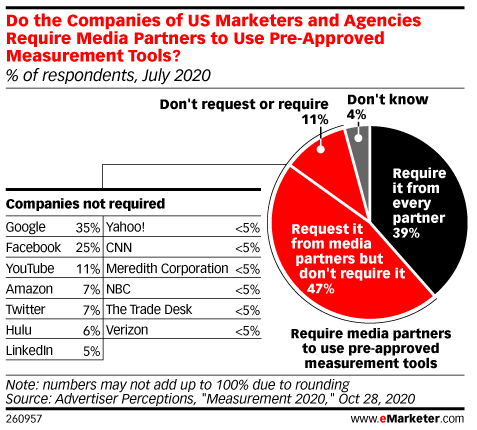
Other research from last year suggests US marketers and agencies generally remain willing to give the walled gardens a break when it comes to their normal measurement requirements. Two in five respondents to a July 2020 Advertiser Perceptions survey required all their media partners to use the buyer’s preapproved measurement tools—which can be frustrating for publishers, who have a variety of reasons for not working with any given provider. Among those who didn’t require preapproved tools of every media partner, it was typically the biggest walled gardens that didn’t have to participate.

Do the Companies of US Marketers and Agencies Require Media Partners to Use Pre-Approved Measurement Tools? (% of respondents, July 2020)

Shane McAndrew, chief data strategy officer at media agency network Mindshare, explained that walled gardens were one area where incrementality testing could help fill in gaps in reporting. And because of how quickly advertisers can turn advertising on and off within the walled gardens, they can run rapid experiments with relative ease.

Marketers taking a sophisticated approach to revenue attribution want to understand not just whether a given touchpoint or media channel influenced a customer, but whether it drove incremental revenues for the business. Incrementality is often investigated through experimentation, using test and control groups.


By

Sourced from Insider Intelligence

By Brian Boucher,

The study was inspired by news of an AI-generated artwork selling at auction for $432,500.

“There is a battle rising between humans and machines.”

No, that’s not a voiceover from another Matrix or Terminator movie. That’s the first line of a new study on how humans perceive artworks made by computers versus those made by humans, and, according to the findings, published in the journal Empirical Studies in the Arts, things don’t look great for the humans.

When the researcher Harsha Gangadharbatla saw the headlines three years ago about a painting created via artificial intelligence by the collective Obvious selling for $432,500 at Christie’s, he didn’t just shake his head at the price. He wondered what this might teach us about how humans perceive art.

“For me, the interesting thing was the role of humans in producing art,” Gangadharbatla, a professor of advertising at the University of Colorado, Boulder, told Artnet News. “I always assumed there was a soul that the human pours into the work. When a machine creates the work, how do people interpret it? Are they still moved? What role does the knowledge of who produced the artwork play in how it is perceived?”

So Gangadharbatla set up an online survey that asked people to distinguish between artworks generated via AI and those created by human hands. He used images of art made by two humans, Tom Bailey of Massachusetts and Indiana’s Steve Johnson, and art created by a young artist whose algorithms produce images that appear indistinguishable from the artists’ work.

The landscapes, both machine- and human-generated, are anodyne impressionistic landscapes. The machine-made abstract work is hazy and pastel-hued, with an allover composition; the human-made version is roughly geometric and has strongly contrasting reds and blues.

While previous studies have focused on whether experts can distinguish machine-made from human art, says Gangadharbatla, this study zeroed in on everyday observers. Some 211 subjects recruited on Amazon answered the survey. A majority of respondents were only able to identify one of the five AI landscape works as such. Around 75 to 85 percent of respondents guessed wrong on the other four. When they did correctly attribute an artwork to AI, it was the abstract one. (So maybe the man on the street thinks abstract painters are robots! A subject for a future study, perhaps.)

Gangadharbatla doesn’t just find these results unflattering for humans—he finds them worrisome.

“I come from the advertising world, where a lot of research is looking at the role of technology,” he said. “When I looked at the news about the artwork being sold at Christie’s, I thought, this has huge implications for the advertising world. Already, the role of humans is shrinking every day and the role of big data is growing. So creativity is the last bastion, the line that humans hold in advertising.”

What’s the next frontier for computer-made art? For now, Gangadharbatla says, when a computer creates an artwork, you know exactly how it did it. But that may not be the case in the future.

“What would be interesting is if we could find computers producing artworks and we don’t know how they did it,” he said. “I’m fascinated with that. That would be truly creative and truly scary. But then, artworks are harmless. They’re not trying to persuade you, but advertising is. If computers start producing persuasive messages and they’re put in front of people, what effect would that have?”

Feature Image Credit: La Baronne de Belamy, an AI-created painting by Obvious Art. Courtesy of Sotheby’s. 

By Brian Boucher,

Sourced from artnet

“One cannot be betrayed if one has no people.”

[Warning: Violent and gruesome metaphor ahead.]

In The Usual Suspects (1995), there’s a scene in which the true extent of ur-villain Keyser Söze’s evil is clarified for the viewer. A gang of Hungarians has burst into Söze’s home and taken his wife and children hostage. “They realized that, to be in power, you didn’t need guns or money or even numbers,” one character, Verbal Kint, narrates. “You just needed the will to do what the other guy wouldn’t.”

The Hungarians want Söze’s territory, and to show how serious their intentions are, one of them slices the throat of Söze’s youngest boy, to the obvious horror of his wife. The Hungarian grabs a girl and makes it clear that she’ll be next.

Söze shoots two of the Hungarians and then does the unthinkable — remember, he’s the bad guy! — and shoots his own children, one by one, and his wife. Söze tells the Hungarian “he would rather see his family dead than live another day after this.” He lets the last Hungarian go, the better to spread the legend of the villain so heartless he would murder his own family to make a point.

As Verbal puts it: “Keaton always said: ‘I don’t believe in God, but I’m afraid of him.’ Well, I believe in God, and the only thing that scares me is Keyser Söze.”1

In Australia, Facebook just shot the hostages. (Metaphorically, of course.) 

Australian regulators have been arguing for months that Facebook derives huge value from the news stories shared on its platform — and that, as a result, Facebook should be forced to compensate the Australian publishers who create them. As with the Hungarians above, Australia’s play can be simplified to: We have something you find incredibly valuable, and unless you give us what we want, we can destroy it.

To which Facebook, by unilaterally banning Australian news stories, responded: You have a really messed up idea of who finds what valuable here. Here, watch me shoot the hostages and show how illusory your “leverage” really is.

It took less than a week for Australia to backtrack. The mandatory arbitration that was the key to Australia’s proposed new law has been reduced to a matter of theory. Facebook can now decide to offer different publishers whatever amount it wants, including nothing at all, without risk of penalty. And Facebook retains the right to shoot more hostages whenever it likes, as Campbell Brown’s statement makes clear:

After further discussions with the Australian government, we have come to an agreement that will allow us to support the publishers we choose to, including small and local publishers. We’re restoring news on Facebook in Australia in the coming days. Going forward, the government has clarified we will retain the ability to decide if news appears on Facebook so that we won’t automatically be subject to a forced negotiation. It’s always been our intention to support journalism in Australia and around the world, and we’ll continue to invest in news globally and resist efforts by media conglomerates to advance regulatory frameworks that do not take account of the true value exchange between publishers and platforms like Facebook.

The money is not and has never been the issue here. Facebook and Google are both perfectly willing to throw money at publishers to hold off regulation. (I wouldn’t be surprised if there’s a petty cash drawer somewhere in Menlo Park labeled Hush Money For Publishers In Anglophone Countries (Small).) As I wrote last year (and, I daresay, it’s held up):

From the duopoly’s perspective, the biggest problem with paying for all the news coursing through their digital veins isn’t the money. (They have plenty of money.) It’s that paying for news in any systemic way would attack their core advantage as platforms: organizing other people’s content.

Say you think Google owes The New York Times money for including all of its news stories in search. Fine. Do they also owe me money for including my old blog from the early 2000s? It’s in Google’s index too. How about Breitbart? How about The Daily Stormer or Stormfront? What about your tweets? DairyQueen.com? All of them are digital content that contributes some sort of notional value to Google as a product. Maybe you think you can draw the line somewhere, but where — and how do you apply it to an index of billions of websites?

Should Facebook pay publishers based on how much value they add to News Feed? Okay — then the biggest check goes to the Daily Mail, and The Daily Wire gets as much as The New York Times.

No, any sort of systematic, performance-driven payments to publishers based on the value they offer platforms are a no-go. So Facebook and Google have responded by looking for other ways to deal with the PR headache by getting money to news companies.

Hence the various Journalism Projects and News Initiatives of Google and Facebook, which started with innovation grants and have since grown to “Okay, we’ll pay publishers some money, fine, but only for this side product that no one really cares about, and we pick who and how much to pay.” 

The tech giants have money, and they have power. They don’t mind giving up money if it gives them something in return: a friendlier regulatory environment, or silence from cranky publishers. What they don’t want to give up is the power: the power to pick winners (whether via algorithm or cash transfer), the power to decide what it’s willing to pay, and — most importantly — the power to maintain their main advantage as platforms, which is to aggregate huge amounts of free information and profit from all the ways they can organize, distribute, and monetize it all.

If there were suddenly a law that says Google has to pay for some kinds of information in its search index — or that Facebook has to pay to have some kinds of information in News Feed — that core element of their model would be at risk. Suddenly, instead of being a toll road that commuters pay to use, you have to pay drivers for the privilege of using you? That’s the unthinkable.

As Google’s Melanie Silva told Australian officials: “The concept of paying a very small group of website or content creators for appearing purely in our organic search results sets a dangerous precedent for us that presents unmanageable risk from a product and business-model point of view.”

The thing about Keyser Söze vs. the Hungarians is that there’s no side to root for. They’re both bad guys with bad intentions, so instead of some sort of moral valence, all you’re left to compare is the raw power on display by both sides.

Facebook is a corporate nightmare that has done very real and meaningful damage to democracy. Australian regulators carry water for Rupert Murdoch and have been proposing a policy that would, as Tim Berners-Lee says, make the web “unworkable.” But a bad company facing bad regulations distills down to pure power, and by shooting the hostages, Facebook made it very clear where that still lies.

Or, to put it another way: “How do you shoot the devil in the back? What if you miss?”

Sourced from NiemanLab