Author

editor

Browsing

By Jamie Johnson

TikTok is currently one of the fastest-growing social media networks in the world. And recent reports estimate that the company will surpass 1.2 billion active monthly users in 2021.

This kind of rapid growth means that there are plenty of opportunities to build a following on the platform. And once you’ve made a name for yourself, you can start to monetize that following.

7 Ways To Make Money on TikTok

Best of all, you can use TikTok to start creating multiple revenue streams. Let’s look at seven ways you can start making money on TikTok.

1. Donations

If you have at least 1,000 followers on TikTok, then one of the easiest ways to start making money is by accepting donations from your followers. TikTok has its own currency, and users can buy coins and donate them to their favourite influencers.

Relying on donations is not a reliable way to make money on TikTok because you’re at the mercy of your followers and whether or not they feel like donating. But it is an option, and it’s an excellent way to make a little bit of money in the beginning.

2. TikTok Creator Fund

The TikTok Creator Fund is a program where TikTok pays you directly for the content you create. Essentially, the program is a revenue-sharing model where TikTok pays you a portion of the money they earn on advertising. The amount you make is based on your total audience and engagement.

The Creator Fund is the only way you’ll get paid directly by TikTok, but the program has received mixed reactions. For one thing, you need to have at least 10,000 followers to even be eligible. And it’s not entirely clear what factors payment is based on.

And some users have complained that their engagement dropped after signing up for the program. But it may be worth your while to sign up and see if utilizing the TikTok Creator Fund is right for you.

3. Advertising

What if you’re not interested in creating content for TikTok but still want to find a way to make money using the platform? Well, if you have your own products and services you want to promote, you might consider paying for TikTok advertising.

TikTok ads last 9 to 15 seconds and are a great way to promote your brand. It will help you reach a younger audience that is often less receptive to other forms of advertising.

4. Affiliate Marketing

Affiliate marketing is one of the most popular ways to earn money through TikTok. As an affiliate, you promote the products and services of other companies. When a subscriber follows one of your links and makes a purchase, you’ll earn a percentage of the money they spent.

Many people like affiliate marketing because it doesn’t require that you create your own products and services. And regardless of the type of niche you’re in, there are endless products and services you can promote.

And if you get a large enough following, you can build up a hefty income through affiliate marketing. However, affiliate marketing is most effective when you’re promoting companies you love and fully support.

5. Brand Sponsorships

If you’ve built up a significant following on TikTok, brands will be willing to pay you good money to feature them in one of your videos. You’ll create a video for your audience endorsing that company’s product or service to your followers.

Unlike affiliate marketing, you’ll be paid for the content you create, whether anyone buys the products or not. And brand sponsorships can be very lucrative depending on how many followers you have. If you have a large following, you could earn thousands of dollars for a single video.

If you’re interested in pursuing brand sponsorships, just make sure you’re selective about the companies you work with. Just like with affiliate marketing, it’s the most effective when you promote companies you’re passionate about.

6. Offer Consulting

If you’ve cracked the code on how to build a following on TikTok, many people will be willing to pay you good money to learn that information. So you may be able to utilize your insights and offer TikTok consulting services.

Before you move forward with any type of consulting arrangement, make sure you outline the terms and deliverables in a contract. And it may be worth your while to negotiate a revenue-sharing agreement. That way, if any of your clients see massive success on the platform, you’ll receive a piece of their earnings.

7. Sell Your Own Products

And finally, one of the best ways to make money on TikTok is by selling your own products. It may take time for you to get to this point, but selling your own products will give you more control over your brand and income.

When you sign up for the Creator Program or use affiliate marketing, you’ll only get to keep a portion of the money earned through your content. And that company could change the terms of your agreement at any time.

But when you sell your own products, you get to keep 100% of the earnings. And this will allow you to build your own brand and set yourself up for success in the long run.

Final Thoughts

TikTok can be a great way to build a following and start making money as an influencer on the platform. But just like any other business, you’ll have to put in the work first. Take the time to develop a relationship with your followers, and be thoughtful about your monetization strategies.

And only promote products and services that you really believe in. This will give you the best chance of success in the long run.

By Jamie Johnson

Jamie Johnson is a freelance writer who covers a variety of personal finance topics, including investing, loans, and building credit. In addition to writing for GOBankingWrites, she currently writes for clients like Quicken Loans, Credit Karma, and the US Chamber of Commerce.

Sourced from GOBankingRates

By

COVID-19 has made 2020 a tough year. Millions of people have lost their businesses, jobs or had to accept a reduced income. Due to the pandemic, it is now common to find people searching the internet for ways they can make money online during these challenging times.

You may be among those looking for a way to earn online not only now but hope to find a money-making venture that makes you more prepared should a new pandemic happen in the future.

This is why website monetization has once again become a widely searched topic.

Although it has been tried, tested, and proven to be a great way to earn money online, many people have feared trying it out. This is mainly because creating a website that will generate an income for you requires patience, which many people lack.

Many individuals have started websites but given up along the way because of the challenges in sustaining and consistently creating content.

But if you want to start a website or want to revive your site, now is a perfect time. With lockdowns happening all over the world due to COVID-19, more people are spending their time online.

So if you’re able to create a good website, offer an excellent product or service, and successfully market your site, you should have loads of web traffic. It is this website traffic you can use to earn from your website. Here are the top ways you can monetize your site.

1. Affiliate Marketing

Affiliate means to connect. When you do affiliate marketing, you connect with other businesses and earn a commission from selling their products or service to your website visitors.

Amazon has one of the most popular affiliate programs you can join. When you sign-up for their program, you will be given a link to include in the content you write to recommend various Amazon products on your website.

When people click on the link and purchase the product, you earn a percentage from the sale.

There are many affiliate programs out there. So do your research and look for the ones that suit your website’s niche.

Be sure to disclose to your audience that you’re using affiliate links for transparency.

2. Sell a Product or Service

Here you may need to rack your brain a little. With so many products and services available nowadays, it can be a bit difficult to stand out. But it is possible.

Look at what you’re passionate about and then find a problem within it. The simpler the problem, the better.

Once you found it, create a solution by way of a product or a service.

The good thing about selling your product or service is that you get 100% of the sale amount, unlike affiliate marketing, where you only get a commission.

3. Resell Your Website Traffic

Once you get thousands of visitors on your website, you can join platforms like Google Ads, Ezoic, or Mediavine to place advertisements on your website. When your website traffic sees or clicks on these ads, you get paid for it.

Alternatively, you can reach out to advertisers yourself and charge them to advertise on your website.

If your website numbers are still low, you can pay for a traffic service like ultimatewebtraffic. This web traffic seller can provide your website with 100% human and highly targeted website traffic.

4. Charge for Membership

This is a sure way to get paid with your website. For example, you could create exclusive content, then ask your website traffic to pay you a fee to access this content.

The content you provide has to be of the highest quality and not readily available to make your visitors see the need to pay for it.

Content on a membership website can include research, webinars, or podcasts.

5. Sponsored Posts

With a big website audience, you can reach out to companies within your niches that would be interested in your website traffic.

When you reach out, you can offer to publish an authoritative blog or video about their product or service and link to them. Include them in your regular newsletter, or place their ads on your site.

This can be done regularly. Only, be cautious of some brands because if you seem to be a bit biased toward their competitor, you may be seen as a threat to them.

Just make sure you know what you are doing and let them know your goal with your review or sponsorship deal.

Conclusion

While staying at home due to Covid-19 is not exciting, you could make the best of it and start a website that could earn you a regular income long after being done with this pandemic.

Monetizing a website is not a walk in the park, though, so here’s a quick checklist to see if you have what it takes to take on the task.

  • Attitude

As the age-old saying goes: your attitude determines your altitude. There is much truth behind that kernel of wisdom.

Monetizing a website is a long-term investment and may need time before you see dividends. You should have the right amount of patience, perseverance, and motivation to push through.

  • Goals

Your goals should be S.M.A.R.T., which stands for Specific, Measurable, Actionable, Realistic, and Timely.

  • Skills

Creating a good website will need some set of skills. You will need to plan, write, design, and even code a little.

Don’t worry if this seems like plenty of tasks to do. If you have good team management skills, you can hire people to reduce your workload.

You should also have a thorough understanding of how to buy website traffic. If you don’t, the best way to get immediate traffic is to work with a traffic service like web traffic experts. This web traffic provider can drive thousands of visitors to your websites within hours of paying for their service.

I wish you all the best in your website monetization efforts!

By

Sourced from INFLUENCIVE

By Laurence Minsky and David Aron

There are few tools more ubiquitous in management, marketing, and other key business functions than the SWOT analysis: It involves listing the strengths, weaknesses, opportunities, and threats facing your firm, division, functional area, or other aspects of your organization, products, or services. The results of a SWOT analysis can be (and almost always are) presented simply as a 2 x 2 grid, with one dimension representing the internal versus external factors, and the other depicting positive versus negative valence.

The problem is, as typically conducted, the SWOT is not really an analysis or diagnosis at all. It is simply list and categorization of the internal and external situational factors related to the subject that you’re evaluating, usually produced during a group brainstorming session. The resulting document is typically less than insightful and does not offer a clear path to action. It is simply an elegant organizational tool. That might be part of its attractiveness — besides its catchy acronym — and a key reason for its popularity.

There are a few reasons that SWOT, in its current form, falls short of desired outcomes. First, the traditional 2 x 2 grid layout for the analysis, which encourages users to present all of the information on a single PowerPoint slide or piece of paper, often leads to exceedingly short, often one- or two-word descriptions. This desire for brevity also often leads to shortcuts in thinking. In our experience as both consultants and teachers, for instance, we’ve found that an important attribute like “price” might be listed as a strength, weakness, opportunity, and threat without any further explanation. The SWOT offers no analysis or insight as to whether the price is too comparatively high, if competitors can undercut it, if a firm can run a promotion, or any other factor related to pricing.

Second, the SWOT analysis is surprisingly difficult to interpret, primarily because of the lack of a hierarchy. All four quadrants of the grid are emphasized equally. It is merely a snapshot of the current situation — or, worse, a snapshot of what’s currently on the minds of brainstorming session attendees.

Third, our natural instinct is to jump to solutions, particularly when it comes to listing opportunities. In too many cases that we’ve seen, SWOT users misinterpret what “opportunities” are, presuming that they are recommendations of “what could be done.” For instance, we once saw a bicycle tour service provider list “create a mobile application with a live map” as an opportunity. But this isn’t an opportunity in the SWOT sense of the word; rather, it is merely a recommendation that has not been fully processed. Rather, an opportunity might be the growth in the adoption of voice technology. Another: That phone apps are becoming easier to develop, yet the competition isn’t using them.

Despite these issues, SWOT can still be helpful tool for insight or planning if you change the way you use it. How do we mean? By turning the SWOT process on its head.

Drawing from our experience coaching leading brands and thousands of students, as well as building on the research of others, we have found that the traditional approach of identifying internal factors first (strengths and weaknesses) and then moving to external factors (opportunities and threats) just isn’t effective. To improve the inventory collection, you should start with the external factors, then turn your attention to the firm’s internal ones.

There are several reasons we recommend taking this approach. First, these environmental conditions exist not only for your firm but for all competitors. In effect, the external factors create the arena in which the competition takes place. Managers must adjust their strategies to reflect it, even as this environment changes. Since no business operates in a vacuum, it is the context around it that helps determine to what extent any particular internal attribute is relevant. Meanwhile, focusing on the external factors first can get you thinking more broadly about the internal factors, reducing the risk of myopia. In other words, taking this approach can lead you to uncover internal factors that you might not have otherwise considered.

Then, once you complete your inventory, you can actually use the factors to conduct a true analysis that can result in strategic recommendations for planning. Specifically, here’s how we recommend proceeding.

First, gather an inventory of relevant environmental conditions — the threats and opportunities. At this stage, don’t worry about whether these are positive or negative. Remember, we don’t want to take shortcuts. There are existing tools designed for organizing an environmental scan, such as the PEST, PESTEL, and STEEP, but don’t feel limited to these tools. If you have other preferred tools to help you organize the external factors, you can use them.

Next, explore internal strengths and weaknesses. Here, too, ignore whether they are potentially positive or negative. Your first job is to inventory the attributes. The relative positivity or negativity of a factor included in the inventory may again be a function of the external environment. At this early stage of the analysis, it is more important that the factors are included than how they’re categorized beyond simply being external or internal. Don’t settle for one- or two-word descriptors like “price” or “technology.” Explicitly spell out the situation with a detailed phrase or a sentence.

Generate recommendations with a simple sentence. With your external and internal inventories in hand, generating recommendations is now much easier. Simply consider each external factor’s relationship to each internal factor. To help, you might want to complete this sentence:

Given the condition of [external factor], our ability to [internal factor] leads to our recommendation that we [recommendation].

You may find that some external factors will not readily apply to certain internal factors, which means they might not lead to a recommendation. Yet, given enough time or with a creative group working on this analysis, you might develop options that you would not expect to reach, based on combinations of external factors and internal factors.

Let’s take an example, using the external factor of an economic recession as a starting point.

In a traditionally conducted SWOT analysis, one might include the objectively internal attribute of “price” in all four of the cells because it’s a strength (the firm’s product costs less to purchase than the competition’s), a weakness (people have less money to spend on the product), an opportunity (the firm can afford to run a price promotion), and a threat (the competition can easily undercut what the firm charges). This is not an analysis; it is merely a set of poorly supported suggestions.

In our model, the template listed above could lead to one or more thoughtfully developed recommendations such as:

Given the condition of our current recession, our ability to realize cost savings over our competitors leads to our recommendation that we reduce our price.

The model doesn’t stop there. Several other recommendations might flow from the use of this template, under the stated conditions. For instance, following the prescribed process for the analysis, the external factor would then be combined with another factor from the internal inventory, and then another, with each possibly (but not necessarily) leading to a unique recommendation:

Given the condition of our current recession, our ability to maintain strong relationships throughout our distribution channel leads to our recommendation that we offer discounts to our channel partners to help them weather the storm.

Or, for a perceived weakness:

Given the condition of our current recession, our low brand recognition leads to our recommendation that we target this brand for reduced marketing support, in favor of our stronger brands.

By looking at the external conditions, in conjunction with internal attributes, a set of clear-cut and supported recommendations can be generated. And this should be your goal: Using an analytical tool to help you identify a wide range of possible actionable outcomes. The process is straightforward and demands attention to a range of internal and external factors, and the results are recommendations that are more thoroughly developed and grounded. Try this approach the next time you’re asked to generate a SWOT and see the power of it for yourself.

By Laurence Minsky and David Aron

David Aron is Professor of Marketing and Director of Graduate Programs at Dominican University. A frequent conference presenter, his research on consumer satisfaction and marketing pedagogy has been widely published in academic journals.

Laurence Minsky is an Associate Professor at Columbia College Chicago. His most recent books include Global Brand Management, The Activation Imperative, and Audio Branding.

Sourced from Harvard Business Review

By Spencer Haws

Today, I’m excited to share with you an interview I did with Steve Wiideman from Wiideman.com.

Steve has been in the SEO industry since 1999…a dinosaur in internet years!  His first job out of college was doing SEO and search engine marketing.

So, Steve brings all of his SEO knowledge and experience to the podcast today.

In particular, we discuss how his SEO consulting group is working with clients doing local SEO, eCommerce SEO, and much more.

During the interview we discuss specifically how the Wiideman group helped Bob’s Watches:

  • eCommerce SEO
  • Bobs Watches has grown to over $40 million a year in revenue
  • and much more

We also discussed his view on affiliate sites and how it relates SEO.

  • Are affiliate sites really providing value or are they just doorway pages?
  • What sort of link building and keyword research should be done?
  • Ranking affiliate sites in Google

Steve is also a professor at Fullerton college and UCSD where he teaches SEO and online marketing.

He’s put together lots of video materials that he is giving away for free.

If you want to get free access to Steve Wiideman’s SEO videos you can go to AcademyOfSearch.com.  Use coupon code SEOSteve to get free access.

Get Academy of Search for Free

Free Access with Coupon code “SEOSteve”

If you’d like to follow along with Steve, be sure to head over to:

Watch Entire Interview with Steve Wiideman


Read Transcript

Hey Steve, welcome to the niche pursuits podcast.

Steve Wiideman: What’s up, Spencer, how are you doing? I’m doing really good.

Spencer Haws: It is great to connect and connect with an SEO veteran. You’ve been in the industry

Steve Wiideman: for a long time.

Spencer Haws: I do what I can and to know, but some of our listeners, maybe aren’t aware who you are. Right. So why don’t you give us just a quick background, who you are, what you’ve been involved with professionally.

Steve Wiideman: Of course. Yeah. So I started in digital, around the late nineties. I was freelancing doing some web design work for friends and family members. And. Really discovered a passion for it. One of my jobs, my I, my day job at IBM global services was to migrate data from what was going to printers and mail rooms to be online.

And I had this epiphany. I’m like, you know what? I’ll bet every business is going to have a website at some point, you know, and we’re talking late nineties, there were some sites didn’t even exist yet. Google didn’t even exist yet. And so, you know, I had that epiphany, I went back to school. I got a degree in e-business management.

You got to learn everything from database networking, graphic design, and pulling it all together through project management. And my first job out the Gates, my first professional job out the gate was as a search engine optimizer for a local. it’s more at the time it was more of a national, but I had a, brick and mortar location for monitors and that sort of thing.

And what year was your first job? Oh, geez. That was professionally. It was probably 2004, 2005. Okay. So before that I was just freelancing and going to school and, yeah, so 2000. Late 2005, I get a phone call saying, Hey, this this little company ran by a mouse, wants to hire you to manage paid advertising with this Google ad words and, and MSN ad center thing.

You know, could you, could you see if that’s something that’s a good fit for you? And I’m like work for Disney? That’d be amazing. So, I ended up actually being the STM account manager for disneyland.com, marketing and commerce marketing, you know, new Nemo ride grad night, commerce tickets, packages, reservations, and a new brand that they created called to adventures by Disney.

And that was an all flash website that couldn’t even be crawled or, you know, with no pages to index, there’s just a Swift file. So, you know, my, my role there, was mainly paid and I convinced my manager to give me a shot at this SEO thing. he, wasn’t very impressed that I ranked number one for.

Orange County SEO expert. And he said, tell you what show me that you can rank for SEO expert and we’ll talk. And so three months later after creating my SEO expert page and doing some promotion for it, adding video, getting some links to it. I’m on the first page. I’m like, like, Hey Terry, check it out.

I’m on the first page of Google for SEO expert. Let me do some SEO on these websites. And, and it comes back and goes, well, you’re not number one, few months later, I got the number one spot. I held it for 12 years, until I realized that my peer group and you know, that the community thought that it was bragging.

And I got blacklisted from a lot of speaking opportunities. the moment I dropped that some three years ago now. now I, I get the most amazing adventures with some of these peers that, that, before I thought I was just this guy that bragged about being number one for SEO expert. And now I get to go camping with these amazing friends and it was so worth it.

So that’s interesting.

Spencer Haws: So you think people didn’t like you because you ranked number one for SEO

Steve Wiideman: expert. And in fact, I, I saw lots of hate and blog posts and things back in the day that. It’s like, you don’t even know me. I, a few times I actually found the contact information of the people who wrote things about me and I’m like, Hey, let’s, let’s talk for a few minutes.

So you get to know who I am, you know? And then afterwards they post this guy actually had the audacity to call me. And, but it turns out he is actually a pretty cool guy, you know?

Spencer Haws: So I think that would be a good thing if you’re ranking for SEO expert.

Steve Wiideman: Well, I would just

Spencer Haws: ignore the haters.

They

Steve Wiideman: didn’t know what they were talking about anyways.

Yeah. Well, those, those haters now are my best friends and they’re so supportive of me. And when I get stuck on a really difficult technical or, or contextual SEO issue there they’re right there for me. So. we have some pretty exciting, amazing, you know, brands we get to work with now, a few restaurant chains, and I didn’t have that peer group around me, folks that were.

Just as experienced or veteran is as you call an earlier, you know, I don’t know that I’d be as successful. So I think it was worth it to, to move on from that what we’re going to hold list of new keywords. We’re going to try to tackle, but, I don’t think SEO expert is going to be one of them. Okay.

Spencer Haws: Well, so how did you actually end up making your first dollar online?

So you’re ranking for SEO expert. Was that kind of the first way you were getting clients or. Just curious. Yeah. How did you make your first

Steve Wiideman: dollar online? I think I started some of our own websites around 99 in 1999. I started to create some web directories. I had some web directories for, DJs and limousine drivers.

And at first it was just to help my, my friends and, and, you know, freelance clients that had those businesses. And then it evolved to something where I had people subscribing to my online directories. They pay an annual fee or monthly fee and. that was probably where I made the first dog was really just kind of creating my own line online directories.

All right.

Spencer Haws: that’s very cool. so what are all the businesses that you’re involved with now to kind of catch people up? You know, you’ve kind of given some of the history now, but, but what are you involved with now? is it just the one business? Wait a minute.com or. Is there

a

Steve Wiideman: portfolio there? I think, I think all of us, as we get started, you know, we, we get to a place after a couple of years, we own 500 domain names and we want to do something with all of them.

And we’ve got all these great ideas of what we want to do. that list has gone down, you know, it’s probably less than 70 domains that I own now, of which I probably use 10, some of which, are projects that I worked on with, students at some of the colleges I was doing guest speaking for and some mentoring for.

but the only two sort of companies or anything that I’m doing at the moment, one is just running our small group here at Wayman consulting. You know, we’ve got nine employees now and. we support everything from, you know, your local HVAC company to, you know, one of the largest restaurant, casual dining chains in the country.

and the other, the other sort of role I’m taking right now is an adjunct professor at Cal state Fullerton, UC San Diego. I’m not teaching six classes at Portland community college. So when everyone else gets off the clock and they go home and eat dinner and. You know, and watch the very entertaining news right now.

no I’m being sarcastic. I’m not, I’m, I’m putting courses together and helping students and helping the next generation of SEO so that, you know, in five, 10 years from now, You know, the, the, hopefully there’ll be more transparency, more ethics and more strategy and less, tactic, less, black hat and, you know, things that, that manipulate search results.

Instead, we’re building good foundations on how we, you know, how we handle digital marketing. So collectively I think I have. just over about 160 students. So, you know, it’s, it’s, because it’s an online course for digital certificate programs. Some of them are only one unit long. it’s not that challenging, but there are days where I’m like, I’m not going to get home tonight.

It doesn’t do things I’m doing, I’m running that demand at the moment. And, and with, wait a minute, we’ve got, you know, our, our training programs and our digital programs. And then I have the teaching side and the teaching side actually helps build a weight of insight. As we reinvent our website over the next month or two, it’s gonna be very educational and it’s going to leverage a lot of the content that I’ve created for the students.

Spencer Haws: Yeah. You know, I think it’s very cool that you’re teaching in college and the fact that there actually is a degree or courses for SEO and search engine marketing, that didn’t didn’t exist when I was going to college. I was actually surprised to hear that there was an E business, Degree when you graduated.

I didn’t know that existed back in there, but

Steve Wiideman: I got that postcard. I’m like really? Wow. I’m not going to say no to that. And then I saw a full sale, had a, an actual master’s degree program, like, Hmm. Should I go back to school and get a master’s degree? And, an e-business and I just never did. So did you graduate in, like, what

Spencer Haws: was it?

2003,

Steve Wiideman: 2004, 2004? Yeah. Okay. All right. So,

Spencer Haws: I hate to admit it, but I might be older than you. I graduated in 2002 and they didn’t have any online business courses that I was aware of. At least

Steve Wiideman: this was through Westwood college of technology and that’s awesome. It was a tech school, but. I also had a bit of a break between high school and college.

I had, you know, three years where I served in the us army in Fort hood. and then, you know, came back and did the work grind for a few years before I went back to school. So. Gotcha.

Spencer Haws: Very cool. So we did a brief call, before hitting record here and we kind of talked a little bit about what I’m involved with.

I mentioned that a lot of my listeners are building affiliate sites. I built a lot of affiliate sites and sort of in that discussion, you mentioned. Sorta that you don’t do your, your group doesn’t do a lot of consulting. I essentially asked you have any clients that are doing sort of affiliate marketing, you said no, not, not really.

and you sort of mentioned that, oftentimes, you know, affiliate sites are building a lot of doorway pages and, it’s just Google. Doesn’t really like that very much. It’s I’m

Steve Wiideman: paraphrasing. Yeah. A lot of, a lot of our effort is around lower funnel content. How do we drive customers? To our clients, you know, that the brick and mortars and the small stores and restaurants and some online, you know, e-commerce websites that we support where there’s an actual sale or a product.

So we can actually calculate ROI. One of the. One of the things that we really enjoy is geeking out on analytics and being able to say, Hey, you invested X, thousands of dollars in SEO this month and generated X dollars of revenue. It’s really to do that. Or you’re really easy to do that when you have an e-commerce website or a hybrid, if you’re a brick and mortar and you can place an online order, especially now during the pandemic, but can’t you do that with an affiliate site to some degree?

Yeah. I mean, you could do it where you’re, you’re calculating and importing data back. If you’re doing some. online ads to promote your, your page from an organic perspective, I suppose. Depending on how you’re doing it. If you’re doing it through a third-party network tying in which, which keywords generating traffic and that sort of thing can be a little more tricky with affiliate when there’s not a sale on the site itself, unless you’re drop shipping.

Of course job, ship’s different. Cause they’re still ordering on your website. I see.

Spencer Haws: When you, when do you want to get that granular data, right? You want to see that you ranked number one for this

Steve Wiideman: particular keyword. You want to see

Spencer Haws: how much this particular product sold from that page. cause, cause certainly we’re doing a lot as affiliate site owners, we’re doing a ton of analytics, you know, cause, that is the primary driver of traffic for affiliate sites is SEO.

Steve Wiideman: Right? Right. So if you were to perform a query right now for a product, with an intent to purchase, most of the results are going to be your, your Amazons and your, you know, your online stores. if you were to do a longer sweat, so query how, where compare versus ideas, strategies, tips, lists, right?

Those are the, the, the obvious opportunity for affiliate sites to create really rich long form content. Right. You’ll make recommendations within that content to, you know, to drive affiliate. We do have two affiliate clients that, that are in the medical industry and they’re selling like essential oils and those sorts of things.

And, and they’re doing really well because they create amazing content. They’ve got these great videos and like, hi, I’m Dr. So-and-so. And this is my wife, Dr. So-and-so and say, we’re going to be talking about backs, the unboxing, the YouTube videos that you know, that people are looking to decide whether they want to buy a product that.

You know, the, the product review keywords that you’re going after. I think there’s a huge opportunity there for affiliate marketing. but our, our forte has always been focused around, you know, direct sales and, you know, we really don’t have a lot of affiliate clients, but that’s not to say I don’t believe in it.

I think, I think affiliate’s amazing. And I think any, any entrepreneur, who’s not doing something to, to drive affiliate revenue. I mean our whole, our whole new website that we’re launching has a section for partners and folks that we recommend where the goal is to of course have affiliate relationship there.

So you’d be, you’d be silly not to diversify your, your online income streams by not doing a little bit of affiliate marketing. Right, right.

Spencer Haws: Yeah. No, and that’s, that’s good to hear just. To clarify for listeners, because most of them, that’s what they’re doing. You know, sort of those opportunities that you laid out said, Hey, there’s great opportunities for the comparison, the reviews, the lists, the all that, that, that’s exactly what I teach, and have been teaching for 10 years, right?

Is, is building these sort of niche affiliate sites. You write really in-depth content. You rank number one for Google for best XYZ product or. X versus Y product or whatever. and a lot of people built, you know, that’s their livelihood, you know, people do this full-time and they’re making really good money doing

Steve Wiideman: it at the equipment in my room was supposed to because of recommendations that I found likely.

Yeah. Ended up on BNH or somewhere else.

Spencer Haws: So just to clarify, you think Google is happy and, and they’re okay. Ranking this type of content affiliates that are building this in depth type of content that we just mentioned. Shouldn’t have to worry.

Steve Wiideman: No, not at all. I think, I think where they would have to worry is if, if they were trying to compete against a very behavioral targeted query, like by purchase order right out the gate, if you’re doing, you know, buy.

IPad case, you know, and, and I, I definitely encourage anyone who’s listening and watching to that, to do some of these queries where they’re using words like buy purchase order, reserve book, those, those types of call to actions, you know, really are conducive to somebody who’s in the, I need to buy now.

They’re not really interested right away to read an article. Their intent is I know what I want. I’m going to buy it. But if they’re in sort of mid funnel or upper funnel, it’s great. The greatest catalyst I can imagine. It’s more, you know, driving income through affiliate. back my, one of my first eBooks that I wrote in the two thousands was called SEO in a day.

And I went after, is it Monety or the little how’d you call it? It’s a saw you drink, right? Oh, I saw that they weren’t doing any, any sort of digital marketing for themselves and I’m like, all right, I’m going to pick, I want to pick one of these MLMs and just create a, a affiliate site and show that you can do optimization and get.

traffic and revenue in a day or less. And so we went through with this whole WordPress walk through our board, a little video on how to do it and create a content was up to like, you know, 10 o’clock at night creating content. The first thing that I optimized for was the thing that I had the most trouble with.

I couldn’t sign up. To become an affiliate without talking to an affiliate. I’m a tech introverted, you know, guy. I don’t at the time, I didn’t want to talk to anybody. So I did this search for Mondavi distributor ID, and I just wanted to set enters through your ID to sign up. I’m like, crap, I don’t have one.

They don’t want to talk to anybody. Five by pages into Google. I find a distributor ID and someone’s thread on some other website. And so I grabbed that and the very first page I create is Mondavi distributor. I need five, six, whatever, you know. Right, right. In the title of the page. And, you know, with, within a couple of weeks, I started getting calls from mom and be like, what are you doing?

You’re getting more downlines and more orders than like any of our affiliates who you working with, this, this person isn’t even responding to our emails. And I’m like, I don’t even know who the distributor ID was. I grabbed, I, I just, you know, I knew what I wanted. I was trying to find it and I optimized for it.

And so, yeah, four months later I’m getting checks from people who are buying this product and. so it was called STO in a day and it’s totally outdated now because it was pre Google penalties, like, you know, their penguin link penalty and they’re Panda content penalties. So a lot of the suggestions in there and the methods that I used to get links to the site quickly, you know, were obsolete.

But, but yeah, I love and passionate about it. Affiliate is I’m sure. All of us are awesome. Not

Spencer Haws: very cool. So, now you’re focusing more on, at least through Wiedemann group consulting. You’re more focused on local companies. e-commerce companies, those, those that, you know, they’re, they’re making purchases either on their side of they’re trying to drive foot traffic into their business potentially.

Steve Wiideman: Right, right. And part of it’s because you know, it, it gives us more of a challenge. You know, when, when we get a large corporate client who comes in and says, we’re on this really wonky CMS system, and we’re getting beat by all these competitors, what do we do? It gives us the opportunity to really challenge ourselves.

you know, the best could that competition and really big industries and, and, and explore and pioneer new areas of search. So, you know, for one of our restaurant chains, for example, we did a study recently of some 300 local pages. You know, if you have a brick and mortar company and you’ve got multiple locations, you’re going to have multiple pages or those locations.

And so we got to study all of those different pages and their attributes. What’s the difference between one that’s ranking higher and one that’s not, you know, and, and in doing that, you know, we’re, we’re creating and we’re building data and best practices and sort of the anatomy of a local landing page.

And, and that’s exciting because now, now you’re a pioneer now you’re. You’re someone who’s, who’s looked on as the guys who, who love to research and discover things and people will pay for the information. That’s the best part is we, as we do, you know, push a lot more of our educational stuff and the road, you know, the, the, the sales part of that and how we really generate revenue is when they purchase, you know, some of the research that we built.

Spencer Haws: So I wanted to ask a little bit about that. Just kind of how, your consulting group is set up. I understand that you’re not an agent agency, but you are a consulting group. So can you clarify that? And, and why is

Steve Wiideman: that? Sure. You know, I, I didn’t have a good experience in agency when I left the corporate world, 2008 or so I did two years in the agency and I was miserable.

I didn’t like it. How, how agencies treated clients in general. I didn’t like that. Yeah, the way that they they’ve really tried to have their secret sauce of what they do. And instead of being transparent, you know, when I, when I went off on my own and, you know, decided to be a freelance consultants, you know, late 2009, it was built around transparency.

Hey client, here’s all the things we’re going to do together. I’m gonna load it up into our project management system and we’re going to work together to get it done. And they’re like, wait, you’re giving me everything you do. Are you afraid? I’m just going to do it all myself. I mean, you’re looking at all this, so you really, you really want to do it all yourself.

Like no. So, and those clients that are DIY, they’re going to figure it out one way or the other. Anyway, those people who know and trust your expertise would feel better knowing that you’re their wing man. So we’re, we’re, we’re using a model that, that allows us to, to really help. Businesses to bring in their own SEO team, their own content writer, their own technical, you know, resources managing the tech side of SEO and their, their own outreach and link building digital PR teams.

And now all the things that they’re doing have the brand voice on them. And they’re, and they’re saving so much money. Once these resources get trained up and, and are able to do all the same things, agencies do. They get to save so much money in what would have gone to overhead and leadership and, you know, and, and, other costs.


By Spencer Haws

Sourced from NICHEPURSUITS

By Rimal Farrukh

  • Shopify landed a partnership with Facebook to expand seller checkout through Shop Pay on Facebook and Instagram.
  • According to Shopify, 28 percent of young online shoppers made purchases through social media.

Shopify announced a partnership with Facebook to expand its online checkout platform Shop Pay to all Shopify merchants selling across Facebook and Instagram. The expansion will enable Shop Pay as a payment option on Facebook Pay for consumers on Facebook and Instagram.

Currently the feature is available in the U.S on Facebook Pay for Shopify merchants using checkout on Instagram. In the coming weeks, it will be accessible to Shopify sellers in the U.S using checkout on Facebook.

“Facebook continues to be one of our most popular sales and marketing channels for our merchants,” said Carl Rivera, general manager at Shopify and head of product at Shop Pay.

“For example, at the start of the pandemic from March through April, marketing on Facebook and Instagram via Shopify’s channel integration saw 36 percent growth in monthly active users — a trend that continues to rise — paving the way for the very natural expansion of Shop Pay onto these platforms.”

According to Rivera, Shopify sees social shopping as a growing area of commerce driven largely by a younger demographic who are more likely to use social media to discover new brands and shop.

Shopify’s Future of Commerce report states that 28 percent of younger online shoppers said they purchased via social media, compared to 20 percent of middle aged online shoppers and 8 percent of older consumers. It also demonstrates that 54 percent of younger consumers who purchase from independent retailers discover brands through social media compared to 43 percent of middle aged consumers aged between 35 and 54 and 25 percent of consumers older than 55.

“Social commerce is a very effective tool for e-commerce that has only just begun gaining momentum and widespread usage,” said Alexander M. Kehoe, the co-founder of digital marketing and strategy agency Caveni Digital Solutions. “Listing your products on every channel available is fairly standard for most e-commerce sellers. The inclusion of even more easily accessible channels to place products on means that e-commerce providers are positioned to benefit significantly.”

In addition to its social media expansion, Shop Pay allows users to track orders and see the carbon emissions offset from the deliveries of their purchases. According to Shopify, Shop Pay has offset 75,000 tons of carbon emissions, which is the equivalent of 85 million trees protected in the Peruvian rainforest.

“With 53 percent of consumers saying they prefer green or sustainable products, we’re now making it possible for more consumers who check out on Facebook and Instagram to shop sustainably,” said Rivera.

In 2020. Shop Pay processed more than 137 million orders and by the end of the year and has facilitated nearly $20 billion in cumulative GMV since its launch in 2017. A Shopify study found that checkout on Shop Pay is 70 percent faster than a typical checkout, with a 1.72x higher conversion rate.

According to Joe Sinkwitz, CEO of influencer marketing network Intellifluence, Shop Pay’s social media expansion will open up significant business opportunities for social media influencers. Through increased monetary incentives, influencers will be in the position to market Shopify enabled products which will ultimately encourage more purchases.

“From an influencer perspective, we’re seeing a lot of excitement surrounding the Shopify integrations into Instagram and Facebook, as that will give creators a sizable increase in monetization capacity, and will be great for those brands hosted on Shopify to have the additional sales channel,” said Sinkwitz. “We expect the integration will in time be a primary driver of influencer marketing requests, in terms of activating Instagram as a more direct sales channel.”

By Rimal Farrukh

Sourced from TEARSHEET 

By Michael Allison

More trouble for the social media company.

What you need to know

  • TikTok is facing complaints from European consumer bodies.
  • The BUEC and 15 other bodies accused the company of being lax with data and having skewed terms of service.
  • By way of response, TikTok offered a meeting with BEUC representatives to “listen to their concerns.”

TikTok is facing multiple complaints from the European Consumer Organisation (BEUC), and other consumer organizations in 15 European countries over privacy rights violations. The BEUC today argued that the social media app breached EU consumer rights and failed to protect children from both inappropriate content and stealth advertising. It called for a comprehensive EU investigation into TikTok’s policies and practices and requested more transparency from the company.

More specifically, the BEUC alleged that TikTok was unclear in its terms of service with the terms drafted to give outsized benefits to TikTok rather than users when it came to content ownership and remuneration.

The BEUC also took aim that TikTok’s virtual coins as well as its hashtag challenges, noting that both provided significant financial benefit for TikTok with little benefit for users. when it came to hashtag challenges, the body also accused TikTok of not doing due diligence in protecting teen and child users from suggestive content.

Finally, the BEUC stated that TikTok violated the GDPR by being unclear about what personal data it collected and how it used it.

Monique Goyens, BEUC Director, said in a statement:

In just a few years, TikTok has become one of the most popular social media apps with millions of users across Europe. But TikTok is letting its users down by breaching their rights on a massive scale. We have discovered a whole series of consumer rights infringements and therefore filed a complaint against TikTok.

Children love TikTok but the company fails to keep them protected. We do not want our youngest ones to be exposed to pervasive hidden advertising and unknowingly turned into billboards when they are just trying to have fun.

Together with our members – consumer groups from across Europe – we urge authorities to take swift action. They must act now to make sure TikTok is a place where consumers, especially children, can enjoy themselves without being deprived of their rights.

Speaking to Reuters, TikTok responded:

We’re always open to hearing how we can improve, and we have contacted BEUC as we would welcome a meeting to listen to their concerns.

The company has faced more challenges than most nascent social media did in their early years including attempted U.S. bans, temporary bans in Pakistan, and a seemingly permanent one in India leading to potential divestment.

Feature Image Credit: Source: Android Central

By Michael Allison

Sourced from androidcentral

By Nate Nead 

For years, content marketing has been the go-to marketing strategy for new startups. And for good reason. Content marketing is relatively cheap, especially when compared to traditional advertising strategies like print, radio, and TV ads. It’s accessible, since almost anyone can get started in the strategy with minimal experience. And best of all, it’s a prime strategy for long-term growth, capable of seeing compounding returns over the course of years.

But there’s a problem. Content marketing hasn’t changed much in the past 10 years or so. People are practicing the same tactics and following the same fundamentals they’ve practiced and followed for years. They’re still getting decent results, but how long could this continue to last?

The start-up content marketing world is overdue for disruption – a massive changeup to rebuild content marketing from its very foundations. But why is this disruption so overdue and what could an overhaul look like?

Why Content Marketing Is in Need of an Overhaul 

Let’s take a look at some of the biggest reasons why content marketing is in need of a major, ground-up overhaul:

  • Saturation and competition. The first problem is saturation, and by extension, competition. One of the greatest advantages of content marketing has also become one of its greatest weaknesses: accessibility. Anyone with a few hours to spare can learn the fundamentals of writing great content, and you don’t need any fancy equipment or tools to publish it. With even the smallest budget and a limited amount of time, you can make your content available online. Over time, this has led to billions, if not trillions of articles posted on more than 600 million blogs and 1.7 billion websites. If you want a chance at standing out, you’ll need to choose a very specific niche to get started – and even then, you’ll likely be competing with hundreds to thousands of brands that have years-long head starts on you. This makes it both difficult to enter as a new content marketer and difficult to navigate as a consumer.
  • Consumer familiarity. Speaking of consumers, consumer familiarity has also become a problem. One reason why content marketing became so popular for startups is because it served as an alternative to traditional advertising. Over the course of many years, consumers became fatigued by traditional ads; they don’t like being manipulated, and they don’t take traditional ad messaging as sincere. By contrast, content provides consumers with information, entertainment, and often a seemingly sincere desire to help. But because content marketing has been wielded by so many persuaders and manipulators, even online content is beginning to be treated with the same kind of skepticism as traditional ads.
  • Automation and predictability. Content marketers have long been enthusiastic about the prospects of marketing automation – the ability to create and execute marketing strategies with minimal manual effort. And certainly, automation has a lot of benefits. However, the introduction of automation tends to make content much more predictable and much less engaging for consumers, especially if most companies are using the same tools in the same way. Additionally, because automation multiplies the amount of content being circulated for marketing purposes, it tends to complicate and intensify the other factors on this list.
  • Minimal innovation. Let’s face it. Over the years, there has been minimal innovation in the field of content marketing. People are using video content more than they used to, and some of the tactics in fields like search engine optimization (SEO) have changed, but most of the fundamentals are the same. If we’re going to continue providing consumers with the best materials and leverage the best marketing approaches available, we need to be able to adapt.

Content marketing is primed for a major change. But what could that change look like? How could content marketing for start-ups evolve in the near future?

Mediums and Channels 

One of the most promising areas of development is in an expansion of the mediums and channels available to content creators. Today, if you want to create content, you could write an article, develop a test or quiz, take photos, illustrate new designs, shoot video, or host a podcast – or try to blend a few of these mediums together.

But what about the future? Could we see a rise in the popularity of virtual reality (VR) and augmented reality (AR)? Will new devices make it possible to interact with content in new ways, such as projecting it onto a wall? Will there be a future technology that can beam some forms of content directly into people’s heads? Some of these possibilities may seem overly futuristic, but they could be exactly the wave of disruption content marketing needs.

Formats

The format of content could also be a source of innovation. Today, most content falls into one of two overarching forms: short-form content, designed to be read or digested in a matter of minutes, and long-form content, exploring a subject or topic thoroughly over the course of hours.

But what about a different form of content altogether? Could we see a rise in popularity of ultra-short content, meant to provide users with immediate insights? Or what about an undercurrent of content, providing people with a steady stream of information throughout the day?

Interactions 

Content is already starting to evolve to become more interactive, so it makes sense that interactive content could become the next evolutionary form of content marketing overall. Interactive content has much greater potential for development; since it relies on an interaction with consumers, it can branch off in many different directions. It’s therefore more unique and harder to replicate, leading to more original and noteworthy content.

This content is also more appealing to individual readers and consumers, defeating the consumer familiarity problem. The only real issue is that interactive content currently exists in a limited number of forms (such as tests and quizzes) and creating it is often more difficult and time-consuming than creating its ordinary counterparts.

Hybridization 

Content marketing currently has tremendous synergy with other marketing strategies; for example, it’s often a staple component of any search engine optimization (SEO) or social media marketing strategy. But we can innovate in the content marketing world by hybridizing it with other forms of marketing and advertising.

For example, we could blend content marketing and guerrilla marketing together for a much more aggressive, unexpected form of content presentation and consumption.

Pressure Factors to Consider

The future of content marketing depends on the amount of pressure it faces to evolve. If left uncontested and unchallenged, content marketing will never change.

Instead, we’ll only see a change based on the confluence of pressure from these areas:

  • Channel pressure. If channels like Google make it harder for brands to benefit from content marketing, marketers will be forced to reinvent content marketing, innovate, or relinquish their content-derived traffic.
  • Consumer pressure. As long as consumers are happy with your content, it will continue generating a return. If they become dissatisfied or demand something better, content transformation is practically a certainty.
  • Competitive pressure. Perhaps most importantly, if your competitors transform their content strategies for the better, you must follow if you want to keep up – or innovate in your own way to gain an advantage.

It’s hard to say exactly how or when content marketing will undergo its next phase of evolution. And according to some experts, this may be the final form of content marketing; though it may change gradually to keep up with new trends and new technologies, it may never be radically different than it is today.

If you want to get the most value from your marketing strategy, your best bet is to diversify. Continue investing in your current line of content marketing tactics while also investing in novel experimental content marketing approaches – and don’t forget to invest in other marketing and advertising strategies as well.

By Nate Nead 

Sourced from readwrite


By

Anyone working within programmatic advertising is likely to hear the phrase ‘curated marketplace’ a lot in 2021 – but what does ‘curation’ really mean in this context and why should it be a key priority for media buyers over the next 12 months?

Michael Simpkins, Marketplace Commercial Lead at Xandr explains, as the programmatic landscape has become increasingly cluttered and complex over the past decade, many people now assume that media buyers operating their own ‘curated marketplace’ are simply looking to work with fewer partners in the advertising supply chain. However, this is only the first step and barely scratches the surface of how curation can help improve the effectiveness of a media strategy.

Going back to basics

With the rapid growth of the programmatic industry, the supply chain became fragmented, resulting in a loss of control and transparency for both buyers and sellers. Buyers are also facing increasing pressure to justify return on ad spend, but siloed spending, rigid metrics and a convoluted supply chain make it hard to prove marketing impact on business outcomes.

As a collective, the industry has matured in the past few years to take a step back and simplify the complex landscape. Direct relationships between buyers and sellers are being rebuilt and big steps are being taken to improve supply chain transparency. Marketers, now more understanding of the supply chain, are seeking to regain control not just over their ad spend but over their campaign performance too and, with the deprecation of the third-party cookie, these objectives take on even greater importance. On the other hand, with the proliferation of header bidding, publishers want to make sure their most important media buyers are still able to reach and value their inventory effectively. It is important for companies to deliver unique value across the advertising ecosystem from consumers, buyers and sellers. One of the ways we at Xandr are able to do this is through our curation offering, which brings buyers and sellers together on our platform, offering buyers a simplified and dedicated workflow to easily build out their own curated marketplaces from the supply available on our premium advertising marketplace.

Regaining control of the supply chain

By building out a curated marketplace, buyers gain control within the SSP (sell-side platform) and can apply macro business rules to supply before it hits the DSP (demand-side platform) for targeting, significantly reducing risk in a diverse supply chain.

Through curation, buyers are able to maximise their investment by having full control over supply decisioning and ensuring all media is run across brand safe environments and eliminating non-essential pass throughs in the supply chain. Costs can also be reduced as buyers streamline supply sources, campaign workflows and operational complexity while also having the ability to negotiate price and priority within publishers. Buyers are able to receive regular reports on supply-side fees and auction dynamics, strengthening cross-industry relationships and supporting our industry’s quest for supply chain transparency.

As collaboration becomes even more important in 2021 and beyond, curating a marketplace on a single platform can reduce the risk even further. With fewer partners you’re able to work together on market and regulatory changes, niche audience targets and specific campaign needs together.

What is curation?

Today, we are used to a two-party transaction with a buyer using a DSP to purchase inventory and a seller using an SSP to surface their inventory to the buy side. Curation moves us to a three-party transaction where we now have a curator that sits between the SSP and DSP and works alongside the publishers to decide what inventory is allowed into their marketplace and then packages and merchandises that inventory via a curated multi-seller private marketplace (PMP) to make it available to the buy side to trade in their DSP.

Creating your own curated marketplace does not have to be a huge undertaking – in fact, it involves just four key steps:

  • Identify what you want to get out of the curated marketplace. Is it fee and auction dynamic transparency? More control on your supply paths? Performance gains? Setting a clear objective and strategy for the curated marketplace will make the process clearer for all parties involved.
  • Establish who you want to partner with to build out the curated marketplace. Pick a technology partner that has the supply coverage, tools, expertise and service models to implement a successful curated marketplace.
  • Work with your technology partner to understand what supply to bring into your marketplace and how to work with the publishers to do so. A curated marketplace should bring buyers and publishers closer together, not act as a blocker.
  • Optimise your curated marketplace. These marketplaces shouldn’t be static and should constantly be optimised based on performance, market changes and pricing.

As consumers continue to access media content across numerous devices, their attention becomes increasingly difficult to capture and hold. To catch their audience wherever they are viewing content means marketers are having to reconsider their strategies for planning, buying and measuring advertisers. We have to introduce an option for those who want to buy advertising and access to consumers on all devices and formats in one place, and that option is curation.

By

Sourced from The Drum

By Ben Thompson

To what extent are new companies, particularly those in new spaces, pushed versus pulled into existence? Last week I wrote about how Tesla is a Meme Company:

It turned out, though, that TSLA was itself a meme, one about a car company, but also sustainability, and most of all, about Elon Musk himself. Issuing more stock was not diluting existing shareholders; it was extending the opportunity to propagate the TSLA meme to that many more people, and while Musk’s haters multiplied, so did his fans. The Internet, after all, is about abundance, not scarcity. The end result is that instead of infrastructure leading to a movement, a movement, via the stock market, funded the building out of infrastructure.

Electrification of personal vehicles would have happened at some point; it seems fair to argue that Musk accelerated the timeline significantly. Clubhouse, meanwhile, Silicon Valley’s hottest consumer startup, feels like the opposite case: in retrospect its emergence feels like it was inevitable — if anything, the question is what took so long for audio to follow the same path as text, images, and video.

Step 1: Democratization

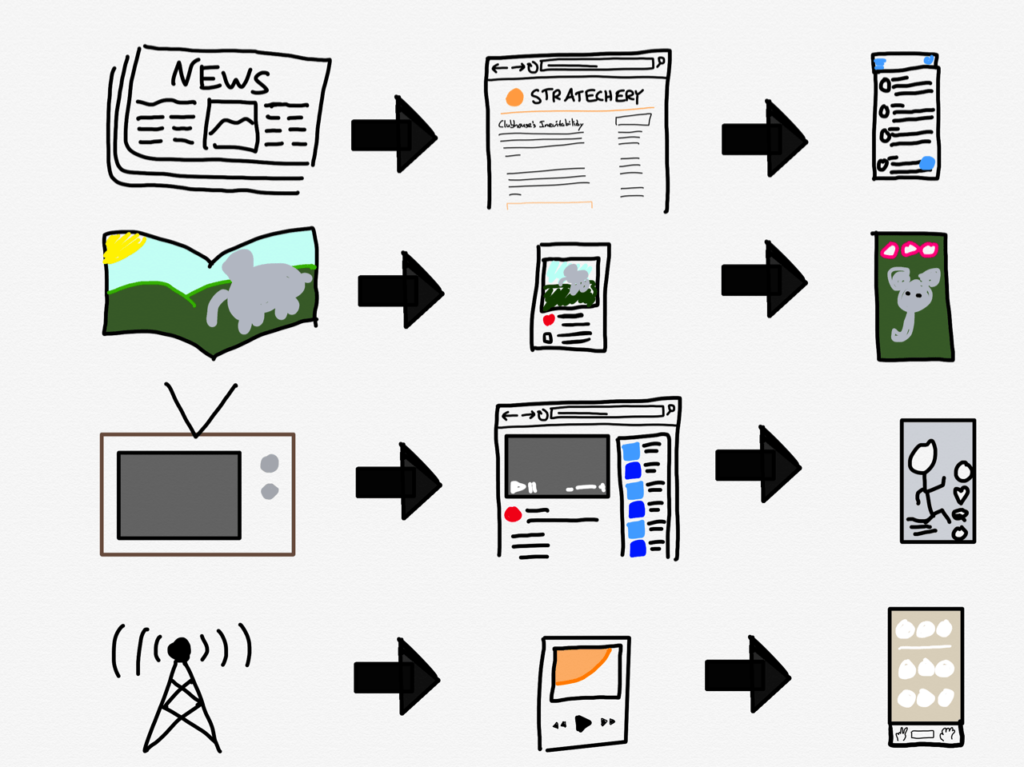
The grandaddy of independent publishing on the Internet was the blog: suddenly anyone could publish their thoughts to the entire world! This was representative of the Internet’s most obvious impact on media of all types: democratization.

  • Distributing text no longer required a printing press, but simply blogging software:
    From print to blogs
  • Distributing images no longer required screen-printing, but simply a website:
    From magazines to Instagram
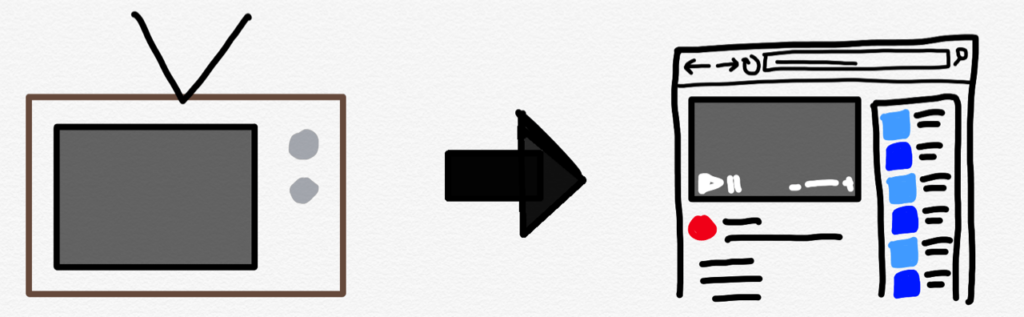
  • Distributing video no longer required a broadcast license, but simply a server:
    From TV to YouTube
  • Distributing audio no longer required a radio tower, but simply an MP3:
    From radio to podcasts

Businesses soon sprang up to make this process easier: Blogger for blogging, Flickr for photo-sharing, YouTube for video, and iTunes for podcasting (although, in a quirk of history, Apple never actually provided centralized hosting for podcasts, only a directory). Now you didn’t even need to have your own website or any particular expertise: simply pick a username and password and you were a publisher.

Step 2: Aggregation

Making anyone into a publisher resulted in an explosion of content; this shifted value to entities able to help consumers find what they were interested in. In text the big winner was Google, which indexed pre-existing publications, independent blogs, and everything in-between. The big winner in photos, meanwhile, ended up being Instagram: users “came for the tool and stayed for the network”, as Chris Dixon memorably put it:

Instagram’s initial hook was the innovative photo filters. At the time some other apps like Hipstamatic had filters but you had to pay for them. Instagram also made it easy to share your photos on other networks like Facebook and Twitter. But you could also share on Instagram’s network, which of course became the preferred way to use Instagram over time.

The Internet creates a far tighter feedback loop between content creation and consumption than analog media; Instagram leveraged this loop to become the dominant photo network. YouTube accomplished a similar feat, although the relative difficulty in creating video meant that the ratio of viewers to creators was much more extreme than in the case of photo-sharing. That, though, is exactly what made YouTube so dominant: creators knew that that was where all of their would-be viewers were.

Spotify is trying to do something similar for audio, particularly podcasts. I wrote in a Daily Update after the streaming service signed Joe Rogan to an exclusive contract:

Spotify, meanwhile, has its eyes on an absolute maxima — a podcast industry that monetizes at a rate befitting its share of attention — but as I have explained, that will only be possible with a Facebook-like model that dynamically matches advertisers and listeners in real-time, as they are streaming a podcast…This, by extension, means that Spotify needs a much larger share of the market, so that they can start generating advertising payouts that are better than the current stunted model, thus convincing podcasters to give up their current ads and use Spotify’s platform to monetize instead.

In this view the motivation for the Rogan deal is obvious: Spotify doesn’t just want to capture new listeners, it wants to actively take them from Apple and other podcast players. And, if it can take a sufficient number, the company surely believes it can create a superior monetization mechanism such that the rest of the podcast creator market shifts to Spotify out of self interest.

Capture enough of the audience and the creators will follow.

Step 3: Transformation

Still, even with the explosion of content resulting from democratizing publishing, what was actually published was roughly analogous to what might have been published in the pre-Internet world. A blog post was just an article; an Instagram post was just a photo; a YouTube video was just a TV episode; a podcast was just radio show. The final step was transformation: creating something entirely new that was simply not possible previously.

Start with text: Twitter is not discrete articles but a stream of thoughts, 280 characters long. It was the stream that was uniquely enabled by the Internet: there is no real world analogy to being able to ingest the thoughts of hundreds or thousands of people from all over the world in real-time, and to have the diet be different for every person.

From blogging to Twitter

What is interesting is the effect this transformation had on blogging; Twitter all but killed it, for three reasons:

  • First, Twitter was even more accessible than blogging ever was. Just type out your thoughts, no matter how half-formed they may be, and hit tweet.
  • Second, because blogging was so distributed and imperfectly aggregated it was hard to build an audience; Twitter, on the other hand, combined creation and consumption like any other social network, which dramatically increased the reward and motivation for posting your thoughts there instead of on your blog.
  • Third, Twitter, thanks to the way it combined a wide variety of creators in an easily-consumable stream, was just a lot more interesting than most blogs; this completed a virtuous cycle, as more consumers led to more creators which led to more consumers.

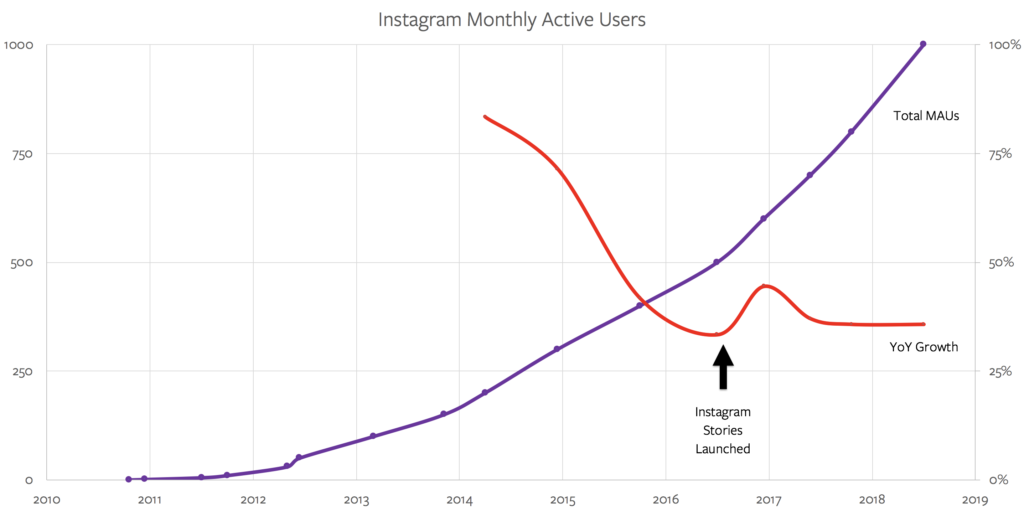
Instagram, meanwhile, had always had that transformational feed, which carried the service to its first 500 million users; it was Stories, though, that re-ignited growth:

Instagram's Monthly Active Users

Stories — which Instagram audaciously copied from Snapchat — combined the customized nature of the feed with the ephemerality inherent in digital’s abundance; the problem with posting what you had for lunch was not that it was boring, but that no one wanted it to stick around forever.

From feed to stories

This too appears to have reduced usage of what came before; while Facebook has never disclosed Stories usage relative to feed viewing, that chart above is from this August 2018 Article about Facebook’s Story Problem — and Opportunity, where I observed:

While more people may use Instagram because of Stories, some significant number of people view Stories instead of the Instagram News Feed, or both in place of the Facebook News Feed. In the long run that is fine by Facebook — better to have users on your properties than not — but the very same user not viewing the News Feed, particularly the Facebook News Feed, may simply not be as valuable, at least for now.

The opportunity came from the fact that dramatically increasing inventory would surely lead to significant growth in the long run, which is exactly what has happened. It didn’t matter that Stories were not nearly as well-composed as pictures in the Instagram feed; in fact, that made them even more valuable, because Stories were easier to both produce and consume.

TikTok is doing the same thing with video; in this case the transformative technology is its algorithm. I explained in The TikTok War:

All of this explains what makes TikTok such a breakthrough product. First, humans like video. Second, TikTok’s video creation tools were far more accessible and inspiring for non-professional videographers. The crucial missing piece, though, is that TikTok isn’t really a social network…

ByteDance’s 2016 launch of Douyin — the Chinese version of TikTok — revealed another, even more important benefit to relying purely on the algorithm: by expanding the library of available video from those made by your network to any video made by anyone on the service, Douyin/TikTok leverages the sheer scale of user-generated content to generate far more compelling content than professionals could ever generate, and relies on its algorithms to ensure that users are only seeing the cream of the crop.

YouTube has invested heavily in its own algorithm to keep you on the site, but its level of immersion is still gated by its history of serving discrete videos from individual creators; TikTok, on the other hand, drops you into a stream of videos that quickly blur together into a haze of engagement and virality.

From YouTube to TikTok

There is nothing like it in the real world.

Podcasts and Blogs

What is striking about audio is how stunted its development is relative to other mediums. Yes, podcasts are popular, but the infrastructure and business model surrounding podcasts is stuck somewhere in the mid-2000’s, a point I made in 2019 in Spotify’s Podcast Aggregation Play:

The current state of podcast advertising is a situation not so different from the early web: how many people remember this?

The old "punch the monkey" display ad

These ads were elaborate affiliate marketing schemes; you really could get a free iPod if you signed up for several credit cards, a Netflix account, subscription video courses, you get the idea. What all of these marketers had in common was an anticipation that new customers would have large lifetime values, justifying large payouts to whatever dodgy companies managed to sign them up.

The parallels to podcasting should be obvious: why is Squarespace on seemingly every podcast? Because customers paying monthly for a website have huge lifetime values. Sure, they may only set up the website once, but they are likely to maintain it for a very long time, particularly if they grabbed a “free” domain along the way. This makes the hassle of coordinating ad reads and sponsorship codes across a plethora of podcasts worth the trouble; it’s the same story with other prominent podcast sponsors like ZipRecruiter or SimpliSafe.

The problem is that the affiliated marketing for large lifetime-value purchases segment is not a particularly large one

One of the takeaways of that piece was that monetization was holding podcasts back, and that Spotify appeared to be positioning itself to expand the podcast advertising market via centralization. Looking back, though, I should have realized that but for a few exceptions, advertising never ended up working out for blogs; the premise behind 2015’s Blogging’s Bright Future was that subscriptions made far more sense as a business model:

Forgive me if this article read a bit too much like an advertisement for Stratechery; the honest truth is my fervent belief in the individual blog not only as a product but also as a business is what led to my founding this site, not the other way around. And, after this past weekend’s “blogging-is-dead” overdose, I almost feel compelled to note that my conclusion — and experience — is the exact opposite of Klein’s and all the others’: I believe that Sullivan’s The Daily Dish will in the long run be remembered not as the last of a dying breed but as the pioneer of a new, sustainable journalism that strikes an essential balance to the corporate-backed advertising-based “scale” businesses that Klein (and the afore-linked Smith) is pursuing.

Interestingly enough, of the three authors cited in that paragraph, both Ezra Klein — formerly of Vox — and Ben Smith — formerly of BuzzFeed — are now at the New York Times, which is thriving with a subscription model. Sullivan, meanwhile, is at Substack — itself modeled after Stratechery — where within a month of launch he had reached a $500,000 run rate.

When you think about the Twitter-driven shake-out of blogging this evolution makes sense: Twitter captured the long-tail of blogs, in the process dramatically expanding the market for publishing text, but that by definition meant that the blogs that remained popular had readers that would jump through hoops — or at least click a link — to consume their content. It makes sense that the most sustainable way for those bloggers to pay the bills was by directly charging their readers, who already had demonstrated an above-average interest in their content.

My personal bet is that podcasts will follow a similar path. Podcasts, even more than blogs, require a commitment on the part of the listener, but that commitment is rewarded by a connection to the podcast host that feels even more authentic; host-read podcast advertising leverages this authenticity, but for most medium-sized podcasts charging listeners directly will make more sense in the long run.

Implicit in this prediction, though, is that podcasts actually fade in relative importance and popularity to an alternative that doesn’t simply further democratize audio publishing, but also transforms it. Enter Clubhouse.

Clubhouse’s Opening

The most obvious difference between Clubhouse and podcasts is how much dramatically easier it is to both create a conversation and to listen to one. This step change is very much inline with the shift from blogging to Twitter, from website publishing to Instagram, or from YouTube to TikTok.

Clubhouse is similar to Twitter, Instagram, and TikTok

Secondly, like those successful networks, Clubhouse centralizes creation and consumption into a tight feedback loop. In fact, conversation consumers can, by raising their hand and being recognized by the moderator, become creators in a matter of seconds.

This capability is enabled by the “only on the Internet” feature that makes Clubhouse transformational: the fact that it is live. In many mediums this feature would be fatal: one isn’t always free to watch a live video, and believe me, it is not very exciting to watch me type. However, the fact that audio can be consumed while you are doing something else allows the immediacy and vibrancy of live conversation to shine.

Being live also feeds back into the first quality: Clubhouse is far better suited than podcasts to discuss events as they are happening, or immediately afterwards. For example, both Clubhouse and Locker Room, its sports-focused competitor, have become go-to destinations for sports reaction conversations, both during and after games; it’s only a matter of time before secondary market of play-by-play announcers develops, and not only for sports: anything that is happening can be narrated and discussed.

Make no mistake, most of these conversations will be terrible. That, though, is the case for all user-generated content. The key for Clubhouse will be in honing its algorithms so that every time a listener opens the app they are presented with a conversation that is interesting to them. This is the other area where podcasts miss the mark: it is amazing to have so much choice, but all too often that choice is paralyzing; sometimes — a lot of times! — users just want to scroll their Twitter feed instead of reading a long blog post, or click through Stories or swipe TikToks, and Clubhouse is poised to provide the same mindless escapism for background audio.

COVID, China, and Controversy

Much of what I’ve written is perhaps obvious; to me that lends credence to the idea that Clubhouse is onto something substantial. To that end, though, why now?

One reason is hardware:


The fact that Clubhouse makes it so easy to drop in and out of conversation is matched by how easy AirPods make it to drop into and out of audio-listening mode.

An even more important reason, though, is probably COVID. Clubhouse launched last April in the midst of a worldwide lockdown, and despite its very rough state it provided a place for people to socialize when there were few other options. This was likely crucial in helping Clubhouse achieve its initial breakthrough. At the same time, just because COVID helped Clubhouse get off the ground does not mean its end will herald the end of the audio service, any more than improved iPhone cameras heralded the end of Instagram simply because its filters were no longer necessary; the question is if the crisis was sufficient to bootstrap the network.

I suspect so. For one there is the brazenness with which Clubhouse is leveraging the iPhone’s address book to build out its network; getting on the app requires an invitation, or signing up for the waiting list and hoping someone in your address book is already on the service, which lets you “jump the line”. This incentivizes both existing and prospective members to allow Clubhouse to ingest their contacts and get their friends on as quickly as possible.

Secondly, any suggestion that Clubhouse is limited to Silicon Valley is very much off the mark. I almost fell out of my chair while playing board games when my not-at-all-technical sister-in-law started listening to a Clubhouse while we were playing board games over the weekend, and by all accounts Taiwan is one of a whole host of markets where the app has taken off. Locker Room, as noted, appears to be the app of choice for NBA Twitter, but I suspect that is a function of Clubhouse being both gated and iPhone-only; I expect both to be rectified sooner-rather-than-later. And, of course, there is the fact the service has been banned in China.

Unfortunately, that is not the only China angle when it comes to Clubhouse; the service is powered by Agora, a Shanghai-based company. The Stanford Internet Observatory investigated:

The Stanford Internet Observatory has confirmed that Agora, a Shanghai-based provider of real-time engagement software, supplies back-end infrastructure to the Clubhouse App. This relationship had previously been widely suspected but not publicly confirmed. Further, SIO has determined that a user’s unique Clubhouse ID number and chatroom ID are transmitted in plaintext, and Agora would likely have access to users’ raw audio, potentially providing access to the Chinese government. In at least one instance, SIO observed room metadata being relayed to servers we believe to be hosted in the PRC, and audio to servers managed by Chinese entities and distributed around the world via Anycast. It is also likely possible to connect Clubhouse IDs with user profiles.

That certainly puts Clubhouse’s aggressive contact collection in a more sinister light; it also very much fits the stereotype of a new social network scrambling to capture the market first, and worrying about potential downsides later. Given the importance of network effects, I’m not surprised, but the choice of a Chinese infrastructure provider in particular is disappointing for a service launching in 2020.

The perhaps sad reality, though, is that most users probably won’t care: the payoff from uploading contacts is clear, and even if you don’t, you still need a phone number to register, which means that Clubhouse is probably reconstructing your contact list from your friends who did. The company has been far more aggressive in implementing blocking and user-reported content violations mechanism; I suspect this reflects the reality that content controversies are, in the current environment, more damaging than China connections, despite the fact that the former are an inescapable reality of user-generated content, while the latter is a choice.

Whither Facebook?

The one social network that I have barely mentioned in this Article is the social network that the FTC has sued for being a monopoly. That sentence, on close examination, certainly seems to raise some rather obvious questions about the strength of the FTC’s case.

Still, the discussion of all of these different networks really does highlight how Facebook is unique: while Twitter, Instagram, YouTube, and TikTok are all first and foremost about the medium, and only then the network, Facebook is about the network first. That is how the service has evolved from text to images to video and, I wouldn’t be surprised, to audio. This also explains why Facebook managed the shift to mobile so well; for these other networks, meanwhile, it was mobile that was the foundation for their transformative breakthroughs.

That is why I would actually give Facebook’s upcoming Clubhouse competitor a better chance than Twitter’s already-launched offering. Facebook takes innovations developed in different apps for interest-based networks and adds them to its relationship-based network; at the same time, this also means that Facebook is never going to be a real competitor for Clubhouse, which seems more likely to recreate Twitter’s interest-based network than Twitter is likely to recreate the vibrancy of Clubhouse.

The other way that Facebook looms large in the social networking discussion is monetization: it is obvious that there is an endless human appetite for social networks, but advertisers would much rather focus on Facebook’s integrated suite of properties. It is not clear that Clubhouse will even pursue advertising, though; the company has announced its intention to help creators monetize via mechanisms like tipping. This has already been proven out on platforms like Twitch in the West, and is a massive success in China (there is a reason, I should note, why the best available live streaming technology was offered by a Chinese company). It’s a smart move for Clubhouse to move in this direction early, both as a means of locking in creators, and also going where Facebook is less likely to follow.

One potential loser, meanwhile, is Spotify; the company has bet heavily on podcasts, which could be similar to betting on blogs in 2007. Still, the fact the company’s most important means of monetization is subscriptions may be its saving grace; it may turn out that Spotify is the obvious home for highly produced content, available in a more consumer-friendly bundle than the a la carte pricing that followed from blogging’s decentralized nature.


For now I don’t expect Clubhouse to be too concerned about the competition; the company said on its website when it reportedly became a unicorn:

We’ve grown faster than expected over the past few months, causing too many people to see red error messages when our servers are struggling. A large portion of the new funding round will go to technology and infrastructure to scale the Clubhouse experience for everyone, so that it’s always fast and performant, regardless of how many people are joining.

That is, obviously, the best sort of problem to have, and one that evinces product-market fit (the only thing missing is a fail whale); the fact it all seems so obvious is simply because we have seen this story before.

By Ben Thompson

Sourced from Stratechery

By Roy Hutchinson

We are living in a time of seismic change for brand management, the third of its kind in the last 35 years. Covid brought to the surface what’s been percolating in the market for years: the need for brands to focus on their purpose in order to lure millennial consumers, who have become today’s highest quality consumers because they’re the beneficiaries of the largest wealth transfer in human history.

No longer is advertising a product’s benefits or features enough to keep a brand afloat and attract consumers in troubling times. Brands need to showcase what they do for the greater good, how they treat their employees, and their actions to protect the environment if they want to cash in on the new spending power of millennial consumers.

Previous Seismic Transformations In Branding  

Over the past 35 years of my career, I can recall only two periods of similar seismic branding transformation: when the very notion of brand value was questioned in the 1990s and when digital marketing hit the scene in the 2000s.

When Brands Almost Disappeared In The 1990s

In the early 1990s, the world started to question why brands were even important. Why would someone pay more for a name-brand soda when a store substitute tastes nearly the same?

At the time, it was questionable if the very concept of “brand” would survive outside of luxury goods. The debate was reversed when non-luxury brands worked hard to create sales-driving brand association. Toyota and Honda became shorthand for reliability because of the brand’s cost-to-performance ratio. No matter if customers purchased the lowest- or highest-priced Toyota, they knew they were getting the best vehicle for that price point. Apple resurrected itself from near bankruptcy to become the standard for quality in electronics by offering elite-quality products that last, combined with instantly-recognizable design. Quality craftsmanship was only the starting point to elevate these brands, of course. Advertising and marketing campaigns spread the word that both Apple and Toyota produced only “best in class” products.

If you’d like to read more about it, I highly suggest David Aaker’s classic book Managing Brand Equity. (Aaker and I are not professionally affiliated.)

Digital Domination In The 2000s 

The second earthquake moment happened with the advent of digital media. Suddenly, print, radio and television were no longer the only way to target consumers. Advertising became a completely new science driven by data that enabled very fine segmentation of messaging. This required a massive change in the skills of marketers, such as learning to engage on social media and create high-converting websites. To this day, two decades on, many brands still struggle with digital success.

Today’s Shift To Purpose  

Today, we are experiencing a third transformational change in branding and marketing. This time, the transformation centres around purpose.

To reach millennials, businesses must define and promote their purpose. Almost two-thirds of millennials express “a preference for brands that have a point of view and stand for something,” according to a study of global brands by Kantar.

Millennials favour doing business with brands that share their values. According to the Deloitte Global Millennial Survey 2020:

• 47% educate themselves on the environmental impact of the brands they consume

• 41% think that businesses have a positive impact on society

• 38% have initiated a relationship with a business that has a positive impact on the environment

• 33% think business leaders are having a positive impact on them and on society

• 22% have reduced their engagement with a brand because of the CEO’s political views

Largest Transfer Of Wealth In Human History 

In addition to the fact that every millennial is now of working age, from 24 (entry-level workforce) to 39 (peak age for savings and borrowing), they are also the beneficiaries of the largest wealth transfer in human history. This makes them the highest-value target demographic in the market today.

As Baby Boomers (a disproportionate number of whom rode stock options and a 20-year bull market to unusual levels of wealth) begin to retire and pass away, they are transferring a staggering amount of money to their millennial descendants. So not only are millennials earning income in the workforce, they are also on track to becoming an extremely wealthy generation via inheritance.

Estimates of this wealth transfer stand at $30 trillion in the U.S. alone, of which $9 trillion will be liquid assets (e.g., cash, houses). Worldwide, the estimated wealth transfer reaches $100 trillion. Add this to their current spending power as part of the workforce, and brands would be remiss not to do everything in their power to capture this market.

The Pandemic Brought Purpose To The Forefront of Advertising  

While Covid-19 made every brand put “being safe” at the heart of its messaging, it is easy to tell a true purpose-driven brand from an opportunistic campaign. The latter often includes thinly disguised offers (e.g., “Stay at home and order food online with our credit card, which gives 10% cash back on groceries”). Compare these with genuine, purpose-driven campaigns, like those we saw from Apple, Nationwide, and Vodafone, and the difference becomes evident in tonality and responsibility.

It Takes More Than Advertising To Reach Quality Consumers   

Creating a brand that is truly purpose-driven — and comes across as such — requires a company to rethink its internal culture, its consumer-facing processes and its treatment of staff. Millennials will not do business with a company known for unethical treatment of employees, unfair pay practices, animal testing and other transgressions.

What does your company offer to the world? What is your true purpose, other than turning a profit? Craft a brand purpose that resonates with your audience and that your company can and will actually “live.”  Then, invest in marketing, advertising and action that brings that purpose to life.

Feature Image Credit: getty

By Roy Hutchinson

Roy Hutchinson, Chief Strategy and Communications Officer, Deem Finance LLC. Read Roy Hutchinson’s full executive profile here.

Sourced from Forbes