Author

editor

Browsing

By Prashant Kumar.

Affiliate marketing is a form of marketing that provides great benefits to marketers and companies. The best thing about it is that there are no contracts or deadlines that have to be met. It allows markets to work at their will to offer the best quality. Affiliate marketing is the practice of promoting someone else’s services or products to their own customers or audience. This is something that social media influencers can do really well. With every sale that is made through the link that is provided to them, they get some commission according to the company’s policy. There are many eCommerce websites like Amazon that provide up to 10-12% commission on the sale of every product that they sell. This is something that creates customers and hype for an eCommerce website and brands as well and they don’t have to pay a fixed amount to them.

Dedication, Regularity, And Smart Work

Dedication, regularity, and smart work are the three factors that can help an affiliate marketer to generate more sales. This might be counted as a great source of side income but it is not that easy to generate sales from it. People who think that they can just post a link and get users on that behalf need to understand that they will not earn anything significant that way. This is why in this article we have curated 10 strategies that can help anyone who wants to generate sales through their affiliate marketing campaign.

10 Affiliate Marketing Tactics to Generate More Sales

1. Know the Products That You Are Promoting

This is a must. No one can market or promote something that they don’t know about. This is the reason why it is important to research and know everything about the product and the brand that affiliate marketers are associated with. It also gives an edge to markets because the more you know about products the better you will be able to explain about them. Convincing someone that the product is better and that they should buy it increases the probability of a sale.

2. Get Expertise on The Type of Products in The Same Category

People prefer to trust experts. They will be able to understand a product just by reading the content that an affiliate marketer weaves around the product and its promotion. Though promoting content is all about describing it properly in a manner that none of it looks false. There should be experts who can write everything that can attract the customers or the audience that is an influencer or affiliate marketer. Without expertise, it can be really hard to tell people why they should buy a product, especially from an affiliate link.

3. Promote the Content in All Possible Mediums

Affiliate marketing works when an article or content along with a link is circulated everywhere. This can include social media channels like Facebook, Instagram, Twitter, YouTube, and whatnot. Other social media platforms like Pinterest and Quora can also be used to do the same but with some smart placement. The content should only be placed in places where it looks relevant.

However, marketers should not just post the content and the link on all questions. Quora removes answers that are not relevant to a question. This can also result in the profile getting banned from the platform. This is bad marketing and should not be done if marketers wish to stay in the game for long.

4. Have A Backup Plan to Reinitiate the Campaign When It Is Not Working

Not all plans work, because no plan is perfect. In these times where people change their minds in a fraction of a second, it is important to have a backup plan. This will help marketers when the first plan that they execute starts failing or didn’t even pick up in the first place. They cannot just let it go. Having a backup plan will save them from wasting all the effort and the time that they invested in creating content and finding the best images of products.

5. Choose Products Carefully

The products that are to be promoted should be chosen very carefully. The reason behind this is that people will not buy a product unless it provides value for their money, has decent brand value, or is super affordable but has great reviews. These are the things that can be considered before finalizing a product to promote.

6. Provide Real Images and Videos

Many affiliate marketers make the mistake of using staged photos that have been used by a brand. People get attracted when they see how a product looks in real life. This is what attracts them and also keeps them intrigued. It is something that they don’t see elsewhere and that is why there are high chances that they will click on the link to the product and also buy the products.

Unboxing videos can also be used in review and comparison articles – they make a huge impact on people’s minds. These are the things that can trigger the person reading the content to buy the product right away. It all depends on the way the content is written and the way a reader perceives it.

7. Provide Special Offers

Affiliate marketers can provide some special offers to their clients. There can be a cashback or even freebies when they buy from the link that the marketer provides in their posts or their blogs. There might be some reduction in the profit margin of individual projects but it will increase the frequency that will do more than just covering it up.

8. Never Lie in Order to Sell

This is the worst tactic that has been used a lot until now: lying in order to sell. Many affiliate marketers lie about the product that they are promoting in their articles. This is something that might generate a one-time sale for it but will kill all the possibility of the users coming back to its website.

In no way is this something that will increase the profit. It is something that will take the affiliate marketing campaign down in just a couple of months or even weeks. Using false practices like promising a discount or a freebie that users will never be able to get will just put them off.

9. Write Top 10 Or Review Articles to Engage People

Most people generally search for the top 10 products when they are confused as to what they need to buy. This is also the keyword for first-time shoppers. The top 10 articles create great engagement and if written in a promotional manner, they can generate great sales. Reviews are another category of articles that can engage people.

10. Place the Product Link (Affiliate Link) Carefully

Make sure that the affiliate link/product link is not stuffed. Users know when you just want to sell and not tell them how they will benefit from buying a product. The first rule of affiliate marketing is that it can’t be obvious that the article is just about selling a product through a link. Remember that people always have an option to directly buy a product from its website.

Conclusion

The strategies that have been listed above are not magic spells. It takes time to implement them and see their results but if done in the right way, they can provide good results. Most successful affiliate marketers use the same strategies and they have earned a lot from them.

By Prashant Kumar.

@prashant-kumar

Tech Writer, Entrepreneur, and a Visionary

Sourced from Hackernoon

By .

One of the most difficult parts to starting a business is, well, starting a business. You might have a great idea, or an amazing set of skills, or insight into an emerging market, but unless you have connections in high places or funds, it can be incredibly difficult to quit your fulltime job and jump into an entirely new venture.

One solution for this problem is to try franchising. The 2021 rankings of our Franchise 500 were just announced, and these established businesses can help you get off the ground, support you as you learn how to lead and bring in customers through built-in brand awareness and marketing efforts. If you have a different vision in mind, though, your best bet may be to slowly grow your business with the time and money you already have.

These three strategies can help you maximize your resources and steer your product or service toward profitability. That way, when you are finally ready to make your side hustle a full-time business, you’ll feel more confident diving off the deep end.

1. Refuse to offer your talents for free

Hopefully, The Joker is not one of your role models, in either life or business. In The Dark Knight, the villainous clown (portrayed infamously by Heath Ledger) commits countless felonies including murder, bank robbery and — worst of all from a financial sense — burning several million dollars in a fit of pique. But, The Joker does have one single line in the movie that all entrepreneurs would do well to remember: “If you’re good at something, never do it for free.”

Perhaps in the past, you’ve taken unpaid internships to put a fancy name on your resume or gain experience in a new industry. But, according to the Department of Labor, unpaid internships or labour are only legal if the worker is considered the primary beneficiary of the work. Some of the necessary boxes one might need to check to prove the unpaid labourer is the true beneficiary include demonstrating that “the internship provides training that would be similar to that which would be given in an educational environment” and “the internship is tied to the intern’s formal education program.”

If you’ve already mastered the essential skills for your next business — say, copywriting, business consulting, or public speaking, then don’t do it for free. You’re only cheating yourself out of a pay check that could help you establish your business. You might even be pushing potential investors or customers away.

It’s like the old anecdote about the garage sale washing machine: If you just set it outside with a sign that reads “FREE,” people will assume it’s broken and worthless — even if you tell them otherwise — and ignore it. But if you give it a price, say, $40, then people might end up fighting over such a great bargain.

The same is true of your potential business.

Turning your skill into a business requires learning how to profit from your skill set by attracting paying customers, which can take some time. What’s an optimal price point for your offerings? What’s the target market? Which marketing strategy most speaks to new clients? What does your optimal sales funnel look like? Answering these questions can help you turn your skill into an actual business far quicker than doing a friend a favour.

If you’re uncertain about where to begin, Executive Vice President and GM of Essentials and SMB at Salesforce Meredith Schmidt wrote a great piece for Entrepreneur about a simple, five-step process you can use to find the right price for your offerings:

  1. Understand the value of your product or service. Schmidt says you should start by asking your customers an aided question. “Something like: ‘What would you think if we charged X amount?’ The second is an unaided question like: ‘What would you be willing to pay for this?’ You can reconcile the two sets of answers to get closer to a target price.”
  2. Research the competition. You don’t have to copy what other businesses in your industry do, but they can help you find a price that might give you a competitive advantage in the marketplace.
  3. Determine your costs. This one might be obvious, but if you don’t know how much you spend on your product or service, you won’t know your break-even cost: the minimum price to charge for your offering to earn back what you’ve invested.
  4. Build a basic pricing model. You might hate math, but there’s a fairly straightforward formula you can use. First, take the price of your offering and subtract the cost it requires to make. Then, multiply that number by the quantity of your sales, and you have your profit.
  5. Move to behaviour numbers. Schmidt reminds you that English readers go from left to right, and thus, pay more attention to the far-left numbers than those on the right. An item priced at $19 can seem considerably less in someone’s mind than if it’s priced at $20, but it’s only a dollar difference. These behavior numbers can help you sell more without considerably lowering prices.

Schmidt also notes that pricing your business can be an inexact science: Charge too much, and you might lose some customers. Charge too little, and you won’t earn as much as you could. Trial and error can help you find the right number for you, if you’re willing to try.

2. Utilize freemium models and third-party shops to round out your offerings

What if your business idea is digital? It might not be practical to expect consumers to pay for your product, site unseen (pun intended), when there are so many free options available to them. Even the most popular subscription platforms in the U.S., like The Athletic ($1 per week for the first six months) or The New York Times ($1 per week for the first year), offer heavily discounted trials for access.

Unless you have decades of history or tens of millions in venture capital, it may not make sense for you to charge right away. In such cases, a freemium model can help you monetize your digital platform without scaring away potential customers.

Unfamiliar with freemium? Harvard Business Review defines it this way: “Users get basic features at no cost and can access richer functionality for a subscription fee. If you’ve networked on LinkedIn, shared files through Dropbox, watched TV shows through Hulu or searched for a mate on Match, you’ve experienced the model first-hand. It works for B2B companies as well — examples include Box, Splunk and Yammer.”

One of my favourite examples is Riot Games’s League of Legends, a free online game that makes billions through optional purchases. Another example of a freemium model is Entrepreneur itself. Much of our online offerings are available at no cost, like this article. Other pieces of content, like this or this, require Insider access. The magazine requires a subscription or can be purchased at a newsstand.

Or, you can create additional, semi-related paid opportunities on your site. For example, Entrepreneur isn’t a fashion company, or a technology company, but you can buy swag and gadgets on our site.

The best way to do this, if you want to avoid the headache of dealing with the security required for ecommerce, might be to capitalize on established, third-party sites. Amazon’s affiliate program “helps content creators, publishers and bloggers monetize their traffic” by earning “up to 10% in associate commissions from qualifying purchases and programs.” You could connect your website to an online store like Shopify so “customers can enter your custom URL into their web browser to visit your online store. You still use your third-party domain provider to manage your domain settings, pay for your domain, and renew it.”

3. Freelancing

If your business is cantered around a service, you might consider freelancing as a way to build your customer base and get paid at the same time. It’s almost like the discounted trials we spoke about above from The New York Times, where potential clients can test out what you have to offer without making a long-term commitment.

Entrepreneur contributor Julia McCoy is the founder of Express Writers, and she’s written a pair of articles on our site about how you can start freelancing as a copywriter. While you might have a different skill set, many of her insights can apply to a wide range of services.

McCoy says there are five basic steps you can follow:

  1. Find your niche. You might think that casting a wide net is your best option, but McCoy notes that within her field, “authority writers get paid up to $1 per word while building a lasting name in their industry.” And while $1 per word may not sound like very much, consider the fact that prolific writers can easily churn out several thousand words in a single day.
  2. Decide which hard and soft skills are essential. In a separate piece, McCoy outlines three hard skills, which are more technical, that one might need to become an excellent freelance copywriter, which include SEO and content strategy. But your clients will be people, and so it’s just as important to develop more interpersonal, soft skills like empathy or curiosity.
  3. Build your portfolio. What do you already have to offer as proof of your worth? Can you direct people to a well-designed website with customer testimonials?
  4. Pitch for projects. McCoy recommends Upwork and Fiverr for those who are just getting started with freelancing. But, if you already have some potential clients, you might try reaching out to them directly.
  5. Rinse and repeat. Just as a business is always iterating, so should your freelance process. More projects means a better portfolio, a better-defined niche and more lessons. Keep using each step of the process to grow your network and reputation.

Entrepreneur Press author Laura Briggs wrote a book titled, Start Your Own Freelance Writing Business: The Complete Guide to Starting and Scaling from Scratch. In an excerpt published on our site, Briggs broke down how you can set your rates as a freelancer. For example, if you are a freelance writer, should you charge hourly, per page, per project or in some other fashion? In the end, it’s up to each freelancer, but Briggs says you should consider several aspects before deciding what’s best for you.

For example, if you work faster than your competitors, you may devalue your work by offering an hourly price. But, if you work on an artistic project, you should factor in any revisions to the project price.

And if you’re struggling to appeal to clients, Briggs has an article on that, too. She details some great tips you can use to attract more people and, just as importantly, some mistakes to avoid — like making your pitch too long and talking about yourself too much.

Just keep it simple. Explain who you are, summarize why you’re the right person to help a client with their project, and offer details about your work.

How to make money and build your business without quitting your day job

Trying to build your business without quitting your 9 to 5? Don’t worry. Even if the ideas above don’t work, you still have options. You could try posting about yourself and your pursuits on sites like Gofundme, Kofi or Patreon. You could try selling your handmade wares on Etsy. You could build an audience by devoting your time to an email list or a social media platform, or network with people who can help make your dream a reality.

But if you don’t have the time or money to quit your job, try to at least do something to build your business every day — even if it’s only for a few minutes. As the old saying goes, we often overestimate what we can do in a day, but underestimate what we can accomplish in a year.

Feature Image Credit: Image credit: Pitchaya Makied/EyeEm | Getty Images

By

Sourced from Entrepreneur Europe

By Tyler Lessard

Data-Driven Thinking” is written by members of the media community and contains fresh ideas on the digital revolution in media. 

Once upon a time, buyers consumed traditional ads across television, radio, magazines and mailers to learn about products and services. They most likely contacted a small number of vendors with whom they were familiar early on in their discovery process to learn about capabilities and pricing. Sales reps hopped on the phone or were invited onsite for a live demonstration. There may have even been a golf game in the mix.

Fast forward to today and buying behaviours have changed so dramatically across both B2B and B2C markets that businesses are being forced not only to evolve their approach to marketing and sales, but to fundamentally reinvent how they connect, educate, influence and earn trust in a digital-first world.

Today’s buyers have immediate access to an infinite pool of online content, connections, reviews and followers, and are much less inclined to follow the buyer’s journey of yore.

In fact, Sirius Decisions and Forrester Research have both reported in recent years that more than 80% of the buyer’s journey now happens online in a self-service fashion. And that was before the “great virtualization” of 2020.

So, what does this mean for today’s marketer and sellers? A heck of a lot.

Now your marketing team is not only responsible for brand awareness and lead generation, but also for educating audiences through the buying process, maximizing online engagement, building memorable relationships and doing it all at scale through online digital content.

Marketing has become the sales rep that never sleeps, and every marketer needs to think more like a seller as they become responsible for an expanding part of the buyer’s journey.

On the flip side, sales teams are being pulled out of their comfort zone. They can no longer rely on “one great meeting” or an onsite visit to progress and close a deal. And as buyers evolve to prefer more asynchronous communications and on-demand learning, so too must sellers.

Here are a few of the key trends that will impact how successful businesses are at transforming their go-to-market strategies.

Outbound to inbound

Marketing teams continue to shift their focus from outbound paid sponsorships and advertisements to inbound content marketing, search engine marketing and community building. As part of this, the role of advertising is changing to become an integrated touchpoint among all of these brand-building and demand generation tactics.

Expand and diversify

The digital channels that are being used to reach prospects are mushrooming as marketers embrace search engine marketing, website optimization, email, social media, webinars, blogs, YouTube, Instagram, review sites, chatbots – you name it. The marketing and sales universe is quickly expanding.

More responsibility

As the demand for self-service content and information rises, marketers have a greater responsibility for generating results throughout the entire customer lifecycle, from lead generation and deal acceleration to post-sale customer marketing. Increasingly, it’s about having a full-funnel marketing mentality.

Offline goes online

Businesses are starting to think online-first across marketing, sales and customer service, a trend that has only accelerated in 2020,

Virtual events, virtual meetings and online digital experiences are now the preferred, and often only, way to deliver programs. Both live and on-demand video is now a key component of relationship-building.

A digital-first approach

Most businesses aren’t thinking about how to transform in this new world. They are reacting, not reinventing. Many still believe that digital-first selling and marketing means more Zoom calls, more emails and hosting virtual events. But that can’t be further from the truth. Instead of doing more, do better. Be different.

Use digital channels in entirely new ways, not to simply distribute information and build awareness, but to build meaningful relationships and create experiences that modern buyers expect.

Develop better self-service, friction-free online learning. Deliver more engaging and human content that helps you earn trust from a distance. Master the art of online networking, community building and communication. Embrace asynchronous video as a way to engage in this new world.

Put quite simply, start marketing and selling the way people actually want to learn and buy in a digital-first world.

By Tyler Lessard

VP of marketing and chief video strategist at Vidyard. Follow Tyler Lessard (@tylerlessard) and AdExchanger (@adexchanger) on Twitter.

Sourced from ad exchanger

By Jessica Yun

Customer service specialists, digital marketing experts, data scientists and cyber security specialists are among some of the jobs that will see pay increases over the next five years, according to recruitment experts.

Despite chronic wage stagnation in Australia, certain job sectors – like healthcare, trades and government – are currently experiencing salary growth, and tech skills, soft skills and business know-how will be prized.

COVID-19 has also accelerated the growth of some industries; for example, those in aged care, the disability sector, and mining and infrastructure are seeing notable pay increases.

Tech skills are still #1

Thanks to COVID-19’s acceleration of remote work and the digitisation of the workplace, those with digital and technological skills will be in greater demand over the coming years.

“When it comes to salary growth, technology jobs are in a stronger position compared to many other positions in the market,” Robert Half director Nicole Gorton told Yahoo Finance.

Businesses across all industries are investing more heavily into artificial intelligence and robotics, she said.

With the international travel ban still in place, hiring managers are struggling to fill specialised IT roles.

“Both these forces are placing upward pressure on tech salaries as companies compete for the right talent to help them prepare for the future of work.”

Nearly 7 in 10 chief information officers surveyed by Robert Half said they were willing to pay more to secure top talent in IT.

“With the trend likely to continue for the next few years, we expect roles such as cyber-security specialists, DevOps and cloud engineers, as well as front end software developers to show the strongest salary growth, even though they’re not necessarily projected to be the highest salaries in the market,” Gorton said.

Data scientists will also be rewarded for their expertise and specialisation, she added.

Hands holding australian dollars 50 banknotes. Finance and payment concept.
Hands holding Australian dollars 50 banknotes. Finance and payment concept.

Soft skills, business acumen in high demand

But soft skills such as communication and emotional intelligence – will be well-remunerated in the coming years, too, according to Adecco Australia managing director Kelly Van Nelson.

“The ability for employees to deal with uncertainty, pressure, and to continue working at their best during tough times is what will set them apart from the rest,” she said, highlighting resilience as a particularly important quality.

But the rare workers who combine both tech skills, business acumen and soft skills will be the true winners. For example, financial planners and business analysts that can help businesses navigate a post-pandemic world will be in a stronger position to negotiate salaries, said Gorton.

“By 2025, it’s expected that the highest earning roles will be those which have evolved to leverage new technology to enhance a company’s capabilities and competitiveness in the market.

“In other words, jobs that break down the barriers between IT and other business functions, combining technology skills with commercial mindedness, a high degree of business acumen, and niche expertise.”

Traditional departments such as finance, marketing, and HR will prize new hires that also have tech skills, she added.

“Candidates who can enhance the value of their expertise and experience in these fields by developing knowledge of different systems, proficiency with data analytics tools, and their ability to implement and manage systems upgrades are likely to be on a path to the most highly rewarded careers in 2025.”

According to Robert Half and Adecco Australia, these are the jobs that are seeing the highest salary growth:

  • Software Developer
  • Sales Representative
  • Project Manager
  • IT Administrator
  • Customer Service Specialist
  • Digital Marketer
  • IT Support
  • Data Analyst
  • Financial Analyst
  • Graphic Designer
  • Cyber-security Specialist
  • DevOps and Cloud Engineer
  • Front End Developers
  • Data Scientist
  • Financial Planning & Analysis

Feature Image Credit: Getty

By Jessica Yun

Sourced from yahoo!finance

By Kate Talbot

With over 720 million global users on the platform, LinkedIn has solidified its spot as the go-to social network for all things professional development. In fact, with the over-saturation of content on other social networks where you have to pay-to-play, there’s a prime opportunity to build your personal brand and thought leadership on LinkedIn.

As we’re in a digital-first reality, building your digital personal brand can lead to incredible opportunities like increased deal flow, speaking on podcasts and at conferences, and more media attention— all through using social media to your advantage.

Here are three ways to level up your LinkedIn in 2021.

Authentically Connect 

Let’s face it, our working lives look different nowadays, with most utilizing remote work that can entail many Zoom meetings with young children running into the background or your partner walking in the background. Instead of hiding who you are, share with your community stories of what your new normal looks like. Since we’re all in the same boat, it’s a fantastic way to authentically connect and show off your 360 self even within the work environment.

Additionally, LinkedIn is notorious for unwelcome spam messages. Do not start spamming or sending unwanted content to persons you’re not familiar with, and you’ll end up in the trash and not build your thought leadership. The best way to build authentic relationships is to connect with those with interests or mutual connections in common. Then, you can build spark conversations.

Engaging Storytelling

Creating content that adds value to your audience that inspires and engages is a clear strategy proven to win with any social platform. In the case of LinkedIn, you have a multitude of ways to do this: photo, video, live video, and Stories.

With photos, you’re able to illustrate your story through a visual medium that adds color and background. You can add multiple photos to your post or just one. It’s best to use photos from your camera roll instead of stock photography to create a real bond with your audience.

Video on LinkedIn can either be pre-recorded video, natively created, or part of LinkedIn Live’s beta program. It is best practice to add captions to your video for the hearing impaired or scrolling through the feed with the sound off with pre-recorded video. All video mediums allow you to show off your knowledge-base by sharing your thought leadership applicable to your industry.

Like Stories on every other social channel, LinkedIn Stories is 20-second pieces of ephemeral content that disappears after 24 hours. LinkedIn added stickers that help prompt users to engage. They include: “Ask me a career question” or “Giving informational interviews” and many more.

They most recently launched the ability for those that have over 5,000 followers to utilize the ‘swipe-up’ feature where you can produce a Story and have a link for users to swipe up to — this helps with a much richer content distribution flow.

By showing that behind-the-scenes aspect to your work, you’re able to humanize yourself in the context of the corporate world, and in doing so, allows for people to connect more with you.

Build Community 

Community is the moat that differentiates you from the rest. By building an engaged community through authentic storytelling, you’re able to strengthen relationships and have more visibility on LinkedIn and beyond. A strong community and being positioned as a thought leader for that industry allows for media mentions, speaking opportunities, and podcast interviews.

To implement this on LinkedIn, you can interact with your followers by asking questions that inspire a response, form an engagement pod with community members to like and comment on one another’s post to help boost visibility, and create polls.

As social networks become increasingly large, creating a community of individuals that want more content from you and are inspired by your words, allows for great opportunities outside the social platform.

Going Forward

As you can see, LinkedIn has a myriad of ways to build authority in your industry. By implementing these tactics, you’ll be able to exemplify your thought leadership further and connect authentically to others.

By Kate Talbot

I’m a freelance content marketer, author, and entrepreneur who helps businesses scale using social media. I’ve been featured on CNN, Nasdaq, NPR, NBC News, CNBC, Huffington Post, VentureBeat and named an Instagram Marketing Expert from Foundr Magazine and Social Media Examiner. I wrote a best-selling book, “Oh Snap! You Can Use Snapchat for Business” which IBM named their ‘Book of the Month.’ My strong understanding of the digital landscape comes from scaling startups in the digital space and running branded content and social media for Virgin America, Kiva, and top venture capital firms. I’m also a millennial marketing post-graduate lecturer at Ireland’s Digital Marketing Institute and social media expert witness. When not snapping, I spend my free time at Burn Pilates, reading at Dolores Park, and hosting art and charity events.

Sourced from Forbes

By Lydia Vargo

“What is the difference between branding, marketing and PR, anyway?” People regularly ask me this question, and although the lines have been blurred in recent years, there is an easy way to differentiate between the three:

Branding: Who am I?

Marketing: What am I telling my customers about myself? (This could be through ads, bulletin boards and marketing materials.)

PR: What are other trusted sources saying about me?

Although all elements are key to securing brand success, I’ve found that the one that speaks the loudest to those looking to invest in your brand (like a customer, retailer or investor) is a third-party endorsement. That includes awards, testimonies, a genuine social community and press. In other words: PR.

Although branding is the foundation of any company, people confuse marketing and PR the most and frequently question their purpose.

Large enterprises are often guilty of siloing PR and marketing teams, which makes it more difficult to unify the brand’s real message. That is why PR and marketing have to work together using a holistic approach that keeps both teams on the same page. When done right, the synergy between PR and marketing can give your brand a lot of horsepower.

The digital world makes the differences between PR and marketing less clear; however, there are two sides to every coin, and they need to coexist in order to build a balanced and longstanding business.

The Differences Between PR And Marketing

So, how is PR different from marketing? It comes down to three major points.

1. Press Versus Consumer Relationships

Traditionally, PR was about forming relationships with journalists and media outlets. Marketing, on the other hand, focused more on product promotion, ads and a brand’s relationship with shoppers.

But we have to keep in mind that PR has evolved quite a lot over time. It’s not uncommon for a PR team to oversee influencer marketing, social media and customer-facing content. This is where PR and branding teams tend to overlap and need to collaborate.

2. Reach

Marketing is the art of creating an identity: It’s your logo and colors, as well as the mood and feeling behind your brand. Good branding, however, can’t bring in customers by itself.

PR is where brands actually increase their reach by putting the product or service in the hands of their consumers with well-placed messaging. In an ideal world, branding and the way you market yourself attracts customers to you. PR, on the other hand, entices them to stay.

3. Identity Versus Perception

Marketing creates your business’s identity, but PR shapes public perception of that identity. When you need to create, maintain and protect your perception in the public eye, it’s PR you need.

Three Ways PR And Marketing Should Work Together

PR and marketing are separate disciplines that often bleed together. But good PR can give a big boost to marketing, remove obstacles and solidify your presence in the market.

Even if you’re a small business, you can create a strong, unique brand with a little help from PR. Score more coverage, amplify your efforts and spend very little money doing it with these three brand-boosting PR strategies.

1. Audience Amplification

Who are you speaking to? Audience is everything when you’re trying to make a name for yourself, and who you’re engaging with matters. Your audience should dictate everything from your content format to your language choices.

Your marketing is your message; PR gives your story a stage, a microphone and “puts butts in the seats.”

Your PR strategy should ensure your brand stands out to the right people in the right place. It is the foundation that the brand is built on and the reputation that makes you proud and trusted.

2. Perception And Image

You’ve created a brand, but how do your customers really feel about your brand identity? After all, there’s a reason why some shoppers adore brands like Trader Joe’s and feel lukewarm about big box stores.

Your PR should tell the right story — the one that showcases your values and sets the right tone with shoppers. Instead of crossing your fingers and hoping your audience loves your brand, create a PR strategy that gives you more influence over your place in the market with powerful storytelling.

3. Brand Authority

Authority is hard to measure, but it’s still incredibly important. Make sure your PR strategy boosts the authority behind your brand. It should establish you as a thought leader and trusted investment.

Marketing alone isn’t necessarily strategic and thoughtful. PR, however, is all about strategy and creating a communication plan and playbook to grow your influence methodically. Brand authority will not only net you more press and boost trust with shoppers, but it can also prevent image issues before they happen.

The Bottom Line

PR and marketing make it possible for businesses of all sizes to compete in a dog-eat-dog world. While marketing makes your identity and values clear, you still need a solid PR strategy behind it to boost your influence. Understand the three ways branding and PR should work together so you can forge a positive image in the public’s mind from the start.

Feature Image Credit: Getty

By Lydia Vargo

Lydia is a key contributor to brands’ ongoing success as VP of Global Strategic Accounts at ChicExecs. Read Lydia Vargo’s full executive profile here.

Sourced from Forbes

By

We ask readers of The Drum from brands, agencies and everything in between for their advice on real problems facing today’s marketing practitioners.

Since the first lockdowns of last year, self-improvement projects have seen many of those liberated from their commute pick up new tricks. But while many were trying their hand at breadmaking or portrait-painting, time away from the hubbub of the office has made it harder to keep professional skills as sharp. And efforts to train and develop staff at agencies and brands face many more hurdles when delivered remotely.

So, with working-from-home the comfy default for many more months yet, how have marketing leaders worked to keep their team‘s skills from getting dull?

How do you solve a problem like staff skills going rusty away from the office?

Tamara Littleton, chief executive officer, The Social Element

When lockdown #1 first hit, we were all in ‘coping’ mode and learning took a backseat as we made sure morale and day-to-day work were sustained. As ‘temporary lockdown’ has transformed into a new way of life, we have made sure there’s still ways to learn.

One such route for us has been through virtual roleplay with actors so the team refresh their people skills in new and varying situations (we can all admit to feeling like we haven’t flexed this muscle enough). In this way, we try to create the elusive ‘osmosis’ learning so important in early careers simply by giving people practice.

Perri Grinberg, vice-president of human resources, Rapp

Agencies must advocate, and allow space for, self-guided learning, focused on industry and career related subjects that individual employees are most passionate about, and timed at their own pace.

Rapp has partnered with an online platform where our employees can access a variety of content from anywhere – flexibility has proven particularly valuable during this extended period of remote working. As a complement to this foundational layer of always-on, we’ve crafted content, personal training, or partnered with vendors and experts for webinars focused on development in areas such as DE&I and detecting and tackling unconscious bias, working remotely, empathetic leadership and overall wellbeing.

Feedback that we historically heard from our employees is that they want to attend training, but just don’t have the time. We’ve seen that, when the time is available, employees are more eager than ever to focus on their own development.

Victoria James, director, Great State

Apart from internal training around resilience, line management and productivity, we wanted to combat screen fatigue, which often leads to decreased mood and performance. So, we started learning book clubs with physical or audio copies. It’s a mix of individual offline learning with collaborative online discussions that focus on team building and workshop actions.

Our personal development projects programme consists of short learning projects with dedicated R&D time for each employee, who develops a presentation to showcase. Everyone has access to LinkedIn Learning and can work independently or with their line manager to set up their own learning path. We also improved our mentoring program by connecting people who wouldn’t necessarily work together and have an action learning project for a three-month period. Additionally, we focused on wellness, bringing in external experts to talk on a range of topics like childcare and mindfulness, available for one-to-one individual support if needed.

What have we learnt? Our company thrives on contact, collaboration and growth – a lot of which happened naturally when we were all together in an office – but lockdown made us think differently about learning. By investing in our employees’ progression and development, engagement and productivity have risen.

Cathy Butler, chief executive officer, Organic

One lesson learned while being remote is to over-communicate via online tools. Weekly all-staff meetings via Zoom, using Teams for fun/messaging and Miro for co-creating together were the best ways to create bonds that best captured the camaraderie of being in the office.

We know empathy is also incredibly important in business, so we launched ’Everyday Leadership’, our EQ-skills development program, back in February. Its value was proven in spades during the pandemic. We also learned that small discussions, via small break out rooms, are really effective. They ensure that people are engaged and able to ask questions.

Teresa Fernandez-Ruiz, head of organisational development, Future

Agility and creativity are vital in this climate, where changes can be rapid and unexpected. Therefore, investing in our own talent has never been more important. We’ve created over 150 new roles across our editorial team and recently recruited 20 trainee news writers with no prior experience as part of our bespoke training programme.

The initiative needed quick restructuring when the first lockdown hit, from revamping day-long inductions into snappier half day meetings with plenty of breaks to introducing virtual icebreakers and breakout rooms to encourage online interaction. Supporting individuals to build a successful career in the digital media industry is vital, and ensuring new employees feel supported as well as learning the ropes remotely is crucial to our long-term success.

Sanka Kangudi, vice-president of talent experience and workplace innovation, Hivestack

Professional development is a top priority in the current climate due to its positive impact on employee attitude and wellbeing. I joined Hivestack after the first lockdown to ensure we continued to educate and motivate our staff as the business scaled globally.

With courses and events now online, training is more flexible and we can offer a variety of opportunities, whether through industry-led organisations or global online learning platforms. We always ask employees what they need and how they feel about these initiatives, to nurture a sense of trust and security. We encourage them to commit to individual learning goals and offer rewards to maintain motivation.

Amber R Zent, partner, vice-president and director of social media, Marcus Thomas

In the constantly evolving world of social media, it’s hard for even dedicated social practitioners to keep up. So each year we host a social media training event designed to share knowledge about what’s happening in the social space across our agency disciplines. We don’t expect everyone to become a social expert, but we believe fostering these exchanges makes the work better and makes us better counselors to our clients.

Due to coronavirus, we transitioned to a virtual bootcamp event where members of our social, analytics, media and production teams discussed everything from social commerce to virtual influencers in digestible 10-minute presentations – perfect for video conferences. This virtual format also allowed for easy recording and sharing of the information with our clients, so that they, too, could benefit directly from the valuable sessions.

Ginny Leigh Braun, director of creative operations, McKinney

When the virus hit, we were already remarkably busy, so adding an increased volume of work became a challenge for many employees and their families. Development opportunities needed to be frequently offered and bite-sized. Luckily, in 2019 we established a training series, ’Tap’, that allowed us to employ our amazing talent to host 30-minute trainings aimed at helping us better tap into agency resources across our North Carolina, New York and LA offices. Our teams adapted to new technology, honed skill sets, learned emerging trends and discovered more about their industry and company. These sessions are now an on-demand learning library and double as an orientation resource for new hires.

Sophie Vale, HR and talent director, Zeal Creative

When we set up in our home offices and kitchen tables, there were a few weeks where we all rode the wave of productivity. This was fantastic – no commute, no distractions, no conversations. Until we realised that conversations are the lifeblood of Zeal’s culture. Too much time alone means that work and effort may go unseen, and development appears to have been halted. As a leadership team, our focus quickly turned to not just maintaining the day-to-day, but working out how we drive forward, with three key themes.

We prioritised onboarding to make sure that everyone felt part of the real team from day one. Setting Zeal-ers up for success was even more important. We stayed closer to everyone, no matter their seniority. We scheduled meetings for them, entrusting the team to make them happen, and held regular check-ins. We’re also updating our up-front information, so that new starters can read everything about our culture and practices at their convenience.

Secondly, we overhauled our performance process – leaders now hold career conversations with their teams every 12 weeks. These are future focused, easy and quick to prepare. We then look at themes and individual needs to decide where to focus energy and development budget. Finally, we enlisted brilliant partners to work on our people’s mental toughness, giving them the tools they needed to thrive in lockdown and a post-coronavirus world. Through one-on-one sessions, workshops and action learning groups, individuals are held accountable to do, rather than just listen.

Ron Edwards, global head of commercial development, learning and development, Technicolor

To support development and enable remote learning, we launched virtual academies and provided cross training and upskilling across studios. We’ve re-engineered our onboarding courses to support learning from home so new hires can start practicing and working without having to be in a physical studio, and we now have an end-to-end remote learning and working culture globally.

Lessons we’ve learned along the way include recording live virtual sessions so people can review if needed or they missed a session in a series, and to ensure engagement and understanding by having instructors do virtual ‘rounds’ formally so questions get answered that might not get asked in a virtual class.

Tim Duncan, founder, TDC PR

Maintaining a training programme throughout lockdown has required both flexibility and creativity. For our juniors in particular, not being in the office has removed a whole layer of learning that would happen through osmosis – hearing the leadership team on the phone, wrestling with client challenges over a cuppa, all of which can’t be replicated over Slack or Zoom.

To compensate, we’ve created a much more fluid internal training system that can respond to on the ground needs on a week-to-week basis. Led by different team members each time, it’s also a great way to celebrate excellent work or insight within the company – if someone has done something well, why not share that knowledge immediately? This has helped plug the gap of informal office learning, and supports our existing investment in formal training programmes run by the likes of the PRCA.

Lori Meakin, founder, Joint

After those early weeks in survival mode, helping our people grow and thrive despite lockdown became essential. That meant adapting principles that drive our culture in ‘normal’ times.

Like pooling knowledge. From sharing tips on how to get the best out of Google hangouts when running a 25-person creative workshop, to sharing insights and inspiration.

Making time for learning and growing matters, so everyone should protect time in diaries to take advantage of webinars and formal training that’s shifted online.

Most of all, we keep encouraging different perspectives, actively working to avoid unconscious biases and grow diversity of thought and experience.

By

Sourced from The Drum

By  &

Anti-vaccination groups are projected to dominate social media in the next decade if left unchallenged. To counter their viral misinformation at a time when COVID-19 vaccines are being rolled out, our research team has produced a “psychological vaccine” that helps people detect and resist the lies and hoaxes they encounter online.

The World Health Organization (WHO) expressed concern about a global misinformation “infodemic” in February 2020, recognising that the COVID-19 pandemic would be fought both on the ground and on social media. That’s because an effective vaccine roll out will rely on high vaccine confidence, and viral misinformation can adversely affect that confidence, leading to vaccine hesitancy.

We recently published a large study which found that higher belief in misinformation about the virus was consistently associated with a reduced willingness to get vaccinated. These findings were later reaffirmed in a subsequent study which found a significant relationship between disinformation campaigns and declining vaccination coverage.

The spread of false information about COVID-19 poses a serious risk to not only the success of vaccination campaigns but to public health in general. Our solution is to inoculate people against false information – and we’ve borrowed from the logic of real-life vaccines to inform our approach.

When looking for ways to mitigate misinformation, scientists are confronted with several challenges: first, rumours have been shown to spread faster, further and deeper in social networks than other news, making it difficult for corrections (such as fact-checks) to consistently reach the same number of people as the original misinformation.

Second, even when someone is exposed to a fact-check, research has shown that corrections are unlikely to entirely undo the damage done by misinformation – a phenomenon known as the “continued influence effect”. In other words, approaches to combating misinformation “post-exposure” are probably insufficient.

Our work in recent years has therefore focused on how to prevent people from falling for misinformation in the first place, building on a framework from social psychology known as inoculation theory.

Man in medical face mask holds head and looks at phone in confusion
COVID-19 misinformation is common across social media. TeodorLazarev/Shutterstock

Mental resistance

Psychological inoculations are similar to medical vaccines. Exposing someone to a severely weakened dose of the “virus” (in this case misinformation) triggers the production of mental “antibodies”, thus conferring psychological resistance against future unwanted persuasion attempts.

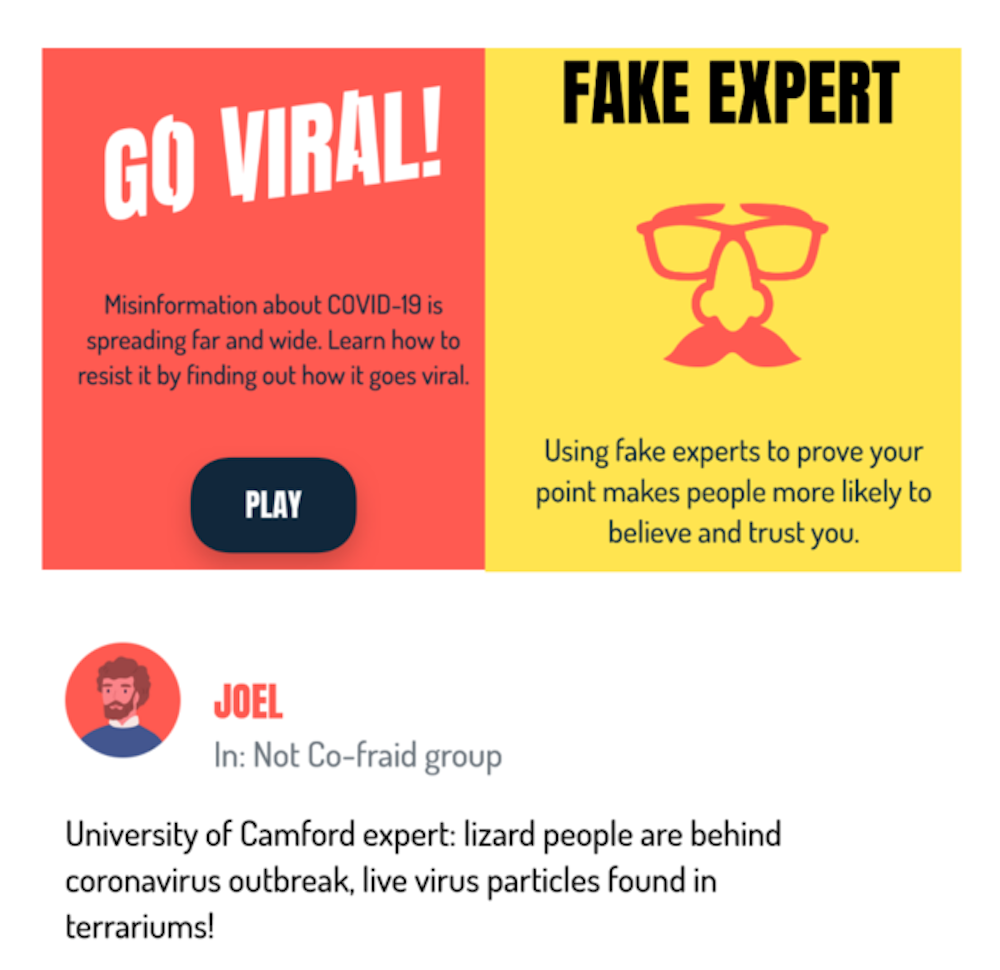
However, rather than only “vaccinating” people against individual examples of misinformation, we instead focus on the more general ways in which people are misled – manipulation techniques such as the use of excessively emotional language, the construction of conspiracy theories, and the false testimony of fake experts.

To do so, we developed a series of online games in which players learn how misinformation works from the inside by being encouraged to create their own fake news: Bad News (about misinformation in general), Harmony Square (about political misinformation) and Go Viral!, which is specifically about misinformation around COVID-19.

Research has shown that a powerful way to induce resistance to persuasion is to make people aware of their own vulnerabilities. In our games, players are forewarned about the dangers of fake news and encouraged to actively generate their own antibodies through gradual exposure to weakened examples of misinformation in a simulated social media environment.

When we assessed the success of these projects, we found that playing a misinformation game reduces the perceived reliability of misinformation (even if participants had never seen the misinformation before); increases people’s confidence in their ability to assess the reliability of misinformation on their feed; and reduces their self-reported willingness to share misinformation with other people in their network. We also found that similar inoculation effects are conferred across cultures and languages.

An image from an app showing how an app works

An image from the ‘psychological vaccine’ game GoViral! Sander van der Linden, Author provided (No reuse)

We then looked at how long the games’ inoculation effect lasted and found that people remained significantly better at spotting manipulation techniques in social media content for at least one week after playing our game Bad News. This “immunity” lasted up to three months when participants were assessed at regular intervals each week. We see these prompts as motivational “booster shots”, topping up people’s immunity to misinformation by staying engaged.

Herd Immunity

Of course, our work is not without its limitations. Although these games have been played over a million times around the world and have been shared by governments, the WHO, and the United Nations, not everyone is interested in playing an online game.

But the game itself functions as just one kind of “virtual needle”. A global “vaccination programme” against misinformation will require a suite of different interventions. For example, we’re working with Google’s technology incubator “Jigsaw”, and our colleague Professor Stephan Lewandowsky, to develop and test a series of short animated inoculation videos.

Like the game, these videos forewarn and administer a micro-dose of a manipulation technique, which primes the watcher to spot similar techniques in the information they subsequently consume online. We intend to publish our study on the efficacy of video vaccines later this year.

As the pandemic continues to wreak havoc worldwide, a successful vaccine rollout is of vital interest to the global community. Preventing the spread of misinformation about the virus and the vaccines that have been developed against it is a crucial component of this effort.

Although it is not possible to inoculate everyone against misinformation on a permanent basis, if enough people have gained a sufficient level of psychological immunity to misinformation, fake news won’t have a chance to spread as far and as wide as it does currently. This will help arrest the alarming growth of anti-vaccination sentiment on the internet.

Feature Image Credit: Alexander Limbach/Shutterstock

By  &

  • Professor of Social Psychology in Society and Director, Cambridge Social Decision-Making Lab, University of Cambridge

  • Postdoctoral Fellow, Psychology, University of Cambridge

Sourced from The Conversation

By

It’s a simple phrase that answers so many questions about SEO, yet stirs up a lot of discussion and debate: Google ranks webpages, not websites.

I’m about to tell you an SEO fact that will answer so many questions about how Google operates that I can’t even cover them all in this article.

It’s also a great way to stir up debate in your finer SEO discussion forums.

Google ranks webpages, not websites.

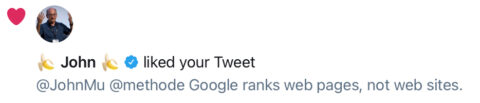
Don’t believe me? Ask John Mueller of Google (I did):

John Mueller confirms Google ranks web pages, not websites.

Don’t believe John Mueller or Google?

Well, that’s a whole different discussion, but luckily, there have been many, many, many others who have stated the same thing.

Google ranks webpages, not websites.

Once you consider the power of this seemingly unassuming statement, you’ll see how keeping it in mind while you’re developing your organic search strategy can simplify many of your decisions.

Plus, it puts an end to many of the more popular SEO debates we’ve all suffered over the years.

What Does It Really Mean?

Look, we don’t need to overcomplicate this here, but let’s dive into how this phrase shakes things up and sometimes really upsets some of my fellow SEO pros.

Click HERE to read the remainder of the article.

By

Sourced from Search Engine Journal

Sourced from Khaleej Times

Kevin Murphy, Vice President and Head of Ericsson Levant Countries and Global Customer Unit Ooredoo, explains how the combination of 5G, AR and VR is creating completely new user experiences.

Sports fans are a passionate breed and whether they’re at the match or on their couches, they demand the full experience. For fans, and athletes alike, leading technologies enrich the sporting experience, bringing people closer to the action, and creating new immersive ways to showcase the commitment, excitement, and teamwork of sports.

The Covid-19 pandemic has led to a growth in digital experiences which may become permanent. The increase in virtual events is raising the bar for the quality and design of the experience, with audiences becoming increasingly sophisticated, demanding a more social, innovative and engaging event.

To transform the digital experience for fans, players and support staff alike, three main types of support is required; a sports performance information system, a digital experience backend system, and technology consulting and innovation services.

The combination of 5G, Augmented Reality (AR) and Virtual Reality (VR) supports completely new user experiences in sports – pushing boundaries and taking the consumer to the heart of the game itself. For a team playing before a packed stadium or a lonesome runner on a forest track, connectivity and mobility enable new values in an emerging internet of sport.

This is where 5G can be a vital tool for the sports sector, as it seeks to re-invent the fan experience at home and at the sports arena. Sporting events could better serve both the travelling fan attending every game in person and the die-hard fan catching the game remotely.

In this age of digital and mobile consumption, fans expect an experience boosted by their mobile devices. Through live-streaming video, mixed reality experiences and real-time access to information about the game, the next generation in mobile wireless technology can create an enhanced experience, reinventing how fans participate in sports.

Immersive Sporting Experiences at Home

Sports fans today are looking for new ways to connect to the sporting experience digitally. There is potential to create more immersive fan experiences with the introduction of 360-degree cameras, and virtual and augmented reality. Fans can walk the sideline, see what the goalkeepers are seeing, or join the victory celebration in the locker room – all serving the purpose of bringing fans closer to the action at the venue from home.

What’s more, the trend of increased solitary viewing due to the development of personal screens and on-demand viewing could be reversed thanks to the capabilities and promises of Virtual Reality (VR). It can provide a way to connect with friends watching the game at different physical locations, creating a “virtual hangout” for the times you can’t be there in person.

VR also brings an exciting prospect to the table: the ability to watch 4K/UHD content without owning a big physical screen and allowing on-demand viewing to become more of a social activity than it is today. Soon, friends and people with similar interests can watch content together in a VR living room, viewers will have the freedom to look anywhere in every scene of a movie and consumers can experience a football match with other fans in a VR arena, as if they are actually there.

And for sports fans in areas that don’t have access to fibre coverage, 5G enables fixed wireless access applications for very high-quality video streaming in 4K video, 360 or AR/VR formats.

This means that you get to watch the 4K video on your mobile device. But 5G is also so fast and so reliable that it will make fixed wireless a real challenger in the broadband market, streaming 4K video wirelessly to your big screen TV as well. And it’s not just the quality either. You’ll be able to choose what camera angles you like, or if you want information overlaid on the screen, or if you want to watch in VR or not.

Creating the Connected Stadium

A great experience at the arena is fundamental to enjoying live sports. Where fans today see broadband connectivity to their smartphone for social media posts as table stakes, there is so much more that could be done digitally to connect fans to the action. This is an area where 5G can improve the overall experience, compared to standard WiFi solutions.

5G can expand the experience for fans at the game, creating new possibilities by connecting sensors in balls, goals, and even players – all in real-time with extremely low latency. The next generation technology can deliver enough capacity to the stadium for fans to stream high-quality video and share the views from their seats with others at the same match.

Other future changes coming to the fan experience with 5G connectivity include the ability to experience matches from new vantage points, using phones to switch between different 360-degree, ultra-high definition virtual reality cameras filming all around the stadium.

The introduction of 5G at a stadium also creates a horizontal platform to serve additional applications. Fans would be able to monitor and track athletes’ performance during practice and competition in real time, for example. This represents a major opportunity for service providers to deliver enhanced networks in stadiums and arenas to ensure their subscribers are well connected.

Sourced from Khaleej Times