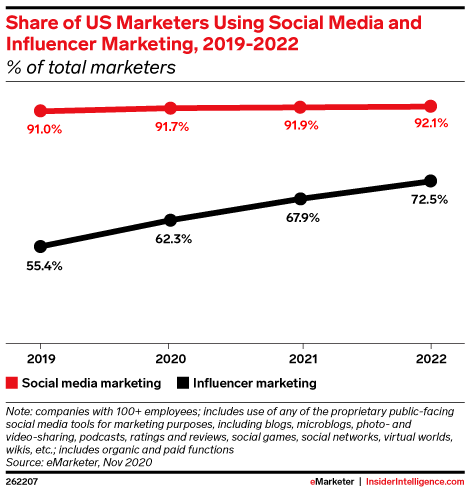
Not every marketer does influencer marketing, but a large majority do. In our first-ever forecast, we estimate that 67.9% of US marketers with 100 or more employees will use influencers for paid or unpaid brand partnerships in 2021.
Although some marketers cut spending on influencer marketing during the pandemic (such as travel marketers), the interest in working with influencers actually increased; between 2019 and 2020 the percentage of US marketers using influencers grew from 55.4% to 62.3%, according to our forecast.
And budgets for influencer marketing look ready to rise. In July 2020 research by Kantar Media, senior marketers worldwide said they expected to increase budget allocation for branded content shared by influencers by 48% in 2021.
What it means for marketers: Influencer marketing has its pitfalls, but an increasing percentage of marketers are working with influencers. Considering the important role they play in other trends in our list of social media predictions for 2021, such as social commerce and livestreaming, the impetus to use influencers will continue to grow.
The answer is: A fast loading website is in-friggin’-dispensable. The human attention span is in a downward spiral – no one wants to wait, especially if they are on a mobile device.
How fast do we need to be? Google recommends a page load time of less than two seconds.
There are many popular measures across on-page and technical domains of SEO that help you meet the goal.
However, one of those measures – Setting up Accelerated Mobile Pages (AMP) for the mobile version of a website – is used sparingly.
Why? In a nutshell, going AMP takes a fair bit of time, effort, and funds depending on how big a website is. In the end, it may not even be worth it.
Is it worth it for you to invest in AMP? If the answer is yes, this post will help you with a step-by-step process of effectively setting up AMP for your WordPress website.
Step 1: Choose the right plugin
Plugin options
WordPress offers many plugins for AMP. I have tried a few of them with success to varying degrees. One of them gave marvelous results in the Google Pagespeed Insights for a while. But it broke all my AMP pages on mobile!
My recommendation
I would recommend the AMP for WP – Accelerated Mobile Pages – WordPress plugin. This plugin provides a lot of options to customize mobile webpages. The rest of the post will be about setting up AMP for your website using this plugin.
After you install and activate the plugin, the WordPress dashboard will show the option of opening the AMP version of your website. You will also see the new plugin (AMP) as highlighted in the below image.
As in the image above, you will see a set of options, we will cover each of them one-by-one.
Lets jump into the settings.
Step 2: Basic setup of the plugin
Website type
Select the option that best represents your business. Select ‘other’ if nothing else matches, you will get an option to type in your website type after that.
Where do you need AMP?
Select where you want to implement AMP. When you go for AMP, you are deciding to keep your mobile web pages almost completely HTML. You need to let go of the CSS/JS codes that reduce the load speed.
The downside to that is, the user experience (UX) gets impacted. For instance, you can no longer have a call-to-action (CTA) button that swivels to attract a visitor’s attention. AMP cuts out that code, thus saving on page load time. This may eventually result in a reduced engagement rate.
In the above list, you may want to choose to have AMP on your pages, or posts, or both.
Design and presentation
Here, you can Setup Your Logo, the recommended size is 120 x 90 pixels. I would recommend not using the logo as it adds to page load time. If no logo is updated on this panel, the AMP page will only have the website name in place of the logo.
The Global Color Scheme option will help you pick a color for your AMP pages that appears on the CTA links on the page, and on the footer link.
For instance, I chose light blue as my Global Color, as seen in the image below.
Analytics tracking
In this option panel, you can enable the tools that you use for tracking. For instance, you can enable Google Analytics by adding the Tracking ID. This way data from the AMP pages will get updated directly in your Google Analytics account.
Similarly, you can add multiple other tracking tools as listed in the image above.
Privacy settings
The Cookie Notice Bar enables you to seek consent from visitors for the cookies you are using on the website. In the below image, the dialogue box in black is a cookie notice bar.
If you or your audience base is from a GDPR country, you need to turn on the settings for GDPR – General Data Protection Regulation.
Please note, if you have to choose, you can choose only one of the two options, not both.
Advertisement
In this segment, choose where you want to position your Advertisements. You can customize as per need – you can have Ads published sitewide or on single posts, or headers among other options.
You can choose the Ad type, Ad size, and Data Ad Client and Data Ad Slot from the Adsense Ad Code.
3rd party compatibility
The last entity captures the list of plugins that you need AMP compatibility for.
Gravity Form and Elementor for AMP require you to pay for extensions. Structured Data, Ads for WP, and PWA for WP are free plugins. The last three shall be covered in a bit more detail later in the post.
Step 3: More AMP settings
General Settings
The General tab covers the options we covered in the basic set-up. In addition, you get to choose if you want to have AMP on archives, category, and tags pages.
Enabling the last option – AMP Takeover (Beta) – will cause your desktop and mobile version to be the same. This means, your desktop version will also have AMP pages.
I would recommend keeping this option off. Page load is usually better on desktop than on mobile. Having AMP on desktop means trading off UX for a small increment in Page speed. Not a good bargain.
Advertisement
This section has the same options as the Advertisement section in the basic setup.
SEO
If you choose to turn on Meta Description, the text you fill in the Head Section will be picked up by Google. This will be different from the text you filled in for the desktop version. I would recommend keeping the setting off, and keeping the Meta Description consistent across the two versions.
OpenGraph Metadata tags are snippets of code that control how URLs are displayed when shared on social media. This section is visible for the desktop version when you are setting up Title and Metadata in your SEO plugin. Below is an example of the Yoast SEO plugin.
You can find it by going to the Editor section of any post or page, scroll to the bottom. Once you see the section for Yoast, click on the ‘Social’ tab, then you can choose the social media platform of choice.
The AMP plugin allows you to select the SEO plugin of choice on the same option panel. In the above example, Yoast is the plugin chosen. All the data you enter into Yoast for the Desktop version gets copied into the AMP version.
You will see the option to Remove Paginated Pages Indexing and URL Inspection Tool Compatibility.
Paginated pages should be indexed but only as canonical. I would recommend keeping this setting off.
URL Inspection Tool Compatibility fosters a more transparent search for you. It provides detailed reports on crawl, index and serving information in your Google Search Console account. I would recommend keeping it turned on.
Elementor Support
The option of AMPforWP PageBuilder will let you build individual pages for the AMP version, different from the desktop version. It is useful when you want to have slightly different text or CTA for AMP pages.
For example, if you have a ‘Contact Us’ CTA for desktop but you would rather the mobile visitors to call you, you can activate this option and create a separate page.
PWA
As per AMP for WP Plugin’s description – Progressive Web Apps (PWA) transforms your website into a web application and gives visitors a native mobile app-like experience.
It is a design enhancement. Activating the module is a matter of choice.
It enables you to Minify CSS/JS to reduce bandwidth usage without impacting UX or functionality. Leverage Browser Cache enables you to speed up load time for returning visitors. I would recommend keeping both the options turned on.
Enabling Optimize CSS will trigger the tree shaking feature of optimizing CSS. You can keep it turned on in case you don’t have a different plugin that already does that job.
Analytics, Structured Data, Notice Bar and GDPR
These sections have the same options as those covered in the basic setup.
Push Notifications
In case you want to set-up push notifications, you can opt for one among OneSignal, iZooto and Truepush.
In the above example, I have selected OneSignal. However, for any selection, you will see a section to enter the APP ID, an option to enable push notifications for Pages. In addition, you need to choose where you want to position the notification (bottom of the page for example), and what text you want to display.
Contact Forms
This enables you to choose one of the 3 plugins to optimize AMP for – Contact Form 7, Gravity Forms, and Ninja Forms.
All three require you to pay for an extension. In case your CTA is focused mainly on forms, it is prudent to invest in the extension.
Comments
This screen lets you choose where you want the user-generated comments to show on your website. You can also choose the sources to display comments from.
Choose the settings that work best for you.
Instant Articles
Instant Articles is a feature on the Facebook App for mobile users that lets you host your website articles.
The benefit of turning this feature on is an even faster load time compared to having the same article on your website. Since the article loads within the App, you get up to 10 times faster load speed.
However, since the content stays on Facebook, you might lose out on some website traffic. It’s a trade-off between page-speed and website traffic. I would recommend keeping it off.
If you choose to keep it on, you will see the below settings.
After entering your Facebook Page ID, you can customize the article settings. A setting that requires more explanation is – Crawler Ingestion.
When the link of your article hosted on your website gets shared on Facebook, Facebook crawlers look for the ia:markup_url tag. If it’s present, Facebook ingests your article and creates an instant article on your Facebook page.
Tools
The Individual AMP Page option lets you choose if you want to show the AMP pages by default or not. When you choose Show by Default, all your pages will show the AMP version. However, you can choose to hide AMP for individual posts or pages.
To do that, go to any page and click on Edit Page. In the Settings tab toward the right, you can find the option of turning it off.
Similarly, you can choose to Hide the AMP versions for selected categories and posts.
Query Monitor is the developer tools panel for WordPress. If you are a developer, who needs to see the queries on the page, you should keep the setting turned on.
Advance Settings
The Advance Settings option panel has a host of settings most of which are self-explanatory.
I would recommend keeping the default settings turned on unless you are a WP developer or have hired an expert to design your website.
eCommerce
If you own an online store, you can customize your AMP version for WooCommerce. If you primarily sell digital assets, you can turn on the Easy Digital Downloads Support option. Both the options require you to enable a paid extension.
Translation Panel
This panel enables you to select the right translations for a commonly used set of words into the language of your choice.
For instance, you need to type in the translation for the View Non-AMP Version suited to your audience.
For multilingual translations, you can turn on the Use POT file method of Translation. POT (Portable Object Template) file is a template for the PO files. They are plain text files that contain the translations. Each language has its own file extension. For instance French has po.fr.
Step 4: Design
Themes
Just like for the desktop version of your website, you can pick a theme for the AMP version.
There are four free options to choose from.
Design One
Design Two
Design Three
Swift
In addition, every page and post has a section that enables you to create your own design.
Here’s how you can find it. Go to the page or post, and click on ‘Edit Page’ in the top toolbar. Scroll down to see the below screen.
If you select the Use Builder checkbox, the template you create will be shown, if not, the free template you select will be shown.
In case you are building your own template, you have the below modules to choose from.
Remember, AMP is basically an HTML page. You can not get much customization or fancy buttons.
Please note: You have to select a theme. The plugin needs it to pick icons and structure – even when you create your own design.
Global
This option panel lets you customize your AMP version.
You can select the colors of choice as above. In addition, you can select Google Fonts. However, I would recommend keeping it off as Google Fonts increase the load time, defeating the purpose of AMP.
Further on, you can choose to keep Sidebar and Infinite Scroll on if that’s what you want your webpage to look like. However, from a page speed perspective, you should keep it off.
The Font Icon Library will be the same as the theme you had chosen at the beginning of the Design panel.
Header
The Header options panel, lets you decide the layout of your header and how your navigation menu should look.
It also lets you add a Call Now Button. It’s a useful button for mobile users.
You may choose to show your Non-AMP link in the Header. However, if your audience is not technically SEO oriented, they may not click on the link.
You can also enable the Search bar. It’s beneficial if you have a blogging website.
The Advanced Header Option enables you to get more specific with your header section settings. It’s a matter of choice. However, keep in mind not to add to the code, as it will negatively impact the page load speed.
Homepage, Single, Footer, Page, Social Sharing, Date and Misc
These option panels, just like the header, are completely a matter of design choice. You can choose any settings that suit you the best.
Summing up
The above steps will help you implement AMP effectively on your website. Once you have saved the changes, check out the AMP version on your phone, or, by appending ‘/amp’ after the URL.
The below images capture the features of your AMP page.
AMG PAGE VISUAL
FOOTER
There you have it. Follow these steps to have error free, superfast pages that load in less than 2 seconds for mobile phone visitors.
Sai Kalki is a Digital Marketing Consultant specializing in SEO. He is the founder of DigiGrow, and has helped small businesses grow their business through SEO, PPC and Instagram Marketing.
We know there are numerous ways to generate B2B sales leads, but let’s face it, the same old methods have been done to death.
It’s time to take an unconventional approach to lead generation, especially for B2B companies, because B2B is a different ballgame than B2C — and your strategies need to reflect your audience.
As a refresher, here’s how organization goals differ in the B2C versus the B2B sectors:
Source: Venngage
Before we begin detailing these B2B methods, it’s important to keep in mind that lead generation isn’t a one-and-done deal.
You have to be open to A/B testing your strategies and your content. Regularly track your content performance, metrics, conversions, and be ready to improve.
So, what are these unconventional methods to generate B2B sales leads? Read on to find out.
1. Tailor content for B2B sales leads
B2B content is brand and agency-focused, and you want to create materials that attract attention from that audience.
Getting eyeballs on your content won’t mean much if they aren’t converting into customers — those aren’t the right B2B sales leads for your company.
Most businesses create audience personas to help them reach their target market. In the B2B arena, don’t aim for a company — look for the decision-makers within that company.
Every target company will have a few key people who decide which products and services benefit the business. These are the decision-makers your content needs to be tailored to, and for whom you can build buyer personas around, such as this example:
Source: Venngage
Determine who within a business will most need your product or service, and build your buyer personas based on the following:
Age
Location
Job title
Level in company
Preferred content channels
Desired goals
Pain points
Create a flow chart with these details to facilitate the content creation process. This also helps you decide which channels will get you the most traction.
Search intent
Once you know your audience, your next step in tailoring content to earn B2B sales leads is to determine their search intent, which can take numerous forms:
Searching for information
Searching to buy
Searching to learn
As a largely B2B company, we do extensive research before creating a piece of content. We ascertain keywords related to our topic, but we also check Google, the “People Also Ask” section, AnswerThePublic, and conduct surveys among fellow marketers.
Choose keywords and terms that are relevant to your audience — not solely based on search volume. Popular searches in your industry will attract more B2C consumers, whereas focused keywords that have a higher value, but a lower search volume, usually fall in the B2B realm.
2. How to use B2B email marketing
B2B email marketing has a higher click-to-open ratio than B2C, and is a favored channel for 59% of B2B marketers.
This is a channel that can consistently bring in B2B sales leads — if done right. You have to keep a few things in mind to make email marketing a successful lead generation channel.
Automate email marketing
Marketing teams know the benefits of automating processes: smoother workflow, faster processing time, and time funneled into creativity instead of repetitive tasks.
You can use marketing automation to segment email lists, send targeted campaigns, respond to abandoned carts, and convert customers, as this graphic explains:
Source: Venngage
Imagine this scenario: a customer gets to the final stage of purchasing, but leaves your site right before checkout. Whether that customer was distracted, lost connection, or changed their mind, it’s up to your company to encourage them to finish the process.
If cart abandonment is being handled manually, this customer could fall through the cracks, or get a response well after they’ve decided on another brand.
Email automation can be programmed to respond to them immediately upon cart abandonment — and you’ve earned a customer who would otherwise have been lost.
Email deliverability
Automating emails is one thing, but are your customers receiving your emails? You can create the best content in your industry, but it will amount to little if your newsletters end up in the spam folder.
Emails sent with a company name instead of a person’s name are more likely to end up in the spam folder or not opened at all. Use an individual’s address to send emails, and include a reply-to option to that address.
Don’t change the frequency of your email campaigns too often. There will be certain periods when you send more emails, but be as consistent as possible so your subscriber base knows when to expect your emails.
Regularly check and clean your lists so you aren’t sending emails to addresses that no longer exist and increase your bounce rates.
Email content
Keep these things in mind when creating your email content as, at the end of the day, your email content is what will be most successful in earning you B2B sales leads:
Your content should be consistent with your brand. Send emails about products, services, events, industry news, and your latest blog posts.
Create a consistent design for your marketing newsletters, including branding elements like your logo, brand colors, and fonts.
Don’t go for the hard-sell approach! If every email is selling products to your list, people will unsubscribe.
Make it worth their while to click on and open your emails by sharing news, updates, and stories that will enrich your customers’ lives.
3. Hybrid events
Conferences have always been a good place to make potential B2B sales, as they’re shared spaces for people with similar interests. But 2020 changed all that.
Though the COVID-19 vaccine is ready for distribution, it’s going to take a while to return to business as usual. We’ve seen an increase in virtual events in 2020, but the future of networking lies in hybrid events, like Apple’s annual announcements.
Combining physical and virtual elements and attendees, hybrid events allow access to a greater swathe of industry specialists and clients.
There are three ways to get B2B sales leads from hybrid events:
Attend the event: B2B marketers should look at attending more hybrid events in their industry to meet potential clients.
Participating in events: search for speaking engagements at conferences to place your business as a thought leader in the field and generate more organic leads.
Hold events: your business can hold hybrid events to connect with experts in your field and establish partnerships with prospective customers.
Events can be a lot of hard work, but the potential for earning leads, converting customers, and boosting ROI make the process worth it.
4. Personalize B2B sales lead content
Personalization is a huge part of content marketing — and it’s crucial for finding B2B sales leads. In the B2B arena, you need to build personal relationships, not just transactional ones.
Because every relationship isn’t just a customer earned, it’s also a customer retained, with the possibility for future referrals that will bring in more sales.
Here are the three areas you want to focus on for personalization:
Presentations
Social media
Landing pages
Sales presentations
You can start building customer relationships early on in the lead generation process by designing a presentation that includes your branding and your customer’s.
In the pitch meeting, talk about subjects that matter to your customer — don’t focus too much on what your business can do, unless you’re talking about the solutions you can provide.
Don’t be afraid of getting granular in your pitch by mentioning buyer intent keywords related to your customer and their industry.
Do your research so you can show them how knowledgeable you are about their company, but also that you’re planning for a future with them.
Social media
Take it a step further by personalizing your social media outreach. Long believed to be the realm of B2C lead generation, social media has its advantages in the B2B field, too.
I’ve mentioned the importance of finding decision-makers within target companies. Most of these decision-makers will have a presence on social channels such as LinkedIn and Twitter. Choose personnel who can make personal connections with key decision-makers on these channels. But don’t treat every channel the same way.
Work with your team to craft LinkedIn summaries that showcase your brand’s ethos — and not just on your company page but also on staff profiles, where you can exhibit some personality.
Twitter is another place to generate B2B sales leads, and it’s a good one for understanding your customers, because Twitter is where people tend to share personal stories.
There are scheduling and analytics tools that you can use to research decision-makers and find out what their interests are — this will help create more meaningful relationships.
Landing pages
A great landing page grabs a customer’s attention within seconds. The best way to do that is to personalize your landing page to generate B2B sales leads.
What does a landing page need to include? It has to answer a specific question that your customers are asking.
What we’ve learned from making our landing pages is that you do not want to put too much information on there — that can be overwhelming for a visitor.
Keep it short and sweet — focus on one selling point, not all. That’s why we love the Moz landing page — it clearly states what the brand can do for any customer visiting it.
Can’t fit all your selling points onto one page? Create multiple landing pages, each one optimized to specific keywords and buyer intent.
It sounds like more work but designing more landing pages helps you retain B2B sales leads by creating cohesion between your advertising and landing pages.
For B2B brands — where sales can sometimes involve millions of dollars — a referral from a friend, backed up by strong reviews, can lead to a purchase much more quickly than paid incentives and advertising.
Referrals lead to more loyal customers and better retention rates. They also act as a tool for boosting organic reach because established customers become your company’s ambassadors, like this PioneerSystems case study.
How do you get referrals? Here are a few steps:
Offer rewards such as discounts, free training sessions, and event invitations
Survey multiple customers
Keep your surveys short and precise so customers will be more likely to respond
Send surveys regularly and keep the window between surveys short
Include follow-up questions asking customers to explain their scores
Use the net promoter system to calculate how likely customers will be to recommend you
Ask for a written review or testimonial, or to feature in a testimonial video
Suggest creating a case study
Ask for a quote for a press release
Offer content that customers can share with their friends
Referral marketing is a great way to generate leads, but you do need to incentivize the process so customers participate.
6. Repurpose content
At Venngage, we are huge on repurposing content — we even created an infographic explaining how to do it:
We know how overwhelming it is for marketers to create fresh content to bring in more views and leads. This is why we’ve found ways to repurpose existing content.
Using old content in new ways takes a bit of practice, but once you get the hang of it, your marketing team can structure your strategy around it.
Here are a few ways we’ve stretched a single piece of content and generated more B2B sales leads:
Take quotes and stats from a blog post and create data visualizations for social media
Turn a blog post into an infographic — look at these infographic examples for inspiration
Share infographics on social channels and as a newsletter
Divide an infographic into multiple smaller graphics to share on social media
Turn listicles into social media carousel posts
Create email headers from social posts
Turn a blog post into a podcast or webisode
Combine multiple blog posts on a similar subject into a white paper or eBook
Use an eBook as the basis for a webinar
Divide a longer e-seminar into short YouTube videos
Create GIFs out of videos to share on social media
These are the content repurposing methods we’ve used but the possibilities with this method are endless.
7. Varied content channels
Conventional wisdom has been to focus on the channels that you know best, instead of being a jack-of-all-trades and dabbling in multiple channels. But you also need to know what channels your potential B2B sales leads are favoring. If you’re not where your customers are, you are losing leads.
The content market is currently oversaturated — diversifying your content channels helps you reach leads who may not see your content on conventional platforms. Consider starting a podcast for your business. They take some time and investment, but podcasts are easier to run and maintain now. Focus your podcast on thought leadership, industry news, or on sharing behind the scenes tidbits about your business.
Creating a YouTube channel for testimonials, business insights, how-to guides, and troubleshooting videos will bring in leads who don’t have the time to read a blog post.
But videos do take time and effort to create — you need equipment and software to shoot and edit videos. Plus, you can’t create a video and leave it at that — a promotion plan will need to be executed.
Forums
Search for B2B leads on channels like Quora and Reddit. Customers use these platforms to ask questions and you can tailor content around these.
But don’t use these channels to pitch your company. Follow the same etiquette as responding to a blog post comment. Share your own experience and use these channels for research.
There are a variety of channels available to get qualified leads. Don’t stretch yourself too thin as that will impact the quality of your content but don’t restrict yourself either.
8. Create gated content
eBooks, white papers, and webinars make for great gated content. But why should customers sign up for them?
We’ve seen success with our gated B2B content by doing the following:
Address your customers’ pain points early on
Solve their problems with your content
Include calls-to-action for gated content in relevant blog posts
Use more visuals than text in gated content — don’t make customers work hard
Repurpose your content whenever you can
Provide a preview of your content to whet their appetite
Be informative, inspire action, educate, be personable, and then promote
Your gated content should add value to anyone who accesses it, so longer-form content is the best for this lead generation strategy.
Key takeaways: Focus on the people behind B2B sales leads, not the business
The process of generating leads and encouraging them through the buyer journey to become a loyal customer who advocates for your business is a challenging one. It’s important to remember that even in the B2B field, you are engaging with people at the end of the day.
To recap, here are eight unconventional ways to get B2B sales leads:
Tailored content
Email marketing
Hybrid events
Personalize
Referral marketing
Repurposed content
New content channels
Gated content
You can adopt all or a few of these lead gen methods, but remember to test target segments, CTAs, landing page designs, and social media captions.
And finally, while it’s great to get as many leads as possible, ensure your automation software and sales team can handle it.
Nadya is the Chief Growth Officer at Venngage and has been featured in Entrepreneur, The Huffington Post, The Next Web, Forbes, Marketing Profs, Social Media Examiner and more. She also has a web-series called Drunk Entrepreneurs where she interviews different entrepreneurs who are finding success.
Ikea says it will stop printing its famous catalogue after almost seven decades.
The booklet is one of the world’s biggest publications every year as the brand showcases its range across the world. It says that customers and turning to their website to browse more and more and the current edition will be the last. The catalogue, with an MK Wing Chair on the cover, was launched in Sweden back in 1951 and had a run of 285,000 copies. At its peak in 2016, 200 million copies were distributed to 50 markets across the world, but this year the run fell to 40 million copies. The brand is aiming to become more digital. In the last 12 months, online sales jumped 45%. Konrad Gruss, Managing Director at franchisor Inter IKEA Systems told Reuters: ‘The number of copies has gone down, but we have also seen that people have much more used our website, apps and social media. The catalogue became less and less important. ‘The interest in the catalogue has come down.’ Back in 2004, the brand admitted that the catalogue made up 70% of it’s annual marketing budget. The brand will produce smaller print publications to provide inspiration but the current format will not be printed again.
It comes after Argos announced it would stop printing its famous catalogue after almost 50 years. It’s first book was published in 1973, with two editions every year. At its height the Argos catalogue was Europe’s most widely printed publication, and was found in three quarters of homes in Britain. Over almost 50 years, one billion copies have been printed.
It’s no surprise that communication is key, and in order for your brand to create meaningful connections, it needs to be clearly heard. Through a set brand voice and tone, your audience can get to know and understand your brand, as you create a dialogue.
It is the chance for business leaders to express their brands’ unique persona and seamlessly build up relationships with the audience. When it comes to presenting your brand, choosing which brand voice and tone to use is crucial. Particularly during the introduction stage, customers instinctively recognize the way they are addressed and spoken to, which then significantly impacts their entire view of a brand. Here are a few ideas that unpack what it means to establish a brand voice and tone, along with their effectiveness.
What’s the difference?
Although brand voice and tone are interconnected with one another, there’s a distinct difference between them. Brand voice revolves around what is being said and remains quite consistent with the communications delivered. By having an unchanging voice, users are able to perceive the brand as being reliable and understandable.
On the other hand, brand tone is focused specifically on the message that’s being conveyed and what it sounds like. In addition, tone can be adjusted depending on the context and the channel that’s been chosen. For instance, the way you provide information through an email regarding serious changes may differ from a social media post announcing a much-awaited product launch. You can cultivate a combination of tones, such as friendly and informative or warm and welcoming, to ensure it best suits the target audience.
How can it help your brand?
Voice and tone reflect your brand’s personality, so naturally, these impact how your entire brand is identified. They both serve the mutual purpose of demonstrating the core values and goals that your brand and founders are striving toward transparently. For staff and consumers, voice and tone can guide them toward understanding your brand’s unique qualities and culture.
When it comes to your brand’s presence, voice and tone can shape the end user’s experience and how the company is remembered. Also, using a variety of tones with different communication styles can highlight your brand’s inclusivity and flexibility.
How can it help gain customers?
Voice and tone collaborate with each other to strengthen your brand’s appeal to consumers. By evaluating the responses received and encouraging ongoing conversation, you can identify the type of audience you’re actively engaging with. The way content is delivered to readers is determined by the voice, tone and language. With authentic connections and increasing organic traffic about your brand, your company’s messages are more likely to be welcomed and happily received.
Customers are only able to communicate openly when they are listened to and in return, may bring in other prospective clients. You can improve the voice and tone you employ by listening to the way your community describes your brand and shares their experiences.
Brands are better able to reach their audiences clearly and pleasantly. Despite the brand voice and tone functioning differently, they are required to work together in order to send out the company’s messages successfully. When communicating, there is a necessary balance for brand voice to bring consistency and tone to create a relatable space. The company’s identity can be demonstrated through the way statements are shared and the characteristics that make them stand out.
Want to improve organic engagement on LinkedIn? Wondering if LinkedIn Stories and Live could work for you?
To explore organic LinkedIn marketing strategies that work today, I interview Michaela Alexis on the Social Media Marketing Podcast.
Michaela is a LinkedIn expert and an official LinkedIn Learning trainer, coach, and consultant who helps businesses master their LinkedIn organic presence. She co-authored Think Video: Smart Video Marketing and Influencing.
You’ll learn what kind of content works best in the LinkedIn feed and how best to use LinkedIn Stories and Live video to engage the people in your network.
Scroll to the end of the article for links to important resources mentioned in this episode.
The reason LinkedIn is important to professionals, especially marketers, comes down to user intent. Michaela notes that while most people spend time on Facebook and Instagram to reconnect with friends and family or to escape, people come to LinkedIn to grow, connect, learn, and meet new people. As a result of the current pandemic and a rise in remote working, people are also turning to LinkedIn to stay in touch and engaged with their colleagues and teams.
When you pair that strong user intent with the platform’s growth over the past year, its place as a global, professional networking space is unquestionable. Almost 700 million people are on LinkedIn, and 45% of internet users who make more than $75,000 a year annually use LinkedIn.
Though it got a good start in 2020, 2021 is the year branded content will truly come into its own according to Ottavio Nava, co-founder and chief executive at We Are Social Italy and Spain. To make a success of the medium, he says marketers should glean lessons from the likes of Ben & Jerry’s, Lavazza and Circles.Life.
Branded content reached new heights in 2020. Long seen as a valuable add-on to marketing campaigns, and particularly effective when combined with traditional paid-for models, we are at now seeing just how powerful the medium can be as a strategic brand building tool.
With all the smartest marketers paying attention, I feel safe predicting that 2021 is going to be a memorable year for this highly creative marketing technique.
The pandemic has forced more people then ever consume content digitally at home, which has let brand content has come into its own in recent months. This shift can be put down to the crisis accelerating a number of important on-going trends, just as much as it can be attributed to brands having access to a more captive audience.
Pre-2020, consumer habits were already changing as a result of the ubiquity of smartphones with content available to read, watch, listen to and interact with via a great choice of applications and in a wider array of different contexts than ever before. Brands, meanwhile, were seeking ways to engage in the face of declining engagement by many viewers in live TV advertising – just one result of growing fatigue with traditional media.
Both of these drivers have been significantly uplifted by behavioural changes spurred by Covid-19. People’s digital activity increased significantly, resulting in more eyeballs coming into contact with more brands online. In turn, this has cemented the increasingly central role branded content is now playing in the advertising ecosystem – a role which – when you consider how peripheral it once was – has now changed significantly and irreversibly.
Here are three lessons learned from those brands who have used branded content most effectively in recent months point to how branded content can, and will, evolve further.
The first is a mindset shift to creating content from the get-go to thrive in a more organic, long-term way, irrespective of platform or format. Ben & Jerry’s is a great example of this. It recently launched ’Who We Are: A Chronicle of Racism in America’ – a podcast series comprising six 30-minute episodes about white supremacy in America, developed in partnership with Vox Media.
The SuperSimpleStuff app for Pfizer, which uses a series of micro games where players can fight coronavirus while finding out the best ways to prevent the virus spreading, is just another example of creative content execution. It’s also proof impactive brand content doesn’t just mean video. Elsewhere, Australian mobile network Circles.Life recently paraded a 1.2m sculpture of a hand giving 2020 the middle finger around Sydney as part of its ’Unfuck 2020’ campaign; showing how paid-for content can be funny, engaging and generate organic headlines of its own.
The second lesson for brands is to think and create like entertainers by embracing the rules of publishers and media companies, instead of simply working to a marketing playbook.
Publishers understand who their audiences are and create a product for them. To make effective branded content, CMOs must do the same. The best marketers understand what kind of brand they have and what needs to happen for it to grow.
The ambition here is to create campaigns on the same level as the entertainment people consume, as we did for Lavazza with Coffee Defenders: A Path from Coca to Coffee, which tells the story of a Colombian farmer from a region devastated by civil war who turns land formerly used to cultivate cocaine into a coffee plantation.
This 30-minute video documentary blends the sustainability and communities work championed by the Lavazza Foundation with top entertainment production values. And it was distributed through a carefully considered strategy built to extend brand reach beyond TV ad audiences by focusing on long-form content platforms.
The third, and final, lesson for brand content’s further evolution lies in the growing use of the ‘creative newsroom’ – an approach that allows a brand to blend brand marketing needs with what’s happening in the world and in pop culture.
For our film for Barilla, The Roof Top Match with Roger Federer, a creative newsroom approach informed the idea of bringing together Roger Federer with two girls from a Ligurian village whose rooftop tennis matches during lockdown had become a viral phenomenon. It also shaped a creative strategy that allowed what happened next to naturally unfold, rather than attempting to control it.
These last two examples of successful branded content, in particular, obeyed another publishing rule. For as well as helping to generate profits and hitting KPIs, both – like the best brand content – add real and tangible value to their audience.
While much of 2020 is best left behind us, this revitalised approach to branded content is something that marketers should embrace longer term.
Feature Image Credit: Australian mobile network Circles. Life recently paraded a 1.2m sculpture of a hand giving 2020 the middle finger around Sydney
Social media has been a key marketing channel since its conception and has increasingly played a role in how people shop. But up until now, shopping behaviour was limited to discovery and consideration, with purchase taking place off-platform on a brand or retailer website.
Today, social platforms look poised to ’close the loop’, meaning users will be able to browse, shop and purchase seamlessly and entirely within one connected social media experience. This development has the potential to fundamentally transform the way we buy online.
Welcome to the future of ‘social commerce’.
To better understand shopper behaviours, attitudes and beliefs in this space, we polled a nationally representative audience of UK shoppers, discovering that nearly two-in-three people would be more likely to purchase from a brand if they could browse and shop entirely within a social media platform.
From this, the evidence is clear: the winners of tomorrow will be the brands that embrace social commerce as a real tool for customer acquisition and retention. For those that fail to act, loss of market share could become a tangible concern. In a social world, learning how to navigate these waters is no longer just a ‘nice to have’.
The rise of social commerce
According to the latest research, social commerce is a market with a remarkable growth trajectory, with analysts projecting it could be worth $600bn in the next seven years.
As we’ve seen in the past year, Covid-19 has accelerated existing trends in shopper behaviour. The latest figures suggest an extra £5.3bn will be spent via e-commerce in the UK alone in 2020 as the fallout from the pandemic has forced more people online than ever before. Early figures suggest this behaviour is set to stay as we emerge from the pandemic.
Although shoppers are flocking online, social commerce is still a fairly nascent market in the UK and US. In fact, studies suggest that only 6% of UK consumers have purchased directly on a social platform, in part due to the lack of in-platform purchasing options in these markets.
In more advanced countries like China, however, social commerce is an integral part of the online shopping experience. Tencent’s WeChat delivered $115bn in social commerce sales in 2019 alone, while Pinduoduo, a group-buying app where friends can purchase together on social media, has grown from an innovative startup to China’s second most valuable online retailer.
As US platforms look to replicate some of this functionality, China provides us with a model of how social will likely evolve for commerce in the west.
Shopper thinking will be crucial to navigate social commerce
Today, brands have more opportunities to interact with people than ever, across an increasing number of digital touchpoints. Digital and social platforms have succeeded at meeting new customer expectations, with values such as convenience, ease of use, customisation and control redefining the shopping experience.
It’s not surprising, then, that social media is uniquely positioned to deliver on these needs. Based on our research, however, social will remain a nuanced and highly intricate channel. Careful consideration of different shopper motivations and barriers, as well as brand experience across the shopper journey, will be key to maximising shoppability across brands’ social media channels.
Consumer behaviour in this channel is anything but homogenous; in fact, our research suggests adoption of social commerce will differ by age. Being able to buy within platform would encourage 75% of 21- to 34-year-olds to purchase with a brand, suggesting that demographic differences will necessitate careful persona planning.
Price also seems to be a determining factor in whether or not someone would purchase on social, with our research suggesting that big-ticket items such as travel and luxury are much less popular than more affordable items.
Different categories also differ in their appeal, with respondents ranking fashion, beauty, wellbeing and grocery as the categories they would most like to shop for on social.
Taken as a whole, these findings are representative of a shift towards social media as a new and growing e-commerce channel, but they also demonstrate a need for smart planning. For brands, understanding where, when and how to activate a social commerce strategy as part of a connected shopper experience will be key as we move into 2021.
Social platforms at different levels of readiness
Another consideration is that the platforms themselves are at different levels of ‘readiness’ when it comes to social commerce.
Instagram, for example, has beta-tested its Checkout feature, which allows users to search and shop directly within the app. The mass rollout of this feature will transform how people shop with brands online, making it more convenient to shop not only directly from a brand’s posts, but from influencer posts too. These platform changes will make the social shopping experience on Instagram feel effortless and seamless – all the way from discovery to purchase.
The rollout of Shops across Facebook, meanwhile, allows brands to create digital storefronts, with links to purchase products either on the retailer’s website or directly within Facebook itself.
Even YouTube and TikTok are experimenting with social commerce. YouTube Shopping allows customers to make purchases directly on-site by browsing through catalogues offered by sellers, while TikTok’s partnership with Shopify allows merchants to create and show shoppable content on the platform.
Even before these functionality considerations, each platform lends itself differently to the shopping experience and users’ openness to brand advertising. Instagram, for example, feels like a natural fit for commerce as its highly visual nature emulates a glossy magazine, where products feel native and premium.
This was validated in our research findings, which showed nearly half of all shoppers (45%) would prefer to shop on Instagram, with Facebook (41%) coming in a close second.
These two platforms appear, at the moment, to be far ahead in terms of delivering on shopper expectations, with YouTube (9%) and TikTok (5%) capturing a much smaller percentage of shopper interest.
The sophisticated targeting options available to brands through Facebook Advertising (which includes Instagram) and Google (YouTube) also present opportunities for personalisation and disruption along the shopper journey.
Moreover, social commerce is a particularly exciting development for brands that sell exclusively through retailers, since it presents an opportunity to provide shoppers with a more personalised experience (in lieu of a true direct-to-consumer offering).
We spoke with Joseph Harper, e-commerce marketing manager at Kellogg Company, who notes: “The way people shop in the future will be totally different – it will be completely interactive and personalised.
“We know that retailers are starting to see themselves as media platforms and media platforms are starting to see themselves as retailers. That, in essence, is the crux of social commerce.”
Creating a connected experience for consumers
For a marketing channel with considerable upside, social commerce looks set to have a significant impact on the way shoppers discover, browse and buy. E-commerce has already lowered the barriers to entry, enabling new digital startups to burst on to the scene while forcing legacy brands to rethink existing strategies.
Social looks set to do the same again, challenging traditional brand and retailer relationships and ways of marketing to consumers.
But for the forward-thinking brand, success will come from more than just taking advantage of new platform innovations. Brands need to build connected experiences across all touchpoints that deliver on the values of a new generation of shoppers.
Whether researching on Amazon, being inspired on Instagram, watching adverts on TV or unpacking an order at home, there’s an ever-expanding ecosystem of places shoppers can engage with brands.
Marketers need to focus on optimising the customer journey and include social commerce as a key touchpoint in this. In doing so, brands can take one step closer to delivering a truly connected omnichannel experience.
Feature Image Credit: Initials advise marketers to better optimise the customer journey using social commerce
The new frontier of ecommerce is full of rapid innovation. As the face of the industry changes, entrepreneurs must change with it.
History has proven that pandemics and outbreaks have pushed forward the evolution of ecommerce.
In 2003, Alibaba had to quarantine almost all its staff due to the positive SARS diagnosis of one staff member. This period became the incubation period where Jack Ma perfected the Taobao website and launched his first C2C eCom platform. The SARS coronavirus pandemic was a buffer for Taobao and Alibaba as a whole, as they registered immense profits.
During pandemics, online transactions become habitual for a large chunk of the world’s population. The Covid-19 pandemic isn’t much different from SARS, they both originated from China and they have both caused a shift in the e-commerce space.
However, 2020 is about much more than Covid-19. The massive shifts in customer behaviour that we have observed go beyond Covid and they are so extensive that they are predicted to become the pillars of the new ecommerce frontier. These are expressions of customer behaviour that every new and old ecommerce entrepreneur should take into account in 2021 and beyond.
1. Video marketing takes centre stage
Ecommerce Marketing once revolved around text and copy, then it gradually became Image-based, now video marketing is taking centre stage as the main medium for on-site marketing for ecommerce businesses.
This was always the destination of on-site marketing and product reviews and in 2021, we just might see it take over the mainstream. Creating the perfect on-site experience is critical to ecommerce businesses’ success and is an important determinant to the final sales numbers.
Product videos are comprehensive in nature without feeling bulky or tedious. They bring storytelling to life while offering a comprehensive view of the product in action and answering customer questions all in one go. When done right Product Videos are a combination of Marketing, Reviews, and Answers to FAQs.
The statistics now tilt overwhelmingly in the favour of video marketing, making it impossible to ignore in the new frontier of ecommerce.
People are 4 times more likely to watch a product video than read a product description
73% of consumers are more likely to go ahead in purchasing a product after watching a video of it in action.
These numbers reveal one clear truth, Video Marketing is going to define ecommerce for this decade and probably beyond.
2. Voice commerce has become a defining force
The increased use of voice-assisted devices like Google Assistant, Siri, and Alexa has become a defining feature of many of our lives. In the last 3 years, we have seen the reliance on these systems spread into product searches and even purchase.
This has become increasingly popular, largely due to the increased effectiveness and accuracy of this technology. With Amazon and Google now pushing regional languages, it has led ecommerce businesses to begin to adapt quickly.
The realities of this evolution are clear, ecommerce businesses who have their websites optimized for voice searches will have an increasing chunk of customers fall freely into their conversion funnel.
Ecommerce businesses should begin creating content that increases the probability of appearing in voice searches and should begin offering voice-based in-app and on-site navigation amongst other things. This way, you get your slice of the huge $40 billion pie beginning from 2021.
3. Social shopping and commerce becomes a mainstay
87% of ecommerce shoppers believe that Social Media helps them make a buying decision. This trend is buoyed by the rapid rise in mobile usage and shopping, with 73% of total ecommerce sales predicted to be executed on mobile by the end of 2021.
In 2019 Instagram launched its e-commerce checkout feature. This did not become an instant hit but has gradually grown popular with marketers overtime.
Facebook, Pinterest, and even Tiktok have caught on and are now beginning to integrate or popularize their in-app purchasing capabilities so that customers can buy items without ever leaving the social media app.
4. The rise of AR in ecommerce
If you have used the common silly Snapchat filters or tried to catch a pokemon before, then you have already used Augmented Reality (AR)in some way.
Augmented Reality has existed for a very long time, some even argue before social media, but it is only now coming mainstream and it is likely going to be a defining feature of ecommerce in 2021 and beyond.
A Statista study projects that by 2023, AR technology would have become an $18 billion industry. It also predicts that consumer spending on AR-embedded mobile apps will reach $15 million by 2022.
These are hard numbers, difficult to ignore, especially when we see how it is being used in ecommerce. For example, Sony electronics recently launched the Envision TV AR app as a way to “try before you use.”
One of the major criticisms of ecommerce over the years has been that customers do not get to “experience” the product before purchase. AR will solve that problem.
Ecommerce businesses in the furniture sales space are already launching AR apps or in-app capabilities that allow customers to see a 3D model of the product, check its size, consider the specs , and to fit it in their space and do their interior design virtually before deciding on buying it.
This technology is still evolving in the way it influences ecommerce, but when I consider the speed of its evolution, it’s pretty clear that it is going to trump even Video.
Remember how optimistic we were in January 2020? We expected 2020 to be the year when we started seeing more clearly, eagerly embarking on a fresh decade. But then came March, and what we thought might be a few weeks or months of interruption spiralled into four seasons of fear and loss. For those who were lucky enough to remain employed in the business world and work from the safety and comfort of home, the constant stream of human connection was abruptly reduced to a trickle. According to Gartner, during March of that fateful year 97% of companies cancelled all business trips and 88% moved to WFH.
Of course, taking the hallway to work instead of the highway offers a profusion of benefits, but team cohesion is not one of them. To keep employees engaged and inspired to work together, savvy leaders have been forced to get creative. After all, the valuable unprompted discussions in the company café, informal chats in meeting rooms and general physical proximity to the people we work with has vanished. But with crisis comes innovation and renewal, and inspiring managers have created dynamic new ways to bring the humanity back to business by reaching out to organizations that deliver something much more meaningful than trivia parties or those competitive offsites from the “before times” (paintball and axe-throwing, anyone?).
The best leaders have created special opportunities for connection—everything from shared virtual experiences to transformative conversations. The goal of these experiences is to amp up the fun factor but also help people learn individually about each other while forging with something deeper—giving back to the world by addressing societal challenges that are extra visible right now. And if those challenges can be addressed by group members who have the freedom to bring their true selves to the task, the cohesion will be lasting.
For some departments, especially the ones that are deeply entrenched in sombre tasks, what they really need is an indulgent break. Alex Schrecengost founded Virtual With Us when she saw her husband’s need to remotely connect with colleagues in a relaxing, business casual social environment. She connected her hospitality industry knowledge and expertise with technology to create special experiences with highly curated wines and sommeliers from famous restaurants, like Jennifer Foucher (formerly of Fiola), Joshua Lit (formerly of Gotham Bar & Grill), Brian Long (part-time sommelier at Marea).
Other leaders found ways to celebrate their colleagues as individuals while at the same time creating fun shared experiences to include the whole group. Jude Baliti, Partner Development Lead & Executive Coach at PwC UK, for example, worked with people throughout the firm to create a cookbook where team members could contribute their favourite recipe and share stories of the background or traditions of these recipes. “It was a great way to open up the conversation around culture and ethnicity, celebrate the diversity of the team and find out a more about each other,” Baliti said.
ActiveCampaign, a cloud software platform, put their people in the act—literally. They hosted a variety show featuring employees from throughout the organization. A live MC guided the event from a studio in Chicago, showcasing some of their people’s hidden talents while recognizing their stars for performance and actions in the annual giving contest. Although this was a remote event, participants had the opportunity to interact with entertainment acts and with each other in the chat.
Successful leaders at other organizations have opted for team training programs that serve two big functions—helping their people learn and grow while also helping them get to know each other better. Blended learning programs that combine self-directed knowledge acquisition with live virtual opportunities for team members to get to know each other provide a particularly powerful impact. Topics like emotional intelligence, DEI and personal branding enable deeper connections among participants than training in hard skills.
It may not seem possible to create a team bonding experience that’s fun, educational, connective and at the same time provides an opportunity to give back. But tell that to the folks at Debate Mate. Their Boardroom to Classroom program helps teams of professionals hone their communication, confidence and leadership skills. Then, participants pay it forward by teaching these skills to Debate Mate students. The sessions typically end with a “challenge” where the students and professionals work together to create an innovative solution to a problem affecting their local community. Debate Mate partners with Number 10 Downing Street, the Bill and Melinda Gates Foundation, and Oxford University. Their clients include Goldman Sachs, BCG, bp, and UBS.
Like everything in the Covid era, boosting the morale of a remote team will take some extra effort. But it’s worth it to find a truly special experience that will spark not just teambuilding but also the reassuring spirit of humanity.