Author

editor

Browsing

By Josh Barney

Yesterday, I witnessed one of the finest pieces of digital marketing that I’ve seen for some time.

For 24 hours my social feeds on Instagram, Twitter and Facebook were clogged with branded content that’d been shared by my friends, connections and followers.
spotify wrapped shareable content

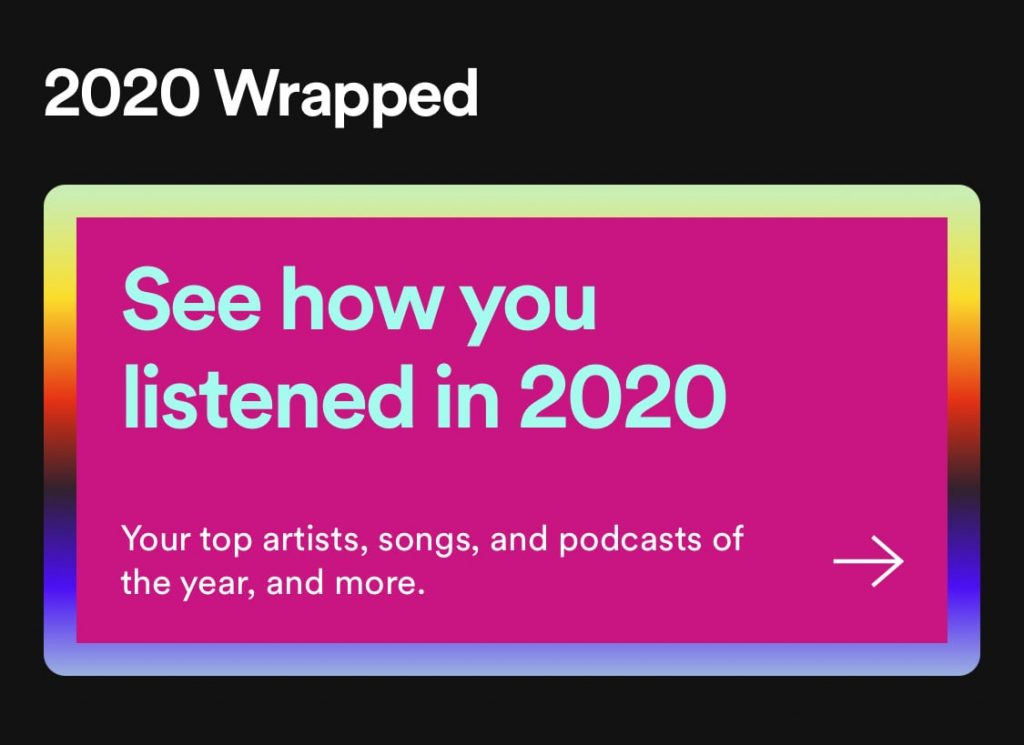
It was an onslaught of user shared content and a tour de force of brand dominance. The campaign in question was called ‘Your 2020 Wrapped’ by Spotify.

The music app’s campaign was simple – show their users what they’d been listening to – and offer them the chance to share this information on social media. Their user’s accepted.

On the same day that Spotify launched this campaign, MyWallSt reported that their share price had risen by 13%.

spotify share price shared content
This graph (from Google) highlights a marked spike on 2nd December, the day Spotify launched ‘Your 2020 Wrapped’.

Contents

Are Social Shares Worth Anything?

I’m faced with a lot of emails – a large percentage of them are about one thing – ‘links’.

I receive requests about guest blogging, updating old content, link exchange proposals, monetary offers – you name it, these people are willing to give it in exchange for a simple URL inserted on our website.

This is an example of a very, very bad outreach email. 

Why is it then, in an age when every other marketer and website owner is tilting towards a link-building, Google optimised strategy, that an established brand can increase their share price by 13% in one day with shareable content? 

In the remainder of this article, I’ll investigate the value of the social media share, whilst uncovering the 5 steps to the most shareable content on the internet.

And as usual, we’ll have take-aways, videos, supporting images, examples, explainers and tons of shareable content…

Shares and Long Term Results, Is There a Correlation?

The main objective of this article is to provide you with something that you can take-away and action (if you’re mildly entertained – that’s a bonus) because I know social shares can have a big impact on your long-term success.

It might not say it in the textbooks, or the guides, or even list it in the depths of the marketing annuls, but social shares have a noticeable effect on long-term results. Many of the best performing content on Einstein Marketer (in terms of evergreen content scores) are located on pages that boast the highest social share counts.

For example, this is one of our most shared blogs and coincidently, one of our most visited too…

social shares and traffic

I’m not suggesting that social shares have a direct impact on search ranking, but the evidence shows that more shares = more results.

A study by CognitiveSEO discovered that the top 4 results on search engines have significantly more Facebook activity (with shares being a key part of that).

Shares aren’t just valuable in the short-term. These social signals have an impactful knock-on effect.

Social Shares As Social Proof 

Regular readers will understand the delicate balance required to succeed with social proof, and this knowledge is pretty handy when it comes to understanding the importance of social shares (and how to get more of them).

If you weren’t there, here’s what you need to know:

  • Social proof is the theory that we are impacted by the decisions of the people in front of us
  • 72% of people copied the action of the person in front of them (in our real-world marketing test)
  • Our Facebook ads performed better when social proof was inserted into the advertising copy (watch the videos if you don’t believe me!)
  • Social proof doesn’t work well when used in the incorrect places (i.e. in promotions for luxury brands)
  • Showing your target market that you’re popular by using social proof signals, can help your marketing performance

If you missed it, here’s a video of me handing out leaflets on the streets, to prove the theory of social proof:

Social media shares act as digital recommendations.

Yes, they look amazing on the page and that definitely has an impact on the psychology of your target audience, but more importantly, they allow us to see what the people we trust most recommend.

Who would you trust more:

  1. Your mother
  2. A stranger

This kind of social proof is invaluable for digital businesses – and reveal one reason why it’s so important for content creators and marketers to aim for ‘shareable content’.


The 5 Steps to The Most Shareable Content on the Internet

Before we dive into our 5 steps to the most shareable content on the internet (a grand claim, I know), I need to draw your attention to an article I published a little while ago called, The Psychology of Sharing.

In this article, I analysed a three-part research program conducted by The New York Times known as ‘The Psychology of Sharing’.

new york times

The study revealed that the most likely reason people share content is to:

  1. Bring Valuable or Entertaining Content to Others
  2. Define Themselves to Others
  3. Grow and Nurture Relationships
  4. Enjoy Having Others Engage
  5. Spread/Share Good Causes

With that knowledge in the bag, and these 5 points acting as a useful reference point for the rest of this article, it’s time to get into the content marketing tactics that will create irresistibly shareable content.

1. Personalisation 

Let’s go back to the very start of this article when I praised Spotify for their excellent ‘Your 2020 Wrapped’ feature.

The one word in this campaign that made all the difference was ‘Your’ – this possessive pronoun (thank me later for the English language lesson) is the reason that they received so many social shares.

spotify wrapped shares opinion

If Spotify had created a feature called ‘2020 Wrapped’, and sent their users the best performing artists, songs and genres of the year in total, their results would’ve been very different.

As revealed in The New York Times study, a top reason why people share content is ‘to define themselves to others’ – and let’s face it, there are few better ways to define yourself than by sharing the music you listen to.

nirvana t-shirt
Ever seen a t-shirt like this? This is a real-world equivalent of Spotify’s Wrapped campaign. 

Personalisation is a key stepping stone towards the holy grail of virally shared content and Spotify hasn’t been the only ones to notice.

A bigger brand has made a bigger splash, with a bigger marketing campaign based on the shareability of their personalised content.

Coca-Cola’s ‘Share a Coke’ campaign is one of the most famous marketing campaigns in recent memory – and I couldn’t write an article about creating shareable content without mentioning its name.

The campaign involved Coca-Cola removing their brand name from labels and replacing them with the 250 most popular names of each country they were released in.

A bit too sugary for my taste, but a purchase is tempting when the product has my name on it.

In the first year of the ‘Share a Coke’ campaign, photos were tagged with the hashtag ‘#shareacoke’ more than 500,000 times, and Coca-Cola gained more than 25 million Facebook followers (Source: Investopedia).

The personalisation of their products gave them the leverage to increase product sales AND the platform to build on their growth – thanks to the shareability of their personalised bottles.

Before 2011, Coca-Cola had seen ups and downs but never surpassed its peak share price in 1998. After their ‘Share a Coke’ campaign, their share price did nothing but rise until 2020.

How to Personalise Your Content For Shares

Creating shareable content via personalisation requires one very important thing: data.

Without information, you simply can’t personalise anything.

For instance, regular readers will know that my name is Josh, and therefore have enough data to personalise a message to me. A message or comment like this will capture more of my attention than one addressed as ‘Dear Sir’.

Data is a touchy subject – but nobody seems to care when it’s used to let us show off, as Spotify’s campaign proved. 

Spotify succeeded because they had collected tons of data from their customers. Coca-Cola succeeded because they had enough resources to create a blanket personalisation campaign.

How Can You Use Personalisation? 

We don’t all have the budgets or data holding of companies like Spotify and Coca-Cola, so here are a few ways that anybody can use personalisation in their marketing campaigns and content to increase shareability:

  • Know your audience: Start with a customer avatar, create stuff that will help your ideal customer.
  • CRM Tags: Tag actions and behaviours in your customer relationship management software, and use this to inform future promotions, e.g. tag everyone who buys specific products and tailor their future communications around it.
  • Pixel/Cookies: Track behaviours and actions on your website and create custom audiences based on this behaviour, e.g. clicks, scrolls, URL visits, conversions. Retarget each segment with personalised content.
  • Collect More Data: Use sign-up forms to collect as much information as possible – first names, last names, company names, location etc. Use this information in communications.
  • Analytics: Use Google Tag Manager and Analytics to track what content your audience is most in tune with, and create more of it!
  • Implement a Live Chat: Create a live chat/messenger option for website visitors and personalise their conversation and future interactions with your website.

2. Let Them Share!

I see too many talented creators and marketers fail to offer their audience the chance to share their work.

It’s as easy as this:

Click on the share buttons below to spread the word:

135 Shares

Or this…

BTW: The social share buttons (above) are provided by a company called Social Warfare. They act as a WordPress plugin. Install these (or a similar plugin), activate them and add them to your website – it’s not rocket science.

Calling your audience to share shouldn’t be restricted to written content, it should be done in videos and podcasts. too The best times to do this are at the start and end of your content.

These sharing recommendations are known as a ‘call-to-action’.

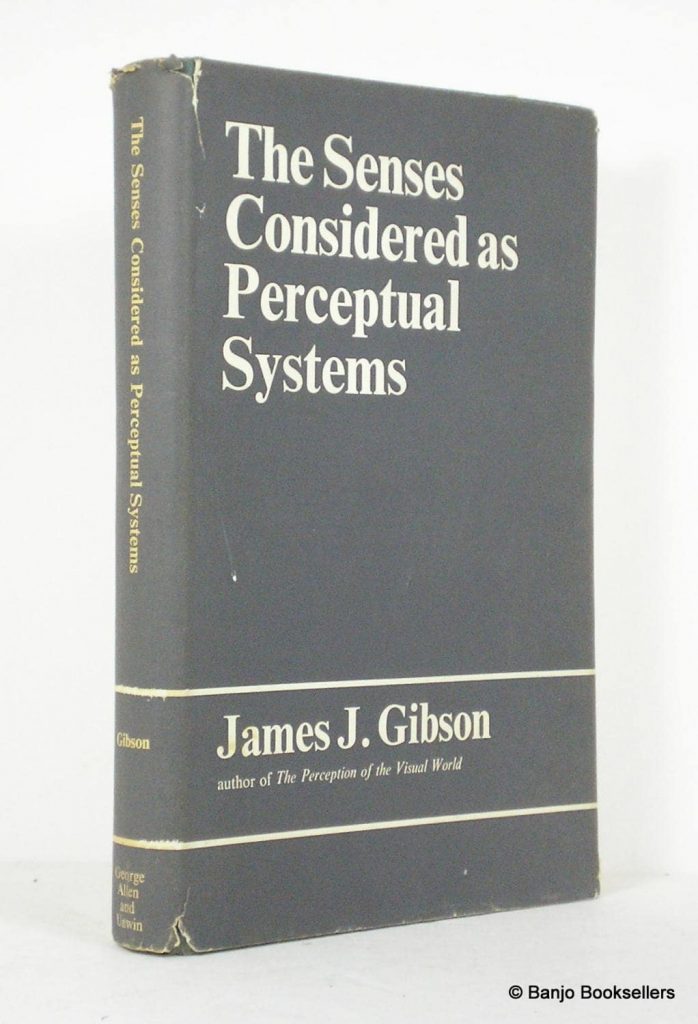
We can explain why calls-to-action work, thanks to a 1966 book by James J Gibson, called The Senses Considered as Perpetual Systems.
affordances in marketing james gibson
Good luck to anybody who tries to read this – it’s not for the faint-hearted. 

Gibson coined a term known as ‘affordances’. This explains why certain objects have properties that direct us to take action.

For example, when we see a button, we instinctively know (and want) to press it, when we see a doorknob, we know to twist it, when we’re faced with a switch, we want to flip it.

Thanks to digital, affordances have stretched much further than simply flicking and turning switches. We know to pinch our fingers to zoom in, double-tap to like (on Instagram) and drag down to reload pages.

It’s up to you to provide your audience with the correct sharing ‘affordances’, so they’ll instinctively want to share your content.

Give them buttons to press!

135 Shares

How To Use Share Buttons

Unfortunately, there isn’t an option to add 3D knobs and switches to your content, but, as you’ve already noticed, there are some powerful ways to use share buttons in your content:

  • Make it visible: Use floating bars at the side or bottom of your content to keep your share buttons in-view at all times. When the ‘I want to share’ moment hits, the option needs to be there.
  • Embed share buttons: Don’t ram sharing buttons down your audience’s throat, embed them where appropriate
  • Ask, be polite: Don’t tell your audience to do stuff, ask them politely. Many of them will understand the importance and impact of a social share and will do so if you ask.
  • Use incentives: A click-to-tweet is effectively a free piece of content for your audience, offer them the incentive. Alternatively, offer them offers/deals etc within your email content in exchange for shares.
  • Colours: Green’s and oranges are the most commonly used CTA colours, why not try using them in your social share buttons. It might be worth testing.
  • Show share numbers: If your content regularly receives high levels of shares, put a share counter beside your share buttons. This technique uses social proof to encourage more shares – just don’t overdo it!
  • 3D Buttons: Design your share buttons so they look like they’ll depress when they’re clicked on. Alternatively, change their design when a mouse hovers over them.

3. Stand Out!

Doing the same thing as everyone else achieves below-average results – especially when you’re relatively new in content.

It pays to stand out – and the currency for your achievements are social shares.

The number one reason that people share content in The New York Times study was ‘to bring valuable or entertaining content to others’. People are inherently social creatures, and they are always looking at ways of helping their social circles (and raising their standing within it).

Standing out requires creativity, skill, ingenuity and having the bravery to go against the grain, or in the words of a Nobel prize winner:

‘The opposite of a great idea is another great idea.’

Niels Bohr

A sports brand like Nike would be well advised to use athletes in their ads as aspirational figures that are aligned with their products. However, one of their most virally shared campaigns was their ‘Find Your Greatness’ ad, where they did the exact opposite:

Or a drink brand like Guinness should – to any rational thinker – hide that their product is slow to pour, but instead they advertise it like a badge of honour.

guinness bar mat marketing

And it’s one of the foremost reasons that at a time when everyone is publishing as much content as possible, I’ve decided to reduce the number of blogs being published on Einstein Marketer, in order to raise the level of quality that’s associated with our brand.

Great ideas come at both ends of the spectrum. Find which end suits you and create content that warrants the ‘stand out’ motivated share.

And if you need further inspiration, here’s an apology from KFC that received tons of shares for ‘stand out’ reasons:

kfc fck campaign

How to Make Your Content ‘Stand Out’

The Austrian psychologist, Ernest Dichter, released a study in 1966 about word-of-mouth marketing.

He discovered that the most common reason for somebody to recommend a product to a friend was ‘product involvement’. This occurred when an experience with a product was so novel and pleasurable that it simply had to be shared.
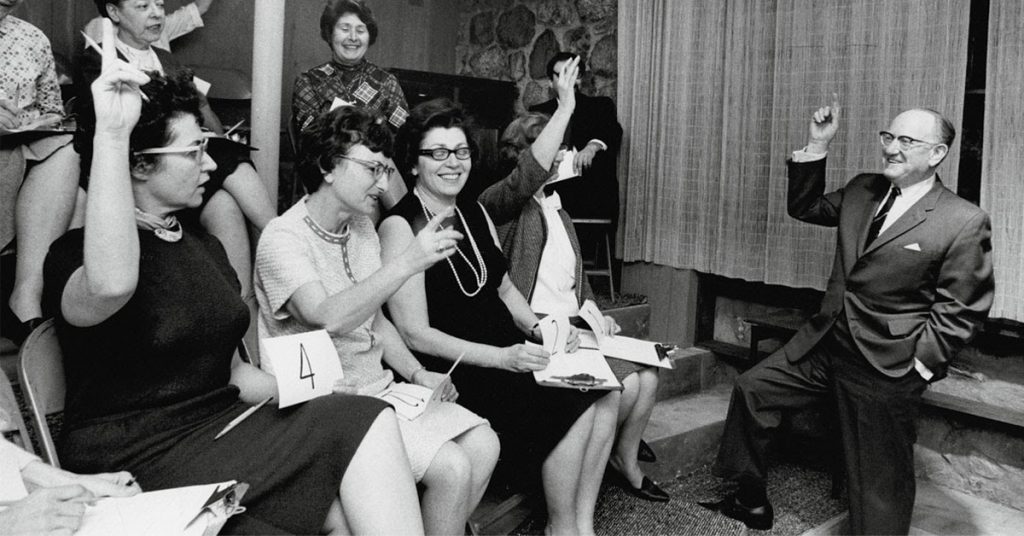
ernest dichter word of mouth study

You must aim to elicit that same feeling with your content.

A brand that have achieved this with their content is Blendtec, with their infamous YouTube videos, ‘Will it Blend?’:

But, how can you use content to stand out and gain those all-important social shares? Here are a few ways that we’ve used them in the past:

  • Think of a good idea and do the opposite: Let’s face it, you aren’t the only person online creating content – your good idea has probably been executed before. Why not flip it on its head and try the opposite?
  • Do something immeasurable: Almost everything online can be tracked, but why not try something that can’t be tracked – have longer conversations with prospects, post less, post more, publish elsewhere, go offline, create branded merchandise.
  • Create nonsense: I only know one brand of blender, because Blendtec is the only one who created nonsense content with their product. If you have a product, try some nonsense for yourself.
  • Be honest: Trust is one of the hardest commodities to find online – being honest about yourself, your brand and your journey will stand out from the crowd.

4. Positivity

I’m smiling already.

‘Positivity’ is an especially relevant point for me because I regularly share it. My most recent retweet (at the time of writing) was about the world’s first Covid-19 vaccination:


And I’m not the only one, in Contagious: Why Things Catch On, Jonah Berger and his colleague analysed seven thousand articles to discover what elements contributed to their most emailed articles.

contagious jonah berger social sharing
Add this book to your reading list

They discovered that there were two primary factors that led to the sharing of articles:

  1. How positive the article was
  2. How excited it made the reader

Joy is a feeling that we instinctively want to share it with others. Spreading happiness builds and nurtures relationships and gives us enjoyment (both of these are top 5 psychological share factors according to The New York Times study).

positive news and shareable content
News sites like Good News Network are often seen shared on social media.

The message itself doesn’t have to be positive to incite positive sharing feelings. As brands and marketers, it can be difficult to find feel-good topics when we’re creating content about our products or problem-fixes.

Instead, we can use easter eggs (hidden gems in our content) or our medium delivery to spark joy in our audience. Check out this promotional video about train safety:

This video for Dumb Ways to Die has been viewed more than 200 million times on YouTube and even has a mobile app. 

Try watching that video and telling me that you don’t want to hit these share buttons…

135 Shares

How to Make Your Content More Positive

If your singing voice isn’t quite up to a catchy new jingle, and you’re fresh out of inspirational stories, there are other ways to generate positivity.

Excitement and positivity are similar emotions, you can use either to create the shareable content you’re seeking.

Here are a few ways to make your content more positive and your shares more frequent:

  • Release dates: If you have a product, content or changes to your business that will impact your customer positively – create content about them and build excitement. Computer game companies earn $$$ in pre-orders from shares of their release date promos.
  • Product teasers: If you have something that’s in development, a completed prototype or potential change to your services – create a content teaser and post it on social media. Think positively!
  • Staff stories: We’re social creatures, and people love people. Try using your own funny industry-related stories, or those of your staff.
  • Video: It’s much easier to share positive emotions about a mundane topic when you’re on video on doing it.
  • Curate: Use your social channels to curate positive news from other sources. You won’t own the content, but you’ll be the messenger.
  • Think positively: Don’t force the feeling. Positive vibes radiate off you when you’re in the zone and will flow into your content too. Enjoy the process!

5. Stories

In 1996, a few weeks before the Olympic Games, a young athlete was diagnosed with stage 3 testicular cancer. A year later, after undertaking chemotherapy and having the cancer removed, he was declared cancer-free and started his own foundation.

The man was Lance Armstrong, his foundation, Livestrong. Fast forward 7 years and Armstrong had just picked up a record-breaking 6th consecutive Tour de France.

This seemingly impossible story led to Nike selling more than 80 million yellow wristbands with his foundation’s ‘Livestrong’ branding:

livestrong fad virality
It’s probably best not to mention what happened to Armstrong a few years later.

This yellow bracelet went ‘purchase viral’, and the same thing happens to content and marketing campaigns when they’re attached to the correct story.

In the UK, many people eagerly await John Lewis’s Christmas advert (if you’re not a Brit, John Lewis is a large department store) because they’re always built around touching stories.

When these ads drop, you cannot move on social for shares of their video.

My favourite John Lewis ad wasn’t even created by them. In this ad, Twitter teamed up with a man named John Lewis, who lives in Virginia, US and owns the Twitter handle @JohnLewis. Because of his username, he is regularly inundated with tags, mentions and requests from UK twitter users:

Since @johnlewis tweeted this ad, it has been shared more than 25k times from his account alone.

BTW: If you haven’t seen a John Lewis Christmas advert, check them out on YouTube.

Stories are an amazing way to elicit emotion. They give us the opportunity to share good causes (like the Livestrong band), build relationships and entertain others – 3 big psychological reasons why we share content.

I opened this blog with a story about Spotify to capture your attention, and I’ve weaved in several more to keep you engaged. As a creator, marketer and entrepreneur, you must understand the value of attention.

A great story can pull new audiences from their ferociously busy newsfeeds – giving you the chance to convert that into a share.

Watch me briefly explain the value of attention on stage at EMC 2020. 

How to Use Stories In Your Content

Stories are everywhere, it’s just a matter of knowing how to find them. Here are a few ways that anybody can use stories to create irresistibly shareable content:

  • Brand stories: Your business must’ve started for a reason, and there has to be some background to this. This is your brand story – you simply have to use it. Think of the emotional steps that took you from where you were, to where you are today.
  • Customer stories: This type of story are great on landing and sales pages because they increase conversion rates. Ask your existing customers to talk about their life (in relation to your product’s problem-solving ability) before and after they found you. Use quotes and videos to build trust in your brand.
  • Progress updates: Nobody ever started at the top of the tree. If you’re on your way up, show your audience every step along the way. We are all living, breathing stories. Use updates to build a community who are invested in yours.
  • Vlogs/blogs: Vlogs and blogs are a great way to go into more detail about your journey. You can reveal problems you’ve faced, shortcuts and advice.

The 5 Steps to the Most Shareable Content On the Internet

There we have it – the 5 steps to the most shareable content on the internet.

We’ve been through highs and lows, witnessed some great modern marketing campaigns, and put the theory of shareable content to the test with examples and explanations.

As a quick recap, here are our 5 ways to create shareable content:

  1. Personalisation
  2. Let them share!
  3. Stand out!
  4. Positivity
  5. Stories

If you can tie two or three of these elements together, you’ll create something that is irresistible on social media.

I’ll be back soon with more super-valuable content like this – as always, scroll down to the bottom of this page to subscribe for updates…

…and please share this article to spread the knowledge (and love).

By Josh Barney

Josh is an award winning content marketer and the Director of Content at Einstein Marketer, previously working as a content manager, freelance copywriter and marketer. He writes, edits, proofs and strategises content for Einstein Marketer’s agency and their clients, sharing the most successful tactics and strategies with his lovely audience. He hates writing in the third person, follow him on the social links (above) so he can get back to writing as himself.


Sourced from Einstein Marketer

By Ben Lovejoy

Apple’s new app privacy labels went live in the App Store last month, giving users the chance to see what data is collected by each. We then explained how to view them.

All apps are required to show what data is used to track you, and what data is linked to your identity. Looking at that more comprehensive category reveals some stark differences between four popular messaging apps…

App privacy labels for messaging apps

Forbes compared Signal, Apple’s own iMessage, WhatsApp and Facebook Messenger.

Signal

None. (The only personal data Signal stores is your phone number, and it makes no attempt to link that to your identity.)

iMessage

  • Email address
  • Phone number
  • Search history
  • Device ID

WhatsApp

  • Device ID
  • User ID
  • Advertising Data
  • Purchase History
  • Coarse Location
  • Phone Number
  • Email Address
  • Contacts
  • Product Interaction
  • Crash Data
  • Performance Data
  • Other Diagnostic Data
  • Payment Info
  • Customer Support
  • Product Interaction
  • Other User Content

Facebook Messenger

Apps have to show what data is used in what way — categorized by such things as third-party advertising and developer marketing. Some data is shown in more than one category, but it was easy enough to de-dupe them in the above apps. With Facebook Messenger, in contrast, the list is so long I have to list it in full.

Third-Party Advertising

Purchases
  • Purchase History
Financial Info
  • Other Financial Info
Location
  • Precise Location
  • Coarse Location
Contact Info
  • Physical Address
  • Email Address
  • Name
  • Phone Number
  • Other User Contact Info
Contacts
  • Contacts
User Content
  • Photos or Videos
  • Gameplay Content
  • Other User Content
Search History
  • Search History
Browsing History
  • Browsing History
Identifiers
  • User ID
  • Device ID
Usage Data
  • Product Interaction
  • Advertising Data
  • Other Usage Data
Diagnostics
  • Crash Data
  • Performance Data
  • Other Diagnostic Data
Other Data
  • Other Data Types

Developer’s Advertising or Marketing

Purchases
  • Purchase History
Financial Info
  • Other Financial Info
Location
  • Precise Location
  • Coarse Location
Contact Info
  • Physical Address
  • Email Address
  • Name
  • Phone Number
  • Other User Contact Info
Contacts
  • Contacts
User Content
  • Photos or Videos
  • Gameplay Content
  • Other User Content
Search History
  • Search History
Browsing History
  • Browsing History
Identifiers
  • User ID
  • Device ID
Usage Data
  • Product Interaction
  • Advertising Data
  • Other Usage Data
Diagnostics
  • Crash Data
  • Performance Data
  • Other Diagnostic Data
Other Data
  • Other Data Types

Analytics

Health & Fitness
  • Health
  • Fitness
Purchases
  • Purchase History
Financial Info
  • Payment Info
  • Other Financial Info
Location
  • Precise Location
  • Coarse Location
Contact Info
  • Physical Address
  • Email Address
  • Name
  • Phone Number
  • Other User Contact Info
Contacts
  • Contacts
User Content
  • Photos or Videos
  • Audio Data
  • Gameplay Content
  • Customer Support
  • Other User Content
Search History
  • Search History
Browsing History
  • Browsing History
Identifiers
  • User ID
  • Device ID
Usage Data
  • Product Interaction
  • Advertising Data
  • Other Usage Data
Sensitive Info
  • Sensitive Info
Diagnostics
  • Crash Data
  • Performance Data
  • Other Diagnostic Data
Other Data
  • Other Data Types

Product Personalization

Purchases
  • Purchase History
Financial Info
  • Other Financial Info
Location
  • Precise Location
  • Coarse Location
Contact Info
  • Physical Address
  • Email Address
  • Name
  • Phone Number
  • Other User Contact Info
Contacts
  • Contacts
User Content
  • Photos or Videos
  • Gameplay Content
  • Other User Content
Search History
  • Search History
Browsing History
  • Browsing History
Identifiers
  • User ID
  • Device ID
Usage Data
  • Product Interaction
  • Advertising Data
  • Other Usage Data
Sensitive Info
  • Sensitive Info
Diagnostics
  • Crash Data
  • Performance Data
  • Other Diagnostic Data
Other Data
  • Other Data Types

App Functionality

Health & Fitness
  • Health
  • Fitness
Purchases
  • Purchase History
Financial Info
  • Payment Info
  • Credit Info
  • Other Financial Info
Location
  • Precise Location
  • Coarse Location
Contact Info
  • Physical Address
  • Email Address
  • Name
  • Phone Number
  • Other User Contact Info
Contacts
  • Contacts
User Content
  • Emails or Text Messages
  • Photos or Videos
  • Audio Data
  • Gameplay Content
  • Customer Support
  • Other User Content
Search History
  • Search History
Browsing History
  • Browsing History
Identifiers
  • User ID
  • Device ID
Usage Data
  • Product Interaction
  • Advertising Data
  • Other Usage Data
Sensitive Info
  • Sensitive Info
Diagnostics
  • Crash Data
  • Performance Data
  • Other Diagnostic Data
Other Data
  • Other Data Types

Other Purposes

Purchases
  • Purchase History
Financial Info
  • Other Financial Info
Location
  • Precise Location
  • Coarse Location
Contact Info
  • Physical Address
  • Email Address
  • Name
  • Phone Number
  • Other User Contact Info
Contacts
  • Contacts
User Content
  • Photos or Videos
  • Gameplay Content
  • Customer Support
  • Other User Content
Search History
  • Search History
Browsing History
  • Browsing History
Identifiers
  • User ID
  • Device ID
Usage Data
  • Product Interaction
  • Advertising Data
  • Other Usage Data
Diagnostics
  • Crash Data
  • Performance Data
  • Other Diagnostic Data
Other Data
  • Other Data Types

Some have suggested that Apple respond to Facebook’s full-page newspaper ads with a response consisting solely of the above list.

How many people will actually read the app privacy labels, let alone have that influence their choice of messaging app, remains to be seen.

By Ben Lovejoy

Sourced from 9to5 Mac

By Tom Maxwell

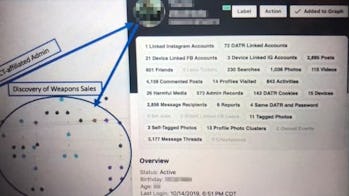
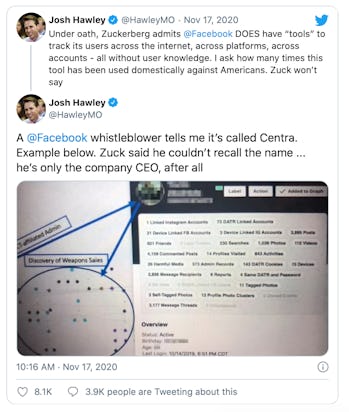
During a Senate hearing today Senator Josh Hawley asked Mark Zuckerberg about Facebook’s mysterious “Centra” internal dashboard. His answers should worry us all.

Jack Dorsey and Mark Zuckerberg faced another grilling from the U.S. Senate today, mostly over spurious claims that their social networks are silencing conservative voices in the fallout of the presidential election. One more interesting tidbit from the hearing was when Senator Josh Hawley of Missouri asked Zuckerberg about “Centra,” the name for what he claims is an internal tool Facebook uses to track its users across the internet.

Hawley shared a picture of the purported tool on Twitter, which he says he obtained from a Facebook whistle-blower.

The dashboard, if authentic, shows a litany of data points Facebook has on individual users. And importantly, it highlights how users cannot easily escape the company’s tracking even if they want to.

Break them up — One such label visible in the dashboard, “3 Device Linked IG Accounts,” shows that Facebook can log the same user’s activity on a device even if they switch accounts by using the device’s unique hardware identifiers, like a smartphone’s fixed IMEI number. Basically, you don’t need to be logged into a particular account for the company to know it’s you — create a new Instagram account and device-level identifiers will be used to recognize you’re the same person. When you log in to Facebook on the web, the company drops a “DATR” cookie that will keep track of your activity even after you log out… and for up to two years thereafter.

It’s been previously reported that Facebook uses browser cookies to track people who’ve never created a Facebook account at all, creating “shadow profiles” for those it hopes might create an account later.

The state of ad-tech — None of this is surprising, and Facebook is far from alone in performing this type of tracking — the entire online advertising industry is built upon it. In order to generate a detailed profile on individuals for the purpose of precise targeting, Facebook needs as much visibility as possible into your browsing activity across devices and platforms.

If you switch accounts — or use a smartphone and laptop interchangeably and your browsing activity doesn’t sync across them — advertisers get much less information on you with which to target ads. Fixed identifiers allow Facebook to log user activity even if they’ve logged out, or deleted the Facebook app, or are using a different web browser.

The scope of this tracking may still be surprising to some people, despite awareness that Facebook collects heaps of data. Critics have said that users might be willing to exchange their data for free services, but the vast tracking apparatus used by Facebook and others is so complex as to make it difficult for the average person to know the extent of the tracking.

Apple responded to these privacy concerns with its release of iOS 14, which now requires apps to request permission before they can use a device identifier. Some apps monetize via advertisements from Facebook, which requires the company be able to identify who the user is. Without being able to link an app user to the information Facebook knows about them, the ads lose all the precise targeting secret sauce that makes them valuable. Zuckerberg has said that the change could wipe out billions in revenue. Apple has temporarily paused the change in order to give Facebook time to change its model. Meanwhile, all we hear are tiny violins playing a somber tune.

Abuse potential — The Cambridge Analytica scandal and revelations from Edward Snowden about NSA wiretapping showed how this data can get into the wrong hands even if Facebook doesn’t intend for it to happen. That’s the fundamental concern of privacy advocates — that Facebook is collecting unprecedented data in the interest of advertising, but is a poor steward of data privacy. Laws in the United States regarding privacy aren’t exactly stringent, either, with the Patriot Act effectively giving the government free rein to conduct secret searches of Facebook’s data under the guise of national security. That risks stifling free speech.

During the hearing, Zuckerberg said he wasn’t familiar with Centra. But a rose by any other name would smell as invasive.

By Tom Maxwell

Sourced from INPUT

By Frank Landman

If there’s one niche of the business world that never stops evolving, it’s marketing. Digital marketing is highly dependent on the maturation of online technologies and is continuously pivoting and responding to new developments. Having said that, are you prepared for 2021?

The Digital Marketing Trends Set to Define 2021

Now is the time to begin planning ahead to account for the digital marketing trends of 2021. By staying current, you can develop a digital marketing strategy that takes the latest tips, trends, and frameworks into account.

“A good digital marketing strategy gives your company a cohesive plan that is consistent through your many online and offline channels,” Marcel Digital explains. “After all, you want your branding and message to be the same on your point-of-purchase advertising in your stores as it is on your social media pages and website. A cohesive message saves time and effort by not having employees recreate a marketing message for every channel.”

But our focus is not to discuss how to create a cohesive message. While important, we want to dig into the how. In other words, how do you execute once you’ve zeroed in on your message?

Though classic marketing principles and approaches will always prove effective, sometimes it’s helpful to study the latest trends to get a feel for innovative opportunities that can take marketing to the next level. And in this article, we want to focus on a few of the top trends for 2021. Take a look:

1. Live Video

Live video streaming has exploded over the past three years (and will continue to do so over the next decade). Powered by social media platforms, live streaming is available to the masses and provides an avenue for the continued democratization of content. Just consider the following data points as curated by HubSpot:

  • Internet users watched approximately 1.1 billion hours of live video in 2019.
  • By 2027, the live video streaming market is expected to hit $184.3 billion.
  • By 2020, live streaming is expected to account for 82% of all internet traffic.

Those are significant numbers – too significant to ignore. And there are plenty of reasons why businesses are making the jump to live video, including:

  • There’s almost no learning curve to record live video. There’s no need for a script, props, or post production. You hit the record button and push out live content. It’s casual, relaxed, and relatable.
  • There’s no requirement for advanced technology. While you can certainly enhance quality with some tech upgrades, a smartphone is all that’s needed to get started.
  • Live video feels exclusive and commands longer average view times when compared to pre-recorded videos. (There’s a sense of urgency from the viewer that they might not be able to see the content later.)

Live streaming video is used in a variety of capacities and is highly dependent on your brand, goals, and content strategy. However, it’s ideal for things like Q&As with an audience, customer support, special announcements, interviews with influencers, live events, and backstage events.

If you’re new to live video but want to get started, the best piece of advice is to jump in and do it. Try a couple of videos and see what happens. Were you comfortable? Did you enjoy it? Did the audience engage? What can you learn?

Your first shot at live streaming won’t be perfect, but you can always optimize over time.

2. Programmatic Advertising

Another sweeping trend is the growth of programmatic advertising. If paid traffic is part of your strategy for 2021, you need to gain some understanding and proficiency in this area.

As MarTech Advisor explains, “Programmatic advertising is the process of automating the buying and selling of ad inventory in real-time through an automated bidding system. Programmatic advertising enables brands or agencies to purchase ad impressions on publisher sites or apps within milliseconds through a sophisticated ecosystem.”

Over the past couple of years, programmatic advertising has become the preferred method of running ad campaigns. It offers real-time insights, enhanced targeting capabilities, increased transparency, better budget utilization, and provides a way to combat ad fraud effectively.

Programmatic advertising can be deployed in a variety of channels and formats, including display ads, video ads, social ads, audio ads, native ads, and digital out-of-home (DOOH) ads.

Contrary to how traditional media buying works, programmatic advertising doesn’t usually involve publishers and advertising working together in a one-to-one fashion. The type of programmatic deal – such as real-time bidding, private marketplaces, preferred deals, or programmatic guaranteed – determines how they’re delivered.

3. Voice Search

Would it surprise you to learn that approximately 27 percent of the online global population uses voice search on mobile? Or that more than 1 in 3 US internet users use a voice assistant monthly (up from just 9.5 percent in 2018).

Consider that by the end of 2020, roughly 30 percent of all internet browsing sessions will include voice search. And that more than half of adults use voice search on a semi-regular basis.

The writing is on the wall. Voice search will soon become the preferred method of browsing the internet. It’s faster, hands-free, and ultimately more convenient.

So what does that mean for digital marketing? Well, it changes everything, particularly on the content strategy side of things. People speak differently than they write. Consider, for example, someone searching for a pizza restaurant. Their queries might look like this:

Typed: pizza restaurant Bronx

Spoken: What’s the best pizza restaurant in the Bronx?

Voice search is ushering in a new age of SEO and content creation where long-tail keywords are the focus. Natural, conversational language wins the day. Brands that adapt to this style will see their SEO rankings improve and search traffic scale.

In terms of blogging strategy, brands should focus on developing content that answers questions. People go to Google when they have a question and the search engine knows this. So in an effort to satisfy their users, they’re elevating content that answers very specific questions.

4. Interactive Content

Online users are growing bored with basic blog posts and static content. They want to be stimulated. They also want control over their experiences. And these desires are currently culminating in the rise of interactive content.

Research shows that interactive content gains 2X more engagement than static content. This has led 34 percent of marketers to include interactive content in at least 10 percent of their strategies.

The most popular types of interactive content include quizzes, polls, interactive infographics, AR, VR, and online calculators.

Interactive content is typically just a subsegment of the larger content strategy. But in 2021 and beyond, it’s going to become an even bigger portion. While many brands are currently developing one piece of interactive content for every nine pieces of static content, that number will likely increase to 20 percent.

5. Shifts in Influencer Marketing

In 2016, the influencer marketing industry was worth an estimated $1.7 billion. By the end of this year, it’s projected to be worth somewhere north of $9.7 billion.

People like to hate on influencers, but they’re effective. The earned media value for money spent on influencer marketing was roughly $18 for every dollar spent in 2019. And over the last three years, there’s been a 1500% increase in brands searching for “influencer marketing” on Google. In other words, it’s effective and here to stay. But as we enter into 2021, this industry will undergo significant shifts that will ultimately change the way businesses approach marketing and advertising.

One of the biggest shifts will be the rise in micro influencers. These are influencers who have small yet loyal followings (anything less than 10,000 followers). And what they lack in reach (compared to large influencers), they make up for with high engagement and affordability.

It’s also possible that we’ll see an increase in performance-based influencer marketing. In the past, it’s always been sort of a flat fee deal. Businesses pay per post and the influencer gets the same amount of money no matter what happens on the engagement front. But as the influencer arena gets more competitive, brands will gain more leverage. Soon, we could see payment based on the number of clicks, comments, or even sales.

Ultimately, the changes in this space will be dictated by consumers. Followers make it clear what they do and don’t respond to by the type of engagement they offer. As brands and influencers gather more data and analytics from these types of posts, they’ll iterate and zero in on what works best.

Hit the Refresh Button on Your Digital Marketing

No digital marketing strategy is set in stone. As you approach 2021, take the time to understand the new trends so that you can shift your strategy into a direction that aligns with the trajectory of the larger consumer marketplace. Whether it’s live video, programmatic advertising, voice search, interactive content, or shifts in influencer marketing, there’s ample opportunity for growth and expansion.

By Frank Landman

Frank is a freelance journalist who has worked in various editorial capacities for over 10 years. He covers trends in technology as they relate to business.

Sourced from readwrite

Sourced from eMarketerD

Amid the pandemic, Amazon’s ad revenues along with its retail sales have increased as consumers continue to shift to ecommerce at elevated rates. We now forecast even faster growth this year for Amazon’s US ad business than we had expected in March.

How Has the Forecast for US Net Amazon Ad Revenues Changed? (billions, 2019-2022)

It’s critical that marketers stay ahead of the latest B2B buying committee trends. Join eMarketer’s Tech-Talk Webinar, with sponsored content presented by Salesforce. Learn how demand generation leaders are adopting new practices and AI-powered technology to grow ROI and outperform competitors.

Register Now

Amazon has a unique place in our US digital ad revenue breakout: It’s the only company for which we revised our 2020 estimate upward between March and October. We now expect Amazon to earn $14.55 billion in net US digital ad revenues in 2020.

Sourced from eMarketer

eMarketer and Business Insider Intelligence have joined forces to become the leading research company focused on digital transformation. For more insights and key statistics on the biggest trends in today’s most disruptive industries, subscribe to Chart of the Day.

By

Despite the efforts that you may put into acquiring and engaging new customers, some of them tend to stop interacting with your brand

The synergies that were powering the machinery of the modern world are shifting across all spheres. Even as social media and the Internet continue to bring people closer in a closely-knit capitalist superstructure—the development amplified by technological intervention—brands have to deal with an ineludible truth. Despite the efforts that you may put into acquiring and engaging new customers, some of them tend to stop interacting with your brand.

Inactive customers are an inevitable part of business reality. While the reasons for the suspension of the engagement between a brand and its customers—temporary or permanent—can be miscellaneous, the ultimate result is invariably the same: the customer ceases to be a customer. This can be devastating for businesses because establishing deeply personalized, contextual relationships with new customers requires brands to invest an exorbitant amount of time and effort…all of which brings us to the all-important question: how do you bring these non-responsive customers back into your brand’s fold?

Reigniting the spark: What is connected re-engagement and why it is good for your business

Connected re-engagement steps into this picture to enable your brand to reignite interactions with lapsed customers. The core idea behind it is simple. Existing customers are already primed to be engaged with the brand—all a brand needs are the right ‘connected’ strategies.

Connected strategies are critical because modern-day customers are disposed to switch between different channels when interacting with a brand. A report by Social Media Today revealed that nearly three in four customers (72 per cent) prefer an omnichannel communication approach. Opting for connected re-engagement strategies—which comprise myriad methodologies and approaches—has proven advantages across multiple sectors. Recent market studies indicate that customers that interact across multiple channels spend 3-4 times more, on average, than their peers who interact across a single channel. Brands that opt for a strong omnichannel approach to customer engagement also register an average 9.5 per cent increase in their annual revenues.

In short, while your brand may grow in the absence of a connected communication strategy, your odds of long-term success are more favourable if you opt for one.

This invites the question: how do you build a strong and effective re-engagement campaign that is powered by connected communication? Here are the key aspects of any connected communication strategy, along with some examples of how brands across verticals have used different approaches to re-engage customers:

Identifying and segmenting inactive customers

Before you endeavour to target your inactive customers with re-engagement campaigns, you first need to identify your least engaged customers. In-depth data mining and analysis of consumers and their past behavioural patterns can help you to accomplish this goal by enabling you to categorize dormant customers into appropriate segments. You can create diverse segments depending on your business objectives and requirements.

For instance, one segment could include customers who have not made any purchase from your shop in the last half-year. Customers who have not visited the shop in the past three months can be grouped into yet another segment. More segments can be created to segregate customers into organized sub-clusters, such as users who have not interacted with your brand on any social media platform over the last three months or shared negative feedback on a product/service.

Identifying and understanding these segments is essential as they can then be targeted with highly personalized content and call-to-actions that are precision-tailored to speak to their stated and unstated needs. For instance, if a customer bucket includes people who now only prefer to passively engage with your brand (like over your social media pages through reactions on posts, videos, etc.), you can send them personalized emails along with appealing offers.

Targeting each segment with personalized content

Offers such as digital coupons and sales promotions (including providing free product samples or limited-time subscriptions) can remind your inactive customers what they have been missing out on. A popular OTT platform did something similar with a recentre-engagement campaign. It was different because people could sign up for free content streaming without filling in their credit/debit card details. By eliminating this barrier, the brand prevented the problem of customer drop-off before sign-up while significantly expanding its customer database and generating massive social media traction.

You can also up the ante of your offers (such as rewards and loyalty programmes) by making the interaction of customers with your (re-) engagement campaign intriguing. A popular digital payments app recently gamified the users’ engagement through a travel game. Users gained reward points upon each transaction, enabling them to advance to the next level. The excitement of moving ahead in the game, in turn, incentivised users to transact more frequently. The short-term and long-term rewards reaped under such gamified initiatives can also be a powerful motivation for customers to re-engage with a brand they’re already familiar with. This can, therefore, maximize the impact of your re-engagement strategy.

Focus on data to build a truly connected strategy

Once you have successfully re-engaged a segment of lapsed customers, the next step involves doing it at speed and scale across multiple channels. This is where data and analytics enter the picture. As mentioned above, the data that you have accrued from your past interactions comprise a valuable asset. You can leverage this wealth of information to optimise the effectiveness of your re-engagement strategy through data-mined insights.

Every successive campaign facilitates the capture of better quality of data that you can then leverage to create even better strategies. A robust technological infrastructure, such as those enabled by leading players in the connected communication space, can help you tap into the power of this virtuous cycle and optimise re-engagement. Having a data-driven omnichannel communication strategy also increases the number of points of interaction, thus ensuring that the customer engages with your campaigns across multiple channels.

Unless brands find a way of rigging the balance of probability, an uninformed chase of customers is not likely to yield the desired result, and chance is the one thing that brands cannot afford to take in this highly unpredictable post-pandemic business landscape. The only viable solution, then, is to create a well-thought-through and tech-augmented connected communication strategy. By keeping the aforementioned steps in mind, brands of all sizes can optimise their customer engagement and ensure that they achieve all the relevant objectives, with precision and at scale.

Feature Image Credit: Gerd Altmann from Pixabay

By

Managing Director-India, Infobi

Sourced from Entrepreneur India

By Jared Atchison

Having a powerful content creating strategy is key to getting customers to engage with your brand.

Most businesses know that content is the key to winning customers. However, building a content creation strategy that actually engages users is still a challenging issue.

There are a few mistakes that businesses continue to make. For example, focusing on quantity over quality. And creating content that sounds “professional” but impersonal to users.

In this post, we’ll cover several practical ways you can create engaging content. And with the tips given here, you’ll be able to make content that’s appealing and gets attention – which in turn will lead to more sales for your business.

Create content customers want to read

This tip seems obvious, but many businesses approach content creation by keeping their business goals in mind.

For example, I once came across a website selling high-end bathtubs for personal use. The creator of the site and the content focused on technical specifications such as the model names and numbers of the tubs. If they had thought about what their customers want,  they would have focused on how their bathtubs could be a way to relax or add a classy touch to their homes. And they could have optimized their SEO for bathtubs and the location they catered to.

To create content your customers want to read, keep the following in mind:

  • Learn about your primary demographic. You should have a clear idea of whom you are selling your product to. Even if your product is for everyone, you’re better of picking your most important demographic and learning about how they use your product
  • Focus on the benefits your product provides rather than the features you think are important. Specs matter but what your customers really want to know is that your product will meet their needs

The remaining sections of this post will give you more guidelines on how to make content people want to read. Start with researching who your audience is and what they want. And use the rest of the ideas here to build content that shows them that your business is the right fit for them.

Imagine your audience in clear detail

Have you noticed that when you know someone well, your conversations with them are meaningful and generate a positive response? This is something you can do even when you’re writing email posts, blog content, or ads for your audience.

When you write for a faceless mass, your communication will lack liveliness. But if you can build a customer persona, your content automatically becomes more interesting. For example, a clothing company for plus-sized women will have a different view of their customers when compared to how a fabric manufacturer for furnishings will think about their target market.

When imagining your audience, give them an age, a name, a profession, and make them “real.” Then, when you think about them and write your blog post or create your video, you’ll approach your material with greater energy and personalization.

Have a tone of voice

In a sea of impersonal content, having a ‘voice’ and a specific tone for your brand can set it apart. As an example, consider how Old Spice differentiates itself from other grooming brands for men. All their marketing, from their website copy to their ads, use a fun, humorous, and cheeky tone. This makes the brand memorable and people immediately associate their content with grooming and self-care products for men.

After you’ve made a clear picture of your audience, imagine that you’re talking to them directly as you would a friend. With practice, you’ll find that creating and maintaining a tone becomes easier and will also engage people more.

Choose a tone of voice that’s right for your business. Humour in content is always engaging but is not necessarily appropriate in all situations. You can opt to be professional, academic, uplifting, or choose any other tone that makes sense for your audience and your business. The important thing is to remain consistent across your communication.

Engage your audience’s emotions

A critical element that makes content jump out online is the use of emotion in your blog posts or social media content. Always look for ways to connect with people at an emotional level. Here are my suggestions for doing this:

  • Make use of power words that are proven to get people’s attention. Words like “Free”, “Best”, “Guarantee”, and many others create an impact when you add them to email subject lines, blog titles, and ads
  • Craft blog titles with “How-tos” and “X Best” or “X Easiest” and similar formats as these tell users that your content will help them
  • Pique your audience’s curiosity by building a suspenseful opening sentence in  your emails
  • Ask a question that makes your audience think
  • Make a bold statement or an assertion that compels people to keep reading your content
  • Add stories, case studies, and news to add examples to your posts and provide context to users

The next time you’re on social media, observe posts that go viral. You’ll note that virtually all of them evoke people’s emotions in some way or the other. Keep working on making emotional content and track the impact of your content through analytics. You’ll identify what works and how to leverage your content for the best effect.

Format your content

Nothing will put your readers off as much as a badly formatted blog post. Even though an article may contain extensive information, your audience will not consider it helpful if they can’t scan it and understand whether it’s relevant to them in a brief glance.

Here’s how to format your content for the best effect:

  • You can make your content scannable by breaking your text into smaller paragraphs – keep each paragraph to three or four lines each
  • Run your content through an app like the Hemingway Editor. It will detect sentences that are too wordy and highlight them for your attention
  • Use a casual way of speaking or writing in your posts. A friendly and conversational writeup will make your content easy to understand. What’s more 83% of people prefer an informal and chatty tone.
  • Break up long posts with images and video content. Images retain people longer on your website and illustrate your point well. Posts with images get 94% more views as opposed to ones without any visual elements.
  • Use headings and subheadings to tells users what each section of your posts is about. This makes it readily apparent to your users whether your post will help them or not
  • Make use of bullet points and numbered lists to break up long paragraphs into actionable points

A well-formatted blog post or article will make your content look appealing to people seeking relevant and informational material. These tips will keep people on your page longer, impacting your engagement rates and SEO too.

Leave a call to action

When you end a piece of content, whether it’s a video, social media post or a blog article, be sure to give your users something to do.

A call to action serves the purpose of driving customers to take action that leads to further engagement. These actions can include following you on social media or liking a video. You can direct users to subscribe to a newsletter or join an exclusive membership site.

When you don’t add a call to action, even one as simple as telling people to check out more of your content, your audience will lose interest fast and find content elsewhere.

With calls to action, you’ll be able to reengage your audience. When they receive your emails, get notifications for new videos and posts, you’ll have the opportunity to continue nurturing your relationship with them.

The tips given here are practical and proven to work. By implementing just some of them, you’ll see an improvement in how well people respond to your content.

Of course, you’ll have to go through some trial and error before finding what works for your business in particular. But if you keep working on these tips and use analytics to support your efforts, you’ll see a boost in customer engagement.

By Jared Atchison

Co-Founder of WPForms, one of the largest WordPress contact form plugins in the market. I have been programming for over a decade and enjoy creating plugins that help people create powerful web designs without touching code. See Jared Atchison’s Profile

Sourced from business.c

Sourced from Next Big Idea Club

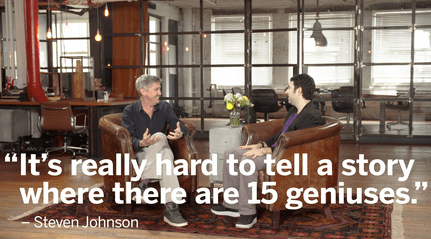
As we likely all learned in elementary school, Thomas Edison invented the lightbulb… right? Sort of, says best-selling science historian Steven Johnson. It turns out that the story of genius is more complicated than we think. Steven sat down with psychologist Scott Barry Kaufman, scientific director of the Imagination Institute, to discuss how creativity, innovation and genius truly happen.

This conversation has been excerpted from the “Open Minds” video series on American Express OPEN Forum®. View the complete video and series for more on creativity.

For more on creativity, view the complete video and series on American Express OPEN Forum.

Steven Johnson: Over the last decade, there has been so much interesting research into our understanding of innovation and creativity. There’s been a lot of debate about the lone genius archetype, where people have a certain essential genius to them, and they isolate themselves and come up with a brilliant idea that changes the world. Is that a myth, or is there some truth to that?

Scott Barry Kaufman: With optimal creativity, you find people switching back and forth between moments of solitude and moments of collaboration. Often you need to give people a chance to have the solitude to reflect on something, to really flesh it out in their own way. Then when they bring it to the table and share it with co-workers, that’s when the synergy happens, and great insights tend to happen. You need both.

Johnson: My feeling is there are important insights that come out of people who are uniquely talented, but we have a warped sense of how important that is simply because the lone genius makes for better storytelling. I wrestled with this a lot.

The history of the lightbulb, for instance—every kid learns that Thomas Edison invented the lightbulb. It’s ingrained in your head as a school kid. But there were 15 different people inventing the lightbulb in the same period of time. Edison ended up making the first commercially successful lightbulb, but the ideas that made a lightbulb imaginable in the first place were very much in a network of people whose work Edison was fully aware of. He even bought some of the patents for some of the work that they’d done. He also assembled a very multidisciplinary team to help him turn the lightbulb into a viable commercial product.

And yet it’s really hard to tell a story where there are 15 protagonists—15 geniuses. It’s so much easier to say, “And there he was, plucky Tom Edison, coming up with this great idea!” We compress the story of genius down into an individual one because it makes for a stronger narrative, when in fact, the most important ideas involve some level of network collaboration.

Kaufman: It’s important to make the distinction between being sociable and drawing on other people’s work. These 15 people that contributed, it’s not like they all sat down at the table together and did it. My argument is more that it’s really important to have that solitude—even if you’re drawing on other people’s work during that solitude—to have that time to synthesize all these different ideas without the pressures of having to on the spot be sociable about it. That’s particularly useful for introverts, right?

Left: Steven Johnson, Right: Scott Barry Kaufman

Johnson: It’s a really important point, and relates, in a way, to one of the things I’ve written about that I see as a misconception about creativity, which is the overemphasis on the eureka moment.

It is absolutely true that there are moments of insight, where an idea seems to crystallize in your head, and often those moments come when you have time to just let your mind network with itself, rather than being out in the world. I think, again, the problem is one of storytelling: “Well, the apple falls from the tree, and oh, he’s got a theory of gravity.” That’s a good story. We like to hear moments of sudden insight or understanding.

If you look at the most transformative ideas, whether they’re commercial, business, technological or scientific ideas, we neglect that they have a long incubation period as hunches, as an intimation that something is interesting or intriguing but you can’t really put your finger on why. One of the defining characteristics of the people that I studied is that they’re very good at keeping those hunches alive for long periods of time and allowing themselves to follow those leads, even though they’re not sure where they’re being taken.

The eventual insight or eureka moment is often a collision between two or three different hunches that belong to different categories that somehow come together. So there are eureka moments. But if you haven’t set up an environment where you give yourself time to cultivate these hunches, you won’t get to that eureka moment. You have to start with that hunch cultivation first.

Kaufman: I have maybe 40 insights a day and 99 percent of them are junk. So just having an insight doesn’t mean it’s going to be a good one. It’s just a process, the way that our brain works. For brainstorming sessions, you allow your workers to go on their own and generate as many ideas as possible with no judgment. You really need to keep the judgment aspect off of that. Then you can bring everyone together and have them share. First give them that process where they can go a little crazy. Nothing’s off the table. Then, of course, you want to hone, but you don’t want to hone at that beginning stage.

Johnson: One thing I think is really fascinating—and it’s been central to your work—is how much recent neuroscience has illuminated how creativity works in the brain, and the imagination network of the brain. This is one of the most important new insights in our understanding of how the mind works in the last 20 or 30 years. It’s all about creativity.

Scott Barry Kaufman, scientific director, Imagination Institute

Kaufman: For a very long time in the field of cognitive neuroscience there was this focus on what’s called the Executive Attention Network. It was really important for focusing on a task, for getting stuff done and implementing. And don’t get me wrong, it is extraordinarily important. Ask anyone who has great difficulty concentrating what that experience is like, and it’s not a great experience. In fact, there is this research at Harvard showing that a wandering mind is an unhappy mind. Being able to control your mind is important.

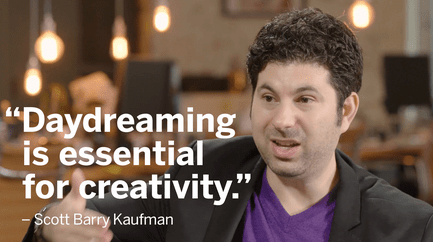
But recently, a bunch of rogue cognitive neuroscientists began asking, “Well, is there any value to your own internal stream of consciousness to be able to daydream, to go inwards, to ignore the external environment?” I think it is a big paradigm shift in the field to have discovered what’s called the Imagination Brain Network, which we activate whenever we go inward; we’re really tied to our deepest passions, our deepest memories, our personal memories. It turns out creativity requires daydreaming on ourselves, in a way. Daydreaming is essential for creativity.

Johnson: A common theme of everything that we’ve been saying is that, in a sense, the creative process is not about one state. It’s the ability to move between different mental states: to have that daydreaming state, and then have that executive function—“I’ve got to get this done, I’ve got to ship a product”—and the ability to comfortably move among them, and also to move between solitude and being social.

The one thing I would add to it is that on some level, there’s a geographic quality as well. There’s a great story about this guy, Frederic Tudor, who basically invents the ice trade. He comes up with this idea before refrigeration, before the invention of freezers, basically carving frozen chunks of water from New England lakes and then shipping the stuff down to the Caribbean or the South in the early 1800s.

Ice becomes the second-largest export in the United States behind cotton. This guy has this genius idea, transforms our economy, becomes a multi-millionaire because of this, and he gets the idea by traveling to the South and to the Caribbean as a 19-year-old who’d grown up in Boston, and he’s looking around in this new environment and thinking, “Wow. There’s no ice here.”

If you lived in the Caribbean in 1800, you would’ve never seen ice. It was just not possible to make ice, and it never got below freezing there. He has this insight: “If I could get ice down to this environment, I could make money. It’s something that’s very scarce and valuable in this environment, and basically free up north.” What’s crucial to this story is that he physically moved, he went from an environment where he had all these expectations about how the world worked, to some other place where the world was different and challenged his expectations. In a sense, from the physical migration from one place to another, the spark of an idea emerged. Sometimes it’s moving from one mental state to another, and sometimes it’s moving from a physical state to another that helps you unlock that creativity.

Sourced from Next Big Idea Club

Sourced from AdAge

TikTok tops our annual list of the top performing brands of the year

The 10 brands that comprise Ad Age’s 2020 Marketers of the Year list didn’t just survive the pandemic, they thrived.

The list is topped by TikTok, which emerged as a major pop culture force and must-stop for an increasing number of brands, including several on our list. That includes cosmetics upstart e.l.f., which had the foresight to jump on the platform back in late 2019 with its 15-second “Eyes Lips Face” song, and has since amassed 10 billion views for its TikTok content. Other new economy brands making the list include meditation app Calm, whose Election Day marketing set a new standard for timely product placement. Online marketplace Etsy smartly tapped into trends like DIY and customizable goods, including, yes, masks.

But breakthrough marketing in 2020 was not confined to plucky start-ups. Stalwarts like State Farm, which is nearly 100-years-old,also cracked the list, thanks to a reinvention strategy that included putting a new spin on its iconic “Like a good neighbour” tagline. McDonald’s, No. 2 on our list, found ways to reach new audiences, including with its wildly successful Travis Scott collaboration.

The list—chosen by a team of Ad Age reporters and editors based on factors that include business results driven by breakthrough advertising and smart strategic thinking–is full of brand marketing lessons, including from an unlikely source: Conservative anti-Trump PAC The Lincoln Project, whose go-for-broke attitude shows that fearlessness is a key ingredient for great creative. “We’re not unemotional about this stuff,” TLP cofounder Rick Wilson told us. “We’re passionate about this stuff.”

No. 1: TikTok

No. 2: McDonald’s

No. 3: Lowe’s

No. 4: The Lincoln Project

No. 5: Etsy

No. 6: Calm

No. 7: e.l.f.

No. 8: Lego

No. 9: Adobe

No. 10: State Farm

Sourced from AdAge

By Greg Tucker.

Surprisingly few companies track the brand loyalty leakage throughout their customer’s experience to learn where loyalty is “won and lost”.

With over $600 Billion spent on advertising to create brand awareness, drive prospect conversion and build customer loyalty, surprisingly few companies track the brand loyalty leakage throughout their customer’s experience with them to learn where loyalty is “won and lost”.

Our customer journey research efforts with global brands covers four key aspects of the “Path to Purchase”:

  1. Marketing / Prospect Leakage – Turning unaware prospects into buyers and minimizing the “leakage” of prospects from the “Awareness-to-purchase” stage
  2. Sales / Revenue Leakage – Ensuring that customers can spend the full amount of their purchase intention during the sales & renewal journey, and that “Revenue leakage” throughout the customer lifecycle is minimized
  3. Customer Retention / Customer Leakage – Ensuring that customers receive the positive experience that will keep them coming back year after year and renewing their purchases with the company and brand. Especially important in B2B contractual customer relationships.
  4. Customer Satisfaction / Loyalty Leakage – Ensuring that customers receive the “on-brand” experience that results in high satisfaction/NPS scores that drives and sustains positive word-of-mouth” marketing.

Customer Satisfaction / Loyalty Leakage

Our customer journey research for existing customers is designed to answer these questions:
• For a customer starting their relationship with us, what is the “typical experience” they receive from start to finish? What is an “on-brand customer experience”?
• What differentiates the “on-brand experience” and the “typical experience” (or the “off-brand experience”)? What differentiates our experience with the leading competitor’s experience?
• What is the impact of our experience on our customer loyalty metric? What could our full potential of brand loyalty look like if we delivered the “most impactful, on-brand experience”?
• What can be done to improve the customer’s experience, the impact on loyalty and on business results? What improvements have the highest impact?

A popular restaurant company asked us these questions and asked us to identify the “Existing Customer Experience” and where it didn’t meet their expectations. Over 25 factors needed to be assessed as part of the experience – food, service, wait times, price, cleanliness, power & Wi-Fi, rewards programs, specials, etc. Several customer segments needed to be engaged across different restaurant formats and across multiple day-parts (breakfast, lunch, afternoon snack, dinner and late-night snack).

Through qualitative, quantitative, ethnographic, biometric and eye-tracking research, it became clear that the current customer experience was solid, but not stellar. And customer loyalty scores trailed the leading competitor by a wide margin.

The insights that emerged included:
• There were 8 stages of the customer experience journey – and 20 friction points were encountered along the journey – well-known to the restaurant employees – but not prioritized or proactively managed on a systematic basis
• Many of the 25+ factors that were studied had little impact on the customer experience. They weren’t relevant to being “on-brand”.
• There were 4 “moments of truth” along the journey that defined the overall experience. Getting these 4 things right resulted in an outstanding “on-brand experience” – getting them wrong resulted in an “off-brand experience”. 90 points of customer loyalty (NPS) were “leaking” out of the customer journey through a failure to proactively manage these 4 moments of truth.

Linking these insights to business results allowed us to model and quantify the following:
• Focusing on delivering an “on-brand experience” in the 4 key areas (out of 25+ potential areas) of the customer experience results in an industry-leading customer loyalty result, with a measurable and immediate NPS improvement.
• This impact had a 30% improvement in customer lifecycle revenue, based on visit frequency, increased spending per visit.
• Improving the experience would allow the company to expand its customer base within the family members and their friends, making new customer growth faster and less expensive.

By Greg Tucker

Greg Tucker is a Who’s who of Customer Experience and award-winning CX practitioner, advisor and leader for more than 15 years. As CEO of Tucker & Company he consults to Fortune 1000 enterprises and emerging companies on Customer Experience strategies and programs, delivering transformational business results. As a CX Officer and CMO at Copart Auto Auctions, he implemented an end-to-end CX program across all channels that delivered a 20% improvement in Enterprise profitability and received the 2012 CX Innovation Award for delivering a powerful ROI from the CX Program.

Sourced from The Customer