A quick guide to spotting issues with privacy laws.
Privacy law is growing and evolving at a rapid pace. It can be overwhelming even for practitioners specializing in privacy to keep up with the changing requirements and even more challenging for law students or attorneys specializing in other areas of law. To help you identify which privacy laws apply, I ’ve come up with an alliterative privacy issue-spotting mechanism: “the four Ps of privacy.”
The “four Ps” also serve as a useful tool for practitioners and organizations to ensure they are conducting a complete evaluation of relevant privacy issues to learn whether privacy laws are implicated and determine the scope that privacy counsel should consider and apply. Evaluating the four Ps of privacy is also a process I recommend my law students to follow when attacking their final in my privacy law class.
The four Ps of privacy are people, places, platforms, and purposes. Each one is covered in more detail below.
People
With very limited exceptions, privacy laws only apply where human people—natural persons—are involved. Typically, these people must be identified or identifiable by some means on an individual level to implicate privacy laws. If people are not involved, privacy laws are not in play.
If it turns out people are involved, there is a two-pronged assessment within this “P.” The first assessment involves what type of people are within scope, both on their own and in relation to the entity collecting their personal information. Employees? Customers? Prospective employees or customers? Patients? Website visitors? Adults? Children?
Second, what categories of personal information are being collected from or about these people? Names? Social security numbers? Fingerprints? IP addresses? Different privacy obligations apply to different types of people and the categories of personal information processed. Those requirements change further depending on how the remaining Ps come into play.
Places
Geography, or “place,” plays a crucial role in the application of privacy laws. Privacy laws typically apply to residents of the jurisdiction where the privacy law has been passed. Still, some privacy laws cast a wider net and reach beyond their territorial borders. Much attention has been paid to privacy laws coming from places like California, Brazil, and Europe because of their broad potential geographic scope. Knowing the locations where the people involved live, work, and, potentially, travel will identify the geography-specific privacy laws that should be evaluated.
Platforms
The mechanisms that are used to collect, store, or share information can alter privacy obligations. There are several privacy laws that only govern certain platforms, such as websites, phones, cameras, Internet of Things devices, and vehicles. Additionally, the owners of certain platforms such as mobile app stores and social media networks have imposed specific privacy requirements on their users.
Purposes
Finally, the purposes for which information is being processed will round out the privacy identification process. Is the collected information being used for advertising? For treatment? For security purposes, such as to verify someone’s identity? The purposes of any personal information collection, use, and sharing, can trigger additional legal obligations.
Four Ps in Practice
The four Ps can help companies gauge overall privacy compliance or assess compliance obligations when they undertake new initiatives that implicate one or more of the four Ps. So, how does this work in practice? Say, for example, a brick-and-mortar retailer in Buffalo, New York, wants to set up a website to sell its merchandise and wants to start sending marketing emails to its customers. The company is based in New York, but its brick-and-mortar customers may be from other places, like Canada or Pennsylvania since the company is setting up a website that may sell merchandise to other jurisdictions. The people newly within the scope of this company’s potential privacy obligations are website visitors and customers. The platforms being added are a website and emails. Finally, the purposes of the website and emails are to facilitate e-commerce transactions and potentially to track individuals who access the website or open the emails and to market to them.
Going through the process of assessing the four Ps will set the company on the right path to identifying and evaluating the specific privacy laws it needs to consider as it undertakes new initiatives.
By Starr Drum
Starr Drum is a shareholder with Maynard Cooper & Gale in Birmingham, Alabama.
Emotional design can seep into every level, be it a logo or the offline and online packaging, of any brand. As human beings, we respond to humour, love, pain and a plethora of emotions.
Good design has two layers: aesthetics and functionality. However, great design happens to have an additional facet to it, empathy. The emotional element of designing is rarely thought about, be it on the part of marketeers or designers. Creating catchy looking collateral and content for brands thrives on a single, detestable word – VIRAL. Unfortunately, this ugly V word is often mistaken to be a tool that builds rooted connections with its users when it’s actually far from it.
With expanding channels that allow brands to connect with their user base, brand owners and marketeers currently face a challenge they had never envisioned. In order to ensure brand visibility and find a place in the target audience’s mind, they need to constantly create and push out fresh content aggressively in order to stay relevant. Be it videos or posters, brochures, infographics, reels or G.I.F’s, nothing seems ever enough! The brand owners straddle a thin line where on one hand, they need to have a social media presence that reflects what their brand stands. On the other hand, however, they don’t want to create brand saturation either. From the brand owner’s perspective, the question of how much brand content is enough brand content, is a tough nut to crack. As for the user, most of brand content often feels like stale leftovers. Having been recycled and reheated many a times, for the user, most of these brand content simply seems like a rehash of the latest viral trend – oh no, not this again!
User Experience designer, Aaron Walter, in his book ‘Designing for Emotion’, talks about how emotional experiences imprint on our long-term memories. Designs have the capability of creating experiences where the user feels like their interaction with the brand is grounded in shared human interest as opposed to the mechanical feeling of interacting with machines. Don Norman, the author of ‘Emotional Design,’ breaks down his approach to creative design into three stages: building the appearance of a design, perfecting the way it works and lastly amplifying the long-term impact. It is in these core basics where most brands fail. Brand owners, marketeers and design agencies these days are so busy creating as much content as quickly as possible that they forget how unsustainable this whole vicious cycle gets. If anything, we need to evaluate and evolve the manner in which we measure the impact of digital branding, stepping away from number of views and clicks. Being able to create designs that allow users to be introspective, become aware of unhealthy social patterns, uplift moods or create a call for action for social causes, are the kind of meaningful experiences that helps a product or a services crossover from being a brand to becoming a part and parcel of the community.
Emotional design can seep into every level, be it a logo or the offline and online packaging, of any brand. As human beings, we respond to humor, love, pain and a plethora of emotions. Hence, a design can reach its fullest potential by being, not merely functional but also emotionally stimulating. The #likeagirl campaign by Always won an Emmy, a Cannes Grand Prix award, and the Grand Clio award not because it wowed the panel with its CPC value. 2017’s App of the Year Calm, is a product that cracked emotional design to the T. Designing with emotion reinstates the awareness in the user that the brand is genuinely invested in their growth as opposed to treating them as mere numerical targets. By daring to go beyond numbers and projections, these well-designed campaigns have added substance to their brand identity.
Simply put, as a brand, you have to look at the concept of success in long term perspective. By rising above immediate buzz, it becomes critically important that each element of your brand, be it your website, an advertisement or an entire ad campaign is a building block to your brand’s identity as well as longevity. To build meaningful relationships and interactive communities through a brand, what one needs is not design that is VIRAL, but design that is actually HUMAN.
My warm New Year’s greetings to all local business owners and local SEOs reading my column today. Add to this my sincere sentiments of solidarity for what we went through together in 2020 — we won’t soon forget it, and our stories from the journey contain important teachings for our market and industry.
I often find that the best local SEO takeaways sprout from the real-world anecdotes of colleagues and friends, and you’ll find those here today along with my personal predictions for the year ahead. Let’s get learning!
Teachings from the real lives of local SEOs
In a year when we were physically distant from one another in unprecedented ways, I’ve found memorable lessons in how local business owners broke down barriers to keep communities connected. I asked four wonderful colleagues to share a personal anecdote with me about a local business they transacted with, both prior to and during the pandemic. As you read these brief stories, see if you can identify six common threads running through them.
“One of my favorite businesses that I have used before and during 2020 is Pete’s Diner. I first found out about them by driving by, but they have been in the community for decades.
Before the pandemic, my husband and I would have breakfast with his parents every Saturday at a different local restaurant. It became one of our regular breakfast spots because their food is great and it’s pretty close to our home. They also carried a hard-to-find, high-quality olive oil that we would buy in large quantities while we were there.
During the pandemic, we decided to do our best to continue to support local businesses. Pete’s really has adapted to the current climate by offering online ordering and delivery without raising prices significantly or compromising on the quality of their food. Moving into 2021, I recommend that local businesses continue to offer delivery and online ordering even after the pandemic is over. Use Google Posts to keep customers up to date on specials or new services and products.”
“I discovered my favourite Vietnamese pho restaurant three years ago. I was on the hunt for something that was close to my home, was family-run, and that had an amazing Vietnamese bone broth noodle soup that would remind me of my childhood (my family immigrated to Canada from Vietnam).
Like many SEOs do, I found it through Google Search. I always check Google reviews to see what a company’s online reputation is. The first time I stepped foot in their restaurant, they recognized that I was new. They took the time to explain their business and tell me their most popular dishes. They took the time to build a personal relationship and rapport with me by asking my name and sharing theirs. It felt like there was a real personal touch. And of course, the food was amazing, the service was quick, and they topped it all off with complimentary dessert. I was hooked!
I’d been going to this pho restaurant weekly — that is until the pandemic hit. I didn’t visit them for a little over three months when lockdown first went into effect. But when I did, I was so happy to see that they had implemented all of the necessary health precautions to make their customers and staff feel safe. I noticed a huge influx of takeout orders.
I think my best local marketing advice for 2021 would be to take care of your customers! Listen to them intently and go over and above what you typically would. Treat every single customer like they’re your family and they will feel the love! Don’t expect anything in return, and you will be rewarded when you least expect it!”
“There is a local cafe/coffee shop near me that I would frequent, especially for their homemade doughnut Fridays. The proximity of the location (two blocks away), the quality of the food, and the customer service made me a repeat customer.
The business was quick to offer delivery (even for two blocks away), which has been amazing — who doesn’t want Irish coffee and fresh doughnuts delivered to their door on a Friday morning? They’ve added other fun takeaway options, too, like bake-your-own cookie dough, meals, and a Thanksgiving pie and beer collab with the brewery down the street. Think outside the box and don’t be afraid to pivot. Focus on customer service and your customers will stay loyal.”
“Some might argue that Wegmans, the northeast grocery chain, has a cult following. It’s easy to understand why. I first discovered the store from my father. He raved about the way they had special baked goods, quality produce, and an assortment of branded products. I was living in New Jersey at the time, and I was hooked after my first visit. Maybe it was the takeout sandwiches, the fresh sushi, or the large and open layout of the store — and it didn’t hurt that they were about five minutes from my apartment at the time.
Since then, I’ve learned more about the brand and appreciate their philosophy: ‘Employees first, customers second.’ I want to go to a store that takes care of their employees. They’ve even invested $5 million dollars in employee scholarships. How cool is that?
In 2020, they adapted to the pandemic by being one of the first grocery stores to implement mask policies, glass splash guards, and social distancing. They increased their employees’ wages in March by $2.00, and had hand sanitizer at entrances very early on. If I had to give them one piece of local search marketing advice, I’d recommend utilizing Google Posts more frequently. Adding a post once every couple of months is better than nothing, but it’s such an opportunity to attract more customers to their grocery stores.”
Did you spot the commonalities in the four stories? When I distil them down into local SEO themes, here’s what I see:
1. Essential local businesses take pride of place
When I asked for a story about a favourite business, Amanda, John, Niki, and Garrett all chose an essential business — a restaurant or grocery store that fed them! Eating is the most fundamental of all activities, as recent times have highlighted for us all. One of my major takeaways from 2020 that I’ll be bringing with me into 2021 is that operating an essential business which fulfils the basic structural needs of a community is the wisest entrepreneurial strategy.
If you’re adjusting your business model and its inventory, opening a new business this year, or advising local entrepreneurs, learn to map community essentials and create a business plan that puts basics before luxuries.
2. Local business discovery is multi-channel
Getting found is the preliminary step to every local business transaction:
Amanda found a restaurant while driving
John looked at Google listings and reviews
Niki needed a spot in close proximity to her workplace
Garrett heard by word-of-mouth from a family member
Being there for the customer means being discoverable both online and offline, via vehicle, foot traffic, web-based local business platforms, and by word-of-mouth recommendations. Your visibility strategy for the year ahead needs to cover all these bases.
3. Local businesses can deliver multiple types of value
The local businesses you’re marketing have the best chance of success if you can unlock the secret of what patrons value most. These examples abound in our four anecdotes:
High quality — clearly, all of these foods are extra delicious!
Convenience — everyone wanted something nearby.
Brand affinity — John wants a family-owned business, Garret wants employees to be cared for, Niki likes businesses that partner up with one another, and Amanda likes a brand that maintains quality without raising prices too much.
Brand adaptability — all four brands made safety adjustments to keep serving the public.
This year, find out what your customers and potential customers value most, and make common cause with them.
4. Pandemic adaptations drive loyalty
The four businesses our contributors highlighted are successfully weathering an incredible storm via the praiseworthy changes they made to keep serving the public safely, like:
Implementing new sanitary policies
Implementing digital commerce
Offering home delivery
Doubling down on takeout service
Increasing employees’ wages
Trying new things, like meal kits
Forming new cross-sales partnerships with fellow businesses
Taking maximum safety precautions, delivering at the curb or the front door, facilitating online purchasing, and experimenting with new ideas are all must-haves for 2021.
5. There’s even more that good local brands can do
I asked our experts what they’d suggest if they could offer once piece of local SEO advice to their favourite businesses for 2021. They recommended:
Maintaining all new sales and service channels, even after the hoped-for end of COVID-19.
Making consistent use of Google Posts as a communications channel.
Listening intently to evolving customer needs.
Putting customer service at the centre of everything.
Making customers feel loved.
6. The most important local SEO factor is the human factor
These are the parts of the stories I like best, because they show businesses making us feel less alone, despite our necessary distancing.
Amanda found a place a family feels so welcome, they made it a regular multi-generational hangout.
Niki found a place that added a sense of fun to life with their creativity.
John found a place that not only served a beloved dish from childhood, but where the staff took the time to build a personal relationship with him.
Garrett found a place where he can feel good shopping because they take genuine care of their staff.
Philosopher Thích Nhất Hạnh might say that each of these businesses found a way to shatter the illusion of separateness, in the midst of a pandemic, by making each of these patrons feel like valued members of the community. Any local business you market in 2021 can definitely do the same.
My own local SEO predictions and tips for 2021
Here we go!
1. Your local business website will be more essential than in any previous year
It’s hard to believe that just three years ago, I felt compelled to publish a piece on why you still needed a website, pushing back on the narrative that the amount of zero-click-type SERPs was making websites irrelevant. Nobody can claim this in 2021, and recent stats from Moxtra’s Small Business Digital Resilience Report make the “why” of this clear. Consider:
66% of respondents say the pandemic made them more likely to do business with SMBs in the future (and I’ve seen higher numbers than this in other surveys).
But, 2020 saw 30% growth in consumers requiring that digital capabilities be present to facilitate transactions (think e-commerce and tele meetings).
And, 84% said if these capabilities were lacking, they’d consider looking elsewhere for a brand that could serve them online (84% is a huge number!).
Local digital sales are where it’s at in 2021, so finding the best possible e-commerce provider should be the top priority for all relevant brands. Don’t worry too much about zero-click SERPs this year. Yes, Google has its shopping engine and has even ramped up its “nearby” filter in 2020, but focus on pulling in every bit of traffic you can to your website’s own shopping cart this year. This goal will build stronger-than-ever bridges between local and organic SEO, so this is the time for local-focused agencies to double down on organic skills.
I’m also watching with interest the rise of medical devices and apps that monitor heart rate, blood pressure, and other vitals. There’s a telemedicine revolution going on, which should seep into other professional services that could improve customer convenience via secure tele meetings, any time face-to-face appointments aren’t essential.
Has anyone ever really enjoyed sitting for hours in a waiting room to speak to an accountant, a consultant, a banker? I don’t think so. In 2021, websites for professional service providers should be optimized to drive online bookings for as many remote meetings as possible.
2. The triumphant return of the milkman and the everything-delivery person!
What I find absolutely key to this story is that Alpenrose is managing delivery in-house. They aren’t outsourcing to a third party and losing something like one-third of their revenue. If a local business you’re marketing can deliver, it definitely should.
Further, I’d urge digital marketing agencies to have vital conversations with clients in Q1 about the problems inherent in outsourcing customer experience to a third party. As I’ve learned from both restaurateurs and grocers, it’s generally too costly and too risky to let another company get between you and your customers. This means that a key problem to solve in the year ahead is the employment and transportation of in-house drivers.
“Oyster man. Oyster manny-manny-manny!”
A vintage cookbook tells me this is the song residents of mid-century New Orleans heard each day as a seafood wagon came down their streets. When I look through and beyond 2021, my best inspiration comes from examining the past, with its bountiful produce trucks making rounds, and ladies coming onto porches to purvey gumbo file powder. Ask your elders for reminiscences to inspire 2021 opportunities, because everything old is becoming new again, and whenever I ask around, customers who have gotten a taste of home delivery want it to continue beyond the hoped-for end of the pandemic.
But here’s one problem I need help to solve: If I’m predicting the continued expansion of delivery, and I’m looking back in time, I see lots of households with somebody available to accept perishable orders. In June of 2020, 42% of the US workforce was working at home, but if and when we return to formal workplaces, who will be in situ to bring in the meat and dairy before they spoil?
Will the return of the milkman necessitate the return of the outdoor icebox, or at least some form of it, like a fridge on the porch, a cooler the driver knows to fill, an apartment complex cold case? Inventors, please speak up, because there’s just no way I’m going to let Amazon into my house.
3. My tossed salad of local search marketing predictions
So, solving for local digital sales and delivery are the two biggest stories I’m focused on in the year ahead, but here are my mixed greens of other developments I think we’ll see in the next twelve months:
1. Google’s Core Web Vitals is coming, and it will be felt on local business shores. But the truth is that — as recently as 2019 — one-third of small businesses still reported having no website at all (hence, nothing to optimize for Google’s latest initiatives). While local SERPs make it clear that it’s quite possible to rank a site-less local business in even moderately competitive packs and finders, 2020 turned the lack of a digital presence into a dire disadvantage for the smallest brands. Even a free website will be better than nothing in the year ahead.
2. Google will push harder on Google Messaging, and brands and agencies will need to decide whether to invite them into customer communications to this degree. If Google Messaging ever fully takes off, I wouldn’t be surprised to see Google sunset Questions & Answers as a result.
3. Google’s purchase of Pointy should start to surface more clearly as key to their strategy for a local transactional future. I strongly believe Google’s greatest growth potential lies in facilitating local online shopping through a mapped interface, and I’m expecting their game plan for this to be more obvious by the end of 2021.
4. Reviews will continue to be absolutely central, but unless Google does something more about vetting the quality of reviews and Q&A responses from its Local Guides program, searcher experience will suffer. We won’t see a massive erosion of trust to threaten Google’s review dominance in 2021, but review spam and poor content will continue the confidence leak at a slow, aggravating trickle unless Google plugs it up.
5. If Apple launches its search engine this year, the local SEO industry’s necessary hyper-focus on Google could see some welcome variation. Moz Local already distributes to Apple Maps, so if you’re a customer, you’re ahead of the Apple game, but coverage of optimizing for Apple search will deserve your closest attention to be an early bird.
6. The rise of Nextdoor for local business visibility will hit a new high, and hopefully prompt the company to start developing more agency-friendly solutions. Nextdoor is the structured citation platform in which I’m most interested for the new year, and Moz Local now offers a top tier plan with a solution for agencies to help get all their clients onto Nextdoor (a function that’s absent from the platform’s own interface). Watch the Moz Blog for further coverage this year!
7. Local medical and personal service providers may need to expand hires (at least temporarily). Once a truly successful COVID-19 vaccine has been widely implemented, expect a glut of bookings from clients who have put off all kinds of appointments during lockdown. Now is the time to investigate good booking software and also evaluate Google’s options for this, because online reputation will be impacted by the ability to see clients in a timely manner once it’s safe to do so.
8. Public-brand affinity will set conscientious local businesses apart. Centering deep concern for whatever your local public cares about most will be increasingly important in the coming year. Whether through brand activism or allyship with major movements like Black Lives Matter or climate change addressal, or diligent support of local programs to alleviate poverty or increase diversity, equity, and inclusion, company reputations will become further tied to actions for the common good.
In summary
I’ll sum up by saying that there’s never been a tougher year than 2021 for making marketing predictions. After all, how many of us foresaw the harsh realities of 2020? But, as I look to the sunrise of a vaccine, and couple this with multiple polls indicating just how strongly the public wants to support local businesses, I think there’s both reason for optimism and genuine opportunity ahead.
2020 reminded us of just how interdependent we all are, for the basics of daily living and for human support, encouragement, and hope. Everyone benefits from inhabiting well-resourced, sustainable communities and if your brand or agency can help with this, the future belongs to you.
Apple’s game-changing new privacy move is great for users and bad for data collectors such as Facebook. And it could spark a serious new problem, according to reports.
After Apple announced iOS 14 last year, firms including Facebook were up in arms. Their issue—a game-changing new iPhone privacy feature which would essentially signal the end of the so-called identifier for advertisers (IDFA).
So much was the resistance to Apple’s new anti-tracking feature that the iPhone maker delayed it when it launched the rest of iOS 14 in September, to give developers more time to adjust.
But the feature is still on its way in an upcoming update of iOS 14, and it could mean app developers find new ways of tracking you, despite the fact it could get them thrown out of Apple’s iPhone App Store.
Developers say they will try to circumvent the iOS 14 privacy change
The confirmation comes after an article in Ars Technica, which quotes several app developers who say they will try to circumvent the iOS 14 privacy change. Device fingerprinting—which correlates factors such as a device’s operating system, browser version and type, language and IP address to identify it—is one method being considered, a mobile games developer told the site.
This goes against Apple’s guidelines, which state in answer to the question “Can I fingerprint or use signals from the device to try to identify the device or user?”:
“No. Per the Developer program License Agreement, you may not derive data from a device for the purpose of uniquely identifying it.”
Worryingly, the article states that some developers plan to use methods such as this even if Apple users deny access to the IDFA.
It comes as Facebook finally yielded to Apple’s anti-tracking changes, saying people have no choice but to follow the new rules. Facebook placed full size adverts in several newspapers last year criticising the iPhone maker.
Apple app developers—”between a rock and a hard place”
In some ways, it’s understandable that developers are desperately looking for new ways to recoup lost revenue in the lucrative iPhone advertising market. “App developers are stuck between a rock and a hard place,” says Jake Moore, cybersecurity specialist at ESET.
“They need to make an app functional and secure and yet there is always a major push to make such apps track. IDFA tracking without explicit user consent has been the backbone of modern-day advertising and is worth billions of dollars so when privacy updates are instructed by Apple, it is inevitable that some developers will seek to avoid these new measures.”
Sean Wright, application security SME lead at Immersive Labs says because developers rely on advertising as a means of generating revenue from their applications, it’s no surprise the proposed changes from Apple “aren’t too popular.”
What Apple users should do
Bad practices such as fingerprinting are against Apple’s App Store rules, but Wright says it’s important how the iPhone maker enforces this. “It’s a question if this will be something they can enforce via technical controls or instead rely on users reporting violations.”
So what does this mean for iPhone users? Wright says the best way to avoid device fingerprinting is to have similar settings to other users, so it’s hard to identify your device. Of course, this isn’t easy to do, so Wright also advises Apple users to look to paid alternatives instead, “since they would not tend to rely on advertising for revenue.”
As Apple’s anti-tracking changes draw near, iPhone need to be prepared. One thing you can do now is use my guide to turning off the ability for apps to track in your settings. More generally, make sure you trust the developers who make your apps. Use the app privacy labels and manage your permissions carefully.
In the meantime, why not have an app clean up on your iPhone, deleting anything you don’t use. When you download new apps, paid for services may be safer. After all, nothing is ever truly free.
Feature Image Credit: Apple’s game-changing new privacy move is great for users and bad for data collectors such as Facebook. And it could spark a serious new problem, according to reports. SOPA Images/LightRocket via Getty Images
I’m a freelance cybersecurity journalist with over a decade’s experience writing news, reviews and features. I report and analyze breaking cybersecurity and privacy stories with a particular interest in cyber warfare, application security and data misuse by the big tech companies. In addition to Forbes, you can find my work in Wired, The Times, The Economist and The Guardian. Contact me at [email protected].
A strong social media presence is the foundation from which you can build a world-conquering brand.
As per the Digital 2020 July Global Snapshot, nearly half of the world is on social media. Today, to build a personal brand, there’s nothing quite like social media. The potential audience and exposure that the platform can generate would be unimaginable to yesteryear’s advertising and marketing teams.
Through social media, brands can connect and interact with their audience on a sincere and personal level. In turn, this creates customer loyalty, generates leads, and provides the sort of marketing and advertising money cannot buy.
Social media creates its momentum and can take what once was a niche brand and make it a household name. Here are three reasons why social media has become the most formidable and powerful tool any person can leverage when building their personal brand.
Social media adds an air of authenticity to your brand
In a digital landscape where everyone is jostling for attention, it’s becoming increasingly difficult for any brand to stand out. The biggest compliment any audience can give you is to believe in your brand. They will only do this if you’re an authentic and genuine article. “Once you have authenticity on social media, the world is your oyster,” shares wealth coach Rob Coats, founder of Connect and Grow Rich Consulting Agency. Coats made his name on social media through positivity and perseverance. “People tend to follow me on social media because I break it down in simple terms how they can generate wealth, and I make their financial goals tangible,” Rob continues.
He further adds that you should steer clear of bluff or bluster to gain your followers’ trust on social media. “You have to be honest on social media, or you’ll be called out as a fraud,” he explains.
Social media elevates your brand into a way of life
Social media is a place where people who share similar lifestyles connect and broaden their horizons. Lifestyles are a tangible commodity and encompass a broad spectrum. Social media can document a lifestyle like no other medium. Founder of TripleOne Inc, James Awad, who lives the sort of lifestyle that many entrepreneurs endeavour to emulate, uses it as an example of what his social media followers can achieve if, in his words, “They commit themselves to their passion and leave no stone unturned to master it.”
He explains, “With the rise in social media usage, individuals, as well as brands, must figure out what cult they want to build around themselves and then work harder and be more innovative than anyone else.”
Social media gives your brand worldwide exposure
The most dynamic thing about social media is its reach. It is a platform where ambition can truly thrive. In today’s world, you do not need a marketing firm or team of advertisers to make your brand a global one; you need to be social media savvy. Above all, social media is a level playing field. It doesn’t care where you’re from or what you’ve done; it just cares about where you’re at.
“Social media offers everyone a chance to make it big,” shares business coach Julian Kuschner. The millennial mentor knows all about having his back to the wall. He has survived getting kicked out of college and being fired from a series of dead-end jobs and came out the other end as someone who has achieved great success on his own terms. Julian now inspires others on social media to find the inner strength and resolve needed to build a successful business.
He explains, “Social media has given me an opportunity to help people all over the world. More and more people are financially struggling than ever before, but I believe it’s not so much the struggle but how you respond to it. Through social media, I aim to inspire people to stay positive, stay strong, and rebuild one step at a time.”
Have you ever wondered howI influencers are able to afford all of those designer clothes and extravagant trips? Well, tax deductions might have something to do with it.
“I was today years old when I realized YouTubers do clothing hauls on their channels so that they can write off the clothing on their taxes,” she said in the video. “They literally get all this cool [clothing and] make a video of it so it’s considered work and then they get to write it off. THAT’S SO COOL!”
This might sound too good to be true, but Holmes is right. According to tax advisor Handy Tax Guy, all you have to do is prove that your clothes are necessary for “accomplishing your job as an online influencer” in order to write them off as a business deduction.
That’s not the only thing influencers can write off when they’re doing their taxes, either. Travel expenses like transportation and lodging can be considered essential for an influencer, which makes them a tax write-off. Prizes used in giveaways, charitable donations and meals eaten while discussing work can also be written off as business expenses. For bloggers and influencers, the list of write-offs is seemingly endless.
On Holmes’ video, many influencers noted that the amount of things that can be written off during tax season is “insane.”
“And as a travel content creator I get to write off my travel,” travel blogger @whereintheworldisnina said. “And lots of other stuff!”
“Being a small business owner has its perks,” another person added. “I write off my entire house mortgage because my office is in my basement.”
Other people who aren’t as familiar with the business of being an influencer were just plain shocked.
Before you make a YouTube channel just to get “free clothes,” you should consult a tax expert to learn more about how write-offs work. Write-offs lower your taxable income, thereby lowering how much you owe in taxes. At the end of the day, you will still be paying something for those trips and clothes.
Every entrepreneur is after two things: exposure and profit. As the co-founder of multiple million-dollar companies, I can fully appreciate the power of networking and have gone as far as closing high-ticket sales through a single social media message. Here are some tips for networking effectively:
1. Create a personal brand.
What all of my businesses have in common is that they are focused on personal branding for individuals and businesses. With the rise of social media, having a rock-solid personal brand has become absolutely essential across the board. Getting prestigious mentions, appearing on Instagram and Facebook lives to share a message and engaging with one’s followers are the keys to success in 2020 and beyond.
The importance of having a credible personal brand is so that people can see your creativity, vision, consistency and reputation when they go to your profile. If you’re putting out consistent brand content with the angle you want to work on, it’s much easier for influencers to take you seriously and eventually work with you. Your personal brand goes far beyond entertaining or informing your followers. It’s your own personal billboard.
2. Reach out on social media.
Through my latest venture organizing celebrity loop giveaways, I’ve had the opportunity to work with some of the world’s most renowned names, such as artist Snoop Dogg, comedian Kevin Hart, actress Bella Thorne and more. My way of going about sales is quite unconventional. I often “slide into the DMs” and make conversation that then grows into a sale.
While some say sliding in DMs is risky, I abide by the phrase “no risk, no reward.” If you aren’t willing to take risks in business, you need to honestly ask yourself why. Obviously don’t go and DM Drake hoping he will save your company, but you need to assess if the risk is attainable based on your skill set and brand. Start small and slowly work your way up.
3. Communicate to negotiate.
I’ve always been drawn to high-profile people. Money aside, I love their motivation and mindset. Since I share the same mindset, it isn’t hard for me to establish a connection. We always mutually benefit one another. In business, everything is a two-way street. Communication and negotiation are crucial.
The best way to negotiate is to figure out what the other person wants most out of the deal. Once you figure that out, you can then present an opportunity that’s valuable to them. It’s not about the cost; rather, it’s about how much value you can provide. What can they gain? How can you provide for them? Answer those questions, and you will be a master negotiator.
4. Be enthusiastic and put in the work.
My secret to networking isn’t all that secretive, after all. I simply approach everyone with a genuine attitude and enthusiasm. I back up this enthusiasm with a relentless work ethic because dreams alone don’t work. I put a lot of work into the process and do a lot of research into the celebrity, their team, and their management. Then, I tailor my pitch and send it off to the team. These are the fundamental steps of the process that I follow each time. I want to pioneer the industry as a leader, and one aspect that is crucial to me is that my team and I uphold the values of hard work, networking and showing up with enthusiasm on a daily basis.
As one of my best clients, Ricky Carruth, would say: “Relationships over transactions.” I’m not in this business to take advantage of people, but I’m in it to help others. Where can I provide value? How can I get everyone satisfied with my output? When you ask those questions, you will be setting yourself up for success.
Placing a heavy focus on minimal details such as a varied colour palette and direct typography, United Sodas of America takes a different path to packaging design.
When it comes to packaging, most designers tend to zoom in on the details, looking endlessly for an illustrator to work with, or an inventive approach to its labelling, maybe – or even an extra bold typeface to catch someone’s eye off the shelf. It seems little attention is often paid to the actual vessel, an element thought of as a non-negotiable factor handed over from the manufacturer. Yet the newly launched United Sodas of America pushes against this design approach, surprisingly placing its can’s shape centre stage and in turn making the everyday become iconic.
The result of over two years worth of work by Brooklyn-based brand design company Center, the design approach for United Sodas of America is built around the idea of reinventing soda and an audience’s initial perception of it. Beginning by studying and visually riffing off the name provided – as well as the brief’s leading question: “What if soda was invented in 2020?” – the agency’s founder Alex Center notes that the team (made up of Kevin Batory, Ashleigh Bowring, Pete Freeman, Andrew Galloway and Alex himself from Center, and Marisa Zupan and Kate Reeder from United Sodas) first identified soda as “a classic American beverage”. Therefore in its attempt to reinvent it aesthetically, the agency and brand should purposefully “embrace that, not avoid it,” he tells It’s Nice That. Center’s focused on the idea to add very little to the can visually, creating a minimalistic identity that manages to retain the same nuanced detail of its neighbours in the fridge.
The most obvious design decision when looking at Center’s approach is the colour palette used, again a concept driven from the product’s name. The inclusion of a 12 colour rainbow-like selection is a purposeful step away from the red, white and blue we often associate with the US, developed from the team feeling that “in a world that sees just red and blue, variety unites,” explains Alex. Collectively believing in this concept also led United Sodas of America to launch with 12 available flavours, and include one of each in their flagship variety pack. “That’s not normal for a beverage company,” adds Alex. “So that’s why the brand is so colourful, because the idea is that within the range of flavours, everyone is going to find one that speaks to them. A flavour for every flavour, if you will.”
Despite its simplicity, deciding upon this unified yet wide ranging colour palette took the team’s time. As Alex points out: “With a brand that is as minimal as United Sodas, all of the details needed to be perfect”. Beginning by tracing back the approaches of great American midcentury colour masters and colour field painters, including Ellsworth Kelly, Clyfford Still, Helen Frankenthaler and Mark Rothko, Center’s team aimed towards utilising colour as “a way of creating deeper meaning” as these artist had, referencing their colour palettes as a starting point.
More specific shades were then selected when it came to assigning colours to flavour, an approach which suitably “thought beyond just ‘the colour of the fruit’,” says Alex. Referencing not only flavour but wider ingredients, personality and a feeling, each comes together “in a tone that created an entire immersive experience, a flavour world,” he continues. This was also inspired by how the painters mentioned often made their own paints. “Clyfford Still used to mix them in his garage, Frakenthaler added extra oil to get the paints to mix with the canvas, creating a more complex tone,” points out Alex, “so, of course, a simple ‘blue’ wouldn’t do it for sour blueberry!” Each of these careful decisions add nuance to United Sodas of America’s branding, and is an area Center will continue to explore, “with more visuals, copy and sounds that make each a complete sensory experience.”
Aside from colour, the beverage’s branding is then brought to life through typography. The decision to use Klim Type Foundry’s Founders Grotesk as the main brand typeface was driven from a want to “feel unbranded”. Founders Grotesk offers “just the right amount of trustworthiness and directness but also some quirk to it,” says Alex. “It’s matter-of-fact and informative at times, and humorous at others.”
With United Sodas of America now launched in a design style which utilises minimalism “to represent the idea of a new America,” Center’s branding has piqued the interest of many with its unique approach. Reflecting on this, Alex adds: “The reaction has been truly everything we could have hoped for, and more,” he tells us. “We’ve been working on this project since we launched the studio in 2018 and have been itching to get it into people’s hands ever since.” For the founder, it’s been an additionally rewarding experience, given his background of working at Coca-Cola and across the wider beverage industry. “To go out on my own and put together a team of amazing humans that are building this iconic brand, I’m just so insanely proud.”
It’s that time again, when we look back at the agencies, the brands, the organizations, movements and trends that have shaped the past year. In 2020 – a year so many of us would like to forget – our industry of problem solvers proved time and again that they have what it takes to muck in, help out, ask questions, shape cultures and change the world. It is them that we celebrate in our New Year Honors.
Lockdown has been a lucky break for TikTok. The short-form social video platform has seen its growth catalysed and its place in the cultural zeitgeist secured, while successfully pursuing advertisers’ budgets in straitened times.
While many expected TikTok to have a decent 12 months (we included it in last year’s New Year Honors after it took pole position as the youth social platform of choice and somersaulted creators such as Lil Nas X to the top of the charts) few would have predicted the highs and lows the platform has faced this year.
This year, big brands chased young users making a home in its endless archives of short-form films. While they’re still experimenting with how to engage with TikTok users, it has begun to siphon off spend from more established channels and will continue to do so, with a Kantar study finding two-thirds of senior marketer planning to increase their spend on the app next year.
TikTok has been proactive in encouraging that migration, launching its TikTok for Business portal in the summer and touting its ability to help place advertisers right in the thick of its rapid-fire discourse by sponsoring hashtags and sparking trends. It has also actively courted creators from other platforms, expanding the toolkit available to those with large followings and working in partnership to secure their status on the platform – an innovative approach compared to the hands-off policies of many social networks to date.
That policy has not just been in aid of expansion. TikTok’s rising star has already attracted would-be competitors of its own, most prominently US short-form app Triller. It’s unlikely that app will catch TikTok’s ascendancy, though it has tried to prise away stars such as Charli D’Amelio with the aid of a sizable war chest. TikTok itself has responded with its first advertising campaigns, growth among older demographics and a recent design tweak that will soon enable videos of up to three minutes in length – developments that signal ambitions beyond capturing just the youth market and which likely suggest designs upon YouTube’s throne.
Most of all though, the app has survived its stint as a political football. Banned in India, TikTok was handed an ultimatum by President Donald Trump: sell up to an American operator or get out of town. Following a scare over the app’s data policies, the president tried to squeeze the platform and remarkably failed. Although a sale seemed likely, the deadline set by President Trump came and went without the threatened official ban; TikTok shed a US chief executive officer in the form of Kevin Mayer, but gained street cred and avoided the worst-case scenario. An unusual approach to lobbying, but one that paid off nonetheless.
Feature Image: TikTok launched its TikTok for Business portal in the summer
Yesterday, I witnessed one of the finest pieces of digital marketing that I’ve seen for some time.
For 24 hours my social feeds on Instagram, Twitter and Facebook were clogged with branded content that’d been shared by my friends, connections and followers.
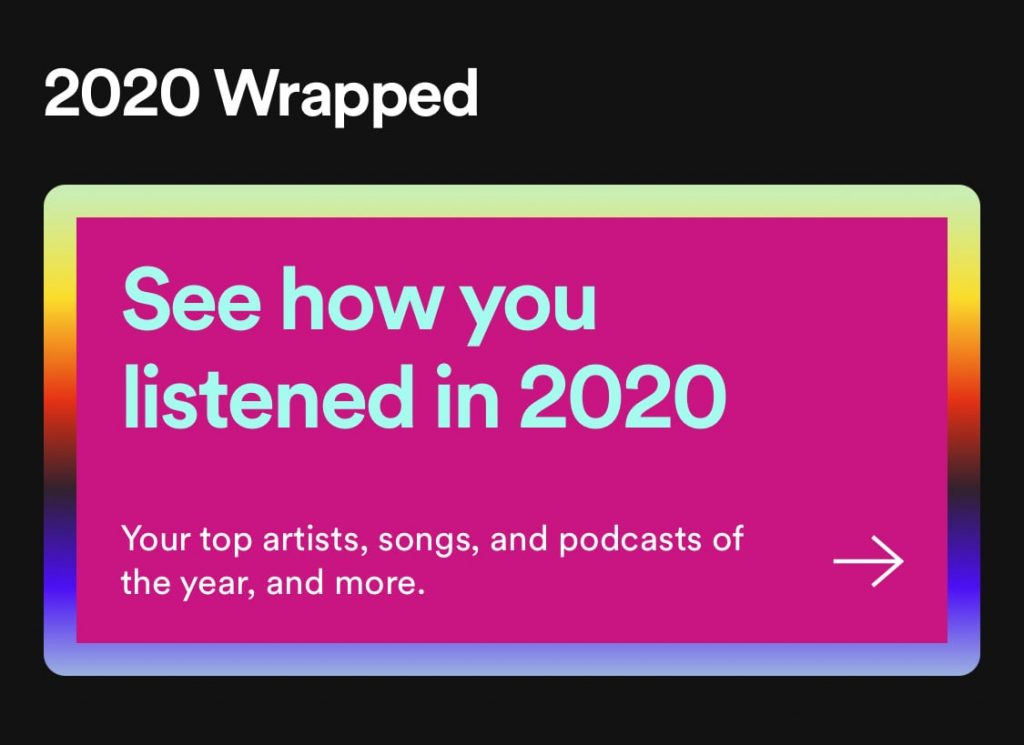
It was an onslaught of user shared content and a tour de force of brand dominance. The campaign in question was called ‘Your 2020 Wrapped’ by Spotify.
The music app’s campaign was simple – show their users what they’d been listening to – and offer them the chance to share this information on social media. Their user’s accepted.
On the same day that Spotify launched this campaign, MyWallSt reported that their share price had risen by 13%.
This graph (from Google) highlights a marked spike on 2nd December, the day Spotify launched ‘Your 2020 Wrapped’.
Contents
Are Social Shares Worth Anything?
I’m faced with a lot of emails – a large percentage of them are about one thing – ‘links’.
I receive requests about guest blogging, updating old content, link exchange proposals, monetary offers – you name it, these people are willing to give it in exchange for a simple URL inserted on our website.
This is an example of a very, very bad outreach email.
Why is it then, in an age when every other marketer and website owner is tilting towards a link-building, Google optimised strategy, that an established brand can increase their share price by 13% in one day with shareable content?
In the remainder of this article, I’ll investigate the value of the social media share, whilst uncovering the 5 steps to the most shareable content on the internet.
And as usual, we’ll have take-aways, videos, supporting images, examples, explainers and tons of shareable content…
Shares and Long Term Results, Is There a Correlation?
The main objective of this article is to provide you with something that you can take-away and action (if you’re mildly entertained – that’s a bonus) because I know social shares can have a big impact on your long-term success.
It might not say it in the textbooks, or the guides, or even list it in the depths of the marketing annuls, but social shares have a noticeable effect on long-term results. Many of the best performing content on Einstein Marketer (in terms of evergreen content scores) are located on pages that boast the highest social share counts.
For example, this is one of our most shared blogs and coincidently, one of our most visited too…
I’m not suggesting that social shares have a direct impact on search ranking, but the evidence shows that more shares = more results.
A study by CognitiveSEO discovered that the top 4 results on search engines have significantly more Facebook activity (with shares being a key part of that).
Shares aren’t just valuable in the short-term. These social signals have an impactful knock-on effect.
Social Shares As Social Proof
Regular readers will understand the delicate balance required to succeed with social proof, and this knowledge is pretty handy when it comes to understanding the importance of social shares (and how to get more of them).
If you weren’t there, here’s what you need to know:
Social proof is the theory that we are impacted by the decisions of the people in front of us
72% of people copied the action of the person in front of them (in our real-world marketing test)
Our Facebook ads performed better when social proof was inserted into the advertising copy (watch the videos if you don’t believe me!)
Social proof doesn’t work well when used in the incorrect places (i.e. in promotions for luxury brands)
Showing your target market that you’re popular by using social proof signals, can help your marketing performance
If you missed it, here’s a video of me handing out leaflets on the streets, to prove the theory of social proof:
Social media shares act as digital recommendations.
Yes, they look amazing on the page and that definitely has an impact on the psychology of your target audience, but more importantly, they allow us to see what the people we trust most recommend.
Who would you trust more:
Your mother
A stranger
This kind of social proof is invaluable for digital businesses – and reveal one reason why it’s so important for content creators and marketers to aim for ‘shareable content’.
The 5 Steps to The Most Shareable Content on the Internet
Before we dive into our 5 steps to the most shareable content on the internet (a grand claim, I know), I need to draw your attention to an article I published a little while ago called, The Psychology of Sharing.
In this article, I analysed a three-part research program conducted by The New York Times known as ‘The Psychology of Sharing’.
The study revealed that the most likely reason people share content is to:
Bring Valuable or Entertaining Content to Others
Define Themselves to Others
Grow and Nurture Relationships
Enjoy Having Others Engage
Spread/Share Good Causes
With that knowledge in the bag, and these 5 points acting as a useful reference point for the rest of this article, it’s time to get into the content marketing tactics that will create irresistibly shareable content.
1. Personalisation
Let’s go back to the very start of this article when I praised Spotify for their excellent ‘Your 2020 Wrapped’ feature.
The one word in this campaign that made all the difference was ‘Your’ – this possessive pronoun (thank me later for the English language lesson) is the reason that they received so many social shares.
If Spotify had created a feature called ‘2020 Wrapped’, and sent their users the best performing artists, songs and genres of the year in total, their results would’ve been very different.
As revealed in The New York Times study, a top reason why people share content is ‘to define themselves to others’ – and let’s face it, there are few better ways to define yourself than by sharing the music you listen to.
Ever seen a t-shirt like this? This is a real-world equivalent of Spotify’s Wrapped campaign.
Personalisation is a key stepping stone towards the holy grail of virally shared content and Spotify hasn’t been the only ones to notice.
A bigger brand has made a bigger splash, with a bigger marketing campaign based on the shareability of their personalised content.
Coca-Cola’s ‘Share a Coke’ campaign is one of the most famous marketing campaigns in recent memory – and I couldn’t write an article about creating shareable content without mentioning its name.
The campaign involved Coca-Cola removing their brand name from labels and replacing them with the 250 most popular names of each country they were released in.
A bit too sugary for my taste, but a purchase is tempting when the product has my name on it.
In the first year of the ‘Share a Coke’ campaign, photos were tagged with the hashtag ‘#shareacoke’ more than 500,000 times, and Coca-Cola gained more than 25 million Facebook followers (Source: Investopedia).
The personalisation of their products gave them the leverage to increase product sales AND the platform to build on their growth – thanks to the shareability of their personalised bottles.
Before 2011, Coca-Cola had seen ups and downs but never surpassed its peak share price in 1998. After their ‘Share a Coke’ campaign, their share price did nothing but rise until 2020.
How to Personalise Your Content For Shares
Creating shareable content via personalisation requires one very important thing: data.
Without information, you simply can’t personalise anything.
For instance, regular readers will know that my name is Josh, and therefore have enough data to personalise a message to me. A message or comment like this will capture more of my attention than one addressed as ‘Dear Sir’.
Data is a touchy subject – but nobody seems to care when it’s used to let us show off, as Spotify’s campaign proved.
Spotify succeeded because they had collected tons of data from their customers. Coca-Cola succeeded because they had enough resources to create a blanket personalisation campaign.
We don’t all have the budgets or data holding of companies like Spotify and Coca-Cola, so here are a few ways that anybody can use personalisation in their marketing campaigns and content to increase shareability:
Know your audience: Start with a customer avatar, create stuff that will help your ideal customer.
CRM Tags: Tag actions and behaviours in your customer relationship management software, and use this to inform future promotions, e.g. tag everyone who buys specific products and tailor their future communications around it.
Pixel/Cookies: Track behaviours and actions on your website and create custom audiences based on this behaviour, e.g. clicks, scrolls, URL visits, conversions. Retarget each segment with personalised content.
Collect More Data: Use sign-up forms to collect as much information as possible – first names, last names, company names, location etc. Use this information in communications.
Analytics: Use Google Tag Manager and Analytics to track what content your audience is most in tune with, and create more of it!
Implement a Live Chat: Create a live chat/messenger option for website visitors and personalise their conversation and future interactions with your website.
2. Let Them Share!
I see too many talented creators and marketers fail to offer their audience the chance to share their work.
It’s as easy as this:
Click on the share buttons below to spread the word:
BTW: The social share buttons (above) are provided by a company called Social Warfare. They act as a WordPress plugin. Install these (or a similar plugin), activate them and add them to your website – it’s not rocket science.
Calling your audience to share shouldn’t be restricted to written content, it should be done in videos and podcasts. too The best times to do this are at the start and end of your content.
These sharing recommendations are known as a ‘call-to-action’.
We can explain why calls-to-action work, thanks to a 1966 book by James J Gibson, called The Senses Considered as Perpetual Systems.
Good luck to anybody who tries to read this – it’s not for the faint-hearted.
Gibson coined a term known as ‘affordances’. This explains why certain objects have properties that direct us to take action.
For example, when we see a button, we instinctively know (and want) to press it, when we see a doorknob, we know to twist it, when we’re faced with a switch, we want to flip it.
Thanks to digital, affordances have stretched much further than simply flicking and turning switches. We know to pinch our fingers to zoom in, double-tap to like (on Instagram) and drag down to reload pages.
It’s up to you to provide your audience with the correct sharing ‘affordances’, so they’ll instinctively want to share your content.
Unfortunately, there isn’t an option to add 3D knobs and switches to your content, but, as you’ve already noticed, there are some powerful ways to use share buttons in your content:
Make it visible: Use floating bars at the side or bottom of your content to keep your share buttons in-view at all times. When the ‘I want to share’ moment hits, the option needs to be there.
Embed share buttons: Don’t ram sharing buttons down your audience’s throat, embed them where appropriate
Ask, be polite: Don’t tell your audience to do stuff, ask them politely. Many of them will understand the importance and impact of a social share and will do so if you ask.
Use incentives: A click-to-tweet is effectively a free piece of content for your audience, offer them the incentive. Alternatively, offer them offers/deals etc within your email content in exchange for shares.
Colours: Green’s and oranges are the most commonly used CTA colours, why not try using them in your social share buttons. It might be worth testing.
Show share numbers: If your content regularly receives high levels of shares, put a share counter beside your share buttons. This technique uses social proof to encourage more shares – just don’t overdo it!
3D Buttons: Design your share buttons so they look like they’ll depress when they’re clicked on. Alternatively, change their design when a mouse hovers over them.
3. Stand Out!
Doing the same thing as everyone else achieves below-average results – especially when you’re relatively new in content.
It pays to stand out – and the currency for your achievements are social shares.
The number one reason that people share content in The New York Times study was ‘to bring valuable or entertaining content to others’. People are inherently social creatures, and they are always looking at ways of helping their social circles (and raising their standing within it).
Standing out requires creativity, skill, ingenuity and having the bravery to go against the grain, or in the words of a Nobel prize winner:
‘The opposite of a great idea is another great idea.’
Niels Bohr
A sports brand like Nike would be well advised to use athletes in their ads as aspirational figures that are aligned with their products. However, one of their most virally shared campaigns was their ‘Find Your Greatness’ ad, where they did the exact opposite:
Or a drink brand like Guinness should – to any rational thinker – hide that their product is slow to pour, but instead they advertise it like a badge of honour.
And it’s one of the foremost reasons that at a time when everyone is publishing as much content as possible, I’ve decided to reduce the number of blogs being published on Einstein Marketer, in order to raise the level of quality that’s associated with our brand.
Great ideas come at both ends of the spectrum. Find which end suits you and create content that warrants the ‘stand out’ motivated share.
And if you need further inspiration, here’s an apology from KFC that received tons of shares for ‘stand out’ reasons:
How to Make Your Content ‘Stand Out’
The Austrian psychologist, Ernest Dichter, released a study in 1966 about word-of-mouth marketing.
He discovered that the most common reason for somebody to recommend a product to a friend was ‘product involvement’. This occurred when an experience with a product was so novel and pleasurable that it simply had to be shared.
You must aim to elicit that same feeling with your content.
A brand that have achieved this with their content is Blendtec, with their infamous YouTube videos, ‘Will it Blend?’:
But, how can you use content to stand out and gain those all-important social shares? Here are a few ways that we’ve used them in the past:
Think of a good idea and do the opposite: Let’s face it, you aren’t the only person online creating content – your good idea has probably been executed before. Why not flip it on its head and try the opposite?
Do something immeasurable: Almost everything online can be tracked, but why not try something that can’t be tracked – have longer conversations with prospects, post less, post more, publish elsewhere, go offline, create branded merchandise.
Create nonsense: I only know one brand of blender, because Blendtec is the only one who created nonsense content with their product. If you have a product, try some nonsense for yourself.
Be honest: Trust is one of the hardest commodities to find online – being honest about yourself, your brand and your journey will stand out from the crowd.
4. Positivity
I’m smiling already.
‘Positivity’ is an especially relevant point for me because I regularly share it. My most recent retweet (at the time of writing) was about the world’s first Covid-19 vaccination:
And I’m not the only one, in Contagious: Why Things Catch On, Jonah Berger and his colleague analysed seven thousand articles to discover what elements contributed to their most emailed articles.
Add this book to your reading list
They discovered that there were two primary factors that led to the sharing of articles:
How positive the article was
How excited it made the reader
Joy is a feeling that we instinctively want to share it with others. Spreading happiness builds and nurtures relationships and gives us enjoyment (both of these are top 5 psychological share factors according to The New York Times study).
News sites like Good News Network are often seen shared on social media.
The message itself doesn’t have to be positive to incite positive sharing feelings. As brands and marketers, it can be difficult to find feel-good topics when we’re creating content about our products or problem-fixes.
Instead, we can use easter eggs (hidden gems in our content) or our medium delivery to spark joy in our audience. Check out this promotional video about train safety:
This video for Dumb Ways to Die has been viewed more than 200 million times on YouTube and even has a mobile app.
Try watching that video and telling me that you don’t want to hit these share buttons…
If your singing voice isn’t quite up to a catchy new jingle, and you’re fresh out of inspirational stories, there are other ways to generate positivity.
Excitement and positivity are similar emotions, you can use either to create the shareable content you’re seeking.
Here are a few ways to make your content more positive and your shares more frequent:
Release dates:If you have a product, content or changes to your business that will impact your customer positively – create content about them and build excitement. Computer game companies earn $$$ in pre-orders from shares of their release date promos.
Product teasers: If you have something that’s in development, a completed prototype or potential change to your services – create a content teaser and post it on social media. Think positively!
Staff stories: We’re social creatures, and people love people. Try using your own funny industry-related stories, or those of your staff.
Video: It’s much easier to share positive emotions about a mundane topic when you’re on video on doing it.
Curate: Use your social channels to curate positive news from other sources. You won’t own the content, but you’ll be the messenger.
Think positively: Don’t force the feeling. Positive vibes radiate off you when you’re in the zone and will flow into your content too. Enjoy the process!
5. Stories
In 1996, a few weeks before the Olympic Games, a young athlete was diagnosed with stage 3 testicular cancer. A year later, after undertaking chemotherapy and having the cancer removed, he was declared cancer-free and started his own foundation.
The man was Lance Armstrong, his foundation, Livestrong. Fast forward 7 years and Armstrong had just picked up a record-breaking 6th consecutive Tour de France.
This seemingly impossible story led to Nike selling more than 80 million yellow wristbands with his foundation’s ‘Livestrong’ branding:
It’s probably best not to mention what happened to Armstrong a few years later.
This yellow bracelet went ‘purchase viral’, and the same thing happens to content and marketing campaigns when they’re attached to the correct story.
In the UK, many people eagerly await John Lewis’s Christmas advert (if you’re not a Brit, John Lewis is a large department store) because they’re always built around touching stories.
When these ads drop, you cannot move on social for shares of their video.
My favourite John Lewis ad wasn’t even created by them. In this ad, Twitter teamed up with a man named John Lewis, who lives in Virginia, US and owns the Twitter handle @JohnLewis. Because of his username, he is regularly inundated with tags, mentions and requests from UK twitter users:
Since @johnlewis tweeted this ad, it has been shared more than 25k times from his account alone.
BTW: If you haven’t seen a John Lewis Christmas advert, check them out on YouTube.
Stories are an amazing way to elicit emotion. They give us the opportunity to share good causes (like the Livestrong band), build relationships and entertain others – 3 big psychological reasons why we share content.
I opened this blog with a story about Spotify to capture your attention, and I’ve weaved in several more to keep you engaged. As a creator, marketer and entrepreneur, you must understand the value of attention.
A great story can pull new audiences from their ferociously busy newsfeeds – giving you the chance to convert that into a share.
Watch me briefly explain the value of attention on stage at EMC 2020.
How to Use Stories In Your Content
Stories are everywhere, it’s just a matter of knowing how to find them. Here are a few ways that anybody can use stories to create irresistibly shareable content:
Brand stories: Your business must’ve started for a reason, and there has to be some background to this. This is your brand story – you simply have to use it. Think of the emotional steps that took you from where you were, to where you are today.
Customer stories:This type of story are great on landing and sales pages because they increase conversion rates. Ask your existing customers to talk about their life (in relation to your product’s problem-solving ability) before and after they found you. Use quotes and videos to build trust in your brand.
Progress updates: Nobody ever started at the top of the tree. If you’re on your way up, show your audience every step along the way. We are all living, breathing stories. Use updates to build a community who are invested in yours.
Vlogs/blogs: Vlogs and blogs are a great way to go into more detail about your journey. You can reveal problems you’ve faced, shortcuts and advice.
The 5 Steps to the Most Shareable Content On the Internet
There we have it – the 5 steps to the most shareable content on the internet.
We’ve been through highs and lows, witnessed some great modern marketing campaigns, and put the theory of shareable content to the test with examples and explanations.
As a quick recap, here are our 5 ways to create shareable content:
Personalisation
Let them share!
Stand out!
Positivity
Stories
If you can tie two or three of these elements together, you’ll create something that is irresistible on social media.
I’ll be back soon with more super-valuable content like this – as always, scroll down to the bottom of this page to subscribe for updates…
…and please share this article to spread the knowledge (and love).
Josh is an award winning content marketer and the Director of Content at Einstein Marketer, previously working as a content manager, freelance copywriter and marketer. He writes, edits, proofs and strategises content for Einstein Marketer’s agency and their clients, sharing the most successful tactics and strategies with his lovely audience. He hates writing in the third person, follow him on the social links (above) so he can get back to writing as himself.